

5 hours ago
Vale S.A. (NYSE:VALE) is considering making its debut in China's domestic bond market as soon as this year, with CFO Marcelo Bacci saying the company is preparing for a potential Panda bond issuance. The move would be strategically significant because China accounts for roughly half of Vale's revenue, making renminbi financing a natural extension of its relationship with its largest market. Bloomberg reported that Vale is still ****** sing the market, including whether it can obtain a maturity longer than the typical two-, three-, or five-year terms available to international issuers.
The timing is also favorable for Vale because China's Panda bond market is expanding rapidly. Reuters reported that foreign issuers have increasingly turned to Asian bond markets to diversify funding sources, while Chinese yuan bond issuance has reached record levels in 2026. For Vale S.A. (NYSE:VALE), the potential transaction therefore looks less like a necessity for raising capital and more like an effort to diversify its investor base, potentially lower funding costs, and build a longer-term financing relationship with Chinese investors.
The strongest bullish argument is that Vale S.A. (NYSE:VALE) could potentially lower and diversify its cost of capital by accessing a large pool of Chinese investors at a time when renminbi funding remains relatively inexpensive. Reuters noted that Chinese onshore and offshore yuan bond markets have experienced record issuance this year, with foreign borrowers increasingly using these markets to diversify away from traditional funding currencies. If Vale can achieve competitive pricing, a Panda bond could provide an additional funding channel alongside its established dollar financing, reducing its dependence on a single market.
The move could also create a better natural match between Vale's revenues and its financing currency. Because China represents approximately half of Vale's revenue, raising at least some debt in renminbi could provide a degree of currency alignment with its Chinese business exposure. More importantly, establishing itself as a repeat issuer could strengthen Vale's relationships with Chinese banks and institutional investors, potentially giving it access to another source of capital when global dollar markets become less attractive.
There is also a broader strategic benefit. China is actively expanding the Panda bond market and encouraging international companies to use it. Official Chinese data showed that more than 160 billion yuan of Panda bonds were issued during the first half of 2026, up 69% year over year, demonstrating that the market is becoming more established and liquid. Vale entering this market could therefore position the company early in a growing financing ecosystem rather than waiting until it becomes more crowded.
#chinese #bond #panda #China
The timing is also favorable for Vale because China's Panda bond market is expanding rapidly. Reuters reported that foreign issuers have increasingly turned to Asian bond markets to diversify funding sources, while Chinese yuan bond issuance has reached record levels in 2026. For Vale S.A. (NYSE:VALE), the potential transaction therefore looks less like a necessity for raising capital and more like an effort to diversify its investor base, potentially lower funding costs, and build a longer-term financing relationship with Chinese investors.
The strongest bullish argument is that Vale S.A. (NYSE:VALE) could potentially lower and diversify its cost of capital by accessing a large pool of Chinese investors at a time when renminbi funding remains relatively inexpensive. Reuters noted that Chinese onshore and offshore yuan bond markets have experienced record issuance this year, with foreign borrowers increasingly using these markets to diversify away from traditional funding currencies. If Vale can achieve competitive pricing, a Panda bond could provide an additional funding channel alongside its established dollar financing, reducing its dependence on a single market.
The move could also create a better natural match between Vale's revenues and its financing currency. Because China represents approximately half of Vale's revenue, raising at least some debt in renminbi could provide a degree of currency alignment with its Chinese business exposure. More importantly, establishing itself as a repeat issuer could strengthen Vale's relationships with Chinese banks and institutional investors, potentially giving it access to another source of capital when global dollar markets become less attractive.
There is also a broader strategic benefit. China is actively expanding the Panda bond market and encouraging international companies to use it. Official Chinese data showed that more than 160 billion yuan of Panda bonds were issued during the first half of 2026, up 69% year over year, demonstrating that the market is becoming more established and liquid. Vale entering this market could therefore position the company early in a growing financing ecosystem rather than waiting until it becomes more crowded.
#chinese #bond #panda #China


6 hours ago
TotalEnergies SE (NYSE:TTE) plans to invest $10 billion alongside its partners in Angola over the next five years, with the goal of maintaining and potentially increasing its oil production in the country. TotalEnergies currently produces around 450,000 barrels per day in Angola, making it the country's largest oil operator and accounting for more than 40% of its total output.
The investment will go toward existing operations, new exploration, and projects aimed at replacing production from Angola's aging offshore fields. One of the biggest projects in the pipeline is the $6 billion Kaminho development, which is expected to start producing oil in 2028. TotalEnergies SE (NYSE:TTE) is also expanding its exploration efforts after signing agreements for two additional offshore blocks. On top of that, the company recently announced a new discovery in Block 17 that could add roughly 6,000 barrels per day to production.
The investment strengthens TotalEnergies SE (NYSE:TTE)'s position in one of Africa's key oil-producing markets and, perhaps more importantly, helps protect a major source of existing production. With around 450,000 barrels per day already coming from Angola, simply keeping output at current levels could continue to provide a meaningful contribution to the company's upstream cash flow. Any additional production from new discoveries and projects would offer further upside.
The current oil-price environment also works in TotalEnergies' favor. Brent crude recently climbed above $100 a barrel amid supply concerns and geopolitical tensions and is currently trading near this range. If prices remain elevated, projects designed to maintain or increase Angolan production could generate strong returns and make the company's investment more attractive.
There are also signs that TotalEnergies SE (NYSE:TTE) is doing more than just trying to slow production declines. Its recent Acacia-5 discovery in Block 17 could add around 6,000 barrels per day, while the company is expanding its exploration presence through new offshore blocks in the Lower Congo Basin. Angola's efforts to reform its oil sector and attract more exploration investment could also create a more favorable environment for TotalEnergies over the longer term.
#investment #offshore
The investment will go toward existing operations, new exploration, and projects aimed at replacing production from Angola's aging offshore fields. One of the biggest projects in the pipeline is the $6 billion Kaminho development, which is expected to start producing oil in 2028. TotalEnergies SE (NYSE:TTE) is also expanding its exploration efforts after signing agreements for two additional offshore blocks. On top of that, the company recently announced a new discovery in Block 17 that could add roughly 6,000 barrels per day to production.
The investment strengthens TotalEnergies SE (NYSE:TTE)'s position in one of Africa's key oil-producing markets and, perhaps more importantly, helps protect a major source of existing production. With around 450,000 barrels per day already coming from Angola, simply keeping output at current levels could continue to provide a meaningful contribution to the company's upstream cash flow. Any additional production from new discoveries and projects would offer further upside.
The current oil-price environment also works in TotalEnergies' favor. Brent crude recently climbed above $100 a barrel amid supply concerns and geopolitical tensions and is currently trading near this range. If prices remain elevated, projects designed to maintain or increase Angolan production could generate strong returns and make the company's investment more attractive.
There are also signs that TotalEnergies SE (NYSE:TTE) is doing more than just trying to slow production declines. Its recent Acacia-5 discovery in Block 17 could add around 6,000 barrels per day, while the company is expanding its exploration presence through new offshore blocks in the Lower Congo Basin. Angola's efforts to reform its oil sector and attract more exploration investment could also create a more favorable environment for TotalEnergies over the longer term.
#investment #offshore

3 days ago
On September 2, Shell Offshore, a subsidiary of Shell plc (NYSE:SHEL), announced the acquisition of a 30% working interest in Conifer, an exploration prospect operated by BP p.l.c. (NYSE:BP) in the U.S. Gulf of Mexico. Located offshore within Keathley Canyon near BP's Kaskida host development, Conifer represents a significant deep-water play. BP retains operatorship, with the initial exploration well expected to spud in 2027. While the deal reflects shared risk and capital efficiency in high-cost offshore basins, comparing the two giants' Q2 2026 earnings shows that Shell is currently executing from a position of superior financial strength.
Shell plc (NYSE:SHEL) delivered an exceptionally clean Q2 2026 report. Adjusted earnings reached $9.8 billion, driven by record upstream production in Brazil and record refinery utilization, which offset Middle East operational outages. Cash flow from operations (CFFO) came in at $21.4 billion, supported by higher realized prices and a $3.4 billion working capital inflow. Shell maintained strict capital discipline, reiterating its full-year capex outlook of $24 billion–$26 billion while completing $5.8 billion in structural cost reductions since 2022. Balance sheet health remains robust, with gearing at 19% and net debt at $42 billion ($12 billion excluding leases).
BP p.l.c. (NYSE:BP) also turned in a solid Q2 recovery, but its headline metrics lag behind Shell's scale. BP reported underlying replacement cost profit (its proxy for net income) of $5.7 billion, a 78% quarter-over-quarter rebound fueled by strong refining margins and oil trading. Operating cash flow reached $10.9 billion after absorbing a $1.0 billion working capital build. BP used strong cash generation to trim net debt down to $22.25 billion, while guiding full-year capex to $13.5 billion–$14.0 billion.
Although BP raised its quarterly dividend by 4% to 8.66 cents, Shell's cash engine allowed it to announce its 19th consecutive quarter of at least $3 billion in share buybacks, distributing 44% of CFFO over the trailing 12 months.
Shell's bull case centers on superior capital allocation, aggressive portfolio high-grading, including the ARC Resources acquisition targeting a 4% production CAGR through 2030, and consistent share buybacks. The bear case focuses on execution risks in integrated gas and LNG amid volatile market conditions, as well as the challenges of integrating large-scale acquisitions.
#cost
Shell plc (NYSE:SHEL) delivered an exceptionally clean Q2 2026 report. Adjusted earnings reached $9.8 billion, driven by record upstream production in Brazil and record refinery utilization, which offset Middle East operational outages. Cash flow from operations (CFFO) came in at $21.4 billion, supported by higher realized prices and a $3.4 billion working capital inflow. Shell maintained strict capital discipline, reiterating its full-year capex outlook of $24 billion–$26 billion while completing $5.8 billion in structural cost reductions since 2022. Balance sheet health remains robust, with gearing at 19% and net debt at $42 billion ($12 billion excluding leases).
BP p.l.c. (NYSE:BP) also turned in a solid Q2 recovery, but its headline metrics lag behind Shell's scale. BP reported underlying replacement cost profit (its proxy for net income) of $5.7 billion, a 78% quarter-over-quarter rebound fueled by strong refining margins and oil trading. Operating cash flow reached $10.9 billion after absorbing a $1.0 billion working capital build. BP used strong cash generation to trim net debt down to $22.25 billion, while guiding full-year capex to $13.5 billion–$14.0 billion.
Although BP raised its quarterly dividend by 4% to 8.66 cents, Shell's cash engine allowed it to announce its 19th consecutive quarter of at least $3 billion in share buybacks, distributing 44% of CFFO over the trailing 12 months.
Shell's bull case centers on superior capital allocation, aggressive portfolio high-grading, including the ARC Resources acquisition targeting a 4% production CAGR through 2030, and consistent share buybacks. The bear case focuses on execution risks in integrated gas and LNG amid volatile market conditions, as well as the challenges of integrating large-scale acquisitions.
#cost


6 days ago
Moerus Capital Management LLC, an investment management firm, recently released its "Worldwide Fund " second-quarter 2026 investor letter. A copy of the letter can be downloaded here. The fund navigated a highly bifurcated investment environment in the second quarter of 2026, as investor enthusiasm for artificial intelligence and technology drove a sharp rally in growth stocks while capital moved away from more traditional, value-oriented areas. The Fund's Institutional Class returned 0.14% in Q2, compared with 14.49% for the MSCI ACWI ex USA and 14.93% for the MSCI ACWI, while its first-half return stood at 5.37%, versus 13.69% and 11.25%, respectively, for the two benchmarks. The relative underperformance was primarily driven by the Fund's limited exposure to Information Technology as semiconductor and AI-related stocks surged, while its Energy holdings also gave back some earlier gains as oil prices declined; however, the Fund benefited from several energy-related investments during the first half. Looking ahead, Moerus views the extreme gap between expensive AI-focused areas and neglected parts of the market as an opportunity, maintaining its long-term deep-value approach of investing in unpopular businesses and ****** ets at significant discounts to intrinsic value and using market volatility to identify potentially attractive investments. In addition, please check the Fund's top five holdings to know its best picks in 2026.
In its second-quarter 2026 investor letter, Moerus Worldwide Fund highlighted stocks like Tidewater Inc. (NYSE:TDW). Tidewater Inc. is an offshore supply vessel operator that provides support services to the offshore energy industry. Moerus identified Tidewater as one of the Fund's five most significant positive contributors during the first half of 2026. The one-month return of Tidewater Inc. (NYSE:TDW) was 3.68% while its shares traded between $46.65 and $101.58 over the last 52 weeks. On September 7, 2026, Tidewater Inc. (NYSE:TDW) stock closed at approximately $94.26 per share, with a market capitalization of about $4.61 billion.
Moerus Worldwide Fund stated the following regarding Tidewater Inc. (NYSE:TDW) in its Q2 2026 investor letter:
"Similarly, we'd argue that offshore supply vessel (OSV) operator Tidewater Inc. (NYSE:TDW) has grown the per share value of its business dramatically since 2018 through a combination of a relentless focus on costs, share repurchases, and most notably, the utilization of its OSV industry-leading balance sheet to make three acquisitions of ****** ets (with a fourth pending) from distressed and/or motivated sellers at deep discounts to replacement costs during a years-long industry depression."
#tidewater #fund #energy #second
In its second-quarter 2026 investor letter, Moerus Worldwide Fund highlighted stocks like Tidewater Inc. (NYSE:TDW). Tidewater Inc. is an offshore supply vessel operator that provides support services to the offshore energy industry. Moerus identified Tidewater as one of the Fund's five most significant positive contributors during the first half of 2026. The one-month return of Tidewater Inc. (NYSE:TDW) was 3.68% while its shares traded between $46.65 and $101.58 over the last 52 weeks. On September 7, 2026, Tidewater Inc. (NYSE:TDW) stock closed at approximately $94.26 per share, with a market capitalization of about $4.61 billion.
Moerus Worldwide Fund stated the following regarding Tidewater Inc. (NYSE:TDW) in its Q2 2026 investor letter:
"Similarly, we'd argue that offshore supply vessel (OSV) operator Tidewater Inc. (NYSE:TDW) has grown the per share value of its business dramatically since 2018 through a combination of a relentless focus on costs, share repurchases, and most notably, the utilization of its OSV industry-leading balance sheet to make three acquisitions of ****** ets (with a fourth pending) from distressed and/or motivated sellers at deep discounts to replacement costs during a years-long industry depression."
#tidewater #fund #energy #second


6 days ago
Moerus Capital Management LLC, an investment management firm, recently released its "Worldwide Fund " second-quarter 2026 investor letter. A copy of the letter can be downloaded here. The fund navigated a highly bifurcated investment environment in the second quarter of 2026, as investor enthusiasm for artificial intelligence and technology drove a sharp rally in growth stocks while capital moved away from more traditional, value-oriented areas. The Fund's Institutional Class returned 0.14% in Q2, compared with 14.49% for the MSCI ACWI ex USA and 14.93% for the MSCI ACWI, while its first-half return stood at 5.37%, versus 13.69% and 11.25%, respectively, for the two benchmarks. The relative underperformance was primarily driven by the Fund's limited exposure to Information Technology as semiconductor and AI-related stocks surged, while its Energy holdings also gave back some earlier gains as oil prices declined; however, the Fund benefited from several energy-related investments during the first half. Looking ahead, Moerus views the extreme gap between expensive AI-focused areas and neglected parts of the market as an opportunity, maintaining its long-term deep-value approach of investing in unpopular businesses and ******* ets at significant discounts to intrinsic value and using market volatility to identify potentially attractive investments. In addition, please check the Fund's top five holdings to know its best picks in 2026.
In its second-quarter 2026 investor letter, Moerus Worldwide Fund highlighted stocks like Transocean Ltd. (NYSE:RIG) while discussing its investment in Valaris. Transocean Ltd. is an offshore drilling contractor. Moerus discussed the company in connection with its agreement to acquire Valaris in an all-stock transaction, which it said helped surface significant latent value in Valaris. The one-month return of Transocean Ltd. (NYSE:RIG) was 2.53% while its shares traded between $3.01 and $7.66 over the last 52 weeks. On September 7, 2026, Transocean Ltd. (NYSE:RIG) stock closed at approximately $5.85 per share, with a market capitalization of about $6.56 billion.
Moerus Worldwide Fund stated the following regarding Transocean Ltd. (NYSE:RIG) in its Q2 2026 investor letter:
"Shares of this U.S.-based provider of offshore drilling services surged in response to the February 9th announcement that the company had agreed to be acquired by Transocean Ltd. (NYSE:RIG) in an all-stock transaction, which was priced at a roughly 32% premium to Valaris' stock price (based on the previous day's closing price of each stock)."
#valaris
In its second-quarter 2026 investor letter, Moerus Worldwide Fund highlighted stocks like Transocean Ltd. (NYSE:RIG) while discussing its investment in Valaris. Transocean Ltd. is an offshore drilling contractor. Moerus discussed the company in connection with its agreement to acquire Valaris in an all-stock transaction, which it said helped surface significant latent value in Valaris. The one-month return of Transocean Ltd. (NYSE:RIG) was 2.53% while its shares traded between $3.01 and $7.66 over the last 52 weeks. On September 7, 2026, Transocean Ltd. (NYSE:RIG) stock closed at approximately $5.85 per share, with a market capitalization of about $6.56 billion.
Moerus Worldwide Fund stated the following regarding Transocean Ltd. (NYSE:RIG) in its Q2 2026 investor letter:
"Shares of this U.S.-based provider of offshore drilling services surged in response to the February 9th announcement that the company had agreed to be acquired by Transocean Ltd. (NYSE:RIG) in an all-stock transaction, which was priced at a roughly 32% premium to Valaris' stock price (based on the previous day's closing price of each stock)."
#valaris

6 days ago
Moerus Capital Management LLC, an investment management firm, recently released its "Worldwide Fund " second-quarter 2026 investor letter. A copy of the letter can be downloaded here. The fund navigated a highly bifurcated investment environment in the second quarter of 2026, as investor enthusiasm for artificial intelligence and technology drove a sharp rally in growth stocks while capital moved away from more traditional, value-oriented areas. The Fund's Institutional Class returned 0.14% in Q2, compared with 14.49% for the MSCI ACWI ex USA and 14.93% for the MSCI ACWI, while its first-half return stood at 5.37%, versus 13.69% and 11.25%, respectively, for the two benchmarks. The relative underperformance was primarily driven by the Fund's limited exposure to Information Technology as semiconductor and AI-related stocks surged, while its Energy holdings also gave back some earlier gains as oil prices declined; however, the Fund benefited from several energy-related investments during the first half. Looking ahead, Moerus views the extreme gap between expensive AI-focused areas and neglected parts of the market as an opportunity, maintaining its long-term deep-value approach of investing in unpopular businesses and ****** ets at significant discounts to intrinsic value and using market volatility to identify potentially attractive investments. In addition, please check the Fund's top five holdings to know its best picks in 2026.
In its second-quarter 2026 investor letter, Moerus Worldwide Fund highlighted stocks like Valaris Limited (NYSE:VAL). Valaris Limited is a U.S.-based provider of offshore drilling services. Moerus described Valaris as its largest individual contributor to performance in the first half of 2026. The one-month return of Valaris Limited (NYSE:VAL) was 1.62% while its shares traded between $46.70 and $114.12 over the last 52 weeks. On September 7, 2026, Valaris Limited (NYSE:VAL) stock closed at approximately $86.74 per share, with a market capitalization of about $6.03 billion.
Moerus Worldwide Fund stated the following regarding Valaris Limited (NYSE:VAL) in its Q2 2026 investor letter:
"For example, consider Valaris Limited (NYSE:VAL), the largest individual contributor to performance in H1. Shares of this U.S.-based provider of offshore drilling services surged in response to the February 9th announcement that the company had agreed to be acquired by Transocean in an all-stock transaction, which was priced at a roughly 32% premium to Valaris' stock price (based on the previous day's closing price of each stock). Valaris was added to the Fund in early 2025 following a slide in its share price, amid then-subdued oil prices and what we believed to be a temporary lull in offshore drilling activity caused by support infrastructure constraints (among other factors)."
#worldwide #Stock
In its second-quarter 2026 investor letter, Moerus Worldwide Fund highlighted stocks like Valaris Limited (NYSE:VAL). Valaris Limited is a U.S.-based provider of offshore drilling services. Moerus described Valaris as its largest individual contributor to performance in the first half of 2026. The one-month return of Valaris Limited (NYSE:VAL) was 1.62% while its shares traded between $46.70 and $114.12 over the last 52 weeks. On September 7, 2026, Valaris Limited (NYSE:VAL) stock closed at approximately $86.74 per share, with a market capitalization of about $6.03 billion.
Moerus Worldwide Fund stated the following regarding Valaris Limited (NYSE:VAL) in its Q2 2026 investor letter:
"For example, consider Valaris Limited (NYSE:VAL), the largest individual contributor to performance in H1. Shares of this U.S.-based provider of offshore drilling services surged in response to the February 9th announcement that the company had agreed to be acquired by Transocean in an all-stock transaction, which was priced at a roughly 32% premium to Valaris' stock price (based on the previous day's closing price of each stock). Valaris was added to the Fund in early 2025 following a slide in its share price, amid then-subdued oil prices and what we believed to be a temporary lull in offshore drilling activity caused by support infrastructure constraints (among other factors)."
#worldwide #Stock

10 days ago
Encountering some rough seas earlier this summer, shares of The Metals Company (NASDAQ: TMC) sank 19.6% in July. Last month, however, the deep-sea mining specialist found calmer waters -- and its stock thrived as investors celebrated the company's reporting of second-quarter 2026 financial results. Plus, an ***** yst's bullish take on the stock provided a catalyst at the end of the month, propelling shares higher.
According to data provided by S&P Global Market Intelligence, shares of The Metals Company rose 34% in August.
Missed Nvidia in 2009? This Rare Signal Is Flashing Again. In 2009, a "Double Down" signal flashed for a little-known chipmaker called Nvidia. For the first time in years, that same "Total Conviction" signal is flashing for a company 1/100th the size of Nvidia. Continue »
Announcing Q2 2026 financial results on Aug. 13, The Metals Company reported earnings per share (EPS) of negative $0.14 -- a slimmer loss than the $0.20 it reported during the same period in 2025.
In the press release accompanying the Q2 2026 financial results, Gerard Barron, the company's CEO, reassured investors that The Metals Company is advancing steadily toward achieving the necessary certifications. Barron stated, "The regulatory picture is becoming clearer as our applications continue to progress through NOAA's [National Oceanic and Atmospheric Administration] review process." Moreover, Barron commented that despite encountering some delays, the company remains "confident that the permit will arrive well in advance of offshore vessel commissioning by the end of 2027, which we believe remains the critical path for production start."
#metals #barron #financial #flashing
According to data provided by S&P Global Market Intelligence, shares of The Metals Company rose 34% in August.
Missed Nvidia in 2009? This Rare Signal Is Flashing Again. In 2009, a "Double Down" signal flashed for a little-known chipmaker called Nvidia. For the first time in years, that same "Total Conviction" signal is flashing for a company 1/100th the size of Nvidia. Continue »
Announcing Q2 2026 financial results on Aug. 13, The Metals Company reported earnings per share (EPS) of negative $0.14 -- a slimmer loss than the $0.20 it reported during the same period in 2025.
In the press release accompanying the Q2 2026 financial results, Gerard Barron, the company's CEO, reassured investors that The Metals Company is advancing steadily toward achieving the necessary certifications. Barron stated, "The regulatory picture is becoming clearer as our applications continue to progress through NOAA's [National Oceanic and Atmospheric Administration] review process." Moreover, Barron commented that despite encountering some delays, the company remains "confident that the permit will arrive well in advance of offshore vessel commissioning by the end of 2027, which we believe remains the critical path for production start."
#metals #barron #financial #flashing


12 days ago
(By Oil & Gas 360) – Month Ending: August 2026 – August was the month energy markets began treating geopolitical disruption less like a temporary shock and more like a structural part of the investment landscape. The Iran conflict remained the dominant force running through oil prices, tanker markets, LNG flows, sanctions policy, and shipping through the Strait of Hormuz.
Yet one of the more revealing developments was how quickly commodity markets learned to absorb the uncertainty. Oil could rally on renewed fighting, fall on hopes for diplomacy, and then trade lower even as physical shipping constraints remained very real.
The industry's response told a different story. Producers, midstream companies, and governments continued committing capital to natural gas, new drilling inventory, offshore exploration, pipelines, ports, automation, and alternative supply routes. August was therefore not simply a month defined by war or volatile crude prices. It was a month that exposed how deeply intertwined energy security, infrastructure, technology, and access to resources are becoming.
The Iran conflict remained the defining energy story of August. Brent repeatedly moved in response to developments surrounding fighting and diplomacy, while commodity vessel traffic through the Strait of Hormuz fell to a three-month low. Reports that nearly half of global oil flows originated in or moved through conflict-affected regions underscored just how exposed the world's energy system had become to geopolitical instability.
The consequences extended well beyond crude prices. VLCC tanker rates reportedly climbed as high as $650,000 per day, Qatar suffered a severe collapse in LNG exports, and Gulf producers accelerated investment in pipelines and ports capable of reducing dependence on vulnerable maritime corridors.
#strait #hormuz
Yet one of the more revealing developments was how quickly commodity markets learned to absorb the uncertainty. Oil could rally on renewed fighting, fall on hopes for diplomacy, and then trade lower even as physical shipping constraints remained very real.
The industry's response told a different story. Producers, midstream companies, and governments continued committing capital to natural gas, new drilling inventory, offshore exploration, pipelines, ports, automation, and alternative supply routes. August was therefore not simply a month defined by war or volatile crude prices. It was a month that exposed how deeply intertwined energy security, infrastructure, technology, and access to resources are becoming.
The Iran conflict remained the defining energy story of August. Brent repeatedly moved in response to developments surrounding fighting and diplomacy, while commodity vessel traffic through the Strait of Hormuz fell to a three-month low. Reports that nearly half of global oil flows originated in or moved through conflict-affected regions underscored just how exposed the world's energy system had become to geopolitical instability.
The consequences extended well beyond crude prices. VLCC tanker rates reportedly climbed as high as $650,000 per day, Qatar suffered a severe collapse in LNG exports, and Gulf producers accelerated investment in pipelines and ports capable of reducing dependence on vulnerable maritime corridors.
#strait #hormuz


12 days ago
Riverwater Partners, an investment management company, released its 'Small Cap Strategy' Q2 2026 investor letter. The letter can be downloaded here. The Small Cap Strategy underperformed the Russell 2000 in the second quarter as the benchmark experienced one of its strongest risk-on rallies in recent memory, although the strategy remained ahead year-to-date. The quarter was defined by accelerating AI investment, energy market disruptions, and renewed investor appetite for higher-beta stocks, creating headwinds for the firm's quality-focused approach and healthcare positioning. Despite this, stock selection contributed positively in energy, materials, and financials, while healthcare and consumer discretionary detracted due to the fund's disciplined avoidance of speculative businesses. Looking ahead, the firm remains cautiously optimistic, focusing on opportunities created by market dislocations, including AI infrastructure enablers, select consumer companies, healthcare innovators, and energy businesses trading below intrinsic value. The strategy continues to emphasize high-quality companies with strong management teams and attractive valuations, positioning the portfolio for a potential rotation away from speculative market leadership. In addition, please check the Strategy's top five holdings to know its best picks in 2026.
In its second-quarter 2026 investor letter, Riverwater Partners Small Cap Strategy highlighted Oceaneering International, Inc. (NYSE:OII). Oceaneering International, Inc. (NYSE:OII), a subsea engineering and offshore services company that serves the offshore energy, defense, aerospace, and manufacturing industries, was added to the portfolio in the quarter. On August 31, 2026, Oceaneering International, Inc. (NYSE:OII) closed at $51.76 per share. The one-month return of Oceaneering International, Inc. (NYSE:OII) was 2.64% and its shares gained 112.92% over the past 52 weeks. Oceaneering International, Inc. (NYSE:OII) has a market capitalization of $5.15 billion.
Riverwater Partners Small Cap Strategy stated the following regarding Oceaneering International, Inc. (NYSE:OII) in its Q2 2026 investor letter:
"Within energy, we repositioned toward services. We initiated Oceaneering International (OII), a leader in subsea robotics and offshore services, as offshore and subsea capital spending emerges from a seven-year drought and the U.S. rig count climbs; the position was funded in part by our exit of natural gas producer CNX Resources (CNX)."
#small #riverwater #investor #letter
In its second-quarter 2026 investor letter, Riverwater Partners Small Cap Strategy highlighted Oceaneering International, Inc. (NYSE:OII). Oceaneering International, Inc. (NYSE:OII), a subsea engineering and offshore services company that serves the offshore energy, defense, aerospace, and manufacturing industries, was added to the portfolio in the quarter. On August 31, 2026, Oceaneering International, Inc. (NYSE:OII) closed at $51.76 per share. The one-month return of Oceaneering International, Inc. (NYSE:OII) was 2.64% and its shares gained 112.92% over the past 52 weeks. Oceaneering International, Inc. (NYSE:OII) has a market capitalization of $5.15 billion.
Riverwater Partners Small Cap Strategy stated the following regarding Oceaneering International, Inc. (NYSE:OII) in its Q2 2026 investor letter:
"Within energy, we repositioned toward services. We initiated Oceaneering International (OII), a leader in subsea robotics and offshore services, as offshore and subsea capital spending emerges from a seven-year drought and the U.S. rig count climbs; the position was funded in part by our exit of natural gas producer CNX Resources (CNX)."
#small #riverwater #investor #letter


16 days ago
Chevron Corporation (NYSE:CVX) and TotalEnergies SE (NYSE:TTE) are making major moves in Sub-Saharan Africa, underscored by Chevron's August 17 announcement of a significant oil and gas condensate discovery in offshore Angola's Block 0. The 105-4X exploration well in the Lower Congo Basin encountered over 600 meters of column with 90 meters of net pay in the primary Pinda reservoir. Operated by Chevron's subsidiary CABGOC (39.2% interest) alongside Sonangol E&P, Azule Energy, and TotalEnergies, the ****** et will likely be tied back to nearby existing infrastructure for low-cost production. The discovery highlights Chevron's broader Sub-Saharan push, which generates ~300k boed net and includes recent additions in Nigeria, Guinea-Bissau, Equatorial Guinea, and Angola's Blocks 49, 50, 33, and 14/23, alongside the upcoming Nabba-1X well in Namibia.
Photo from Fervo Energy website
Looking at Q2 2026 financial metrics, both energy giants posted robust results, but Chevron outperformed TotalEnergies across absolute top- and bottom-line figures as well as capital efficiency.
Chevron Corporation (NYSE:CVX) generated $70.1 billion in revenue and reported net income of $12.1 billion ($6.11 per share), with adjusted earnings hitting $12.0 billion. Driven by record production of 4.07 million boed (up 20% year-over-year) and strong refining throughput, Chevron produced an impressive $22.6 billion in operating cash flow and $18.1 billion in free cash flow, delivering a return on capital employed (ROCE) of 21.4%.
TotalEnergies SE (NYSE:TTE) also delivered solid top-line cash generation but came in lower in net profitability. Leveraging higher commodity prices during the Middle East conflict, TotalEnergies generated $9.8 billion in cash flow and $6.0 billion in adjusted net income for Q2 2026, with oil and gas production averaging 2.395 Mboe/d. Its Exploration & Production unit posted $3.2 billion in adjusted net operating income and $5.8 billion in cash flow, while Downstream contributed $2.9 billion in cash flow and Integrated Power generated $700 million. Both energy majors maintain strong, identical balance-sheet leverage, with each firm posting a net debt gearing ratio of 13.1% at the close of Q2. Overall, Chevron leads in total profitability, cash flow generation, and return on capital, making it the stronger financial performer this quarter.
#cash #TotalEnergies #flow #well
Photo from Fervo Energy website
Looking at Q2 2026 financial metrics, both energy giants posted robust results, but Chevron outperformed TotalEnergies across absolute top- and bottom-line figures as well as capital efficiency.
Chevron Corporation (NYSE:CVX) generated $70.1 billion in revenue and reported net income of $12.1 billion ($6.11 per share), with adjusted earnings hitting $12.0 billion. Driven by record production of 4.07 million boed (up 20% year-over-year) and strong refining throughput, Chevron produced an impressive $22.6 billion in operating cash flow and $18.1 billion in free cash flow, delivering a return on capital employed (ROCE) of 21.4%.
TotalEnergies SE (NYSE:TTE) also delivered solid top-line cash generation but came in lower in net profitability. Leveraging higher commodity prices during the Middle East conflict, TotalEnergies generated $9.8 billion in cash flow and $6.0 billion in adjusted net income for Q2 2026, with oil and gas production averaging 2.395 Mboe/d. Its Exploration & Production unit posted $3.2 billion in adjusted net operating income and $5.8 billion in cash flow, while Downstream contributed $2.9 billion in cash flow and Integrated Power generated $700 million. Both energy majors maintain strong, identical balance-sheet leverage, with each firm posting a net debt gearing ratio of 13.1% at the close of Q2. Overall, Chevron leads in total profitability, cash flow generation, and return on capital, making it the stronger financial performer this quarter.
#cash #TotalEnergies #flow #well


17 days ago
Alongside boosting exploration and production offshore its home market Norway, Equinor is pursuing an international growth strategy, aiming to significantly increase its overseas oil and gas output by focusing on fewer but more lucrative regions such as the U.S., Brazil, and Angola.
In recent years, Equinor has streamlined and high-graded its portfolio outside Norway, selling ****** ets and positions in Azerbaijan and Nigeria, to name a few.
But Equinor has kept and grown its U.S., Brazilian, and Angolan businesses, and plans to keep these growing through 2030, the company's executives said at the Offshore Northern Seas (ONS) energy conference in Stavanger this week.
Equinor's international production averaged 750,000 barrels of oil equivalent per day (boepd) in the second quarter of 2026. The company expects to raise this to 950,000 boepd by 2030, by boosting the U.S., Brazilian, and Angolan output, executive vice president Philippe Mathieu said at a press briefing in Stavanger on Tuesday.
"Equinor's international oil and gas portfolio is simplified, improved and set for significant growth," Mathieu said.
#offshore #boosting
In recent years, Equinor has streamlined and high-graded its portfolio outside Norway, selling ****** ets and positions in Azerbaijan and Nigeria, to name a few.
But Equinor has kept and grown its U.S., Brazilian, and Angolan businesses, and plans to keep these growing through 2030, the company's executives said at the Offshore Northern Seas (ONS) energy conference in Stavanger this week.
Equinor's international production averaged 750,000 barrels of oil equivalent per day (boepd) in the second quarter of 2026. The company expects to raise this to 950,000 boepd by 2030, by boosting the U.S., Brazilian, and Angolan output, executive vice president Philippe Mathieu said at a press briefing in Stavanger on Tuesday.
"Equinor's international oil and gas portfolio is simplified, improved and set for significant growth," Mathieu said.
#offshore #boosting

19 days ago
Norway's energy major Equinor hopes to make a "pretty big" oil discovery offshore Namibia, the global exploration hotspot it has just entered, a senior company official said on Tuesday.
Equinor hopes that the Petroleum Exploration License 90 (PEL 90) offshore Namibia could hold a big discovery similar to those TotalEnergies and Galp have made in recent years in the same Orange basin, Philippe Mathieu, Executive Vice President, Exploration & Production International, at Equinor, told reporters on the sidelines of an energy conference in Norway's city of Stavanger.
A week ago, the Norwegian oil and gas major entered the Namibian exploration rush by signing an agreement with Harmattan Energy Limited, a Chevron subsidiary in Namibia, to buy a 17.4% participating interest in Petroleum Exploration License 90 (PEL 90) in the Orange Basin offshore Namibia.
The deal with the U.S. supermajor marks Equinor's entry into Namibia, and the license provides access to a drill-ready prospect scheduled for testing in 2026, the Norwegian company said last week.
"This transaction aligns with our strategy to strengthen and replenish our international portfolio through focused and disciplined growth," Mathieu said last week.
#namibia #exploration #energy
Equinor hopes that the Petroleum Exploration License 90 (PEL 90) offshore Namibia could hold a big discovery similar to those TotalEnergies and Galp have made in recent years in the same Orange basin, Philippe Mathieu, Executive Vice President, Exploration & Production International, at Equinor, told reporters on the sidelines of an energy conference in Norway's city of Stavanger.
A week ago, the Norwegian oil and gas major entered the Namibian exploration rush by signing an agreement with Harmattan Energy Limited, a Chevron subsidiary in Namibia, to buy a 17.4% participating interest in Petroleum Exploration License 90 (PEL 90) in the Orange Basin offshore Namibia.
The deal with the U.S. supermajor marks Equinor's entry into Namibia, and the license provides access to a drill-ready prospect scheduled for testing in 2026, the Norwegian company said last week.
"This transaction aligns with our strategy to strengthen and replenish our international portfolio through focused and disciplined growth," Mathieu said last week.
#namibia #exploration #energy

19 days ago
Key Takeaways
The Blockchain ******* ociation urged the SEC and CFTC to create a coordinated US framework for equity perpetual contracts.
It proposed regulating equity perpetuals under existing security-futures rules, arguing that no new legislation is necessary.
The group warned that continued regulatory uncertainty will push liquidity, jobs, market data and innovation further offshore.
The Blockchain ******* ociation has called on the Securities and Exchange Commission and the Commodity Futures Trading Commission to create a coordinated regulatory pathway for equity perpetual contracts in the United States.
#Equity #commission
The Blockchain ******* ociation urged the SEC and CFTC to create a coordinated US framework for equity perpetual contracts.
It proposed regulating equity perpetuals under existing security-futures rules, arguing that no new legislation is necessary.
The group warned that continued regulatory uncertainty will push liquidity, jobs, market data and innovation further offshore.
The Blockchain ******* ociation has called on the Securities and Exchange Commission and the Commodity Futures Trading Commission to create a coordinated regulatory pathway for equity perpetual contracts in the United States.
#Equity #commission


20 days ago
ADNOC has awarded McDermott a contract worth more than $1 billion for a major offshore pressure-boosting facility at Abu Dhabi's Umm Shaif field, as the UAE accelerates investment in natural gas production.
The engineering, procurement, construction and installation contract covers Package 4 of ADNOC's Umm Shaif Integrated Gas Cap and Surface Pressure Boosting Project. McDermott and its Qingdao McDermott Wuchuan consortium will construct and install a new jacket and topside while modifying existing offshore infrastructure.
McDermott did not disclose the exact contract value but classified it as a "mega" award, which the company defines as exceeding $1 billion. The company said the completed topside will be among the heaviest offshore modules ever installed in the Middle East.
The contract follows ADNOC's $6.2-billion final investment decision in July to develop the Umm Shaif Gas Cap alongside TotalEnergies, Eni and China National Petroleum Corporation. The wider project includes three EPC contracts worth a combined $5.1 billion and a 14-well drilling program.
ADNOC expects the development to unlock more than 600 million standard cubic feet per day of natural gas and ***** ociated liquids, equivalent to roughly 10% of current UAE domestic gas consumption. First production is targeted for 2030.
#mcdermott
The engineering, procurement, construction and installation contract covers Package 4 of ADNOC's Umm Shaif Integrated Gas Cap and Surface Pressure Boosting Project. McDermott and its Qingdao McDermott Wuchuan consortium will construct and install a new jacket and topside while modifying existing offshore infrastructure.
McDermott did not disclose the exact contract value but classified it as a "mega" award, which the company defines as exceeding $1 billion. The company said the completed topside will be among the heaviest offshore modules ever installed in the Middle East.
The contract follows ADNOC's $6.2-billion final investment decision in July to develop the Umm Shaif Gas Cap alongside TotalEnergies, Eni and China National Petroleum Corporation. The wider project includes three EPC contracts worth a combined $5.1 billion and a 14-well drilling program.
ADNOC expects the development to unlock more than 600 million standard cubic feet per day of natural gas and ***** ociated liquids, equivalent to roughly 10% of current UAE domestic gas consumption. First production is targeted for 2030.
#mcdermott


20 days ago
Norwegian oil and gas firms Equinor and Aker BP have made a gas and condensate discovery close to the operating Balder field in the North Sea, the Norwegian Offshore Directorate, the regulator of the industry in Norway, said on Monday.
Equinor and Aker BP had an exploration well drilled in a production license 16 kilometers (10 miles) northwest of the Balder field and 205 kilometers (127 miles) west of Stavanger, a major oil services hub in Norway.
Preliminary estimates indicate the size of the discovery is between 0.1 and 2.1 million standard cubic meters (Sm3) of recoverable oil equivalent, the Norwegian regulator said.
The licensees are now reviewing the result from the well and the other wells previously drilled in the license to consider further exploration potential in the production license.
Norway, Equinor, Aker BP, and other producers in the Norwegian Continental Shelf (NCS) continue to pursue drilling and development in areas close to existing infrastructure to fast-track potential new projects by tie-backs to operational platforms.
#norway #license #close #field
Equinor and Aker BP had an exploration well drilled in a production license 16 kilometers (10 miles) northwest of the Balder field and 205 kilometers (127 miles) west of Stavanger, a major oil services hub in Norway.
Preliminary estimates indicate the size of the discovery is between 0.1 and 2.1 million standard cubic meters (Sm3) of recoverable oil equivalent, the Norwegian regulator said.
The licensees are now reviewing the result from the well and the other wells previously drilled in the license to consider further exploration potential in the production license.
Norway, Equinor, Aker BP, and other producers in the Norwegian Continental Shelf (NCS) continue to pursue drilling and development in areas close to existing infrastructure to fast-track potential new projects by tie-backs to operational platforms.
#norway #license #close #field


20 days ago
$544. That is the average withdrawal on Argentine retail crypto rails such as Lemon Wallet. The median transfer is between $150 and $270—closer to rent money than a portfolio shift.
That figure changes the familiar image of capital flight. Money once moved offshore through private bankers and complex accounts. Across Latin America, workers and small businesses can now do it from a phone.
BeInCrypto Intelligence's 23-page report, The Exodus Economy, traced six routes money takes out of the region and audited 12 products marketed as dollar accounts. We shared the findings with five industry executives. Their responses point to a difficult question: once digital dollars remove the friction from leaving, what could persuade that money to return?
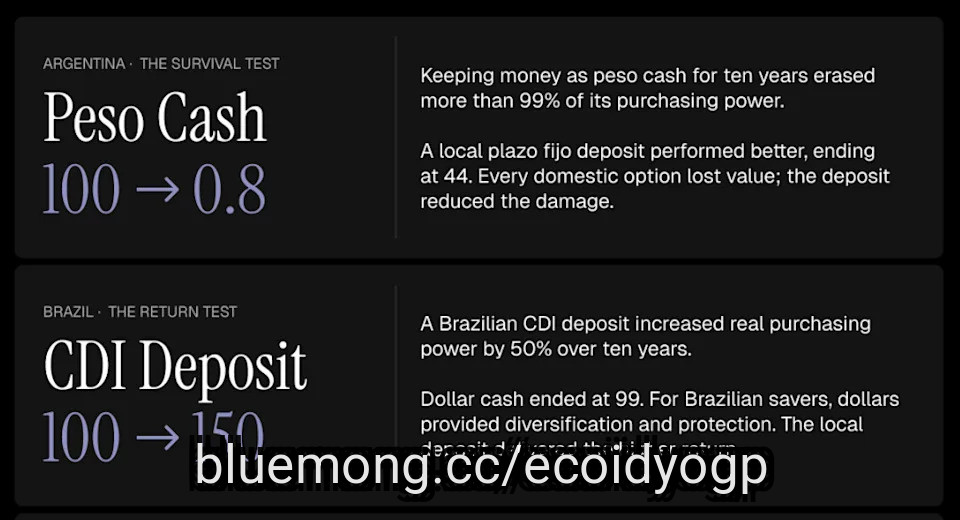
Brazil shows why returns alone cannot explain the movement. The report sets local savings and dollars to a starting value of 100 in 2016.
Money-earning Brazil's benchmark CDI rate grew to about 150 over the next decade, while dollars held without yield ended at 99. Yet Brazilians' declared offshore wealth reached an estimated $654 billion in 2024.
#money #once #argentine
That figure changes the familiar image of capital flight. Money once moved offshore through private bankers and complex accounts. Across Latin America, workers and small businesses can now do it from a phone.
BeInCrypto Intelligence's 23-page report, The Exodus Economy, traced six routes money takes out of the region and audited 12 products marketed as dollar accounts. We shared the findings with five industry executives. Their responses point to a difficult question: once digital dollars remove the friction from leaving, what could persuade that money to return?
Brazil shows why returns alone cannot explain the movement. The report sets local savings and dollars to a starting value of 100 in 2016.
Money-earning Brazil's benchmark CDI rate grew to about 150 over the next decade, while dollars held without yield ended at 99. Yet Brazilians' declared offshore wealth reached an estimated $654 billion in 2024.
#money #once #argentine



21 days ago
Mexico's state oil firm Pemex and Brazil's national oil company Petrobras are joining efforts and expertise to drill prospects in Mexican waters in the Gulf of Mexico, hoping to unlock huge oil resources from source rock formations that are miles deeper and eight times older than the currently producing formations in the U.S. Gulf.
Exploration in the Jurassic formations deep under the Mexican Gulf seabed in the Campeche Bay carries high risks, but the reward in case of a discovery could be enormous, geologists and ******* ysts tell Bloomberg.
Back in 2018, Pemex drilled more than 7,800 meters (25,600 feet) below the sea floor and penetrated the Campeche salt layer in an exploratory well that was declared unproductive. The Mexican oil giant hasn't ventured new exploratory wells in the area since then, but industry experts believe that Pemex may have found something of great geological and/or hydrocarbon-bearing potential, which has prompted it to pursue exploration further.
Pemex hasn't shared publicly any results of its 2018 drilling campaign offshore Campeche, but ******* ysts say there is a reason why the Mexican oil giant hasn't abandoned efforts to find huge resources and turn around years of declining domestic oil production from legacy wells.
Related: America's Next Strategic Partner Is Hiding in Plain Sight
#mexican #formations #efforts
Exploration in the Jurassic formations deep under the Mexican Gulf seabed in the Campeche Bay carries high risks, but the reward in case of a discovery could be enormous, geologists and ******* ysts tell Bloomberg.
Back in 2018, Pemex drilled more than 7,800 meters (25,600 feet) below the sea floor and penetrated the Campeche salt layer in an exploratory well that was declared unproductive. The Mexican oil giant hasn't ventured new exploratory wells in the area since then, but industry experts believe that Pemex may have found something of great geological and/or hydrocarbon-bearing potential, which has prompted it to pursue exploration further.
Pemex hasn't shared publicly any results of its 2018 drilling campaign offshore Campeche, but ******* ysts say there is a reason why the Mexican oil giant hasn't abandoned efforts to find huge resources and turn around years of declining domestic oil production from legacy wells.
Related: America's Next Strategic Partner Is Hiding in Plain Sight
#mexican #formations #efforts


21 days ago
ExxonMobil (NYSE: XOM) recently warned Kazakhstan that the Central Asian nation's largest oil field, Tengiz, will hit its production peak next year. Worse yet, output from the field will begin to decline. Exxon estimates it will fall nearly 40% by 2035 to around 500,000 barrels per day (bpd). That also has implications for Chevron, as it helped develop the field through its 50% interest in the Tengizchevroil (TCO) partnership.
However, while Tengiz is about to plateau and decline, that's not a crisis for ExxonMobil. Here's why.
Missed Nvidia in 2009? This Rare Signal Is Flashing Again. In 2009, a "Double Down" signal flashed for a little-known chipmaker called Nvidia. For the first time in years, that same "Total Conviction" signal is flashing for a company 1/100th the size of Nvidia. Continue »
Even though output at Tengiz is about to peak and start declining, Exxon has another opportunity in Kazakhstan: Kashagan. The giant offshore field in the Caspian Sea is operated by a partnership that includes Exxon, Shell, TotalEnergies, and others. Exxon sees the potential for an $80 billion joint investment to develop the western part of the field. This expansion could produce up to 600,000 bpd.
However, the field is part of a long-running dispute between Kazakhstan and the operating consortium. Kazakhstan levied a $5 billion environmental fine that the field's operator hasn't paid. Additionally, the government says the partners owe it $150 billion for lost revenue due to development delays, a claim currently before international arbitration. Exxon and its partners won't invest the capital needed to boost production in this field until they resolve the dispute with the government.
#billion
However, while Tengiz is about to plateau and decline, that's not a crisis for ExxonMobil. Here's why.
Missed Nvidia in 2009? This Rare Signal Is Flashing Again. In 2009, a "Double Down" signal flashed for a little-known chipmaker called Nvidia. For the first time in years, that same "Total Conviction" signal is flashing for a company 1/100th the size of Nvidia. Continue »
Even though output at Tengiz is about to peak and start declining, Exxon has another opportunity in Kazakhstan: Kashagan. The giant offshore field in the Caspian Sea is operated by a partnership that includes Exxon, Shell, TotalEnergies, and others. Exxon sees the potential for an $80 billion joint investment to develop the western part of the field. This expansion could produce up to 600,000 bpd.
However, the field is part of a long-running dispute between Kazakhstan and the operating consortium. Kazakhstan levied a $5 billion environmental fine that the field's operator hasn't paid. Additionally, the government says the partners owe it $150 billion for lost revenue due to development delays, a claim currently before international arbitration. Exxon and its partners won't invest the capital needed to boost production in this field until they resolve the dispute with the government.
#billion


21 days ago
Exxon is in the running for Shell's U.S. chemicals business that could fetch $8 billion, the Financial Times reported today, citing unnamed sources familiar with developments.
The U.S. supermajor is competing with LyondellBasell, Apollo Global Management, and the Kuwait Petroleum Corporation, the unnamed sources also told the publication. The potential buyers have submitted non-binding offers to Shell, with these ranging from offers to buy parts of the business to offers for the whole division.
Shell's chemicals business in the United States comprises four facilities in Louisiana, Texas, and Pennsylvania that make chemicals used in a range of industries, from plastics production to detergents.
Shell has made two **** et sales recently, one of its onshore wind and solar power business in Europe and the other of a stake in a gas project offshore Cyprus. The wind and solar power deal went to TotalEnergies and involved 500 megawatts of combined renewable generation capacity in operation and in development, as well as a pipeline of projects for future development across Italy, the Netherlands, Spain, and the UK.
The transaction is subject to regulatory approvals and is expected to complete by the end of 2026, Shell said earlier this month in the announcement of the deal with TotalEnergies.
#business #chemicals #unnamed #wind
The U.S. supermajor is competing with LyondellBasell, Apollo Global Management, and the Kuwait Petroleum Corporation, the unnamed sources also told the publication. The potential buyers have submitted non-binding offers to Shell, with these ranging from offers to buy parts of the business to offers for the whole division.
Shell's chemicals business in the United States comprises four facilities in Louisiana, Texas, and Pennsylvania that make chemicals used in a range of industries, from plastics production to detergents.
Shell has made two **** et sales recently, one of its onshore wind and solar power business in Europe and the other of a stake in a gas project offshore Cyprus. The wind and solar power deal went to TotalEnergies and involved 500 megawatts of combined renewable generation capacity in operation and in development, as well as a pipeline of projects for future development across Italy, the Netherlands, Spain, and the UK.
The transaction is subject to regulatory approvals and is expected to complete by the end of 2026, Shell said earlier this month in the announcement of the deal with TotalEnergies.
#business #chemicals #unnamed #wind

24 days ago
(Corrects Aug 20 story in paragraph 5 to remove erroneous reference to Julius Baer)
By Summer Zhen, Selena Li and Xinghui Kok
HONG KONG/SINGAPORE, Aug 20 (Reuters) - A growing campaign to tax offshore wealth is forcing wealthy Chinese people to rethink their trust structures and investment holdings, lawyers and advisers say, as Beijing sharpens its focus on capital outflows and rule enforcement amid growing fiscal strains.
In late July, authorities overhauled rules to impose a 20% income tax on offshore trusts, while tax offices in major cities like Beijing and Hangzhou have started to enforce taxation on returns from offshore insurance policies.
Those measures have triggered a scramble among some wealthy individuals to ***** s their liabilities, raise cash to meet them and revamp investment holdings. They have also fuelled concern that Beijing may widen its tax crackdown and scrutiny of offshore wealth.
#wealth #wealthy #investment
By Summer Zhen, Selena Li and Xinghui Kok
HONG KONG/SINGAPORE, Aug 20 (Reuters) - A growing campaign to tax offshore wealth is forcing wealthy Chinese people to rethink their trust structures and investment holdings, lawyers and advisers say, as Beijing sharpens its focus on capital outflows and rule enforcement amid growing fiscal strains.
In late July, authorities overhauled rules to impose a 20% income tax on offshore trusts, while tax offices in major cities like Beijing and Hangzhou have started to enforce taxation on returns from offshore insurance policies.
Those measures have triggered a scramble among some wealthy individuals to ***** s their liabilities, raise cash to meet them and revamp investment holdings. They have also fuelled concern that Beijing may widen its tax crackdown and scrutiny of offshore wealth.
#wealth #wealthy #investment


25 days ago
Saudi Arabia's Arabian Drilling Company has secured a new offshore drilling contract in Oman covering as many as four wells, extending the company's push beyond its domestic market.
The Saudi-listed drilling contractor signed the agreement with Masirah Oil Limited and Northern Offshore Ltd for two firm wells plus two optional wells. Operations are expected to begin before the end of the third quarter of 2026.
Arabian Drilling did not disclose the contract value but said the deal is expected to contribute to its 2026 financial results and strengthen its backlog and future revenue visibility.
The contract follows the early completion of Arabian Drilling's first international offshore **** ignment and the subsequent redeployment of its jack-up rig elsewhere in the Gulf Cooperation Council region.
The new campaign could also provide a boost to Oman's Block 50, located in the Arabian Sea off the country's east coast. Masirah Oil holds a 100% interest in the concession, which contains the producing Yumna oil field.
#saudi #Oman
The Saudi-listed drilling contractor signed the agreement with Masirah Oil Limited and Northern Offshore Ltd for two firm wells plus two optional wells. Operations are expected to begin before the end of the third quarter of 2026.
Arabian Drilling did not disclose the contract value but said the deal is expected to contribute to its 2026 financial results and strengthen its backlog and future revenue visibility.
The contract follows the early completion of Arabian Drilling's first international offshore **** ignment and the subsequent redeployment of its jack-up rig elsewhere in the Gulf Cooperation Council region.
The new campaign could also provide a boost to Oman's Block 50, located in the Arabian Sea off the country's east coast. Masirah Oil holds a 100% interest in the concession, which contains the producing Yumna oil field.
#saudi #Oman


25 days ago
BUCHAREST, Aug 20 (Reuters) - Romania scrambled F-16 fighter jets to destroy a marine drone spotted a few hundred metres from the Black Sea gas project Neptun Deep, Defence Minister Radu Miruta said on Thursday.
The incident underscores the growing threat to critical energy infrastructure in the Black Sea from drones and mines linked to Russia's war in Ukraine, with Neptun Deep expected to make Romania the European Union's largest gas producer when it comes onstream in 2027.
NATO-member Romania shares a 614-km (382-mile) land border with Ukraine and has seen Russian drones breaching its airspace over the last four years and mines floating in the Black Sea across key trade and energy routes.
Thursday's incident follows similar action earlier this month when army divers destroyed two Gerbera-type drones drifting in the exclusive economic zone near the offshore Neptun Deep project.
"In order to protect the lives of the several hundred people working on the platform and to secure critical infrastructure, the decision was made to destroy (the marine drone)," Miruta said in a Facebook post on Thursday.
#neptun #ukraine #destroy
The incident underscores the growing threat to critical energy infrastructure in the Black Sea from drones and mines linked to Russia's war in Ukraine, with Neptun Deep expected to make Romania the European Union's largest gas producer when it comes onstream in 2027.
NATO-member Romania shares a 614-km (382-mile) land border with Ukraine and has seen Russian drones breaching its airspace over the last four years and mines floating in the Black Sea across key trade and energy routes.
Thursday's incident follows similar action earlier this month when army divers destroyed two Gerbera-type drones drifting in the exclusive economic zone near the offshore Neptun Deep project.
"In order to protect the lives of the several hundred people working on the platform and to secure critical infrastructure, the decision was made to destroy (the marine drone)," Miruta said in a Facebook post on Thursday.
#neptun #ukraine #destroy


25 days ago
Venezuela's new petroleum minister sees her South American home not as a dilapidated former oil giant, but as an emerging energy economy ripe for U.S. and foreign investments in new oil and gas exploration, both onshore and offshore.
Paula Henao, who took over as the hydrocarbons minister in March after the forced U.S. removal of former leader Nicolás Maduro, told an overflowing Houston energy audience on Wednesday that Venezuela is much more than just its famed heavy-grade crude oil. There are more than 916 exploration opportunities awaiting foreign investment, she said, including natural gas and other untapped oil basins. She cited an estimated 192 trillion cubic feet of natural gas reserves, as well as the country's world-leading proven oil reserves of more than 300 billion barrels.
"It's an entire world waiting to be discovered, just waiting for us to reach these agreements so we can develop these new areas," Henao said in Spanish to the crowd at the posh Post Oak Hotel in Houston.
Henao and leaders of the Venezuelan state oil company, PDVSA, were in Houston this week for meetings and a showcase event in advance of a bigger Venezuela Energy Week in February in Caracas.
"Go to Venezuela to invest, go to Venezuela to develop businesses there," said PDVSA Vice President Jovanny Martinez, also speaking in Spanish. "We are at the right place at this historical moment. We have the energy that the world requires."
#venezuela #henao
Paula Henao, who took over as the hydrocarbons minister in March after the forced U.S. removal of former leader Nicolás Maduro, told an overflowing Houston energy audience on Wednesday that Venezuela is much more than just its famed heavy-grade crude oil. There are more than 916 exploration opportunities awaiting foreign investment, she said, including natural gas and other untapped oil basins. She cited an estimated 192 trillion cubic feet of natural gas reserves, as well as the country's world-leading proven oil reserves of more than 300 billion barrels.
"It's an entire world waiting to be discovered, just waiting for us to reach these agreements so we can develop these new areas," Henao said in Spanish to the crowd at the posh Post Oak Hotel in Houston.
Henao and leaders of the Venezuelan state oil company, PDVSA, were in Houston this week for meetings and a showcase event in advance of a bigger Venezuela Energy Week in February in Caracas.
"Go to Venezuela to invest, go to Venezuela to develop businesses there," said PDVSA Vice President Jovanny Martinez, also speaking in Spanish. "We are at the right place at this historical moment. We have the energy that the world requires."
#venezuela #henao


26 days ago
Colombia's state-controlled oil company Ecopetrol (NYSE: EC) has completed its roughly $1.2 billion acquisition of a controlling 51% stake in Brazil's Brava Energia, significantly expanding its position in one of Latin America's most important oil-producing markets.
The deal combines approximately 25% of Brava's shares acquired through a voluntary tender offer with another 26% purchased under an agreement reached with existing shareholders in April. Ecopetrol had offered R$23 per share in the tender and said earlier this month that the auction had been successfully completed.
The acquisition gives Ecopetrol control of a sizeable portfolio of Brazilian offshore and onshore **** ets. Brava produced an average of around 78,800 barrels of oil equivalent per day (boed) during the first half of 2026, rising to approximately 84,400 boed in June.
Brava also reported 459 million barrels of oil equivalent (MMboe) of proved reserves at the end of 2025 under PRMS standards. Ecopetrol previously described Brava as Brazil's second-largest listed independent oil company by reserves and production.
At the approximately $1.2 billion purchase price, Ecopetrol is paying an implied $8.40 per boe of proved reserves and around $6.30 per boe of proved-plus-probable reserves. Brava generated approximately $2.34 billion in revenue and $1.05 billion in EBITDA during the 12 months through June 2026.
#approximately
The deal combines approximately 25% of Brava's shares acquired through a voluntary tender offer with another 26% purchased under an agreement reached with existing shareholders in April. Ecopetrol had offered R$23 per share in the tender and said earlier this month that the auction had been successfully completed.
The acquisition gives Ecopetrol control of a sizeable portfolio of Brazilian offshore and onshore **** ets. Brava produced an average of around 78,800 barrels of oil equivalent per day (boed) during the first half of 2026, rising to approximately 84,400 boed in June.
Brava also reported 459 million barrels of oil equivalent (MMboe) of proved reserves at the end of 2025 under PRMS standards. Ecopetrol previously described Brava as Brazil's second-largest listed independent oil company by reserves and production.
At the approximately $1.2 billion purchase price, Ecopetrol is paying an implied $8.40 per boe of proved reserves and around $6.30 per boe of proved-plus-probable reserves. Brava generated approximately $2.34 billion in revenue and $1.05 billion in EBITDA during the 12 months through June 2026.
#approximately

27 days ago
Brazilian state-controlled oil giant Petrobras has identified hydrocarbons in an exploration well being drilled in ultra-deep waters off the state of Amapá, providing an early indication of petroleum potential in one of the country's most closely watched exploration frontiers.
The Morpho well, formally known as 1-BRSA-1405-APS, is being drilled in the FZA-M-59 block in the Foz do Amazonas Basin, around 175 kilometers offshore in water depths of 2,886 meters. Petrobras said the hydrocarbon-bearing interval was identified through electrical well logs and indications in rock.
Drilling remains underway, and Petrobras has not disclosed the size of the accumulation, the type or quality of the hydrocarbons, or any estimate of recoverable resources. The result therefore represents an exploration discovery rather than confirmation of a commercially viable oil or gas development.
Still, the find is significant because Petrobras described it as its first discovery offshore Amapá, an area at the northern end of Brazil's Equatorial Margin where the company has been seeking to establish a new exploration province.
Petrobras began drilling Morpho after receiving an operating license from Brazilian environmental regulator Ibama in October 2025. At the time, the company said the well was designed to collect geological data and determine whether hydrocarbons were present in economically viable quantities, with no production planned during the exploration phase.
#hydrocarbons #morpho
The Morpho well, formally known as 1-BRSA-1405-APS, is being drilled in the FZA-M-59 block in the Foz do Amazonas Basin, around 175 kilometers offshore in water depths of 2,886 meters. Petrobras said the hydrocarbon-bearing interval was identified through electrical well logs and indications in rock.
Drilling remains underway, and Petrobras has not disclosed the size of the accumulation, the type or quality of the hydrocarbons, or any estimate of recoverable resources. The result therefore represents an exploration discovery rather than confirmation of a commercially viable oil or gas development.
Still, the find is significant because Petrobras described it as its first discovery offshore Amapá, an area at the northern end of Brazil's Equatorial Margin where the company has been seeking to establish a new exploration province.
Petrobras began drilling Morpho after receiving an operating license from Brazilian environmental regulator Ibama in October 2025. At the time, the company said the well was designed to collect geological data and determine whether hydrocarbons were present in economically viable quantities, with no production planned during the exploration phase.
#hydrocarbons #morpho


27 days ago
Argentina LNG, the liquefied natural gas project backed by YPF, Eni and Abu Dhabi-based XRG, has applied for inclusion in Argentina's Large Investment Incentive Regime, or RIGI, as the partners work toward a final investment decision by the end of 2026.
The proposed integrated development would connect natural gas production from Argentina's Vaca Muerta shale formation with processing, transportation and LNG export infrastructure. The project calls for two floating LNG vessels offshore Río Negro province with combined liquefaction capacity of 12 million tonnes per year.
YPF said in a separate project announcement that total spending over the life of Argentina LNG could reach $51 billion, making it the largest project submitted under the RIGI framework to date. The company expects the two floating LNG units to begin operations around 2031.
RIGI was established to encourage large-scale investments in Argentina by providing qualifying projects with long-term fiscal, customs and foreign-exchange benefits and greater regulatory stability. For Argentina LNG, securing those terms would help underpin the financing of a capital-intensive project intended largely for export markets.
The application follows several steps by the partners to deepen their involvement in the project. YPF, Eni and XRG signed a binding joint development agreement in February to advance engineering, commercial and financing work for the 12-million-tonne-per-year development.
#project #rigi #export
The proposed integrated development would connect natural gas production from Argentina's Vaca Muerta shale formation with processing, transportation and LNG export infrastructure. The project calls for two floating LNG vessels offshore Río Negro province with combined liquefaction capacity of 12 million tonnes per year.
YPF said in a separate project announcement that total spending over the life of Argentina LNG could reach $51 billion, making it the largest project submitted under the RIGI framework to date. The company expects the two floating LNG units to begin operations around 2031.
RIGI was established to encourage large-scale investments in Argentina by providing qualifying projects with long-term fiscal, customs and foreign-exchange benefits and greater regulatory stability. For Argentina LNG, securing those terms would help underpin the financing of a capital-intensive project intended largely for export markets.
The application follows several steps by the partners to deepen their involvement in the project. YPF, Eni and XRG signed a binding joint development agreement in February to advance engineering, commercial and financing work for the 12-million-tonne-per-year development.
#project #rigi #export


29 days ago
Offshore fishing teams are used to battling huge waves, but big waves are no comparison to the emotional roller coaster experienced by two Charleston crews in the White Marlin Open fished Aug. 3-8 in Ocean City, Md.
Anxiety! Stress! Pride! Mister Pete and Bull Pen were in line to earn paydays soaring into the millions, but at the same time they were thinking of that famous line by Yogi Berra: "It ain't over till it's over."
But when it was over, Mister Pete had earned the top prize in one of the largest (334 boats) and most prestigious billfish tournaments. And Bull Pen finished third but earned the second-highest payout in the tournament. Mister Pete, a 60-foot Spencer owned by brothers Bob and Rusty McClam and captained by Alan Neiford, won $3,503,891.54 for catching an 80-pound white marlin on Aug. 6.
The day before, Bull Pen, a 62-foot Bayliss owned by Todd Wigfield and captained by Cordes Lucas, had brought in the first eligible white marlin, a 70-pound catch that could have been worth more than $5 million if Mister Pete hadn't landed its fish. Bull Pen won $1,818,546.84, more than five times the amount of the second-place fish. Reel Hunter out of St. Michael's, Md., caught a 71.5-pound white marlin on Aug. 7 but didn't enter as many divisions as Bull Pen and finished with a $360,721.49 payday.
To be eligible for prizes, a white marlin must measure 70 inches from the tip of its lower jaw to the fork of the tail, and it must weigh at least 70 pounds. And those were the exact measurements of Bull Pen's fish caught by James Hood.
#earned
Anxiety! Stress! Pride! Mister Pete and Bull Pen were in line to earn paydays soaring into the millions, but at the same time they were thinking of that famous line by Yogi Berra: "It ain't over till it's over."
But when it was over, Mister Pete had earned the top prize in one of the largest (334 boats) and most prestigious billfish tournaments. And Bull Pen finished third but earned the second-highest payout in the tournament. Mister Pete, a 60-foot Spencer owned by brothers Bob and Rusty McClam and captained by Alan Neiford, won $3,503,891.54 for catching an 80-pound white marlin on Aug. 6.
The day before, Bull Pen, a 62-foot Bayliss owned by Todd Wigfield and captained by Cordes Lucas, had brought in the first eligible white marlin, a 70-pound catch that could have been worth more than $5 million if Mister Pete hadn't landed its fish. Bull Pen won $1,818,546.84, more than five times the amount of the second-place fish. Reel Hunter out of St. Michael's, Md., caught a 71.5-pound white marlin on Aug. 7 but didn't enter as many divisions as Bull Pen and finished with a $360,721.49 payday.
To be eligible for prizes, a white marlin must measure 70 inches from the tip of its lower jaw to the fork of the tail, and it must weigh at least 70 pounds. And those were the exact measurements of Bull Pen's fish caught by James Hood.
#earned



1 month ago
Manus announced Tuesday that it will resume operating as an independent company, as it works to comply with Beijing's order to reverse Meta's $2 billion acquisition of the startup.
Manus is an AI agent startup that originated in China in 2022 and later moved its base to Singapore, according to CNBC. Meta announced the acquisition of Manus in December 2025. China's National Development and Reform Commission issued a directive in April ordering the parties to unwind the transaction, citing the country's rules on foreign investment.
As part of the separation, some Manus users will have data deleted. Specifically, for users in certain jurisdictions, any data created from December 29, 2025 onward — the day the acquisition closed — is slated for removal. "This is part of our separation from Meta; we must take this step to comply with regulatory requirements in specific parts of the world," the company said.
Affected users have a backup window open through 7:59 p.m. EDT on August 22. Data will be deleted August 23 through August 24, and users will be able to restore their backed-up data starting August 25. Manus said it will not charge affected users during the backup period.
The unwinding process has been underway for months. Meta cut off Manus staff from its internal data systems and barred Meta employees from using Manus tools, in steps toward operational separation. China's NDRC order made clear that offshore incorporation does not shield a deal from Beijing's authority when the underlying technology and talent originated in China — a structure critics had called "Singapore washing." Co-founders Xiao Hong and Ji Yichao were required to appear before Chinese officials in Beijing in March and have since been prohibited from traveling abroad.
#meta #august #users #acquisition
Manus is an AI agent startup that originated in China in 2022 and later moved its base to Singapore, according to CNBC. Meta announced the acquisition of Manus in December 2025. China's National Development and Reform Commission issued a directive in April ordering the parties to unwind the transaction, citing the country's rules on foreign investment.
As part of the separation, some Manus users will have data deleted. Specifically, for users in certain jurisdictions, any data created from December 29, 2025 onward — the day the acquisition closed — is slated for removal. "This is part of our separation from Meta; we must take this step to comply with regulatory requirements in specific parts of the world," the company said.
Affected users have a backup window open through 7:59 p.m. EDT on August 22. Data will be deleted August 23 through August 24, and users will be able to restore their backed-up data starting August 25. Manus said it will not charge affected users during the backup period.
The unwinding process has been underway for months. Meta cut off Manus staff from its internal data systems and barred Meta employees from using Manus tools, in steps toward operational separation. China's NDRC order made clear that offshore incorporation does not shield a deal from Beijing's authority when the underlying technology and talent originated in China — a structure critics had called "Singapore washing." Co-founders Xiao Hong and Ji Yichao were required to appear before Chinese officials in Beijing in March and have since been prohibited from traveling abroad.
#meta #august #users #acquisition

1 month ago
Our ***** ysts just identified a stock with the potential to be the next Nvidia. Tell us how you invest and we'll show you why it's our #1 pick. Tap here.
China just handed Deutsche Bank a bigger role in the renminbi's global rollout. That sounds technical, because it is. But the strategic message is simple: Beijing wants more trade and finance to move through its own currency pipes, not just the dollar's.
Deutsche Bank has been appointed by the People's Bank of China as a renminbi clearing bank in Frankfurt.
That makes the German lender the first European bank to receive the designation. Most offshore renminbi clearing has historically been handled by local branches of China's big state-owned lenders, including Bank of China, ICBC, Bank of Communications and China Construction Bank.
Deutsche said it will provide direct end-to-end processing, clearing and settlement services for cross-border renminbi transactions for European companies and financial institutions.
#tell #beijing
China just handed Deutsche Bank a bigger role in the renminbi's global rollout. That sounds technical, because it is. But the strategic message is simple: Beijing wants more trade and finance to move through its own currency pipes, not just the dollar's.
Deutsche Bank has been appointed by the People's Bank of China as a renminbi clearing bank in Frankfurt.
That makes the German lender the first European bank to receive the designation. Most offshore renminbi clearing has historically been handled by local branches of China's big state-owned lenders, including Bank of China, ICBC, Bank of Communications and China Construction Bank.
Deutsche said it will provide direct end-to-end processing, clearing and settlement services for cross-border renminbi transactions for European companies and financial institutions.
#tell #beijing


1 month ago
Interested in Tenaris S.A.? Here are five stocks we like better.
Second-quarter performance weakened as sales fell 4% to $3 billion and EBITDA declined 12% sequentially to $649 million, pressured by Strait of Hormuz shipping disruptions, lower fixed-cost absorption, and higher raw-material and logistics costs.
Tenaris approved a higher interim dividend of $0.59 per share ($1.18 per ADR), totaling about $600 million, supported by $396 million in quarterly free cash flow and $3.6 billion in net cash.
Management expects second-half revenue and EBITDA to be roughly in line with the first half, while potential upside could come from resumed Gulf shipments, stronger fourth-quarter volumes and pricing, rising North American drilling activity, and an expanding offshore project backlog.
Tyson Foods Offers a Meaty Opportunity for Income Investors
#million #quarter #cash #interested
Second-quarter performance weakened as sales fell 4% to $3 billion and EBITDA declined 12% sequentially to $649 million, pressured by Strait of Hormuz shipping disruptions, lower fixed-cost absorption, and higher raw-material and logistics costs.
Tenaris approved a higher interim dividend of $0.59 per share ($1.18 per ADR), totaling about $600 million, supported by $396 million in quarterly free cash flow and $3.6 billion in net cash.
Management expects second-half revenue and EBITDA to be roughly in line with the first half, while potential upside could come from resumed Gulf shipments, stronger fourth-quarter volumes and pricing, rising North American drilling activity, and an expanding offshore project backlog.
Tyson Foods Offers a Meaty Opportunity for Income Investors
#million #quarter #cash #interested