

2 days ago
TotalEnergies SE (NYSE:TTE) plans to invest $10 billion alongside its partners in Angola over the next five years, with the goal of maintaining and potentially increasing its oil production in the country. TotalEnergies currently produces around 450,000 barrels per day in Angola, making it the country's largest oil operator and accounting for more than 40% of its total output.
The investment will go toward existing operations, new exploration, and projects aimed at replacing production from Angola's aging offshore fields. One of the biggest projects in the pipeline is the $6 billion Kaminho development, which is expected to start producing oil in 2028. TotalEnergies SE (NYSE:TTE) is also expanding its exploration efforts after signing agreements for two additional offshore blocks. On top of that, the company recently announced a new discovery in Block 17 that could add roughly 6,000 barrels per day to production.
The investment strengthens TotalEnergies SE (NYSE:TTE)'s position in one of Africa's key oil-producing markets and, perhaps more importantly, helps protect a major source of existing production. With around 450,000 barrels per day already coming from Angola, simply keeping output at current levels could continue to provide a meaningful contribution to the company's upstream cash flow. Any additional production from new discoveries and projects would offer further upside.
The current oil-price environment also works in TotalEnergies' favor. Brent crude recently climbed above $100 a barrel amid supply concerns and geopolitical tensions and is currently trading near this range. If prices remain elevated, projects designed to maintain or increase Angolan production could generate strong returns and make the company's investment more attractive.
There are also signs that TotalEnergies SE (NYSE:TTE) is doing more than just trying to slow production declines. Its recent Acacia-5 discovery in Block 17 could add around 6,000 barrels per day, while the company is expanding its exploration presence through new offshore blocks in the Lower Congo Basin. Angola's efforts to reform its oil sector and attract more exploration investment could also create a more favorable environment for TotalEnergies over the longer term.
#investment #offshore
The investment will go toward existing operations, new exploration, and projects aimed at replacing production from Angola's aging offshore fields. One of the biggest projects in the pipeline is the $6 billion Kaminho development, which is expected to start producing oil in 2028. TotalEnergies SE (NYSE:TTE) is also expanding its exploration efforts after signing agreements for two additional offshore blocks. On top of that, the company recently announced a new discovery in Block 17 that could add roughly 6,000 barrels per day to production.
The investment strengthens TotalEnergies SE (NYSE:TTE)'s position in one of Africa's key oil-producing markets and, perhaps more importantly, helps protect a major source of existing production. With around 450,000 barrels per day already coming from Angola, simply keeping output at current levels could continue to provide a meaningful contribution to the company's upstream cash flow. Any additional production from new discoveries and projects would offer further upside.
The current oil-price environment also works in TotalEnergies' favor. Brent crude recently climbed above $100 a barrel amid supply concerns and geopolitical tensions and is currently trading near this range. If prices remain elevated, projects designed to maintain or increase Angolan production could generate strong returns and make the company's investment more attractive.
There are also signs that TotalEnergies SE (NYSE:TTE) is doing more than just trying to slow production declines. Its recent Acacia-5 discovery in Block 17 could add around 6,000 barrels per day, while the company is expanding its exploration presence through new offshore blocks in the Lower Congo Basin. Angola's efforts to reform its oil sector and attract more exploration investment could also create a more favorable environment for TotalEnergies over the longer term.
#investment #offshore

4 days ago
The Cooper Companies Inc. (NASDAQ:COO), a leading medical device company, announced its third quarter fiscal 2026 results on September 9. Topline went up 1% to $1.066 billion in comparison with the same quarter last year, which also included 1% organic growth. The company posted quarterly adjusted diluted EPS of $1.15, which represented a 4% jump from Q3 FY25. During the quarter, $339.1 million was spent on repurchasing around 4.9 million of the company's common shares. This leaves management with $1.5 billion of repurchase capacity, which remains available after the Board had raised its buyback authorization from $2 billion to $3 billion.
The quarter featured several encouraging highlights. These include earnings that exceeded projections, notable growth across the fertility segment within CooperSurgical, record free cash flow generation, and a major tax resolution in the company's favor.
GAAP gross margin went up from 65% in Q3 FY25 to 67% during the recent quarter, largely reflecting the comparison against fiscal 2025 inventory write-downs tied to a CooperSurgical product line exit. Adjusted operating margin improved by 30 basis points to 26%, supported by cost discipline and productivity gains, though partly offset by currency headwinds.
Interest expense fell to $21.5 million from $25.4 million a year prior, reflecting lower rates and reduced average debt. Free cash flow surged 66% to $273.0 million, driven by $341.7 million in operating cash flow less $68.7 million in capital spending.
Due to unfavorable currency movements and rising manufacturing costs, the Q3 gross margin settled at 67% on adjusted basis. This was a 60 basis point drop from Q3 FY25. Certain areas of the business grant caution, such as the CooperVision segment. It generated flat organic growth amid notable weakness across the Asia Pacific and Americas regions.
#billion #cash
The quarter featured several encouraging highlights. These include earnings that exceeded projections, notable growth across the fertility segment within CooperSurgical, record free cash flow generation, and a major tax resolution in the company's favor.
GAAP gross margin went up from 65% in Q3 FY25 to 67% during the recent quarter, largely reflecting the comparison against fiscal 2025 inventory write-downs tied to a CooperSurgical product line exit. Adjusted operating margin improved by 30 basis points to 26%, supported by cost discipline and productivity gains, though partly offset by currency headwinds.
Interest expense fell to $21.5 million from $25.4 million a year prior, reflecting lower rates and reduced average debt. Free cash flow surged 66% to $273.0 million, driven by $341.7 million in operating cash flow less $68.7 million in capital spending.
Due to unfavorable currency movements and rising manufacturing costs, the Q3 gross margin settled at 67% on adjusted basis. This was a 60 basis point drop from Q3 FY25. Certain areas of the business grant caution, such as the CooperVision segment. It generated flat organic growth amid notable weakness across the Asia Pacific and Americas regions.
#billion #cash

5 days ago
Demand for artificial intelligence (AI) is growing and creating massive opportunities for companies with the compute capacity to run training and inference workloads.
Iren (NASDAQ: IREN) has traditionally used its compute capacity to mine Bitcoin, but the company has pivoted from cryptocurrency mining to providing cloud services to help technology companies manage workloads.
Missed Nvidia in 2009? This Rare Signal Is Flashing Again. In 2009, a "Double Down" signal flashed for a little-known chipmaker called Nvidia. For the first time in years, that same "Total Conviction" signal is flashing for a company 1/100th the size of Nvidia. Continue »
Iren is winding down its Bitcoin operations by the end of this year and leaning fully into managing AI workloads. With the stock trading down about 37% from its 52-week high, is now a good time to buy? Let's dive into the business and opportunity ahead to find out.
For years, Iren focused on mining Bitcoin using ASIC (custom integrated circuit chips built for a specific task rather than general computing) hardware. However, the company is undergoing a massive strategic shift, redirecting its computing infrastructure toward AI cloud services.
#iren #NVIDIA #company #flashing
Iren (NASDAQ: IREN) has traditionally used its compute capacity to mine Bitcoin, but the company has pivoted from cryptocurrency mining to providing cloud services to help technology companies manage workloads.
Missed Nvidia in 2009? This Rare Signal Is Flashing Again. In 2009, a "Double Down" signal flashed for a little-known chipmaker called Nvidia. For the first time in years, that same "Total Conviction" signal is flashing for a company 1/100th the size of Nvidia. Continue »
Iren is winding down its Bitcoin operations by the end of this year and leaning fully into managing AI workloads. With the stock trading down about 37% from its 52-week high, is now a good time to buy? Let's dive into the business and opportunity ahead to find out.
For years, Iren focused on mining Bitcoin using ASIC (custom integrated circuit chips built for a specific task rather than general computing) hardware. However, the company is undergoing a massive strategic shift, redirecting its computing infrastructure toward AI cloud services.
#iren #NVIDIA #company #flashing

8 days ago
CNBC and Reuters reported that The Gap, Inc. (NYSE:GAP) named retail veteran Michael Francis as president and CEO of Old Navy, effective November 2, succeeding Haio Barbeito, who will move into an advisory role.
The announcement came alongside second-quarter results showing Old Navy net sales fell 4% year over year to $2.1 billion, with comparable sales down 4% versus ******* ysts' expected 2.4% decline, marking the brand's first negative comp in 12 quarters. Old Navy contributes nearly 60% of Gap's total revenue. CEO Richard ******* son attributed the miss partly to summer marketing that "lacked a direct product message" but said the brand has already seen "significant improvement" in traffic and sales over the past month. Gap's namesake brand posted 10% comparable sales growth in the same quarter, and Gap shares jumped as much as 14% after the report.
Northfoto / Shutterstock.com
Overall profitability far exceeded what the sales headline suggests since operating income more than doubled to $676 million from $292 million a year earlier, while net income more than doubled to $501 million from $216 million. These results show that Gap can significantly improve earnings even while Old Navy struggles.
The turnaround playbook is clearly working where it has been fully applied. The Gap, Inc. (NYSE:GAP)'s namesake brand delivered double-digit comparable sales growth this quarter. It shows that CEO ******* son's broader strategy can succeed decisively when executed well, which strengthens confidence that it can eventually be applied successfully to fix Old Navy too.
#sales #million #quarter #NYSE
The announcement came alongside second-quarter results showing Old Navy net sales fell 4% year over year to $2.1 billion, with comparable sales down 4% versus ******* ysts' expected 2.4% decline, marking the brand's first negative comp in 12 quarters. Old Navy contributes nearly 60% of Gap's total revenue. CEO Richard ******* son attributed the miss partly to summer marketing that "lacked a direct product message" but said the brand has already seen "significant improvement" in traffic and sales over the past month. Gap's namesake brand posted 10% comparable sales growth in the same quarter, and Gap shares jumped as much as 14% after the report.
Northfoto / Shutterstock.com
Overall profitability far exceeded what the sales headline suggests since operating income more than doubled to $676 million from $292 million a year earlier, while net income more than doubled to $501 million from $216 million. These results show that Gap can significantly improve earnings even while Old Navy struggles.
The turnaround playbook is clearly working where it has been fully applied. The Gap, Inc. (NYSE:GAP)'s namesake brand delivered double-digit comparable sales growth this quarter. It shows that CEO ******* son's broader strategy can succeed decisively when executed well, which strengthens confidence that it can eventually be applied successfully to fix Old Navy too.
#sales #million #quarter #NYSE


13 days ago
Benzinga and Yahoo Finance LLC may earn commission or revenue on some items through the links below.
Oracle (NYSE:ORCL) could become a weak link in the AI boom if OpenAI runs into trouble, according to Council on Foreign Relations senior fellow Sebastian Mallaby.
"If OpenAI runs into trouble, I think we can say that there's a good chance that Oracle may also run into trouble," Mallaby said on CFR's The Spillover podcast, pointing to Oracle's heavier debt load and dependence on OpenAI.
The warning comes as OpenAI CEO Sam Altman says he is seeing signs of "unsustainable silliness" in the wider compute buildout.
Mallaby said Alphabet, Amazon, Microsoft and Meta entered the AI boom with stronger balance sheets and more room to fund expansion internally. Oracle, by contrast, has relied much more heavily on borrowing to finance its data-center buildout.
#oracle #finance #runs
Oracle (NYSE:ORCL) could become a weak link in the AI boom if OpenAI runs into trouble, according to Council on Foreign Relations senior fellow Sebastian Mallaby.
"If OpenAI runs into trouble, I think we can say that there's a good chance that Oracle may also run into trouble," Mallaby said on CFR's The Spillover podcast, pointing to Oracle's heavier debt load and dependence on OpenAI.
The warning comes as OpenAI CEO Sam Altman says he is seeing signs of "unsustainable silliness" in the wider compute buildout.
Mallaby said Alphabet, Amazon, Microsoft and Meta entered the AI boom with stronger balance sheets and more room to fund expansion internally. Oracle, by contrast, has relied much more heavily on borrowing to finance its data-center buildout.
#oracle #finance #runs


14 days ago
By Mike Dolan
Sept 2 (Reuters) - A new wave of strikes in the Iran war this week has seen energy prices surge once again, adding fuel to the selloff across world bond markets as investors brace for a series of central bank interest rate rises this month.
With rising government borrowing costs concentrated on the economically sensitive 10-year benchmark rates, rising yields have ripped across global stock markets, too.
U.S. 10-year Treasury yields hit their highest since 2023 on Wednesday as world crude and natural gas prices climbed. At 4.8%, the 10-year yield is fast approaching a 5% level seen as a major challenge to equities for mixed ****** et portfolio managers.
But with interest rate rises now odds-on at the Federal Reserve, European Central Bank, and Bank of ****** an this month, there's a nervous couple of weeks ahead.
#seen #World
Sept 2 (Reuters) - A new wave of strikes in the Iran war this week has seen energy prices surge once again, adding fuel to the selloff across world bond markets as investors brace for a series of central bank interest rate rises this month.
With rising government borrowing costs concentrated on the economically sensitive 10-year benchmark rates, rising yields have ripped across global stock markets, too.
U.S. 10-year Treasury yields hit their highest since 2023 on Wednesday as world crude and natural gas prices climbed. At 4.8%, the 10-year yield is fast approaching a 5% level seen as a major challenge to equities for mixed ****** et portfolio managers.
But with interest rate rises now odds-on at the Federal Reserve, European Central Bank, and Bank of ****** an this month, there's a nervous couple of weeks ahead.
#seen #World

16 days ago
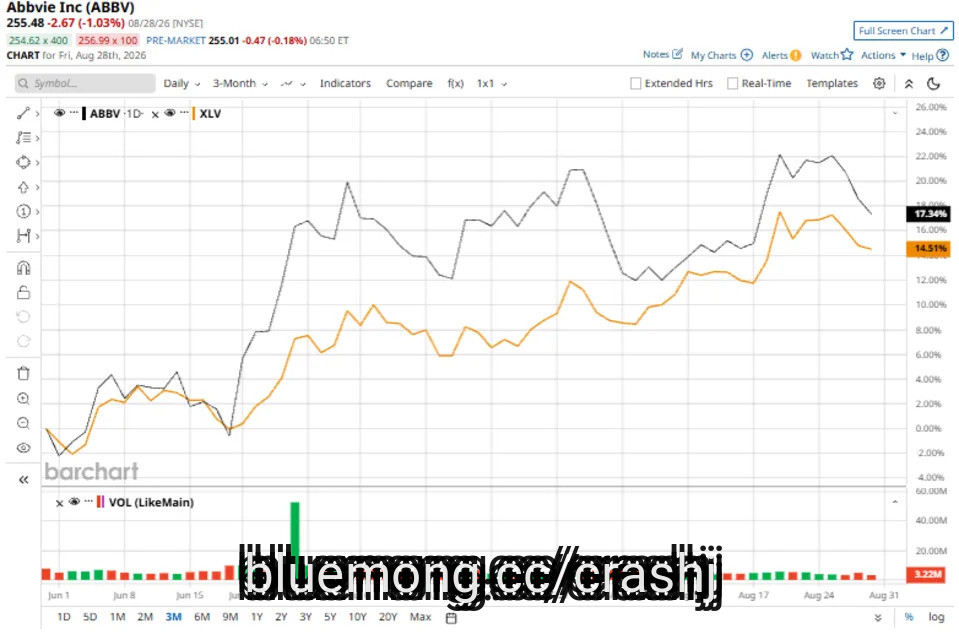
North Chicago, Illinois-based AbbVie Inc. (ABBV) is a global, research-driven biopharmaceutical company focused on developing and commercializing medicines for complex and serious diseases. Valued at a market cap of $386.3 billion, its key therapeutic areas include immunology, neuroscience, oncology and aesthetics, with operations spanning more than 75 countries.
Companies with a market capitalization of $200 billion or more are typically referred to as "mega-cap stocks." ABBV fits right into that category, with its market cap exceeding this threshold, reflecting its substantial size and influence in the general drug manufacturers industry. AbbVie combines a large established pharmaceutical portfolio with a rapidly expanding immunology franchise and a broad pipeline.
Wu-Tang Clan Member Raekwon Is a Palantir 'OG,' Visiting Headquarters 16 Years After Receiving His Custom PLTR Jacket
Tesla Just Killed Its Solar Roof After Years of Struggling to Scale. What It Means for TSLA Stock.
Tesla Stock Could Benefit as Trump Locks Down the U.S. Power Grid
#abbvie #abbv #billion
Companies with a market capitalization of $200 billion or more are typically referred to as "mega-cap stocks." ABBV fits right into that category, with its market cap exceeding this threshold, reflecting its substantial size and influence in the general drug manufacturers industry. AbbVie combines a large established pharmaceutical portfolio with a rapidly expanding immunology franchise and a broad pipeline.
Wu-Tang Clan Member Raekwon Is a Palantir 'OG,' Visiting Headquarters 16 Years After Receiving His Custom PLTR Jacket
Tesla Just Killed Its Solar Roof After Years of Struggling to Scale. What It Means for TSLA Stock.
Tesla Stock Could Benefit as Trump Locks Down the U.S. Power Grid
#abbvie #abbv #billion



24 days ago
Friday ended with both the Nasdaq and the S&P 500 posted their first weekly decline in four weeks. Each kept their year-to-date gains above 12%. And both indexes also undercut the low of their Aug. 4 follow through days. A key difference is that, in addition, the Nasdaq ended Friday's session below its 21-day exponential moving average, while the S&P 500 managed to hold narrowly above that key technical line of support.
That means, according to IBD Senior Market ****** yst Mike Webster during Friday's Stock Market Today video, that this is a very tricky time. The undercut by both indexes negates the follow through day that turned the rally attempt into a confirmed the uptrend. (The uptrend remains intact unless an index cuts below the first up day of the rally attempt, which occurred July 30.)
But the Nasdaq's close below its 21-day line also puts it in limbo with regard to what IBD defines as a power trend.
A power trend is a robust set of market circumstances which improve the odds for investors. Webster describes a power trend as "a state of the market where you trade differently...it allows you to be more aggressive longer." But the Nasdaq's undercut waved a caution flag.
"You can't have a power trend on the Nasdaq anytime soon," Webster says, "because you need that low above your 21-day for 10 consecutive days. So we need at least a couple of weeks before that can happen."
#above
That means, according to IBD Senior Market ****** yst Mike Webster during Friday's Stock Market Today video, that this is a very tricky time. The undercut by both indexes negates the follow through day that turned the rally attempt into a confirmed the uptrend. (The uptrend remains intact unless an index cuts below the first up day of the rally attempt, which occurred July 30.)
But the Nasdaq's close below its 21-day line also puts it in limbo with regard to what IBD defines as a power trend.
A power trend is a robust set of market circumstances which improve the odds for investors. Webster describes a power trend as "a state of the market where you trade differently...it allows you to be more aggressive longer." But the Nasdaq's undercut waved a caution flag.
"You can't have a power trend on the Nasdaq anytime soon," Webster says, "because you need that low above your 21-day for 10 consecutive days. So we need at least a couple of weeks before that can happen."
#above

27 days ago
Las Vegas, Nevada-based Wynn Resorts, Limited (WYNN) designs, develops, and operates integrated resorts. Valued at $10.4 billion by market cap, the company offers amenities such as guest rooms and suites, restaurants, golf course, spa, bars, meeting and convention ****** e, night clubs, and recreation and leisure facilities.
Shares of this luxury resort and casino company have underperformed the broader market over the past year. WYNN has declined 9.8% over this time frame, while the broader S&P 500 Index ($SPX) has rallied nearly 19.3%. In 2026, WYNN stock is down 15.4%, compared to the SPX's 12.4% rise on a YTD basis.
Barron Trump, 20, Now Worth $150 Million — More Than Mom, Melania — From Crypto And $39 Energy Drink
Billionaire Michael Saylor Warns Against Buying a House Because 'Every 36 Years You Actually Pay the Cost of the House in Tax to the Government'
QQQ Just 'Gamma Flipped' as Market Makers Were Forced to Sell. Here's What Our Top Chart Expert is Tracking Next.
#wynn #limited
Shares of this luxury resort and casino company have underperformed the broader market over the past year. WYNN has declined 9.8% over this time frame, while the broader S&P 500 Index ($SPX) has rallied nearly 19.3%. In 2026, WYNN stock is down 15.4%, compared to the SPX's 12.4% rise on a YTD basis.
Barron Trump, 20, Now Worth $150 Million — More Than Mom, Melania — From Crypto And $39 Energy Drink
Billionaire Michael Saylor Warns Against Buying a House Because 'Every 36 Years You Actually Pay the Cost of the House in Tax to the Government'
QQQ Just 'Gamma Flipped' as Market Makers Were Forced to Sell. Here's What Our Top Chart Expert is Tracking Next.
#wynn #limited


1 month ago
Some offers on this page are from advertisers who pay us, which may affect which products we write about, but not our recommendations. See our Advertiser Disclosure.
If you're looking for a secure place to store your money and earn interest, a high-yield certificate of deposit (CD) could be a good option. These accounts require you to keep your money on deposit for a set period of time, and in exchange for locking in your funds, you may earn a higher rate than what traditional savings accounts offer.
Not sure where to start? We reviewed more than 400 data points to determine the best CDs available today across 6-month, 1-year, 18-month, and 2-year terms. Accounts were evaluated based on factors such as APY, minimum opening deposit, customer service, and more (see our full methodology here).
We then identified the best CD rates among the accounts we reviewed. Today, these are the highest CD rates available from our selection of the best CD accounts on the market today.
Minimum deposit: $1,500
#deposit
If you're looking for a secure place to store your money and earn interest, a high-yield certificate of deposit (CD) could be a good option. These accounts require you to keep your money on deposit for a set period of time, and in exchange for locking in your funds, you may earn a higher rate than what traditional savings accounts offer.
Not sure where to start? We reviewed more than 400 data points to determine the best CDs available today across 6-month, 1-year, 18-month, and 2-year terms. Accounts were evaluated based on factors such as APY, minimum opening deposit, customer service, and more (see our full methodology here).
We then identified the best CD rates among the accounts we reviewed. Today, these are the highest CD rates available from our selection of the best CD accounts on the market today.
Minimum deposit: $1,500
#deposit



1 month ago
The pharmaceutical giant sent shareholders a fortune in cash, yet the stock itself fell far behind the market. Here is the honest accounting of what owners actually got.
For an income investor holding Pfizer (PFE) stock, which trades around $25 a share, the last five years have posed a sharp question. The company returned an extraordinary $49 billion to shareholders through dividends and buybacks. That figure, equal to 34% of its current market value, is a gusher of cash by any standard. But over that same period, the stock's total return was -21%, while the S&P 500 delivered an +81% gain. The paradox is the whole story: the company showered owners with cash while the stock lagged. Was holding worth it, and is it now?
The machine behind the payout is a large pharmaceuticals business with $63.31 billion in revenue over the last twelve months. Its operating margin of 25% runs well ahead of the 18.4% median for the S&P 500, generating the substantial free cash flow needed to fund shareholder returns. Of the $49 billion returned over five years, the vast majority, $47 billion, came from dividends, with a smaller $2.0 billion spent on share repurchases.
This dividend focus is a core part of the company's stated strategy. Management recently affirmed its commitment, stating on its latest earnings call, "We intend to maintain and over time, grow our dividend as we continue to de-lever and build long-term value." For shareholders, this has meant a steady stream of checks from a business built for scale.
While the checks were generous, the total return figure tells a sobering story. The -21% return already includes reinvested dividends; the stock's price performance was significantly worse. The market has been pricing the stock not on its past cash generation, but on its future challenges. The honest catch is the looming patent cliff, what the industry calls loss of exclusivity (LOE). Management recently sized this headwind at "$14 billion to $15 billion" in annual revenue at risk.
#billion #cash #behind
For an income investor holding Pfizer (PFE) stock, which trades around $25 a share, the last five years have posed a sharp question. The company returned an extraordinary $49 billion to shareholders through dividends and buybacks. That figure, equal to 34% of its current market value, is a gusher of cash by any standard. But over that same period, the stock's total return was -21%, while the S&P 500 delivered an +81% gain. The paradox is the whole story: the company showered owners with cash while the stock lagged. Was holding worth it, and is it now?
The machine behind the payout is a large pharmaceuticals business with $63.31 billion in revenue over the last twelve months. Its operating margin of 25% runs well ahead of the 18.4% median for the S&P 500, generating the substantial free cash flow needed to fund shareholder returns. Of the $49 billion returned over five years, the vast majority, $47 billion, came from dividends, with a smaller $2.0 billion spent on share repurchases.
This dividend focus is a core part of the company's stated strategy. Management recently affirmed its commitment, stating on its latest earnings call, "We intend to maintain and over time, grow our dividend as we continue to de-lever and build long-term value." For shareholders, this has meant a steady stream of checks from a business built for scale.
While the checks were generous, the total return figure tells a sobering story. The -21% return already includes reinvested dividends; the stock's price performance was significantly worse. The market has been pricing the stock not on its past cash generation, but on its future challenges. The honest catch is the looming patent cliff, what the industry calls loss of exclusivity (LOE). Management recently sized this headwind at "$14 billion to $15 billion" in annual revenue at risk.
#billion #cash #behind

2 months ago
By Toby Sterling
AMSTERDAM, July 28 (Reuters) - China's launch of a homegrown type of advanced lithography chip printing machine is spotlighting how European chip tool maker ASML, whose recent share price surge made it Europe's most valuable listed company, is being squeezed between two sides.
On the one hand, U.S. controls on exports of high-tech goods to China are threatening to reduce access to a major market; and on the other, Beijing's push for technological independence in areas such as chip production raises the possibility of a China-based competitor.
Reuters reported on Tuesday that a little-known Chinese state-owned firm called Shanghai Aishengna Electronic Technology Group was leading an effort to mass produce locally made immersion deep ultraviolet (DUV) lithography tools, key to modern chipmaking.
ASML, which dominates the market for DUV and more cutting-edge EUV machines that print circuitry on AI chips, saw its shares fall some 10% in two days following this report, enough to wipe more than €60 billion off its stock market value.
#chip #market #asml
AMSTERDAM, July 28 (Reuters) - China's launch of a homegrown type of advanced lithography chip printing machine is spotlighting how European chip tool maker ASML, whose recent share price surge made it Europe's most valuable listed company, is being squeezed between two sides.
On the one hand, U.S. controls on exports of high-tech goods to China are threatening to reduce access to a major market; and on the other, Beijing's push for technological independence in areas such as chip production raises the possibility of a China-based competitor.
Reuters reported on Tuesday that a little-known Chinese state-owned firm called Shanghai Aishengna Electronic Technology Group was leading an effort to mass produce locally made immersion deep ultraviolet (DUV) lithography tools, key to modern chipmaking.
ASML, which dominates the market for DUV and more cutting-edge EUV machines that print circuitry on AI chips, saw its shares fall some 10% in two days following this report, enough to wipe more than €60 billion off its stock market value.
#chip #market #asml

2 months ago
On July 21, during CNBC's Mad Money program, host Jim Cramer used the daily chart **** ysis by options trader Bob Lang, founder of Explosive Options, to examine American Express Company (NYSE:AXP). Cramer pointed to the company's distinct cardholder demographic and high-margin annual fee structure, as he highlighted why the premium card issuer remains a long-time favorite for core portfolio allocations:
Now finally, there's one that I have been near and dear for as long as I can remember, and that's American Express. Now, this only has 10% of purchase volume with fewer cards in circulation, but their cardholders tend to spend a lot more money. Plus, they charge fees for their best cards, basically making you pay for access to their generous rewards programs. It's a fantastic business model. But remember, they do have credit risk.
Under Cramer's framework, American Express occupies a specialized niche compared to rival payment networks Visa Inc. (NYSE:V) and Mastercard Incorporated (NYSE:MA). While Visa controls 60% of cardholders and Mastercard holds 25% to 30%, American Express Company (NYSE:AXP) commands roughly 10% of purchase volume. However, unlike Visa and Mastercard, which operate strictly as neutral tollbooths with zero balance-sheet risk, American Express operates as a direct card issuer. That closed-loop structure allows the company to capture premium annual membership fees and higher per-cardholder spending, though it requires absorbing credit default risk when consumers fall behind on payments.
On the technical side, Cramer highlighted that Lang noted that American Express Company (NYSE:AXP) has shown exceptional relative strength during recent broader market chop. After breaking out above its 200-day moving average in early June, the stock successfully retested that key support level on multiple occasions before surging higher on heavy volume. With the MACD indicator continuing to flash a buy signal, Lang sees a clear path toward $350, with a secondary upside target at its February peak of $370. It is the exact price level where sellers previously emerged. Furthermore, heading into Friday's quarterly report, Cramer shared Lang's bullish fundamental outlook on travel demand while offering his own tactical trading playbook for retail investors:
Now, I've gotta tell you, in his view, American Express is the best in class. Given that we've seen big numbers in travel here, Lang expects that Amex will shoot the lights out when it reports on Friday… I agree with him that this company's best of breed, but I also want to point out that American Express' stock, no matter what they seem to report, tends to sell off in response to earnings on that Friday even when the numbers are terrific. Then it gradually finds its footing afterwards and mounts strong rallies in between quarters, which is why I always say, you know, around like 10:30, 11, you might want to buy this one. I'm not kidding. It's been a good prediction so far.
#volume
Now finally, there's one that I have been near and dear for as long as I can remember, and that's American Express. Now, this only has 10% of purchase volume with fewer cards in circulation, but their cardholders tend to spend a lot more money. Plus, they charge fees for their best cards, basically making you pay for access to their generous rewards programs. It's a fantastic business model. But remember, they do have credit risk.
Under Cramer's framework, American Express occupies a specialized niche compared to rival payment networks Visa Inc. (NYSE:V) and Mastercard Incorporated (NYSE:MA). While Visa controls 60% of cardholders and Mastercard holds 25% to 30%, American Express Company (NYSE:AXP) commands roughly 10% of purchase volume. However, unlike Visa and Mastercard, which operate strictly as neutral tollbooths with zero balance-sheet risk, American Express operates as a direct card issuer. That closed-loop structure allows the company to capture premium annual membership fees and higher per-cardholder spending, though it requires absorbing credit default risk when consumers fall behind on payments.
On the technical side, Cramer highlighted that Lang noted that American Express Company (NYSE:AXP) has shown exceptional relative strength during recent broader market chop. After breaking out above its 200-day moving average in early June, the stock successfully retested that key support level on multiple occasions before surging higher on heavy volume. With the MACD indicator continuing to flash a buy signal, Lang sees a clear path toward $350, with a secondary upside target at its February peak of $370. It is the exact price level where sellers previously emerged. Furthermore, heading into Friday's quarterly report, Cramer shared Lang's bullish fundamental outlook on travel demand while offering his own tactical trading playbook for retail investors:
Now, I've gotta tell you, in his view, American Express is the best in class. Given that we've seen big numbers in travel here, Lang expects that Amex will shoot the lights out when it reports on Friday… I agree with him that this company's best of breed, but I also want to point out that American Express' stock, no matter what they seem to report, tends to sell off in response to earnings on that Friday even when the numbers are terrific. Then it gradually finds its footing afterwards and mounts strong rallies in between quarters, which is why I always say, you know, around like 10:30, 11, you might want to buy this one. I'm not kidding. It's been a good prediction so far.
#volume

2 months ago
What happened: Supermicro (SMCI) stock jumped 24% in early trading on Wednesday.
What's behind the move: The AI server maker said after Tuesday's market close that it expects gross margins to nearly double, as it works through a record order backlog in the coming quarters.
"Backlog rose to record levels at the end of fiscal 2026 with total new orders in excess of $60 billion received during the fourth quarter of fiscal 2026," said the company in its business update.
Supermicro said it expects its gross margin to be in the range of 15% to 17%, significantly higher than the company's prior guidance of 8.2% to 8.4%, "primarily due to a favorable customer and product mix."
What else you need to know: Supermicro designs and builds servers and data center systems that incorporate semiconductors from chipmakers like Nvidia (NVDA), Intel (INTEL), and AMD (AMD).
#fiscal
What's behind the move: The AI server maker said after Tuesday's market close that it expects gross margins to nearly double, as it works through a record order backlog in the coming quarters.
"Backlog rose to record levels at the end of fiscal 2026 with total new orders in excess of $60 billion received during the fourth quarter of fiscal 2026," said the company in its business update.
Supermicro said it expects its gross margin to be in the range of 15% to 17%, significantly higher than the company's prior guidance of 8.2% to 8.4%, "primarily due to a favorable customer and product mix."
What else you need to know: Supermicro designs and builds servers and data center systems that incorporate semiconductors from chipmakers like Nvidia (NVDA), Intel (INTEL), and AMD (AMD).
#fiscal

2 months ago
GameStop (GME) is taking another step to make its products more accessible to consumers. Through a new partnership with Uber Eats, announced on July 15, customers across the U.S. can now order video games, consoles, accessories, collectibles, and other electronics for on-demand or scheduled delivery directly from participating GameStop stores. The agreement expands GameStop's digital reach beyond its own stores and website, giving the retailer access to Uber Eats' growing retail marketplace as it looks to drive convenience and capture incremental sales.
The partnership is about strengthening its omnichannel strategy. Faster delivery could help the company capitalize on launch-day game releases, last-minute purchases, and impulse buying while enhancing customer engagement without significant capital investment. Although the deal looks unlikely to materially change GameStop's near-term earnings on its own, it demonstrates management's continued effort to modernize the business and diversify sales channels as the video game retail industry increasingly shifts toward convenience and digital commerce.
Mark Cuban Says If You've Got $100,000, You'll Get The 'Best Guaranteed' ROI Buying Bulk Toothpaste & Soup — Put the Rest in the Bank, 'Let It Earn Nothing'
Micron Is Signing Deals in the Automotive ******* e. What That Means for MU Stock Here.
5% Bond Returns Are a Gift for Retirement Investors. My Favorite Way to Invest in Treasurys Lets You Earn a Paycheck No Matter What the Market Does.
The partnership is about strengthening its omnichannel strategy. Faster delivery could help the company capitalize on launch-day game releases, last-minute purchases, and impulse buying while enhancing customer engagement without significant capital investment. Although the deal looks unlikely to materially change GameStop's near-term earnings on its own, it demonstrates management's continued effort to modernize the business and diversify sales channels as the video game retail industry increasingly shifts toward convenience and digital commerce.
Mark Cuban Says If You've Got $100,000, You'll Get The 'Best Guaranteed' ROI Buying Bulk Toothpaste & Soup — Put the Rest in the Bank, 'Let It Earn Nothing'
Micron Is Signing Deals in the Automotive ******* e. What That Means for MU Stock Here.
5% Bond Returns Are a Gift for Retirement Investors. My Favorite Way to Invest in Treasurys Lets You Earn a Paycheck No Matter What the Market Does.


2 months ago
Hesai Group (NASDAQ:HSAI) is one of the 10 Fastest Growing Consumer Stocks to Buy Now.
On June 30, 2026, Hesai Group (NASDAQ:HSAI) announced in a regulatory filing that shareholders approved all proposed resolutions at its annual general meeting held on June 26. The approvals included an 8-for-1 stock split proposal. Following the shareholder resolutions, the share subdivision became effective on Friday, July 10, and dealings in the subdivided Class B ordinary shares began at 9:00 a.m. on Friday, July 10.
In May, Citi lowered the firm's price target on Hesai to $28.60 from $33 and kept a Buy rating on the shares. Citi said it adjusted revenue and net profit forecasts "towards a more conservative level" and lowered its multiple due to the EV sector's likely weaker-than-expected Q2 shipment trend.
photo by Business-laptop-campaign-creators on Unsplash
On May 19, Hesai reported Q1 EPS of 4c, compared with 1c last year, and revenue of $98.7M, compared with $72.4M last year. Q1 total lidar shipments were 471,723 units, up 140.9% from 195,818 units in the corresponding period of 2025. CEO Yifan Li said the first quarter marked a "transformative chapter" as Hesai began its strategic evolution from spatial perception to spatial intelligence, while noting that the company serves as a strategic lidar partner and confirmed supplier for Mercedes-Benz models, enabling L3 autonomy.
On June 30, 2026, Hesai Group (NASDAQ:HSAI) announced in a regulatory filing that shareholders approved all proposed resolutions at its annual general meeting held on June 26. The approvals included an 8-for-1 stock split proposal. Following the shareholder resolutions, the share subdivision became effective on Friday, July 10, and dealings in the subdivided Class B ordinary shares began at 9:00 a.m. on Friday, July 10.
In May, Citi lowered the firm's price target on Hesai to $28.60 from $33 and kept a Buy rating on the shares. Citi said it adjusted revenue and net profit forecasts "towards a more conservative level" and lowered its multiple due to the EV sector's likely weaker-than-expected Q2 shipment trend.
photo by Business-laptop-campaign-creators on Unsplash
On May 19, Hesai reported Q1 EPS of 4c, compared with 1c last year, and revenue of $98.7M, compared with $72.4M last year. Q1 total lidar shipments were 471,723 units, up 140.9% from 195,818 units in the corresponding period of 2025. CEO Yifan Li said the first quarter marked a "transformative chapter" as Hesai began its strategic evolution from spatial perception to spatial intelligence, while noting that the company serves as a strategic lidar partner and confirmed supplier for Mercedes-Benz models, enabling L3 autonomy.

2 months ago
When Strategy (NASDAQ: MSTR) sold a modest amount of Bitcoin earlier this year, it was a noteworthy development given that the company's business has centered around buying up as much of the cryptocurrency as it can, and vowing to never sell. And it often boasts of being the largest corporate holder of the digital currency.
The company brushed off the sale of 32 Bitcoins, with management saying it simply wanted to "inoculate the market." Well, now it appears that Strategy is doing much more than just that, and there could be more significant cryptocurrency sales in the future.
Missed Nvidia in 2009? This Rare Signal Is Flashing Again. In 2009, a "Double Down" signal flashed for a little-known chipmaker called Nvidia. For the first time in years, that same "Total Conviction" signal is flashing for a company 1/100th the size of Nvidia. Continue »
On June 29, Strategy released a framework going forward that it says will "enhance liquidity, preserve long-term Bitcoin exposure, and support long-term value creation for shareholders." Among the notable components is its Bitcoin monetization program.
Within that program, the company says it may sell some of its cryptocurrency holdings for multiple reasons, including to fund a USD reserve, fund dividends or interest expense, or to fund repurchases of digital credit securities or common stock.
The company brushed off the sale of 32 Bitcoins, with management saying it simply wanted to "inoculate the market." Well, now it appears that Strategy is doing much more than just that, and there could be more significant cryptocurrency sales in the future.
Missed Nvidia in 2009? This Rare Signal Is Flashing Again. In 2009, a "Double Down" signal flashed for a little-known chipmaker called Nvidia. For the first time in years, that same "Total Conviction" signal is flashing for a company 1/100th the size of Nvidia. Continue »
On June 29, Strategy released a framework going forward that it says will "enhance liquidity, preserve long-term Bitcoin exposure, and support long-term value creation for shareholders." Among the notable components is its Bitcoin monetization program.
Within that program, the company says it may sell some of its cryptocurrency holdings for multiple reasons, including to fund a USD reserve, fund dividends or interest expense, or to fund repurchases of digital credit securities or common stock.

2 months ago
US stock futures fell as oil surged and President Trump declared that the memorandum of understanding between the US and Iran was "over," raising the likelihood of a reescalation in the Middle East war.
Futures tied to the Dow (YM=F) fell 1%, or nearly 600 points, while contracts on the S&P 500 (ES=F) dropped 0.8%. Nasdaq 100 futures (NQ=F) slipped 1.3% following a down day for US markets.
Markets are digesting a sharp escalation in US-Iran tensions after American forces carried out a "series of powerful strikes" against Iran late Tuesday in response to attacks on three commercial vessels in the Strait of Hormuz.
President Trump, speaking in Ankara ahead of a NATO summit, stated that the US-Iran ceasefire agreement was over amid the flare-up in hostilities. "As far as I'm concerned, it's just a waste of time dealing with them," Trump said of Iran.
Energy markets have been shaken after the Treasury revoked a license that had allowed Iran to export oil globally, adding to concerns over potential supply disruptions. Crude prices climbed more than 5%, with West Texas Intermediate (CL=F) trading above $74 a barrel and Brent (BZ=F) at $78 a barrel.
Futures tied to the Dow (YM=F) fell 1%, or nearly 600 points, while contracts on the S&P 500 (ES=F) dropped 0.8%. Nasdaq 100 futures (NQ=F) slipped 1.3% following a down day for US markets.
Markets are digesting a sharp escalation in US-Iran tensions after American forces carried out a "series of powerful strikes" against Iran late Tuesday in response to attacks on three commercial vessels in the Strait of Hormuz.
President Trump, speaking in Ankara ahead of a NATO summit, stated that the US-Iran ceasefire agreement was over amid the flare-up in hostilities. "As far as I'm concerned, it's just a waste of time dealing with them," Trump said of Iran.
Energy markets have been shaken after the Treasury revoked a license that had allowed Iran to export oil globally, adding to concerns over potential supply disruptions. Crude prices climbed more than 5%, with West Texas Intermediate (CL=F) trading above $74 a barrel and Brent (BZ=F) at $78 a barrel.

2 months ago
Dow Jones futures will open Sunday evening, along with S&P 500 futures and Nasdaq futures. Apple, ***** eX, Sandisk and Robinhood Markets are notable stocks to watch heading into the week. Last week, the major indexes had solid gains, but while the Dow Jones ended at record highs, the Nasdaq fell back below key levels as AI stocks were hammered. However,…

2 months ago
Is XPO a good stock to buy? We came across a bullish thesis on XPO, Inc. on R. Dennis's Substack by OppCost. In this article, we will summarize the bulls' thesis on XPO. XPO, Inc.'s share was trading at $205.29 as of June 30th. XPO's trailing and forward P/E were 70.55 and 43.10 respectively according to Yahoo Finance.
Rasica/Shutterstock.com
XPO, Inc., together with its subsidiaries, provides freight transportation services in the United States and internationally. XPO is the focus of a bullish volatility income trade where a seller wrote 3,000 August 21, 2026 $155 puts at roughly $2.00, collecting about $600,000 in premium, positioning for mean reversion after a sharp sentiment-driven pullback.
Read More: 15 AI Stocks That Are Quietly Making Investors Rich
Read More: Undervalued AI Stock Poised For Massive Gains: 10000% Upside Potential
Rasica/Shutterstock.com
XPO, Inc., together with its subsidiaries, provides freight transportation services in the United States and internationally. XPO is the focus of a bullish volatility income trade where a seller wrote 3,000 August 21, 2026 $155 puts at roughly $2.00, collecting about $600,000 in premium, positioning for mean reversion after a sharp sentiment-driven pullback.
Read More: 15 AI Stocks That Are Quietly Making Investors Rich
Read More: Undervalued AI Stock Poised For Massive Gains: 10000% Upside Potential

2 months ago
NuScale Power Corporation (NYSE:SMR) was among the stocks Jim Cramer commented on as he advised investors on how to take advantage of Wednesday's market rotation. When a caller inquired about the stock during the lightning round, Cramer remarked, "It's too speculative for me. I like GEV… GEV is safer. GEV's safer."
Photo by Adam Nowakowski on Unsplash
NuScale Power Corporation (NYSE:SMR) provides advanced small modular reactor technology centered on its 77-MWe NuScale Power Module. During the December 15, 2025, episode, Cramer mentioned the stock and commented:
NuScale Power, which is trying to build small-scale nuclear reactors. Like the other nuclear plays, this company's losing fortunes. Its stock, which at one time was at $57, is now at $17 and change, down just 3% for the year. I hope we can stay at that level, but it might not because, well, it's got a pretty lofty evaluation still.
It is worth noting that since the above comment was aired, the company's stock has declined by nearly 42%.
Photo by Adam Nowakowski on Unsplash
NuScale Power Corporation (NYSE:SMR) provides advanced small modular reactor technology centered on its 77-MWe NuScale Power Module. During the December 15, 2025, episode, Cramer mentioned the stock and commented:
NuScale Power, which is trying to build small-scale nuclear reactors. Like the other nuclear plays, this company's losing fortunes. Its stock, which at one time was at $57, is now at $17 and change, down just 3% for the year. I hope we can stay at that level, but it might not because, well, it's got a pretty lofty evaluation still.
It is worth noting that since the above comment was aired, the company's stock has declined by nearly 42%.