4 hours ago
When a caller inquired about SoFi Technologies, Inc. (NASDAQ:SOFI) during the September 10 episode of Mad Money, Jim Cramer commented:
Well, you know, it's a financial tech. It's a bank, but let's put it this way: It's doing as well as it can, but it has a very high price-to-earnings multiple versus the others in its cohort. So, it's going to mark time until the earnings continue to go up. I do like the company. I like the management. I wouldn't mind you owning it for the long term.
SoFi Technologies, Inc. (NASDAQ:SOFI) reported record second-quarter adjusted net revenue of $1.2 billion, up 40% year over year, while GAAP net income rose 61% to $156.6 million. Adjusted EBITDA increased 44% to $358 million. Loan originations reached a record $14.8 billion, while members increased 35% to 15.8 million and deposits reached $45.5 billion. Moreover, at the September 8 Goldman Sachs conference, CFO Chris Lapointe said SoFi generated approximately 40% year-over-year revenue growth in each of the first two quarters and approximately 30% adjusted EBITDA margins. He also said the company had outpaced the Rule of 40 for 20 consecutive quarters. Additionally, the company raised its 2026 adjusted net revenue outlook to $4.75 billion to $4.85 billion but maintained its adjusted EPS outlook at $0.60.
A concern is that SoFi Technologies, Inc.'s (NASDAQ:SOFI) earnings growth may not be sufficient to justify the multiple investors are paying. SoFi is trading at a premium valuation compared to its traditional banking peers, with Yahoo Finance's latest data showing a trailing P/E of 35.12 and a forward P/E of 21.51. That valuation leaves the shares sensitive to a slowdown in earnings growth. Credit performance is another important consideration as SoFi expands its lending business. For the six months ended June 30, total net charge-offs were $406.1 million, up $77.2 million from the prior-year period, while the total net charge-off ratio declined to 1.91% from 2.24%. The increase in charge-offs was driven primarily by higher personal-loan net charge-offs and student-loan net charge-offs, reflecting growth in average loans.
According to Insider Monkey, which tracks more than 1,000 hedge funds, 44 hedge funds held SoFi in Q2, down from 47 in Q1. Its short interest stood at about 14% to 15% of the float. SoFi Technologies, Inc.'s (NASDAQ:SOFI) growth and improving profitability give Cramer's long-term view a fundamental basis, but its valuation still leaves the stock dependent on continued earnings growth. The company's ability to turn strong revenue and loan growth into higher earnings will remain important to the stock's valuation.
#earnings #adjusted #million #charge
Well, you know, it's a financial tech. It's a bank, but let's put it this way: It's doing as well as it can, but it has a very high price-to-earnings multiple versus the others in its cohort. So, it's going to mark time until the earnings continue to go up. I do like the company. I like the management. I wouldn't mind you owning it for the long term.
SoFi Technologies, Inc. (NASDAQ:SOFI) reported record second-quarter adjusted net revenue of $1.2 billion, up 40% year over year, while GAAP net income rose 61% to $156.6 million. Adjusted EBITDA increased 44% to $358 million. Loan originations reached a record $14.8 billion, while members increased 35% to 15.8 million and deposits reached $45.5 billion. Moreover, at the September 8 Goldman Sachs conference, CFO Chris Lapointe said SoFi generated approximately 40% year-over-year revenue growth in each of the first two quarters and approximately 30% adjusted EBITDA margins. He also said the company had outpaced the Rule of 40 for 20 consecutive quarters. Additionally, the company raised its 2026 adjusted net revenue outlook to $4.75 billion to $4.85 billion but maintained its adjusted EPS outlook at $0.60.
A concern is that SoFi Technologies, Inc.'s (NASDAQ:SOFI) earnings growth may not be sufficient to justify the multiple investors are paying. SoFi is trading at a premium valuation compared to its traditional banking peers, with Yahoo Finance's latest data showing a trailing P/E of 35.12 and a forward P/E of 21.51. That valuation leaves the shares sensitive to a slowdown in earnings growth. Credit performance is another important consideration as SoFi expands its lending business. For the six months ended June 30, total net charge-offs were $406.1 million, up $77.2 million from the prior-year period, while the total net charge-off ratio declined to 1.91% from 2.24%. The increase in charge-offs was driven primarily by higher personal-loan net charge-offs and student-loan net charge-offs, reflecting growth in average loans.
According to Insider Monkey, which tracks more than 1,000 hedge funds, 44 hedge funds held SoFi in Q2, down from 47 in Q1. Its short interest stood at about 14% to 15% of the float. SoFi Technologies, Inc.'s (NASDAQ:SOFI) growth and improving profitability give Cramer's long-term view a fundamental basis, but its valuation still leaves the stock dependent on continued earnings growth. The company's ability to turn strong revenue and loan growth into higher earnings will remain important to the stock's valuation.
#earnings #adjusted #million #charge


5 hours ago
Jim Cramer sees Seneca Foods Corporation (NASDAQ:SENEA) as an attractive food stock after its sharp rally, but he wants investors to leave room for a further pullback. During the September 10 episode of Mad Money, he noted that the shares had recently fallen about 11% from their high the previous week. He added:
Looking at the chart, you'd think this was an AI data center company. The stock's up 256% over the past three years, nearly 70% year to date.
Cramer said its appeal starts with its exposure to both branded and private-label products:
They don't care whether you're buying the premium nationally branded stuff or the cheap private-label knockoffs because they package everything.
Seneca reported fiscal first-quarter 2027 revenue of $405.2 million, up 36.2% year over year, while diluted EPS increased to $2.85 from $2.14. Management attributed the revenue growth to the Green Giant U.S. frozen acquisition, private-label growth and the timing of contract-packaging sales. Cramer credited the Green Giant transaction with helping drive the improvement after Seneca acquired B&G Foods' U.S. frozen business in March.
#seneca #giant
Looking at the chart, you'd think this was an AI data center company. The stock's up 256% over the past three years, nearly 70% year to date.
Cramer said its appeal starts with its exposure to both branded and private-label products:
They don't care whether you're buying the premium nationally branded stuff or the cheap private-label knockoffs because they package everything.
Seneca reported fiscal first-quarter 2027 revenue of $405.2 million, up 36.2% year over year, while diluted EPS increased to $2.85 from $2.14. Management attributed the revenue growth to the Green Giant U.S. frozen acquisition, private-label growth and the timing of contract-packaging sales. Cramer credited the Green Giant transaction with helping drive the improvement after Seneca acquired B&G Foods' U.S. frozen business in March.
#seneca #giant


5 hours ago
Some offers on this page are from advertisers who pay us, which may affect which products we write about, but not our recommendations. See our Advertiser Disclosure.
Getting denied for a credit card can be frustrating, but it doesn't necessarily mean you can't qualify for another card. Your first step should be figuring out why your application was rejected.
Credit card issuers can deny applications for many reasons, including your credit history, high balances, recent credit applications, income, or issuer-specific eligibility requirements. After a denial, review the reason the issuer provides before deciding what to do next.
If your credit card application is denied, the issuer must send you an adverse action notice explaining the reasons for the denial or how to request them.
Common reasons for credit card denials include credit history, high credit utilization, too many recent applications, insufficient income, and issuer-specific restrictions.
#issuer #reasons #many #high
Getting denied for a credit card can be frustrating, but it doesn't necessarily mean you can't qualify for another card. Your first step should be figuring out why your application was rejected.
Credit card issuers can deny applications for many reasons, including your credit history, high balances, recent credit applications, income, or issuer-specific eligibility requirements. After a denial, review the reason the issuer provides before deciding what to do next.
If your credit card application is denied, the issuer must send you an adverse action notice explaining the reasons for the denial or how to request them.
Common reasons for credit card denials include credit history, high credit utilization, too many recent applications, insufficient income, and issuer-specific restrictions.
#issuer #reasons #many #high




5 hours ago
Steel and materials markets fluctuated between rallies and pullbacks as the US-Canada trade relationship shifted from near agreement to open dispute. Nucor Corporation (NYSE:NUE) and Cleveland-Cliffs Inc. (NYSE:CLF) rose on August 25, after discussions between the two countries broke down, a turnaround from the week before, when several of the same stocks fell on hopes that a new deal would decrease steel and aluminum tariffs. The VanEck Steel ETF gained 1.6% on the day, while the State Street Materials Select Sector SPDR reached an intraday high. The rise didn't last: by the end of the week, the materials ETF had slipped to negative territory, while the steel ETF was about flat, though, both remain substantially up for 2026.
The volatility traces a rapid escalation. On August 19, Bloomberg reported that the US and Canada had tentatively agreed to reduce tariffs on Canadian steel and aluminum to 25% and vehicle charges to 15%. That optimism was dashed within days: on August 22, the US imposed 50% tariffs on a wide variety of Canadian exports, and Canadian Prime Minister Mark Carney responded by declaring Canada officially "at war" with the United States, saying "You're at war when you're attacked, and we got attacked."
On August 25, Ottawa announced counter-tariffs of C$27.6 billion on American goods, which took effect on September 8 at rates ranging from 15% to 50%. The dispute has continued to escalate since then, with Washington announcing additional restrictions and tariffs on Canadian goods in September, reinforcing the view that a quick resolution remains unlikely.
Atsi Sheth, Moody's chief credit officer, put it bluntly: "Expect much more of this uncertainty for some time to come." Investors initially welcomed tariffs as good news for US steelmakers facing less Canadian competition, but the back-and-forth negotiations, as well as Canada's reaction, have made predicting a steady outcome difficult.
The more intriguing story is how differently the aforementioned companies are positioned. Nucor Corporation (NYSE:NUE) relies primarily on scrap-based electric arc furnace steelmaking, while Cleveland-Cliffs Inc. (NYSE:CLF) operates a vertically integrated model with internally sourced iron ore, scrap and other raw materials. Both have meaningful domestic raw-material exposure, although their production models differ substantially. Nucor Corporation (NYSE:NUE) is up more than 50% year-to-date, while Cleveland-Cliffs Inc. (NYSE:CLF), despite similar structural insulation, remains negative for 2026, which **** ysts attribute to balance sheet stress rather than tariffs.
#august #nucor #corporation #cleveland
The volatility traces a rapid escalation. On August 19, Bloomberg reported that the US and Canada had tentatively agreed to reduce tariffs on Canadian steel and aluminum to 25% and vehicle charges to 15%. That optimism was dashed within days: on August 22, the US imposed 50% tariffs on a wide variety of Canadian exports, and Canadian Prime Minister Mark Carney responded by declaring Canada officially "at war" with the United States, saying "You're at war when you're attacked, and we got attacked."
On August 25, Ottawa announced counter-tariffs of C$27.6 billion on American goods, which took effect on September 8 at rates ranging from 15% to 50%. The dispute has continued to escalate since then, with Washington announcing additional restrictions and tariffs on Canadian goods in September, reinforcing the view that a quick resolution remains unlikely.
Atsi Sheth, Moody's chief credit officer, put it bluntly: "Expect much more of this uncertainty for some time to come." Investors initially welcomed tariffs as good news for US steelmakers facing less Canadian competition, but the back-and-forth negotiations, as well as Canada's reaction, have made predicting a steady outcome difficult.
The more intriguing story is how differently the aforementioned companies are positioned. Nucor Corporation (NYSE:NUE) relies primarily on scrap-based electric arc furnace steelmaking, while Cleveland-Cliffs Inc. (NYSE:CLF) operates a vertically integrated model with internally sourced iron ore, scrap and other raw materials. Both have meaningful domestic raw-material exposure, although their production models differ substantially. Nucor Corporation (NYSE:NUE) is up more than 50% year-to-date, while Cleveland-Cliffs Inc. (NYSE:CLF), despite similar structural insulation, remains negative for 2026, which **** ysts attribute to balance sheet stress rather than tariffs.
#august #nucor #corporation #cleveland


7 hours ago
Adobe (ADBE) reported a record fiscal Q3 2026 and raised its fiscal 2026 revenue and earnings targets. Revenue rose 13% as reported to $6.76 billion, above the $6.70 billion the company had guided. But the key figure that did not move is the one to hold the quarter against: the fiscal 2026 target for growth in ending annualized recurring revenue, or ARR, still 10.2%.
The fiscal 2026 revenue target moved to $26.576 billion to $26.626 billion from $26.55 billion. The interim CFO sized that at around $50 million at the midpoint, a little less than the $60 million revenue beat in fiscal Q3. The gap is a slight currency headwind in fiscal Q4, and the interim CFO said nothing in the business changed. Non-GAAP earnings per share of $6.13 cleared the $6.08 guide, and the fiscal 2026 non-GAAP EPS target moved to $24.45 to $24.50.
Total ending ARR was $27.5 billion, up 11.2% year over year at the end of fiscal Q3, and the fiscal 2026 year-end growth target for it stayed at 10.2%. Remaining performance obligations, or RPO, grew 8% year over year. One ***** yst called that the first single-digit reading since early fiscal 2023, and down from the prior quarter. The interim CFO tied the RPO figure to the push to acquire new users through the freemium model, and said RPO typically steps up in fiscal Q4 and then stays roughly flat for three quarters.
Another ***** yst put net new ARR down 36% to 37% year over year. Management's answer: Adobe has sent a portion of its traffic into the freemium path to acquire users, and will calibrate when to convert them into paying ARR. The CEO said the company was happy to skip pricing actions that might have brought short-term relief but matter less than new user adoption. Creative freemium monthly active users, which include Firefly, Express and the web and mobile versions of Photoshop, crossed 100 million, growing more than 70% year over year.
So far the paying signal is small against the book. AI-first ending ARR passed $650 million, growing more than 150% year over year, which is about 2.4% of the $27.5 billion total. Management says credit consumption is accelerating quarter on quarter across Creative Cloud and the Firefly app, and Acrobat AI ***** istant monthly active users doubled from the prior quarter. Management gave no date for resuming the pricing actions it deferred in Creative Cloud, and said it is constantly calibrating the best conversion point.
#year #revenue #target #creative
The fiscal 2026 revenue target moved to $26.576 billion to $26.626 billion from $26.55 billion. The interim CFO sized that at around $50 million at the midpoint, a little less than the $60 million revenue beat in fiscal Q3. The gap is a slight currency headwind in fiscal Q4, and the interim CFO said nothing in the business changed. Non-GAAP earnings per share of $6.13 cleared the $6.08 guide, and the fiscal 2026 non-GAAP EPS target moved to $24.45 to $24.50.
Total ending ARR was $27.5 billion, up 11.2% year over year at the end of fiscal Q3, and the fiscal 2026 year-end growth target for it stayed at 10.2%. Remaining performance obligations, or RPO, grew 8% year over year. One ***** yst called that the first single-digit reading since early fiscal 2023, and down from the prior quarter. The interim CFO tied the RPO figure to the push to acquire new users through the freemium model, and said RPO typically steps up in fiscal Q4 and then stays roughly flat for three quarters.
Another ***** yst put net new ARR down 36% to 37% year over year. Management's answer: Adobe has sent a portion of its traffic into the freemium path to acquire users, and will calibrate when to convert them into paying ARR. The CEO said the company was happy to skip pricing actions that might have brought short-term relief but matter less than new user adoption. Creative freemium monthly active users, which include Firefly, Express and the web and mobile versions of Photoshop, crossed 100 million, growing more than 70% year over year.
So far the paying signal is small against the book. AI-first ending ARR passed $650 million, growing more than 150% year over year, which is about 2.4% of the $27.5 billion total. Management says credit consumption is accelerating quarter on quarter across Creative Cloud and the Firefly app, and Acrobat AI ***** istant monthly active users doubled from the prior quarter. Management gave no date for resuming the pricing actions it deferred in Creative Cloud, and said it is constantly calibrating the best conversion point.
#year #revenue #target #creative

7 hours ago
This story was originally published on Bisnow, the newsroom global commercial real estate reads first. To receive daily news and ******* ysis, subscribe to Bisnow's free suite of newsletters.
A pair of national real estate investment managers closed their U.S. office credit fund with $1.1B in investor commitments.
Hines and Rialto Capital secured 126 investors for their Hines Rialto Credit Partners, a co-general partnership focused on U.S. office credit investments. The fund required a minimum investment of $100K, according to a filing with the U.S. Securities and Exchange Commission.
With the rapid growth of private credit, Hines said it believes investors are searching for real estate credit strategies grounded in specialized underwriting and deep market knowledge.
"Yield alone does not tell you the quality of the risk," Alfonso Munk, Hines' global co-head of investment management, said in a statement. "In real estate credit, understanding the underlying ******* et — what it is worth, how it performs and how it may hold up under pressure — is becoming increasingly important as the market works through a significant refinancing cycle."
#real #rialto
A pair of national real estate investment managers closed their U.S. office credit fund with $1.1B in investor commitments.
Hines and Rialto Capital secured 126 investors for their Hines Rialto Credit Partners, a co-general partnership focused on U.S. office credit investments. The fund required a minimum investment of $100K, according to a filing with the U.S. Securities and Exchange Commission.
With the rapid growth of private credit, Hines said it believes investors are searching for real estate credit strategies grounded in specialized underwriting and deep market knowledge.
"Yield alone does not tell you the quality of the risk," Alfonso Munk, Hines' global co-head of investment management, said in a statement. "In real estate credit, understanding the underlying ******* et — what it is worth, how it performs and how it may hold up under pressure — is becoming increasingly important as the market works through a significant refinancing cycle."
#real #rialto


7 hours ago
Some offers on this page are from advertisers who pay us, which may affect which products we write about, but not our recommendations. See our Advertiser Disclosure.
Yes, you can sometimes have two of the same credit card, but whether you're allowed to depends on the card issuer and the specific card. And even with issuers that allow you to have two of the same card, you're usually subject to limitations and restrictions.
Whether you can have two of the same credit card at one time depends on each credit card issuer's policies. Credit card issuers don't always make it clear that you can apply for the same card multiple times, so we reached out to several major credit card issuers. We asked them to clarify whether a customer could have two of the same card, and this is what we found:
Can you have 2 of the same credit card?
Yes
#same #whether #you 're #advertiser
Yes, you can sometimes have two of the same credit card, but whether you're allowed to depends on the card issuer and the specific card. And even with issuers that allow you to have two of the same card, you're usually subject to limitations and restrictions.
Whether you can have two of the same credit card at one time depends on each credit card issuer's policies. Credit card issuers don't always make it clear that you can apply for the same card multiple times, so we reached out to several major credit card issuers. We asked them to clarify whether a customer could have two of the same card, and this is what we found:
Can you have 2 of the same credit card?
Yes
#same #whether #you 're #advertiser




8 hours ago
Generate Capital, a leading investor, owner and operator of critical infrastructure, on September 15 announced the closing of a $117-million term debt facility with MUFG to finance a portfolio of community solar projects. The transaction marks Generate's first community solar financing with MUFG and further expands the company's network of leading institutional financing partners.The facility supports Generate's Community Solar Fund 11, comprising 18 projects and 114-MWdc across Illinois and New York. The financing will support Generate's continued investment in community solar infrastructure that expands access to reliable and affordable power for communities and businesses."The closing of this facility with MUFG further expands our financing partner network and provides additional capital to support the continued growth of our community solar platform," said Ed Bossange, Chief Capital Formation Officer at Generate Capital. "Combined with the significant financing activity we completed during the first half of the year, this transaction reflects the strength of our platform and our ability to attract capital from leading institutions across a diverse range of infrastructure solutions.""We are pleased to partner with Generate on this financing and support the continued growth of its community solar platform," said Fred Zelaya, managing director at MUFG. "Generate has built a strong track record of developing and operating high-quality distributed energy ****** ets, and this transaction reflects our shared commitment to financing critical infrastructure that delivers reliable, affordable power to communities across the country."The transaction builds on significant capital formation momentum for Generate in 2026. During the first half of the year, the company closed approximately $1.4 billion of financing commitments across a diversified portfolio of infrastructure investments spanning community solar, battery energy storage systems and energy efficiency.First-half highlights included:
Closing of a 104-MW community solar portfolio alongside Monarch Private Capital, supporting more than 15 community solar projects expected to deliver approximately $200 million in investment tax credits.
A $61-million senior secured U.S. Private Placement to finance energy efficiency projects for a leading investment-grade industrial customer. The 15-year construction-to-term financing represents Generate's inaugural 4(a)2 U.S. Private Placement, further diversifying the firm's funding sources and financing partner base.
#community #generate #leading #projects
Closing of a 104-MW community solar portfolio alongside Monarch Private Capital, supporting more than 15 community solar projects expected to deliver approximately $200 million in investment tax credits.
A $61-million senior secured U.S. Private Placement to finance energy efficiency projects for a leading investment-grade industrial customer. The 15-year construction-to-term financing represents Generate's inaugural 4(a)2 U.S. Private Placement, further diversifying the firm's funding sources and financing partner base.
#community #generate #leading #projects


8 hours ago
Enova International Inc (NYSE:ENVA) withdrew regulatory applications for its planned Grasshopper Bancorp acquisition on Tuesday, sending shares sharply lower despite reaffirmed growth forecasts and plans for faster buybacks.
Shares fell 25% to $169.50 following the company's acquisition update.
The technology and ******* ytics company pulled applications with the Office of the Comptroller of the Currency and the Federal Reserve after reviewing the transaction and bank approval process.
CEO Steve Cunningham said withdrawing the applications was the best choice for Enova and its shareholders, adding that the company can keep growing without becoming a bank.
He argued that banking rules have not kept pace with the credit needs of consumers and small businesses that banks do not adequately serve.
#acquisition #bank #international
Shares fell 25% to $169.50 following the company's acquisition update.
The technology and ******* ytics company pulled applications with the Office of the Comptroller of the Currency and the Federal Reserve after reviewing the transaction and bank approval process.
CEO Steve Cunningham said withdrawing the applications was the best choice for Enova and its shareholders, adding that the company can keep growing without becoming a bank.
He argued that banking rules have not kept pace with the credit needs of consumers and small businesses that banks do not adequately serve.
#acquisition #bank #international


9 hours ago
Carlyle Global Head of Liquid Credit Lauren Basmadjian spoke with Bloomberg's Dani Burger from the sidelines of Carlyle's Global Investor Conference and talked about the health of corporate borrowers, the loan market moving toward equilibrium, data centers as an emerging source of loan supply, and more.
#liquid #credit
#liquid #credit


10 hours ago
Citigroup Inc. (NYSE:C)'s CFO Gonzalo Luchetti said the bank expects return on tangible common equity (RoTCE) to come in slightly above 11% in 2026, while also indicating that Citi will increase stock buybacks from the $13 billion repurchased in 2025. The bank plans to accelerate roughly $500 million of investment by year-end, including spending on severance and marketing intended to expand its credit-card and wealth-management businesses. Citi also expects to remove Banamex from its balance sheet in 2027, which will create an estimated $9 billion currency-translation adjustment loss.
The 11%+ target is meaningful because Citi's profitability has already improved materially. In the second quarter, Citi generated $24.8 billion of revenue, up 14% year over year, while net income rose 45% to $5.8 billion. Investment-banking revenue increased 44% to $1.55 billion, and net interest income increased 13%. Citi's SEC filing shows second-quarter RoTCE of 13.0%, versus 8.7% a year earlier, while the first half of 2026 produced a 13.1% RoTCE. The new guidance therefore suggests management believes profitability can remain above the longer-term 11%-13% RoTCE range Citi established for 2027-28, despite additional investment spending.
Kiev.Victor / Shutterstock.com
The bullish argument is that Citigroup Inc. (NYSE:C) appears to be converting its multiyear restructuring into higher returns while simultaneously returning more capital to shareholders. The move from 8.7% RoTCE in the second quarter of 2025 to 13.0% in the second quarter of 2026 represents a substantial improvement in capital efficiency. Citi's efficiency ratio also improved to 57.4% from 62.7%, indicating that revenue growth is increasingly translating into operating leverage rather than being absorbed by expenses. That is particularly relevant because management now intends to spend another roughly $500 million on severance, marketing, and growth initiatives; if these investments produce the intended expansion in cards and wealth management, they could support revenue growth without derailing the profitability trajectory.
Capital returns provide another positive lever. Citi repurchased $13 billion of stock in 2025 and now expects to increase that amount, while its June 2026 CET1 ratio remained 12.78%, comfortably above its 11.6% standardized regulatory requirement. Buybacks can reduce tangible common equity and shares outstanding, potentially supporting both RoTCE and per-share earnings when executed below intrinsic value. Citi's tangible book value per share had already risen 7% year over year to $100.89 by June 30, 2026. The combination of higher operating profitability, shrinking share count, and improving capital efficiency strengthens the case for a valuation re-rating if Citi can sustain returns above 11%.
#rotce #citi #management
The 11%+ target is meaningful because Citi's profitability has already improved materially. In the second quarter, Citi generated $24.8 billion of revenue, up 14% year over year, while net income rose 45% to $5.8 billion. Investment-banking revenue increased 44% to $1.55 billion, and net interest income increased 13%. Citi's SEC filing shows second-quarter RoTCE of 13.0%, versus 8.7% a year earlier, while the first half of 2026 produced a 13.1% RoTCE. The new guidance therefore suggests management believes profitability can remain above the longer-term 11%-13% RoTCE range Citi established for 2027-28, despite additional investment spending.
Kiev.Victor / Shutterstock.com
The bullish argument is that Citigroup Inc. (NYSE:C) appears to be converting its multiyear restructuring into higher returns while simultaneously returning more capital to shareholders. The move from 8.7% RoTCE in the second quarter of 2025 to 13.0% in the second quarter of 2026 represents a substantial improvement in capital efficiency. Citi's efficiency ratio also improved to 57.4% from 62.7%, indicating that revenue growth is increasingly translating into operating leverage rather than being absorbed by expenses. That is particularly relevant because management now intends to spend another roughly $500 million on severance, marketing, and growth initiatives; if these investments produce the intended expansion in cards and wealth management, they could support revenue growth without derailing the profitability trajectory.
Capital returns provide another positive lever. Citi repurchased $13 billion of stock in 2025 and now expects to increase that amount, while its June 2026 CET1 ratio remained 12.78%, comfortably above its 11.6% standardized regulatory requirement. Buybacks can reduce tangible common equity and shares outstanding, potentially supporting both RoTCE and per-share earnings when executed below intrinsic value. Citi's tangible book value per share had already risen 7% year over year to $100.89 by June 30, 2026. The combination of higher operating profitability, shrinking share count, and improving capital efficiency strengthens the case for a valuation re-rating if Citi can sustain returns above 11%.
#rotce #citi #management


10 hours ago
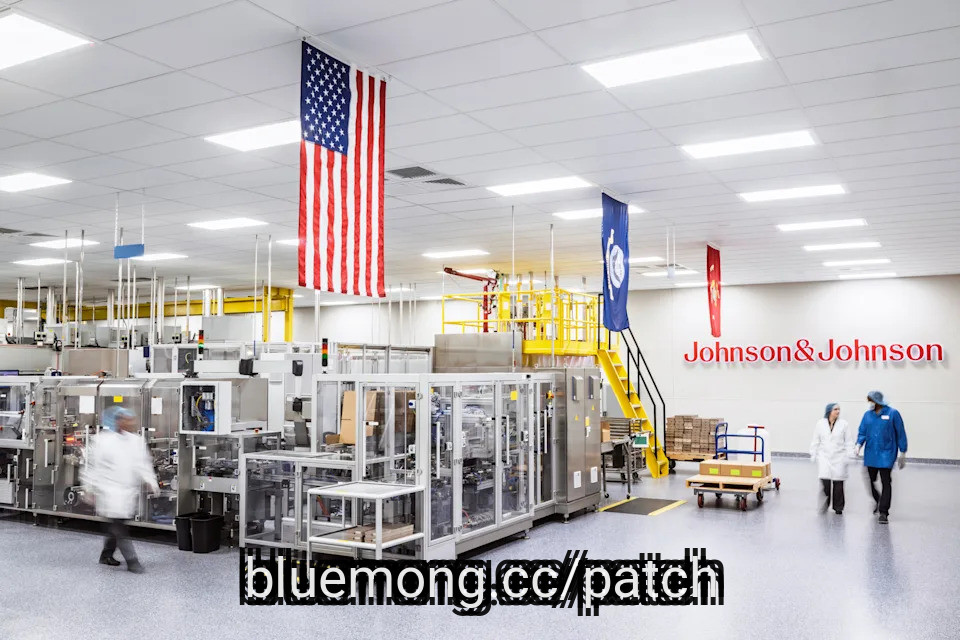
Apollo Global Management, Inc. (NYSE:APO) is reportedly in talks to acquire Johnson & Johnson (NYSE:JNJ) DePuy Synthes orthopedics business in a transaction that could value the unit at close to $20 billion, according to Bloomberg, as reported by Reuters. J&J generated $9.3 billion of revenue from the orthopedics business in 2025, making the potential transaction material for both companies. The discussions could reach an agreement within weeks, although J&J is also considering a public-market spin-off. This is consistent with J&J's October 2025 decision to separate DePuy Synthes within an expected 18-to-24-month timeframe and shift its MedTech portfolio toward higher-growth, higher-margin businesses.
For Apollo Global Management, Inc. (NYSE:APO), the attraction is the opportunity to acquire a large, established medical-device franchise with substantial recurring demand from joint-replacement and surgical procedures. A roughly $20 billion valuation against $9.3 billion of 2025 revenue implies a price-to-sales multiple of about 2.2x, giving Apollo room to pursue operational improvements, portfolio rationalization, and margin expansion if the business is acquired at an attractive valuation.
DePuy Synthes also has meaningful scale and leading positions across major orthopedics categories, while J&J has recently invested in technologies that could strengthen the franchise, including an agreement covering Gemtrack tracking technology for robotic and navigation-assisted joint procedures and the acquisition of Expanding Innovations for expandable spine implants. Apollo is also entering the potential deal from a position of considerable financial scale: it had approximately $1.05 trillion of ***** ets under management as of June 30, 2026, with $198 billion in equity strategies and $849 billion in credit strategies. Its second-quarter results included $111 billion of gross capital deployment, demonstrating the capacity to execute large transactions.
For Johnson & Johnson (NYSE:JNJ), a sale could accelerate the portfolio transformation that management has already identified as a strategic priority while potentially delivering a sizeable upfront cash inflow. J&J explicitly said its planned orthopedics separation should increase the company's top-line growth and operating margins by allowing it to concentrate on Oncology, Immunology, Neuroscience, Cardiovascular, Surgery and Vision.
The company has also been restructuring orthopedics, with $307 million of restructuring expense in 2025, following $167 million in 2024 and $319 million in 2023, primarily tied to market and product exits. A sale could therefore remove a business that has required restructuring resources while allowing J&J to redeploy capital toward areas it views as higher growth and higher margin.
#billion #depuy
For Apollo Global Management, Inc. (NYSE:APO), the attraction is the opportunity to acquire a large, established medical-device franchise with substantial recurring demand from joint-replacement and surgical procedures. A roughly $20 billion valuation against $9.3 billion of 2025 revenue implies a price-to-sales multiple of about 2.2x, giving Apollo room to pursue operational improvements, portfolio rationalization, and margin expansion if the business is acquired at an attractive valuation.
DePuy Synthes also has meaningful scale and leading positions across major orthopedics categories, while J&J has recently invested in technologies that could strengthen the franchise, including an agreement covering Gemtrack tracking technology for robotic and navigation-assisted joint procedures and the acquisition of Expanding Innovations for expandable spine implants. Apollo is also entering the potential deal from a position of considerable financial scale: it had approximately $1.05 trillion of ***** ets under management as of June 30, 2026, with $198 billion in equity strategies and $849 billion in credit strategies. Its second-quarter results included $111 billion of gross capital deployment, demonstrating the capacity to execute large transactions.
For Johnson & Johnson (NYSE:JNJ), a sale could accelerate the portfolio transformation that management has already identified as a strategic priority while potentially delivering a sizeable upfront cash inflow. J&J explicitly said its planned orthopedics separation should increase the company's top-line growth and operating margins by allowing it to concentrate on Oncology, Immunology, Neuroscience, Cardiovascular, Surgery and Vision.
The company has also been restructuring orthopedics, with $307 million of restructuring expense in 2025, following $167 million in 2024 and $319 million in 2023, primarily tied to market and product exits. A sale could therefore remove a business that has required restructuring resources while allowing J&J to redeploy capital toward areas it views as higher growth and higher margin.
#billion #depuy

10 hours ago
Equifax Inc. (EFX) is a global data, **** ytics, and technology company headquartered in Atlanta, Georgia. It operates as one of the "Big Three" credit bureaus, providing consumer and commercial credit reporting, identity and fraud solutions, and decisioning **** ytics to financial institutions, employers, governments, and other enterprises worldwide. The company has a market capitalization of $20.24 billion, which makes it a "big cap" stock.
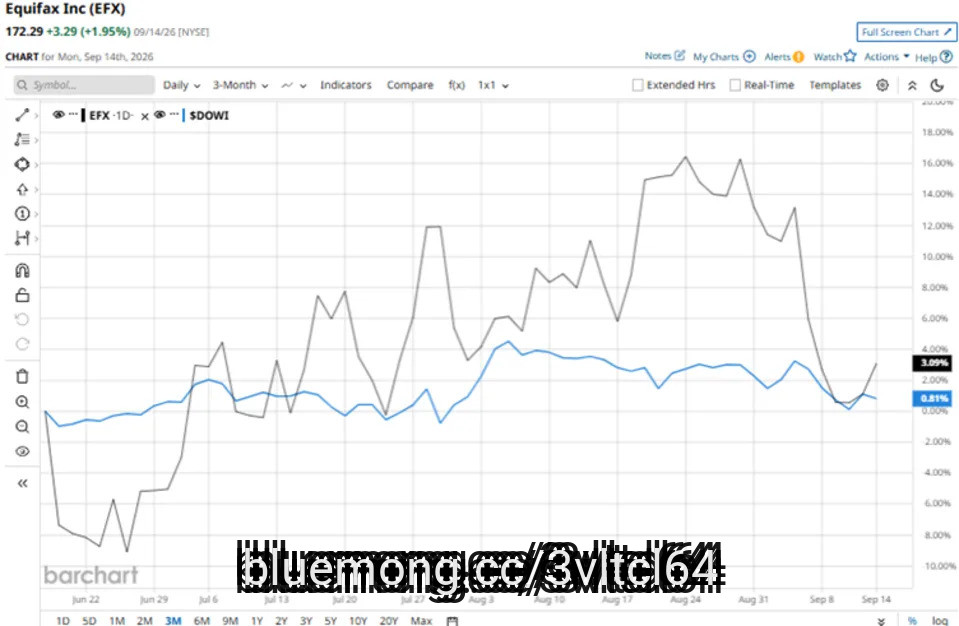
The stock reached a 52-week low of $150.74 on June 22, but is up 14.3% from that level. Renewed confidence in Equifax's growth initiatives has sent the stock up 5.2% over the past three months. The broader Dow Jones Industrial Average ($DOWI) is up 2.4% over the same period. Therefore, the stock has outperformed the wider index over this period.
Goldman Sachs Expects Fed Chair Kevin Warsh to Raise Rates This Week — But Not Because of Oil Prices.
Morgan Stanley Doubles Down on Apple Stock as New Offerings Become 'More Exciting'
The EV Bubble Has Burst. How to Play Rivian Stock Now.
#analytics #credit #period #equifax
The stock reached a 52-week low of $150.74 on June 22, but is up 14.3% from that level. Renewed confidence in Equifax's growth initiatives has sent the stock up 5.2% over the past three months. The broader Dow Jones Industrial Average ($DOWI) is up 2.4% over the same period. Therefore, the stock has outperformed the wider index over this period.
Goldman Sachs Expects Fed Chair Kevin Warsh to Raise Rates This Week — But Not Because of Oil Prices.
Morgan Stanley Doubles Down on Apple Stock as New Offerings Become 'More Exciting'
The EV Bubble Has Burst. How to Play Rivian Stock Now.
#analytics #credit #period #equifax


12 hours ago
Adobe Systems (ADBE) reported strong revenue and free cash flow results for fiscal Q3 on Sept. 10. Free cash flow (FCF) margins were over 40% over the past year. ADBE stock is dirt cheap now at less than 10x earnings and 10x trailing 12-month (TTM) FCF. As a result, shorting ADBE puts and put credit spreads work well for value investors.
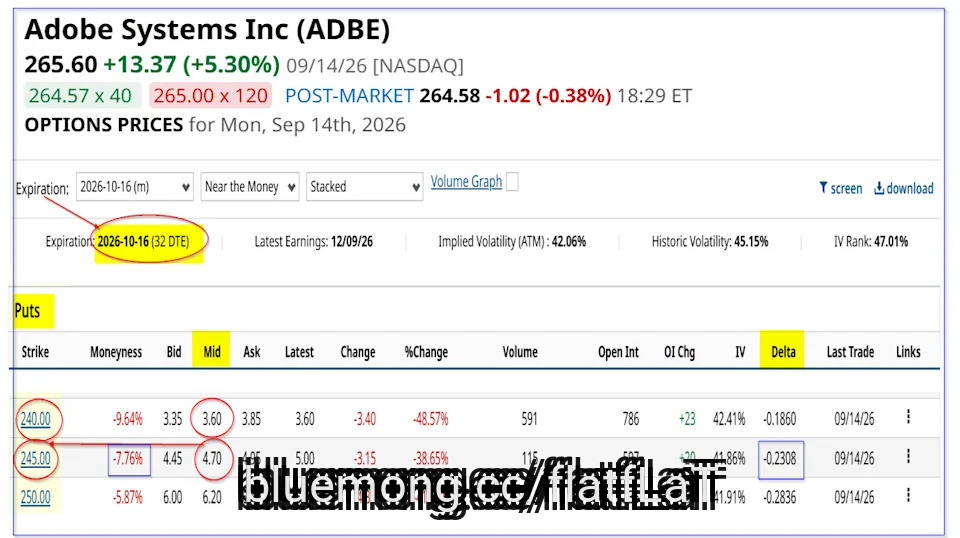
ADBE closed at $265.60 on Monday, Sept. 14, up from a recent trough of $248.83 on Sept. 10 before the earnings release. However, the chart below from Barchart shows ADBE has been flat for the past month and a half.
Goldman Sachs Expects Fed Chair Kevin Warsh to Raise Rates This Week — But Not Because of Oil Prices.
What Old-School Chart ****** ysis and Gamma Exposure Tell Us About QQQ This Fed Week
Unusually High Volume in Deep Out-of-the-Money Vertiv Call Options Shows Investors Bullish on VRT
#week #cash #flow
ADBE closed at $265.60 on Monday, Sept. 14, up from a recent trough of $248.83 on Sept. 10 before the earnings release. However, the chart below from Barchart shows ADBE has been flat for the past month and a half.
Goldman Sachs Expects Fed Chair Kevin Warsh to Raise Rates This Week — But Not Because of Oil Prices.
What Old-School Chart ****** ysis and Gamma Exposure Tell Us About QQQ This Fed Week
Unusually High Volume in Deep Out-of-the-Money Vertiv Call Options Shows Investors Bullish on VRT
#week #cash #flow



12 hours ago
Our ****** ysts just identified a stock with the potential to be the next Nvidia. Tell us how you invest and we'll show you why it's our #1 pick. Tap here.
Fiscal 2026 performance was significantly impacted by ongoing litigation with specific creditors and the resulting business disruptions from these disputes.
The 18% revenue decline was primarily driven by the international business and a strategic reconfiguration of the seed business model.
Commercial operations in Argentina have stabilized following a successful reprofiling of local debt obligations at the start of the fourth quarter.
Management prioritized a leaner operating structure, achieving a 19% reduction in SG&A for the quarter to offset gross profit declines.
#analysts #identified
Fiscal 2026 performance was significantly impacted by ongoing litigation with specific creditors and the resulting business disruptions from these disputes.
The 18% revenue decline was primarily driven by the international business and a strategic reconfiguration of the seed business model.
Commercial operations in Argentina have stabilized following a successful reprofiling of local debt obligations at the start of the fourth quarter.
Management prioritized a leaner operating structure, achieving a 19% reduction in SG&A for the quarter to offset gross profit declines.
#analysts #identified


12 hours ago
Some offers on this page are from advertisers who pay us, which may affect which products we write about, but not our recommendations. See our Advertiser Disclosure.
Debt settlement is a debt relief strategy where you negotiate with creditors to pay less than the full amount you owe, often through a lump-sum payment. In some cases, a creditor will accept as little as 50% of your balance.
A successful debt settlement has the potential to save you money and get you out of debt, but it comes with serious trade-offs, including potential fees, damage to your credit, and tax liabilities. There's also no guarantee that your lender will agree to settle your debt.
It's important to understand these pros and cons to determine whether debt settlement is a viable path for you.
While you can pursue debt settlement on your own, there are companies that offer debt settlement services and negotiate directly with the lender on your behalf. Here are the steps you'll typically take to settle a debt:
#settlement #lender #disclosure #here
Debt settlement is a debt relief strategy where you negotiate with creditors to pay less than the full amount you owe, often through a lump-sum payment. In some cases, a creditor will accept as little as 50% of your balance.
A successful debt settlement has the potential to save you money and get you out of debt, but it comes with serious trade-offs, including potential fees, damage to your credit, and tax liabilities. There's also no guarantee that your lender will agree to settle your debt.
It's important to understand these pros and cons to determine whether debt settlement is a viable path for you.
While you can pursue debt settlement on your own, there are companies that offer debt settlement services and negotiate directly with the lender on your behalf. Here are the steps you'll typically take to settle a debt:
#settlement #lender #disclosure #here


14 hours ago
Citigroup Inc. (NYSE:C)'s CFO Gonzalo Luchetti said the bank expects return on tangible common equity (RoTCE) to come in slightly above 11% in 2026, while also indicating that Citi will increase stock buybacks from the $13 billion repurchased in 2025. The bank plans to accelerate roughly $500 million of investment by year-end, including spending on severance and marketing intended to expand its credit-card and wealth-management businesses. Citi also expects to remove Banamex from its balance sheet in 2027, which will create an estimated $9 billion currency-translation adjustment loss.
The 11%+ target is meaningful because Citi's profitability has already improved materially. In the second quarter, Citi generated $24.8 billion of revenue, up 14% year over year, while net income rose 45% to $5.8 billion. Investment-banking revenue increased 44% to $1.55 billion, and net interest income increased 13%. Citi's SEC filing shows second-quarter RoTCE of 13.0%, versus 8.7% a year earlier, while the first half of 2026 produced a 13.1% RoTCE. The new guidance therefore suggests management believes profitability can remain above the longer-term 11%-13% RoTCE range Citi established for 2027-28, despite additional investment spending.
Kiev.Victor / Shutterstock.com
The bullish argument is that Citigroup Inc. (NYSE:C) appears to be converting its multiyear restructuring into higher returns while simultaneously returning more capital to shareholders. The move from 8.7% RoTCE in the second quarter of 2025 to 13.0% in the second quarter of 2026 represents a substantial improvement in capital efficiency. Citi's efficiency ratio also improved to 57.4% from 62.7%, indicating that revenue growth is increasingly translating into operating leverage rather than being absorbed by expenses. That is particularly relevant because management now intends to spend another roughly $500 million on severance, marketing, and growth initiatives; if these investments produce the intended expansion in cards and wealth management, they could support revenue growth without derailing the profitability trajectory.
Capital returns provide another positive lever. Citi repurchased $13 billion of stock in 2025 and now expects to increase that amount, while its June 2026 CET1 ratio remained 12.78%, comfortably above its 11.6% standardized regulatory requirement. Buybacks can reduce tangible common equity and shares outstanding, potentially supporting both RoTCE and per-share earnings when executed below intrinsic value. Citi's tangible book value per share had already risen 7% year over year to $100.89 by June 30, 2026. The combination of higher operating profitability, shrinking share count, and improving capital efficiency strengthens the case for a valuation re-rating if Citi can sustain returns above 11%.
#year #management
The 11%+ target is meaningful because Citi's profitability has already improved materially. In the second quarter, Citi generated $24.8 billion of revenue, up 14% year over year, while net income rose 45% to $5.8 billion. Investment-banking revenue increased 44% to $1.55 billion, and net interest income increased 13%. Citi's SEC filing shows second-quarter RoTCE of 13.0%, versus 8.7% a year earlier, while the first half of 2026 produced a 13.1% RoTCE. The new guidance therefore suggests management believes profitability can remain above the longer-term 11%-13% RoTCE range Citi established for 2027-28, despite additional investment spending.
Kiev.Victor / Shutterstock.com
The bullish argument is that Citigroup Inc. (NYSE:C) appears to be converting its multiyear restructuring into higher returns while simultaneously returning more capital to shareholders. The move from 8.7% RoTCE in the second quarter of 2025 to 13.0% in the second quarter of 2026 represents a substantial improvement in capital efficiency. Citi's efficiency ratio also improved to 57.4% from 62.7%, indicating that revenue growth is increasingly translating into operating leverage rather than being absorbed by expenses. That is particularly relevant because management now intends to spend another roughly $500 million on severance, marketing, and growth initiatives; if these investments produce the intended expansion in cards and wealth management, they could support revenue growth without derailing the profitability trajectory.
Capital returns provide another positive lever. Citi repurchased $13 billion of stock in 2025 and now expects to increase that amount, while its June 2026 CET1 ratio remained 12.78%, comfortably above its 11.6% standardized regulatory requirement. Buybacks can reduce tangible common equity and shares outstanding, potentially supporting both RoTCE and per-share earnings when executed below intrinsic value. Citi's tangible book value per share had already risen 7% year over year to $100.89 by June 30, 2026. The combination of higher operating profitability, shrinking share count, and improving capital efficiency strengthens the case for a valuation re-rating if Citi can sustain returns above 11%.
#year #management


14 hours ago
Equifax Inc. (EFX) is a global data, **** ytics, and technology company headquartered in Atlanta, Georgia. It operates as one of the "Big Three" credit bureaus, providing consumer and commercial credit reporting, identity and fraud solutions, and decisioning **** ytics to financial institutions, employers, governments, and other enterprises worldwide. The company has a market capitalization of $20.24 billion, which makes it a "big cap" stock.
The stock reached a 52-week low of $150.74 on June 22, but is up 14.3% from that level. Renewed confidence in Equifax's growth initiatives has sent the stock up 5.2% over the past three months. The broader Dow Jones Industrial Average ($DOWI) is up 2.4% over the same period. Therefore, the stock has outperformed the wider index over this period.
Goldman Sachs Expects Fed Chair Kevin Warsh to Raise Rates This Week — But Not Because of Oil Prices.
Morgan Stanley Doubles Down on Apple Stock as New Offerings Become 'More Exciting'
The EV Bubble Has Burst. How to Play Rivian Stock Now.
#credit #period #georgia
The stock reached a 52-week low of $150.74 on June 22, but is up 14.3% from that level. Renewed confidence in Equifax's growth initiatives has sent the stock up 5.2% over the past three months. The broader Dow Jones Industrial Average ($DOWI) is up 2.4% over the same period. Therefore, the stock has outperformed the wider index over this period.
Goldman Sachs Expects Fed Chair Kevin Warsh to Raise Rates This Week — But Not Because of Oil Prices.
Morgan Stanley Doubles Down on Apple Stock as New Offerings Become 'More Exciting'
The EV Bubble Has Burst. How to Play Rivian Stock Now.
#credit #period #georgia



14 hours ago
Apollo Global Management, Inc. (NYSE:APO) is reportedly in talks to acquire Johnson & Johnson (NYSE:JNJ) DePuy Synthes orthopedics business in a transaction that could value the unit at close to $20 billion, according to Bloomberg, as reported by Reuters. J&J generated $9.3 billion of revenue from the orthopedics business in 2025, making the potential transaction material for both companies. The discussions could reach an agreement within weeks, although J&J is also considering a public-market spin-off. This is consistent with J&J's October 2025 decision to separate DePuy Synthes within an expected 18-to-24-month timeframe and shift its MedTech portfolio toward higher-growth, higher-margin businesses.
For Apollo Global Management, Inc. (NYSE:APO), the attraction is the opportunity to acquire a large, established medical-device franchise with substantial recurring demand from joint-replacement and surgical procedures. A roughly $20 billion valuation against $9.3 billion of 2025 revenue implies a price-to-sales multiple of about 2.2x, giving Apollo room to pursue operational improvements, portfolio rationalization, and margin expansion if the business is acquired at an attractive valuation.
DePuy Synthes also has meaningful scale and leading positions across major orthopedics categories, while J&J has recently invested in technologies that could strengthen the franchise, including an agreement covering Gemtrack tracking technology for robotic and navigation-assisted joint procedures and the acquisition of Expanding Innovations for expandable spine implants. Apollo is also entering the potential deal from a position of considerable financial scale: it had approximately $1.05 trillion of **** ets under management as of June 30, 2026, with $198 billion in equity strategies and $849 billion in credit strategies. Its second-quarter results included $111 billion of gross capital deployment, demonstrating the capacity to execute large transactions.
For Johnson & Johnson (NYSE:JNJ), a sale could accelerate the portfolio transformation that management has already identified as a strategic priority while potentially delivering a sizeable upfront cash inflow. J&J explicitly said its planned orthopedics separation should increase the company's top-line growth and operating margins by allowing it to concentrate on Oncology, Immunology, Neuroscience, Cardiovascular, Surgery and Vision.
The company has also been restructuring orthopedics, with $307 million of restructuring expense in 2025, following $167 million in 2024 and $319 million in 2023, primarily tied to market and product exits. A sale could therefore remove a business that has required restructuring resources while allowing J&J to redeploy capital toward areas it views as higher growth and higher margin.
#NYSE #johnson
For Apollo Global Management, Inc. (NYSE:APO), the attraction is the opportunity to acquire a large, established medical-device franchise with substantial recurring demand from joint-replacement and surgical procedures. A roughly $20 billion valuation against $9.3 billion of 2025 revenue implies a price-to-sales multiple of about 2.2x, giving Apollo room to pursue operational improvements, portfolio rationalization, and margin expansion if the business is acquired at an attractive valuation.
DePuy Synthes also has meaningful scale and leading positions across major orthopedics categories, while J&J has recently invested in technologies that could strengthen the franchise, including an agreement covering Gemtrack tracking technology for robotic and navigation-assisted joint procedures and the acquisition of Expanding Innovations for expandable spine implants. Apollo is also entering the potential deal from a position of considerable financial scale: it had approximately $1.05 trillion of **** ets under management as of June 30, 2026, with $198 billion in equity strategies and $849 billion in credit strategies. Its second-quarter results included $111 billion of gross capital deployment, demonstrating the capacity to execute large transactions.
For Johnson & Johnson (NYSE:JNJ), a sale could accelerate the portfolio transformation that management has already identified as a strategic priority while potentially delivering a sizeable upfront cash inflow. J&J explicitly said its planned orthopedics separation should increase the company's top-line growth and operating margins by allowing it to concentrate on Oncology, Immunology, Neuroscience, Cardiovascular, Surgery and Vision.
The company has also been restructuring orthopedics, with $307 million of restructuring expense in 2025, following $167 million in 2024 and $319 million in 2023, primarily tied to market and product exits. A sale could therefore remove a business that has required restructuring resources while allowing J&J to redeploy capital toward areas it views as higher growth and higher margin.
#NYSE #johnson

15 hours ago
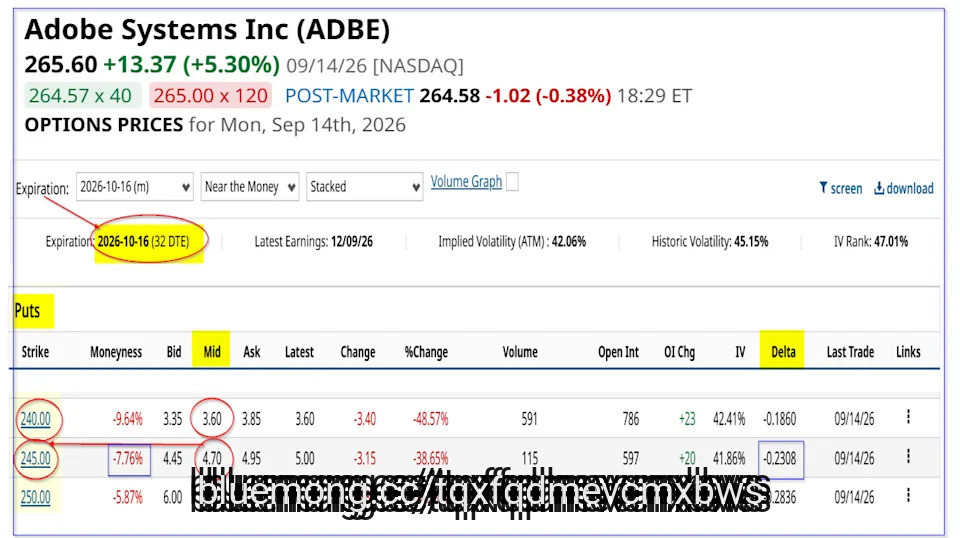
Adobe Systems (ADBE) reported strong revenue and free cash flow results for fiscal Q3 on Sept. 10. Free cash flow (FCF) margins were over 40% over the past year. ADBE stock is dirt cheap now at less than 10x earnings and 10x trailing 12-month (TTM) FCF. As a result, shorting ADBE puts and put credit spreads work well for value investors.
ADBE closed at $265.60 on Monday, Sept. 14, up from a recent trough of $248.83 on Sept. 10 before the earnings release. However, the chart below from Barchart shows ADBE has been flat for the past month and a half.
Goldman Sachs Expects Fed Chair Kevin Warsh to Raise Rates This Week — But Not Because of Oil Prices.
What Old-School Chart ****** ysis and Gamma Exposure Tell Us About QQQ This Fed Week
Unusually High Volume in Deep Out-of-the-Money Vertiv Call Options Shows Investors Bullish on VRT
#investors #cash #flow #past
ADBE closed at $265.60 on Monday, Sept. 14, up from a recent trough of $248.83 on Sept. 10 before the earnings release. However, the chart below from Barchart shows ADBE has been flat for the past month and a half.
Goldman Sachs Expects Fed Chair Kevin Warsh to Raise Rates This Week — But Not Because of Oil Prices.
What Old-School Chart ****** ysis and Gamma Exposure Tell Us About QQQ This Fed Week
Unusually High Volume in Deep Out-of-the-Money Vertiv Call Options Shows Investors Bullish on VRT
#investors #cash #flow #past


15 hours ago
Our ***** ysts just identified a stock with the potential to be the next Nvidia. Tell us how you invest and we'll show you why it's our #1 pick. Tap here.
Fiscal 2026 performance was significantly impacted by ongoing litigation with specific creditors and the resulting business disruptions from these disputes.
The 18% revenue decline was primarily driven by the international business and a strategic reconfiguration of the seed business model.
Commercial operations in Argentina have stabilized following a successful reprofiling of local debt obligations at the start of the fourth quarter.
Management prioritized a leaner operating structure, achieving a 19% reduction in SG&A for the quarter to offset gross profit declines.
#business #NVIDIA #management #analysts
Fiscal 2026 performance was significantly impacted by ongoing litigation with specific creditors and the resulting business disruptions from these disputes.
The 18% revenue decline was primarily driven by the international business and a strategic reconfiguration of the seed business model.
Commercial operations in Argentina have stabilized following a successful reprofiling of local debt obligations at the start of the fourth quarter.
Management prioritized a leaner operating structure, achieving a 19% reduction in SG&A for the quarter to offset gross profit declines.
#business #NVIDIA #management #analysts

20 hours ago
This story was originally published on CRE Daily. Join 70,000+ commercial real estate professionals getting daily news, market insights, and industry ******* ysis delivered straight to their inbox with the free CRE Daily newsletter.
A $420 million CMBS loan backed by the 893,000-square-foot office tower at 51 West 52nd Street will exit special servicing after Harbor Group closed a negotiated extension.
Morningstar reported occupancy fell from 99% to 86% and cash flow dropped 37% below underwritten levels, though a source close to the deal says the building is now fully leased.
Harbor Group bought the Midtown tower from ViacomCBS for $760 million in 2021, the largest investment sale that year, and has since invested $150 million in upgrades.
A $420 million CMBS loan backed by 51 West 52nd Street, a 38-story, 893,000-square-foot Midtown office tower, will exit special servicing after sponsor Harbor Group International closed a negotiated loan extension, according to Commercial Observer. The loan, which backs the single-asset, single-borrower DBGS 2021-W52 deal, was transferred to special servicing ahead of its October 2026 maturity even though it still carried a 12-month extension option, per an alert from Morningstar Credit ******* ytics.
#group #extension
A $420 million CMBS loan backed by the 893,000-square-foot office tower at 51 West 52nd Street will exit special servicing after Harbor Group closed a negotiated extension.
Morningstar reported occupancy fell from 99% to 86% and cash flow dropped 37% below underwritten levels, though a source close to the deal says the building is now fully leased.
Harbor Group bought the Midtown tower from ViacomCBS for $760 million in 2021, the largest investment sale that year, and has since invested $150 million in upgrades.
A $420 million CMBS loan backed by 51 West 52nd Street, a 38-story, 893,000-square-foot Midtown office tower, will exit special servicing after sponsor Harbor Group International closed a negotiated loan extension, according to Commercial Observer. The loan, which backs the single-asset, single-borrower DBGS 2021-W52 deal, was transferred to special servicing ahead of its October 2026 maturity even though it still carried a 12-month extension option, per an alert from Morningstar Credit ******* ytics.
#group #extension


21 hours ago
On September 14, Radiant Logistics (NYSEAMERICAN:RLGT) held its fourth fiscal quarter earnings call, and the headline numbers landed harder than a typical logistics update. Net income jumped 53.1% to $7.5 million for the quarter ended June 30, while revenue climbed 18.5% to $261.4 million. Look past that one quarter, though, and the picture gets more complicated, because full-year adjusted profitability actually fell. That gap between a blowout quarter and a softer year is what makes this name worth a closer look.
The fourth fiscal quarter was strong from top to bottom. Adjusted EBITDA rose 31.6% to $10.4 million, margin expanded 240 basis points to 15.5%, and adjusted net income climbed 34.5% to $7.4 million, all against organic revenue growth of 8%. Management credited the acceleration to US forwarding operations and international airfreight, including work supporting disaster relief after typhoon activity hit the Western Pacific earlier this year, plus airfreight demand tied to capital flows into global data center buildouts.
The balance sheet backs up the story. Radiant enters fiscal 2027 with zero net debt, $25.6 million in cash as of June 30, and a $200 million senior credit facility that was extended and restated in August, pushing maturity out to August 7, 2031, while its acquisition-focused accordion grew to $100 million from $75 million. On the domestic side, capacity has been exiting the truckload and intermodal markets, and spot rates and tender rejections moved higher late in the quarter. Radiant also launched a new independent agent program at Radiant Road & Rail during the quarter, extending its freight forwarding agent network into truck brokerage and intermodal, while Navegate is gaining traction, with one enterprise customer now managing more than 1,400 vendors on the platform.
The full-year numbers tell a different story than the quarter does. Revenue rose just 3.5% to $934.4 million from $902.7 million, a fraction of the fourth quarter's 18.5% pace, and full-year net income grew a modest 8.7% to $18.8 million. Full-year adjusted EBITDA actually fell 5.4% to $36.7 million from $38.8 million, and that figure included a $1.3 million First Brands adjustment. Strip that out and normalized adjusted EBITDA comes in at $35.4 million, an even steeper decline than the headline number suggests.
The operating backdrop stays complicated too. Ocean shipping routes remain disrupted by the closure of the Strait of Hormuz and continued Houthi activity affecting Suez Canal transits, keeping capacity tight on key trade lanes. US tariff policy is generating elevated IEEPA-related filing activity, and Canada put new retaliatory tariff measures into effect in early September, adding fresh complexity for shippers moving goods across that border. Management itself acknowledged that the domestic truck brokerage improvement seen late in the fourth quarter is not yet fully reflected in the reported results.
#million #quarter #revenue #fiscal
The fourth fiscal quarter was strong from top to bottom. Adjusted EBITDA rose 31.6% to $10.4 million, margin expanded 240 basis points to 15.5%, and adjusted net income climbed 34.5% to $7.4 million, all against organic revenue growth of 8%. Management credited the acceleration to US forwarding operations and international airfreight, including work supporting disaster relief after typhoon activity hit the Western Pacific earlier this year, plus airfreight demand tied to capital flows into global data center buildouts.
The balance sheet backs up the story. Radiant enters fiscal 2027 with zero net debt, $25.6 million in cash as of June 30, and a $200 million senior credit facility that was extended and restated in August, pushing maturity out to August 7, 2031, while its acquisition-focused accordion grew to $100 million from $75 million. On the domestic side, capacity has been exiting the truckload and intermodal markets, and spot rates and tender rejections moved higher late in the quarter. Radiant also launched a new independent agent program at Radiant Road & Rail during the quarter, extending its freight forwarding agent network into truck brokerage and intermodal, while Navegate is gaining traction, with one enterprise customer now managing more than 1,400 vendors on the platform.
The full-year numbers tell a different story than the quarter does. Revenue rose just 3.5% to $934.4 million from $902.7 million, a fraction of the fourth quarter's 18.5% pace, and full-year net income grew a modest 8.7% to $18.8 million. Full-year adjusted EBITDA actually fell 5.4% to $36.7 million from $38.8 million, and that figure included a $1.3 million First Brands adjustment. Strip that out and normalized adjusted EBITDA comes in at $35.4 million, an even steeper decline than the headline number suggests.
The operating backdrop stays complicated too. Ocean shipping routes remain disrupted by the closure of the Strait of Hormuz and continued Houthi activity affecting Suez Canal transits, keeping capacity tight on key trade lanes. US tariff policy is generating elevated IEEPA-related filing activity, and Canada put new retaliatory tariff measures into effect in early September, adding fresh complexity for shippers moving goods across that border. Management itself acknowledged that the domestic truck brokerage improvement seen late in the fourth quarter is not yet fully reflected in the reported results.
#million #quarter #revenue #fiscal

21 hours ago
Willing and Abel: Berkshire's New CEO Makes Huge Portfolio Changes in Q1
American Express raised its 2026 revenue-growth outlook toward 10% after reporting strong first-half trends, including 10% foreign-exchange-adjusted revenue growth, mid-teens EPS growth, 16% card-fee growth and double-digit net interest income growth.
The company plans to direct better-than-expected performance toward customer acquisition, technology and product development, while maintaining long-term aspirations of 10% revenue growth and mid-teens EPS growth.
International, travel and younger-cardmember growth remain key opportunities: international billings have risen about 50% in three years, travel spending is contributing to growth, and Millennials and Gen Z represent 65% of new accounts, with credit metrics remaining stable.
Capital One's Big Bet Faces Rising Credit Risk
#Growth #international #travel #makes
American Express raised its 2026 revenue-growth outlook toward 10% after reporting strong first-half trends, including 10% foreign-exchange-adjusted revenue growth, mid-teens EPS growth, 16% card-fee growth and double-digit net interest income growth.
The company plans to direct better-than-expected performance toward customer acquisition, technology and product development, while maintaining long-term aspirations of 10% revenue growth and mid-teens EPS growth.
International, travel and younger-cardmember growth remain key opportunities: international billings have risen about 50% in three years, travel spending is contributing to growth, and Millennials and Gen Z represent 65% of new accounts, with credit metrics remaining stable.
Capital One's Big Bet Faces Rising Credit Risk
#Growth #international #travel #makes


21 hours ago
Some offers on this page are from advertisers who pay us, which may affect which products we write about, but not our recommendations. See our Advertiser Disclosure.
Mission Lane is a credit card company that offers cash-back rewards cards as well as card options for people with less-than-perfect credit.
There are four Mission Lane cards, and each is designed for people with different credit profiles. But it's important to understand the details of each one and the costs they can carry before you apply. Here are 5 things to know about Mission Lane credit cards:
The four credit cards offered by Mission Lane differ in card type, rewards offered, qualifications, and more. Here's a closer look at how they compare:
Annual fee
#offers
Mission Lane is a credit card company that offers cash-back rewards cards as well as card options for people with less-than-perfect credit.
There are four Mission Lane cards, and each is designed for people with different credit profiles. But it's important to understand the details of each one and the costs they can carry before you apply. Here are 5 things to know about Mission Lane credit cards:
The four credit cards offered by Mission Lane differ in card type, rewards offered, qualifications, and more. Here's a closer look at how they compare:
Annual fee
#offers




21 hours ago
On September 14, Dave & Buster's Entertainment (NASDAQ:PLAY) reported second-quarter fiscal 2026 results that read like two different companies at once. Revenue fell, and the company posted a net loss for the period ended August 4, yet comparable sales, which had been sliding for more than a year, kept getting less bad every month from June through the first five weeks of the third quarter. New CEO Darin Harper is betting that improvement compounds into something bigger.
The clearest evidence is the trend line itself. Comparable store sales fell 5.4% in the first quarter of fiscal 2026, then 2.9% in the second quarter, then just 1.6% in July after a 5% decline in June, and Harper said trends improved further over the first five weeks of the third quarter. Food and beverage sales are moving in the opposite direction entirely, up 7.6% in the quarter and positive for five straight quarters, helped by the Eat & Play Combo, a bundled meal and game credit offer sold through kiosks. Special event sales have now grown for seven consecutive quarters.
Behind that shift sits a rebuilt leadership bench. Dave & Buster's went more than a year without a chief marketing officer, and Harper has since added a CMO, a chief operations officer, a chief technology officer, and a chief legal officer since taking over. The company also leaned on new content, launching 10 games and attractions this year, including tie-ins with Mandalorian and Grogu, John Wick and Stranger Things, after research found more than 70% of guests said new games would bring them back more often. Changes to game pricing pushed play and dwell time up 16% to 20% or more. Six remodeled stores are already outperforming the rest of the chain, and management says the newest remodel template costs less to build than the last one. Net capital spending dropped to $127.6 million through the first half of the year from $155.4 million, and adjusted free cash flow swung to positive $19.5 million from negative $36.5 million, a $56 million improvement.
The headline figures were still rough. Total revenue slipped 2.4% to $544.1 million from $557.4 million a year earlier, and adjusted EBITDA dropped to $98.9 million, an 18.2% margin, from $129.8 million and a 23.3% margin. On a GAAP basis, the company posted a net loss of $12.5 million, or $0.36 per diluted share, versus net income of $11.4 million in the same quarter last year. About $15 million of the EBITDA decline came from items management calls non-normalized, including a $10 million noncash deferral adjustment that did not repeat this year, $3 million in extra preopening costs and $2 million in higher insurance expenses, but even stripped of those, the underlying decline was still roughly $16 million.
#quarter #sales
The clearest evidence is the trend line itself. Comparable store sales fell 5.4% in the first quarter of fiscal 2026, then 2.9% in the second quarter, then just 1.6% in July after a 5% decline in June, and Harper said trends improved further over the first five weeks of the third quarter. Food and beverage sales are moving in the opposite direction entirely, up 7.6% in the quarter and positive for five straight quarters, helped by the Eat & Play Combo, a bundled meal and game credit offer sold through kiosks. Special event sales have now grown for seven consecutive quarters.
Behind that shift sits a rebuilt leadership bench. Dave & Buster's went more than a year without a chief marketing officer, and Harper has since added a CMO, a chief operations officer, a chief technology officer, and a chief legal officer since taking over. The company also leaned on new content, launching 10 games and attractions this year, including tie-ins with Mandalorian and Grogu, John Wick and Stranger Things, after research found more than 70% of guests said new games would bring them back more often. Changes to game pricing pushed play and dwell time up 16% to 20% or more. Six remodeled stores are already outperforming the rest of the chain, and management says the newest remodel template costs less to build than the last one. Net capital spending dropped to $127.6 million through the first half of the year from $155.4 million, and adjusted free cash flow swung to positive $19.5 million from negative $36.5 million, a $56 million improvement.
The headline figures were still rough. Total revenue slipped 2.4% to $544.1 million from $557.4 million a year earlier, and adjusted EBITDA dropped to $98.9 million, an 18.2% margin, from $129.8 million and a 23.3% margin. On a GAAP basis, the company posted a net loss of $12.5 million, or $0.36 per diluted share, versus net income of $11.4 million in the same quarter last year. About $15 million of the EBITDA decline came from items management calls non-normalized, including a $10 million noncash deferral adjustment that did not repeat this year, $3 million in extra preopening costs and $2 million in higher insurance expenses, but even stripped of those, the underlying decline was still roughly $16 million.
#quarter #sales

24 hours ago
By Michael S. Derby
Sept 16 (Reuters) - Surging government bond yields are raising credit costs across the U.S. economy and could factor into Federal Reserve monetary policy deliberations, but **** ysts see the central bank resisting any explicit call from the Trump administration to bail out the market.
The focus on the Fed's possible involvement comes as Treasury Secretary Scott Bessent has taken an unusually activist role in trying to tamp down rising yields he considers to be misaligned with the U.S. economic outlook.
Bessent's campaign, which saw the expansion of a key debt buyback operation last week, is foundering, as the 10-year Treasury note rose above 5% to its highest since 2007. He shrugged the move off as owing to "global issues" on Tuesday as he arrived for a congressional hearing.
Treasury's bond market travails are raising questions whether the Fed might be requested to buy government debt to reduce supply, which could cap or lower yields, in turn easing government and private sector borrowing costs.
#costs
Sept 16 (Reuters) - Surging government bond yields are raising credit costs across the U.S. economy and could factor into Federal Reserve monetary policy deliberations, but **** ysts see the central bank resisting any explicit call from the Trump administration to bail out the market.
The focus on the Fed's possible involvement comes as Treasury Secretary Scott Bessent has taken an unusually activist role in trying to tamp down rising yields he considers to be misaligned with the U.S. economic outlook.
Bessent's campaign, which saw the expansion of a key debt buyback operation last week, is foundering, as the 10-year Treasury note rose above 5% to its highest since 2007. He shrugged the move off as owing to "global issues" on Tuesday as he arrived for a congressional hearing.
Treasury's bond market travails are raising questions whether the Fed might be requested to buy government debt to reduce supply, which could cap or lower yields, in turn easing government and private sector borrowing costs.
#costs


2 days ago
When you buy through links on our articles, Future and its syndication partners may earn a commission.
Credit: Getty Images
Maybe it's a me thing, but I've been craving the thrill and suspense of an award show. Luckily, tonight is the 78th Primetime Emmy Awards, where NBC's Law & Order star Mariska Hargitay is hosting live from the Peacock Theater in Los Angeles. As a self-proclaimed binge-watcher, I'm all caught up on tonight's nominees, led by The Pitt with 25 nominations and Hacks at 24, breaking the record for a comedy series to date. But it's not just the potential winners getting buzz; it's the red carpet arrivals, too.
We're tuning in to see which designers tonight's attendees are wearing and get a glimpse of which trends will define 2027—or, in this case, which controversial trends. Shailene Woodley, who won her first Emmy Award for Outstanding Guest Actress in a Drama Series for her role in Hulu's Paradise last week, arrived on tonight's red carpet in a look from Pierpaolo Piccioli's Balenciaga F/W 26 haute couture collection.
The trend in question? Sequin-embroidered trousers. Woodley wore the divisive pants with their runway pairing, a plunging periwinkle tank, but traded the oversize coat for a pair of burgundy opera gloves. Woodley's stylist, Karla Welch, introduced more color with a beautiful collared necklace crafted from Venetian glass by HOWL. The flooded hem hides Woodley's, I ***** ume, very tall heels.
#emmy #woodley #trends
Credit: Getty Images
Maybe it's a me thing, but I've been craving the thrill and suspense of an award show. Luckily, tonight is the 78th Primetime Emmy Awards, where NBC's Law & Order star Mariska Hargitay is hosting live from the Peacock Theater in Los Angeles. As a self-proclaimed binge-watcher, I'm all caught up on tonight's nominees, led by The Pitt with 25 nominations and Hacks at 24, breaking the record for a comedy series to date. But it's not just the potential winners getting buzz; it's the red carpet arrivals, too.
We're tuning in to see which designers tonight's attendees are wearing and get a glimpse of which trends will define 2027—or, in this case, which controversial trends. Shailene Woodley, who won her first Emmy Award for Outstanding Guest Actress in a Drama Series for her role in Hulu's Paradise last week, arrived on tonight's red carpet in a look from Pierpaolo Piccioli's Balenciaga F/W 26 haute couture collection.
The trend in question? Sequin-embroidered trousers. Woodley wore the divisive pants with their runway pairing, a plunging periwinkle tank, but traded the oversize coat for a pair of burgundy opera gloves. Woodley's stylist, Karla Welch, introduced more color with a beautiful collared necklace crafted from Venetian glass by HOWL. The flooded hem hides Woodley's, I ***** ume, very tall heels.
#emmy #woodley #trends




2 days ago
When you buy through links on our articles, Future and its syndication partners may earn a commission.
Credit: Getty Images
Hosted by Mariska Hargitay and live from the Peacock Theater in Los Angeles, the 78th Primetime Emmy Awards welcomed over 20 first-time nominees, including Chase Infiniti for The Testaments, Hacks star Megan Stalter, Sarah Pidgeon for FX's Love Story, and Carey Mulligan, who is up for two Emmy nominations for her role as Lindsay Crane-Martín in Netflix's Beef.
Mulligan attended tonight's ceremony in a dress designed by everyone's favorite minimalist duo, the Olsen twins. And yet, despite The Row's restrained approach to fashion, Mulligan's resort 27 dress is anything but. It's colorful. It's playful. It's eye-catching. The sky-blue strapless dress teases a reveal of a stark-white underpinning at the neckline, overlayed with patterned embroidery. Mulligan wore for minimal jewelry—no necklace, opting instead for stunning diamond stud earrings and a pearl ring.
The back of the dress features a deconstructed bow that drapes down to meet the hem, where a pair of pointed-toe heels peek out from underneath. See the entirety of Mulligan's look below.
#credit
Credit: Getty Images
Hosted by Mariska Hargitay and live from the Peacock Theater in Los Angeles, the 78th Primetime Emmy Awards welcomed over 20 first-time nominees, including Chase Infiniti for The Testaments, Hacks star Megan Stalter, Sarah Pidgeon for FX's Love Story, and Carey Mulligan, who is up for two Emmy nominations for her role as Lindsay Crane-Martín in Netflix's Beef.
Mulligan attended tonight's ceremony in a dress designed by everyone's favorite minimalist duo, the Olsen twins. And yet, despite The Row's restrained approach to fashion, Mulligan's resort 27 dress is anything but. It's colorful. It's playful. It's eye-catching. The sky-blue strapless dress teases a reveal of a stark-white underpinning at the neckline, overlayed with patterned embroidery. Mulligan wore for minimal jewelry—no necklace, opting instead for stunning diamond stud earrings and a pearl ring.
The back of the dress features a deconstructed bow that drapes down to meet the hem, where a pair of pointed-toe heels peek out from underneath. See the entirety of Mulligan's look below.
#credit



2 days ago
Deshaun Watson played poor football for all four quarters on Sunday, playing a key part in a 34-10 loss to the Jacksonville Jaguars. He was out of rhythm with his playmakers, lacked confidence in his throws, and made a handful of reckless decisions. However, if you asked Watson, it's just par for the course in being an NFL quarterback.
While speaking to the media after Sunday's loss, Watson downplayed his struggles, chalking it up to routine bad plays:
"Bad plays are going to happen all the time. Look all around the league, everyone throws interceptions, everyone makes bad plays. You got to give the defense credit."
It's getting to be beyond noticeable: Watson's lack of self-awareness. Instead of owning up to his mistakes- poor reads, bad timing, and irresponsible decision-making- he says that bad plays are going to happen? It leaves you wondering how long he can keep up this blatant disrespect, and how long he will keep the job in the first place.
This article originally appeared on Browns Wire: Deshaun Watson gives dismissive comments on his performance in Week 1
#deshaun #poor #going #happen
While speaking to the media after Sunday's loss, Watson downplayed his struggles, chalking it up to routine bad plays:
"Bad plays are going to happen all the time. Look all around the league, everyone throws interceptions, everyone makes bad plays. You got to give the defense credit."
It's getting to be beyond noticeable: Watson's lack of self-awareness. Instead of owning up to his mistakes- poor reads, bad timing, and irresponsible decision-making- he says that bad plays are going to happen? It leaves you wondering how long he can keep up this blatant disrespect, and how long he will keep the job in the first place.
This article originally appeared on Browns Wire: Deshaun Watson gives dismissive comments on his performance in Week 1
#deshaun #poor #going #happen