22 days ago
GNL paid out more in dividends than it earned in operating cash for four straight years and has already slashed its quarterly dividend from $0.53 to $0.19; PSEC's NAV fell from $6.56 to $5.71 while distributions exceeded net investment income.
IEP carries a 30% yield but posted net losses every year from 2019 through 2025 and slashed distributions from $2 to $0.50 per quarter while units dropped 66% over five years.
BEP and CWEN both rely on billions in annual financing inflows to fund distributions, with BEP's 2025 capex hitting $6.7 billion against just $1.5 billion in operating cash flow.
Building a portfolio and living off one are two completely different skills, and almost ******* ody teaches the second. This problem is what The Definitive Guide to Retirement Income helps, and it is free today. Read more here. (Sponsor)
One stock on this list has a forward yield of about 30%. For a retiree, a number like that looks like a solid paycheck. A high yield only means something if the payout is sustainable, and each of the five names below has spent years sending out more cash than the business brought in.
#distributions #operating #slashed


23 days ago
BarriC's $750 XRP target extrapolates the token's historic 500x rally from 2017, ignoring that it implies a staggering $47 trillion market cap.
At $750, XRP's market cap would dwarf Bitcoin's entire $1.73 trillion valuation 27 times over, requiring capital inflows unprecedented in any market.
XRP must first climb 143% just to reclaim its $3.65 all-time high, making a 500x moonshot an extraordinarily remote possibility.
Building a portfolio and living off one are two completely different skills, and almost ******* ody teaches the second. This problem is what The Definitive Guide to Retirement Income helps, and it is free today. Read more here. (Sponsor)
Crypto ******* yst BarriC recently suggested that XRP (CRYPTO:XRP) could potentially reach $750 if it replicates the extraordinary 500-fold increase seen in 2017 and 2018. This prediction has gained traction in the XRP community on social media platform X, where BarriC has made bold price forecasts for years.
#market #barric #building #definitive



1 month ago
Sept 18 (Reuters) - US equity funds recorded outflows for a fourth consecutive week in the week to September 18, as rising crude oil prices heightened inflation concerns and expectations of a Federal Reserve rate hike added to investor caution ahead of its policy decision.
US equity funds recorded net redemptions of $31.44 billion during the week, largely matching the $32 billion withdrawn a week earlier, LSEG Lipper data showed.
Crude oil prices rose to four-month highs during the week, fueling inflation concerns and lifting Treasury yields, which weighed on growth-oriented funds.
The Fed raised interest rates by 25 basis points on Wednesday and signaled that further tightening may be needed to curb inflation fueled by higher energy costs linked to the war in Iran.
Investors withdrew $28.71 billion, $1.73 billion and $3.16 billion from US large-cap, mid-cap and multi-cap funds, respectively. In contrast, small-cap funds attracted $568 million in weekly inflows.
#funds #recorded #concerns


1 month ago
The CLARITY Act's 49-50 Senate failure sent XRP down 8% and invalidated every major **** yst price target built on the bill passing.
ChatGPT's 90-day forecast puts XRP's central estimate at $1.20, down from $1.30, and identifies the $1.20 to $1.23 range as the key near-term battleground.
Weekly XRP ETF inflows fell from $110 million to $19 million, while a second Fed rate hike in October threatens further downside pressure.
Read More: Learn 7 secret wealth tips high net worth investors use that most investors miss (sponsor)
XRP (CRYPTO:XRP) holders spent this year anticipating the Digital **** et Market Clarity Act, a bill intended to write XRP's commodity status into federal law rather than leaving it subject to regulatory changes. The bill reached the Senate floor with 126 Democratic amendments included but failed on a procedural vote on September 15, 2026, with cloture ending 49 to 50.
#clarity #october #Crypto




1 month ago
Coinbase (COIN) dropped sharply when the CLARITY Act failed its Senate vote as Bitcoin barely moved, proving the bill served exchanges, not the coin.
Circle (CRCL) sold off alongside COIN while Polymarket prices Bitcoin reaching $95,000 by December at just 26%, well below Wall Street's bullish targets.
Grok flags October's Fed hike as Bitcoin's real gate, arguing that if it proves to be the last, returning ETF inflows could bring $100,000 within reach as a stretch target.
Read More: Avoid these 13 retirement mistakes before they derail your future (sponsor)
Coinbase (NASDAQ:COIN) and Circle (NYSE:CRCL) both fell sharply after the September 15 Senate cloture vote failed to advance the CLARITY Act, while Bitcoin (CRYPTO:BTC) barely moved.
#Coinbase #circle



1 month ago
CoinShares PLC (NASDAQ:CSHR) reported approximately $27.6 million in net inflows for the first half of 2026, yet U.S. GAAP revenue fell 35.7% to $51.4 million from $80 million. The September 14 results show that attracting **** ets and restoring earnings are different challenges.
Asset Management revenue declined to $40 million from $59.6 million. CoinShares PLC (NASDAQ:CSHR) attributed that decline primarily to lower average **** ets under management (AUM) following weaker digital-asset prices. Product mix and a targeted fee reduction add another hurdle: the revenue generated by each dollar of **** ets.
Positive flows during a difficult market provide evidence of demand. The physically backed product platform generated approximately $155.9 million in net inflows during the half. That suggests CoinShares PLC (NASDAQ:CSHR) can attract capital even when market performance reduces the value of existing holdings.
CoinShares PLC (NASDAQ:CSHR) reported that AUM recovered to approximately $6.93 billion by August 31 from $5.52 billion at June 30. Whether that recovery restores fee revenue depends on average **** ets and product mix.
A broader product mix also has strategic value. Lower-fee products may reach customers who would otherwise invest elsewhere. For CoinShares PLC (NASDAQ:CSHR), accepting a lower fee can make economic sense if it secures durable **** ets at an attractive cost.
#revenue


1 month ago
Virtus Investment Partners, Inc. (NYSE:VRTS) reported on September 11 that preliminary ****** ets under management, or AUM, totaled $147.501 billion at August-end, compared with $148.874 billion at July-end. That represents a $1.373 billion decline, or approximately 0.9%.
Management identified net outflows in institutional accounts, retail separate accounts, U.S. retail funds and global funds, partly offset by positive flows into exchange-traded funds, or ETFs, and tender-offer funds.
Positive market performance partly offset net outflows. The $1.373 billion AUM decline therefore differs from net client withdrawals, which the announcement did not quantify. The underlying business question is whether products attracting new money can become large enough to stabilize the revenue base.
Virtus Investment Partners, Inc. (NYSE:VRTS) has identifiable sources of customer demand. Positive net flows into ETFs and tender-offer funds provide a route toward a more balanced product mix.
ETF demand also appeared in the second quarter, when these products attracted $0.3 billion of net inflows. August's positive flows suggest the opportunity extends beyond a single reporting period.
#virtus #investment #partners


1 month ago
In XRP news today, its 30-day liquidity index on Binance has climbed to 0.0675, the highest reading in about six months. Its 30-day turnover recovered to approximately $4.6 billion after sinking to between $2 billion and $3 billion during July and August.
The rebound signals that XRP liquidity conditions have meaningfully improved, but a deeper order book supports both accumulation and distribution equally well, and is leaving the question of which side actually controls this market unanswered.
The liquidity index measures how easily traders can move XRP in and out of positions without moving the price against themselves, calculated against how quickly XRP turns over relative to what Binance holds on its books. A rising reading means faster turnover and tighter execution, which is exactly what the data shows.
XRP closed August up about 28.5%, its strongest August performance since 2021, while U.S. spot XRP ETF products pulled in $153.55 million of inflows that month.
Now, the flow data from the end of last week complicates a clean bullish read. More than 91 million XRP moved into Binance on the 11th, and over 113 million XRP moved out, both six-month highs in single-day volume. Withdrawals outpaced deposits by 22.7 million XRP, yet Binance's total XRP holdings rose just 0.43% over the full week.
#reading


1 month ago
The exchange-traded fund (ETF) market's August numbers look flawless on the surface, until you look at where the money actually went.
The industry held $16.4 trillion in ******* ets through August 31, 2026, with $180 billion in fresh capital pouring in that month alone, 3.8 times the historical August average and the strongest August on record for fund inflows, State Street reported.
New fund creation has been equally prolific, with 1,023 ETFs debuting in the first eight months of 2026, a 52% jump from the previous year's pace.
Active strategies represent more than 80% of the year's new products, and about 25% of August's 134 launches used leveraged or inverse structures, FactSet noted.
Among August's new launches were 18 single-stock ETFs, most of them targeting semiconductor companies to tap into the artificial intelligence infrastructure buildout.
#august #state #street #exchange

1 month ago
XRP dropped 9% on the CLARITY Act's Senate failure, but Coinbase fell 9%, more exposed to the rulebook the bill would have set.
XRP retains its SEC-CFTC commodity classification and 5 live spot ETFs with $1.7 billion in net inflows, keeping its legal floor intact.
XRP has underperformed Bitcoin on every rate release this month, with $1.25 as the critical support heading into the Fed's afternoon decision.
Read More: Learn 7 secret wealth tips high net worth investors use that most investors miss (sponsor)
On Monday, XRP (CRYPTO:XRP) surged 9.8% to $1.49, while Ripple CEO Brad Garlinghouse told the Senate that "the world was watching." However, two days later, the Senate failed to open debate on the CLARITY Act, and XRP fell to $1.28.
#senate #fell #learn #Monday



2 months ago
Ethereum ETFs posted $824.41 million in inflows during the week of August 24–28, their strongest five-day total on record, followed by another $218.40 million the subsequent week.
The $24.29 million outflow on September 8 was concentrated in Grayscale's funds, while Fidelity's FETH attracted $9.89 million and BlackRock's ETHA recorded no outflow.
The latest outflow looks more like a pause than a reversal, but sustained withdrawals from ETHA or FETH, combined with a deeper ETH price decline, would be a stronger warning sign.
Just released. Our ***** ysts combed the entire stock market and named the ten best stocks to buy right now. The report is free. Enter your email and see if any of your stocks made the cut.
Ethereum (CRYPTO:ETH) Exchange Traded Fundss recorded a $24.29 million net outflow on September 8, 2026, their second outflow day since a five-day run in late August that brought in $824.41 million, the funds' strongest week on record.
#week #strongest



2 months ago
Dell Technologies Inc. (NYSE:DELL) reported fiscal second-quarter 2027 revenue of $47.0 billion, up 58% year over year. AI server orders reached $60.9 billion, while recognized AI server revenue totaled $16.4 billion and ending AI server backlog reached $95.0 billion.
Orders and backlog are company-reported operating metrics, not recognized revenue. Orders measure booked demand, while backlog represents orders awaiting conversion. The backlog provides substantial revenue visibility, although Dell Technologies Inc. (NYSE:DELL) did not disclose its conversion schedule.
Dell Technologies Inc. (NYSE:DELL) raised its fiscal 2027 revenue outlook by $25 billion to $192 billion and increased expected AI-optimized server revenue from $60 billion to $74 billion. However, cash flow from operating activities decreased 13% to $2.225 billion. First-half operating cash flow still increased 18% to $6.306 billion.
The company-defined non-GAAP cash measures require a closer look. Free cash flow was $986 million, calculated from $2.225 billion of operating cash flow less $1.239 billion of capital expenditures and capitalized software development costs, net of **** et-sale proceeds. Adjusted free cash flow was $8.149 billion after adding the $6.667 billion operating-cash-flow impact from changes in financing receivables and the $496 million net impact of capital expenditures and depreciation for equipment under operating leases. Dell Technologies Inc. (NYSE:DELL) excludes these Dell Financial Services items because their initial funding is largely replaced by cash inflows from related debt.
Infrastructure Solutions Group revenue increased 89% to $31.8 billion, while operating income rose 225% to $4.8 billion. The company-reported ISG operating income rate, calculated as segment operating income divided by segment revenue, improved to 15.0% from 8.8%. Scale, pricing discipline, and operating leverage are producing stronger segment economics.
#operating #technologies

0.00$ raised of 0.00$ goal
0 donations
0.00$
to go

2 months ago
On August 5, Primerica (NYSE:PRI) reported second-quarter results that read as two different companies bolted together. Net income climbed 13% to $202 million, and earnings per diluted share jumped 19% to $6.45, pushing return on stockholders' equity to 32.1%. Total revenue reached $865 million, up 9% from a year earlier. But those headline figures obscure a split story. The investment arm is sprinting to record highs while the life insurance sales force is quietly getting smaller. Here is what is actually moving the numbers.
Investment and savings product sales hit a record $4.4 billion in the quarter, up 23% from a year ago, while client ***** et values ended the period at an all-time high of $140 billion, up 16%. Net inflows added another $397 million. That growth translated directly into profit. ISP segment revenue rose 21% to $361 million, and pretax income jumped 31% to $104 million, meaning the segment's margin expanded even as it grew. The reason: ***** et-based commission revenue climbed 28%, outpacing the 19% rise in average client ***** ets, thanks to a shift toward higher-margin US managed accounts and Canadian mutual funds.
Primerica also returned $172 million to shareholders in the quarter through $135 million in buybacks and roughly $37 million in dividends, bringing year-to-date capital returns to $352 million. Its effective tax rate improved to 21.7% from 23.9% a year earlier, and its life insurer's statutory risk-based capital ratio stood at approximately 440%, a cushion most insurers would envy.
The company's distribution engine tells a rougher story. The life-licensed sales force fell 3% year over year to 148,612 representatives. Recruiting rose 2% to 82,346 recruits, but far fewer of them actually got licensed: new life-licensed representatives dropped 15% to 11,020. That gap between recruiting and licensing shows up directly in output. The company issued 78,904 life insurance policies, down 12%, with total face amount issued falling 8% to $27.7 billion.
Term Life revenue was roughly flat at $444 million even as adjusted direct premiums rose 3%, and segment pretax income fell 4% to $148 million. Part of that came from cost creep rather than claims: the benefits and claims ratio held steady at 57.9%, but the insurance expense ratio rose to 8.4% from 7.6% a year earlier, eating into a segment that is supposed to be Primerica's stable, predictable cash generator.
#million #year #rose #sales

2 months ago
On August 4, Voya Financial (NYSE:VOYA) announced its second-quarter 2026 results, and the headline numbers tell an uncomfortable story. Net income available to common shareholders dropped to $90 million, or $0.97 per diluted share, down from $162 million and $1.66 a year earlier. Adjusted operating earnings fell just as sharply, to $140 million from $240 million. Yet look past the income statement and Voya's underlying businesses were adding client ******* ets, growing fee income, and returning cash to shareholders at a steady pace.
Voya's Retirement business crossed 10 million participant accounts during the quarter, a milestone that arrived alongside the completed integration of OneAmerica. Total client ******* ets in that segment reached $863 billion as of June 30, up 14% from $757 billion a year earlier, and fee-based revenues climbed 10% year over year. Investment Management told a similar story. Pre-tax adjusted operating earnings there rose 12% to $57 million, helped by $1.2 billion of net inflows during the quarter that pushed ******* ets under management to $377 billion, up from $360 billion a year ago.
Assets under advisory grew even faster, reaching $63 billion from $54 billion. Margins widened too, up 100 basis points on a trailing twelve-month basis to 29.0%. Employee Benefits, often the company's most volatile segment, showed real underwriting progress: the total aggregate loss ratio improved to 74% from 79% a year earlier, lifting its trailing twelve-month margin to 11.0% from just 3.7%. None of that came at the expense of shareholders. Voya generated roughly $150 million of excess capital in the quarter, more than fully converting its adjusted operating earnings into deployable cash, and returned about $200 million through dividends and buybacks, with $263 million still authorized for future repurchases.
The drop in profitability traces to specific, identifiable costs. Corporate reported pre-tax adjusted operating losses of $102 million, up from $67 million a year earlier, largely because of roughly $40 million in severance tied to efficiency actions. A $15 million pre-tax loss on alternative investments added further pressure. Those same alternative investment declines hit Retirement directly: pre-tax adjusted operating earnings there fell to $190 million from $235 million, even as fee revenue grew, because lower alternative investment income and planned strategic investment spending offset the gains. Employee Benefits saw the sharpest swing, with pre-tax adjusted operating earnings falling to $22 million from $69 million.
#year #earnings #assets #voya


2 months ago
On August 5, Primerica (NYSE:PRI) reported second-quarter results that read as two different companies bolted together. Net income climbed 13% to $202 million, and earnings per diluted share jumped 19% to $6.45, pushing return on stockholders' equity to 32.1%. Total revenue reached $865 million, up 9% from a year earlier. But those headline figures obscure a split story. The investment arm is sprinting to record highs while the life insurance sales force is quietly getting smaller. Here is what is actually moving the numbers.
Investment and savings product sales hit a record $4.4 billion in the quarter, up 23% from a year ago, while client ****** et values ended the period at an all-time high of $140 billion, up 16%. Net inflows added another $397 million. That growth translated directly into profit. ISP segment revenue rose 21% to $361 million, and pretax income jumped 31% to $104 million, meaning the segment's margin expanded even as it grew. The reason: ****** et-based commission revenue climbed 28%, outpacing the 19% rise in average client ****** ets, thanks to a shift toward higher-margin US managed accounts and Canadian mutual funds.
Primerica also returned $172 million to shareholders in the quarter through $135 million in buybacks and roughly $37 million in dividends, bringing year-to-date capital returns to $352 million. Its effective tax rate improved to 21.7% from 23.9% a year earlier, and its life insurer's statutory risk-based capital ratio stood at approximately 440%, a cushion most insurers would envy.
The company's distribution engine tells a rougher story. The life-licensed sales force fell 3% year over year to 148,612 representatives. Recruiting rose 2% to 82,346 recruits, but far fewer of them actually got licensed: new life-licensed representatives dropped 15% to 11,020. That gap between recruiting and licensing shows up directly in output. The company issued 78,904 life insurance policies, down 12%, with total face amount issued falling 8% to $27.7 billion.
Term Life revenue was roughly flat at $444 million even as adjusted direct premiums rose 3%, and segment pretax income fell 4% to $148 million. Part of that came from cost creep rather than claims: the benefits and claims ratio held steady at 57.9%, but the insurance expense ratio rose to 8.4% from 7.6% a year earlier, eating into a segment that is supposed to be Primerica's stable, predictable cash generator.
#sales


2 months ago
On August 4, Hamilton Lane (NASDAQ:HLNE) posted a first fiscal quarter that showed just how far the private markets manager has scaled. Revenue jumped 56% year over year to $275.3 million, fee-related earnings climbed 49% to $124.5 million, and the firm's total ******* et footprint pushed past $1.1 trillion. That kind of quarter would normally be the whole story. Instead, it came wrapped around three separate balance sheet payouts and a candid admission that client flows have gotten choppier than the headline numbers suggest.
Hamilton Lane's specialized funds are doing the heavy lifting. Fee-earning ******* ets under management in that category grew 25% year over year to $42.6 billion, and that mix shift toward higher-fee products pushed the blended fee rate up to 69 basis points. Management and advisory fees rose 21% to $161.4 million, and FRE margin expanded to 53% from 51% a year earlier, a sign the extra revenue is reaching the bottom line rather than getting absorbed by costs.
The Evergreen platform, Hamilton Lane's semi-liquid product line built for individual and smaller institutional investors, generated $640 million of net inflows and ended the quarter with $19 billion in ******* ets. Ten of twelve funds took in net new money, and none of them needed to gate redemptions even as the broader alternatives industry has wrestled with liquidity questions. The company also added six senior Evergreen sales professionals poached from Fidelity, BlackRock, PIMCO, JPMorgan, Morgan Stanley and Monroe Capital, and just landed its multi-strategy equity fund on a third wirehouse platform.
Fundraising on the closed-end side was equally strong. The sixth direct equity fund closed at $3.8 billion combined, 57% larger than its predecessor, while the seventh secondary fund and second venture fund each held first closes, at $1.3 billion and $370 million. On top of that, Hamilton Lane is set to book roughly $33 million in combined gains from monetizing its stakes in Russell Investments and Canoe, on top of a newly public stake in Securitize.
Not every part of the story is clean. Hamilton Lane's non-US multi-strategy equity fund swung to net outflows for the quarter, and management pointed to a broader hesitancy taking hold. Co-CEO Erik Hirsch acknowledged "a slowdown in flows on certain products and the general hesitancy with investors," a rare moment of candor from a company that otherwise leaned on strong numbers.
#fund #lane


2 months ago
Sept 4 (Reuters) - Global money market funds attracted significant inflows in the week through September 2, as escalating U.S.-Iran tensions and a selloff in global bonds prompted investors to increase cash holdings and favour shorter-duration debt.
Investors added a net $46.1 billion to global money market funds, the biggest weekly inflow since August 5, according to LSEG Lipper data.
The United States struck Iranian military targets near the Strait of Hormuz, while Tehran said it had targeted U.S. **** ets across the region. Brent crude climbed to a nearly 1-1/2-month high of $97.62 a barrel, adding to inflation concerns.
Rate worries also resurfaced after Federal Reserve Chair Kevin Warsh said last week that the central bank would "have work to do" if policymakers were not confident underlying inflation was returning to its 2% target.
Meanwhile, global equity funds attracted net inflows of $6.65 billion, more than reversing the previous week's $6.13 billion in outflows.
#billion #investors #attracted #inflation


2 months ago
Bitcoin (CRYPTO:BTC) rose 5.5% to $81,491.82, Ethereum (CRYPTO:ETH) rose 5.2% to $2,511.01, and Solana (CRYPTO:SOL) rose 5.9% to $105.30 as of early evening on Sept. 3. The total crypto market cap increased 4.7% to $2.82 trillion as crypto risk appetite returned.
Bitcoin retook the $81,000 mark for the first time since May as cryptocurrency markets benefited from concerns about rising bond yields and lower odds of a Federal Reserve rate hike. Fed Governor Christopher Waller said he would support leaving rates unchanged as long as there's not a dramatic shift in inflation figures.
Spot Bitcoin ETFs inflows improved, with around $101.1 million in net inflows yesterday, led by the iShares Bitcoin Trust ETF (IBIT). Ethereum ETFs broke a 12-day winning streak of inflows yesterday, but today's data may show institutional funds returning.
Bitcoin has gained almost 27% in the past month as confidence returns to the market -- the crypto fear and greed index, which measures investors' mood, has moved from extreme fear a month ago to greed today. The lead crypto isn't close to retaking its all-time high just yet, but the rapid recovery is a reminder to long-term investors that crypto winters do pass and that sentiment can quickly swing from gloom to optimism.
That said, cryptocurrency prices remain susceptible to macro factors in the near term. The recent rally was helped by bond market turmoil and concerns about the value of the U.S. dollar, but inflation, interest rates, and the tensions in the Middle East could all weigh on investor confidence. Particularly as economists still think there's a 50.5% chance of a rate hike and higher rates tend to pressure riskier ***** ets like crypto.
#ethereum

2 months ago
In Bitcoin ETF news today, US spot ETFs posted approximately $236.46M in net outflows on September 1, wiping out the previous session's $216.70 million inflow in a single trading day. The reversal landed just as BTC price briefly dipped below $77,000, having traded above $80,000 as recently as late August.
At the time this data was reported, BTC traded near $77,900.00, up +1.3% on the day, a sign the drop wasn't a rout but rather a pause after a bullish month that saw Bitcoin move up +23%.
August was the strongest month of 2026 for Bitcoin ETFs by a wide margin, yet September opened with the largest daily outflow since July 31. One number doesn't cancel the other, but it does raise the question of whether institutional demand is cooling or just catching its breath.
August wasn't a fluke session – it was a month-long accumulation. According to SoSoValue data cited in the primary reporting, US spot Bitcoin ETFs pulled in roughly $3.52Bn in net inflows, dwarfing July's approximately $172M. Bitcoin itself gained about +25% over the same stretch, its best monthly performance since November 2024.
The funds posted inflows in 16 of August's 21 trading sessions, anchored by a nine-day streak from August 17 through August 27, as detailed in coverage of that inflow streak.
#month #spot #posted


2 months ago
U.S.-listed spot XRP (CRYPTO: XRP) exchange-traded funds (ETFs) have attracted $170 million U.S. of investor capital over 11 consecutive trading days.
The XRP ETFs have continued to see net inflows despite the cryptocurrency's price declining to begin September.
XRP is trading at $1.34 U.S. on Sept. 2, down from a peak of $1.45 U.S. on Aug. 27.
More From Cryptoprowl:
MEXC Launches Earn Plus With Limited-Time Event Offering Up to 800% APR Booster
#etfs #trading #earn #plus

2 months ago
Investors added $27.2 billion to US-listed ETFs during the week ending Friday, Aug. 28, pushing year-to-date inflows to $1.38 trillion.
International equity ETFs led the way with $9.1 billion, followed by US fixed income ETFs with $8.6 billion. US equity ETFs took in a relatively modest $2.3 billion, less even than the $2.5 billion that went into currency funds.
The backdrop was a firmer stock market and a softer bond market. The S&P 500 rose about 1% last week, while the 10-year Treasury yield ticked a few basis points higher. On Monday it climbed further, reaching as much as 4.77%, its highest level since January 2025.
Judging by the flows, ETF investors have been treating those higher yields as a buying opportunity.
At the individual fund level, the Vanguard S&P 500 ETF (VOO) led with $11.4 billion, lifting its year-to-date haul to a whopping $106 billion. The Vanguard Short-Term Treasury ETF (VGSH) followed with $2.7 billion.
Meanwhile, both the AI trade and the debasement trade remained in play, with $1.6 billion flowing into the VanEck Semiconductor ETF (SMH) and $1.2 billion into the iShares Bitcoin Trust ETF (IBIT).
For a full list of last week's top inflows and outflows, see the tables below.
Ticker
Name
Net Flows ($, mm)
AUM ($, mm)
#etfs #vanguard #flows #week


2 months ago
By Nupur Anand
NEW YORK, Aug 26 (Reuters) - Former JPMorgan Chase executive Jes Staley told U.S. lawmakers he repeatedly shared confidential and market-sensitive bank information with Jeffrey Epstein and was at one point named as a trustee of his estate, according to a transcript released by the U.S. Congress House Oversight Committee.
These admissions come as lawmakers probe the late convicted **** offender's ties with political and business elites. Staley appeared before the House Committee on Oversight and Government Reform in July as part of its investigation into Epstein and his **** ociate Ghislaine Maxwell. Transcripts from the meeting were released on Wednesday.
In the closed-door, voluntary interview conducted on July 24, Staley said he divulged to Epstein the bank's communications with the Federal Reserve during the 2008 financial crisis, a figure of $44 billion in private bank inflows over two weeks, his own compensation, and details of pending deals.
Staley also admitted to sharing other confidential information about JPMorgan with Epstein, according to the transcript.
#staley #epstein #oversight

2 months ago
Investors poured more than $56 billion into US-listed ETFs during the week ending Aug. 21, lifting year-to-date inflows past $1.3 trillion.
US equity ETFs took in about half the total at $25 billion. US fixed income added $12.5 billion, international equity funds gathered $5.6 billion, and international fixed income took in $2.5 billion.
Commodity ETFs were the notable standout, pulling in almost $5 billion, while currency funds at $2.2 billion and alternatives at $2.8 billion also had strong weeks.
The S&P 500 slipped a little over 1% last week, pulling back from the record highs it had set the week before. Bonds stayed under pressure even after the Treasury Department moved to support the market, announcing it would double the size of its long-dated debt buybacks.
Yields fell briefly on the news but quickly reversed, leaving the 30-year Treasury yield not far from the 19-year high above 5.3% it reached on Aug. 17.
The Treasury's attempts to keep long-term yields down revived the so-called debasement trade. The SPDR Gold Shares (GLD) took in $3.4 billion and the iShares Bitcoin Trust (IBIT) added more than $1 billion as both gold and bitcoin spiked. Gold is now back in the green, up around 8% on the year after spending much of the summer underwater. IBIT remains down about 10% in 2026, though that is a marked improvement from the 33% loss it was nursing at its worst point in June.
On the other side of the ledger, the VanEck Semiconductor ETF (SMH) led outflows, shedding $1.7 billion. Semiconductor stocks have been treading water lately, chopping up and down after starting the third quarter under pressure.
The broader AI trade remains intact, but it has grown increasingly volatile as investors go back and forth over whether the rally is sustainable and whether the group has already peaked.
For a full list of last week's top inflows and outflows, see the tables below
Ticker
Name
Net Flows ($, mm)
AUM ($, mm)
#etfs #year #took #down


2 months ago
Solana's real-world-asset ecosystem crossed $4 billion in total value on August 23, according to a post from the official Solana account. The milestone came two days after validators activated SIMD-0525 at epoch 1020, cutting the network's slot time from 400 milliseconds to 350 milliseconds for the first time since launch.
In the six days before epoch 1020, Solana Compass network ***** ytics recorded average user throughput of 1,710 transactions per second and 27.7% compute utilization against the 400ms block ceiling.
DISCOVER: Best Meme Coins to Buy in 2026
Motley Fool's ***** ysis of the 30 days ending August 19 put Solana's RWA inflows at $263 million, while Ethereum's RWA ecosystem recorded $337 million in outflows over the same window. The report put Solana's 30-day growth rate at 10.6%, compared with Ethereum's 1.3%.
Tokenized U.S. Treasury products accounted for $1.2 billion of Solana's reported RWA ecosystem total, up 16.1% over the same period, according to the same report. Backed Finance's xStocks product offers more than 60 U.S. stocks and ETFs as SPL tokens, with trading available on Raydium, Jupiter, and Kamino Finance.
#Solana #time


2 months ago
Money entering crypto ETFs over their first two years meant institutions were arriving, and institutions arriving meant more demand for crypto. However, mid-2026 has made that relationship considerably more complicated.
Digital ***** et investment products went through eight consecutive weeks of withdrawals totalling a record $8 billion before inflows returned in July and early August. By August 7, the same products had recorded five consecutive positive weeks, including around $1.05 billion during the first week of August.
U.S. spot Bitcoin ETFs show the reversal particularly well. They attracted roughly $865 million between August 3 and August 7, followed by a combined net withdrawal of about $198 million from August 10 through August 12.
ETFs remain a major source of crypto demand. Their behaviour increasingly resembles other large investment vehicles, however: investors buy when risk looks attractive and redeem when it does not.
BeInCrypto asked executives from Wirex, Zoomex and Phemex what recent flows reveal about investor demand, how ETFs have affected crypto trading, and whether another generation of altcoin funds can reproduce Bitcoin's success.
#august #Crypto #meant #investment


2 months ago
Spot Bitcoin (CRYPTO: $BTC) exchange-traded funds (ETFs) in the United States recorded their strongest weekly inflows in 10 months last week, as a sharp rally drew investors back into the market.
The US-listed spot Bitcoin ETFs attracted a combined $1.92 billion in net inflows, according to data from SoSoValue. It was the largest weekly haul since early October last year, when the funds attracted $2.71 billion in net weekly inflows.
The funds also recorded their strongest single-day inflow in more than three months on August 20, when investors poured in $606.3 million.
More From Cryptoprowl:
Canadian Defense Tech Firm Jumps 92% as Government Revenue Boosts Margins
#recorded


2 months ago
Aug 21 (Reuters) - Global equity funds drew their largest weekly inflows in three weeks through August 19 as investors bet on a strong earnings season, though rising bond yields and oil prices began to weigh on markets.
The fund-flow data preceded a broad late-week selloff. Global stocks were on track for their steepest weekly decline since mid-July on Friday as higher government bond yields, elevated oil prices and renewed inflation concerns pressured equity valuations.
Global equity funds drew net inflows of $22.01 billion during the week, their biggest weekly gain since July 29, according to LSEG Lipper data.
Investors remained upbeat about the strong earnings season, as roughly 90% of MSCI World companies had reported second-quarter results, with combined net income rising 39.7% from a year earlier, LSEG data showed.
Anthropic projected strong revenue growth earlier this week. Investors are now awaiting Nvidia's results next week for clues on demand for AI infrastructure and data-center revenue.
#week #investors


2 months ago
US spot Bitcoin (CRYPTO: $BTC) exchange-traded funds (ETFs) recorded $517.2 million in net inflows on Wednesday, their largest single-day investment since May 4, as Bitcoin rallied alongside renewed attention on US crypto regulation and financial markets.
The latest inflows pushed August's total to $1.47 billion. The funds have attracted about $1 billion since Monday, putting them on pace for their strongest weekly net inflow since the week ended Jan. 16, when they brought in roughly $1.42 billion, according to data from SoSoValue.
Spot Ethereum (CRYPTO: $ETH) ETFs also recorded strong demand, with $189.2 million in net inflows on Wednesday, bringing their weekly inflows to about $291.5 million.
More From Cryptoprowl:
Hyperliquid Turns to CFTC for Path Into U.S. Perpetual Futures Market
#million


2 months ago
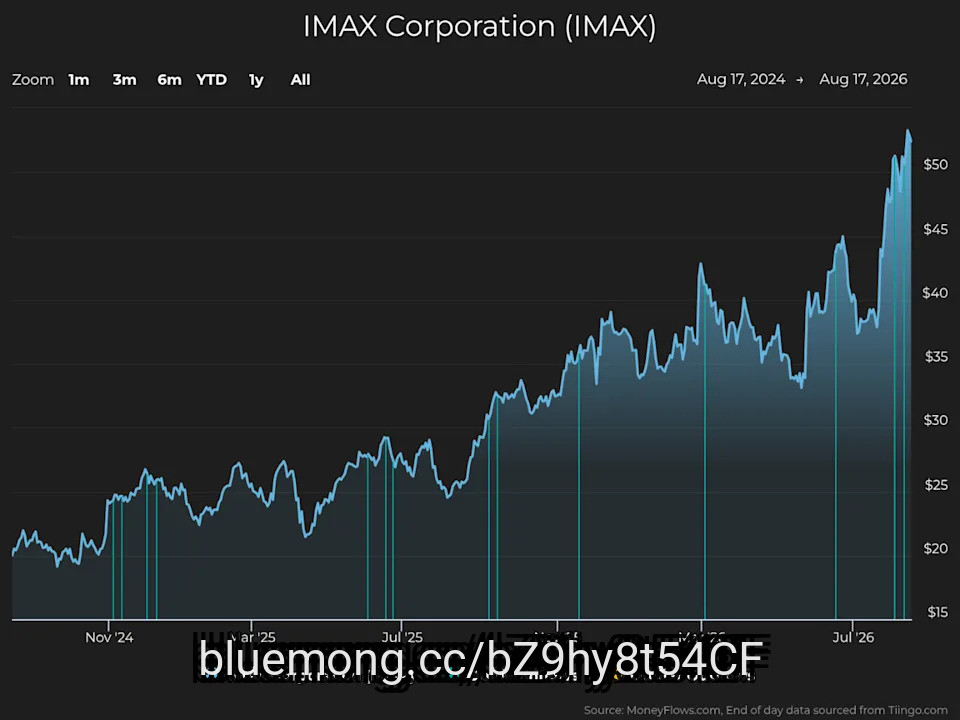
IMAX develops motion picture technologies and presentations, offering content, technology, and production solutions to customers around the world. The company's second-quarter fiscal 2026 report showed revenue of $103 million (a 12% year-over-year gain), with "The Odyssey" generating $52 million in global opening-weekend box office sales, adjusted per-share earnings of $0.43 (up 65%), and adjusted EBITDA of $48 million (a nearly 47% margin).
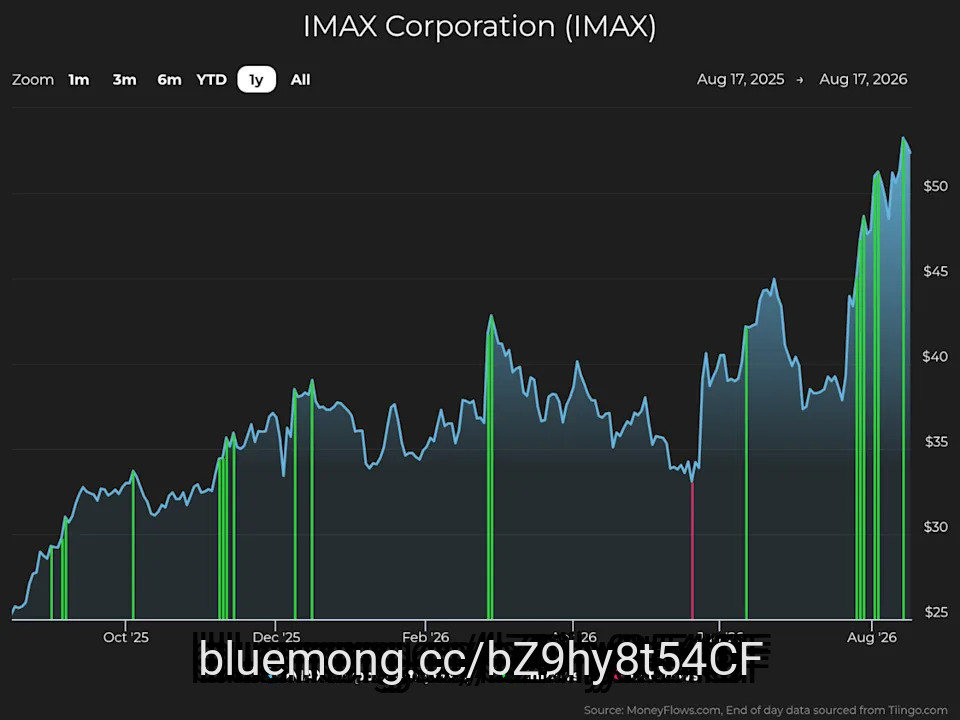
No wonder IMAX shares are up 42% so far this year – and they could rise more. MoneyFlows data shows how Big Money investors are again betting heavily on the stock.
Institutional volumes reveal plenty. In the last year, IMAX has enjoyed strong investor demand, which we believe to be institutional support.
Each green bar signals unusually large volumes in IMAX shares. They reflect our proprietary inflow signal, pushing the stock higher:
A year's worth of institutional inflows pushed IMAX shares higher by 103.5%. Source: www.moneyflows.com
#year #higher
2 months ago
DELL specializes in information technology infrastructure, workforce transformation, and technology connectivity solutions, with AI servers under heavy demand currently. In its first-quarter fiscal 2027 earnings report, Dell showed a record $43.8 billion in revenue (an 88% year-over-year gain), $16.1 billion in AI server revenue, non-GAAP per-share earnings of $4.86 (a 214% gain), and $2.1 billion returned to shareholders through repurchases and dividends. The company reports again on Sept. 3.
It's no wonder DELL shares are up 281% so far this year – and they could rise more. MoneyFlows data shows how Big Money investors are again betting heavily on the stock.
Institutional volumes reveal plenty. In the last year, DELL has enjoyed strong investor demand, which we believe to be institutional support.
Each green bar signals unusually large volumes in DELL shares. They reflect our proprietary inflow signal, pushing the stock higher:
DELL has experienced almost nothing but inflows from institutions, boosting shares over 245% in the last year. Source: www.moneyflows.com
#billion #shares #moneyflows