
1 hr. ago
No withdrawal order eliminates RMDs from a traditional IRA. Only Roth conversions, qualified charitable distributions, or never owning one in the first place can genuinely shrink them.
IRMAA surcharges hit Medicare premiums two years after the income that triggers them, jumping joint filers from $203 to $284 monthly by crossing $218,000 MAGI.
Letting an IRA compound untouched through your 60s forces larger RMDs at 73, often pushing retirees into higher brackets and through IRMAA cliffs simultaneously.
Read More: Avoid these 13 retirement mistakes before they derail your future (sponsor)
A $2.1 million nest egg split evenly between a taxable brokerage account and a traditional IRA can throw off a six-figure income. What most retirees miss is that where each holding sits and when each dollar comes out determine whether Medicare surcharges and a swollen required minimum distribution eat that income a decade later.
#medicare #surcharges #retirees #magi
IRMAA surcharges hit Medicare premiums two years after the income that triggers them, jumping joint filers from $203 to $284 monthly by crossing $218,000 MAGI.
Letting an IRA compound untouched through your 60s forces larger RMDs at 73, often pushing retirees into higher brackets and through IRMAA cliffs simultaneously.
Read More: Avoid these 13 retirement mistakes before they derail your future (sponsor)
A $2.1 million nest egg split evenly between a taxable brokerage account and a traditional IRA can throw off a six-figure income. What most retirees miss is that where each holding sits and when each dollar comes out determine whether Medicare surcharges and a swollen required minimum distribution eat that income a decade later.
#medicare #surcharges #retirees #magi


20 hours ago
A large land-sale gain can push Medicare Part B premiums from $203 to $690 monthly, with the IRMAA impact arriving two years after closing.
Federal installment-sale rules let sellers spread gain recognition across multiple years, softening Medicare surcharges and Social Security tax exposure.
Taking the full lump sum eliminates buyer default risk, but installment sales may only reduce years spent at peak IRMAA tiers, not avoid them entirely.
Just released. Our ***** ysts combed the entire stock market and named the ten best stocks to buy right now. The report is free. Enter your email and see if any of your stocks made the cut.
A retired man in his late sixties owns rural land that suddenly sits in the path of a data center developer. The offer runs into seven figures. He is ready to sell, but instead of taking every dollar at closing, he negotiates payments over several years.
#irmaa #gain
Federal installment-sale rules let sellers spread gain recognition across multiple years, softening Medicare surcharges and Social Security tax exposure.
Taking the full lump sum eliminates buyer default risk, but installment sales may only reduce years spent at peak IRMAA tiers, not avoid them entirely.
Just released. Our ***** ysts combed the entire stock market and named the ten best stocks to buy right now. The report is free. Enter your email and see if any of your stocks made the cut.
A retired man in his late sixties owns rural land that suddenly sits in the path of a data center developer. The offer runs into seven figures. He is ready to sell, but instead of taking every dollar at closing, he negotiates payments over several years.
#irmaa #gain


1 day ago
Delaying the first RMD to April 1 stacks two distributions on one tax return, potentially bundling over $150,000 in income for a $2 million IRA.
Medicare sets 2028 premiums using 2026 income, so a bunched RMD year can trigger IRMAA surcharges costing a married couple nearly $5,770 extra annually.
Taking the first RMD by December 31 instead of April 1 keeps both distributions on separate returns and eliminates the income-stacking problem entirely.
Read More: Learn 7 ways to generate income with a $1,000,000+ portfolio (sponsor)
A retiree turned 73 in 2025 and used the option Congress left him. Instead of taking his first required minimum distribution (RMD) by December 31, he delayed it until April 1, 2026. The second RMD was still due December 31, 2026. Two withdrawals landed on one tax return, and Medicare does not care that the first one "belonged" to 2025. Both dollars became 2026 income. The April deadline bought three months. It did not buy another tax year.
#taking #instead
Medicare sets 2028 premiums using 2026 income, so a bunched RMD year can trigger IRMAA surcharges costing a married couple nearly $5,770 extra annually.
Taking the first RMD by December 31 instead of April 1 keeps both distributions on separate returns and eliminates the income-stacking problem entirely.
Read More: Learn 7 ways to generate income with a $1,000,000+ portfolio (sponsor)
A retiree turned 73 in 2025 and used the option Congress left him. Instead of taking his first required minimum distribution (RMD) by December 31, he delayed it until April 1, 2026. The second RMD was still due December 31, 2026. Two withdrawals landed on one tax return, and Medicare does not care that the first one "belonged" to 2025. Both dollars became 2026 income. The April deadline bought three months. It did not buy another tax year.
#taking #instead


2 days ago
Less-than-truckload carrier Old Dominion Freight Line saw yield growth accelerate in August, but tonnage remained slightly negative, according to a Thursday update.
The Thomasville, North Carolina-based company's daily revenue increased 12.4% year over year in August, an improvement from the 8.2% y/y growth rate logged in July. However, diesel fuel prices increased 46% y/y in August compared with a 31% y/y increase in July. (Fuel was up 10% sequentially in August.)
Less-than-truckload fuel surcharge programs include a step function as diesel prices rise, typically resulting in better margins.
Old Dominion's (NASDAQ: ODFL) yield growth accelerated from July, both with and without fuel surcharges. August revenue per hundredweight (yield) was likely 13% higher y/y with fuel surcharges, and roughly 5.5% higher excluding fuel. The July growth rates were 9.3% and 4.2%, respectively. (Growth rates for the two months combined were 11.3% and 4.8%, respectively.) Higher shipment weights were a modest drag on the yield metrics in both months.
"Old Dominion produced solid revenue growth for July and August, with underlying demand trends remaining relatively consistent as the quarter has progressed," said Marty Freeman, president and CEO, in a news release. "In addition, the strength and consistency of our industry-leading service continue to support the ongoing improvement in our LTL revenue per hundredweight."
#revenue #higher
The Thomasville, North Carolina-based company's daily revenue increased 12.4% year over year in August, an improvement from the 8.2% y/y growth rate logged in July. However, diesel fuel prices increased 46% y/y in August compared with a 31% y/y increase in July. (Fuel was up 10% sequentially in August.)
Less-than-truckload fuel surcharge programs include a step function as diesel prices rise, typically resulting in better margins.
Old Dominion's (NASDAQ: ODFL) yield growth accelerated from July, both with and without fuel surcharges. August revenue per hundredweight (yield) was likely 13% higher y/y with fuel surcharges, and roughly 5.5% higher excluding fuel. The July growth rates were 9.3% and 4.2%, respectively. (Growth rates for the two months combined were 11.3% and 4.8%, respectively.) Higher shipment weights were a modest drag on the yield metrics in both months.
"Old Dominion produced solid revenue growth for July and August, with underlying demand trends remaining relatively consistent as the quarter has progressed," said Marty Freeman, president and CEO, in a news release. "In addition, the strength and consistency of our industry-leading service continue to support the ongoing improvement in our LTL revenue per hundredweight."
#revenue #higher



2 days ago
On August 26, Movado Group (NYSE:MOV) reported second-quarter fiscal 2027 results that pushed adjusted earnings per share to $0.54 from $0.23 a year earlier, while net sales climbed 4.9% to $169.8 million. The jewelry and watch company also confirmed it will stop issuing annual financial guidance going forward, choosing instead to focus commentary on near-term trends. For a business built on Swiss craftsmanship and a stable of licensed fashion brands, the quarter marked a fifth straight period of positive momentum, and it came with a few surprises tucked inside the numbers.
Some of the headline strength came from a one-time source: $3.2 million in IEEPA duty refunds tied to tariffs paid between February 2025 and May 2026, which lifted GAAP gross margin to 59.4% from 54.1%. But strip that out and adjusted gross margin still rose 340 basis points to 57.5%, driven by favorable channel and product mix, strategic pricing, and less discounting. Growth was broad rather than concentrated in one line item. US net sales rose 4.9%, international sales rose 4.9% as well (4.1% in constant currency), and Latin America and India posted particularly strong results.
Movado.com sales jumped 8%, and Olivia Burton sales grew 23%, powered by small-shaped watches focused on the U.K. and US markets. The company also flagged a resurgence in traditional watch interest among younger buyers, pointing to the Baby Face mini strap watch, which sold out more than 400 units on movado.com in under a month. Looking ahead, Movado is expanding its Tapestry partnership to launch Kate Spade watches starting next fiscal year. The balance sheet backs up the momentum, with $211.6 million in cash, no debt, and $16.6 million already returned to shareholders through dividends this year.
Not every piece of this quarter travels into the second half. Management was explicit that the favorable mix of lower duty rate inventory that padded margins is temporary and is not expected to continue, and second-half gross margin guidance of 55% to 56% reflects that normalization. Sallie DeMarsilis also noted that gross margin gains were partially offset by higher shipping costs tied to fuel surcharges and rising e-commerce volume.
Geographically, the Middle East remains a soft spot, with Efraim Grinberg citing tourism-related headwinds in a region still affected by regional conflict. Operating expenses rose to $85.7 million from $80.6 million, largely on higher performance-based compensation and marketing spend. There is also a smaller but notable item: a $0.2 million pretax charge tied to a misconduct investigation within a Dubai-based Swiss subsidiary branch. And while Movado expects to recover another $6.8 million in IEEPA duties, it has chosen not to recognize that gain until the cash actually arrives, a reminder that not all of this quarter's tailwind is guaranteed to repeat.
#second
Some of the headline strength came from a one-time source: $3.2 million in IEEPA duty refunds tied to tariffs paid between February 2025 and May 2026, which lifted GAAP gross margin to 59.4% from 54.1%. But strip that out and adjusted gross margin still rose 340 basis points to 57.5%, driven by favorable channel and product mix, strategic pricing, and less discounting. Growth was broad rather than concentrated in one line item. US net sales rose 4.9%, international sales rose 4.9% as well (4.1% in constant currency), and Latin America and India posted particularly strong results.
Movado.com sales jumped 8%, and Olivia Burton sales grew 23%, powered by small-shaped watches focused on the U.K. and US markets. The company also flagged a resurgence in traditional watch interest among younger buyers, pointing to the Baby Face mini strap watch, which sold out more than 400 units on movado.com in under a month. Looking ahead, Movado is expanding its Tapestry partnership to launch Kate Spade watches starting next fiscal year. The balance sheet backs up the momentum, with $211.6 million in cash, no debt, and $16.6 million already returned to shareholders through dividends this year.
Not every piece of this quarter travels into the second half. Management was explicit that the favorable mix of lower duty rate inventory that padded margins is temporary and is not expected to continue, and second-half gross margin guidance of 55% to 56% reflects that normalization. Sallie DeMarsilis also noted that gross margin gains were partially offset by higher shipping costs tied to fuel surcharges and rising e-commerce volume.
Geographically, the Middle East remains a soft spot, with Efraim Grinberg citing tourism-related headwinds in a region still affected by regional conflict. Operating expenses rose to $85.7 million from $80.6 million, largely on higher performance-based compensation and marketing spend. There is also a smaller but notable item: a $0.2 million pretax charge tied to a misconduct investigation within a Dubai-based Swiss subsidiary branch. And while Movado expects to recover another $6.8 million in IEEPA duties, it has chosen not to recognize that gain until the cash actually arrives, a reminder that not all of this quarter's tailwind is guaranteed to repeat.
#second


3 days ago
On August 3, The Andersons Inc. (NASDAQ:ANDE) reported second-quarter results that dwarfed last year's numbers, with net income attributable to the company climbing to $57 million, or $1.65 per diluted share, from just $7.9 million, or $0.23 per share, a year earlier. Adjusted net income reached $74 million, or $2.15 per share, versus $8.4 million, or $0.24 per share, in the second quarter of 2025. The turnaround leaned almost entirely on one business: renewable fuels.
Renewables did the heavy lifting. The segment posted a record second-quarter pretax income of $65 million, with the adjusted figure reaching $88 million, on record plant output and strong merchandising execution. Andersons credited its low-carbon strategy for $24 million in 45Z producer tax credits during the quarter, plus the first-quarter finalization of the Renewable Volume Obligations, which firmed up commodity markets and opened trading opportunities for the merchandising desk. Gains in distillers corn oil and RIN pricing also helped. Segment adjusted EBITDA came in at $103 million, more than triple the $30 million posted a year earlier.
Agribusiness improved too, if more modestly, with pretax income of $20 million, both on a GAAP and adjusted basis, up from $17 million in the prior-year quarter. Fertilizer margins strengthened even as volumes fell, and merchandising benefited from higher commodity prices and early-quarter volatility. The company is pushing further into low-carbon fuels, preparing a debottlenecking project at its Clymers, Indiana ethanol plant and advancing a Class VI well permit to capture more 45Z value. A new soybean meal export operation at the Port of Houston is expected online in the fourth quarter. Operating cash flow of $488 million for the quarter, up from $299 million a year earlier, gave the company room to keep funding those projects while holding long-term debt to EBITDA below its 2.5-times target.
The numbers come with caveats. Cash and cash equivalents stood at just $66.5 million at the end of the second quarter, down from $351 million a year earlier, even as short-term debt climbed to $314 million from $104 million. Much of that swing traces to working capital timing and investment spending rather than distress, but it leaves less cushion than the company carried a year ago.
In Agribusiness, the fertilizer and merchandising gains were partly offset by fuel surcharges, a reminder that the segment's profitability still moves with input costs it does not control. Andersons also warned that a drier stretch across its western growing regions could weigh on grain-asset profits this fall, even though better conditions in the eastern corn belt cut the other way, and that grower economics could limit fertilizer purchasing heading into the fall application season.
#million #year #income #Share
Renewables did the heavy lifting. The segment posted a record second-quarter pretax income of $65 million, with the adjusted figure reaching $88 million, on record plant output and strong merchandising execution. Andersons credited its low-carbon strategy for $24 million in 45Z producer tax credits during the quarter, plus the first-quarter finalization of the Renewable Volume Obligations, which firmed up commodity markets and opened trading opportunities for the merchandising desk. Gains in distillers corn oil and RIN pricing also helped. Segment adjusted EBITDA came in at $103 million, more than triple the $30 million posted a year earlier.
Agribusiness improved too, if more modestly, with pretax income of $20 million, both on a GAAP and adjusted basis, up from $17 million in the prior-year quarter. Fertilizer margins strengthened even as volumes fell, and merchandising benefited from higher commodity prices and early-quarter volatility. The company is pushing further into low-carbon fuels, preparing a debottlenecking project at its Clymers, Indiana ethanol plant and advancing a Class VI well permit to capture more 45Z value. A new soybean meal export operation at the Port of Houston is expected online in the fourth quarter. Operating cash flow of $488 million for the quarter, up from $299 million a year earlier, gave the company room to keep funding those projects while holding long-term debt to EBITDA below its 2.5-times target.
The numbers come with caveats. Cash and cash equivalents stood at just $66.5 million at the end of the second quarter, down from $351 million a year earlier, even as short-term debt climbed to $314 million from $104 million. Much of that swing traces to working capital timing and investment spending rather than distress, but it leaves less cushion than the company carried a year ago.
In Agribusiness, the fertilizer and merchandising gains were partly offset by fuel surcharges, a reminder that the segment's profitability still moves with input costs it does not control. Andersons also warned that a drier stretch across its western growing regions could weigh on grain-asset profits this fall, even though better conditions in the eastern corn belt cut the other way, and that grower economics could limit fertilizer purchasing heading into the fall application season.
#million #year #income #Share

4 days ago
On August 25, Citi Trends (NASDAQ:CTRN) reported second-quarter results that pushed its comparable sales growth streak to eight consecutive quarters, and this time the momentum showed up on the bottom line. Total sales rose 10.9% to $211.6 million, comparable sales climbed 10.5%, and adjusted EBITDA swung from a $1.1 million loss a year ago to $5.5 million. That improvement helped push first-half EBITDA to $19.4 million, already ahead of everything the company generated in all of fiscal 2025. Management responded by raising its full-year outlook across nearly every metric that matters.
The eighth straight quarter of comparable sales growth stands out on its own, especially with the two-year stack running at 19.7%, but the more telling shift is what happened underneath it. Gross margin expanded 60 basis points to 40.6% on better merchandise margin and lower shrinkage, while adjusted SG&A leveraged 260 basis points as fixed costs spread across a bigger sales base. Store payroll leveraged 70 basis points, and distribution center costs fell 60 basis points year to date, evidencing that the efficiency gains are showing up across the operation rather than in one line item. That combination pushed adjusted EBITDA margin to 2.6% for the quarter, and management raised full-year sales guidance to 10% to 12% growth, comparable sales guidance to 9% to 11%, and adjusted EBITDA guidance to $38 million to $42 million.
The balance sheet backs up the story. Citi Trends ended the quarter with $55.9 million in cash, no debt, and no draw on its $75 million credit facility, even as merchandise inventory grew a controlled 7.5% against double-digit comparable sales growth. The company is also leaning on a customer base broader than the discount label suggests: shoppers with household incomes between $75,000 and $150,000 make up 25% of customers but generate more than 40% of revenue. Management is funding growth accordingly, shifting capital toward its remodel program, now expected to cover 60 to 65 stores this year, up from 50, while building newer levers like the Insiders Club loyalty platform launched July 15 and AI tools for allocation and site selection. CEO Kenneth Seipel described the program as one that "turns traffic into loyalty, loyalty into frequency, and frequency into EBITDA."
Not everything in the print was clean. CFO Heather Plutino noted that rising fuel surcharges are pushing freight costs higher and said the pressure should continue for the rest of the year, a headwind that partially offset the gross margin gains. New store openings were also trimmed, with fiscal 2026 guidance cut to around 20 locations from a prior target of 25 due to timing, even as capital shifted toward remodels instead of new boxes.
#sales #million #comparable #quarter
The eighth straight quarter of comparable sales growth stands out on its own, especially with the two-year stack running at 19.7%, but the more telling shift is what happened underneath it. Gross margin expanded 60 basis points to 40.6% on better merchandise margin and lower shrinkage, while adjusted SG&A leveraged 260 basis points as fixed costs spread across a bigger sales base. Store payroll leveraged 70 basis points, and distribution center costs fell 60 basis points year to date, evidencing that the efficiency gains are showing up across the operation rather than in one line item. That combination pushed adjusted EBITDA margin to 2.6% for the quarter, and management raised full-year sales guidance to 10% to 12% growth, comparable sales guidance to 9% to 11%, and adjusted EBITDA guidance to $38 million to $42 million.
The balance sheet backs up the story. Citi Trends ended the quarter with $55.9 million in cash, no debt, and no draw on its $75 million credit facility, even as merchandise inventory grew a controlled 7.5% against double-digit comparable sales growth. The company is also leaning on a customer base broader than the discount label suggests: shoppers with household incomes between $75,000 and $150,000 make up 25% of customers but generate more than 40% of revenue. Management is funding growth accordingly, shifting capital toward its remodel program, now expected to cover 60 to 65 stores this year, up from 50, while building newer levers like the Insiders Club loyalty platform launched July 15 and AI tools for allocation and site selection. CEO Kenneth Seipel described the program as one that "turns traffic into loyalty, loyalty into frequency, and frequency into EBITDA."
Not everything in the print was clean. CFO Heather Plutino noted that rising fuel surcharges are pushing freight costs higher and said the pressure should continue for the rest of the year, a headwind that partially offset the gross margin gains. New store openings were also trimmed, with fiscal 2026 guidance cut to around 20 locations from a prior target of 25 due to timing, even as capital shifted toward remodels instead of new boxes.
#sales #million #comparable #quarter


5 days ago
MD Sass, a boutique ****** et management firm, published its second-quarter investor update for its flagship, the "MD Sass Concentrated Value Strategy." The letter can be downloaded here. In the first half of 2026, AI infrastructure stocks led the market, with the Russell 1000 Value increasing by 16.3%, outpacing the S&P 500 (10.2%) and Russell 1000 Growth (5.3%). This growth was fueled by semiconductor, memory, and hardware companies benefiting from AI development, even though they are considered cyclical. These sectors, representing only 7.7% of the Russell 1000 Value at the start of the year, contributed nearly 70% of its returns. The portfolio gained 10.0% in the second quarter, net of fees, compared to 13.9% for the Russell 1000 Value Index. Year-to-date, the strategy returned 6.6%, net of fees, versus 16.3% for the Index. The portfolio faced challenges due to limited exposure to companies with the greatest upside from AI infrastructure investments. It also lacked exposure to the Energy sector, which returned about 20% in the first half amid geopolitical tensions with Iran that increased commodity prices, affecting performance. The firm recognizes the importance of adapting its strategies while maintaining core investment principles as it explores future opportunities in emerging technological themes. Also, check the fund's top five holdings to see its best picks in 2026.
In its second-quarter 2026 investor letter, MD Sass Concentrated Value Strategy highlighted Knight-Swift Transportation Holdings Inc. (NYSE:KNX). Knight-Swift Transportation Holdings Inc. (NYSE:KNX) is a freight transportation services provider that operates through Truckload, Less-than-truckload (LTL), Logistics, and Intermodal segments. On August 28, 2026, Knight-Swift Transportation Holdings Inc. (NYSE:KNX) closed at $67.24 per share, reflecting a market capitalization of $10.94 billion. Knight-Swift Transportation Holdings Inc. (NYSE:KNX) posted a one‑month return of ‑1.04%, while its shares gained 54.24% over the past 52 weeks.
MD Sass Concentrated Value Strategy stated the following regarding Knight-Swift Transportation Holdings Inc. (NYSE:KNX) in its Q2 2026 investor letter:
"Knight-Swift Transportation Holdings Inc. (NYSE:KNX) operates the largest full-truckload fleet in North America and operates approximately 21,000 tractors across its irregular route and dedicated fleets. Excluding fuel surcharges and intersegment transactions, Truckload represents approximately 63% of revenue, less-than-truckload represents 19%, logistics 8%, and intermodal 5%.
Trucking is a cyclical, fragmented, and historically low-margin business, and for those reasons we have avoided it. So why own it now? We believe the industry is entering a rate cycle that is meaningfully different from the demand-driven cycles of the past. This cycle is being manufactured on the supply side through a combination of economic attrition, regulatory enforcement, and increased legal liability. Importantly
In its second-quarter 2026 investor letter, MD Sass Concentrated Value Strategy highlighted Knight-Swift Transportation Holdings Inc. (NYSE:KNX). Knight-Swift Transportation Holdings Inc. (NYSE:KNX) is a freight transportation services provider that operates through Truckload, Less-than-truckload (LTL), Logistics, and Intermodal segments. On August 28, 2026, Knight-Swift Transportation Holdings Inc. (NYSE:KNX) closed at $67.24 per share, reflecting a market capitalization of $10.94 billion. Knight-Swift Transportation Holdings Inc. (NYSE:KNX) posted a one‑month return of ‑1.04%, while its shares gained 54.24% over the past 52 weeks.
MD Sass Concentrated Value Strategy stated the following regarding Knight-Swift Transportation Holdings Inc. (NYSE:KNX) in its Q2 2026 investor letter:
"Knight-Swift Transportation Holdings Inc. (NYSE:KNX) operates the largest full-truckload fleet in North America and operates approximately 21,000 tractors across its irregular route and dedicated fleets. Excluding fuel surcharges and intersegment transactions, Truckload represents approximately 63% of revenue, less-than-truckload represents 19%, logistics 8%, and intermodal 5%.
Trucking is a cyclical, fragmented, and historically low-margin business, and for those reasons we have avoided it. So why own it now? We believe the industry is entering a rate cycle that is meaningfully different from the demand-driven cycles of the past. This cycle is being manufactured on the supply side through a combination of economic attrition, regulatory enforcement, and increased legal liability. Importantly


5 days ago
On August 25, Citi Trends (NASDAQ:CTRN) reported second-quarter results that pushed its comparable sales growth streak to eight consecutive quarters, and this time the momentum showed up on the bottom line. Total sales rose 10.9% to $211.6 million, comparable sales climbed 10.5%, and adjusted EBITDA swung from a $1.1 million loss a year ago to $5.5 million. That improvement helped push first-half EBITDA to $19.4 million, already ahead of everything the company generated in all of fiscal 2025. Management responded by raising its full-year outlook across nearly every metric that matters.
The eighth straight quarter of comparable sales growth stands out on its own, especially with the two-year stack running at 19.7%, but the more telling shift is what happened underneath it. Gross margin expanded 60 basis points to 40.6% on better merchandise margin and lower shrinkage, while adjusted SG&A leveraged 260 basis points as fixed costs spread across a bigger sales base. Store payroll leveraged 70 basis points, and distribution center costs fell 60 basis points year to date, evidencing that the efficiency gains are showing up across the operation rather than in one line item. That combination pushed adjusted EBITDA margin to 2.6% for the quarter, and management raised full-year sales guidance to 10% to 12% growth, comparable sales guidance to 9% to 11%, and adjusted EBITDA guidance to $38 million to $42 million.
The balance sheet backs up the story. Citi Trends ended the quarter with $55.9 million in cash, no debt, and no draw on its $75 million credit facility, even as merchandise inventory grew a controlled 7.5% against double-digit comparable sales growth. The company is also leaning on a customer base broader than the discount label suggests: shoppers with household incomes between $75,000 and $150,000 make up 25% of customers but generate more than 40% of revenue. Management is funding growth accordingly, shifting capital toward its remodel program, now expected to cover 60 to 65 stores this year, up from 50, while building newer levers like the Insiders Club loyalty platform launched July 15 and AI tools for allocation and site selection. CEO Kenneth Seipel described the program as one that "turns traffic into loyalty, loyalty into frequency, and frequency into EBITDA."
Not everything in the print was clean. CFO Heather Plutino noted that rising fuel surcharges are pushing freight costs higher and said the pressure should continue for the rest of the year, a headwind that partially offset the gross margin gains. New store openings were also trimmed, with fiscal 2026 guidance cut to around 20 locations from a prior target of 25 due to timing, even as capital shifted toward remodels instead of new boxes.
#year #ebitda #quarter #Margin
The eighth straight quarter of comparable sales growth stands out on its own, especially with the two-year stack running at 19.7%, but the more telling shift is what happened underneath it. Gross margin expanded 60 basis points to 40.6% on better merchandise margin and lower shrinkage, while adjusted SG&A leveraged 260 basis points as fixed costs spread across a bigger sales base. Store payroll leveraged 70 basis points, and distribution center costs fell 60 basis points year to date, evidencing that the efficiency gains are showing up across the operation rather than in one line item. That combination pushed adjusted EBITDA margin to 2.6% for the quarter, and management raised full-year sales guidance to 10% to 12% growth, comparable sales guidance to 9% to 11%, and adjusted EBITDA guidance to $38 million to $42 million.
The balance sheet backs up the story. Citi Trends ended the quarter with $55.9 million in cash, no debt, and no draw on its $75 million credit facility, even as merchandise inventory grew a controlled 7.5% against double-digit comparable sales growth. The company is also leaning on a customer base broader than the discount label suggests: shoppers with household incomes between $75,000 and $150,000 make up 25% of customers but generate more than 40% of revenue. Management is funding growth accordingly, shifting capital toward its remodel program, now expected to cover 60 to 65 stores this year, up from 50, while building newer levers like the Insiders Club loyalty platform launched July 15 and AI tools for allocation and site selection. CEO Kenneth Seipel described the program as one that "turns traffic into loyalty, loyalty into frequency, and frequency into EBITDA."
Not everything in the print was clean. CFO Heather Plutino noted that rising fuel surcharges are pushing freight costs higher and said the pressure should continue for the rest of the year, a headwind that partially offset the gross margin gains. New store openings were also trimmed, with fiscal 2026 guidance cut to around 20 locations from a prior target of 25 due to timing, even as capital shifted toward remodels instead of new boxes.
#year #ebitda #quarter #Margin


8 days ago
Nursing home bills can wipe out the tax on a Roth conversion when both occur in the same year, because deductible medical costs above 7.5% of AGI offset conversion income.
The strategy requires itemizing deductions and works only when the IRA owner and the patient are the same person, a spouse, or a qualifying dependent.
Each converted dollar raises AGI, lifting the 7.5% deduction floor, and a larger MAGI can trigger IRMAA Medicare surcharges two years later.
Read More: Learn 7 ways to generate income with a $1,000,000+ portfolio (sponsor)
If you have a traditional IRA and someone in your household faces catastrophic nursing home bills, a tax interaction exists. A Roth conversion executed in the same year as enormous deductible medical costs can move IRA dollars into a Roth at a fraction of their normal tax cost, because the medical expense itemized deduction absorbs the taxable income the conversion generates. The strategy pairs two ordinary tools most people use separately, and the window closes at year-end.
#deductible
The strategy requires itemizing deductions and works only when the IRA owner and the patient are the same person, a spouse, or a qualifying dependent.
Each converted dollar raises AGI, lifting the 7.5% deduction floor, and a larger MAGI can trigger IRMAA Medicare surcharges two years later.
Read More: Learn 7 ways to generate income with a $1,000,000+ portfolio (sponsor)
If you have a traditional IRA and someone in your household faces catastrophic nursing home bills, a tax interaction exists. A Roth conversion executed in the same year as enormous deductible medical costs can move IRA dollars into a Roth at a fraction of their normal tax cost, because the medical expense itemized deduction absorbs the taxable income the conversion generates. The strategy pairs two ordinary tools most people use separately, and the window closes at year-end.
#deductible


12 days ago
Our **** ysts just identified a stock with the potential to be the next Nvidia. Tell us how you invest and we'll show you why it's our #1 pick. Tap here.
Achieved eighth consecutive quarter of comparable store sales growth, driven by a balanced increase in both transaction counts and basket size.
Refined 'good, better, best' pricing tiers to capture a broad demographic, noting that 25% of customers earn between $75,000 and $150,000 and generate 40% of revenue.
Leveraged AI-driven allocation systems and enterprise data tools to improve inventory productivity and merchandising efficiency.
Improved selling margins and reduced shrinkage through store-level technology investments, successfully offsetting increased transportation fuel surcharges.
#leveraged
Achieved eighth consecutive quarter of comparable store sales growth, driven by a balanced increase in both transaction counts and basket size.
Refined 'good, better, best' pricing tiers to capture a broad demographic, noting that 25% of customers earn between $75,000 and $150,000 and generate 40% of revenue.
Leveraged AI-driven allocation systems and enterprise data tools to improve inventory productivity and merchandising efficiency.
Improved selling margins and reduced shrinkage through store-level technology investments, successfully offsetting increased transportation fuel surcharges.
#leveraged


13 days ago
St. George retirement at 65 demands a $525,000 paid-off home plus $450,000 in invested ******* ets, ******* uming a 4% withdrawal rate and full Social Security.
Retiring at 62 instead of 67 shrinks Social Security by 30% and tightens the safe withdrawal rate, pushing the required liquid portfolio to $1.1 million.
Utah's flat tax on all retirement income can combine with Medicare IRMAA surcharges to push large Roth conversions toward a 40% effective marginal rate.
Are you ahead, or behind on retirement? SmartAsset's free tool can match you with a financial advisor in minutes to help you answer that today. Each advisor has been carefully vetted, and must act in your best interests. Don't waste another minute; learn more here.
St. George, Utah, keeps surfacing whenever readers who are planning to retire in five or ten years ask about fast-growing retirement destinations outside Florida and Arizona. Tucked into the red rock country of the state's southwest corner, it has mild winters, nearby national parks, and has climbed the fastest-growing metro rankings for years while drawing a large share of retirees. What follows walks through the actual cost picture in current dollars, the portfolio target that budget implies, and the tax mechanic most buyers overlook until they file that first return.
#rate #Portfolio
Retiring at 62 instead of 67 shrinks Social Security by 30% and tightens the safe withdrawal rate, pushing the required liquid portfolio to $1.1 million.
Utah's flat tax on all retirement income can combine with Medicare IRMAA surcharges to push large Roth conversions toward a 40% effective marginal rate.
Are you ahead, or behind on retirement? SmartAsset's free tool can match you with a financial advisor in minutes to help you answer that today. Each advisor has been carefully vetted, and must act in your best interests. Don't waste another minute; learn more here.
St. George, Utah, keeps surfacing whenever readers who are planning to retire in five or ten years ask about fast-growing retirement destinations outside Florida and Arizona. Tucked into the red rock country of the state's southwest corner, it has mild winters, nearby national parks, and has climbed the fastest-growing metro rankings for years while drawing a large share of retirees. What follows walks through the actual cost picture in current dollars, the portfolio target that budget implies, and the tax mechanic most buyers overlook until they file that first return.
#rate #Portfolio

15 days ago
Discover how intermodal freight is delivering massive savings in today's volatile market. As truckload spot and contract rates stabilize, intermodal options provide a crucial cost-saving advantage, especially on key lanes. Learn where to find the biggest savings and how shifting modes can optimize your freight spend.
Intermodal savings have surged to their highest level in several years, driven by a widening gap between rising truckload rates and relatively flat intermodal pricing, according to FreightWaves SONAR data presented by Julie Van de Kamp during a live update from the College Football Hall of Fame.
On the Harrisburg, Pennsylvania, to Atlanta lane — one of the top savings lanes in SONAR's intermodal dashboard — van spot truckload rates are up approximately 42%, van contract rates are up about 26%, and intermodal rates have risen only 16%, making a compelling case for mode conversion. East Coast corridors, particularly those out of Atlanta and Harrisburg, are leading the savings rankings, with lanes including Atlanta to Chicago, Atlanta to Joliet, Atlanta to Elizabeth, New Jersey, and Harrisburg to both Ontario, California, and Los Angeles all trending upward in the savings index over the most recent three months.
"That is such a good reason to consider mode conversion, take advantage of those savings, and understand where that helps even in a backhaul lane like what would typically be PA to Chicago at a length of haul that's not transcon," said Julie Van de Kamp.
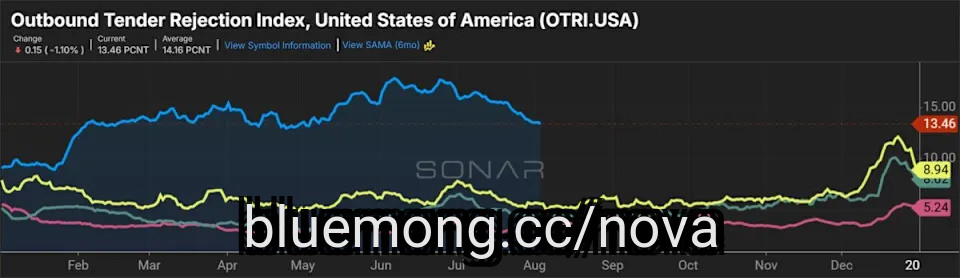
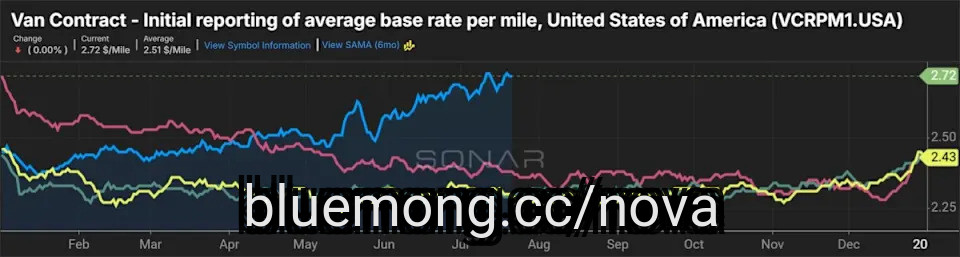
The broader market context reinforces the intermodal value proposition. Tender rejections saw a significant drop from July 20 to August 5 but are now stabilizing, and spot rates, while down from earlier peaks year to date, are also leveling off. Meanwhile, contract truckload rates continue to rise, narrowing the gap between spot and contract. Van de Kamp noted a roughly 66-cent-per-mile spread between spot rates on the NTI and contract rates on the VCRPM1, though she cautioned that spot rates are all-in while contract rates are linehaul only — with fuel surcharges running approximately $0.70 per mile based on a Department of Energy estimate of around $45.
#spot #kamp
Intermodal savings have surged to their highest level in several years, driven by a widening gap between rising truckload rates and relatively flat intermodal pricing, according to FreightWaves SONAR data presented by Julie Van de Kamp during a live update from the College Football Hall of Fame.
On the Harrisburg, Pennsylvania, to Atlanta lane — one of the top savings lanes in SONAR's intermodal dashboard — van spot truckload rates are up approximately 42%, van contract rates are up about 26%, and intermodal rates have risen only 16%, making a compelling case for mode conversion. East Coast corridors, particularly those out of Atlanta and Harrisburg, are leading the savings rankings, with lanes including Atlanta to Chicago, Atlanta to Joliet, Atlanta to Elizabeth, New Jersey, and Harrisburg to both Ontario, California, and Los Angeles all trending upward in the savings index over the most recent three months.
"That is such a good reason to consider mode conversion, take advantage of those savings, and understand where that helps even in a backhaul lane like what would typically be PA to Chicago at a length of haul that's not transcon," said Julie Van de Kamp.
The broader market context reinforces the intermodal value proposition. Tender rejections saw a significant drop from July 20 to August 5 but are now stabilizing, and spot rates, while down from earlier peaks year to date, are also leveling off. Meanwhile, contract truckload rates continue to rise, narrowing the gap between spot and contract. Van de Kamp noted a roughly 66-cent-per-mile spread between spot rates on the NTI and contract rates on the VCRPM1, though she cautioned that spot rates are all-in while contract rates are linehaul only — with fuel surcharges running approximately $0.70 per mile based on a Department of Energy estimate of around $45.
#spot #kamp

19 days ago
Social Security's earnings test ignores 401(k) withdrawals entirely, counting only wages and net self-employment income against the 2026 limit of $24,480.
A $70,000 traditional 401(k) withdrawal enters IRS provisional income calculations, potentially making up to 85% of Social Security benefits taxable at ordinary rates.
Large 401(k) distributions can trigger IRMAA Medicare premium surcharges with a two-year delay, so a 2026 withdrawal may raise 2028 Part B and Part D costs.
Many financial professionals are salespeople paid on what they push, not whether you end up wealthier. A fiduciary is the opposite. The SEC legally requires them to put your interests first. Advisor.com's free matching tool pairs you with vetted fiduciaries from major national firms, all in under three minutes. See who you match with today.
Picture a 63-year-old who left his full-time shop job last year, started drawing Social Security early, and now picks up welding and small fabrication work from his garage. In a single year, he withdraws $70,000 from a traditional 401(k) to cover the mortgage and buy a truck. After business expenses, his welding work produces $10,000 in net self-employment earnings. He ***** umes the government sees $80,000 in income. Social Security does not. Its retirement earnings test looks only at the $10,000.
#security #year #income #part
A $70,000 traditional 401(k) withdrawal enters IRS provisional income calculations, potentially making up to 85% of Social Security benefits taxable at ordinary rates.
Large 401(k) distributions can trigger IRMAA Medicare premium surcharges with a two-year delay, so a 2026 withdrawal may raise 2028 Part B and Part D costs.
Many financial professionals are salespeople paid on what they push, not whether you end up wealthier. A fiduciary is the opposite. The SEC legally requires them to put your interests first. Advisor.com's free matching tool pairs you with vetted fiduciaries from major national firms, all in under three minutes. See who you match with today.
Picture a 63-year-old who left his full-time shop job last year, started drawing Social Security early, and now picks up welding and small fabrication work from his garage. In a single year, he withdraws $70,000 from a traditional 401(k) to cover the mortgage and buy a truck. After business expenses, his welding work produces $10,000 in net self-employment earnings. He ***** umes the government sees $80,000 in income. Social Security does not. Its retirement earnings test looks only at the $10,000.
#security #year #income #part


23 days ago
The HSA is the only account delivering all three tax advantages: deductible contributions (including FICA savings), tax-free growth, and tax-free qualified withdrawals.
Invest HSA funds in equity index funds, pay current medical bills from cash, and save receipts to reimburse yourself tax-free decades later.
After 65, HSA medical withdrawals don't count toward MAGI, helping retirees dodge IRMAA surcharges that add hundreds per month to Medicare premiums.
Are you ahead, or behind on retirement? SmartAsset's free tool can match you with a financial advisor in minutes to help you answer that today. Each advisor has been carefully vetted, and must act in your best interests. Don't waste another minute; learn more here.
Walk into any physician lounge and you'll hear the same advice from the partners closing in on 60: fund the match in your 401(k), then send the next dollar to your Health Savings Account before you finish the deferral. The HSA is the only account in the federal code that escapes tax three separate times, and the people who do tax math for a living treat it accordingly.
#free #don 't #only #three
Invest HSA funds in equity index funds, pay current medical bills from cash, and save receipts to reimburse yourself tax-free decades later.
After 65, HSA medical withdrawals don't count toward MAGI, helping retirees dodge IRMAA surcharges that add hundreds per month to Medicare premiums.
Are you ahead, or behind on retirement? SmartAsset's free tool can match you with a financial advisor in minutes to help you answer that today. Each advisor has been carefully vetted, and must act in your best interests. Don't waste another minute; learn more here.
Walk into any physician lounge and you'll hear the same advice from the partners closing in on 60: fund the match in your 401(k), then send the next dollar to your Health Savings Account before you finish the deferral. The HSA is the only account in the federal code that escapes tax three separate times, and the people who do tax math for a living treat it accordingly.
#free #don 't #only #three


27 days ago
The Trump administration's Department of Transportation (DOT) has proposed loosening a 2011 Obama-era rule that requires airlines and travel sites to show the total price travelers actually pay.
The current "full fare advertising rule," which centers on consumer protection, requires both U.S. and foreign air carriers and ticket agents that advertise airfares to "state the entire price to be paid by the customer, inclusive of all mandatory taxes and fees," (including both government and carrier surcharges) at the first mention. The rule also prohibits any sellers of air transportation from "displaying in airfare advertisements charges that are included within the airfare more prominently or in the same or larger font size than the total single price."
Jeff Bezos backs a platform that lets anyone invest in rental homes for as little as $100 — 6 ways to build wealth like a landlord without actually being one
Dave Ramsey warns nearly 50% of Americans are making 1 big Social Security mistake. Here's what it is and 3 simple steps to fix it ASAP
Millionaires under 43 hold only 25% of their wealth in stocks. Here's where their money is actually going
#requires #airfare #wealth #department
The current "full fare advertising rule," which centers on consumer protection, requires both U.S. and foreign air carriers and ticket agents that advertise airfares to "state the entire price to be paid by the customer, inclusive of all mandatory taxes and fees," (including both government and carrier surcharges) at the first mention. The rule also prohibits any sellers of air transportation from "displaying in airfare advertisements charges that are included within the airfare more prominently or in the same or larger font size than the total single price."
Jeff Bezos backs a platform that lets anyone invest in rental homes for as little as $100 — 6 ways to build wealth like a landlord without actually being one
Dave Ramsey warns nearly 50% of Americans are making 1 big Social Security mistake. Here's what it is and 3 simple steps to fix it ASAP
Millionaires under 43 hold only 25% of their wealth in stocks. Here's where their money is actually going
#requires #airfare #wealth #department


28 days ago
Medicare's two-year lookback means a 2026 distribution sets 2028 premiums, costing married couples up to $1,783 yearly once MAGI exceeds $137,000.
Crossing $109,000 MAGI can make 85% of Social Security taxable, stacking costs that push the effective marginal rate on 401(k) withdrawals toward 40%.
Retirees can limit surcharges by modeling MAGI below thresholds, using QCDs up to $111,000 from an IRA, or filing Form SSA-44 after life-changing events.
Are you ahead, or behind on retirement? SmartAsset's free tool can match you with a financial advisor in minutes to help you answer that today. Each advisor has been carefully vetted, and must act in your best interests. Don't waste another minute; learn more here.
A 66-year-old retiree with $1.4 million in a traditional 401(k) pulls $60,000 in 2026 to renovate a kitchen. Combined with $28,000 in Social Security and a modest pension, modified adjusted gross income lands at $112,000. Nothing dramatic happens on the 1040. In January 2028, the Medicare bill jumps.
#security #year
Crossing $109,000 MAGI can make 85% of Social Security taxable, stacking costs that push the effective marginal rate on 401(k) withdrawals toward 40%.
Retirees can limit surcharges by modeling MAGI below thresholds, using QCDs up to $111,000 from an IRA, or filing Form SSA-44 after life-changing events.
Are you ahead, or behind on retirement? SmartAsset's free tool can match you with a financial advisor in minutes to help you answer that today. Each advisor has been carefully vetted, and must act in your best interests. Don't waste another minute; learn more here.
A 66-year-old retiree with $1.4 million in a traditional 401(k) pulls $60,000 in 2026 to renovate a kitchen. Combined with $28,000 in Social Security and a modest pension, modified adjusted gross income lands at $112,000. Nothing dramatic happens on the 1040. In January 2028, the Medicare bill jumps.
#security #year


28 days ago
United Parcel Service, Inc. (NYSE:UPS) shares surged in premarket trading on July 28 after the package-delivery company reported a second-quarter beat and raised its 2026 outlook. Revenue reached $22.83 billion, above the $21.81 billion consensus estimate, while adjusted earnings of $1.76 per share exceeded the $1.66 estimate. UPS now expects full-year revenue of approximately $91.2 billion, up from $89.7 billion, and adjusted earnings of approximately $7.22 per share.
The more important development was operational. Eighteen months after announcing an accelerated reduction in lower-margin Amazon volume, UPS said it had completed the planned "glide down" and the related phase of its network reconfiguration. That did not end the Amazon relationship: Amazon had accounted for more than 13% of UPS revenue at its peak, but its contribution had fallen to 8.8% by the end of the first quarter.
That strategy was always supposed to make UPS smaller before making it more profitable. The second quarter offered the clearest evidence yet that the second part may finally be starting. U.S. Domestic average daily package volume fell 3.3%, but revenue rose 6% as revenue per piece increased 9.3%. Adjusted domestic operating profit increased 21%, lifting the segment's adjusted margin to 8% from roughly 7% a year earlier.
Still, the margin remains well below the International segment's 12.4%, and fuel surcharges contributed to the stronger revenue-per-piece result. The core tension is whether UPS has created a durably more profitable domestic network, or whether fuel surcharges and temporary restructuring effects made one quarter look better than the underlying cost structure.
The bull case is that UPS has begun to prove the logic behind sacrificing Amazon volume: fewer packages can produce more revenue and profit when the packages that remain carry better yields.
#revenue #Margin
The more important development was operational. Eighteen months after announcing an accelerated reduction in lower-margin Amazon volume, UPS said it had completed the planned "glide down" and the related phase of its network reconfiguration. That did not end the Amazon relationship: Amazon had accounted for more than 13% of UPS revenue at its peak, but its contribution had fallen to 8.8% by the end of the first quarter.
That strategy was always supposed to make UPS smaller before making it more profitable. The second quarter offered the clearest evidence yet that the second part may finally be starting. U.S. Domestic average daily package volume fell 3.3%, but revenue rose 6% as revenue per piece increased 9.3%. Adjusted domestic operating profit increased 21%, lifting the segment's adjusted margin to 8% from roughly 7% a year earlier.
Still, the margin remains well below the International segment's 12.4%, and fuel surcharges contributed to the stronger revenue-per-piece result. The core tension is whether UPS has created a durably more profitable domestic network, or whether fuel surcharges and temporary restructuring effects made one quarter look better than the underlying cost structure.
The bull case is that UPS has begun to prove the logic behind sacrificing Amazon volume: fewer packages can produce more revenue and profit when the packages that remain carry better yields.
#revenue #Margin


1 month ago
Medicare's two-year lookback treats a one-time home sale gain as recurring income, spiking Part B premiums for retirees who enroll at 65.
A single filer with MAGI above $500,000 pays $689.90 monthly for Part B alone, up from the standard $203, plus extra Part D surcharges.
The IRMAA surcharge is temporary, but timing the home sale outside the two-year Medicare lookback window can prevent it entirely.
Are you ahead, or behind on retirement? SmartAsset's free tool can match you with a financial advisor in minutes to help you answer that today. Each advisor has been carefully vetted, and must act in your best interests. Don't waste another minute; learn more here.
The scenario is common enough that Medicare planners have a name for it: the IRMAA cliff. A homeowner sells her longtime residence at 63, walks away with a large capital gain, and files a tax return that looks nothing like her usual retirement income. Two years later, when she enrolls in Medicare at 65, the Social Security Administration reaches back to that inflated return and prices her Part B and Part D premiums as if she earns that much every year. In reality, the gain was a one-time event, while the surcharge lingers.
#gain #irmaa #time #sale
A single filer with MAGI above $500,000 pays $689.90 monthly for Part B alone, up from the standard $203, plus extra Part D surcharges.
The IRMAA surcharge is temporary, but timing the home sale outside the two-year Medicare lookback window can prevent it entirely.
Are you ahead, or behind on retirement? SmartAsset's free tool can match you with a financial advisor in minutes to help you answer that today. Each advisor has been carefully vetted, and must act in your best interests. Don't waste another minute; learn more here.
The scenario is common enough that Medicare planners have a name for it: the IRMAA cliff. A homeowner sells her longtime residence at 63, walks away with a large capital gain, and files a tax return that looks nothing like her usual retirement income. Two years later, when she enrolls in Medicare at 65, the Social Security Administration reaches back to that inflated return and prices her Part B and Part D premiums as if she earns that much every year. In reality, the gain was a one-time event, while the surcharge lingers.
#gain #irmaa #time #sale

1 month ago
Medicare uses a two-year lookback, so income recorded on your 2026 tax return will determine your 2028 Part B and Part D surcharges.
Joint filers crossing the first IRMAA threshold by just $1 face roughly $2,300 in annual surcharges, with the top tier costing nearly $13,900.
Sizing Roth conversions carefully, using QCDs after age 70½, and harvesting capital losses can all reduce 2026 MAGI before December 31 cuts off your options.
Are you ahead, or behind on retirement? SmartAsset's free tool can match you with a financial advisor in minutes to help you answer that today. Each advisor has been carefully vetted, and must act in your best interests. Don't waste another minute; learn more here.
A couple in their late sixties opened a January Medicare statement and watched their combined Part B premiums double. Nothing in their 2026 budget explained it. The trigger was a Roth conversion they completed in December 2024, back when a market dip made the move look cheap. Medicare calls this a two-year lookback because 2026 premiums generally use 2024 tax information. On the actual calendar, barely 13 months separated the conversion from the first higher premium.
#december #carefully
Joint filers crossing the first IRMAA threshold by just $1 face roughly $2,300 in annual surcharges, with the top tier costing nearly $13,900.
Sizing Roth conversions carefully, using QCDs after age 70½, and harvesting capital losses can all reduce 2026 MAGI before December 31 cuts off your options.
Are you ahead, or behind on retirement? SmartAsset's free tool can match you with a financial advisor in minutes to help you answer that today. Each advisor has been carefully vetted, and must act in your best interests. Don't waste another minute; learn more here.
A couple in their late sixties opened a January Medicare statement and watched their combined Part B premiums double. Nothing in their 2026 budget explained it. The trigger was a Roth conversion they completed in December 2024, back when a market dip made the move look cheap. Medicare calls this a two-year lookback because 2026 premiums generally use 2024 tax information. On the actual calendar, barely 13 months separated the conversion from the first higher premium.
#december #carefully

1 month ago
Diesel consumers can be excused if they are exhausted from trying to project where the prices they pay at the pump will be going after the events of the past few days and weeks.
The weekly Department of Energy/Energy Information Administration average retail diesel price that is the basis for most fuel surcharges fell Monday, published Tuesday, to $5.348/gallon, up 3.5 cts/g. It's the fourth consecutive week the benchmark has increased, up 77 cts/g during that time.
The increase came as prices are rapidly falling in the futures market on the latest news that a deal to reopen the Strait of Hormuz is imminent. That decline came after a sharp slide in the prior three trading days on that same hope, as the market quickly embraces any prospect of an end to the closure of the strait.
Price movement in the ultra low sulfur diesel (ULSD) contract on the CME commodity exchange during those three days, and into Tuesday, have been some of the most volatile since the U.S. and Israel launched their attacks on Iran at the beginning of March.
With the market latching on to any talk of some sort of settlement that would reopen the Strait of Hormuz, the price of ULSD on CME fell, respectively, 3.68%, 2.09% and 5.93% in the three trading days ending Monday.
#strait #tuesday #hormuz
The weekly Department of Energy/Energy Information Administration average retail diesel price that is the basis for most fuel surcharges fell Monday, published Tuesday, to $5.348/gallon, up 3.5 cts/g. It's the fourth consecutive week the benchmark has increased, up 77 cts/g during that time.
The increase came as prices are rapidly falling in the futures market on the latest news that a deal to reopen the Strait of Hormuz is imminent. That decline came after a sharp slide in the prior three trading days on that same hope, as the market quickly embraces any prospect of an end to the closure of the strait.
Price movement in the ultra low sulfur diesel (ULSD) contract on the CME commodity exchange during those three days, and into Tuesday, have been some of the most volatile since the U.S. and Israel launched their attacks on Iran at the beginning of March.
With the market latching on to any talk of some sort of settlement that would reopen the Strait of Hormuz, the price of ULSD on CME fell, respectively, 3.68%, 2.09% and 5.93% in the three trading days ending Monday.
#strait #tuesday #hormuz

1 month ago
Although the transportation market cooled in July from a seasonally stronger June, it remained very tight, according to data from a monthly survey of supply chain professionals. Key transportation metrics in the Logistics Managers' Index showed mixed results, with capacity falling faster while pricing grew at a slightly slower pace.
The index is a diffusion index in which a reading above 50 indicates expansion, while one below 50 signals contraction. The LMI displayed a 28.4 reading for transportation capacity in July. Sentiment around capacity declined at a rate that was 2.4 percentage points faster than June, tying the second-fastest contraction rate captured by the 10-year-old dataset. (The record-low reading was 23.8 in September 2020.)
A push by regulatory authorities to remove unsafe drivers has significantly tightened supply in the truckload market. Further, most publicly traded carriers aren't adding equipment, instead making better use of what they have.
Recent initiatives to improve **** et utilization were apparent in second-quarter results.
Omaha, Nebraska-based Werner Enterprises (NASDAQ: WERN) announced an official restructuring of its one-way TL fleet in February. The plan involved exiting non-profitable accounts and repurposing or disposing under-utilized tractors. Revenue per truck per week (excluding fuel surcharges) jumped 28% year over year in the latest quarter, as miles per truck were up 16% and revenue per total mile increased 10%. It expects rate per mile to increase by 10% to 13% y/y in the third quarter.
#index #year
The index is a diffusion index in which a reading above 50 indicates expansion, while one below 50 signals contraction. The LMI displayed a 28.4 reading for transportation capacity in July. Sentiment around capacity declined at a rate that was 2.4 percentage points faster than June, tying the second-fastest contraction rate captured by the 10-year-old dataset. (The record-low reading was 23.8 in September 2020.)
A push by regulatory authorities to remove unsafe drivers has significantly tightened supply in the truckload market. Further, most publicly traded carriers aren't adding equipment, instead making better use of what they have.
Recent initiatives to improve **** et utilization were apparent in second-quarter results.
Omaha, Nebraska-based Werner Enterprises (NASDAQ: WERN) announced an official restructuring of its one-way TL fleet in February. The plan involved exiting non-profitable accounts and repurposing or disposing under-utilized tractors. Revenue per truck per week (excluding fuel surcharges) jumped 28% year over year in the latest quarter, as miles per truck were up 16% and revenue per total mile increased 10%. It expects rate per mile to increase by 10% to 13% y/y in the third quarter.
#index #year

1 month ago
Autonomous trucking developer Aurora Innovation (NASDAQ: AUR) reported a second-quarter net loss of $270 million on $2 million in revenue Wednesday. Executives restated the driverless truck rates behind the two business models the company is selling to carriers and shippers.
Chief Financial Officer David Maday said Aurora's transportation-as-a-service offering carries a per-mile revenue outlook in the $2-plus-per-mile range, while its driver-as-a-service subscription targets $0.85+ per mile. Maday said the company had put both figures out previously. Aurora plans to begin moving customers from the first model to the second in 2027.
The gap between those two numbers is the practical question for any fleet weighing autonomous capacity. Under TaaS, Aurora holds a U.S. Department of Transportation operating authority, controls the truck, carries the insurance, and bills a full-service rate. Under DaaS, according to the company's Form 10-Q, customers "acquire, manage, and maintain fleets directly, while subscribing to the Aurora Driver and a suite of related services."
Aurora's loss amounted to 14 cents a share, wider than the 12-cent average of ****** ysts' estimates. Revenue rose 100% from $1 million a year earlier, which the company attributed in its Form 10-Q to increased utilization, geographical expansion, and higher fuel surcharges.
"Obviously the TaaS deals have a higher per mile revenue outlook because it's the full service," Maday said. "As we've said before, kind of in that $2 plus range, whereas DaaS is targeting the $0.85 plus. There's a substantial difference in TaaS versus DaaS on a revenue side, but there's also a substantial difference on the cost side and on the margin side."
#taas #plus
Chief Financial Officer David Maday said Aurora's transportation-as-a-service offering carries a per-mile revenue outlook in the $2-plus-per-mile range, while its driver-as-a-service subscription targets $0.85+ per mile. Maday said the company had put both figures out previously. Aurora plans to begin moving customers from the first model to the second in 2027.
The gap between those two numbers is the practical question for any fleet weighing autonomous capacity. Under TaaS, Aurora holds a U.S. Department of Transportation operating authority, controls the truck, carries the insurance, and bills a full-service rate. Under DaaS, according to the company's Form 10-Q, customers "acquire, manage, and maintain fleets directly, while subscribing to the Aurora Driver and a suite of related services."
Aurora's loss amounted to 14 cents a share, wider than the 12-cent average of ****** ysts' estimates. Revenue rose 100% from $1 million a year earlier, which the company attributed in its Form 10-Q to increased utilization, geographical expansion, and higher fuel surcharges.
"Obviously the TaaS deals have a higher per mile revenue outlook because it's the full service," Maday said. "As we've said before, kind of in that $2 plus range, whereas DaaS is targeting the $0.85 plus. There's a substantial difference in TaaS versus DaaS on a revenue side, but there's also a substantial difference on the cost side and on the margin side."
#taas #plus

1 month ago
Less-than-truckload carrier Saia's shares were off 12% in midday trading on Thursday following a better-than-expected second-quarter report that was muted by management's softer third-quarter margin outlook. The company has made real estate investments totaling over $1 billion in recent years, and its new locations are still working to close the profitability gap to the rest of the network.
Saia (NASDAQ: SAIA) reeled in its full-year margin outlook on a Thursday call with ***** ysts. It now expects to hit the lower end of a guidance range calling for 100 to 200 basis points of year-over-year improvement.
"Our strong second quarter results highlight the continued enhancement of our expanded service offering, disciplined execution and the commitment of our team members," said Saia CEO Fritz Holzgrefe. "We achieved record revenue and tonnage, along with a second-quarter record in shipments, reflecting solid growth across our network."
The Johns Creek, Georgia-based company reported second-quarter earnings per share of $3.51 on Thursday before the market opened. The result was 84 cents higher y/y and 12 cents better than the consensus estimate. A lower tax rate compared to the prior-year quarter was a 2-cent tailwind. A $3 million decline in net interest expense was an 8-cent tailwind.
Revenue was 17% higher y/y at 957 million, largely in line with consensus. Both tonnage and yield increased by 8% y/y. (Yield was down 2% excluding fuel surcharges.)
#quarter #saia #better
Saia (NASDAQ: SAIA) reeled in its full-year margin outlook on a Thursday call with ***** ysts. It now expects to hit the lower end of a guidance range calling for 100 to 200 basis points of year-over-year improvement.
"Our strong second quarter results highlight the continued enhancement of our expanded service offering, disciplined execution and the commitment of our team members," said Saia CEO Fritz Holzgrefe. "We achieved record revenue and tonnage, along with a second-quarter record in shipments, reflecting solid growth across our network."
The Johns Creek, Georgia-based company reported second-quarter earnings per share of $3.51 on Thursday before the market opened. The result was 84 cents higher y/y and 12 cents better than the consensus estimate. A lower tax rate compared to the prior-year quarter was a 2-cent tailwind. A $3 million decline in net interest expense was an 8-cent tailwind.
Revenue was 17% higher y/y at 957 million, largely in line with consensus. Both tonnage and yield increased by 8% y/y. (Yield was down 2% excluding fuel surcharges.)
#quarter #saia #better



1 month ago
Our ***** ysts just identified a stock with the potential to be the next Nvidia. Tell us how you invest and we'll show you why it's our #1 pick. Tap here.
Performance was driven by a rapid transition to value-based pricing and global energy surcharges, which offset rising commodity costs within a single quarter.
The Global High-Tech platform has emerged as the primary growth engine, scaling from $150 million in 2021 to an annualized run rate of $1.5 billion following the CoolIT acquisition.
Life Sciences performance reached a strategic inflection point with 15% growth, driven by market share gains in bioprocessing and the scaling of commercial manufacturing for customers.
The 'One Ecolab' initiative is successfully driving mid-single-digit growth in core businesses like Food & Beverage through integrated water and food safety cross-selling.
#performance #global #driven #NVIDIA
Performance was driven by a rapid transition to value-based pricing and global energy surcharges, which offset rising commodity costs within a single quarter.
The Global High-Tech platform has emerged as the primary growth engine, scaling from $150 million in 2021 to an annualized run rate of $1.5 billion following the CoolIT acquisition.
Life Sciences performance reached a strategic inflection point with 15% growth, driven by market share gains in bioprocessing and the scaling of commercial manufacturing for customers.
The 'One Ecolab' initiative is successfully driving mid-single-digit growth in core businesses like Food & Beverage through integrated water and food safety cross-selling.
#performance #global #driven #NVIDIA


1 month ago
Oil prices are plummeting again, but the benchmark used for most fuel surcharges has risen for a third consecutive week.
The Department of Energy/Energy Information Administration average weekly retail diesel price climbed 17.9 cents/gallon to $5.313/g, effective Monday but published Tuesday. It's the third consecutive week of an increase, tacking on 73.5 cts/g during that time.
But as a reflection of how volatile markets have been, the latest DOE/EIA price, even after such a steep slide, has risen to a level that is the highest since just June 8, when it was $5.21/g. It is just under where it was on April 27–$5.351/g–but since that day has experienced double digit increases or decreases eight out of the last 13 weeks.
Given the lag in retail changes, the price would not have been expected this week to reflect the sharp fall in futures prices that began when trading opened for the week Sunday evening U.S. time. That decline followed lower prices Friday that were seen not as a reversal of the market but more of a "breather" after several days of sharp increases.
Possible peace?
#week #energy #consecutive
The Department of Energy/Energy Information Administration average weekly retail diesel price climbed 17.9 cents/gallon to $5.313/g, effective Monday but published Tuesday. It's the third consecutive week of an increase, tacking on 73.5 cts/g during that time.
But as a reflection of how volatile markets have been, the latest DOE/EIA price, even after such a steep slide, has risen to a level that is the highest since just June 8, when it was $5.21/g. It is just under where it was on April 27–$5.351/g–but since that day has experienced double digit increases or decreases eight out of the last 13 weeks.
Given the lag in retail changes, the price would not have been expected this week to reflect the sharp fall in futures prices that began when trading opened for the week Sunday evening U.S. time. That decline followed lower prices Friday that were seen not as a reversal of the market but more of a "breather" after several days of sharp increases.
Possible peace?
#week #energy #consecutive


1 month ago
Moving from California to Nevada eliminates the 9.3% state income tax on RMDs, saving six figures over 20 years on a $2.1 million IRA.
Nevada residency doesn't fix federal exposure: IRMAA surcharges kick in above $109,000 MAGI, and up to 85% of Social Security stays federally taxable.
A Qualified Charitable Distribution of up to $111,000 in 2026 can satisfy the entire first RMD and keep it out of AGI completely.
Two retirees, same $1 million, same 4% rule, buy one finished with $1.4 million, the other hit $0 in 12 years. Our free reader guide explains the flaw that separated them, and the income-first method built to avoid it.
A recent post on r/personalfinance describes exactly this move: a father who rolled a large 401(k) into a traditional IRA at 72, then relocated from California to Nevada for what the poster called "a 9.3% instant savings once RMD hits." The specifics fit a common profile: a $2.1 million balance, a first required minimum distribution one year away, and a California tax bill that grows every year the account does. The math on why the U-Haul is worth it, and the federal trap the move does not solve, is more interesting than the headline.
#california #distribution #federal
Nevada residency doesn't fix federal exposure: IRMAA surcharges kick in above $109,000 MAGI, and up to 85% of Social Security stays federally taxable.
A Qualified Charitable Distribution of up to $111,000 in 2026 can satisfy the entire first RMD and keep it out of AGI completely.
Two retirees, same $1 million, same 4% rule, buy one finished with $1.4 million, the other hit $0 in 12 years. Our free reader guide explains the flaw that separated them, and the income-first method built to avoid it.
A recent post on r/personalfinance describes exactly this move: a father who rolled a large 401(k) into a traditional IRA at 72, then relocated from California to Nevada for what the poster called "a 9.3% instant savings once RMD hits." The specifics fit a common profile: a $2.1 million balance, a first required minimum distribution one year away, and a California tax bill that grows every year the account does. The math on why the U-Haul is worth it, and the federal trap the move does not solve, is more interesting than the headline.
#california #distribution #federal


1 month ago
SPY's 8.82% early-2026 slide let IRA holders convert shares at a lower taxable value, sheltering the entire rebound inside a Roth permanently.
Filling the 22% bracket during a dip and paying conversion taxes from a taxable account moves every share into the Roth intact.
Since 2018, conversions cannot be undone, and large ones can trigger IRMAA surcharges or push long-term capital gains into a higher rate.
Don't wait: the ***** yst who called NVIDIA in 2010 just revealed his top 10 AI stocks. See the full list FREE now.
If you have a traditional IRA or an old 401(k), the IRS runs a quiet sale every time the market dips. It is baked into how the tax code prices a Roth conversion: you pay ordinary income tax on the dollar value of what you move, on the day you move it. When your portfolio is down, that bill shrinks even though your share count does not.
#move #since #irmaa
Filling the 22% bracket during a dip and paying conversion taxes from a taxable account moves every share into the Roth intact.
Since 2018, conversions cannot be undone, and large ones can trigger IRMAA surcharges or push long-term capital gains into a higher rate.
Don't wait: the ***** yst who called NVIDIA in 2010 just revealed his top 10 AI stocks. See the full list FREE now.
If you have a traditional IRA or an old 401(k), the IRS runs a quiet sale every time the market dips. It is baked into how the tax code prices a Roth conversion: you pay ordinary income tax on the dollar value of what you move, on the day you move it. When your portfolio is down, that bill shrinks even though your share count does not.
#move #since #irmaa

1 month ago
Regulatory authorities continued to force out non-compliant capacity in the second quarter, creating a "rapid progression in truckload market conditions," according to Knight-Swift Transportation. The carrier reported better-than-expected results on Wednesday, highlighted by contract rates that climbed throughout the period and a tender rejection rate that was twice the industry average. It expects the positive momentum to intensify starting in September and to carry through the rest of the year.
"We've just never seen the FMCSA, the DOT with the push that they're making on cleaning up our industry and taking the non-compliant, the bad actors out of it," said CEO Adam Miller on a Wednesday evening call with **** ysts.
He believes the change the industry is experiencing is "durable" and "raises the floor" for rates in the next downturn.
Knight-Swift (NYSE: KNX) reported second-quarter adjusted earnings per share of 63 cents, 28 cents higher year over year and 12 cents better than the consensus estimate. (Management's EPS guidance range was 45 to 49 cents.)
Revenue of $2.1 billion was 13% higher y/y and ahead of the $2.04 billion consensus estimate. Revenue was up 6% y/y excluding fuel surcharges.
#swift #wednesday
"We've just never seen the FMCSA, the DOT with the push that they're making on cleaning up our industry and taking the non-compliant, the bad actors out of it," said CEO Adam Miller on a Wednesday evening call with **** ysts.
He believes the change the industry is experiencing is "durable" and "raises the floor" for rates in the next downturn.
Knight-Swift (NYSE: KNX) reported second-quarter adjusted earnings per share of 63 cents, 28 cents higher year over year and 12 cents better than the consensus estimate. (Management's EPS guidance range was 45 to 49 cents.)
Revenue of $2.1 billion was 13% higher y/y and ahead of the $2.04 billion consensus estimate. Revenue was up 6% y/y excluding fuel surcharges.
#swift #wednesday


2 months ago
The benchmark diesel price used as the basis for most fuel surcharges rose this week by the second-largest amount since the start of the Iran war.
The Department of Energy/Energy Information Administration average retail diesel price climbed 33.8 cents/gallon to $5.134/g, published Tuesday but effective Monday.
The size of the increase is the second largest since the benchmark price rose 96.2 cts/g on March 9, the first time the DOE/EIA price measured a full week of market movement following the launch of military action against Iran by the U.S. and Israel on February 28/March 1.
With the benchmark price having moved up sharply two weeks in a row, it is now 55.6 cts/g more than where it stood just three weeks ago.
Retail prices, as they generally do, are reacting after the fact to increases in the price of ultra low sulfur diesel (ULSD) on the CME commodity exchange.
#price #march
The Department of Energy/Energy Information Administration average retail diesel price climbed 33.8 cents/gallon to $5.134/g, published Tuesday but effective Monday.
The size of the increase is the second largest since the benchmark price rose 96.2 cts/g on March 9, the first time the DOE/EIA price measured a full week of market movement following the launch of military action against Iran by the U.S. and Israel on February 28/March 1.
With the benchmark price having moved up sharply two weeks in a row, it is now 55.6 cts/g more than where it stood just three weeks ago.
Retail prices, as they generally do, are reacting after the fact to increases in the price of ultra low sulfur diesel (ULSD) on the CME commodity exchange.
#price #march