

23 hours ago
On August 4, Willis Lease Finance Corporation (NASDAQ:WLFC) reported second-quarter results that pulled in two directions at once. The lessor of commercial aircraft engines grew its operating business at a healthy clip, yet net income fell by more than half, a split that makes this quarter harder to read than the headline suggests.
Income from operations climbed 20.2% to $34.0 million in the quarter ended June 30, 2026, and the engine underneath that number is lease rent revenue, which rose 6.7% to $77.1 million as the average size of Willis Lease's portfolio expanded from a year earlier. Over the first six months of 2026, lease rent revenue is up 10.4% to $154.5 million, a steadier pace than the quarterly figure alone implies.
The company's trading business added to that. Willis Lease booked a $32.0 million gain on the sale of leased equipment, up 16.2%, after selling 21 engines and other parts and equipment during the quarter, compared with 14 engines and two airframes a year earlier. That kind of turnover matters for a leasing company, since selling ****** ets at a gain confirms that engine values in the market are holding up.
The bigger story sits in how Willis Lease is expanding beyond its own balance sheet. ****** ets under management, which folds in the company's on-balance-sheet fleet along with its Willis Aviation Capital business, grew 21% year over year to $4.4 billion. CEO Austin C. Willis tied that growth directly to building out Willis Aviation Capital, and the fee income backs that up: management and advisory fees jumped 113.4% to $5.5 million in the quarter and 194.9% to $13.4 million over six months. Two new investment fund partnerships, one with Liberty Mutual Investments that began operating in March 2026 and one with Blackstone Credit & Insurance that started in April 2026, are the mechanics behind that shift toward managing other people's capital rather than only deploying its own.
Net income attributable to common shareholders fell 51.2% to $28.7 million, and diluted earnings per share dropped from $2.81 to $1.31. Some of that gap traces to a tough comparison rather than a weaker quarter, since the second quarter of 2025 included a $43.0 million gain from the sale of the BAML business that had no counterpart this year. Willis Lease also recognized a $5.4 million loss on debt extinguishment in the quarter, and $12.4 million over six months, a cost tied to refinancing that simply was not there in 2025.
#lease #capital #months
Income from operations climbed 20.2% to $34.0 million in the quarter ended June 30, 2026, and the engine underneath that number is lease rent revenue, which rose 6.7% to $77.1 million as the average size of Willis Lease's portfolio expanded from a year earlier. Over the first six months of 2026, lease rent revenue is up 10.4% to $154.5 million, a steadier pace than the quarterly figure alone implies.
The company's trading business added to that. Willis Lease booked a $32.0 million gain on the sale of leased equipment, up 16.2%, after selling 21 engines and other parts and equipment during the quarter, compared with 14 engines and two airframes a year earlier. That kind of turnover matters for a leasing company, since selling ****** ets at a gain confirms that engine values in the market are holding up.
The bigger story sits in how Willis Lease is expanding beyond its own balance sheet. ****** ets under management, which folds in the company's on-balance-sheet fleet along with its Willis Aviation Capital business, grew 21% year over year to $4.4 billion. CEO Austin C. Willis tied that growth directly to building out Willis Aviation Capital, and the fee income backs that up: management and advisory fees jumped 113.4% to $5.5 million in the quarter and 194.9% to $13.4 million over six months. Two new investment fund partnerships, one with Liberty Mutual Investments that began operating in March 2026 and one with Blackstone Credit & Insurance that started in April 2026, are the mechanics behind that shift toward managing other people's capital rather than only deploying its own.
Net income attributable to common shareholders fell 51.2% to $28.7 million, and diluted earnings per share dropped from $2.81 to $1.31. Some of that gap traces to a tough comparison rather than a weaker quarter, since the second quarter of 2025 included a $43.0 million gain from the sale of the BAML business that had no counterpart this year. Willis Lease also recognized a $5.4 million loss on debt extinguishment in the quarter, and $12.4 million over six months, a cost tied to refinancing that simply was not there in 2025.
#lease #capital #months


1 day ago
Walmart (WMT) recently took another step into restaurant delivery, announcing a national partnership with Inspire Brands that puts it more directly in competition with DoorDash (DASH) and Uber Technologies' (UBER) Uber Eats. But the expansion announced recently is still largely limited to restaurants operating as tenants inside Walmart stores, where the logistics are considerably easier to manage. The bigger question is what happens when the company moves beyond these in-store tenants and takes on the more difficult parts of the restaurant delivery market. Until then, the current expansion says more about Walmart's ambition than its ability to become a structural competitor to the established players.
Walmart is expanding its restaurant delivery strategy through a new collaboration with Inspire Brands, whose portfolio includes Arby's, Jimmy John's, Dunkin, Baskin-Robbins, and Sonic. The partnership will bring restaurant delivery into Walmart's app. Dunkin' will be the first brand to launch, starting with 150 in-store tenant locations. Walmart and Dunkin' then plan to expand the offering to most of Dunkin's roughly 10,000 U.S. restaurants, including locations outside Walmart's stores. The broader opportunity is built around Walmart's existing physical footprint. A customer could place a restaurant order alongside a Walmart purchase and receive both through the same delivery. The retail giant says its footprint is located within 10 miles of about 90% of the U.S. population.
Dear ****** eX Stock Fans, Mark Your Calendars for September 21
How to Play IBM Stock as It Teams Up with NASA to Launch a New Open-Source Model
GF Securities Says NAND Prices May Stabilize Later This Year. What This Means for Sandisk Stock.
#uber #Stock #inspire #launch
Walmart is expanding its restaurant delivery strategy through a new collaboration with Inspire Brands, whose portfolio includes Arby's, Jimmy John's, Dunkin, Baskin-Robbins, and Sonic. The partnership will bring restaurant delivery into Walmart's app. Dunkin' will be the first brand to launch, starting with 150 in-store tenant locations. Walmart and Dunkin' then plan to expand the offering to most of Dunkin's roughly 10,000 U.S. restaurants, including locations outside Walmart's stores. The broader opportunity is built around Walmart's existing physical footprint. A customer could place a restaurant order alongside a Walmart purchase and receive both through the same delivery. The retail giant says its footprint is located within 10 miles of about 90% of the U.S. population.
Dear ****** eX Stock Fans, Mark Your Calendars for September 21
How to Play IBM Stock as It Teams Up with NASA to Launch a New Open-Source Model
GF Securities Says NAND Prices May Stabilize Later This Year. What This Means for Sandisk Stock.
#uber #Stock #inspire #launch



1 day ago
On September 10, Designer Brands (NYSE:DBI) reported second-quarter results that pushed full-year earnings guidance sharply higher, even as net sales slipped 1% year over year to $730.6 million. Adjusted operating income reached $39.4 million for the quarter, and management raised its adjusted diluted earnings per share outlook to a range of $0.47 to $0.52, up from $0.28 to $0.38. That kind of upward revision usually calms skeptics. Here, more than a third of the float is still sold short.
The clearest story in this report is a company reorganizing itself around its own brands rather than its stores. Brand portfolio sales climbed 18% in the quarter to $86.3 million, and the growth showed up on the bottom line too, with year-to-date adjusted operating income of $58.8 million, more than doubling what Designer Brands produced over the same stretch last year. Topo grew revenue more than 24% during the quarter, and management now expects the brand to clear $100 million in 2027. Jessica Simpson sales rose about 24% as well, with growth across every major account, and intercompany sales between the brand and retail segments rose by double digits, a sign the two sides of the business are reinforcing each other rather than splitting the same customer dollar.
Profitability improved even where the headlines are less flashy. Gross margin expanded 430 basis points to 47.9%, and while $20.2 million in tariff refunds accounted for much of that, the company still added 150 basis points of margin from better ***** ortment and inventory management alone. Merchandise margin in retail widened 140 basis points, with 100 of those points coming from less markdown activity, meaning more inventory is selling at full price. Debt fell by $93 million to $423.1 million compared with a year earlier, and total liquidity stood at roughly $198 million, funding room for projects like the Topo sourcing integration and the new Edit at DSW store-within-a-store pilot without leaning further on the balance sheet.
The retail side of the business is still the drag. CEO Doug Howe said sandals, the company's largest seasonal category, "were pressured by early weather-related headwinds and never fully rebounded," and that alone accounted for roughly 200 basis points of the retail segment's 2% sales decline. Comparable sales fell 2.6% in retail and 2.4% companywide, and the segment battled a sequential traffic headwind even as average unit retail and average dollars per sale held firm. Strip out the brand portfolio's 18% growth, and the underlying store business is still shrinking.
#million #brands
The clearest story in this report is a company reorganizing itself around its own brands rather than its stores. Brand portfolio sales climbed 18% in the quarter to $86.3 million, and the growth showed up on the bottom line too, with year-to-date adjusted operating income of $58.8 million, more than doubling what Designer Brands produced over the same stretch last year. Topo grew revenue more than 24% during the quarter, and management now expects the brand to clear $100 million in 2027. Jessica Simpson sales rose about 24% as well, with growth across every major account, and intercompany sales between the brand and retail segments rose by double digits, a sign the two sides of the business are reinforcing each other rather than splitting the same customer dollar.
Profitability improved even where the headlines are less flashy. Gross margin expanded 430 basis points to 47.9%, and while $20.2 million in tariff refunds accounted for much of that, the company still added 150 basis points of margin from better ***** ortment and inventory management alone. Merchandise margin in retail widened 140 basis points, with 100 of those points coming from less markdown activity, meaning more inventory is selling at full price. Debt fell by $93 million to $423.1 million compared with a year earlier, and total liquidity stood at roughly $198 million, funding room for projects like the Topo sourcing integration and the new Edit at DSW store-within-a-store pilot without leaning further on the balance sheet.
The retail side of the business is still the drag. CEO Doug Howe said sandals, the company's largest seasonal category, "were pressured by early weather-related headwinds and never fully rebounded," and that alone accounted for roughly 200 basis points of the retail segment's 2% sales decline. Comparable sales fell 2.6% in retail and 2.4% companywide, and the segment battled a sequential traffic headwind even as average unit retail and average dollars per sale held firm. Strip out the brand portfolio's 18% growth, and the underlying store business is still shrinking.
#million #brands


1 day ago
Concerned about an AI bubble? Sign up for The Daily Upside for smart and actionable market news, built for investors.
He doesn't get as much media attention as Larry Fink or Bill Ackman, but David Booth, chairman of Dimensional Fund Advisors, has played a foundational role in the creation of the modern ***** et management industry. Working alongside Rex Sinquefield since the early 1980s, Booth has championed the idea that academic research is superior to Wall Street intuition.
During that time, Dimensional has grown from a fledgling business operating out of a spare room of Booth's Brooklyn brownstone to a global investment manager with $1.1 trillion in ***** ets under management. He's no longer running the company, having passed the reins to current co-CEOs Dave Butler and Gerard O'Reilly, but Booth is still intimately involved in setting Dimensional's direction at a time when innovation in the exchange-traded fund market and related trends are driving another sea change in how professional portfolios are built.
Sign up for The Daily Upside at no cost for premium ***** ysis on all your favorite stocks.
READ ALSO: Your Client's Big Tech Company Just IPO'd. Now What? and Investors Need Real Talk About Interval Funds
#company
He doesn't get as much media attention as Larry Fink or Bill Ackman, but David Booth, chairman of Dimensional Fund Advisors, has played a foundational role in the creation of the modern ***** et management industry. Working alongside Rex Sinquefield since the early 1980s, Booth has championed the idea that academic research is superior to Wall Street intuition.
During that time, Dimensional has grown from a fledgling business operating out of a spare room of Booth's Brooklyn brownstone to a global investment manager with $1.1 trillion in ***** ets under management. He's no longer running the company, having passed the reins to current co-CEOs Dave Butler and Gerard O'Reilly, but Booth is still intimately involved in setting Dimensional's direction at a time when innovation in the exchange-traded fund market and related trends are driving another sea change in how professional portfolios are built.
Sign up for The Daily Upside at no cost for premium ***** ysis on all your favorite stocks.
READ ALSO: Your Client's Big Tech Company Just IPO'd. Now What? and Investors Need Real Talk About Interval Funds
#company


1 day ago
Gold and silver investors have had to contend with some sharp price moves so far in 2026. Gold, for example, surpassed $5,500 per ounce early this year, but has since retreated significantly from that record high, with the price of gold sitting closer to $4,275 per ounce as of mid-September. Silver, on the other hand, has also experienced sizable price swings as investors have responded to shifting expectations for inflation, interest rates and the economy.
And those price movements could become even more **** ounced in the days ahead. The Federal Reserve meets September 15 and 16, and persistent inflation has increased the possibility of another rate hike. That prospect matters for precious metals investors because changes in interest rates can quickly alter where investors put their money and how much they're willing to pay for **** ets such as gold and silver.
Still, the outcome isn't as simple as higher rates automatically leading to lower precious metals prices. Gold and silver are being pulled by several competing forces right now, and the Fed's decision is only one of them. So, if the central bank does raise rates this week, what could it actually mean for gold and silver prices — both immediately and in the months that follow? That's what we'll examine below.
Find out how you can use gold and silver to protect your portfolio today.
If the Fed raises rates at its September meeting, gold and silver prices could face some short-term pressure, as higher interest rates tend to make other interest-bearing options, such as bonds and savings products, more attractive. Gold and silver **** ets don't pay interest, though, so some investors may be less willing to hold them when they can earn higher returns elsewhere.
#Gold #silver #rates #ounce
And those price movements could become even more **** ounced in the days ahead. The Federal Reserve meets September 15 and 16, and persistent inflation has increased the possibility of another rate hike. That prospect matters for precious metals investors because changes in interest rates can quickly alter where investors put their money and how much they're willing to pay for **** ets such as gold and silver.
Still, the outcome isn't as simple as higher rates automatically leading to lower precious metals prices. Gold and silver are being pulled by several competing forces right now, and the Fed's decision is only one of them. So, if the central bank does raise rates this week, what could it actually mean for gold and silver prices — both immediately and in the months that follow? That's what we'll examine below.
Find out how you can use gold and silver to protect your portfolio today.
If the Fed raises rates at its September meeting, gold and silver prices could face some short-term pressure, as higher interest rates tend to make other interest-bearing options, such as bonds and savings products, more attractive. Gold and silver **** ets don't pay interest, though, so some investors may be less willing to hold them when they can earn higher returns elsewhere.
#Gold #silver #rates #ounce


1 day ago
You can find original article here WealthManagement. Subscribe to our free daily WealthManagement newsletters.
The giant artificial intelligence company Anthropic has rolled out Claude for Financial Advisors, a suite of artificial intelligence connectors and what the company refers to as "workflow skills" designed to help advisors automate research, meeting preparation and documentation tasks.
Its new product includes connectors to custodians, ***** et managers and wealth technology providers, such as Charles Schwab, BlackRock, Addepar, Envestnet, iCapital, Orion, SS&C Black Diamond, Wealthbox, Wealth.com, Vanguard and Zocks, along with previously available integrations with Microsoft 365, Salesforce, DocuSign, Box, FactSet, S&P Global and Morningstar.
The platform includes skills for advisor onboarding, alternative investments briefing, compliance and AI policy review, estate and tax briefing, portfolio rebalance review, post-meeting notes and follow-up, pre-meeting preparation and prospect intake, according to Anthropic.
"We aren't trying to replace any of the tools out there," said Peter Nolan, head of ***** et and wealth management at Anthropic, during an interview with WealthManagement, when asked whether this puts Anthropic in the position of competing with and potentially upending the developing ecosystem of entrepreneurs and developers working with it and other major AI model providers.
#advisors
The giant artificial intelligence company Anthropic has rolled out Claude for Financial Advisors, a suite of artificial intelligence connectors and what the company refers to as "workflow skills" designed to help advisors automate research, meeting preparation and documentation tasks.
Its new product includes connectors to custodians, ***** et managers and wealth technology providers, such as Charles Schwab, BlackRock, Addepar, Envestnet, iCapital, Orion, SS&C Black Diamond, Wealthbox, Wealth.com, Vanguard and Zocks, along with previously available integrations with Microsoft 365, Salesforce, DocuSign, Box, FactSet, S&P Global and Morningstar.
The platform includes skills for advisor onboarding, alternative investments briefing, compliance and AI policy review, estate and tax briefing, portfolio rebalance review, post-meeting notes and follow-up, pre-meeting preparation and prospect intake, according to Anthropic.
"We aren't trying to replace any of the tools out there," said Peter Nolan, head of ***** et and wealth management at Anthropic, during an interview with WealthManagement, when asked whether this puts Anthropic in the position of competing with and potentially upending the developing ecosystem of entrepreneurs and developers working with it and other major AI model providers.
#advisors


1 day ago
Some offers on this page are from advertisers who pay us, which may affect which products we write about, but not our recommendations. See our Advertiser Disclosure.
Gold can play a role in a diversified retirement portfolio, but it's generally better suited as a complement to stocks, bonds, and other investments than as a primary retirement ****** et.
Gold may help diversify a portfolio because it can perform differently from stocks and bonds under certain market conditions. But gold also has drawbacks, including lower long-term returns than stocks and, in the case of a gold IRA, potentially high storage and custodial fees.
How much gold belongs in your retirement portfolio depends on factors including your age, risk tolerance, time until retirement, and investment goals.
Gold can help diversify a retirement portfolio, but it shouldn't replace stocks, bonds, and other investments.
#Portfolio #including
Gold can play a role in a diversified retirement portfolio, but it's generally better suited as a complement to stocks, bonds, and other investments than as a primary retirement ****** et.
Gold may help diversify a portfolio because it can perform differently from stocks and bonds under certain market conditions. But gold also has drawbacks, including lower long-term returns than stocks and, in the case of a gold IRA, potentially high storage and custodial fees.
How much gold belongs in your retirement portfolio depends on factors including your age, risk tolerance, time until retirement, and investment goals.
Gold can help diversify a retirement portfolio, but it shouldn't replace stocks, bonds, and other investments.
#Portfolio #including



1 day ago
A major consumer company is considering a move that could put several familiar household brands on the market.
The move comes as the company reassesses parts of its portfolio and seeks to strengthen performance in a key market. If completed, the sale could reshape a personal care business that includes well-known products used by consumers for decades.
The potential sale follows a trend of other large companies reshaping their portfolios amid shifting consumer spending, rising costs, and intensifying competition.
Founded in 1806 in New York City, Colgate-Palmolive is an American multinational consumer products company that owns multiple familiar brands in oral health, pet health, personal care, and home care.
Colgate-Palmolive (CL) is exploring the potential sale of certain mass-market personal care brands, including Softsoap, Irish Spring, and Speed Stick, according to sources familiar with the matter cited by Reuters.
#care #palmolive
The move comes as the company reassesses parts of its portfolio and seeks to strengthen performance in a key market. If completed, the sale could reshape a personal care business that includes well-known products used by consumers for decades.
The potential sale follows a trend of other large companies reshaping their portfolios amid shifting consumer spending, rising costs, and intensifying competition.
Founded in 1806 in New York City, Colgate-Palmolive is an American multinational consumer products company that owns multiple familiar brands in oral health, pet health, personal care, and home care.
Colgate-Palmolive (CL) is exploring the potential sale of certain mass-market personal care brands, including Softsoap, Irish Spring, and Speed Stick, according to sources familiar with the matter cited by Reuters.
#care #palmolive


1 day ago
Dow Inc. (NYSE:DOW) is reportedly considering selling its 35% stake in Sadara Chemical, its $20 billion chemicals joint venture with Saudi Aramco, as the company continues to reshape its portfolio amid a prolonged downturn in the global chemicals industry. No final decision has been made, and Aramco or another strategic or financial investor could potentially acquire Dow's stake.
The potential exit comes as Sadara has become a significant financial burden for Dow. As of June 30, Dow Inc. (NYSE:DOW) had a negative investment balance of $793 million in Sadara and had suspended recognition of its share of the venture's equity losses in the first quarter. Dow has also been exposed to Sadara's financing obligations and previously disclosed that the venture had drawn on a credit facility.
At the same time, Sadara remains a major industrial ****** et, operating a complex in Jubail with more than 3 million metric tons of annual chemicals and plastics capacity. Its operations were disrupted earlier this year by the Middle East conflict, adding transportation, supply-chain, and operating pressures to an industry already dealing with weak demand and global oversupply.
The strongest argument for Dow Inc. (NYSE:DOW) is that exiting Sadara could remove a persistent drag on cash flow and allow management to redirect capital toward businesses with better returns. Dow's exposure to Sadara is no longer simply an investment in a large Saudi chemicals complex; the company has accumulated a negative investment balance and financial obligations ****** ociated with the venture. A sale could therefore reduce Dow's exposure to future funding requirements and limit the amount of capital that could otherwise have to be committed to the partnership.
That would be particularly valuable because Dow is already trying to improve its cash generation. Management has said its objective is to reach free-cash-flow breakeven while pursuing significant cost reductions. In March, CEO Jim Fitterling said Dow's goal was to avoid putting additional cash into Sadara during 2026, while describing the venture as having low operating cash costs but more challenging fixed costs and financing obligations.
#chemicals
The potential exit comes as Sadara has become a significant financial burden for Dow. As of June 30, Dow Inc. (NYSE:DOW) had a negative investment balance of $793 million in Sadara and had suspended recognition of its share of the venture's equity losses in the first quarter. Dow has also been exposed to Sadara's financing obligations and previously disclosed that the venture had drawn on a credit facility.
At the same time, Sadara remains a major industrial ****** et, operating a complex in Jubail with more than 3 million metric tons of annual chemicals and plastics capacity. Its operations were disrupted earlier this year by the Middle East conflict, adding transportation, supply-chain, and operating pressures to an industry already dealing with weak demand and global oversupply.
The strongest argument for Dow Inc. (NYSE:DOW) is that exiting Sadara could remove a persistent drag on cash flow and allow management to redirect capital toward businesses with better returns. Dow's exposure to Sadara is no longer simply an investment in a large Saudi chemicals complex; the company has accumulated a negative investment balance and financial obligations ****** ociated with the venture. A sale could therefore reduce Dow's exposure to future funding requirements and limit the amount of capital that could otherwise have to be committed to the partnership.
That would be particularly valuable because Dow is already trying to improve its cash generation. Management has said its objective is to reach free-cash-flow breakeven while pursuing significant cost reductions. In March, CEO Jim Fitterling said Dow's goal was to avoid putting additional cash into Sadara during 2026, while describing the venture as having low operating cash costs but more challenging fixed costs and financing obligations.
#chemicals


1 day ago
Long-running speculation over the future of Hain Celestial's business in Europe has finally come to a head with the disposal to a private-equity investor.
Nasdaq-listed Hain Celestial said in a statement today (14 September) it has agreed the sale of its "international" operations to Aurelius for $323m in cash.
The divestment follows a review of Hain Celestial's portfolio instigated by president and CEO Alison Lewis last year, which already resulted in the sale of its North American snacks business in 2026 to Canada's Snackruptors for $115m in cash.
That disposal included the brands Garden Veggie Snacks, Terra chips and Garden of Eatin'.
Ella's Kitchen baby and kids foods, the Joya and Natumi plant-based beverage lines and Hartley's jelly are joining Aurelius.
#hain #garden #sale #long
Nasdaq-listed Hain Celestial said in a statement today (14 September) it has agreed the sale of its "international" operations to Aurelius for $323m in cash.
The divestment follows a review of Hain Celestial's portfolio instigated by president and CEO Alison Lewis last year, which already resulted in the sale of its North American snacks business in 2026 to Canada's Snackruptors for $115m in cash.
That disposal included the brands Garden Veggie Snacks, Terra chips and Garden of Eatin'.
Ella's Kitchen baby and kids foods, the Joya and Natumi plant-based beverage lines and Hartley's jelly are joining Aurelius.
#hain #garden #sale #long



1 day ago
Colgate-Palmolive (CL) hired Goldman Sachs to explore selling Softsoap, Irish Spring, and Speed Stick as North America revenue fell 3% in Q2 2026.
Private equity leads as the likeliest buyer, with every named strategic acquirer blocked by scale gaps, leverage limits, or an active acquisition lock-up.
The real test is whether shedding mature brands resolves Colgate's self-described long-term North America turnaround or simply makes the company smaller.
Just released. Our ***** ysts combed the entire stock market and named the ten best stocks to buy right now, and Colgate-Palmolive didn't make the cut. Enter your email to see the names that beat CL. The report is free. Enter your email and see if any of your stocks made the cut.
Colgate-Palmolive (NYSE:CL) is reportedly shopping a slice of its portfolio that many investors forgot it still owned. Reuters reported on Friday, September 11, 2026, citing unnamed sources, that Colgate is exploring a sale of Softsoap, Irish Spring, and Speed Stick and has hired Goldman Sachs to run the process.
#palmolive #goldman #irish
Private equity leads as the likeliest buyer, with every named strategic acquirer blocked by scale gaps, leverage limits, or an active acquisition lock-up.
The real test is whether shedding mature brands resolves Colgate's self-described long-term North America turnaround or simply makes the company smaller.
Just released. Our ***** ysts combed the entire stock market and named the ten best stocks to buy right now, and Colgate-Palmolive didn't make the cut. Enter your email to see the names that beat CL. The report is free. Enter your email and see if any of your stocks made the cut.
Colgate-Palmolive (NYSE:CL) is reportedly shopping a slice of its portfolio that many investors forgot it still owned. Reuters reported on Friday, September 11, 2026, citing unnamed sources, that Colgate is exploring a sale of Softsoap, Irish Spring, and Speed Stick and has hired Goldman Sachs to run the process.
#palmolive #goldman #irish



1 day ago
Umios, the ******* anese seafood giant previously trading as Maruha Nichiro, has made another investment in Southeast Asia with a stake in Pataya Food Industries.
Tokyo-listed Umios is taking a 25.1% stake in Thailand's Pataya Food Industries (PFI), which was set up in 1979 and manufactures branded seafood and pet-food products, as well as acting as a B2B supplier in Asia.
Based in the capital Bangkok, PFI has a capitalisation of Bt280m ($8.4m), according to Umios, which did not disclose the target purchase price for the minority interest.
The transaction is being conducted through the Umios group firm Kingfisher Holdings.
Umios said in a statement the deal and "alliance" with PFI will "expand the group's portfolio of processed foods and other products, as well as its sales channels in Asia, advancing the local strategy set out in its long-term vision".
#pataya #industries #seafood #well
Tokyo-listed Umios is taking a 25.1% stake in Thailand's Pataya Food Industries (PFI), which was set up in 1979 and manufactures branded seafood and pet-food products, as well as acting as a B2B supplier in Asia.
Based in the capital Bangkok, PFI has a capitalisation of Bt280m ($8.4m), according to Umios, which did not disclose the target purchase price for the minority interest.
The transaction is being conducted through the Umios group firm Kingfisher Holdings.
Umios said in a statement the deal and "alliance" with PFI will "expand the group's portfolio of processed foods and other products, as well as its sales channels in Asia, advancing the local strategy set out in its long-term vision".
#pataya #industries #seafood #well


3 days ago
Fundstrat's Tom Lee took the Future Proof Citywide stage earlier this year with CNBC's Scott Wapner for a session that landed in the middle of a jittery tape that included geopolitical conflict, oil spiking, private credit cracking, and fresh doubts about AI spending. Not too far off where we find ourselves currently, but with an awful lot of volatility and shifting, uncertain outlooks between these six months. While their conversation was a snapshot in time, you can expect more of this kind of sharp, thoughtful ****** ysis next week.
The contrarian take of the session was oil. High crude, Lee argued, is actually constructive for U.S. equities. With the U.S. as a net exporter, our economic competitors are importers, and stalled global growth pushes investors toward growth stocks, which is about 80% of the U.S. market. On AI CapEx, he pushed back on the sticker shock, claiming roughly $700 billion a year is a fraction of the $60 trillion global labor market and small change against daily moves in gold.
Lee also made the case that software had bottomed at the time, that enterprises building their own tools inherit the maintenance burden software companies exist to carry, and that private credit is genuinely bad but not a GFC repeat, with the real fix being taking private companies public rather than pushing private product into retail portfolios. On crypto, his argument shifted from a perspective of digital gold to one of plumbing whereby Wall Street tokenizes ****** ets, and AI agents needing a settlement rail that handles fractions of a penny.
His parting advice was the oldest one in the book, dressed in new clothes: miss the 10 best days of each year and a 16% average return goes to roughly nothing. Danger and opportunity show up together. Staying invested is the perpetual drumbeat of advisors to their clients, but one that needs banging louder when markets feel much less certain.
Future Proof Festival is September 14–17 in Huntington Beach and includes four days on the boardwalk with advisors, ****** et managers, and fintechs building the modern wealth management industry. Find us at the ETF Oasis and don't miss the stellar agenda we've got lined up.
#find #session #credit #time
The contrarian take of the session was oil. High crude, Lee argued, is actually constructive for U.S. equities. With the U.S. as a net exporter, our economic competitors are importers, and stalled global growth pushes investors toward growth stocks, which is about 80% of the U.S. market. On AI CapEx, he pushed back on the sticker shock, claiming roughly $700 billion a year is a fraction of the $60 trillion global labor market and small change against daily moves in gold.
Lee also made the case that software had bottomed at the time, that enterprises building their own tools inherit the maintenance burden software companies exist to carry, and that private credit is genuinely bad but not a GFC repeat, with the real fix being taking private companies public rather than pushing private product into retail portfolios. On crypto, his argument shifted from a perspective of digital gold to one of plumbing whereby Wall Street tokenizes ****** ets, and AI agents needing a settlement rail that handles fractions of a penny.
His parting advice was the oldest one in the book, dressed in new clothes: miss the 10 best days of each year and a 16% average return goes to roughly nothing. Danger and opportunity show up together. Staying invested is the perpetual drumbeat of advisors to their clients, but one that needs banging louder when markets feel much less certain.
Future Proof Festival is September 14–17 in Huntington Beach and includes four days on the boardwalk with advisors, ****** et managers, and fintechs building the modern wealth management industry. Find us at the ETF Oasis and don't miss the stellar agenda we've got lined up.
#find #session #credit #time


3 days ago
A ~$1.7M portfolio split evenly between SCHD and JEPI targets $7,700/month using each fund's forward payout rate.
JEPI's monthly distributions have dropped sharply since 2022 as volatility fell, and recent payouts still vary from $0.34 to $0.45 per share.
Hold JEPI in an IRA and SCHD in a taxable account to maximize after-tax income from this two-fund strategy.
Read More: Learn 7 ways to generate income with a $1,000,000+ portfolio (sponsor)
A portfolio of roughly $1.7 million, split evenly between SCHD and JEPI, targets $7,700 a month in distributions using each fund's current forward payout rate. Two tickers, one brokerage screen, nothing to rebalance beyond keeping the halves even. For a reader who finds a seven-holding portfolio intimidating, that simplicity is genuinely appealing, and it deserves to be said before the caveats begin.
#targets
JEPI's monthly distributions have dropped sharply since 2022 as volatility fell, and recent payouts still vary from $0.34 to $0.45 per share.
Hold JEPI in an IRA and SCHD in a taxable account to maximize after-tax income from this two-fund strategy.
Read More: Learn 7 ways to generate income with a $1,000,000+ portfolio (sponsor)
A portfolio of roughly $1.7 million, split evenly between SCHD and JEPI, targets $7,700 a month in distributions using each fund's current forward payout rate. Two tickers, one brokerage screen, nothing to rebalance beyond keeping the halves even. For a reader who finds a seven-holding portfolio intimidating, that simplicity is genuinely appealing, and it deserves to be said before the caveats begin.
#targets

3 days ago
Dave Ramsey told caller Hazel her secret teen payments aren't a money problem but a marriage problem requiring full financial transparency and counseling.
Secret spending makes joint wealth-building impossible. Hiding $400 monthly from a spouse means losing its compounding potential in a Roth IRA or 529.
Transparency alone flips the outcome: a joint kid-support budget lets both spouses plan together, while secret contributions force decisions based on false information.
Read More: Learn 7 ways to generate income with a $1,000,000+ portfolio (sponsor)
On the September 9 episode of The Ramsey Show, a caller named Hazel admitted she has been slipping money to her three teenagers from a prior marriage, quietly, from her own account, because her husband of almost seven years refuses to help pay for their sports and school costs. Dave Ramsey did not reach for a spreadsheet. He told her: "You don't have a combining money problem and you don't have a who pays for what problem. You have a marriage problem."
#problem #secret
Secret spending makes joint wealth-building impossible. Hiding $400 monthly from a spouse means losing its compounding potential in a Roth IRA or 529.
Transparency alone flips the outcome: a joint kid-support budget lets both spouses plan together, while secret contributions force decisions based on false information.
Read More: Learn 7 ways to generate income with a $1,000,000+ portfolio (sponsor)
On the September 9 episode of The Ramsey Show, a caller named Hazel admitted she has been slipping money to her three teenagers from a prior marriage, quietly, from her own account, because her husband of almost seven years refuses to help pay for their sports and school costs. Dave Ramsey did not reach for a spreadsheet. He told her: "You don't have a combining money problem and you don't have a who pays for what problem. You have a marriage problem."
#problem #secret

3 days ago
Investors seeking exposure to artificial intelligence infrastructure must weigh the explosive growth of Astera Labs Inc (NASDAQ:ALAB) against the established scale and diverse portfolio of Marvell Technology Inc(NASDAQ:MRVL) to determine the better buy.
Both companies focus on the plumbing of the digital world, ensuring data moves quickly between processors and memory. While Astera Labs focuses on specialized connectivity for AI racks, Marvell offers a broader range of networking, storage, and custom compute solutions. This comparison explores which strategy offers more potential for long-term investors.
Astera Labs designs connectivity solutions that integrate various protocols to support rack-scale AI infrastructure, a high-growth niche among semiconductor stocks. The company serves major hyperscalers and equipment manufacturers who need to overcome data bottlenecks in massive data centers, though its revenue is highly concentrated. In 2025, one end customer -- Amazon.com Inc (NASDAQ:AMZN) -- accounted for over 70% of revenue, which adds a significant layer of risk to the business model.
According to its latest annual report, filed for the fiscal year ended Dec. 31, 2025, revenue reached close to $853 million, representing a significant jump of 115% compared with the prior fiscal year. This growth trajectory helped the company transition to a net income of just over $219 million after recording losses in the previous two years. The net margin for the latest year was close to 26%.
As of its December 2025 balance sheet, the debt-to-equity ratio was 0.0x, meaning the company carries no debt relative to its shareholder equity, while the so-called current ratio was 10.2x. Free cash flow for the period reached nearly $282 million. Note that stock-based compensation (SBC) represented roughly 50.1% of operating cash flow, which inflates reported cash generation since SBC is a non-cash expense added back in the cash flow statement.
#company #million
Both companies focus on the plumbing of the digital world, ensuring data moves quickly between processors and memory. While Astera Labs focuses on specialized connectivity for AI racks, Marvell offers a broader range of networking, storage, and custom compute solutions. This comparison explores which strategy offers more potential for long-term investors.
Astera Labs designs connectivity solutions that integrate various protocols to support rack-scale AI infrastructure, a high-growth niche among semiconductor stocks. The company serves major hyperscalers and equipment manufacturers who need to overcome data bottlenecks in massive data centers, though its revenue is highly concentrated. In 2025, one end customer -- Amazon.com Inc (NASDAQ:AMZN) -- accounted for over 70% of revenue, which adds a significant layer of risk to the business model.
According to its latest annual report, filed for the fiscal year ended Dec. 31, 2025, revenue reached close to $853 million, representing a significant jump of 115% compared with the prior fiscal year. This growth trajectory helped the company transition to a net income of just over $219 million after recording losses in the previous two years. The net margin for the latest year was close to 26%.
As of its December 2025 balance sheet, the debt-to-equity ratio was 0.0x, meaning the company carries no debt relative to its shareholder equity, while the so-called current ratio was 10.2x. Free cash flow for the period reached nearly $282 million. Note that stock-based compensation (SBC) represented roughly 50.1% of operating cash flow, which inflates reported cash generation since SBC is a non-cash expense added back in the cash flow statement.
#company #million


3 days ago
Two retirees with identical $1.65M portfolios face different tax outcomes based solely on withdrawal order and account placement, not holdings.
Drawing down or converting a traditional IRA to Roth before age 73 shrinks future RMDs and keeps income below IRMAA Medicare surcharge thresholds.
VTEB's tax-exempt municipal interest still counts fully toward IRMAA calculations, making it a hidden Medicare cost trap for retirees.
Read More: Learn 7 ways to generate income with a $1,000,000+ portfolio (sponsor)
Two retirees, same age, same $1.65 million balance, same seven holdings in identical weights. One will pay a Medicare premium surcharge stacked on top of a rising required withdrawal starting at 73. The other will not. Only the order they draw from, and the accounts those draws come from, separates the outcomes.
#medicare #irmaa #holdings
Drawing down or converting a traditional IRA to Roth before age 73 shrinks future RMDs and keeps income below IRMAA Medicare surcharge thresholds.
VTEB's tax-exempt municipal interest still counts fully toward IRMAA calculations, making it a hidden Medicare cost trap for retirees.
Read More: Learn 7 ways to generate income with a $1,000,000+ portfolio (sponsor)
Two retirees, same age, same $1.65 million balance, same seven holdings in identical weights. One will pay a Medicare premium surcharge stacked on top of a rising required withdrawal starting at 73. The other will not. Only the order they draw from, and the accounts those draws come from, separates the outcomes.
#medicare #irmaa #holdings


3 days ago
All eyes are on the Fed with another higher than expected reading for core inflation. Jeff Klingelhofer, CFA, Managing Director, Portfolio Manager & Senior Research **** yst, Securitized **** ets at Aristotle Pacific, talks with host Brad Roth on this episode of Behind the Ticker about why the new Fed Chair stepping into an environment of high inflation matters for investors and bonds, and what that means for how the firm is positioning their strategies that include three new ETFs, the Aristotle Core Plus Income ETF (ARCP), the Aristotle Multi-Sector Income ETF (ARMS), and the Aristotle Short Term Income ETF (SDUR).
You can also watch this conversation here or on our YouTube, as well as find it on any of your preferred podcast streaming platforms.
A non-traditional path to fixed income: Jeff Klingelhofer started at PIMCO, moved through Tokyo and London, then took an unexpected detour into a five-person hedge fund during his Chicago MBA. That experience shaped his career trajectory, from building Thornburg's taxable fixed income desk from scratch to joining Aristotle Pacific in 2024.
The relative value philosophy: Instead of chasing yield by taking more risk within a single **** et class, Klingelhofer compares opportunities across all of fixed income, including corporates, ABS, CLOs, bank loans, and more. His go-to example: in 2020, an American Airlines corporate bond and its aircraft-backed EETC priced identically, but a month later one traded at 27 cents on the dollar while the other held at 65 cent, proof that siloed desks miss cross-market mispricing.
Three ETFs, one philosophy: Aristotle Pacific's new suite of SDUR (short-term income), ARCP (core plus), and ARMS (multi-sector income) applies this relative value lens across the risk spectrum, each targeting a different level of duration and credit exposure. All three aim to outperform passive benchmarks through active security selection rather than added risk.
#jeff #etfs
You can also watch this conversation here or on our YouTube, as well as find it on any of your preferred podcast streaming platforms.
A non-traditional path to fixed income: Jeff Klingelhofer started at PIMCO, moved through Tokyo and London, then took an unexpected detour into a five-person hedge fund during his Chicago MBA. That experience shaped his career trajectory, from building Thornburg's taxable fixed income desk from scratch to joining Aristotle Pacific in 2024.
The relative value philosophy: Instead of chasing yield by taking more risk within a single **** et class, Klingelhofer compares opportunities across all of fixed income, including corporates, ABS, CLOs, bank loans, and more. His go-to example: in 2020, an American Airlines corporate bond and its aircraft-backed EETC priced identically, but a month later one traded at 27 cents on the dollar while the other held at 65 cent, proof that siloed desks miss cross-market mispricing.
Three ETFs, one philosophy: Aristotle Pacific's new suite of SDUR (short-term income), ARCP (core plus), and ARMS (multi-sector income) applies this relative value lens across the risk spectrum, each targeting a different level of duration and credit exposure. All three aim to outperform passive benchmarks through active security selection rather than added risk.
#jeff #etfs


3 days ago
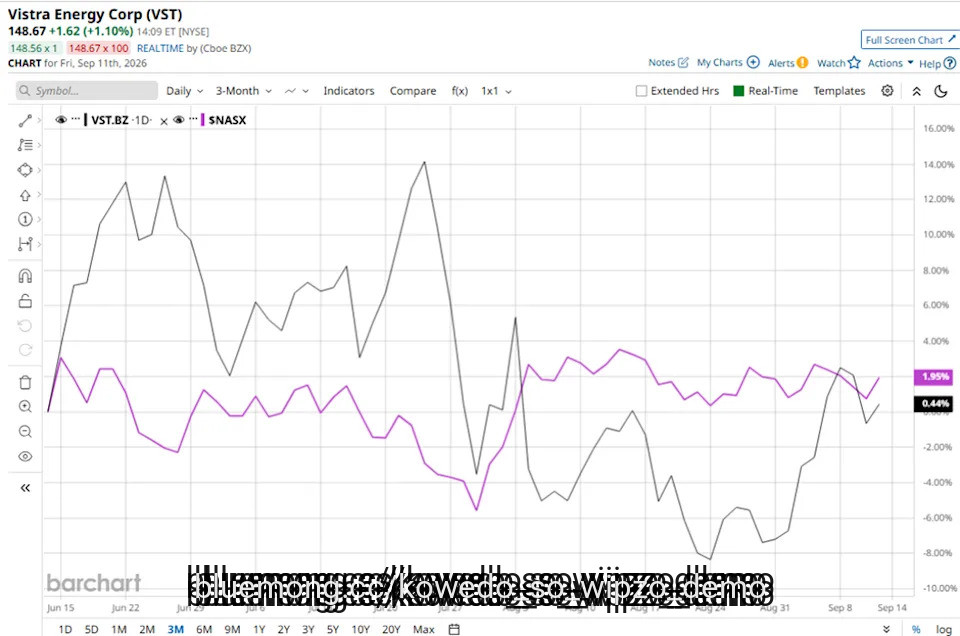
With a market cap of $49.4 billion, Vistra Corp. (VST) is a leading integrated electricity and power generation company. The company provides essential energy resources to customers, businesses, and communities across the United States, with a strong focus on reliability, affordability, and sustainability.
Companies valued at more than $10 billion are generally considered "large-cap" stocks, and Vistra fits this criterion perfectly. Vistra operates a diverse and efficient power generation portfolio spanning natural gas, nuclear, coal, solar, and battery energy storage, complemented by a customer-centric retail business.
Why It's Time to Load Up on Intel Stock
Google Plans to Build Mammoth Solar Farm on an Abandoned Coal Mine. This Penny Stock Just Won the Deal.
NVDA Stock Alert: What to Know as Nvidia Faces DOJ Probe
#Stock #energy #corp
Companies valued at more than $10 billion are generally considered "large-cap" stocks, and Vistra fits this criterion perfectly. Vistra operates a diverse and efficient power generation portfolio spanning natural gas, nuclear, coal, solar, and battery energy storage, complemented by a customer-centric retail business.
Why It's Time to Load Up on Intel Stock
Google Plans to Build Mammoth Solar Farm on an Abandoned Coal Mine. This Penny Stock Just Won the Deal.
NVDA Stock Alert: What to Know as Nvidia Faces DOJ Probe
#Stock #energy #corp


3 days ago
Some offers on this page are from advertisers who pay us, which may affect which products we write about, but not our recommendations. See our Advertiser Disclosure.
Gold can act as a hedge against inflation, but it doesn't reliably rise whenever inflation does. Some investors use gold to help preserve purchasing power as prices rise, but inflation is only one of several factors that can influence gold prices.
If you've researched gold as an investment, you've probably come across financial experts ****** erting that gold is a hedge against inflation. Understanding what that actually means — and what it doesn't — can help put gold's role in an investment portfolio into perspective.
An inflation hedge is an investment or strategy intended to help offset the loss of purchasing power caused by rising prices.
As inflation rises, each dollar buys a little less than it did before. For example, imagine a cart of groceries that costs $100 today. If those same groceries cost $105 next year, your $100 no longer buys as much as it did before.
#inflation #Gold #doesn 't #power
Gold can act as a hedge against inflation, but it doesn't reliably rise whenever inflation does. Some investors use gold to help preserve purchasing power as prices rise, but inflation is only one of several factors that can influence gold prices.
If you've researched gold as an investment, you've probably come across financial experts ****** erting that gold is a hedge against inflation. Understanding what that actually means — and what it doesn't — can help put gold's role in an investment portfolio into perspective.
An inflation hedge is an investment or strategy intended to help offset the loss of purchasing power caused by rising prices.
As inflation rises, each dollar buys a little less than it did before. For example, imagine a cart of groceries that costs $100 today. If those same groceries cost $105 next year, your $100 no longer buys as much as it did before.
#inflation #Gold #doesn 't #power



3 days ago
To summarize my investment approach, I prefer to buy companies with long histories of dividend increases and historically high yields. Those two traits don't come around all that often, and sometimes I find clusters of stocks in specific sectors. I need to think specifically about diversification, one of the simplest and most effective ways to reduce risk. Here's how I've done it as I've built my portfolio of around 34 investments.
The Motley Fool recommends that investors own 50 stocks. That's a perfectly fine number, but also a lot of work. And just owning 50 stocks doesn't actually mean you are diversified. You could own 50 technology stocks, for example, which would leave you with exposure to just a single sector. That's not diversification. Diversification is really about owning a reasonable number of investments across a wide range of sectors and ****** et classes.
Missed Nvidia in 2009? This Rare Signal Is Flashing Again. In 2009, a "Double Down" signal flashed for a little-known chipmaker called Nvidia. For the first time in years, that same "Total Conviction" signal is flashing for a company 1/100th the size of Nvidia. Continue »
My first step toward diversification was to take an honest look at what I want to achieve and what I'm capable of. My goal is a mixture of income and capital appreciation. I am fairly confident in my ability to select dividend stocks, though every investor makes mistakes from time to time, and I know I can only juggle so many stocks at once. In other words, 50 stocks are too many for me, so a core part of my diversification strategy is to outsource some of my work.
For example, I own two Baron mutual funds to gain exposure to growth stocks and smaller companies. I own several closed-end funds: one focused on healthcare stocks with an option income overlay, one investing in convertible securities, and one with a broadly diversified dividend portfolio. And I own three exchange-traded funds: one with an option income focus and two that use very different screening approaches to pick dividend stocks.
#Diversification #funds
The Motley Fool recommends that investors own 50 stocks. That's a perfectly fine number, but also a lot of work. And just owning 50 stocks doesn't actually mean you are diversified. You could own 50 technology stocks, for example, which would leave you with exposure to just a single sector. That's not diversification. Diversification is really about owning a reasonable number of investments across a wide range of sectors and ****** et classes.
Missed Nvidia in 2009? This Rare Signal Is Flashing Again. In 2009, a "Double Down" signal flashed for a little-known chipmaker called Nvidia. For the first time in years, that same "Total Conviction" signal is flashing for a company 1/100th the size of Nvidia. Continue »
My first step toward diversification was to take an honest look at what I want to achieve and what I'm capable of. My goal is a mixture of income and capital appreciation. I am fairly confident in my ability to select dividend stocks, though every investor makes mistakes from time to time, and I know I can only juggle so many stocks at once. In other words, 50 stocks are too many for me, so a core part of my diversification strategy is to outsource some of my work.
For example, I own two Baron mutual funds to gain exposure to growth stocks and smaller companies. I own several closed-end funds: one focused on healthcare stocks with an option income overlay, one investing in convertible securities, and one with a broadly diversified dividend portfolio. And I own three exchange-traded funds: one with an option income focus and two that use very different screening approaches to pick dividend stocks.
#Diversification #funds

3 days ago
DIVO's trailing yield overstates its committed forward rate by 30%, built on discretionary year-end specials the fund has never guaranteed to repeat.
DIVO, DGRO, and MAIN all show gaps between trailing and forward income, inflating the look-back for most of the portfolio's weight.
Duke Energy and Southern Company, the smallest 5% positions, are the only holdings with predictable scheduled dividend raises a retiree can count on to the penny.
Read More: Learn 7 ways to generate income with a $1,000,000+ portfolio (sponsor)
Replacing $8,600 a month, or roughly $103,200 a year, with portfolio income at age 61 sounds pretty straightforward on paper. But here's the catch: the biggest holding in a popular seven-fund income sleeve is the one whose payout the fund has never actually promised.
#income #fund #divo #main
DIVO, DGRO, and MAIN all show gaps between trailing and forward income, inflating the look-back for most of the portfolio's weight.
Duke Energy and Southern Company, the smallest 5% positions, are the only holdings with predictable scheduled dividend raises a retiree can count on to the penny.
Read More: Learn 7 ways to generate income with a $1,000,000+ portfolio (sponsor)
Replacing $8,600 a month, or roughly $103,200 a year, with portfolio income at age 61 sounds pretty straightforward on paper. But here's the catch: the biggest holding in a popular seven-fund income sleeve is the one whose payout the fund has never actually promised.
#income #fund #divo #main


3 days ago
NVIDIA Corporation (NASDAQ:NVDA) is expanding its global AI infrastructure ambitions, with Australia emerging as an important new market for its growing portfolio of GPUs, CPUs, networking products, and AI software.
On September 9, it announced strategic partnerships with Australian NVIDIA Cloud Partners (NCPs) and AI infrastructure providers as it works with local partners toward an AI infrastructure buildout of up to 2 gigawatts by 2027.
The initiative will expand the availability of land, power, and data center shell capacity designed to host multiple generations of Nvidia's DSX AI factory infrastructure. While the buildout is designed to meet Australia's growing demand for AI computing, it could also create a significant new source of demand for Nvidia's hardware and software ecosystem.
The Australian buildout could benefit NVIDIA Corporation (NASDAQ:NVDA) beyond the initial sale of GPUs. Nvidia will provide its DSX platform, accelerated computing, networking, software, and ecosystem support to the emerging network of AI factories. DSX is also compatible with Nvidia's CUDA ecosystem.
As enterprises, universities, government agencies, and startups increasingly build AI workloads around Nvidia's architecture, the company could strengthen CUDA's position as the underlying software platform for AI development and deployment.
#NASDAQ #australian
On September 9, it announced strategic partnerships with Australian NVIDIA Cloud Partners (NCPs) and AI infrastructure providers as it works with local partners toward an AI infrastructure buildout of up to 2 gigawatts by 2027.
The initiative will expand the availability of land, power, and data center shell capacity designed to host multiple generations of Nvidia's DSX AI factory infrastructure. While the buildout is designed to meet Australia's growing demand for AI computing, it could also create a significant new source of demand for Nvidia's hardware and software ecosystem.
The Australian buildout could benefit NVIDIA Corporation (NASDAQ:NVDA) beyond the initial sale of GPUs. Nvidia will provide its DSX platform, accelerated computing, networking, software, and ecosystem support to the emerging network of AI factories. DSX is also compatible with Nvidia's CUDA ecosystem.
As enterprises, universities, government agencies, and startups increasingly build AI workloads around Nvidia's architecture, the company could strengthen CUDA's position as the underlying software platform for AI development and deployment.
#NASDAQ #australian


4 days ago
Some offers on this page are from advertisers who pay us, which may affect which products we write about, but not our recommendations. See our Advertiser Disclosure.
Gold doesn't rise or fall because of a single economic event. Its price reflects the decisions of millions of investors, central banks, manufacturers, jewelers, and others around the world. Those decisions are shaped by changing economic conditions and future expectations.
Understanding what drives the price of gold means learning how multiple forces interact. Sometimes they reinforce one another. Sometimes they pull in opposite directions. That's why different headlines can describe the same market move from different angles.
Every second the global gold market is open, buyers and sellers are negotiating a price — but they're not all buying gold for the same reason.
An investor may be looking to diversify a portfolio. A jewelry manufacturer may need gold for finished products. A technology company may use it in electronic components. A central bank may be increasing its reserves. Another investor may believe interest rates are about to fall.
#Gold #price #economic #different
Gold doesn't rise or fall because of a single economic event. Its price reflects the decisions of millions of investors, central banks, manufacturers, jewelers, and others around the world. Those decisions are shaped by changing economic conditions and future expectations.
Understanding what drives the price of gold means learning how multiple forces interact. Sometimes they reinforce one another. Sometimes they pull in opposite directions. That's why different headlines can describe the same market move from different angles.
Every second the global gold market is open, buyers and sellers are negotiating a price — but they're not all buying gold for the same reason.
An investor may be looking to diversify a portfolio. A jewelry manufacturer may need gold for finished products. A technology company may use it in electronic components. A central bank may be increasing its reserves. Another investor may believe interest rates are about to fall.
#Gold #price #economic #different


4 days ago
Zhihu Inc. (NYSE:ZH) disclosed on September 6 that a wholly owned subsidiary had signed a conditional RMB1.5 billion cash commitment to Tianjin Lisi Xingshen Equity Investment Partnership. The agreement, dated September 4, requires shareholder approval, with payments funded internally through capital calls.
Zhihu Inc. (NYSE:ZH) expects to hold no more than 30% of the fund and will have no role in daily management or individual investment decisions. The blind-pool structure asks shareholders to approve a manager and strategy before specific investments are identified. The fund targets early-to-mid-stage private AI and technology companies with significant mainland China connections.
The strategic rationale fits the company's existing capabilities. Zhihu Inc. (NYSE:ZH) is developing AI search, expert-data solutions and AI-enabled content businesses. Exposure to foundation models, infrastructure, robotics and applications could create technology partnerships and help identify emerging customer needs.
A specialist fund also supplies investment research, deal sourcing and portfolio oversight that would require substantial internal resources to replicate. For shareholders, the potential benefit combines investment returns with commercial opportunities for the core content platform. Any cooperation would still require separate **** sment and agreement.
There is an operating business to build around. Second-quarter paid content and intellectual-property operations revenue increased to RMB425.9 million from RMB408.2 million. Zhihu Inc. (NYSE:ZH) also reduced total operating expenses by 13% to RMB469.4 million. These results support a focused approach in which outside technology complements established content and expert relationships.
#content #technology #million
Zhihu Inc. (NYSE:ZH) expects to hold no more than 30% of the fund and will have no role in daily management or individual investment decisions. The blind-pool structure asks shareholders to approve a manager and strategy before specific investments are identified. The fund targets early-to-mid-stage private AI and technology companies with significant mainland China connections.
The strategic rationale fits the company's existing capabilities. Zhihu Inc. (NYSE:ZH) is developing AI search, expert-data solutions and AI-enabled content businesses. Exposure to foundation models, infrastructure, robotics and applications could create technology partnerships and help identify emerging customer needs.
A specialist fund also supplies investment research, deal sourcing and portfolio oversight that would require substantial internal resources to replicate. For shareholders, the potential benefit combines investment returns with commercial opportunities for the core content platform. Any cooperation would still require separate **** sment and agreement.
There is an operating business to build around. Second-quarter paid content and intellectual-property operations revenue increased to RMB425.9 million from RMB408.2 million. Zhihu Inc. (NYSE:ZH) also reduced total operating expenses by 13% to RMB469.4 million. These results support a focused approach in which outside technology complements established content and expert relationships.
#content #technology #million

4 days ago
Horizon Technology Finance Corp., an affiliate of Monroe Capital, on September 10 said that the RoHo Capital Opportunity Fund LLC, a joint venture formed by Horizon and CR Financial Holdings, Inc., the holding company for Roth Capital Partners, LLC, has provided a $20-million senior credit facility to NeoVolta, Inc., with the ability to increase the facility to $30 million upon mutual agreement. An initial $20 million was funded at closing to support NeoVolta's continued growth.NeoVolta is an energy technology company focused on developing and manufacturing domestic battery energy storage systems (BESS). Together with its joint venture partner LONGi, NeoVolta is developing a 210,600-square-foot manufacturing facility in Pendergrass, Georgia, to produce BESS systems designed to meet U.S. domestic content and supply-chain requirements. The facility is expected to have an initial annual production capacity of up to 2 GWh, with the potential to scale to 8 GWh over time."Providing growth capital to innovative companies operating in attractive, high-growth markets is a core focus of RoHo's investment strategy," said Paul Seitz, chief investment officer of Horizon. "Formed by Horizon and Roth Capital, RoHo pairs Horizon's venture lending and structuring expertise with Roth's deep public markets relationships to deliver flexible growth capital to small- and micro-cap public companies. We are pleased to support NeoVolta's growth plans with a tailored financing solution and look forward to continuing to deploy capital through RoHo in support of innovative public companies pursuing significant market opportunities.""Horizon and Roth Capital bring valuable experience and a collaborative approach as we advance NeoVolta's domestic battery energy storage systems manufacturing platform," said Ardes Johnson, CEO of NeoVolta. "As we ramp our Georgia facility and pursue larger commercial and utility-scale opportunities, this relationship supports our ability to execute on our long-term growth strategy."Horizon Technology Finance Corp. is a specialty finance company that provides capital in the form of secured loans to venture capital and private equity-backed companies and publicly traded companies in the technology, life science, healthcare information and services, and sustainability industries. The investment objective of Horizon is to maximize its investment portfolio's return by generating current income from the debt investments it makes and capital appreciation from the warrants it receives when making such debt investments. Horizon is headquartered in Farmington, Connecticut, with a regional office in Pleasanton, California, and investment professionals located throughout the U.S.Monroe Capital is a premier ****** et management firm specializing in private credit markets across various strategies, including direct lending, technology finance, venture debt, opportunistic, structured credit, real estate and equity.CR Financial Holdings, Inc., is a private hol


4 days ago
Prosper Stars & Stripes, a long/short equity fund, recently released its second-quarter 2026 investor letter. The letter can be downloaded here. In Q2 2026, the portfolio delivered a strong net return of +30.1% compared to the Russell 2000 Index's +21.5% return and the HFRX Equity Hedge Index's +10.3% return. The long book drove performance, generating a 43.2% gross contribution, while average net exposure remained relatively modest at 47%. U.S. economic growth remained resilient despite inflation concerns, elevated energy prices, and geopolitical uncertainty. Markets rallied sharply after easing U.S.-Iran tensions pushed oil prices lower, supporting renewed risk appetite. Small-cap equities benefited significantly, with Information Technology, Industrials, and Health Care leading gains, while Energy declined as crude prices fell. Year to date, the Composite returned +23.7%, slightly ahead of the Russell 2000's +22.6% and well above the HFRI Equity Hedge Index's +9.7%. Additionally, you can review the Portfolio's top 5 holdings to see its best picks for 2026.
In its second-quarter 2026 investor letter, Prosper Stars & Stripes highlighted TechTarget, Inc. (NASDAQ:TTGT) as the largest contributor to the portfolio's short book. TechTarget, Inc. (NASDAQ:TTGT) provides sales and support of purchase intent-driven advertising campaigns. On September 9, 2026, TechTarget, Inc. (NASDAQ:TTGT) closed at $3.89 per share. Over the past month, TechTarget, Inc. (NASDAQ:TTGT) returned 1.57% and its shares lost 35.17% over the past 52 weeks. TechTarget, Inc. (NASDAQ:TTGT) has a market capitalization of $281.37 million, and its stock has traded within a 52-week range of $3.37 to $7.15.
Prosper Stars & Stripes stated the following regarding TechTarget, Inc. (NASDAQ:TTGT) in its Q2 2026 investor letter:
"TechTarget, Inc. (NASDAQ:TTGT) was the largest contributor to our short book during the quarter. The company monetizes the purchase research behavior of enterprise IT buyers by operating a network of websites where buyers register to consume technical content, then selling those intent signals as leads to IT vendors. We first shorted the company after it completed a value-destroying acquisition in December 2024 that led to significant impairment charges in Q1 2025 and again in Q1 2026. We believe AI is likely to dismantle search-based discovery and commoditize content, the two pillars of TechTarget's value propositions. Results have validated our concerns, with management describing its market as mature, with 2% to 3% top-line growth, and EBITDA margins that peaked in 2022 falling to 7% in Q1 2026. Notably, revenue growth began deteriorating before ChatGPT launched in November 2022, suggesting that problems run deeper than AI alone. We continue to believe generative AI will weigh on TechTarget's prospects and remain short the company."
#techtarget #NASDAQ
In its second-quarter 2026 investor letter, Prosper Stars & Stripes highlighted TechTarget, Inc. (NASDAQ:TTGT) as the largest contributor to the portfolio's short book. TechTarget, Inc. (NASDAQ:TTGT) provides sales and support of purchase intent-driven advertising campaigns. On September 9, 2026, TechTarget, Inc. (NASDAQ:TTGT) closed at $3.89 per share. Over the past month, TechTarget, Inc. (NASDAQ:TTGT) returned 1.57% and its shares lost 35.17% over the past 52 weeks. TechTarget, Inc. (NASDAQ:TTGT) has a market capitalization of $281.37 million, and its stock has traded within a 52-week range of $3.37 to $7.15.
Prosper Stars & Stripes stated the following regarding TechTarget, Inc. (NASDAQ:TTGT) in its Q2 2026 investor letter:
"TechTarget, Inc. (NASDAQ:TTGT) was the largest contributor to our short book during the quarter. The company monetizes the purchase research behavior of enterprise IT buyers by operating a network of websites where buyers register to consume technical content, then selling those intent signals as leads to IT vendors. We first shorted the company after it completed a value-destroying acquisition in December 2024 that led to significant impairment charges in Q1 2025 and again in Q1 2026. We believe AI is likely to dismantle search-based discovery and commoditize content, the two pillars of TechTarget's value propositions. Results have validated our concerns, with management describing its market as mature, with 2% to 3% top-line growth, and EBITDA margins that peaked in 2022 falling to 7% in Q1 2026. Notably, revenue growth began deteriorating before ChatGPT launched in November 2022, suggesting that problems run deeper than AI alone. We continue to believe generative AI will weigh on TechTarget's prospects and remain short the company."
#techtarget #NASDAQ


4 days ago
Prosper Stars & Stripes, a long/short equity fund, recently released its second-quarter 2026 investor letter. The letter can be downloaded here. In Q2 2026, the portfolio delivered a strong net return of +30.1% compared to the Russell 2000 Index's +21.5% return and the HFRX Equity Hedge Index's +10.3% return. The long book drove performance, generating a 43.2% gross contribution, while average net exposure remained relatively modest at 47%. U.S. economic growth remained resilient despite inflation concerns, elevated energy prices, and geopolitical uncertainty. Markets rallied sharply after easing U.S.-Iran tensions pushed oil prices lower, supporting renewed risk appetite. Small-cap equities benefited significantly, with Information Technology, Industrials, and Health Care leading gains, while Energy declined as crude prices fell. Year to date, the Composite returned +23.7%, slightly ahead of the Russell 2000's +22.6% and well above the HFRI Equity Hedge Index's +9.7%. Additionally, you can review the Portfolio's top 5 holdings to see its best picks for 2026.
In its second-quarter 2026 investor letter, Prosper Stars & Stripes highlighted Ambiq Micro, Inc. (NYSE:AMBQ). Ambiq Micro, Inc. (NYSE:AMBQ), provides ultra-low-power semiconductor solutions, contributed to the portfolio's long book during the quarter. On September 09, 2026, Ambiq Micro, Inc. (NYSE:AMBQ) closed at $63.78 per share. Over the past quarter, Ambiq Micro, Inc. (NYSE:AMBQ) declined 0.89% and its shares gained 74.38% over the past 52 weeks. Ambiq Micro, Inc. (NYSE:AMBQ) has a market capitalization of $1.53 billion, and its stock has traded within a 52-week range of $22.12 to $91.61.
Prosper Stars & Stripes stated the following regarding Ambiq Micro, Inc. (NYSE:AMBQ) in its Q2 2026 investor letter:
"Ambiq Micro, Inc. (NYSE:AMBQ) was the second-best contributor to our long book during the quarter. Ambiq is a fabless semiconductor company that designs ultra-low power systems-on-chip (SoCs) for edge AI applications. The company's proprietary design approach delivers two to five times lower power consumption than competing solutions, a decisive advantage in battery-constrained devices like wearables, where customers include Garmin, Google, and Huawei. In semiconductors, we look for companies levered to two enduring themes: lower power consumption and miniaturization. In January, the company raised equity, signaling a step-change in revenue growth. After posting 2% year-over-year revenue growth in Q4 2025, the company reported 59% growth in Q1 2026 and guided for 75% growth for Q2. We ascribed a high single digit multiple of sales to the shares, but as the price met our bullish targets, like many stocks in this part of the market, we exited our position."
#micro
In its second-quarter 2026 investor letter, Prosper Stars & Stripes highlighted Ambiq Micro, Inc. (NYSE:AMBQ). Ambiq Micro, Inc. (NYSE:AMBQ), provides ultra-low-power semiconductor solutions, contributed to the portfolio's long book during the quarter. On September 09, 2026, Ambiq Micro, Inc. (NYSE:AMBQ) closed at $63.78 per share. Over the past quarter, Ambiq Micro, Inc. (NYSE:AMBQ) declined 0.89% and its shares gained 74.38% over the past 52 weeks. Ambiq Micro, Inc. (NYSE:AMBQ) has a market capitalization of $1.53 billion, and its stock has traded within a 52-week range of $22.12 to $91.61.
Prosper Stars & Stripes stated the following regarding Ambiq Micro, Inc. (NYSE:AMBQ) in its Q2 2026 investor letter:
"Ambiq Micro, Inc. (NYSE:AMBQ) was the second-best contributor to our long book during the quarter. Ambiq is a fabless semiconductor company that designs ultra-low power systems-on-chip (SoCs) for edge AI applications. The company's proprietary design approach delivers two to five times lower power consumption than competing solutions, a decisive advantage in battery-constrained devices like wearables, where customers include Garmin, Google, and Huawei. In semiconductors, we look for companies levered to two enduring themes: lower power consumption and miniaturization. In January, the company raised equity, signaling a step-change in revenue growth. After posting 2% year-over-year revenue growth in Q4 2025, the company reported 59% growth in Q1 2026 and guided for 75% growth for Q2. We ascribed a high single digit multiple of sales to the shares, but as the price met our bullish targets, like many stocks in this part of the market, we exited our position."
#micro


4 days ago
Prosper Stars & Stripes, a long/short equity fund, recently released its second-quarter 2026 investor letter. The letter can be downloaded here. In Q2 2026, the portfolio delivered a strong net return of +30.1% compared to the Russell 2000 Index's +21.5% return and the HFRX Equity Hedge Index's +10.3% return. The long book drove performance, generating a 43.2% gross contribution, while average net exposure remained relatively modest at 47%. U.S. economic growth remained resilient despite inflation concerns, elevated energy prices, and geopolitical uncertainty. Markets rallied sharply after easing U.S.-Iran tensions pushed oil prices lower, supporting renewed risk appetite. Small-cap equities benefited significantly, with Information Technology, Industrials, and Health Care leading gains, while Energy declined as crude prices fell. Year to date, the Composite returned +23.7%, slightly ahead of the Russell 2000's +22.6% and well above the HFRI Equity Hedge Index's +9.7%. Additionally, you can review the Portfolio's top 5 holdings to see its best picks for 2026.
In its second-quarter 2026 investor letter, Prosper Stars & Stripes highlighted The Elmet Group Co. (NASDAQ:ELMT). The Elmet Group Co. (NASDAQ:ELMT) manufactures and sells precision-engineered components and high-energy systems for the aerospace, defense and government, industrial, medical, semiconductor and electronics, and energy industries. On September 09, 2026, The Elmet Group Co. (NASDAQ:ELMT) closed at $16.46 per share. Over the past month The Elmet Group Co. (NASDAQ:ELMT) declined 4.02% and its shares lost 15.29% over the past 3 months. The Elmet Group Co. (NASDAQ:ELMT) has a market capitalization of $511.11 million and its stock has traded within a 52-week range of $12.49 to $22.51.
Prosper Stars & Stripes stated the following regarding The Elmet Group Co. (NASDAQ:ELMT) in its Q2 2026 investor letter:
"We are also invested in Applied Aerospace & Defense (AADX) and The Elmet Group Co. (NASDAQ:ELMT). Elmet's critical materials division supplies inputs for the U.S. military supply chain that are essential to production and increasingly must be sourced domestically, steering business towards the company. We believe the building of domestic supply chains can benefit Elmet and drive better-than-forecast earnings growth as they grow organically and deploy their underutilized balance sheet to broaden their businesses."
The Elmet Group Co. (NASDAQ:ELMT) is not on our list of the 40 Most Popular Stocks Among Hedge Funds. As per our database, 19 hedge fund portfolios held The Elmet Group Co. (NASDAQ:ELMT) at the end of the second quarter which was 0 in the previous quarter. While we acknowledge the potential of The Elmet Group Co. (NASDAQ:ELMT) as an investment, we believe certain AI stocks offer greater upside potential and carry less downside risk. If you're looking for an extremely undervalued AI stock that also stands to benefit significantly from Trump-era tariffs and the onshoring tr
In its second-quarter 2026 investor letter, Prosper Stars & Stripes highlighted The Elmet Group Co. (NASDAQ:ELMT). The Elmet Group Co. (NASDAQ:ELMT) manufactures and sells precision-engineered components and high-energy systems for the aerospace, defense and government, industrial, medical, semiconductor and electronics, and energy industries. On September 09, 2026, The Elmet Group Co. (NASDAQ:ELMT) closed at $16.46 per share. Over the past month The Elmet Group Co. (NASDAQ:ELMT) declined 4.02% and its shares lost 15.29% over the past 3 months. The Elmet Group Co. (NASDAQ:ELMT) has a market capitalization of $511.11 million and its stock has traded within a 52-week range of $12.49 to $22.51.
Prosper Stars & Stripes stated the following regarding The Elmet Group Co. (NASDAQ:ELMT) in its Q2 2026 investor letter:
"We are also invested in Applied Aerospace & Defense (AADX) and The Elmet Group Co. (NASDAQ:ELMT). Elmet's critical materials division supplies inputs for the U.S. military supply chain that are essential to production and increasingly must be sourced domestically, steering business towards the company. We believe the building of domestic supply chains can benefit Elmet and drive better-than-forecast earnings growth as they grow organically and deploy their underutilized balance sheet to broaden their businesses."
The Elmet Group Co. (NASDAQ:ELMT) is not on our list of the 40 Most Popular Stocks Among Hedge Funds. As per our database, 19 hedge fund portfolios held The Elmet Group Co. (NASDAQ:ELMT) at the end of the second quarter which was 0 in the previous quarter. While we acknowledge the potential of The Elmet Group Co. (NASDAQ:ELMT) as an investment, we believe certain AI stocks offer greater upside potential and carry less downside risk. If you're looking for an extremely undervalued AI stock that also stands to benefit significantly from Trump-era tariffs and the onshoring tr

4 days ago
Prosper Stars & Stripes, a long/short equity fund, recently released its second-quarter 2026 investor letter. The letter can be downloaded here. In Q2 2026, the portfolio delivered a strong net return of +30.1% compared to the Russell 2000 Index's +21.5% return and the HFRX Equity Hedge Index's +10.3% return. The long book drove performance, generating a 43.2% gross contribution, while average net exposure remained relatively modest at 47%. U.S. economic growth remained resilient despite inflation concerns, elevated energy prices, and geopolitical uncertainty. Markets rallied sharply after easing U.S.-Iran tensions pushed oil prices lower, supporting renewed risk appetite. Small-cap equities benefited significantly, with Information Technology, Industrials, and Health Care leading gains, while Energy declined as crude prices fell. Year to date, the Composite returned +23.7%, slightly ahead of the Russell 2000's +22.6% and well above the HFRI Equity Hedge Index's +9.7%. Additionally, you can review the Portfolio's top 5 holdings to see its best picks for 2026.
In its second-quarter 2026 investor letter, Prosper Stars & Stripes highlighted Applied Aerospace & Defense, Inc. (NYSE:AADX). Applied Aerospace & Defense, Inc. (NYSE:AADX) designs, engineers, and manufactures integrated aerospace and defense subsystems for **** e and defense applications. On September 09, 2026, Applied Aerospace & Defense, Inc. (NYSE:AADX) closed at $11.94 per share. Over the past month, Applied Aerospace & Defense, Inc. (NYSE:AADX) declined 36.49% and its shares lost 45.95% over the past three months. Applied Aerospace & Defense, Inc. (NYSE:AADX) has a market capitalization of $2.06 billion and its stock has traded within a 52-week range of $11.77 and $24.24.
Prosper Stars & Stripes stated the following regarding Applied Aerospace & Defense, Inc. (NYSE:AADX) in its Q2 2026 investor letter:
"We are also invested in Applied Aerospace & Defense, Inc. (NYSE:AADX) and Elmet Group (ELMT). Applied Aerospace participates in many of the fastest growing programs in defense as a sole sourced, IP-rich component supplier, enabling high (and rising) EBITDA margins. We believe bookings can accelerate and drive revenues, earnings, and the multiple higher."
rommma/Shutterstock.com
#Equity
In its second-quarter 2026 investor letter, Prosper Stars & Stripes highlighted Applied Aerospace & Defense, Inc. (NYSE:AADX). Applied Aerospace & Defense, Inc. (NYSE:AADX) designs, engineers, and manufactures integrated aerospace and defense subsystems for **** e and defense applications. On September 09, 2026, Applied Aerospace & Defense, Inc. (NYSE:AADX) closed at $11.94 per share. Over the past month, Applied Aerospace & Defense, Inc. (NYSE:AADX) declined 36.49% and its shares lost 45.95% over the past three months. Applied Aerospace & Defense, Inc. (NYSE:AADX) has a market capitalization of $2.06 billion and its stock has traded within a 52-week range of $11.77 and $24.24.
Prosper Stars & Stripes stated the following regarding Applied Aerospace & Defense, Inc. (NYSE:AADX) in its Q2 2026 investor letter:
"We are also invested in Applied Aerospace & Defense, Inc. (NYSE:AADX) and Elmet Group (ELMT). Applied Aerospace participates in many of the fastest growing programs in defense as a sole sourced, IP-rich component supplier, enabling high (and rising) EBITDA margins. We believe bookings can accelerate and drive revenues, earnings, and the multiple higher."
rommma/Shutterstock.com
#Equity