
10 hours ago
During the September 10 episode of Mad Money, a caller questioned whether recent vertical integration by industrial competitors and market selloffs warranted a lower valuation for Howmet Aerospace Inc.'s (NYSE:HWM) economic moat, or if demand remained strong enough to make the pullback an overreaction. Jim Cramer replied:
Now, look, I'll tell you, here's the problem… It's a fastener company, and it frankly is, most times, very commodity-oriented business, and it happens to sell at 44 times earnings, and we don't want to pay that for commodities even though the business is strong. I think people are saying, "Wait a second, that's too much to pay, and I'm going to wait till it goes lower." And if you look at the chart, it does seem like it is going lower.
Howmet Aerospace Inc. (NYSE:HWM) occupies a sole-source or primary-supplier position across critical narrowbody and widebody aircraft programs, providing single-crystal turbine blades, advanced structural castings, and **** anium fasteners. Approval and qualification requirements, manufacturing complexity, and a limited supplier base can make alternative sources difficult to establish quickly. That gives the company strong pricing power on both new plane parts and higher-margin replacement spares.
The structural advantages of Howmet Aerospace Inc.'s (NYSE:HWM) business model can be seen in its Q2 financial results. Revenue surged over 24% year-over-year (21% organically) to $2.55 billion, driven by a 28% jump in commercial aerospace revenue, a 38% expansion in industrial gas turbines, and an 11% gain in defense aerospace. The core Engine Products division recorded third-party sales of $1.37 billion, up 32% year-over-year, while segment adjusted EBITDA margins expanded by 470 basis points to 37.7%.
Despite its market positioning, Howmet Aerospace Inc. (NYSE:HWM) carries valuation risks that advise a cautious approach. Trading at elevated EV/EBITDA and forward P/E multiples relative to traditional industrial peers, the stock leaves little margin for operational missteps. Capital expenditures are projected to exceed $500 million in 2026 as the company builds out production capacity for next-generation engine components and gas turbines, reducing near-term free cash conversion flexibility.
#lower #ebitda
Now, look, I'll tell you, here's the problem… It's a fastener company, and it frankly is, most times, very commodity-oriented business, and it happens to sell at 44 times earnings, and we don't want to pay that for commodities even though the business is strong. I think people are saying, "Wait a second, that's too much to pay, and I'm going to wait till it goes lower." And if you look at the chart, it does seem like it is going lower.
Howmet Aerospace Inc. (NYSE:HWM) occupies a sole-source or primary-supplier position across critical narrowbody and widebody aircraft programs, providing single-crystal turbine blades, advanced structural castings, and **** anium fasteners. Approval and qualification requirements, manufacturing complexity, and a limited supplier base can make alternative sources difficult to establish quickly. That gives the company strong pricing power on both new plane parts and higher-margin replacement spares.
The structural advantages of Howmet Aerospace Inc.'s (NYSE:HWM) business model can be seen in its Q2 financial results. Revenue surged over 24% year-over-year (21% organically) to $2.55 billion, driven by a 28% jump in commercial aerospace revenue, a 38% expansion in industrial gas turbines, and an 11% gain in defense aerospace. The core Engine Products division recorded third-party sales of $1.37 billion, up 32% year-over-year, while segment adjusted EBITDA margins expanded by 470 basis points to 37.7%.
Despite its market positioning, Howmet Aerospace Inc. (NYSE:HWM) carries valuation risks that advise a cautious approach. Trading at elevated EV/EBITDA and forward P/E multiples relative to traditional industrial peers, the stock leaves little margin for operational missteps. Capital expenditures are projected to exceed $500 million in 2026 as the company builds out production capacity for next-generation engine components and gas turbines, reducing near-term free cash conversion flexibility.
#lower #ebitda


11 hours ago
On August 6, The RealReal (NASDAQ:REAL) reported second quarter results that beat its own outlook and pushed the resale luxury marketplace to raise its full year guidance. Gross merchandise value hit an all time high of $617 million, up 22% from a year earlier, and management pointed to four straight quarters of GMV growth above 20%. But a wider net loss sitting next to those record numbers complicates the story for anyone weighing the stock today.
The headline number is GMV of $617 million for the quarter ended June 30, up 22% year over year, with total revenue climbing 17% to $193 million. Consignment revenue grew 15% while Direct Revenue, the company's owned inventory channel, grew 26%, showing both sides of the business contributing to the acceleration. Profitability moved in the same direction. Gross margin reached 74.4%, up 10 basis points from a year ago, and Adjusted EBITDA margin jumped to 7%, a 290 basis point improvement that management called nearly 300 basis points of expansion.
The buyer base backs up the growth story rather than just the pricing. Trailing twelve-month active buyers rose 11% to 1,107,000, and average order value climbed 13% to $659, meaning existing shoppers are spending meaningfully more per transaction, not just showing up more often. That combination gave management enough confidence to raise full-year guidance to $2.54 billion to $2.57 billion in GMV and $788 million to $797 million in total revenue, alongside third-quarter Adjusted EBITDA guidance of $13.5 million to $14.5 million.
Despite the operating improvements, GAAP losses widened. Net loss came in at $27 million, or 14.1% of total revenue, compared to $11 million, or 6.9% of total revenue, a year earlier. GAAP basic net loss per share was $0.23 versus $0.10 in the prior year period, and diluted net loss per share was $0.23 versus $0.13. Much of that swing traces to a $(18.6) million non-cash adjustment tied to the change in fair value of warrant liability, a factor unrelated to how the underlying business performed. On a non-GAAP basis, basic and diluted net loss per share actually narrowed to $0.01 from $0.06, underscoring how much of the GAAP gap is accounting rather than operations.
There is also a transparency wrinkle in the guidance itself. The RealReal said it has not reconciled its forward-looking Adjusted EBITDA figures to GAAP net income or loss, citing components like payroll tax expense on employee stock transactions that it cannot predict with reasonable certainty. That leaves investors trusting a non-GAAP target without the usual bridge back to the bottom line.
#adjusted
The headline number is GMV of $617 million for the quarter ended June 30, up 22% year over year, with total revenue climbing 17% to $193 million. Consignment revenue grew 15% while Direct Revenue, the company's owned inventory channel, grew 26%, showing both sides of the business contributing to the acceleration. Profitability moved in the same direction. Gross margin reached 74.4%, up 10 basis points from a year ago, and Adjusted EBITDA margin jumped to 7%, a 290 basis point improvement that management called nearly 300 basis points of expansion.
The buyer base backs up the growth story rather than just the pricing. Trailing twelve-month active buyers rose 11% to 1,107,000, and average order value climbed 13% to $659, meaning existing shoppers are spending meaningfully more per transaction, not just showing up more often. That combination gave management enough confidence to raise full-year guidance to $2.54 billion to $2.57 billion in GMV and $788 million to $797 million in total revenue, alongside third-quarter Adjusted EBITDA guidance of $13.5 million to $14.5 million.
Despite the operating improvements, GAAP losses widened. Net loss came in at $27 million, or 14.1% of total revenue, compared to $11 million, or 6.9% of total revenue, a year earlier. GAAP basic net loss per share was $0.23 versus $0.10 in the prior year period, and diluted net loss per share was $0.23 versus $0.13. Much of that swing traces to a $(18.6) million non-cash adjustment tied to the change in fair value of warrant liability, a factor unrelated to how the underlying business performed. On a non-GAAP basis, basic and diluted net loss per share actually narrowed to $0.01 from $0.06, underscoring how much of the GAAP gap is accounting rather than operations.
There is also a transparency wrinkle in the guidance itself. The RealReal said it has not reconciled its forward-looking Adjusted EBITDA figures to GAAP net income or loss, citing components like payroll tax expense on employee stock transactions that it cannot predict with reasonable certainty. That leaves investors trusting a non-GAAP target without the usual bridge back to the bottom line.
#adjusted


11 hours ago
On August 10, Red Violet Inc. (NASDAQ:RDVT) reported second-quarter 2026 results for the period ended June 30 that showed the company converting growth into profit at an accelerating clip. Revenue rose 23% to $26.7 million, and net income nearly doubled to $5 million. For a company built on selling identity intelligence to businesses, watching net margin move from 12% to 19% says that growth is not costing more to produce.
Gross profit climbed 29% to $20.2 million, pushing gross margin to 76% from 72%, while adjusted EBITDA jumped 48% to $11.2 million as its margin widened to 42% from 35%. Adjusted net income rose 58% to $7.2 million. Cash generation told the same story: operating cash flow increased 42% to a record $10.6 million for the quarter. None of that came from adding customers who barely move the needle. Red Violet signed on 447 new IDI customers in the quarter, a company record, ending with 10,869 customers on the platform.
FOREWARN, its product built for real estate agents, picked up 25,493 new users to reach 443,173, and 660 REALTOR ****** ociations across the country are now under contract to use it. The company also closed an underwritten public offering in August that sold 1,916,667 shares, including 250,000 shares from the underwriters' full exercise of their option, generating net proceeds of about $109.0 million. Between the funds already on hand and this new raise, Red Violet says it holds over $160 million in cash and carries no debt, money earmarked for working capital and possible acquisitions.
CEO Derek Dubner called it what he described as "the strongest pipeline of strategic initiatives" in the company's history. The company also repurchased 74,500 shares by June 30, paying $41.87 per share on average, and had $15.5 million left on its buyback authorization.
The August offering that padded Red Violet's cash balance also added 1,916,667 new shares to the count, arriving in the same year that per-share profit is climbing fastest. Diluted earnings came in a penny below basic at $0.34, and adjusted diluted earnings landed at $0.50 versus $0.51 on a basic basis, a gap new shares will only widen going forward. There is also a timing tension worth sitting with: Red Violet spent part of the quarter buying back its own stock at an average of $41.87 a share, then turned around weeks later and sold new shares to the public.
#million
Gross profit climbed 29% to $20.2 million, pushing gross margin to 76% from 72%, while adjusted EBITDA jumped 48% to $11.2 million as its margin widened to 42% from 35%. Adjusted net income rose 58% to $7.2 million. Cash generation told the same story: operating cash flow increased 42% to a record $10.6 million for the quarter. None of that came from adding customers who barely move the needle. Red Violet signed on 447 new IDI customers in the quarter, a company record, ending with 10,869 customers on the platform.
FOREWARN, its product built for real estate agents, picked up 25,493 new users to reach 443,173, and 660 REALTOR ****** ociations across the country are now under contract to use it. The company also closed an underwritten public offering in August that sold 1,916,667 shares, including 250,000 shares from the underwriters' full exercise of their option, generating net proceeds of about $109.0 million. Between the funds already on hand and this new raise, Red Violet says it holds over $160 million in cash and carries no debt, money earmarked for working capital and possible acquisitions.
CEO Derek Dubner called it what he described as "the strongest pipeline of strategic initiatives" in the company's history. The company also repurchased 74,500 shares by June 30, paying $41.87 per share on average, and had $15.5 million left on its buyback authorization.
The August offering that padded Red Violet's cash balance also added 1,916,667 new shares to the count, arriving in the same year that per-share profit is climbing fastest. Diluted earnings came in a penny below basic at $0.34, and adjusted diluted earnings landed at $0.50 versus $0.51 on a basic basis, a gap new shares will only widen going forward. There is also a timing tension worth sitting with: Red Violet spent part of the quarter buying back its own stock at an average of $41.87 a share, then turned around weeks later and sold new shares to the public.
#million


11 hours ago
On August 6, PureCycle Technologies (NASDAQ:PCT) reported second-quarter results for the period ended June 30, and buried in the numbers was something the plastics recycler has chased for years: an actual branded product on store shelves. Select Downy detergent caps made with PureCycle's PureFive resin entered commercial production for Procter & Gamble during the quarter, the first tangible sign the company's purification technology can clear a major consumer brand's supply chain. Revenue came in at $4.5 million, up roughly 173% from a year earlier and the sixth straight quarter of sequential growth.
The Downy win was not an isolated event. PureCycle said select Tide caps are scheduled for retail production in the third quarter, with Vicks ZzzQuil PURE Zzzs child-resistant lids targeted for the fourth quarter of 2026. Seven customer conversions took place during the quarter, alongside six new commercial partnerships spanning closures, automotive, film, and food packaging, including Amcor, Motherson, and Innovia Films. Regulation is doing real work here too. New Jersey's Department of Environmental Protection approved PureFive as post-consumer recycled content, a decision that arrives as the state's food contact exemption expires in January 2027 and its recycled content requirement climbs to 20%, while California's SB54 is already in effect.
Operationally, the Ironton facility's planned turnaround finished ahead of schedule and under budget, with more than 170 reliability and rate projects completed and inspections showing no corrosion on major equipment. On-site compounding, commissioned in April, is now running 24 hours a day, five days a week, with plans to expand to seven by the fourth quarter. PureCycle also picked up ISO 9001:2015 certification in May and closed the quarter with $236.9 million in total liquidity after a June capital raise.
The other side of the ledger is harder to ignore. PureCycle posted a net loss of $142.2 million for the quarter, and adjusted EBITDA actually widened to a loss of $31.7 million from a loss of $27.8 million a year earlier, a shift the company attributes to smaller non-cash addbacks rather than weaker operations. PureFive production fell to 4.5 million pounds for the quarter, a direct result of the planned turnaround, even though output was still up about 32% from a year ago. Growth is not coming cheap either. Full-year 2026 project spending guidance was raised to a range of $45 million to $50 million, up from the prior $39 million to $45 million.
#year #loss
The Downy win was not an isolated event. PureCycle said select Tide caps are scheduled for retail production in the third quarter, with Vicks ZzzQuil PURE Zzzs child-resistant lids targeted for the fourth quarter of 2026. Seven customer conversions took place during the quarter, alongside six new commercial partnerships spanning closures, automotive, film, and food packaging, including Amcor, Motherson, and Innovia Films. Regulation is doing real work here too. New Jersey's Department of Environmental Protection approved PureFive as post-consumer recycled content, a decision that arrives as the state's food contact exemption expires in January 2027 and its recycled content requirement climbs to 20%, while California's SB54 is already in effect.
Operationally, the Ironton facility's planned turnaround finished ahead of schedule and under budget, with more than 170 reliability and rate projects completed and inspections showing no corrosion on major equipment. On-site compounding, commissioned in April, is now running 24 hours a day, five days a week, with plans to expand to seven by the fourth quarter. PureCycle also picked up ISO 9001:2015 certification in May and closed the quarter with $236.9 million in total liquidity after a June capital raise.
The other side of the ledger is harder to ignore. PureCycle posted a net loss of $142.2 million for the quarter, and adjusted EBITDA actually widened to a loss of $31.7 million from a loss of $27.8 million a year earlier, a shift the company attributes to smaller non-cash addbacks rather than weaker operations. PureFive production fell to 4.5 million pounds for the quarter, a direct result of the planned turnaround, even though output was still up about 32% from a year ago. Growth is not coming cheap either. Full-year 2026 project spending guidance was raised to a range of $45 million to $50 million, up from the prior $39 million to $45 million.
#year #loss



12 hours ago
On August 5, Clear Channel Outdoor Holdings Inc. (NYSE:CCO) reported second-quarter results that showed the billboard and airport advertising company accelerating just as it prepares to leave the public markets. On February 9, Clear Channel agreed to be acquired by an investor consortium advised by Mubadala Capital for $2.43 per share, a deal stockholders approved on May 12, and one expected to close by the end of the third quarter of 2026. Because of the pending Merger, Clear Channel skipped its usual earnings call and offered no forward guidance.
Consolidated revenue climbed 8.7% to $438.0 million in the quarter and 10.2% to $811.9 million over the first half, with the 2026 FIFA World Cup pulling in extra advertising spend across both of Clear Channel's segments. The America division, which houses the roadside billboard and street furniture business, grew revenue 7% to $324.3 million as demand from technology advertisers in the San Francisco/Bay Area market broadened out and digital billboard revenue rose 7.2% to $122 million. Airports revenue jumped 14% to $113.6 million, helped by strong demand at San Francisco
International Airport and digital sales that climbed 15.6% to $73.4 million, with national advertisers now accounting for 57.8% of that segment's revenue. Profitability grew even faster than the top line. Adjusted EBITDA rose 11.6% to $143.4 million for the quarter and 19% to $247.3 million for the first half, while Airports Segment Adjusted EBITDA jumped 22.8% to $29.9 million. Adjusted Funds From Operations climbed 61.6% to $44.9 million in the quarter, and for the first half it went from just $5 million a year ago to $51.5 million. On August 4, Clear Channel also closed the sale of its Spain business for about $132.3 million, proceeds it plans to put toward paying down debt.
The growth did not reach the bottom line. Clear Channel posted a loss from continuing operations of $10 million in the quarter, reversing a $6.3 million profit a year earlier, and the consolidated net loss came to $5 million versus net income of $10.6 million in the same period of 2025. Over six months, the loss from continuing operations widened 21.4% to $59.4 million. Costs rose alongside revenue. Direct operating and SG&A expenses increased 5.9% for the quarter, and Airports site lease expense alone jumped 12.0% to $67.1 million on higher minimum guaranteed payments and the renewed contract with the Metropolitan Washington Airports Authority.
#channel #revenue #airports #operations
Consolidated revenue climbed 8.7% to $438.0 million in the quarter and 10.2% to $811.9 million over the first half, with the 2026 FIFA World Cup pulling in extra advertising spend across both of Clear Channel's segments. The America division, which houses the roadside billboard and street furniture business, grew revenue 7% to $324.3 million as demand from technology advertisers in the San Francisco/Bay Area market broadened out and digital billboard revenue rose 7.2% to $122 million. Airports revenue jumped 14% to $113.6 million, helped by strong demand at San Francisco
International Airport and digital sales that climbed 15.6% to $73.4 million, with national advertisers now accounting for 57.8% of that segment's revenue. Profitability grew even faster than the top line. Adjusted EBITDA rose 11.6% to $143.4 million for the quarter and 19% to $247.3 million for the first half, while Airports Segment Adjusted EBITDA jumped 22.8% to $29.9 million. Adjusted Funds From Operations climbed 61.6% to $44.9 million in the quarter, and for the first half it went from just $5 million a year ago to $51.5 million. On August 4, Clear Channel also closed the sale of its Spain business for about $132.3 million, proceeds it plans to put toward paying down debt.
The growth did not reach the bottom line. Clear Channel posted a loss from continuing operations of $10 million in the quarter, reversing a $6.3 million profit a year earlier, and the consolidated net loss came to $5 million versus net income of $10.6 million in the same period of 2025. Over six months, the loss from continuing operations widened 21.4% to $59.4 million. Costs rose alongside revenue. Direct operating and SG&A expenses increased 5.9% for the quarter, and Airports site lease expense alone jumped 12.0% to $67.1 million on higher minimum guaranteed payments and the renewed contract with the Metropolitan Washington Airports Authority.
#channel #revenue #airports #operations


12 hours ago
On September 10, Lovesac (NASDAQ:LOVE) reported record second quarter revenue of $161.2 million, its highest Q2 total ever, even as its entry-level furniture shopper kept pulling back. The 0.4% sales increase came almost entirely from showrooms rather than higher-margin online orders, and the quarter's real profit boost was traced to a one-time source. A $20 million tariff refund lifted gross margin by 1,200 basis points to 68.4%, masking an underlying business that actually lost money once that windfall is stripped out.
Configurations priced above $6,000 grew by double digits during the quarter, even against a strong comparison from a year earlier, and management pointed to that segment as the clearest sign the brand's value proposition still resonates. Showroom net sales climbed 4.6% to $114.1 million, helped by 14 net new locations opened over the past year and a double-digit jump in conversion rates that offset softer foot traffic.
The Snugg platform, a smaller and more digitally oriented sofa line, helped push "other products" revenue up 198.2%, with more than half of Snugg sales happening online, giving Lovesac a lower-priced entry point into the brand. The Loved by Lovesac resale program is doing similar work, with 70% of its customers new to the company.
Behind all of this sits a pipeline of four major launches set for the second half: a personalized comfort feature for Sactionals, an entirely new large-format premium seating platform, Snugg accessories including a corner piece and swivel base, and the start of onshore Sactionals seat manufacturing, alongside a national rollout of White Glove and Room of Choice delivery. The balance sheet backs it up, with $68.8 million in cash, no debt, $34 million in unused borrowing capacity, and $7.2 million in buybacks with $46.9 million left under the current authorization.
Omni-channel comparable sales fell 1.9%, driven by demand pressure below $6,000, where management said inflation, higher interest rates, and a spike in gas prices have hit the same buyers for several quarters running. Internet sales dropped 5.3%, Sacs sales fell 8.6%, and the exit of the Best Buy shop-in-shop partnership cut "other" net sales by 23.2%. Strip out the tariff refund and adjusted EBITDA was actually a loss of $1.3 million, compared with income of $0.8 million a year earlier, a sign the core business is less profitable than the headline numbers suggest.
#million #quarter #revenue
Configurations priced above $6,000 grew by double digits during the quarter, even against a strong comparison from a year earlier, and management pointed to that segment as the clearest sign the brand's value proposition still resonates. Showroom net sales climbed 4.6% to $114.1 million, helped by 14 net new locations opened over the past year and a double-digit jump in conversion rates that offset softer foot traffic.
The Snugg platform, a smaller and more digitally oriented sofa line, helped push "other products" revenue up 198.2%, with more than half of Snugg sales happening online, giving Lovesac a lower-priced entry point into the brand. The Loved by Lovesac resale program is doing similar work, with 70% of its customers new to the company.
Behind all of this sits a pipeline of four major launches set for the second half: a personalized comfort feature for Sactionals, an entirely new large-format premium seating platform, Snugg accessories including a corner piece and swivel base, and the start of onshore Sactionals seat manufacturing, alongside a national rollout of White Glove and Room of Choice delivery. The balance sheet backs it up, with $68.8 million in cash, no debt, $34 million in unused borrowing capacity, and $7.2 million in buybacks with $46.9 million left under the current authorization.
Omni-channel comparable sales fell 1.9%, driven by demand pressure below $6,000, where management said inflation, higher interest rates, and a spike in gas prices have hit the same buyers for several quarters running. Internet sales dropped 5.3%, Sacs sales fell 8.6%, and the exit of the Best Buy shop-in-shop partnership cut "other" net sales by 23.2%. Strip out the tariff refund and adjusted EBITDA was actually a loss of $1.3 million, compared with income of $0.8 million a year earlier, a sign the core business is less profitable than the headline numbers suggest.
#million #quarter #revenue


12 hours ago
On September 10, IBEX Limited (NASDAQ:IBEX) held its fourth-quarter and full fiscal year 2026 earnings call, and the numbers backed up a message management has been building toward for months. The company posted record full-year revenue, adjusted EBITDA, and free cash flow, all while pitching itself as a business that has flipped the AI narrative in its favor rather than becoming its next casualty. For a sector that has spent the last two years bracing for automation to gut it, that is a notable claim to back with actual client wins.
Full-year revenue hit $644.1 million, up 15.4% organically, and fourth-quarter revenue reached $164.3 million, up 11.6% from a year earlier. That marked the sixth straight quarter of double-digit growth, a streak that suggests the momentum is not a one-off. HealthTech led the charge, climbing 38.5% to $114 million for the year and blowing past the $100 million target management had set for the segment, driven largely by demand from large insurance payers. Technology grew 27.4% in the quarter, while travel and logistics added 17.8%, helped by a new AI agent partnership with Philippine Airlines.
That Philippine Airlines deal is the clearest evidence that IBEX's Sierra AI partnership, formalized in January and announced publicly in May, is more than a slide in an investor deck. During the proof of concept, the AI agent handled interactions in English, Tagalog, and Taglish, hit resolution rates above 20%, and scored a 4.7 out of 5.0 on customer satisfaction, on par with human agents. A separate deployment for BJ's Wholesale pushed resolution rates above 40% and matched that same satisfaction score, beating the marks the client's prior BPO vendor had put up with human agents alone. The company added 17 new trophy logo clients across the year, and its top five clients now make up 33% of revenue, down from 36%, a sign the business is not leaning on a shrinking handful of accounts to carry it.
Not every line moved in the right direction. Fourth quarter GAAP net income slipped to $8.7 million from $9.6 million a year earlier, and diluted EPS fell to $0.59 from $0.66. Management pointed to training costs tied to all those new client wins, a temporary hit from shifting work out of nearshore centers into offshore ones, and higher fuel prices hitting utility and transportation costs, particularly offshore. Adjusted EBITDA margin for the quarter slipped to 12.3% from 13.9%, the same set of pressures showing up in the profitability line rather than just net income.
#revenue #fourth
Full-year revenue hit $644.1 million, up 15.4% organically, and fourth-quarter revenue reached $164.3 million, up 11.6% from a year earlier. That marked the sixth straight quarter of double-digit growth, a streak that suggests the momentum is not a one-off. HealthTech led the charge, climbing 38.5% to $114 million for the year and blowing past the $100 million target management had set for the segment, driven largely by demand from large insurance payers. Technology grew 27.4% in the quarter, while travel and logistics added 17.8%, helped by a new AI agent partnership with Philippine Airlines.
That Philippine Airlines deal is the clearest evidence that IBEX's Sierra AI partnership, formalized in January and announced publicly in May, is more than a slide in an investor deck. During the proof of concept, the AI agent handled interactions in English, Tagalog, and Taglish, hit resolution rates above 20%, and scored a 4.7 out of 5.0 on customer satisfaction, on par with human agents. A separate deployment for BJ's Wholesale pushed resolution rates above 40% and matched that same satisfaction score, beating the marks the client's prior BPO vendor had put up with human agents alone. The company added 17 new trophy logo clients across the year, and its top five clients now make up 33% of revenue, down from 36%, a sign the business is not leaning on a shrinking handful of accounts to carry it.
Not every line moved in the right direction. Fourth quarter GAAP net income slipped to $8.7 million from $9.6 million a year earlier, and diluted EPS fell to $0.59 from $0.66. Management pointed to training costs tied to all those new client wins, a temporary hit from shifting work out of nearshore centers into offshore ones, and higher fuel prices hitting utility and transportation costs, particularly offshore. Adjusted EBITDA margin for the quarter slipped to 12.3% from 13.9%, the same set of pressures showing up in the profitability line rather than just net income.
#revenue #fourth


12 hours ago
On September 10, 1-800-Flowers.com Inc. (NASDAQ:FLWS) reported fiscal 2026 results that read like a company still finding its footing after a hard year. Full year revenue fell 10.8% to $1.5 billion, and the fourth quarter alone dropped 12.9% to $293.1 million, as consumers stayed selective with discretionary spending on gifts and gourmet food. Buried under those declines, though, is a different story: inventory shrank, free cash flow improved by $55 million, and the company hit a two-year cost savings target a full year early. The question now is whether that discipline can outrun the sales slide.
1-800-Flowers spent fiscal 2026 tearing down the walls between its brands. Instead of separate teams running each brand in silos, the company shifted to functional teams built around marketing, merchandising, and the digital shopping experience, with one team now acting as store manager for every website. That shift already shows up in products: the floral business combined its florist-fulfilled and direct-ship merchandising teams, so the same popular arrangements are available either way, instead of competing against itself on one landing page. Harry & David rolled out a redesigned, mobile-first website with AI-powered search that is currently in A/B testing, and several low-traffic standalone sites were folded into harryanddavid.com to concentrate traffic rather than split it.
The financial discipline behind that reorganization is real. The company reached its $50 million cost savings run rate a full year ahead of schedule and has already lined up another $15 million to $20 million in savings for fiscal 2027, with the full benefit landing in fiscal 2028. That, combined with tighter working capital management, pushed free cash flow up $55 million year over year and cut inventory to $153 million from $177 million. Average order value rose 5.5%, third-party marketplace sales through Amazon, Walmart, and DoorDash are growing at double-to-triple-digit rates and are already contribution margin positive, and BloomNet grew 1.9% on the back of local delivery partnerships with apps like DoorDash and Instacart.
The rest of the story is bleaker. Total transactions fell 17.6% for the year, and the fourth quarter's decline was broad-based: consumer floral and gifts dropped 13.4% to $182.8 million as the company pulled back on promotional discounting, and gourmet foods and gift baskets fell 15.4% to $85.8 million, a decline made worse by the timing of Easter. Adjusted EBITDA for the year collapsed to $2.9 million from $29.2 million, and adjusted gross margin slipped 110 basis points to 38%. Even the fourth quarter's 34.7% gross margin leaned on a one-time $7 million tariff refund.
#fiscal
1-800-Flowers spent fiscal 2026 tearing down the walls between its brands. Instead of separate teams running each brand in silos, the company shifted to functional teams built around marketing, merchandising, and the digital shopping experience, with one team now acting as store manager for every website. That shift already shows up in products: the floral business combined its florist-fulfilled and direct-ship merchandising teams, so the same popular arrangements are available either way, instead of competing against itself on one landing page. Harry & David rolled out a redesigned, mobile-first website with AI-powered search that is currently in A/B testing, and several low-traffic standalone sites were folded into harryanddavid.com to concentrate traffic rather than split it.
The financial discipline behind that reorganization is real. The company reached its $50 million cost savings run rate a full year ahead of schedule and has already lined up another $15 million to $20 million in savings for fiscal 2027, with the full benefit landing in fiscal 2028. That, combined with tighter working capital management, pushed free cash flow up $55 million year over year and cut inventory to $153 million from $177 million. Average order value rose 5.5%, third-party marketplace sales through Amazon, Walmart, and DoorDash are growing at double-to-triple-digit rates and are already contribution margin positive, and BloomNet grew 1.9% on the back of local delivery partnerships with apps like DoorDash and Instacart.
The rest of the story is bleaker. Total transactions fell 17.6% for the year, and the fourth quarter's decline was broad-based: consumer floral and gifts dropped 13.4% to $182.8 million as the company pulled back on promotional discounting, and gourmet foods and gift baskets fell 15.4% to $85.8 million, a decline made worse by the timing of Easter. Adjusted EBITDA for the year collapsed to $2.9 million from $29.2 million, and adjusted gross margin slipped 110 basis points to 38%. Even the fourth quarter's 34.7% gross margin leaned on a one-time $7 million tariff refund.
#fiscal


12 hours ago
On September 10, MasterCraft Boat Holdings (NASDAQ:MCFT) reported a fiscal fourth quarter that looked nothing like the one a year earlier. Adjusted EBITDA more than doubled, margins expanded across the legacy business, and the company closed out a year defined by its May 15 acquisition of Marine Products Corporation. But buried inside those same results was a $10.1 million writedown that tells a very different story about one corner of the business.
MasterCraft's core boat business is the reason the quarter worked at all. Legacy net sales, meaning the business before the acquisition, climbed 21.5% year over year to $96.6 million in the fourth quarter, powered by the next generation X Series lineup and less discounting at the dealer level. That combination of volume and pricing pushed legacy adjusted EBITDA margin up 730 basis points to 19.3%, up from 12% a year earlier. Once the newly acquired Chaparral and Robalo brands are added in, which contributed for only six weeks after the deal closed on May 15, consolidated fourth quarter net sales reached $129.9 million, up 63.4%, and adjusted EBITDA hit $20.5 million, up 114.9%.
The company also cleaned up its channel. Dealer field inventory for the legacy business fell 30% year over year, with turnover now running ahead of pre-pandemic levels, a sign dealers are selling boats rather than sitting on them. Full-year adjusted net income reached $30.2 million, or $1.76 per diluted share, up from $15.1 million, or $0.92 per share, in fiscal 2025. The company generated $22.3 million in free cash flow for the year and, as of June 30, held $43.9 million in cash, zero debt, and a fully available $75 million credit line. MasterCraft's own retail sales grew low single digits for the year even as the broader powerboat industry fell mid to high single digits, and the newer Robalo brand posted high single-digit retail growth in the fishing boat category.
The picture gets murkier once you look past the flagship brand. The Leisure segment, home to the Crest and Balise pontoon boats, saw fourth-quarter sales fall 11.2% year over year to $12.1 million, and the company booked a $10.1 million non-cash impairment against Crest brand ******* ets tied to what management called current category conditions. On a GAAP basis, that charge combined with acquisition costs and purchase accounting adjustments turned the quarter into a net loss of $7 million, or $0.35 per diluted share, compared to net income of $5.5 million a year earlier. Operating expenses rose $23.1 million in the quarter, including $5.9 million in transaction costs tied to the acquisition.
#million #legacy
MasterCraft's core boat business is the reason the quarter worked at all. Legacy net sales, meaning the business before the acquisition, climbed 21.5% year over year to $96.6 million in the fourth quarter, powered by the next generation X Series lineup and less discounting at the dealer level. That combination of volume and pricing pushed legacy adjusted EBITDA margin up 730 basis points to 19.3%, up from 12% a year earlier. Once the newly acquired Chaparral and Robalo brands are added in, which contributed for only six weeks after the deal closed on May 15, consolidated fourth quarter net sales reached $129.9 million, up 63.4%, and adjusted EBITDA hit $20.5 million, up 114.9%.
The company also cleaned up its channel. Dealer field inventory for the legacy business fell 30% year over year, with turnover now running ahead of pre-pandemic levels, a sign dealers are selling boats rather than sitting on them. Full-year adjusted net income reached $30.2 million, or $1.76 per diluted share, up from $15.1 million, or $0.92 per share, in fiscal 2025. The company generated $22.3 million in free cash flow for the year and, as of June 30, held $43.9 million in cash, zero debt, and a fully available $75 million credit line. MasterCraft's own retail sales grew low single digits for the year even as the broader powerboat industry fell mid to high single digits, and the newer Robalo brand posted high single-digit retail growth in the fishing boat category.
The picture gets murkier once you look past the flagship brand. The Leisure segment, home to the Crest and Balise pontoon boats, saw fourth-quarter sales fall 11.2% year over year to $12.1 million, and the company booked a $10.1 million non-cash impairment against Crest brand ******* ets tied to what management called current category conditions. On a GAAP basis, that charge combined with acquisition costs and purchase accounting adjustments turned the quarter into a net loss of $7 million, or $0.35 per diluted share, compared to net income of $5.5 million a year earlier. Operating expenses rose $23.1 million in the quarter, including $5.9 million in transaction costs tied to the acquisition.
#million #legacy


16 hours ago
Our ***** ysts just identified a stock with the potential to be the next Nvidia. Tell us how you invest and we'll show you why it's our #1 pick. Tap here.
Achieved record quarterly revenue of $24 million, validating the long-term strategy of transitioning toward higher-value integrated systems and custom cabling solutions.
Realized significant operating leverage as revenue surpassed the $20 million threshold, driving adjusted EBITDA margins to 11.1%, exceeding the company's 10% long-term goal.
Diversification efforts successfully reduced reliance on traditional telecom, with meaningful contributions from aerospace, defense, industrial manufacturing, and medical imaging.
Unified engineering and product management teams into a single structure to accelerate product launches and ensure technical innovation translates directly to revenue impact.
#long #product
Achieved record quarterly revenue of $24 million, validating the long-term strategy of transitioning toward higher-value integrated systems and custom cabling solutions.
Realized significant operating leverage as revenue surpassed the $20 million threshold, driving adjusted EBITDA margins to 11.1%, exceeding the company's 10% long-term goal.
Diversification efforts successfully reduced reliance on traditional telecom, with meaningful contributions from aerospace, defense, industrial manufacturing, and medical imaging.
Unified engineering and product management teams into a single structure to accelerate product launches and ensure technical innovation translates directly to revenue impact.
#long #product

2 days ago
Jim Cramer sees Enterprise Products Partners L.P. (NYSE:EPD) as a major beneficiary of the disruption surrounding the Strait of Hormuz, as he said during the September 8 episode of Mad Money:
When I wrote How to Make Money in Any Market… I didn't know that Enterprise Products Partners was going to be the, maybe the single biggest pipeline winner in this country thanks to the war. I didn't see that war coming. The CEO of Enterprise, Jim Teague, has raised awareness for the company's profit opportunity because of the Hormuz closing. The margins of some of its liquids, like ethane to ethylene, ethylene to polyethylene, have soared. As Teague says, the Houston Ship Channel is now just as important as the Strait of Hormuz. Now, there's an endorsement. Stock yields 5.8%.
Enterprise Products Partners L.P. (NYSE:EPD) reported record second-quarter adjusted EBITDA of $2.8 billion, up 17% year over year, while operational distributable cash flow reached a record $2.3 billion, up 21%. Moreover, pipeline volumes reached a record 14.7 million barrels of oil equivalent per day, up 8%, while marine-terminal volumes increased 33% to 2.8 million barrels per day. Co-Chief Executive Officer James Teague said:
Volumes at our marine terminals have returned to normal levels in June and July after the initial rush to backfill volumes affected by hostilities in the Middle East in April and May.
In July, Enterprise Products Partners L.P. (NYSE:EPD) declared a quarterly distribution of $0.56 per unit, or $2.24 annualized, a 2.8% increase from a year earlier. At EPD's September 8 closing price of $38.83, that equates to a yield of approximately 5.8%. The company has increased its distribution for 27 consecutive years. The company's latest investor materials show $6.5 billion of major capital projects under construction. It expects 2026 organic growth capital spending, net of ***** et-sale proceeds, of $2.9 billion to $3.4 billion. The company retained $1.1 billion of DCF for internally funded growth capital expenditures and buybacks.
#partners #hormuz
When I wrote How to Make Money in Any Market… I didn't know that Enterprise Products Partners was going to be the, maybe the single biggest pipeline winner in this country thanks to the war. I didn't see that war coming. The CEO of Enterprise, Jim Teague, has raised awareness for the company's profit opportunity because of the Hormuz closing. The margins of some of its liquids, like ethane to ethylene, ethylene to polyethylene, have soared. As Teague says, the Houston Ship Channel is now just as important as the Strait of Hormuz. Now, there's an endorsement. Stock yields 5.8%.
Enterprise Products Partners L.P. (NYSE:EPD) reported record second-quarter adjusted EBITDA of $2.8 billion, up 17% year over year, while operational distributable cash flow reached a record $2.3 billion, up 21%. Moreover, pipeline volumes reached a record 14.7 million barrels of oil equivalent per day, up 8%, while marine-terminal volumes increased 33% to 2.8 million barrels per day. Co-Chief Executive Officer James Teague said:
Volumes at our marine terminals have returned to normal levels in June and July after the initial rush to backfill volumes affected by hostilities in the Middle East in April and May.
In July, Enterprise Products Partners L.P. (NYSE:EPD) declared a quarterly distribution of $0.56 per unit, or $2.24 annualized, a 2.8% increase from a year earlier. At EPD's September 8 closing price of $38.83, that equates to a yield of approximately 5.8%. The company has increased its distribution for 27 consecutive years. The company's latest investor materials show $6.5 billion of major capital projects under construction. It expects 2026 organic growth capital spending, net of ***** et-sale proceeds, of $2.9 billion to $3.4 billion. The company retained $1.1 billion of DCF for internally funded growth capital expenditures and buybacks.
#partners #hormuz


2 days ago
Solaris Energy Infrastructure, Inc. (NYSE:SEI), traditionally known as an oil and gas field services and solutions company, has been increasingly shifting toward the data center market. On September 8, the company provided an update to its guidance ranges, which suggests that this shift is working.
The company lifted its adjusted EBITDA guidance for the third and fourth quarters of 2026 and provided its initial outlook for the first quarter of 2027. The company said that the updated expectations reflect stronger contributions from its core power services business, along with better-than-expected performance from recently acquired businesses. Solaris Energy Infrastructure, Inc. (NYSE:SEI) now expects Q3 2026 adjusted EBITDA of $110 million to $130 million, up from its previous range of $90 million to $105 million. At the midpoint, that represents a 23% increase.
For Q4 2026, the company raised its guidance to $145 million to $180 million from $100 million to $120 million, a 48% increase at the midpoint. The company also provided initial Q1 2027 adjusted EBITDA guidance of $200 million to $240 million.
Investors responded positively to the update as the stock rallied following the announcement. Solaris Energy Infrastructure, Inc. (NYSE:SEI) has returned about 150% over the past 12 months. As of September 8, the stock was up more than 25% year to date, compared with a 12% gain for the S&P 500.
The guidance update follows the company's September 2 announcement of its acquisition of Omega Foundation Services, a leader in the specialized engineering, procurement and construction industry with expertise in heavy civil construction across several end markets, including large-scale data centers.
#energy #Services
The company lifted its adjusted EBITDA guidance for the third and fourth quarters of 2026 and provided its initial outlook for the first quarter of 2027. The company said that the updated expectations reflect stronger contributions from its core power services business, along with better-than-expected performance from recently acquired businesses. Solaris Energy Infrastructure, Inc. (NYSE:SEI) now expects Q3 2026 adjusted EBITDA of $110 million to $130 million, up from its previous range of $90 million to $105 million. At the midpoint, that represents a 23% increase.
For Q4 2026, the company raised its guidance to $145 million to $180 million from $100 million to $120 million, a 48% increase at the midpoint. The company also provided initial Q1 2027 adjusted EBITDA guidance of $200 million to $240 million.
Investors responded positively to the update as the stock rallied following the announcement. Solaris Energy Infrastructure, Inc. (NYSE:SEI) has returned about 150% over the past 12 months. As of September 8, the stock was up more than 25% year to date, compared with a 12% gain for the S&P 500.
The guidance update follows the company's September 2 announcement of its acquisition of Omega Foundation Services, a leader in the specialized engineering, procurement and construction industry with expertise in heavy civil construction across several end markets, including large-scale data centers.
#energy #Services


2 days ago
On September 9, AeroVironment Inc. (NASDAQ:AVAV) revealed its Q1 FY27 results, posting its highest ever first quarter revenue. Topline figure of $480.5 million marked a 6% year-over-year growth, fueled by a $15.5 million jump in product sales and a $10.3 million expansion of service revenue. The company reported a book-to-bill ratio of 1.4, after total bookings for the quarter came in at $0.7 billion. Let's explore the underlying drivers of AeroVironment's impressive first quarter print.
Photo by NASA on Unsplash
The first quarter record topline figure reflects on strength across the underlying business lines. The Autonomous Systems (AxS) and the ***** e, Cyber and Directed Energy (SCDE) segments contributed $346 million and $134.5 million to the total revenue, respectively. The overall gross profit jumped 31% during the quarter to $124.6 million. This pushed gross margin to 26% from 21% posted a year earlier.
Adjusted diluted earnings per share for the first quarter almost doubled, from $0.32 in the same period last year to of $0.59 in the recently concluded quarter. The company also increased its funded backlog, which clocked in at $1.5 billion, compared to $1.2 billion recorded on April 30.
With a strong backlog position and landmark strategic wins, management upheld its full-year guidance, with topline figures estimated to land between $2.125 billion and $2.225 billion. It has forecasted an adjusted EBITDA ranging from $305 million to $325 million, along with diluted EPS between $3.02 and $3.34 on adjusted basis.
#million #quarter #billion #first
Photo by NASA on Unsplash
The first quarter record topline figure reflects on strength across the underlying business lines. The Autonomous Systems (AxS) and the ***** e, Cyber and Directed Energy (SCDE) segments contributed $346 million and $134.5 million to the total revenue, respectively. The overall gross profit jumped 31% during the quarter to $124.6 million. This pushed gross margin to 26% from 21% posted a year earlier.
Adjusted diluted earnings per share for the first quarter almost doubled, from $0.32 in the same period last year to of $0.59 in the recently concluded quarter. The company also increased its funded backlog, which clocked in at $1.5 billion, compared to $1.2 billion recorded on April 30.
With a strong backlog position and landmark strategic wins, management upheld its full-year guidance, with topline figures estimated to land between $2.125 billion and $2.225 billion. It has forecasted an adjusted EBITDA ranging from $305 million to $325 million, along with diluted EPS between $3.02 and $3.34 on adjusted basis.
#million #quarter #billion #first


2 days ago
On September 10, Piper Sandler **** yst Bill Carcache initiated coverage of Q2 Holdings, Inc. (NYSE:QTWO), giving the stock an Overweight rating and setting the price target at $82.
The research firm started coverage on companies in the payments and consumer finance group and named Q2 Holdings, Inc. (NYSE:QTWO) as its preferred name in the sector.
According to Piper Sandler, the company offers the "clearest combination" of subscription revenue growth, visibility into annual recurring revenue, and improving free cash flow conversion. The firm also highlighted the company's growing margins and debt-free balance sheet. Piper Sandler said these factors support what it sees as the clearest path toward durable growth among the payments and consumer finance group.
Q2 Holdings, Inc. (NYSE:QTWO) delivered strong financial performance in Q2 2026. The company reported revenue of $219.8 million, an increase of 13% year-over-year and 2% sequentially. GAAP gross margin improved to 59.2% from 53.6% in the prior-year quarter, while GAAP net income rose to $29.9 million from $11.8 million.
Adjusted EBITDA reached a record $62.8 million, up 37% year-over-year. The company said it delivered another quarter of consistent execution, with strong bookings across its solutions.
#year #NYSE #revenue
The research firm started coverage on companies in the payments and consumer finance group and named Q2 Holdings, Inc. (NYSE:QTWO) as its preferred name in the sector.
According to Piper Sandler, the company offers the "clearest combination" of subscription revenue growth, visibility into annual recurring revenue, and improving free cash flow conversion. The firm also highlighted the company's growing margins and debt-free balance sheet. Piper Sandler said these factors support what it sees as the clearest path toward durable growth among the payments and consumer finance group.
Q2 Holdings, Inc. (NYSE:QTWO) delivered strong financial performance in Q2 2026. The company reported revenue of $219.8 million, an increase of 13% year-over-year and 2% sequentially. GAAP gross margin improved to 59.2% from 53.6% in the prior-year quarter, while GAAP net income rose to $29.9 million from $11.8 million.
Adjusted EBITDA reached a record $62.8 million, up 37% year-over-year. The company said it delivered another quarter of consistent execution, with strong bookings across its solutions.
#year #NYSE #revenue


4 days ago
Prosper Stars & Stripes, a long/short equity fund, recently released its second-quarter 2026 investor letter. The letter can be downloaded here. In Q2 2026, the portfolio delivered a strong net return of +30.1% compared to the Russell 2000 Index's +21.5% return and the HFRX Equity Hedge Index's +10.3% return. The long book drove performance, generating a 43.2% gross contribution, while average net exposure remained relatively modest at 47%. U.S. economic growth remained resilient despite inflation concerns, elevated energy prices, and geopolitical uncertainty. Markets rallied sharply after easing U.S.-Iran tensions pushed oil prices lower, supporting renewed risk appetite. Small-cap equities benefited significantly, with Information Technology, Industrials, and Health Care leading gains, while Energy declined as crude prices fell. Year to date, the Composite returned +23.7%, slightly ahead of the Russell 2000's +22.6% and well above the HFRI Equity Hedge Index's +9.7%. Additionally, you can review the Portfolio's top 5 holdings to see its best picks for 2026.
In its second-quarter 2026 investor letter, Prosper Stars & Stripes highlighted TechTarget, Inc. (NASDAQ:TTGT) as the largest contributor to the portfolio's short book. TechTarget, Inc. (NASDAQ:TTGT) provides sales and support of purchase intent-driven advertising campaigns. On September 9, 2026, TechTarget, Inc. (NASDAQ:TTGT) closed at $3.89 per share. Over the past month, TechTarget, Inc. (NASDAQ:TTGT) returned 1.57% and its shares lost 35.17% over the past 52 weeks. TechTarget, Inc. (NASDAQ:TTGT) has a market capitalization of $281.37 million, and its stock has traded within a 52-week range of $3.37 to $7.15.
Prosper Stars & Stripes stated the following regarding TechTarget, Inc. (NASDAQ:TTGT) in its Q2 2026 investor letter:
"TechTarget, Inc. (NASDAQ:TTGT) was the largest contributor to our short book during the quarter. The company monetizes the purchase research behavior of enterprise IT buyers by operating a network of websites where buyers register to consume technical content, then selling those intent signals as leads to IT vendors. We first shorted the company after it completed a value-destroying acquisition in December 2024 that led to significant impairment charges in Q1 2025 and again in Q1 2026. We believe AI is likely to dismantle search-based discovery and commoditize content, the two pillars of TechTarget's value propositions. Results have validated our concerns, with management describing its market as mature, with 2% to 3% top-line growth, and EBITDA margins that peaked in 2022 falling to 7% in Q1 2026. Notably, revenue growth began deteriorating before ChatGPT launched in November 2022, suggesting that problems run deeper than AI alone. We continue to believe generative AI will weigh on TechTarget's prospects and remain short the company."
#techtarget #NASDAQ
In its second-quarter 2026 investor letter, Prosper Stars & Stripes highlighted TechTarget, Inc. (NASDAQ:TTGT) as the largest contributor to the portfolio's short book. TechTarget, Inc. (NASDAQ:TTGT) provides sales and support of purchase intent-driven advertising campaigns. On September 9, 2026, TechTarget, Inc. (NASDAQ:TTGT) closed at $3.89 per share. Over the past month, TechTarget, Inc. (NASDAQ:TTGT) returned 1.57% and its shares lost 35.17% over the past 52 weeks. TechTarget, Inc. (NASDAQ:TTGT) has a market capitalization of $281.37 million, and its stock has traded within a 52-week range of $3.37 to $7.15.
Prosper Stars & Stripes stated the following regarding TechTarget, Inc. (NASDAQ:TTGT) in its Q2 2026 investor letter:
"TechTarget, Inc. (NASDAQ:TTGT) was the largest contributor to our short book during the quarter. The company monetizes the purchase research behavior of enterprise IT buyers by operating a network of websites where buyers register to consume technical content, then selling those intent signals as leads to IT vendors. We first shorted the company after it completed a value-destroying acquisition in December 2024 that led to significant impairment charges in Q1 2025 and again in Q1 2026. We believe AI is likely to dismantle search-based discovery and commoditize content, the two pillars of TechTarget's value propositions. Results have validated our concerns, with management describing its market as mature, with 2% to 3% top-line growth, and EBITDA margins that peaked in 2022 falling to 7% in Q1 2026. Notably, revenue growth began deteriorating before ChatGPT launched in November 2022, suggesting that problems run deeper than AI alone. We continue to believe generative AI will weigh on TechTarget's prospects and remain short the company."
#techtarget #NASDAQ


4 days ago
Prosper Stars & Stripes, a long/short equity fund, recently released its second-quarter 2026 investor letter. The letter can be downloaded here. In Q2 2026, the portfolio delivered a strong net return of +30.1% compared to the Russell 2000 Index's +21.5% return and the HFRX Equity Hedge Index's +10.3% return. The long book drove performance, generating a 43.2% gross contribution, while average net exposure remained relatively modest at 47%. U.S. economic growth remained resilient despite inflation concerns, elevated energy prices, and geopolitical uncertainty. Markets rallied sharply after easing U.S.-Iran tensions pushed oil prices lower, supporting renewed risk appetite. Small-cap equities benefited significantly, with Information Technology, Industrials, and Health Care leading gains, while Energy declined as crude prices fell. Year to date, the Composite returned +23.7%, slightly ahead of the Russell 2000's +22.6% and well above the HFRI Equity Hedge Index's +9.7%. Additionally, you can review the Portfolio's top 5 holdings to see its best picks for 2026.
In its second-quarter 2026 investor letter, Prosper Stars & Stripes highlighted Applied Aerospace & Defense, Inc. (NYSE:AADX). Applied Aerospace & Defense, Inc. (NYSE:AADX) designs, engineers, and manufactures integrated aerospace and defense subsystems for **** e and defense applications. On September 09, 2026, Applied Aerospace & Defense, Inc. (NYSE:AADX) closed at $11.94 per share. Over the past month, Applied Aerospace & Defense, Inc. (NYSE:AADX) declined 36.49% and its shares lost 45.95% over the past three months. Applied Aerospace & Defense, Inc. (NYSE:AADX) has a market capitalization of $2.06 billion and its stock has traded within a 52-week range of $11.77 and $24.24.
Prosper Stars & Stripes stated the following regarding Applied Aerospace & Defense, Inc. (NYSE:AADX) in its Q2 2026 investor letter:
"We are also invested in Applied Aerospace & Defense, Inc. (NYSE:AADX) and Elmet Group (ELMT). Applied Aerospace participates in many of the fastest growing programs in defense as a sole sourced, IP-rich component supplier, enabling high (and rising) EBITDA margins. We believe bookings can accelerate and drive revenues, earnings, and the multiple higher."
rommma/Shutterstock.com
#Equity
In its second-quarter 2026 investor letter, Prosper Stars & Stripes highlighted Applied Aerospace & Defense, Inc. (NYSE:AADX). Applied Aerospace & Defense, Inc. (NYSE:AADX) designs, engineers, and manufactures integrated aerospace and defense subsystems for **** e and defense applications. On September 09, 2026, Applied Aerospace & Defense, Inc. (NYSE:AADX) closed at $11.94 per share. Over the past month, Applied Aerospace & Defense, Inc. (NYSE:AADX) declined 36.49% and its shares lost 45.95% over the past three months. Applied Aerospace & Defense, Inc. (NYSE:AADX) has a market capitalization of $2.06 billion and its stock has traded within a 52-week range of $11.77 and $24.24.
Prosper Stars & Stripes stated the following regarding Applied Aerospace & Defense, Inc. (NYSE:AADX) in its Q2 2026 investor letter:
"We are also invested in Applied Aerospace & Defense, Inc. (NYSE:AADX) and Elmet Group (ELMT). Applied Aerospace participates in many of the fastest growing programs in defense as a sole sourced, IP-rich component supplier, enabling high (and rising) EBITDA margins. We believe bookings can accelerate and drive revenues, earnings, and the multiple higher."
rommma/Shutterstock.com
#Equity

4 days ago
While much of the clothing and footwear industry has spent this earnings season explaining away low consumer demand, Birkenstock Holding plc (NYSE:BIRK) showed an entirely different story, and investors rewarded it accordingly.
Shares of the German footwear manufacturer rose up to 20% on August 13 after the company published fiscal third-quarter earnings that exceeded expectations and prompted management to improve its full-year guidance. Revenue for the quarter came in at €720 million (about $829 million), up 13% on a reported basis and 15% in constant currency, exceeding ****** ysts expectations of around €713-715 million. Meanwhile, adjusted earnings per share of €0.74 happened to be somewhat lower than the €0.76 consensus, though this fact did little to dampen enthusiasm given the report's overall strength.
The headline change was direction. Birkenstock Holding plc (NYSE:BIRK) now targets fiscal 2026 revenue growth of 15% on a constant-currency basis, up from its previous range of 13% to 15%, putting the company at the upper end of its own previous objective rather than just reiterating it. Management also increased its adjusted EBITDA forecast to at least €710 million, up from a previous floor of €700 million, and now expects reported revenue to be at the high end of the €2.30 billion-€2.35 billion range.
According to Birkenstock Holding plc (NYSE:BIRK), the reason for some of the strength is simple: full-price demand from affluent buyers who haven't reduced their discretionary spending in the same manner that the broader consumer has. Strong pricing power and brand loyalty helped shield companies catering to wealthier customers from the broader spending pullback affecting much of the apparel and footwear sector, and Birkenstock's results reflect this across all regions it operates in, with the Americas growing 14%, EMEA 15%, and Asia-Pacific rising the fastest at 23%, all in constant currency terms.
Birkenstock Holding plc (NYSE:BIRK) has also carefully managed its balance sheet during this period of strength. On June 30, the company executed an accelerated share buyback program of €230 million, decreasing its outstanding share count by about 6 million shares. The move helped enhance per-share earnings growth, with adjusted EPS rising 19% year-over-year.
#million #birk #company
Shares of the German footwear manufacturer rose up to 20% on August 13 after the company published fiscal third-quarter earnings that exceeded expectations and prompted management to improve its full-year guidance. Revenue for the quarter came in at €720 million (about $829 million), up 13% on a reported basis and 15% in constant currency, exceeding ****** ysts expectations of around €713-715 million. Meanwhile, adjusted earnings per share of €0.74 happened to be somewhat lower than the €0.76 consensus, though this fact did little to dampen enthusiasm given the report's overall strength.
The headline change was direction. Birkenstock Holding plc (NYSE:BIRK) now targets fiscal 2026 revenue growth of 15% on a constant-currency basis, up from its previous range of 13% to 15%, putting the company at the upper end of its own previous objective rather than just reiterating it. Management also increased its adjusted EBITDA forecast to at least €710 million, up from a previous floor of €700 million, and now expects reported revenue to be at the high end of the €2.30 billion-€2.35 billion range.
According to Birkenstock Holding plc (NYSE:BIRK), the reason for some of the strength is simple: full-price demand from affluent buyers who haven't reduced their discretionary spending in the same manner that the broader consumer has. Strong pricing power and brand loyalty helped shield companies catering to wealthier customers from the broader spending pullback affecting much of the apparel and footwear sector, and Birkenstock's results reflect this across all regions it operates in, with the Americas growing 14%, EMEA 15%, and Asia-Pacific rising the fastest at 23%, all in constant currency terms.
Birkenstock Holding plc (NYSE:BIRK) has also carefully managed its balance sheet during this period of strength. On June 30, the company executed an accelerated share buyback program of €230 million, decreasing its outstanding share count by about 6 million shares. The move helped enhance per-share earnings growth, with adjusted EPS rising 19% year-over-year.
#million #birk #company

4 days ago
For its Q3 FY26, ABM Industries Inc. (NYSE:ABM) posted a record topline figure of $2.3 billion. With year-over-year acquisitive growth and organic expansion of 2.1% each, the total jump in sales was 4.2%. The company's adjusted EBITDA for the quarter climbed 11% to $139.6 million, compared to Q3 FY25. Adjusted net income stood at $61.5 million, exhibiting a 19% growth and translating into an adjusted diluted EPS of $1.04. ABM generated operating cash flows for the third quarter totaling $146.8 million, while free cash flow stood at $128.4 million.
Dmitry Kalinovsky/Shutterstock.com
Third quarter print revealed that majority of the topline growth was concentrated across the company's Aviation, and Manufacturing & Distribution (M&D) segments, which expanded 12.5% and 17.6% respectively. Performance within the M&D segment was driven by strong technology market trends, with further support coming from ABM's acquisition of WGNstar. Aviation segment got a boost from robust demand for air travel and healthy progress around the company's newly secured London Heathrow contract.
Prudent cost management resulted in around $3 million reduction in ongoing corporate costs compared to the previous year. Overall growth in bottom line can be attributed to higher operating profits across most segments, a lower tax bill, and cut down in corporate overhead. Some of these were offset by rising interest burden due to the financing of the WGNstar transaction. The company's share buyback initiative was another factor that led to a 25% rise in diluted EPS for the quarter.
The Education segment's revenue held steady. Business & Industry (B&I) slipped 2.6%, largely in line with expectations, due to the previously disclosed loss of a major UK client and ongoing weakness along the US west coast. Technical Solutions (ATS) growth was hampered by certain deferred projects.
#Growth #adjusted #topline
Dmitry Kalinovsky/Shutterstock.com
Third quarter print revealed that majority of the topline growth was concentrated across the company's Aviation, and Manufacturing & Distribution (M&D) segments, which expanded 12.5% and 17.6% respectively. Performance within the M&D segment was driven by strong technology market trends, with further support coming from ABM's acquisition of WGNstar. Aviation segment got a boost from robust demand for air travel and healthy progress around the company's newly secured London Heathrow contract.
Prudent cost management resulted in around $3 million reduction in ongoing corporate costs compared to the previous year. Overall growth in bottom line can be attributed to higher operating profits across most segments, a lower tax bill, and cut down in corporate overhead. Some of these were offset by rising interest burden due to the financing of the WGNstar transaction. The company's share buyback initiative was another factor that led to a 25% rise in diluted EPS for the quarter.
The Education segment's revenue held steady. Business & Industry (B&I) slipped 2.6%, largely in line with expectations, due to the previously disclosed loss of a major UK client and ongoing weakness along the US west coast. Technical Solutions (ATS) growth was hampered by certain deferred projects.
#Growth #adjusted #topline


4 days ago
On September 8, 2026, GE Aerospace (NYSE:GE) agreed to buy Consolidated Precision Products (CPP) for $11.75 billion. The acquisition marks the company's largest bet yet on precision engine castings, a constraint that has been capping GE's growth. Trading already at roughly 40x earnings, the company has now attacked one of its genuine bottlenecks through the deal. But has it paid too much to do it?
Castings, including the superalloy and ******* anium hot-section parts inside the jet engines, have constrained GE's engine production, including programs such as LEAP and GEnx, as well as its high-margin aftermarket. Without these castings, the company can neither build nor service its engines. If the acquisition closes, the company will gain access to CPP's 20-plus plants and about 6,600 workers, which are essential for making those components. The deal would therefore enable GE to control the constraint as well as defend its margins. CEO Larry Culp characterized the move as securing manufacturing capacity to meet simultaneous demand across commercial engines, aftermarket services, and defense contracts.
The valuation is where bulls should slow down. GE is paying roughly 18x 2027 EBITDA including synergies (26x without synergies). The sellers are private equity firms Warburg Pincus and Berkshire Partners. They have basically offloaded a cyclical business near the peak of the aerospace cycle. This is smart money selling to GE instead of the other way around. The real tell is that GE felt compelled to buy its way past this capacity bottleneck instead of scaling organically, which reveals how tight its prized aftermarket really was. Also, CPP also supplies other major aerospace and defense companies such as Pratt & Whitney, Honeywell, and Lockheed Martin, and through the vertical tie-up, the company invites antitrust scrutiny before it closes in late 2027.
GE's 40x multiple rests on its high-margin razor-and-blade business model that services a huge installed base. And the casting supply shortages quietly constrain this aftermarket. Hence, more than merely fixing a supply chain issue, the CPP acquisition defends the company's high margin and multiple. Financially, the transaction is accretive to adjusted EPS and free cash flow in the first year, funded through $7 billion in cash alongside newly issued debt. Insider Monkey data shows 113 hedge funds held GE in Q2 2026, down modestly from 119 in Q1, reflecting firm institutional positioning. Short interest is just 1.3% of float, below peers like Honeywell International (1.6%). Almost no one bets against it.
#aftermarket #acquisition #including
Castings, including the superalloy and ******* anium hot-section parts inside the jet engines, have constrained GE's engine production, including programs such as LEAP and GEnx, as well as its high-margin aftermarket. Without these castings, the company can neither build nor service its engines. If the acquisition closes, the company will gain access to CPP's 20-plus plants and about 6,600 workers, which are essential for making those components. The deal would therefore enable GE to control the constraint as well as defend its margins. CEO Larry Culp characterized the move as securing manufacturing capacity to meet simultaneous demand across commercial engines, aftermarket services, and defense contracts.
The valuation is where bulls should slow down. GE is paying roughly 18x 2027 EBITDA including synergies (26x without synergies). The sellers are private equity firms Warburg Pincus and Berkshire Partners. They have basically offloaded a cyclical business near the peak of the aerospace cycle. This is smart money selling to GE instead of the other way around. The real tell is that GE felt compelled to buy its way past this capacity bottleneck instead of scaling organically, which reveals how tight its prized aftermarket really was. Also, CPP also supplies other major aerospace and defense companies such as Pratt & Whitney, Honeywell, and Lockheed Martin, and through the vertical tie-up, the company invites antitrust scrutiny before it closes in late 2027.
GE's 40x multiple rests on its high-margin razor-and-blade business model that services a huge installed base. And the casting supply shortages quietly constrain this aftermarket. Hence, more than merely fixing a supply chain issue, the CPP acquisition defends the company's high margin and multiple. Financially, the transaction is accretive to adjusted EPS and free cash flow in the first year, funded through $7 billion in cash alongside newly issued debt. Insider Monkey data shows 113 hedge funds held GE in Q2 2026, down modestly from 119 in Q1, reflecting firm institutional positioning. Short interest is just 1.3% of float, below peers like Honeywell International (1.6%). Almost no one bets against it.
#aftermarket #acquisition #including

4 days ago
On August 11, Humana Inc. (NYSE:HUM) announced that its Medicaid plan, Humana Healthy Horizons in Indiana, is collaborating with HealthStream, Inc. (NASDAQ:HSTM). The partnership expands access to workforce training for caregivers, aiming to recruit and retain talent in rural and underserved communities. While one provides healthcare coverage and the other builds the software to train healthcare workers, both companies are capitalizing on the industry's critical focus: solving caregiving shortages and optimizing healthcare delivery.
HealthStream emerges as the operationally cleaner, higher-growth performer, while Humana continues to navigate a more complex transition marked by regulatory and profitability pressures. Humana Inc. (NYSE:HUM) reported Q2 2026 GAAP EPS of $5.73 and adjusted EPS of $7.61, with an Insurance segment GAAP benefit ratio of 91.2%. The company reaffirmed its full-year adjusted EPS guidance of at least $9.00 but lowered its FY 2026 GAAP EPS forecast to at least $6.52 from $8.36, reflecting non-cash adjustments and value creation charges. Although individual Medicare Advantage membership is expected to grow approximately 25% in 2026, lower Star Ratings remain a significant drag on profitability.
HealthStream, Inc. (NASDAQ:HSTM), meanwhile, delivered record Q2 2026 results, with revenue rising 12.5% year over year to $83.7 million. Operating income increased 41.4% to $8.3 million, while net income climbed 23.8% to $6.7 million, or $0.23 per diluted share. Adjusted EBITDA also increased 16.9% to $20.6 million. The company's debt-free balance sheet, supported by $66.7 million in cash and cash equivalents, further strengthens its financial flexibility. While Humana operates at substantially greater scale, HealthStream is demonstrating stronger operational leverage, margin expansion, and balance sheet flexibility.
Humana's bull case is supported by strong Medicare Advantage membership growth, with the company targeting a 25% increase in 2026, alongside strategic expansion of its CenterWell primary care business and state Medicaid footprint, including its recent Illinois win. These initiatives could strengthen its long-term recovery and expand its addressable market. However, the bear case centers on elevated medical benefit ratios, which reached 91.2% in Q2, as well as regulatory pressures in Medicaid and continued Medicare Star Ratings headwinds. These factors could further squeeze margins and weigh on net earnings.
#healthcare #year
HealthStream emerges as the operationally cleaner, higher-growth performer, while Humana continues to navigate a more complex transition marked by regulatory and profitability pressures. Humana Inc. (NYSE:HUM) reported Q2 2026 GAAP EPS of $5.73 and adjusted EPS of $7.61, with an Insurance segment GAAP benefit ratio of 91.2%. The company reaffirmed its full-year adjusted EPS guidance of at least $9.00 but lowered its FY 2026 GAAP EPS forecast to at least $6.52 from $8.36, reflecting non-cash adjustments and value creation charges. Although individual Medicare Advantage membership is expected to grow approximately 25% in 2026, lower Star Ratings remain a significant drag on profitability.
HealthStream, Inc. (NASDAQ:HSTM), meanwhile, delivered record Q2 2026 results, with revenue rising 12.5% year over year to $83.7 million. Operating income increased 41.4% to $8.3 million, while net income climbed 23.8% to $6.7 million, or $0.23 per diluted share. Adjusted EBITDA also increased 16.9% to $20.6 million. The company's debt-free balance sheet, supported by $66.7 million in cash and cash equivalents, further strengthens its financial flexibility. While Humana operates at substantially greater scale, HealthStream is demonstrating stronger operational leverage, margin expansion, and balance sheet flexibility.
Humana's bull case is supported by strong Medicare Advantage membership growth, with the company targeting a 25% increase in 2026, alongside strategic expansion of its CenterWell primary care business and state Medicaid footprint, including its recent Illinois win. These initiatives could strengthen its long-term recovery and expand its addressable market. However, the bear case centers on elevated medical benefit ratios, which reached 91.2% in Q2, as well as regulatory pressures in Medicaid and continued Medicare Star Ratings headwinds. These factors could further squeeze margins and weigh on net earnings.
#healthcare #year

4 days ago
Our ****** ysts just identified a stock with the potential to be the next Nvidia. Tell us how you invest and we'll show you why it's our #1 pick. Tap here.
Fast fashion group Inditex sold more clothes, made more money and started autumn strongly, yet the stock still fell because expectations were already so high that even another record performance was not enough to keep investors fully satisfied.
Inditex shares dropped around 3% after the Zara owner reported another record first half but delivered slightly softer profitability than investors had hoped for.
Sales reached €19.76 billion (about $23 billion) in the six months to July, up 7.6% year on year and the highest first-half figure in the group's history, while constant-currency growth was even stronger at 9.2%.
Net profit increased 6.8% to a record €2.98 billion, while EBITDA rose 7.8% to €5.51 billion and operating profit increased 7.6% to €3.84 billion.
#record #Stock
Fast fashion group Inditex sold more clothes, made more money and started autumn strongly, yet the stock still fell because expectations were already so high that even another record performance was not enough to keep investors fully satisfied.
Inditex shares dropped around 3% after the Zara owner reported another record first half but delivered slightly softer profitability than investors had hoped for.
Sales reached €19.76 billion (about $23 billion) in the six months to July, up 7.6% year on year and the highest first-half figure in the group's history, while constant-currency growth was even stronger at 9.2%.
Net profit increased 6.8% to a record €2.98 billion, while EBITDA rose 7.8% to €5.51 billion and operating profit increased 7.6% to €3.84 billion.
#record #Stock


5 days ago
ZETA combines data, AI, automation, and execution into a single platform to turn data into strategic decisions with measurable outcomes – and its initial marketing focus is broadening. The company's second-quarter 2026 report showed $443 million in revenue (a 44% year-over-year gain), adjusted EBITDA of $92 million (a 56% jump), net income of $8.2 million or $0.03 per share (after a loss of nearly $13 million the prior quarter), and offered full-year EPS guidance of $0.11.
It's no wonder ZETA shares are up 51% this year – and they could rise more. MoneyFlows data shows how Big Money investors are once again betting heavily on the forward picture of the stock.
Institutional volumes reveal plenty. In the last year, ZETA has enjoyed strong investor demand, which we believe to be institutional support.
Each green bar signals unusually large volumes in ZETA shares. They reflect our proprietary inflow signal, pushing the stock higher:
Plenty of technology names are under accumulation right now. But there's a powerful fundamental story happening with Zeta Global.
#million #data #institutional #quarter
It's no wonder ZETA shares are up 51% this year – and they could rise more. MoneyFlows data shows how Big Money investors are once again betting heavily on the forward picture of the stock.
Institutional volumes reveal plenty. In the last year, ZETA has enjoyed strong investor demand, which we believe to be institutional support.
Each green bar signals unusually large volumes in ZETA shares. They reflect our proprietary inflow signal, pushing the stock higher:
Plenty of technology names are under accumulation right now. But there's a powerful fundamental story happening with Zeta Global.
#million #data #institutional #quarter

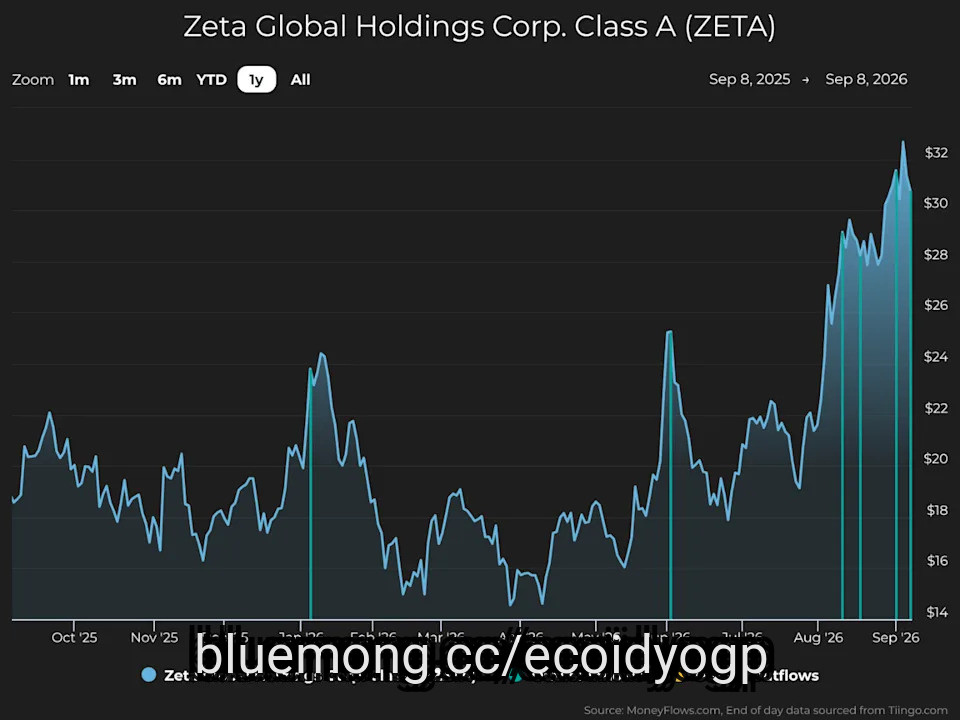
0.00$ raised of 0.00$ goal
0 donations
0.00$
to go

5 days ago
On August 27, ****** an Machinery Inc. (NASDAQ:TITN) reported results for the fiscal second quarter ended July 31, and the numbers point in two different directions at once. Revenue fell to $496.4 million from $546.4 million a year earlier, and the net loss widened to $9.2 million, or $0.40 per diluted share, compared with a $6.0 million loss a year ago. Yet gross margin climbed to 18.6% from 17.1%, and management held its full year profitability targets steady even while cutting its outlook for Europe. Sorting out that mix is the real story of the quarter.
The clearest bright spot is margin. Gross profit margin expanded 150 basis points to 18.6%, which the company attributed to stronger equipment margins as aged inventory keeps shrinking, plus a richer mix of parts and service revenue. That improvement showed up directly in the segments. Agriculture's pretax loss narrowed sharply to $3.3 million from $12.3 million a year ago, even though segment revenue fell to $310.2 million on an 8.4% same-store sales decline. Construction told an even better story, with revenue rising to $78.6 million from $72.0 million on 9.2% same-store growth, and the segment flipped to $0.4 million of pretax income from a $1.2 million pretax loss last year, helped by data center and infrastructure project activity.
Management raised its Construction revenue ****** umption for the year to up 5% to 10%, from flat to up 5% previously. Australia also improved, with revenue up 22.5% once currency effects are stripped out, and its full-year outlook was raised to up 15% to 20% on better moisture levels and farmer sentiment. Floorplan and other interest expense fell to $8.1 million from $11.5 million as interest-bearing inventory levels came down, another sign the cleanup is easing pressure on the business.
The offsetting weakness is just as clear. Consolidated revenue dropped across nearly every line, and Agriculture's same-store decline reflects continued pressure on grower profitability in North America. The bottom line moved the wrong way too, with Adjusted EBITDA slipping to $4.6 million from $5.6 million and operating expenses rising to 19.0% of revenue from 17.0%. Europe was the sharpest problem. Segment revenue fell to $66.1 million from $98.1 million, and once a $1.1 million currency benefit is excluded, revenue was down $33.1 million, or 33.7%. The wind-down of the company's German operations accounted for roughly $11 million of that decline, with the rest coming from softer demand after the boost Romania saw from European Union stimulus programs faded.
#million #once #even
The clearest bright spot is margin. Gross profit margin expanded 150 basis points to 18.6%, which the company attributed to stronger equipment margins as aged inventory keeps shrinking, plus a richer mix of parts and service revenue. That improvement showed up directly in the segments. Agriculture's pretax loss narrowed sharply to $3.3 million from $12.3 million a year ago, even though segment revenue fell to $310.2 million on an 8.4% same-store sales decline. Construction told an even better story, with revenue rising to $78.6 million from $72.0 million on 9.2% same-store growth, and the segment flipped to $0.4 million of pretax income from a $1.2 million pretax loss last year, helped by data center and infrastructure project activity.
Management raised its Construction revenue ****** umption for the year to up 5% to 10%, from flat to up 5% previously. Australia also improved, with revenue up 22.5% once currency effects are stripped out, and its full-year outlook was raised to up 15% to 20% on better moisture levels and farmer sentiment. Floorplan and other interest expense fell to $8.1 million from $11.5 million as interest-bearing inventory levels came down, another sign the cleanup is easing pressure on the business.
The offsetting weakness is just as clear. Consolidated revenue dropped across nearly every line, and Agriculture's same-store decline reflects continued pressure on grower profitability in North America. The bottom line moved the wrong way too, with Adjusted EBITDA slipping to $4.6 million from $5.6 million and operating expenses rising to 19.0% of revenue from 17.0%. Europe was the sharpest problem. Segment revenue fell to $66.1 million from $98.1 million, and once a $1.1 million currency benefit is excluded, revenue was down $33.1 million, or 33.7%. The wind-down of the company's German operations accounted for roughly $11 million of that decline, with the rest coming from softer demand after the boost Romania saw from European Union stimulus programs faded.
#million #once #even

0.00$ raised of 0.00$ goal
0 donations
0.00$
to go

5 days ago
On August 5, Cytek Biosciences (NASDAQ:CTKB) reported financial results for the second quarter ended June 30, and the report reads like two different companies at once. Revenue climbed, margins widened, and the installed base of instruments kept expanding. At the same time, the net loss more than doubled from a year earlier and adjusted EBITDA swung negative. For a company selling hardware into cell ***** ysis labs, that split between growing revenue and growing losses is the story investors need to untangle.
Total revenue reached $48.1 million in the second quarter of 2026, up 6% from the second quarter of 2025, and the growth came from more than one source. Cytek expanded its installed base to 3,933 instruments as of June 30, 2026, adding 142 units in the quarter, and each new machine tends to pull in service and reagent sales over time. That dynamic already shows up in the numbers: recurring revenue from service and reagents hit $18.5 million in the quarter, and on a trailing 12-month basis it now makes up 35% of total revenue, up from 32% a year earlier.
Gross profit told a similar story, climbing 19% to $28.3 million, with GAAP gross margin rising to 59% from 52% and adjusted gross margin reaching 61% from 56%. Some of that lift came from a one-time tariff refund, but even stripped of it, adjusted gross margin still improved to 56%. Cytek also launched the Borealis, a 7-laser flow cytometer built for 60-color panels, and rolled out more automated configurations of its Aurora Evo line, giving the sales team new hardware to sell into the rest of 2026. Full-year revenue guidance moved up to a range of $207 million to $212 million, raising the midpoint by $1 million.
The same quarter that grew revenue also widened the losses. Operating expenses rose 15% year over year to $39.7 million, with general and administrative costs jumping 24% to $16.8 million because of litigation-related expenses, severance, and other personnel costs. R&D spending grew 10% to $9.7 million, and sales and marketing rose 9% to $13.2 million, so the increase was not confined to one line item. The loss from operations widened to $11.4 million from $10.6 million a year earlier, and net loss more than doubled to $12.2 million from $5.6 million.
Adjusted EBITDA, which strips out stock-based compensation and currency swings, swung to a $1.5 million loss from a positive $1.3 million a year earlier, after also adjusting for a write-off tied to an early-stage technology investment. The tariff refund that boosted this quarter's headline gross margin also means the underlying figures, 53% GAAP and 56% adjusted, are the more honest baseline going forward. Cash and marketable securities held roughly flat at $262.0 million as of June 30, 2026, down only slightly from $262.2 million three months earlier, so the balance sheet has not yet felt the strain.
#quarter #adjusted
Total revenue reached $48.1 million in the second quarter of 2026, up 6% from the second quarter of 2025, and the growth came from more than one source. Cytek expanded its installed base to 3,933 instruments as of June 30, 2026, adding 142 units in the quarter, and each new machine tends to pull in service and reagent sales over time. That dynamic already shows up in the numbers: recurring revenue from service and reagents hit $18.5 million in the quarter, and on a trailing 12-month basis it now makes up 35% of total revenue, up from 32% a year earlier.
Gross profit told a similar story, climbing 19% to $28.3 million, with GAAP gross margin rising to 59% from 52% and adjusted gross margin reaching 61% from 56%. Some of that lift came from a one-time tariff refund, but even stripped of it, adjusted gross margin still improved to 56%. Cytek also launched the Borealis, a 7-laser flow cytometer built for 60-color panels, and rolled out more automated configurations of its Aurora Evo line, giving the sales team new hardware to sell into the rest of 2026. Full-year revenue guidance moved up to a range of $207 million to $212 million, raising the midpoint by $1 million.
The same quarter that grew revenue also widened the losses. Operating expenses rose 15% year over year to $39.7 million, with general and administrative costs jumping 24% to $16.8 million because of litigation-related expenses, severance, and other personnel costs. R&D spending grew 10% to $9.7 million, and sales and marketing rose 9% to $13.2 million, so the increase was not confined to one line item. The loss from operations widened to $11.4 million from $10.6 million a year earlier, and net loss more than doubled to $12.2 million from $5.6 million.
Adjusted EBITDA, which strips out stock-based compensation and currency swings, swung to a $1.5 million loss from a positive $1.3 million a year earlier, after also adjusting for a write-off tied to an early-stage technology investment. The tariff refund that boosted this quarter's headline gross margin also means the underlying figures, 53% GAAP and 56% adjusted, are the more honest baseline going forward. Cash and marketable securities held roughly flat at $262.0 million as of June 30, 2026, down only slightly from $262.2 million three months earlier, so the balance sheet has not yet felt the strain.
#quarter #adjusted

0.00$ raised of 0.00$ goal
0 donations
0.00$
to go

5 days ago
Arcosa, Inc. (NYSE:ACA) shareholders approved the proposed acquisition by CRH plc (NYSE:CRH) on September 4. The merger agreement received 39,595,867 votes in favor, compared with 66,113 against and 16,786 abstentions. Approximately 39.7 million shares, representing 80.8% of shares outstanding as of the record date, were present or represented by proxy.
The vote satisfies a major condition for the all-cash transaction. CRH plc (NYSE:CRH) agreed to pay $150 per share, valuing Arcosa, Inc. (NYSE:ACA) at an enterprise value of approximately $8.5 billion. The companies continue to expect a first-quarter 2027 closing, subject to required regulatory approvals and other customary conditions.
CRH plc (NYSE:CRH) described the valuation as 11.5 times estimated 2026 adjusted EBITDA, a company-defined non-GAAP measure, including $175 million of targeted annual run-rate cost synergies expected by year three. CRH plc (NYSE:CRH) defines adjusted EBITDA as earnings from continuing operations before interest, taxes, depreciation, depletion and amortization, with exclusions for impairments, divestitures and investments, equity-method results, substantial acquisition costs and specified pension items.
The result removes the principal seller-side approval risk. The merger no longer depends on another shareholder meeting, and support was decisive among the shares represented. Financing appears less exposed than regulatory clearance: CRH plc (NYSE:CRH) plans to use available cash and committed debt financing, while completion is not subject to a financing condition.
The strategic rationale is tangible. Arcosa, Inc. (NYSE:ACA) would add 109 quarries and yards, nine asphalt plants, 19 terminals and approximately 35 million tons of 2025 aggregates shipments. CRH plc (NYSE:CRH) expects more than 265 million tons of combined annualized aggregates production. Arcosa, Inc. (NYSE:ACA) also brings engineered structures serving grid modernization, electrification and data-center construction.
#NYSE #represented
The vote satisfies a major condition for the all-cash transaction. CRH plc (NYSE:CRH) agreed to pay $150 per share, valuing Arcosa, Inc. (NYSE:ACA) at an enterprise value of approximately $8.5 billion. The companies continue to expect a first-quarter 2027 closing, subject to required regulatory approvals and other customary conditions.
CRH plc (NYSE:CRH) described the valuation as 11.5 times estimated 2026 adjusted EBITDA, a company-defined non-GAAP measure, including $175 million of targeted annual run-rate cost synergies expected by year three. CRH plc (NYSE:CRH) defines adjusted EBITDA as earnings from continuing operations before interest, taxes, depreciation, depletion and amortization, with exclusions for impairments, divestitures and investments, equity-method results, substantial acquisition costs and specified pension items.
The result removes the principal seller-side approval risk. The merger no longer depends on another shareholder meeting, and support was decisive among the shares represented. Financing appears less exposed than regulatory clearance: CRH plc (NYSE:CRH) plans to use available cash and committed debt financing, while completion is not subject to a financing condition.
The strategic rationale is tangible. Arcosa, Inc. (NYSE:ACA) would add 109 quarries and yards, nine asphalt plants, 19 terminals and approximately 35 million tons of 2025 aggregates shipments. CRH plc (NYSE:CRH) expects more than 265 million tons of combined annualized aggregates production. Arcosa, Inc. (NYSE:ACA) also brings engineered structures serving grid modernization, electrification and data-center construction.
#NYSE #represented

0.00$ raised of 0.00$ goal
0 donations
0.00$
to go

5 days ago
Our ****** ysts just identified a stock with the potential to be the next Nvidia. Tell us how you invest and we'll show you why it's our #1 pick. Tap here.
Performance outperformance was driven by disciplined channel management, with legacy field inventory reduced by approximately 30% year-over-year to improve turns to better than pre-pandemic levels.
The MasterCraft brand's success was anchored by the next-generation X Series rollout, which drove a favorable premium mix and offset lower industry-wide volumes.
Management attributed the 730 basis point expansion in legacy adjusted EBITDA margin to improved fixed cost absorption on higher unit volumes and lower promotional discounting.
The combination with Chaparral and Robalo is framed as a transformational pivot to a larger, more diversified platform spanning inland and coastal markets with broader price points.
#management #lower #NVIDIA
Performance outperformance was driven by disciplined channel management, with legacy field inventory reduced by approximately 30% year-over-year to improve turns to better than pre-pandemic levels.
The MasterCraft brand's success was anchored by the next-generation X Series rollout, which drove a favorable premium mix and offset lower industry-wide volumes.
Management attributed the 730 basis point expansion in legacy adjusted EBITDA margin to improved fixed cost absorption on higher unit volumes and lower promotional discounting.
The combination with Chaparral and Robalo is framed as a transformational pivot to a larger, more diversified platform spanning inland and coastal markets with broader price points.
#management #lower #NVIDIA

0.00$ raised of 0.00$ goal
0 donations
0.00$
to go

7 days ago
Our **** ysts just identified a stock with the potential to be the next Nvidia. Tell us how you invest and we'll show you why it's our #1 pick. Tap here.
Performance was driven by the disciplined execution of a value creation strategy, resulting in 27% full-year adjusted EBITDA growth despite reported sales declines from network optimization.
Management attributes underlying sales growth to the $90 billion target addressable market of differentiated retailers, who increased their grocery industry share by 30 basis points.
Operational efficiency improved through the deployment of 'Lean' daily management to 44 distribution centers, resulting in four consecutive quarters of fill rate and throughput gains.
The natural product segment continues to outperform the broader market, reflecting enduring consumer demand for health-forward and specialty products.
#resulting #performance #ebitda #operational
Performance was driven by the disciplined execution of a value creation strategy, resulting in 27% full-year adjusted EBITDA growth despite reported sales declines from network optimization.
Management attributes underlying sales growth to the $90 billion target addressable market of differentiated retailers, who increased their grocery industry share by 30 basis points.
Operational efficiency improved through the deployment of 'Lean' daily management to 44 distribution centers, resulting in four consecutive quarters of fill rate and throughput gains.
The natural product segment continues to outperform the broader market, reflecting enduring consumer demand for health-forward and specialty products.
#resulting #performance #ebitda #operational


7 days ago
Our **** ysts just identified a stock with the potential to be the next Nvidia. Tell us how you invest and we'll show you why it's our #1 pick. Tap here.
French energy distributor Rubis just proved that expensive oil does not have to mean ugly numbers. First-half profits jumped, guidance went up and investors rewarded the French energy distributor with a roughly 5% share-price pop.
Rubis shares climbed after the French energy distribution and renewables group delivered a strong first half and upgraded its full-year outlook.
Revenue rose 24% to €4.07 billion (about $4.8 billion) in the six months to June, while EBITDA increased 18% to €434 million from €369 million a year earlier.
Net income attributable to shareholders climbed 17% to €191 million, with diluted earnings per share also rising 17% to €1.85.
#rubis #distributor #half
French energy distributor Rubis just proved that expensive oil does not have to mean ugly numbers. First-half profits jumped, guidance went up and investors rewarded the French energy distributor with a roughly 5% share-price pop.
Rubis shares climbed after the French energy distribution and renewables group delivered a strong first half and upgraded its full-year outlook.
Revenue rose 24% to €4.07 billion (about $4.8 billion) in the six months to June, while EBITDA increased 18% to €434 million from €369 million a year earlier.
Net income attributable to shareholders climbed 17% to €191 million, with diluted earnings per share also rising 17% to €1.85.
#rubis #distributor #half
7 days ago
Shares of Chime Financial (NASDAQ: CHYM) rallied 44% in August, according to data from S&P Global Market Intelligence.
Chime delivered an excellent second-quarter earnings report, showing stronger-than-expected growth and a significant inflection in profitability. With the stock having sold off since going public a little over a year ago, it's no surprise to see a rally in response to the strong numbers one year later.
Missed Nvidia in 2009? This Rare Signal Is Flashing Again. In 2009, a "Double Down" signal flashed for a little-known chipmaker called Nvidia. For the first time in years, that same "Total Conviction" signal is flashing for a company 1/100th the size of Nvidia. Continue »
In the second quarter, Chime's revenue grew 27% to $670 million, with earnings per share swinging from a loss in the prior-year quarter to a positive $0.07. Both figures handily beat **** yst expectations. Chime also raised its full-year revenue guidance to between $2.725 and $2.745 billion, up from the prior quarter's range of $2.66 billion to $2.69 billion, and adjusted EBITDA (earnings before interest, taxes, and depreciation, and amortization) between $465 and $475 million, up from the prior quarter's guidance between $416 million and $431 million.
While revenue growth came in ahead of expectations, the real story appeared to be the company's skyrocketing profit margins. Second quarter adjusted EBITDA margins of 15% marked a more than 12 percentage point improvement relative to the year-ago quarter.
#year #chime #signal
Chime delivered an excellent second-quarter earnings report, showing stronger-than-expected growth and a significant inflection in profitability. With the stock having sold off since going public a little over a year ago, it's no surprise to see a rally in response to the strong numbers one year later.
Missed Nvidia in 2009? This Rare Signal Is Flashing Again. In 2009, a "Double Down" signal flashed for a little-known chipmaker called Nvidia. For the first time in years, that same "Total Conviction" signal is flashing for a company 1/100th the size of Nvidia. Continue »
In the second quarter, Chime's revenue grew 27% to $670 million, with earnings per share swinging from a loss in the prior-year quarter to a positive $0.07. Both figures handily beat **** yst expectations. Chime also raised its full-year revenue guidance to between $2.725 and $2.745 billion, up from the prior quarter's range of $2.66 billion to $2.69 billion, and adjusted EBITDA (earnings before interest, taxes, and depreciation, and amortization) between $465 and $475 million, up from the prior quarter's guidance between $416 million and $431 million.
While revenue growth came in ahead of expectations, the real story appeared to be the company's skyrocketing profit margins. Second quarter adjusted EBITDA margins of 15% marked a more than 12 percentage point improvement relative to the year-ago quarter.
#year #chime #signal

7 days ago
Reuters reported that Solstice Advanced Materials, Inc. (NASDAQ:SOLS) and Element Solutions Inc (NYSE:ESI) mutually agreed to terminate their $14.5 billion merger agreement, the companies said on August 27, citing feedback from shareholders on both sides who preferred each to stay independent. Neither side will pay a termination fee.
Solstice Chairman Rajeev Gautam said the company valued that feedback, including shareholders' "excitement about Solstice's strategy and growth trajectory as an independent company." Solstice's board also authorized its first-ever buyback, up to $500 million, and reaffirmed its recently raised guidance. Solstice shares jumped 15% in after-hours trading, while Element gained 4%. The deal, announced July 6 just 10 months after Solstice's Honeywell spin-off, would have combined Solstice's refrigerants and specialty materials businesses with Element's electronics chemicals operations, paying Element holders $10 cash plus 0.5 Solstice shares per share. The original announcement got a rough welcome: Solstice fell nearly 15% that day, which CEO David Sewell blamed on arbitrage trading, not doubts about the deal.
Both companies continue to perform strongly on their own. Solstice's second-quarter net sales rose 11% to $1.148 billion, and the company raised its full-year sales guidance to $4.125 billion-$4.185 billion. Element delivered an even stronger quarter, with record net sales up 56% to $978 million and full-year adjusted EBITDA guidance raised to $690 million-$710 million.
Solstice Advanced Materials, Inc. (NASDAQ:SOLS) sheds significant deal risk by walking away. The termination removes the financing and merger risks linked to the acquisition and eliminates the need to use the $4.685 billion bridge facility. It also lets Solstice maintain its 1.3x net leverage. Its new $500 million buyback, the company's first ever, also gives Solstice a direct way to return capital to shareholders while it focuses on organic growth.
Element Solutions Inc (NYSE:ESI) also maintains the strengths that its shareholders wanted to preserve. Chairman Ian Ashken said investors valued Element's management team, culture, and existing business portfolio. CEO Benjamin Gliklich said the company's growth remains compelling. Remaining independent allows Element to continue investing in its existing businesses and pursuing its own growth strategy without taking on the risks of a larger combination.
#billion #million #Growth
Solstice Chairman Rajeev Gautam said the company valued that feedback, including shareholders' "excitement about Solstice's strategy and growth trajectory as an independent company." Solstice's board also authorized its first-ever buyback, up to $500 million, and reaffirmed its recently raised guidance. Solstice shares jumped 15% in after-hours trading, while Element gained 4%. The deal, announced July 6 just 10 months after Solstice's Honeywell spin-off, would have combined Solstice's refrigerants and specialty materials businesses with Element's electronics chemicals operations, paying Element holders $10 cash plus 0.5 Solstice shares per share. The original announcement got a rough welcome: Solstice fell nearly 15% that day, which CEO David Sewell blamed on arbitrage trading, not doubts about the deal.
Both companies continue to perform strongly on their own. Solstice's second-quarter net sales rose 11% to $1.148 billion, and the company raised its full-year sales guidance to $4.125 billion-$4.185 billion. Element delivered an even stronger quarter, with record net sales up 56% to $978 million and full-year adjusted EBITDA guidance raised to $690 million-$710 million.
Solstice Advanced Materials, Inc. (NASDAQ:SOLS) sheds significant deal risk by walking away. The termination removes the financing and merger risks linked to the acquisition and eliminates the need to use the $4.685 billion bridge facility. It also lets Solstice maintain its 1.3x net leverage. Its new $500 million buyback, the company's first ever, also gives Solstice a direct way to return capital to shareholders while it focuses on organic growth.
Element Solutions Inc (NYSE:ESI) also maintains the strengths that its shareholders wanted to preserve. Chairman Ian Ashken said investors valued Element's management team, culture, and existing business portfolio. CEO Benjamin Gliklich said the company's growth remains compelling. Remaining independent allows Element to continue investing in its existing businesses and pursuing its own growth strategy without taking on the risks of a larger combination.
#billion #million #Growth