
21 days ago
XOM has raised its dividend for 43 straight years, while CVX yields 3.45% with Hess acquisition synergies running 50% above initial targets.
EPD's distributable cash flow covered its 6% distribution 1.9x last quarter, with a trailing payout ratio of just 56% on adjusted cash flow.
Read More: Learn 7 ways to generate income with a $1,000,000+ portfolio (sponsor)
Energy has a reputation for boom and bust, yet the sector's largest companies have turned volatile commodities into some of the market's most reliable income. Exxon Mobil (NYSE:XOM) alone has grown its annual dividend per share for 43 consecutive years. The four large caps below split into two integrated oil majors and two midstream toll-road operators. Each pairs a well-covered payout with strong cash generation, making them natural candidates for a long-term income portfolio.
At a recent price of $163.83, Exxon's annualized forward dividend of $4.12 per share works out to a 2.51% yield. The quarterly payout is $1.03, up from $0.99 after a 4% raise late last year.
#income


1 month ago
GE Vernova Inc. (NYSE:GEV) received a boost on September 16 after CEO Scott Strazik stated that the company's backlog could hit the $200 billion mark "very early" in 2027, sooner than Wall Street had expected. The company expects the "strong and durable demand" to drive accelerated growth after its backlog had reached $167 billion at the end of the second quarter of 2026.
GEV has gained by almost 50% over the last year but is down by more than 14% over the last month, reflecting growing investor concerns surrounding the AI trade. The stock also came under pressure on September 14 when GLJ Research slammed it with a 'Sell' rating and a Street-low price target of $470, describing the company as "a cyclical gas turbine manufacturer priced as a secular compounder".
The update builds on extraordinarily strong momentum for GE Vernova, powered by the incredibly strong demand for its power equipment amid the AI data center boom. The company's backlog of $176 billion at the end of Q2 grew $13 billion from the previous quarter and was up 37% YoY, providing it with visibility into earnings well into the 2030s.
Notably, GE Vernova is translating this demand into financial improvement rather than simply a very large order book. The company's revenue grew by 22% YoY to $11.1 billion in the second quarter, while its free cash flow reached $5.1 billion, already exceeding its full-year 2025 level. Given the high demand, GEV raised its 2026 revenue forecast to $45.5 billion-$46.5 billion, up from its previous range of $44.5 billion-$45.5 billion.
The ongoing AI boom has been a major growth catalyst for GE Vernova, as its data center-related orders exceeded $5 billion in the first half of this year, more than double 2025's total. According to Barron's, power availability has become a key constraint for data center operators, and this strong demand has effectively constrained GEV's turbine capacity, which can support pricing and the value of scarce delivery slots.
#billion #year #data #center

1 month ago
FleetCor and CEO Ronald Clarke agreed to a $100 million payment resolving Federal Trade Commission litigation. The settlement follows years of court action over hidden charges involving commercial fuel cards. Harm reached tens of thousands among small-business customers seeking lower operating costs. Regulators say promised savings disappeared beneath undisclosed billing practices.
Federal regulators accused FleetCor, which now operates as Corpay, of imposing unauthorized fees totaling hundreds of millions. Investigators found improper late penalties despite timely remittance or company barriers that prevented payment. Officials cited misleading claims about gas savings, fraud controls, plus card-related expenses. Those practices harmed operators across the United States, according to a 2019 complaint.
Regulators found FleetCor often waited several billing cycles before adding many charges. Delayed timing made extra costs harder for customers to notice. Invoices omitted fee disclosures, pushing account holders toward separate management reports. Even those documents obscured some amounts among unrelated details or excluded them entirely.
"FleetCor deceived its small business customers by promising fuel savings that never materialized," Christopher Mufarrige said. He directs FTC's Bureau of Consumer Protection. Agency officials also criticized hidden and unauthorized charges. Settlement terms channel restitution toward harmed account holders.
In 2023, one federal district court granted summary judgment to the FTC on every count. Its ruling found hidden charges and false representations involving savings, fees, plus fraud-control features. Permanent injunction terms barred FleetCor from billing without informed consent alongside clear disclosures. That order also prohibited deceptive fuel-card claims or hiding material information behind hyperlinks.
#fleetcor #savings



1 month ago
Nebius Group (NASDAQ: NBIS) stock surged sharply higher Thursday morning, gaining as much as 11.2%. As of 2:27 p.m. ET, the stock had given back most of those gains, but was still up 2.1%.
The catalyst that sent the artificial intelligence (AI) and neocloud specialist higher was a report that the company is raising some prices.
Missed Nvidia in 2009? This Rare Signal Is Flashing Again. In 2009, a "Double Down" signal flashed for a little-known chipmaker called Nvidia. For the first time in years, that same "Total Conviction" signal is flashing for a company 1/100th the size of Nvidia. Continue »
Nebius is one of several neocloud operators that stockpile graphics processing units (GPUs) and provide on-demand AI processing. The company announced that it will raise the price for access to on-demand Nvidia (NASDAQ: NVDA) GPUs by roughly 20%, effective Oct. 1.
H100 chips -- $4.50 per GPU hour, up 17%
#Stock #neocloud



1 month ago
Updated Sept 16, 2026, 12:44 pm EDT / Original Sept 16, 2026, 10:49 am EDT
Power availability is a key constraint to
AI growthExternal link
. Computers need to be turned on. That idea has sent data center operators scrambling for internally controlled power-generation solutions, helping send shares of power-equipment providers to the moon.
Copyright ©2026 Dow Jones & Company, Inc. All Rights Reserved. 87990cbe856818d5eddac44c7b1cdeb8
U.S.-Canada energy trade already delivers energy security and abundance for consumers on a larger scale than Venezuela can provide, Ben Cahill writes.
#power #sept #updated


1 month ago
The House of Representatives on Tuesday passed a bipartisan bill aimed at shielding Americans from increased electricity costs **** ociated with data centers being built across the country.
The Ratepayer Protection Act, which passed with an overwhelming 417-3 majority, "ensures American families are not left footing the bill for the grid upgrades and new energy generation required to operate large data centers," Republican Rep. Gabe Evans, one of the bill's sponsors, said ahead of the vote.
The bill now moves to the Senate, where its prospects of passing are uncertain.
The Ratepayer Protection Act is the first major piece of legislation taken up by Congress to address the growing public discontent over the mass buildout of data centers among the American public. Even if it passes, though, it won't directly set the rates that data center operators pay for their electricity.
Congress doesn't have the power to compel utilities to set higher rates for the facilities. Only states have that authority. What the Ratepayer Protection Act would do is compel state utility regulators to consider adopting a federal standard under which large data centers would cover the extra costs of upgrades. The bill is comparable to a proclamation signed by President Trump earlier this year that established a similar voluntary pledge for tech companies.
#passed



1 month ago
Interested in Eli Lilly and Company? Here are five stocks we like better.
The healthcare sector offers options for investors of every age, combining high-growth drugmakers, defensive operators, and reliable dividend payers.
Eli Lilly suits younger investors with its obesity and diabetes drug pipeline driving growth, having gained nearly 34% since its April low.
UnitedHealth Group fits middle-aged investors with a turnaround story and rising dividend, while Johnson & Johnson's Dividend King status appeals to older, income-focused investors.
When it comes to investing, there is no one-size-fits-all approach. Strategies vary based on numerous factors, including but not limited to investors' risk tolerance, net worth, and age. When it comes to stock-picking, that last one is important.
#comes #here #april


1 month ago
Nokia stock surged 6% to $10.39 after its AI-RAN platform advanced to live field trials with eight global operators, delivering 20%+ spectral efficiency gains.
Ericsson's near-flat 0.7% move signals markets aren't pricing AI-RAN as a category-wide event, keeping today's rally a Nokia-specific story.
Read More: Learn 7 secret wealth tips high net worth investors use that most investors miss (sponsor)
Nokia (NYSE:NOK) stock is rising in early Wednesday trading, up 6% to $10.39 after the company said its artificial intelligence-powered radio access network (AI-RAN) platform is moving from evaluation to live field trials at eight global operators. The list spans North America, Europe, Asia-Pacific and the Middle East, and it reframes AI-RAN as a shared industry priority rather than a single-vendor pilot. That geographic reach is what today's move is paying up for.
The move is Nokia-specific. The iShares U.S. Technology ETF (NYSEARCA:IYW) is unchanged at $250.08, and the SPDR S&P 500 ETF Trust (NYSEARCA:SPY) is up 0.4% to $760.33. Nokia stock is climbing while U.S. technology sits still and the broad benchmark is only marginally higher, which frames today as a name-specific catalyst.
#trials



2 months ago
ExxonMobil Holdings Corporation (NYSE:XOM) agreed to increase its Papua LNG interest from 28.7% to 34.1% and ***** ume operatorship, as disclosed on September 7. The proposed ownership percentages reflect Papua New Guinea's state participation rights.
Papua LNG targets a fourth-quarter 2026 final investment decision, or FID. Santos Limited (ASX:STO) disclosed FID as a closing condition for its own stake acquisition; the operatorship announcement did not specify an equivalent condition.
TotalEnergies SE (NYSE:TTE) said redesign and contractor rebidding had reduced estimated development spending by nearly $4 billion since 2024 to approximately $14 billion. The project would produce 5.6 million tonnes of liquefied natural gas annually. The question is whether that smaller budget can support attractive returns through construction and an uncertain LNG market.
ExxonMobil Holdings Corporation (NYSE:XOM) already operates neighboring PNG LNG. Combining operatorship could improve coordination during construction and operations, including the redesigned handling of upstream condensate. That gives the proposed efficiency gains a practical basis in existing infrastructure and local experience.
The cost reduction is substantial. Mechanically, nearly $4 billion off an approximately $18 billion previous estimate represents about 22%. For ExxonMobil Holdings Corporation (NYSE:XOM), lower development spending would reduce the capital required to generate each future dollar of project cash flow, ***** uming production and operating economics hold.
#holdings #operatorship


2 months ago
FirstEnergy Corp. (NYSE:FE), through its Potomac Edison subsidiary, proposed a $52.8 million Maryland distribution-rate adjustment to support investment in aging infrastructure, grid modernization and electric-system reliability. If approved, the request would increase the average residential customer's monthly bill by approximately 5.3%.
Potomac Edison said its electric rates were 25% below the average of its in-state peers as of June 1. The utility expects its residential rates to remain the lowest among Maryland's investor-owned electric utilities even after the proposed adjustment.
The proposed reliability program includes Supervisory Control and Data Acquisition technology, replacement of substation reclosers, new circuit ties and automation, overhead-conductor upgrades, aging underground-cable replacement and removal of high-risk trees near power lines. The Maryland Public Service Commission must review and approve the request before any adjustment can take effect.
The proposal connects the requested revenue to specific reliability investments. SCADA technology can give operators greater visibility into system conditions, while reclosers, circuit ties, and automation can isolate problems and reroute electricity. These capabilities can reduce the number of customers affected by outages and shorten restoration times.
Reconductoring, underground-cable replacement and vegetation management address physical causes of service interruptions. The investments could also improve resilience during severe weather, potentially lowering emergency-response costs and reducing the disruption experienced by customers.
#proposed #maryland #aging


2 months ago
On September 2, Shell Offshore, a subsidiary of Shell plc (NYSE:SHEL), announced the acquisition of a 30% working interest in Conifer, an exploration prospect operated by BP p.l.c. (NYSE:BP) in the U.S. Gulf of Mexico. Located offshore within Keathley Canyon near BP's Kaskida host development, Conifer represents a significant deep-water play. BP retains operatorship, with the initial exploration well expected to spud in 2027. While the deal reflects shared risk and capital efficiency in high-cost offshore basins, comparing the two giants' Q2 2026 earnings shows that Shell is currently executing from a position of superior financial strength.
Shell plc (NYSE:SHEL) delivered an exceptionally clean Q2 2026 report. Adjusted earnings reached $9.8 billion, driven by record upstream production in Brazil and record refinery utilization, which offset Middle East operational outages. Cash flow from operations (CFFO) came in at $21.4 billion, supported by higher realized prices and a $3.4 billion working capital inflow. Shell maintained strict capital discipline, reiterating its full-year capex outlook of $24 billion–$26 billion while completing $5.8 billion in structural cost reductions since 2022. Balance sheet health remains robust, with gearing at 19% and net debt at $42 billion ($12 billion excluding leases).
BP p.l.c. (NYSE:BP) also turned in a solid Q2 recovery, but its headline metrics lag behind Shell's scale. BP reported underlying replacement cost profit (its proxy for net income) of $5.7 billion, a 78% quarter-over-quarter rebound fueled by strong refining margins and oil trading. Operating cash flow reached $10.9 billion after absorbing a $1.0 billion working capital build. BP used strong cash generation to trim net debt down to $22.25 billion, while guiding full-year capex to $13.5 billion–$14.0 billion.
Although BP raised its quarterly dividend by 4% to 8.66 cents, Shell's cash engine allowed it to announce its 19th consecutive quarter of at least $3 billion in share buybacks, distributing 44% of CFFO over the trailing 12 months.
Shell's bull case centers on superior capital allocation, aggressive portfolio high-grading, including the ARC Resources acquisition targeting a 4% production CAGR through 2030, and consistent share buybacks. The bear case focuses on execution risks in integrated gas and LNG amid volatile market conditions, as well as the challenges of integrating large-scale acquisitions.
#cost

2 months ago
Tesla, Inc. (NASDAQ:TSLA) is moving further into the autonomous-driving market as it has started offering robotaxi rides using its Cybercab. The company hosted a Cybercab launch event in Austin on September 3.
Following the event, Goldman Sachs maintained a Neutral rating on Tesla, Inc. (NASDAQ:TSLA). The bank has a 12-month price target of $360 on the stock. The firm sees an illustrative upside scenario of about $500 and a downside scenario of roughly $150.
Goldman Sachs said the Cybercab could give the company a cost advantage in the autonomous-vehicle market. However, the firm believes the company's ability to scale its robotaxi business will depend more on software performance than on the cost of manufacturing the vehicle.
Tesla, Inc. (NASDAQ:TSLA) said it has completed 1 million miles of unsupervised robotaxi operations. The company is also looking for operators interested in owning Cybercab fleets, running hubs and related infrastructure, or hosting robotaxi events.
Goldman Sachs highlighted the company's focus on developing a low-cost autonomous vehicle. The company's unboxed manufacturing approach and camera-only sensor system could help improve the economics of its robotaxi business. According to Goldman estimates, if Tesla, Inc. (NASDAQ:TSLA) can achieve its targeted Cybercab cost of $20,000 to $30,000 at scale, it could have a potential $0.05 to $0.30 per-mile cost advantage over autonomous-vehicle competitors with upfront vehicle costs of $50,000 to $100,000.
#sachs


2 months ago
After signing what President Donald Trump touted as "the biggest oil deal in world history" to take majority control of 65 billion barrels of proven crude oil reserves in Venezuela, the U.S. Administration is setting its sights on the South American country's potentially vast gold and critical minerals wealth.
The Trump Administration is weighing measures to involve U.S. companies in Venezuela's gold and critical minerals and has held initial meetings with firms to see if there is interest in engaging in the Venezuelan mining sector, sources with knowledge of the plans told Reuters this week.
Securing gold and critical minerals from Venezuela could help the U.S. with its supply of metals crucial for defense technology and applications that don't depend on China. Moreover, greater access for U.S. and Western firms in Venezuela's minerals sector would further undermine Chinese and Russian influence in the country, which the ousted Venezuelan leader, Nicolas Maduro, deposed and arrested by the U.S. in January, had enjoyed.
"We are all watching the oil situation closely and recognize there could be a parallel track with critical minerals," an executive from a critical minerals firm who met with the U.S. Administration about Venezuela, told Reuters.
However, the path to mining Venezuela's minerals would not be as straightforward as it arguably is for the oil reserves. Operators generally know how much crude oil Venezuela has (the biggest reserves in the world), but no one really knows the reserves and mining potential of the gold and critical minerals deposits.
#venezuela


2 months ago
Comstock Resources, Inc. (NYSE:CRK) signed a nonbinding letter of intent under which SOCAR would pay $1.65 billion in cash, subject to customary adjustments. SOCAR would acquire non-operated working interests representing 20% of the Legacy Haynesville and 15% of the Western Haynesville upstream interests held by Comstock Resources, Inc. (NYSE:CRK). SOCAR would also acquire 15% of the 73% ownership interest held by Comstock Resources, Inc. (NYSE:CRK) in Pinnacle Gas Services.
The letter of intent requires good-faith negotiations but does not obligate completion. The parties are targeting a definitive agreement by October 31, 2026, and closing by year-end, subject to negotiations, approvals, and customary conditions.
Separately, a Jerry Jones family partnership will fund 85% of the drilling and completion costs for 18 Western Haynesville wells and 80% for nine Legacy Haynesville wells. The total 27-well program is expected to cost approximately $450 million over 12 months. After a 15% return on investment, 50% of the interest covered by the venture will revert to Comstock Resources, Inc. (NYSE:CRK).
If the SOCAR transaction closes, Comstock Resources, Inc. (NYSE:CRK) estimates that the proceeds would reduce company-defined non-GAAP net debt from $3.1 billion to $1.5 billion as of June 30, 2026. Net debt is calculated as total debt less cash and cash equivalents. The approximately $1.6 billion reduction would nearly halve the measure and could improve financial flexibility.
The drilling venture allows development to continue without equivalent near-term cash funding. Following completion of the SOCAR transaction, Comstock Resources, Inc. (NYSE:CRK) would retain operatorship of the upstream ****** ets and control of Pinnacle Gas Services. Drilling should provide volumes to Pinnacle and help delineate the 545,000 net acres in the Western Haynesville.
#SOCAR

0.00$ raised of 0.00$ goal
0 donations
0.00$
to go

2 months ago
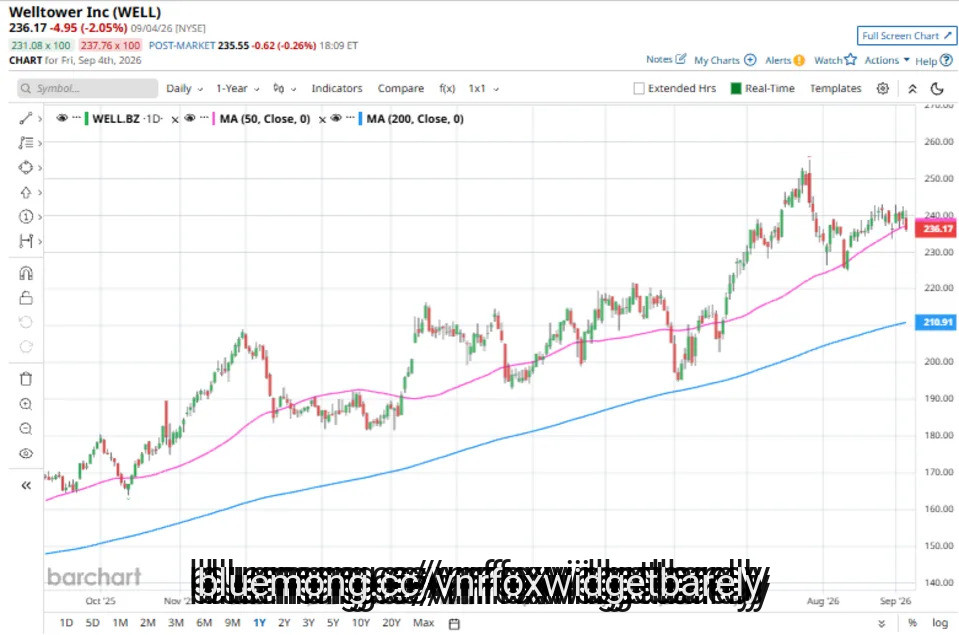
Toledo, Ohio-based Welltower Inc. (WELL) is a heavyweight in healthcare real estate. With a market cap of $170.2 billion, the REIT owns and manages properties across the United States, Canada, and the United Kingdom. Its portfolio is centered on senior housing communities, outpatient medical centers, and long-term care facilities.
Companies worth $10 billion or more are generally referred to as "large-cap stocks." Welltower fits right into that category, with its market cap exceeding the threshold, reflecting its substantial size, influence, and dominance in the real estate sector. By partnering with healthcare providers and senior living operators, Welltower is positioned to capitalize on the growing demand for care as populations age.
How to Play SNPS Stock as Layoffs Hit Synopsys
Micron Stock More Than Tripled in 2026. Now Taiwan Strike Threat Could Shake the AI Boom.
Dear Adobe Stock Fans, Mark Your Calendars for September 10
#estate


2 months ago
The chief executive of Robinhood (HOOD) said on Bloomberg Television late last month that states suing to shut down prediction markets are protecting their own money. "States disagree for various reasons," Vlad Tenev said. "I mean, number one is there's a huge financial incentive from collecting taxes on these state-owned operators for that to be protected."
American Gaming ****** ociation figures put state and local tax collections from sports betting at $3.71 billion in calendar 2025, up 32.4% on the year, on $16.96 billion of sportsbook revenue and $166.94 billion of handle. New York, which taxes mobile sports betting at 51%, accounts for roughly a third of the national total on its own; the state's own court filing says mobile operators generated about $2 billion in gross gaming revenue in 2024 and paid more than $1 billion in state taxes. New York and Illinois together produce close to half of everything states collect on sports betting.
How to Play SNPS Stock as Layoffs Hit Synopsys
Micron Stock More Than Tripled in 2026. Now Taiwan Strike Threat Could Shake the AI Boom.
Dear Adobe Stock Fans, Mark Your Calendars for September 10
#Stock

2 months ago
On September 2, ChargePoint Holdings, Inc (NYSE:CHPT) reported stronger-than-expected results for the second quarter of fiscal 2027. Revenue and the company's loss per share both came in better than Wall Street expectations and the company also reported record non-GAAP gross margin while also highlighting continued progress across its charging business.
Q2 revenue increased 18% year-over-year to $116.1 million, exceeding the $105.2 million ****** yst estimate. ChargePoint Holdings, Inc (NYSE:CHPT) reported an adjusted loss of 35 cents per share, compared with ****** ysts' expectations for a loss of 85 cents per share, according to average estimates compiled by LSEG.
The company also benefited from higher North American home-charging sales, which helped push revenue above expectations. Networked charging systems revenue was up 25% year-over-year as it reached $62.9 million. Subscription revenue increased 10% to $43.7 million. Additionally, the company reported a 78% improvement in its non-GAAP adjusted EBITDA loss, which narrowed sharply to $4.8 million from $22.1 million in the same quarter last year.
ChargePoint Holdings, Inc (NYSE:CHPT) expanded its commercial relationships during the quarter as it extended its long-standing partnership with Mercedes-Benz through a new agreement covering charging solutions for fleet operators in the UK and Germany. The company also announced agreements with Optimus Energy Solutions and Onvo that are expected to add hundreds of new charging ports across the eastern US.
The company also appointed automotive industry veteran John Saffrett as Executive Vice President and Managing Director for Europe, where he will be overseeing sales, customer relationships, partnerships, and market expansion.
#revenue #holdings #chpt


2 months ago
Stablecoins were supposed to route around the banking system. Instead, the companies scaling them are building deeper into it than anyone predicted.
Stripe paid $1.1 billion for Bridge, whose core product is orchestrating banks. Citi is launching crypto custody. Standard Chartered is testing stablecoin settlement in Singapore. One by one, the operators moving institutional volume keep landing on the same architecture.
An enterprise cross-border payment has three legs. The payer's money moves in local currency over local rails—a Brazilian importer paying in BRL via Pix. The payee receives local currency on their end—the supplier collecting dollars in their account.
Between them sits the middle leg: getting value across the border from one institution to the other. That leg used to run through correspondent banking, SWIFT messages hopping between intermediary banks, each holding accounts with the next, each adding a day and a fee. When both institutions accept a stablecoin, that leg settles on-chain in seconds. Banks still own the other two.
Citi to Launch Bitcoin Custody as Wall Street Pushes Deeper Into Crypto
#banking #stablecoin


2 months ago
On the basis of its price right now relative to where it was at the same point in its prior four-year market cycles, Bitcoin (CRYPTO: BTC) looks pretty cheap, with a price of $77,155 as of Sept. 1, 38% below its last all-time high near $126,080, which was set in October 2025.
Of course, Bitcoin "cycle theory" isn't an empirically proven law, but it can be a useful framework for understanding the coin's behavior relative to past periods. If we take that caveat in stride, there's reason to believe decent returns await those who buy it now, so let's examine the case for it being priced at a bargain.
Missed Nvidia in 2009? This Rare Signal Is Flashing Again. In 2009, a "Double Down" signal flashed for a little-known chipmaker called Nvidia. For the first time in years, that same "Total Conviction" signal is flashing for a company 1/100th the size of Nvidia. Continue »
Bitcoin miners are businesses that lend their computing power to the network to produce new coins by essentially burning electricity on difficult calculations.
When the coin's price drops below its production cost, such as during a bear market, the least efficient miners have to capitulate and shut down their rigs to stop operating at a loss, and the network's total computing power, called the hash rate, declines. If the hash rate declines by too much, it takes longer for each new block to be mined, which triggers an automatic downward adjustment to the protocol's mining difficulty. Then, when mining becomes a bit easier again, the recently discouraged operators can return, as they're more likely to be profitable with a lower mining difficulty, and more Bitcoin is subsequently produced.
#Bitcoin #mining


2 months ago
On the basis of its price right now relative to where it was at the same point in its prior four-year market cycles, Bitcoin (CRYPTO: BTC) looks pretty cheap, with a price of $77,155 as of Sept. 1, 38% below its last all-time high near $126,080, which was set in October 2025.
Of course, Bitcoin "cycle theory" isn't an empirically proven law, but it can be a useful framework for understanding the coin's behavior relative to past periods. If we take that caveat in stride, there's reason to believe decent returns await those who buy it now, so let's examine the case for it being priced at a bargain.
Missed Nvidia in 2009? This Rare Signal Is Flashing Again. In 2009, a "Double Down" signal flashed for a little-known chipmaker called Nvidia. For the first time in years, that same "Total Conviction" signal is flashing for a company 1/100th the size of Nvidia. Continue »
Bitcoin miners are businesses that lend their computing power to the network to produce new coins by essentially burning electricity on difficult calculations.
When the coin's price drops below its production cost, such as during a bear market, the least efficient miners have to capitulate and shut down their rigs to stop operating at a loss, and the network's total computing power, called the hash rate, declines. If the hash rate declines by too much, it takes longer for each new block to be mined, which triggers an automatic downward adjustment to the protocol's mining difficulty. Then, when mining becomes a bit easier again, the recently discouraged operators can return, as they're more likely to be profitable with a lower mining difficulty, and more Bitcoin is subsequently produced.
#Bitcoin #flashing #same


2 months ago
This story was originally published on Restaurant Dive. To receive daily news and insights, subscribe to our free daily Restaurant Dive newsletter.
Only 49% of restaurant operators said they plan to grow their staffing levels this year, down from 60% in 2025, according to Toast's Voice of the Restaurant Industry Survey.
However, 48% said they plan to keep the same number of staff, an increase of 10 points compared to last year, per the survey of 676 operators.
This shift indicates that retaining talent, rather than hiring new workers, is becoming more important for the restaurant industry as key measures of labor turnover have stabilized.
The unemployment rate in accommodation and food service has hovered between 5% and 7% in recent months, reaching a low of 5.6% in July, suggesting that restaurants aren't reducing their staff counts, unlike other industries.
#staff


2 months ago
WestEnd Capital Management, an investment advisor, released its Q2 2026 investor letter. The letter can be downloaded here. WestEnd Capital Management's Core Strategy achieved a 16.3% net return in the quarter, surpassing the S&P 500's 15.0%. This performance stemmed from strong earnings generators and upward earnings revisions, showcasing U.S. companies' efficiency in converting sales into profits. S&P 500 net profit margins reached a decade-high of 14.8% in Q1 and are expected to remain above 14% in Q2 despite challenges like higher interest rates and geopolitical uncertainty. Technology remains a key focus in WestEnd's portfolio, along with investments in infrastructure, demographic shifts, financial innovation, and selective consumer opportunities. Also, check the fund's top five holdings to see its best picks in 2026.
In its second-quarter 2026 investor letter, WestEnd Capital Management highlighted Janus Living, Inc. (NYSE:JAN). Janus Living, Inc. (NYSE:JAN) is the only U.S. publicly traded REIT focused exclusively on the senior housing sector and the only U.S. publicly traded REIT. On September 2, 2026, Janus Living, Inc. (NYSE:JAN) closed at $30.70 per share. Over the past month, Janus Living, Inc. (NYSE:JAN) returned 5.51%, and its shares are up 27.08% over the three months. Janus Living, Inc. (NYSE:JAN) has a market capitalization of $9.45 billion.
WestEnd Capital Management stated the following regarding Janus Living, Inc. (NYSE:JAN) in its Q2 2026 investor letter:
"Janus Living, Inc. (NYSE:JAN) is one of the nation's largest pure-play owners and operators of senior housing communities. Unlike traditional triple-net REITs that collect fixed lease payments, Janus generates operating income directly from resident rents and service fees. That means the company captures the full operational upside as occupancy and rental rates increase, while also ******* uming the operational risks of running its communities. Because residents pay privately rather than through Medicare or Medicaid reimbursement programs, the business is largely insulated from changes in government reimbursement policy.
The industry's long-term fundamentals remain compelling:
#westend


2 months ago
We ran an **** ysis based on Insider Monkey's proprietary database to see which real estate stocks billionaire-led funds held at the end of the second quarter. We narrowed the list to names paying dividend yields above 5%. Two stood out.
VICI Properties Inc. (NYSE:VICI) came in first. A total of 22 billionaire-led funds held stakes in the company at the end of the second quarter. VICI owns casino and gaming real estate and leases the properties back to operators under triple-net agreements, which means tenants cover taxes, insurance and maintenance. It has a dividend yield of about 7%.
Gaming and Leisure Properties, Inc. (NASDAQ:GLPI) was in about 19 billionaire-led fund portfolios as of the end of the June quarter, up from 16 in the first quarter. The stock has a dividend yield of about 7.5%. In this article, we will focus on Gaming and Leisure Properties, Inc. (NASDAQ:GLPI).
Gaming and Leisure Properties, Inc. (NASDAQ:GLPI) is a REIT focusing on casino properties. In the most recent quarter, its revenue rose about 9% year over year and beat estimates. Management raised its full-year fiscal 2026 outlook for adjusted funds from operations.
Photo by Breno **** is on Unsplash
#quarter #NASDAQ #Dividend


2 months ago
This story was originally published on Utility Dive. To receive daily news and insights, subscribe to our free daily Utility Dive newsletter.
South Carolina's public power and water utility Santee Cooper announced Thursday that it is working with Google to modernize its financial planning and load forecasting with artificial intelligence tools.
Google's WeatherNext 2 is designed to provide more accurate medium-range weather forecasts, which is expected to improve Santee Cooper's load forecasting, the utility's CFO, Tami Wilson, said during a Wednesday press teleconference. The utility is also using Google's Gemini Enterprise Agent Platform to speed up financial forecasting, she said.
Wilson said the utility is undergoing a "major digital transformation" by "shifting away from legacy, clunky, **** bersome processes," and wants to "automate the routine" without automating accountability or risk management, which she said will remain with human operators.
Wilson said the utility plans to use different approaches with generative AI versus agentic AI. Generative AI will be used to perform "low-cost initial drafting," while Santee Cooper will use agentic AI to "execute multi-step processes autonomously."
#generative


2 months ago
On August 5, LTC Properties (NYSE:LTC) reported second-quarter results for the period ended June 30, 2026, and the numbers show a real estate investment trust leaning harder into a strategy it only started a year ago. Total revenue climbed to $98.9 million from $60.2 million a year earlier, and net income available to common stockholders nearly doubled to $29.5 million. Diluted earnings per share rose to $0.56 from $0.32. Alongside the results, the company raised its full-year 2026 investment guidance by 50% at the midpoint, putting more weight behind a business line called SHOP.
LTC increased the midpoint of its 2026 SHOP investment guidance to $900 million, calling that figure a jump of 50% from the previous midpoint. Management now expects $700 million in year-to-date SHOP acquisitions by the end of the third quarter, and projects SHOP will represent 40% of pro forma annualized net operating income by that same point, which the company says is ahead of its own estimates. LTC expects that share to approach 50% by year-end, with a stated pathway toward 75% by the end of 2028.
Since launching the platform in May 2025, LTC has built the SHOP portfolio to 39 communities across 12 operators, 10 of which are new relationships for the company, representing 37% of total gross real estate investments as of July 31, 2026. Second quarter core SHOP NOI came in at $13.3 million. The company closed $171 million in acquisitions during the quarter and expects another $529 million to close in the third quarter, with $208 million of that already done. LTC also raised its full-year diluted earnings per share guidance to $8.08 to $8.10 and expanded its credit facility to $1.1 billion, leaving $648 million in total pro forma liquidity.
Growth this fast comes with a cost that shows up once you move past revenue. Core FFO per diluted share held flat at $0.68, unchanged from a year earlier even though revenue grew 64%. Core FAD per diluted share actually slipped to $0.70 from $0.71. Part of the explanation is share count. Diluted weighted average shares outstanding rose to 52.2 million from 46.0 million, and total shares outstanding climbed to 53.9 million from 46.1 million, dilution that has kept per-share growth well behind the topline.
Expenses grew just as fast as revenue did. Total expenses nearly doubled to $75.5 million from $44.5 million, with senior housing operating expenses, the direct cost of running SHOP, jumping to $42.2 million from $9.4 million as the new segment scaled up. Interest expense rose to $9.5 million from $8.0 million, and $356 million remains drawn on the revolving credit line even after that facility's expansion. SHOP also depends on the 12 third-party operators running those communities day to day, 10 of which have never worked with LTC before, concentrating execution risk in relationships still being tested.
#million #company


2 months ago
Nvidia's less famous telecom investment had more than doubled on paper by midyear. In October 2025, NVIDIA Corporation (NASDAQ:NVDA) agreed to invest $1 billion in Nokia at $6.01 per share. Nvidia's Q2 13F valued the stake at about $2.2 billion as of June 30. The marked gain is impressive, but the strategic prize is larger: Nokia Corporation (NYSE:NOK) and Nvidia are developing AI-RAN technology intended to carry artificial intelligence from data centers into mobile networks and eventually 6G.
NVIDIA Corporation (NASDAQ:NVDA) wants the network itself to become accelerated computing infrastructure. If radio access networks adopt software-defined, AI-enabled architectures, Nvidia can sell computing, networking, and software into a market beyond hyperscale data centers. The bull case is that inference moves closer to users and telecom operators use spare network capacity for AI workloads. The bear case is timing. Standards, carrier budgets, and commercial rollouts move slowly, making near-term revenue difficult to separate from long-term vision.
Nokia Corporation (NYSE:NOK) gains a strategic partner, capital, and access to an AI platform that can make its radio portfolio more competitive. A successful AI-RAN transition could improve product differentiation and create recurring software opportunities. Yet Nokia must balance that promise with operator spending cycles, intense competition, and the risk that open architectures reduce hardware pricing power. A valuable Nvidia stake does not by itself repair telecom margins.
The partnership is therefore an option on convergence. Nvidia supplies the compute ecosystem; Nokia supplies carrier relationships and radio expertise. Each fills a gap the other cannot quickly build. However, investors should not treat the June valuation as a realized return or ***** ume 6G revenue is imminent. The commercial value emerges only when operators deploy systems at scale and disclose credible returns with attractive economics across multiple markets.
Hedge-fund participation increased in both names. Nvidia ownership rose to 285 funds in the second quarter from 275, while Nokia ownership increased to 81 funds from 66. Fisher ***** et Management raised its Nvidia stake 3% to 90.9 million shares, and Marshall Wace increased its Nokia position 232% to 33 million shares. As of August 14, 43.2 million Nokia shares were sold short, only 0.75% of the float and 0.6 days of average trading volume. The low reported short-interest percentage shows limited reported short positioning, but it does not identify the holders or tell us why those positions exist. Nvidia's paper gain rewards the entry price; the real upside depends on AI-RAN becoming a commercial bridge to 6G.
#nokia #stake


2 months ago
AI gate automation cut dwell times to under 30 seconds while EAIGLE posted 350% year-over-year growth. CEO Amir Hoss explains how the company uses existing security cameras and computer vision to automate gate, yard and dock workflows.On site at a live facility, Hoss breaks down how EAIGLE went from a customer problem to a fully automated, paperless gate and yard operation. He also explains why the next growth phase matters for carriers, shippers and warehouse operators trying to move trucks through the yard faster.#GateAutomation #YardManagement #SupplyChainAI
EAIGLE, an automation company focused on gate-to-dock logistics, has closed a growth funding round on the heels of 350% year-over-year revenue growth, CEO and founder Amir Hoss said in an interview with FreightWaves. The company's computer vision platform reduces gate dwell times that previously ranged from 7.5 to 18 minutes down to under 30 seconds — and sometimes under one minute — by tapping into camera infrastructure that facilities already own.
The technology matters to carriers, brokers, and shippers because gate congestion and yard opacity have long been among the most stubborn inefficiencies in distribution operations. EAIGLE's system automates the full check-in and check-out process, validates bills of lading, purchase orders, appointments, and USDOT numbers in real time, and feeds clean data directly into yard management, warehouse management, and transportation management systems via APIs.
At one active facility where Hoss spoke — a site processing roughly 1,100 trucks per day across two gates and four lanes — EAIGLE replaced 18 full-time staff across three shifts with a fully unmanned, paperless operation. "We didn't validate here, we just log," Hoss recalled a security guard telling him five or six years ago, a dynamic he said rendered downstream YMS data unreliable. "It becomes garbage in and garbage out," he said.
"The bar is really high because you own that responsibility of initiating the high accuracy and complete data capture and validation for the rest of the systems in the supply chain ecosystem of each one of the operational customers."
#eaigle #amir #automation


2 months ago
Sands Capital, an investment management company, released its "Sands Capital Select Growth Fund" Q2 2026 investor letter. The letter can be downloaded here. Select Growth Fund targets U.S. businesses driving significant structural change through disruptive innovation. The fund returned 23.2% in the quarter, outperforming the Russell 1000 Growth Index's 16.7%. U.S. large-cap growth equities rebounded sharply, driven by improving corporate fundamentals and renewed investor confidence in AI, despite geopolitical uncertainties. However, the market's gains were narrow, concentrated among AI beneficiaries. The portfolio's success stemmed from strength in AI infrastructure holdings, especially memory and storage, supported by better pricing and tightening supply. As AI development advances, continuous demand for compute capacity is expected, prompting investments in memory, CPUs, AI chips, and semiconductor manufacturing to address emerging bottlenecks essential for scaling AI. Also, check the fund's top five holdings to see its best picks in 2026.
In its second-quarter 2026 investor letter, Sands Capital Select Growth Fund highlighted Intercontinental Exchange, Inc. (NYSE:ICE), a US-based financial services company that provides technology, data, and market infrastructure to financial institutions, corporations, and government entities. On September 1, 2026, Intercontinental Exchange, Inc. (NYSE:ICE) closed at $159.60 per share. Over the past month, Intercontinental Exchange, Inc. (NYSE:ICE) returned 4.85%, while its shares have declined 10.30% in the last 52 weeks. Intercontinental Exchange, Inc. (NYSE:ICE) has a market capitalization of $89.6 billion, and its stock has traded within a 52-week range of $121.79 to $177.00.
Sands Capital Select Growth Fund stated the following regarding Intercontinental Exchange, Inc. (NYSE:ICE) in its Q2 2026 investor letter:
"Intercontinental Exchange, Inc. (NYSE:ICE) is one of the world's largest operators of financial exchanges and clearinghouses. Shares declined as investor concerns around AI disruption in ICE's Mortgage business and potential competition from perpetual futures contracts weighed on the stock. Much of the underperformance appears to reflect multiple compression rather than a weakening of fundamentals, which remain solid. In our view, the market is overestimating the risk that AI will displace ICE Mortgage. The business is not simply a workflow solution; it is a platform that connects lenders, data vendors, and other participants required to originate, sell, and service mortgages, while also serving as a system of record for a significant portion of the U.S. mortgage ecosystem. We also believe concerns around perpetual futures competition are overstated, as the structure of these products may limit their use in institutional hedging and risk management, particularly before accounting for liquidity. As such, we believe the recent sell-off more than discounts these risks."
#investor

2 months ago
This story was originally published on FSR. To receive daily news and insights, subscribe to our free daily FS Insider.
More than half a decade after the pandemic fundamentally changed how consumers interact with restaurants, delivery has moved well beyond the "turn it on" phase for full-service operators. The focus now is less on adding a sales channel than on optimizing one that touches the kitchen, labor model, guest relationship, and broader tech stack.
"We look at it a little differently nowadays," says Jason Saposnik, VP of information technology for FSC Franchise Co., the parent company of Beef 'O' Brady's, The Brass Tap, and Newk's Eatery. "Early on, the focus was more about just growing delivery sales. Now, we're a lot more focused on whether those sales are profitable, how the restaurants can handle that increased volume, and whether customers are actually getting the same great experience."
The first major improvement in delivery operations was straightforward: getting orders into the restaurant without forcing employees to act as the integration layer.
Saposnik recalls an earlier "tablet ******* " environment in which teams monitored separate devices for DoorDash, Uber Eats, and other channels, then manually entered orders into the POS. "That created all sorts of issues for missed orders and mistakes and delays," he says. "Now, everything just flows into the POS and into the kitchen correctly."
#getting

2 months ago
On August 10, Chemours (NYSE:CC) launched two new refrigerants, Opteon ZE and Opteon 515B, built specifically for stationary chillers that cool data centers, commercial buildings, and other facilities that cannot afford downtime. The announcement lands as data center operators everywhere are scrambling to keep pace with the heat that AI workloads generate, and Chemours is betting its chemistry can be part of the answer.
Chemours designed these products around a specific problem: AI infrastructure is pushing heat loads and uptime requirements past what older cooling systems were built for. Joseph Martinko, President of Thermal & Specialized Solutions at Chemours, said the company is expanding the choices available to chiller manufacturers and operators as they build and maintain the systems powering data centers and other mission-critical environments. That framing matters because it puts Chemours squarely inside the AI infrastructure buildout rather than on its periphery, and the company describes this as part of a broader push into higher-value, high-growth cooling applications.
The two products are designed to work together rather than compete for the same customer. Opteon ZE, the R-1234ze(E) formulation, is an HFO-based refrigerant with a GWP of approximately 1 and zero ozone depletion potential, aimed at air- and water-cooled chillers, commercial air conditioning, heat pumps, and data center cooling specifically. It also offers high energy efficiency and works with commonly used POE lubricants, which matters for equipment makers who do not want to redesign their systems from scratch.
Opteon 515B is a blend of roughly 91.1% R-1234ze(E) and 8.9% R-227ea, with a GWP near 293, pitched at operators running conventional chillers who want an easier path away from higher-GWP refrigerants without a full system overhaul. Having both a near-zero-GWP option and a lower-friction transitional option lets Chemours sell into new builds and legacy fleets at the same time.
The launch is not without caveats. Opteon ZE carries an ASHRAE A2L classification, meaning it is mildly flammable, while Opteon 515B carries the non-flammable A1 rating. That difference alone could steer certain customers toward one product over the other depending on local codes and installation requirements.
#heat #cooling