8 days ago
Karl-Anthony Towns says the pandemic brought him closer to Jordyn Woods, deepening a friendship that eventually became a marriage.
The New York Knicks center told PEOPLE that having COVID-19 "broke me down to the core," while also helping shape the man he became.
He said Woods witnessed his illness firsthand and understands why he remains particularly protective of himself and his family when it comes to the virus.
The interview comes as Towns serves as a paid spokesperson for Sanofi in a campaign promoting NUVAXOVID, a protein-based COVID-19 vaccine. Sanofi announced the partnership on Oct. 2.
Towns' mother, Jacqueline Cruz-Towns, died on April 13, 2020, at 58 after spending about a month hospitalized with COVID-19. His father, Karl Towns Sr., also contracted the virus and recovered. Other relatives died as the pandemic continued.
#towns #covid #virus #died
The New York Knicks center told PEOPLE that having COVID-19 "broke me down to the core," while also helping shape the man he became.
He said Woods witnessed his illness firsthand and understands why he remains particularly protective of himself and his family when it comes to the virus.
The interview comes as Towns serves as a paid spokesperson for Sanofi in a campaign promoting NUVAXOVID, a protein-based COVID-19 vaccine. Sanofi announced the partnership on Oct. 2.
Towns' mother, Jacqueline Cruz-Towns, died on April 13, 2020, at 58 after spending about a month hospitalized with COVID-19. His father, Karl Towns Sr., also contracted the virus and recovered. Other relatives died as the pandemic continued.
#towns #covid #virus #died


10 days ago
Russia on Monday sought to downplay reports that a laboratory technician had died of plague, even as President Donald Trump said Washington was closely monitoring the situation and offered US help.
Reports on Friday that pneumonic plague had killed a 28-year-old woman named Darya Shipilova, who had been working for the anti-plague institute in Siberia's Irkutsk region, sparked alarm.
"We're looking at it very strongly, we just heard about it," Trump told reporters at the White House when asked what Washington was going to do about the risk of plague coming from Russia.
"We'll help them, we'll help them as much as we can."
The Russian news outlet People of Baikal, citing unnamed sources close to the regional security services, said the dead woman may have contracted pneumonic plague from a broken test tube.
#plague #Russia #reports #pneumonic
Reports on Friday that pneumonic plague had killed a 28-year-old woman named Darya Shipilova, who had been working for the anti-plague institute in Siberia's Irkutsk region, sparked alarm.
"We're looking at it very strongly, we just heard about it," Trump told reporters at the White House when asked what Washington was going to do about the risk of plague coming from Russia.
"We'll help them, we'll help them as much as we can."
The Russian news outlet People of Baikal, citing unnamed sources close to the regional security services, said the dead woman may have contracted pneumonic plague from a broken test tube.
#plague #Russia #reports #pneumonic


25 days ago
Just over a year ago, investors largely viewed IREN (IREN) as a bitcoin mining company. Today, the company supplies AI infrastructure to Microsoft (MSFT) and signs billion-dollar contracts with some of the biggest names in the AI market, including Nvidia (NVDA) and Dell Technologies (DELL). These developments provide evidence that IREN's shift toward AI infrastructure is translating into actual business activity, and the market has responded strongly to that progress. IREN shares have been rewarded with two strong moves over the last two months.
IREN's AI transformation centers on a major five-year agreement with Microsoft. The company entered into a $9.7 billion cloud services agreement with Microsoft, with 20% of the contract value paid upfront. Once fully commissioned, the deal is expected to generate nearly $1.94 billion in annualized run-rate revenue. That gives IREN a significant source of contracted business as it builds out its AI cloud operations.
Here's Another Little-Known Firm Jensen Huang's Nvidia Is Quietly Backing
MediaTek Is Stepping Up Competition Against Qualcomm With a New 2-Nanometer Chip. What This Means for QCOM Stock.
JPMorgan Changed Its Mind on Meta Stock After This Major AI Breakthrough
#NVIDIA
IREN's AI transformation centers on a major five-year agreement with Microsoft. The company entered into a $9.7 billion cloud services agreement with Microsoft, with 20% of the contract value paid upfront. Once fully commissioned, the deal is expected to generate nearly $1.94 billion in annualized run-rate revenue. That gives IREN a significant source of contracted business as it builds out its AI cloud operations.
Here's Another Little-Known Firm Jensen Huang's Nvidia Is Quietly Backing
MediaTek Is Stepping Up Competition Against Qualcomm With a New 2-Nanometer Chip. What This Means for QCOM Stock.
JPMorgan Changed Its Mind on Meta Stock After This Major AI Breakthrough
#NVIDIA



25 days ago
Sempra (NYSE:SRE) added a long-term customer commitment on September 14, when its infrastructure subsidiary announced a 20-year sales and purchase agreement with Petróleo Brasileiro S.A. - Petrobras (NYSE:PBR). The agreement covers approximately 0.8 million tonnes annually of liquefied natural gas, or LNG.
Supply will come from the subsidiary's contracted liquefaction capacity at Port Arthur LNG Phase 2 in Texas. The project is under construction, with trains 3 and 4 expected to begin commercial operations in 2030 and 2031, respectively. The agreement improves visibility into future sales, while the earnings contribution depends on delivery and contract economics.
Petróleo Brasileiro S.A. - Petrobras (NYSE:PBR) becomes the infrastructure subsidiary's first South American LNG customer. That broadens the geographic base of buyers and establishes a commercial relationship extending over two decades.
For Sempra (NYSE:SRE), the practical benefit is an external buyer for part of the subsidiary's contracted capacity. Securing that relationship before startup could reduce the need to find buyers for the covered volumes as production approaches, while supporting longer-term supply planning.
The annual commitment equals approximately 6.2% of Phase 2's planned 13-million-tonne annual capacity. This provides a measure of scale, although it does not establish the percentage of capacity still available for sale.
#agreement #petr #supply #term
Supply will come from the subsidiary's contracted liquefaction capacity at Port Arthur LNG Phase 2 in Texas. The project is under construction, with trains 3 and 4 expected to begin commercial operations in 2030 and 2031, respectively. The agreement improves visibility into future sales, while the earnings contribution depends on delivery and contract economics.
Petróleo Brasileiro S.A. - Petrobras (NYSE:PBR) becomes the infrastructure subsidiary's first South American LNG customer. That broadens the geographic base of buyers and establishes a commercial relationship extending over two decades.
For Sempra (NYSE:SRE), the practical benefit is an external buyer for part of the subsidiary's contracted capacity. Securing that relationship before startup could reduce the need to find buyers for the covered volumes as production approaches, while supporting longer-term supply planning.
The annual commitment equals approximately 6.2% of Phase 2's planned 13-million-tonne annual capacity. This provides a measure of scale, although it does not establish the percentage of capacity still available for sale.
#agreement #petr #supply #term
26 days ago
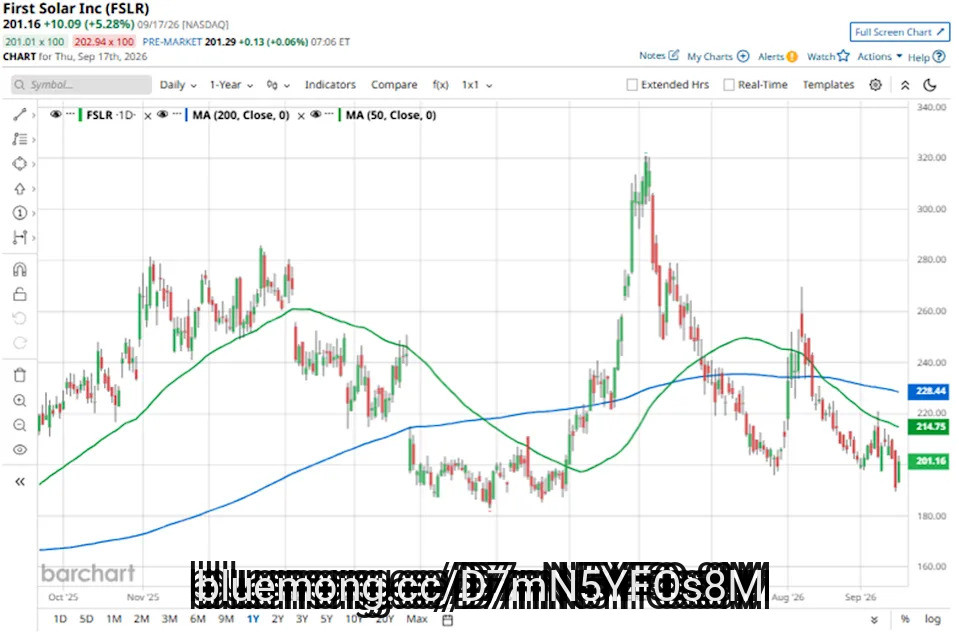
Tempe, Arizona-based First Solar, Inc. (FSLR) is a leading photovoltaic (PV) solar technology and manufacturing company. The company develops and manufactures solar modules using its proprietary thin-film semiconductor technology, offering an alternative to conventional crystalline silicon PV modules. First Solar operates a global manufacturing network spanning the United States, India, Malaysia, and Vietnam. With a market cap of $21.6 billion, the company is one of the largest solar manufacturers.
Companies worth $10 billion or more are generally described as "large-cap stocks," and First Solar fits this description. The company is also one of the few major solar manufacturers with a significant U.S. manufacturing footprint, positioning it to benefit from domestic-content incentives and the broader push to expand U.S. solar manufacturing capacity. First Solar ended the second quarter with a contracted sales backlog of approximately 45.1 GW extending through 2030.
Bank of America Just Declared a 'Generational Entry Point' in U.S. Bonds. Why Investors Should Be Backing Up the Truck on Treasuries Here.
Mark Cuban Says He Was Dizzy for Months, So He Built a VR Fix That Does at Home 'Much Of What A 180k Machine' Does
JPMorgan Gives Up Forecasting Iran War Endgame as Trump Tells Reporters 'Anything Could Happen With Me'
#Solar #first #billion #tempe
Companies worth $10 billion or more are generally described as "large-cap stocks," and First Solar fits this description. The company is also one of the few major solar manufacturers with a significant U.S. manufacturing footprint, positioning it to benefit from domestic-content incentives and the broader push to expand U.S. solar manufacturing capacity. First Solar ended the second quarter with a contracted sales backlog of approximately 45.1 GW extending through 2030.
Bank of America Just Declared a 'Generational Entry Point' in U.S. Bonds. Why Investors Should Be Backing Up the Truck on Treasuries Here.
Mark Cuban Says He Was Dizzy for Months, So He Built a VR Fix That Does at Home 'Much Of What A 180k Machine' Does
JPMorgan Gives Up Forecasting Iran War Endgame as Trump Tells Reporters 'Anything Could Happen With Me'
#Solar #first #billion #tempe


26 days ago
Volkswagen has dramatically cut its 2026 profit outlook as deteriorating business in China, restructuring costs and a multibillion-euro writedown at Porsche pile pressure on Europe's largest automaker.
The German carmaker now expects an operating margin of no more than 1% this year, down from its previous forecast of at least 4%, according to Bloomberg. Volkswagen shares fell more than 7% following the announcement, dragging other automakers lower.
VW expects around €10 billion ($11.5 billion) in charges this year, including restructuring costs ****** ociated with workforce reductions and writedowns on Chinese ****** ets. The total includes a €6-billion writedown related to Porsche, reflecting revised long-term expectations for the sports-car maker.
Excluding the exceptional charges, Volkswagen said its operating margin would be around 4%.
China represents one of the biggest challenges. Volkswagen CFO Arno Antlitz said the market has contracted by around 20%, with no stabilization currently in sight. Chinese automakers are simultaneously taking domestic market share and expanding into Europe with competitively priced electric vehicles.
#porsche
The German carmaker now expects an operating margin of no more than 1% this year, down from its previous forecast of at least 4%, according to Bloomberg. Volkswagen shares fell more than 7% following the announcement, dragging other automakers lower.
VW expects around €10 billion ($11.5 billion) in charges this year, including restructuring costs ****** ociated with workforce reductions and writedowns on Chinese ****** ets. The total includes a €6-billion writedown related to Porsche, reflecting revised long-term expectations for the sports-car maker.
Excluding the exceptional charges, Volkswagen said its operating margin would be around 4%.
China represents one of the biggest challenges. Volkswagen CFO Arno Antlitz said the market has contracted by around 20%, with no stabilization currently in sight. Chinese automakers are simultaneously taking domestic market share and expanding into Europe with competitively priced electric vehicles.
#porsche


26 days ago
UEC holds $488M cash with zero debt and actual uranium production; NXE's 257M lb Arrow deposit draws 16 unanimous ***** yst buy ratings averaging $19.
Utilities are structurally short contracted uranium pounds, and the last US mine permitting took 14 years, which helps explain why in-ground resources command extreme revenue multiples.
Denison's Phoenix is Canada's first uranium mine approved for construction in 20 years, with 8M+ lbs already contracted and first production targeted for mid-2028.
Just released. Our ***** ysts combed the entire stock market and named the ten best stocks to buy right now, and NexGen Energy didn't make the cut. Enter your email to see the names that beat NXE. The report is free. Enter your email and see if any of your stocks made the cut.
Uranium mining is the narrow end of the funnel feeding the AI-driven reactor buildout. On April 23, the U.S. Department of Energy launched the Nuclear Dominance 3x33 campaign to secure the domestic nuclear fuel supply chain and support future reactor deployment, and utilities are staring at a widening long-term supply gap while a Russian enriched-uranium ban takes hold.
#enter #contracted
Utilities are structurally short contracted uranium pounds, and the last US mine permitting took 14 years, which helps explain why in-ground resources command extreme revenue multiples.
Denison's Phoenix is Canada's first uranium mine approved for construction in 20 years, with 8M+ lbs already contracted and first production targeted for mid-2028.
Just released. Our ***** ysts combed the entire stock market and named the ten best stocks to buy right now, and NexGen Energy didn't make the cut. Enter your email to see the names that beat NXE. The report is free. Enter your email and see if any of your stocks made the cut.
Uranium mining is the narrow end of the funnel feeding the AI-driven reactor buildout. On April 23, the U.S. Department of Energy launched the Nuclear Dominance 3x33 campaign to secure the domestic nuclear fuel supply chain and support future reactor deployment, and utilities are staring at a widening long-term supply gap while a Russian enriched-uranium ban takes hold.
#enter #contracted



27 days ago
During the September 14 episode of Mad Money, Jim Cramer addressed the broader tech sector pullback and mentioned Broadcom Inc. (NASDAQ:AVGO) as an attractive option for investors looking past short-term volatility. He stated:
Well, it's a tough time to come out to San Francisco, a day when the whole AI complex is getting hammered because Anthropic and OpenAI seem to be, I don't know… pulling in their horns. Actually, I think there's some real bargains in this group. Take Broadcom, the maker of chips, networking equipment, and tech infrastructure and software with a stock that's down more than 10% over the past month. At the beginning of this month, Broadcom reported a strong set of results, issued a spectacular multi-year forecast, but their guidance for the current quarter was, I don't know, viewed by some as in line.
The stock got slammed. I think Broadcom's still on track to put up some incredible growth because they're at the heart of the AI ecosystem because the company's never let us down in all the years my Charitable Trust has owned it. And down here, roughly 150 points below its June high, the stock may be too cheap to ignore.
Recent financial reports from Broadcom Inc. (NASDAQ:AVGO) highlights the scale of expansion driving its core semiconductor and infrastructure divisions. Total revenue for the fiscal third quarter reached $29.6 billion, representing an 85.5% increase compared to the same period in the previous year. Artificial intelligence semiconductor revenue surged 221% to $16.7 billion, accounting for roughly 56% of total revenue. Remaining performance obligations climbed significantly to $179.2 billion, providing substantial visibility into future contracted revenue. Broadcom also serves major hyperscale AI customers including Alphabet and Meta Platforms.
Management raised its full year guidance to $58 billion from $56 billion in artificial intelligence revenue, while projecting $115 billion for fiscal 2027 and $230 billion for fiscal 2028. The figures highlight a deep integration into the enterprise artificial intelligence ecosystem through custom accelerators and high-speed networking solutions.
#down #year #fiscal #NASDAQ
Well, it's a tough time to come out to San Francisco, a day when the whole AI complex is getting hammered because Anthropic and OpenAI seem to be, I don't know… pulling in their horns. Actually, I think there's some real bargains in this group. Take Broadcom, the maker of chips, networking equipment, and tech infrastructure and software with a stock that's down more than 10% over the past month. At the beginning of this month, Broadcom reported a strong set of results, issued a spectacular multi-year forecast, but their guidance for the current quarter was, I don't know, viewed by some as in line.
The stock got slammed. I think Broadcom's still on track to put up some incredible growth because they're at the heart of the AI ecosystem because the company's never let us down in all the years my Charitable Trust has owned it. And down here, roughly 150 points below its June high, the stock may be too cheap to ignore.
Recent financial reports from Broadcom Inc. (NASDAQ:AVGO) highlights the scale of expansion driving its core semiconductor and infrastructure divisions. Total revenue for the fiscal third quarter reached $29.6 billion, representing an 85.5% increase compared to the same period in the previous year. Artificial intelligence semiconductor revenue surged 221% to $16.7 billion, accounting for roughly 56% of total revenue. Remaining performance obligations climbed significantly to $179.2 billion, providing substantial visibility into future contracted revenue. Broadcom also serves major hyperscale AI customers including Alphabet and Meta Platforms.
Management raised its full year guidance to $58 billion from $56 billion in artificial intelligence revenue, while projecting $115 billion for fiscal 2027 and $230 billion for fiscal 2028. The figures highlight a deep integration into the enterprise artificial intelligence ecosystem through custom accelerators and high-speed networking solutions.
#down #year #fiscal #NASDAQ


27 days ago
Comments from Anthropic CEO Dario Amodei and OpenAI CEO Sam Altman calling for a more measured approach to frontier AI development contributed to a sharp selloff across neoclouds and data center stocks. Bernstein identified CoreWeave Inc. (NASDAQ:CRWV) as the most exposed name because of its rural footprint and focus on AI training. The concern represents a genuine structural argument. However, it marks the second time this year that the same group of stocks has faced concerns over the sustainability of AI demand. There is also an important tension within Bernstein's own note, which highlights CoreWeave's exposure while acknowledging that most of its backlog remains shielded by contracts.
Bernstein cautioned that a slowdown in AI training could weigh on data center developers. The warning followed Amodei's weekend comments urging the industry to deliberately slow the pace of frontier AI capability gains, along with similar remarks from Sam Altman. According to ****** yst Madison Rezaei, slower training activity would likely reduce demand for rural data center sites designed for latency-insensitive workloads. The ****** yst pointed out that rural and Tier 3 markets account for 70% of the industry's 488GW pipeline. CoreWeave was identified as the most exposed name in the firm's coverage. ****** yst Madison Rezaei remarked:
We estimate that 25% of their existing active U.S. power, with an additional ~74% of their contracted power, is situated in Tier 3 and Tier 4 markets.
However, there is a key counterpoint within Bernstein's own note:
The backlog is primarily comprised of take-or-pay contracts, so we do not anticipate a threat there but could see a pullback in demand for the contracted-not-yet-sold rural power if training development slows.
#training #analyst
Bernstein cautioned that a slowdown in AI training could weigh on data center developers. The warning followed Amodei's weekend comments urging the industry to deliberately slow the pace of frontier AI capability gains, along with similar remarks from Sam Altman. According to ****** yst Madison Rezaei, slower training activity would likely reduce demand for rural data center sites designed for latency-insensitive workloads. The ****** yst pointed out that rural and Tier 3 markets account for 70% of the industry's 488GW pipeline. CoreWeave was identified as the most exposed name in the firm's coverage. ****** yst Madison Rezaei remarked:
We estimate that 25% of their existing active U.S. power, with an additional ~74% of their contracted power, is situated in Tier 3 and Tier 4 markets.
However, there is a key counterpoint within Bernstein's own note:
The backlog is primarily comprised of take-or-pay contracts, so we do not anticipate a threat there but could see a pullback in demand for the contracted-not-yet-sold rural power if training development slows.
#training #analyst

28 days ago
York Water holds the longest dividend streak in US public markets at 27 consecutive years, while WTW's $1.775B operating cash flow dwarfs its $358M dividend obligation.
Amdocs and Ituran both run near-recession-proof revenue models, with DOX posting near-100% managed services renewal rates and ITRN carrying zero debt alongside $103.7M in net cash.
All five stocks fund dividends from contracted or recurring revenue streams such as regulated rates, fee income, or subscriptions, insulating payouts from economic cycles.
Read More: Learn 7 secret wealth tips high net worth investors use that most investors miss (sponsor)
Income investors heading into the fourth quarter want payouts that don't wobble with the business cycle. The five names below share one thing: dividends funded by recurring, contracted, or fee-based revenue streams that keep flowing whether or not the macro cooperates. Each has raised its payout recently, and each trades on Nasdaq. As a grounding data point, Willis Towers Watson (NASDAQ:WTW) alone generated $360 million of first-half free cash flow, roughly double the prior-year period, giving the broker ample room to keep funding both dividends and buybacks.
#revenue #NASDAQ #Dividend
Amdocs and Ituran both run near-recession-proof revenue models, with DOX posting near-100% managed services renewal rates and ITRN carrying zero debt alongside $103.7M in net cash.
All five stocks fund dividends from contracted or recurring revenue streams such as regulated rates, fee income, or subscriptions, insulating payouts from economic cycles.
Read More: Learn 7 secret wealth tips high net worth investors use that most investors miss (sponsor)
Income investors heading into the fourth quarter want payouts that don't wobble with the business cycle. The five names below share one thing: dividends funded by recurring, contracted, or fee-based revenue streams that keep flowing whether or not the macro cooperates. Each has raised its payout recently, and each trades on Nasdaq. As a grounding data point, Willis Towers Watson (NASDAQ:WTW) alone generated $360 million of first-half free cash flow, roughly double the prior-year period, giving the broker ample room to keep funding both dividends and buybacks.
#revenue #NASDAQ #Dividend


28 days ago
NBIS revenue surged 454% to $582M with a $37.49B contracted backlog, while ALAB posted its eighth straight EPS beat on 104% revenue growth.
GPUs are worthless without high-speed interconnects, making cables, switches, and optical modules the AI industry's most critical and most overlooked bottleneck.
CRDO plunged 42% last month despite delivering 114.7% revenue growth and guiding for over 85% full-year growth in fiscal 2027.
Just released. Our ***** ysts combed the entire stock market and named the ten best stocks to buy right now, and Astera Labs didn't make the cut. Enter your email to see the names that beat ALAB. The report is free. Enter your email and see if any of your stocks made the cut.
The interconnect layer beneath AI clusters is the current bottleneck. GPUs are useless if they cannot exchange gradients and tokens at line rate, and the cables, switches, retimers, and optical modules that carry that traffic have become the constraint the industry is racing to relieve. One data point frames the pressure: (NASDAQ:ALAB) said PCIe 6 products already made up more than 50% of its total revenue in Q2, up from one third in Q1, evidence that the connectivity generation shift is happening in quarters, not years.
#gpus #cables
GPUs are worthless without high-speed interconnects, making cables, switches, and optical modules the AI industry's most critical and most overlooked bottleneck.
CRDO plunged 42% last month despite delivering 114.7% revenue growth and guiding for over 85% full-year growth in fiscal 2027.
Just released. Our ***** ysts combed the entire stock market and named the ten best stocks to buy right now, and Astera Labs didn't make the cut. Enter your email to see the names that beat ALAB. The report is free. Enter your email and see if any of your stocks made the cut.
The interconnect layer beneath AI clusters is the current bottleneck. GPUs are useless if they cannot exchange gradients and tokens at line rate, and the cables, switches, retimers, and optical modules that carry that traffic have become the constraint the industry is racing to relieve. One data point frames the pressure: (NASDAQ:ALAB) said PCIe 6 products already made up more than 50% of its total revenue in Q2, up from one third in Q1, evidence that the connectivity generation shift is happening in quarters, not years.
#gpus #cables



29 days ago
Applied Digital turned negative for the year after a 24% monthly slide, while peers Core Scientific and Cipher Mining each fell between 4% and 5% on Tuesday despite staying positive year to date.
The sector ETF DTCR fell just 0.6% as selling stays concentrated in leveraged buildout names, not the broader infrastructure basket.
Despite $36 billion in contracted lease value and strong Q4 results, Applied Digital's $2.7 billion debt load raises dilution risk as its share price falls.
Read More: Learn 7 secret wealth tips high net worth investors use that most investors miss (sponsor)
Applied Digital's slide Tuesday afternoon matters most for what it does to the year. Applied Digital (NASDAQ:APLD) stock is down 4% to $23.72, pushing the year-to-date figure to a decline of 3%. That's a stark reversal for a name that was among the market's most favored artificial intelligence (AI) capacity plays earlier in 2026, and it caps a month in which the group has bled steadily lower.
#year #despite #date #billion
The sector ETF DTCR fell just 0.6% as selling stays concentrated in leveraged buildout names, not the broader infrastructure basket.
Despite $36 billion in contracted lease value and strong Q4 results, Applied Digital's $2.7 billion debt load raises dilution risk as its share price falls.
Read More: Learn 7 secret wealth tips high net worth investors use that most investors miss (sponsor)
Applied Digital's slide Tuesday afternoon matters most for what it does to the year. Applied Digital (NASDAQ:APLD) stock is down 4% to $23.72, pushing the year-to-date figure to a decline of 3%. That's a stark reversal for a name that was among the market's most favored artificial intelligence (AI) capacity plays earlier in 2026, and it caps a month in which the group has bled steadily lower.
#year #despite #date #billion


29 days ago
A European independent power producer is expanding its ******* et base on the continent. Israel-headquartered Econergy on September 15 said it is entering the French market with a €134-million ($155 million) acquisition of Escofi, a private wind energy platform of about 740 MW.Econergy, which has offices across Europe, said the deal significantly expands the company's European wind ******* et base, bringing its total renewable portfolio to 13 GW. Escofi, founded in 1988, originates, finances, builds, and operates onshore wind projects, with its wind energy portfolio across four development stages: 128 MW in commercial operation, 34 MW under construction, 147 MW in advanced development stage (with building permits and grid connection approvals in place and construction due to commence between 2028 and 2030), and 432 MW in early and mid-stage development.Escofi's portfolio is concentrated in the Hauts-de-France and Grand Est regions of northern France, which officials said have the strongest onshore wind conditions and regulatory environments in the country.
More than 90% of Escofi's operational and under-construction capacity benefits from 20-year contracted revenues under France's Contracts for Difference (CfDs) regime, providing a stable, long-term revenue stream for the portfolio. Escofi in July of this year secured additional CfDs for three more projects totaling 46 MW at prices above €80/MWh ($92/MWh) for 20-year terms, further strengthening the portfolio's contracted revenue base."The acquisition of Escofi is a significant strategic step for Econergy, establishing our presence in France and materially expanding our European wind platform," said Eyal Podhorzer, CEO of Econergy. "Escofi brings us a proven, 37-year-old French onshore wind operator with a high-quality operational fleet and a strong pipeline of projects with 20-year CfD revenues located in the best wind regions in France. Combined with our existing European platform, this gives Econergy a stronger and more geographically diversified base of long-term, contracted cash flows to build on."Escofi's 309 MW of operational, under-construction, and advanced-development projects are expected to generate annual revenues of €59-65 million and EBITDA of €47-53 million on a representative-year basis. By 2030, on completion of the projects under construction and the 147-MW advanced pipeline, Escofi's operational capacity is expected to reach about 300 MW, with project-level EBITDA of about €42–44 million. Escofi's effective ownership across projects stands at about 91%, and the 432-MW early- and mid-stage pipeline provides the platform's long-term growth runway, according to the company.
#econergy
More than 90% of Escofi's operational and under-construction capacity benefits from 20-year contracted revenues under France's Contracts for Difference (CfDs) regime, providing a stable, long-term revenue stream for the portfolio. Escofi in July of this year secured additional CfDs for three more projects totaling 46 MW at prices above €80/MWh ($92/MWh) for 20-year terms, further strengthening the portfolio's contracted revenue base."The acquisition of Escofi is a significant strategic step for Econergy, establishing our presence in France and materially expanding our European wind platform," said Eyal Podhorzer, CEO of Econergy. "Escofi brings us a proven, 37-year-old French onshore wind operator with a high-quality operational fleet and a strong pipeline of projects with 20-year CfD revenues located in the best wind regions in France. Combined with our existing European platform, this gives Econergy a stronger and more geographically diversified base of long-term, contracted cash flows to build on."Escofi's 309 MW of operational, under-construction, and advanced-development projects are expected to generate annual revenues of €59-65 million and EBITDA of €47-53 million on a representative-year basis. By 2030, on completion of the projects under construction and the 147-MW advanced pipeline, Escofi's operational capacity is expected to reach about 300 MW, with project-level EBITDA of about €42–44 million. Escofi's effective ownership across projects stands at about 91%, and the 432-MW early- and mid-stage pipeline provides the platform's long-term growth runway, according to the company.
#econergy


29 days ago
Our ****** ysts just identified a stock with the potential to be the next Nvidia. Tell us how you invest and we'll show you why it's our #1 pick. Tap here.
Delivered total revenue growth of 1.1%, marking the second consecutive quarter of expansion as the Project Sunshine transformation gains traction.
Direct segment revenue grew 8% with comparable sales up 9.2%, serving as the primary indicator of customer resonance with new product and marketing strategies.
Gross margin expanded by more than 40 basis points (excluding tariff refunds) through disciplined pricing, promotion governance, and improved product ****** ortment productivity.
Indirect channel revenue contracted 39% due to intentional shifts in marketplace strategy and a strategic reduction in liquidation sales to protect brand equity.
#tell
Delivered total revenue growth of 1.1%, marking the second consecutive quarter of expansion as the Project Sunshine transformation gains traction.
Direct segment revenue grew 8% with comparable sales up 9.2%, serving as the primary indicator of customer resonance with new product and marketing strategies.
Gross margin expanded by more than 40 basis points (excluding tariff refunds) through disciplined pricing, promotion governance, and improved product ****** ortment productivity.
Indirect channel revenue contracted 39% due to intentional shifts in marketplace strategy and a strategic reduction in liquidation sales to protect brand equity.
#tell

29 days ago
Oracle Corporation (NYSE:ORCL) is increasing the expected cost of its fiscal 2026 restructuring plan by about $700 million to roughly $2.8 billion as it simultaneously ramps up spending to capture demand for AI cloud services. The additional costs include severance, contract terminations and other exit expenses, with some restructuring directly linked to adopting AI across parts of the organization.
Oracle had already recorded $1.8 billion of restructuring expenses in fiscal 2026, compared with $299 million in fiscal 2025, showing how materially the company is accelerating its operational transformation. The restructuring comes alongside an unusually large AI investment cycle. Oracle booked more than $30 billion of new AI cloud contracts in its latest quarter, lifting its remaining performance obligations/revenue backlog to $664 billion, while roughly half of that backlog is expected to convert into revenue over the next 36 months.
The strongest bull argument is that the additional restructuring expense is part of a broader shift toward a higher-growth cloud and AI business rather than simply a deterioration in cost control. Oracle Corporation (NYSE:ORCL)'s restructuring program is explicitly aimed at improving efficiency while reallocating resources toward cloud-based offerings and second-generation cloud infrastructure. If the $2.8 billion restructuring program reduces lower-growth costs and enables Oracle to redirect personnel and capital toward AI infrastructure, the near-term earnings pressure could support stronger operating leverage later as cloud revenue scales.
More importantly, the restructuring is occurring against evidence that AI demand is already translating into contracted revenue. Oracle added more than $30 billion of AI cloud contracts in one quarter, pushing its backlog to $664 billion, above the $639.89 billion ******* yst estimate. Management said most of the newly contracted revenue would not require substantial incremental capital because customers are using prepayments or supplying their own hardware. That is particularly important because Oracle's biggest weakness has been the mismatch between rapid infrastructure investment and current cash generation. If customer-funded capacity continues to reduce Oracle's upfront capital burden, the company could convert its huge backlog into revenue without proportionally increasing its cash burn.
The early financial evidence also supports the possibility that the AI strategy is beginning to improve Oracle's growth profile. Revenue in the recent quarter rose 30% year over year to $19.3 billion, adjusted EPS reached $1.92 versus the $1.74 ******* yst consensus, and Oracle Corporation (NYSE:ORCL) raised its fiscal 2027 adjusted EPS forecast from $8.05 to $8.10. Meanwhile, first-quarter free cash flow of negative $5.4 billion was substantially better than both the expected negative $9.56 billion and the previous-quarter negative $11.48 billion. If this trajectory continues, the $700
Oracle had already recorded $1.8 billion of restructuring expenses in fiscal 2026, compared with $299 million in fiscal 2025, showing how materially the company is accelerating its operational transformation. The restructuring comes alongside an unusually large AI investment cycle. Oracle booked more than $30 billion of new AI cloud contracts in its latest quarter, lifting its remaining performance obligations/revenue backlog to $664 billion, while roughly half of that backlog is expected to convert into revenue over the next 36 months.
The strongest bull argument is that the additional restructuring expense is part of a broader shift toward a higher-growth cloud and AI business rather than simply a deterioration in cost control. Oracle Corporation (NYSE:ORCL)'s restructuring program is explicitly aimed at improving efficiency while reallocating resources toward cloud-based offerings and second-generation cloud infrastructure. If the $2.8 billion restructuring program reduces lower-growth costs and enables Oracle to redirect personnel and capital toward AI infrastructure, the near-term earnings pressure could support stronger operating leverage later as cloud revenue scales.
More importantly, the restructuring is occurring against evidence that AI demand is already translating into contracted revenue. Oracle added more than $30 billion of AI cloud contracts in one quarter, pushing its backlog to $664 billion, above the $639.89 billion ******* yst estimate. Management said most of the newly contracted revenue would not require substantial incremental capital because customers are using prepayments or supplying their own hardware. That is particularly important because Oracle's biggest weakness has been the mismatch between rapid infrastructure investment and current cash generation. If customer-funded capacity continues to reduce Oracle's upfront capital burden, the company could convert its huge backlog into revenue without proportionally increasing its cash burn.
The early financial evidence also supports the possibility that the AI strategy is beginning to improve Oracle's growth profile. Revenue in the recent quarter rose 30% year over year to $19.3 billion, adjusted EPS reached $1.92 versus the $1.74 ******* yst consensus, and Oracle Corporation (NYSE:ORCL) raised its fiscal 2027 adjusted EPS forecast from $8.05 to $8.10. Meanwhile, first-quarter free cash flow of negative $5.4 billion was substantially better than both the expected negative $9.56 billion and the previous-quarter negative $11.48 billion. If this trajectory continues, the $700
29 days ago
Oracle Corporation (NYSE:ORCL) is increasing the expected cost of its fiscal 2026 restructuring plan by about $700 million to roughly $2.8 billion as it simultaneously ramps up spending to capture demand for AI cloud services. The additional costs include severance, contract terminations and other exit expenses, with some restructuring directly linked to adopting AI across parts of the organization.
Oracle had already recorded $1.8 billion of restructuring expenses in fiscal 2026, compared with $299 million in fiscal 2025, showing how materially the company is accelerating its operational transformation. The restructuring comes alongside an unusually large AI investment cycle. Oracle booked more than $30 billion of new AI cloud contracts in its latest quarter, lifting its remaining performance obligations/revenue backlog to $664 billion, while roughly half of that backlog is expected to convert into revenue over the next 36 months.
The strongest bull argument is that the additional restructuring expense is part of a broader shift toward a higher-growth cloud and AI business rather than simply a deterioration in cost control. Oracle Corporation (NYSE:ORCL)'s restructuring program is explicitly aimed at improving efficiency while reallocating resources toward cloud-based offerings and second-generation cloud infrastructure. If the $2.8 billion restructuring program reduces lower-growth costs and enables Oracle to redirect personnel and capital toward AI infrastructure, the near-term earnings pressure could support stronger operating leverage later as cloud revenue scales.
More importantly, the restructuring is occurring against evidence that AI demand is already translating into contracted revenue. Oracle added more than $30 billion of AI cloud contracts in one quarter, pushing its backlog to $664 billion, above the $639.89 billion ****** yst estimate. Management said most of the newly contracted revenue would not require substantial incremental capital because customers are using prepayments or supplying their own hardware. That is particularly important because Oracle's biggest weakness has been the mismatch between rapid infrastructure investment and current cash generation. If customer-funded capacity continues to reduce Oracle's upfront capital burden, the company could convert its huge backlog into revenue without proportionally increasing its cash burn.
The early financial evidence also supports the possibility that the AI strategy is beginning to improve Oracle's growth profile. Revenue in the recent quarter rose 30% year over year to $19.3 billion, adjusted EPS reached $1.92 versus the $1.74 ****** yst consensus, and Oracle Corporation (NYSE:ORCL) raised its fiscal 2027 adjusted EPS forecast from $8.05 to $8.10. Meanwhile, first-quarter free cash flow of negative $5.4 billion was substantially better than both the expected negative $9.56 billion and the previous-quarter negative $11.48 billion. If this trajectory continues, the $700 mi
Oracle had already recorded $1.8 billion of restructuring expenses in fiscal 2026, compared with $299 million in fiscal 2025, showing how materially the company is accelerating its operational transformation. The restructuring comes alongside an unusually large AI investment cycle. Oracle booked more than $30 billion of new AI cloud contracts in its latest quarter, lifting its remaining performance obligations/revenue backlog to $664 billion, while roughly half of that backlog is expected to convert into revenue over the next 36 months.
The strongest bull argument is that the additional restructuring expense is part of a broader shift toward a higher-growth cloud and AI business rather than simply a deterioration in cost control. Oracle Corporation (NYSE:ORCL)'s restructuring program is explicitly aimed at improving efficiency while reallocating resources toward cloud-based offerings and second-generation cloud infrastructure. If the $2.8 billion restructuring program reduces lower-growth costs and enables Oracle to redirect personnel and capital toward AI infrastructure, the near-term earnings pressure could support stronger operating leverage later as cloud revenue scales.
More importantly, the restructuring is occurring against evidence that AI demand is already translating into contracted revenue. Oracle added more than $30 billion of AI cloud contracts in one quarter, pushing its backlog to $664 billion, above the $639.89 billion ****** yst estimate. Management said most of the newly contracted revenue would not require substantial incremental capital because customers are using prepayments or supplying their own hardware. That is particularly important because Oracle's biggest weakness has been the mismatch between rapid infrastructure investment and current cash generation. If customer-funded capacity continues to reduce Oracle's upfront capital burden, the company could convert its huge backlog into revenue without proportionally increasing its cash burn.
The early financial evidence also supports the possibility that the AI strategy is beginning to improve Oracle's growth profile. Revenue in the recent quarter rose 30% year over year to $19.3 billion, adjusted EPS reached $1.92 versus the $1.74 ****** yst consensus, and Oracle Corporation (NYSE:ORCL) raised its fiscal 2027 adjusted EPS forecast from $8.05 to $8.10. Meanwhile, first-quarter free cash flow of negative $5.4 billion was substantially better than both the expected negative $9.56 billion and the previous-quarter negative $11.48 billion. If this trajectory continues, the $700 mi

1 month ago
On September 10, Adobe (NASDAQ:ADBE) posted record third-quarter revenue of $6.76 billion, up 13% year over year, and raised its full-year revenue and profit targets. Non-GAAP EPS climbed 15% to $6.13, while GAAP EPS rose 11% to $4.62. Buried inside those headline numbers was a sharper story: AI-first ending ARR topped $650 million, growing more than 150% year over year. The same call brought a leadership change, with Anil S. Chakravarthy set to take over as CEO from Shantanu Narayen on December 1. Investors got a lot to digest in one afternoon.
Adobe's AI tools are no longer just a demo. Firefly ending ARR, which spans the Firefly app and its credit packs, grew 40% quarter over quarter, and the Acrobat AI ******* istant doubled its monthly active users over the same three months. Total monthly active users across Adobe's businesses surpassed 1 billion in the quarter, up more than 20% year over year, and creative premium MAU crossed 100 million, up more than 70%. Business professionals and consumers MAU passed 900 million, up more than 25%. That kind of user growth, concentrated in free and freemium tiers, is what feeds the paid AI upgrades now showing up in ARR.
The company backed that growth with cash. Operating cash flow hit a third-quarter record of $2.52 billion, and Adobe bought back roughly 9.5 million shares during the quarter, leaving $24.55 billion still authorized for repurchases. Management raised its full-year revenue target to a range of $26.58 billion to $26.63 billion and its non-GAAP EPS target to $24.45 to $24.50. On the product side, Adobe struck a deal to acquire Topaz Labs, whose AI enhancement models for image and video work would slot directly into Firefly and Creative Cloud. Enterprise demand held up too, with ending ARR growing more than 20% year over year at each of Adobe Experience Manager, Adobe Gen Studio, and Adobe Experience Platform.
Not every metric moved as fast. Remaining performance obligations, the backlog of contracted but unrecognized revenue, grew 8% year over year to $22.16 billion, trailing both the 13% revenue growth and the 11.2% growth in total ending ARR. Current RPO grew 9%, also behind the topline. Interim CFO Steven Day flagged a separate issue heading into the fourth quarter: a foreign-exchange headwind that partly offset the benefit of the third-quarter beat when management updated its full-year guidance.
AI-first ARR, for all its 150% growth rate, is still just over $650 million against a total ARR base of $27.50 billion, so it remains a small slice of the business even as it scales. The transition arrives at a pivotal moment too, with Chakravarthy set to take the CEO seat on Dec. 1 just as the company leans harder into an unproven agentic-software strategy, and the Topaz Labs deal still needs to clear regulatory approval before it adds anything to the numbers.
#adobe #billion #million
Adobe's AI tools are no longer just a demo. Firefly ending ARR, which spans the Firefly app and its credit packs, grew 40% quarter over quarter, and the Acrobat AI ******* istant doubled its monthly active users over the same three months. Total monthly active users across Adobe's businesses surpassed 1 billion in the quarter, up more than 20% year over year, and creative premium MAU crossed 100 million, up more than 70%. Business professionals and consumers MAU passed 900 million, up more than 25%. That kind of user growth, concentrated in free and freemium tiers, is what feeds the paid AI upgrades now showing up in ARR.
The company backed that growth with cash. Operating cash flow hit a third-quarter record of $2.52 billion, and Adobe bought back roughly 9.5 million shares during the quarter, leaving $24.55 billion still authorized for repurchases. Management raised its full-year revenue target to a range of $26.58 billion to $26.63 billion and its non-GAAP EPS target to $24.45 to $24.50. On the product side, Adobe struck a deal to acquire Topaz Labs, whose AI enhancement models for image and video work would slot directly into Firefly and Creative Cloud. Enterprise demand held up too, with ending ARR growing more than 20% year over year at each of Adobe Experience Manager, Adobe Gen Studio, and Adobe Experience Platform.
Not every metric moved as fast. Remaining performance obligations, the backlog of contracted but unrecognized revenue, grew 8% year over year to $22.16 billion, trailing both the 13% revenue growth and the 11.2% growth in total ending ARR. Current RPO grew 9%, also behind the topline. Interim CFO Steven Day flagged a separate issue heading into the fourth quarter: a foreign-exchange headwind that partly offset the benefit of the third-quarter beat when management updated its full-year guidance.
AI-first ARR, for all its 150% growth rate, is still just over $650 million against a total ARR base of $27.50 billion, so it remains a small slice of the business even as it scales. The transition arrives at a pivotal moment too, with Chakravarthy set to take the CEO seat on Dec. 1 just as the company leans harder into an unproven agentic-software strategy, and the Topaz Labs deal still needs to clear regulatory approval before it adds anything to the numbers.
#adobe #billion #million

1 month ago
On September 10, Tsakos Energy Navigation (NYSE:TEN) reported a first half of 2026 that reads like a fantasy year for a decades-old tanker operator. Net income hit $228 million, more than triple what the company earned over the same six months a year earlier, while diluted EPS climbed to $7.12 from $1.70. Behind those numbers sits a rare combination: a fleet locked into billions in forward earnings, war-driven cargo detours pushing rates higher, and a newbuilding bet that has already paid off before half the ships have even hit the water.
The earnings power came from two directions at once. The average time charter equivalent rate rose 41% to $43,503 a day in the first half, and profit-sharing contracts on nine large vessels brought in $71 million, up from just $10 million a year earlier. Even with six vessels pulled from service for scheduled dry docks, the fleet still ran at 96.5% utilization. Second-quarter results followed the same pattern, with net income of $139.3 million, which included a $38 million gain on ******* et sales, and earnings per share of $4.40 against $0.67 in last year's second quarter.
Tsakos is also sitting on a fleet renewal bet that already worked out. Since the start of 2023, the company has sold 20 tankers averaging 17.3 years old and replaced them with 35 vessels averaging just half a year old. Its 26-ship newbuilding program, contracted for about $3.1 billion, is now valued roughly 30% above that cost, and CEO Nikolas Tsakos said the VLCCs in that order book have nearly doubled in price since they were placed. With $466 million in cash and forward committed earnings of roughly $3.5 billion, management has room to raise its dividend, which already paid out $1.60 per share this year, and is weighing whether to redeem $120 million of 9.25% preferred shares, a move it estimates could add $0.30 to $0.40 to EPS.
That performance came against a backdrop the company would rather not have. President George Saroglou said vessels have been attacked, and seafarers hurt or killed trying to keep global trade moving through the Strait of Hormuz, where a ceasefire unraveled roughly halfway through its planned 60-day run and a US naval presence now tries to manage safe passage. Tsakos has chosen to route around the strait entirely rather than put crews through the toll those attacks take.
The cost side is climbing too. Bunker prices jumped about 25%, pushing first-half voyage expenses to $82 million from $68 million, and operating expenses rose to $111 million from $102 million on higher dry-docking costs and inflation. Total debt reached $2.1 billion at the end of June, up from $1.8 billion a year earlier, as the company finances its newbuilding program. And while profit-sharing revenue jumped, the operating days tied to those market-related contracts actually fell 22%, meaning a smaller slice of the fleet is left exposed to capture further spot-rate gains if the tanker market keeps running hot.
#billion
The earnings power came from two directions at once. The average time charter equivalent rate rose 41% to $43,503 a day in the first half, and profit-sharing contracts on nine large vessels brought in $71 million, up from just $10 million a year earlier. Even with six vessels pulled from service for scheduled dry docks, the fleet still ran at 96.5% utilization. Second-quarter results followed the same pattern, with net income of $139.3 million, which included a $38 million gain on ******* et sales, and earnings per share of $4.40 against $0.67 in last year's second quarter.
Tsakos is also sitting on a fleet renewal bet that already worked out. Since the start of 2023, the company has sold 20 tankers averaging 17.3 years old and replaced them with 35 vessels averaging just half a year old. Its 26-ship newbuilding program, contracted for about $3.1 billion, is now valued roughly 30% above that cost, and CEO Nikolas Tsakos said the VLCCs in that order book have nearly doubled in price since they were placed. With $466 million in cash and forward committed earnings of roughly $3.5 billion, management has room to raise its dividend, which already paid out $1.60 per share this year, and is weighing whether to redeem $120 million of 9.25% preferred shares, a move it estimates could add $0.30 to $0.40 to EPS.
That performance came against a backdrop the company would rather not have. President George Saroglou said vessels have been attacked, and seafarers hurt or killed trying to keep global trade moving through the Strait of Hormuz, where a ceasefire unraveled roughly halfway through its planned 60-day run and a US naval presence now tries to manage safe passage. Tsakos has chosen to route around the strait entirely rather than put crews through the toll those attacks take.
The cost side is climbing too. Bunker prices jumped about 25%, pushing first-half voyage expenses to $82 million from $68 million, and operating expenses rose to $111 million from $102 million on higher dry-docking costs and inflation. Total debt reached $2.1 billion at the end of June, up from $1.8 billion a year earlier, as the company finances its newbuilding program. And while profit-sharing revenue jumped, the operating days tied to those market-related contracts actually fell 22%, meaning a smaller slice of the fleet is left exposed to capture further spot-rate gains if the tanker market keeps running hot.
#billion

1 month ago
The Welsh Rugby Union (WRU) has hit back at claims the women's programme is a financial drain on the men's game.
WRU women's rugby director Nadine Griffiths said allegations she had read on social media that a region is to be cut because of investment in the women's game were "embarrassing".
And she added the women's game had in fact made money for the governing body.
The Union has had a professional women's programme since the start of 2022 and there are now more than 40 contracted players.
But plans to axe one of the four men's professional regions - most likely Scarlets or Ospreys - has stirred hostility.
#union #nadine #griffiths #scarlets
WRU women's rugby director Nadine Griffiths said allegations she had read on social media that a region is to be cut because of investment in the women's game were "embarrassing".
And she added the women's game had in fact made money for the governing body.
The Union has had a professional women's programme since the start of 2022 and there are now more than 40 contracted players.
But plans to axe one of the four men's professional regions - most likely Scarlets or Ospreys - has stirred hostility.
#union #nadine #griffiths #scarlets


1 month ago
Dire warnings on AI from the CEOs of Anthropic (ANTH.PVT) and OpenAI (OPAI.PVT) could weigh especially heavily on the business of CoreWeave if the tech is reined in.
"The most exposed name in our coverage is CoreWeave," Bernstein ******* yst Madison Rezaei wrote in a note on Monday. "We estimate that 25% of their existing active U.S. power, with an additional ~74% of their contracted power, is situated in Tier 3 and Tier 4 markets. The backlog is primarily comprised of take-or-pay contracts, so we do not anticipate a threat there, but could see a pullback in demand for the contracted, not-yet-sold rural power if training development slows."
CoreWeave shares fell nearly 7% in premarket trading, one of the worst slides in the AI stock patch on the fresh CEO warnings.
Within the course of two days, AI ******* ans at Anthropic (ANTH.PVT), CEO Dario Amodei, and OpenAI (OPAI.PVT), CEO Sam Altman, have managed to scare the ******* out of the human race with the powerful technology they created and pushed their teams full of pioneering super-coders to supercharge.
"Over the last few months, I have become convinced that fully addressing the risks requires even more prudence — not just investing in risk prevention, but pacing the rate of capabilities advancement so that risk prevention has time to keep up," Amodei stated in a 3,800-word essay on Saturday. "We must slow the pace at which we improve the capabilities of A.I. models. Progress will still seem fast, and we must make wise use of the time we gain."
#power #anth #openai #warnings
"The most exposed name in our coverage is CoreWeave," Bernstein ******* yst Madison Rezaei wrote in a note on Monday. "We estimate that 25% of their existing active U.S. power, with an additional ~74% of their contracted power, is situated in Tier 3 and Tier 4 markets. The backlog is primarily comprised of take-or-pay contracts, so we do not anticipate a threat there, but could see a pullback in demand for the contracted, not-yet-sold rural power if training development slows."
CoreWeave shares fell nearly 7% in premarket trading, one of the worst slides in the AI stock patch on the fresh CEO warnings.
Within the course of two days, AI ******* ans at Anthropic (ANTH.PVT), CEO Dario Amodei, and OpenAI (OPAI.PVT), CEO Sam Altman, have managed to scare the ******* out of the human race with the powerful technology they created and pushed their teams full of pioneering super-coders to supercharge.
"Over the last few months, I have become convinced that fully addressing the risks requires even more prudence — not just investing in risk prevention, but pacing the rate of capabilities advancement so that risk prevention has time to keep up," Amodei stated in a 3,800-word essay on Saturday. "We must slow the pace at which we improve the capabilities of A.I. models. Progress will still seem fast, and we must make wise use of the time we gain."
#power #anth #openai #warnings


1 month ago
Patterson-UTI Energy, Inc. (NASDAQ:PTEN) reported on September 7 that it averaged 101 revenue-earning drilling rigs in the United States during August and 100 over the two months ended August 31.
The count measures rigs earning revenue under drilling contracts. The announcement provided no day rates, contract duration, utilization by rig class, or margins. Management explicitly cautioned that rig-count trends alone may not indicate financial performance.
For investors, the update supplies evidence that customers are putting equipment to work. Whether that activity produces better returns depends on the revenue earned and costs incurred for each contracted rig.
The two-month average is consistent with management's earlier outlook for approximately 100 U.S. rigs in the third quarter, compared with 92 in the second quarter. That supports an activity recovery from the prior quarter, although September will determine the final quarterly average.
There is also pricing evidence outside the monthly release. In its July 29 results, Patterson-UTI Energy, Inc. (NASDAQ:PTEN) said recently awarded term contracts carried approximately 10% to 15% higher pricing than levels at the start of the year. Management attributed that improvement to higher demand and customer interest in structural rig upgrades. Those increases applied to recently awarded contracts, rather than the entire fleet.
#rigs #energy #pten
The count measures rigs earning revenue under drilling contracts. The announcement provided no day rates, contract duration, utilization by rig class, or margins. Management explicitly cautioned that rig-count trends alone may not indicate financial performance.
For investors, the update supplies evidence that customers are putting equipment to work. Whether that activity produces better returns depends on the revenue earned and costs incurred for each contracted rig.
The two-month average is consistent with management's earlier outlook for approximately 100 U.S. rigs in the third quarter, compared with 92 in the second quarter. That supports an activity recovery from the prior quarter, although September will determine the final quarterly average.
There is also pricing evidence outside the monthly release. In its July 29 results, Patterson-UTI Energy, Inc. (NASDAQ:PTEN) said recently awarded term contracts carried approximately 10% to 15% higher pricing than levels at the start of the year. Management attributed that improvement to higher demand and customer interest in structural rig upgrades. Those increases applied to recently awarded contracts, rather than the entire fleet.
#rigs #energy #pten

1 month ago
Tamboran Resources Corporation (NYSE:TBN) announced September 7 that it and Daly Waters Energy, LP had begun gas sales from the Shenandoah South Pilot Project into Australia's Northern Territory network. The deliveries mark the Beetaloo Basin's first gas sales and move the project into revenue generation.
The Sturt Plateau Compression Facility has a capacity of approximately 48.5 million cubic feet per day. Contracted supply of approximately 38.8 million cubic feet per day is expected by early 2027 under a long-term take-or-pay agreement with the Northern Territory Government. These are gross project volumes. Commissioning gas receives a discounted price because supply remains interruptible.
Tamboran Resources Corporation (NYSE:TBN) now has a working route from wells through processing infrastructure to a customer. All five wells on the Shenandoah South 2 pad have been drilled, stimulated and connected to the facility. Initial deliveries reduce uncertainty around the physical connection between the resource and its market.
Contracted demand equals 80% of stated processing capacity, providing a substantial foundation for utilization once production reaches the target. Take-or-pay agreements generally require buyers to pay for committed volumes even if they do not take delivery, subject to contractual conditions.
The gas sales agreement specifies a fixed price with annual adjustments linked to Australia's Consumer Price Index. That structure provides more revenue visibility than relying entirely on spot-market demand, although the price remains confidential.
#corporation
The Sturt Plateau Compression Facility has a capacity of approximately 48.5 million cubic feet per day. Contracted supply of approximately 38.8 million cubic feet per day is expected by early 2027 under a long-term take-or-pay agreement with the Northern Territory Government. These are gross project volumes. Commissioning gas receives a discounted price because supply remains interruptible.
Tamboran Resources Corporation (NYSE:TBN) now has a working route from wells through processing infrastructure to a customer. All five wells on the Shenandoah South 2 pad have been drilled, stimulated and connected to the facility. Initial deliveries reduce uncertainty around the physical connection between the resource and its market.
Contracted demand equals 80% of stated processing capacity, providing a substantial foundation for utilization once production reaches the target. Take-or-pay agreements generally require buyers to pay for committed volumes even if they do not take delivery, subject to contractual conditions.
The gas sales agreement specifies a fixed price with annual adjustments linked to Australia's Consumer Price Index. That structure provides more revenue visibility than relying entirely on spot-market demand, although the price remains confidential.
#corporation

1 month ago
When a caller inquired about IREN Limited (NASDAQ:IREN) during the lightning round on September 3, Mad Money host Jim Cramer said:
If you're going to do neocloud, you got to do, the only one I like is CoreWeave with Michael Intrator. The others I think are too speculative for me.
The two companies are at different stages of building their AI businesses. CoreWeave, Inc. (NASDAQ:CRWV) reported $2.575 billion of second-quarter revenue, up approximately 112% from a year earlier. Its revenue backlog stood at approximately $104 billion as of June 30, excluding more than $25 billion of additional customer commitments secured in early July. Furthermore, active power reached 1.5 gigawatts, while contracted power rose to approximately 3.7 gigawatts. CEO Michael Intrator said on the company's second-quarter earnings call that "our near-term capacity remains effectively sold out." He also described broadening customer demand and rapidly expanding enterprise adoption.
Meanwhile, IREN Limited's (NASDAQ:IREN) AI Cloud Services revenue reached $128.8 million in fiscal 2026, compared with $16.4 million a year earlier. Total fiscal 2026 revenue was $707 million, including $578.2 million from Bitcoin mining. The company reported $4 billion of contracted AI annualized run rate revenue for 2026 capacity, with $1 billion of operating ARR as of August 26. CEO Daniel Roberts said on August 27 that its 2026 capacity was "largely sold out." Roberts said recent three-year contracts represented more than $20 million of revenue per megawatt and that customer prepayments represented 45%-55% of ****** ociated GPU capital expenditures.
CoreWeave, Inc.'s (NASDAQ:CRWV) capital requirements remain substantial. The company spent $9.4 billion on capital expenditures in the second quarter and raised its 2026 CapEx forecast to $35 billion-$39 billion. It also reported $640 million of net interest expense and a $626 million net loss for the quarter. Total debt stood at $35.6 billion as of June 30.
#billion #revenue
If you're going to do neocloud, you got to do, the only one I like is CoreWeave with Michael Intrator. The others I think are too speculative for me.
The two companies are at different stages of building their AI businesses. CoreWeave, Inc. (NASDAQ:CRWV) reported $2.575 billion of second-quarter revenue, up approximately 112% from a year earlier. Its revenue backlog stood at approximately $104 billion as of June 30, excluding more than $25 billion of additional customer commitments secured in early July. Furthermore, active power reached 1.5 gigawatts, while contracted power rose to approximately 3.7 gigawatts. CEO Michael Intrator said on the company's second-quarter earnings call that "our near-term capacity remains effectively sold out." He also described broadening customer demand and rapidly expanding enterprise adoption.
Meanwhile, IREN Limited's (NASDAQ:IREN) AI Cloud Services revenue reached $128.8 million in fiscal 2026, compared with $16.4 million a year earlier. Total fiscal 2026 revenue was $707 million, including $578.2 million from Bitcoin mining. The company reported $4 billion of contracted AI annualized run rate revenue for 2026 capacity, with $1 billion of operating ARR as of August 26. CEO Daniel Roberts said on August 27 that its 2026 capacity was "largely sold out." Roberts said recent three-year contracts represented more than $20 million of revenue per megawatt and that customer prepayments represented 45%-55% of ****** ociated GPU capital expenditures.
CoreWeave, Inc.'s (NASDAQ:CRWV) capital requirements remain substantial. The company spent $9.4 billion on capital expenditures in the second quarter and raised its 2026 CapEx forecast to $35 billion-$39 billion. It also reported $640 million of net interest expense and a $626 million net loss for the quarter. Total debt stood at $35.6 billion as of June 30.
#billion #revenue


1 month ago
TeraWulf fell 4% to $16.50, APLD dropped 3%, and IREN slid 2%, all on broad profit-taking after strong YTD gains with no new company catalysts.
The Bitcoin mining ETF WGMI dropped 4% while QQQ fell just 0.4%, confirming the selloff is a group rotation, not broad tech weakness.
Paul Meeks initiated TeraWulf with a Buy and $19 target, while a 20-year Anthropic deal worth $19 billion in contracted revenue remains fully intact.
Just released. Our ******* ysts combed the entire stock market and named the ten best stocks to buy right now, and Iren didn't make the cut. Enter your email to see the names that beat IREN. The report is free. Enter your email and see if any of your stocks made the cut.
Shares of TeraWulf (NASDAQ:WULF) are down 4% to $16.50 in Thursday's midday session, trimming a slice of what's been a 43.6% year-to-date advance for the stock. The pullback is showing up across the miner-turned-AI-infrastructure cohort, and there's no fresh company disclosure to pin it on.
#enter #broad
The Bitcoin mining ETF WGMI dropped 4% while QQQ fell just 0.4%, confirming the selloff is a group rotation, not broad tech weakness.
Paul Meeks initiated TeraWulf with a Buy and $19 target, while a 20-year Anthropic deal worth $19 billion in contracted revenue remains fully intact.
Just released. Our ******* ysts combed the entire stock market and named the ten best stocks to buy right now, and Iren didn't make the cut. Enter your email to see the names that beat IREN. The report is free. Enter your email and see if any of your stocks made the cut.
Shares of TeraWulf (NASDAQ:WULF) are down 4% to $16.50 in Thursday's midday session, trimming a slice of what's been a 43.6% year-to-date advance for the stock. The pullback is showing up across the miner-turned-AI-infrastructure cohort, and there's no fresh company disclosure to pin it on.
#enter #broad

0.00$ raised of 0.00$ goal
0 donations
0.00$
to go

1 month ago
Palo Alto Networks, Inc. (NASDAQ:PANW) reported fiscal fourth-quarter revenue of $3.41 billion, up 34% year over year. Next-Generation Security annual recurring revenue, or NGS ARR, increased 63% to $9.10 billion, while remaining performance obligations rose 34% to $21.2 billion. Remaining performance obligations represent contracted revenue not yet recognized.
NGS ARR is a company-reported operating metric measuring annualized allocated revenue from active contracts, excluding hardware, legacy attached subscriptions and support, and professional services. The current portfolio includes acquired identity and observability businesses absent from the prior-year base, so the 63% increase is not an organic growth rate. Palo Alto Networks, Inc. (NASDAQ:PANW) also reported a $282 million GAAP net loss after earning $254 million a year earlier.
The commercial indicators support greater customer consolidation onto the expanded platform. Palo Alto Networks, Inc. (NASDAQ:PANW) added approximately $970 million of net new NGS ARR. The $21.2 billion RPO balance provides visibility as contracted revenue is recognized over time.
Cash generation also remained strong despite the GAAP loss. Palo Alto Networks, Inc. (NASDAQ:PANW) produced $1.36 billion of operating cash flow, up from $1.02 billion a year earlier. That cash supports integration work.
Management expects fiscal 2027 revenue of $14.10 billion to $14.20 billion, representing growth of 23% to 24%. NGS ARR is expected to reach $11.075 billion to $11.175 billion, up 22% to 23%. Palo Alto Networks, Inc. (NASDAQ:PANW) also acquired Console, an AI-native platform intended to add agentic workflows to Cortex and extend automated investigation and remediation across enterprise operations.
#billion #networks #NASDAQ
NGS ARR is a company-reported operating metric measuring annualized allocated revenue from active contracts, excluding hardware, legacy attached subscriptions and support, and professional services. The current portfolio includes acquired identity and observability businesses absent from the prior-year base, so the 63% increase is not an organic growth rate. Palo Alto Networks, Inc. (NASDAQ:PANW) also reported a $282 million GAAP net loss after earning $254 million a year earlier.
The commercial indicators support greater customer consolidation onto the expanded platform. Palo Alto Networks, Inc. (NASDAQ:PANW) added approximately $970 million of net new NGS ARR. The $21.2 billion RPO balance provides visibility as contracted revenue is recognized over time.
Cash generation also remained strong despite the GAAP loss. Palo Alto Networks, Inc. (NASDAQ:PANW) produced $1.36 billion of operating cash flow, up from $1.02 billion a year earlier. That cash supports integration work.
Management expects fiscal 2027 revenue of $14.10 billion to $14.20 billion, representing growth of 23% to 24%. NGS ARR is expected to reach $11.075 billion to $11.175 billion, up 22% to 23%. Palo Alto Networks, Inc. (NASDAQ:PANW) also acquired Console, an AI-native platform intended to add agentic workflows to Cortex and extend automated investigation and remediation across enterprise operations.
#billion #networks #NASDAQ

0.00$ raised of 0.00$ goal
0 donations
0.00$
to go
1 month ago
Data centers will need a lot more electricity. That's the takeaway from Goldman Sachs research published Sept. 1, 2026, which estimates U.S. data center power demand could approach 108 gigawatts by 2030.
That surge creates opportunities not only for utilities that deliver power to the grid, like American Electric Power (NASDAQ: AEP), but also for companies that manage power and heat inside the data center, like Vertiv (NYSE: VRT). Here's how these industrials stocks can help you profit from the artificial intelligence (AI) power boom.
Missed Nvidia in 2009? This Rare Signal Is Flashing Again. In 2009, a "Double Down" signal flashed for a little-known chipmaker called Nvidia. For the first time in years, that same "Total Conviction" signal is flashing for a company 1/100th the size of Nvidia. Continue »
American Electric Power is one of the country's leading utilities, serving millions of customers across 11 states. It also operates the largest transmission network, which puts it in a prime spot to capture rising demand from data centers for more high-voltage lines and additional power supply.
AEP now has 69 gigawatts of contracted load additions through 2030, up from 63 gigawatts disclosed in the first quarter. That increase highlights growing customer commitments and supports the case that data center demand is durable.
#power #flashing
That surge creates opportunities not only for utilities that deliver power to the grid, like American Electric Power (NASDAQ: AEP), but also for companies that manage power and heat inside the data center, like Vertiv (NYSE: VRT). Here's how these industrials stocks can help you profit from the artificial intelligence (AI) power boom.
Missed Nvidia in 2009? This Rare Signal Is Flashing Again. In 2009, a "Double Down" signal flashed for a little-known chipmaker called Nvidia. For the first time in years, that same "Total Conviction" signal is flashing for a company 1/100th the size of Nvidia. Continue »
American Electric Power is one of the country's leading utilities, serving millions of customers across 11 states. It also operates the largest transmission network, which puts it in a prime spot to capture rising demand from data centers for more high-voltage lines and additional power supply.
AEP now has 69 gigawatts of contracted load additions through 2030, up from 63 gigawatts disclosed in the first quarter. That increase highlights growing customer commitments and supports the case that data center demand is durable.
#power #flashing
0.00$ raised of 0.00$ goal
0 donations
0.00$
to go

1 month ago
GitLab Inc. (NASDAQ:GTLB) reported fiscal second-quarter revenue of $286.3 million, up 21% year over year, as gross bookings reached a company record. Annual recurring revenue, or ARR, is the annualized run rate of subscription revenue at period end and excludes professional services. GitLab Inc. (NASDAQ:GTLB) defines Net ARR as the change in ARR between periods on a bookings basis, measured by opportunity close date. Quarterly Net ARR grew more than 40%, which does not mean total ending ARR grew at that rate.
Dollar-based net retention was 117%, the same rounded figure as the first quarter. GitLab Inc. (NASDAQ:GTLB) said the underlying rate accelerated sequentially, although it declined from 121% one year earlier. Customers generating more than $100,000 of ARR increased 17% to 1,571. Current remaining performance obligations, or contracted revenue expected to be recognized within 12 months, rose 20% to $744.7 million. Total remaining performance obligations increased 16% to $1.2 billion.
Record bookings and management-reported sequential improvement in dollar-based net retention create a credible path to future subscription revenue. First orders more than doubled, while first-order Net ARR grew nearly 40%. Deals worth at least $500,000 increased more than 150%, and the Ultimate tier reached 59% of ARR after growing approximately 35%.
AI and consumption products are gaining early traction. Duo Agent Platform paid consumption run rate grew roughly 50% sequentially. GitLab Inc. (NASDAQ:GTLB) defines paid consumption run rate as a point-in-time annualized measure of credit and Flex commitments plus paid on-demand consumption, excluding trials and promotional credits. It exceeded $40 million, up from $15 million entering the quarter, but is not revenue or ARR. The increase included Flex, where existing subscription dollars can enter the commitment pool, so it was not necessarily incremental consumption demand.
GitLab Flex attracted more than 130 customers and over $20 million of commitments during its first six weeks, with most occurring at renewal. Flex lets customers allocate one commitment across seats, credits, and eligible consumption products, potentially reducing procurement friction as AI-driven activity grows.
#revenue #consumption #gtlb #first
Dollar-based net retention was 117%, the same rounded figure as the first quarter. GitLab Inc. (NASDAQ:GTLB) said the underlying rate accelerated sequentially, although it declined from 121% one year earlier. Customers generating more than $100,000 of ARR increased 17% to 1,571. Current remaining performance obligations, or contracted revenue expected to be recognized within 12 months, rose 20% to $744.7 million. Total remaining performance obligations increased 16% to $1.2 billion.
Record bookings and management-reported sequential improvement in dollar-based net retention create a credible path to future subscription revenue. First orders more than doubled, while first-order Net ARR grew nearly 40%. Deals worth at least $500,000 increased more than 150%, and the Ultimate tier reached 59% of ARR after growing approximately 35%.
AI and consumption products are gaining early traction. Duo Agent Platform paid consumption run rate grew roughly 50% sequentially. GitLab Inc. (NASDAQ:GTLB) defines paid consumption run rate as a point-in-time annualized measure of credit and Flex commitments plus paid on-demand consumption, excluding trials and promotional credits. It exceeded $40 million, up from $15 million entering the quarter, but is not revenue or ARR. The increase included Flex, where existing subscription dollars can enter the commitment pool, so it was not necessarily incremental consumption demand.
GitLab Flex attracted more than 130 customers and over $20 million of commitments during its first six weeks, with most occurring at renewal. Flex lets customers allocate one commitment across seats, credits, and eligible consumption products, potentially reducing procurement friction as AI-driven activity grows.
#revenue #consumption #gtlb #first
0.00$ raised of 0.00$ goal
0 donations
0.00$
to go

1 month ago
Workday, Inc. (NASDAQ:WDAY) reported fiscal second-quarter revenue of $2.65 billion, up nearly 13% year over year and above the $2.64 billion ***** ysts expected, Reuters reported, citing LSEG data. Subscription revenue rose 13.9% to $2.471 billion. Chief Commercial Officer Rob Enslin said, "Over half of our net new wins in the second quarter signed up for one or more AI solutions," and AI products drove more than $100 million in new annual contract value, over 25% of all new ACV closed in the quarter. Non-GAAP operating margin expanded to 31.1%, up 212 basis points year over year. CFO Zane Rowe said Workday expects fiscal 2028 subscription revenue to grow by nearly 11%, in line with the pace expected for the second half of fiscal 2027.
The beat came with quantified AI monetization behind it. AI products already account for more than 25% of new annual contract value and are approaching $600 million in annual recurring revenue. It is evidence that customers are paying for AI capabilities today rather than Workday simply promising future upside.
Profitability is expanding at the same time growth continues, not at growth's expense. Non-GAAP operating margin rose to 31.1%, up 212 basis points from a year earlier. It shows Workday's AI investment is being absorbed without eroding the bottom line, a combination that strengthens the case that AI is additive rather than just a cost center.
Workday, Inc. (NASDAQ:WDAY)'s reporting is directly countering the disruption narrative that has weighed on enterprise software stocks. Reuters described the results as "easing investor fears of artificial intelligence disruption," and Enslin's comment that AI is now "a key reason companies are modernizing their core on Workday" shows AI is pulling customers toward Workday's platform rather than away from it.
Forward revenue visibility is improving, not just this quarter's headline number. The 12-month subscription revenue backlog grew 14.2% to $9.03 billion. It gives Workday a larger, growing pipeline of already-contracted future revenue to draw on.
#revenue #year #fiscal #rather
The beat came with quantified AI monetization behind it. AI products already account for more than 25% of new annual contract value and are approaching $600 million in annual recurring revenue. It is evidence that customers are paying for AI capabilities today rather than Workday simply promising future upside.
Profitability is expanding at the same time growth continues, not at growth's expense. Non-GAAP operating margin rose to 31.1%, up 212 basis points from a year earlier. It shows Workday's AI investment is being absorbed without eroding the bottom line, a combination that strengthens the case that AI is additive rather than just a cost center.
Workday, Inc. (NASDAQ:WDAY)'s reporting is directly countering the disruption narrative that has weighed on enterprise software stocks. Reuters described the results as "easing investor fears of artificial intelligence disruption," and Enslin's comment that AI is now "a key reason companies are modernizing their core on Workday" shows AI is pulling customers toward Workday's platform rather than away from it.
Forward revenue visibility is improving, not just this quarter's headline number. The 12-month subscription revenue backlog grew 14.2% to $9.03 billion. It gives Workday a larger, growing pipeline of already-contracted future revenue to draw on.
#revenue #year #fiscal #rather


1 month ago
Anthropic, the company behind the Claude artificial intelligence (AI) models, plans to publish its initial public offering (IPO) prospectus after Monday's Labor Day holiday, The Information reported late last month. A listing may follow as soon as late September or in October. Amazon (NASDAQ:AMZN) shareholders have a more specific reason than most to open the document when it lands.
On April 20, Anthropic committed to spend "more than $100 billion over the next ten years" with Amazon Web Services (AWS), Amazon's cloud computing segment. That promise is equal to about a fifth of AWS's backlog of contracted work, which reached about $496 billion in June.
Missed Nvidia in 2009? This Rare Signal Is Flashing Again. In 2009, a "Double Down" signal flashed for a little-known chipmaker called Nvidia. For the first time in years, that same "Total Conviction" signal is flashing for a company 1/100th the size of Nvidia. Continue »
In other words, Amazon has already told investors how much one of its biggest cloud customers intends to spend. What no Amazon filing can show is whether the customer's own finances support it. That's what the prospectus is for.
Image source: Getty Images.
#amazon #signal #anthropic
On April 20, Anthropic committed to spend "more than $100 billion over the next ten years" with Amazon Web Services (AWS), Amazon's cloud computing segment. That promise is equal to about a fifth of AWS's backlog of contracted work, which reached about $496 billion in June.
Missed Nvidia in 2009? This Rare Signal Is Flashing Again. In 2009, a "Double Down" signal flashed for a little-known chipmaker called Nvidia. For the first time in years, that same "Total Conviction" signal is flashing for a company 1/100th the size of Nvidia. Continue »
In other words, Amazon has already told investors how much one of its biggest cloud customers intends to spend. What no Amazon filing can show is whether the customer's own finances support it. That's what the prospectus is for.
Image source: Getty Images.
#amazon #signal #anthropic


1 month ago
NRG Energy gained 6.4% and Constellation Energy rose 4.9% on September 4 while the S&P 500 fell 0.4%. The gains were consistent with the broader AI-power trade where data-center projects increasingly depend on generators that can add reliable capacity, navigate interconnection queues, and sign contracts before construction. NRG Energy, Inc. (NYSE:NRG) and Constellation Energy Corporation (NASDAQ:CEG) offer different versions of that opportunity.
NRG is advancing a Bring Your Own Power strategy with a hyperscaler for a 1.2-gigawatt combined-cycle gas project in Texas. It also brought a 415-megawatt facility into commercial operation and reported $1.03 billion of second-quarter free cash flow before growth investments. The bull case is speed: pairing contracted data-center load with dispatchable generation can bypass part of the grid bottleneck. The bear case is project execution, fuel exposure, financing, and the possibility that forecast load never materializes.
Insider Monkey counted 59 hedge funds holding NRG Energy, Inc. (NYSE:NRG) at June 30, down from 76 at March 31. Israel Englander's Millennium Management nevertheless disclosed 4,257,712 shares, 115% more than in Q1. The contrast between a falling fund count and one manager's larger position argues against treating institutional sentiment as uniform.
Constellation brings the largest U.S. nuclear fleet plus gas **** ets acquired with Calpine. It raised full-year adjusted operating EPS guidance to $11.50 to $12.50 and said it had signed another 920 megawatts of long-term power agreements. The bull case is scarce around-the-clock clean generation. The bear case includes plant outages, regulatory intervention, integration risk, and the danger of overpaying to expand capacity during a demand boom.
Seventy-three hedge funds held Constellation Energy Corporation (NASDAQ:CEG) in Q2, down from 79 in Q1. Philippe Laffont's Coatue Management disclosed 4,632,475 shares at quarter-end; the available profile did not show a usable sequential activity figure, so no motive or timing is inferred.
#energy #management
NRG is advancing a Bring Your Own Power strategy with a hyperscaler for a 1.2-gigawatt combined-cycle gas project in Texas. It also brought a 415-megawatt facility into commercial operation and reported $1.03 billion of second-quarter free cash flow before growth investments. The bull case is speed: pairing contracted data-center load with dispatchable generation can bypass part of the grid bottleneck. The bear case is project execution, fuel exposure, financing, and the possibility that forecast load never materializes.
Insider Monkey counted 59 hedge funds holding NRG Energy, Inc. (NYSE:NRG) at June 30, down from 76 at March 31. Israel Englander's Millennium Management nevertheless disclosed 4,257,712 shares, 115% more than in Q1. The contrast between a falling fund count and one manager's larger position argues against treating institutional sentiment as uniform.
Constellation brings the largest U.S. nuclear fleet plus gas **** ets acquired with Calpine. It raised full-year adjusted operating EPS guidance to $11.50 to $12.50 and said it had signed another 920 megawatts of long-term power agreements. The bull case is scarce around-the-clock clean generation. The bear case includes plant outages, regulatory intervention, integration risk, and the danger of overpaying to expand capacity during a demand boom.
Seventy-three hedge funds held Constellation Energy Corporation (NASDAQ:CEG) in Q2, down from 79 in Q1. Philippe Laffont's Coatue Management disclosed 4,632,475 shares at quarter-end; the available profile did not show a usable sequential activity figure, so no motive or timing is inferred.
#energy #management