
1 month ago
On August 5, Cencora (NYSE:COR) reported results for its fiscal third quarter, which closed on June 30, and the headline numbers looked clean. Revenue rose 5.1% to $84.8 billion, adjusted earnings per share climbed 12.0% to $4.48, and management raised its full-year adjusted EPS outlook to $17.75 to $17.95. The company also repurchased $1 billion of its own stock during the quarter. But the profit story has moving parts, and a few of them pull in opposite directions.
Start with the gap between profit growth and sales growth. Adjusted operating income rose 17.0% while revenue grew only 5.1%. Much of the help came from gross profit, which jumped 23.2% on an adjusted basis as both segments contributed and the OneOncology acquisition in February lifted margins in the US business. In plain terms, adjusted gross margin widened 61 basis points to 4.16%, so the company keeps more gross profit from every dollar it sells.
The strength was not confined to one corner, either. US Healthcare Solutions grew operating income 15.9% on higher pharmaceutical sales and the OneOncology deal, while specialty volume to health systems and physician groups lifted its revenue. International Healthcare Solutions did better still, with operating income up 20.8% on strength in European distribution and global specialty logistics. Management also put cash to work, completing in one quarter the $1 billion of buybacks it had expected to finish by the close of calendar 2026. The board declared a $0.60 quarterly dividend as well, payable August 31, to holders of record on August 14.
Growth is costing more than it first appears. Adjusted operating expenses jumped 26.8%, faster than adjusted gross profit, because OneOncology brought expenses along with its profits. Even so, adjusted operating income amounts to just 1.46% of revenue, a thin cushion on a business this large. Financing adds weight too. Cencora funded part of the purchase with new senior notes plus variable-rate term loans, and net interest expense rose $58.9 million from a year earlier.
The sales mix carries its own drag. GLP-1 drugs for diabetes and weight loss are adding to revenue, but they earn lower gross margins, so each dollar of that growth is worth less to profit. Meanwhile, an oncology customer Cencora lost in 2025, and lower sales to a large mail order customer both held back US revenue, as did lower manufacturer prices on some brand pharmaceuticals. Cencora is also exploring strategic alternatives for a group of other businesses, and its April divestiture of US Consulting Services trimmed consulting sales.
#adjusted #revenue #august
Start with the gap between profit growth and sales growth. Adjusted operating income rose 17.0% while revenue grew only 5.1%. Much of the help came from gross profit, which jumped 23.2% on an adjusted basis as both segments contributed and the OneOncology acquisition in February lifted margins in the US business. In plain terms, adjusted gross margin widened 61 basis points to 4.16%, so the company keeps more gross profit from every dollar it sells.
The strength was not confined to one corner, either. US Healthcare Solutions grew operating income 15.9% on higher pharmaceutical sales and the OneOncology deal, while specialty volume to health systems and physician groups lifted its revenue. International Healthcare Solutions did better still, with operating income up 20.8% on strength in European distribution and global specialty logistics. Management also put cash to work, completing in one quarter the $1 billion of buybacks it had expected to finish by the close of calendar 2026. The board declared a $0.60 quarterly dividend as well, payable August 31, to holders of record on August 14.
Growth is costing more than it first appears. Adjusted operating expenses jumped 26.8%, faster than adjusted gross profit, because OneOncology brought expenses along with its profits. Even so, adjusted operating income amounts to just 1.46% of revenue, a thin cushion on a business this large. Financing adds weight too. Cencora funded part of the purchase with new senior notes plus variable-rate term loans, and net interest expense rose $58.9 million from a year earlier.
The sales mix carries its own drag. GLP-1 drugs for diabetes and weight loss are adding to revenue, but they earn lower gross margins, so each dollar of that growth is worth less to profit. Meanwhile, an oncology customer Cencora lost in 2025, and lower sales to a large mail order customer both held back US revenue, as did lower manufacturer prices on some brand pharmaceuticals. Cencora is also exploring strategic alternatives for a group of other businesses, and its April divestiture of US Consulting Services trimmed consulting sales.
#adjusted #revenue #august


1 month ago
Xenon Pharmaceuticals (XENE) shares crashed on Friday after the biopharmaceutical firm said it has paused new patient enrollment in its clinical trials evaluating azetukalner. As investors responded to the setback involving XENE's lead drug candidate for major depressive disorder, its relative strength index (RSI) slipped into the early teens, indicating extremely oversold conditions.
Following today's decline, Xenon Pharmaceuticals stock is trading nearly 40% below its year-to-date high.
Bank of America Just Declared a 'Generational Entry Point' in U.S. Bonds. Why Investors Should Be Backing Up the Truck on Treasuries Here.
Mark Cuban Says He Was Dizzy for Months, So He Built a VR Fix That Does at Home 'Much Of What A 180k Machine' Does
JPMorgan Gives Up Forecasting Iran War Endgame as Trump Tells Reporters 'Anything Could Happen With Me'
#xene #following #America
Following today's decline, Xenon Pharmaceuticals stock is trading nearly 40% below its year-to-date high.
Bank of America Just Declared a 'Generational Entry Point' in U.S. Bonds. Why Investors Should Be Backing Up the Truck on Treasuries Here.
Mark Cuban Says He Was Dizzy for Months, So He Built a VR Fix That Does at Home 'Much Of What A 180k Machine' Does
JPMorgan Gives Up Forecasting Iran War Endgame as Trump Tells Reporters 'Anything Could Happen With Me'
#xene #following #America



1 month ago
Merck (MRK) stock returned about 87% over the past twelve months, climbing from roughly $79 to about $147. Nothing in the year's results looks like that. The medicines Merck sells today grew at their usual pace. Investors spent the year repricing what comes next.
Revenue over the trailing twelve months was $66.6 billion, up 4.6% and in line with its own three-year pace. Profitability did not follow. Its operating margin over the same twelve months was 10.5%, versus a three-year average of 22.4%.
Most of that gap is one purchase. Merck took a $5.7 billion charge in the second quarter of 2026, about 9% of a year's sales. It bought Terns Pharmaceuticals, and with it MK-4208, a candidate for chronic myeloid leukemia. The bill hits earnings now and the medicine arrives later.
The proof matters because of the risk hanging over this stock. The KEYTRUDA family was just over half of Merck's revenue in the second quarter of 2026. The company is openly planning for the end of that exclusivity when Keytruda loses primary U.S. patent protection in 2028. Management describes the stretch as more of a hill than a cliff, with a shallow dip and a fast return to growth.
Johnson & Johnson (JNJ) returned 56% over the same twelve months and Pfizer (PFE) 23%, so a good year for pharmaceuticals explains some of this but not Merck's lead. What separated Merck was evidence. The FDA approved LIPFENDRA, the first and only oral PCSK9 inhibitor. In the CORALreef Lipids trial it lowered LDL cholesterol by up to 60% when added to a statin.
#year #johnson
Revenue over the trailing twelve months was $66.6 billion, up 4.6% and in line with its own three-year pace. Profitability did not follow. Its operating margin over the same twelve months was 10.5%, versus a three-year average of 22.4%.
Most of that gap is one purchase. Merck took a $5.7 billion charge in the second quarter of 2026, about 9% of a year's sales. It bought Terns Pharmaceuticals, and with it MK-4208, a candidate for chronic myeloid leukemia. The bill hits earnings now and the medicine arrives later.
The proof matters because of the risk hanging over this stock. The KEYTRUDA family was just over half of Merck's revenue in the second quarter of 2026. The company is openly planning for the end of that exclusivity when Keytruda loses primary U.S. patent protection in 2028. Management describes the stretch as more of a hill than a cliff, with a shallow dip and a fast return to growth.
Johnson & Johnson (JNJ) returned 56% over the same twelve months and Pfizer (PFE) 23%, so a good year for pharmaceuticals explains some of this but not Merck's lead. What separated Merck was evidence. The FDA approved LIPFENDRA, the first and only oral PCSK9 inhibitor. In the CORALreef Lipids trial it lowered LDL cholesterol by up to 60% when added to a statin.
#year #johnson

1 month ago
On August 5, Cencora (NYSE:COR) reported results for its fiscal third quarter, which closed on June 30, and the headline numbers looked clean. Revenue rose 5.1% to $84.8 billion, adjusted earnings per share climbed 12.0% to $4.48, and management raised its full-year adjusted EPS outlook to $17.75 to $17.95. The company also repurchased $1 billion of its own stock during the quarter. But the profit story has moving parts, and a few of them pull in opposite directions.
Start with the gap between profit growth and sales growth. Adjusted operating income rose 17.0% while revenue grew only 5.1%. Much of the help came from gross profit, which jumped 23.2% on an adjusted basis as both segments contributed and the OneOncology acquisition in February lifted margins in the US business. In plain terms, adjusted gross margin widened 61 basis points to 4.16%, so the company keeps more gross profit from every dollar it sells.
The strength was not confined to one corner, either. US Healthcare Solutions grew operating income 15.9% on higher pharmaceutical sales and the OneOncology deal, while specialty volume to health systems and physician groups lifted its revenue. International Healthcare Solutions did better still, with operating income up 20.8% on strength in European distribution and global specialty logistics. Management also put cash to work, completing in one quarter the $1 billion of buybacks it had expected to finish by the close of calendar 2026. The board declared a $0.60 quarterly dividend as well, payable August 31, to holders of record on August 14.
Growth is costing more than it first appears. Adjusted operating expenses jumped 26.8%, faster than adjusted gross profit, because OneOncology brought expenses along with its profits. Even so, adjusted operating income amounts to just 1.46% of revenue, a thin cushion on a business this large. Financing adds weight too. Cencora funded part of the purchase with new senior notes plus variable-rate term loans, and net interest expense rose $58.9 million from a year earlier.
The sales mix carries its own drag. GLP-1 drugs for diabetes and weight loss are adding to revenue, but they earn lower gross margins, so each dollar of that growth is worth less to profit. Meanwhile, an oncology customer Cencora lost in 2025, and lower sales to a large mail order customer both held back US revenue, as did lower manufacturer prices on some brand pharmaceuticals. Cencora is also exploring strategic alternatives for a group of other businesses, and its April divestiture of US Consulting Services trimmed consulting sales.
#profit #operating #Growth #august
Start with the gap between profit growth and sales growth. Adjusted operating income rose 17.0% while revenue grew only 5.1%. Much of the help came from gross profit, which jumped 23.2% on an adjusted basis as both segments contributed and the OneOncology acquisition in February lifted margins in the US business. In plain terms, adjusted gross margin widened 61 basis points to 4.16%, so the company keeps more gross profit from every dollar it sells.
The strength was not confined to one corner, either. US Healthcare Solutions grew operating income 15.9% on higher pharmaceutical sales and the OneOncology deal, while specialty volume to health systems and physician groups lifted its revenue. International Healthcare Solutions did better still, with operating income up 20.8% on strength in European distribution and global specialty logistics. Management also put cash to work, completing in one quarter the $1 billion of buybacks it had expected to finish by the close of calendar 2026. The board declared a $0.60 quarterly dividend as well, payable August 31, to holders of record on August 14.
Growth is costing more than it first appears. Adjusted operating expenses jumped 26.8%, faster than adjusted gross profit, because OneOncology brought expenses along with its profits. Even so, adjusted operating income amounts to just 1.46% of revenue, a thin cushion on a business this large. Financing adds weight too. Cencora funded part of the purchase with new senior notes plus variable-rate term loans, and net interest expense rose $58.9 million from a year earlier.
The sales mix carries its own drag. GLP-1 drugs for diabetes and weight loss are adding to revenue, but they earn lower gross margins, so each dollar of that growth is worth less to profit. Meanwhile, an oncology customer Cencora lost in 2025, and lower sales to a large mail order customer both held back US revenue, as did lower manufacturer prices on some brand pharmaceuticals. Cencora is also exploring strategic alternatives for a group of other businesses, and its April divestiture of US Consulting Services trimmed consulting sales.
#profit #operating #Growth #august


1 month ago
On September 15, Jazz Pharmaceuticals plc (NASDAQ:JAZZ) completed its acquisition of privately held Actio Biosciences for $820 million upfront, adding a clinical-stage epilepsy drug called ABS-1230 to its rare disease pipeline. The deal lands weeks after Jazz posted its highest quarterly revenue ever on August 3, and raised its full-year guidance, so a fresh acquisition now sits on top of a business that was already accelerating. The question for investors is whether that combination adds up to durable growth or just a bigger bill.
ABS-1230 targets KCNT1-related epilepsy, a rare and hard-to-treat form of the disease. In an early clinical proof-of-concept trial, children who received the drug experienced meaningful seizure reductions, and preclinical testing showed it inhibited KCNT1 across every pathogenic mutation researchers evaluated, hinting it could work across the whole patient population rather than a narrow subset. The FDA has already granted ABS-1230 Orphan Drug, Rare Pediatric Disease and Fast Track designations, and accepted it into the agency's Rare Disease Evidence Principles process, a set of regulatory advantages that can speed a drug toward approval.
The acquisition also arrives while Jazz's existing business is firing on multiple cylinders. Second-quarter revenue climbed 16% year over year to $1.2 billion, the company's highest quarterly total on record, and management raised full-year 2026 revenue guidance to a range of $4.6 billion to $4.75 billion. Growth was not confined to one product. Xywav sales rose 13% to $471 million on 525 net new patients, Epidiolex grew 16% to $292 million, and Zepzelca jumped 42% to $106 million. Zanidatamab, sold as Ziihera in biliary tract cancer, also received Breakthrough Therapy designation from the FDA for a form of colorectal cancer, adding another avenue for the oncology franchise Jazz has been building beyond its epilepsy and sleep businesses.
None of that came free. The $820 million upfront payment for Actio lands on top of $4.4 billion in long-term debt that Jazz already carried as of June 30, even after the company used part of its cash to repay $1.0 billion of exchangeable notes that matured this year. Cash, equivalents and investments stood at $2.2 billion at that point, meaning the Actio payment alone accounts for a meaningful share of the company's liquid resources.
Jazz's recent history also shows how acquisitions can distort the bottom line before they pay off. A $905.4 million in-process research and development charge tied to the 2025 Chimerix acquisition pushed second-quarter 2025 GAAP earnings to a loss of $11.74 per share, and a smaller $77 million IPR&D charge from the AbCellera and Werewolf deals still dented second-quarter 2026 results. ABS-1230 itself remains early, with only proof-of-concept data in hand and no late-stage trial results yet. The portfolio is not without setbacks, either. Jazz is moving to voluntarily drop the second-line indication for Zepzelca in meta
ABS-1230 targets KCNT1-related epilepsy, a rare and hard-to-treat form of the disease. In an early clinical proof-of-concept trial, children who received the drug experienced meaningful seizure reductions, and preclinical testing showed it inhibited KCNT1 across every pathogenic mutation researchers evaluated, hinting it could work across the whole patient population rather than a narrow subset. The FDA has already granted ABS-1230 Orphan Drug, Rare Pediatric Disease and Fast Track designations, and accepted it into the agency's Rare Disease Evidence Principles process, a set of regulatory advantages that can speed a drug toward approval.
The acquisition also arrives while Jazz's existing business is firing on multiple cylinders. Second-quarter revenue climbed 16% year over year to $1.2 billion, the company's highest quarterly total on record, and management raised full-year 2026 revenue guidance to a range of $4.6 billion to $4.75 billion. Growth was not confined to one product. Xywav sales rose 13% to $471 million on 525 net new patients, Epidiolex grew 16% to $292 million, and Zepzelca jumped 42% to $106 million. Zanidatamab, sold as Ziihera in biliary tract cancer, also received Breakthrough Therapy designation from the FDA for a form of colorectal cancer, adding another avenue for the oncology franchise Jazz has been building beyond its epilepsy and sleep businesses.
None of that came free. The $820 million upfront payment for Actio lands on top of $4.4 billion in long-term debt that Jazz already carried as of June 30, even after the company used part of its cash to repay $1.0 billion of exchangeable notes that matured this year. Cash, equivalents and investments stood at $2.2 billion at that point, meaning the Actio payment alone accounts for a meaningful share of the company's liquid resources.
Jazz's recent history also shows how acquisitions can distort the bottom line before they pay off. A $905.4 million in-process research and development charge tied to the 2025 Chimerix acquisition pushed second-quarter 2025 GAAP earnings to a loss of $11.74 per share, and a smaller $77 million IPR&D charge from the AbCellera and Werewolf deals still dented second-quarter 2026 results. ABS-1230 itself remains early, with only proof-of-concept data in hand and no late-stage trial results yet. The portfolio is not without setbacks, either. Jazz is moving to voluntarily drop the second-line indication for Zepzelca in meta


1 month ago
Wolfe Research upgraded two prominent pharmaceutical companies to Outperform on August 13. The firm upgraded both Biogen Inc. (NASDAQ:BIIB) and AbbVie Inc. (NYSE:ABBV)'s ratings from Peer Perform, with Wolfe ***** igning them similar $300 price targets. The firm's logic in each case was based on a comparable set of factors: pipelines that the market appears to undervalue, and valuations that Wolfe believes are too low given each company's growth track.
Wolfe's thesis for Biogen Inc. (NASDAQ:BIIB) is mainly based on late-stage clinical programs, which it believes the stock has yet to reflect. The firm focused on two experimental therapies in particular, both of which have key late-stage clinical readouts expected over the coming year: litifilimab, which Wolfe believes could be the first biologic approved for cutaneous lupus erythematosus, and felzartamab, which the firm claims represents a bigger commercial opportunity in antibody-mediated transplant rejection than Wall Street currently thinks.
Wolfe also cited Biogen's acquisition of Apellis Pharmaceuticals as strengthening its near-term revenue base through the FDA-approved drugs Empaveli and Syfovre. That move is part of an overall pattern of Biogen Inc. (NASDAQ:BIIB) diversifying beyond its core neurology brand, with the company completing its acquisition of RayThera on August 6, adding another early-stage immunology platform to its pipeline.
Wolfe's Biogen Inc. (NASDAQ:BIIB) thesis is incomplete without valuation. The firm believes the stock is trading at a discount to the broader market, despite the company's development on Leqembi, its Alzheimer's medication, and what Wolfe described as solid commercial execution overall.
AbbVie's upgrade is based on a slightly different premise: patent strength and cash generation rather than simple clinical events. Wolfe stated that AbbVie's 2027 earnings multiple of 14.6x seemed too low for a company that forecasts high-single-digit revenue growth for the rest of the decade. AbbVie's patent position, according to Wolfe, sets the company apart from its competitors in a way that the market has yet to completely price in.
#wolfe #firm #market #clinical
Wolfe's thesis for Biogen Inc. (NASDAQ:BIIB) is mainly based on late-stage clinical programs, which it believes the stock has yet to reflect. The firm focused on two experimental therapies in particular, both of which have key late-stage clinical readouts expected over the coming year: litifilimab, which Wolfe believes could be the first biologic approved for cutaneous lupus erythematosus, and felzartamab, which the firm claims represents a bigger commercial opportunity in antibody-mediated transplant rejection than Wall Street currently thinks.
Wolfe also cited Biogen's acquisition of Apellis Pharmaceuticals as strengthening its near-term revenue base through the FDA-approved drugs Empaveli and Syfovre. That move is part of an overall pattern of Biogen Inc. (NASDAQ:BIIB) diversifying beyond its core neurology brand, with the company completing its acquisition of RayThera on August 6, adding another early-stage immunology platform to its pipeline.
Wolfe's Biogen Inc. (NASDAQ:BIIB) thesis is incomplete without valuation. The firm believes the stock is trading at a discount to the broader market, despite the company's development on Leqembi, its Alzheimer's medication, and what Wolfe described as solid commercial execution overall.
AbbVie's upgrade is based on a slightly different premise: patent strength and cash generation rather than simple clinical events. Wolfe stated that AbbVie's 2027 earnings multiple of 14.6x seemed too low for a company that forecasts high-single-digit revenue growth for the rest of the decade. AbbVie's patent position, according to Wolfe, sets the company apart from its competitors in a way that the market has yet to completely price in.
#wolfe #firm #market #clinical


1 month ago
Chemical manufacturer OXEA has selected Uber Freight as its strategic logistics provider across the U.S., Canada, Mexico and Europe as the company moves to consolidate regional transportation operations into a more unified global network.
Houston-based OXEA said Uber Freight will manage day-to-day transportation execution across truckload, rail and ocean freight, using technology, data and logistics services to provide greater visibility across the chemical manufacturer's supply chain.
The agreement represents Uber Freight's (NYSE: UBER) first managed transportation engagement designed from the outset to span the U.S., Canada, Mexico and Europe, according to the companies.
OXEA manufactures oxo intermediates and oxo performance chemicals used in products including coatings, lubricants, cosmetics, pharmaceuticals, flavors and fragrances, printing inks and plastics. The company employs more than 1,200 people and sells chemicals in more than 60 countries.
The partnership is intended to replace a more regionally segmented approach to transportation management with an integrated operation connecting OXEA's plants, carriers and customers.
#Mexico #chemical #Logistics
Houston-based OXEA said Uber Freight will manage day-to-day transportation execution across truckload, rail and ocean freight, using technology, data and logistics services to provide greater visibility across the chemical manufacturer's supply chain.
The agreement represents Uber Freight's (NYSE: UBER) first managed transportation engagement designed from the outset to span the U.S., Canada, Mexico and Europe, according to the companies.
OXEA manufactures oxo intermediates and oxo performance chemicals used in products including coatings, lubricants, cosmetics, pharmaceuticals, flavors and fragrances, printing inks and plastics. The company employs more than 1,200 people and sells chemicals in more than 60 countries.
The partnership is intended to replace a more regionally segmented approach to transportation management with an integrated operation connecting OXEA's plants, carriers and customers.
#Mexico #chemical #Logistics


1 month ago
Chemical manufacturer OXEA has selected Uber Freight as its strategic logistics provider across the U.S., Canada, Mexico and Europe as the company moves to consolidate regional transportation operations into a more unified global network.
Houston-based OXEA said Uber Freight will manage day-to-day transportation execution across truckload, rail and ocean freight, using technology, data and logistics services to provide greater visibility across the chemical manufacturer's supply chain.
The agreement represents Uber Freight's (NYSE: UBER) first managed transportation engagement designed from the outset to span the U.S., Canada, Mexico and Europe, according to the companies.
OXEA manufactures oxo intermediates and oxo performance chemicals used in products including coatings, lubricants, cosmetics, pharmaceuticals, flavors and fragrances, printing inks and plastics. The company employs more than 1,200 people and sells chemicals in more than 60 countries.
The partnership is intended to replace a more regionally segmented approach to transportation management with an integrated operation connecting OXEA's plants, carriers and customers.
#Transportation #Logistics
Houston-based OXEA said Uber Freight will manage day-to-day transportation execution across truckload, rail and ocean freight, using technology, data and logistics services to provide greater visibility across the chemical manufacturer's supply chain.
The agreement represents Uber Freight's (NYSE: UBER) first managed transportation engagement designed from the outset to span the U.S., Canada, Mexico and Europe, according to the companies.
OXEA manufactures oxo intermediates and oxo performance chemicals used in products including coatings, lubricants, cosmetics, pharmaceuticals, flavors and fragrances, printing inks and plastics. The company employs more than 1,200 people and sells chemicals in more than 60 countries.
The partnership is intended to replace a more regionally segmented approach to transportation management with an integrated operation connecting OXEA's plants, carriers and customers.
#Transportation #Logistics


1 month ago
The most talked about and market moving research calls around Wall Street are now in one place. Here are today's research calls that investors need to know, as compiled by The Fly.
Top 5 Upgrades:
Wolfe Research upgraded Paychex (PAYX) to Peer Perform from Underperform without a price target. The firm sees reduced estimate risk for the company amid stable employment trends.
UBS upgraded Union Pacific (UNP) to Buy from Neutral with a price target of $339, up from $310. The firm says its **** ysis of key customer markets points to a second year of strong volume growth in 2027 for Union Pacific.
Needham upgraded Rocket Pharmaceuticals (RCKT) to Buy from Hold with a $9 price target after the FDA reaffirmed the pivotal study design for RP-A501 in Danon Disease, except for a recalibrated dose and prophylaxis.
Needham upgraded Similarweb (SMWB) to Buy from Hold with an $11 price target after meeting with management. Needham was encouraged by AI's potential to increase the value and consumption of Similarweb's data.
#needham #Research #union #pacific
Top 5 Upgrades:
Wolfe Research upgraded Paychex (PAYX) to Peer Perform from Underperform without a price target. The firm sees reduced estimate risk for the company amid stable employment trends.
UBS upgraded Union Pacific (UNP) to Buy from Neutral with a price target of $339, up from $310. The firm says its **** ysis of key customer markets points to a second year of strong volume growth in 2027 for Union Pacific.
Needham upgraded Rocket Pharmaceuticals (RCKT) to Buy from Hold with a $9 price target after the FDA reaffirmed the pivotal study design for RP-A501 in Danon Disease, except for a recalibrated dose and prophylaxis.
Needham upgraded Similarweb (SMWB) to Buy from Hold with an $11 price target after meeting with management. Needham was encouraged by AI's potential to increase the value and consumption of Similarweb's data.
#needham #Research #union #pacific


1 month ago
Vertex Pharmaceuticals Incorporated (NASDAQ:VRTX) could be positioning itself for its next major phase of growth following its roughly $10 billion acquisition of Crinetics Pharmaceuticals. The deal gives the company immediate exposure to the endocrinology market and provides a new commercial platform beyond its established cystic fibrosis franchise.
On September 3, Citigroup **** yst Geoff Meacham highlighted the strategic importance of the Crinetics acquisition, arguing it could diversify Vertex's business while complementing its existing cystic fibrosis franchise and newer businesses in renal disease, hematology, and pain.
Through the transaction, Vertex Pharmaceuticals Incorporated (NASDAQ:VRTX) gains access to Palsonify (paltusotine), an oral treatment for acromegaly that has already received regulatory approval in Europe. Paltusotine is also in Phase 3 development for carcinoid syndrome **** ociated with neuroendocrine tumors.
Palsonify is particularly important because it provides an immediate commercial revenue opportunity, rather than requiring the company to wait several years for an entirely new drug to reach the market.
Early uptake of Palsonify has been encouraging, supported by expanding physician adoption and improving reimbursement coverage. If that momentum continues, the drug could become an important contributor to Vertex's revenue growth.
#palsonify
On September 3, Citigroup **** yst Geoff Meacham highlighted the strategic importance of the Crinetics acquisition, arguing it could diversify Vertex's business while complementing its existing cystic fibrosis franchise and newer businesses in renal disease, hematology, and pain.
Through the transaction, Vertex Pharmaceuticals Incorporated (NASDAQ:VRTX) gains access to Palsonify (paltusotine), an oral treatment for acromegaly that has already received regulatory approval in Europe. Paltusotine is also in Phase 3 development for carcinoid syndrome **** ociated with neuroendocrine tumors.
Palsonify is particularly important because it provides an immediate commercial revenue opportunity, rather than requiring the company to wait several years for an entirely new drug to reach the market.
Early uptake of Palsonify has been encouraging, supported by expanding physician adoption and improving reimbursement coverage. If that momentum continues, the drug could become an important contributor to Vertex's revenue growth.
#palsonify


1 month ago
On August 13, a federal appeals court ruled in favor of Gilead Sciences, Inc. (NASDAQ:GILD), upholding a preliminary injunction that bars the defendants from importing or facilitating the sale of foreign-market Gilead-branded medications in the US. The US Court of Appeals for the Fourth Circuit found that the differences between Gilead's HIV medication for the US market and the foreign versions being imported were "material, not theoretical." The controversy began in December 2024 when Gilead Sciences, Inc. (NASDAQ:GILD) filed suit against a number of companies, including third-party administrator Meritain Health, pharmacy benefit manager ProAct, and pharmacies Rx Valet and Advanced Pharmacy, alleging illegal imports of its best-selling HIV drug Biktarvy.
The dispute dates back to December 2024, when Gilead Sciences, Inc. (NASDAQ:GILD) sued a group of companies, including third-party administrator Meritain Health, pharmacy benefit manager ProAct, and pharmacies Rx Valet and Advanced Pharmacy, alleging illegal imports of its top-selling HIV drug Biktarvy. The lawsuit arose from a specific instance in which a patient in Maryland received the medicine in the mail from Turkey, with label instructions written in Turkish.
A federal district court in Baltimore ruled in Gilead's favor and ordered a preliminary injunction, determining that the company was likely to succeed on its Lanham Act trademark violation and unfair competition arguments. As the case continued, the injunction was increased to include new sellers like CanaRx, ElectRx, and ScriptSourcing. The defendants filed an appeal with the Fourth Circuit, and the district judge declined to suspend the injunction while the appeal was pending, thus the import restriction has been in effect the entire time. The recent ruling maintains the order rather than overturning it.
In court documents, Rx Valet stated that the Turkish-sourced Biktarvy was chemically identical to the US version, which was offered at a significantly higher price. Meritain, for its part, said that it has never supported getting non-FDA-approved pharmaceuticals from outside the US and denies the claims, despite being named as a defendant.
The Fourth Circuit rejected the defendants' main argument that the imported and domestic versions of Biktarvy are interchangeable. The court's judgment that the two versions differ materially, not just in packaging or labeling, but also in the quality-control protocols that each version goes through before reaching a patient, challenges the basic argument that these alternative funding programs have used to support their business model.
#gild
The dispute dates back to December 2024, when Gilead Sciences, Inc. (NASDAQ:GILD) sued a group of companies, including third-party administrator Meritain Health, pharmacy benefit manager ProAct, and pharmacies Rx Valet and Advanced Pharmacy, alleging illegal imports of its top-selling HIV drug Biktarvy. The lawsuit arose from a specific instance in which a patient in Maryland received the medicine in the mail from Turkey, with label instructions written in Turkish.
A federal district court in Baltimore ruled in Gilead's favor and ordered a preliminary injunction, determining that the company was likely to succeed on its Lanham Act trademark violation and unfair competition arguments. As the case continued, the injunction was increased to include new sellers like CanaRx, ElectRx, and ScriptSourcing. The defendants filed an appeal with the Fourth Circuit, and the district judge declined to suspend the injunction while the appeal was pending, thus the import restriction has been in effect the entire time. The recent ruling maintains the order rather than overturning it.
In court documents, Rx Valet stated that the Turkish-sourced Biktarvy was chemically identical to the US version, which was offered at a significantly higher price. Meritain, for its part, said that it has never supported getting non-FDA-approved pharmaceuticals from outside the US and denies the claims, despite being named as a defendant.
The Fourth Circuit rejected the defendants' main argument that the imported and domestic versions of Biktarvy are interchangeable. The court's judgment that the two versions differ materially, not just in packaging or labeling, but also in the quality-control protocols that each version goes through before reaching a patient, challenges the basic argument that these alternative funding programs have used to support their business model.
#gild


1 month ago
Biohaven (BHVN) stock plummeted Thursday after the company paused enrollment in a midstage study of its seizure treatment due to safety concerns.
The Food and Drug Administration is now requiring Biohaven to ***** s the potential for human toxicity from a metabolite in the drug, opakalim. Opakalim is in testing as a treatment for focal onset seizures. But, in rats, it proved toxic.
Dosing is still ongoing. But the rodent toxicity setback likely delays potential regulatory approval. That's a boon for Xenon Pharmaceuticals (XENE), which is in late-stage testing with its drug, azetukalner. Both drugs work by opening potassium channels in the nervous system to calm overactive brain cells.
On the stock market today, Biohaven stock dropped 14.7% to 12.79. Shares fell below their 21-day and 50-day moving averages on the news, MarketSurge shows. Xenon stock slid a fraction to 58.80.
To ask for FDA approval, Biohaven will need the results of studies called RISE-2 and RISE-3. The hold was placed on the former, but the latter is still ongoing. The company expects to have the results from RISE-3 later this year.
#toxicity
The Food and Drug Administration is now requiring Biohaven to ***** s the potential for human toxicity from a metabolite in the drug, opakalim. Opakalim is in testing as a treatment for focal onset seizures. But, in rats, it proved toxic.
Dosing is still ongoing. But the rodent toxicity setback likely delays potential regulatory approval. That's a boon for Xenon Pharmaceuticals (XENE), which is in late-stage testing with its drug, azetukalner. Both drugs work by opening potassium channels in the nervous system to calm overactive brain cells.
On the stock market today, Biohaven stock dropped 14.7% to 12.79. Shares fell below their 21-day and 50-day moving averages on the news, MarketSurge shows. Xenon stock slid a fraction to 58.80.
To ask for FDA approval, Biohaven will need the results of studies called RISE-2 and RISE-3. The hold was placed on the former, but the latter is still ongoing. The company expects to have the results from RISE-3 later this year.
#toxicity


1 month ago
Royalty Pharma plc (NASDAQ:RPRX) disclosed that pelacarsen failed the Phase 3 Lp(a)HORIZON cardiovascular-outcomes trial conducted by Novartis AG (NYSE:NVS). The randomized, double-blind study enrolled 8,323 patients with elevated lipoprotein(a), or Lp(a), and established cardiovascular disease.
Pelacarsen lowered Lp(a), but the study did not meet its primary endpoint of reducing cardiovascular events compared with placebo in the overall population. The endpoint combined cardiovascular death, nonfatal heart attack, nonfatal stroke, and urgent coronary revascularization requiring hospitalization. Complete results have not yet been presented.
Royalty Pharma plc (NASDAQ:RPRX) provided Ionis Pharmaceuticals, Inc. (NASDAQ:IONS) with $500 million in January 2023. The transaction allocated $150 million to pelacarsen royalties and $350 million to Spinraza royalties. The clinical failure shifts the financial focus from uncertain pelacarsen upside to recovery through Spinraza.
Royalty Pharma plc (NASDAQ:RPRX) acquired 25% of the Spinraza royalties received by Ionis Pharmaceuticals, Inc. (NASDAQ:IONS) through 2027. That share increases to 45% in 2028 on Spinraza annual sales of up to $1.5 billion.
Following the HORIZON result, the Spinraza interest will revert after aggregate payments to Royalty Pharma plc (NASDAQ:RPRX) reach $550 million, equal to 1.1 times the original funding. Management expects the structure to recover the entire investment and generate a modest positive return despite the clinical failure.
#royalty #pharma #cardiovascular #horizon
Pelacarsen lowered Lp(a), but the study did not meet its primary endpoint of reducing cardiovascular events compared with placebo in the overall population. The endpoint combined cardiovascular death, nonfatal heart attack, nonfatal stroke, and urgent coronary revascularization requiring hospitalization. Complete results have not yet been presented.
Royalty Pharma plc (NASDAQ:RPRX) provided Ionis Pharmaceuticals, Inc. (NASDAQ:IONS) with $500 million in January 2023. The transaction allocated $150 million to pelacarsen royalties and $350 million to Spinraza royalties. The clinical failure shifts the financial focus from uncertain pelacarsen upside to recovery through Spinraza.
Royalty Pharma plc (NASDAQ:RPRX) acquired 25% of the Spinraza royalties received by Ionis Pharmaceuticals, Inc. (NASDAQ:IONS) through 2027. That share increases to 45% in 2028 on Spinraza annual sales of up to $1.5 billion.
Following the HORIZON result, the Spinraza interest will revert after aggregate payments to Royalty Pharma plc (NASDAQ:RPRX) reach $550 million, equal to 1.1 times the original funding. Management expects the structure to recover the entire investment and generate a modest positive return despite the clinical failure.
#royalty #pharma #cardiovascular #horizon


1 month ago
American Century Investments, an investment management company, released its second-quarter 2026 investor letter for the "American Century Investments Focused Dynamic Growth Fund". The letter can be downloaded here. U.S. stocks advanced sharply with double-digit quarterly gains largely due to robust earnings, resilient economic data, and momentum in AI-related stocks. However, there was a slight pullback in June as momentum waned and investors anticipated potential interest rate hikes by the Federal Reserve. Growth and AI stocks outperformed value stocks, while large-cap companies generally surpassed small- and mid-cap stocks. Underperformance was noted in healthcare and communication services, while industrials, particularly in aerospace and defense, contributed positively to performance. The fund's investor class returned 16.38%, slightly below the Russell 1000 Growth Index's 16.74%. The investment approach focuses on bottom-up financial ***** ysis to identify large-cap companies with long-term earnings growth potential, while aiming to mitigate non-financial risks. Please review the Fund's top five holdings to gain insights into its key selections for 2026.
In its second-quarter 2026 investor letter, American Century Investments Focused Dynamic Growth Fund highlighted Alnylam Pharmaceuticals, Inc. (NASDAQ:ALNY). Alnylam Pharmaceuticals, Inc. (NASDAQ:ALNY), a biopharmaceutical company that discovers and commercializes therapeutics based on ribonucleic acid interference, detracted from the Fund's performance this quarter. On September 09, 2026, Alnylam Pharmaceuticals, Inc. (NASDAQ:ALNY) closed at $258.00 per share. Over the past month, Alnylam Pharmaceuticals, Inc. (NASDAQ:ALNY) returned 13.60%, but its shares are down 44.94% over the past year. Alnylam Pharmaceuticals, Inc. (NASDAQ:ALNY) has a market capitalization of $34.52 billion, and its stock has traded within a 52-week range of $197.81 to $495.55.
American Century Investments Focused Dynamic Growth Fund stated the following regarding Alnylam Pharmaceuticals, Inc. (NASDAQ:ALNY) in its Q2 2026 investor letter:
"Stock choices and a sector overweight relative to the benchmark detracted as many biotechnology stocks, including Alnylam Pharmaceuticals and Insmed, underperformed the market. Alnylam Pharmaceuticals, Inc. (NASDAQ:ALNY). The biotechnology company's stock underperformed amid concerns of its upcoming late-stage clinical trial readouts despite what we believed was its otherwise strong recent financial performance."
#alny #century
In its second-quarter 2026 investor letter, American Century Investments Focused Dynamic Growth Fund highlighted Alnylam Pharmaceuticals, Inc. (NASDAQ:ALNY). Alnylam Pharmaceuticals, Inc. (NASDAQ:ALNY), a biopharmaceutical company that discovers and commercializes therapeutics based on ribonucleic acid interference, detracted from the Fund's performance this quarter. On September 09, 2026, Alnylam Pharmaceuticals, Inc. (NASDAQ:ALNY) closed at $258.00 per share. Over the past month, Alnylam Pharmaceuticals, Inc. (NASDAQ:ALNY) returned 13.60%, but its shares are down 44.94% over the past year. Alnylam Pharmaceuticals, Inc. (NASDAQ:ALNY) has a market capitalization of $34.52 billion, and its stock has traded within a 52-week range of $197.81 to $495.55.
American Century Investments Focused Dynamic Growth Fund stated the following regarding Alnylam Pharmaceuticals, Inc. (NASDAQ:ALNY) in its Q2 2026 investor letter:
"Stock choices and a sector overweight relative to the benchmark detracted as many biotechnology stocks, including Alnylam Pharmaceuticals and Insmed, underperformed the market. Alnylam Pharmaceuticals, Inc. (NASDAQ:ALNY). The biotechnology company's stock underperformed amid concerns of its upcoming late-stage clinical trial readouts despite what we believed was its otherwise strong recent financial performance."
#alny #century


1 month ago
Biopharmaceutical leader Kiniksa Pharmaceuticals (KNSA) is approaching a new buy point in the wake of a strong quarterly sales report. That makes Kiniksa stock Thursday's pick for IBD 50 Growth Stocks To Watch from Investor's Business Daily.
Kiniksa develops and commercializes medicines for cardiovascular, autoimmune and autoinflammatory diseases. Its only drug, Arcalyst, treats recurrent pericarditis, a condition in which the sac protecting the heart, the pericardium, becomes inflamed. The risk of recurrence increases with each subsequent flare-up of pericarditis, according to the Arcalyst website.
The company expects to replace Arcalyst with a next-generation version, now called KPL-387, in 2028 or 2029.
While Arcalyst requires a weekly under-the-skin shot, KPL-387 is a monthly injection. KPL-387 sales are expected to start slow at $21.7 million in 2028, growing to $173.7 million, $486.3 million and $1.03 billion over the next three years.
During the second quarter, Arcalyst generated $243.6 million in sales, growing 55% year over year. That crushed estimates from FactSet that called for $227.7 million.
#next #biopharmaceutical
Kiniksa develops and commercializes medicines for cardiovascular, autoimmune and autoinflammatory diseases. Its only drug, Arcalyst, treats recurrent pericarditis, a condition in which the sac protecting the heart, the pericardium, becomes inflamed. The risk of recurrence increases with each subsequent flare-up of pericarditis, according to the Arcalyst website.
The company expects to replace Arcalyst with a next-generation version, now called KPL-387, in 2028 or 2029.
While Arcalyst requires a weekly under-the-skin shot, KPL-387 is a monthly injection. KPL-387 sales are expected to start slow at $21.7 million in 2028, growing to $173.7 million, $486.3 million and $1.03 billion over the next three years.
During the second quarter, Arcalyst generated $243.6 million in sales, growing 55% year over year. That crushed estimates from FactSet that called for $227.7 million.
#next #biopharmaceutical
0.00$ raised of 0.00$ goal
0 donations
0.00$
to go

1 month ago
Harbor Funds, an investment management company, released its Q2 2026 investor letter for "Harbor Mid Cap Value Fund". The letter can be downloaded here. Global equities experienced a sharp rally in Q2 2026, with the S&P 500 returning 15.2%, its strongest quarter since 2020, driven by a shift from software to hardware in the Artificial Intelligence capital spending cycle. Small caps outperformed large caps, with the Russell 2000® gaining 21.5% compared to the Russell 1000's 15.1%. Growth stocks led within large caps, while Information Technology rose about 33%, contributing significantly to the S&P 500's return. The Harbor Mid Cap Value Fund returned 13.99%, outperforming its benchmark, the Russell Midcap Value Index. Strong stock selection in Consumer Discretionary, Real Estate, and Financials contributed positively, although an underweight in Information Technology negatively impacted results. Despite ongoing economic uncertainties, the investment philosophy remains committed to a disciplined value approach. Check the fund's top five holdings for its best picks in 2026.
In its second-quarter 2026 investor letter, Harbor Mid Cap Value Fund highlighted Regeneron Pharmaceuticals, Inc. (NASDAQ:REGN) as a newly added position. Regeneron Pharmaceuticals, Inc. (NASDAQ:REGN) is a biotechnology company that develops and commercializes medicines to treat various diseases. On September 04, 2026, Regeneron Pharmaceuticals, Inc. (NASDAQ:REGN) closed at $827.72 per share, reflecting a market capitalization of $85.21 billion. Regeneron Pharmaceuticals, Inc. (NASDAQ:REGN) posted a one‑month return of 2.43%, while its shares gained 48.22% over the past 52 weeks.
Harbor Mid Cap Value Fund stated the following regarding Regeneron Pharmaceuticals, Inc. (NASDAQ:REGN) in its Q2 2026 investor letter:
"We added to our position in Regeneron Pharmaceuticals, Inc. (NASDAQ:REGN), a biotech company in the Health Care sector. The stock ranks high on multiple cash flow and forecasted earnings measures — two of our most important measures of valuation. While the company pays a below-average dividend, Regeneron has been buying back stock, which we view positively. Price momentum over the past 12 months has been strong. In addition, several indicators of operating momentum also are attractive with improving operating margins and growth in sales. Overall, the stock ranks in the top 10% in our stock-ranking universe, which led to the second quarter purchase."
Regeneron Pharmaceuticals, Inc. (NASDAQ:REGN) is not on our list of the 40 Most Popular Stocks Among Hedge Funds. According to our database, 63 hedge fund portfolios held Regeneron Pharmaceuticals, Inc. (NASDAQ:REGN) at the end of the second quarter, down from 72 in the previous quarter. While we acknowledge the potential of Regeneron Pharmaceuticals, Inc. (NASDAQ:REGN) as an investment, we believe certain AI stocks offer greater upside potential and carry less downside risk. If you're looking for an extremely undervalue
In its second-quarter 2026 investor letter, Harbor Mid Cap Value Fund highlighted Regeneron Pharmaceuticals, Inc. (NASDAQ:REGN) as a newly added position. Regeneron Pharmaceuticals, Inc. (NASDAQ:REGN) is a biotechnology company that develops and commercializes medicines to treat various diseases. On September 04, 2026, Regeneron Pharmaceuticals, Inc. (NASDAQ:REGN) closed at $827.72 per share, reflecting a market capitalization of $85.21 billion. Regeneron Pharmaceuticals, Inc. (NASDAQ:REGN) posted a one‑month return of 2.43%, while its shares gained 48.22% over the past 52 weeks.
Harbor Mid Cap Value Fund stated the following regarding Regeneron Pharmaceuticals, Inc. (NASDAQ:REGN) in its Q2 2026 investor letter:
"We added to our position in Regeneron Pharmaceuticals, Inc. (NASDAQ:REGN), a biotech company in the Health Care sector. The stock ranks high on multiple cash flow and forecasted earnings measures — two of our most important measures of valuation. While the company pays a below-average dividend, Regeneron has been buying back stock, which we view positively. Price momentum over the past 12 months has been strong. In addition, several indicators of operating momentum also are attractive with improving operating margins and growth in sales. Overall, the stock ranks in the top 10% in our stock-ranking universe, which led to the second quarter purchase."
Regeneron Pharmaceuticals, Inc. (NASDAQ:REGN) is not on our list of the 40 Most Popular Stocks Among Hedge Funds. According to our database, 63 hedge fund portfolios held Regeneron Pharmaceuticals, Inc. (NASDAQ:REGN) at the end of the second quarter, down from 72 in the previous quarter. While we acknowledge the potential of Regeneron Pharmaceuticals, Inc. (NASDAQ:REGN) as an investment, we believe certain AI stocks offer greater upside potential and carry less downside risk. If you're looking for an extremely undervalue


1 month ago
Impax ***** et Management, based in London and specializing in sustainable investing, released its Q2 2026 investor letter for the "Impax US Sustainable Economy Fund". The letter can be downloaded here. The US Sustainable Economy portfolio outperformed the Russell 1000 in Q2 2026, with Institutional Class at 17.96%, Investor Class at 17.95%, and Class A at 17.92%, versus the index's 15.14%. Sector allocation and stock selection drove performance. The sustainability tools, including the Impax Sustainability Lens and Corporate Resilience framework, contributed positively. Equity markets rallied, with both the S&P 500 and Nasdaq reaching new highs before retreating. A key trend was rotation into AI and tech stocks, supported by mega-cap earnings and data center investments (US$750bn to US$1tn). In the second half of 2026, markets may remain volatile amid debates on AI adoption pace and economic momentum. However, growth tied to energy security and efficiency remains compelling, with demand for power, grid, and resource-efficient solutions supporting companies that benefit. The team focuses on businesses with strong growth, sound management, and attractive valuations, adjusting holdings as needed. This approach aims to build well-diversified, differentiated portfolios. Also, please check the fund's top five holdings for its best picks in 2026.
In its second-quarter 2026 investor letter, Impax US Sustainable Economy Fund highlighted Zoetis Inc. (NYSE:ZTS). Zoetis Inc. (NYSE:ZTS), an animal health company focused on animal health medications, vaccines, and diagnostic products, detracted from the Fund's performance during the quarter. On September 04, 2026, Zoetis Inc. (NYSE:ZTS) closed at $75.81 per share. Over the past month, Zoetis Inc. (NYSE:ZTS) returned 1.31%, but its shares are down 50.04% over the past year. Zoetis Inc. (NYSE:ZTS) has a market capitalization of $31.33 billion.
Impax US Sustainable Economy Fund stated the following regarding Zoetis Inc. (NYSE:ZTS) in its Q2 2026 investor letter:
"Zoetis Inc. (NYSE:ZTS) (Pharmaceuticals, Health Care) is owned for its attractive sustainability opportunity profile in areas including Wellbeing and Evolving Health Care Challenge, as well as its strong governance profile. The stock declined sharply in the quarter following a downward revision to near-term earnings guidance. Sales of Librela, the company's key canine arthritis pain management product, continued to face headwinds from safety perception concerns among some veterinarians, and management indicated that the ramp-up of next-generation product launches would extend into the following year."
#economy #Health
In its second-quarter 2026 investor letter, Impax US Sustainable Economy Fund highlighted Zoetis Inc. (NYSE:ZTS). Zoetis Inc. (NYSE:ZTS), an animal health company focused on animal health medications, vaccines, and diagnostic products, detracted from the Fund's performance during the quarter. On September 04, 2026, Zoetis Inc. (NYSE:ZTS) closed at $75.81 per share. Over the past month, Zoetis Inc. (NYSE:ZTS) returned 1.31%, but its shares are down 50.04% over the past year. Zoetis Inc. (NYSE:ZTS) has a market capitalization of $31.33 billion.
Impax US Sustainable Economy Fund stated the following regarding Zoetis Inc. (NYSE:ZTS) in its Q2 2026 investor letter:
"Zoetis Inc. (NYSE:ZTS) (Pharmaceuticals, Health Care) is owned for its attractive sustainability opportunity profile in areas including Wellbeing and Evolving Health Care Challenge, as well as its strong governance profile. The stock declined sharply in the quarter following a downward revision to near-term earnings guidance. Sales of Librela, the company's key canine arthritis pain management product, continued to face headwinds from safety perception concerns among some veterinarians, and management indicated that the ramp-up of next-generation product launches would extend into the following year."
#economy #Health


2 months ago
On August 6, Ligand Pharmaceuticals (NASDAQ:LGND) reported second-quarter 2026 results showing royalty revenue up 32% year over year, just weeks after the company closed its acquisition of XOMA Royalty. Total revenue reached $63.7 million for the quarter, up from $47.6 million a year earlier, and Ligand raised the low end of its full-year adjusted earnings guidance. The headline growth numbers are easy to like. What is harder to ignore is that Ligand just more than doubled its royalty portfolio and added $700 million in convertible debt in the same stretch.
Royalty revenue is where Ligand's growth is actually coming from, and it has been strong on its own merits. Royalties totaled $48.0 million in the second quarter, up from $36.4 million a year earlier, with Travere Therapeutics' Filspari, Pelthos Therapeutics' Zelsuvmi, and Merck's Ohtuvayre leading the increase. That growth compounded further in the first half, when royalties reached $91.0 million, up 42% from $63.9 million a year ago. The Filspari story helps explain why: the FDA approved the drug in April to treat FSGS, a second rare kidney disease beyond its original approval, and Travere reported $141 million in US net sales in early August, up 96% year over year.
Then there is the XOMA deal. On July 14, Ligand closed its acquisition of XOMA Royalty, adding more than 120 commercial, clinical, and preclinical **** ets, including Roche's Vabysmo, Servier's Ojemda, and Zevra Therapeutics' Miplyffa. That pushed Ligand's total portfolio past 200 royalty **** ets, more than double what it held before. Management expects the deal to add roughly $0.50 per share to 2026 adjusted earnings and $1.50 per share in 2027, and it came with about $700 million in deployable capital left over to keep buying royalty streams at a stated pace of $150 million to $250 million a year.
That growth is not coming cheap. G&A expense jumped to $29.1 million in the second quarter from $20.2 million a year earlier, driven by transaction costs tied to the XOMA deal along with higher headcount and stock compensation. R&D expense nearly tripled to $14.7 million, largely because of a $12.3 million funding arrangement with Orchestra BioMed. A large share of the quarter's reported profit also did not come from the royalty business at all: net non-operating income of $55.7 million included a $35.7 million non-cash gain tied to swings in the value of Ligand's Pelthos Therapeutics stock holdings, a figure that can move the other way just as easily.
#reported
Royalty revenue is where Ligand's growth is actually coming from, and it has been strong on its own merits. Royalties totaled $48.0 million in the second quarter, up from $36.4 million a year earlier, with Travere Therapeutics' Filspari, Pelthos Therapeutics' Zelsuvmi, and Merck's Ohtuvayre leading the increase. That growth compounded further in the first half, when royalties reached $91.0 million, up 42% from $63.9 million a year ago. The Filspari story helps explain why: the FDA approved the drug in April to treat FSGS, a second rare kidney disease beyond its original approval, and Travere reported $141 million in US net sales in early August, up 96% year over year.
Then there is the XOMA deal. On July 14, Ligand closed its acquisition of XOMA Royalty, adding more than 120 commercial, clinical, and preclinical **** ets, including Roche's Vabysmo, Servier's Ojemda, and Zevra Therapeutics' Miplyffa. That pushed Ligand's total portfolio past 200 royalty **** ets, more than double what it held before. Management expects the deal to add roughly $0.50 per share to 2026 adjusted earnings and $1.50 per share in 2027, and it came with about $700 million in deployable capital left over to keep buying royalty streams at a stated pace of $150 million to $250 million a year.
That growth is not coming cheap. G&A expense jumped to $29.1 million in the second quarter from $20.2 million a year earlier, driven by transaction costs tied to the XOMA deal along with higher headcount and stock compensation. R&D expense nearly tripled to $14.7 million, largely because of a $12.3 million funding arrangement with Orchestra BioMed. A large share of the quarter's reported profit also did not come from the royalty business at all: net non-operating income of $55.7 million included a $35.7 million non-cash gain tied to swings in the value of Ligand's Pelthos Therapeutics stock holdings, a figure that can move the other way just as easily.
#reported

2 months ago
On the September 2 episode of Mad Money, Jim Cramer called Cardinal Health, Inc. (NYSE:CAH) one of his "absolute favorites" and mentioned its growing exposure to specialty pharmaceuticals and higher-margin healthcare services.
Cardinal's been running circles around McKesson and Cencora. They consistently put up the best numbers because this company has gradually become less of a commoditized service provider and more of a specialized player.
Cardinal Health, Inc.'s (NYSE:CAH) fiscal fourth-quarter revenue rose 6% to $63.7 billion but missed estimates, while adjusted earnings per share came in at $2.91. Excluding a $0.31 per share tariff refund benefit, adjusted EPS was $2.60. Management forecast fiscal 2027 non-GAAP EPS of $12.40 to $12.60, a 13% to 15% growth, while adjusted free cash flow is expected at $3.5 billion to $4 billion.
The revenue miss is less significant if the company continues converting pharmaceutical volume into earnings. Lower branded-drug prices, including those affected by Medicare negotiations, can reduce reported sales without a proportional decline in distributor fees. The shift toward generics can have a similar effect because lower-priced drugs generate less revenue but can support attractive margins and high volumes. As Cramer said:
Remember, volume is where Cardinal really makes the money, volume, okay? That's why I keep shrugging off the revenue misses.
#cardinal #less #billion #NYSE
Cardinal's been running circles around McKesson and Cencora. They consistently put up the best numbers because this company has gradually become less of a commoditized service provider and more of a specialized player.
Cardinal Health, Inc.'s (NYSE:CAH) fiscal fourth-quarter revenue rose 6% to $63.7 billion but missed estimates, while adjusted earnings per share came in at $2.91. Excluding a $0.31 per share tariff refund benefit, adjusted EPS was $2.60. Management forecast fiscal 2027 non-GAAP EPS of $12.40 to $12.60, a 13% to 15% growth, while adjusted free cash flow is expected at $3.5 billion to $4 billion.
The revenue miss is less significant if the company continues converting pharmaceutical volume into earnings. Lower branded-drug prices, including those affected by Medicare negotiations, can reduce reported sales without a proportional decline in distributor fees. The shift toward generics can have a similar effect because lower-priced drugs generate less revenue but can support attractive margins and high volumes. As Cramer said:
Remember, volume is where Cardinal really makes the money, volume, okay? That's why I keep shrugging off the revenue misses.
#cardinal #less #billion #NYSE

2 months ago
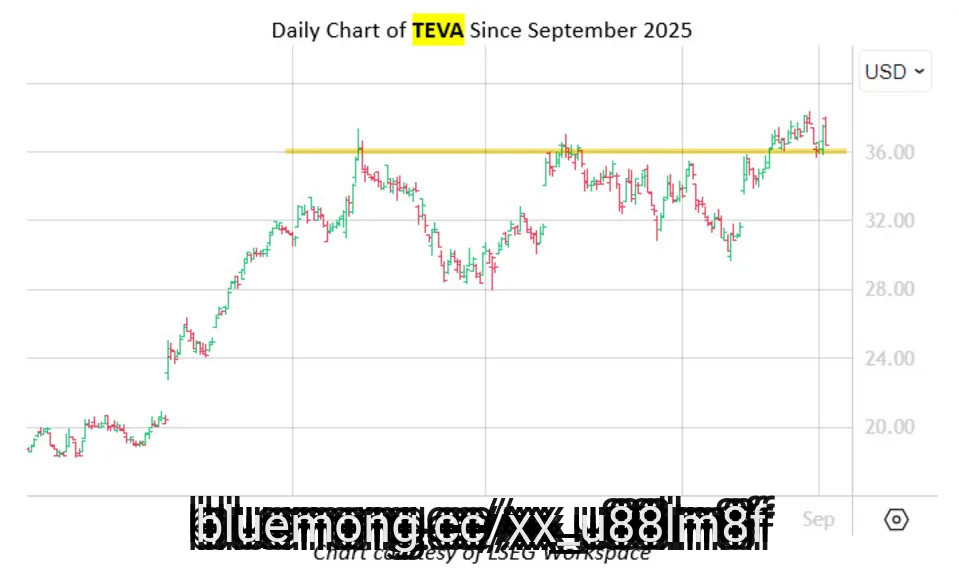
Teva Pharmaceuticals Industries (NYSE:TEVA) is moving 2.9% lower to trade at $36.41, pulling back from its Aug. 27, nearly nine-year high of $38.36. The $36 level looks to have moved in as a floor of support, a former level of resistance for the shares since late January. More gains could be on the table, however, with a fresh bull signal now flashing for the drug maker.
TEVA's long-term outperformance comes amid historically low implied volatility (IV). Specifically, the equity's current SVI of 29% stands in the low 5th percentile of its annual range.
According to data from Schaeffer's Senior Quantitative ******* yst Rocky White, there have been five instances in the past five years when the equity traded within 2% of its 52-week high, while its Schaeffer's Volatility Index (SVI) ranked in the 20th percentile of its annual range or lower.
TEVA was higher one month later 80% of the time after those signals, averaging a 5.5% gain. From its current perch, a shift of this amount would put the equity back above $38 -- within a chip-shot of its August peak.
Options traders are still not convinced. This is per the equity's 10-day put/call volume ratio at the International Securities Exchange (ISE), Cboe Options Exchange (CBOE), and NASDAQ OMX PHLX (PHLX), which sits higher than 96% of readings from the past year. Should this bearish sentiment begin to unwind, it could trigger more tailwinds for the shares.
#exchange
TEVA's long-term outperformance comes amid historically low implied volatility (IV). Specifically, the equity's current SVI of 29% stands in the low 5th percentile of its annual range.
According to data from Schaeffer's Senior Quantitative ******* yst Rocky White, there have been five instances in the past five years when the equity traded within 2% of its 52-week high, while its Schaeffer's Volatility Index (SVI) ranked in the 20th percentile of its annual range or lower.
TEVA was higher one month later 80% of the time after those signals, averaging a 5.5% gain. From its current perch, a shift of this amount would put the equity back above $38 -- within a chip-shot of its August peak.
Options traders are still not convinced. This is per the equity's 10-day put/call volume ratio at the International Securities Exchange (ISE), Cboe Options Exchange (CBOE), and NASDAQ OMX PHLX (PHLX), which sits higher than 96% of readings from the past year. Should this bearish sentiment begin to unwind, it could trigger more tailwinds for the shares.
#exchange

2 months ago
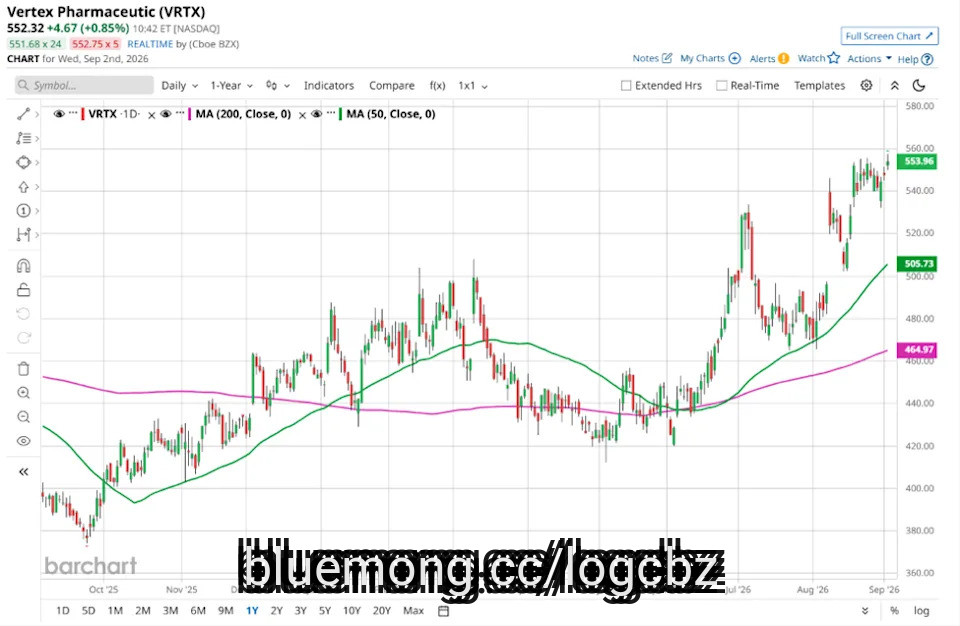
Boston, Massachusetts-based Vertex Pharmaceuticals Incorporated (VRTX) develops and commercializes therapies for treating cystic fibrosis (CF). Valued at $139 billion by market cap, the company invests in scientific innovation to create transformative medicines for people with serious diseases.
Companies worth $10 billion or more are generally described as "large-cap stocks," and VRTX perfectly fits that description, with its market cap exceeding this mark, underscoring its size, influence, and dominance within the biotechnology industry. VRTX derives its primary competitive strength from its global monopoly in CF treatments, anchored by flagship blockbusters like Trikafta/Katori which generate robust cash flow to fuel its high-impact clinical pipeline.
Dear GameStop Stock Fans, Mark Your Calendars for September 8
SMCI vs. CoreWeave: 1 AI Infrastructure Model Has the Bigger Opportunity
Why **** ysts Think Sellas Life Sciences Stock Can Gain 150% From Here
#vrtx #massachusetts
Companies worth $10 billion or more are generally described as "large-cap stocks," and VRTX perfectly fits that description, with its market cap exceeding this mark, underscoring its size, influence, and dominance within the biotechnology industry. VRTX derives its primary competitive strength from its global monopoly in CF treatments, anchored by flagship blockbusters like Trikafta/Katori which generate robust cash flow to fuel its high-impact clinical pipeline.
Dear GameStop Stock Fans, Mark Your Calendars for September 8
SMCI vs. CoreWeave: 1 AI Infrastructure Model Has the Bigger Opportunity
Why **** ysts Think Sellas Life Sciences Stock Can Gain 150% From Here
#vrtx #massachusetts


2 months ago
On August 26, Biohaven (NYSE:BHVN) and SK Biopharmaceuticals announced a global licensing agreement covering opakalim, Biohaven's lead epilepsy candidate, in a deal worth up to $795 million plus royalties. SK Biopharmaceuticals picks up exclusive worldwide rights to Biohaven's Kv7 ion channel platform, while Biohaven walks away with $400 million in near-term cash. The timing lines up with an August 10, 2026 earnings report that showed Biohaven still losing well over $100 million a quarter, and the gap between those two dates explains a lot about why this deal happened now.
SK Biopharmaceuticals will pay up to $795 million in upfront and milestone payments connected to the Kv7 platform, on top of tiered royalties on US net sales of opakalim that range from the mid-teens to low twenties. Biohaven collects $350 million at closing and another $50 million in 2027, with as much as $150 million more available through development and regulatory milestones plus royalties on global sales. SK Biopharmaceuticals is also taking over Kv7 program costs going forward, including certain Knopp Biosciences obligations. CEO Vlad Coric described the structure as proof Biohaven can monetize its pipeline through partnerships rather than leaning on public markets for cash.
The deal only makes sense because opakalim looks like it works. In a proof-of-concept study in idiopathic generalized epilepsy, the median time to a second generalized tonic-clonic seizure stretched to 141 days on opakalim versus 47 days on placebo, and a third of patients made it through the full 24 weeks without a second seizure. In focal epilepsy, 54% of patients in an open-label extension study saw at least a 50% drop in seizure frequency over any six months, in a group of more than 100 patients.
Opakalim is also designed as a once-daily pill with no ******* ration required, a real edge over older antiseizure drugs. Pairing that data with SK Biopharmaceuticals, the company behind XCOPRI and the only firm to bring a new focal-seizure drug to the US market since 2016, gives Opakalim a commercial path Biohaven would have struggled to build alone. The cash also buys runway for the rest of the pipeline, including protein degraders BHV-1300 and BHV-1400, which have shown rapid, selective reductions in disease-driving antibodies in Graves' disease and IgA nephropathy with clean safety data across nearly 200 patients dosed.
Biohaven is giving up full ownership of an ******* et it now believes could be a major seller. Royalties in the mid-teens to low twenties are real money, but they are a fraction of what outright ownership of an approved epilepsy drug would be worth, and $50 million of the $400 million upfront does not arrive until 2027. The Knopp Biosciences obligations SK Biopharmaceuticals is absorbing, worth up to $245 million plus mid-single-digit royalties, are a reminder that other parties already have claims on opakalim's future revenue before Biohaven sees a dollar of profit from it.
#ro
SK Biopharmaceuticals will pay up to $795 million in upfront and milestone payments connected to the Kv7 platform, on top of tiered royalties on US net sales of opakalim that range from the mid-teens to low twenties. Biohaven collects $350 million at closing and another $50 million in 2027, with as much as $150 million more available through development and regulatory milestones plus royalties on global sales. SK Biopharmaceuticals is also taking over Kv7 program costs going forward, including certain Knopp Biosciences obligations. CEO Vlad Coric described the structure as proof Biohaven can monetize its pipeline through partnerships rather than leaning on public markets for cash.
The deal only makes sense because opakalim looks like it works. In a proof-of-concept study in idiopathic generalized epilepsy, the median time to a second generalized tonic-clonic seizure stretched to 141 days on opakalim versus 47 days on placebo, and a third of patients made it through the full 24 weeks without a second seizure. In focal epilepsy, 54% of patients in an open-label extension study saw at least a 50% drop in seizure frequency over any six months, in a group of more than 100 patients.
Opakalim is also designed as a once-daily pill with no ******* ration required, a real edge over older antiseizure drugs. Pairing that data with SK Biopharmaceuticals, the company behind XCOPRI and the only firm to bring a new focal-seizure drug to the US market since 2016, gives Opakalim a commercial path Biohaven would have struggled to build alone. The cash also buys runway for the rest of the pipeline, including protein degraders BHV-1300 and BHV-1400, which have shown rapid, selective reductions in disease-driving antibodies in Graves' disease and IgA nephropathy with clean safety data across nearly 200 patients dosed.
Biohaven is giving up full ownership of an ******* et it now believes could be a major seller. Royalties in the mid-teens to low twenties are real money, but they are a fraction of what outright ownership of an approved epilepsy drug would be worth, and $50 million of the $400 million upfront does not arrive until 2027. The Knopp Biosciences obligations SK Biopharmaceuticals is absorbing, worth up to $245 million plus mid-single-digit royalties, are a reminder that other parties already have claims on opakalim's future revenue before Biohaven sees a dollar of profit from it.
#ro


2 months ago
By Mike Sheikh
Cocrystal Pharma (NASDAQ: COCP) may look like another undercapitalized, clinical-stage biotech searching for its niche, and in need of a rescue, but there is more to this story than what meets the eye. Investors glancing at the stock chart may miss the signs of a strategic reset orchestrated by biotech legends, and miss this unique opportunity.
COCP is not a company that lacks science or researchers. It has a drug discovery platform technology capable of delivering broad spectrum antivirals on demand for high value diseases that include norovirus, influenza, coronaviruses, and hepatitis C. If you had to point to something they were lacking then the missing "it factor" was a clear strategic vision. They needed an operator and a commercialization guru capable of aligning the board to his vision and raising the capital they needed on favorable terms to turn a platform technology into an enterprise.
The appointment of James Sapirstein was a transformative moment for the company.
Sapirstein is a high powered biotech exec with an impeccable pedigree. He's not an eager early-career operator looking to make a name for himself. Investors need to realize he joined after decades of experience in commercial pharmaceutical leadership, antiviral development, product launches, and business development. From his bio we learned that he has participated in or led 23 product launches and has driven numerous business-development transactions. His résumé includes founding CEO of Tobira Therapeutics, CEO of Contravir Pharmaceuticals (Hepion Pharmaceuticals, Inc. NASDAQ: HEPA), executive leadership at Serono Laboratories, senior commercial roles at Gilead Sciences (NASDAQ: GILD), and international marketing leadership in Bristol Myers Squibb's (NYSE:BMY) infectious-disease division.
#NASDAQ #Biotech
Cocrystal Pharma (NASDAQ: COCP) may look like another undercapitalized, clinical-stage biotech searching for its niche, and in need of a rescue, but there is more to this story than what meets the eye. Investors glancing at the stock chart may miss the signs of a strategic reset orchestrated by biotech legends, and miss this unique opportunity.
COCP is not a company that lacks science or researchers. It has a drug discovery platform technology capable of delivering broad spectrum antivirals on demand for high value diseases that include norovirus, influenza, coronaviruses, and hepatitis C. If you had to point to something they were lacking then the missing "it factor" was a clear strategic vision. They needed an operator and a commercialization guru capable of aligning the board to his vision and raising the capital they needed on favorable terms to turn a platform technology into an enterprise.
The appointment of James Sapirstein was a transformative moment for the company.
Sapirstein is a high powered biotech exec with an impeccable pedigree. He's not an eager early-career operator looking to make a name for himself. Investors need to realize he joined after decades of experience in commercial pharmaceutical leadership, antiviral development, product launches, and business development. From his bio we learned that he has participated in or led 23 product launches and has driven numerous business-development transactions. His résumé includes founding CEO of Tobira Therapeutics, CEO of Contravir Pharmaceuticals (Hepion Pharmaceuticals, Inc. NASDAQ: HEPA), executive leadership at Serono Laboratories, senior commercial roles at Gilead Sciences (NASDAQ: GILD), and international marketing leadership in Bristol Myers Squibb's (NYSE:BMY) infectious-disease division.
#NASDAQ #Biotech


2 months ago
Rahway, New Jersey-based Merck & Co., Inc. (MRK) is a global research-driven biopharmaceutical company focused on developing medicines, vaccines, and animal-health products. Known as MSD outside the U.S. and Canada, Merck operates through two main businesses: Pharmaceuticals and Animal Health. Valued at a market cap of $297 billion, its pharmaceutical portfolio spans oncology, vaccines, cardiometabolic disease, infectious diseases, and other therapeutic areas.
Companies with a market cap of $200 billion or more are typically referred to as "mega-cap stocks." It fits right into that category, with its market cap exceeding this threshold, reflecting its substantial size and influence in the general drug manufacturers industry. Merck combines a dominant oncology franchise, a broad vaccine portfolio, an expanding pipeline of newer medicines, and a large animal-health business. Its key investment consideration is balancing the continued strength of Keytruda and newer products against pressure on mature franchises such as Gardasil and the eventual impact of Keytruda's patent expiry.
Wu-Tang Clan Member Raekwon Is a Palantir 'OG,' Visiting Headquarters 16 Years After Receiving His Custom PLTR Jacket
Tesla Just Killed Its Solar Roof After Years of Struggling to Scale. What It Means for TSLA Stock.
Tesla Stock Could Benefit as Trump Locks Down the U.S. Power Grid
#animal #medicines #products
Companies with a market cap of $200 billion or more are typically referred to as "mega-cap stocks." It fits right into that category, with its market cap exceeding this threshold, reflecting its substantial size and influence in the general drug manufacturers industry. Merck combines a dominant oncology franchise, a broad vaccine portfolio, an expanding pipeline of newer medicines, and a large animal-health business. Its key investment consideration is balancing the continued strength of Keytruda and newer products against pressure on mature franchises such as Gardasil and the eventual impact of Keytruda's patent expiry.
Wu-Tang Clan Member Raekwon Is a Palantir 'OG,' Visiting Headquarters 16 Years After Receiving His Custom PLTR Jacket
Tesla Just Killed Its Solar Roof After Years of Struggling to Scale. What It Means for TSLA Stock.
Tesla Stock Could Benefit as Trump Locks Down the U.S. Power Grid
#animal #medicines #products



2 months ago
The FDA approved Pasatru, whose generic name is garetosmab, of Regeneron Pharmaceuticals, Inc. (NASDAQ:REGN) for adults with fibrodysplasia ossificans progressiva. FOP is an ultra-rare genetic disorder in which bone forms inside muscles, tendons, and ligaments, progressively restricting movement. In a 56-week Phase 3 trial involving 63 adults, the approved 3-milligram-per-kilogram dose reduced the number of new abnormal bone lesions by 94% compared with placebo. The decision completed an unusual clinical recovery. Regeneron paused an earlier study in 2020 after five patients died during its open-label portion, when all participants were receiving active treatment. The published ****** ysis later considered a relationship to treatment unlikely, although causality could not be ruled out. For Regeneron Pharmaceuticals, Inc. (NASDAQ:REGN), Pasatru is a regulatory and scientific victory whose earnings potential is constrained by an exceptionally small market.
The company's existing scale makes that limitation difficult to ignore. Regeneron Pharmaceuticals, Inc. (NASDAQ:REGN) generated second-quarter revenue of $4.29 billion, up 17%, while company-defined non-GAAP diluted EPS reached $14.29. Global Dupixent sales, recorded by partner Sanofi, increased 38% to approximately $6 billion, and U.S. Eylea HD sales rose 52% to $596 million. Against those franchises, even a successful Pasatru launch would have limited influence on consolidated results.
The approval demonstrates that Regeneron Pharmaceuticals, Inc. (NASDAQ:REGN) can recover a program after a major clinical setback. Following the 2020 dosing pause, the company worked with regulators to design a late-stage study that produced a statistically significant reduction in new bone lesions. Pasatru also validates research into Activin A, which activates the mutant ACVR1/ALK2 receptor and triggers abnormal bone formation in FOP.
That platform value may matter more than initial sales. Regeneron Pharmaceuticals, Inc. (NASDAQ:REGN) plans to begin a pediatric trial later in 2026, which could eventually expand the eligible population. The regulatory recovery may also strengthen confidence in the company's ability to advance other rare-disease programs from internally discovered biology.
Regeneron Pharmaceuticals, Inc. (NASDAQ:REGN) is entering an exceptionally small pharmaceutical market. Published prevalence estimates generally range from approximately one case per one million to one per two million people. Only approximately 800 to 900 known or confirmed cases have been identified globally, although additional patients may remain undiagnosed. Pasatru is currently approved only for adults, further narrowing its immediate market.
#regeneron #pasatru #adults #market
The company's existing scale makes that limitation difficult to ignore. Regeneron Pharmaceuticals, Inc. (NASDAQ:REGN) generated second-quarter revenue of $4.29 billion, up 17%, while company-defined non-GAAP diluted EPS reached $14.29. Global Dupixent sales, recorded by partner Sanofi, increased 38% to approximately $6 billion, and U.S. Eylea HD sales rose 52% to $596 million. Against those franchises, even a successful Pasatru launch would have limited influence on consolidated results.
The approval demonstrates that Regeneron Pharmaceuticals, Inc. (NASDAQ:REGN) can recover a program after a major clinical setback. Following the 2020 dosing pause, the company worked with regulators to design a late-stage study that produced a statistically significant reduction in new bone lesions. Pasatru also validates research into Activin A, which activates the mutant ACVR1/ALK2 receptor and triggers abnormal bone formation in FOP.
That platform value may matter more than initial sales. Regeneron Pharmaceuticals, Inc. (NASDAQ:REGN) plans to begin a pediatric trial later in 2026, which could eventually expand the eligible population. The regulatory recovery may also strengthen confidence in the company's ability to advance other rare-disease programs from internally discovered biology.
Regeneron Pharmaceuticals, Inc. (NASDAQ:REGN) is entering an exceptionally small pharmaceutical market. Published prevalence estimates generally range from approximately one case per one million to one per two million people. Only approximately 800 to 900 known or confirmed cases have been identified globally, although additional patients may remain undiagnosed. Pasatru is currently approved only for adults, further narrowing its immediate market.
#regeneron #pasatru #adults #market

2 months ago
UPS disclosed Monday that it is investing more than $2 billion across its international, healthcare, and supply chain solutions businesses, revealing the total figure for the first time. The investments began in 2024 and are set to continue through 2028, the company said.
Scott Szwast, UPS vice president of international strategy, framed the spending as an effort to build out capabilities that help customers in specialized sectors navigate increasingly complicated global supply chains. "These investments are really aligned to one of our big strategic areas of focus, which is creating capabilities to enable our customers, particularly in complex industries, to more effectively run their global supply chains," he told CNBC.
Among the initiatives are a new hub in the Philippines slated for this year, a facility in Ontario, Canada, due to open in 2027, and an air hub at Hong Kong International Airport scheduled for 2028. UPS has also opened a technology-enabled logistics center in Taiwan and an Amsterdam facility that integrates freight forwarding, customs brokerage, and cold-chain capabilities under one roof. The Taiwan facility has used automation and robotics to cut total supply chain time by one day, Szwast said. UPS also operates weekly service on the Paris–Hong Kong route and the Shenzhen–Sydney route, each running five days a week.
Szwast said that as global supply chains come under growing strain, companies have moved to spread risk across multiple sourcing and distribution points rather than relying on a single node, even as those same businesses push out new products with unfamiliar logistics demands faster than ever before. "What they find in a lot of cases is that their supply chains look more like their histories than their strategies," he said.
The $2 billion figure encompasses a previously announced $48 million buildout of 27 temperature-controlled facilities across the Americas, Europe, and Asia aimed at handling temperature-sensitive pharmaceuticals, including GLP-1 weight loss drugs. UPS said the healthcare initiative is part of its broader effort to grow in higher-margin logistics services.
#global #Logistics
Scott Szwast, UPS vice president of international strategy, framed the spending as an effort to build out capabilities that help customers in specialized sectors navigate increasingly complicated global supply chains. "These investments are really aligned to one of our big strategic areas of focus, which is creating capabilities to enable our customers, particularly in complex industries, to more effectively run their global supply chains," he told CNBC.
Among the initiatives are a new hub in the Philippines slated for this year, a facility in Ontario, Canada, due to open in 2027, and an air hub at Hong Kong International Airport scheduled for 2028. UPS has also opened a technology-enabled logistics center in Taiwan and an Amsterdam facility that integrates freight forwarding, customs brokerage, and cold-chain capabilities under one roof. The Taiwan facility has used automation and robotics to cut total supply chain time by one day, Szwast said. UPS also operates weekly service on the Paris–Hong Kong route and the Shenzhen–Sydney route, each running five days a week.
Szwast said that as global supply chains come under growing strain, companies have moved to spread risk across multiple sourcing and distribution points rather than relying on a single node, even as those same businesses push out new products with unfamiliar logistics demands faster than ever before. "What they find in a lot of cases is that their supply chains look more like their histories than their strategies," he said.
The $2 billion figure encompasses a previously announced $48 million buildout of 27 temperature-controlled facilities across the Americas, Europe, and Asia aimed at handling temperature-sensitive pharmaceuticals, including GLP-1 weight loss drugs. UPS said the healthcare initiative is part of its broader effort to grow in higher-margin logistics services.
#global #Logistics

2 months ago
Irving, Texas-based McKesson Corporation (MCK) distributes pharmaceuticals, medical-surgical supplies, and health and beauty care products. With a market cap of $100.1 billion, the company also develops, implements, and supports software that facilitates the integration of data throughout the health enterprise. In addition, McKesson offers **** ytic, care management, and patient solutions for payers.
Shares of this healthcare giant have outperformed the broader market over the past year. MCK has gained 25.5% over this time frame, while the broader S&P 500 Index ($SPX) has rallied nearly 20.5%. However, in 2026, MCK stock is up 5.5%, compared to the SPX's 12.1% rise on a YTD basis.
Soros Fund Management Opened a New Position in Nebius During Q2. What This Means for NBIS Stock.
Nvidia Earnings, Jackson Hole and Other Key Things to Watch this Week
Ahead of Nvidia Earnings, Here's What Barchart Data Says Comes Next for NVDA Stock
#data #Health #care #broader
Shares of this healthcare giant have outperformed the broader market over the past year. MCK has gained 25.5% over this time frame, while the broader S&P 500 Index ($SPX) has rallied nearly 20.5%. However, in 2026, MCK stock is up 5.5%, compared to the SPX's 12.1% rise on a YTD basis.
Soros Fund Management Opened a New Position in Nebius During Q2. What This Means for NBIS Stock.
Nvidia Earnings, Jackson Hole and Other Key Things to Watch this Week
Ahead of Nvidia Earnings, Here's What Barchart Data Says Comes Next for NVDA Stock
#data #Health #care #broader


2 months ago
UPS disclosed Monday that it is investing more than $2 billion across its international, healthcare, and supply chain solutions businesses, revealing the total figure for the first time. The investments began in 2024 and are set to continue through 2028, the company said.
Scott Szwast, UPS vice president of international strategy, framed the spending as an effort to build out capabilities that help customers in specialized sectors navigate increasingly complicated global supply chains. "These investments are really aligned to one of our big strategic areas of focus, which is creating capabilities to enable our customers, particularly in complex industries, to more effectively run their global supply chains," he told CNBC.
Among the initiatives are a new hub in the Philippines slated for this year, a facility in Ontario, Canada, due to open in 2027, and an air hub at Hong Kong International Airport scheduled for 2028. UPS has also opened a technology-enabled logistics center in Taiwan and an Amsterdam facility that integrates freight forwarding, customs brokerage, and cold-chain capabilities under one roof. The Taiwan facility has used automation and robotics to cut total supply chain time by one day, Szwast said. UPS also operates weekly service on the Paris–Hong Kong route and the Shenzhen–Sydney route, each running five days a week.
Szwast said that as global supply chains come under growing strain, companies have moved to spread risk across multiple sourcing and distribution points rather than relying on a single node, even as those same businesses push out new products with unfamiliar logistics demands faster than ever before. "What they find in a lot of cases is that their supply chains look more like their histories than their strategies," he said.
The $2 billion figure encompasses a previously announced $48 million buildout of 27 temperature-controlled facilities across the Americas, Europe, and Asia aimed at handling temperature-sensitive pharmaceuticals, including GLP-1 weight loss drugs. UPS said the healthcare initiative is part of its broader effort to grow in higher-margin logistics services.
#chains #facility #Logistics
Scott Szwast, UPS vice president of international strategy, framed the spending as an effort to build out capabilities that help customers in specialized sectors navigate increasingly complicated global supply chains. "These investments are really aligned to one of our big strategic areas of focus, which is creating capabilities to enable our customers, particularly in complex industries, to more effectively run their global supply chains," he told CNBC.
Among the initiatives are a new hub in the Philippines slated for this year, a facility in Ontario, Canada, due to open in 2027, and an air hub at Hong Kong International Airport scheduled for 2028. UPS has also opened a technology-enabled logistics center in Taiwan and an Amsterdam facility that integrates freight forwarding, customs brokerage, and cold-chain capabilities under one roof. The Taiwan facility has used automation and robotics to cut total supply chain time by one day, Szwast said. UPS also operates weekly service on the Paris–Hong Kong route and the Shenzhen–Sydney route, each running five days a week.
Szwast said that as global supply chains come under growing strain, companies have moved to spread risk across multiple sourcing and distribution points rather than relying on a single node, even as those same businesses push out new products with unfamiliar logistics demands faster than ever before. "What they find in a lot of cases is that their supply chains look more like their histories than their strategies," he said.
The $2 billion figure encompasses a previously announced $48 million buildout of 27 temperature-controlled facilities across the Americas, Europe, and Asia aimed at handling temperature-sensitive pharmaceuticals, including GLP-1 weight loss drugs. UPS said the healthcare initiative is part of its broader effort to grow in higher-margin logistics services.
#chains #facility #Logistics

2 months ago
Pfizer (NYSE: PFE) has an attractive 6.4% dividend yield. That compares to 1% for the S&P 500 index (SNPINDEX: ^GSPC) and 1.4% for the average pharmaceutical stock. Despite the outsize yield, the company is sticking by the dividend payment. That's great, but why is the yield so high? An examination of the business through 2030 will explain the problem.
From a big picture perspective, Pfizer sells pharmaceuticals. Only the drugs it sells don't appear out of thin air. It has to develop them or buy them before it can market them. That's an expensive, often time-consuming, and difficult process. This is why drug companies are afforded a limited, patent-protected window of exclusivity to sell their drugs. Drug companies like Pfizer can generate substantial revenue from patent-protected drugs.
Missed Nvidia in 2009? This Rare Signal Is Flashing Again. In 2009, a "Double Down" signal flashed for a little-known chipmaker called Nvidia. For the first time in years, that same "Total Conviction" signal is flashing for a company 1/100th the size of Nvidia. Continue »
There's just one small problem: revenues tend to fall dramatically after a drug loses patent protections. Complicating this is that developing new drugs doesn't follow a set timeline, unlike patent expirations. So sometimes there's a mismatch that puts pressure on a company's top and bottom lines.
That's what Pfizer is dealing with right now. In 2027, oncology drugs Ibrance and Xtandi are set to lose patent protection. In 2028, the cardiovascular drug Eliquis will lose patent protection. Pfizer is working hard to find drugs to replace revenue lost from these patent expirations, but investors are clearly worried that it won't be able to. It doesn't help any that the company suffered a material black eye when it had to drop its internally developed GLP-1 weight-loss drug candidate in 2025.
#pfizer #drug #yield
From a big picture perspective, Pfizer sells pharmaceuticals. Only the drugs it sells don't appear out of thin air. It has to develop them or buy them before it can market them. That's an expensive, often time-consuming, and difficult process. This is why drug companies are afforded a limited, patent-protected window of exclusivity to sell their drugs. Drug companies like Pfizer can generate substantial revenue from patent-protected drugs.
Missed Nvidia in 2009? This Rare Signal Is Flashing Again. In 2009, a "Double Down" signal flashed for a little-known chipmaker called Nvidia. For the first time in years, that same "Total Conviction" signal is flashing for a company 1/100th the size of Nvidia. Continue »
There's just one small problem: revenues tend to fall dramatically after a drug loses patent protections. Complicating this is that developing new drugs doesn't follow a set timeline, unlike patent expirations. So sometimes there's a mismatch that puts pressure on a company's top and bottom lines.
That's what Pfizer is dealing with right now. In 2027, oncology drugs Ibrance and Xtandi are set to lose patent protection. In 2028, the cardiovascular drug Eliquis will lose patent protection. Pfizer is working hard to find drugs to replace revenue lost from these patent expirations, but investors are clearly worried that it won't be able to. It doesn't help any that the company suffered a material black eye when it had to drop its internally developed GLP-1 weight-loss drug candidate in 2025.
#pfizer #drug #yield

2 months ago
On August 13, ARS Pharmaceuticals (NASDAQ:SPRY) held its second-quarter 2026 earnings call, the first for new President and CEO Donn Casale. He used it to lay out three priorities: sharper commercial targeting for neffy, tighter financial discipline, and a pipeline push into chronic spontaneous urticaria. The quarter itself showed a company still early in proving its epinephrine nasal spray can win over prescribers who default to needle-based injectors out of habit.
The headline number is market share. Neffy's total US share reached 5% in the second quarter, double the 2.5% mark from a year earlier. Inside the field sales team's targeted call universe, share jumped further, to 8% from 4%. That targeted approach is showing up in the prescriber data too, with more than 16,000 unique neffy prescribers in the quarter, over three times the year-ago total. Casale pointed to a stark gap between covered and uncovered territory: where the sales team is active, neffy holds 8% share versus roughly 1% where it isn't.
To lead that push, ARS brought on Meg Smith as Chief Commercial Officer, a 25-year veteran Casale worked with at Dynavax. The field organization is now fully built out and pointed at the highest-value prescribers, who represent 44% of the total market opportunity. Beyond neffy, ARS is extending its intranasal epinephrine platform into CSU, a market with no FDA-approved on-demand treatment for acute flares today, a gap the company believes its existing commercial infrastructure is positioned to fill.
The flip side of that story is cost. Second quarter total revenue was $33.7 million, with $26.2 million of that coming from US net product sales, against total operating expenses of $95.1 million, including $12.8 million in cost of goods sold. SG&A alone ran approximately $77.6 million for the quarter, a level Casale acknowledged reflected an earlier strategy built around broad consumer advertising that didn't convert well in what he described as a prevention-based market rather than a treatment market.
The company is now guiding to combined SG&A and R&D expenses of $114 million to $126 million for the back half of 2026, with cash-based spending in that category expected to fall to $100 million to $110 million, a cut of more than 40% in cash SG&A from the first half of the year. That reduced spending pace is expected to hold through 2027. On the pipeline side, the CSU phase II-B interim readout, previously expected by the end of 2026, has slipped to the first quarter of 2027, a delay the company attributed to the trial's design requiring patients to log three separate flare episodes before data can be collected.
#million #market #company #year
The headline number is market share. Neffy's total US share reached 5% in the second quarter, double the 2.5% mark from a year earlier. Inside the field sales team's targeted call universe, share jumped further, to 8% from 4%. That targeted approach is showing up in the prescriber data too, with more than 16,000 unique neffy prescribers in the quarter, over three times the year-ago total. Casale pointed to a stark gap between covered and uncovered territory: where the sales team is active, neffy holds 8% share versus roughly 1% where it isn't.
To lead that push, ARS brought on Meg Smith as Chief Commercial Officer, a 25-year veteran Casale worked with at Dynavax. The field organization is now fully built out and pointed at the highest-value prescribers, who represent 44% of the total market opportunity. Beyond neffy, ARS is extending its intranasal epinephrine platform into CSU, a market with no FDA-approved on-demand treatment for acute flares today, a gap the company believes its existing commercial infrastructure is positioned to fill.
The flip side of that story is cost. Second quarter total revenue was $33.7 million, with $26.2 million of that coming from US net product sales, against total operating expenses of $95.1 million, including $12.8 million in cost of goods sold. SG&A alone ran approximately $77.6 million for the quarter, a level Casale acknowledged reflected an earlier strategy built around broad consumer advertising that didn't convert well in what he described as a prevention-based market rather than a treatment market.
The company is now guiding to combined SG&A and R&D expenses of $114 million to $126 million for the back half of 2026, with cash-based spending in that category expected to fall to $100 million to $110 million, a cut of more than 40% in cash SG&A from the first half of the year. That reduced spending pace is expected to hold through 2027. On the pipeline side, the CSU phase II-B interim readout, previously expected by the end of 2026, has slipped to the first quarter of 2027, a delay the company attributed to the trial's design requiring patients to log three separate flare episodes before data can be collected.
#million #market #company #year