
7 days ago
Definium Therapeutics, Inc. (NASDAQ:DFTX) has now delivered a third consecutive positive Phase 3 readout for its LSD-based medication, the second in generalized anxiety disorder. The result puts the company on a viable route toward a potential FDA approval of an LSD-based treatment for generalized anxiety disorder, and considering how closely psychedelic stocks have historically traded on each other's data, the reading carries far more weight than Definium's own ticker.
On September 14, Definium Therapeutics, Inc. (NASDAQ:DFTX) announced that its drug DT120, an orally disintegrating tablet formulation of LSD, was successful in Panorama, the company's second late-stage anxiety trial. Over 12 weeks, patients who received a 100-microgram dose experienced a 9.8-point decline on the Hamilton Anxiety Rating Scale, a typical clinical measure, compared to a 4.7-point drop with placebo.
The resulting 5.1-point placebo-adjusted improvement is similar to what the company's first pivotal anxiety trial, Voyage, showed back in August: an 11.6-point improvement versus 6.2 for placebo, a 5.4-point separation that Jefferies called one of the strongest placebo-adjusted efficacy results ever seen in generalized anxiety disorder, and that Stifel simply described as "a clean win."
Psychedelic equities have a history of trading as a group rather than as individual names, and this tendency applies both ways. In February 2026, when Compass Pathways, the sector's other clinical leader developing a psilocybin-based drug for treatment-resistant depression, reported positive late-stage data, shares of Definium Therapeutics, Inc. (NASDAQ:DFTX), Atai Beckley, GH Research, and Helus Pharma all rose, some by double digits.
That correlation is significant here because Definium's win is an independent validation of the broader therapeutic argument on which Compass and others are betting: a single dose of a classic psychedelic, administered in a controlled clinical setting, can produce lasting improvements in serious mental health conditions via pathways different from existing SSRIs and other standard-of-care drugs.
#definium #placebo
On September 14, Definium Therapeutics, Inc. (NASDAQ:DFTX) announced that its drug DT120, an orally disintegrating tablet formulation of LSD, was successful in Panorama, the company's second late-stage anxiety trial. Over 12 weeks, patients who received a 100-microgram dose experienced a 9.8-point decline on the Hamilton Anxiety Rating Scale, a typical clinical measure, compared to a 4.7-point drop with placebo.
The resulting 5.1-point placebo-adjusted improvement is similar to what the company's first pivotal anxiety trial, Voyage, showed back in August: an 11.6-point improvement versus 6.2 for placebo, a 5.4-point separation that Jefferies called one of the strongest placebo-adjusted efficacy results ever seen in generalized anxiety disorder, and that Stifel simply described as "a clean win."
Psychedelic equities have a history of trading as a group rather than as individual names, and this tendency applies both ways. In February 2026, when Compass Pathways, the sector's other clinical leader developing a psilocybin-based drug for treatment-resistant depression, reported positive late-stage data, shares of Definium Therapeutics, Inc. (NASDAQ:DFTX), Atai Beckley, GH Research, and Helus Pharma all rose, some by double digits.
That correlation is significant here because Definium's win is an independent validation of the broader therapeutic argument on which Compass and others are betting: a single dose of a classic psychedelic, administered in a controlled clinical setting, can produce lasting improvements in serious mental health conditions via pathways different from existing SSRIs and other standard-of-care drugs.
#definium #placebo


7 days ago
It's been a disappointing couple of years for shareholders of biotechnology outfit CRISPR Therapeutics (NASDAQ: CRSP). This stock's barely up since the end of 2022, lagging the broad market's gains. It's not the performance that investors keeping tabs on this company were expecting, given its potential.
Don't be discouraged, though. While still speculative like most young biotech names, CRISPR Therapeutics remains a compelling prospect for investors who can stomach the risk and its inevitable volatility. Here's why.
Missed AI's "Act 1"? Act 2 Could Be 15x Bigger. Most investors think they missed the AI boat because they didn't buy Nvidia in 2005. But according to our **** ysts, we're only at the end of "Act 1"—the R&D phase. "Act 2" is the global rollout. Continue »
On the off-chance you're reading this and aren't already familiar with the company, CRISPR Therapeutics is a drug developer that specializes in gene editing.
It's probably an area you've heard a great deal about. No gene-editing drugs were actually on the market in the United States until CRISPR Therapeutics' Casgevy was approved by the FDA as a treatment for sickle cell disease in late 2023. Any and all gene therapies currently on the market followed this pioneer's foray. Being first is a well-deserved accolade for the company, too, which was co-founded by Dr. Emmanuelle Charpentier, who was one of the co-discoverers of the CRISPR/Cas9 gene-editing mechanism that makes Casgevy work.
#crispr #gene #company
Don't be discouraged, though. While still speculative like most young biotech names, CRISPR Therapeutics remains a compelling prospect for investors who can stomach the risk and its inevitable volatility. Here's why.
Missed AI's "Act 1"? Act 2 Could Be 15x Bigger. Most investors think they missed the AI boat because they didn't buy Nvidia in 2005. But according to our **** ysts, we're only at the end of "Act 1"—the R&D phase. "Act 2" is the global rollout. Continue »
On the off-chance you're reading this and aren't already familiar with the company, CRISPR Therapeutics is a drug developer that specializes in gene editing.
It's probably an area you've heard a great deal about. No gene-editing drugs were actually on the market in the United States until CRISPR Therapeutics' Casgevy was approved by the FDA as a treatment for sickle cell disease in late 2023. Any and all gene therapies currently on the market followed this pioneer's foray. Being first is a well-deserved accolade for the company, too, which was co-founded by Dr. Emmanuelle Charpentier, who was one of the co-discoverers of the CRISPR/Cas9 gene-editing mechanism that makes Casgevy work.
#crispr #gene #company

7 days ago
Interested in Axsome Therapeutics, Inc.? Here are five stocks we like better.
Auvelity remains Axsome's main growth driver: It generated more than $180 million of the company's $218.4 million in second-quarter revenue, while its new Alzheimer's disease agitation indication is supported by an expanded sales force of more than 600 representatives.
The commercial portfolio is expanding: Sunosi continues to grow, and SYMBRAVO revenue increased 30% sequentially in the second quarter as Axsome expanded its migraine sales team.
Pipeline and finances are strengthening: Axsome has several late-stage programs and upcoming clinical milestones, ended the quarter with $320 million in cash, and said it is approaching cash-flow positivity.
Biotech Is Heating Up—These 2 Red-Hot Stocks Stand Out
#second
Auvelity remains Axsome's main growth driver: It generated more than $180 million of the company's $218.4 million in second-quarter revenue, while its new Alzheimer's disease agitation indication is supported by an expanded sales force of more than 600 representatives.
The commercial portfolio is expanding: Sunosi continues to grow, and SYMBRAVO revenue increased 30% sequentially in the second quarter as Axsome expanded its migraine sales team.
Pipeline and finances are strengthening: Axsome has several late-stage programs and upcoming clinical milestones, ended the quarter with $320 million in cash, and said it is approaching cash-flow positivity.
Biotech Is Heating Up—These 2 Red-Hot Stocks Stand Out
#second

7 days ago
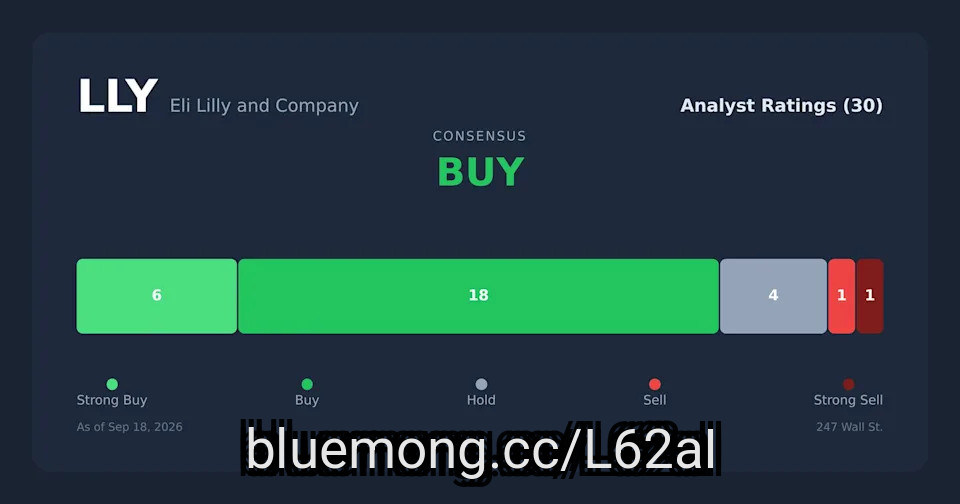
Eli Lilly presents mid-stage eloraTZP data September 30, and LLY stock near $1,152 with a $1 trillion market cap leaves no room for a weak result.
Novo Nordisk's GLP-1 franchise faces headwinds while Viking Therapeutics' VK2735 looms; a convincing eloraTZP win raises the bar for both rivals.
Bearish options positioning shows put/call ratios hitting 4.67 for October 9 expiry, signaling Wall Street is hedging hard against disappointment.
Just released. Our **** ysts combed the entire stock market and named the ten best stocks to buy right now, and Eli Lilly didn't make the cut. Enter your email to see the names that beat LLY. The report is free. Enter your email and see if any of your stocks made the cut.
Eli Lilly (NYSE:LLY) presents mid-stage data on eloraTZP, a combination of eloralintide and tirzepatide, at a European **** ociation for the Study of Diabetes symposium on September 30.
#eloratzp #september #Stock
Novo Nordisk's GLP-1 franchise faces headwinds while Viking Therapeutics' VK2735 looms; a convincing eloraTZP win raises the bar for both rivals.
Bearish options positioning shows put/call ratios hitting 4.67 for October 9 expiry, signaling Wall Street is hedging hard against disappointment.
Just released. Our **** ysts combed the entire stock market and named the ten best stocks to buy right now, and Eli Lilly didn't make the cut. Enter your email to see the names that beat LLY. The report is free. Enter your email and see if any of your stocks made the cut.
Eli Lilly (NYSE:LLY) presents mid-stage data on eloraTZP, a combination of eloralintide and tirzepatide, at a European **** ociation for the Study of Diabetes symposium on September 30.
#eloratzp #september #Stock


14 days ago
Harold Bernstein, President of Research and Development and Chief Medical Officer at Maze Therapeutics, Inc. (NASDAQ:MAZE), sold 9,705 shares of common stock on September 4, 2026, according to an SEC Form 4 filing.
Metric
Value
Transaction value
~$255,000
#value #president #Research #medical
Metric
Value
Transaction value
~$255,000
#value #president #Research #medical


15 days ago
Intellia Therapeutics, Inc. (NASDAQ:NTLA) entered a five-year senior secured credit facility with OrbiMed for up to $400 million and drew $75 million at closing. The remaining $325 million depends on milestones or further lender agreement.
The facility bears interest at an annual rate equal to the greater of 3% or the one-month Secured Overnight Financing Rate, plus 6.15%, payable monthly. The formula sets a 9.15% minimum. Applying that floor to the initial borrowing produces approximately $6.9 million of article-calculated annual interest before commitment, administrative, undrawn-amount, and facility fees.
The financing arrives as Intellia Therapeutics, Inc. (NASDAQ:NTLA) prepares for a potential U.S. launch of lonvoguran ziclumeran, or lonvo-z, for hereditary angioedema. Intellia Therapeutics, Inc. (NASDAQ:NTLA) held $628.4 million of cash, cash equivalents, and marketable securities as of June 30, but reported a $106.6 million second-quarter net loss.
The staged structure gives Intellia Therapeutics, Inc. (NASDAQ:NTLA) capital without issuing equity at closing and avoids drawing the full amount before milestones that could support additional debt.
A second $75 million tranche becomes available at the option of Intellia Therapeutics, Inc. (NASDAQ:NTLA) if the FDA approves the biologics license application for lonvo-z before a specified date. Three further $40 million tranches depend on lonvo-z revenue targets, while another $30 million requires an equity-fundraising milestone. This links most committed borrowing capacity to regulatory and commercial progress.
#million #therapeutics #ntla #lonvo
The facility bears interest at an annual rate equal to the greater of 3% or the one-month Secured Overnight Financing Rate, plus 6.15%, payable monthly. The formula sets a 9.15% minimum. Applying that floor to the initial borrowing produces approximately $6.9 million of article-calculated annual interest before commitment, administrative, undrawn-amount, and facility fees.
The financing arrives as Intellia Therapeutics, Inc. (NASDAQ:NTLA) prepares for a potential U.S. launch of lonvoguran ziclumeran, or lonvo-z, for hereditary angioedema. Intellia Therapeutics, Inc. (NASDAQ:NTLA) held $628.4 million of cash, cash equivalents, and marketable securities as of June 30, but reported a $106.6 million second-quarter net loss.
The staged structure gives Intellia Therapeutics, Inc. (NASDAQ:NTLA) capital without issuing equity at closing and avoids drawing the full amount before milestones that could support additional debt.
A second $75 million tranche becomes available at the option of Intellia Therapeutics, Inc. (NASDAQ:NTLA) if the FDA approves the biologics license application for lonvo-z before a specified date. Three further $40 million tranches depend on lonvo-z revenue targets, while another $30 million requires an equity-fundraising milestone. This links most committed borrowing capacity to regulatory and commercial progress.
#million #therapeutics #ntla #lonvo


15 days ago
American Century Investments, an investment management company, released its second-quarter 2026 investor letter for the "American Century Investments Focused Dynamic Growth Fund". The letter can be downloaded here. U.S. stocks advanced sharply with double-digit quarterly gains largely due to robust earnings, resilient economic data, and momentum in AI-related stocks. However, there was a slight pullback in June as momentum waned and investors anticipated potential interest rate hikes by the Federal Reserve. Growth and AI stocks outperformed value stocks, while large-cap companies generally surpassed small- and mid-cap stocks. Underperformance was noted in healthcare and communication services, while industrials, particularly in aerospace and defense, contributed positively to performance. The fund's investor class returned 16.38%, slightly below the Russell 1000 Growth Index's 16.74%. The investment approach focuses on bottom-up financial ***** ysis to identify large-cap companies with long-term earnings growth potential, while aiming to mitigate non-financial risks. Please review the Fund's top five holdings to gain insights into its key selections for 2026.
In its second-quarter 2026 investor letter, American Century Investments Focused Dynamic Growth Fund highlighted Alnylam Pharmaceuticals, Inc. (NASDAQ:ALNY). Alnylam Pharmaceuticals, Inc. (NASDAQ:ALNY), a biopharmaceutical company that discovers and commercializes therapeutics based on ribonucleic acid interference, detracted from the Fund's performance this quarter. On September 09, 2026, Alnylam Pharmaceuticals, Inc. (NASDAQ:ALNY) closed at $258.00 per share. Over the past month, Alnylam Pharmaceuticals, Inc. (NASDAQ:ALNY) returned 13.60%, but its shares are down 44.94% over the past year. Alnylam Pharmaceuticals, Inc. (NASDAQ:ALNY) has a market capitalization of $34.52 billion, and its stock has traded within a 52-week range of $197.81 to $495.55.
American Century Investments Focused Dynamic Growth Fund stated the following regarding Alnylam Pharmaceuticals, Inc. (NASDAQ:ALNY) in its Q2 2026 investor letter:
"Stock choices and a sector overweight relative to the benchmark detracted as many biotechnology stocks, including Alnylam Pharmaceuticals and Insmed, underperformed the market. Alnylam Pharmaceuticals, Inc. (NASDAQ:ALNY). The biotechnology company's stock underperformed amid concerns of its upcoming late-stage clinical trial readouts despite what we believed was its otherwise strong recent financial performance."
#alny #century
In its second-quarter 2026 investor letter, American Century Investments Focused Dynamic Growth Fund highlighted Alnylam Pharmaceuticals, Inc. (NASDAQ:ALNY). Alnylam Pharmaceuticals, Inc. (NASDAQ:ALNY), a biopharmaceutical company that discovers and commercializes therapeutics based on ribonucleic acid interference, detracted from the Fund's performance this quarter. On September 09, 2026, Alnylam Pharmaceuticals, Inc. (NASDAQ:ALNY) closed at $258.00 per share. Over the past month, Alnylam Pharmaceuticals, Inc. (NASDAQ:ALNY) returned 13.60%, but its shares are down 44.94% over the past year. Alnylam Pharmaceuticals, Inc. (NASDAQ:ALNY) has a market capitalization of $34.52 billion, and its stock has traded within a 52-week range of $197.81 to $495.55.
American Century Investments Focused Dynamic Growth Fund stated the following regarding Alnylam Pharmaceuticals, Inc. (NASDAQ:ALNY) in its Q2 2026 investor letter:
"Stock choices and a sector overweight relative to the benchmark detracted as many biotechnology stocks, including Alnylam Pharmaceuticals and Insmed, underperformed the market. Alnylam Pharmaceuticals, Inc. (NASDAQ:ALNY). The biotechnology company's stock underperformed amid concerns of its upcoming late-stage clinical trial readouts despite what we believed was its otherwise strong recent financial performance."
#alny #century


16 days ago
On September 3, AbbVie Inc. (NYSE:ABBV) finalized its acquisition of clinical-stage biotech Apogee Therapeutics, Inc. (NASDAQ:APGE) for $135.11 per share in cash. The $10.9 billion buyouts immediately fold Apogee's promising inflammatory and immunology (I&I) pipeline into AbbVie's commercial engine. On the exact same day, AbbVie separately reported positive Phase 3 Cervino trial results for its bispecific T-cell engager, etentamig, in relapsed/refractory multiple myeloma. Together, the dual catalysts emphasize how mega-cap pharmaceutical giants are deploying cash flow from legacy franchises to lock in next-generation immunology and oncology ***** ets.
In Q2 2026, AbbVie Inc. (NYSE:ABBV) posted $16.99 billion in net revenue, up 10.2% year over year, while adjusted diluted EPS increased 22.9% to $3.65. Growth was driven by its immunology blockbusters, Skyrizi and Rinvoq, which generated $5.505 billion and $2.525 billion in revenue, respectively, representing growth of 24.4% and 24.5%. These gains more than offset the continued decline in Humira revenue, which fell 35.9% to $756 million amid biosimilar competition. AbbVie reiterated its full-year 2026 adjusted EPS guidance of $13.87–$14.07, including a $0.14 dilutive impact from the Apogee transaction.
As a clinical-stage biotech, Apogee Therapeutics, Inc. (NASDAQ:APGE) generated no product revenue in Q2 2026, while R&D expenses reached $67.3 million and G&A expenses totaled $24.3 million, resulting in a quarterly net loss of $85.9 million. Despite the cash burn, the company maintained a strong liquidity position, with $1.3 billion in cash and marketable securities, alongside a $1.3 billion non-dilutive credit collaboration with Blackstone Life Sciences to support Phase 3 trials of its lead ***** et, zumilokibart.
Financially, AbbVie is vastly superior in immediate cash generation and profitability, whereas Apogee represented pure clinical optionality backed by robust liquidity.
For AbbVie, acquiring Apogee's optimized antibody portfolio, including zumilokibart for atopic dermatitis, strengthens its post-Humira immunology franchise. Combined with internal R&D advances such as etentamig, which achieved statistically significant overall response rate and progression-free survival results in the Phase 3 Cervino study, along with an 87.9% 12-month overall survival rate, AbbVie demonstrates potential to sustain strong organic growth.
#phase #revenue #Growth
In Q2 2026, AbbVie Inc. (NYSE:ABBV) posted $16.99 billion in net revenue, up 10.2% year over year, while adjusted diluted EPS increased 22.9% to $3.65. Growth was driven by its immunology blockbusters, Skyrizi and Rinvoq, which generated $5.505 billion and $2.525 billion in revenue, respectively, representing growth of 24.4% and 24.5%. These gains more than offset the continued decline in Humira revenue, which fell 35.9% to $756 million amid biosimilar competition. AbbVie reiterated its full-year 2026 adjusted EPS guidance of $13.87–$14.07, including a $0.14 dilutive impact from the Apogee transaction.
As a clinical-stage biotech, Apogee Therapeutics, Inc. (NASDAQ:APGE) generated no product revenue in Q2 2026, while R&D expenses reached $67.3 million and G&A expenses totaled $24.3 million, resulting in a quarterly net loss of $85.9 million. Despite the cash burn, the company maintained a strong liquidity position, with $1.3 billion in cash and marketable securities, alongside a $1.3 billion non-dilutive credit collaboration with Blackstone Life Sciences to support Phase 3 trials of its lead ***** et, zumilokibart.
Financially, AbbVie is vastly superior in immediate cash generation and profitability, whereas Apogee represented pure clinical optionality backed by robust liquidity.
For AbbVie, acquiring Apogee's optimized antibody portfolio, including zumilokibart for atopic dermatitis, strengthens its post-Humira immunology franchise. Combined with internal R&D advances such as etentamig, which achieved statistically significant overall response rate and progression-free survival results in the Phase 3 Cervino study, along with an 87.9% 12-month overall survival rate, AbbVie demonstrates potential to sustain strong organic growth.
#phase #revenue #Growth


16 days ago
Is it better to own a company already selling drugs or one with a potential blockbuster in testing? Investors are weighing Axsome Therapeutics (NASDAQ:AXSM) against Viking Therapeutics (NASDAQ:VKTX) to decide.
Axsome focuses on commercializing treatments for depression and sleep disorders, showing significant revenue growth. Viking is a clinical-stage developer targeting the massive obesity market but has no products on the market yet. Both represent different stages of growth within the biotech world, making them popular choices for healthcare-minded portfolios.
Axsome develops and sells treatments for central nervous system conditions such as depression, migraines, and narcolepsy. It is a prominent name among biotech stocks, with a portfolio that includes Auvelity, Sunosi, and Symbravo. The company recently entered a settlement that grants license rights to five generic manufacturers for Sunosi starting in 2040, providing long-term clarity on its patent life and market position. In its latest annual report, filed in early 2026, the company noted it had over 900 full-time employees to support its commercial reach.
In FY 2025, revenue reached nearly $638.5 million, marking growth of close to 65.5% compared to the prior year. This increase was driven by the continued expansion of its key central nervous system treatments into new geographic markets. The company reported a net loss of approximately $183.2 million, resulting in a negative net margin, which is the percentage of revenue left after all expenses are paid, of roughly 28.7%. Some investors focus on the P/S ratio to value the business relative to this growing revenue.
As of December 2025, the debt-to-equity ratio was nearly 2.7x, meaning the company uses significant debt relative to its equity. The current ratio of approximately 1.6x indicates it has $1.60 in ****** ets for every $1.00 in liabilities due within a year. Free cash flow, or cash from operations minus capital spending, was nearly negative $93.9 million as the company continues to invest in its commercial pipeline. This spending is intended to support the long-term growth of its approved products and the development of new candidates.
#ratio #therapeutics
Axsome focuses on commercializing treatments for depression and sleep disorders, showing significant revenue growth. Viking is a clinical-stage developer targeting the massive obesity market but has no products on the market yet. Both represent different stages of growth within the biotech world, making them popular choices for healthcare-minded portfolios.
Axsome develops and sells treatments for central nervous system conditions such as depression, migraines, and narcolepsy. It is a prominent name among biotech stocks, with a portfolio that includes Auvelity, Sunosi, and Symbravo. The company recently entered a settlement that grants license rights to five generic manufacturers for Sunosi starting in 2040, providing long-term clarity on its patent life and market position. In its latest annual report, filed in early 2026, the company noted it had over 900 full-time employees to support its commercial reach.
In FY 2025, revenue reached nearly $638.5 million, marking growth of close to 65.5% compared to the prior year. This increase was driven by the continued expansion of its key central nervous system treatments into new geographic markets. The company reported a net loss of approximately $183.2 million, resulting in a negative net margin, which is the percentage of revenue left after all expenses are paid, of roughly 28.7%. Some investors focus on the P/S ratio to value the business relative to this growing revenue.
As of December 2025, the debt-to-equity ratio was nearly 2.7x, meaning the company uses significant debt relative to its equity. The current ratio of approximately 1.6x indicates it has $1.60 in ****** ets for every $1.00 in liabilities due within a year. Free cash flow, or cash from operations minus capital spending, was nearly negative $93.9 million as the company continues to invest in its commercial pipeline. This spending is intended to support the long-term growth of its approved products and the development of new candidates.
#ratio #therapeutics
0.00$ raised of 0.00$ goal
0 donations
0.00$
to go

19 days ago
On August 5, Protagonist Therapeutics (NASDAQ:PTGX) reported second-quarter 2026 results that flipped the company from red ink to a $162.8 million profit, or $2.29 per diluted share, compared with a $34.8 million loss a year earlier. The swing came as the company banked payments tied to two drugs moving from the lab bench to the pharmacy counter: ICOTYDE, an oral psoriasis treatment, and rusfertide, an injectable now awaiting an FDA decision. Cash and marketable securities climbed to $849.5 million. Here's what's fueling the optimism, and what could complicate it.
The quarter marked the first full three months of commercial sales for ICOTYDE, which won FDA approval on March 18 for moderate-to-severe plaque psoriasis in patients 12 and older weighing at least 40 kg. That approval triggered a $50 million milestone payment and made ICOTYDE, according to the company, the first and only FDA-approved targeted oral peptide for the condition. Protagonist can still collect up to $580 million more in milestones from partner Johnson & Johnson, plus royalties that average around 7.25 percent at $4 billion in annual sales.
Rusfertide carries even more weight. Its new drug application sits under Priority Review with a PDUFA goal date in August, backed by Breakthrough Therapy, Orphan Drug, and Fast Track designations for polycythemia vera. Partner Takeda already paid Protagonist $200 million on an opt-out election in April, with another $200 million and a $75 million approval milestone still due, on top of royalties that can reach 29 percent of sales above $1.5 billion. Behind both drugs, PN-881, an oral IL-17 antagonist, is heading into a Phase 2b psoriasis program in early 2027 after Phase 1 data showed drug levels beating their pharmacokinetic targets, and a Phase 1 study just began for PN-477sc, an injectable obesity peptide.
Look closer at that $213.5 million in license and collaboration revenue, and $192.4 million of it traces to the proportional recognition of Takeda's initial opt-out payment, not repeatable product sales. A year earlier, the same line item was just $5.5 million, so the growth reflects a single deal event more than an operating business scaling up. And that opt-out itself cuts both ways: Protagonist gave up its right to develop and commercialize rusfertide on its own, trading full ownership for royalties and milestones that depend on Takeda's execution rather than Protagonist's.
Spending is also set to climb. Management expects research and development costs to increase significantly in the second half of 2026 versus the first half, driven by the new PN-881 Phase 2b program, manufacturing investments, and added headcount. General and administrative costs are rising too, largely on stock-based compensation. And rusfertide's fate still hinges on an FDA decision that hasn't happened yet, priority review or not.
#protagonist
The quarter marked the first full three months of commercial sales for ICOTYDE, which won FDA approval on March 18 for moderate-to-severe plaque psoriasis in patients 12 and older weighing at least 40 kg. That approval triggered a $50 million milestone payment and made ICOTYDE, according to the company, the first and only FDA-approved targeted oral peptide for the condition. Protagonist can still collect up to $580 million more in milestones from partner Johnson & Johnson, plus royalties that average around 7.25 percent at $4 billion in annual sales.
Rusfertide carries even more weight. Its new drug application sits under Priority Review with a PDUFA goal date in August, backed by Breakthrough Therapy, Orphan Drug, and Fast Track designations for polycythemia vera. Partner Takeda already paid Protagonist $200 million on an opt-out election in April, with another $200 million and a $75 million approval milestone still due, on top of royalties that can reach 29 percent of sales above $1.5 billion. Behind both drugs, PN-881, an oral IL-17 antagonist, is heading into a Phase 2b psoriasis program in early 2027 after Phase 1 data showed drug levels beating their pharmacokinetic targets, and a Phase 1 study just began for PN-477sc, an injectable obesity peptide.
Look closer at that $213.5 million in license and collaboration revenue, and $192.4 million of it traces to the proportional recognition of Takeda's initial opt-out payment, not repeatable product sales. A year earlier, the same line item was just $5.5 million, so the growth reflects a single deal event more than an operating business scaling up. And that opt-out itself cuts both ways: Protagonist gave up its right to develop and commercialize rusfertide on its own, trading full ownership for royalties and milestones that depend on Takeda's execution rather than Protagonist's.
Spending is also set to climb. Management expects research and development costs to increase significantly in the second half of 2026 versus the first half, driven by the new PN-881 Phase 2b program, manufacturing investments, and added headcount. General and administrative costs are rising too, largely on stock-based compensation. And rusfertide's fate still hinges on an FDA decision that hasn't happened yet, priority review or not.
#protagonist


22 days ago
On August 6, Ligand Pharmaceuticals (NASDAQ:LGND) reported second-quarter 2026 results showing royalty revenue up 32% year over year, just weeks after the company closed its acquisition of XOMA Royalty. Total revenue reached $63.7 million for the quarter, up from $47.6 million a year earlier, and Ligand raised the low end of its full-year adjusted earnings guidance. The headline growth numbers are easy to like. What is harder to ignore is that Ligand just more than doubled its royalty portfolio and added $700 million in convertible debt in the same stretch.
Royalty revenue is where Ligand's growth is actually coming from, and it has been strong on its own merits. Royalties totaled $48.0 million in the second quarter, up from $36.4 million a year earlier, with Travere Therapeutics' Filspari, Pelthos Therapeutics' Zelsuvmi, and Merck's Ohtuvayre leading the increase. That growth compounded further in the first half, when royalties reached $91.0 million, up 42% from $63.9 million a year ago. The Filspari story helps explain why: the FDA approved the drug in April to treat FSGS, a second rare kidney disease beyond its original approval, and Travere reported $141 million in US net sales in early August, up 96% year over year.
Then there is the XOMA deal. On July 14, Ligand closed its acquisition of XOMA Royalty, adding more than 120 commercial, clinical, and preclinical **** ets, including Roche's Vabysmo, Servier's Ojemda, and Zevra Therapeutics' Miplyffa. That pushed Ligand's total portfolio past 200 royalty **** ets, more than double what it held before. Management expects the deal to add roughly $0.50 per share to 2026 adjusted earnings and $1.50 per share in 2027, and it came with about $700 million in deployable capital left over to keep buying royalty streams at a stated pace of $150 million to $250 million a year.
That growth is not coming cheap. G&A expense jumped to $29.1 million in the second quarter from $20.2 million a year earlier, driven by transaction costs tied to the XOMA deal along with higher headcount and stock compensation. R&D expense nearly tripled to $14.7 million, largely because of a $12.3 million funding arrangement with Orchestra BioMed. A large share of the quarter's reported profit also did not come from the royalty business at all: net non-operating income of $55.7 million included a $35.7 million non-cash gain tied to swings in the value of Ligand's Pelthos Therapeutics stock holdings, a figure that can move the other way just as easily.
#reported
Royalty revenue is where Ligand's growth is actually coming from, and it has been strong on its own merits. Royalties totaled $48.0 million in the second quarter, up from $36.4 million a year earlier, with Travere Therapeutics' Filspari, Pelthos Therapeutics' Zelsuvmi, and Merck's Ohtuvayre leading the increase. That growth compounded further in the first half, when royalties reached $91.0 million, up 42% from $63.9 million a year ago. The Filspari story helps explain why: the FDA approved the drug in April to treat FSGS, a second rare kidney disease beyond its original approval, and Travere reported $141 million in US net sales in early August, up 96% year over year.
Then there is the XOMA deal. On July 14, Ligand closed its acquisition of XOMA Royalty, adding more than 120 commercial, clinical, and preclinical **** ets, including Roche's Vabysmo, Servier's Ojemda, and Zevra Therapeutics' Miplyffa. That pushed Ligand's total portfolio past 200 royalty **** ets, more than double what it held before. Management expects the deal to add roughly $0.50 per share to 2026 adjusted earnings and $1.50 per share in 2027, and it came with about $700 million in deployable capital left over to keep buying royalty streams at a stated pace of $150 million to $250 million a year.
That growth is not coming cheap. G&A expense jumped to $29.1 million in the second quarter from $20.2 million a year earlier, driven by transaction costs tied to the XOMA deal along with higher headcount and stock compensation. R&D expense nearly tripled to $14.7 million, largely because of a $12.3 million funding arrangement with Orchestra BioMed. A large share of the quarter's reported profit also did not come from the royalty business at all: net non-operating income of $55.7 million included a $35.7 million non-cash gain tied to swings in the value of Ligand's Pelthos Therapeutics stock holdings, a figure that can move the other way just as easily.
#reported


25 days ago
By Mike Sheikh
Cocrystal Pharma (NASDAQ: COCP) may look like another undercapitalized, clinical-stage biotech searching for its niche, and in need of a rescue, but there is more to this story than what meets the eye. Investors glancing at the stock chart may miss the signs of a strategic reset orchestrated by biotech legends, and miss this unique opportunity.
COCP is not a company that lacks science or researchers. It has a drug discovery platform technology capable of delivering broad spectrum antivirals on demand for high value diseases that include norovirus, influenza, coronaviruses, and hepatitis C. If you had to point to something they were lacking then the missing "it factor" was a clear strategic vision. They needed an operator and a commercialization guru capable of aligning the board to his vision and raising the capital they needed on favorable terms to turn a platform technology into an enterprise.
The appointment of James Sapirstein was a transformative moment for the company.
Sapirstein is a high powered biotech exec with an impeccable pedigree. He's not an eager early-career operator looking to make a name for himself. Investors need to realize he joined after decades of experience in commercial pharmaceutical leadership, antiviral development, product launches, and business development. From his bio we learned that he has participated in or led 23 product launches and has driven numerous business-development transactions. His résumé includes founding CEO of Tobira Therapeutics, CEO of Contravir Pharmaceuticals (Hepion Pharmaceuticals, Inc. NASDAQ: HEPA), executive leadership at Serono Laboratories, senior commercial roles at Gilead Sciences (NASDAQ: GILD), and international marketing leadership in Bristol Myers Squibb's (NYSE:BMY) infectious-disease division.
#NASDAQ #Biotech
Cocrystal Pharma (NASDAQ: COCP) may look like another undercapitalized, clinical-stage biotech searching for its niche, and in need of a rescue, but there is more to this story than what meets the eye. Investors glancing at the stock chart may miss the signs of a strategic reset orchestrated by biotech legends, and miss this unique opportunity.
COCP is not a company that lacks science or researchers. It has a drug discovery platform technology capable of delivering broad spectrum antivirals on demand for high value diseases that include norovirus, influenza, coronaviruses, and hepatitis C. If you had to point to something they were lacking then the missing "it factor" was a clear strategic vision. They needed an operator and a commercialization guru capable of aligning the board to his vision and raising the capital they needed on favorable terms to turn a platform technology into an enterprise.
The appointment of James Sapirstein was a transformative moment for the company.
Sapirstein is a high powered biotech exec with an impeccable pedigree. He's not an eager early-career operator looking to make a name for himself. Investors need to realize he joined after decades of experience in commercial pharmaceutical leadership, antiviral development, product launches, and business development. From his bio we learned that he has participated in or led 23 product launches and has driven numerous business-development transactions. His résumé includes founding CEO of Tobira Therapeutics, CEO of Contravir Pharmaceuticals (Hepion Pharmaceuticals, Inc. NASDAQ: HEPA), executive leadership at Serono Laboratories, senior commercial roles at Gilead Sciences (NASDAQ: GILD), and international marketing leadership in Bristol Myers Squibb's (NYSE:BMY) infectious-disease division.
#NASDAQ #Biotech


30 days ago
Spyre Therapeutics (SYRE) took a hit Wednesday after its experimental rheumatoid arthritis treatment failed to pass muster in midstage testing.
But **** ysts are far more interested in Spyre's inflammatory bowel disease drugs. These conditions include ulcerative colitis and Crohn's disease.
"Even excluding all non-UC (ulcerative colitis) indications, our PT (price target) would remain at ~$115, well above current trading levels," Wedbush **** yst David Nierengarten said in a client note. "While we view the RS (rheumatoid arthritis) results as disappointing, we see limited impact to our core IBD-driven (inflammatory bowel disease) thesis."
Still, Spyre stock fell 1.8%, closing at 93.61. Shares are highly rated with a strong IBD Digital Relative Strength Rating of 98, putting the stock's 12-month performance in the leading 2% of all stocks.
Spyre's drug, dubbed SPY072, actually showed some effectiveness in patients with rheumatoid arthritis. But the results didn't pass the company's internal bar for advancement. Spyre is still testing SPY072 in other rheumatology indications, including psoriatic arthritis and axial spondyloarthritis.
#arthritis #testing #bowel
But **** ysts are far more interested in Spyre's inflammatory bowel disease drugs. These conditions include ulcerative colitis and Crohn's disease.
"Even excluding all non-UC (ulcerative colitis) indications, our PT (price target) would remain at ~$115, well above current trading levels," Wedbush **** yst David Nierengarten said in a client note. "While we view the RS (rheumatoid arthritis) results as disappointing, we see limited impact to our core IBD-driven (inflammatory bowel disease) thesis."
Still, Spyre stock fell 1.8%, closing at 93.61. Shares are highly rated with a strong IBD Digital Relative Strength Rating of 98, putting the stock's 12-month performance in the leading 2% of all stocks.
Spyre's drug, dubbed SPY072, actually showed some effectiveness in patients with rheumatoid arthritis. But the results didn't pass the company's internal bar for advancement. Spyre is still testing SPY072 in other rheumatology indications, including psoriatic arthritis and axial spondyloarthritis.
#arthritis #testing #bowel


1 month ago
On August 13, Capricor Therapeutics (NASDAQ:CAPR) held its second-quarter earnings call, just over two weeks after an FDA advisory committee voted 3 to 9 against the company's bid to treat cardiomyopathy in ****** nne muscular dystrophy patients on July 29. That rejection forced a strategic pivot. Management now plans to amend its Biologics License Application to pursue a narrower upper limb skeletal muscle indication, the same measure that carried the HOPE-3 trial's primary endpoint. The shift extends the regulatory timeline, but it also puts the spotlight back on the data that held up best.
Deramiocel's case still rests on real numbers. The HOPE-3 primary endpoint showed a statistically significant slowing of upper limb disease progression, with a 4.5% mean difference favoring the drug and a p-value of 0.029. During a separate advisory committee discussion, feedback on upper limb function was described as directionally supportive of that evidence. The cardiomyopathy subgroup's ejection fraction data held too, showing a 2.8 percentage point treatment difference at a p-value of 0.02, unchanged from the original ****** ysis.
Safety data spans more than 1,300 intravenous infusions across over 200 patients in three clinical trials, with more than 80 patients enrolled in open-label extension studies, some receiving infusions for over five years. The full HOPE-3 data set was published in The Lancet in July following independent peer review. The FDA has indicated it will review the coming BLA amendment and extend the PDUFA date accordingly, and Capricor has already opened regulatory conversations in Europe and ****** an while its manufacturing facility in San Diego remains operational for a potential launch.
The financial picture moved the other direction. Cash and marketable securities fell to $237.9 million as of June 30, 2026, down from $318.1 million at the end of 2025. Second quarter net loss widened to $40.7 million, or $0.70 per share, compared to $25.9 million, or $0.57 per share, a year earlier, as operating expenses climbed to $42.9 million from $27.7 million. Research and development spending rose to $28.9 million and general and administrative costs jumped to $14.1 million from $5.7 million. The company booked zero revenue again.
Complicating matters, the left ventricular ejection fraction result across all patients was revised under the prespecified statistical model from a 2.4 percentage point difference at p=0.04 down to 1.8 percentage points at p=0.09, weakening a key secondary measure. An FDA Bioresearch Monitoring inspection in July produced a Form 483 with one observation. Non-Deramiocel pipeline work remains on hold, and the company's arbitration with NS Pharma over their distribution agreement isn't expected to begin until fall 2026.
#limb
Deramiocel's case still rests on real numbers. The HOPE-3 primary endpoint showed a statistically significant slowing of upper limb disease progression, with a 4.5% mean difference favoring the drug and a p-value of 0.029. During a separate advisory committee discussion, feedback on upper limb function was described as directionally supportive of that evidence. The cardiomyopathy subgroup's ejection fraction data held too, showing a 2.8 percentage point treatment difference at a p-value of 0.02, unchanged from the original ****** ysis.
Safety data spans more than 1,300 intravenous infusions across over 200 patients in three clinical trials, with more than 80 patients enrolled in open-label extension studies, some receiving infusions for over five years. The full HOPE-3 data set was published in The Lancet in July following independent peer review. The FDA has indicated it will review the coming BLA amendment and extend the PDUFA date accordingly, and Capricor has already opened regulatory conversations in Europe and ****** an while its manufacturing facility in San Diego remains operational for a potential launch.
The financial picture moved the other direction. Cash and marketable securities fell to $237.9 million as of June 30, 2026, down from $318.1 million at the end of 2025. Second quarter net loss widened to $40.7 million, or $0.70 per share, compared to $25.9 million, or $0.57 per share, a year earlier, as operating expenses climbed to $42.9 million from $27.7 million. Research and development spending rose to $28.9 million and general and administrative costs jumped to $14.1 million from $5.7 million. The company booked zero revenue again.
Complicating matters, the left ventricular ejection fraction result across all patients was revised under the prespecified statistical model from a 2.4 percentage point difference at p=0.04 down to 1.8 percentage points at p=0.09, weakening a key secondary measure. An FDA Bioresearch Monitoring inspection in July produced a Form 483 with one observation. Non-Deramiocel pipeline work remains on hold, and the company's arbitration with NS Pharma over their distribution agreement isn't expected to begin until fall 2026.
#limb


1 month ago
On August 13, Nektar Therapeutics (NASDAQ:NKTR) held its second-quarter earnings call and laid out where its lead drug candidate stands after years of development. Rezpegaldesleukin, known as rezpeg, is now enrolling patients in Phase 3 trials for two separate autoimmune conditions, atopic dermatitis and alopecia areata. Management framed the quarter around two numbers that matter most to investors right now: a $1.02 billion cash balance that provides a runway into 2028, and a drug program that finally has late-stage data on the calendar.
Nektar's Phase 3 program for atopic dermatitis, called ZENITH AD, began randomizing patients in July 2026 across two pivotal studies, each enrolling 510 adolescent and adult patients. A third study in patients who have already tried other treatments is set to start by the end of September 2026. Management expects top-line data from the first studies in mid-2028, with a Biologics License Application submission to follow in 2029 if results hold up. After an end-of-Phase 2 meeting with the FDA, Nektar also finalized a single registrational Phase 3 study for alopecia areata, called ZENITH AA, which will enroll 850 patients and use a SALT score of 20 or less at week 52, meaning 80% or more scalp hair coverage, as its primary endpoint.
The case for rezpeg goes beyond trial design. CEO Howard Robin noted that roughly 15 million people in the U.S. have moderate to severe atopic dermatitis, and fewer than 10% currently get a systemic therapy, leaving room for the market itself to grow. He also pointed out that about half of patients on IL-13 drugs such as Dupixent either stop responding or never respond at all. In alopecia areata, where JAK inhibitors carry boxed warnings that keep many dermatologists away, the market for approved treatments is still projected to reach $5 billion by 2033. Nektar's own market research found that 150 of 151 physicians surveyed preferred rezpeg's short-lived injection site reactions over the longer-lasting conjunctivitis tied to current options, a result management used to argue rezpeg could compete across first, second, and third-line patients.
None of this comes cheap. Nektar's operating loss widened to $42.3 million in the second quarter, up from $36.2 million a year earlier, and the net loss came in at $40.6 million, or $1.23 per share. Research and development spending is set to climb further, with full-year guidance now at $210 million to $230 million as the Phase 3 programs and manufacturing activities ramp up. The company's only revenue right now is $10.1 million in noncash royalty income, down from $11.2 million a year ago, and full-year revenue guidance tops out at $45 million. That gap between spending and revenue is why Nektar leaned on a public stock offering that raised $373.8 million in gross proceeds in April 2026, a move that keeps the lights on but also dilutes existing shareholders.
#quarter
Nektar's Phase 3 program for atopic dermatitis, called ZENITH AD, began randomizing patients in July 2026 across two pivotal studies, each enrolling 510 adolescent and adult patients. A third study in patients who have already tried other treatments is set to start by the end of September 2026. Management expects top-line data from the first studies in mid-2028, with a Biologics License Application submission to follow in 2029 if results hold up. After an end-of-Phase 2 meeting with the FDA, Nektar also finalized a single registrational Phase 3 study for alopecia areata, called ZENITH AA, which will enroll 850 patients and use a SALT score of 20 or less at week 52, meaning 80% or more scalp hair coverage, as its primary endpoint.
The case for rezpeg goes beyond trial design. CEO Howard Robin noted that roughly 15 million people in the U.S. have moderate to severe atopic dermatitis, and fewer than 10% currently get a systemic therapy, leaving room for the market itself to grow. He also pointed out that about half of patients on IL-13 drugs such as Dupixent either stop responding or never respond at all. In alopecia areata, where JAK inhibitors carry boxed warnings that keep many dermatologists away, the market for approved treatments is still projected to reach $5 billion by 2033. Nektar's own market research found that 150 of 151 physicians surveyed preferred rezpeg's short-lived injection site reactions over the longer-lasting conjunctivitis tied to current options, a result management used to argue rezpeg could compete across first, second, and third-line patients.
None of this comes cheap. Nektar's operating loss widened to $42.3 million in the second quarter, up from $36.2 million a year earlier, and the net loss came in at $40.6 million, or $1.23 per share. Research and development spending is set to climb further, with full-year guidance now at $210 million to $230 million as the Phase 3 programs and manufacturing activities ramp up. The company's only revenue right now is $10.1 million in noncash royalty income, down from $11.2 million a year ago, and full-year revenue guidance tops out at $45 million. That gap between spending and revenue is why Nektar leaned on a public stock offering that raised $373.8 million in gross proceeds in April 2026, a move that keeps the lights on but also dilutes existing shareholders.
#quarter


1 month ago
On August 13, Karyopharm Therapeutics (NASDAQ:KPTI) held its second-quarter earnings call, and the story split cleanly in two. The company laid out a myelofibrosis combination therapy with data strong enough to earn an accelerated approval pathway from the FDA, alongside a cash position that funds operations only into September. A $15.8 million loan payment lands September 10, and management admitted that paying it without new financing could trip a liquidity covenant and trigger default. Investors are being asked to weigh a genuinely differentiated drug against a genuinely short clock.
The bull case rests on selinexor paired with ruxolitinib, which Karyopharm plans to submit for FDA review this month under the Accelerated Approval Pathway for myelofibrosis. The Phase III SENTRY study found statistically significant, rapid, deep, and sustained spleen volume reductions, along with a preliminary overall survival signal and hints of disease modification. At week 24, the combination nearly doubled the spleen response rate versus ruxolitinib alone, with responses showing up as early as week 12 and holding through week 36 across patient subgroups. Even when ruxolitinib was dosed below 15 milligrams a day, the combination produced SVR35 rates as high as 50%, compared with zero for ruxolitinib alone, suggesting doctors could trim ruxolitinib without losing efficacy.
The overall survival hazard ratio at the time of the topline ******* ysis was 0.43. If cleared, this would be the first approved combination therapy in frontline myelofibrosis, a disease affecting roughly 20,000 people in the US with about 4,000 newly treated each year and no combination option on the market. Karyopharm pegs the peak US revenue opportunity at up to $1 billion and plans to lean on the commercial infrastructure it already runs for XPOVIO, including its KaryForward patient support program, to move quickly if approved. On the existing business, XPOVIO generated $30.8 million in U.S. net product revenue in the quarter, with demand holding roughly flat from a year earlier even as the treatment landscape gets more crowded.
The financial picture is where the caution belongs. Total revenue fell to $33.4 million from $37.9 million a year earlier, largely because Menarini's reimbursement of development costs ended in late 2025, a roughly $6.5 million swing. Net loss widened to $67 million from $37.3 million, and while some of that reflects non-cash mark-to-market adjustments tied to the company's financing structure, the cash balance tells its own story: $65.4 million in cash, equivalents, and investments at quarter end. Management said that funds current plans only through September 2026. A $15.8 million term loan payment is due September 10, and if it goes out without additional financing or a lender waiver, cash would fall below the $10 million minimum liquidity covenant, an event of default.
#september #cash #karyopharm #myelofibrosis
The bull case rests on selinexor paired with ruxolitinib, which Karyopharm plans to submit for FDA review this month under the Accelerated Approval Pathway for myelofibrosis. The Phase III SENTRY study found statistically significant, rapid, deep, and sustained spleen volume reductions, along with a preliminary overall survival signal and hints of disease modification. At week 24, the combination nearly doubled the spleen response rate versus ruxolitinib alone, with responses showing up as early as week 12 and holding through week 36 across patient subgroups. Even when ruxolitinib was dosed below 15 milligrams a day, the combination produced SVR35 rates as high as 50%, compared with zero for ruxolitinib alone, suggesting doctors could trim ruxolitinib without losing efficacy.
The overall survival hazard ratio at the time of the topline ******* ysis was 0.43. If cleared, this would be the first approved combination therapy in frontline myelofibrosis, a disease affecting roughly 20,000 people in the US with about 4,000 newly treated each year and no combination option on the market. Karyopharm pegs the peak US revenue opportunity at up to $1 billion and plans to lean on the commercial infrastructure it already runs for XPOVIO, including its KaryForward patient support program, to move quickly if approved. On the existing business, XPOVIO generated $30.8 million in U.S. net product revenue in the quarter, with demand holding roughly flat from a year earlier even as the treatment landscape gets more crowded.
The financial picture is where the caution belongs. Total revenue fell to $33.4 million from $37.9 million a year earlier, largely because Menarini's reimbursement of development costs ended in late 2025, a roughly $6.5 million swing. Net loss widened to $67 million from $37.3 million, and while some of that reflects non-cash mark-to-market adjustments tied to the company's financing structure, the cash balance tells its own story: $65.4 million in cash, equivalents, and investments at quarter end. Management said that funds current plans only through September 2026. A $15.8 million term loan payment is due September 10, and if it goes out without additional financing or a lender waiver, cash would fall below the $10 million minimum liquidity covenant, an event of default.
#september #cash #karyopharm #myelofibrosis


1 month ago
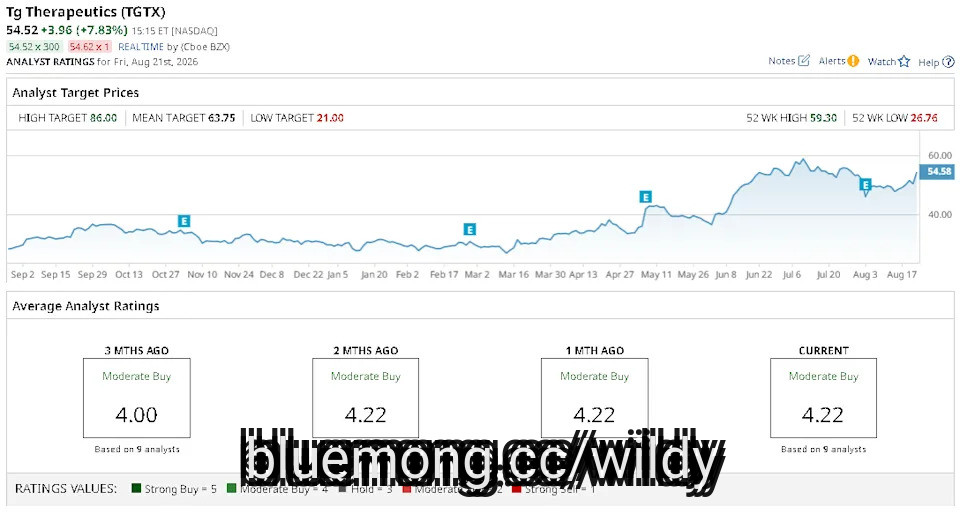
TG Therapeutics (TGTX) shares soared on Aug 21 as speculation emerged that the biotech firm could be the target of a potential takeover. Investors cheered TGTX following an "uncooked" alert from Betaville, suggesting a U.S. biopharma company with a market cap between $20 billion and $40 billion may be interested in acquiring TG Therapeutics.
Following the meteoric rally on Friday, TG Therapeutics stock is up about 85% versus the start of this year.
Microsoft vs. Broadcom: One Has 85% Upside, But I'm Picking the Other
Google Lost About $186 Billion After 4 of Its Top AI Researchers Left, but Sundar Pichai Says Google Will Be 'A Founding Investor' Anyway
Rocket Lab and AST ******* eMobile Are Priced for the Big Bang. One ******* e Stock Already Delivered.
#billion #investors #betaville #Friday
Following the meteoric rally on Friday, TG Therapeutics stock is up about 85% versus the start of this year.
Microsoft vs. Broadcom: One Has 85% Upside, But I'm Picking the Other
Google Lost About $186 Billion After 4 of Its Top AI Researchers Left, but Sundar Pichai Says Google Will Be 'A Founding Investor' Anyway
Rocket Lab and AST ******* eMobile Are Priced for the Big Bang. One ******* e Stock Already Delivered.
#billion #investors #betaville #Friday


1 month ago
On August 13, Abeona Therapeutics (NASDAQ:ABEO) reported second-quarter results that captured a company scaling a genuinely new kind of medicine while working through the ***** ps that come with it. ZEVASKYN, its cell therapy for a severe skin disease called recessive dystrophic epidermolysis bullosa, brought in $11.4 million in revenue for the quarter, and the number of patients treated kept rising. But the call also laid out cancellations, manufacturing hiccups, and a shift in how the company plans to report its own progress, all within the same three months.
Revenue climbed 31%, or $2.7 million, to $11.4 million from $8.7 million in the first quarter of 2026. Abeona has now treated 12 patients since ZEVASKYN's launch, including five in the second quarter and three more in the third quarter to date. The treatment center network grew alongside that, reaching seven activated sites with the recent addition of Cincinnati Children's, one of the largest epidermolysis bullosa treatment hubs in the country. New York-Presbyterian/Columbia University Irving Medical Center and Children's Hospital of Philadelphia also came online during the quarter, and CHOP moved fast, completing its first treatment in July just months after activating in May. UTMB, meanwhile, finished its first patient biopsy. Roughly 40% of the addressable patient population now has in-state access to a qualified treatment center.
Abeona also picked up a new technology add-on payment from the Centers for Medicare and Medicaid Services, effective Oct. 1, 2026, for fiscal year 2027, making it one of only three approvals out of 15 new applications that cycle. On the cost side, R&D spending fell to $5 million from $9.6 million, which had included a one-time $7 million licensing payment, and SG&A dropped to $15.8 million from $19.5 million. The company closed the quarter with $146.8 million in cash and short-term investments.
The net loss widened to $20.2 million, or $0.35 per share, from $17.1 million, or $0.30 per share, in the first quarter. Of the five patients treated in the second quarter, only four generated recognized revenue, because one batch's cell yield came in below the threshold required for recognition. Management pointed to ZEVASKYN's 84-hour shelf life as a core operational challenge, since it forces dermatologists, surgeons, anesthesiologists, and hospital staff to lock in exact dates well ahead of time. That rigidity showed up directly in the numbers: two scheduled biopsies were canceled at the last minute in the second quarter after patients' health unexpectedly declined, and because those slots had been booked so far in advance, they could not be filled by another patient.
#abeona #first #center
Revenue climbed 31%, or $2.7 million, to $11.4 million from $8.7 million in the first quarter of 2026. Abeona has now treated 12 patients since ZEVASKYN's launch, including five in the second quarter and three more in the third quarter to date. The treatment center network grew alongside that, reaching seven activated sites with the recent addition of Cincinnati Children's, one of the largest epidermolysis bullosa treatment hubs in the country. New York-Presbyterian/Columbia University Irving Medical Center and Children's Hospital of Philadelphia also came online during the quarter, and CHOP moved fast, completing its first treatment in July just months after activating in May. UTMB, meanwhile, finished its first patient biopsy. Roughly 40% of the addressable patient population now has in-state access to a qualified treatment center.
Abeona also picked up a new technology add-on payment from the Centers for Medicare and Medicaid Services, effective Oct. 1, 2026, for fiscal year 2027, making it one of only three approvals out of 15 new applications that cycle. On the cost side, R&D spending fell to $5 million from $9.6 million, which had included a one-time $7 million licensing payment, and SG&A dropped to $15.8 million from $19.5 million. The company closed the quarter with $146.8 million in cash and short-term investments.
The net loss widened to $20.2 million, or $0.35 per share, from $17.1 million, or $0.30 per share, in the first quarter. Of the five patients treated in the second quarter, only four generated recognized revenue, because one batch's cell yield came in below the threshold required for recognition. Management pointed to ZEVASKYN's 84-hour shelf life as a core operational challenge, since it forces dermatologists, surgeons, anesthesiologists, and hospital staff to lock in exact dates well ahead of time. That rigidity showed up directly in the numbers: two scheduled biopsies were canceled at the last minute in the second quarter after patients' health unexpectedly declined, and because those slots had been booked so far in advance, they could not be filled by another patient.
#abeona #first #center


1 month ago
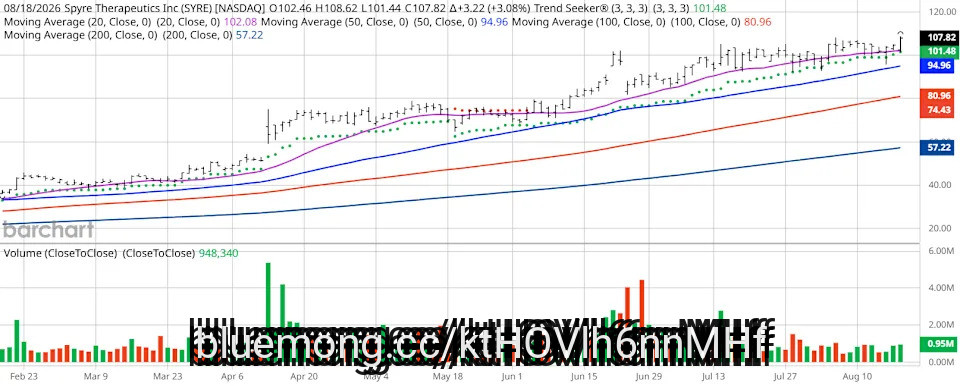
Spyre Therapeutics (SYRE) has surged more than 565% over the past year, driven by strong technical momentum.
Shares are trading at a new 3-year high.
SYRE maintains a 100% "Buy" technical opinion from Barchart.
Short interest is elevated at 13.81% of float, highlighting volatility and the need for disciplined risk management.
Valued at $9.5 billion, Spyre Therapeutics (SYRE) is a biotechnology company which aims to create inflammatory bowel disease products by combining antibody engineering, rational therapeutic combinations, and precision medicine approaches for patient selection.
#year #short
Shares are trading at a new 3-year high.
SYRE maintains a 100% "Buy" technical opinion from Barchart.
Short interest is elevated at 13.81% of float, highlighting volatility and the need for disciplined risk management.
Valued at $9.5 billion, Spyre Therapeutics (SYRE) is a biotechnology company which aims to create inflammatory bowel disease products by combining antibody engineering, rational therapeutic combinations, and precision medicine approaches for patient selection.
#year #short


1 month ago
On August 11, Bicara Therapeutics (NASDAQ:BCAX) used its second-quarter earnings call to deliver two headlines at once. CEO Claire Mazumdar announced she will step into a Vice Chair and Strategic Adviser role at the start of next year, handing the top job to President and Chief Operating Officer Ryan Cohlhepp. That handoff arrives just as the company points to fresh survival data for ficerafusp alfa, its lead drug candidate for frontline recurrent or metastatic HPV-negative head and neck cancer, and pushes its pivotal trial toward a critical readout.
At May's ASCO meeting, Bicara presented three-year follow-up data spanning roughly 90 patients across three dose cohorts, the longest follow-up reported for any investigational agent in HPV-negative head and neck cancer. At the 1,500 milligram weekly pivotal dose, about one in three patients was still alive at three years, roughly double the survival rate seen in retrospective **** yses of standard-of-care pembrolizumab in this population. Management ties that benefit to the drug's TGF-beta inhibition, which it says drives tumor penetration and immune cell infiltration rather than blocking a single pathway. Overall survival nearly doubled against the standard of care while the safety profile stayed consistent, the company said.
Execution on the pivotal Phase III FORTIFI-HN01 study has kept pace. Bicara says it is on track for substantial enrollment by the end of 2026, with more than 200 sites now active, positioning the trial for a mid-2027 interim readout that could open the door to accelerated approval. The company also launched FORTIFI-FLEX, a study of an every-three-week maintenance dose built on encouraging results from an exploratory every-two-week cohort shown earlier this year, with data targeted for the time of any U.S. approval decision. Beyond the core indication, Bicara points to early proof of concept in cutaneous squamous cell carcinoma and **** canal cancer, backed by roughly $497 million in cash that management says funds operations through the first half of 2029.
The leadership overhaul goes well beyond the CEO chair. Jenn Larson took over as Chief Financial Officer the day after the call, succeeding Ivan Hyep, who had a hand in raising over $800 million for the company since its early days. Two more transitions take effect in January: Chief Development Officer Tanya Green moves into the Chief Operating Officer seat, and Chief Corporate Affairs Officer Jenna Cohen becomes Chief Business Officer. A new Chief Legal Officer and two new board members are joining as well, a lot of change concentrated in a single quarter right as the company approaches its most consequential trial milestone.
#bicara #three #survival #cancer
At May's ASCO meeting, Bicara presented three-year follow-up data spanning roughly 90 patients across three dose cohorts, the longest follow-up reported for any investigational agent in HPV-negative head and neck cancer. At the 1,500 milligram weekly pivotal dose, about one in three patients was still alive at three years, roughly double the survival rate seen in retrospective **** yses of standard-of-care pembrolizumab in this population. Management ties that benefit to the drug's TGF-beta inhibition, which it says drives tumor penetration and immune cell infiltration rather than blocking a single pathway. Overall survival nearly doubled against the standard of care while the safety profile stayed consistent, the company said.
Execution on the pivotal Phase III FORTIFI-HN01 study has kept pace. Bicara says it is on track for substantial enrollment by the end of 2026, with more than 200 sites now active, positioning the trial for a mid-2027 interim readout that could open the door to accelerated approval. The company also launched FORTIFI-FLEX, a study of an every-three-week maintenance dose built on encouraging results from an exploratory every-two-week cohort shown earlier this year, with data targeted for the time of any U.S. approval decision. Beyond the core indication, Bicara points to early proof of concept in cutaneous squamous cell carcinoma and **** canal cancer, backed by roughly $497 million in cash that management says funds operations through the first half of 2029.
The leadership overhaul goes well beyond the CEO chair. Jenn Larson took over as Chief Financial Officer the day after the call, succeeding Ivan Hyep, who had a hand in raising over $800 million for the company since its early days. Two more transitions take effect in January: Chief Development Officer Tanya Green moves into the Chief Operating Officer seat, and Chief Corporate Affairs Officer Jenna Cohen becomes Chief Business Officer. A new Chief Legal Officer and two new board members are joining as well, a lot of change concentrated in a single quarter right as the company approaches its most consequential trial milestone.
#bicara #three #survival #cancer

1 month ago
Spyre Therapeutics (SYRE) has surged more than 565% over the past year, driven by strong technical momentum.
Shares are trading at a new 3-year high.
SYRE maintains a 100% "Buy" technical opinion from Barchart.
Short interest is elevated at 13.81% of float, highlighting volatility and the need for disciplined risk management.
Valued at $9.5 billion, Spyre Therapeutics (SYRE) is a biotechnology company which aims to create inflammatory bowel disease products by combining antibody engineering, rational therapeutic combinations, and precision medicine approaches for patient selection.
#syre #technical #short #valued
Shares are trading at a new 3-year high.
SYRE maintains a 100% "Buy" technical opinion from Barchart.
Short interest is elevated at 13.81% of float, highlighting volatility and the need for disciplined risk management.
Valued at $9.5 billion, Spyre Therapeutics (SYRE) is a biotechnology company which aims to create inflammatory bowel disease products by combining antibody engineering, rational therapeutic combinations, and precision medicine approaches for patient selection.
#syre #technical #short #valued


1 month ago
On August 11, Bicara Therapeutics (NASDAQ:BCAX) used its second-quarter earnings call to deliver two headlines at once. CEO Claire Mazumdar announced she will step into a Vice Chair and Strategic Adviser role at the start of next year, handing the top job to President and Chief Operating Officer Ryan Cohlhepp. That handoff arrives just as the company points to fresh survival data for ficerafusp alfa, its lead drug candidate for frontline recurrent or metastatic HPV-negative head and neck cancer, and pushes its pivotal trial toward a critical readout.
At May's ASCO meeting, Bicara presented three-year follow-up data spanning roughly 90 patients across three dose cohorts, the longest follow-up reported for any investigational agent in HPV-negative head and neck cancer. At the 1,500 milligram weekly pivotal dose, about one in three patients was still alive at three years, roughly double the survival rate seen in retrospective ****** yses of standard-of-care pembrolizumab in this population. Management ties that benefit to the drug's TGF-beta inhibition, which it says drives tumor penetration and immune cell infiltration rather than blocking a single pathway. Overall survival nearly doubled against the standard of care while the safety profile stayed consistent, the company said.
Execution on the pivotal Phase III FORTIFI-HN01 study has kept pace. Bicara says it is on track for substantial enrollment by the end of 2026, with more than 200 sites now active, positioning the trial for a mid-2027 interim readout that could open the door to accelerated approval. The company also launched FORTIFI-FLEX, a study of an every-three-week maintenance dose built on encouraging results from an exploratory every-two-week cohort shown earlier this year, with data targeted for the time of any U.S. approval decision. Beyond the core indication, Bicara points to early proof of concept in cutaneous squamous cell carcinoma and ****** canal cancer, backed by roughly $497 million in cash that management says funds operations through the first half of 2029.
The leadership overhaul goes well beyond the CEO chair. Jenn Larson took over as Chief Financial Officer the day after the call, succeeding Ivan Hyep, who had a hand in raising over $800 million for the company since its early days. Two more transitions take effect in January: Chief Development Officer Tanya Green moves into the Chief Operating Officer seat, and Chief Corporate Affairs Officer Jenna Cohen becomes Chief Business Officer. A new Chief Legal Officer and two new board members are joining as well, a lot of change concentrated in a single quarter right as the company approaches its most consequential trial milestone.
#three
At May's ASCO meeting, Bicara presented three-year follow-up data spanning roughly 90 patients across three dose cohorts, the longest follow-up reported for any investigational agent in HPV-negative head and neck cancer. At the 1,500 milligram weekly pivotal dose, about one in three patients was still alive at three years, roughly double the survival rate seen in retrospective ****** yses of standard-of-care pembrolizumab in this population. Management ties that benefit to the drug's TGF-beta inhibition, which it says drives tumor penetration and immune cell infiltration rather than blocking a single pathway. Overall survival nearly doubled against the standard of care while the safety profile stayed consistent, the company said.
Execution on the pivotal Phase III FORTIFI-HN01 study has kept pace. Bicara says it is on track for substantial enrollment by the end of 2026, with more than 200 sites now active, positioning the trial for a mid-2027 interim readout that could open the door to accelerated approval. The company also launched FORTIFI-FLEX, a study of an every-three-week maintenance dose built on encouraging results from an exploratory every-two-week cohort shown earlier this year, with data targeted for the time of any U.S. approval decision. Beyond the core indication, Bicara points to early proof of concept in cutaneous squamous cell carcinoma and ****** canal cancer, backed by roughly $497 million in cash that management says funds operations through the first half of 2029.
The leadership overhaul goes well beyond the CEO chair. Jenn Larson took over as Chief Financial Officer the day after the call, succeeding Ivan Hyep, who had a hand in raising over $800 million for the company since its early days. Two more transitions take effect in January: Chief Development Officer Tanya Green moves into the Chief Operating Officer seat, and Chief Corporate Affairs Officer Jenna Cohen becomes Chief Business Officer. A new Chief Legal Officer and two new board members are joining as well, a lot of change concentrated in a single quarter right as the company approaches its most consequential trial milestone.
#three

1 month ago
By Karen Roman
Fulcrum Therapeutics, Inc. (Nasdaq: FULC) said it is merging with Slate Medicines, Inc. to advance next-generation therapeutics to treat migraine and other headache disorders, with the combining company operating as Slate Medicines, Inc. and trading on Nasdaq under the ticker "SLTE."
Slate reported it secured an oversubscribed concurrent private placement of $245 million from healthcare investors led by Frazier Life Sciences and including Forbion, RA Capital Management, and Deep Track Capital, among other firms. The new company's cash balance is expected to fund operations into 2029, it said.
"Migraine remains one of the most prevalent and disabling neurological diseases, yet millions of patients continue to be underserved by existing therapies," said Gregory Oakes, Slate Medicines CEO. "This merger and the related financing are expected to provide the resources to advance SLTE-1009, along with the rest of our pipeline, through potentially meaningful clinical milestones."
Contact:
#karen
Fulcrum Therapeutics, Inc. (Nasdaq: FULC) said it is merging with Slate Medicines, Inc. to advance next-generation therapeutics to treat migraine and other headache disorders, with the combining company operating as Slate Medicines, Inc. and trading on Nasdaq under the ticker "SLTE."
Slate reported it secured an oversubscribed concurrent private placement of $245 million from healthcare investors led by Frazier Life Sciences and including Forbion, RA Capital Management, and Deep Track Capital, among other firms. The new company's cash balance is expected to fund operations into 2029, it said.
"Migraine remains one of the most prevalent and disabling neurological diseases, yet millions of patients continue to be underserved by existing therapies," said Gregory Oakes, Slate Medicines CEO. "This merger and the related financing are expected to provide the resources to advance SLTE-1009, along with the rest of our pipeline, through potentially meaningful clinical milestones."
Contact:
#karen


1 month ago
Greenhaven Road Capital, an investment management company, released its second-quarter 2026 investor letter. A copy of the letter can be downloaded here. The fund achieved an approximate 11% net return in the second quarter, indicating progress from the first quarter. Key changes to the portfolio will include lower concentration and increased investments with near-term catalysts, alongside a proactive stance on profit-taking. The focus will remain on owning strong businesses and conducting research that challenges consensus views, as several major investments are poised for significant events within the year. Despite declines in market multiples, underlying businesses continue to grow, suggesting a favorable positioning for returns. Additionally, reviewing the Fund's top five holdings could help identify its best picks for 2026.
In its Q2 2026 investor letter, Greenhaven Road Capital highlighted AnaptysBio, Inc. (NASDAQ:ANAB) as a newly added position. AnaptysBio, Inc. (NASDAQ:ANAB) is a clinical-stage biotechnology company focusing on immunology therapeutics for autoimmune and inflammatory diseases. On August 14, 2026, AnaptysBio, Inc. (NASDAQ:ANAB) closed at $58.47 per share, reflecting a market capitalization of $1.73 billion. AnaptysBio, Inc. (NASDAQ:ANAB) posted a one-month return of 16.27%, while its shares gained 338.15% over the past 52 weeks.
Greenhaven Road Capital stated the following regarding AnaptysBio, Inc. (NASDAQ:ANAB) in its Q2 2026 investor letter:
"Many of our investments require patience. Rather than a clear near-term catalyst, they offer an advantaged product or management team that can build the business and compound value over time. This quarter, we invested in AnaptysBio, a situation that may not require as much patience.
AnaptysBio, Inc. (NASDAQ:ANAB) is a drug royalty company. In 2014, Tesaro licensed a portfolio of pre-clinical antibodies from AnaptysBio. Tesaro, then a small company with $180M in cash, paid AnaptysBio $17M under an agreement designed for two small companies. The agreement included exclusivity and notification provisions and required Tesaro to seek an "optimal commercial return" for AnaptysBio's drugs, which were still in clinical trials.
#road #company #letter
In its Q2 2026 investor letter, Greenhaven Road Capital highlighted AnaptysBio, Inc. (NASDAQ:ANAB) as a newly added position. AnaptysBio, Inc. (NASDAQ:ANAB) is a clinical-stage biotechnology company focusing on immunology therapeutics for autoimmune and inflammatory diseases. On August 14, 2026, AnaptysBio, Inc. (NASDAQ:ANAB) closed at $58.47 per share, reflecting a market capitalization of $1.73 billion. AnaptysBio, Inc. (NASDAQ:ANAB) posted a one-month return of 16.27%, while its shares gained 338.15% over the past 52 weeks.
Greenhaven Road Capital stated the following regarding AnaptysBio, Inc. (NASDAQ:ANAB) in its Q2 2026 investor letter:
"Many of our investments require patience. Rather than a clear near-term catalyst, they offer an advantaged product or management team that can build the business and compound value over time. This quarter, we invested in AnaptysBio, a situation that may not require as much patience.
AnaptysBio, Inc. (NASDAQ:ANAB) is a drug royalty company. In 2014, Tesaro licensed a portfolio of pre-clinical antibodies from AnaptysBio. Tesaro, then a small company with $180M in cash, paid AnaptysBio $17M under an agreement designed for two small companies. The agreement included exclusivity and notification provisions and required Tesaro to seek an "optimal commercial return" for AnaptysBio's drugs, which were still in clinical trials.
#road #company #letter


1 month ago
Fulcrum Therapeutics and Slate Medicines have signed a definitive agreement to merge in an all-stock transaction backed by a $245m private placement financing from a syndicate of healthcare investors.
The combined organisation, which will operate as Slate Medicines, is expected to be listed on Nasdaq under the "SLTE" ticker symbol.
Following completion of the merger, the new entity will focus on developing Slate's pipeline of migraine treatments, with SLTE-1009 as its lead candidate.
This clinical-stage subcutaneous anti- pituitary adenylate cyclase-activating peptide / vasoactive intestinal peptide (PACAP/VIP) monoclonal antibody is intended for the prevention of migraine and other headache disorders.
The financing is expected to support operations through 2029, enabling progress of SLTE-1009 through Phase I studies in healthy volunteers and a Phase II dose-range finding study in patients with migraine.
#phase #expected #peptide #therapeutics
The combined organisation, which will operate as Slate Medicines, is expected to be listed on Nasdaq under the "SLTE" ticker symbol.
Following completion of the merger, the new entity will focus on developing Slate's pipeline of migraine treatments, with SLTE-1009 as its lead candidate.
This clinical-stage subcutaneous anti- pituitary adenylate cyclase-activating peptide / vasoactive intestinal peptide (PACAP/VIP) monoclonal antibody is intended for the prevention of migraine and other headache disorders.
The financing is expected to support operations through 2029, enabling progress of SLTE-1009 through Phase I studies in healthy volunteers and a Phase II dose-range finding study in patients with migraine.
#phase #expected #peptide #therapeutics

1 month ago
Two biopharma giants, Merck & Co., Inc. (NYSE:MRK) and Gilead Sciences, Inc. (NASDAQ:GILD), are proving that in modern drug development, the biggest catalyst isn't always competing head-to-head; it is knowing when to join forces. While both companies reported their first-quarter 2026 earnings earlier this year, their recent double dose of clinical and regulatory breakthroughs across oncology and virology shows how strategic alliances can reshape two massive therapeutic markets at once.
Merck & Co., Inc. delivered $16.3 billion in total sales for the first quarter of 2026, up 5% year-over-year (3% excluding foreign exchange). Top-line growth continued to be anchored by its flagship oncology therapy, Keytruda, which, alongside its sub-formulations, brought in $8.0 billion in sales, representing an 8% ex-exchange increase. Pulmonary arterial hypertension treatment Winrevair also contributed strongly with $525 million in quarterly revenue, up 87% ex-exchange. GAAP and non-GAAP bottom-line metrics reflected net losses per share of $1.72 and $1.28, respectively, largely driven by upfront charges tied to the strategic acquisition of Cidara Therapeutics. Despite those acquisition-related charges, Merck narrowed and raised the midpoint of its full-year worldwide sales guidance to between $65.8 billion and $67.0 billion.
Merck's growth story remains heavily reliant on expanding Keytruda's reach into earlier-stage treatments and novel combination regimens. With key patent expirations approaching toward the end of the decade, management has aggressively pursued business development and combination therapies to diversify its revenue base and maintain its dominance in immuno-oncology.
Gilead Sciences, Inc. reported $7.0 billion in total revenue for the first quarter of 2026, posting 5% year-over-year product sales growth. Gilead's base business, excluding COVID-19 treatment Veklury, rose 8% year-over-year to $6.8 billion, powered by its market-leading HIV franchise, which generated $5.0 billion in sales (up 10% year-over-year). Biktarvy remained the primary growth driver, while newly launched therapies like Yeztugo (lenacapavir) for HIV pre-exposure prophylaxis provided fresh momentum. The corporation's adjusted diluted earnings per share reached $2.03.
Backed by strong demand across its core virology portfolio, Gilead Sciences, Inc. raised its full-year 2026 total product sales guidance range by $400 million, targeting $30.0 billion to $30.4 billion.
#billion #merck #sciences #oncology
Merck & Co., Inc. delivered $16.3 billion in total sales for the first quarter of 2026, up 5% year-over-year (3% excluding foreign exchange). Top-line growth continued to be anchored by its flagship oncology therapy, Keytruda, which, alongside its sub-formulations, brought in $8.0 billion in sales, representing an 8% ex-exchange increase. Pulmonary arterial hypertension treatment Winrevair also contributed strongly with $525 million in quarterly revenue, up 87% ex-exchange. GAAP and non-GAAP bottom-line metrics reflected net losses per share of $1.72 and $1.28, respectively, largely driven by upfront charges tied to the strategic acquisition of Cidara Therapeutics. Despite those acquisition-related charges, Merck narrowed and raised the midpoint of its full-year worldwide sales guidance to between $65.8 billion and $67.0 billion.
Merck's growth story remains heavily reliant on expanding Keytruda's reach into earlier-stage treatments and novel combination regimens. With key patent expirations approaching toward the end of the decade, management has aggressively pursued business development and combination therapies to diversify its revenue base and maintain its dominance in immuno-oncology.
Gilead Sciences, Inc. reported $7.0 billion in total revenue for the first quarter of 2026, posting 5% year-over-year product sales growth. Gilead's base business, excluding COVID-19 treatment Veklury, rose 8% year-over-year to $6.8 billion, powered by its market-leading HIV franchise, which generated $5.0 billion in sales (up 10% year-over-year). Biktarvy remained the primary growth driver, while newly launched therapies like Yeztugo (lenacapavir) for HIV pre-exposure prophylaxis provided fresh momentum. The corporation's adjusted diluted earnings per share reached $2.03.
Backed by strong demand across its core virology portfolio, Gilead Sciences, Inc. raised its full-year 2026 total product sales guidance range by $400 million, targeting $30.0 billion to $30.4 billion.
#billion #merck #sciences #oncology


2 months ago
AbbVie (NYSE:ABBV) just moved a step closer to expanding one of its most recognizable brands. On August 4, the FDA accepted for review a supplemental Biologics License Application for Botox Cosmetic to treat masseter muscle prominence, the jaw-muscle bulge that can give a face a wider, squarer look. If cleared, Botox Cosmetic would become the first and only neurotoxin approved for that use in the US and the fifth aesthetic indication for a drug that already anchors AbbVie's fastest-growing units.
The filing rests on two Phase 3 studies, M21-416 and M21-417, both of which hit their main goal and showed statistically significant improvement in masseter prominence against a placebo, with p-values of 0.0046 and 0.0014. Twice as many treated patients called themselves satisfied compared with the placebo group, and the safety data lined up with Botox's long track record, with no new red flags. That is the AbbVie playbook in miniature: squeeze another approved use out of a drug it already owns rather than starting from zero.
The broader business backs that pattern up. In the quarter ended June 30, net revenue came in just under $17 billion, up more than 10% year over year, with immunology sales climbing 15% on Skyrizi and Rinvoq and neuroscience revenue jumping more than 20%. Management raised its full-year outlook for the second time this year, and the Humira patent-cliff drag that weighed on results for two years now looks largely behind the company.
Most of AbbVie's US product sales still flow through just three wholesale distributors, McKesson, Cardinal Health, and Cencora, a concentration that leaves the company exposed if any one relationship sours. The balance sheet carries real leverage too: a debt-to-equity ratio of roughly -21.1x as of its December 2025 filing means liabilities outweigh shareholder equity outright, and a current ratio near 0.7x offers less short-term cushion than many healthcare peers hold.
Patent protection for Skyrizi and Rinvoq remains a multi-year risk, and the Inflation Reduction Act already allows government price negotiation on products including Imbruvica and, notably, Botox itself. The pending $10.9 billion Apogee Therapeutics acquisition adds fresh debt and integration risk on top of that. Oncology revenue slipped almost 2% in the latest quarter, and the stock's 8% gain this year has trailed the S&P 500's 13%, with a trailing P/E near 70 that mostly reflects acquisition-related charges rather than the underlying business.
#revenue
The filing rests on two Phase 3 studies, M21-416 and M21-417, both of which hit their main goal and showed statistically significant improvement in masseter prominence against a placebo, with p-values of 0.0046 and 0.0014. Twice as many treated patients called themselves satisfied compared with the placebo group, and the safety data lined up with Botox's long track record, with no new red flags. That is the AbbVie playbook in miniature: squeeze another approved use out of a drug it already owns rather than starting from zero.
The broader business backs that pattern up. In the quarter ended June 30, net revenue came in just under $17 billion, up more than 10% year over year, with immunology sales climbing 15% on Skyrizi and Rinvoq and neuroscience revenue jumping more than 20%. Management raised its full-year outlook for the second time this year, and the Humira patent-cliff drag that weighed on results for two years now looks largely behind the company.
Most of AbbVie's US product sales still flow through just three wholesale distributors, McKesson, Cardinal Health, and Cencora, a concentration that leaves the company exposed if any one relationship sours. The balance sheet carries real leverage too: a debt-to-equity ratio of roughly -21.1x as of its December 2025 filing means liabilities outweigh shareholder equity outright, and a current ratio near 0.7x offers less short-term cushion than many healthcare peers hold.
Patent protection for Skyrizi and Rinvoq remains a multi-year risk, and the Inflation Reduction Act already allows government price negotiation on products including Imbruvica and, notably, Botox itself. The pending $10.9 billion Apogee Therapeutics acquisition adds fresh debt and integration risk on top of that. Oncology revenue slipped almost 2% in the latest quarter, and the stock's 8% gain this year has trailed the S&P 500's 13%, with a trailing P/E near 70 that mostly reflects acquisition-related charges rather than the underlying business.
#revenue

2 months ago
Eli Lilly (NYSE:LLY) delivered a quarter that forced Wall Street to catch up to its own numbers. On August 5, the company reported second-quarter revenue of $23.0 billion, up 48% from a year earlier, and used the momentum to raise its full-year sales and profit targets. Shares moved higher the same day as investors focused on how fast the obesity franchise is still expanding.
The headline number came from Mounjaro and Zepbound. Mounjaro revenue jumped 91% to $9.9 billion, while Zepbound climbed 46% to $4.9 billion, and together they anchored a quarter where US sales rose 33% to $14.4 billion, and international sales rose 80% to $8.6 billion. Growth was not confined to the diabetes and obesity lineup either. Lilly's immunology, oncology, and neuroscience products grew a combined 121%, showing the newer parts of the portfolio are starting to contribute in a real way.
Management responded by lifting full-year revenue guidance to a range of $85 billion to $87 billion, up from $82 billion to $85 billion previously. Lilly is also plowing the cash back into its pipeline, closing acquisitions of Orna Therapeutics, Ajax Therapeutics, Centessa Pharmaceuticals, and Kelonia Therapeutics during the quarter, agreeing to buy AtaiBeckley afterward, and committing another $4.5 billion to expand manufacturing in Indiana. On the drug development side, three more Phase 3 trials of the experimental triple agonist retatrutide read out positively, giving Lilly a complete data package to support a planned obesity application submission in the first quarter of 2027.
The same quarter that produced 48% revenue growth also showed what that growth is costing. Realized prices fell 13% company-wide, with international pricing down 36% largely tied to Mounjaro's addition to China's national reimbursement drug list, a trade-off Lilly is making for volume and market access. The acquisition spree carried a real accounting price tag too. Acquired R&D charges hit $2.8 billion in the quarter, versus just $154 million a year earlier, which is why reported EPS grew only 26% even as the non-GAAP figure grew 33%.
Asset impairment and restructuring charges of $703 million, largely tied to the Kelonia and Centessa deals, added further drag, and the effective tax rate climbed to 23.3% from 16.5% because of the non-deductible nature of those charges. R&D spending rose 14% to $3.8 billion, and marketing and administrative costs rose 25% to $3.4 billion, a reminder that funding a pipeline this active and prepping for a wave of new launches is not cheap. None of this changes the underlying growth story, but it does mean the path from strong sales to clean reported profit is getting ****** pier as the deal-making continues.
#billion #lilly #therapeutics #reported
The headline number came from Mounjaro and Zepbound. Mounjaro revenue jumped 91% to $9.9 billion, while Zepbound climbed 46% to $4.9 billion, and together they anchored a quarter where US sales rose 33% to $14.4 billion, and international sales rose 80% to $8.6 billion. Growth was not confined to the diabetes and obesity lineup either. Lilly's immunology, oncology, and neuroscience products grew a combined 121%, showing the newer parts of the portfolio are starting to contribute in a real way.
Management responded by lifting full-year revenue guidance to a range of $85 billion to $87 billion, up from $82 billion to $85 billion previously. Lilly is also plowing the cash back into its pipeline, closing acquisitions of Orna Therapeutics, Ajax Therapeutics, Centessa Pharmaceuticals, and Kelonia Therapeutics during the quarter, agreeing to buy AtaiBeckley afterward, and committing another $4.5 billion to expand manufacturing in Indiana. On the drug development side, three more Phase 3 trials of the experimental triple agonist retatrutide read out positively, giving Lilly a complete data package to support a planned obesity application submission in the first quarter of 2027.
The same quarter that produced 48% revenue growth also showed what that growth is costing. Realized prices fell 13% company-wide, with international pricing down 36% largely tied to Mounjaro's addition to China's national reimbursement drug list, a trade-off Lilly is making for volume and market access. The acquisition spree carried a real accounting price tag too. Acquired R&D charges hit $2.8 billion in the quarter, versus just $154 million a year earlier, which is why reported EPS grew only 26% even as the non-GAAP figure grew 33%.
Asset impairment and restructuring charges of $703 million, largely tied to the Kelonia and Centessa deals, added further drag, and the effective tax rate climbed to 23.3% from 16.5% because of the non-deductible nature of those charges. R&D spending rose 14% to $3.8 billion, and marketing and administrative costs rose 25% to $3.4 billion, a reminder that funding a pipeline this active and prepping for a wave of new launches is not cheap. None of this changes the underlying growth story, but it does mean the path from strong sales to clean reported profit is getting ****** pier as the deal-making continues.
#billion #lilly #therapeutics #reported


2 months ago
Baron Capital, an investment management company, released its Q2 2026 investor letter for the "Baron Health Care Fund". A copy of the letter is available to download here. The Fund gained 11.99% during the quarter, compared with the 10.48% gain for the Russell 3000 Health Care Index and the 15.44% gain for the Russell 3000 Index. Since inception, the Fund appreciated 10.61% on an annualized basis, compared with 10.02% for the Benchmark and 14.83% for the Index. Strong stock selection in pharmaceuticals, biotechnology, health care equipment, and life sciences tools and services supported the Fund's outperformance, although limited exposure to managed care stocks reduced relative returns. The Fund remains positive on health care due to improving biotechnology funding, strong acquisition activity, recovering managed care margins, and growth from an aging population, chronic disease, medical innovation, and higher health care spending. In addition, please check the Fund's top five holdings to know the best picks in 2026.
In its second-quarter 2026 investor letter, Baron Health Care Fund highlighted Apogee Therapeutics, Inc. (NASDAQ:APGE). Apogee Therapeutics, Inc. (NASDAQ:APGE) a clinical stage biotechnology company, develops novel biologics for the treatment of atopic dermatitis, asthma, eosinophilic esophagitis, chronic obstructive pulmonary disease, and other inflammatory and immunology indications. On August 04, 2026, Apogee Therapeutics, Inc. (NASDAQ:APGE) closed at $134.19 per share. One-month return of Apogee Therapeutics, Inc. (NASDAQ:APGE) was 1.05% and its shares gained 269.47% over the past 52 weeks. Apogee Therapeutics, Inc. (NASDAQ:APGE) has a market capitalization of $10.11 billion with a 52-week trading range between $34.34 - $134.46.
Baron Health Care Fund stated the following regarding Apogee Therapeutics, Inc. (NASDAQ:APGE) in its Q2 2026 investor letter:
"Favorable stock selection in biotechnology, mostly attributable to acquisition target Apogee Therapeutics, Inc. (NASDAQ:APGE), was partly offset by higher exposure to this underperforming sub-industry. In June, Apogee announced an agreement to be acquired by AbbVie Inc. for $135.11 per share, representing a 49.5% premium over the prior day's closing stock price. We sold Apogee Therapeutics, Inc. following announcements that it was being acquired by AbbVie Inc."
Apogee Therapeutics, Inc. (NASDAQ:APGE) is not on our list of the 40 Most Popular Stocks Among Hedge Funds. As per our database, 44 hedge fund portfolios held Apogee Therapeutics, Inc. (NASDAQ:APGE) at the end of the first quarter which was 35 in the previous quarter. While we acknowledge the potential of Apogee Therapeutics, Inc. (NASDAQ:APGE) as an investment, we believe certain AI stocks offer greater upside potential and carry less downside risk. If you're looking for an extremely undervalued AI stock that also stands to benefit significantly from Trump-era tariffs and the onshoring trend, see our free report on the
In its second-quarter 2026 investor letter, Baron Health Care Fund highlighted Apogee Therapeutics, Inc. (NASDAQ:APGE). Apogee Therapeutics, Inc. (NASDAQ:APGE) a clinical stage biotechnology company, develops novel biologics for the treatment of atopic dermatitis, asthma, eosinophilic esophagitis, chronic obstructive pulmonary disease, and other inflammatory and immunology indications. On August 04, 2026, Apogee Therapeutics, Inc. (NASDAQ:APGE) closed at $134.19 per share. One-month return of Apogee Therapeutics, Inc. (NASDAQ:APGE) was 1.05% and its shares gained 269.47% over the past 52 weeks. Apogee Therapeutics, Inc. (NASDAQ:APGE) has a market capitalization of $10.11 billion with a 52-week trading range between $34.34 - $134.46.
Baron Health Care Fund stated the following regarding Apogee Therapeutics, Inc. (NASDAQ:APGE) in its Q2 2026 investor letter:
"Favorable stock selection in biotechnology, mostly attributable to acquisition target Apogee Therapeutics, Inc. (NASDAQ:APGE), was partly offset by higher exposure to this underperforming sub-industry. In June, Apogee announced an agreement to be acquired by AbbVie Inc. for $135.11 per share, representing a 49.5% premium over the prior day's closing stock price. We sold Apogee Therapeutics, Inc. following announcements that it was being acquired by AbbVie Inc."
Apogee Therapeutics, Inc. (NASDAQ:APGE) is not on our list of the 40 Most Popular Stocks Among Hedge Funds. As per our database, 44 hedge fund portfolios held Apogee Therapeutics, Inc. (NASDAQ:APGE) at the end of the first quarter which was 35 in the previous quarter. While we acknowledge the potential of Apogee Therapeutics, Inc. (NASDAQ:APGE) as an investment, we believe certain AI stocks offer greater upside potential and carry less downside risk. If you're looking for an extremely undervalued AI stock that also stands to benefit significantly from Trump-era tariffs and the onshoring trend, see our free report on the


2 months ago
This has been an active year in the mergers-and-acquisitions landscape across the biopharmaceutical industry. One of the more notable deals was Vertex Pharmaceuticals' acquisition of Crinetics Pharmaceuticals for $10 billion in cash (the transaction hasn't closed yet). This is the largest acquisition in Vertex Pharmaceuticals' history, and it will enable the biotech giant to gain several promising pipeline candidates in endocrinology. Could there be an even more massive acquisition on the horizon in the industry? It's hard to say for sure, but if there is, Viking Therapeutics (NASDAQ: VKTX) may be the acquisition target.
Missed Nvidia in 2009? This Rare Signal Is Flashing Again. In 2009, a "Double Down" signal flashed for a little-known chipmaker called Nvidia. For the first time in years, that same "Total Conviction" signal is flashing for a company 1/100th the size of Nvidia. Continue »
According to the U.S. Centers for Disease Control and Prevention, a little over 70% of adults in the country are overweight or obese. Excess weight is linked to a range of serious health problems, including diabetes, heart disease, and many others. Recent breakthroughs are helping address the issue. Anti-obesity medicines are allowing patients to lose weight and reduce their risk of developing a range of conditions. But this market is still in its early stages and is projected to expand rapidly over the next decade. According to some estimates, it will be worth $190 billion in 2035, compared to just $79 billion last year.
No wonder, then, that many pharmaceutical giants are looking to dip their toes in this **** e. But discovering and developing brand-new therapies from scratch in any field is expensive and time-consuming. That's why well-established drugmakers often prefer to acquire companies with promising mid and late-stage **** ets. That's where Viking Therapeutics comes in. The company's portfolio includes subcutaneous VK2735, currently in phase 3 clinical trials, as well as an oral version of the drug, which should begin late-stage studies by year-end. Further, Viking Therapeutics developed VK3019, another weight-loss candidate, which recently started phase 1 clinical trials.
Viking Therapeutics has one of the more impressive weight-loss pipelines among mid-cap biotechs, making it a great target for a pharmaceutical leader looking to fast-track the process and land some highly promising anti-obesity pipeline candidates overnight. Viking Therapeutics' phase 3 studies for VK2735 are expected to be completed by late 2027. If the results are very strong, the company's shares will soar, making it a much more expensive acquisition target. So, if any pharmaceutical giant is going to make a move, it probably will be before then.
#viking #NVIDIA #weight #promising
Missed Nvidia in 2009? This Rare Signal Is Flashing Again. In 2009, a "Double Down" signal flashed for a little-known chipmaker called Nvidia. For the first time in years, that same "Total Conviction" signal is flashing for a company 1/100th the size of Nvidia. Continue »
According to the U.S. Centers for Disease Control and Prevention, a little over 70% of adults in the country are overweight or obese. Excess weight is linked to a range of serious health problems, including diabetes, heart disease, and many others. Recent breakthroughs are helping address the issue. Anti-obesity medicines are allowing patients to lose weight and reduce their risk of developing a range of conditions. But this market is still in its early stages and is projected to expand rapidly over the next decade. According to some estimates, it will be worth $190 billion in 2035, compared to just $79 billion last year.
No wonder, then, that many pharmaceutical giants are looking to dip their toes in this **** e. But discovering and developing brand-new therapies from scratch in any field is expensive and time-consuming. That's why well-established drugmakers often prefer to acquire companies with promising mid and late-stage **** ets. That's where Viking Therapeutics comes in. The company's portfolio includes subcutaneous VK2735, currently in phase 3 clinical trials, as well as an oral version of the drug, which should begin late-stage studies by year-end. Further, Viking Therapeutics developed VK3019, another weight-loss candidate, which recently started phase 1 clinical trials.
Viking Therapeutics has one of the more impressive weight-loss pipelines among mid-cap biotechs, making it a great target for a pharmaceutical leader looking to fast-track the process and land some highly promising anti-obesity pipeline candidates overnight. Viking Therapeutics' phase 3 studies for VK2735 are expected to be completed by late 2027. If the results are very strong, the company's shares will soar, making it a much more expensive acquisition target. So, if any pharmaceutical giant is going to make a move, it probably will be before then.
#viking #NVIDIA #weight #promising