
4 days ago
AA Milne's first Pooh book was published a century ago in October 1926. Generations of children loved it, but its inspiration, the author's own son, told the BBC that he took to "running away when people bring up the subject".
"Pooh, promise you won't forget about me, ever. Not even when I'm a hundred." This is the plaintive cry made by Christopher Robin to his teddy bear, Winnie-the-Pooh, in the final chapter of The House in Pooh Corner.
British novelist and playwright AA Milne needn't have worried. The first Winnie-the-Book was published 100 years ago in October 1926, and introduced a cast of characters modelled on the author's son and the soft toys he played with: lovably dim Pooh Bear, nervy Piglet, hyperactive Tigger, pessimistic Eeyore. Far from being forgotten, in the century since then the characters have taken on a life far beyond the parameters of their idyllic home, the Hundred Acre Wood.
BBC Radio 4, Desert Island Discs: Christopher Milne, 13/11/1976
From 1966, they became the subject of animated and live-action Disney films, in what is now one of the highest-grossing media franchises of all time. Pooh Bear has even courted controversy in Poland for being "inappropriate", sparked memes mocking the Chinese president Xi Jinping, and prompted tongue-in-cheek pop-culture theories in which the residents of the Hundred Acre Wood have been "diagnosed" with different psychological conditions.
#christopher #acre #wood


11 days ago
One ESPN ****** yst claims to have some insight on the biggest story surrounding the Detroit Red Wings.
In an episode of the Frankly Hockey podcast featuring NHL ****** ysts John Buccigross and Frank Seravalli published on Friday, Oct. 16, Buccigross said he had information that indicated the Red Wings will soon be making a blockbuster deal.
"I think there's going to be a trade within seven to 10 days in Detroit," he said.
Seravalli then asked Buccigross to confirm that he was talking about disgruntled star Dylan Larkin, to which Buccigross said yes, "that's coming."
Larkin's trade request became public knowledge on June 4, with the native Michigander having played a big role on the Red Wings since his rookie season in 2015-16. About a month after the news broke, the Red Wings parted ways with longtime general manager Steve Yzerman and named Shawn Horcoff the interim GM on Sept. 15.
#john



23 days ago
When a farm sells for a lump sum, IRS rules split proceeds across five ******* et types, and only market cattle profits count as Social Security self-employment earnings.
In a hypothetical sale generating $500,000 in gains, only $100,000 from market cattle counts toward Social Security's earnings test, while land and equipment gains register $0.
Land gains escape the Social Security earnings test but still raise adjusted gross income, potentially making up to 85% of benefits taxable.
Read More: Learn 7 ways to generate income with a $1,000,000+ portfolio (sponsor)
Freeman Family Ranches covered 87,953 acres across the North Texas and Oklahoma panhandles. The three properties, in the family for four generations, sold in late July after being listed at nearly $128 million.
#Social #gains #family #market


23 days ago
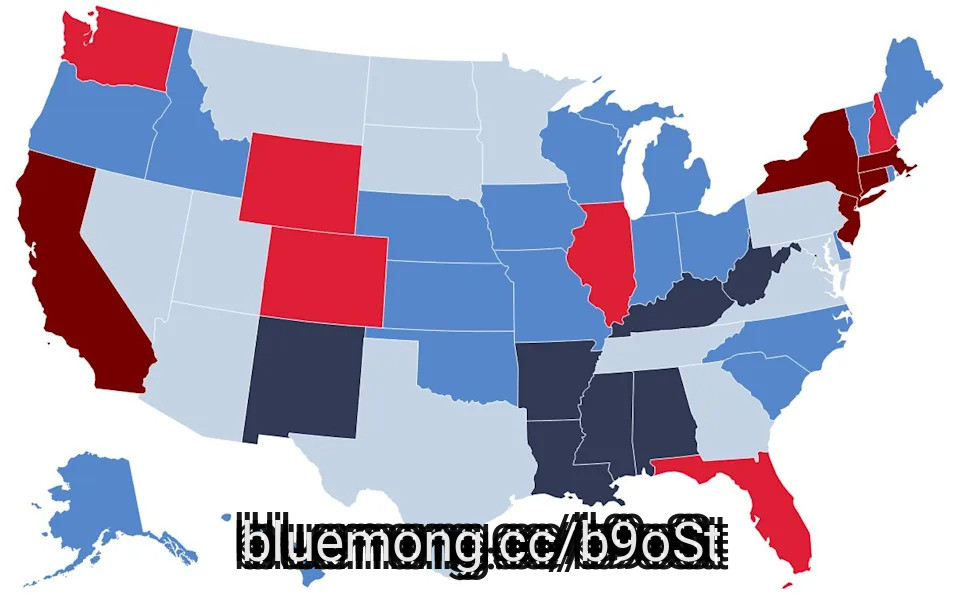
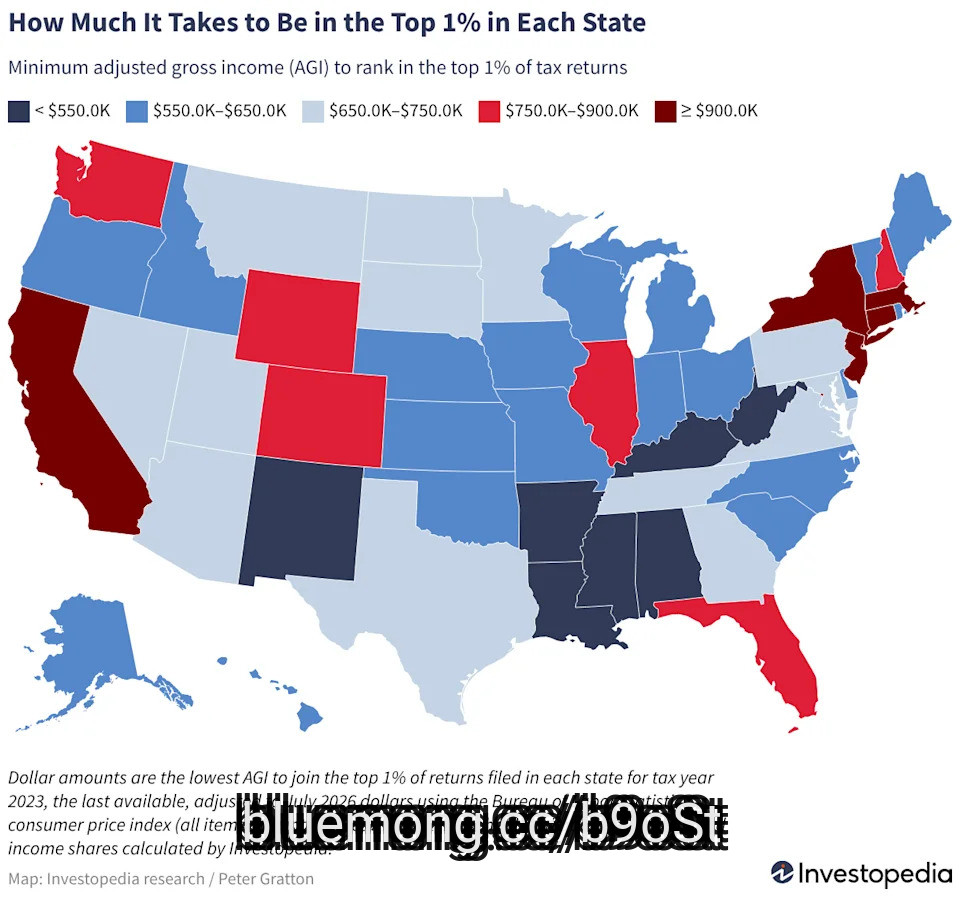
Newly released IRS data put the top-1% cutoff at about $748,000 nationally, ranging from about $426,000 in West Virginia to $1.1 million in Washington, D.C.
Only D.C. and Connecticut clear $1 million; nationally, the cutoff rose less than inflation in the latest year.
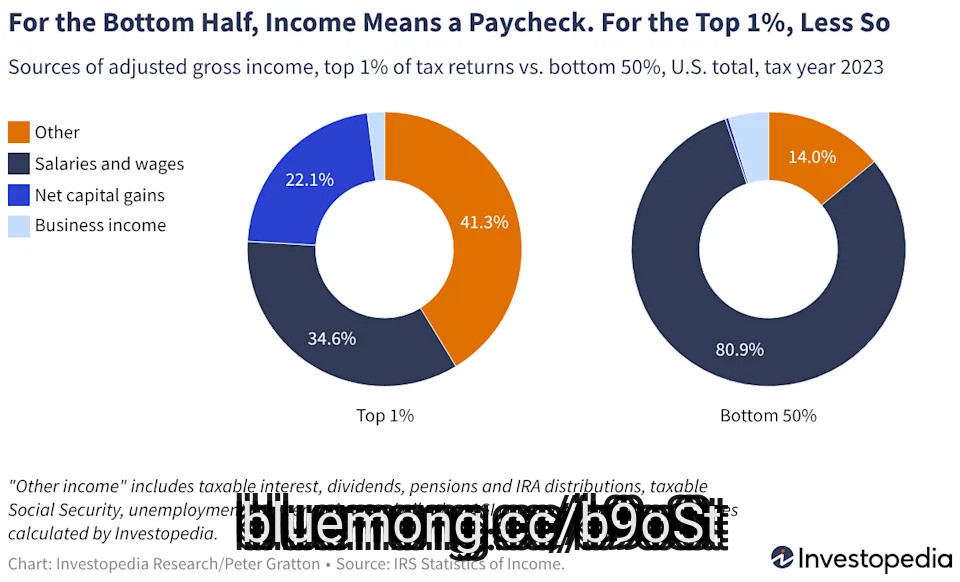
Wages make up 81% of income for the bottom half of filers, but just 35% for the top 1%, with capital gains accounting for another 22%.
The top 1% starts in a very different place depending on where you file your taxes.
The IRS's newly released state data put the income floor for the top 1% nationally at about $748,000 in adjusted gross income (AGI), according to an Investopedia **** ysis. The data was from 2023 but adjusted to 2026 dollars. In D.C., it takes about $1.1 million, while in West Virginia, it's about $426,000.
#income

24 days ago
American Tower Corporation (NYSE:AMT) traded at around $165 on October 6, within five dollars of its 52-week low of $160.06.
The company keeps 45.41% of revenue as operating profit on a portfolio of communications towers leased to wireless carriers. A business that profitable sitting at a 52-week low is usually a disagreement about the future rather than the present.
READ ALSO: What is eBay's (EBAY) Economic Moat, and is it Widening or Narrowing?
A tower is difficult to replicate for reasons that have nothing to do with engineering. Local authorities restrict where new structures can go, so an existing site near a highway or a dense suburb cannot simply be copied next door.
The economics follow from that scarcity. The first tenant on a tower covers the construction and the ground lease, and each additional tenant is close to pure margin. Gross margin of 73.77% is what that layering produces, and the 45.41% operating margin is what survives after the overheads.
#NYSE


24 days ago
The Boeing Company (NYSE:BA) was trading at around $193 on October 5, down 11.91% over twelve months. Boeing reported net income of $2.09 billion over the past twelve months. Its EBITDA over the same period was negative $2.9 billion.
Those two figures describe the same year and point in opposite directions. Only one of them tells you what the business did.
READ ALSO: GE Aerospace (GE) vs. RTX (RTX): Which Is the Better Stock to Buy?
Start with the figure that describes the aircraft business itself. Boeing's operating margin is 0.00%. On $93.99 billion of revenue, building and selling airplanes earned nothing.
That is not a rounding problem. Gross profit was $4.43 billion on that revenue, under five percent for a manufacturer, which means the cost of building the aircraft very nearly equals what customers pay for them.
#same


24 days ago
Energy Transfer (NYSE: ET) is one of the largest U.S.-listed master limited partnerships (MLPs) specializing in the ownership of pipelines and other midstream energy ***** ets. Based on current prices, Energy Transfer has a forward distribution yield of 6.64%.
In other words, add up its quarterly cash distributions and divide by the current stock price, and you'll get approximately this figure. Considering this, let's run the numbers and see how many shares of this pipeline stock you'd need to own in order to earn $250 monthly.
Missed AI's "Act 1"? Act 2 Could Be 14x Bigger. Most investors think they missed the AI boat because they didn't buy Nvidia in 2005. But according to our ***** ysts, we're only at the end of "Act 1"—the R&D phase. "Act 2" is the global rollout. Continue »
Considering the complexities of MLPs and taxation, we will focus on a gross dividend income of $250 per month from an Energy Transfer position, for purposes of our calculation. A monthly payout of $250 comes out to $3,000 per year. Energy Transfer pays $1.36 per share in annual distributions.
Divide $3,000 by $1.36, and you get 2,205 shares, worth around $45,136 based on Energy Transfer's current stock price. From this position, you'd generate around $2,998.80 in dividend income annually, or just under $250 per month.
#transfer #mlps #considering


24 days ago
Even famed "bond king" Bill Gross is warning investors about the risks of owning longer-term bonds, arguing that excessive debt and current macroeconomic conditions have made them increasingly risky. But his recommendation comes with one important exception.
In a Sept. 30 op-ed for the Financial Times, Gross, who co-founded ***** et management giant Pacific Investment Management Company (PIMCO), put it bluntly: "Don't own bonds."
Dave Ramsey warns nearly 50% of Americans are making 1 big Social Security mistake. Here's what it is and 3 simple steps to fix it ASAP
The tax breaks in Trump's 'big beautiful bill' expire after 2028. Here are 4 reasons why retirees can't afford to waste time
Jeff Bezos backs a platform that lets anyone invest in rental homes for as little as $100 — 6 ways to build wealth like a landlord without actually being one
#gross #bill #bonds


27 days ago
The lawyer for the woman who alleges she was raped at a Cornell University fraternity house says she is "not doing well" as she finds herself "under siege" from online sleuths seeking to identity her.
Thomas Giuffra said the woman known in legal documents as Jane Doe was "incapable of consent" because she was "completely, grossly intoxicated" when she turned up at the home where she says the ***** ault took place.
The woman alleges she was ***** aulted by seven men at the campus in Ithaca, New York, in 2024.
No charges were initially filed in the case. It has reopened since she filed a civil lawsuit that thrust the claims into the national spotlight, reigniting the possibility of criminal charges.
In an interview on Friday with CNN, Giuffra said: "She's under siege on social media where people are trying to identify her."
#woman #university #jane


28 days ago
Billie Lourd revealed during her Oct. 1 appearance on Watch What Happens Live with Andy Cohen that she is looking for a couple to get married at her wedding-themed 35th birthday party in July 2027
She said she plans to host a competition to find the couple, and emphasized on Instagram that she's "very serious about this"
Lourd is known for going all out for her star-studded birthday parties
Couples planning on tying the knot next summer, listen up! Billie Lourd wants you to get married at her 35th birthday party.
The actress, 34, is known for going all out for her birthday parties. She revealed the theme for her next celebration during her appearance on Watch What Happens Live with Andy Cohen alongside her American Horror Story costar Leslie Grossman on Thursday, Oct. 1.
#watch #happens



29 days ago
Season 35 of Dancing With the Stars premiered on September 15, 2026.
Each week, the stars and their pro partners collaborate on costumes that complement the theme and style of their dances.
InStyle looks back at 13 of the best Dancing With the Stars fashion moments throughout the years.
You may think you're simply reaching the age when Dancing With the Stars starts catering to you, but the long-running competition series is having a major moment in general. So, no matter your age, it makes sense if you've suddenly found yourself completely engrossed in the celebrity-meets-dance-pro spectacle (and keeping who's delivering a perfect 10 each week).
Of course, the choreography is only part of the fun. The themed costumes are often just as entertaining as the dances themselves, with every performance bringing a new opportunity for sequins, fringe, feathers, sheer fabrics, and plenty of sparkle. And when Disney Night, Halloween Night, or the freestyle round rolls around, you can pretty much count on the wardrobe department pulling out all the stops. Depending on the dance and its theme, contestants can transform from Old Hollywood starlets in sweeping gowns to disco divas dripping in rhinestones—and sometimes undergo multiple transitions in a single episode.
#dancing #costumes #season




1 month ago
Titan International, Inc. (NYSE:TWI) announced a definitive agreement on September 21 to sell its Italtractor ITM undercarriage business to USCO S.p.A. The initial purchase price is approximately $207 million, while the stated total cash value reaches up to approximately $285 million. Understanding that difference is central to ******* sing the financial flexibility the disposal could create.
Titan International, Inc. (NYSE:TWI) expects approximately $23 million from closing adjustments and $11 million in dividends before closing. A further $6 million depends on ITM meeting specified 2026 performance criteria. The headline also includes $38 million in dividends received in earlier years.
Subtracting those historical dividends leaves approximately $247 million in potential future gross receipts, including the earnout, or $241 million without it. These calculations use the announced estimates and span different payment dates. Final adjustments, taxes, and transaction costs will determine how much cash becomes available for deployment.
The disclosed dollar amounts were translated at €1.00 to $1.148, the September 18, 2026 exchange rate. Currency movements could increase or reduce the eventual dollar receipts.
Titan International, Inc. (NYSE:TWI) intends to use part of the proceeds to reduce debt and pursue growth investments, including acquisitions and partnerships. The disposal would also concentrate resources on wheel and tire operations.
#september #announced


1 month ago
On August 5, Cencora (NYSE:COR) reported results for its fiscal third quarter, which closed on June 30, and the headline numbers looked clean. Revenue rose 5.1% to $84.8 billion, adjusted earnings per share climbed 12.0% to $4.48, and management raised its full-year adjusted EPS outlook to $17.75 to $17.95. The company also repurchased $1 billion of its own stock during the quarter. But the profit story has moving parts, and a few of them pull in opposite directions.
Start with the gap between profit growth and sales growth. Adjusted operating income rose 17.0% while revenue grew only 5.1%. Much of the help came from gross profit, which jumped 23.2% on an adjusted basis as both segments contributed and the OneOncology acquisition in February lifted margins in the US business. In plain terms, adjusted gross margin widened 61 basis points to 4.16%, so the company keeps more gross profit from every dollar it sells.
The strength was not confined to one corner, either. US Healthcare Solutions grew operating income 15.9% on higher pharmaceutical sales and the OneOncology deal, while specialty volume to health systems and physician groups lifted its revenue. International Healthcare Solutions did better still, with operating income up 20.8% on strength in European distribution and global specialty logistics. Management also put cash to work, completing in one quarter the $1 billion of buybacks it had expected to finish by the close of calendar 2026. The board declared a $0.60 quarterly dividend as well, payable August 31, to holders of record on August 14.
Growth is costing more than it first appears. Adjusted operating expenses jumped 26.8%, faster than adjusted gross profit, because OneOncology brought expenses along with its profits. Even so, adjusted operating income amounts to just 1.46% of revenue, a thin cushion on a business this large. Financing adds weight too. Cencora funded part of the purchase with new senior notes plus variable-rate term loans, and net interest expense rose $58.9 million from a year earlier.
The sales mix carries its own drag. GLP-1 drugs for diabetes and weight loss are adding to revenue, but they earn lower gross margins, so each dollar of that growth is worth less to profit. Meanwhile, an oncology customer Cencora lost in 2025, and lower sales to a large mail order customer both held back US revenue, as did lower manufacturer prices on some brand pharmaceuticals. Cencora is also exploring strategic alternatives for a group of other businesses, and its April divestiture of US Consulting Services trimmed consulting sales.
#adjusted #revenue #august


1 month ago
On September 9, 2026, Casey's General Stores, Inc. (NASDAQ:CASY) reported fiscal first-quarter revenue of $5.68 billion, up 24.3% year over year, and earnings per share of $7.37, beating the $6.78 ******* yst consensus. Yet shares fell roughly 10-15% after same-store sales grew just 3.2%, below the 3.8% Wall Street had expected.
CEO Darren Rebelez described a "volatile" fuel environment during the quarter. Same-store fuel gallons sold declined 0.3% as elevated prices pushed customers toward fewer gallons per visit, more frequent trips, and cheaper fuel grades.
Fuel profitability more than offset softer gallon volumes. Fuel gross profit jumped 19.6% to $446.9 million as the fuel margin expanded to 47.8 cents per gallon from 41.0 cents a year earlier. It shows Casey's General Stores, Inc. (NASDAQ:CASY)'s pricing discipline can protect profitability even when customers buy fewer gallons. Prepared food added another source of margin strength, with same-store sales rising 4.8% and margins expanding to 59.3% from 58.0%.
Strong earnings growth gives Casey's a solid start to fiscal 2027. EBITDA grew 17.1% to $485.1 million, while net income rose 27.1% to $273.7 million. It shows that Casey's can grow earnings despite softer same-store sales. The firm also delivered $5.68 billion of revenue, up 24% year over year and above the $5.56 billion ******* yst estimate. It gives investors evidence that the overall business remains capable of producing strong growth.
Casey's is expanding its store base and integrating Fikes. The business said the Fikes integration remains ahead of schedule and maintained its plan to open at least 120 stores in fiscal 2027 through construction and acquisitions. Ongoing unit growth can expand Casey's geographic reach, increase purchasing scale, and support long-term revenue growth even if mature-store sales remain uneven.
#fuel #revenue


1 month ago
Vera Bradley, Inc. (NASDAQ:VRA) reported on September 15 that fiscal 2027 second-quarter revenue from continuing operations increased 1.1% to $71.6 million. For the quarter ended August 1, 2026, GAAP operating income from continuing operations reached $4.2 million, compared with a $4.6 million loss a year earlier.
However, gross profit included a $7.7 million tariff refund relating to prior-period imports. Subtracting that benefit from reported operating income, with all other items unchanged, produces an illustrative operating loss of approximately $3.5 million and an operating margin of negative 4.9%.
The quarter therefore shows improving customer demand alongside an earnings recovery that still depends heavily on refunds.
Direct-channel performance gives Vera Bradley, Inc. (NASDAQ:VRA) tangible evidence of customer traction. Direct revenue increased 8.0% to $65.4 million, while comparable sales rose 9.2%. Management attributed the comparable-sales improvement to better e-commerce conversion and higher average transaction values across direct channels.
That combination matters because stronger conversion means more shoppers complete purchases, while larger transactions support revenue without requiring equivalent growth in customer traffic. Continued momentum could help spread store, distribution, and corporate costs across a larger sales base.
#bradley


1 month ago
RF Industries, Ltd. (NASDAQ:RFIL) reported stronger fiscal third-quarter results on September 14. Revenue increased 21% to $23.96 million for the quarter ended July 31, 2026, while operating income reached approximately $1.8 million, compared with $720,000 a year earlier.
The next question is whether new orders can sustain that performance. Quarterly bookings totaled $22.5 million, below revenue. Backlog stood at $18.6 million at quarter-end and increased to $19.8 million by September 14.
Bookings measure new orders, including modifications or cancellations of earlier orders. Backlog represents orders received for which revenue has yet to be recognized.
RF Industries, Ltd. (NASDAQ:RFIL) improved both sales and profitability. Gross margin increased to 35.6% from 34% a year earlier, helping operating income grow much faster than revenue.
Management attributes the margin expansion to a shift toward customized cabling and integrated systems. These offerings involve more engineering and larger projects than traditional component sales. Competing on technical capability and customer requirements could support stronger relationships and repeat business.
#earlier


1 month ago
On August 10, Ferguson Enterprises Inc. (NYSE:FERG) reported results for the quarter ended June 30, and the numbers show a company growing straight through a soft housing market. Sales rose 4.6% to $8.8 billion, and management lifted its outlook for the full year. But profit grew more slowly than sales, and that gap is what makes this report worth a closer look.
The strongest engine was non-residential work, where US revenue jumped 8% on share gains in what management called a mixed market. Large capital projects are part of the story, with open order volumes growing and bidding activity strong, so there is a pipeline behind the current numbers. Housing, roughly half of revenue, is the weak spot. Yet residential sales still rose 2% in the US even though new construction is weak and repair work is soft, which means Ferguson is beating its markets rather than riding them.
Capital deployment is the second pillar. Ferguson closed five acquisitions in the quarter, and on July 13, it announced a deal for FWI Holdings, known as FloWorks, an industrial distributor of valves and flow-control products that is expected to close in the third quarter. The eight deals announced this year carry about $1.4 billion in annualized revenue, a second growth path alongside organic sales. Net debt sits at 1.3 times adjusted EBITDA, a level management calls strong. The company also returned cash, buying back $202 million of stock in the quarter and declaring a $0.89 dividend payable October 7 to holders of record on August 21. Management raised its full-year sales outlook to mid-single-digit growth, before counting FloWorks.
Start with the gap between sales and profit. Adjusted operating profit rose 2.9%, behind the 4.6% sales gain, and gross margin slipped 20 basis points to 31.0%. Ferguson notes that last year's gross margin was temporarily lifted by the timing of supplier price increases, which is fair context, but the direction is still down. Reported earnings per share of $3.43 rose 6.9%, while the adjusted figure of $3.39 grew a slower 5.3%.
Then there are the soft spots. About half of revenue comes from residential markets that management describes as subdued, so a 2% gain there is modest. Canada's sales slipped 1.9%, with a business divestment outweighing organic growth, and management calls the market there challenging, especially in residential. Management also describes the economic environment as uncertain, and the margin part of the guidance raise is small. The low end of the adjusted operating margin range moved from 9.4% to 9.5%, while the top stayed at 9.8%. The guidance also leaves out FloWorks, and net debt to adjusted EBITDA is 1.3 times, against 1.2 times a year ago.
#management

1 month ago
On August 5, Cencora (NYSE:COR) reported results for its fiscal third quarter, which closed on June 30, and the headline numbers looked clean. Revenue rose 5.1% to $84.8 billion, adjusted earnings per share climbed 12.0% to $4.48, and management raised its full-year adjusted EPS outlook to $17.75 to $17.95. The company also repurchased $1 billion of its own stock during the quarter. But the profit story has moving parts, and a few of them pull in opposite directions.
Start with the gap between profit growth and sales growth. Adjusted operating income rose 17.0% while revenue grew only 5.1%. Much of the help came from gross profit, which jumped 23.2% on an adjusted basis as both segments contributed and the OneOncology acquisition in February lifted margins in the US business. In plain terms, adjusted gross margin widened 61 basis points to 4.16%, so the company keeps more gross profit from every dollar it sells.
The strength was not confined to one corner, either. US Healthcare Solutions grew operating income 15.9% on higher pharmaceutical sales and the OneOncology deal, while specialty volume to health systems and physician groups lifted its revenue. International Healthcare Solutions did better still, with operating income up 20.8% on strength in European distribution and global specialty logistics. Management also put cash to work, completing in one quarter the $1 billion of buybacks it had expected to finish by the close of calendar 2026. The board declared a $0.60 quarterly dividend as well, payable August 31, to holders of record on August 14.
Growth is costing more than it first appears. Adjusted operating expenses jumped 26.8%, faster than adjusted gross profit, because OneOncology brought expenses along with its profits. Even so, adjusted operating income amounts to just 1.46% of revenue, a thin cushion on a business this large. Financing adds weight too. Cencora funded part of the purchase with new senior notes plus variable-rate term loans, and net interest expense rose $58.9 million from a year earlier.
The sales mix carries its own drag. GLP-1 drugs for diabetes and weight loss are adding to revenue, but they earn lower gross margins, so each dollar of that growth is worth less to profit. Meanwhile, an oncology customer Cencora lost in 2025, and lower sales to a large mail order customer both held back US revenue, as did lower manufacturer prices on some brand pharmaceuticals. Cencora is also exploring strategic alternatives for a group of other businesses, and its April divestiture of US Consulting Services trimmed consulting sales.
#profit #operating #Growth #august


1 month ago
While it's extremely difficult to predict a stock market pullback, there are certainly harbingers that the market could be in for a rough ride over the coming month. The September-October period ahead of U.S. mid-term elections is historically a volatile one. In fact, Cantor Fitzgerald notes that the S&P 500 index has fallen by 5% or more during these two months in 15 of the past 24 midterm election cycles.
At the same time, two major market valuation indicators point to stocks being at extremely frothy valuations. The S&P 500 Shiller CAPE (cyclically adjusted price-to-earnings) ratio is at over 40 times for the first time since before the dot.com market crash. The so-called Buffett indicator (U.S. stock market value divided by gross domestic product), named after Warren Buffett, is over 230%, well above the 120% where the market is considered overvalued. Throw in a war and a stressed consumer, and the ingredients for a market pullback are there.
Missed Nvidia in 2009? This Rare Signal Is Flashing Again. In 2009, a "Double Down" signal flashed for a little-known chipmaker called Nvidia. For the first time in years, that same "Total Conviction" signal is flashing for a company 1/100th the size of Nvidia. Continue »
There is no guarantee of a big market dip, and even if there were one, I wouldn't panic. Instead, I'd view it as a strong buying opportunity. AI has changed the equation, leading to big productivity gains that are just beginning, and stocks are generally cheap on a forward basis. The market today is very different than in the past. The S&P 500 is no longer led by cyclical and financial companies. Instead, it's dominated by large tech companies with strong balance sheets that produce enormous operating cash flow.
Let's look at five exchange-traded funds (ETFs) to scoop up if the market dips in the coming month.
#NVIDIA #time #pullback


1 month ago
On August 18, Amer Sports (NYSE:AS) reported second-quarter results that beat its own guidance and then raised the bar for the rest of the year. Revenue climbed 32% to $1.63 billion, adjusted operating profit nearly tripled, and every region and segment posted double-digit growth. Diluted earnings per share reached $0.18, up from a much smaller figure a year earlier. What stands out about August 18 is not just the size of the beat but how broad it was.
Technical Apparel grew 32% to $674 million, led by Arc'teryx and backed by a 17% omni-comp gain across owned stores and e-commerce. Outdoor Performance grew even faster, up 37% to $569 million, driven by Salomon Softgoods. Ball & Racquet Sports rose 24% to $390 million on the strength of Wilson Tennis 360. CEO James Zheng pointed to strong double-digit growth across every segment, geography, and channel as the reason for confidence in the outlook.
That confidence showed up in the numbers: Amer Sports raised full-year 2026 guidance to roughly 24% reported revenue growth, a gross margin of 60.5% to 61.0%, an operating margin of 14.2% to 14.5%, and diluted EPS of $1.27 to $1.30. The balance sheet backs up the reinvestment CFO Andrew Page described, with $573 million in net cash and $720 million in cash and equivalents at quarter-end.
Some of the second quarter's biggest numbers lean on a one-time tailwind. Gross margin expanded 710 basis points to 65.6%, but 390 of those points came from net tariff refunds. Operating margin's 820 basis point jump included the same 390-point benefit. The effect is largest in Ball & Racquet Sports, where adjusted segment operating margin rose 1,300 basis points to 17.2%, yet 970 of those points came from tariff refunds alone. Selling, general and administrative expenses rose 30% to $909 million, and on an adjusted basis SG&A grew 33%, faster than revenue itself.
Inventories climbed 19% year over year to $1,897 million. The guidance for the next quarter also points to a slower pace: third quarter revenue growth is guided at 18% to 20%, well below the 32% just reported, with gross margin guided down to about 59.0% and net finance cost alone guided to $15 million to $20 million, against roughly $85 million for the entire year.
#revenue #basis


1 month ago
Medicare's two-year income lookback makes age 63 the last year a Roth conversion won't directly raise your Medicare premiums at 65.
Married couples can convert roughly $133,000 annually within the 22% bracket, but crossing the $218,000 IRMAA threshold triggers surcharges for both spouses.
Delaying Social Security to 70 preserves low-income years for conversions, since every dollar of benefits claimed adds an invisible marginal rate on top of conversion income.
Read More: Learn 7 secret wealth tips high net worth investors use that most investors miss (sponsor)
A 63-year-old with $1.4 million in a traditional 401(k) has a narrower Roth conversion window than the calendar suggests. Medicare enrollment at 65 uses a two-year lookback on modified adjusted gross income, which means the conversion executed at 63 is the one that sets Medicare premiums at 65. The real deadline arrives earlier than most people expect.
#income #roth #lookback

1 month ago
Burford Capital Limited (NYSE:BUR) announced on September 14 that its indirect, wholly owned subsidiary, Burford Capital Global Finance LLC, priced $300 million of 8% senior secured notes due 2029. Closing is expected September 17, subject to customary conditions.
Net proceeds and existing cash are intended to redeem the subsidiary's 6.25% unsecured notes due in 2028. The transaction would move this maturity into 2029, with a coupon 175 basis points higher.
The September 14 offering announcement confirmed $400 million of outstanding 2028 notes, making the cash contribution central to the refinancing. Burford Capital Limited (NYSE:BUR) said it expected to issue a conditional notice targeting September 24, 2026, for redemption of all $400 million, subject to successful completion of the $300 million financing.
For Burford Capital Limited (NYSE:BUR), refinancing ahead of maturity creates more room for litigation investments to generate cash. Court proceedings, settlements, and collections follow uncertain schedules. Reducing dependence on a particular realization date could help management preserve investment value.
Redeeming the confirmed $400 million balance with $300 million of replacement notes would reduce gross principal by $100 million. Calculated annual coupons would fall from $25 million to $24 million, before fees and other financing costs.
#capital #september #NYSE

1 month ago
Kestra Medical Technologies, Ltd. (NASDAQ:KMTS) reported on September 14 that fiscal first-quarter 2027 revenue increased 60% to $31.0 million. Gross margin reached 56.5%, up from 45.7%, for the quarter ended July 31, 2026.
Management raised fiscal 2027 revenue guidance to $141 million from $137 million, implying 48% annual growth. The outlook strengthens the commercial story, but the expanding organization still consumes substantially more than the business generates in gross profit.
Kestra Medical Technologies, Ltd. (NASDAQ:KMTS) attributed revenue growth to wearable cardioverter defibrillator market expansion, competitive share gains, new sales territories, a higher proportion of in-network patients and improvements in revenue cycle management.
These drivers suggest several ways to expand: reach more patients, improve reimbursement outcomes, and collect revenue more effectively. Their investment value depends on sustaining growth without requiring a matching increase in support costs.
Gross profit nearly doubled to $17.5 million from $8.9 million. Management attributed the margin improvement to higher volume, the in-network patient mix, and cost initiatives. The company is retaining more of each revenue dollar to fund selling expenses and product development.
#million #kestra #kmts


1 month ago
On September 10, 2026, Copart, Inc. (NASDAQ:CPRT) reported fourth-quarter results for the period ended July 31, 2026, and used the call to announce an all-cash acquisition of digital auto marketplace ACV Auctions. Revenue grew 2.4% to $1.2 billion, but gross profit fell 5.5% to $481.4 million and net income dropped 17.4% to $327.4 million. Diluted EPS came in at $0.35 against $0.41 a year earlier.
Wall Street spent the following days separating the deal from the quarter.
Barrington's Gary Prestopino saw enough in the transaction to move off the sidelines, upgrading Copart, Inc. (NASDAQ:CPRT) to Outperform from Market Perform with a $40 target. His argument is that combining Copart's physical network with ACV's digital marketplace, at an implied equity value of $1.9 billion or $10.50 per share in cash, creates an end-to-end remarketing platform and opens a new growth vector in dealer-to-dealer and commercial vehicle auctions.
JPMorgan's Jash Patwa had already upgraded Copart, Inc. (NASDAQ:CPRT) to Overweight from Neutral ahead of the print, raising his target to $40 from $32 on encouraging salvage industry channel checks, web scraping data showing Copart gaining share with a carrier across several states, and a collision cycle he sees turning more favorable as insurance penetration recovers.
Freedom Broker, which trimmed its target to $36 from $39 while keeping a Buy rating, called the report mixed but framed the ACV move as a strong pivot toward digital marketplace expansion.
#NASDAQ #cprt #auctions


1 month ago
On September 10, 2026, The Lovesac Company (NASDAQ:LOVE) reported second-quarter fiscal 2027 results for the period ended August 2, 2026. Net sales rose 0.4% to $161.2 million, a record for the quarter, and the company swung to net income of $7.4 million, or $0.51 per diluted share, from a loss of $6.7 million a year earlier. Inside that $0.51 sits $0.86 of net benefit from IEEPA tariff refunds. Omni-channel comparable sales fell 1.9%.
Canaccord's Maria Ripps read the quarter as in line, with revenue and adjusted EBITDA both landing within guidance and near consensus while tariff refunds pushed gross margin and earnings above expectations; she cut the firm's target on The Lovesac Company (NASDAQ:LOVE) to $20 from $22 but held the Buy rating.
Roth Capital's Matt Koranda also called the quarter in line with consensus, though he flagged omni-channel comps trending modestly negative on soft lower-end consumer demand. He lowered the firm's target on The Lovesac Company (NASDAQ:LOVE) to $20 from $22 as well, keeping a Buy rating, and noted that management reset full-year guidance lower on a tough demand environment and modest product launch delays.
DA Davidson offered a similar interpretation of the lower guidance, arguing that the reset reflects the new CFO's approach more than a deterioration in the underlying business. The firm said the CFO, who joined during the quarter, appears to be establishing more conservative expectations that could restore a beat-and-raise pattern the stock had lacked. DA Davidson lowered its target on The Lovesac Company (NASDAQ:LOVE) to $18 from $20 while maintaining its Buy rating.
The operating case rests on the high end: configurations above $6,000 grew double digits against a tough comparison, showroom net sales rose 4.6% to $114.1 million on 14 net new locations, and Snugg helped push other products revenue up 198.2%. Lovesac ended the quarter with $68.8 million in cash and no debt.
#quarter


1 month ago
On September 9, 2026, Academy Sports and Outdoors, Inc. (NASDAQ:ASO) posted second-quarter results for the period ended August 1, 2026. Net sales rose 3.0% to $1.65 billion, adjusted earnings per share climbed 19.1% to $2.31 from $1.94, and gross margin widened 440 basis points to 40.4%. Management lifted full-year adjusted EPS guidance to $6.50 to $6.90 and gross margin guidance to 35.5% to 36.0%. What the quarter did not deliver was a positive comp, which fell 0.4%.
Telsey Advisory came away seeing nothing that changes the thesis, calling the risk-reward attractive and pushing its target on Academy Sports and Outdoors, Inc. (NASDAQ:ASO) to $63 from $60 while staying at Outperform.
Wells Fargo's Ike Boruchow described himself as cautiously optimistic at current levels, arguing that both the quarter itself and management's forward commentary delivered upside surprise; his target moved to $55 from $50, though the rating stayed Equal Weight.
Barclays **** yst Adrienne Yih focused on the fact that Academy Sports and Outdoors, Inc. (NASDAQ:ASO) held its fiscal 2026 sales and comp guidance despite a tougher consumer backdrop and sequential demand deceleration, lifting her target to $53 from $50 at Equal Weight.
Supporting the case: e-commerce sales grew 12.8%, Sports and Recreation rose 6%, myAcademy loyalty membership passed 15 million, and the company raised adjusted free cash flow guidance to $300 million to $350 million after repurchasing $182.1 million of stock in the first half.
#sports #guidance #sales #target


1 month ago
The Children's Place, Inc. (NASDAQ:PLCE) reported on September 14 that fiscal second-quarter net sales declined 18.9% year over year to $241.8 million. Reported gross margin rose to 34.4% from 34.0% a year earlier for the quarter ended August 1, 2026.
The apparent margin improvement depended heavily on $39 million of tariff refunds recognized as a reduction of cost of sales. That benefit was equivalent to nearly 47% of reported gross profit of $83.3 million.
Management said gross margin excluding the refunds declined 1,550 basis points, or 15.5 percentage points, year over year. This non-GAAP comparison removes the cost-of-sales benefit. The central question is whether inventory cleanup can establish a healthier operating base.
The Children's Place, Inc. (NASDAQ:PLCE) reduced inventory to $340.2 million, down 23.2% from $442.7 million a year earlier. A smaller inventory position allows management to improve the merchandise mix and reduce future exposure to aging products.
Clearing excess stock can release working capital and create room for products better aligned with demand. The eventual benefit depends on rebuilding sales with less discounting, but reducing the stock burden is a useful starting point.
#reported #Margin


1 month ago
Realty Income Corporation (NYSE:O) announced on September 14 a European property venture in which capital accounts advised by KKR & Co. Inc. (NYSE:KKR) intend to invest €528 million for a 49% interest. Closing is expected September 30, subject to customary conditions.
Realty Income Corporation (NYSE:O) would receive approximately €528 million in gross proceeds while retaining 51% ownership and day-to-day ******* et management. The contributed portfolio carries a 5.9% effective initial capitalization rate after recurring management fees. The question is whether redeploying the capital and earning fees can more than offset the rental economics transferred to the partner.
The venture could provide another funding source for acquisitions. Selling a minority interest in existing properties can release capital while preserving operational continuity. It also gives management an alternative when public equity or debt financing offers less attractive terms.
Management fees add a second source of income alongside retained property earnings. Realty Income Corporation (NYSE:O) could use its existing European operating platform to manage the venture, potentially spreading overhead across a broader pool of investor capital. The benefit depends on fee revenue exceeding the incremental costs of providing those services.
The structure includes a further source of potential upside. Realty Income Corporation (NYSE:O) would have an option to redeem the partner's interest after year 10 and through year 17. The redemption price would provide a capped internal rate of return, an annualized return accounting for cash-flow timing, expected at 6.3% to 6.5% and finalized at closing.
#NYSE #corporation #management #source

1 month ago
Exodus Movement, Inc. (NYSEAMERICAN:EXOD) reported on September 11 that August payment-processing gross transaction volume reached $356.8 million, up from $338.0 million in July. Monthly active cards declined to 757,900 from 783,600.
Separately, Web3 exchange-provider processed volume increased to $376.8 million from $314.8 million, while reported monthly active users remained at 1.4 million. The figures show stronger transaction activity alongside fewer active cards and a stable reported user count.
The question is whether that activity produces enough revenue to improve profitability while Exodus Movement, Inc. (NYSEAMERICAN:EXOD) integrates Monavate and reduces costs.
Payment growth persists after adjusting for currency translation. Exodus Movement, Inc. (NYSEAMERICAN:EXOD) converted sterling payment volumes into dollars using average rates of $1.35 per pound for August and $1.34 for July. Reversing those conversions implies approximately 4.8% growth in underlying sterling volume, compared with 5.6% in reported dollars. Both calculations use rounded disclosed figures.
Web3 exchange-provider volume increased approximately 19.7%. XO Swap partners contributed 23% of volume in both months. The unchanged reported share suggests both the partner channel and the remaining business contributed to growth.
#reported #exodus #nyseamerican


1 month ago
Toast (NYSE: TOST) is a leading provider of financial technology services for businesses in the restaurant industry. The business is growing rapidly and still seems to have a long runway for expansion, but some of its business segments are carrying a lot more weight on the profitability front than others.
In the second quarter, Toast's revenue grew 23% to reach roughly $1.91 billion. Meanwhile, the business posted net income of $154 million in the period -- good for a margin of roughly 80.7%. The company's payments business once again did the heavy lifting in driving profits, but the picture is also more nuanced.
Missed Nvidia in 2009? This Rare Signal Is Flashing Again. In 2009, a "Double Down" signal flashed for a little-known chipmaker called Nvidia. For the first time in years, that same "Total Conviction" signal is flashing for a company 1/100th the size of Nvidia. Continue »
In the second quarter, the financial technology solutions segment that includes Toast's payments business accounted for $1.57 billion of its overall sales in the period -- roughly 82.2% of the total pie. While the segment's total cost of revenue accounted for roughly $1.21 billion of the total $1.39 billion cost of sales in the quarter, it was still central to the business's gross profit of roughly $516 million in the quarter.
Notably, the company's hardware and professional services segment had a substantially negative gross margin in Q2. While the unit posted revenue of roughly $48 million in the period, it had a cost of revenue of $116 million -- and that doesn't factor in operating expenses for the segment.
#business