
6 days ago
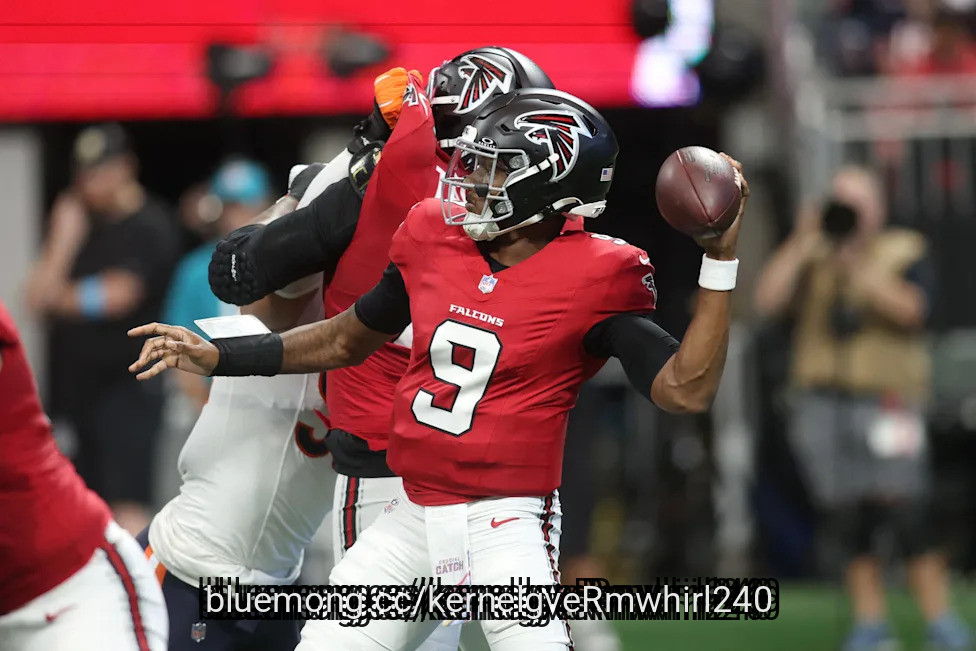
Slowly but surely the secret is coming out that Michael Penix Jr. has officially arrived as a franchise quarterback. The Atlanta Falcons' starter has been exceptional since returning to the lineup in Week 3, racking up nine touchdown passes to go with just one interception.
Penix is fresh off his best game of the season, totaling three scores and no turnovers against a top-five San Francisco 49ers defense.
That should have gotten Penix a huge ****** p in the weekly NFL.com quarterback rankings, but he only saw a modest gain of one spot, coming in at No. 12. That puts him in-between two former league MVPs, one spot below Patrick Mahomes and one above Matt Stafford.
"Michael Penix Jr. looks very comfortable and decisive in Kevin Stefanski's offense, freely spreading the ball among his many talented targets at a rate I haven't seen from him previously in his NFL career. Penix's contributions were especially important in a game in which Bijan Robinson fell short of breaking things open on the ground, and a reason to take the Falcons seriously going forward."
While the small gain is a little disappointing, keep in mind that Penix wasn't even listed in most quarterback rankings going into the season. Instead, it was Tua Tagovailoa representing the Falcons, usually somewhere between Nos. 30 and 32 among projected starters.
#quarterback



7 days ago
After a big road win against Indiana and a bye week to rest, get healthy, and figure out a game plan to install a new quarterback following Julian Sayin's injury, the Ohio State football team heads to L.A. to take on the USC Trojans on Saturday.
Buckeye fans will love that this is a night game in the Coliseum, at least for folks in Ohio, and they might even love that Ohio State is a modest road favorite. USC is coming off a disappointing loss at Wisconsin and now has two losses on the season, so winning against the No. 2-ranked team in the country is almost a must. The Buckeyes also need to win to stay on track for the Big Ten **** le and a potential spot in the College Football Playoff.
The stage is set, and each Thursday, we get a look at what the Ohio State football creative team releases on social media as that week's game trailer, and we have it for you again. This one is set against the story of The Odyssey, which, of course, has Trojans, Troy, and all of that, with the Buckeyes playing the part as the conquerors.
Have a look at the trailer for Game 8, **** led "Warriors."
Kickoff is scheduled for 7:30 p.m. ET and will be telecast on NBC. We'll be there before, during, and after the game, so be sure to come back for more coverage.
#ohio #state


28 days ago
Margaret Qualley embraced understated elegance in a striking Chanel look while attending the New York special screening of "Love of Your Life." The 31-year-old actress stepped onto the blue carpet in a sleek black gown. While the dress looked classic from the front, it revealed a dramatic surprise on the back.
Her slinky open-back dress featured an eye-catching floral accent suspended by delicate metal chains. Consequently, the unique detail gave the timeless little black dress a modern twist.
Margaret Qualley at the "Love Of Your Life" New York Special Screening. pic.twitter.com/pQNO6cXXRF
— 21 (21metgala) October 8, 2026
Margaret Qualley wore Look 78 from Matthieu Blazy's Chanel Fall/Winter 2026 Ready-to-Wear collection. The long-sleeved black dress featured a modest boat neckline and a fluid silhouette that skimmed her frame before falling to her ankles.
#margaret #qualley #chanel



29 days ago
You've probably heard the cliché "it takes money to make money." And there's some truth to the premise. In the business world, you'll usually need at least a little seed capital to start.
If you're an investor with average income, however, you might be surprised how easily you could become a millionaire. And not from brilliantly lucky stock-picking, either; attempting to outperform the overall market can undermine your performance, in fact. The key, rather, is making disciplined contributions to the cause -- no matter how seemingly modest -- even when you don't want to make them. That's often when sticking with your plan helps the most.
Missed Nvidia in 2009? This Rare Signal Is Flashing Again. In 2009, a "Double Down" signal flashed for a little-known chipmaker called Nvidia. For the first time in years, that same "Total Conviction" signal is flashing for a company 1/100th the size of Nvidia. Continue »
And $500 per month would do the trick, given enough time. Here's how, and why.
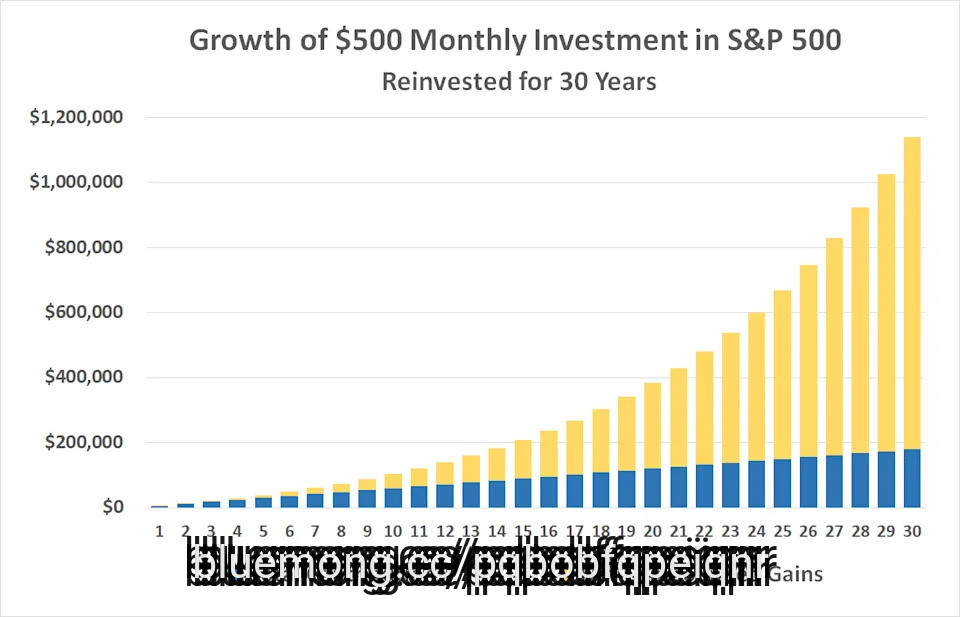
There's no denying that in the economic environment of 2026, coming up with an extra $500 per month can feel like a pretty tall order. For most households willing to buckle down on discretionary spending, though, it's possible. And if you're willing to invest that money in an S&P 500 (SNPINDEX: ^GSPC) index fund that matches the broad market's average annual gain of 10%, in 30 years you'd be sitting on a little over $1.1 million (or slightly less if you're not contributing this cash to a tax-sheltering retirement account).
#NVIDIA #you 're #flashing #down

1 month ago
Pfizer (NYSE:PFE) has been a reliable healthcare company to invest in for decades, also providing shareholders with some terrific dividend income along the way. Nowadays, however, it's struggling to attract any investors at all.
While its shares are up over 10% this year, over the past five years, they're still down 35%. Worries about its future growth and the safety of the payout are keeping investors away. Here's why I think that's a mistake, and why it may just be the most underrated dividend stock out there today.
Missed Nvidia in 2009? This Rare Signal Is Flashing Again. In 2009, a "Double Down" signal flashed for a little-known chipmaker called Nvidia. For the first time in years, that same "Total Conviction" signal is flashing for a company 1/100th the size of Nvidia. Continue »
Image source: Getty Images.
Many investors may scoff at stocks that have high yields, out of fear that they simply are too good to be true, and that a cut could be due. But that isn't always the case. In fact, there can be low and modest-yielding stocks that can be riskier. Yield is not always indicative of risk.
#down #company


2 months ago
When Christmas rolls around, my wife puts out a very small tree and some stuffed ornaments we bought a few years ago at Target. That's a pretty modest approach to decorating for the holidays compared to many of our neighbors.
At the house we just moved out of, some homes added tasteful lights, others opted for religious displays, and a few opted for a whole lot of inflatables. In some cases, the spending was significant, although many of the items were reused year after year.
Decorations are a small but meaningful part of holiday spending.
Americans planned to spend an average of $1,172 on travel, $632 on gifts, $351 on entertaining, and $227 on decorations, according to a BMO survey conducted before the 2024 holiday season.
Getting those items may be more of a challenge this year, as Gordon Companies, which runs a number of Christmas-themed websites and lists Target, Kohl's, Home Depot, Walmart, Amazon, Lowe's, and Michaels as retail partners, has filed for Chapter 11 bankruptcy.
#christmas #decorations #opted #items


2 months ago
Huntington Bancshares Incorporated (NASDAQ:HBAN) dropped 5.55% to $15.82 on September 16, 2026, close to its 52-week low. The price movement was triggered by a profit warning at a Barclays conference. Huntington brought down its 2027 EPS guidance from above $1.90 to the range of $1.75-$1.83, and its 2026 net interest income growth from 39%-43% to roughly 35%. What matters more than these numbers is the reason behind them. Deposit costs are rising, and loan pricing is tightening, and it landed on the day the Fed delivered its first interest rate hike since 2023. The drop therefore raises the question: is this an oversold bank or the opening crack in regional-bank margins?
A well-run bank has just lowered its guidance, citing intense competition for deposits and loans. If Huntington feels the margin pressure, then it is likely that its peers feel the same. This explains why Fifth Third shares slid 4.1% on the same afternoon alongside the whole financials group. The Fed's new hike makes the environment more unfavorable for the group in the near term. While rate increases eventually lift ***** et yields, banks must immediately offer higher deposit yields to retain balances, squeezing net interest margins in the near term. Furthermore, accelerated commercial real estate loan payoffs reduced total earning ***** ets, though these early payoffs lower credit risk on the loan book.
The selloff leans too much into the reset. A move to $1.75-$1.83 from above $1.90 is a modest single-digit trim. Huntington sustains its profit as well as its operational performance. Loans reached $189 billion from $50 billion in 2015. Deposits touched $222 billion. And one of the company's biggest growth engines, value-added fee income, compounded at a 14% annual rate since mid-2024, with year-to-date growth near 32%. The income helps offset a notable portion of the spread pressure and offers a competitive edge against pure spread lenders.
A higher-for-longer rate environment carries trade-offs for commercial banks. It drives up deposit expenses, reflecting the margin pressure Huntington reported. It also expands loan yields as credit ***** ets reprice. Deposit beta determines the net effect by measuring how much of each benchmark rate increase the bank transfers to depositors. After the rate hikes, deposit costs typically rise further, so betting on a near-term peak takes some faith. A lower beta allows fee revenue to support earnings, whereas a higher beta keeps the squeeze sustained over multiple quarters.
#bank #interest #Growth


2 months ago
Morgan Stanley has cut Novo Nordisk A/S (NYSE:NVO) to Underweight on September 11, 2026. Semaglutide, the underlying molecule for Wegovy and Ozempic, generates roughly 75% of 2026 revenue. Morgan Stanley models that it will still represent 59% of total sales when its patent protection expires in 2031. And according to the firm, the valuation does not price in the impact it has on Novo's terminal value. The stock, currently trading at 10.6x earnings and down 33% from its 52-week high, slipped another 2% following the call. At this point, the question isn't about whether the patent cliff is real or not, but whether the 10x multiple reflects an actual bargain.
Semaglutide loses exclusivity in Europe in 2031 and the US in 2032. And Morgan Stanley believes Novo's oral-obesity business, projected to reach $10 billion by 2031, could not offset the pricing collapse after the arrival of generics. Growth decelerates to a 4% compound rate between 2027 and 2030. If the deceleration continues, it will justify 10x earnings as a fair price instead of a cheap one.
The 10.6x multiple already prices aggressive pessimism into a market leader of one of the fastest-growing drug classes in history. Morgan Stanley fueled the pessimism by discounting a 2031 cliff five years earlier. However, pharmaceutical patent expirations frequently face extensions and prove difficult to time. Second, the ***** umption that oral obesity treatments cannot offset patent losses relies on oral semaglutide being the bridge. But Novo's next-generation portfolio, including CagriSema and amycretin, offers a significant defense against the patent cliff. This remains unproven, however, specifically after CagriSema's earlier weight-loss data failed to impress, yet Morgan Stanley's terminal-value model discounts this pipeline almost entirely. The company is also expanding its franchise. On September 7, the STEP Young trial hit its endpoint in children aged six to twelve, strengthening the base its successors inherit.
The smart money is leaning in. As per the Insider Monkey database, 59 hedge funds held NVO in the second quarter of 2026, up from 55 in the first, indicating a slight increase in the modest institutional interest in the stock. Short interest on the ADR is negligible at about 0.7%. The positioning reflects a beaten-down value stock quietly seeing institutional accumulation while Wall Street turns increasingly bearish.
#semaglutide #oral

2 months ago
Dow Jones futures will open Sunday evening, along with S&P 500 futures and Nasdaq futures.
The stock market was mixed, with the 10-year Treasury yield at 5%. The Nasdaq rose modestly, amid continued sector rotations among growth stocks. The S&P 500 largely held its ground but the Dow Jones and small-cap Russell 2000 fell solidly to three-month lows.
Robinhood Markets (HOOD) surged back into a buy zone Friday as part of bullish upside reversal for bitcoin and other crypto plays. Coinbase Global (COIN) flashed an aggressive entry. The iShares Bitcoin Trust ETF (IBIT) also is actionable.
Sandisk (SNDK) and Moderna (MRNA), the top S&P 500 performers so far this year, are in buy areas as well. So is Advanced Micro Devices (AMD), another top-10 S&P 500 stock.
Robinhood stock is on SwingTrader. AMD stock is on the IBD 50.
#futures #jones #Bitcoin #year


2 months ago
On August 20, Royal Caribbean Group (NYSE:RCL) said it had completed a sale of $1.25 billion of notes that carry a 5.55% coupon and come due on January 20, 2034. The money is earmarked first for floating-rate term loans, with anything left over used to repay or refinance other debt, and the offering rode on a shelf registration filed on February 29, 2024. That sounds like routine upkeep. But next to an earnings beat and a flat third-quarter pricing outlook, the deal gives you a handy lens on where the company stands.
Start with the debt itself. Swapping floating-rate borrowings for notes with a stated 5.550% coupon takes some interest-rate guesswork out of the picture, and the notes don't mature until January 20, 2034. That matters because $2.7 billion comes due in 2027 and $3.4 billion in 2028. Against those bills, the company held $6.9 billion of liquidity as of June 30, and it added $250 million to its revolving credit line in July.
The business generating the cash is running well. On July 28, Royal Caribbean reported second-quarter adjusted earnings of $4.21 per share, ahead of its own guidance on stronger last-minute demand, lower costs, and better results from joint ventures. Management then raised full-year adjusted EPS guidance to a range of $17.73 to $17.87, which implies 14% growth. It also kept returning cash to shareholders in the second quarter, through $404 million of dividends and $199 million of buybacks. Booking volumes are running above last year, and 2027 bookings are tracking ahead of past years, even on routes that geopolitical events hit in 2026.
Beat or not, that $4.21 is still below the $4.38 from the same quarter in 2025. Costs excluding fuel per passenger cruise day rose 4.4%, and the cost beat came largely from the timing of expenses. Then there is pricing, where the story gets less rosy. Third-quarter net yields are guided to roughly flat against 2025 while capacity grows 8.5%, so the expected 8% revenue growth comes from more capacity, not from better yields. Management also says prolonged geopolitical activity has dented bookings on select itineraries. It calls the hit modest, but it is now built into guidance.
The refinancing also doesn't shrink the debt pile. New notes pay off old borrowings, so the total owed stays roughly where it was, and the company still expects net interest of $980 million to $990 million this year. Add roughly $4.7 billion of capital spending in 2026, mostly for new ships and destination projects, and it is clear this business needs a steady supply of capital. The April ship orders, Icon VI and Icon VII, extend that appetite, though their financing is already committed.
#billion #quarter #company #year


2 months ago
Robinhood Markets (NASDAQ:HOOD) ended August with $384 billion in Total Platform **** ets, its term for everything customers hold on the platform -- up 8% from July and 26% from a year earlier, according to operating data published Sept. 10.
The next big round number, $500 billion, sits about 30% away. I think Robinhood gets there at some point during 2027.
Missed AI's "Act 1"? Act 2 Could Be 15x Bigger. Most investors think they missed the AI boat because they didn't buy Nvidia in 2005. But according to our **** ysts, we're only at the end of "Act 1"—the R&D phase. "Act 2" is the global rollout. Continue »
The reason isn't a bold **** umption about markets or a bet on a new product taking off. Customers' own deposits carry the platform most of the way, and the market only has to cover a modest gap.
Image source: Getty Images.
#billion #think #NASDAQ


2 months ago
On August 10, Ferguson Enterprises Inc. (NYSE:FERG) reported results for the quarter ended June 30, and the numbers show a company growing straight through a soft housing market. Sales rose 4.6% to $8.8 billion, and management lifted its outlook for the full year. But profit grew more slowly than sales, and that gap is what makes this report worth a closer look.
The strongest engine was non-residential work, where US revenue jumped 8% on share gains in what management called a mixed market. Large capital projects are part of the story, with open order volumes growing and bidding activity strong, so there is a pipeline behind the current numbers. Housing, roughly half of revenue, is the weak spot. Yet residential sales still rose 2% in the US even though new construction is weak and repair work is soft, which means Ferguson is beating its markets rather than riding them.
Capital deployment is the second pillar. Ferguson closed five acquisitions in the quarter, and on July 13, it announced a deal for FWI Holdings, known as FloWorks, an industrial distributor of valves and flow-control products that is expected to close in the third quarter. The eight deals announced this year carry about $1.4 billion in annualized revenue, a second growth path alongside organic sales. Net debt sits at 1.3 times adjusted EBITDA, a level management calls strong. The company also returned cash, buying back $202 million of stock in the quarter and declaring a $0.89 dividend payable October 7 to holders of record on August 21. Management raised its full-year sales outlook to mid-single-digit growth, before counting FloWorks.
Start with the gap between sales and profit. Adjusted operating profit rose 2.9%, behind the 4.6% sales gain, and gross margin slipped 20 basis points to 31.0%. Ferguson notes that last year's gross margin was temporarily lifted by the timing of supplier price increases, which is fair context, but the direction is still down. Reported earnings per share of $3.43 rose 6.9%, while the adjusted figure of $3.39 grew a slower 5.3%.
Then there are the soft spots. About half of revenue comes from residential markets that management describes as subdued, so a 2% gain there is modest. Canada's sales slipped 1.9%, with a business divestment outweighing organic growth, and management calls the market there challenging, especially in residential. Management also describes the economic environment as uncertain, and the margin part of the guidance raise is small. The low end of the adjusted operating margin range moved from 9.4% to 9.5%, while the top stayed at 9.8%. The guidance also leaves out FloWorks, and net debt to adjusted EBITDA is 1.3 times, against 1.2 times a year ago.
#management


2 months ago
The idea of building a $1 million portfolio might sound more daunting than climbing Mt. Everest. In reality, it's more achievable than you probably think. With enough time, discipline, and the right mix of investments, the long-term power of compounding can get you to the $1 million mark and beyond!
Just take a look at history. If you invested $10,000 in the S&P 500 (SNPINDEX: ^GSPC) at the beginning of 1996, it would have grown to roughly $214,000 with dividends reinvested. Now, that's clearly not $1 million, but that's how large it grew with a one-time investment. Imagine how big it could get if you added a modest monthly investment to it over all those years.
Missed AI's "Act 1"? Act 2 Could Be 15x Bigger. Most investors think they missed the AI boat because they didn't buy Nvidia in 2005. But according to our ****** ysts, we're only at the end of "Act 1"—the R&D phase. "Act 2" is the global rollout. Continue »
This is why the idea of regular, consistent investing over time is one of the best pathways to millionaire status.
Over the past century, the S&P 500 has returned around 10% annually. The index has performed much better than that over the past decade, but the next decade could very well be much worse. When projecting long-term returns, it's better to be a little more conservative.
#idea #investment #past


2 months ago
The Nasdaq ended the week with a couple of positive sessions, rebounding from a slight undercut of its 50-day moving average to close up 0.7% and near the top of the week's range. It's nothing to get too excited about, but just some modest positive reinforcement for those edging back into the market. The S&P 500 ended the week fractionally…
#positive #NASDAQ #couple
#positive #NASDAQ #couple



2 months ago
The State Department's approval of two potential arms sales to Saudi Arabia totaling $5.75 billion, including JDAM-ER munitions and AGT-1500 tank engines, offers a modest but meaningful data point for two very different defense players. For The Boeing Company (NYSE:BA), the potential sale represents an additional international defense opportunity as the company continues working through margin pressure elsewhere. For Honeywell Aerospace Inc. (NASDAQ:HONA), the package reinforces a stable business line while the firm tackles its first quarter as a standalone public company.
The State Department approved a potential $5 billion sale of JDAM-ER guidance kits and bombs to Saudi Arabia, along with a separate potential $750 million deal for AGT-1500 tank engines. The JDAM package consists of 5,004 KMU-572 and 5,000 KMU-556 JDAM guidance kits and 5,004 BLU-111 and 5,000 BLU-117 bombs. Boeing has been identified as the principal contractor for the JDAM-ERs, with Honeywell handling the engines. The State Department said the sales would strengthen Saudi Arabia's airborne defense capabilities and improve interoperability with U.S. and Gulf partner forces.
Boeing stands to gain only modestly from the deal, given its roughly $85 billion Defense, ******* e and Security backlog. International orders already account for 27% of that total. The segment reported a second-quarter operating loss, largely due to charges tied to the VC-25B (Air Force One) program. That makes mature, lower-risk munitions programs such as JDAM-ER a more dependable part of the portfolio, though the deal is unlikely to have a meaningful impact on margins. For Honeywell Aerospace, the contract is smaller, but the AGT-1500 fits within its established defense propulsion business. It also adds to the company's international defence business, which makes up about 30% of its total Defense and ******* e revenue.
Honeywell Aerospace is owned by 74 hedge funds as of Q2 2026, which is consistent with Honeywell (NASDAQ:HON) hedge fund ownership prior to the spinoff. Unlike Honeywell, the number of hedge funds holding Boeing stock dropped from 99 at the end of the first quarter of fiscal 2026 to 90 at the end of Q2 2026.
Neither potential sale is large enough to have a meaningful impact on either company's short-term results by itself. Still, each supports a different investment story. For Boeing, the potential sales add to international defense exposure if finalized, as its defense unit continues dealing with fixed-price losses. For Honeywell, they support the steady flow of high-margin legacy revenue across its broader defense franchise.
#international #saudi


2 months ago
NEW YORK (AP) — Wall Street capped an up -and- down week Friday with a mixed finish for U.S. stock indexes, as elevated bond yields and oil prices weighed on the market.
The S&P 500 inched 0.2% higher after drifting between modest gains and losses for much of the day. The benchmark index also posted its second straight weekly loss.
The Dow Jones Industrial Average slipped 0.2%, and the Nasdaq composite added 0.4%.
The majority of stocks on Wall Street fell, and helping to weaken them was rising pressure from the bond market. The yield on the 10-year Treasury climbed to 5% from 4.94% late Thursday after it topped the 5% level early this week for the first time since 2023.
Higher yields slow the overall economy by making it more expensive for everyone to borrow money, from the U.S. government to people looking to buy houses to businesses wanting to build AI data centers. They also tend to undercut prices for stocks and other investments.
#street

2 months ago
On September 10, 2026, The Lovesac Company (NASDAQ:LOVE) reported second-quarter fiscal 2027 results for the period ended August 2, 2026. Net sales rose 0.4% to $161.2 million, a record for the quarter, and the company swung to net income of $7.4 million, or $0.51 per diluted share, from a loss of $6.7 million a year earlier. Inside that $0.51 sits $0.86 of net benefit from IEEPA tariff refunds. Omni-channel comparable sales fell 1.9%.
Canaccord's Maria Ripps read the quarter as in line, with revenue and adjusted EBITDA both landing within guidance and near consensus while tariff refunds pushed gross margin and earnings above expectations; she cut the firm's target on The Lovesac Company (NASDAQ:LOVE) to $20 from $22 but held the Buy rating.
Roth Capital's Matt Koranda also called the quarter in line with consensus, though he flagged omni-channel comps trending modestly negative on soft lower-end consumer demand. He lowered the firm's target on The Lovesac Company (NASDAQ:LOVE) to $20 from $22 as well, keeping a Buy rating, and noted that management reset full-year guidance lower on a tough demand environment and modest product launch delays.
DA Davidson offered a similar interpretation of the lower guidance, arguing that the reset reflects the new CFO's approach more than a deterioration in the underlying business. The firm said the CFO, who joined during the quarter, appears to be establishing more conservative expectations that could restore a beat-and-raise pattern the stock had lacked. DA Davidson lowered its target on The Lovesac Company (NASDAQ:LOVE) to $18 from $20 while maintaining its Buy rating.
The operating case rests on the high end: configurations above $6,000 grew double digits against a tough comparison, showroom net sales rose 4.6% to $114.1 million on 14 net new locations, and Snugg helped push other products revenue up 198.2%. Lovesac ended the quarter with $68.8 million in cash and no debt.
#quarter


2 months ago
Intuitive Surgical (ISRG), maker of the da Vinci surgical robots, trades at about $382, some 36% below its 52-week high. Even so, you pay about 35.9 times trailing adjusted earnings. That is normalized net income with stock-based compensation added back, a basis meant to sit closer to the one ****** ysts forecast on, though the two are not defined identically. ****** ysts' forecasts run to 2027, the year Intuitive plans to start lowering what customers pay per use on some instruments.
The shares were trading about 11% lower the day after second-quarter results in July showed slower US procedure growth. US da Vinci procedures grew 12% in the second quarter, against 14% in the first. Management pointed to two likely causes, with the CFO noting that some customers say coverage changes are delaying deferrable procedures, alongside a little of the law of large numbers.
What the price still pays for is revenue growing faster than procedures. On the first-quarter call, the CFO credited that largely to da Vinci 5 and its higher pricing. More than half of the da Vinci systems Intuitive placed in the second quarter were da Vinci 5.
On ****** ysts' 2026 estimates, today's price is about 35.1 times earnings. On their 2027 estimates, it is about 31.4 times. The revenue forecast behind that looks modest: about 13.1% growth a year through 2027, against 20.7% growth over the past twelve months.
Consensus has earnings and revenue growing at a similar pace between 2026 and 2027, so margins hold roughly steady. Intuitive enters that stretch with an operating margin of 31.3% over the past twelve months, above its three-year average of 27.7%.
#intuitive #analysts #year #procedures


2 months ago
The dollar index (DXY00) fell from a new 1.5-month high on Thursday and finished down by -0.03%. The dollar posted modest losses on Thursday as a sharp rally in stocks curbed demand for dollar liquidity. Lower T-note yields on Thursday also weighed on the dollar.
Dollar losses were limited Thursday after US weekly jobless claims unexpectedly fell to an 8-week low, signaling a strong labor market. The dollar also has carryover support from Wednesday when the FOMC raised interest rates by 25 bp and signaled another rate hike by the end of the year.
Dollar Soars as Fed Hikes Rates and Signals More to Come
Dollar Weakens with Crude Oil Prices and T-Note Yields
Dollar Posts Modest Gains Ahead of Expected Fed Rate Hike
#modest #rates


2 months ago
Aristotle International Equity Fund, sub-advised by Aristotle Capital Management, LLC, released its second-quarter 2026 investor letter. The letter can be downloaded here. Global equity markets reached record highs in Q2, with the MSCI ACWI Index rising 14.93%, while global fixed income grew modestly by 0.87%. Geopolitical tensions, particularly in the Middle East, affected energy markets and investor sentiment, highlighting volatility and fragility in global supply. Central banks reacted variably to inflationary pressures, with the ECB raising rates amidst concerns of stagflation, while the Fed and Bank of England held rates steady. Despite economic challenges, robust earnings continued in Europe and Asia, driven by AI infrastructure demand. The Aristotle International Equity Fund (Class I-2) recorded an 8.40% return in the quarter, underperforming both the MSCI EAFE Index, which returned 10.82%, and the MSCI ACWI ex USA Index, which returned 14.49%. Going forward, the fund remains focused on quality investments as geopolitical and macroeconomic complexities make forecasting returns challenging. Additionally, reviewing the Fund's top five holdings could help identify its best picks for 2026.
In its second-quarter 2026 investor letter, Aristotle International Equity Fund highlighted Unilever PLC (NYSE:UL). Unilever PLC (NYSE:UL) is a British consumer goods giant, that sell products across food, homecare, beauty, and personal care categories. On September 17, 2026, Unilever PLC (NYSE:UL) closed at $62.22 per share. Over the past month, Unilever PLC (NYSE:UL) declined 2.99%, but its shares are down 5.09% over the past year. Unilever PLC (NYSE:UL) has a market capitalization of $133.98 billion, and its stock has traded within a 52-week range of $54.75 to $74.98.
Aristotle International Equity Fund stated the following regarding Unilever PLC (NYSE:UL) in its Q2 2026 investor letter:
"We first invested in Unilever PLC (NYSE:UL), the global consumer staples company, in the second quarter of 2013. We have long been attracted to the company's broad portfolio of leading personal care and food brands (such as Dove, Knorr and Axe), global scale, significant emerging markets exposure and strong position across everyday use categories. Over our more than decade-long holding period, Unilever strengthened and simplified its portfolio, divesting lower-growth food ***** ets, improving efficiency, increasing focus behind its largest brands and shifting the business toward faster-growing, higher-margin beauty, wellbeing, personal care and home care categories. More recently, the separation of the ice cream business and continued reshaping of the food portfolio have further narrowed Unilever's strategic focus. While we continue to view the remaining Unilever franchise as high quality, we believe the more compelling opportunity now resides in the independent ice cream business, where dedicated management and a category-specific strategy should provide a clearer pa
2 months ago
Some offers on this page are from advertisers who pay us, which may affect which products we write about, but not our recommendations. See our Advertiser Disclosure.
The Federal Reserve raised interest rates on Wednesday, marking its first hike in more than three years, in a move that will likely make borrowing more expensive while giving savers a modest boost.
Fed Chairman Kevin Warsh and the Federal Open Market Committee announced a widely expected quarter-point rate increase and indicated another to come.
The stock market's reaction to the Fed's announcement is likely to draw the most headlines, and John Shugar, a partner at Goldman Sachs, leans toward an optimistic scenario.
"You basically have a market where all of the heavy lifting has actually been done on the earnings side," Shugar said in an **** ysis. He points to "terrific opportunities" in various AI consumer sectors, though "over the next few weeks, we may have a lot more speed **** ps."
#shugar #reserve #kevin


2 months ago
Core & Main, Inc. (NYSE:CNM) reported quarterly sales of $2.145 billion on September 9, up 2.5%. Company-defined non-GAAP adjusted EBITDA reached $274 million. The measure adjusts consolidated net income for interest, taxes, depreciation and amortization, equity compensation, debt modification and extinguishment losses, offering expenses, and specified other income or expenses.
Consolidated net income rose 6.4% to $150 million, while GAAP diluted earnings per share increased 10% to $0.77. Diluted weighted-average shares declined approximately 2.5% to 193.4 million. Buybacks amplified an improvement that also had an operating foundation.
The company repurchased $169 million of equity during the quarter, against $62 million of operating cash flow. The investment question is whether cash generation can sustain capital returns alongside the spending needed to grow.
Core & Main, Inc. (NYSE:CNM) benefits from demand for essential infrastructure products. Management highlighted municipal demand, fire protection, treatment plants, and data centers as areas of strength. These end markets provide several sources of business even when construction demand is uneven.
Expense discipline also helped. Quarterly selling, general and administrative expenses declined to $301 million from $302 million. Controlling overhead allows modest sales growth to contribute more to earnings. Stronger volumes would make further earnings gains easier to sustain.
#income #main #quarterly


2 months ago
Stocks slid Wednesday afternoon after Federal Reserve Chair Kevin Warsh followed the central bank's first rate hike in three years with a press conference that hinted it wouldn't be the last.
The S&P 500 dropped 1%, heading toward its lowest close since July. The Dow Jones Industrial Average fell 1.7%, or more than 700 points, with financial shares leading the decline. The Nasdaq Composite fell 0.8%. The 10-year Treasury yield held near 5% a day after touching its highest level since 2007, and the dollar index climbed 0.6% to its strongest since late July.
Markets had priced in the quarter-point increase itself and initially took it in stride. All three indexes were higher before the 2 p.m. decision. The selling started during the press conference.
Warsh was on a tightrope going in. The question was whether he'd frame the hike as a one-off adjustment—which risked the bond market reading it as too little to deter inflation—or as the start of a longer cycle. He did neither, and instead went in a more hawkish direction. "I would be hard pressed to describe broad financial conditions as restrictive," he said in his opening remarks. "This view was widely shared by the committee, so we removed a dose of accommodation."
That's a new way of describing a rate hike, and one investors aren't used to. Under his predecessor, Jerome Powell, the Fed called policy "modestly restrictive," meaning rates were already high enough to slow the economy. Warsh was saying that at 3.5%–3.75%, they weren't—and by implication, one quarter point may not have gotten them there either. Asked directly, he declined to say whether policy is restrictive now.
#hike #press


2 months ago
Argentina's controversial right-wing president, Javier Milei, slashed inflation with a brutal dose of economic austerity, but this came at a steep social cost. The cost of living is spiraling higher, fueling household debt, loan delinquencies, and economic hardship. Industrial output, since Milei took office, has declined sharply, with local companies closing at an alarming rate. While parts of the economy are falling into chaos, Argentina's oil and gas sector is experiencing a generational boom driven by the Vaca Muerta shale.
Argentina's vital hydrocarbon sector continues to surge, with oil production hitting yet another record in July 2026. Output reached 902,920 barrels per day, almost 1% above June and 12% higher than a year earlier, marking the country's highest oil production on record. Natural gas production has also expanded strongly, although output slipped 0.5% month over month and 1.6% year over year in July to average 5.6 billion cubic feet per day. That modest setback barely dents the bigger picture: economically crucial gas production has surged 21% over the past five years.
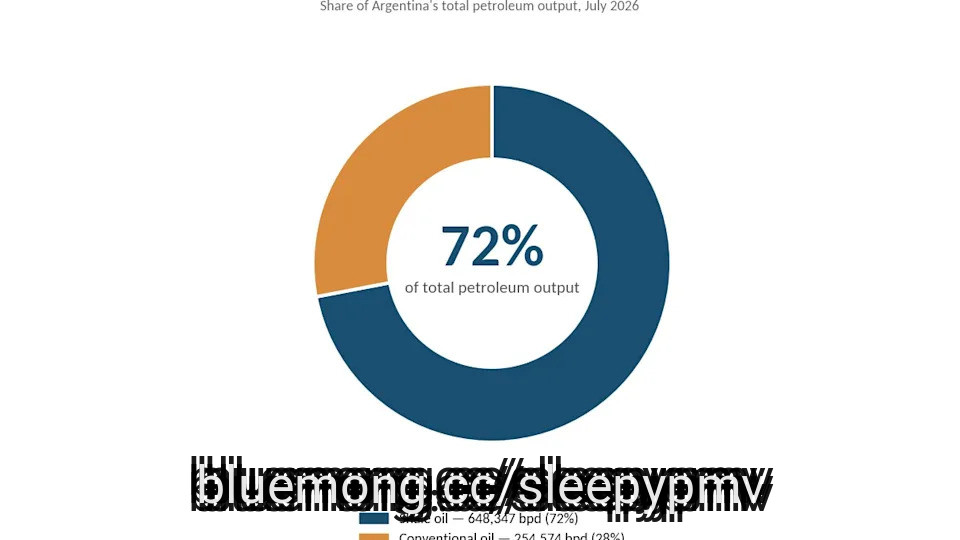
It is the ongoing and growing exploitation of the Vaca Muerta shale, situated in northern Patagonia in Neuquén Province which is responsible for Argentina's booming oil and natural gas complex. For July 2026, shale oil production rose by 1.2% month over month and a whopping 26% year over year to an all-time high of 648,347 barrels per day. As a result, shale oil now comprises a record 72% of Argentina's total petroleum output. This is also responsible for bolstering energy security in the Americas.
Shale gas production is also expanding at a healthy clip. For July 2026, Argentina lifted an average of 3.9 billion cubic feet per day of the fossil, which, despite being nearly 1% less than a month prior, was almost 4% higher year over year. That is the second-highest monthly shale gas production ever recorded. It was only eclipsed by June 2026 output, which hit 3.94 billion cubic feet per day. Shale gas now makes up 70% of Argentina's natural gas output, which is the highest level ever recorded.
Shale oil and gas production will keep growing at a solid pace, with Argentina on track to become a pure unconventional producer. You see, conventional oil output is in decline and has been for over a decade. Argentina's conventional fields are well past their prime, in many cases having hit peak production a decade ago with output now truly in decline. Government data shows July 2026 conventional oil production of 254,574 barrels per day, which is 2% lower than a month prior and 13% less year over year, indicating conventional oil output is 50% lower than a decade ago.
#shale #july #higher #record

2 months ago
The dollar index (DXY00) rallied to a 1.5-month high on Wednesday and finished up by +0.64%. The dollar found support Wednesday on signs of US economic growth after Aug retail sales rose more than expected. The dollar raced to its high Wednesday afternoon after the FOMC raised interest rates by 25 bp and signaled another rate hike by the end of the year. The dollar also found support after the FOMC raised its US 2026 GDP forecast and its core inflation estimate.
US Aug retail sales rose +1.2% m/m, stronger than expectations of +0.8% m/m and the biggest increase in 5 months. Aug retail sales ex-autos rose +1.4% m/m, stronger than expectations of +0.6% m/m.
Dollar Rises on Surging Crude Prices and T-Note Yields
Dollar Supported by Higher Crude Prices and T-Note Yields
Dollar Posts Modest Gains Ahead of Expected Fed Rate Hike
#prices

2 months ago
Some offers on this page are from advertisers who pay us, which may affect which products we write about, but not our recommendations. See our Advertiser Disclosure.
The Federal Reserve raised interest rates on Wednesday, marking its first hike in more than three years, in a move that will likely make borrowing more expensive while giving savers a modest boost.
Fed Chairman Kevin Warsh and the Federal Open Market Committee announced a widely expected quarter-point rate increase and indicated another to come.
The stock market's reaction to the Fed's announcement is likely to draw the most headlines, and John Shugar, a partner at Goldman Sachs, leans toward an optimistic scenario.
"You basically have a market where all of the heavy lifting has actually been done on the earnings side," Shugar said in an ***** ysis. He points to "terrific opportunities" in various AI consumer sectors, though "over the next few weeks, we may have a lot more speed ***** ps."
#shugar #market #disclosure #chairman


2 months ago
On September 15, CareTrust REIT (NYSE:CTRE) announced it had closed on a $400 million skilled nursing portfolio in the Southwest, effective September 1, and unveiled a reloaded $600 million investment pipeline behind it. The deal covers 2,622 licensed beds triple net leased back to the existing operator, sourced off-market and structured through a joint venture that put roughly $380 million of CareTrust's own capital to work. It is the latest entry in a buying spree that has now pushed the company's 2026 investment total past $1.9 billion.
The new portfolio is expected to generate a stabilized yield of about 8.6%, in line with the 8.7% blended yield CareTrust has posted across two dozen deals closed so far in 2026. That consistency matters more than any single transaction. The company has now closed roughly $710 million in investments in the third quarter alone, including a small UK care home purchase in mid-August, on top of the $899.6 million it closed in the second quarter at an 8.9% yield.
Management says the $600 million pipeline of near-term, actionable deals, about half of it aimed at the senior housing operating portfolio, does not even include a set of larger transactions still being pursued, so the deal flow may not be finished. The balance sheet backs up that ambition. CareTrust ended the second quarter, on June 30, 2026, with net debt to annualized normalized EBITDA of just 1.01x, and as of the September announcement it still had $725 million available under its revolver plus $612 million of remaining ATM capacity. That combination let the company raise its full year 2026 guidance on August 6 to normalized FFO of $2.03 to $2.06 per share, an increase of 16.2% at the midpoint over 2025, even before this latest acquisition was on the books.
This growth has come with a real cost to existing shareholders. Diluted weighted average shares outstanding rose from about 192.9 million in the second quarter of 2025 to 234.2 million a year later, as CareTrust leaned on forward equity offerings and its ATM program to fund the buying spree. The company still had $439 million of expected net proceeds sitting in unsettled forward equity contracts as of September 15, meaning more shares are still coming.
The second quarter also carried a $4.7 million provision for loan losses, a line that did not appear in the prior year period and is worth watching as the loan and financing receivable book grows alongside the property portfolio. Interest expense rose to $15.3 million in the quarter from $13.0 million a year earlier, and 2026 guidance leans on rent escalators of just 2.5% a year, a modest built-in growth rate once the acquisition pace eventually slows. The company's own risk disclosures flag reliance on tenants to keep meeting their lease obligations, along with exposure to healthcare reform, staffing requirements, and currency swings tied to its UK operations.
#still


2 months ago
On September 14, Radiant Logistics (NYSEAMERICAN:RLGT) held its fourth fiscal quarter earnings call, and the headline numbers landed harder than a typical logistics update. Net income jumped 53.1% to $7.5 million for the quarter ended June 30, while revenue climbed 18.5% to $261.4 million. Look past that one quarter, though, and the picture gets more complicated, because full-year adjusted profitability actually fell. That gap between a blowout quarter and a softer year is what makes this name worth a closer look.
The fourth fiscal quarter was strong from top to bottom. Adjusted EBITDA rose 31.6% to $10.4 million, margin expanded 240 basis points to 15.5%, and adjusted net income climbed 34.5% to $7.4 million, all against organic revenue growth of 8%. Management credited the acceleration to US forwarding operations and international airfreight, including work supporting disaster relief after typhoon activity hit the Western Pacific earlier this year, plus airfreight demand tied to capital flows into global data center buildouts.
The balance sheet backs up the story. Radiant enters fiscal 2027 with zero net debt, $25.6 million in cash as of June 30, and a $200 million senior credit facility that was extended and restated in August, pushing maturity out to August 7, 2031, while its acquisition-focused accordion grew to $100 million from $75 million. On the domestic side, capacity has been exiting the truckload and intermodal markets, and spot rates and tender rejections moved higher late in the quarter. Radiant also launched a new independent agent program at Radiant Road & Rail during the quarter, extending its freight forwarding agent network into truck brokerage and intermodal, while Navegate is gaining traction, with one enterprise customer now managing more than 1,400 vendors on the platform.
The full-year numbers tell a different story than the quarter does. Revenue rose just 3.5% to $934.4 million from $902.7 million, a fraction of the fourth quarter's 18.5% pace, and full-year net income grew a modest 8.7% to $18.8 million. Full-year adjusted EBITDA actually fell 5.4% to $36.7 million from $38.8 million, and that figure included a $1.3 million First Brands adjustment. Strip that out and normalized adjusted EBITDA comes in at $35.4 million, an even steeper decline than the headline number suggests.
The operating backdrop stays complicated too. Ocean shipping routes remain disrupted by the closure of the Strait of Hormuz and continued Houthi activity affecting Suez Canal transits, keeping capacity tight on key trade lanes. US tariff policy is generating elevated IEEPA-related filing activity, and Canada put new retaliatory tariff measures into effect in early September, adding fresh complexity for shippers moving goods across that border. Management itself acknowledged that the domestic truck brokerage improvement seen late in the fourth quarter is not yet fully reflected in the reported results.
#quarter #revenue


2 months ago
Dow Jones futures rose modestly early Wednesday, along with S&P 500 futures and Nasdaq futures. The Federal Reserve is expected to raise interest rates amid soaring oil prices and Treasury yields.
The stock market saw further losses Tuesday with the Nasdaq and S&P 500 dropping below their 50-day moving averages. The 10-year Treasury yield is at 5% while crude oil prices jumped amid global conflicts.
Salesforce (CRM) fell slightly amid its annual Dreamforce conference but is still near entries. ServiceNow (NOW) rose within a buy zone while Twilio (TWLO) and Dynatrace (DT) reclaimed buy points. Cybersecurity plays Qualys (QLYS), Fortinet (FTNT) and Palo Alto Networks (PANW) flashed buy signals.
Outside of software, Energy play APA Corp. (APA) and Guardant Health (GH) are actionable.
Guardant Health and Twilio are on Leaderboard. Twilio stock, Salesforce and Guardant are on SwingTrader. Salesforce stock is on the IBD 50. Fortinet stock, Salesforce and Dynatrace are on the IBD Big Cap 20.
#Stock #futures

2 months ago
Interested in Truist Financial Corporation? Here are five stocks we like better.
Truist will sell its $5.5 billion near-prime auto loan portfolio and exit its Regional Acceptance Corporation business, which was roughly break-even despite high loan yields. The transaction is expected to modestly improve earnings, tangible book value and credit metrics.
The bank reaffirmed its financial outlook, including third-quarter net interest income growth of about 1.5%, full-year growth of 1% to 1.5%, and its $5 billion share-repurchase plan. The sale is expected to generate approximately $950 million in capital but reduce net interest margin by 4 to 5 basis points.
New CEO Mike Lyons is accelerating a broader portfolio and capital-allocation review, with Truist emphasizing relationship banking, deposits, commercial lending, payments, wealth management and potentially credit cards, mortgages and home equity lending.
Smart Money Shifts: U.S. Bancorp Pairs Tech With Yield
#truist #financial #loan #credit