23 days ago
The USS Abraham Lincoln, the US aircraft carrier that has been deployed for nearly a year and has spent months supporting US military operations against Iran, is scheduled to dock in San Diego on Thursday afternoon.
It marks the end of a deployment that has been described as "one of the most operationally intense and consequential of the modern era" and that became marked by a record-stretch at sea, repeated deployment extensions, and reports of supply shortages, and deteriorating morale and mental health among some crew members.
The Lincoln left San Diego last November, initially bound for the Pacific. But it was redirected to the Middle East after the US and Israel launched their war with Iran in late February. The carrier remained there until late August, when it was relieved by the USS George Washington and began its journey home.
Earlier in August, the Lincoln's deployment made headlines and faced scrutiny as reports began surfacing about poor living conditions aboard the ship, including shortages of supplies and water, plumbing problems, low morale, and worsening mental health among the roughly 5,000 personnel on the carrier. Two leading military newspapers also reported that there had been two attempts by sailors to jump overboard, causing concern among families and military health experts.
The reports prompted outrage from Democrats, while senior officials in the Trump administration pushed back. Pete Hegseth, the US defense secretary, called the reports "completely misrepresented", and when reporters asked Donald Trump if he thought the deployment had gone on too long, he responded: "Not nearly long enough" – a comment that angered some naval families.
#military #Health


25 days ago
U.S. homeowners paid about $633 more on average in property taxes in 2024 compared to 2019, according to the latest U.S. Census Bureau data. Here's what's driving the increase and which states are hit the hardest.
Property taxes are largely determined by a home's ***** sed value and the local tax rate.
The ***** sed value is a dollar amount ***** igned to your home by your local county ***** sor to help determine the property tax. It's not the same as the market value, but it incorporates it.
A higher home market value can mean a higher ***** sed value, which would directly increase its property taxes. And the average market value for a single-family home in the U.S. is $362,210 according to February Zillow estimates — a nearly 55% increase since 2019.
Higher property tax rates may also be behind an increase in real estate taxes. Local governments can raise the rate to cover increases in operational and service costs.
#local #home #average


1 month ago
On September 17, Coherent Corp. (NYSE:COHR) announced an upgraded Pluggable Optical Line System that covers the full C-band and fits in a compact QSFP module, the same slot ordinary transceivers use. That is a lot of networking gear shrunk into a plug, and it follows a quarter of 34% revenue growth. Here is what the launch means, and where the stock's story gets harder to read.
Start with what the product does. The upgraded system can pack 32 wavelengths onto a single pair of fibers, which Coherent says adds up to as much as 25.6Tbps of traffic on links running 2km to 200km. It is designed for the latest 800G coherent optics, and it configures itself, handling link setup and laser safety without a technician tuning each connection. Coherent also says the system is generally available and already shipping in high volume, in 400G and 800G versions that work with existing network setups. Madhu Krishnaswamy, who runs the company's telecom transport unit, describes the goal as easing the usual trade-off between raw performance and operational simplicity.
The launch also sits on top of a business that is already moving. On August 12, Coherent reported results for its fiscal fourth quarter, which ended June 30: revenue of $2.05 billion, up 34% from a year earlier. Non-GAAP earnings per share rose to $1.74 from $1.00, and CEO Jim Anderson noted that for the full year, that measure grew more than twice as fast as revenue. Management guided to revenue of $2.2 billion to $2.4 billion for the first quarter of fiscal 2027, and Anderson says AI data centers are increasingly moving from copper to optical links.
Now look at the two versions of profit. Coherent's non-GAAP earnings came to $1.74 per share, but under GAAP the figure was $1.19. The gap comes from items management leaves out, including stock-based pay, amortization on acquired intangibles, and restructuring and integration costs. Operating margin shows it more clearly, at 21.8% on a non-GAAP basis and 12.4% under GAAP. Some of those costs are non-cash, but they are real, and anyone anchoring on the higher figure is skipping them.
Then there is how much weight this launch can carry. The announcement puts no sales figure on the product, so its contribution to a company that booked $2.05 billion in a quarter cannot be sized from what has been published. The bullish story also rests on management's own read of where AI networks are headed, and on a capacity build-out that CFO Sherri Luther says gets priority in spending. Money spent on capacity only pays off if the demand management describes keeps arriving.
#gaap #revenue #launch #anderson


1 month ago
Huntington Bancshares Incorporated (NASDAQ:HBAN) dropped 5.55% to $15.82 on September 16, 2026, close to its 52-week low. The price movement was triggered by a profit warning at a Barclays conference. Huntington brought down its 2027 EPS guidance from above $1.90 to the range of $1.75-$1.83, and its 2026 net interest income growth from 39%-43% to roughly 35%. What matters more than these numbers is the reason behind them. Deposit costs are rising, and loan pricing is tightening, and it landed on the day the Fed delivered its first interest rate hike since 2023. The drop therefore raises the question: is this an oversold bank or the opening crack in regional-bank margins?
A well-run bank has just lowered its guidance, citing intense competition for deposits and loans. If Huntington feels the margin pressure, then it is likely that its peers feel the same. This explains why Fifth Third shares slid 4.1% on the same afternoon alongside the whole financials group. The Fed's new hike makes the environment more unfavorable for the group in the near term. While rate increases eventually lift ***** et yields, banks must immediately offer higher deposit yields to retain balances, squeezing net interest margins in the near term. Furthermore, accelerated commercial real estate loan payoffs reduced total earning ***** ets, though these early payoffs lower credit risk on the loan book.
The selloff leans too much into the reset. A move to $1.75-$1.83 from above $1.90 is a modest single-digit trim. Huntington sustains its profit as well as its operational performance. Loans reached $189 billion from $50 billion in 2015. Deposits touched $222 billion. And one of the company's biggest growth engines, value-added fee income, compounded at a 14% annual rate since mid-2024, with year-to-date growth near 32%. The income helps offset a notable portion of the spread pressure and offers a competitive edge against pure spread lenders.
A higher-for-longer rate environment carries trade-offs for commercial banks. It drives up deposit expenses, reflecting the margin pressure Huntington reported. It also expands loan yields as credit ***** ets reprice. Deposit beta determines the net effect by measuring how much of each benchmark rate increase the bank transfers to depositors. After the rate hikes, deposit costs typically rise further, so betting on a near-term peak takes some faith. A lower beta allows fee revenue to support earnings, whereas a higher beta keeps the squeeze sustained over multiple quarters.
#bank #interest #Growth


1 month ago
On September 3, 2026, lululemon athletica inc. (NASDAQ:LULU) reported second-quarter fiscal 2026 results for the period ended August 2, 2026. Net revenue fell 4% to $2.4 billion, missing the $2.46 billion ****** ysts expected, and comparable sales dropped 10% on a constant dollar basis. Management cut full-year revenue guidance to a decline of 5% to 7%, down from a prior forecast of flat to down 1%, and lowered full-year earnings per share guidance to $9.48 to $9.73 from its prior forecast of $10.95 to $11.15, compared with $13.26 earned in fiscal 2025. Shares fell about 18% in extended trading. Incoming CEO Heidi O'Neill was set to start the following week.
Photo by Ian Deng Quddu on Unsplash
Citi's cut to $117 from $130 came with a Neutral rating and the observation that the stock's risk-reward is "slightly more favorable" after the selloff, even though the firm called fiscal 2027 visibility "very unclear." The operational bright spots are real.
lululemon athletica inc. (NASDAQ:LULU) increased its chase volume, the supply chain capability that lets it reorder fast-moving styles quickly, by about 20% this year, and away-from-body styles including the Groove Wide-Leg, Align Foldover Jogger, Breezily, and an updated Dance Studio Pant are trending well as shoppers shift from tight-fitting leggings. The brand's community pull held up too.
The SeaWheeze Half Marathon and Festival returned in August for the first time since 2019, drawing nearly 10,000 runners from 24 countries and roughly 14,000 festival attendees, while more than 85,000 people from 120 countries joined the companion Strava challenge, strong enough that Lululemon already committed to bringing the event back next summer. Rest of World revenue, spanning EMEA and APAC, grew 5% on a reported basis, and the company ended the quarter with $1.4 billion in cash and no outstanding borrowings.
#revenue #billion #NASDAQ


1 month ago
A Wall Street Journal report on September 16 revealed that ExxonMobil Holdings Corporation (NYSE:XOM) is nearing a preliminary agreement with Venezuela's state-owned PDVSA, potentially marking its return to the country almost two decades after its ***** ets were nationalized. According to Reuters, Exxon has shown interest in the large Petromonagas heavy oil project in the Orinoco Belt, as well as in areas in the neighboring Carabobo block.
While the talks are still in their preliminary phase and could still fall apart or be delayed, they mark a major turnaround from Exxon's previous stance on Venezuela. The company's CEO, Darren Woods, stated in January that the country was "uninvestable" without durable investment protections, legal reforms, and changes to its hydrocarbon laws.
The development comes amid a broader push by the Trump administration to open Venezuela's oil industry to American companies and revive the country's dilapidated oil infrastructure. The South American nation is sitting on the largest proven crude oil reserves in the world, accounting for roughly 17% of the global total.
Venezuela could provide Exxon with access to an enormous resource base at a time when the company is actively seeking low-cost and long-duration ***** ets. The fields under consideration are estimated to contain more than 50 billion barrels of oil buried underground.
Exxon already holds an advantage through its previous experience in the country. Petromonagas, formerly called Cerro Negro, was once the energy firm's flagship project in Venezuela, giving it familiarity with the country's vast heavy and extra-heavy crude resources. Petromonagas also remains one of the few Venezuelan projects with an operational upgrader capable of turning the Orinoco's extra-heavy crude into lighter exportable grades.
#heavy #project


1 month ago
Johnson & Johnson (JNJ) stock has returned about 57% over the past year, against about 17% for the S&P 500. On the earnings it has already banked, that price looks expensive. But those earnings carry STELARA, which is losing share to biosimilar competition. What looks dear on earnings already reported comes down sharply on the earnings ***** ysts expect.
At about $270 a share, Johnson & Johnson trades at about 28.3 times its trailing earnings. That figure sits on adjusted earnings: normalized net income with stock-based compensation added back, meant to sit closer to the basis ***** ysts use in their forecasts than a GAAP figure would, though the two measures are not defined identically. Measured as market value against consensus net income, the multiple on fiscal 2026 earnings is about 24.1 times, and on the earnings expected for 2027 it is about 20.9 times.
Those trailing twelve months were not a clean run. STELARA cost Johnson & Johnson about 460 basis points of operational sales growth in the second quarter of 2026. Strip it out and the company grew double digits in that quarter on the same basis, on management's own account.
The trailing multiple measures today's price against a period burdened by slowing STELARA revenue. The rest of the portfolio kept growing. Revenue over the trailing twelve months is close to $98 billion, and the company has 28 products and platforms that each sell more than $1 billion a year.
Immunology shows both sides at once. TREMFYA grew 71% in the second quarter of 2026, and it remains the fastest-growing advanced therapy in both Crohn's disease and ulcerative colitis. STELARA is shrinking under biosimilars in that same segment.
#johnson #earnings

1 month ago
One of the world's largest companies has become a cash-return machine of historic scale, but its engine is now facing a serious test.
With Apple (AAPL) stock trading near $337 a share, an owner might ask a simple question. The company has returned a fortune in cash while the stock has dramatically outperformed the market; was holding worth it, and can this machine keep running?
Over the last five years, Apple sent $510.4 billion in cash back to its shareholders. That sum, equal to about 10.3% of the company's current market value, is the largest capital return of any U.S. company Trefis tracks over that period. The question is what that extraordinary payout says about the business today.
The money printer is Apple's core business, which generated $136.68 billion in free cash flow over the last twelve months. In its most recent quarter, the company reported record June-quarter revenue, with iPhone sales growing 22% and Mac sales growing an impressive 29% from a year ago. Management noted that the iPhone and Mac were "both doing remarkably better than we thought they would do."
That operational strength funds the shareholder returns. The five-year payout was heavily weighted toward share repurchases, which totaled $434.5 billion, with another $75.9 billion paid in dividends. Apple's absolute dollar payout stands alone, even though the 10.3% of market value it returned sits well below the 16.9% median for S&P 500 companies.
#market


1 month ago
On September 17, Coherent Corp. (NYSE:COHR) announced an upgraded Pluggable Optical Line System that covers the full C-band and fits in a compact QSFP module, the same slot ordinary transceivers use. That is a lot of networking gear shrunk into a plug, and it follows a quarter of 34% revenue growth. Here is what the launch means, and where the stock's story gets harder to read.
Start with what the product does. The upgraded system can pack 32 wavelengths onto a single pair of fibers, which Coherent says adds up to as much as 25.6Tbps of traffic on links running 2km to 200km. It is designed for the latest 800G coherent optics, and it configures itself, handling link setup and laser safety without a technician tuning each connection. Coherent also says the system is generally available and already shipping in high volume, in 400G and 800G versions that work with existing network setups. Madhu Krishnaswamy, who runs the company's telecom transport unit, describes the goal as easing the usual trade-off between raw performance and operational simplicity.
The launch also sits on top of a business that is already moving. On August 12, Coherent reported results for its fiscal fourth quarter, which ended June 30: revenue of $2.05 billion, up 34% from a year earlier. Non-GAAP earnings per share rose to $1.74 from $1.00, and CEO Jim Anderson noted that for the full year, that measure grew more than twice as fast as revenue. Management guided to revenue of $2.2 billion to $2.4 billion for the first quarter of fiscal 2027, and Anderson says AI data centers are increasingly moving from copper to optical links.
Now look at the two versions of profit. Coherent's non-GAAP earnings came to $1.74 per share, but under GAAP the figure was $1.19. The gap comes from items management leaves out, including stock-based pay, amortization on acquired intangibles, and restructuring and integration costs. Operating margin shows it more clearly, at 21.8% on a non-GAAP basis and 12.4% under GAAP. Some of those costs are non-cash, but they are real, and anyone anchoring on the higher figure is skipping them.
Then there is how much weight this launch can carry. The announcement puts no sales figure on the product, so its contribution to a company that booked $2.05 billion in a quarter cannot be sized from what has been published. The bullish story also rests on management's own read of where AI networks are headed, and on a capacity build-out that CFO Sherri Luther says gets priority in spending. Money spent on capacity only pays off if the demand management describes keeps arriving.
#quarter #launch #anderson


1 month ago
SEIC provides investment processing, management, and operational platforms for private banks, financial advisors, institutional investors, and financial managers. SEIC's second-quarter fiscal 2026 report showed revenue of $641.6 million (a 14.7% year-over-year gain), adjusted per-share earnings of $1.66 (a 38% rise), $207 million in operating income (a 36% jump) – all of which were quarterly records – and the company has nearly $400 million in cash for more growth ahead.
It's no wonder SEIC shares are up 28% so far this year – and they could rise more. MoneyFlows data shows how Big Money investors are again betting heavily on the stock
Institutional volumes reveal plenty. Over the last year, SEIC has enjoyed strong investor demand, which we believe to be institutional support.
Each green bar signals unusually large volumes in SEIC shares. They reflect our proprietary inflow signal, pushing the stock higher:
Plenty of financials names are under accumulation right now. But there's a powerful fundamental story happening with SEI.
#institutional #investors #Stock



1 month ago
This story was originally published on Trucking Dive. To receive daily news and insights, subscribe to our free daily Trucking Dive newsletter.
Truckload LLC, doing business as Expedite Express, filed for Chapter 11 bankruptcy last week, a process typically done to reorganize operations.
The Southwest Florida-based carrier estimated its **** ets between $100,000 and $500,000 with estimated liabilities of $50,000 or less, per a voluntary petition in court. The business also suggested it had at least 50 creditors.
The business has four power units and eight drivers, according to a federal database as of early June, and provides services across North America, per its website.
Expedite Express joins a list of trucking companies declaring bankruptcy in 2026 as financial and operational challenges continue to batter the industry.
#dive #estimated #chapter

1 month ago
Picture a snowy mountain slope in France or an elite tennis court during a grand slam. Whether it is an Arc'teryx jacket designed for the harshest alpine conditions or a Wilson racket in the hands of a professional, Amer Sports (NYSE:AS) equips the world's most demanding athletes. The company functions as a global powerhouse in athletic gear and apparel, operating a premium multi-brand platform that spans from high-end technical clothing to specialized sports equipment. With its current stock price at $27.26 as of Sept. 16, 2026, the company has seen the stock decline 26% over the past year, reflecting the market's digestion of its rapid post-IPO scaling.
Our proprietary Hidden Gems scoring system **** igns Amer Sports an overall Superscore of 75 out of 100, placing it in the Above Average category. This score ranks the company in the Top ~21% of every company we evaluate, ahead of roughly 79 out of every 100 firms we score. The Superscore serves as a data-driven starting point, and this article examines both the operational momentum fueling its recent success and the structural hurdles that keep the company below top-tier rankings, helping you weigh these signals against your own research.
Strong revenue momentum: The company achieved 27% year-over-year revenue growth in 2025, reaching $6.6 billion as it successfully scaled its brand-led platform across global markets.
Effective channel pivot: Direct-to-consumer revenue surged 43% in 2025, allowing the company to capture higher margins and deepen its direct relationship with premium consumers.
Expanding operational efficiency: Adjusted EBITDA margins widened to 18% in 2025, demonstrating that the company's shared infrastructure strategy is successfully converting scale into bottom-line profitability.
#company #sports #global #premium


1 month ago
On September 9, 2026, Reuters reported that GE Aerospace (NYSE:GE) agreed to buy castings maker Consolidated Precision Products for $11.75 billion. It is its largest acquisition since becoming a standalone company in 2024, to secure the supply of the precision metal turbine-blade components that have been a persistent bottleneck across the jet engine industry. CPP is the world's third-largest maker of these parts. CEO Larry Culp called the capacity "mission-critical" as the company works through a backlog stretching into the next decade.
GE Aerospace (NYSE:GE) can use the acquisition to convert its massive backlog into revenue faster. The company's backlog exceeded $210 billion after its second-quarter results. It includes roughly $170 billion in commercial services and more than $30 billion in defense. The $11.75 billion acquisition of Consolidated Precision Products directly targets one of the supply-chain bottlenecks that has limited GE's ability to increase engine production. CPP supplies about one-quarter of GE's casting needs. It gives GE greater control over a critical manufacturing process and could help it meet deliveries tied to its long-term backlog.
Bringing CPP in-house could improve GE's production economics while reducing supplier dependence. Spare-parts delinquencies jumped 20% sequentially in the second quarter. It shows the ongoing operational impact of supply constraints. GE plans to apply its Flight Deck lean operating model at CPP to improve factory yields and machine utilization and reduce scrap and rework. The company expects the acquisition to generate about $200 million in net synergies and achieve double-digit return on invested capital by the fifth year. It gives investors a measurable path to stronger returns from the deal.
The acquisition makes GE's position solid in the next generation of engines. GE expects demand for airfoils to increase more than 30% by 2030 from 2026 levels. CPP's casting expertise could help GE bring new airfoil designs into production faster. The business also expects CPP to make roughly $2 billion in revenue in 2027. That combination gives investors a potential path to higher production capacity, faster technology development, and stronger long-term participation in commercial and defense aerospace demand.
GE Aerospace (NYSE:GE) must justify a nearly $12 billion investment, and investors already ******* ign a premium valuation to the stock. GE Aerospace trades at roughly 46 times forward earnings. It leaves investors with limited tolerance for execution problems or weaker-than-expected returns. The company will fund $7 billion of the acquisition with cash and finance the remainder with new debt. So GE needs CPP's earnings and operating improvements to make sufficient returns to support the purchase price and protect shareholder value.
#billion #backlog #supply


1 month ago
On September 8, 2026, Reuters reported that NIKE, Inc. (NYSE:NKE) shareholders rejected a proposal urging greater transparency on how the company plans to meet its 2030 emissions-reduction targets, despite support from Norway's sovereign wealth fund, Nike's 11th-largest shareholder.
Nike's board had urged a "no" vote, arguing management is "best positioned to determine the targets and related disclosures that are appropriate." Shareholders separately approved the company's executive compensation proposal, including pay for CEO Elliott Hill, in a vote that had faced some opposition.
The failed climate proposal gives NIKE, Inc. (NYSE:NKE)'s management more flexibility to focus on its operational turnaround. Shareholders rejected the request for greater disclosure on how Nike plans to meet its 2030 emissions targets. It allows CEO Elliott Hill and his team to prioritize product innovation, sales recovery, and market-share gains. Nike faces significant operational challenges. So management could benefit from directing more resources toward restoring growth and profitability.
Nike has already made measurable progress toward its environmental targets. It limits the immediate financial impact of the rejected proposal. The company reported an 11% reduction in supply-chain emissions from its 2015 baseline in fiscal 2024, while its 2030 targets call for a 65% reduction in operational emissions and a 30% reduction across its supply chain. This progress gives Nike evidence that it is chasing its climate goals even without expanding its current disclosure.
Shareholders' approval of Elliott Hill's compensation package shows support for Nike's leadership despite the difficult turnaround. Investors approved more than $36 million in total compensation for Hill for fiscal 2026, even though Norway's wealth fund and major proxy advisers opposed the package. Shareholder support gives Hill greater room to execute his strategy as Nike works to stabilize sales, rebuild its market position, and restore long-term earnings growth.
#reduction #elliott #greater


1 month ago
This story was originally published on Bisnow, the newsroom global commercial real estate reads first. To receive daily news and **** ysis, subscribe to Bisnow's free suite of newsletters.
The following article is a collaboration between Bisnow and business tech publication IT Brew.
It was Thanksgiving week in 2022 — a time when most employees are hard to find, let alone critical pieces of data center power infrastructure. And Kurt Bogle needed a transformer.
Bogle, then a senior regional director of critical facilities operations at NTT Global Data Centers, oversaw seven operational buildings around Chicago and Virginia and a staff of about 150 people. After a transformer failed a test, Bogle had to find a replacement and coordinate a swap with the on-site managers — all without disrupting service.
Thankfully, Bogle found a spare, but his experience illustrates the importance of systems thinkers at data centers who know how to acquire the resources necessary to maintain data centers' high uptime expectations. Given supply chain limitations and a steady build-out of data centers, such expertise is more crucial than ever — and there are signs a labor shortage is underway, threatening Big Tech's artificial intelligence ambitions and the reliable operation of mission-critical facilities.
#data #critical

1 month ago
Hub Group, Inc. (NASDAQ:HUBG) disclosed on September 14 that preliminary, unaudited first-half 2026 revenue was expected to reach $1.7 billion to $1.8 billion, near management's expectations. Yet management anticipated an operating loss before one-time charges. This non-GAAP presentation excludes those charges, but neither the loss nor the exclusions were quantified.
Hub Group, Inc. (NASDAQ:HUBG) identified higher fuel, rail, and drayage costs, excess warehouse capacity, and accounting-review and restatement expenses. The central issue is whether pricing and efficiency improvements can restore profitability on the revenue already moving through the business.
Hub Group, Inc. (NASDAQ:HUBG) began implementing rate increases in the third quarter, after transportation costs had pressured first-half results. Relatively stable intermodal volume trends suggest an existing customer base on which better pricing could improve margins. If increases hold without significant volume losses, revenue could become more profitable without requiring a broad freight recovery.
Hub Group, Inc. (NASDAQ:HUBG) also launched additional efficiency initiatives in the second quarter, including warehouse consolidation and improvements in driver and warehouse-worker productivity. These actions address specific weaknesses: underused ***** e spreads fixed costs across fewer orders, while low productivity raises the cost of each shipment or handling task. Better utilization could reinforce the benefit of higher rates.
Hub Group, Inc. (NASDAQ:HUBG) is also targeting order-to-cash processes, which cover the steps from taking orders through billing and collection. Improvements could reduce administrative friction and accelerate cash collection. That would support liquidity while operational changes take effect, although faster collections alone would not repair an operating loss.
#improvements #better


1 month ago
Realty Income Corporation (NYSE:O) announced on September 14 a European property venture in which capital accounts advised by KKR & Co. Inc. (NYSE:KKR) intend to invest €528 million for a 49% interest. Closing is expected September 30, subject to customary conditions.
Realty Income Corporation (NYSE:O) would receive approximately €528 million in gross proceeds while retaining 51% ownership and day-to-day ******* et management. The contributed portfolio carries a 5.9% effective initial capitalization rate after recurring management fees. The question is whether redeploying the capital and earning fees can more than offset the rental economics transferred to the partner.
The venture could provide another funding source for acquisitions. Selling a minority interest in existing properties can release capital while preserving operational continuity. It also gives management an alternative when public equity or debt financing offers less attractive terms.
Management fees add a second source of income alongside retained property earnings. Realty Income Corporation (NYSE:O) could use its existing European operating platform to manage the venture, potentially spreading overhead across a broader pool of investor capital. The benefit depends on fee revenue exceeding the incremental costs of providing those services.
The structure includes a further source of potential upside. Realty Income Corporation (NYSE:O) would have an option to redeem the partner's interest after year 10 and through year 17. The redemption price would provide a capped internal rate of return, an annualized return accounting for cash-flow timing, expected at 6.3% to 6.5% and finalized at closing.
#NYSE #corporation #management #source

1 month ago
Become a CEO after your MBA: that's the promise some private equity firms are using to recruit top operating talent.
This promise propels the best and brightest into top executive roles without requiring them to climb the corporate ladder, underpinned by the belief that cultivating talent is a better bet than making semi-blind bets on external hires.
Alpine Investors and Shore Capital Partners have each built separate pipelines to funnel operational talent, aiming to equip executives to take charge of their portfolio companies.
Lower-middle-market buyout firm Shore Capital Partners runs what it calls its CXO program, a two-year training scheme that places early- to mid-career talent and recent MBA grads into C-suite-adjacent roles at its portfolio companies—typically chief of staff or vice president of business operations or strategic initiatives.
Top-performing CXO graduates then have the chance to be promoted to C-level positions. So far, Shore has produced four CEOs from the CXO program. This includes Mark Larsen, who has been CEO of medical software business Connexure since 2024.
#Companies


1 month ago
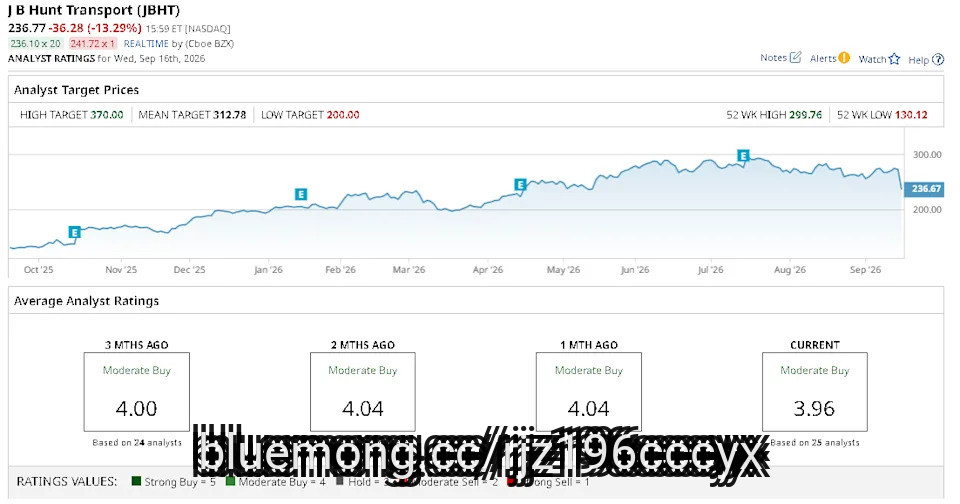
J.B. Hunt (JBHT) shares crashed on Sept. 16 after management issued an unexpected profit warning for the company's third financial quarter. Speaking at the Morgan Stanley Industrial Conference, leadership cautioned that operational headwinds could result in a sequential decline of as much as 10% in the firm's Q3 per-share earnings.
Including today's decline, J.B. Hunt stock is down roughly 20% versus its year-to-date high.
Why It's Time to Load Up on Nvidia Stock
The Case for Selling CrowdStrike Stock
Dear Tesla Stock Fans, Mark Your Calendars for October 1
#industrial
Including today's decline, J.B. Hunt stock is down roughly 20% versus its year-to-date high.
Why It's Time to Load Up on Nvidia Stock
The Case for Selling CrowdStrike Stock
Dear Tesla Stock Fans, Mark Your Calendars for October 1
#industrial



1 month ago
Johnson & Johnson (JNJ) has been a rewarding stock to hold, up about 53% over the past year against about 17% for the S&P 500. The change worth noticing over that stretch is quieter than the price. Management said sales still rose 5.6% despite a STELARA drag of about 460 basis points. Management is encouraging investors to evaluate the company's underlying momentum by presenting growth rates that exclude STELARA alongside its reported figures.
A year and a half ago, that drag was the headline. Management's own framing of the first quarter of 2025 noted an approximate 810 basis point headwind on Innovative Medicine sales.
By the second quarter of 2026, that segment-level drag remained heavy at roughly 760 basis points (or about 460 basis points across the total enterprise), yet management's emphasis shifted to highlighting double-digit operational growth excluding STELARA
The exclusion is not a rounding adjustment. STELARA sales fell 55.7% in the second quarter of 2026, and management put that drag at about 460 basis points of the whole company's 5.6% operational sales growth.
Two products show what the replacement looks like. TREMFYA booked $2 billion of sales in the second quarter of 2026, up over 70%, and management says ulcerative colitis and Crohn's disease are the major drivers of that growth. ICOTYDE, a recently launched once-daily pill for psoriasis, is the second, which leadership has highlighted as a key pipeline priority for the immunology business.
#sales #basis #drag #quarter


1 month ago
Freight fraud risks and carrier vetting are the focus as Highway Chief Commercial Officer Michael Caney joins FreightWaves Today. He breaks down what brokers, carriers and shippers need to watch right now when onboarding and monitoring capacity.If you work fraud prevention, carrier compliance or network procurement, this conversation gets straight to the operational takeaway without the fluff.#FreightFraud #CarrierVetting #SupplyChain
Carrier-vetting platform Highway is putting its balance sheet behind its fraud-detection product: if a broker moves freight using Highway's guarantee standard and loses a load, Highway writes a check for $100,000. The company's chief commercial officer said the program covers the vast majority of carrier capacity in North America — and has paid out only once across roughly one million loads.
Of the approximately 175,000 carriers that move freight for freight brokers, Highway says more than 82% qualify for the guarantee tier. "What I would tell you is the industry keeps trying to solve for the bottom 18% of the market," the CCO said. "And what we're saying is if you will just move your freight to this cohort of carriers, which is the majority of capacity in North America, not only will you be fine, but Highway will stand behind it with a performance guarantee."
"The average cargo theft is not the $100,000, it's $250,000. This idea that a motor carrier can just show up and say, hey man, I'm gonna need this cargo, it's $250 grand, I'm good for it, is bananas."
The single payout to date stemmed from an identity-design flaw tied to California's non-domiciled limited-term licensing rules. A fraudulent carrier obtained a new license through California's process, resubmitted in Highway's system, and the alert dropped off before the bug was caught and fixed — costing Highway $100,000. The CCO described theft events as a "Swiss cheese" of compounding decisions rather than a single failure point, and said Highway continuously monitors for ownership changes, inbox compromises, and cyber anomalies within the guarantee framework.
#carriers #capacity #America


1 month ago
Investors continue to ask for more timely information, even as the volume available to them expands. A 2026 CFA Institute survey of 2,500 **** ysts and portfolio managers found that 62% opposed replacing quarterly reporting with semiannual reporting. Nearly 85% expressed concern about comparability if companies and investment managers could determine their own reporting frequency and format. Access remains important, while interpretation requires a separate discipline.
The demand also concerns the quality of disclosure. PwC's 2025 Global Investor Survey, covering 1,074 investment professionals across 26 countries and territories, found that only 37% believed companies disclosed enough about artificial intelligence strategies and policies. Respondents wanted greater transparency around innovation strategies, AI investment, and expected returns. These findings suggest that investors can face abundant commentary while still lacking the evidence needed to **** s a thesis.
Commercial incentives add another layer. A 2025 CFA Institute report examined continuation funds, in which a manager can oversee both the vehicle selling an **** et and the vehicle buying it. The report recognized the structure's liquidity role and identified conflicts requiring fair processes and governance. The example illustrates why informed **** ysis and aligned incentives are separate considerations.
That distinction applies beyond any single investment structure. Managers often possess valuable operational knowledge because they work directly with **** ets, tenants and financing markets. They may also be raising capital for the strategies they discuss. Their commercial interest becomes additional context for investors weighing forecasts, market narratives and recommendations alongside independently produced evidence. That context can help an investment committee separate a source's knowledge of the market from the confidence it should place in the source's preferred outcome during capital allocation.
Geoffrey Dohrmann, chairman, CEO and editor-in-chief of Institutional Real Estate, Inc., has watched those narratives develop across several market cycles. IREI is a media and market intelligence company covering institutional real estate and infrastructure through publications, research, data, events and consulting. Dohrmann explains its editorial role as independently recording where real-asset capital is moving and examining the explanations offered for those decisions.
#real #institute


1 month ago
On the September 11 episode of Mad Money, Jim Cramer expressed strong optimism for Brinker International, Inc. (NYSE:EAT) ahead of its upcoming **** yst presentation, as he said:
Thursday, we have two important **** yst meetings. Brinker... We have them all the time on the show. Brinker, you know, is Chili's, and the company never fails to wow me. I think this meeting will be no exception.
Brinker International, Inc. (NYSE:EAT) continues to demonstrate operational strength across the casual dining sector, driven by sustained customer traffic and menu innovation at Chili's Grill & Bar. In its fourth quarter of fiscal 2026, the company generated $1.54 billion in total revenue, bringing full-year revenues to $5.81 billion. Adjusted earnings per share for the quarter reached $3.07, representing a 23% year-over-year increase.
Chili's reported a 5.6% increase in comparable store sales, marking its 21st consecutive quarter of positive same-store sales growth. The sustained momentum has been supported by the ongoing success of the $10.99 "3 for Me" everyday value platform as well as targeted menu launches, including the Big Crispy Chicken Sandwich, which helped support traffic as Chili's continued positioning its value proposition against fast-food offerings. According to the company's CEO Kevin Hochman, the Big Crispy Chicken Sandwich "overdelivered" on the management's estimates.
Despite consistent top-line momentum, Brinker International, Inc. (NYSE:EAT) faces ongoing execution risks **** ociated with sticky cost inflation and broader macroeconomic pressures on consumer spending. Elevated wholesale prices for core commodities, especially beef and produce, continue to weigh on restaurant operating costs, while wage growth across regional markets keeps labor expenses elevated.
#elevated #analyst

1 month ago
Our ******* ysts just identified a stock with the potential to be the next Nvidia. Tell us how you invest and we'll show you why it's our #1 pick. Tap here.
Management is deliberately shifting the business model toward a more diversified energy company by balancing legacy long-life non-operated ******* ets with high-margin mineral and royalty interests.
The fourth quarter recovery was driven by the roll-off of temporary operational items, increased production, and improved operating costs per barrel, which more than doubled adjusted EBITDA sequentially.
Portfolio resilience was demonstrated by stronger liquids pricing and improved operations offsetting persistent natural gas pricing headwinds and regional differentials.
The company maintains a 'steady as she goes' outlook for oil demand while anticipating long-term natural gas demand growth from LNG expansion and data center power needs.
#company #improved #demand #NVIDIA


1 month ago
Answering a caller's query about The Procter & Gamble Company (NYSE:PG) during the lightning round of the September 10 episode of Mad Money, Jim Cramer said:
It's a tough stock. It's a tough stock because they don't have the growth that I want. They do have the 3% yield, but that's not enough. So, I'm going to say, you know, we sold it for the club. Don't look back.
The Procter & Gamble Company's (NYSE:PG) upside relies on elite operational execution and pricing power in high-margin categories. Continuous supply chain savings and an aggressive premiumization push toward items like Tide PODS help protect profitability. Combined with strong free cash flow productivity, management returned roughly $15 billion in FY 2026 through dividends and share buybacks, ensuring a steady earnings floor despite slow top-line growth.
The primary headwind is weak top-line momentum, with organic sales flat in the second quarter as challenging consumer trends, particularly in the U.S., weighed on growth. Foreign exchange friction and cost pressures further cap near-term earnings acceleration. Additionally, while the stock offers a reliable 3% dividend yield, that income profile creates a steep opportunity cost when risk-free ******* ets and higher-growth stocks offer attractive returns. We recently discussed what Cramer thinks is the ideal valuation for a good entry point in our article, "Jim Cramer Discusses Procter & Gamble (PG) Valuation and Growth."
According to Insider Monkey's data, 83 hedge funds had a stake in The Procter & Gamble Company (NYSE:PG) in Q2 compared to 78 in the prior quarter. Short percentage of the float is 1.21%, showing its status as a defensive holding rather than a short target. While the company provides exceptional balance sheet stability and reliable cash returns for defensive portfolios, its modest top-line growth trajectory and premium valuation continue to test investor patience, validating Cramer's decision to reallocate capital toward faster-moving opportunities.
#company

1 month ago
Tesla, Inc. (NASDAQ:TSLA) spent nearly two years raising anticipation for the Cybercab. When the time arrived on September 3 in Austin, the result was a stock that popped, then rapidly returned all of its gains, and a robotaxi race that still seems to be Alphabet's to lose.
Tesla, Inc. (NASDAQ:TSLA) had its long-awaited Cybercab launch event in Austin, Texas, but it was invitation-only, not livestreamed, and CEO Elon Musk wasn't there. The company's main public update was a 51-second video released on X of the two-seat, steering-wheel-free vehicle roaming city streets and people hailing it by app. Shares rose roughly 5% throughout the session, finishing near $376. By September 4, enthusiasm had waned, with the stock plummeting as much as 6% as investors realized how little the event revealed about deployment timelines, production ramp, or regulatory clearance.
Only 45 Cybercabs were registered in Texas, and Tesla, Inc. (NASDAQ:TSLA) did not seek an NHTSA exemption before deployment, instead self-certifying the Cybercab as compliant with applicable federal safety standards. NHTSA subsequently opened an audit into that certification and has ordered Tesla to provide additional information about the basis for its compliance claims. CNBC summarized the reaction bluntly: the update "underwhelmed" Wall Street, which had been relying on Tesla, Inc. (NASDAQ:TSLA) becoming a strong rival in the robotaxi sector, which Alphabet's Waymo currently leads.
That comparison is at the heart of the story. Waymo has established the operational track record that Tesla, Inc. (NASDAQ:TSLA) is still chasing: more than 4,000 autonomous vehicles across its U.S. fleet and more than 500,000 fully autonomous rides per week.
Wall Street's take on the incident was severely divided along those lines. Despite Tesla's efforts to control the narrative, some ******* ysts, including Gary Black of Future Fund, called the Cybercab debut largely a bust. Others, such as Deepwater ******* et Management's Gene Munster, predicted that Tesla, Inc. (NASDAQ:TSLA) will add approximately 300 Cybercabs in Austin over the next month.
#tesla #NASDAQ #cybercab

1 month ago
Walk into a Burlington Stores (NYSE:BURL) location on a Saturday afternoon, and you will see the mechanism of the company's business model in action. It's a literal hunt for value: a customer finds a name-brand jacket at a steep discount, checks the tag, and takes it to the register. Burlington operates as an off-price retailer of apparel, footwear, and home goods. With the stock priced at $228.73 as of Sept. 15, 2026, it has fallen by 15% over the past 12 months, a period marked by significant operational expansion and active navigation of the retail sector.
Our proprietary Hidden Gems scoring system ****** igns Burlington Stores an overall Superscore of 78 out of 100, placing it in the Strong category. The Superscore is an AI-powered metric that evaluates a company's overall strength by combining financial performance, product-market position, technological capabilities, leadership quality, and relative valuation. It represents the unification of all our scores into a single score for public companies, with five rating bands: Exceptional (90-100), Strong (75-89), Above Average (60-74), Average (40-59), and Cautious (0-39).
This 78 Superscore places the company in the Top ~14% of every company we score. This ****** ysis provides a data-driven signal to help you weigh the company's operational strengths against its risks as part of your own due diligence.
Accelerated store growth: Management successfully opened 104 net new stores in fiscal 2025, executing a long-term strategy to reach 2,000 total locations.
Operational efficiency gains: Gross margin reached 46% in Q2 fiscal 2026, driven by improved inventory turnover and a sophisticated supply chain that distributes goods from six regional centers.
#strong


1 month ago
On September 10, a caller outlined a detailed financial thesis showing Micron Technology, Inc. (NASDAQ:MU) reaching $1,400 and asked whether the **** ysis held water. In response, Mad Money host Jim Cramer said:
I mean, that's a remarkable **** ysis. It's spot on in every single number. Every single thing you said is true, which is why my Charitable Trust owns it, and why we are buying it aggressively. And by the way, can I just say if you listen to what… [the caller] said, he put some money away. He was fortunate enough to have money, which I know not everybody can have, but he had money. He put it in an individual stock. Now, if he put it in an index fund, he'd make some money, but he got really rich. And part of my job is not just to get you rich, but to hopefully get you really rich.
Micron Technology, Inc. (NASDAQ:MU) stands as one of three primary global manufacturers of dynamic random-access memory (DRAM) and NAND flash memory, positioning it at the center of the ongoing expansion in artificial intelligence infrastructure. Because advanced AI workloads require significantly higher memory bandwidth, demand has surged for Micron's High-Bandwidth Memory (HBM3E) architecture, which is integrated directly into top-tier AI graphics processors and data center accelerators. With memory production capacity for advanced AI chips remaining constrained industry-wide, Micron has secured long-term purchase agreements that cover its HBM output through 2026 and into 2027, providing visibility into top-line revenue growth.
Driven by accelerated AI server adoption and broader pricing recovery across traditional DRAM and NAND markets, it reported extraordinary growth in fiscal Q3. Revenue surged to $41.46 billion, more than quadrupling the $9.30 billion generated in the same period last year and stepping up sharply from $23.86 billion in the prior quarter. The company demonstrated exceptional operating leverage during the period, posting GAAP net income of $28.24 billion ($24.67 per diluted share) and non-GAAP net income of $28.86 billion ($25.11 per diluted share). Operating cash flow also scaled quickly, reaching $25.39 billion compared to $11.90 billion in the prior quarter and $4.61 billion in the prior-year period.
Despite its strong position in the AI supply chain, Micron Technology, Inc. (NASDAQ:MU) operates in a historically cyclical memory industry with some operational and market risks. Memory chip pricing remains sensitive to industry-wide supply-and-demand imbalances, where oversupply can rapidly compress profit margins during broader downturns in consumer electronics demand or corporate IT spending.
#billion #memory #NASDAQ #industry


1 month ago
On September 8, United Natural Foods Inc. (NYSE:UNFI) announced its fourth quarter and full FY26 results. For the final quarter, the company posted an adjusted EBITDA of $172 million, which grew 48.3% compared to Q4 FY25. United's fourth quarter adjusted EPS of $0.69 took a sharp turn relative to a $0.11 adjusted loss per share for the same period last year. Cash flow from operating activities for the quarter stood at $197 million, along with free cash flow of $80 million.
Nejron Photo/Shutterstock.com
Amid a favorable customer mix and network optimizations, United delivered Q4 gross profit of $1,050 million, increasing marginally by 1.9% from the same period last year. This led to a gross margin of 13.7%, compared to 13.4% recorded in Q4 FY25. Cost-saving initiatives, which included efficient productivity through distribution centers and network optimizations, translated into lower operating expenses on a year-over-year basis. It helped United jump from an $87 million net loss for Q4 FY25 to a net income of $35 million during the recently concluded quarter.
For the complete fiscal year, the company delivered an adjusted EBITDA of $701 million, showcasing a 27% growth compared to FY25. Full-year adjusted EPS also climbed from $0.71 last year to $2.65. United generated FY26 operating cash flow of $540 million and free cash flow of $323 million.
Several encouraging operational developments took place during the fourth quarter. United initiated onboarding additional business from its existing customer base, as well as the new ones. Topline impact of such additions will be seen during FY27, once the broader optimization initiatives have cycled through. For its Lean Daily Management (LDM) program, the company concluded a preliminary rollout covering 44 distribution centers. This resulted in year-over-year enhancement in fill rates, throughput, and on-time deliveries, for four consecutive quarters.
#cash #flow #fourth #company

1 month ago
On September 10, Imperial Petroleum Inc. (NASDAQ:IMPP), a company involved in seaborne transportation of crude oil, dry bulk, and petroleum products, released its second quarter results. With a topline figure of $87.1 million, the company delivered record quarterly revenue, which also resulted in 139.9% year-over-year growth. Imperial's adjusted EBITDA for the second quarter stood at $41.7 million, while the Q2 adjusted net income of $35.3 million exhibited around 163% growth in comparison with Q2 FY25.
Ralf Gosch/Shutterstock.com
Several factors contributed to the second quarter topline growth. A 6.9 vessel rise in the company's average fleet size was the primary growth enabler. Other factors include encouraging dynamics across the drybulk segment, and higher rates for both drybulk and tankers amid the geopolitical uncertainties. Operating income for the quarter jumped to a near-record level of $33.4 million, which translates into a 307.3% growth relative to Q2 FY25. Imperial posted an adjusted EPS of $0.76 for the reported quarter, which almost doubled compared to the same quarter a year prior.
At the back of efficient fleet management, management remained focus on strengthening its financial position. The company ended the quarter with no debt, and its liquidity position also remained resilient. Cash and cash equivalents, including time deposits, increased from $179.1 million at the end of 2025 to $245.2 million as of June 30, 2026. The company added that its cash base had increased further to approximately $260 million as of the September 10 results release.
Certain areas of weakness warrant a closer examination. During the reported quarter, fleet operational utilization went down from 83.1% in prior year's second quarter to 73.5%. There was a substantial increase in some of the underlying operating expenses. For instance, the vessel operating expense stood at $14.4 million compared to $8.4 million during Q2 FY25. This $6 million rise can be attributed to Imperial's larger fleet size. Similarly, the voyage expenses also jumped from $10.7 million in last year's Q2 to $22.1 million for Q2 FY26. The incremental voyage expenses stemmed from higher bunkers' rates, as well as a 58.4% jump in spot days.
#fleet