
1 month ago
Shell plc (NYSE:SHEL) is a global group of energy and petrochemical companies with a presence in over 70 countries. The stock has delivered gains of over 23% since the beginning of 2026 and even hit its all-time high earlier in March, driven primarily by soaring oil prices and solid earnings amid supply disruptions in the Middle East.
Following a slight pullback over the last few months, Shell has started to regain momentum, and Morgan Stanley expects the rally to continue. On September 3, the investment bank upgraded SHEL from 'Equal Weight' to 'Overweight', while also raising its price target from $81.60 to $101.30. The target boost implies an upside of 9% from the current levels and even exceeds Shell's previous record high of almost $95 per share achieved earlier this year.
Morgan Stanley noted that the concerns surrounding Shell's long-term resource longevity have now eased, with the company now positioned to sustain production growth through 2030 and stabilize output thereafter. The ******* yst firm believes that while the stock has been weighed down due to its dividend policy, there is now "potential for a significant acceleration. As a result, Morgan Stanley promoted SHEL to top-pick status.
Shell completed the acquisition of ARC Resources earlier this month, addressing the resource-depletion concerns that have weighed down its valuation. The $16.4 billion deal has significantly expanded the energy giant's gas reserves and will boost its production by 370,000 boed. Additionally, the strategic move expands Shell's exposure to the North American gas market and bolsters its position in a region that is emerging as a key player in the global LNG supply.
Shell's recent upstream investments provide further support to Morgan Stanley's bullish thesis. The company announced earlier this month that it had agreed to acquire a 30% interest in BP's Conifer exploration prospect in the US Gulf, and a 50% stake in the Tupinamba exploration block in Brazil's Santos Basin. Additionally, it also recently signed a preliminary agreement for the acquisition of production rights over Ghana's South Deepwater Tano Cape Three Points oil and gas block.
#shel #production #energy #Stock

1 month ago
Shares of Occidental Petroleum Corp (NYSE:OXY) are trading lower Wednesday as energy equities experience broad profit-taking alongside a pullback in crude oil prices.
The weakness in benchmark energy commodities comes as fresh market data indicates a weekly drawdown in U.S. crude inventories, dampening immediate commodity momentum alongside sector-wide risk mitigation ahead of the Federal Reserve's afternoon interest rate decision.
Occidental Petroleum stock is taking a hit today. Why are OXY shares down?
A major catalyst cooling OXY's momentum today is the latest U.S. crude oil inventory report. The Energy Information Administration reported that crude stockpiles fell by just 640,000 barrels for the week ending Sept. 11, missing market expectations for a significantly larger drawdown.
Because a smaller-than-expected inventory draw signals softer overall energy demand, crude prices faced renewed downward pressure, pulling upstream producers like Occidental lower in tandem.
#lower #taking #alongside #market


1 month ago
XLE has surged 46% year-to-date while XLY dropped 7%, with defensive XLP up 9% as markets rotate away from consumer exposure.
XLF's soft 4% gain signals financial stocks aren't pricing a healthy cycle, with the 10-year/2-year Treasury spread flattened to 0.33%.
Torres pegs $120 WTI as the consumer spending breaking point, still 20% above current prices but reminiscent of 2022's economy-crushing oil surge.
Read More: Avoid these 13 retirement mistakes before they derail your future (sponsor)
The national average price of regular gasoline jumped 16 cents in a single week to $4.32 a gallon on September 14, 2026, a move that puts the pump price in the 90th percentile of the past year and caps a 7.8% jump in one month. The proximate cause sits upstream: WTI crude cleared $97.26 a barrel on September 9 after running up 16.1% in a month, and Brent has traded through the $100 line. On Fed decision day, a CNBC Morning Call panel put a number on where this stops being an inconvenience and starts being a recession.
#september #cnbc


1 month ago
XLE has surged 46% year-to-date while XLY dropped 7%, with defensive XLP up 9% as markets rotate away from consumer exposure.
XLF's soft 4% gain signals financial stocks aren't pricing a healthy cycle, with the 10-year/2-year Treasury spread flattened to 0.33%.
Torres pegs $120 WTI as the consumer spending breaking point, still 20% above current prices but reminiscent of 2022's economy-crushing oil surge.
Read More: Avoid these 13 retirement mistakes before they derail your future (sponsor)
The national average price of regular gasoline jumped 16 cents in a single week to $4.32 a gallon on September 14, 2026, a move that puts the pump price in the 90th percentile of the past year and caps a 7.8% jump in one month. The proximate cause sits upstream: WTI crude cleared $97.26 a barrel on September 9 after running up 16.1% in a month, and Brent has traded through the $100 line. On Fed decision day, a CNBC Morning Call panel put a number on where this stops being an inconvenience and starts being a recession.
#Consumer #torres


1 month ago
Argentina's state-controlled energy company YPF is close to signing several LNG sales agreements for its planned Argentina LNG project as it races toward a final investment decision later this year.
YPF CEO Horacio Marín said at the Gastech conference in Bangkok that the company expects to sign two or three LNG contracts covering between 0.5 million and 1.5 million tonnes per year each. YPF aims to have the agreements secured before partners make a final investment decision in November.
The $24-billion Argentina LNG development, backed by YPF, Italy's Eni and Abu Dhabi's XRG, is designed to turn the vast Vaca Muerta shale formation into a major source of LNG for international markets.
The initial development will feature two floating LNG facilities with combined capacity of 12 million tonnes per year, with potential expansion to 18 million tonnes. A dedicated 527-kilometer pipeline will transport gas from Vaca Muerta to the Atlantic coast in Río Negro province. YPF says the development will also include gas treatment and liquids infrastructure.
Eni and XRG each hold approximately 32% interests in the upstream blocks feeding the development, with YPF holding 36%.
#development #year #tonnes #muerta


1 month ago
Energy Transfer LP (NYSE:ET) is set to move the primary listing of its common and Series I preferred units from the New York Stock Exchange to the Texas Stock Exchange in early October, making it the first major company to make such a switch from the NYSE to the newly established Dallas exchange. Reuters said the companies moving to TXSE, including Energy Transfer and related energy businesses, represent nearly $100 billion in combined market value, giving the fledgling exchange an important early credibility boost.
For Energy Transfer LP (NYSE:ET), however, the more important question is whether the move can eventually translate into better investor visibility or valuation rather than simply giving the company a stronger Texas identity. WSJ reported that Energy Transfer is worth roughly $75 billion and that Executive Chairman Kelcy Warren is a major backer of TXSE, owning about 30% of its parent company. That relationship makes the listing particularly significant, but it also means investors may scrutinize whether the decision creates a tangible benefit for Energy Transfer unitholders rather than primarily helping establish the new exchange.
The strongest bull argument is that Energy Transfer LP (NYSE:ET) is positioning itself ahead of a potentially important shift in the U.S. energy infrastructure market. TXSE is backed by major financial institutions including BlackRock, Citadel Securities, and Charles Schwab, and winning a roughly $75 billion company gives the exchange substantially more credibility with institutional investors. If TXSE attracts additional large energy companies, Energy Transfer could benefit from becoming one of the exchange's anchor names and gaining greater visibility among investors already focused on Texas-based energy infrastructure.
More importantly, the listing decision fits the underlying environment in which Energy Transfer LP (NYSE:ET) operates. Reuters has highlighted continued investment in U.S. gas-fired generation, LNG infrastructure, and pipeline networks as electricity demand rises and countries seek reliable energy supplies. The U.S. is also building substantial additional LNG export capacity. That matters because Energy Transfer's extensive midstream network can benefit from higher volumes of natural gas, crude oil, and NGLs without taking the same direct commodity-price exposure as upstream producers. If rising power demand from data centers and continued LNG development drive greater demand for U.S. gas transportation, Energy Transfer could see expanding opportunities to place additional infrastructure into service and lock in long-duration cash flows.
#transfer #company #infrastructure #listing

1 month ago
TotalEnergies SE (NYSE:TTE) plans to invest $10 billion alongside its partners in Angola over the next five years, with the goal of maintaining and potentially increasing its oil production in the country. TotalEnergies currently produces around 450,000 barrels per day in Angola, making it the country's largest oil operator and accounting for more than 40% of its total output.
The investment will go toward existing operations, new exploration, and projects aimed at replacing production from Angola's aging offshore fields. One of the biggest projects in the pipeline is the $6 billion Kaminho development, which is expected to start producing oil in 2028. TotalEnergies SE (NYSE:TTE) is also expanding its exploration efforts after signing agreements for two additional offshore blocks. On top of that, the company recently announced a new discovery in Block 17 that could add roughly 6,000 barrels per day to production.
The investment strengthens TotalEnergies SE (NYSE:TTE)'s position in one of Africa's key oil-producing markets and, perhaps more importantly, helps protect a major source of existing production. With around 450,000 barrels per day already coming from Angola, simply keeping output at current levels could continue to provide a meaningful contribution to the company's upstream cash flow. Any additional production from new discoveries and projects would offer further upside.
The current oil-price environment also works in TotalEnergies' favor. Brent crude recently climbed above $100 a barrel amid supply concerns and geopolitical tensions and is currently trading near this range. If prices remain elevated, projects designed to maintain or increase Angolan production could generate strong returns and make the company's investment more attractive.
There are also signs that TotalEnergies SE (NYSE:TTE) is doing more than just trying to slow production declines. Its recent Acacia-5 discovery in Block 17 could add around 6,000 barrels per day, while the company is expanding its exploration presence through new offshore blocks in the Lower Congo Basin. Angola's efforts to reform its oil sector and attract more exploration investment could also create a more favorable environment for TotalEnergies over the longer term.
#investment #offshore


1 month ago
ExxonMobil Holdings Corporation (NYSE:XOM) agreed to increase its Papua LNG interest from 28.7% to 34.1% and ***** ume operatorship, as disclosed on September 7. The proposed ownership percentages reflect Papua New Guinea's state participation rights.
Papua LNG targets a fourth-quarter 2026 final investment decision, or FID. Santos Limited (ASX:STO) disclosed FID as a closing condition for its own stake acquisition; the operatorship announcement did not specify an equivalent condition.
TotalEnergies SE (NYSE:TTE) said redesign and contractor rebidding had reduced estimated development spending by nearly $4 billion since 2024 to approximately $14 billion. The project would produce 5.6 million tonnes of liquefied natural gas annually. The question is whether that smaller budget can support attractive returns through construction and an uncertain LNG market.
ExxonMobil Holdings Corporation (NYSE:XOM) already operates neighboring PNG LNG. Combining operatorship could improve coordination during construction and operations, including the redesigned handling of upstream condensate. That gives the proposed efficiency gains a practical basis in existing infrastructure and local experience.
The cost reduction is substantial. Mechanically, nearly $4 billion off an approximately $18 billion previous estimate represents about 22%. For ExxonMobil Holdings Corporation (NYSE:XOM), lower development spending would reduce the capital required to generate each future dollar of project cash flow, ***** uming production and operating economics hold.
#holdings #operatorship
1 month ago
On September 2, Shell Offshore, a subsidiary of Shell plc (NYSE:SHEL), announced the acquisition of a 30% working interest in Conifer, an exploration prospect operated by BP p.l.c. (NYSE:BP) in the U.S. Gulf of Mexico. Located offshore within Keathley Canyon near BP's Kaskida host development, Conifer represents a significant deep-water play. BP retains operatorship, with the initial exploration well expected to spud in 2027. While the deal reflects shared risk and capital efficiency in high-cost offshore basins, comparing the two giants' Q2 2026 earnings shows that Shell is currently executing from a position of superior financial strength.
Shell plc (NYSE:SHEL) delivered an exceptionally clean Q2 2026 report. Adjusted earnings reached $9.8 billion, driven by record upstream production in Brazil and record refinery utilization, which offset Middle East operational outages. Cash flow from operations (CFFO) came in at $21.4 billion, supported by higher realized prices and a $3.4 billion working capital inflow. Shell maintained strict capital discipline, reiterating its full-year capex outlook of $24 billion–$26 billion while completing $5.8 billion in structural cost reductions since 2022. Balance sheet health remains robust, with gearing at 19% and net debt at $42 billion ($12 billion excluding leases).
BP p.l.c. (NYSE:BP) also turned in a solid Q2 recovery, but its headline metrics lag behind Shell's scale. BP reported underlying replacement cost profit (its proxy for net income) of $5.7 billion, a 78% quarter-over-quarter rebound fueled by strong refining margins and oil trading. Operating cash flow reached $10.9 billion after absorbing a $1.0 billion working capital build. BP used strong cash generation to trim net debt down to $22.25 billion, while guiding full-year capex to $13.5 billion–$14.0 billion.
Although BP raised its quarterly dividend by 4% to 8.66 cents, Shell's cash engine allowed it to announce its 19th consecutive quarter of at least $3 billion in share buybacks, distributing 44% of CFFO over the trailing 12 months.
Shell's bull case centers on superior capital allocation, aggressive portfolio high-grading, including the ARC Resources acquisition targeting a 4% production CAGR through 2030, and consistent share buybacks. The bear case focuses on execution risks in integrated gas and LNG amid volatile market conditions, as well as the challenges of integrating large-scale acquisitions.
#cost


1 month ago
Energy Transfer (NYSE: ET) and Enterprise Products Partners (NYSE: EPD) are both popular stocks among income investors. They're both midstream pipeline companies that are well-insulated from volatile commodity prices because they simply charge downstream and upstream "tolls" to use their infrastructure. As long as those resources keep flowing through their pipelines, they can generate plenty of cash to fund their big distributions.
Energy Transfer, which operates more than 140,000 miles of pipeline across 44 states, pays a forward yield of 6.3%. Enterprise, which operates over 50,000 miles of pipeline across 27 states, pays a forward yield of 5.6%. Both companies have historically spent only about half of their distributable cash flow (DCF) on distributions, so they can easily cover those yields.
Missed Nvidia in 2009? This Rare Signal Is Flashing Again. In 2009, a "Double Down" signal flashed for a little-known chipmaker called Nvidia. For the first time in years, that same "Total Conviction" signal is flashing for a company 1/100th the size of Nvidia. Continue »
But before you buy Energy Transfer and Enterprise as high-yield plays, you should be aware of an issue which investors often overlook. Both companies are master limited partnerships (MLPs) instead of traditional corporations, so they treat their investors as partners rather than shareholders. Let's see how that key difference makes them more complicated investments.
MLPs are pass-through entities that allow their income to directly flow to their partners. By comparison, traditional corporations are separate, taxable entities that hold their own income.
#NVIDIA #investors #Companies

0.00$ raised of 0.00$ goal
0 donations
0.00$
to go

1 month ago
Comstock Resources, Inc. (NYSE:CRK) signed a nonbinding letter of intent under which SOCAR would pay $1.65 billion in cash, subject to customary adjustments. SOCAR would acquire non-operated working interests representing 20% of the Legacy Haynesville and 15% of the Western Haynesville upstream interests held by Comstock Resources, Inc. (NYSE:CRK). SOCAR would also acquire 15% of the 73% ownership interest held by Comstock Resources, Inc. (NYSE:CRK) in Pinnacle Gas Services.
The letter of intent requires good-faith negotiations but does not obligate completion. The parties are targeting a definitive agreement by October 31, 2026, and closing by year-end, subject to negotiations, approvals, and customary conditions.
Separately, a Jerry Jones family partnership will fund 85% of the drilling and completion costs for 18 Western Haynesville wells and 80% for nine Legacy Haynesville wells. The total 27-well program is expected to cost approximately $450 million over 12 months. After a 15% return on investment, 50% of the interest covered by the venture will revert to Comstock Resources, Inc. (NYSE:CRK).
If the SOCAR transaction closes, Comstock Resources, Inc. (NYSE:CRK) estimates that the proceeds would reduce company-defined non-GAAP net debt from $3.1 billion to $1.5 billion as of June 30, 2026. Net debt is calculated as total debt less cash and cash equivalents. The approximately $1.6 billion reduction would nearly halve the measure and could improve financial flexibility.
The drilling venture allows development to continue without equivalent near-term cash funding. Following completion of the SOCAR transaction, Comstock Resources, Inc. (NYSE:CRK) would retain operatorship of the upstream ****** ets and control of Pinnacle Gas Services. Drilling should provide volumes to Pinnacle and help delineate the 545,000 net acres in the Western Haynesville.
#SOCAR
0.00$ raised of 0.00$ goal
0 donations
0.00$
to go

2 months ago
Shell has completed its acquisition of Canadian oil and gas producer ARC Resources, significantly expanding the supermajor's position in the prolific Montney basin of British Columbia and Alberta.
The transaction has an updated enterprise value of approximately $16.5 billion, including $2.5 billion of net debt and leases. ARC shareholders receive C$8.20 in cash and 0.40247 Shell shares for each ARC share, according to Shell.
The acquisition immediately adds around 370,000 barrels of oil equivalent per day of natural gas and liquids production to Shell's portfolio and more than 1.5 million net acres in the Montney. At the end of 2025, ARC held around 2 billion boe of proved and probable reserves.
The deal also strengthens Shell's Canadian LNG strategy. ARC's gas resources sit close to Shell's existing Montney operations, while Shell owns a 40% interest in LNG Canada. ARC previously said its undeveloped gas properties could help Shell extract additional value through its integrated LNG business, including a potential second phase of LNG Canada.
Shell expects the acquisition to lift production growth across its Integrated Gas and Upstream businesses to around 4% annually through 2030, compared with 2025. The company expects double-digit returns and says the deal should boost free cash flow per share beginning in 2027.
#acquisition #canadian #resources


2 months ago
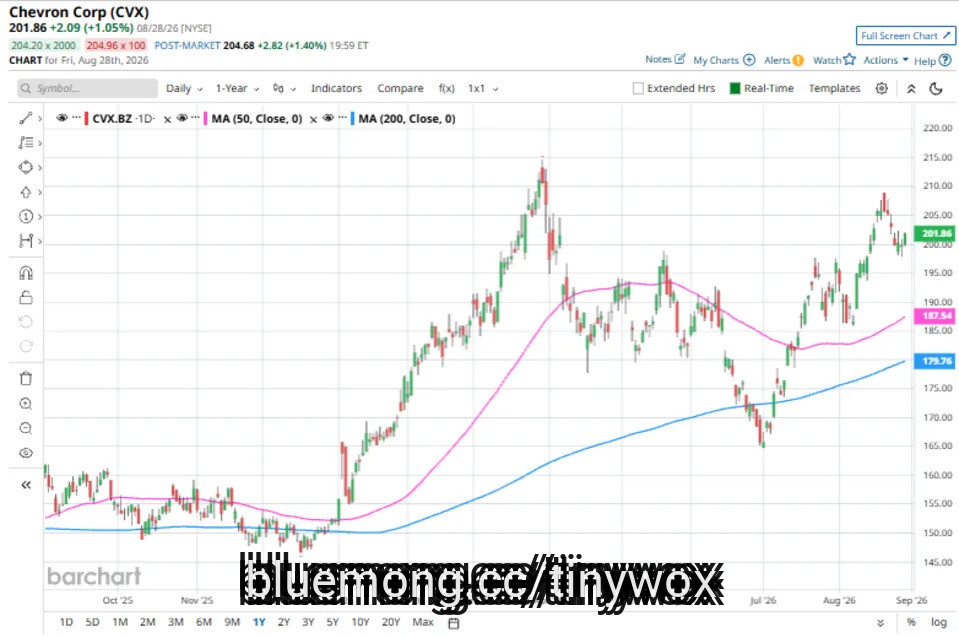
Houston, Texas-based Chevron Corporation (CVX) is one of the world's largest integrated energy companies, with operations spanning oil and natural gas exploration and production, refining, marketing, chemicals, and lower-carbon energy. Headquartered in Houston, Texas, Chevron operates across the U.S. and numerous international markets. The company has a market cap of $364.5 billion.
Companies with a market capitalization of $200 billion or more are typically referred to as "mega-cap stocks." CVX fits right into that category, with its market cap exceeding this threshold, reflecting its substantial size and influence in the integrated oil and gas industry. A major strength of Chevron is its vertically integrated and geographically diversified portfolio. The upstream business provides significant exposure to oil and gas prices, while refining, marketing and chemicals operations can provide earnings diversification when commodity prices or refining margins move in different directions.
Wu-Tang Clan Member Raekwon Is a Palantir 'OG,' Visiting Headquarters 16 Years After Receiving His Custom PLTR Jacket
Tesla Stock Could Benefit as Trump Locks Down the U.S. Power Grid
Tesla Just Killed Its Solar Roof After Years of Struggling to Scale. What It Means for TSLA Stock.
#market #texas #Stock

2 months ago
On August 3, TotalEnergies SE (NYSE:TTE) signed an agreement to acquire Shell plc (NYSE:SHEL)'s entire onshore renewables business in Europe. The acquisition includes 500 MW of operational or under-construction solar and wind ******* ets primarily in Italy and the Netherlands, alongside a 3.5 GW pipeline of solar, wind, and battery storage projects across Italy, the UK, and Spain. Set for completion by late 2026 pending regulatory approval, the deal directly advances TotalEnergies' European Integrated Power strategy, bolstering its existing portfolio of roughly 10 GW in gross capacity/construction and 27 GW under development. Following the news on August 3, Piper Sandler ******* yst John Royall raised Shell's price target from $88 to $89 while maintaining a Neutral rating, citing strong Q2 trading beats.
Both Big Oil majors reported robust Q2 2026 results driven by operational efficiency, yet distinct financial profiles emerge. TotalEnergies SE (NYSE:TTE) generated adjusted net income of $6.0 billion and cash flow from operations (CFFO) of $9.8 billion on 2.395 Mboe/d production, keeping Upstream operating costs down to $5/b despite Middle East transit disruptions. Shell outperformed on sheer cash generation, posting $9.8 billion in Adjusted Earnings and CFFO of $21.4 billion, supported by record upstream production in Brazil, record refinery utilization, and a $3.4 billion working capital inflow.
TotalEnergies retains a leaner debt profile with a gearing ratio of 13.1% ($3.3 billion net debt reduction), whereas Shell holds a 19% gearing ratio with $42 billion in net debt ($12 billion excluding leases). While Shell plc (NYSE:SHEL) leads on top-line cash generation, TotalEnergies displays superior balance sheet leverage and higher quarter-over-quarter cash flow growth (+15%).
TotalEnergies' bull case is supported by strong execution of its Integrated Power strategy, with expanding high-margin renewable power capacity alongside low Upstream costs of approximately $5 per barrel. Its healthy balance sheet, reflected in 13.1% gearing, provides financial flexibility to support a 5.9% dividend increase to €0.90 per share while continuing $1.5 billion in quarterly share buybacks. However, the bear case centers on weakness in Integrated LNG, particularly from underperforming European gas trading. Continued exposure to geopolitical disruptions along Middle Eastern transit corridors could also restrict physical oil liftings and weigh on operations.
#TotalEnergies #shell #upstream


2 months ago
Expion360 Inc. (NASDAQ:XPON) shares closed at $6.20 on August 24, up 80.5% following the company's oil-and-gas acquisition and financing disclosures. The transactions reposition the lithium-battery specialist as a broader energy company. The company also announced a corporate name change to Expion Energy, Inc. as part of the expansion.
Expion360 Inc. (NASDAQ:XPON) paid an adjusted $3.425 million in cash for a company holding an Eastern Louisiana exploration prospect. The acquired ****** ets include approximately 3,000 net leasehold acres, an existing wellbore, mineral-title research covering approximately 13,000 net acres, and related intellectual property. The announcement did not include current production or an estimate of proved reserves.
The company financed the move through $9 million of convertible debentures, generating approximately $8.2 million of net proceeds after fees and expenses.
Expion360 Inc. (NASDAQ:XPON) acquired a defined exploration target rather than starting its acreage and geological work from scratch. The company plans to expand the leasehold and use commercially reasonable efforts to initiate a mandatory well operation involving a lateral wellbore of at least 4,000 feet by February 15, 2027, subject to specified exceptions.
The company expects to retain an approximately 75% net revenue interest after overriding royalty interests. New CEO Kevin Sellers also brings experience in upstream and midstream transactions, addressing part of the expertise gap created by the move beyond battery storage.
#approximately #energy #part

2 months ago
A Bloomberg report on August 18 revealed that BP plc (NYSE:BP) has become the latest foreign company to enter the Venezuelan oil trade, with the tanker Monte Lema loading 400,000 barrels of heavy fuel oil for the British energy giant. The oil is being supplied by the state-owned PDVSA. The strategic move places BP among a select group of companies, including trading giants Trafigura and Vitol, with direct access to Venezuelan oil.
The development comes a few days after it was announced that the London-based company would partner with two other firms to develop the second phase of the Loran gasfield, in one of the first large-scale foreign investments in the South American country since the ouster of Nicolás Maduro earlier this year. That said, while the consortium has secured the official exploration and production license, the project remains in the pre-FID phase.
The developments come after President Trump called for global oil companies to invest in Venezuela and help restore and modernize its dilapidated oil infrastructure. The South American nation is sitting on the largest proven crude oil reserves in the world, accounting for roughly 17% of the global total. However, the oil-rich country's government nationalized major heavy oil projects in 2007, forcing foreign operators into minority stakes or outright seizing their **** ets.
As a relatively early mover, BP plc (NYSE:BP) stands to gain a lot from a gradual revival of Venezuelan oil output. The company appears to be positioning itself across multiple areas of Venezuela's energy value chain – from exploration to production, to trading and international marketing. It means that the energy giant could benefit from the country in many ways as it reconnects with global energy markets.
Moreover, BP's entry into the Venezuelan oil trade could give it an opportunity to capture trading margins in addition to upstream earnings. This could be particularly beneficial for the company as it could potentially leverage its already existing refining, marketing, shipping, and trading infrastructure in the region. Although Trafigura and Vitol have an early foothold in Venezuela's oil trading business, BP's large integrated energy business gives it a significant competitive edge.
#energy #company #vitol


2 months ago
Eagle Capital Management, an investment management company, released its second quarter 2026 investor letter. A copy of the letter can be downloaded here. In the quarter, Eagle Capital Management discussed how enthusiasm around AI capital spending has driven strong S&P 500 earnings growth while also increasing risks from elevated valuations, concentrated demand, and aggressive investment **** umptions. Eagle remains a strong believer in AI but prefers constructing a portfolio that can perform across multiple outcomes rather than relying on one forecast. The firm believes current earnings can overstate underlying economics because semiconductor equipment is depreciated over several years, while free cash flow growth remains much weaker. It also expects competition and additional capacity across AI labs, hyperscalers, and semiconductors to eventually create winners and losers. These dynamics are encouraging Eagle to recycle capital toward attractive opportunities outside the most crowded AI trades while maintaining selective exposure to high quality beneficiaries. The portfolio trades at a 20% market discount with faster expected EPS growth. Please review the Strategy's top five holdings for key selections.
In its second-quarter 2026 investor letter, Eagle Capital Management highlighted ConocoPhillips (NYSE:COP). ConocoPhillips (NYSE:COP) explores for, produces, transports, and markets crude oil, bitumen, natural gas, liquefied natural gas (LNG), and natural gas liquids. On August 18, 2026, ConocoPhillips (NYSE:COP) closed at $129.72 per share. The one-month return of ConocoPhillips (NYSE:COP) was 9.20% and its shares gained 36.71% over the past 52 weeks. ConocoPhillips (NYSE:COP) has a market capitalization of $155.84 billion.
Eagle Capital Management stated the following regarding ConocoPhillips (NYSE:COP) in its Q2 2026 investor letter:
"The energy & metals companies we own benefit from favorable multiyear supply/demand outlooks, management teams that are good capital allocators, and **** et bases that are well-positioned on the global cost curve.
ConocoPhillips (NYSE:COP), the largest U.S. pure-play upstream oil producer, has low-cost, long-lived inventory that we believe is underappreciated relative to peers. In the coming years, its free cash flow should inflect higher as the Willow project in Alaska comes online and transitions from a cash drag to a cash generator. We see the oil market as reasonably balanced, but risks may skew to the upside over the next couple of years as the world manages shortages from the Strait of Hormuz, and the path to its full and enduring reopening remains murky. We expect EPS growth in the mid-teens over the next several years."
#capital #eagle


2 months ago
Eagle Capital Management, an investment management company, released its second quarter 2026 investor letter. A copy of the letter can be downloaded here. In the quarter, Eagle Capital Management discussed how enthusiasm around AI capital spending has driven strong S&P 500 earnings growth while also increasing risks from elevated valuations, concentrated demand, and aggressive investment ****** umptions. Eagle remains a strong believer in AI but prefers constructing a portfolio that can perform across multiple outcomes rather than relying on one forecast. The firm believes current earnings can overstate underlying economics because semiconductor equipment is depreciated over several years, while free cash flow growth remains much weaker. It also expects competition and additional capacity across AI labs, hyperscalers, and semiconductors to eventually create winners and losers. These dynamics are encouraging Eagle to recycle capital toward attractive opportunities outside the most crowded AI trades while maintaining selective exposure to high quality beneficiaries. The portfolio trades at a 20% market discount with faster expected EPS growth. Please review the Strategy's top five holdings for key selections.
In its second-quarter 2026 investor letter, Eagle Capital Management highlighted ConocoPhillips (NYSE:COP). ConocoPhillips (NYSE:COP) explores for, produces, transports, and markets crude oil, bitumen, natural gas, liquefied natural gas (LNG), and natural gas liquids. On August 18, 2026, ConocoPhillips (NYSE:COP) closed at $129.72 per share. The one-month return of ConocoPhillips (NYSE:COP) was 9.20% and its shares gained 36.71% over the past 52 weeks. ConocoPhillips (NYSE:COP) has a market capitalization of $155.84 billion.
Eagle Capital Management stated the following regarding ConocoPhillips (NYSE:COP) in its Q2 2026 investor letter:
"The energy & metals companies we own benefit from favorable multiyear supply/demand outlooks, management teams that are good capital allocators, and ****** et bases that are well-positioned on the global cost curve.
ConocoPhillips (NYSE:COP), the largest U.S. pure-play upstream oil producer, has low-cost, long-lived inventory that we believe is underappreciated relative to peers. In the coming years, its free cash flow should inflect higher as the Willow project in Alaska comes online and transitions from a cash drag to a cash generator. We see the oil market as reasonably balanced, but risks may skew to the upside over the next couple of years as the world manages shortages from the Strait of Hormuz, and the path to its full and enduring reopening remains murky. We expect EPS growth in the mid-teens over the next several years."
#NYSE #eagle

2 months ago
ExxonMobil (NYSE: XOM) technically missed Wall Street's expectations for the second quarter. Adjusted earnings came in at $3.52 per share, just below the consensus estimate of $3.60. That was enough to trigger a negative reaction. But focusing only on the earnings miss overlooks what was arguably one of ExxonMobil's strongest operating quarters in years.
The company reported $14.5 billion in earnings and $14.7 billion in adjusted earnings, its highest quarterly earnings in roughly four years. ExxonMobil also generated $23.6 billion in cash flow from operations and $17.2 billion in free cash flow, giving it plenty of room to continue investing in growth while returning cash to shareholders.
Missed Nvidia in 2009? This Rare Signal Is Flashing Again. In 2009, a "Double Down" signal flashed for a little-known chipmaker called Nvidia. For the first time in years, that same "Total Conviction" signal is flashing for a company 1/100th the size of Nvidia. Continue »
Perhaps the most encouraging numbers weren't on the income statement at all. Exxon delivered its highest upstream production in more than two decades, excluding temporary Middle East disruptions. Production in the Permian Basin reached a record 1.8 million barrels of oil equivalent per day, while the company's fifth floating production vessel for Guyana is scheduled to begin operations in the fourth quarter, adding another 250,000 barrels per day of production capacity.
The downstream business also performed well. Exxon reported record diesel production, helping offset refinery maintenance earlier in the year. Chemical products earned $1.13 billion, while the Energy Products segment rebounded sharply to $5.47 billion after posting a loss during the previous quarter.
#billion #production #cash


2 months ago
AXTI surged on optical sector momentum and 165% YoY revenue growth; TE jumped 10% as new US solar tariffs protect its domestic manufacturing plans.
BW landed a 20-turbine Siemens data center deal and drew a 7.66M share Ameriprise disclosure, but still trades like a turnaround on a weak chart.
Act now: the ****** yst who called NVIDIA in 2010 just named his top 10 AI stocks — and Babcock & Wilcox Enterprises didn't make the cut. Grab the names FREE today.
Three second-derivative AI plays are in focus Friday morning. AXT (NASDAQ:AXTI) is trading higher alongside a broad rally in optics names, T1 Energy (NYSE:TE) is bouncing on the domestic solar policy trade, and Babcock & Wilcox Enterprises (NYSE:BW) is drawing attention around a fresh institutional disclosure. The connective tissue: AI capex is now pulling in materials, power gear, and energy suppliers well beyond the obvious chip names.
AXT is up about 3.1% today, around $79.83, after an Aug. 13 close of $77.45. The catalyst is a sector move. Applied Optoelectronics is up about 5%, Lumentum about 4%, and Corning about 4.5%. AXT makes compound semiconductor substrates, and its indium phosphide wafers are a key input for the high-speed optical transceivers and silicon photonics used in AI data centers. When the optical connectivity trade runs, AXT runs with it as the upstream materials supplier.
#names #axti #enterprises

2 months ago
Antipodes Partners published its "Antipodes Global Strategy" second-quarter 2026 investor letter, highlighting the key performance stocks, portfolio changes, and the market outlook. A copy of the letter can be downloaded here. The second quarter of 2026 delivered one of the strongest equity market recoveries in recent history, as global equities gained 14.9% in US dollar terms. Renewed enthusiasm for artificial intelligence, strong corporate earnings, and easing tensions with Iran supported the rebound, while growth stocks outperformed value and emerging markets led gains, particularly Korea and Taiwan. The Antipodes Global Value Strategy underperformed its benchmark during the quarter and over the 12 months to June 30, 2026, as returns became concentrated in a narrow group of semiconductor and hardware stocks. Consumer staples and consumer discretionary holdings supported performance, while information technology, software, and internet exposure detracted. The firm remains cautious on expensive memory companies because pricing and supply remain cyclical despite AI demand. The Strategy continues to favor valued infrastructure, specialty semiconductors, resilient software, and quality businesses. For insights into its key selections for 2026, please review the Strategy's top five holdings.
In its Q2 2026 investor letter, Antipodes Global Strategy highlighted TotalEnergies SE (NYSE:TTE). TotalEnergies SE (NYSE:TTE) is a leading energy company that produces and markets oil and biofuels, natural gas, biogas, and low-carbon hydrogen, renewables, and electricity. On August 7, 2026, TotalEnergies SE (NYSE:TTE) closed at $85.83 per share. The one-month return of TotalEnergies SE (NYSE:TTE) was 7.49%, and its shares gained 43.01% over the past 52 weeks. TotalEnergies SE (NYSE:TTE) has a market capitalization of $190.44 billion.
Antipodes Global Strategy stated the following regarding TotalEnergies SE (NYSE:TTE) in its Q2 2026 investor letter:
"TotalEnergies SE (NYSE:TTE) underperformed as weaker crude oil and natural gas prices reduced earnings expectations and cash-flow forecasts across the integrated energy sector in line with geopolitical tensions easing over the Quarter. Concerns over slowing global economic growth and softer fuel demand also weighed on commodity markets, while increased OPEC+ supply expectations added further pressure to oil prices. Although TotalEnergies continued to benefit from its diversified LNG, power and renewable energy portfolio, these positives were outweighed by declining upstream earnings expectations. A broader rotation away from defensive energy stocks toward higher-growth sectors and profit taking after a stronger period also contributed to weakness."
#strategy #letter #stocks


2 months ago
ExxonMobil (NYSE:XOM) reported second-quarter 2026 results on July 31, and the headline number disappointed. Adjusted earnings came in at $3.52 per share, short of the $3.60 ***** ysts expected, even though that figure was up sharply from a year earlier. Reported earnings were $14.5 billion, or $3.48 per share. But the company also generated $23.6 billion in cash from operations and $17.2 billion in free cash flow, enough to fund $9.4 billion in shareholder distributions with room to spare. The miss made headlines. The cash didn't miss anything.
Exxon's operating results told a different story than the earnings line. The company posted its highest upstream production in more than two decades, excluding disruptions in the Middle East, and Permian output topped 1.8 million oil-equivalent barrels per day, a record pace consistent with its planned 9% annual growth rate through 2030. A fifth Guyana production vessel set sail during the quarter, with startup on track for the fourth quarter of 2026 and 250,000 barrels per day of new capacity coming online. Diesel production also hit a second-quarter record. None of that shows up directly in a per-share earnings number, but it is the foundation the company is building future cash flow on.
Cost discipline reinforced the picture. Exxon has now banked $16.3 billion in ***** ulative structural cost savings since 2019, including $1.2 billion added in the first half of 2026 alone, a total the company says exceeds what BP, Chevron, Shell, and TotalEnergies have saved combined. It kept investing anyway, spending $13.0 billion in cash capital expenditures through midyear, about 20% more than its nearest rival. Growing production while cutting costs is the combination that funds a rising dividend.
The earnings miss wasn't the only soft spot. The first quarter of 2026 generated just $2.7 billion in free cash flow against $9.2 billion in shareholder distributions, forcing Exxon to lean on its balance sheet, with debt-to-capital reaching 15.4% at the time. Zoom out to the full first half and the math is tighter than the strong second quarter suggests: $19.9 billion in free cash flow covered $18.6 billion in distributions, leaving only about $1.3 billion of cushion. The company reduced debt by $7 billion in the second quarter and brought net debt-to-capital down to 11%, but the episode is a reminder that commodity earnings swing hard from quarter to quarter, and the roughly $37 billion a year Exxon is committing to dividends and buybacks needs strong quarters to keep showing up.
#quarter #cash

2 months ago
It has been a good 2026 so far for many oil companies, with the conflict in the Middle East driving prices higher and lining the pockets of major companies. Big oil companies have traditionally been considered reliable dividend payers, but with the wave of extra cash that they've seen coming in this year, you can bet they'll get more shareholder-friendly.
Chevron (NYSE: CVX) and ExxonMobil (NYSE: XOM), the two largest American oil companies, have long been the standard for big oil dividend payers. But if you're looking for a stock to invest in for passive income, which one is the go-to? For most investors, it's likely Chevron. Here's why.
Missed Nvidia in 2009? This Rare Signal Is Flashing Again. In 2009, a "Double Down" signal flashed for a little-known chipmaker called Nvidia. For the first time in years, that same "Total Conviction" signal is flashing for a company 1/100th the size of Nvidia. Continue »
Both Chevron and ExxonMobil are fully integrated oil and gas companies that operate in all phases of the value chain (upstream, midstream, and downstream). The difference is what they primarily focus on.
Chevron operates more in the upstream segment, drilling and extracting oil. ExxonMobil has a much larger downstream presence, refining crude oil into refined products such as gasoline and plastics. ExxonMobil's business is larger and more diversified than Chevron's, but Chevron is known for its leaner, more efficient operations.
#flashing #Dividend #payers

2 months ago
"Is there an AI bubble?" is such a tired thought. Here's something altogether more wired: The AI boom is paying off, but not in a way that the current equities market has accounted for. The success of the technology in one area of the economy could make the bubble real in another, more precisely.
In a blog post published on Friday, Apollo Chief Economist Torsten Slok highlighted that the parts of the AI value chain with the highest profit margins—companies making AI models and applications—actually have the lowest levels of profitability, a departure from the standard business model of, well business, in which profit margins are higher for companies selling an end product to consumers.
Slok broke down AI companies into four categories: models and applications, cloud and compute, energy and grid, and silicon and equipment. Using data from Pitchbook and Bloomberg for companies including OpenAI, Anthropic, Microsoft, Amazon, Constellation Energy, Nvidia, AMD, and Micron, Slok calculated that silicon and equipment—such as chipmakers—has the highest profit margin, 41%, in the AI value chain. Meanwhile, models and applications—like Anthropic—have a -59% operating margin.
Slok warns that this sharp disparity is because money from the AI boom is not coming from natural demand for AI applications, but rather shareholders hoping to cash in on what they hope is the next technological revolution.
"AI boom's profits are currently being funded by investors rather than earned from customers," Slok said. "The upstream margins are real, but they are paid for out of capital raised by the layer losing money, not out of cash generated by end demand."
#profit #boom


3 months ago
(By Oil & Gas 360) – This week underscored how quickly geopolitical uncertainty can reshape market sentiment, even as companies remain focused on long-term capital discipline. Oil prices strengthened on renewed uncertainty surrounding the Iran conflict, while producers continued investing in natural gas, offshore development, and high-quality shale **** ets.
At the same time, mergers and acquisitions slowed, balance sheets strengthened, and executive leadership changes signaled the industry's continued focus on creating shareholder value through disciplined growth rather than aggressive expansion.
Brent crude climbed as uncertainty surrounding the Iran conflict returned to the forefront. Goldman Sachs said Brent is likely to trade in an $80 to $90 per barrel range until markets receive clarity through either a U.S.–Iran agreement or a significant escalation. Meanwhile, reports indicated a proposed Strait of Hormuz agreement could give Iran greater control over inbound shipping traffic, adding another layer of uncertainty to global energy markets. ADNOC also issued a statement clarifying reports surrounding attacks on its facilities.
Why it matters:
Markets continue to trade on geopolitical expectations rather than purely on supply and demand. The future of Hormuz remains one of the most important variables influencing global oil prices.
U.S. upstream mergers and acquisitions declined sharply during the second quarter as commodity price volatility made buyers more cautious. Despite the slowdown, demand for high-quality Permian Basin **** ets remained strong. **** ex agreed to acquire U.S. tight oil and gas **** ets for $320 million, while bp expanded its natural gas portfolio by acquiring Woodside's stake in Trinidad's Calypso gas project.
#Iran #uncertainty #markets #surrounding


3 months ago
PARIS (AP) — Paris is staging its first high-diving competition in the Seine, with athletes launching themselves from a 20-meter platform in front of the Eiffel Tower — a spectacular new test of the city's effort to reclaim its river for sport.
The event on the Bir-Hakeim Bridge has also exposed the fragility of that ambition: Organizers suspended training Thursday when traces of hydrocarbons were detected upstream. By Friday, the French Swimming Federation said the affected area had been treated, allowing athletes to return to the water and the event to proceed as planned.
High diving concludes Saturday with the final two rounds and medal events, while the broader European Aquatics Championships run through Aug. 16.
"There are things that are within our control, and there are uncertainties that are inevitably linked to any outdoor activity," said Maxime Sauvage, Paris deputy mayor in charge of sports, sports facilities and equal access to sport.
Among the things within the city's control, he said, are the massive investments made before the 2024 Olympic and Paralympic Games to make the river safe for swimming, from work to prevent sewage from flowing directly into the Seine to improvements in stormwater management.
#athletes #things



3 months ago
The geopolitical conflict in the Middle East has the world on edge. The daily news flow from the region can lead to wide swings in oil and natural gas prices. But the truth is that the energy sector has long been volatile, and today's events aren't all that unusual. Which is why long-term investors should probably focus on reliable dividend-paying energy stocks.
ExxonMobil (NYSE: XOM) has one of the most impressive dividend histories in the energy industry. Close behind is Chevron (NYSE: CVX). For those looking to avoid direct commodity exposure, two of the most reliable high-yield stocks are Enbridge (NYSE: ENB) and Enterprise Products Partners (NYSE: EPD). With yields of up to 5.7%, this group of stocks could be your entry point into energy in August.
Missed Nvidia in 2009? This Rare Signal Is Flashing Again. In 2009, a "Double Down" signal flashed for a little-known chipmaker called Nvidia. For the first time in years, that same "Total Conviction" signal is flashing for a company 1/100th the size of Nvidia. Continue »
It actually gets easier to find energy stocks if you start with the premise that the energy sector is volatile. Income-focused investors can immediately look for the strongest companies with the best dividend histories. That very quickly leads to Exxon and Chevron.
From a business model perspective, they are both globally dominant integrated energy companies. They have exposure to the entire energy value chain, including the upstream (production), midstream (pipelines), and the downstream (chemicals and refining). Geographically, they can invest where management believes it can find the highest returns. And, the broad portfolio diversification helps to soften the energy market's normal swings.
#NYSE #stocks #signal #Dividend

3 months ago
Wood Mackenzie now estimates that the global upstream oil and gas sector could generate $495 billion in free cash flow in 2026 if crude averages $90 per barrel, more than doubling its previous forecast based on a $60 oil price **** umption. The revision follows the sharp jump in crude prices triggered by the Middle East conflict, turning what had been expected to be another year of disciplined cash generation into one of the industry's most lucrative windfalls in recent years. Yet the gains will be concentrated among the world's largest producers, with the 49 national and international oil companies covered by Wood Mackenzie expected to capture $272 billion of the total.
Wood Mackenzie expects the conflict to reduce global oil production by at least 3%, with Iraq accounting for roughly 3 million barrels per day of lost output, while damage to infrastructure in Qatar is projected to cut global LNG supply by 2%. The stronger cash flow outlook does not alter the industry's longer-term production trajectory. Wood Mackenzie projects average production across the 155 upstream companies it tracks will fall 30% between 2030 and 2040, with more than 70 producers facing declines of more than 50% unless they make significant new investments.
However, WoodMac says energy companies are likely to maintain capital discipline despite the unexpected influx of cash, with capex budgets expected to largely remain flat while share buybacks are projected to decrease by 5% as boards prioritize balance sheet strength and deleveraging.
Related: War Sends Saudi Oil Output Down and Revenue Up
Meanwhile, energy companies are expected to continue to deploy the excess cash to purchase attractive oil and gas **** ets. Upstream M&A surged to a two-year high in the first half of the year, including Shell Plc's (NYSE:SHEL) $16 billion acquisition of ARC Resources, Devon's (NYSE:DVN) $25 billion merger with Coterra and Mitsubishi's (OTCPK:MSBHF) $7.5 billion purchase of Aethon. Dealmakers are increasingly prioritizing stable, low-cost regions and natural gas/LNG **** ets to ensure supply chain security.
#wood #mackenzie


3 months ago
ExxonMobil (NYSE:XOM) is one of the top energy names in President Donald Trump's financial disclosures from earlier this year. The stock is up about 27% so far this year. But does a presidential trade make it a buy today? Let's break down what's actually driving the stock.
Exxon benefits directly from rising oil prices amid the Iran war. Its upstream segment was projected to see a multibillion-dollar earnings lift for the second quarter compared to the first, driven almost entirely by higher realized prices rather than any change in production. That's the logic behind buying an oil major right as a Middle East conflict escalates.
Exxon's balance sheet gives it room to lean into higher prices. Net debt relative to EBITDA sits under 1x, among the lowest in the industry, and the company is on pace to repurchase roughly $20 billion of stock this year. Guyana production just hit a quarterly record above 900,000 barrels a day, and the company has applied to drill dozens more wells there.
In the Permian Basin, Exxon is now the largest operator following its Pioneer acquisition and expects to roughly double output there by 2030. Longer term, natural gas tied to data center power demand is another growth lever bulls point to, with McKinsey estimating data centers could eventually account for more than a tenth of total U.S. power demand.
There's a demand question sitting underneath the price spike. The IEA sees global oil demand softening this year, and even OPEC, which tends to run more optimistic, trimmed its own demand growth forecast. If the Iran-driven premium in oil prices fades if another ceasefire takes place, some of Exxon's near-term earnings boost fades with it.
#Iran #earnings


3 months ago
Eni (E:NYSE) is raising its share buyback program for the year after reporting on Wednesday consensus-beating earnings for the second quarter on the back of higher oil and gas prices and a jump in upstream production.
The Italian energy major booked an adjusted net profit of $2.65 billion (2.33 billion euros) for the second quarter, more than doubled from $1.29 billion (1.13 billion euros) for the same period last year, and higher than a company-provided consensus estimate of $2.4 billion (2.09 billion euros).
Eni attributed the profit jump to higher oil and gas realizations in a "supportive pricing environment," as well as to growth in volumes and cost management.
The exploration and production (E&P) division reported pro forma adjusted EBIT soaring by 42% from the first quarter of 2026 and by 97% from the second quarter of 2025, driven by favorable volume and mix effects, cost discipline, and better oil realizations, Eni said.
Eni's average realized price of liquids jumped by 54% from a year earlier to $96.50 per barrel for the second quarter of 2026.
#year #higher