
1 hr. ago
When a caller mentioned that they are thinking about adding to their position in Simon Property Group, Inc. (NYSE:SPG) during the October 2 episode of Mad Money, Jim Cramer commented:
I think you're absolutely right... I want you to add to the Simon Property Group... What a great man he (David Simon, previous CEO) was, and he built a fabulous company, and you should buy more of it.
A September 8 question about buying Simon Property Group led Cramer to bring another real estate stock into the conversation.
Simon Property Group, Inc. (NYSE:SPG) reported second-quarter real estate funds from operations of $3.29 per diluted share, up 7.9% year-over-year. Domestic property net operating income increased 8.5%. Occupancy at its U.S. malls and premium outlets remained at 96%, while base minimum rent increased 6.3% to $62.42 per square foot. Management raised its full-year real estate funds from operations outlook to $13.20 - $13.30 per share. These figures show rent and property-income growth without requiring an increase in occupancy. Leasing activity also remained substantial. During the earnings call, management reported signing approximately 1,200 leases covering more than 4.8 million square feet, with new-deal volume increasing more than 20%.
Stable occupancy does not mean every tenant is healthy. Simon Property Group, Inc. (NYSE:SPG) absorbed approximately one million square feet of ****** e returned through retailer bankruptcies during the quarter. Management said it successfully re-leased the ****** e, helping maintain occupancy. That shows leasing strength, but also a reminder of the work required to preserve rental income. Additional retailer failures could bring more vacancies and replacement costs, even when demand for the properties remains sound.
#occupancy #NYSE #management #estate
I think you're absolutely right... I want you to add to the Simon Property Group... What a great man he (David Simon, previous CEO) was, and he built a fabulous company, and you should buy more of it.
A September 8 question about buying Simon Property Group led Cramer to bring another real estate stock into the conversation.
Simon Property Group, Inc. (NYSE:SPG) reported second-quarter real estate funds from operations of $3.29 per diluted share, up 7.9% year-over-year. Domestic property net operating income increased 8.5%. Occupancy at its U.S. malls and premium outlets remained at 96%, while base minimum rent increased 6.3% to $62.42 per square foot. Management raised its full-year real estate funds from operations outlook to $13.20 - $13.30 per share. These figures show rent and property-income growth without requiring an increase in occupancy. Leasing activity also remained substantial. During the earnings call, management reported signing approximately 1,200 leases covering more than 4.8 million square feet, with new-deal volume increasing more than 20%.
Stable occupancy does not mean every tenant is healthy. Simon Property Group, Inc. (NYSE:SPG) absorbed approximately one million square feet of ****** e returned through retailer bankruptcies during the quarter. Management said it successfully re-leased the ****** e, helping maintain occupancy. That shows leasing strength, but also a reminder of the work required to preserve rental income. Additional retailer failures could bring more vacancies and replacement costs, even when demand for the properties remains sound.
#occupancy #NYSE #management #estate


2 days ago
A $100,000 split equally across KO, ABBV, and CVX plus two others yields a blended 3.72%, generating $3,715 in annual passive income.
Realty Income (O) leads the group at a 6.04% yield, paying monthly dividends raised for 115 consecutive quarters on 98.8% occupancy.
Five industries fund the income stream, so a weak year in oil, pharma, or ****** et management hits only a fraction of total payouts.
Building a portfolio and living off one are two completely different skills, and almost ****** ody teaches the second. This problem is what The Definitive Guide to Retirement Income helps, and it is free today. Read more here. (Sponsor)
Retirement changes how income works on the day the paychecks stop. Social Security covers part of the monthly bill, and the rest has to come from savings, an annuity, or a portfolio that pays cash on a schedule. Selling shares to cover groceries works fine until a bear market forces those sales at bad prices. Dividends let a retiree collect income and keep the same number of shares.
#income #works #five
Realty Income (O) leads the group at a 6.04% yield, paying monthly dividends raised for 115 consecutive quarters on 98.8% occupancy.
Five industries fund the income stream, so a weak year in oil, pharma, or ****** et management hits only a fraction of total payouts.
Building a portfolio and living off one are two completely different skills, and almost ****** ody teaches the second. This problem is what The Definitive Guide to Retirement Income helps, and it is free today. Read more here. (Sponsor)
Retirement changes how income works on the day the paychecks stop. Social Security covers part of the monthly bill, and the rest has to come from savings, an annuity, or a portfolio that pays cash on a schedule. Selling shares to cover groceries works fine until a bear market forces those sales at bad prices. Dividends let a retiree collect income and keep the same number of shares.
#income #works #five


19 days ago
Logistic Properties of the Americas (NYSEAMERICAN:LPA) moved closer to selling Parque Logístico Lima Sur after Peru's antitrust authority, INDECOPI, approved the transaction on September 11. FIBRA Prime would acquire the entire 1.3-million-square-foot logistics park for $145 million. Customary administrative closing matters remain outstanding.
Management expects approximately $85 million of net proceeds after debt repayment and before taxes, with Mexico the intended destination. Approval advances the financing of that expansion, while the investment case rests on replacing an established income stream.
Lima Sur generated $10.3 million of cash net operating income, or cash NOI, during the 12 months ended March 31, 2026. Cash NOI is a company-defined non-IFRS measure of property income after operating expenses, adjusted to remove straight-line rental accounting. It excludes corporate overhead, financing costs, income taxes, and other non-property items.
Logistic Properties of the Americas (NYSEAMERICAN:LPA) has demonstrated an ability to develop, lease and operate logistics ***** ets. Second-quarter revenue increased 26.1% to $14.7 million, while stabilized portfolio occupancy reached 100% as of June 30.
Mexico already contributes revenue. Two properties acquired in Puebla in August 2025 generated approximately $0.5 million during the second quarter. That provides an operating foothold for deploying proceeds.
#cash #logistic #nyseamerican #Mexico
Management expects approximately $85 million of net proceeds after debt repayment and before taxes, with Mexico the intended destination. Approval advances the financing of that expansion, while the investment case rests on replacing an established income stream.
Lima Sur generated $10.3 million of cash net operating income, or cash NOI, during the 12 months ended March 31, 2026. Cash NOI is a company-defined non-IFRS measure of property income after operating expenses, adjusted to remove straight-line rental accounting. It excludes corporate overhead, financing costs, income taxes, and other non-property items.
Logistic Properties of the Americas (NYSEAMERICAN:LPA) has demonstrated an ability to develop, lease and operate logistics ***** ets. Second-quarter revenue increased 26.1% to $14.7 million, while stabilized portfolio occupancy reached 100% as of June 30.
Mexico already contributes revenue. Two properties acquired in Puebla in August 2025 generated approximately $0.5 million during the second quarter. That provides an operating foothold for deploying proceeds.
#cash #logistic #nyseamerican #Mexico

20 days ago
Welltower and Ventas posted SHOP NOI growth of 20.5% and 16.3%, respectively, as senior occupancy rates climb and new supply starts remain at record lows.
Roughly 2 million people turn 80 in 2026, and Ventas CEO Debra Cafaro says the senior population growth rate will more than double over the next decade.
OHI's 5.68% yield carries real tenant risk: Genesis Healthcare is in Chapter 11 with $148 million in loans outstanding and the CEO is retiring.
Just released. Our **** ysts combed the entire stock market and named the ten best stocks to buy right now, and Welltower didn't make the cut. Enter your email to see the names that beat WELL. The report is free. Enter your email and see if any of your stocks made the cut.
Senior housing and skilled nursing REITs are riding a demographic tide that shows up in the operating data. Roughly two million people will turn 80 in 2026 alone, and Ventas Chair and CEO Debra A. Cafaro told investors that "the leading edge of the nearly 70 million baby boomers has just begun turning 80 this year, ushering in a decade where the growth rate of the senior population more than doubles, yet new starts remain at record lows." Four US-listed equity REITs sit squarely in that trade. Dividend safety leads the **** ysis, so every payout is measured against FFO or AFFO, not GAAP earnings.
#ventas #welltower
Roughly 2 million people turn 80 in 2026, and Ventas CEO Debra Cafaro says the senior population growth rate will more than double over the next decade.
OHI's 5.68% yield carries real tenant risk: Genesis Healthcare is in Chapter 11 with $148 million in loans outstanding and the CEO is retiring.
Just released. Our **** ysts combed the entire stock market and named the ten best stocks to buy right now, and Welltower didn't make the cut. Enter your email to see the names that beat WELL. The report is free. Enter your email and see if any of your stocks made the cut.
Senior housing and skilled nursing REITs are riding a demographic tide that shows up in the operating data. Roughly two million people will turn 80 in 2026 alone, and Ventas Chair and CEO Debra A. Cafaro told investors that "the leading edge of the nearly 70 million baby boomers has just begun turning 80 this year, ushering in a decade where the growth rate of the senior population more than doubles, yet new starts remain at record lows." Four US-listed equity REITs sit squarely in that trade. Dividend safety leads the **** ysis, so every payout is measured against FFO or AFFO, not GAAP earnings.
#ventas #welltower


21 days ago
This story was originally published on CRE Daily. Join 70,000+ commercial real estate professionals getting daily news, market insights, and industry **** ysis delivered straight to their inbox with the free CRE Daily newsletter.
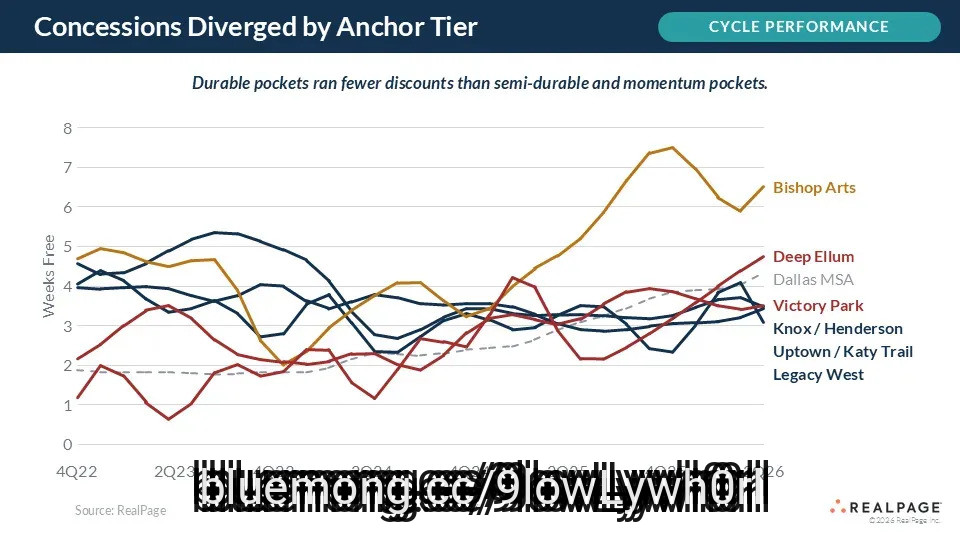
Legacy West apartments average $1,845 a month, a 9% premium over comparable Dallas properties that's smaller than any other demand pocket RealPage tracks, yet the submarket needs the fewest concessions to stay leased.
The pocket posted 95.5% occupancy in the second quarter, two points above the Dallas metro average, anchored by roughly 12,000 corporate jobs from employers including Toyota, JPMorgan Chase, and Frito-Lay.
Because Legacy West's strength rests on continued corporate expansion rather than a larger price premium, its durability depends on employers in the Plano-Frisco corridor keeping up their hiring pace.
Apartments in Legacy West command the smallest rent premium of any demand pocket in the Dallas metro, yet the submarket needs fewer concessions to stay full than any of its peers, according to RealPage. The corporate-anchored district straddling the Plano-Frisco border averaged $1,845 in effective rent in the second quarter, a 9% premium over comparable metro properties. That's the smallest premium among the demand pockets RealPage tracks across Dallas, even though Legacy West's occupancy and leasing strength outperform them.
#legacy #dallas #demand
Legacy West apartments average $1,845 a month, a 9% premium over comparable Dallas properties that's smaller than any other demand pocket RealPage tracks, yet the submarket needs the fewest concessions to stay leased.
The pocket posted 95.5% occupancy in the second quarter, two points above the Dallas metro average, anchored by roughly 12,000 corporate jobs from employers including Toyota, JPMorgan Chase, and Frito-Lay.
Because Legacy West's strength rests on continued corporate expansion rather than a larger price premium, its durability depends on employers in the Plano-Frisco corridor keeping up their hiring pace.
Apartments in Legacy West command the smallest rent premium of any demand pocket in the Dallas metro, yet the submarket needs fewer concessions to stay full than any of its peers, according to RealPage. The corporate-anchored district straddling the Plano-Frisco border averaged $1,845 in effective rent in the second quarter, a 9% premium over comparable metro properties. That's the smallest premium among the demand pockets RealPage tracks across Dallas, even though Legacy West's occupancy and leasing strength outperform them.
#legacy #dallas #demand


22 days ago
This story was originally published on CRE Daily. Join 70,000+ commercial real estate professionals getting daily news, market insights, and industry ******* ysis delivered straight to their inbox with the free CRE Daily newsletter.
A $420 million CMBS loan backed by the 893,000-square-foot office tower at 51 West 52nd Street will exit special servicing after Harbor Group closed a negotiated extension.
Morningstar reported occupancy fell from 99% to 86% and cash flow dropped 37% below underwritten levels, though a source close to the deal says the building is now fully leased.
Harbor Group bought the Midtown tower from ViacomCBS for $760 million in 2021, the largest investment sale that year, and has since invested $150 million in upgrades.
A $420 million CMBS loan backed by 51 West 52nd Street, a 38-story, 893,000-square-foot Midtown office tower, will exit special servicing after sponsor Harbor Group International closed a negotiated loan extension, according to Commercial Observer. The loan, which backs the single-asset, single-borrower DBGS 2021-W52 deal, was transferred to special servicing ahead of its October 2026 maturity even though it still carried a 12-month extension option, per an alert from Morningstar Credit ******* ytics.
#group #extension
A $420 million CMBS loan backed by the 893,000-square-foot office tower at 51 West 52nd Street will exit special servicing after Harbor Group closed a negotiated extension.
Morningstar reported occupancy fell from 99% to 86% and cash flow dropped 37% below underwritten levels, though a source close to the deal says the building is now fully leased.
Harbor Group bought the Midtown tower from ViacomCBS for $760 million in 2021, the largest investment sale that year, and has since invested $150 million in upgrades.
A $420 million CMBS loan backed by 51 West 52nd Street, a 38-story, 893,000-square-foot Midtown office tower, will exit special servicing after sponsor Harbor Group International closed a negotiated loan extension, according to Commercial Observer. The loan, which backs the single-asset, single-borrower DBGS 2021-W52 deal, was transferred to special servicing ahead of its October 2026 maturity even though it still carried a 12-month extension option, per an alert from Morningstar Credit ******* ytics.
#group #extension


24 days ago
Marriott International, Inc. (NASDAQ:MAR)'s Middle East business showed a meaningful improvement in July, with revenue per available room (RevPAR) declining 12% year over year, a sharp improvement from the 43% decline in the second quarter. The improvement came despite continued regional conflict, suggesting that demand is proving more resilient than initially feared. More importantly, Marriott's global business remains strong: global room revenue increased 7% in July, with the U.S. and Canada up 8%.
However, the Middle East remains a risk to Marriott International, Inc. (NASDAQ:MAR)'s growth strategy. The region represents only about 3% of Marriott's global fees but 6% of its development pipeline, meaning prolonged conflict can have an outsized impact on future hotel openings. Supply-chain disruptions and restricted capital flows have already delayed projects, pushing Marriott toward the lower end of its full-year net unit growth target.
The biggest positive is that the Middle East headwind appears to be easing faster than expected. Moving from a 43% RevPAR decline in the second quarter to just 12% in July suggests travel demand can recover even as geopolitical risks remain elevated. If the conflict stabilizes, Marriott International, Inc. (NASDAQ:MAR) could see a relatively quick rebound in regional occupancy and room rates.
More importantly, the Middle East is not large enough to overwhelm Marriott's broader global performance. The company generated a 7% increase in global room revenue in July, while U.S. and Canadian room revenue rose 8%. RevPAR growth was also broad-based across luxury, premium/select and mid-scale brands, suggesting that Marriott's strength is not dependent solely on wealthy travelers.
Marriott also benefits from an ***** et-light, fee-driven model, meaning stronger hotel demand can translate into attractive cash generation without requiring the company to own most of the underlying properties. Barron's has highlighted the resilience of this model, alongside the strength of Marriott Bonvoy and additional growth opportunities from its credit-card partnerships.
#marriott #middle #room
However, the Middle East remains a risk to Marriott International, Inc. (NASDAQ:MAR)'s growth strategy. The region represents only about 3% of Marriott's global fees but 6% of its development pipeline, meaning prolonged conflict can have an outsized impact on future hotel openings. Supply-chain disruptions and restricted capital flows have already delayed projects, pushing Marriott toward the lower end of its full-year net unit growth target.
The biggest positive is that the Middle East headwind appears to be easing faster than expected. Moving from a 43% RevPAR decline in the second quarter to just 12% in July suggests travel demand can recover even as geopolitical risks remain elevated. If the conflict stabilizes, Marriott International, Inc. (NASDAQ:MAR) could see a relatively quick rebound in regional occupancy and room rates.
More importantly, the Middle East is not large enough to overwhelm Marriott's broader global performance. The company generated a 7% increase in global room revenue in July, while U.S. and Canadian room revenue rose 8%. RevPAR growth was also broad-based across luxury, premium/select and mid-scale brands, suggesting that Marriott's strength is not dependent solely on wealthy travelers.
Marriott also benefits from an ***** et-light, fee-driven model, meaning stronger hotel demand can translate into attractive cash generation without requiring the company to own most of the underlying properties. Barron's has highlighted the resilience of this model, alongside the strength of Marriott Bonvoy and additional growth opportunities from its credit-card partnerships.
#marriott #middle #room


24 days ago
ARCC yields nearly 10% with 17 years of stable dividends, while VICI's 7% yield comes with 100% occupancy and 40-year inflation-linked leases.
Pfizer yields 6% at a forward P/E of 10, delivering five straight EPS beats while prioritizing its dividend over buybacks in 2026.
Roth IRA placement turbocharges all four picks since their distributions are taxed as ordinary income in taxable accounts.
Just released. Our ******* ysts combed the entire stock market and named the ten best stocks to buy right now, and Altria didn't make the cut. Enter your email to see the names that beat MO. The report is free. Enter your email and see if any of your stocks made the cut.
Roth IRAs let dividends compound tax-free forever, which makes them the ideal wrapper for names that spit out ordinary-income distributions taxed at your marginal rate outside the account. The four below yield well above the S&P 500 average, and each brings a different flavor of durable cash flow: a business development company, a gaming net-lease REIT, a tobacco cash machine, and a large-cap pharma. As one reference point, Ares Capital (NASDAQ:ARCC) alone reports $1.92 in annualized dividends per share, a payout policy backed by 17 years of stable or increasing regular quarterly dividends.
#dividends #arcc #four
Pfizer yields 6% at a forward P/E of 10, delivering five straight EPS beats while prioritizing its dividend over buybacks in 2026.
Roth IRA placement turbocharges all four picks since their distributions are taxed as ordinary income in taxable accounts.
Just released. Our ******* ysts combed the entire stock market and named the ten best stocks to buy right now, and Altria didn't make the cut. Enter your email to see the names that beat MO. The report is free. Enter your email and see if any of your stocks made the cut.
Roth IRAs let dividends compound tax-free forever, which makes them the ideal wrapper for names that spit out ordinary-income distributions taxed at your marginal rate outside the account. The four below yield well above the S&P 500 average, and each brings a different flavor of durable cash flow: a business development company, a gaming net-lease REIT, a tobacco cash machine, and a large-cap pharma. As one reference point, Ares Capital (NASDAQ:ARCC) alone reports $1.92 in annualized dividends per share, a payout policy backed by 17 years of stable or increasing regular quarterly dividends.
#dividends #arcc #four


26 days ago
Digital Realty Trust, Inc. (NYSE:DLR) announced the opening of its 6.4-megawatt NBO2 data center in Nairobi on September 7, expanding the campus alongside NBO1. The opening coincides with subsidiary iColo's transition to the parent's brand in Kenya and Mozambique.
The attraction extends beyond additional server ****** e. Customers can access the campus's community of more than 100 networks, two internet exchanges and a satellite teleport, which connects terrestrial networks with satellite services. These are connectivity options, not a disclosure of NBO2's leased capacity or customer count.
For Digital Realty Trust, Inc. (NYSE:DLR), the opportunity is to turn that concentration of networks into recurring customer relationships. The opening announcement did not disclose development cost, pre-leasing, occupancy, or expected revenue, leaving the financial payoff unresolved.
Interconnection can give customers a reason to choose a facility beyond price. Physical connections between customers and network providers can reduce latency and support more reliable data exchange. For businesses serving several markets, having carriers and partners close together can simplify how traffic moves between them.
That creates a potential network effect for Digital Realty Trust, Inc. (NYSE:DLR). More useful connections can attract additional customers, making the location more valuable to others. Once customers build several connections into their operations, relocating can become more disruptive. The resulting retention advantage could support recurring revenue, although it remains an investment thesis rather than a demonstrated NBO2 result.
#digital #connections
The attraction extends beyond additional server ****** e. Customers can access the campus's community of more than 100 networks, two internet exchanges and a satellite teleport, which connects terrestrial networks with satellite services. These are connectivity options, not a disclosure of NBO2's leased capacity or customer count.
For Digital Realty Trust, Inc. (NYSE:DLR), the opportunity is to turn that concentration of networks into recurring customer relationships. The opening announcement did not disclose development cost, pre-leasing, occupancy, or expected revenue, leaving the financial payoff unresolved.
Interconnection can give customers a reason to choose a facility beyond price. Physical connections between customers and network providers can reduce latency and support more reliable data exchange. For businesses serving several markets, having carriers and partners close together can simplify how traffic moves between them.
That creates a potential network effect for Digital Realty Trust, Inc. (NYSE:DLR). More useful connections can attract additional customers, making the location more valuable to others. Once customers build several connections into their operations, relocating can become more disruptive. The resulting retention advantage could support recurring revenue, although it remains an investment thesis rather than a demonstrated NBO2 result.
#digital #connections


1 month ago
On August 3, Alexandria Real Estate Equities (NYSE:ARE) reported a Q2 2026 net loss of $0.43 per diluted share, narrower than the $0.64 loss posted a year earlier, while first-half net income swung to $1.68 per share from a loss of $0.71 in H1 2025. Funds from operations, the metric real estate investors watch most closely, moved the other way. Second-quarter FFO per share, as adjusted, fell to $1.73 from $2.33, and first-half FFO per share dropped to $3.46 from $4.63.
Leasing activity picked up meaningfully in the second quarter. Alexandria signed 1,038,917 rentable square feet of leases in Q2 2026, a 60% jump from the first quarter and roughly 87,000 square feet above its trailing quarterly average. Three-quarters of that leasing activity over the trailing twelve months came from existing tenants, and once executed leases with future occupancy are counted, total occupancy climbs to 90.9% from the reported 86.9%. Tenant quality remains a selling point too: 80% of annual rental revenue comes from the company's Megacampus platform, and 57% comes from investment-grade or publicly traded large-cap tenants, with 99.9% of second-quarter rents and receivables collected as of August 3.
The balance sheet backs that stability up. Alexandria holds $3.60 billion in liquidity and just extended its $5.0 billion unsecured line of credit to 2032 at a lower borrowing rate of SOFR plus 0.725%, down from SOFR plus 0.835%. Only 6% of total debt matures through 2028, and the company's 9.7-year weighted-average remaining debt term is the longest among S&P 500 REITs. General and administrative expenses fell 17.4% from Q2 2024, even after a year-over-year uptick, and the company maintained its $0.72 per share quarterly dividend, a 5.4% yield as of June 30.
The numbers behind the improved per-share figures are less reassuring on closer look. Same-property net operating income fell 10.6% in the second quarter and 11.5% for the first half, driven largely by occupancy declines tied to lease expirations. Operating occupancy slipped from 87.7% at the end of March to 86.9% at the end of June, and the current-period average occupancy of 87.1% compares with 92.6% a year earlier. Lease renewals aren't helping much either: rental rate changes on renewed and re-leased ******* e fell 0.7% in the second quarter and 15.0% in the first quarter, with cash-basis declines of 4.3% and 15.8%, respectively.
Leverage remains elevated in the near term. Net debt and preferred stock to Adjusted EBITDA stood at 7.0x on a Q2 2026 annualized basis, well above the company's 5.6x to 6.2x target for the fourth quarter, which depends on completing $2.9 billion in planned dispositions and other capital sources. General and administrative expenses rose 26.5% from Q2 2025 to $36.9 million. The company also recorded $222.5 million of real estate impairment charges in the quarter and continues to evaluate the business and financial strategy for five development and redevelopment projects totaling 1.4 m
Leasing activity picked up meaningfully in the second quarter. Alexandria signed 1,038,917 rentable square feet of leases in Q2 2026, a 60% jump from the first quarter and roughly 87,000 square feet above its trailing quarterly average. Three-quarters of that leasing activity over the trailing twelve months came from existing tenants, and once executed leases with future occupancy are counted, total occupancy climbs to 90.9% from the reported 86.9%. Tenant quality remains a selling point too: 80% of annual rental revenue comes from the company's Megacampus platform, and 57% comes from investment-grade or publicly traded large-cap tenants, with 99.9% of second-quarter rents and receivables collected as of August 3.
The balance sheet backs that stability up. Alexandria holds $3.60 billion in liquidity and just extended its $5.0 billion unsecured line of credit to 2032 at a lower borrowing rate of SOFR plus 0.725%, down from SOFR plus 0.835%. Only 6% of total debt matures through 2028, and the company's 9.7-year weighted-average remaining debt term is the longest among S&P 500 REITs. General and administrative expenses fell 17.4% from Q2 2024, even after a year-over-year uptick, and the company maintained its $0.72 per share quarterly dividend, a 5.4% yield as of June 30.
The numbers behind the improved per-share figures are less reassuring on closer look. Same-property net operating income fell 10.6% in the second quarter and 11.5% for the first half, driven largely by occupancy declines tied to lease expirations. Operating occupancy slipped from 87.7% at the end of March to 86.9% at the end of June, and the current-period average occupancy of 87.1% compares with 92.6% a year earlier. Lease renewals aren't helping much either: rental rate changes on renewed and re-leased ******* e fell 0.7% in the second quarter and 15.0% in the first quarter, with cash-basis declines of 4.3% and 15.8%, respectively.
Leverage remains elevated in the near term. Net debt and preferred stock to Adjusted EBITDA stood at 7.0x on a Q2 2026 annualized basis, well above the company's 5.6x to 6.2x target for the fourth quarter, which depends on completing $2.9 billion in planned dispositions and other capital sources. General and administrative expenses rose 26.5% from Q2 2025 to $36.9 million. The company also recorded $222.5 million of real estate impairment charges in the quarter and continues to evaluate the business and financial strategy for five development and redevelopment projects totaling 1.4 m


1 month ago
On August 3, Alexandria Real Estate Equities (NYSE:ARE) reported a Q2 2026 net loss of $0.43 per diluted share, narrower than the $0.64 loss posted a year earlier, while first-half net income swung to $1.68 per share from a loss of $0.71 in H1 2025. Funds from operations, the metric real estate investors watch most closely, moved the other way. Second-quarter FFO per share, as adjusted, fell to $1.73 from $2.33, and first-half FFO per share dropped to $3.46 from $4.63.
Leasing activity picked up meaningfully in the second quarter. Alexandria signed 1,038,917 rentable square feet of leases in Q2 2026, a 60% jump from the first quarter and roughly 87,000 square feet above its trailing quarterly average. Three-quarters of that leasing activity over the trailing twelve months came from existing tenants, and once executed leases with future occupancy are counted, total occupancy climbs to 90.9% from the reported 86.9%. Tenant quality remains a selling point too: 80% of annual rental revenue comes from the company's Megacampus platform, and 57% comes from investment-grade or publicly traded large-cap tenants, with 99.9% of second-quarter rents and receivables collected as of August 3.
The balance sheet backs that stability up. Alexandria holds $3.60 billion in liquidity and just extended its $5.0 billion unsecured line of credit to 2032 at a lower borrowing rate of SOFR plus 0.725%, down from SOFR plus 0.835%. Only 6% of total debt matures through 2028, and the company's 9.7-year weighted-average remaining debt term is the longest among S&P 500 REITs. General and administrative expenses fell 17.4% from Q2 2024, even after a year-over-year uptick, and the company maintained its $0.72 per share quarterly dividend, a 5.4% yield as of June 30.
The numbers behind the improved per-share figures are less reassuring on closer look. Same-property net operating income fell 10.6% in the second quarter and 11.5% for the first half, driven largely by occupancy declines tied to lease expirations. Operating occupancy slipped from 87.7% at the end of March to 86.9% at the end of June, and the current-period average occupancy of 87.1% compares with 92.6% a year earlier. Lease renewals aren't helping much either: rental rate changes on renewed and re-leased **** e fell 0.7% in the second quarter and 15.0% in the first quarter, with cash-basis declines of 4.3% and 15.8%, respectively.
Leverage remains elevated in the near term. Net debt and preferred stock to Adjusted EBITDA stood at 7.0x on a Q2 2026 annualized basis, well above the company's 5.6x to 6.2x target for the fourth quarter, which depends on completing $2.9 billion in planned dispositions and other capital sources. General and administrative expenses rose 26.5% from Q2 2025 to $36.9 million. The company also recorded $222.5 million of real estate impairment charges in the quarter and continues to evaluate the business and financial strategy for five development and redevelopment projects totaling 1.4 mill
Leasing activity picked up meaningfully in the second quarter. Alexandria signed 1,038,917 rentable square feet of leases in Q2 2026, a 60% jump from the first quarter and roughly 87,000 square feet above its trailing quarterly average. Three-quarters of that leasing activity over the trailing twelve months came from existing tenants, and once executed leases with future occupancy are counted, total occupancy climbs to 90.9% from the reported 86.9%. Tenant quality remains a selling point too: 80% of annual rental revenue comes from the company's Megacampus platform, and 57% comes from investment-grade or publicly traded large-cap tenants, with 99.9% of second-quarter rents and receivables collected as of August 3.
The balance sheet backs that stability up. Alexandria holds $3.60 billion in liquidity and just extended its $5.0 billion unsecured line of credit to 2032 at a lower borrowing rate of SOFR plus 0.725%, down from SOFR plus 0.835%. Only 6% of total debt matures through 2028, and the company's 9.7-year weighted-average remaining debt term is the longest among S&P 500 REITs. General and administrative expenses fell 17.4% from Q2 2024, even after a year-over-year uptick, and the company maintained its $0.72 per share quarterly dividend, a 5.4% yield as of June 30.
The numbers behind the improved per-share figures are less reassuring on closer look. Same-property net operating income fell 10.6% in the second quarter and 11.5% for the first half, driven largely by occupancy declines tied to lease expirations. Operating occupancy slipped from 87.7% at the end of March to 86.9% at the end of June, and the current-period average occupancy of 87.1% compares with 92.6% a year earlier. Lease renewals aren't helping much either: rental rate changes on renewed and re-leased **** e fell 0.7% in the second quarter and 15.0% in the first quarter, with cash-basis declines of 4.3% and 15.8%, respectively.
Leverage remains elevated in the near term. Net debt and preferred stock to Adjusted EBITDA stood at 7.0x on a Q2 2026 annualized basis, well above the company's 5.6x to 6.2x target for the fourth quarter, which depends on completing $2.9 billion in planned dispositions and other capital sources. General and administrative expenses rose 26.5% from Q2 2025 to $36.9 million. The company also recorded $222.5 million of real estate impairment charges in the quarter and continues to evaluate the business and financial strategy for five development and redevelopment projects totaling 1.4 mill


1 month ago
WestEnd Capital Management, an investment advisor, released its Q2 2026 investor letter. The letter can be downloaded here. WestEnd Capital Management's Core Strategy achieved a 16.3% net return in the quarter, surpassing the S&P 500's 15.0%. This performance stemmed from strong earnings generators and upward earnings revisions, showcasing U.S. companies' efficiency in converting sales into profits. S&P 500 net profit margins reached a decade-high of 14.8% in Q1 and are expected to remain above 14% in Q2 despite challenges like higher interest rates and geopolitical uncertainty. Technology remains a key focus in WestEnd's portfolio, along with investments in infrastructure, demographic shifts, financial innovation, and selective consumer opportunities. Also, check the fund's top five holdings to see its best picks in 2026.
In its second-quarter 2026 investor letter, WestEnd Capital Management highlighted Janus Living, Inc. (NYSE:JAN). Janus Living, Inc. (NYSE:JAN) is the only U.S. publicly traded REIT focused exclusively on the senior housing sector and the only U.S. publicly traded REIT. On September 2, 2026, Janus Living, Inc. (NYSE:JAN) closed at $30.70 per share. Over the past month, Janus Living, Inc. (NYSE:JAN) returned 5.51%, and its shares are up 27.08% over the three months. Janus Living, Inc. (NYSE:JAN) has a market capitalization of $9.45 billion.
WestEnd Capital Management stated the following regarding Janus Living, Inc. (NYSE:JAN) in its Q2 2026 investor letter:
"Janus Living, Inc. (NYSE:JAN) is one of the nation's largest pure-play owners and operators of senior housing communities. Unlike traditional triple-net REITs that collect fixed lease payments, Janus generates operating income directly from resident rents and service fees. That means the company captures the full operational upside as occupancy and rental rates increase, while also ******* uming the operational risks of running its communities. Because residents pay privately rather than through Medicare or Medicaid reimbursement programs, the business is largely insulated from changes in government reimbursement policy.
The industry's long-term fundamentals remain compelling:
#westend
In its second-quarter 2026 investor letter, WestEnd Capital Management highlighted Janus Living, Inc. (NYSE:JAN). Janus Living, Inc. (NYSE:JAN) is the only U.S. publicly traded REIT focused exclusively on the senior housing sector and the only U.S. publicly traded REIT. On September 2, 2026, Janus Living, Inc. (NYSE:JAN) closed at $30.70 per share. Over the past month, Janus Living, Inc. (NYSE:JAN) returned 5.51%, and its shares are up 27.08% over the three months. Janus Living, Inc. (NYSE:JAN) has a market capitalization of $9.45 billion.
WestEnd Capital Management stated the following regarding Janus Living, Inc. (NYSE:JAN) in its Q2 2026 investor letter:
"Janus Living, Inc. (NYSE:JAN) is one of the nation's largest pure-play owners and operators of senior housing communities. Unlike traditional triple-net REITs that collect fixed lease payments, Janus generates operating income directly from resident rents and service fees. That means the company captures the full operational upside as occupancy and rental rates increase, while also ******* uming the operational risks of running its communities. Because residents pay privately rather than through Medicare or Medicaid reimbursement programs, the business is largely insulated from changes in government reimbursement policy.
The industry's long-term fundamentals remain compelling:
#westend


1 month ago
On August 13, KinderCare Learning Companies (NASDAQ:KLC) reported second-quarter results that captured the company in the middle of major surgery on itself. Revenue slipped 0.4% to $697.5 million, and the company swung to a net loss of $8.8 million from net income of $38.6 million a year earlier. Behind those numbers sits a deliberate choice: management is closing dozens of underperforming centers even as the core business absorbs the hit.
The clearest bright spot is Champions, KinderCare's before- and after-school program, where revenue climbed 13.4% to $59.4 million on 85 net new sites added over the past year, marking four straight quarters of double-digit growth for the segment. KinderCare for Employers added new corporate partners during the quarter, including a stretch providing 24-hour childcare for Dallas public safety workers during the World Cup, and management is leaning further into tuition benefit programs as employers look for ways to support working parents.
The center closures are framed as addition by subtraction. Ninety percent of the locations shut so far sit in the lowest-performing fifth of the portfolio, and the 49 centers closed this quarter averaged occupancy below 37%. Management expects the full round of 80 to 85 closures to lift occupancy by roughly 1.5 percentage points once complete, while trimming annual rent by about $7 million.
Meanwhile, Creme School, KinderCare's premium brand, opened its first California location in Irvine and posted 26% growth in summer camp enrollment, and CEO Tom Wyatt said revenue from the Learning Adventures enrichment programs "has almost doubled from a year ago." The company also entered its 42nd state with a new center in Bentonville, Arkansas, helped along by fresh childcare funding commitments in New York, California and New Hampshire.
The headline numbers tell a rougher story. Adjusted EBITDA fell to $63.0 million from $82.4 million, and adjusted earnings per share dropped to $0.08 from $0.22, as lower occupancy ate into operating leverage. Same-center occupancy fell 2.4 percentage points to 68.6%, and enrollment in the core early childhood education business declined 4.0% year over year, a drag that a 2.6% tuition rate increase only partly offset. Same-center revenue fell $14 million, or 2%, with $11 million of that tied directly to center closures.
#million #center #management
The clearest bright spot is Champions, KinderCare's before- and after-school program, where revenue climbed 13.4% to $59.4 million on 85 net new sites added over the past year, marking four straight quarters of double-digit growth for the segment. KinderCare for Employers added new corporate partners during the quarter, including a stretch providing 24-hour childcare for Dallas public safety workers during the World Cup, and management is leaning further into tuition benefit programs as employers look for ways to support working parents.
The center closures are framed as addition by subtraction. Ninety percent of the locations shut so far sit in the lowest-performing fifth of the portfolio, and the 49 centers closed this quarter averaged occupancy below 37%. Management expects the full round of 80 to 85 closures to lift occupancy by roughly 1.5 percentage points once complete, while trimming annual rent by about $7 million.
Meanwhile, Creme School, KinderCare's premium brand, opened its first California location in Irvine and posted 26% growth in summer camp enrollment, and CEO Tom Wyatt said revenue from the Learning Adventures enrichment programs "has almost doubled from a year ago." The company also entered its 42nd state with a new center in Bentonville, Arkansas, helped along by fresh childcare funding commitments in New York, California and New Hampshire.
The headline numbers tell a rougher story. Adjusted EBITDA fell to $63.0 million from $82.4 million, and adjusted earnings per share dropped to $0.08 from $0.22, as lower occupancy ate into operating leverage. Same-center occupancy fell 2.4 percentage points to 68.6%, and enrollment in the core early childhood education business declined 4.0% year over year, a drag that a 2.6% tuition rate increase only partly offset. Same-center revenue fell $14 million, or 2%, with $11 million of that tied directly to center closures.
#million #center #management


1 month ago
This story was originally published on QSR. To receive daily news and insights, subscribe to our free daily QSR AM Jolt.
In today's challenging restaurant environment, operators are under constant pressure to grow sales while managing rising food, labor, occupancy, and operating costs. While much attention is placed on pricing, promotions, labor optimization, and food costs, one of the most powerful tools for improving restaurant economics is often overlooked: the menuboard.
The menuboard is one of the most important points of communication between a restaurant and its customers. It does more than tell customers what is available and what it costs. A well-designed and strategically optimized menuboard can greatly influence product selection, increase average check, improve throughput, reduce decision friction, and make the operation easier to execute. When these benefits are considered together, the return on investment from menuboard optimization can be substantial.
A menuboard should be viewed as a "silent" salesperson that serves every customer, every day. Unlike a traditional advertising investment, the menuboard goes to work at the precise moment a customer is making a purchase decision.
Its job is to answer three fundamental customer questions quickly: What can I order? What looks appealing? What represents the best value for me?
#menuboard #costs #customer #optimization
In today's challenging restaurant environment, operators are under constant pressure to grow sales while managing rising food, labor, occupancy, and operating costs. While much attention is placed on pricing, promotions, labor optimization, and food costs, one of the most powerful tools for improving restaurant economics is often overlooked: the menuboard.
The menuboard is one of the most important points of communication between a restaurant and its customers. It does more than tell customers what is available and what it costs. A well-designed and strategically optimized menuboard can greatly influence product selection, increase average check, improve throughput, reduce decision friction, and make the operation easier to execute. When these benefits are considered together, the return on investment from menuboard optimization can be substantial.
A menuboard should be viewed as a "silent" salesperson that serves every customer, every day. Unlike a traditional advertising investment, the menuboard goes to work at the precise moment a customer is making a purchase decision.
Its job is to answer three fundamental customer questions quickly: What can I order? What looks appealing? What represents the best value for me?
#menuboard #costs #customer #optimization

2 months ago
Host Hotels & Resorts (NASDAQ:HST) held its second-quarter earnings call on August 6, and the numbers gave management enough confidence to raise full-year guidance by more than expected. Comparable hotel RevPAR climbed 7% to $251.53 in the quarter, and CEO James Risoleo pointed to luxury resort demand and a run of high-profile events as the drivers. That combination pushed the company to lift its 2026 RevPAR growth range by 125 basis points at the midpoint, to 4.75% to 5.25%.
Every demand segment moved in the same direction. Transient revenue rose 6.9% to $559 million, the strongest growth in seven quarters, while group room revenue grew 7.4% to $332 million on a sellout of 1.1 million room nights. The World Cup added roughly 160 basis points to second-quarter RevPAR growth, and RevPAR in World Cup host markets jumped 15% in June against 12% elsewhere. Maui kept recovering too, with RevPAR up 14% and occupancy up more than 8 percentage points, and golf revenue there now sits 9% ahead of levels seen before the wildfires.
Behind the quarter sits a longer bet on renovated properties. Host Hotels has poured about $2.1 billion into 34 hotels across its Marriott and Hyatt portfolios, a program expected to generate 60% of hotel EBITDA in 2026, and the 21 properties already stabilized have gained roughly 9 points of RevPAR index share on average. That reinvestment, plus a $500 million gain from selling its Four Seasons resorts, funded a $0.72 per share special dividend in July on top of the regular $0.20 payout, all while leverage held at 2.2 times.
CFO Sourav Ghosh was direct about what comes next, saying the company expects margin comparisons to moderate in the second half largely because rate growth will not repeat at the same pace. Much of the first half's strength leaned on tailwinds that fade as the year goes on, including the World Cup and a busy events calendar.
Costs are creeping in from other directions too. A Kona low rainstorm in Hawaii is expected to cause $27 million to $32 million in property damage, and while insurance should cover most of it, remediation alone runs about $2 million. The Four Seasons condo development at Walt Disney World, with 28 of 40 units closed, saw its 2026 EBITDA guidance trimmed to $16 million to $20 million from $20 million to $25 million purely on closing timing. Wage rates are still climbing 5% for the year, and labor makes up about half of total hotel operating expenses.
#World #quarter #points #year
Every demand segment moved in the same direction. Transient revenue rose 6.9% to $559 million, the strongest growth in seven quarters, while group room revenue grew 7.4% to $332 million on a sellout of 1.1 million room nights. The World Cup added roughly 160 basis points to second-quarter RevPAR growth, and RevPAR in World Cup host markets jumped 15% in June against 12% elsewhere. Maui kept recovering too, with RevPAR up 14% and occupancy up more than 8 percentage points, and golf revenue there now sits 9% ahead of levels seen before the wildfires.
Behind the quarter sits a longer bet on renovated properties. Host Hotels has poured about $2.1 billion into 34 hotels across its Marriott and Hyatt portfolios, a program expected to generate 60% of hotel EBITDA in 2026, and the 21 properties already stabilized have gained roughly 9 points of RevPAR index share on average. That reinvestment, plus a $500 million gain from selling its Four Seasons resorts, funded a $0.72 per share special dividend in July on top of the regular $0.20 payout, all while leverage held at 2.2 times.
CFO Sourav Ghosh was direct about what comes next, saying the company expects margin comparisons to moderate in the second half largely because rate growth will not repeat at the same pace. Much of the first half's strength leaned on tailwinds that fade as the year goes on, including the World Cup and a busy events calendar.
Costs are creeping in from other directions too. A Kona low rainstorm in Hawaii is expected to cause $27 million to $32 million in property damage, and while insurance should cover most of it, remediation alone runs about $2 million. The Four Seasons condo development at Walt Disney World, with 28 of 40 units closed, saw its 2026 EBITDA guidance trimmed to $16 million to $20 million from $20 million to $25 million purely on closing timing. Wage rates are still climbing 5% for the year, and labor makes up about half of total hotel operating expenses.
#World #quarter #points #year


2 months ago
If you're in the market for some reliable and generous dividend income, consider Realty Income (NYSE: O). It's not only a dividend payer, recently sporting a dividend yield of 5.12%, but it's also a monthly dividend payer. (Most companies pay their dividends quarterly.) A monthly dividend can be especially attractive to anyone planning to live off of that income.
Missed Nvidia in 2009? This Rare Signal Is Flashing Again. In 2009, a "Double Down" signal flashed for a little-known chipmaker called Nvidia. For the first time in years, that same "Total Conviction" signal is flashing for a company 1/100th the size of Nvidia. Continue »
You can expect that dividend to grow. Realty Income's last increase, announced in June, was its 115th consecutive quarterly increase. It has paid its monthly dividend for more than 670 consecutive months -- or more than 55 years!
Realty Income is a real estate investment trust (REIT) -- a company that owns a lot of real estate and leases it to tenants. Better still, it employs "triple-net leases," which require tenants to cover real estate taxes, property insurance, and operating expenses. Its portfolio encompasses more than 15,500 properties in all 50 U.S. states and parts of Europe. It's well diversified, too, with more than 1,700 clients in more than 90 different industries. Top industries include grocery stores, convenience stores, and home improvement stores.
The company is run very well, which is evident from its portfolio occupancy level, which was recently 98.8% and has never been below 96%. That points to considerable stability and a rather dependable dividend. This is not a stock that's likely to surge in value, but it should be a reliable, long-term slow grower while delivering regular dollars into your account.
#NVIDIA #company #real #stores
Missed Nvidia in 2009? This Rare Signal Is Flashing Again. In 2009, a "Double Down" signal flashed for a little-known chipmaker called Nvidia. For the first time in years, that same "Total Conviction" signal is flashing for a company 1/100th the size of Nvidia. Continue »
You can expect that dividend to grow. Realty Income's last increase, announced in June, was its 115th consecutive quarterly increase. It has paid its monthly dividend for more than 670 consecutive months -- or more than 55 years!
Realty Income is a real estate investment trust (REIT) -- a company that owns a lot of real estate and leases it to tenants. Better still, it employs "triple-net leases," which require tenants to cover real estate taxes, property insurance, and operating expenses. Its portfolio encompasses more than 15,500 properties in all 50 U.S. states and parts of Europe. It's well diversified, too, with more than 1,700 clients in more than 90 different industries. Top industries include grocery stores, convenience stores, and home improvement stores.
The company is run very well, which is evident from its portfolio occupancy level, which was recently 98.8% and has never been below 96%. That points to considerable stability and a rather dependable dividend. This is not a stock that's likely to surge in value, but it should be a reliable, long-term slow grower while delivering regular dollars into your account.
#NVIDIA #company #real #stores


2 months ago
Interested in Dexterra Group Inc.? Here are five stocks we like better.
Strong Q2 financial performance: Revenue rose 8% year over year to C$269 million, adjusted EBITDA increased 9% to C$33 million, and free cash flow reached C$22 million. Net debt fell to C$206 million, reducing leverage to 1.5 times adjusted EBITDA.
Workforce accommodations drove growth and margins: Support Services revenue increased 10%, while ***** et Based Services adjusted EBITDA margins improved to 40% as higher-margin rental activity and Right Choice contributions offset weaker wildfire-related work.
Growth opportunities remain significant: Dexterra is pursuing U.S. data-center workforce-housing projects, including through a new partnership, while also targeting Canadian energy, mining, infrastructure, government and defense opportunities. The company renewed its share-repurchase program and expects more than 50% adjusted EBITDA-to-free-cash-flow conversion for 2026.
Dexterra Group (TSE:DXT) reported higher second-quarter revenue, adjusted EBITDA and free cash flow, supported by workforce accommodations occupancy, new contract activity and contributions from the Right Choice acquisition.
#adjusted #flow
Strong Q2 financial performance: Revenue rose 8% year over year to C$269 million, adjusted EBITDA increased 9% to C$33 million, and free cash flow reached C$22 million. Net debt fell to C$206 million, reducing leverage to 1.5 times adjusted EBITDA.
Workforce accommodations drove growth and margins: Support Services revenue increased 10%, while ***** et Based Services adjusted EBITDA margins improved to 40% as higher-margin rental activity and Right Choice contributions offset weaker wildfire-related work.
Growth opportunities remain significant: Dexterra is pursuing U.S. data-center workforce-housing projects, including through a new partnership, while also targeting Canadian energy, mining, infrastructure, government and defense opportunities. The company renewed its share-repurchase program and expects more than 50% adjusted EBITDA-to-free-cash-flow conversion for 2026.
Dexterra Group (TSE:DXT) reported higher second-quarter revenue, adjusted EBITDA and free cash flow, supported by workforce accommodations occupancy, new contract activity and contributions from the Right Choice acquisition.
#adjusted #flow


2 months ago
On August 6, Comcast (NASDAQ:CMCSA) Business announced a private wireless deployment at the Annapolis headquarters of Smartlink, a national digital infrastructure firm, combining carrier-grade Neutral Host cellular coverage with a dedicated CBRS private network in one managed platform. It is a small deal in dollar terms, but it points to where Comcast wants growth to come from next: enterprise connectivity rather than residential cable.
The Smartlink deployment replaces the kind of Distributed Antenna System infrastructure that used to require separate vendors and separate budgets. Comcast Business now delivers cellular coverage and a private network for cameras, access control, and occupancy sensors through a single platform built on licensed CBRS spectrum. It is not an isolated experiment either. Comcast has already rolled out similar systems at the University of Virginia, The Sound Hotel Seattle Belltown, and Rocket Arena for the Cleveland Cavaliers, and the company is positioning Smartlink as a replicable model for other commercial landlords.
That enterprise push sits on top of a business that still throws off enormous cash. Comcast generated free cash flow of nearly $21.9 billion in fiscal 2025 on revenue of about $123.7 billion, with net income near $20.0 billion, a net margin of 16.2%. Peacock turned profitable for the first time, wireless lines crossed a major subscriber milestone, and the company beat earnings estimates in its most recent quarter. Following the separation of Versant Media Group, management has also sharpened its focus toward the Content and Experiences segments, spanning film, television, and theme parks, giving the enterprise wireless buildout room to grow alongside a leaner core.
The residential side of the business tells a different story. Broadband subscribers keep declining, and fiber operators and fixed wireless providers like Verizon and T-Mobile keep pressing on price and coverage. Comcast paused its share buyback program ahead of a planned NBCUniversal spinoff, a move that adds another layer of complexity for investors trying to track where the company is headed.
Security and legal costs have also piled up. Comcast agreed to a $117.5 million settlement over an Xfinity data breach, and cyberattack risk remains an ongoing concern given the scale of its subscriber base. The company also absorbed a noncash impairment charge of $8.6 billion tied to a Sky writedown, and rising costs for sports rights including the NFL and NBA are squeezing profitability in the media segment. With a debt-to-equity ratio of 1.1x and a current ratio of 0.9x, the balance sheet leaves less cushion than some peers to absorb further shocks.
#comcast
The Smartlink deployment replaces the kind of Distributed Antenna System infrastructure that used to require separate vendors and separate budgets. Comcast Business now delivers cellular coverage and a private network for cameras, access control, and occupancy sensors through a single platform built on licensed CBRS spectrum. It is not an isolated experiment either. Comcast has already rolled out similar systems at the University of Virginia, The Sound Hotel Seattle Belltown, and Rocket Arena for the Cleveland Cavaliers, and the company is positioning Smartlink as a replicable model for other commercial landlords.
That enterprise push sits on top of a business that still throws off enormous cash. Comcast generated free cash flow of nearly $21.9 billion in fiscal 2025 on revenue of about $123.7 billion, with net income near $20.0 billion, a net margin of 16.2%. Peacock turned profitable for the first time, wireless lines crossed a major subscriber milestone, and the company beat earnings estimates in its most recent quarter. Following the separation of Versant Media Group, management has also sharpened its focus toward the Content and Experiences segments, spanning film, television, and theme parks, giving the enterprise wireless buildout room to grow alongside a leaner core.
The residential side of the business tells a different story. Broadband subscribers keep declining, and fiber operators and fixed wireless providers like Verizon and T-Mobile keep pressing on price and coverage. Comcast paused its share buyback program ahead of a planned NBCUniversal spinoff, a move that adds another layer of complexity for investors trying to track where the company is headed.
Security and legal costs have also piled up. Comcast agreed to a $117.5 million settlement over an Xfinity data breach, and cyberattack risk remains an ongoing concern given the scale of its subscriber base. The company also absorbed a noncash impairment charge of $8.6 billion tied to a Sky writedown, and rising costs for sports rights including the NFL and NBA are squeezing profitability in the media segment. With a debt-to-equity ratio of 1.1x and a current ratio of 0.9x, the balance sheet leaves less cushion than some peers to absorb further shocks.
#comcast


2 months ago
Our ******* ysts just identified a stock with the potential to be the next Nvidia. Tell us how you invest and we'll show you why it's our #1 pick. Tap here.
Management attributes the 200 basis point sequential physical occupancy increase to deliberate market share gains and the ramping of record new business wins from the prior year.
The company is successfully winning business from smaller, capital-constrained competitors who are struggling operationally or exiting the industry as new project starts slow.
Strategic focus has shifted toward underpenetrated sectors, including retail footprints in Europe and convenience store capabilities in Asia Pacific, to diversify beyond traditional storage.
Pricing discipline remains a priority, with management choosing to lead with service excellence rather than participating in the price-cutting trends seen among smaller industry participants.
#management #tell #strategic #pacific
Management attributes the 200 basis point sequential physical occupancy increase to deliberate market share gains and the ramping of record new business wins from the prior year.
The company is successfully winning business from smaller, capital-constrained competitors who are struggling operationally or exiting the industry as new project starts slow.
Strategic focus has shifted toward underpenetrated sectors, including retail footprints in Europe and convenience store capabilities in Asia Pacific, to diversify beyond traditional storage.
Pricing discipline remains a priority, with management choosing to lead with service excellence rather than participating in the price-cutting trends seen among smaller industry participants.
#management #tell #strategic #pacific


2 months ago
Our ***** ysts just identified a stock with the potential to be the next Nvidia. Tell us how you invest and we'll show you why it's our #1 pick. Tap here.
Management attributes the 20.4% year-over-year consolidated NOI growth to successful business plan execution following the completion of senior housing operator transitions in late 2025.
The SHOP segment's 37.2% same-property NOI increase was driven by a combination of 160 basis points in occupancy gains and a 6.2% rise in average monthly rates.
Profitability is currently outperforming original underwriting due to an accelerated capture of higher acuity care levels and rapid realization of expense synergies by new operators.
Management noted that while occupancy volume is pacing slightly below initial projections, the 'structural margin enhancements' are fully offsetting top-line volume moderation.
#management #occupancy #tell
Management attributes the 20.4% year-over-year consolidated NOI growth to successful business plan execution following the completion of senior housing operator transitions in late 2025.
The SHOP segment's 37.2% same-property NOI increase was driven by a combination of 160 basis points in occupancy gains and a 6.2% rise in average monthly rates.
Profitability is currently outperforming original underwriting due to an accelerated capture of higher acuity care levels and rapid realization of expense synergies by new operators.
Management noted that while occupancy volume is pacing slightly below initial projections, the 'structural margin enhancements' are fully offsetting top-line volume moderation.
#management #occupancy #tell


2 months ago
Interested in Morguard North American Residential Real Estate Investment Trust? Here are five stocks we like better.
Q2 results weakened: Net income fell to C$26.1 million, while FFO declined 11.1% year over year to C$22 million, or C$0.42 per unit, as vacancy, operating costs and interest expense increased.
Occupancy remained under pressure in both Canada and the U.S., falling to 91.4% and 92.8%, respectively. Management said leasing activity has improved ahead of the summer season, although incentives and elevated repair costs continue to weigh on operations.
The REIT completed C$162.8 million of Canadian CMHC-insured refinancing and a US$29.2 million U.S. refinancing, ending the quarter with approximately C$204 million in cash. It is also advancing due diligence on a potential C$1 billion Canadian residential portfolio acquisition expected to close in the second half of 2026.
Morguard North American Residential Real Estate Investment Trust (TSE:MRG.UN) reported lower second-quarter net income and funds from operations as higher vacancy, operating costs and interest expense weighed on results, while management said leasing activity has improved heading into the busier summer season.
#residential #morguard #real #investment
Q2 results weakened: Net income fell to C$26.1 million, while FFO declined 11.1% year over year to C$22 million, or C$0.42 per unit, as vacancy, operating costs and interest expense increased.
Occupancy remained under pressure in both Canada and the U.S., falling to 91.4% and 92.8%, respectively. Management said leasing activity has improved ahead of the summer season, although incentives and elevated repair costs continue to weigh on operations.
The REIT completed C$162.8 million of Canadian CMHC-insured refinancing and a US$29.2 million U.S. refinancing, ending the quarter with approximately C$204 million in cash. It is also advancing due diligence on a potential C$1 billion Canadian residential portfolio acquisition expected to close in the second half of 2026.
Morguard North American Residential Real Estate Investment Trust (TSE:MRG.UN) reported lower second-quarter net income and funds from operations as higher vacancy, operating costs and interest expense weighed on results, while management said leasing activity has improved heading into the busier summer season.
#residential #morguard #real #investment


2 months ago
Our ****** ysts just identified a stock with the potential to be the next Nvidia. Tell us how you invest and we'll show you why it's our #1 pick. Tap here.
Second quarter RevPAR growth of 5.6% was driven entirely by average daily rate (ADR) as occupancy remained flat year-over-year.
Management attributed the modest 3.3% Total RevPAR growth to a shift in business mix, where transient demand filled gaps left by large FIFA World Cup room block releases, resulting in lower out-of-room spend.
The portfolio saw broad-based strength across markets, with Philadelphia and Salt Lake City leading growth, while the Grand Hyatt Scottsdale continues to track favorably toward stabilization.
Margin compression of 65 basis points was primarily caused by the lapping of a $1.5 million real estate tax refund from 2025 and startup costs for new food and beverage outlets at W Nashville.
#Growth #room #tell #fifa
Second quarter RevPAR growth of 5.6% was driven entirely by average daily rate (ADR) as occupancy remained flat year-over-year.
Management attributed the modest 3.3% Total RevPAR growth to a shift in business mix, where transient demand filled gaps left by large FIFA World Cup room block releases, resulting in lower out-of-room spend.
The portfolio saw broad-based strength across markets, with Philadelphia and Salt Lake City leading growth, while the Grand Hyatt Scottsdale continues to track favorably toward stabilization.
Margin compression of 65 basis points was primarily caused by the lapping of a $1.5 million real estate tax refund from 2025 and startup costs for new food and beverage outlets at W Nashville.
#Growth #room #tell #fifa


2 months ago
Our ******* ysts just identified a stock with the potential to be the next Nvidia. Tell us how you invest and we'll show you why it's our #1 pick. Tap here.
Same-store revenue and NOI acceleration was driven by the company's ability to balance rate and occupancy through sophisticated pricing systems.
Management attributes improving fundamentals to steady customer demand and a gradual moderation in new supply across almost all major markets.
Operational leverage was enhanced by modest year-over-year declines in same-store expenses, which management describes as sub-inflationary performance.
The company is capturing a disproportionate market share by utilizing best-in-class digital marketing and technology infrastructure to attract higher-quality customers.
#year
Same-store revenue and NOI acceleration was driven by the company's ability to balance rate and occupancy through sophisticated pricing systems.
Management attributes improving fundamentals to steady customer demand and a gradual moderation in new supply across almost all major markets.
Operational leverage was enhanced by modest year-over-year declines in same-store expenses, which management describes as sub-inflationary performance.
The company is capturing a disproportionate market share by utilizing best-in-class digital marketing and technology infrastructure to attract higher-quality customers.
#year


2 months ago
The Bundesliga and 2. Bundesliga clubs distributed more tickets during the 2025/26 campaign than in any previous season, according to the latest spectator report released by the DFL. The 36 professional clubs registered a combined total of 21,404,258 tickets, including complimentary and honorary admissions. This amounted to an average of 34,974 tickets per fixture, representing a new record across Germany's top two divisions.
The Bundesliga alone recorded 12,718,097 distributed tickets, an increase of 9.1 percent compared with the previous campaign. The average top-flight attendance rose from 38,082 to 41,562. The return of Hamburg and 1. FC Köln contributed significantly to the increase. Both promoted clubs possess large stadiums and substantial supporter bases, while relegated sides VfL Bochum and Holstein Kiel operated with considerably smaller capacities.
Another rise can be anticipated during the forthcoming campaign following Schalke 04's promotion back to the Bundesliga.
Borussia Dortmund once again recorded the league's highest average attendance, welcoming almost 80,000 spectators per home match in their 81,365-seat venue. Bayern Munich followed with approximately 75,000 in their 75,024-seat Arena while promoted Hamburg averaged around 56,900 in the 57,000-seat Volksparkstadion.
The Bundesliga's reported stadium occupancy rate also increased slightly from 95.9 to 96.1 percent.
#tickets #clubs #campaign #hamburg
The Bundesliga alone recorded 12,718,097 distributed tickets, an increase of 9.1 percent compared with the previous campaign. The average top-flight attendance rose from 38,082 to 41,562. The return of Hamburg and 1. FC Köln contributed significantly to the increase. Both promoted clubs possess large stadiums and substantial supporter bases, while relegated sides VfL Bochum and Holstein Kiel operated with considerably smaller capacities.
Another rise can be anticipated during the forthcoming campaign following Schalke 04's promotion back to the Bundesliga.
Borussia Dortmund once again recorded the league's highest average attendance, welcoming almost 80,000 spectators per home match in their 81,365-seat venue. Bayern Munich followed with approximately 75,000 in their 75,024-seat Arena while promoted Hamburg averaged around 56,900 in the 57,000-seat Volksparkstadion.
The Bundesliga's reported stadium occupancy rate also increased slightly from 95.9 to 96.1 percent.
#tickets #clubs #campaign #hamburg


3 months ago
Logistics warehouse operator Prologis reported another quarter of record lease signings, prompting it to raise earnings guidance for a second time this year. The San Francisco-based real estate investment trust's second-quarter results came in ahead of ***** ysts' forecasts Thursday before the market opened.
Prologis (NYSE: PLD) reported consolidated revenue of $2.43 billion, which was 11% higher year over year and ahead of a $2.16 billion consensus estimate. Core funds from operations (FFO) of $1.63 per share were 17 cents higher y/y and 8 cents better than ***** ysts' expectations.
"We believe the business is entering its next phase of growth," said CEO Dan Letter in a news release. "Customer demand is broadening, and our opportunity set is expanding as logistics, digital infrastructure and energy needs increasingly intersect."
Lease signings covering 67 million square feet of ***** e outpaced the prior record set in the first quarter. Leases commenced totaled 61.7 million square feet, up 21% y/y.
Average occupancy improved 10 basis points y/y to 95%, which was 30 bps lower sequentially. Net effective rent change on Prologis' portfolio of multiyear leases was 36.9% in the quarter, near the company's goal of 40% for full-year 2026.
Prologis (NYSE: PLD) reported consolidated revenue of $2.43 billion, which was 11% higher year over year and ahead of a $2.16 billion consensus estimate. Core funds from operations (FFO) of $1.63 per share were 17 cents higher y/y and 8 cents better than ***** ysts' expectations.
"We believe the business is entering its next phase of growth," said CEO Dan Letter in a news release. "Customer demand is broadening, and our opportunity set is expanding as logistics, digital infrastructure and energy needs increasingly intersect."
Lease signings covering 67 million square feet of ***** e outpaced the prior record set in the first quarter. Leases commenced totaled 61.7 million square feet, up 21% y/y.
Average occupancy improved 10 basis points y/y to 95%, which was 30 bps lower sequentially. Net effective rent change on Prologis' portfolio of multiyear leases was 36.9% in the quarter, near the company's goal of 40% for full-year 2026.


3 months ago
Royal Caribbean Cruises Ltd. (NYSE:RCL) is one of the Iran Peace Deal Sends Oil Lower: Top 8 Travel Stocks to Buy Now. On June 16, Citi ***** yst James Hardiman raised the firm's price target on Royal Caribbean Cruises Ltd. (NYSE:RCL) from $348 to $362 and reaffirmed a Buy rating on the stock. The upward price target revision reflects a further 13% upside from current levels.
Despite challenges ranging from geopolitical conflicts to volatile energy markets and severe weather, the cruise industry remained one of the travel sector's most consistent outperformers. Earlier on May 28, UBS ***** ysts led by Robin Farley highlighted that the cruise industry remains an attractive investment due to its strong value proposition. As a result, the industry appeals to both Baby Boomers and Millennials. They added that slower growth in cruise capacity and a widening price advantage over hotels and resorts make the sector an attractive area of investment.
UBS ***** yst team had this to say about the industry's prospects:
"In an industry that is almost entirely a fixed-cost business, where ships are therefore yielded to full occupancy, it can be difficult to protect the bottom line from fuel price increases. And if investors can look past the near-term spike in fuel prices, the cruise industry is well-positioned to continue capturing a strong demographic wave."
Moreover, the firm believes the cruise industry has significant room for growth, as a larger number of cruise passengers are first-time travelers. This suggests cruising has not reached as many consumers as other parts of the travel industry. As a result, operators like Royal Caribbean Cruises Ltd. (NYSE:RCL) and Carnival Corp are building bigger and better private destinations to attract more customers.
Despite challenges ranging from geopolitical conflicts to volatile energy markets and severe weather, the cruise industry remained one of the travel sector's most consistent outperformers. Earlier on May 28, UBS ***** ysts led by Robin Farley highlighted that the cruise industry remains an attractive investment due to its strong value proposition. As a result, the industry appeals to both Baby Boomers and Millennials. They added that slower growth in cruise capacity and a widening price advantage over hotels and resorts make the sector an attractive area of investment.
UBS ***** yst team had this to say about the industry's prospects:
"In an industry that is almost entirely a fixed-cost business, where ships are therefore yielded to full occupancy, it can be difficult to protect the bottom line from fuel price increases. And if investors can look past the near-term spike in fuel prices, the cruise industry is well-positioned to continue capturing a strong demographic wave."
Moreover, the firm believes the cruise industry has significant room for growth, as a larger number of cruise passengers are first-time travelers. This suggests cruising has not reached as many consumers as other parts of the travel industry. As a result, operators like Royal Caribbean Cruises Ltd. (NYSE:RCL) and Carnival Corp are building bigger and better private destinations to attract more customers.

4 months ago
We just covered Forget AI: Legendary Value Investor Seth Klarman Is Buying These 10 Value Stocks in 2026. Norwegian Cruise Line Holdings (NYSE:NCLH) ranks #9 (see Seth Klarman Is Buying These 5 Value Stocks in 2026).
Baupost's Stake: $67,881,000
Norwegian Cruise Line Holdings (NYSE:NCLH) trades at roughly 9x EV/EBITDA and less than 10x forward earnings. This shows a discount to peers like Royal Caribbean and Carnival, which trade at higher multiples.
In Q1 2026, NCLH returned to profitability with revenue of $2.33 billion and net income of $104.67 million versus a loss a year earlier. Occupancy is expected to exceed 104% in 2026, and Norwegian Cruise Line Holdings' (NYSE:NCLH) luxury brands continue to see healthy demand. Broader cruise bookings are holding up well across the industry.
The debt load has been the biggest concern hanging over the stock. But most of that debt does not mature until 2030, giving management several years to improve cash flow and reduce leverage. Capital spending is also expected to decline significantly after 2027, potentially freeing up nearly $1 billion annually for debt reduction.
Baupost's Stake: $67,881,000
Norwegian Cruise Line Holdings (NYSE:NCLH) trades at roughly 9x EV/EBITDA and less than 10x forward earnings. This shows a discount to peers like Royal Caribbean and Carnival, which trade at higher multiples.
In Q1 2026, NCLH returned to profitability with revenue of $2.33 billion and net income of $104.67 million versus a loss a year earlier. Occupancy is expected to exceed 104% in 2026, and Norwegian Cruise Line Holdings' (NYSE:NCLH) luxury brands continue to see healthy demand. Broader cruise bookings are holding up well across the industry.
The debt load has been the biggest concern hanging over the stock. But most of that debt does not mature until 2030, giving management several years to improve cash flow and reduce leverage. Capital spending is also expected to decline significantly after 2027, potentially freeing up nearly $1 billion annually for debt reduction.


10 months ago
The raging debate in Washington D.C. over the rising cost of living was front and center at the Potrero Power Station on Friday as California U.S. Sen. Adam Schiff used an affordable housing complex there as the backdrop to announce legislation that he said would bring a housing construction boom similar to the one seen after World War II.
The 48-page legislation - a long-shot because it will need Republican support in order to pass - is called the Housing BOOM (Building Occupancy Opportunity for Millions) Act. It proposes a massive expansion of the 9% federal low-income housing tax credits u
The 48-page legislation - a long-shot because it will need Republican support in order to pass - is called the Housing BOOM (Building Occupancy Opportunity for Millions) Act. It proposes a massive expansion of the 9% federal low-income housing tax credits u


1 yr. ago
Business occupancy rates are back to pre-pandemic levels in downtown Madison, according to Madison’s Central Business Improvement District. Yet, some storefronts near the capitol still sit empty.
1 yr. ago
In this week's #aerospace top stories: Talma plans a US$50 million investment, including US$9 million for AIFA. Mexicana de Aviación struggles with 30% occupancy and under 1% market share. This and more in your weekly roundup! #WeeklyRoundups