

1 hr. ago
This story was originally published on Construction Dive. To receive daily news and insights, subscribe to our free daily Construction Dive newsletter.
Robots are gaining steam in the construction industry, with two announcements this week highlighting the demand for these solutions on jobsites.
On Monday, global investment behemoth SoftBank threw its weight behind Gravis Robotics in a $200 million Series A funding round. That same day, Bedrock Robotics, founded by alumni from robotaxi firm Waymo, announced its machines were doing work on real jobsites for established contractors, including Sundt Construction and Zachry Construction.
Those are only the latest developments in the sector. Last year, "robot brain" maker FieldAI raised $405 million across two consecutive funding rounds. And Bedrock's latest jobsite announcement followed its February funding news, where it raised $270 million in a Series B round.
The focus on robots in construction demonstrates not only a desire from legacy investors to pursue automation in the sector, but the need of contractors to find labor — human or otherwise — to complete jobs. As Bedrock CEO Boris Sofman told Construction Dive earlier this week, "We are seeing increasing projects with millions of cubic yards of earth to be moved."
#dive #robotics #robots
Robots are gaining steam in the construction industry, with two announcements this week highlighting the demand for these solutions on jobsites.
On Monday, global investment behemoth SoftBank threw its weight behind Gravis Robotics in a $200 million Series A funding round. That same day, Bedrock Robotics, founded by alumni from robotaxi firm Waymo, announced its machines were doing work on real jobsites for established contractors, including Sundt Construction and Zachry Construction.
Those are only the latest developments in the sector. Last year, "robot brain" maker FieldAI raised $405 million across two consecutive funding rounds. And Bedrock's latest jobsite announcement followed its February funding news, where it raised $270 million in a Series B round.
The focus on robots in construction demonstrates not only a desire from legacy investors to pursue automation in the sector, but the need of contractors to find labor — human or otherwise — to complete jobs. As Bedrock CEO Boris Sofman told Construction Dive earlier this week, "We are seeing increasing projects with millions of cubic yards of earth to be moved."
#dive #robotics #robots


2 hours ago
Shares in Unitree, one of China's largest manufacturers of humanoid robots, closed their first day of trading by more than 460%, showing strong investor appetite for China's robotics sector.
Unitree raised around $900 million in its IPO on Shanghai's STAR Market, the city's board for technology startups, at a valuation of $9 billion. After today's surge, Unitree is now worth around $66 billion, ahead of larger Chinese tech firms like Baidu and JD.com. It's also worth more than the most valuable U.S. robotics company, Figure AI, which got a $39 billion valuation in a September 2025 funding round.
Investors piling into Unitree represents the hype around China's robotics sector, which is responsible for almost all shipments of humanoid robots in the first half of the year. But ******* ysts views are mixed on how much potential companies like Unitree have: While the startup continues to push what their robots can do—recently, beyond human performance—continued struggles on the software side, as well as a recent U.S. ban on foreign-made robots, could weigh on the company's future.
Unitree reported 1.7 billion yuan ($252 million) in revenue in 2025, with almost 45% of that coming from overseas sales. It also generated 600 million yuan ($89 million) in profit last year. Most of Unitree's sales go towards research purposes, though some Chinese tech companies and state-owned enterprises are starting to explore using humanoid robots in their operations.
Unitree has been backed by fellow Hangzhou startup DeepSeek, as well as big tech firms like Alibaba, Ant Group and Tencent, as well as several state-backed investment funds.
Nomura, which gave a "buy" rating to Unitree shares on Wednesday, credited Unitree's "rapid product iteration and continuous innovation" as the foundation of a "first-mover advantage."
#billion #like
Unitree raised around $900 million in its IPO on Shanghai's STAR Market, the city's board for technology startups, at a valuation of $9 billion. After today's surge, Unitree is now worth around $66 billion, ahead of larger Chinese tech firms like Baidu and JD.com. It's also worth more than the most valuable U.S. robotics company, Figure AI, which got a $39 billion valuation in a September 2025 funding round.
Investors piling into Unitree represents the hype around China's robotics sector, which is responsible for almost all shipments of humanoid robots in the first half of the year. But ******* ysts views are mixed on how much potential companies like Unitree have: While the startup continues to push what their robots can do—recently, beyond human performance—continued struggles on the software side, as well as a recent U.S. ban on foreign-made robots, could weigh on the company's future.
Unitree reported 1.7 billion yuan ($252 million) in revenue in 2025, with almost 45% of that coming from overseas sales. It also generated 600 million yuan ($89 million) in profit last year. Most of Unitree's sales go towards research purposes, though some Chinese tech companies and state-owned enterprises are starting to explore using humanoid robots in their operations.
Unitree has been backed by fellow Hangzhou startup DeepSeek, as well as big tech firms like Alibaba, Ant Group and Tencent, as well as several state-backed investment funds.
Nomura, which gave a "buy" rating to Unitree shares on Wednesday, credited Unitree's "rapid product iteration and continuous innovation" as the foundation of a "first-mover advantage."
#billion #like


5 hours ago
This story was originally published on Construction Dive. To receive daily news and insights, subscribe to our free daily Construction Dive newsletter.
Robots are gaining steam in the construction industry, with two announcements this week highlighting the demand for these solutions on jobsites.
On Monday, global investment behemoth SoftBank threw its weight behind Gravis Robotics in a $200 million Series A funding round. That same day, Bedrock Robotics, founded by alumni from robotaxi firm Waymo, announced its machines were doing work on real jobsites for established contractors, including Sundt Construction and Zachry Construction.
Those are only the latest developments in the sector. Last year, "robot brain" maker FieldAI raised $405 million across two consecutive funding rounds. And Bedrock's latest jobsite announcement followed its February funding news, where it raised $270 million in a Series B round.
The focus on robots in construction demonstrates not only a desire from legacy investors to pursue automation in the sector, but the need of contractors to find labor — human or otherwise — to complete jobs. As Bedrock CEO Boris Sofman told Construction Dive earlier this week, "We are seeing increasing projects with millions of cubic yards of earth to be moved."
#robotics #week
Robots are gaining steam in the construction industry, with two announcements this week highlighting the demand for these solutions on jobsites.
On Monday, global investment behemoth SoftBank threw its weight behind Gravis Robotics in a $200 million Series A funding round. That same day, Bedrock Robotics, founded by alumni from robotaxi firm Waymo, announced its machines were doing work on real jobsites for established contractors, including Sundt Construction and Zachry Construction.
Those are only the latest developments in the sector. Last year, "robot brain" maker FieldAI raised $405 million across two consecutive funding rounds. And Bedrock's latest jobsite announcement followed its February funding news, where it raised $270 million in a Series B round.
The focus on robots in construction demonstrates not only a desire from legacy investors to pursue automation in the sector, but the need of contractors to find labor — human or otherwise — to complete jobs. As Bedrock CEO Boris Sofman told Construction Dive earlier this week, "We are seeing increasing projects with millions of cubic yards of earth to be moved."
#robotics #week


22 hours ago
Industrial automation may appear to be on the back burner for the artificial intelligence trade, which has lifted chip and memory names rather than robotics gear makers. Yet it may well be the next frontier as AI pushes into the physical world, making machine vision niche player Cognex (CGNX) an IBD 50 Stocks To Watch pick. Shares rallied into earnings on…
#watch #burner
#watch #burner


2 days ago
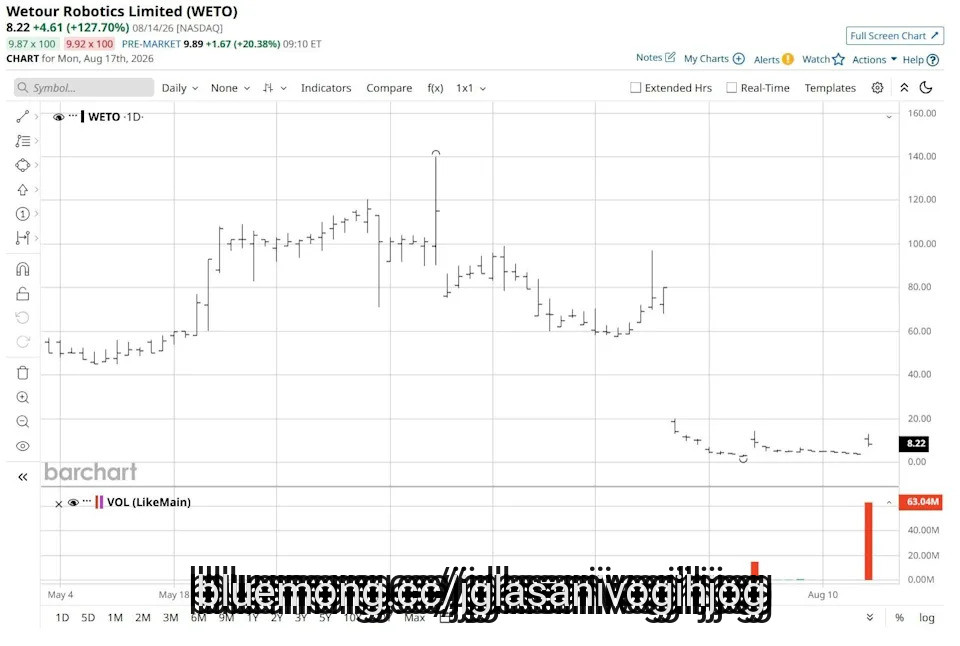
Wetour Robotics (WETO) shares have soared as speculative momentum takes hold of the physical artificial intelligence (AI) and wearable robotics company.
However, investors are advised to exercise caution as WETO is scheduled for an extraordinary general meeting (EGM) on Aug. 24, where shareholders will vote on a 100-for-1 reverse stock split.
A $210 Billion Reason to Buy AMD Stock Here
CoreWeave vs Nebius: Both Companies Reported Strong Earnings, But Here's the Stock You Should Buy
As Oracle Deepens Its Partnership with AWS, Here's How You Should Play ORCL Stock
#nebius
However, investors are advised to exercise caution as WETO is scheduled for an extraordinary general meeting (EGM) on Aug. 24, where shareholders will vote on a 100-for-1 reverse stock split.
A $210 Billion Reason to Buy AMD Stock Here
CoreWeave vs Nebius: Both Companies Reported Strong Earnings, But Here's the Stock You Should Buy
As Oracle Deepens Its Partnership with AWS, Here's How You Should Play ORCL Stock
#nebius


2 days ago
Size isn't everything in China's IPO markets.
Unitree, perhaps China's most famous humanoid robotics maker, is in the middle of an initial public offering on Shanghai's STAR market, the city's board for tech startups, with a trading debut expected for this week. Then, later this week, the fast-fashion platform Shein will reportedly start its own IPO in Hong Kong, with shares potentially debuting as soon as Aug. 28, according to Reuters.
Shein's IPO dwarfs Unitree's, with the fast fashion giant hoping to raise as much as $3 billion, roughly three times what Unitree is targeting. And yet Unitree's IPO is getting most of the attention: Retail investors are scrambling to buy into the company, and secondary markets are predicting a massive jump in valuation after the startup's debut.
Unitree may be smaller and younger compared to Shein, which has a decade of global expansion under its belt. But in the eyes of investors, the robot maker is the more exciting bet, as appetites shift to AI and hardware, and away from e-commerce and internet platforms.
Unitree, founded by ***** Xingxing in 2016, has become a fixture in China's pop culture, thanks to its robots' dance routines at the CCTV Spring Festival Gala, China's most-watched television broadcast.
Unitree is raising 6.1 billion Chinese yuan ($904 million) in its IPO, at a market valuation of around $9 billion. The company claimed last week that the retail portion of its offering was more than 8,000 times oversubscribed.
#maker
Unitree, perhaps China's most famous humanoid robotics maker, is in the middle of an initial public offering on Shanghai's STAR market, the city's board for tech startups, with a trading debut expected for this week. Then, later this week, the fast-fashion platform Shein will reportedly start its own IPO in Hong Kong, with shares potentially debuting as soon as Aug. 28, according to Reuters.
Shein's IPO dwarfs Unitree's, with the fast fashion giant hoping to raise as much as $3 billion, roughly three times what Unitree is targeting. And yet Unitree's IPO is getting most of the attention: Retail investors are scrambling to buy into the company, and secondary markets are predicting a massive jump in valuation after the startup's debut.
Unitree may be smaller and younger compared to Shein, which has a decade of global expansion under its belt. But in the eyes of investors, the robot maker is the more exciting bet, as appetites shift to AI and hardware, and away from e-commerce and internet platforms.
Unitree, founded by ***** Xingxing in 2016, has become a fixture in China's pop culture, thanks to its robots' dance routines at the CCTV Spring Festival Gala, China's most-watched television broadcast.
Unitree is raising 6.1 billion Chinese yuan ($904 million) in its IPO, at a market valuation of around $9 billion. The company claimed last week that the retail portion of its offering was more than 8,000 times oversubscribed.
#maker


3 days ago
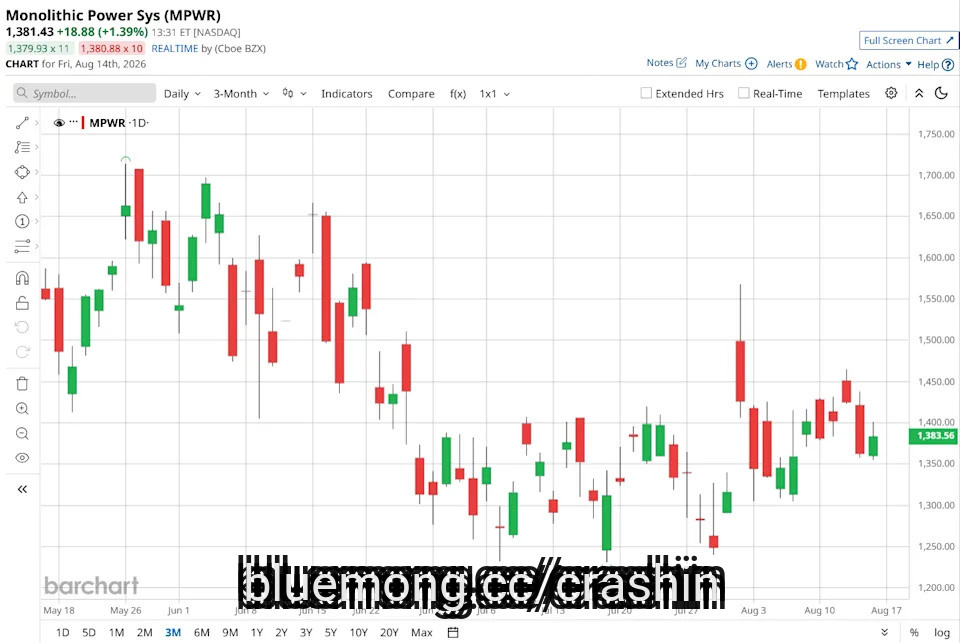
Monolithic Power Systems (MPWR) just picked up another vote of confidence. GF Securities recently initiated coverage of the stock with a "Buy" rating and a $1,706 price target, which is well above where the shares trade today. The reason comes down to one shift that keeps getting bigger. AI chips need power, and Monolithic makes the parts that deliver it. Basically, every new generation of AI chip, from Nvidia's (NVDA) older models to its upcoming ones, draws far more electricity than the last. That power has to be delivered cleanly and precisely, right next to the chip, or performance suffers. Monolithic designs those power components. In other words, as AI chips get hungrier, each one needs more of Monolithic's parts, at a higher value per chip. The company essentially sells more with every step up in AI computing power.
This isn't just a forecast, since it's already showing up in the results. Monolithic reported record revenue of $981 million last quarter, up 48% from a year earlier. The standout was its enterprise data business, the segment tied to AI and data center chips, which jumped 45% sequentially. Demand was strong enough that management raised its full-year growth target for that segment from 85% to a staggering 130%.
Stop Missing Market Moves: Get the FREE Barchart Brief – your midday dose of stock movers, trending sectors, and actionable trade ideas, delivered right to your inbox. Sign Up Now!
The company is also spreading its bets. Beyond AI, it's winning new business in the automotive sector, communications equipment, and pushing into robotics. On the earnings call, CEO Michael Hsing described the shift that the company is going through. He said Monolithic is moving from just selling chips to providing complete power solutions and called it "the highest power density company in the world."
GF Securities isn't alone in its optimism. A vast majority of Wall Street **** ysts covering Monolithic rate it a "Buy." To give you an idea of how bullish the **** ysts are, even the lowest price target of $1,575 is higher than Monolithic's current stock price. The consensus among these experts is broadly the same. As long as AI keeps demanding more power, the company making the parts that deliver it should keep growing rapidly.
#company #chip
This isn't just a forecast, since it's already showing up in the results. Monolithic reported record revenue of $981 million last quarter, up 48% from a year earlier. The standout was its enterprise data business, the segment tied to AI and data center chips, which jumped 45% sequentially. Demand was strong enough that management raised its full-year growth target for that segment from 85% to a staggering 130%.
Stop Missing Market Moves: Get the FREE Barchart Brief – your midday dose of stock movers, trending sectors, and actionable trade ideas, delivered right to your inbox. Sign Up Now!
The company is also spreading its bets. Beyond AI, it's winning new business in the automotive sector, communications equipment, and pushing into robotics. On the earnings call, CEO Michael Hsing described the shift that the company is going through. He said Monolithic is moving from just selling chips to providing complete power solutions and called it "the highest power density company in the world."
GF Securities isn't alone in its optimism. A vast majority of Wall Street **** ysts covering Monolithic rate it a "Buy." To give you an idea of how bullish the **** ysts are, even the lowest price target of $1,575 is higher than Monolithic's current stock price. The consensus among these experts is broadly the same. As long as AI keeps demanding more power, the company making the parts that deliver it should keep growing rapidly.
#company #chip



3 days ago
Benzinga and Yahoo Finance LLC may earn commission or revenue on some items through the links below.
For many Americans, retirement was once expected to come with the major financial milestone of owning a home free and clear. New research from Visa (NYSE:V) shows a rising number of older Americans are still carrying mortgage debt well into retirement.
Some 41% of homeowners between ages 65 and 79 still have mortgage debt as of 2022, according to new research from Visa. Even among homeowners age 80 and older, 31% are still making mortgage payments, up from just 3% in 1989.
Don't Miss:
Jeff Bezos Is Putting $100 Billion Behind AI Robotics — This Company Is Already Deploying Robots In Restaurant Kitchens.
#still #americans #homeowners
For many Americans, retirement was once expected to come with the major financial milestone of owning a home free and clear. New research from Visa (NYSE:V) shows a rising number of older Americans are still carrying mortgage debt well into retirement.
Some 41% of homeowners between ages 65 and 79 still have mortgage debt as of 2022, according to new research from Visa. Even among homeowners age 80 and older, 31% are still making mortgage payments, up from just 3% in 1989.
Don't Miss:
Jeff Bezos Is Putting $100 Billion Behind AI Robotics — This Company Is Already Deploying Robots In Restaurant Kitchens.
#still #americans #homeowners


6 days ago
Demand for critical minerals is growing as electric vehicles, artificial intelligence infrastructure, defense systems, and renewable energy projects require increasing amounts of rare-earth and battery metals. And that's put companies such as MP Materials (NYSE: MP) and The Metals Company (NASDAQ: TMC) squarely in the spotlight. Both operate in the critical minerals ****** e, but they do represent two very different investment stories.
MP Materials owns the Mountain Pass mine in California, the only integrated rare-earth mining and processing operation in the United States. The company has spent the past several years transforming itself from simply mining rare-earth concentrate into producing higher-value rare-earth oxides, metals, and permanent magnets used in electric vehicles, robotics, and defense applications.
Missed Nvidia in 2009? This Rare Signal Is Flashing Again. In 2009, a "Double Down" signal flashed for a little-known chipmaker called Nvidia. For the first time in years, that same "Total Conviction" signal is flashing for a company 1/100th the size of Nvidia. Continue »
And that transition is beginning to show up in the financials. Q2 2026 revenue climbed 89% year over year to $108.5 million, driven by higher sales of neodymium-praseodymium (NdPr) oxide and metal, which is used to build some of the world's strongest permanent magnets. These magnets are integral to the manufacturing of EVs, wind turbines, robotics, and defense systems.
MP also enjoys a strategic advantage that few mining companies can match. The U.S. government has become an active supporter of domestic rare-earth production as policymakers work to reduce dependence on China, which currently dominates global processing capacity. Government price support agreements and long-term supply contracts provide MP with a degree of visibility that many commodity producers lack.
#rare #earth #defense #materials
MP Materials owns the Mountain Pass mine in California, the only integrated rare-earth mining and processing operation in the United States. The company has spent the past several years transforming itself from simply mining rare-earth concentrate into producing higher-value rare-earth oxides, metals, and permanent magnets used in electric vehicles, robotics, and defense applications.
Missed Nvidia in 2009? This Rare Signal Is Flashing Again. In 2009, a "Double Down" signal flashed for a little-known chipmaker called Nvidia. For the first time in years, that same "Total Conviction" signal is flashing for a company 1/100th the size of Nvidia. Continue »
And that transition is beginning to show up in the financials. Q2 2026 revenue climbed 89% year over year to $108.5 million, driven by higher sales of neodymium-praseodymium (NdPr) oxide and metal, which is used to build some of the world's strongest permanent magnets. These magnets are integral to the manufacturing of EVs, wind turbines, robotics, and defense systems.
MP also enjoys a strategic advantage that few mining companies can match. The U.S. government has become an active supporter of domestic rare-earth production as policymakers work to reduce dependence on China, which currently dominates global processing capacity. Government price support agreements and long-term supply contracts provide MP with a degree of visibility that many commodity producers lack.
#rare #earth #defense #materials


6 days ago
MP Materials (NYSE: MP) recently announced it had signed a supply agreement with a new, unnamed customer. That news, along with its second-quarter earnings report, has proven to be quite the catalyst for the rare-earth stock, which has rallied more than 10% since the announcement.
While MP Materials has publicly named many other noteworthy new customers (e.g., Apple and the Department of Defense), it's keeping this one secret for now. All it revealed is that it's a significant long-term offtake agreement with a U.S. aerospace and defense customer for separated gadolinium, one of the 17 rare-earth metals. The customer's name isn't what's significant here. Let's break down why the deal itself matters for MP Materials stock.
Missed Nvidia in 2009? This Rare Signal Is Flashing Again. In 2009, a "Double Down" signal flashed for a little-known chipmaker called Nvidia. For the first time in years, that same "Total Conviction" signal is flashing for a company 1/100th the size of Nvidia. Continue »
MP Materials currently makes most of its revenue from NdPr oxide and metal (a fused blend of neodymium and praseodymium, two rare-earth elements). It's an important material for electric vehicles, robotics, and electronics. During the second quarter, MP Materials generated $94.4 million in revenue from NdPr oxide and metal sales, accounting for 87% of its total revenue.
With that context, let's turn to the deal. The company noted that the contract with the unnamed U.S. aerospace and defense customer is "significant" and "at attractive economics." This suggests it should be a meaningful future contributor to revenue. It's also for separated gadolinium, which will expand its HREE (heavy rare-earth elements) product portfolio, providing additional diversification. The deal also expands its customer base. That's a lot of benefits in one contract.
#NVIDIA #deal
While MP Materials has publicly named many other noteworthy new customers (e.g., Apple and the Department of Defense), it's keeping this one secret for now. All it revealed is that it's a significant long-term offtake agreement with a U.S. aerospace and defense customer for separated gadolinium, one of the 17 rare-earth metals. The customer's name isn't what's significant here. Let's break down why the deal itself matters for MP Materials stock.
Missed Nvidia in 2009? This Rare Signal Is Flashing Again. In 2009, a "Double Down" signal flashed for a little-known chipmaker called Nvidia. For the first time in years, that same "Total Conviction" signal is flashing for a company 1/100th the size of Nvidia. Continue »
MP Materials currently makes most of its revenue from NdPr oxide and metal (a fused blend of neodymium and praseodymium, two rare-earth elements). It's an important material for electric vehicles, robotics, and electronics. During the second quarter, MP Materials generated $94.4 million in revenue from NdPr oxide and metal sales, accounting for 87% of its total revenue.
With that context, let's turn to the deal. The company noted that the contract with the unnamed U.S. aerospace and defense customer is "significant" and "at attractive economics." This suggests it should be a meaningful future contributor to revenue. It's also for separated gadolinium, which will expand its HREE (heavy rare-earth elements) product portfolio, providing additional diversification. The deal also expands its customer base. That's a lot of benefits in one contract.
#NVIDIA #deal

6 days ago
On August 6, Allient (NASDAQ:ALNT) reported its second-quarter fiscal 2026 results, where revenue climbed 10% year-over-year to $153.8 million, gross margin hit a record 34.9%, and orders jumped 49% to $201.3 million, with a book-to-bill ratio of 1.31x. The company also flagged data center demand as a rising piece of its story. So is this durable, or a single strong quarter dressed up as a trend?
The breadth of the quarter stands out. Industrial revenue rose 17%, Aerospace & Defense grew 16%, and Medical increased 9% on demand for surgical robotics and other precision motion work. Data center and infrastructure sales, part of the Industrial bucket, reached $16.3 million, or 10.6% of total revenue, up 60% from a year earlier. On a trailing 12-month basis, those sales hit $57.1 million, up 69% year over year, tied to power quality products like harmonic filters and line reactors that help data centers manage increasingly dense electrical loads.
Profitability improved just as sharply. Operating income rose to $15.6 million from $11.7 million, pushing operating margin to 10.2%, the highest level in roughly a decade. Net income jumped 85% to $10.4 million, or $0.61 per diluted share, while adjusted EBITDA rose 18% to $23.7 million. Backlog ended the quarter at $298 million, with most of it expected to convert to revenue within three to nine months, giving management a clearer read on the back half of the year.
The Vehicle market was the exception to an otherwise strong quarter, with revenue falling 7% on weaker powersports demand. Aerospace & Defense growth of 16% also came despite the previously announced cancellation of the M10 Booker program, a reminder that individual defense contracts can disappear even as the broader segment grows. Management itself cautioned that the record gross margin benefited from favorable mix, and mix can be lumpy, meaning quarter-to-quarter variability should be expected even if the structural trend holds.
Restructuring and business realignment costs, tied partly to the Dothan facility transition, came in at $600,000 for the quarter and are expected to total $2 million to $3 million for the full year. Inventory turnover slipped slightly to 3.1x from 3.2x in 2025, reflecting deliberate investments in inventory and strategic material buys to support growth and hedge against tariff uncertainty. The company also noted it has submitted or expects to submit about $1.3 million in tariff refund claims tied to IEEPA, but hasn't recorded any receivable given the uncertainty around timing and amount.
#defense
The breadth of the quarter stands out. Industrial revenue rose 17%, Aerospace & Defense grew 16%, and Medical increased 9% on demand for surgical robotics and other precision motion work. Data center and infrastructure sales, part of the Industrial bucket, reached $16.3 million, or 10.6% of total revenue, up 60% from a year earlier. On a trailing 12-month basis, those sales hit $57.1 million, up 69% year over year, tied to power quality products like harmonic filters and line reactors that help data centers manage increasingly dense electrical loads.
Profitability improved just as sharply. Operating income rose to $15.6 million from $11.7 million, pushing operating margin to 10.2%, the highest level in roughly a decade. Net income jumped 85% to $10.4 million, or $0.61 per diluted share, while adjusted EBITDA rose 18% to $23.7 million. Backlog ended the quarter at $298 million, with most of it expected to convert to revenue within three to nine months, giving management a clearer read on the back half of the year.
The Vehicle market was the exception to an otherwise strong quarter, with revenue falling 7% on weaker powersports demand. Aerospace & Defense growth of 16% also came despite the previously announced cancellation of the M10 Booker program, a reminder that individual defense contracts can disappear even as the broader segment grows. Management itself cautioned that the record gross margin benefited from favorable mix, and mix can be lumpy, meaning quarter-to-quarter variability should be expected even if the structural trend holds.
Restructuring and business realignment costs, tied partly to the Dothan facility transition, came in at $600,000 for the quarter and are expected to total $2 million to $3 million for the full year. Inventory turnover slipped slightly to 3.1x from 3.2x in 2025, reflecting deliberate investments in inventory and strategic material buys to support growth and hedge against tariff uncertainty. The company also noted it has submitted or expects to submit about $1.3 million in tariff refund claims tied to IEEPA, but hasn't recorded any receivable given the uncertainty around timing and amount.
#defense


9 days ago
On August 10, Reuters reported that Sony Group (NYSE:SONY) and Taiwan Semiconductor Manufacturing (NYSE:TSM) plan to spend around $6.3 billion on a joint venture to build next-generation microchips for image sensors. It pairs Sony's sensor design expertise with TSMC's manufacturing scale, and it lands while both companies already show momentum in their core businesses.
The venture will be owned about 60% by Sony and 40% by TSMC, with commercial production targeted to start as early as 2029 at a site in ****** an's ****** amoto prefecture. The companies first announced plans to form it in May, aiming to combine Sony's design know-how with TSMC's process technology, and the partnership will also explore physical artificial intelligence applications such as automotive and robotics. Sony is already the world's largest maker of image sensors, and TSMC is the world's largest contract chipmaker.
TSMC's own numbers explain why Sony wanted it as a partner. In its second-quarter report on July 16, revenue climbed about 34% year over year to $40.2 billion and net income jumped 77% to a record, with gross margin at 67.7% and operating margin at 60.3%. The newest 2-nanometer node made up just 3% of wafer revenue in the quarter, leaving a long runway as it scales.
Sony's results carry similar momentum. First-quarter operating profit rose 40% from a year earlier, prompting the company on July 31 to raise its full-year group operating profit forecast 8% to 1.72 trillion yen, citing tariff refunds, currency effects, and cost control. Sony also raised its outlook specifically for the image sensor business, pointing to higher sales and favorable exchange rates, while its gaming division stands to benefit from the November 19 launch of Grand Theft Auto VI on PlayStation.
TSMC's valuation still carries risk. Its market cap crossed $2 trillion again on July 30, yet shares trade at roughly 20 times forward earnings, about what an average large company costs, and management is guiding third-quarter gross margin down to 65% to 67% as the costly early phase of the 2-nanometer ramp works through its factories. TSMC also remains a cyclical manufacturer based mostly in Taiwan, so geopolitical tension is a risk no earnings report can erase, and heavy capital spending could pressure returns if AI demand cools before new capacity fills.
#Margin #operating #group
The venture will be owned about 60% by Sony and 40% by TSMC, with commercial production targeted to start as early as 2029 at a site in ****** an's ****** amoto prefecture. The companies first announced plans to form it in May, aiming to combine Sony's design know-how with TSMC's process technology, and the partnership will also explore physical artificial intelligence applications such as automotive and robotics. Sony is already the world's largest maker of image sensors, and TSMC is the world's largest contract chipmaker.
TSMC's own numbers explain why Sony wanted it as a partner. In its second-quarter report on July 16, revenue climbed about 34% year over year to $40.2 billion and net income jumped 77% to a record, with gross margin at 67.7% and operating margin at 60.3%. The newest 2-nanometer node made up just 3% of wafer revenue in the quarter, leaving a long runway as it scales.
Sony's results carry similar momentum. First-quarter operating profit rose 40% from a year earlier, prompting the company on July 31 to raise its full-year group operating profit forecast 8% to 1.72 trillion yen, citing tariff refunds, currency effects, and cost control. Sony also raised its outlook specifically for the image sensor business, pointing to higher sales and favorable exchange rates, while its gaming division stands to benefit from the November 19 launch of Grand Theft Auto VI on PlayStation.
TSMC's valuation still carries risk. Its market cap crossed $2 trillion again on July 30, yet shares trade at roughly 20 times forward earnings, about what an average large company costs, and management is guiding third-quarter gross margin down to 65% to 67% as the costly early phase of the 2-nanometer ramp works through its factories. TSMC also remains a cyclical manufacturer based mostly in Taiwan, so geopolitical tension is a risk no earnings report can erase, and heavy capital spending could pressure returns if AI demand cools before new capacity fills.
#Margin #operating #group


11 days ago
Commercial **** e and defense equities continue to draw investor attention, but CNBC's Mad Money host Jim Cramer took a cautious stance on higher-risk plays in the sector on August 5. When asked about Rocket Lab Corporation (NASDAQ:RKLB), Cramer dismissed the stock as speculative while steering investors toward Voyager Technologies, Inc. (NYSE:VOYG):
Pure spec, that's the problem. It's a pure spec. I like that Voyager. We had that fella on last night, Voyager… I like the Voyager.
Cramer's preference for Voyager Technologies, Inc. (NYSE:VOYG) follows its second-quarter earnings report, which he reviewed during the August 4 episode after interviewing management. Cramer highlighted the expanding government defense contracts, sequential revenue acceleration, and a growing backlog and said:
When you look at this phenomenal run in Voyager Technologies, the **** e and defense company that makes key components for satellites, missiles, and **** ecraft, it's been racking up government contracts left and right. Last night, Voyager reported a very strong quarter with revenue up 51% just versus the previous 3 months, a narrower-than-expected loss, and the backlog jumping 22% sequentially. That's versus last quarter, not last year. Management said that demand is building faster than they can convert it into revenue. High-quality problem. They also raised their full-year revenue forecast pretty substantially. Some of that's thanks to the recent acquisition of Astrobotic. That's a **** e robotics play... The stock jumped 14% yesterday even before the quarter and then rallied another 19.6% today in response to these results, although it's still down roughly 55% from its post-IPO highs last summer. So maybe you haven't missed as much as you might think.
It is worth noting that data tracked by Insider Monkey shows shifting hedge fund sentiment between the two **** e companies entering 2026. Elite hedge fund holders in Rocket Lab Corporation (NASDAQ:RKLB) declined from 45 in the fourth quarter of 2025 to 43 in the first quarter of 2026. On the other hand, hedge fund ownership in Voyager Technologies, Inc. (NYSE:VOYG) expanded during the same period, rising from 35 holders in Q4 2025 to 37 in Q1 2026.
#technologies #revenue
Pure spec, that's the problem. It's a pure spec. I like that Voyager. We had that fella on last night, Voyager… I like the Voyager.
Cramer's preference for Voyager Technologies, Inc. (NYSE:VOYG) follows its second-quarter earnings report, which he reviewed during the August 4 episode after interviewing management. Cramer highlighted the expanding government defense contracts, sequential revenue acceleration, and a growing backlog and said:
When you look at this phenomenal run in Voyager Technologies, the **** e and defense company that makes key components for satellites, missiles, and **** ecraft, it's been racking up government contracts left and right. Last night, Voyager reported a very strong quarter with revenue up 51% just versus the previous 3 months, a narrower-than-expected loss, and the backlog jumping 22% sequentially. That's versus last quarter, not last year. Management said that demand is building faster than they can convert it into revenue. High-quality problem. They also raised their full-year revenue forecast pretty substantially. Some of that's thanks to the recent acquisition of Astrobotic. That's a **** e robotics play... The stock jumped 14% yesterday even before the quarter and then rallied another 19.6% today in response to these results, although it's still down roughly 55% from its post-IPO highs last summer. So maybe you haven't missed as much as you might think.
It is worth noting that data tracked by Insider Monkey shows shifting hedge fund sentiment between the two **** e companies entering 2026. Elite hedge fund holders in Rocket Lab Corporation (NASDAQ:RKLB) declined from 45 in the fourth quarter of 2025 to 43 in the first quarter of 2026. On the other hand, hedge fund ownership in Voyager Technologies, Inc. (NYSE:VOYG) expanded during the same period, rising from 35 holders in Q4 2025 to 37 in Q1 2026.
#technologies #revenue


11 days ago
Intuitive Surgical (NASDAQ: ISRG) can be hard to own because the stock is ***** e to deep drawdowns. It is in a drawdown right now, with the stock down roughly 40% from its early 2025 high. Even after that drop, the price-to-earnings ratio remains lofty at 42x. This is not a stock for the faint of heart.
However, if you are a growth-oriented investor, you shouldn't give up on Intuitive Surgical. Historically, the stock has recovered from deep drawdowns and gone on to reach higher highs. There's a difference this time around due to increasing competition from medical device peers such as Medtronic (NYSE: MDT) and Johnson & Johnson (NYSE: JNJ). But that probably shouldn't stop more aggressive investors. Here's why.
Missed Nvidia in 2009? This Rare Signal Is Flashing Again. In 2009, a "Double Down" signal flashed for a little-known chipmaker called Nvidia. For the first time in years, that same "Total Conviction" signal is flashing for a company 1/100th the size of Nvidia. Continue »
Intuitive Surgical was an early leader in the surgical robotics ***** e. The company's da Vinci system basically helped create the industry niche. So, early on, the question was about medical providers being willing to adopt a new technology. Surgical robotics is now a far more mature and well-accepted technology, generally enabling less invasive surgeries with better outcomes.
In late 2025, Medtronic received approval for its Hugo surgical robotic system in the United States. In mid-2026, J&J received approval for its OTTAVA surgical robot system. Both Medtronic and J&J are well-established competitors with strong industry connections. There is no doubt that they will be fierce competitors to Intuitive Surgical.
#surgical #Stock
However, if you are a growth-oriented investor, you shouldn't give up on Intuitive Surgical. Historically, the stock has recovered from deep drawdowns and gone on to reach higher highs. There's a difference this time around due to increasing competition from medical device peers such as Medtronic (NYSE: MDT) and Johnson & Johnson (NYSE: JNJ). But that probably shouldn't stop more aggressive investors. Here's why.
Missed Nvidia in 2009? This Rare Signal Is Flashing Again. In 2009, a "Double Down" signal flashed for a little-known chipmaker called Nvidia. For the first time in years, that same "Total Conviction" signal is flashing for a company 1/100th the size of Nvidia. Continue »
Intuitive Surgical was an early leader in the surgical robotics ***** e. The company's da Vinci system basically helped create the industry niche. So, early on, the question was about medical providers being willing to adopt a new technology. Surgical robotics is now a far more mature and well-accepted technology, generally enabling less invasive surgeries with better outcomes.
In late 2025, Medtronic received approval for its Hugo surgical robotic system in the United States. In mid-2026, J&J received approval for its OTTAVA surgical robot system. Both Medtronic and J&J are well-established competitors with strong industry connections. There is no doubt that they will be fierce competitors to Intuitive Surgical.
#surgical #Stock

12 days ago
Our **** ysts just identified a stock with the potential to be the next Nvidia. Tell us how you invest and we'll show you why it's our #1 pick. Tap here.
Achieved 4% currency-neutral net sales growth driven by the One Interface strategy, which integrates global functions to support local selling teams and enhances commercial productivity.
Performance was broad-based across all regions and segments, with Healthcare notably delivering 19% global billings growth on top of a 28% comp from the prior year.
Operational improvements, including automation and robotics in Europe and Australia, contributed significantly to margin expansion by reducing costs and increasing throughput.
The Corporate Office segment grew 5% globally, benefiting from a 'flight to quality' in Class A **** es and the need for companies to redesign offices for collaboration and talent retention.
#NVIDIA #Europe
Achieved 4% currency-neutral net sales growth driven by the One Interface strategy, which integrates global functions to support local selling teams and enhances commercial productivity.
Performance was broad-based across all regions and segments, with Healthcare notably delivering 19% global billings growth on top of a 28% comp from the prior year.
Operational improvements, including automation and robotics in Europe and Australia, contributed significantly to margin expansion by reducing costs and increasing throughput.
The Corporate Office segment grew 5% globally, benefiting from a 'flight to quality' in Class A **** es and the need for companies to redesign offices for collaboration and talent retention.
#NVIDIA #Europe


14 days ago
Shares of Medtronic (NYSE: MDT), one of the world's largest medical device makers, have declined by more than 30% over the past five years. Higher costs, supply chain bottlenecks, quality control issues, and competitive pressure in surgical robotics all weighed on its stock.
Yet Wall Street remains bullish on Medtronic, with an average price target of $98.44 and a top target of $121. I believe it could rise more than 40% from its current price of $86 and hit that high-end target by the end of this year for a few simple reasons.
Missed Nvidia in 2009? This Rare Signal Is Flashing Again. In 2009, a "Double Down" signal flashed for a little-known chipmaker called Nvidia. For the first time in years, that same "Total Conviction" signal is flashing for a company 1/100th the size of Nvidia. Continue »
Back in March, Medtronic spun off its diabetes unit as MiniMed (NASDAQ: MMED) to streamline its business. It's also restructuring its business to expand its higher-margin cardiovascular and neuroscience portfolios and to integrate more AI features into its surgical planning products.
In fiscal 2026 (which ended in April), Medtronic's revenue grew 8.4% to $36.4 billion (or 5.8% organically) and marked its strongest top-line growth in ten years. From fiscal 2026 to fiscal 2029, **** ysts expect its revenue and EPS to grow at CAGRs of 5% and 13%, respectively.
#NVIDIA #years #surgical
Yet Wall Street remains bullish on Medtronic, with an average price target of $98.44 and a top target of $121. I believe it could rise more than 40% from its current price of $86 and hit that high-end target by the end of this year for a few simple reasons.
Missed Nvidia in 2009? This Rare Signal Is Flashing Again. In 2009, a "Double Down" signal flashed for a little-known chipmaker called Nvidia. For the first time in years, that same "Total Conviction" signal is flashing for a company 1/100th the size of Nvidia. Continue »
Back in March, Medtronic spun off its diabetes unit as MiniMed (NASDAQ: MMED) to streamline its business. It's also restructuring its business to expand its higher-margin cardiovascular and neuroscience portfolios and to integrate more AI features into its surgical planning products.
In fiscal 2026 (which ended in April), Medtronic's revenue grew 8.4% to $36.4 billion (or 5.8% organically) and marked its strongest top-line growth in ten years. From fiscal 2026 to fiscal 2029, **** ysts expect its revenue and EPS to grow at CAGRs of 5% and 13%, respectively.
#NVIDIA #years #surgical


15 days ago
A warehouse robotics company is generating cash like a high-yield bond, yet the market is pricing it as if that cash flow could vanish.
Symbotic (SYM) builds the AI-powered robot fleets that automate large warehouses. Yet for a company at the center of physical automation, its stock has performed poorly, returning -15.0% over the past year and trading about 47% below its 52-week high. This has created a stark mathematical divide. The market appears to be pricing Symbotic for significant risk, but its financial profile tells a story of high, stable cash generation and growth.
The question is simple: Is the market right to demand such a high return for the perceived risk, or is it overlooking a cash-generating machine that also grows?
This Coupon Pays 13.0% and Is Growing
An investor today has a choice. You can lend to the U.S. government for 10 years and receive a 4.8% yield, the risk-free rate. Or you can own a piece of Symbotic, whose free cash flow alone provides a 13.0% yield at the current price. That is a spread of 8.2% over the safest **** et available. This isn't a one-time event driven by accounting quirks; the company's 3-year average free-cash-flow yield is a still-healthy 8.0%.
#free #generating
Symbotic (SYM) builds the AI-powered robot fleets that automate large warehouses. Yet for a company at the center of physical automation, its stock has performed poorly, returning -15.0% over the past year and trading about 47% below its 52-week high. This has created a stark mathematical divide. The market appears to be pricing Symbotic for significant risk, but its financial profile tells a story of high, stable cash generation and growth.
The question is simple: Is the market right to demand such a high return for the perceived risk, or is it overlooking a cash-generating machine that also grows?
This Coupon Pays 13.0% and Is Growing
An investor today has a choice. You can lend to the U.S. government for 10 years and receive a 4.8% yield, the risk-free rate. Or you can own a piece of Symbotic, whose free cash flow alone provides a 13.0% yield at the current price. That is a spread of 8.2% over the safest **** et available. This isn't a one-time event driven by accounting quirks; the company's 3-year average free-cash-flow yield is a still-healthy 8.0%.
#free #generating


15 days ago
By Samuel Shen and Yantoultra Ngui
SHANGHAI/SINGAPORE, Aug 4 (Reuters) - Chinese robot maker Unitree Technology is expected to be valued at more than 50 billion yuan ($7.4 billion) after its planned Shanghai IPO, according to a report by Citic Securities, which is sponsoring the initial public offering.
Citic Securities expected the Hangzhou-based company to be worth 50.6 billion to 55.9 billion yuan six to 12 months after listing later this month. The valuation report, distributed to investors and seen by Reuters, is largely seen as guidance ahead of Wednesday's IPO price enquiry.
Unitree, which competes with Tesla and Boston Dynamics in making humanoid robots, aims to raise 4.2 billion yuan to fund innovation and production.
Robotics is seen as one of China's strategic industries key to Beijing's tech rivalry with Washington.
#shanghai #reuters #unitree #securities
SHANGHAI/SINGAPORE, Aug 4 (Reuters) - Chinese robot maker Unitree Technology is expected to be valued at more than 50 billion yuan ($7.4 billion) after its planned Shanghai IPO, according to a report by Citic Securities, which is sponsoring the initial public offering.
Citic Securities expected the Hangzhou-based company to be worth 50.6 billion to 55.9 billion yuan six to 12 months after listing later this month. The valuation report, distributed to investors and seen by Reuters, is largely seen as guidance ahead of Wednesday's IPO price enquiry.
Unitree, which competes with Tesla and Boston Dynamics in making humanoid robots, aims to raise 4.2 billion yuan to fund innovation and production.
Robotics is seen as one of China's strategic industries key to Beijing's tech rivalry with Washington.
#shanghai #reuters #unitree #securities



20 days ago
This story was originally published on Construction Dive. To receive daily news and insights, subscribe to our free daily Construction Dive newsletter.
Contech giant Procore has entered an agreement to acquire DroneDeploy, a prominent robotics and visual intelligence platform that's used in over 180 countries, according to a Wednesday announcement. Procore will acquire the firm for $845 million in cash, subject to customary purchase price adjustments.
When the acquisition closes later this year, Procore and DroneDeploy will sell one another's solutions to their client base, Ajei Gopal, president and CEO of Procore, said in the announcement.
The combination will create a veritable ocean of construction data. By pairing the two tech companies' capabilities, builders will be able to use cameras, drones and robots to regularly evaluate jobsites and automatically initiate appropriate responses securely, compliantly and in context, per the announcement.
The deal underscores the power of data control in a landscape dominated by artificial intelligence. Simply put, data is king.
#data #dive #intelligence
Contech giant Procore has entered an agreement to acquire DroneDeploy, a prominent robotics and visual intelligence platform that's used in over 180 countries, according to a Wednesday announcement. Procore will acquire the firm for $845 million in cash, subject to customary purchase price adjustments.
When the acquisition closes later this year, Procore and DroneDeploy will sell one another's solutions to their client base, Ajei Gopal, president and CEO of Procore, said in the announcement.
The combination will create a veritable ocean of construction data. By pairing the two tech companies' capabilities, builders will be able to use cameras, drones and robots to regularly evaluate jobsites and automatically initiate appropriate responses securely, compliantly and in context, per the announcement.
The deal underscores the power of data control in a landscape dominated by artificial intelligence. Simply put, data is king.
#data #dive #intelligence

20 days ago
Arete Research, an independent research firm, has upgraded Texas Instruments Incorporated (NASDAQ:TXN) to Buy from Neutral and lifted its price target to $405 from $303. This 34% raise in the PT comes days after the company posted a strong quarter – a surprise from an ***** og cyclical sector. Texas Instruments' Q2 revenue reached $5.46 billion, up 23% year-over-year, beating the $5.24 billion consensus. The company's EPS rose 52% year-over-year, beating the $1.92 Street estimate with $2.14. The most crucial piece of information tucked away in the report is the twofold growth in data center income.
According to an Arete Research ***** yst, the surging AI demand is anticipated to cause three years of ***** og semiconductor shortages. The ***** yst believes that Texas Instruments is well-positioned with respect to capacity, which should yield significant market share gains during this cycle. Arete projects revenue of approximately $34 billion with earnings of $17 per share by fiscal 2028. These structural tailwinds, discussed by the ***** yst, align with the company's operational and financial performance. Let's break them down.
The AI buildout faces one severe bottleneck – power shortage. And power is exactly what Texas Instruments, nicknamed by the market as "boring ***** og," sells. Hyperscalers are shifting toward 800-volt DC architectures to support denser GPU clusters. As a result, the need for ***** og content per rack increases. Texas Instruments serves this critical conversion layer through high-voltage gallium-nitride (GaN) power devices, real-time motor control, and sensing technology. Additionally, the company's March collaboration with Nvidia on humanoid robotics expands this portfolio. These demands fuel the quarterly ***** og revenue, which rose 26% to $4.37 billion. Texas Instruments is not relying on an industrial market recovery but is working on strengthening its position as a significant supplier for technology's most capital-intensive infrastructure cycle.
A more durable driver stems from timing rather than the AI narrative. Texas Instruments is completing a six-year, roughly $24 billion fab expansion that constrained free cash flow. Spending is dropping significantly. The 2026 capex projected at $2 billion to $3 billion stands in contrast to the comparatively high $4.55 billion in 2025. The fabs are complete, and revenue is recovering now, allowing management to anticipate free cash flow per share exceeding $8 in 2026, compared to $3.23 in 2025. Cash generation is tripling alongside declining capital expenditure, altering the investment profile investors have avoided during the build.
#instruments #analog #Research #cash
According to an Arete Research ***** yst, the surging AI demand is anticipated to cause three years of ***** og semiconductor shortages. The ***** yst believes that Texas Instruments is well-positioned with respect to capacity, which should yield significant market share gains during this cycle. Arete projects revenue of approximately $34 billion with earnings of $17 per share by fiscal 2028. These structural tailwinds, discussed by the ***** yst, align with the company's operational and financial performance. Let's break them down.
The AI buildout faces one severe bottleneck – power shortage. And power is exactly what Texas Instruments, nicknamed by the market as "boring ***** og," sells. Hyperscalers are shifting toward 800-volt DC architectures to support denser GPU clusters. As a result, the need for ***** og content per rack increases. Texas Instruments serves this critical conversion layer through high-voltage gallium-nitride (GaN) power devices, real-time motor control, and sensing technology. Additionally, the company's March collaboration with Nvidia on humanoid robotics expands this portfolio. These demands fuel the quarterly ***** og revenue, which rose 26% to $4.37 billion. Texas Instruments is not relying on an industrial market recovery but is working on strengthening its position as a significant supplier for technology's most capital-intensive infrastructure cycle.
A more durable driver stems from timing rather than the AI narrative. Texas Instruments is completing a six-year, roughly $24 billion fab expansion that constrained free cash flow. Spending is dropping significantly. The 2026 capex projected at $2 billion to $3 billion stands in contrast to the comparatively high $4.55 billion in 2025. The fabs are complete, and revenue is recovering now, allowing management to anticipate free cash flow per share exceeding $8 in 2026, compared to $3.23 in 2025. Cash generation is tripling alongside declining capital expenditure, altering the investment profile investors have avoided during the build.
#instruments #analog #Research #cash


20 days ago
Can the world's newest technology give a boost to one of transportation's oldest? A plan by leading Asia companies wants to find out.
Nvidia and Kawasaki Heavy Industries announced a joint effort to build a "next‑generation digital shipyard" at Kawasaki's Sakaide Works in ****** an.
The core of the deal is co‑development of AI‑powered robots for shipbuilding tasks such as welding, painting, inspection, and material handling.
Kawasaki (OTC: KWHIY) will contribute decades of shipbuilding data, production know‑how, and its own robotics capabilities. Nvidia (NASDAQ: NVDA) will contribute its AI and simulation stack, including products for applications in digital twins, robotics, vision/AI, and edge AI, which applies AI models and algorithms directly to devices such as sensors, cameras, robots, vehicles, or industrial controllers.
One report notes Nvidia making a $5 million investment connected to this 1990s‑era Kawasaki shipbuilding business as part of the arrangement, though the main value is technology integration rather than large equity stakes in shipyards.
#NVIDIA #shipbuilding #technology #heavy
Nvidia and Kawasaki Heavy Industries announced a joint effort to build a "next‑generation digital shipyard" at Kawasaki's Sakaide Works in ****** an.
The core of the deal is co‑development of AI‑powered robots for shipbuilding tasks such as welding, painting, inspection, and material handling.
Kawasaki (OTC: KWHIY) will contribute decades of shipbuilding data, production know‑how, and its own robotics capabilities. Nvidia (NASDAQ: NVDA) will contribute its AI and simulation stack, including products for applications in digital twins, robotics, vision/AI, and edge AI, which applies AI models and algorithms directly to devices such as sensors, cameras, robots, vehicles, or industrial controllers.
One report notes Nvidia making a $5 million investment connected to this 1990s‑era Kawasaki shipbuilding business as part of the arrangement, though the main value is technology integration rather than large equity stakes in shipyards.
#NVIDIA #shipbuilding #technology #heavy


20 days ago
Carillon Tower Advisers, an investment management company, released its second-quarter 2026 investor letter for the "Carillon Eagle Mid Cap Growth Fund". A copy of the letter is available to download here. Mid-cap stocks delivered strong results, with the Russell Midcap® Growth Index rising 14.55% and slightly outperforming the Russell Midcap® Value Index's 13.40% gain. Information technology led the growth index with a 36.90% return, while industrials also outperformed, and energy was the only sector to decline. The quarter was supported by resilient corporate earnings, economic growth and AI infrastructure spending, although geopolitical tensions, higher energy prices and election-related uncertainty could create volatility. The firm remains optimistic that data-center investment will support technology, energy, defense and automation companies, while attractive healthcare valuations and stronger merger activity could create opportunities. However, financials and consumer stocks face mixed conditions because of housing weakness, inflation and uneven spending. In addition, please check the Fund's top five holdings to know its best picks in 2026.
In its second-quarter 2026 investor letter, Carillon Eagle Mid Cap Growth Fund highlighted Teradyne, Inc. (NASDAQ:TER). Teradyne, Inc. (NASDAQ:TER) engages in the design, development, manufacture, and sale of automated test systems and robotics products. On July 29, 2026, Teradyne, Inc. (NASDAQ:TER) closed at $319.41 per share. One-month return of Teradyne, Inc. (NASDAQ:TER) was -13.46% and its shares gained 197.32% over the past 52 weeks. Teradyne, Inc. (NASDAQ:TER) has a market capitalization of $50 billion.
Carillon Eagle Mid Cap Growth Fund stated the following regarding Teradyne, Inc. (NASDAQ:TER) in its Q2 2026 investor letter:
"Teradyne, Inc. (NASDAQ:TER) provides tester equipment for the semiconductor industry and other end markets. AI-related demand for memory and custom silicon chips has led to very strong orders for Teradyne's equipment. Investors also have appreciated the company's potential to take market share from some of its largest customers."
Teradyne, Inc. (NASDAQ:TER) is not on our list of the 40 Most Popular Stocks Among Hedge Funds. As per our database, 80 hedge fund portfolios held Teradyne, Inc. (NASDAQ:TER) at the end of the first quarter which was 77 in the previous quarter. While we acknowledge the risk and potential of Teradyne, Inc. (NASDAQ:TER) as an investment, our conviction lies in the belief that some AI stocks hold greater promise for delivering higher returns and doing so within a shorter time frame. If you are looking for an AI stock that is more promising than Teradyne, Inc. (NASDAQ:TER) and that has 10,000% upside potential, check out our report about this cheapest AI stock.
#carillon #fund #letter #investment
In its second-quarter 2026 investor letter, Carillon Eagle Mid Cap Growth Fund highlighted Teradyne, Inc. (NASDAQ:TER). Teradyne, Inc. (NASDAQ:TER) engages in the design, development, manufacture, and sale of automated test systems and robotics products. On July 29, 2026, Teradyne, Inc. (NASDAQ:TER) closed at $319.41 per share. One-month return of Teradyne, Inc. (NASDAQ:TER) was -13.46% and its shares gained 197.32% over the past 52 weeks. Teradyne, Inc. (NASDAQ:TER) has a market capitalization of $50 billion.
Carillon Eagle Mid Cap Growth Fund stated the following regarding Teradyne, Inc. (NASDAQ:TER) in its Q2 2026 investor letter:
"Teradyne, Inc. (NASDAQ:TER) provides tester equipment for the semiconductor industry and other end markets. AI-related demand for memory and custom silicon chips has led to very strong orders for Teradyne's equipment. Investors also have appreciated the company's potential to take market share from some of its largest customers."
Teradyne, Inc. (NASDAQ:TER) is not on our list of the 40 Most Popular Stocks Among Hedge Funds. As per our database, 80 hedge fund portfolios held Teradyne, Inc. (NASDAQ:TER) at the end of the first quarter which was 77 in the previous quarter. While we acknowledge the risk and potential of Teradyne, Inc. (NASDAQ:TER) as an investment, our conviction lies in the belief that some AI stocks hold greater promise for delivering higher returns and doing so within a shorter time frame. If you are looking for an AI stock that is more promising than Teradyne, Inc. (NASDAQ:TER) and that has 10,000% upside potential, check out our report about this cheapest AI stock.
#carillon #fund #letter #investment

21 days ago
Our ******* ysts just identified a stock with the potential to be the next Nvidia. Tell us how you invest and we'll show you why it's our #1 pick. Tap here.
Record revenue exceeding $1.3 billion was driven by AI demand across all business groups, with AI-related revenue now accounting for more than 60% of total sales.
The company is executing a 'wafer-to-data-center' strategy, capitalizing on the fact that data center build-outs are now primary growth drivers for flash memory, hard disk drives, and robotics.
Management identifies a fundamental shift where the Automated Test Equipment (ATE) market is now outpacing wafer fab equipment (WFE) growth due to increased transistor and bit density.
Advanced packaging is acting as a significant tailwind, as complex multi-chip packages increase test intensity per die to maintain acceptable quality levels.
#revenue #data
Record revenue exceeding $1.3 billion was driven by AI demand across all business groups, with AI-related revenue now accounting for more than 60% of total sales.
The company is executing a 'wafer-to-data-center' strategy, capitalizing on the fact that data center build-outs are now primary growth drivers for flash memory, hard disk drives, and robotics.
Management identifies a fundamental shift where the Automated Test Equipment (ATE) market is now outpacing wafer fab equipment (WFE) growth due to increased transistor and bit density.
Advanced packaging is acting as a significant tailwind, as complex multi-chip packages increase test intensity per die to maintain acceptable quality levels.
#revenue #data

23 days ago
The Trump administration is weighing whether to extend access to some Chinese rare earth materials beyond the January 1, 2027 cutoff after U.S. producers acknowledged they cannot build sufficient domestic processing and magnet capacity before the deadline, Reuters reported on Monday.
Industry executives and Pentagon suppliers told Reuters that U.S. processing and magnet manufacturing capacity remains insufficient to meet despite billions of dollars in federal support for new mines, separation facilities and downstream manufacturing.
The gap threatens not only military procurement but also supply chains serving electric vehicles, offshore wind, robotics, data centers and other energy-intensive industries that depend on high-performance permanent magnets.
The shortage centers on neodymium-iron-boron (NdFeB) and samarium-cobalt magnets, which rely on rare earth supply chains that China continues to dominate. Beijing still controls the overwhelming majority of global rare earth refining and permanent magnet production, giving it enormous leverage over downstream manufacturing even as Western governments accelerate efforts to diversify supply.
While the United States has made meaningful progress expanding domestic mining, processing, alloy production and magnet manufacturing require specialized infrastructure that has taken China decades to develop.
#earth #supply
Industry executives and Pentagon suppliers told Reuters that U.S. processing and magnet manufacturing capacity remains insufficient to meet despite billions of dollars in federal support for new mines, separation facilities and downstream manufacturing.
The gap threatens not only military procurement but also supply chains serving electric vehicles, offshore wind, robotics, data centers and other energy-intensive industries that depend on high-performance permanent magnets.
The shortage centers on neodymium-iron-boron (NdFeB) and samarium-cobalt magnets, which rely on rare earth supply chains that China continues to dominate. Beijing still controls the overwhelming majority of global rare earth refining and permanent magnet production, giving it enormous leverage over downstream manufacturing even as Western governments accelerate efforts to diversify supply.
While the United States has made meaningful progress expanding domestic mining, processing, alloy production and magnet manufacturing require specialized infrastructure that has taken China decades to develop.
#earth #supply


23 days ago
WS Amati Global Innovation Fund, managed by a UK-based equity management firm from AMAti Global Investors, released its second quarter 2026 investor letter. A copy of the letter is available to download here. Financial market performance in the second quarter was dominated by geopolitical conflict and enthusiasm for AI. Significant investments across all elements of AI resulted in exceptional growth for related companies, ranging from chip producers to companies constructing data centres. The fund outperformed the MSCI ACWI benchmark due to its diversified exposure beyond headline AI firms, with semiconductor and equipment suppliers being major contributors. At the same time, software and IT services faced investor skepticism due to fears of automation despite long-term potential. The firm is confident in the innovation frontiers to capture long-term growth opportunities in automation, semiconductors, and advanced technologies. In addition, please check the Strategy's top five holdings to know its best picks in 2026.
In its Q2 2026 investor letter, WS Amati Global Innovation Fund highlighted Allegro MicroSystems, Inc. (NASDAQ:ALGM). Allegro MicroSystems, Inc. (NASDAQ:ALGM) is a semiconductor company that develops sensor integrated circuits (ICs) and application-specific power ICs for sensing, motion control, and power management functions. On July 24, 2026, Allegro MicroSystems, Inc. (NASDAQ:ALGM) closed at $46.03 per share, reflecting a market capitalization of $8.58 billion. Allegro MicroSystems, Inc. (NASDAQ:ALGM) posted a one-month return of -32.12%, while its shares gained 31.09% over the past 52 weeks.
WS Amati Global Innovation Fund stated the following regarding Allegro MicroSystems, Inc. (NASDAQ:ALGM) in its Q2 2026 investor update:
"Allegro MicroSystems, Inc. (NASDAQ:ALGM) is perhaps better known as a sensor company, creating advanced position and movement sensors for use in areas such as robotics. However as a provider of specialist semiconductor chips into the datacentre market they too saw a sharp increase in demand, as well as share price performance."
Allegro MicroSystems, Inc. (NASDAQ:ALGM) is not on our list of 40 Most Popular Stocks Among Hedge Funds Heading Into 2026. According to our database, 34 hedge fund portfolios held Allegro MicroSystems, Inc. (NASDAQ:ALGM) at the end of the first quarter, up from 28 in the previous quarter. While we acknowledge the potential of Allegro MicroSystems, Inc. (NASDAQ:ALGM) as an investment, we believe certain AI stocks offer greater upside potential and carry less downside risk. If you're looking for an extremely undervalued AI stock that also stands to benefit significantly from Trump-era tariffs and the onshoring trend, see our free report on the best short-term AI stock.
#allegro #algm #investor
In its Q2 2026 investor letter, WS Amati Global Innovation Fund highlighted Allegro MicroSystems, Inc. (NASDAQ:ALGM). Allegro MicroSystems, Inc. (NASDAQ:ALGM) is a semiconductor company that develops sensor integrated circuits (ICs) and application-specific power ICs for sensing, motion control, and power management functions. On July 24, 2026, Allegro MicroSystems, Inc. (NASDAQ:ALGM) closed at $46.03 per share, reflecting a market capitalization of $8.58 billion. Allegro MicroSystems, Inc. (NASDAQ:ALGM) posted a one-month return of -32.12%, while its shares gained 31.09% over the past 52 weeks.
WS Amati Global Innovation Fund stated the following regarding Allegro MicroSystems, Inc. (NASDAQ:ALGM) in its Q2 2026 investor update:
"Allegro MicroSystems, Inc. (NASDAQ:ALGM) is perhaps better known as a sensor company, creating advanced position and movement sensors for use in areas such as robotics. However as a provider of specialist semiconductor chips into the datacentre market they too saw a sharp increase in demand, as well as share price performance."
Allegro MicroSystems, Inc. (NASDAQ:ALGM) is not on our list of 40 Most Popular Stocks Among Hedge Funds Heading Into 2026. According to our database, 34 hedge fund portfolios held Allegro MicroSystems, Inc. (NASDAQ:ALGM) at the end of the first quarter, up from 28 in the previous quarter. While we acknowledge the potential of Allegro MicroSystems, Inc. (NASDAQ:ALGM) as an investment, we believe certain AI stocks offer greater upside potential and carry less downside risk. If you're looking for an extremely undervalued AI stock that also stands to benefit significantly from Trump-era tariffs and the onshoring trend, see our free report on the best short-term AI stock.
#allegro #algm #investor

27 days ago
Tesla (NASDAQ:TSLA), the global electric-vehicle, battery storage, and autonomous driving platform, closed at $319.69, down 14.52%. Thursday's drop followed an earnings miss and heavier AI and robotics spending. Investors will continue watching margins with another focus on autonomous-driving guidance next.
Trading volume reached 114.2 million shares, coming in about 131% above its three-month average of 49.4 million shares.
Tesla IPO'd in 2010 and has grown 20,006% since going public.
The S&P 500 (SNPINDEX:^GSPC) fell 1.21% to 7,408.30, and the Nasdaq Composite (NASDAQINDEX:^IXIC) dropped 2.15% to 25,138. Among electric vehicle manufacturing peers, Rivian Automotive (NASDAQ:RIVN) closed at $16.46, down 4.19%, and Lucid Group (NASDAQ:LCID) closed at $6.45, down 4.87%, reflecting pressure across EV names.
Tesla's revenue soared in Q2, driven by a surge in EV unit volume. Deliveries jumped 25% year over year, and revenue gains came close to matching that. Yet profits dropped, and free cash flow turned negative as operating expenses and capital spending soared.
Analysts lowered their price targets for Tesla following the earnings miss, citing margin pressure and cautious guidance on autonomous driving.
The future direction of Tesla stock will depend on what investors prioritize. Competition in the EV market has put pricing pressure on Tesla, which it is offsetting with volume. But that additional revenue isn't reaching the bottom line because of the company's growth investments and expenses.
#revenue
Trading volume reached 114.2 million shares, coming in about 131% above its three-month average of 49.4 million shares.
Tesla IPO'd in 2010 and has grown 20,006% since going public.
The S&P 500 (SNPINDEX:^GSPC) fell 1.21% to 7,408.30, and the Nasdaq Composite (NASDAQINDEX:^IXIC) dropped 2.15% to 25,138. Among electric vehicle manufacturing peers, Rivian Automotive (NASDAQ:RIVN) closed at $16.46, down 4.19%, and Lucid Group (NASDAQ:LCID) closed at $6.45, down 4.87%, reflecting pressure across EV names.
Tesla's revenue soared in Q2, driven by a surge in EV unit volume. Deliveries jumped 25% year over year, and revenue gains came close to matching that. Yet profits dropped, and free cash flow turned negative as operating expenses and capital spending soared.
Analysts lowered their price targets for Tesla following the earnings miss, citing margin pressure and cautious guidance on autonomous driving.
The future direction of Tesla stock will depend on what investors prioritize. Competition in the EV market has put pricing pressure on Tesla, which it is offsetting with volume. But that additional revenue isn't reaching the bottom line because of the company's growth investments and expenses.
#revenue

27 days ago
Tesla reported second-quarter revenue of $28.24 billion, up 26% year over year, while executives highlighted progress toward launching production of the Tesla Semi Class 8 electric truck at its Nevada manufacturing facility.
Austin, Texas-based Tesla (Nasdaq: TSLA) released its second-quarter earnings and held a conference call with ******* ysts after the market closed on Wednesday.
The company generated $20.5 billion in automotive revenue during the quarter, delivered a record 480,126 vehicles worldwide and reported diluted earnings per share of 32 cents.
Operating income totaled $398 million, reflecting higher research and development spending in artificial intelligence, robotics, battery manufacturing and commercial vehicle production.
Tesla CEO Elon Musk said the company is entering what they described as its largest investment cycle, with spending focused on expanding manufacturing capacity across several businesses, including the Tesla Semi program.
#quarter #Manufacturing #semi #year
Austin, Texas-based Tesla (Nasdaq: TSLA) released its second-quarter earnings and held a conference call with ******* ysts after the market closed on Wednesday.
The company generated $20.5 billion in automotive revenue during the quarter, delivered a record 480,126 vehicles worldwide and reported diluted earnings per share of 32 cents.
Operating income totaled $398 million, reflecting higher research and development spending in artificial intelligence, robotics, battery manufacturing and commercial vehicle production.
Tesla CEO Elon Musk said the company is entering what they described as its largest investment cycle, with spending focused on expanding manufacturing capacity across several businesses, including the Tesla Semi program.
#quarter #Manufacturing #semi #year

27 days ago
July 23 (Reuters) - Amnon Shashua, CEO of Mobileye since founding it in 1999, will step down, just as the autonomous-driving technology firm makes a big push into a robotaxi service and robotics.
The company also forecast a 5% to 6% revenue drop for the third quarter, overshadowing its strong April-June showing and sending shares down about 15% in their steepest single-day drop since August 2024.
Shashua's resignation marks Mobileye's biggest leadership change, coming after he steered the firm through a $15.3 billion buyout by Intel in 2017 and a 2022 return to public markets, though the stock has fallen 60% since the debut on uneven demand.
Shashua did not give a reason for his resignation, but said that it was the "right moment to establish the leadership structure that will be best suited for Mobileye's next chapter."
He will step down once Mobileye appoints a successor and has been offered the role of chairman and will stay on as a director.
#drop #resignation
The company also forecast a 5% to 6% revenue drop for the third quarter, overshadowing its strong April-June showing and sending shares down about 15% in their steepest single-day drop since August 2024.
Shashua's resignation marks Mobileye's biggest leadership change, coming after he steered the firm through a $15.3 billion buyout by Intel in 2017 and a 2022 return to public markets, though the stock has fallen 60% since the debut on uneven demand.
Shashua did not give a reason for his resignation, but said that it was the "right moment to establish the leadership structure that will be best suited for Mobileye's next chapter."
He will step down once Mobileye appoints a successor and has been offered the role of chairman and will stay on as a director.
#drop #resignation



27 days ago
Tesla (NASDAQ:TSLA) shares fell more than 5% in premarket trading on Thursday after the electric vehicle maker reported earnings below market expectations, with softer automotive margins and negative free cash flow overshadowing record vehicle deliveries and continued investment in artificial intelligence.
The results reinforced investor concerns about the company's ability to balance heavy spending on future technologies with near-term profitability.
Tesla reported capital expenditure of $5.8 billion during the second quarter as it continued investing heavily in autonomous driving, robotics and artificial intelligence.
Chief Executive Elon Musk acknowledged the scale of the investment programme, telling investors, "This is a massive capex year," while adding that the spending is expected to eventually "yield incredible returns."
The company generated negative free cash flow of $1.1 billion during the quarter, its first negative reading in two years, reflecting the financial impact of its long-term growth strategy.
#cash #flow #investment #artificial
The results reinforced investor concerns about the company's ability to balance heavy spending on future technologies with near-term profitability.
Tesla reported capital expenditure of $5.8 billion during the second quarter as it continued investing heavily in autonomous driving, robotics and artificial intelligence.
Chief Executive Elon Musk acknowledged the scale of the investment programme, telling investors, "This is a massive capex year," while adding that the spending is expected to eventually "yield incredible returns."
The company generated negative free cash flow of $1.1 billion during the quarter, its first negative reading in two years, reflecting the financial impact of its long-term growth strategy.
#cash #flow #investment #artificial

28 days ago
By
Updated July 22, 2026 7:13 pm ET
Listen
(1 min)
With its eye on an AI- and robotics-driven future, automaker Tesla TSLA -14.52%
decrease; down pointing triangle
boosted its spending to $5.8 billion in the second quarter, sending its free cash flow into the red for the first time in two years despite a surge in revenue.
#robotics #future
Updated July 22, 2026 7:13 pm ET
Listen
(1 min)
With its eye on an AI- and robotics-driven future, automaker Tesla TSLA -14.52%
decrease; down pointing triangle
boosted its spending to $5.8 billion in the second quarter, sending its free cash flow into the red for the first time in two years despite a surge in revenue.
#robotics #future