
51 mins. ago
SailPoint Inc. (NASDAQ:SAIL), a leading player within the enterprise identity security ***** e, released its fiscal second-quarter 2027 on September 9. The company registered a 25% growth in its annual recurring revenue compared to the same period last year, with figures of $1.231 billion. This was driven by a 36% expansion in SaaS ARR which clocked in at $847 million. SailPoint generated $45 million in operating cash flow during the quarter, along with $37 million in free cash flow.
Burben/Shutterstock.com
Topline for the quarter hit $309 million, exhibiting 17% growth compared to Q2 FY26, amid several underlying factors. The company's subscription revenue reached $295 million, up 19% from a year earlier. SaaS customer base increased by 16%, with net new SaaS ARR jumping 34% year-over-year. It contributed around 97% to overall net new ARR for the business, with AI-driven ARR crossing $70 million mark.
SailPoint's existing customer base showed highly encouraging trends in adopting the company's AI-enabled solutions, with a 60% increase in their annual spend during the second quarter. These solutions were incorporated within more than two-thirds of the completed migrations during the quarter. Quarterly adjusted operating income increased from $54 million a year prior to $63 million, translating into an adjusted margin of 20%.
The quarter also saw key strategic moves by the management. It introduced the SailPoint Identity Security solution, which integrates SailPoint Agentic Fabric with SailPoint Human Fabric to deliver a real-time cycle for discovering and securing intricate digital ecosystems. The company also launched its Cursor Enterprise connector, which enables enterprises to manage both autonomous AI agents and human developers through an integrated control plane.
#year #SaaS #fabric #identity
Burben/Shutterstock.com
Topline for the quarter hit $309 million, exhibiting 17% growth compared to Q2 FY26, amid several underlying factors. The company's subscription revenue reached $295 million, up 19% from a year earlier. SaaS customer base increased by 16%, with net new SaaS ARR jumping 34% year-over-year. It contributed around 97% to overall net new ARR for the business, with AI-driven ARR crossing $70 million mark.
SailPoint's existing customer base showed highly encouraging trends in adopting the company's AI-enabled solutions, with a 60% increase in their annual spend during the second quarter. These solutions were incorporated within more than two-thirds of the completed migrations during the quarter. Quarterly adjusted operating income increased from $54 million a year prior to $63 million, translating into an adjusted margin of 20%.
The quarter also saw key strategic moves by the management. It introduced the SailPoint Identity Security solution, which integrates SailPoint Agentic Fabric with SailPoint Human Fabric to deliver a real-time cycle for discovering and securing intricate digital ecosystems. The company also launched its Cursor Enterprise connector, which enables enterprises to manage both autonomous AI agents and human developers through an integrated control plane.
#year #SaaS #fabric #identity


2 days ago
Our ***** ysts just identified a stock with the potential to be the next Nvidia. Tell us how you invest and we'll show you why it's our #1 pick. Tap here.
Performance was driven by the compounding power of the identity security platform and rapid adoption of SaaS, which accounted for 97% of net new ARR in Q2.
Management attributes growth to the strategic elevation of identity governance to CISO and Board-level priorities, unlocking larger enterprise budget opportunities.
The acquisition of Entro Security accelerated the product roadmap by expanding discovery capabilities to over 1,200 non-human identity types, providing critical lineage context.
Strategic positioning focuses on a unified control plane, arguing that monitoring alone is insufficient and that proactive governance must link autonomous agents to accountable humans.
#performance #management
Performance was driven by the compounding power of the identity security platform and rapid adoption of SaaS, which accounted for 97% of net new ARR in Q2.
Management attributes growth to the strategic elevation of identity governance to CISO and Board-level priorities, unlocking larger enterprise budget opportunities.
The acquisition of Entro Security accelerated the product roadmap by expanding discovery capabilities to over 1,200 non-human identity types, providing critical lineage context.
Strategic positioning focuses on a unified control plane, arguing that monitoring alone is insufficient and that proactive governance must link autonomous agents to accountable humans.
#performance #management


2 days ago
By
Sept. 9, 2026 5:54 am ET
Listen
(2 min)
The “SaaSpocalypse” of earlier this year—based on the notion that powerful AI models will soon make companies selling software-as-a-service obsolete—turned out to be a phantom. A quick look at Salesforce’s stock price, for instance, shows it is now back to where it started the year, after a 40% swoon.
#year
Sept. 9, 2026 5:54 am ET
Listen
(2 min)
The “SaaSpocalypse” of earlier this year—based on the notion that powerful AI models will soon make companies selling software-as-a-service obsolete—turned out to be a phantom. A quick look at Salesforce’s stock price, for instance, shows it is now back to where it started the year, after a 40% swoon.
#year

0.00$ raised of 0.00$ goal
0 donations
0.00$
to go

2 days ago
Shares of big data software pioneer Palantir (NASDAQ: PLTR) rallied 51.5% in August, according to data from S&P Global Market Intelligence.
Palantir became a darling of the AI era over the past couple of years, and hit a very high valuation at its peak last November. Since then, the "SaaS-pocalypse" has taken a toll on the entire software sector, including Palantir, as fears of disruption from leading AI labs cut its stock price nearly in half, from its November 2025 highs to its June 2026 lows.
Missed Nvidia in 2009? This Rare Signal Is Flashing Again. In 2009, a "Double Down" signal flashed for a little-known chipmaker called Nvidia. For the first time in years, that same "Total Conviction" signal is flashing for a company 1/100th the size of Nvidia. Continue »
The downturn set Palantir up for a bounce higher if it posted continued strong financial results. Its second-quarter August report provided that, in spades.
In the second quarter, Palantir delivered 93% revenue growth to $1.94 billion, while adjusted (non-GAAP) earnings per share grew 156% to $0.41. Both figures handily beat ****** yst expectations. This amazing growth marked a stunning acceleration from the 48% revenue growth in the year-ago quarter and the 85% growth in the first quarter of 2026. Another impressive metric was profitability, as adjusted free cash flow margins expanded to a massive 63% -- among the highest in the industry.
#palantir #quarter #august #software
Palantir became a darling of the AI era over the past couple of years, and hit a very high valuation at its peak last November. Since then, the "SaaS-pocalypse" has taken a toll on the entire software sector, including Palantir, as fears of disruption from leading AI labs cut its stock price nearly in half, from its November 2025 highs to its June 2026 lows.
Missed Nvidia in 2009? This Rare Signal Is Flashing Again. In 2009, a "Double Down" signal flashed for a little-known chipmaker called Nvidia. For the first time in years, that same "Total Conviction" signal is flashing for a company 1/100th the size of Nvidia. Continue »
The downturn set Palantir up for a bounce higher if it posted continued strong financial results. Its second-quarter August report provided that, in spades.
In the second quarter, Palantir delivered 93% revenue growth to $1.94 billion, while adjusted (non-GAAP) earnings per share grew 156% to $0.41. Both figures handily beat ****** yst expectations. This amazing growth marked a stunning acceleration from the 48% revenue growth in the year-ago quarter and the 85% growth in the first quarter of 2026. Another impressive metric was profitability, as adjusted free cash flow margins expanded to a massive 63% -- among the highest in the industry.
#palantir #quarter #august #software

0.00$ raised of 0.00$ goal
0 donations
0.00$
to go

5 days ago
CNBC reported that Salesforce, Inc. (NYSE:CRM) reported fiscal second-quarter revenue of $11.35 billion, up 11% year over year and above the $11.32 billion ******* ysts expected. Net income rose to $3.53 billion from $1.89 billion a year earlier, boosted by a $2.6 billion gain on its Anthropic investment.
Shares surged more than 12% on the results and kept climbing the next day after Salesforce CEO Marc Benioff and Anthropic CEO Dario Amodei disclosed "Claudeforce," a plug-in bringing Salesforce data into Claude. "This SaaSpocalypse narrative has been such nonsense," Benioff told CNBC's Jim Cramer. "Frontier models depend on CRM. They don't replace it." Agentforce annualized revenue topped $1.5 billion, up 240% year over year. Salesforce announced a $1.6 billion VA contract and a planned $3.6 billion acquisition of Fin.
The quarter's strength was broad-based, not confined to one metric skeptics could dismiss. Net new annual order value growth was the strongest in four years. Seats grew across Agentforce, Sales, Service, and Slack rather than declining as bears predicted; attrition sat near its lowest level ever, and bookings more than doubled quarter over quarter, directly rebutting the claims the "SaaSpocalypse" narrative was built on.
Agentforce is now a large, fast-growing business on its own, not just a talking point. Annualized revenue from the AI agent platform topped $1.5 billion, up 240% year over year. It gives Salesforce a concrete, rapidly scaling product line that validates its AI strategy with real recurring revenue.
The Claude partnership strengthens Salesforce, Inc. (NYSE:CRM)'s AI offering by giving customers direct access to Anthropic's models within its CRM platform. Incorporating Claude with Salesforce's proprietary customer data could make Agentforce and other AI tools more useful to businesses while giving Salesforce another way to monetize the growing demand for enterprise AI. The partnership also shows Salesforce can work with leading AI model developers rather than relying entirely on its own models.
#billion #year
Shares surged more than 12% on the results and kept climbing the next day after Salesforce CEO Marc Benioff and Anthropic CEO Dario Amodei disclosed "Claudeforce," a plug-in bringing Salesforce data into Claude. "This SaaSpocalypse narrative has been such nonsense," Benioff told CNBC's Jim Cramer. "Frontier models depend on CRM. They don't replace it." Agentforce annualized revenue topped $1.5 billion, up 240% year over year. Salesforce announced a $1.6 billion VA contract and a planned $3.6 billion acquisition of Fin.
The quarter's strength was broad-based, not confined to one metric skeptics could dismiss. Net new annual order value growth was the strongest in four years. Seats grew across Agentforce, Sales, Service, and Slack rather than declining as bears predicted; attrition sat near its lowest level ever, and bookings more than doubled quarter over quarter, directly rebutting the claims the "SaaSpocalypse" narrative was built on.
Agentforce is now a large, fast-growing business on its own, not just a talking point. Annualized revenue from the AI agent platform topped $1.5 billion, up 240% year over year. It gives Salesforce a concrete, rapidly scaling product line that validates its AI strategy with real recurring revenue.
The Claude partnership strengthens Salesforce, Inc. (NYSE:CRM)'s AI offering by giving customers direct access to Anthropic's models within its CRM platform. Incorporating Claude with Salesforce's proprietary customer data could make Agentforce and other AI tools more useful to businesses while giving Salesforce another way to monetize the growing demand for enterprise AI. The partnership also shows Salesforce can work with leading AI model developers rather than relying entirely on its own models.
#billion #year


7 days ago
Shares of enterprise automation software company UiPath (NYSE: PATH) rallied 46.3% in August, according to data from S&P Global Market Intelligence.
UiPath didn't provide any specific financial news last month, as it just reported fiscal second-quarter earnings on Thursday.
Missed Nvidia in 2009? This Rare Signal Is Flashing Again. In 2009, a "Double Down" signal flashed for a little-known chipmaker called Nvidia. For the first time in years, that same "Total Conviction" signal is flashing for a company 1/100th the size of Nvidia. Continue »
However, there were a few bullish data points for the enterprise software ****** e during August, as Wall Street ****** ysts grew more optimistic on the sector following the first half's "SaaS-pocalypse." Earnings results from UiPath's peers also indicated resilience amid the disruption concerns that dominated the first half. With a very cheap valuation heading into August, UiPath had a strong month.
In August, the software sector received some encouragement from the ****** yst community after a terrible first half. In the first half of 2026, the enterprise software ****** e was hit by fears of disruption, as Anthropic's Claude code and other agentic software offerings raised concerns that companies might be able to "vibe code" their own software rather than purchasing from others.
#software #flashing
UiPath didn't provide any specific financial news last month, as it just reported fiscal second-quarter earnings on Thursday.
Missed Nvidia in 2009? This Rare Signal Is Flashing Again. In 2009, a "Double Down" signal flashed for a little-known chipmaker called Nvidia. For the first time in years, that same "Total Conviction" signal is flashing for a company 1/100th the size of Nvidia. Continue »
However, there were a few bullish data points for the enterprise software ****** e during August, as Wall Street ****** ysts grew more optimistic on the sector following the first half's "SaaS-pocalypse." Earnings results from UiPath's peers also indicated resilience amid the disruption concerns that dominated the first half. With a very cheap valuation heading into August, UiPath had a strong month.
In August, the software sector received some encouragement from the ****** yst community after a terrible first half. In the first half of 2026, the enterprise software ****** e was hit by fears of disruption, as Anthropic's Claude code and other agentic software offerings raised concerns that companies might be able to "vibe code" their own software rather than purchasing from others.
#software #flashing


8 days ago
Palantir Technologies' stock jumped approximately 8% on Thursday, recovering from the previous session's nearly 6% decline and trading near $183.
The rebound came even as prominent short-seller Michael Burry, known for his role in "The Big Short," renewed his long-standing bearish critique of the company.
In a detailed post on X early Thursday, Burry reiterated that Palantir is back in the stratosphere and that the facts have not changed. He described the firm as a consultant riding a bubble of AI FOMO demand and warned that its market cap could eventually fall well below $100 billion.
Burry focused on accounts receivable trends, noting that receivables had grown faster than revenue in 9 of the last 12 quarters, with one customer accounting for about 25% of receivables while contributing less than 10% of revenue.
He also highlighted rising days sales outstanding, deferred revenue patterns resembling those of consulting firms like Accenture rather than pure SaaS peers, elevated stock-based compensation, and large net operating losses. Burry disclosed that he remains short the stock and holds put options.
#Stock #revenue
The rebound came even as prominent short-seller Michael Burry, known for his role in "The Big Short," renewed his long-standing bearish critique of the company.
In a detailed post on X early Thursday, Burry reiterated that Palantir is back in the stratosphere and that the facts have not changed. He described the firm as a consultant riding a bubble of AI FOMO demand and warned that its market cap could eventually fall well below $100 billion.
Burry focused on accounts receivable trends, noting that receivables had grown faster than revenue in 9 of the last 12 quarters, with one customer accounting for about 25% of receivables while contributing less than 10% of revenue.
He also highlighted rising days sales outstanding, deferred revenue patterns resembling those of consulting firms like Accenture rather than pure SaaS peers, elevated stock-based compensation, and large net operating losses. Burry disclosed that he remains short the stock and holds put options.
#Stock #revenue



8 days ago
On August 18, Commvault (NASDAQ:CVLT) expanded its Cloud Rewind platform, tripling the number of Microsoft Azure resource types it can protect and recover after a cyberattack or outage. The move follows the company's fiscal first quarter 2027 results, reported on July 28, when subscription revenue rose 16% year over year to $267 million. Together, the two updates show a company betting on cloud recovery as its next growth engine, even as some of the underlying numbers complicate that story.
Cloud Rewind sits at the center of that bet. The August update makes it three times more capable on Azure, reaching 62% of the enterprise-relevant resource types available on that cloud. The tool continuously discovers cloud resources, maps how applications depend on each other, and orchestrates rebuilding the infrastructure and configurations an app needs, not just its files. New Protection Groups tie application data and cloud configuration into one recovery workflow, and policy-based protection can auto-enroll resources by tag, region, and type instead of onboarding each one by hand. Allcargo Group, a logistics customer, said the tool let it restore its operational environment in hours.
That kind of speed lines up with how fast Commvault itself is growing: subscription annualized recurring revenue reached $1,054 million in the quarter, up 22% year over year, while SaaS revenue crossed $100 million for the first time, up 39%, and free cash flow jumped 71% to $51 million. Commvault also struck a multi-year deal with Microsoft to sell its resilience tools as a native service on Azure, and Gartner named it a Magic Quadrant Leader in backup and data protection for the 15th straight year.
The numbers also show where the strain sits. Commvault's GAAP operating margin was just 8.2% in the quarter, far below the 22.8% non-GAAP margin the company highlights, a gap wide enough to suggest real costs are being adjusted away. Guidance points to more of the same rather than acceleration: management expects second-quarter subscription revenue of $264 million to $268 million, essentially flat against the $267 million just reported, and it guided full-year non-GAAP EBIT margin to about 21%, below the 22.8% just posted.
Even the marquee Cloud Rewind expansion has a gap built in. Tripling Azure coverage still leaves the platform reaching 62% of enterprise-relevant resource types, meaning well over a third of what enterprises run on Azure sits outside its recovery net, and the announcement says nothing about extending that coverage to AWS or Google Cloud. For a company competing on breadth of recovery, that is a real limitation until it is addressed.
#year #recovery
Cloud Rewind sits at the center of that bet. The August update makes it three times more capable on Azure, reaching 62% of the enterprise-relevant resource types available on that cloud. The tool continuously discovers cloud resources, maps how applications depend on each other, and orchestrates rebuilding the infrastructure and configurations an app needs, not just its files. New Protection Groups tie application data and cloud configuration into one recovery workflow, and policy-based protection can auto-enroll resources by tag, region, and type instead of onboarding each one by hand. Allcargo Group, a logistics customer, said the tool let it restore its operational environment in hours.
That kind of speed lines up with how fast Commvault itself is growing: subscription annualized recurring revenue reached $1,054 million in the quarter, up 22% year over year, while SaaS revenue crossed $100 million for the first time, up 39%, and free cash flow jumped 71% to $51 million. Commvault also struck a multi-year deal with Microsoft to sell its resilience tools as a native service on Azure, and Gartner named it a Magic Quadrant Leader in backup and data protection for the 15th straight year.
The numbers also show where the strain sits. Commvault's GAAP operating margin was just 8.2% in the quarter, far below the 22.8% non-GAAP margin the company highlights, a gap wide enough to suggest real costs are being adjusted away. Guidance points to more of the same rather than acceleration: management expects second-quarter subscription revenue of $264 million to $268 million, essentially flat against the $267 million just reported, and it guided full-year non-GAAP EBIT margin to about 21%, below the 22.8% just posted.
Even the marquee Cloud Rewind expansion has a gap built in. Tripling Azure coverage still leaves the platform reaching 62% of enterprise-relevant resource types, meaning well over a third of what enterprises run on Azure sits outside its recovery net, and the announcement says nothing about extending that coverage to AWS or Google Cloud. For a company competing on breadth of recovery, that is a real limitation until it is addressed.
#year #recovery


9 days ago
During the August 31 episode of Mad Money, Jim Cramer examined the sharp rotation back into enterprise software following the forced unwinding of bearish hedge fund positions. Mentioning Veeva Systems Inc. (NYSE:VEEV) and Salesforce, Inc. (NYSE:CRM) as examples of sector leaders, he commented:
Situational Awareness just despised enterprise software and Veeva Systems, number three, up 40%, is enterprise software writ large for the healthcare industry. I think it's bounced back in conjunction with all the other enterprise software companies that Situational Awareness believed would be destroyed by AI that haven't been. Once that hedge fund blew up, the whole group came roaring back as Situational was no longer there to put pressure on them. Hey, Salesforce had a similar rally, up nearly 40%. Now, here's one that openly took on the short sellers first with rhetoric and then with numbers which have not been hurt at all by… the SaaS-pocalypse. His blowout quarter obliterated the shorts. I don't think they still know what hit them.
For months, bearish macro funds aggressively shorted enterprise software providers, on the belief that emerging artificial intelligence platforms would easily replicate proprietary workflows and trigger severe pricing compression.
Salesforce, Inc. (NYSE:CRM) and Veeva Systems Inc. (NYSE:VEEV) proved the exact opposite. Salesforce showed that autonomous enterprise features act as expansion engines. Similarly, Veeva Systems, which powers critical clinical and commercial operations for the heavily regulated life sciences sector, integrated advanced data capabilities directly into its platform. Rather than cannibalizing software licenses, artificial intelligence features reinforced the massive switching costs embedded in both platforms.
Despite solid execution, market skeptics continue to scrutinize the growth limits and valuation multiples of both companies. Salesforce, Inc. (NYSE:CRM) trades at a forward P/E of 19x, showing market hesitation over macroeconomic budget tightening and the necessity for the company to rapidly monetize its heavy artificial intelligence investments.
#salesforce #situational #artificial #intelligence
Situational Awareness just despised enterprise software and Veeva Systems, number three, up 40%, is enterprise software writ large for the healthcare industry. I think it's bounced back in conjunction with all the other enterprise software companies that Situational Awareness believed would be destroyed by AI that haven't been. Once that hedge fund blew up, the whole group came roaring back as Situational was no longer there to put pressure on them. Hey, Salesforce had a similar rally, up nearly 40%. Now, here's one that openly took on the short sellers first with rhetoric and then with numbers which have not been hurt at all by… the SaaS-pocalypse. His blowout quarter obliterated the shorts. I don't think they still know what hit them.
For months, bearish macro funds aggressively shorted enterprise software providers, on the belief that emerging artificial intelligence platforms would easily replicate proprietary workflows and trigger severe pricing compression.
Salesforce, Inc. (NYSE:CRM) and Veeva Systems Inc. (NYSE:VEEV) proved the exact opposite. Salesforce showed that autonomous enterprise features act as expansion engines. Similarly, Veeva Systems, which powers critical clinical and commercial operations for the heavily regulated life sciences sector, integrated advanced data capabilities directly into its platform. Rather than cannibalizing software licenses, artificial intelligence features reinforced the massive switching costs embedded in both platforms.
Despite solid execution, market skeptics continue to scrutinize the growth limits and valuation multiples of both companies. Salesforce, Inc. (NYSE:CRM) trades at a forward P/E of 19x, showing market hesitation over macroeconomic budget tightening and the necessity for the company to rapidly monetize its heavy artificial intelligence investments.
#salesforce #situational #artificial #intelligence

10 days ago
It's crucial to separate two very different time frames, because they tell opposite stories. On a year-to-date basis, semiconductors still dominate: semiconductor ETFs like SOXX and SMH are up roughly 50% to 70%+, while the flagship software ETF, IGV, spent much of the year underwater, down double digits at points as investors dumped software on fears that AI would disrupt SaaS business models.
But on a month-to-date and recent-trend basis, the leadership has completely reversed. Over the past several weeks, software ETFs have sharply outperformed chip ETFs. In August alone, software crushed semiconductors in what ****** ysts called a record divergence. 58 of 61 major chip stocks fell while the software winners posted enormous monthly gains. If you're looking at the last month rather than the last year, software is winning decisively.
After a monster first half, chip stocks became expensive with some names trading at extreme forward multiples (Intel at one point traded near 79x forward earnings). Meanwhile, software had been sold off hard earlier in the year on AI-disruption fears, leaving many SaaS names historically cheap. When the growth is comparable but one side is pricey and the other is discounted, money typically rotates toward the discount.
The first phase of the AI boom was about building the infrastructure — the chips, the data centers, the memory. That phase overwhelmingly rewarded semiconductors. The market is now shifting to the next question: who actually monetizes AI? Increasingly, the answer points to the application and software layer — the companies embedding AI into enterprise products and charging for it. That thesis flows directly into software ETFs like IGV, SKYY, and WCLD.
Semiconductor indices had become historically top-heavy and crowded, with concentration metrics near record extremes. When a trade gets that crowded, it becomes vulnerable to a sharp unwind, exactly what the August sell-off in chips looked like. Investors took profits in their biggest winners and redeployed into the laggard.
#year #Semiconductors #chip #semiconductor
But on a month-to-date and recent-trend basis, the leadership has completely reversed. Over the past several weeks, software ETFs have sharply outperformed chip ETFs. In August alone, software crushed semiconductors in what ****** ysts called a record divergence. 58 of 61 major chip stocks fell while the software winners posted enormous monthly gains. If you're looking at the last month rather than the last year, software is winning decisively.
After a monster first half, chip stocks became expensive with some names trading at extreme forward multiples (Intel at one point traded near 79x forward earnings). Meanwhile, software had been sold off hard earlier in the year on AI-disruption fears, leaving many SaaS names historically cheap. When the growth is comparable but one side is pricey and the other is discounted, money typically rotates toward the discount.
The first phase of the AI boom was about building the infrastructure — the chips, the data centers, the memory. That phase overwhelmingly rewarded semiconductors. The market is now shifting to the next question: who actually monetizes AI? Increasingly, the answer points to the application and software layer — the companies embedding AI into enterprise products and charging for it. That thesis flows directly into software ETFs like IGV, SKYY, and WCLD.
Semiconductor indices had become historically top-heavy and crowded, with concentration metrics near record extremes. When a trade gets that crowded, it becomes vulnerable to a sharp unwind, exactly what the August sell-off in chips looked like. Investors took profits in their biggest winners and redeployed into the laggard.
#year #Semiconductors #chip #semiconductor


10 days ago
Investment management company First Pacific Advisors recently released its "FPA Queens Road Small Cap Value Fund" second-quarter 2026 investor letter. A copy of the letter can be downloaded here. The Fund returned 27.02% in the first half of 2026, outperforming the Russell 2000 Value Index's 22.99% gain and the S&P 600 Index's 23.90% return. Small-cap earnings growth also began accelerating relative to large caps, while the small-cap technology sector surged nearly 100% in 26H1. The fund's technology holdings gained 72.39%, contributing 14.87 percentage points, compared with a 95.27% return and 7.10-point contribution from the benchmark's technology sector. Excluding IT and cash, the Fund contributed 12.73% versus 15.89% for the Russell 2000 Value Index; on a fully invested basis, the figures were 16.62% and 17.59%, respectively. The portfolio continued to trim appreciated technology holdings amid the AI-driven rally, while maintaining a bottom-up approach and avoiding beaten-down SaaS stocks due to the widening range of AI-related outcomes. The fund also eliminated about $62 million in capital gains during Q2 and approximately $140 million year-to-date through July, while ending the quarter with 10.2% in cash. In addition, please check the Fund's top five holdings to know its best picks in 2026.
In its second-quarter 2026 investor letter, FPA Queens Road Small Cap Value Fund highlighted stocks like Sprouts Farmers Market (NASDAQ:SFM). Sprouts Farmers Market (NASDAQ:SFM) operates a specialty grocery chain focused on fresh, natural, organic, and health-oriented food products. The one-month return of Sprouts Farmers Market (NASDAQ:SFM) was -2.69% while its shares traded between $64.75 and $141.24 over the last 52 weeks. On August 31, 2026, Sprouts Farmers Market (NASDAQ:SFM) stock closed at approximately $82.04 per share, with a market capitalization of about $7.82 billion.
FPA Queens Road Small Cap Value Fund stated the following regarding Sprouts Farmers Market (NASDAQ:SFM) in its Q2 2026 investor letter:
Sprouts Farmers Market (NASDAQ:SFM) is a supermarket chain focusing on fresh, natural, and organic products. The company has strong operating margins, attractive returns on capital, and excellent new store economics. Through April 2025, SFM's stock performed extremely well in concert with strong revenue growth and rising earnings estimates. As SFM's valuation increased, we trimmed our position in late 2024 and early 2025. Then, when growth slowed in the second half of 2025, SFM's share price collapsed. Today, SFM trades at a low-teens multiple of forward earnings and we are comfortable holding a mid-sized position.
#sprouts #farmers #fund #road
In its second-quarter 2026 investor letter, FPA Queens Road Small Cap Value Fund highlighted stocks like Sprouts Farmers Market (NASDAQ:SFM). Sprouts Farmers Market (NASDAQ:SFM) operates a specialty grocery chain focused on fresh, natural, organic, and health-oriented food products. The one-month return of Sprouts Farmers Market (NASDAQ:SFM) was -2.69% while its shares traded between $64.75 and $141.24 over the last 52 weeks. On August 31, 2026, Sprouts Farmers Market (NASDAQ:SFM) stock closed at approximately $82.04 per share, with a market capitalization of about $7.82 billion.
FPA Queens Road Small Cap Value Fund stated the following regarding Sprouts Farmers Market (NASDAQ:SFM) in its Q2 2026 investor letter:
Sprouts Farmers Market (NASDAQ:SFM) is a supermarket chain focusing on fresh, natural, and organic products. The company has strong operating margins, attractive returns on capital, and excellent new store economics. Through April 2025, SFM's stock performed extremely well in concert with strong revenue growth and rising earnings estimates. As SFM's valuation increased, we trimmed our position in late 2024 and early 2025. Then, when growth slowed in the second half of 2025, SFM's share price collapsed. Today, SFM trades at a low-teens multiple of forward earnings and we are comfortable holding a mid-sized position.
#sprouts #farmers #fund #road


10 days ago
Investment management company First Pacific Advisors recently released its "FPA Queens Road Small Cap Value Fund" second-quarter 2026 investor letter. A copy of the letter can be downloaded here. The Fund returned 27.02% in the first half of 2026, outperforming the Russell 2000 Value Index's 22.99% gain and the S&P 600 Index's 23.90% return. Small-cap earnings growth also began accelerating relative to large caps, while the small-cap technology sector surged nearly 100% in 26H1. The fund's technology holdings gained 72.39%, contributing 14.87 percentage points, compared with a 95.27% return and 7.10-point contribution from the benchmark's technology sector. Excluding IT and cash, the Fund contributed 12.73% versus 15.89% for the Russell 2000 Value Index; on a fully invested basis, the figures were 16.62% and 17.59%, respectively. The portfolio continued to trim appreciated technology holdings amid the AI-driven rally, while maintaining a bottom-up approach and avoiding beaten-down SaaS stocks due to the widening range of AI-related outcomes. The fund also eliminated about $62 million in capital gains during Q2 and approximately $140 million year-to-date through July, while ending the quarter with 10.2% in cash. In addition, please check the Fund's top five holdings to know its best picks in 2026.
In its second-quarter 2026 investor letter, FPA Queens Road Small Cap Value Fund highlighted stocks like InterDigital (NASDAQ:IDCC). InterDigital (NASDAQ:IDCC) develops wireless and video technologies and generates licensing revenue from its portfolio of cellular and digital communications patents. The one-month return of InterDigital (NASDAQ:IDCC) was 3.67% while its shares traded between $249.14 and $412.60 over the last 52 weeks. On August 31, 2026, InterDigital (NASDAQ:IDCC) stock closed at approximately $335.15 per share, with a market capitalization of about $8.65 billion.
FPA Queens Road Small Cap Value Fund stated the following regarding InterDigital (NASDAQ:IDCC) in its Q2 2026 investor letter:
"Interdigital (NASDAQ:IDCC) owns an expansive collection of wireless patents. Most of their revenue comes from licensing agreements with smart phone manufacturers, but the company has also started licensing to consumer electronics, auto, industrial and media companies. CEO Liren Chen joined in 2021 from Qualcomm and has done an exceptional job ramping up the pace of licensing deals. The stock price has followed earnings growth higher and IDCC was a top performer for the Fund in 2023, 2024 and 2025. We have trimmed all the way up but still hold a less than 2% position in IDCC."
#fund #small #road
In its second-quarter 2026 investor letter, FPA Queens Road Small Cap Value Fund highlighted stocks like InterDigital (NASDAQ:IDCC). InterDigital (NASDAQ:IDCC) develops wireless and video technologies and generates licensing revenue from its portfolio of cellular and digital communications patents. The one-month return of InterDigital (NASDAQ:IDCC) was 3.67% while its shares traded between $249.14 and $412.60 over the last 52 weeks. On August 31, 2026, InterDigital (NASDAQ:IDCC) stock closed at approximately $335.15 per share, with a market capitalization of about $8.65 billion.
FPA Queens Road Small Cap Value Fund stated the following regarding InterDigital (NASDAQ:IDCC) in its Q2 2026 investor letter:
"Interdigital (NASDAQ:IDCC) owns an expansive collection of wireless patents. Most of their revenue comes from licensing agreements with smart phone manufacturers, but the company has also started licensing to consumer electronics, auto, industrial and media companies. CEO Liren Chen joined in 2021 from Qualcomm and has done an exceptional job ramping up the pace of licensing deals. The stock price has followed earnings growth higher and IDCC was a top performer for the Fund in 2023, 2024 and 2025. We have trimmed all the way up but still hold a less than 2% position in IDCC."
#fund #small #road


10 days ago
Investment management company First Pacific Advisors recently released its "FPA Queens Road Small Cap Value Fund" second-quarter 2026 investor letter. A copy of the letter can be downloaded here. The Fund returned 27.02% in the first half of 2026, outperforming the Russell 2000 Value Index's 22.99% gain and the S&P 600 Index's 23.90% return. Small-cap earnings growth also began accelerating relative to large caps, while the small-cap technology sector surged nearly 100% in 26H1. The fund's technology holdings gained 72.39%, contributing 14.87 percentage points, compared with a 95.27% return and 7.10-point contribution from the benchmark's technology sector. Excluding IT and cash, the Fund contributed 12.73% versus 15.89% for the Russell 2000 Value Index; on a fully invested basis, the figures were 16.62% and 17.59%, respectively. The portfolio continued to trim appreciated technology holdings amid the AI-driven rally, while maintaining a bottom-up approach and avoiding beaten-down SaaS stocks due to the widening range of AI-related outcomes. The fund also eliminated about $62 million in capital gains during Q2 and approximately $140 million year-to-date through July, while ending the quarter with 10.2% in cash. In addition, please check the Fund's top five holdings to know its best picks in 2026.
In its second-quarter 2026 investor letter, FPA Queens Road Small Cap Value Fund highlighted stocks like Vontier (NYSE:VNT). Vontier (NYSE:VNT) provides technology and solutions for mobility, transportation, and industrial markets, including fueling, fleet, and repair applications. The one-month return of Vontier (NYSE:VNT) was -4.76% while its shares traded between $27.25 and $48.20 over the last 52 weeks. On August 31, 2026, Vontier (NYSE:VNT) stock closed at approximately $32.76 per share, with a market capitalization of about $4.35 billion.
FPA Queens Road Small Cap Value Fund stated the following regarding Vontier (NYSE:VNT) in its Q2 2026 investor letter:
"In Q2 we added new position. Vontier (NYSE:VNT) manufactures tanks, pumps and payment systems for gas stations. The company was a 2021 spinoff from Fortive, which itself was the spinoff of Danaher's lower growth industrial ****** ets. Since 2021, Vontier has been dealing with headwinds following a pull forward of sales from changing payment standards (EMV) and reorganizing the disparate collection of businesses that were originally acquired by Danaher. At their November 2025 Investor Day, Vontier made the cogent argument that they benefit from potential sales to the growing convenience store end market. We believe that shares are attractively priced at roughly 9x earnings."
#NYSE #fund #small #technology
In its second-quarter 2026 investor letter, FPA Queens Road Small Cap Value Fund highlighted stocks like Vontier (NYSE:VNT). Vontier (NYSE:VNT) provides technology and solutions for mobility, transportation, and industrial markets, including fueling, fleet, and repair applications. The one-month return of Vontier (NYSE:VNT) was -4.76% while its shares traded between $27.25 and $48.20 over the last 52 weeks. On August 31, 2026, Vontier (NYSE:VNT) stock closed at approximately $32.76 per share, with a market capitalization of about $4.35 billion.
FPA Queens Road Small Cap Value Fund stated the following regarding Vontier (NYSE:VNT) in its Q2 2026 investor letter:
"In Q2 we added new position. Vontier (NYSE:VNT) manufactures tanks, pumps and payment systems for gas stations. The company was a 2021 spinoff from Fortive, which itself was the spinoff of Danaher's lower growth industrial ****** ets. Since 2021, Vontier has been dealing with headwinds following a pull forward of sales from changing payment standards (EMV) and reorganizing the disparate collection of businesses that were originally acquired by Danaher. At their November 2025 Investor Day, Vontier made the cogent argument that they benefit from potential sales to the growing convenience store end market. We believe that shares are attractively priced at roughly 9x earnings."
#NYSE #fund #small #technology


10 days ago
Investment management company First Pacific Advisors recently released its "FPA Queens Road Small Cap Value Fund" second-quarter 2026 investor letter. A copy of the letter can be downloaded here. The Fund returned 27.02% in the first half of 2026, outperforming the Russell 2000 Value Index's 22.99% gain and the S&P 600 Index's 23.90% return. Small-cap earnings growth also began accelerating relative to large caps, while the small-cap technology sector surged nearly 100% in 26H1. The fund's technology holdings gained 72.39%, contributing 14.87 percentage points, compared with a 95.27% return and 7.10-point contribution from the benchmark's technology sector. Excluding IT and cash, the Fund contributed 12.73% versus 15.89% for the Russell 2000 Value Index; on a fully invested basis, the figures were 16.62% and 17.59%, respectively. The portfolio continued to trim appreciated technology holdings amid the AI-driven rally, while maintaining a bottom-up approach and avoiding beaten-down SaaS stocks due to the widening range of AI-related outcomes. The fund also eliminated about $62 million in capital gains during Q2 and approximately $140 million year-to-date through July, while ending the quarter with 10.2% in cash. In addition, please check the Fund's top five holdings to know its best picks in 2026.
In its second-quarter 2026 investor letter, FPA Queens Road Small Cap Value Fund highlighted stocks like Upbound Group (NASDAQ:UPBD). Upbound Group (NASDAQ:UPBD) provides consumer leasing and retail solutions through brands including Rent-A-Center, serving customers seeking flexible payment options. The one-month return of Upbound Group (NASDAQ:UPBD) was -10.86% while its shares traded between $15.82 and $28.03 over the last 52 weeks. On August 28, 2026, Upbound Group (NASDAQ:UPBD) stock closed at approximately $19.22 per share, with a market capitalization of about $1.07 billion.
FPA Queens Road Small Cap Value Fund stated the following regarding Upbound Group (NASDAQ:UPBD) in its Q2 2026 investor letter:
"Upbound Group (NASDAQ:UPBD) lends to sub-prime consumers in two primary segments: Rent-a-Center, which focuses on furniture and appliances through physical stores; and Acima, which offers last-look financing through ***** ociated retailers including electronics and tire shops ("Buy Now Pay Later"). Sub-prime consumers are struggling but Upbound's operating results remain stable. The company has been slow to de-lever after purchasing Acima in 2021 and made another incremental acquisition on Jan. 31, 2025 when it bought Brigit, an app that charges subscription fees to access payday lending. UPBD's stock is cheap at less than five times earnings. But we have been slow to add given the company's leverage and concerns regarding the Buy Now Pay Later segment".
#letter
In its second-quarter 2026 investor letter, FPA Queens Road Small Cap Value Fund highlighted stocks like Upbound Group (NASDAQ:UPBD). Upbound Group (NASDAQ:UPBD) provides consumer leasing and retail solutions through brands including Rent-A-Center, serving customers seeking flexible payment options. The one-month return of Upbound Group (NASDAQ:UPBD) was -10.86% while its shares traded between $15.82 and $28.03 over the last 52 weeks. On August 28, 2026, Upbound Group (NASDAQ:UPBD) stock closed at approximately $19.22 per share, with a market capitalization of about $1.07 billion.
FPA Queens Road Small Cap Value Fund stated the following regarding Upbound Group (NASDAQ:UPBD) in its Q2 2026 investor letter:
"Upbound Group (NASDAQ:UPBD) lends to sub-prime consumers in two primary segments: Rent-a-Center, which focuses on furniture and appliances through physical stores; and Acima, which offers last-look financing through ***** ociated retailers including electronics and tire shops ("Buy Now Pay Later"). Sub-prime consumers are struggling but Upbound's operating results remain stable. The company has been slow to de-lever after purchasing Acima in 2021 and made another incremental acquisition on Jan. 31, 2025 when it bought Brigit, an app that charges subscription fees to access payday lending. UPBD's stock is cheap at less than five times earnings. But we have been slow to add given the company's leverage and concerns regarding the Buy Now Pay Later segment".
#letter

11 days ago
Andvari ***** ociates, an investment management firm, released its first-quarter 2025 investor letter. The letter can be downloaded here. Andvari's portfolio has performed strongly in the quarter, highlighted by Constellation Software's 19.9% revenue growth and its plans to spend on acquisitions in 2026. The company is also focusing on AI tools to enhance productivity and customer relationships. However, the AI sector is experiencing extreme hype, leading to a growing disconnect between valuations and future cash flows. Predictions suggest the AI investment phase may decline in 1-3 years, despite current high demand for AI infrastructure, which is expected to attract significant competition. Concerns about overbuilding and risky financial behaviors, like Oracle's downgraded credit rating amid a $90-$95 billion AI cloud investment, reflect potential pitfalls. Andvari has minimized exposure to this sector, aiming to protect and grow ***** ets through disciplined investments in stable industries despite recent underperformance during the AI boom. Also, check the fund's top five holdings to see its best picks in 2026.
In its second-quarter 2026 investor letter, Andvari ***** ociates highlighted Tyler Technologies, Inc. (NYSE:TYL). Tyler Technologies, Inc. (NYSE:TYL) is a leading US-based integrated software and technology solutions provider for the public sector. On August 28, 2026, Tyler Technologies, Inc. (NYSE:TYL) closed at $377.94 per share. The one-month return of Tyler Technologies, Inc. (NYSE:TYL) was 23.70%, and its shares lost 32.86% over the past 52 weeks. Tyler Technologies, Inc. (NYSE:TYL) has a market capitalization of $15.48 billion.
Andvari ***** ociates stated the following regarding Tyler Technologies, Inc. (NYSE:TYL) in its Q2 2026 investor letter:
"Tyler Technologies, Inc. (NYSE:TYL), a software company focused solely on state and local government customers, recently raised its 2030 financial goals because the cloud transition for its customers has moved from aspiration to solid proof. Since its 2023 investor day, Tyler has met or exceeded its 2025 interim targets, shifted more than 95% of new-client total contract value to SaaS ("software as a service"), completed the migration of its roughly 5,000 hosted customers onto AWS, and exited its last private data center on schedule. All this gives management more confidence in both future growth and margins. Tyler's remaining on-premise maintenance base still represents a large conversion pool, and each maintenance-to-SaaS "Lip" is expected to lift recurring revenue by roughly 1.7x before any cross-sell, payments attach, or module expansion. Just as important, Tyler's next phase—"Cloud Living"—should reduce version complexity, lower support burden, speed upgrades, and create a more scalable operating model…" (Click here to read the full text)
#andvari #quarter
In its second-quarter 2026 investor letter, Andvari ***** ociates highlighted Tyler Technologies, Inc. (NYSE:TYL). Tyler Technologies, Inc. (NYSE:TYL) is a leading US-based integrated software and technology solutions provider for the public sector. On August 28, 2026, Tyler Technologies, Inc. (NYSE:TYL) closed at $377.94 per share. The one-month return of Tyler Technologies, Inc. (NYSE:TYL) was 23.70%, and its shares lost 32.86% over the past 52 weeks. Tyler Technologies, Inc. (NYSE:TYL) has a market capitalization of $15.48 billion.
Andvari ***** ociates stated the following regarding Tyler Technologies, Inc. (NYSE:TYL) in its Q2 2026 investor letter:
"Tyler Technologies, Inc. (NYSE:TYL), a software company focused solely on state and local government customers, recently raised its 2030 financial goals because the cloud transition for its customers has moved from aspiration to solid proof. Since its 2023 investor day, Tyler has met or exceeded its 2025 interim targets, shifted more than 95% of new-client total contract value to SaaS ("software as a service"), completed the migration of its roughly 5,000 hosted customers onto AWS, and exited its last private data center on schedule. All this gives management more confidence in both future growth and margins. Tyler's remaining on-premise maintenance base still represents a large conversion pool, and each maintenance-to-SaaS "Lip" is expected to lift recurring revenue by roughly 1.7x before any cross-sell, payments attach, or module expansion. Just as important, Tyler's next phase—"Cloud Living"—should reduce version complexity, lower support burden, speed upgrades, and create a more scalable operating model…" (Click here to read the full text)
#andvari #quarter

12 days ago
Moderna led the S&P 500 in August after reporting promising results from a late-stage trial of a personalized mRNA cancer vaccine it co-developed with Merck, according to CNBC. The data challenged years of skepticism about whether the company's mRNA technology could produce another major breakthrough following the decline of its Covid-19 vaccine business. "This is miraculous, so it got a miraculous welcome," CNBC's Jim Cramer said Monday.
Enterprise software stocks accounted for many of the index's other top performers. Palantir, Veeva Systems, Salesforce, and ServiceNow had each come under sustained selling pressure as investors grew skeptical that traditional software models could remain competitive against the backdrop of accelerating AI development, according to the outlet. Those declines were compounded by large short positions held by Situational Awareness, a leveraged hedge fund that had bet against software companies based on that thesis. When the fund was forced to unwind its trades in late July, those shorts became a tailwind for the stocks it had targeted. "As August comes to a grinding end, it's hard to believe that the reverberations of a hedge fund implosion could color so much of the month's action," Cramer said.
Situational Awareness, which was run by Leopold Aschenbrenner and peaked at $45 billion in **** ets at the start of July, lost roughly $35 billion after margin calls from prime brokers Bank of America, Goldman Sachs, and JPMorgan Chase forced a distressed sale of its publicly traded holdings to Ken Griffin's Citadel. The fund had used as much as 400% leverage and held large short positions in software names including Adobe alongside bullish bets on AI infrastructure stocks.
Among individual software stocks, Salesforce bounced back after better-than-expected quarterly results quieted fears of what Cramer called a "SaaSpocalypse," while ServiceNow gained ground after showing investors that AI could be folded into its platform without disrupting existing operations. Veeva Systems climbed in tandem with the wider software sector after the anticipated AI threat to its life sciences niche failed to materialize in any meaningful way. Gartner also joined the recovery, as worries that large AI models would erode the market for its research and advisory services turned out not to be borne out by the company's actual results.
Outside software, Newmont benefited from a recovery in gold prices, while Coinbase climbed as cryptocurrencies rebounded amid concerns about U.S. debt and government spending. Super Micro Computer and Sandisk also surged on strong demand for memory used in AI data centers.
#cramer
Enterprise software stocks accounted for many of the index's other top performers. Palantir, Veeva Systems, Salesforce, and ServiceNow had each come under sustained selling pressure as investors grew skeptical that traditional software models could remain competitive against the backdrop of accelerating AI development, according to the outlet. Those declines were compounded by large short positions held by Situational Awareness, a leveraged hedge fund that had bet against software companies based on that thesis. When the fund was forced to unwind its trades in late July, those shorts became a tailwind for the stocks it had targeted. "As August comes to a grinding end, it's hard to believe that the reverberations of a hedge fund implosion could color so much of the month's action," Cramer said.
Situational Awareness, which was run by Leopold Aschenbrenner and peaked at $45 billion in **** ets at the start of July, lost roughly $35 billion after margin calls from prime brokers Bank of America, Goldman Sachs, and JPMorgan Chase forced a distressed sale of its publicly traded holdings to Ken Griffin's Citadel. The fund had used as much as 400% leverage and held large short positions in software names including Adobe alongside bullish bets on AI infrastructure stocks.
Among individual software stocks, Salesforce bounced back after better-than-expected quarterly results quieted fears of what Cramer called a "SaaSpocalypse," while ServiceNow gained ground after showing investors that AI could be folded into its platform without disrupting existing operations. Veeva Systems climbed in tandem with the wider software sector after the anticipated AI threat to its life sciences niche failed to materialize in any meaningful way. Gartner also joined the recovery, as worries that large AI models would erode the market for its research and advisory services turned out not to be borne out by the company's actual results.
Outside software, Newmont benefited from a recovery in gold prices, while Coinbase climbed as cryptocurrencies rebounded amid concerns about U.S. debt and government spending. Super Micro Computer and Sandisk also surged on strong demand for memory used in AI data centers.
#cramer

14 days ago
On the Mad Money episode aired on August 26, Jim Cramer recently highlighted Salesforce, Inc. (NYSE:CRM) after a massive post-earnings rally driven by a blowout quarterly report and a major expansion of its AI partnership with Anthropic. He stated:
Look at the stock of Salesforce run. After the close, the cloud software kingpin reported a gigantic blowout quarter. Also rolled out a major expansion of their partnership with Anthropic where they'll be embedding their customer relationship management software in Anthropic's Claude. Wall Street was terrified that companies like Salesforce will be eaten alive by AI competition. But this partnership puts these worries to bed, maybe permanently.
Salesforce, Inc. (NYSE:CRM) delivered a powerful second-quarter financial report for fiscal 2027. The company posted record quarterly revenue of $11.35 billion, representing an 11% year-over-year increase. More impressively, adjusted earnings per share reached $5.90, although $2.53 per share of the result came from gains on strategic investments. Backed by surging cash flow generation and strong demand for its cloud ecosystem, management raised its full-year fiscal revenue guidance to a range of $46.1 billion to $46.4 billion.
The core catalyst behind the recent market enthusiasm is a major expansion of Salesforce, Inc.'s (NYSE:CRM) strategic alliance with Anthropic, highlighted by the introduction of "Claudeforce". The integration embeds Claude's advanced reasoning models directly into Salesforce's Agentforce platform and Slack, while launching a specialized "Salesforce in Claude" plugin featuring 37 prebuilt sales skills. By allowing sales teams to ***** yze live customer data, update pipelines, and execute governed actions natively within Claude, Salesforce, Inc. (NYSE:CRM) is bridging the gap between conversational AI and enterprise workflows. Rather than falling victim to AI disruption, the company is taking the driver's seat in how companies automate their daily work.
Despite the celebratory market reaction, structural challenges remain for the cloud software leader. While headline figures appeared strong, the year-over-year revenue growth of 11% shows a maturing SaaS profile when compared to high-flying hardware and semiconductor peers. Furthermore, a substantial portion of the company's non-GAAP earnings beat was driven by a one-time paper gain of roughly $2.6 billion from marking up its strategic investment in Anthropic; stripping out this non-operational valuation gain reveals a much tighter beat. It is also important to note that the potential margin drag from enterprise token consumption costs and execution risks could be high as Salesforce, Inc. (NYSE:CRM) works to prove customer adoption and sustained monetization of its agentic workflows.
#salesforce #earnings
Look at the stock of Salesforce run. After the close, the cloud software kingpin reported a gigantic blowout quarter. Also rolled out a major expansion of their partnership with Anthropic where they'll be embedding their customer relationship management software in Anthropic's Claude. Wall Street was terrified that companies like Salesforce will be eaten alive by AI competition. But this partnership puts these worries to bed, maybe permanently.
Salesforce, Inc. (NYSE:CRM) delivered a powerful second-quarter financial report for fiscal 2027. The company posted record quarterly revenue of $11.35 billion, representing an 11% year-over-year increase. More impressively, adjusted earnings per share reached $5.90, although $2.53 per share of the result came from gains on strategic investments. Backed by surging cash flow generation and strong demand for its cloud ecosystem, management raised its full-year fiscal revenue guidance to a range of $46.1 billion to $46.4 billion.
The core catalyst behind the recent market enthusiasm is a major expansion of Salesforce, Inc.'s (NYSE:CRM) strategic alliance with Anthropic, highlighted by the introduction of "Claudeforce". The integration embeds Claude's advanced reasoning models directly into Salesforce's Agentforce platform and Slack, while launching a specialized "Salesforce in Claude" plugin featuring 37 prebuilt sales skills. By allowing sales teams to ***** yze live customer data, update pipelines, and execute governed actions natively within Claude, Salesforce, Inc. (NYSE:CRM) is bridging the gap between conversational AI and enterprise workflows. Rather than falling victim to AI disruption, the company is taking the driver's seat in how companies automate their daily work.
Despite the celebratory market reaction, structural challenges remain for the cloud software leader. While headline figures appeared strong, the year-over-year revenue growth of 11% shows a maturing SaaS profile when compared to high-flying hardware and semiconductor peers. Furthermore, a substantial portion of the company's non-GAAP earnings beat was driven by a one-time paper gain of roughly $2.6 billion from marking up its strategic investment in Anthropic; stripping out this non-operational valuation gain reveals a much tighter beat. It is also important to note that the potential margin drag from enterprise token consumption costs and execution risks could be high as Salesforce, Inc. (NYSE:CRM) works to prove customer adoption and sustained monetization of its agentic workflows.
#salesforce #earnings

15 days ago
Hayden Capital, an investment management firm, released its second-quarter 2026 investment letter. The letter can be downloaded here. In the second quarter, the portfolio gained 6.9%, compared to the S&P 500's 15.2%. Overall, approximately 34% of the portfolio is in Asia, 43% in North America, and the rest spread across other regions. Hayden Capital remains guided by a strategy focused on high-quality franchises with stable earnings power, continuing to invest despite this year's challenging results. Their largest investments are experiencing over 40% revenue growth yet are trading at similar valuations to the broader market, indicating potential for future outperformance. The recent market corrections in AI investments have prompted a healthier perspective among investors, emphasizing the importance of strong business fundamentals. Companies are leaning towards partnerships with AI firms rather than outright replacements, ensuring better access to data and operational efficiency. Six months into the "SaaS-pocalypse," software incumbents remain resilient despite initial fears of disruption. While AI is indeed transformative, the anticipated rapid changes in markets have not materialized as quickly as expected. Also, check the fund's top five holdings to see its best picks in 2026.
In its second-quarter 2026 investor letter, Hayden Capital highlighted PDD Holdings Inc. (NASDAQ:PDD). PDD Holdings Inc. (NASDAQ:PDD) is a multinational commerce group that owns and operates Pinduoduo and Temu platforms. On August 27, 2026, PDD Holdings Inc. (NASDAQ:PDD) closed at $84.69 per share. Over the past month, PDD Holdings Inc. (NASDAQ:PDD) returned 2.69%, while its shares have declined 28.31% in the last 52 weeks. PDD Holdings Inc. (NASDAQ:PDD) has a market capitalization of $120.55 billion.
Hayden Capital stated the following regarding PDD Holdings Inc. (NASDAQ:PDD) in its Q2 2026 investor letter:
"PDD Holdings Inc. (NASDAQ:PDD): Four years ago, China was still in the middle of its "zero-covid" policy, with city-wide lock-downs. US-China tensions were running high with many US institutions dumping their Chinese investments, and China's economic health remained highly uncertain.
It was against this background, that we originally invested in Pinduoduo in 2022. I believed the market was misunderstanding the company and the operating leverage inherent in the model.
#NASDAQ #hayden #capital
In its second-quarter 2026 investor letter, Hayden Capital highlighted PDD Holdings Inc. (NASDAQ:PDD). PDD Holdings Inc. (NASDAQ:PDD) is a multinational commerce group that owns and operates Pinduoduo and Temu platforms. On August 27, 2026, PDD Holdings Inc. (NASDAQ:PDD) closed at $84.69 per share. Over the past month, PDD Holdings Inc. (NASDAQ:PDD) returned 2.69%, while its shares have declined 28.31% in the last 52 weeks. PDD Holdings Inc. (NASDAQ:PDD) has a market capitalization of $120.55 billion.
Hayden Capital stated the following regarding PDD Holdings Inc. (NASDAQ:PDD) in its Q2 2026 investor letter:
"PDD Holdings Inc. (NASDAQ:PDD): Four years ago, China was still in the middle of its "zero-covid" policy, with city-wide lock-downs. US-China tensions were running high with many US institutions dumping their Chinese investments, and China's economic health remained highly uncertain.
It was against this background, that we originally invested in Pinduoduo in 2022. I believed the market was misunderstanding the company and the operating leverage inherent in the model.
#NASDAQ #hayden #capital

15 days ago
Hayden Capital, an investment management firm, released its second-quarter 2026 investment letter. The letter can be downloaded here. In the second quarter, the portfolio gained 6.9%, compared to the S&P 500's 15.2%. Overall, approximately 34% of the portfolio is in Asia, 43% in North America, and the rest spread across other regions. Hayden Capital remains guided by a strategy focused on high-quality franchises with stable earnings power, continuing to invest despite this year's challenging results. Their largest investments are experiencing over 40% revenue growth yet are trading at similar valuations to the broader market, indicating potential for future outperformance. The recent market corrections in AI investments have prompted a healthier perspective among investors, emphasizing the importance of strong business fundamentals. Companies are leaning towards partnerships with AI firms rather than outright replacements, ensuring better access to data and operational efficiency. Six months into the "SaaS-pocalypse," software incumbents remain resilient despite initial fears of disruption. While AI is indeed transformative, the anticipated rapid changes in markets have not materialized as quickly as expected. Also, check the fund's top five holdings to see its best picks in 2026.
In its second-quarter 2026 investor letter, Hayden Capital highlighted MercadoLibre, Inc. (NASDAQ:MELI). MercadoLibre, Inc. (NASDAQ:MELI) operates online commerce platforms in Brazil, Mexico, Argentina, and internationally. On August 27, 2026, MercadoLibre, Inc. (NASDAQ:MELI) closed at $1,930.75 per share. Over the past month, MercadoLibre, Inc. (NASDAQ:MELI) returned 2.81%, while its shares have declined 21.92% in the last 52 weeks. MercadoLibre, Inc. (NASDAQ:MELI) has a market capitalization of $97.88 billion, and its stock has traded within a 52-week range of $1,495.00 to $2,548.50.
Hayden Capital stated the following regarding MercadoLibre, Inc. (NASDAQ:MELI) in its Q2 2026 investor letter:
"Another situation I'm following closely is MercadoLibre, Inc.'s (NASDAQ:MELI) reinvestment program in Latin America. The company has been building out same and next-day shipping, and offering free shipping on low-ticket items (those under R$19 in Brazil).
By my calculations, Mercado Libre has spent ~$2.2BN in ***** ulative reinvestment spend since mid-last year. The initiative is still early, but we're starting to see signs of it paying off. New buyers grew ~+18M over the last twelve months (+26% y/y), against a pre-investment run-rate of ~15% y/y.
#mercadolibre #second
In its second-quarter 2026 investor letter, Hayden Capital highlighted MercadoLibre, Inc. (NASDAQ:MELI). MercadoLibre, Inc. (NASDAQ:MELI) operates online commerce platforms in Brazil, Mexico, Argentina, and internationally. On August 27, 2026, MercadoLibre, Inc. (NASDAQ:MELI) closed at $1,930.75 per share. Over the past month, MercadoLibre, Inc. (NASDAQ:MELI) returned 2.81%, while its shares have declined 21.92% in the last 52 weeks. MercadoLibre, Inc. (NASDAQ:MELI) has a market capitalization of $97.88 billion, and its stock has traded within a 52-week range of $1,495.00 to $2,548.50.
Hayden Capital stated the following regarding MercadoLibre, Inc. (NASDAQ:MELI) in its Q2 2026 investor letter:
"Another situation I'm following closely is MercadoLibre, Inc.'s (NASDAQ:MELI) reinvestment program in Latin America. The company has been building out same and next-day shipping, and offering free shipping on low-ticket items (those under R$19 in Brazil).
By my calculations, Mercado Libre has spent ~$2.2BN in ***** ulative reinvestment spend since mid-last year. The initiative is still early, but we're starting to see signs of it paying off. New buyers grew ~+18M over the last twelve months (+26% y/y), against a pre-investment run-rate of ~15% y/y.
#mercadolibre #second


16 days ago
Toast, Inc. (NYSE:TOST) delivered strong second-quarter 2026 financial results, highlighted by raised full-year guidance across key profitability metrics. The restaurant management software provider raised its full-year 2026 adjusted EBITDA outlook to $805 million–$825 million, up from its previous projection of $790 million–$810 million. Management also raised its guidance for recurring gross profit streams, defined as subscription services and financial technology solutions gross profit, to $2,325 million–$2,355 million (23%–25% year-over-year growth).
For Q2 2026, total revenue reached $1.90 billion, climbing 23% year-over-year, while total gross profit reached $516 million. GAAP net income rose sharply to $154 million ($0.26 per diluted share) from $80 million ($0.13 per share) in Q2 2025. Adjusted EBITDA reached $221 million, inclusive of a $10 million one-time benefit from tariff refunds, which management plans to reinvest into strategic growth initiatives. Operational expansion remained robust: Annualized Recurring Run-Rate (ARR) surged 25% year-over-year to $2.4 billion, supported by 22% growth in Gross Payment Volume (GPV) to $60.7 billion. The company added a record 9,500 net new locations in the quarter, bringing its global active footprint to approximately 180,000 locations.
This raises a core question: Does Toast, Inc. (NYSE:TOST)'s operational momentum and platform expansion justify a valuation premium, or will increasing market saturation and macroeconomic pressure on restaurant spending cap further upside?
Bulls emphasize Toast, Inc. (NYSE:TOST)'s industry-leading software adoption and expanding ecosystem. Following the Q2 report, on August 12, Truist raised its price target on Toast to $39 from $33 on August 12, maintaining a Buy rating. The firm noted higher recurring gross profit estimates driven by location net adds and rising subscription SaaS ARPU as new product launches ramp up. Operational tailwinds received another boost on August 10 when Adyen announced an expanded partnership with Toast into the U.S., supporting Toast's more than $215 billion in annual GPV across 180,000 locations and scaling its global processing capabilities.
Bears argue that persistent inflation and consumer spending fatigue could pressure restaurant transaction volumes, impacting Toast, Inc. (NYSE:TOST)'s payment processing revenues. While DA Davidson raised its price target to $34 from $30 on August 10 following the Q2 beat, the firm maintained a Neutral rating, pointing to a balanced risk-reward profile. Additionally, Toast's Q2 EPS of $0.26 came in below certain consensus estimates despite top-line beats, reflecting ongoing investments in international scaling, enterprise sales, and AI features like Toast IQ Grow. Free cash flow also slowed to $130 million in Q2 2026 from $208 million in the prior-year period.
#toast #gross #raised #billion
For Q2 2026, total revenue reached $1.90 billion, climbing 23% year-over-year, while total gross profit reached $516 million. GAAP net income rose sharply to $154 million ($0.26 per diluted share) from $80 million ($0.13 per share) in Q2 2025. Adjusted EBITDA reached $221 million, inclusive of a $10 million one-time benefit from tariff refunds, which management plans to reinvest into strategic growth initiatives. Operational expansion remained robust: Annualized Recurring Run-Rate (ARR) surged 25% year-over-year to $2.4 billion, supported by 22% growth in Gross Payment Volume (GPV) to $60.7 billion. The company added a record 9,500 net new locations in the quarter, bringing its global active footprint to approximately 180,000 locations.
This raises a core question: Does Toast, Inc. (NYSE:TOST)'s operational momentum and platform expansion justify a valuation premium, or will increasing market saturation and macroeconomic pressure on restaurant spending cap further upside?
Bulls emphasize Toast, Inc. (NYSE:TOST)'s industry-leading software adoption and expanding ecosystem. Following the Q2 report, on August 12, Truist raised its price target on Toast to $39 from $33 on August 12, maintaining a Buy rating. The firm noted higher recurring gross profit estimates driven by location net adds and rising subscription SaaS ARPU as new product launches ramp up. Operational tailwinds received another boost on August 10 when Adyen announced an expanded partnership with Toast into the U.S., supporting Toast's more than $215 billion in annual GPV across 180,000 locations and scaling its global processing capabilities.
Bears argue that persistent inflation and consumer spending fatigue could pressure restaurant transaction volumes, impacting Toast, Inc. (NYSE:TOST)'s payment processing revenues. While DA Davidson raised its price target to $34 from $30 on August 10 following the Q2 beat, the firm maintained a Neutral rating, pointing to a balanced risk-reward profile. Additionally, Toast's Q2 EPS of $0.26 came in below certain consensus estimates despite top-line beats, reflecting ongoing investments in international scaling, enterprise sales, and AI features like Toast IQ Grow. Free cash flow also slowed to $130 million in Q2 2026 from $208 million in the prior-year period.
#toast #gross #raised #billion


16 days ago
Citizens is heading into Salesforce Inc. (NYSE:CRM)'s fiscal second-quarter 2027 print with a bullish view. The firm reiterated a Market Outperform rating on the stock with a $315.00 price target, citing positive industry checks. As per the firm, 50% of checks came positive in Q2 compared to 22% in the first quarter of fiscal 2027.
However, the stock is down more than 19% year-to-date, entering the print as one of the most beaten-down stocks in tech. Against this backdrop, improving channel checks serve as a meaningful positive against a market that has been weighed down over concerns around AI agent economics and cash flow.
Salesforce came under the brunt of a massive sector-wide selloff amongst software-as-a-service (SaaS) companies, dubbed the "SaaSpocalypse." Investors believed that AI would take business away from SaaS enterprises such as Salesforce. However, the stock's recent results have been challenging the most bearish version of this thesis.
For the fiscal first quarter, the company reported a record revenue of $11.1 billion, up 13% year over year. This strong start led it to raise its full-year revenue forecast to a range of $45.9 billion to $46.2 billion. Its AI metrics also moved well, with annualized revenue from Agentforce reaching $1.2 billion, up 205% year over year. Previously, Agentforce had been struggling and making less than a billion in ARR.
Meanwhile, bookings for Agentforce One edition and Agentforce for Apps grew almost 60% year-over-year. Its CRPO (Current Remaining Performance Obligation), a key forward demand indicator, was $33.6 billion, up approximately 14% nominal and 13% in constant currency.
#checks
However, the stock is down more than 19% year-to-date, entering the print as one of the most beaten-down stocks in tech. Against this backdrop, improving channel checks serve as a meaningful positive against a market that has been weighed down over concerns around AI agent economics and cash flow.
Salesforce came under the brunt of a massive sector-wide selloff amongst software-as-a-service (SaaS) companies, dubbed the "SaaSpocalypse." Investors believed that AI would take business away from SaaS enterprises such as Salesforce. However, the stock's recent results have been challenging the most bearish version of this thesis.
For the fiscal first quarter, the company reported a record revenue of $11.1 billion, up 13% year over year. This strong start led it to raise its full-year revenue forecast to a range of $45.9 billion to $46.2 billion. Its AI metrics also moved well, with annualized revenue from Agentforce reaching $1.2 billion, up 205% year over year. Previously, Agentforce had been struggling and making less than a billion in ARR.
Meanwhile, bookings for Agentforce One edition and Agentforce for Apps grew almost 60% year-over-year. Its CRPO (Current Remaining Performance Obligation), a key forward demand indicator, was $33.6 billion, up approximately 14% nominal and 13% in constant currency.
#checks


16 days ago
Good morning. Stocks advanced on Thursday after Nvidia's (NVDA) bullish outlook sparked a rally in tech stocks, offsetting weakness elsewhere. Nvidia stock gained over 6% in early trading, while semiconductor stocks like Intel (INTC) and SK Hynix (SKHY) also rose.
Earnings movers Salesforce (CRM), Okta (OKTA), and CrowdStrike (CRWD) also surged by double digits on the backs of strong results and outlooks, spurring on a rally in software names as well. Salesforce CEO Marc Benioff called for an end to fears of software disruption, saying, "This nonsense of this SaaSpocalypse, I think it's time for it to stop."
Here's a check of the markets in the first few minutes of trading, based on a heat map powered by Yahoo Finance AlphaSpace data.
Tech (XLK) outperformed the rest of the market as the lone S&P 500 sector in the green. Strength in tech helped counterbalance declines in Utilities (XLU), Energy (XLE), and Communications Services (XLC).
Here are some notable stocks that Yahoo Finance readers are viewing this morning: Nvidia, Sandisk (SNDK), INTC, Marvell (MRVL), CrowdStrike, SK Hynix, Dollar Tree (DLTR)
#stocks #hynix #okta
Earnings movers Salesforce (CRM), Okta (OKTA), and CrowdStrike (CRWD) also surged by double digits on the backs of strong results and outlooks, spurring on a rally in software names as well. Salesforce CEO Marc Benioff called for an end to fears of software disruption, saying, "This nonsense of this SaaSpocalypse, I think it's time for it to stop."
Here's a check of the markets in the first few minutes of trading, based on a heat map powered by Yahoo Finance AlphaSpace data.
Tech (XLK) outperformed the rest of the market as the lone S&P 500 sector in the green. Strength in tech helped counterbalance declines in Utilities (XLU), Energy (XLE), and Communications Services (XLC).
Here are some notable stocks that Yahoo Finance readers are viewing this morning: Nvidia, Sandisk (SNDK), INTC, Marvell (MRVL), CrowdStrike, SK Hynix, Dollar Tree (DLTR)
#stocks #hynix #okta
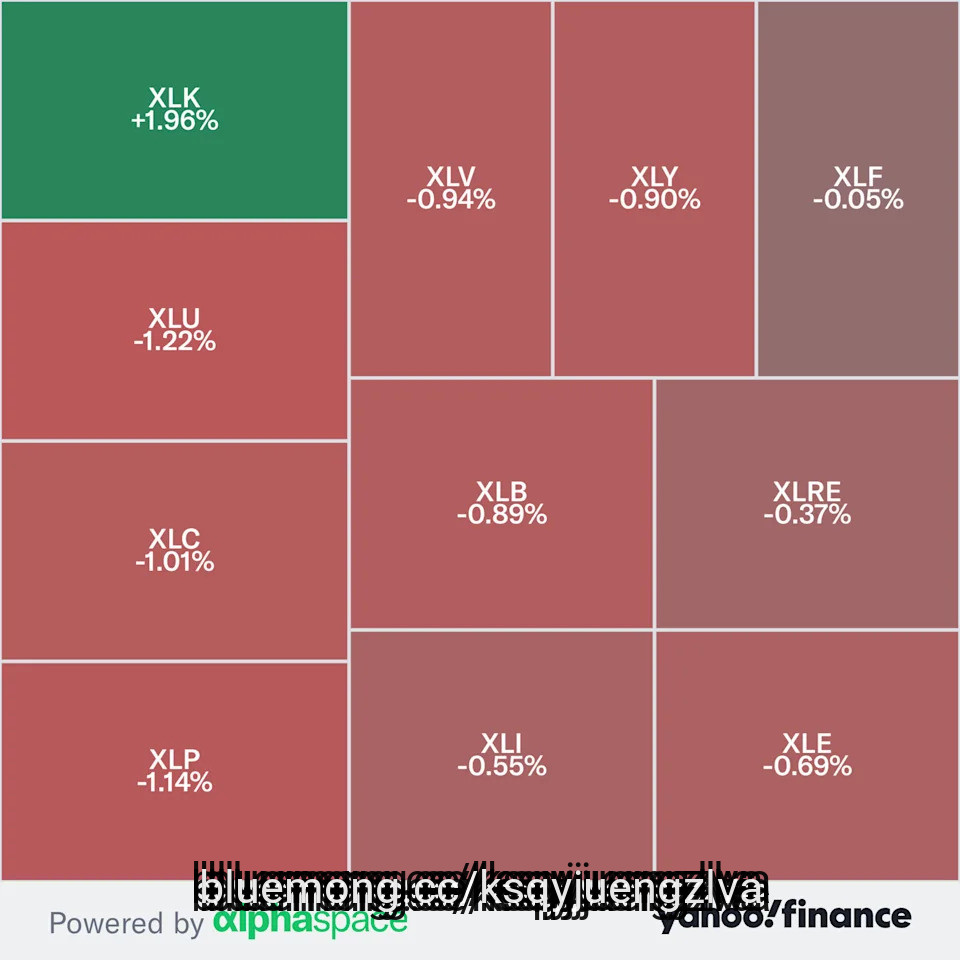

17 days ago
Salesforce (NYSE: CRM) stock is enjoying a resurgence. It's up by 28% over the past month as "SaaSpocalypse" fears subside and agentic artificial intelligence initiatives catapult the company's revenue higher.
However, even after its big rally, Salesforce remains attractively valued. Here's how the SaaS stock could climb further.
Missed Nvidia in 2009? This Rare Signal Is Flashing Again. In 2009, a "Double Down" signal flashed for a little-known chipmaker called Nvidia. For the first time in years, that same "Total Conviction" signal is flashing for a company 1/100th the size of Nvidia. Continue »
Salesforce now trades at a price-to-earnings (P/E) ratio of 24, which is lower than the average ratio of the S&P 500. Less than a year ago, the customer relationship management platform company commanded a P/E ratio above 40.
It isn't often that a stock's valuation drops as the company's fundamentals improve, but that has been the case with Salesforce. In its fiscal 2027 first quarter, which ended April 30, it delivered 13% year-over-year revenue growth, and CEO Marc Benioff cited agentic AI as "the biggest growth opportunity for our customers, and for Salesforce."
#first
However, even after its big rally, Salesforce remains attractively valued. Here's how the SaaS stock could climb further.
Missed Nvidia in 2009? This Rare Signal Is Flashing Again. In 2009, a "Double Down" signal flashed for a little-known chipmaker called Nvidia. For the first time in years, that same "Total Conviction" signal is flashing for a company 1/100th the size of Nvidia. Continue »
Salesforce now trades at a price-to-earnings (P/E) ratio of 24, which is lower than the average ratio of the S&P 500. Less than a year ago, the customer relationship management platform company commanded a P/E ratio above 40.
It isn't often that a stock's valuation drops as the company's fundamentals improve, but that has been the case with Salesforce. In its fiscal 2027 first quarter, which ended April 30, it delivered 13% year-over-year revenue growth, and CEO Marc Benioff cited agentic AI as "the biggest growth opportunity for our customers, and for Salesforce."
#first

18 days ago
Guinness Global Innovators, an investment management company, recently released its Q2 2026 quarterly investor update for its "Guinness Global Innovators Fund". You can download the letter here. The Guinness Global Innovators Fund focuses on investing in global companies that benefit from innovation in technology, communication, globalization, and management strategies. In the second quarter of 2026, the Guinness Global Innovators Fund returned 13.8% in GBP, compared with 13.0% for the MSCI World Index and 13.1% for the IA Global sector average. Easing Middle East tensions, falling oil prices, and renewed enthusiasm for artificial intelligence helped reverse much of the caution seen earlier in the year, with investors rotating back toward growth stocks and AI infrastructure beneficiaries. The Fund benefited from its overweight position in the Information Technology sector, while its overweight position in Communication Services detracted. Avoiding weaker Utilities, Materials, and Energy also supported relative performance. Also, please check the Fund's top five holdings to see its best picks for 2026.
In its second-quarter 2026 investor letter, Guinness Global Innovators Fund highlighted Intuit Inc. (NASDAQ:INTU). Intuit Inc. (NASDAQ:INTU) provides financial management, payments and capital, compliance, and marketing products and services. On August 21, 2026, Intuit Inc. (NASDAQ:INTU) closed at $367.00 per share. The one-month return of Intuit Inc. (NASDAQ:INTU) was 20.76%, and its shares lost -44.14% over the past 52 weeks. Intuit Inc. (NASDAQ:INTU) has a market capitalization of $100.4 billion with a 52-week trading range between $252.84 - $705.08.
Guinness Global Innovators Fund stated the following regarding Intuit Inc. (NASDAQ:INTU) in its Q2 2026 investor letter:
"We initially bought Intuit Inc. (NASDAQ:INTU) for its market-leading position in mission-critical tax and accounting software, a deeply embedded QuickBooks platform with significant switching costs, and a strong consumer brand in TurboTax. QuickBooks' c.80% market share, high customer retention and accountant-led distribution created a durable competitive advantage, while Intuit's expanding ecosystem across payments, payroll, lending, Mailchimp, and tax services provided a clear runway for long-term growth and further monetisation. Toward the end of 2025 and in early 2026, markets became increasingly concerned with the 'Saaspocalypse', the implications of AI disruption of the software sector, causing sentiment on the stock to sour. While Intuit continued to deliver resilient results overall, its most recent earnings print changed the thesis for us. Revenue and earnings were modestly ahead of consensus, but the quarter was overshadowed by disappointing TurboTax performance, where revenue growth of 7% fell short of expectations (c.8%) and paid DIY returns declined sharply, particularly among price-sensitive, lower-income filers. This reignited concerns that Intuit's pricing power
In its second-quarter 2026 investor letter, Guinness Global Innovators Fund highlighted Intuit Inc. (NASDAQ:INTU). Intuit Inc. (NASDAQ:INTU) provides financial management, payments and capital, compliance, and marketing products and services. On August 21, 2026, Intuit Inc. (NASDAQ:INTU) closed at $367.00 per share. The one-month return of Intuit Inc. (NASDAQ:INTU) was 20.76%, and its shares lost -44.14% over the past 52 weeks. Intuit Inc. (NASDAQ:INTU) has a market capitalization of $100.4 billion with a 52-week trading range between $252.84 - $705.08.
Guinness Global Innovators Fund stated the following regarding Intuit Inc. (NASDAQ:INTU) in its Q2 2026 investor letter:
"We initially bought Intuit Inc. (NASDAQ:INTU) for its market-leading position in mission-critical tax and accounting software, a deeply embedded QuickBooks platform with significant switching costs, and a strong consumer brand in TurboTax. QuickBooks' c.80% market share, high customer retention and accountant-led distribution created a durable competitive advantage, while Intuit's expanding ecosystem across payments, payroll, lending, Mailchimp, and tax services provided a clear runway for long-term growth and further monetisation. Toward the end of 2025 and in early 2026, markets became increasingly concerned with the 'Saaspocalypse', the implications of AI disruption of the software sector, causing sentiment on the stock to sour. While Intuit continued to deliver resilient results overall, its most recent earnings print changed the thesis for us. Revenue and earnings were modestly ahead of consensus, but the quarter was overshadowed by disappointing TurboTax performance, where revenue growth of 7% fell short of expectations (c.8%) and paid DIY returns declined sharply, particularly among price-sensitive, lower-income filers. This reignited concerns that Intuit's pricing power

18 days ago
RGA Investment Advisors, an investment management company, has released its second-quarter 2026 investor letter. The letter can be downloaded here. The letter addresses the incorporation of AI into investment strategies and the dramatic changes in market dynamics that have emerged, specifically referencing the AI Bottleneck 40. This group of stocks is crucial to data center infrastructure. Initially, these stocks were closely aligned with the S&P, but by mid-2025, they began to diverge and outperform the index, exhibiting significant volatility, with realized volatility rates approaching 60%. The letter stresses the importance of continually monitoring these trends and adjusting the investment strategy. Also, check the fund's top five holdings to see its best picks in 2026.
In its Q2 2026 investor letter, RGA Investment Advisors highlighted Adobe Inc. (NASDAQ:ADBE). Adobe Inc. (NASDAQ:ADBE) is a multinational technology company that offers creative, digital media, and document management products. On August 24, 2026, Adobe Inc. (NASDAQ:ADBE) closed at $276.27 per share, reflecting a market capitalization of $109.82 billion. Adobe Inc. (NASDAQ:ADBE) posted a one‑month return of 10.87%, while its shares lost 22.16% over the past 52 weeks.
RGA Investment Advisors stated the following regarding Adobe Inc. (NASDAQ:ADBE) in its Q2 2026 investor letter:
"We had watched and studied Adobe Inc. (NASDAQ:ADBE) with admiration for many years following their evolution from selling licensed software to subscription software. Adobe became the template by which numerous other software companies pivoted to SaaS and the rest, as they say, is history. Or so we all thought. Over the past several years, Adobe's shares have dropped dramatically. At first, the concern was competition from Figma and Canva. Then Adobe became Exhibit 1 in the "AI losers basket." We think Adobe is far more resilient than fears suggest. Similar to GitLab, there is seat-based pricing risk; however, in many industries, Adobe's offerings are irreplaceable, even with AI. Moreover, Adobe is in a great position to become the layer on top of which key AI workflows are built. Data and context are critical to these workflows, and Adobe has considerable advantages in both. We acknowledge some of the risks Adobe faces, but at a P/E of sub-10x and a FCF yield north of 10%, the market is pricing the stock as a melting ice cube while growth is still right around 10%. The company is using its healthy balance sheet and robust free cash flow to repurchase shares at a healthy clip. We think this is a potent setup as the company proves its resilience for the AI era."
#shares
In its Q2 2026 investor letter, RGA Investment Advisors highlighted Adobe Inc. (NASDAQ:ADBE). Adobe Inc. (NASDAQ:ADBE) is a multinational technology company that offers creative, digital media, and document management products. On August 24, 2026, Adobe Inc. (NASDAQ:ADBE) closed at $276.27 per share, reflecting a market capitalization of $109.82 billion. Adobe Inc. (NASDAQ:ADBE) posted a one‑month return of 10.87%, while its shares lost 22.16% over the past 52 weeks.
RGA Investment Advisors stated the following regarding Adobe Inc. (NASDAQ:ADBE) in its Q2 2026 investor letter:
"We had watched and studied Adobe Inc. (NASDAQ:ADBE) with admiration for many years following their evolution from selling licensed software to subscription software. Adobe became the template by which numerous other software companies pivoted to SaaS and the rest, as they say, is history. Or so we all thought. Over the past several years, Adobe's shares have dropped dramatically. At first, the concern was competition from Figma and Canva. Then Adobe became Exhibit 1 in the "AI losers basket." We think Adobe is far more resilient than fears suggest. Similar to GitLab, there is seat-based pricing risk; however, in many industries, Adobe's offerings are irreplaceable, even with AI. Moreover, Adobe is in a great position to become the layer on top of which key AI workflows are built. Data and context are critical to these workflows, and Adobe has considerable advantages in both. We acknowledge some of the risks Adobe faces, but at a P/E of sub-10x and a FCF yield north of 10%, the market is pricing the stock as a melting ice cube while growth is still right around 10%. The company is using its healthy balance sheet and robust free cash flow to repurchase shares at a healthy clip. We think this is a potent setup as the company proves its resilience for the AI era."
#shares

19 days ago
Wolfspeed (NYSE: WOLF) had been one of the hottest stocks in the market this spring, surging on hopes that it could become the next AI winner.
The rise coincided with a bullish report from Substack publication Citrini Research, which had earlier come into prominence after publishing a thought piece about how artificial intelligence (AI) would negatively impact software-as-a-service (SaaS) stocks, helping sink that sector.
Missed Nvidia in 2009? This Rare Signal Is Flashing Again. In 2009, a "Double Down" signal flashed for a little-known chipmaker called Nvidia. For the first time in years, that same "Total Conviction" signal is flashing for a company 1/100th the size of Nvidia. Continue »
However, after its shares reached more than $80, Wolfspeed stock has come crashing back down to earth, retracing the big move it had made in May following Citrini pumping the stock. Its latest pullback coincided with another disheartening earnings report on Aug. 19.
Wolfspeed emerged from bankruptcy last fall, wiping out some expensive debt and finding itself on better footing. However, many of the issues that pushed it into bankruptcy in the first place remain. The chief among them is negative gross margins.
#signal #down
The rise coincided with a bullish report from Substack publication Citrini Research, which had earlier come into prominence after publishing a thought piece about how artificial intelligence (AI) would negatively impact software-as-a-service (SaaS) stocks, helping sink that sector.
Missed Nvidia in 2009? This Rare Signal Is Flashing Again. In 2009, a "Double Down" signal flashed for a little-known chipmaker called Nvidia. For the first time in years, that same "Total Conviction" signal is flashing for a company 1/100th the size of Nvidia. Continue »
However, after its shares reached more than $80, Wolfspeed stock has come crashing back down to earth, retracing the big move it had made in May following Citrini pumping the stock. Its latest pullback coincided with another disheartening earnings report on Aug. 19.
Wolfspeed emerged from bankruptcy last fall, wiping out some expensive debt and finding itself on better footing. However, many of the issues that pushed it into bankruptcy in the first place remain. The chief among them is negative gross margins.
#signal #down

19 days ago
Guinness Global Innovators, an investment management company, recently released its Q2 2026 quarterly investor update for its "Guinness Global Innovators Fund". You can download the letter here. The Guinness Global Innovators Fund focuses on investing in global companies that benefit from innovation in technology, communication, globalization, and management strategies. In the second quarter of 2026, the Guinness Global Innovators Fund returned 13.8% in GBP, compared with 13.0% for the MSCI World Index and 13.1% for the IA Global sector average. Easing Middle East tensions, falling oil prices, and renewed enthusiasm for artificial intelligence helped reverse much of the caution seen earlier in the year, with investors rotating back toward growth stocks and AI infrastructure beneficiaries. The Fund benefited from its overweight position in the Information Technology sector, while its overweight position in Communication Services detracted. Avoiding weaker Utilities, Materials, and Energy also supported relative performance. Also, please check the Fund's top five holdings to see its best picks for 2026.
In its second-quarter 2026 investor letter, Guinness Global Innovators Fund highlighted Intuit Inc. (NASDAQ:INTU). Intuit Inc. (NASDAQ:INTU) provides financial management, payments and capital, compliance, and marketing products and services. On August 21, 2026, Intuit Inc. (NASDAQ:INTU) closed at $367.00 per share. The one-month return of Intuit Inc. (NASDAQ:INTU) was 20.76%, and its shares lost -44.14% over the past 52 weeks. Intuit Inc. (NASDAQ:INTU) has a market capitalization of $100.4 billion with a 52-week trading range between $252.84 - $705.08.
Guinness Global Innovators Fund stated the following regarding Intuit Inc. (NASDAQ:INTU) in its Q2 2026 investor letter:
"We initially bought Intuit Inc. (NASDAQ:INTU) for its market-leading position in mission-critical tax and accounting software, a deeply embedded QuickBooks platform with significant switching costs, and a strong consumer brand in TurboTax. QuickBooks' c.80% market share, high customer retention and accountant-led distribution created a durable competitive advantage, while Intuit's expanding ecosystem across payments, payroll, lending, Mailchimp, and tax services provided a clear runway for long-term growth and further monetisation. Toward the end of 2025 and in early 2026, markets became increasingly concerned with the 'Saaspocalypse', the implications of AI disruption of the software sector, causing sentiment on the stock to sour. While Intuit continued to deliver resilient results overall, its most recent earnings print changed the thesis for us. Revenue and earnings were modestly ahead of consensus, but the quarter was overshadowed by disappointing TurboTax performance, where revenue growth of 7% fell short of expectations (c.8%) and paid DIY returns declined sharply, particularly among price-sensitive, lower-income filers. This reignited concerns that Intuit's pricing power
In its second-quarter 2026 investor letter, Guinness Global Innovators Fund highlighted Intuit Inc. (NASDAQ:INTU). Intuit Inc. (NASDAQ:INTU) provides financial management, payments and capital, compliance, and marketing products and services. On August 21, 2026, Intuit Inc. (NASDAQ:INTU) closed at $367.00 per share. The one-month return of Intuit Inc. (NASDAQ:INTU) was 20.76%, and its shares lost -44.14% over the past 52 weeks. Intuit Inc. (NASDAQ:INTU) has a market capitalization of $100.4 billion with a 52-week trading range between $252.84 - $705.08.
Guinness Global Innovators Fund stated the following regarding Intuit Inc. (NASDAQ:INTU) in its Q2 2026 investor letter:
"We initially bought Intuit Inc. (NASDAQ:INTU) for its market-leading position in mission-critical tax and accounting software, a deeply embedded QuickBooks platform with significant switching costs, and a strong consumer brand in TurboTax. QuickBooks' c.80% market share, high customer retention and accountant-led distribution created a durable competitive advantage, while Intuit's expanding ecosystem across payments, payroll, lending, Mailchimp, and tax services provided a clear runway for long-term growth and further monetisation. Toward the end of 2025 and in early 2026, markets became increasingly concerned with the 'Saaspocalypse', the implications of AI disruption of the software sector, causing sentiment on the stock to sour. While Intuit continued to deliver resilient results overall, its most recent earnings print changed the thesis for us. Revenue and earnings were modestly ahead of consensus, but the quarter was overshadowed by disappointing TurboTax performance, where revenue growth of 7% fell short of expectations (c.8%) and paid DIY returns declined sharply, particularly among price-sensitive, lower-income filers. This reignited concerns that Intuit's pricing power


25 days ago
At least one Wall Street ******* yst is skeptical that private equity firm Silver Lake will pull off a deal to acquire software maker Workday (WDAY). Workday stock popped on Feb. 13 amid reports of Silver Lake's interest but has cooled off the next two trading sessions.
In early 2026, Workday Cofounder and Executive Chairman Aneel Bhusri returned as chief executive officer. Slowing subscription revenue growth has pressured Workday stock. UBS ******* yst Karl Keirstead in a report on Monday said that private equity firm Silver Lake in unlikely to buy out the enterprise software maker.
"From the perspective of Workday, the founder only returned to the CEO role in February with an apparent mission to invest in the AI suite and accelerate growth," Keirstead said. "For him (and the board) to turn around in a matter of months and negotiate a sale, at a historically depressed free cash flow multiple and before any material time for Workday to realize any upside from these investments, strikes us as very surprising."
Second-quarter earnings are due for Workday stock on Aug. 27.
Other software stocks, including SAP (SAP) and Oracle (ORCL), climbed last week amid speculation over a Workday buyout. There has been growing investor concern that software-as-a-service companies could be disrupted by artificial intelligence-driven competition, an event referred to as a" SaaSpocalypse."
#private
In early 2026, Workday Cofounder and Executive Chairman Aneel Bhusri returned as chief executive officer. Slowing subscription revenue growth has pressured Workday stock. UBS ******* yst Karl Keirstead in a report on Monday said that private equity firm Silver Lake in unlikely to buy out the enterprise software maker.
"From the perspective of Workday, the founder only returned to the CEO role in February with an apparent mission to invest in the AI suite and accelerate growth," Keirstead said. "For him (and the board) to turn around in a matter of months and negotiate a sale, at a historically depressed free cash flow multiple and before any material time for Workday to realize any upside from these investments, strikes us as very surprising."
Second-quarter earnings are due for Workday stock on Aug. 27.
Other software stocks, including SAP (SAP) and Oracle (ORCL), climbed last week amid speculation over a Workday buyout. There has been growing investor concern that software-as-a-service companies could be disrupted by artificial intelligence-driven competition, an event referred to as a" SaaSpocalypse."
#private


26 days ago
If you put ServiceNow (NYSE: NOW) and Palantir (NASDAQ: PLTR) side by side, they both look like slick artificial intelligence (AI) businesses selling software as a service (SaaS) to big governments and global enterprises. The stories feel similar until you zero in on one number that really explains why their growth rates look so different: how fast U.S. commercial revenue is growing.
Missed Nvidia in 2009? This Rare Signal Is Flashing Again. In 2009, a "Double Down" signal flashed for a little-known chipmaker called Nvidia. For the first time in years, that same "Total Conviction" signal is flashing for a company 1/100th the size of Nvidia. Continue »
ServiceNow comes into this comparison as a mature cloud platform. It already sits inside thousands of large organizations, running workflows for IT, HR, security, and customer service. The AI products it is pushing now, like Now **** ist, are layered onto a foundation built long before the current AI wave.
In Q2 2026, ServiceNow reported total revenue of about $3.9 billion, with subscription revenue up roughly 23% year over year in constant currency. That is healthy growth for a company of its size and age. The more telling numbers are in the order backlog. Remaining performance obligations reached about $29 billion, and current RPO, the contract revenue due in the next 12 months, stood at about $13.2 billion with growth of a bit more than 21%.
ServiceNow's AI story fits that profile. AI annual contract value crossed $1 billion in Q2, driven by hundreds of seven-figure deals and expanding commitments from existing customers. This is AI as an accelerator atop a large installed base. Growth is strong, but it is tied to a world where many customers already use ServiceNow and are now paying more for AI-infused workflows.
#revenue #billion #signal #flashing
Missed Nvidia in 2009? This Rare Signal Is Flashing Again. In 2009, a "Double Down" signal flashed for a little-known chipmaker called Nvidia. For the first time in years, that same "Total Conviction" signal is flashing for a company 1/100th the size of Nvidia. Continue »
ServiceNow comes into this comparison as a mature cloud platform. It already sits inside thousands of large organizations, running workflows for IT, HR, security, and customer service. The AI products it is pushing now, like Now **** ist, are layered onto a foundation built long before the current AI wave.
In Q2 2026, ServiceNow reported total revenue of about $3.9 billion, with subscription revenue up roughly 23% year over year in constant currency. That is healthy growth for a company of its size and age. The more telling numbers are in the order backlog. Remaining performance obligations reached about $29 billion, and current RPO, the contract revenue due in the next 12 months, stood at about $13.2 billion with growth of a bit more than 21%.
ServiceNow's AI story fits that profile. AI annual contract value crossed $1 billion in Q2, driven by hundreds of seven-figure deals and expanding commitments from existing customers. This is AI as an accelerator atop a large installed base. Growth is strong, but it is tied to a world where many customers already use ServiceNow and are now paying more for AI-infused workflows.
#revenue #billion #signal #flashing

29 days ago
Networking equipment and software provider Arista Networks, Inc. (NYSE:ANET) is one of Cramer's favorite stocks. In fact, as far back as February 2025, the CNBC TV host remarked that going against Arista Networks, Inc. (NYSE:ANET) and its CEO meant an "invitation to your funeral." The shares are up by 49% over the past year and by 52% year-to-date. Over the month, they are up by 11.5% and closed 3.6% higher on August 5th, the day after Arista Networks, Inc. (NYSE:ANET)'s second quarter earnings report. Yet, as the shares dipped on the 6th, Cramer called the move profit taking:
"I was talking to Jayshree Ullal yesterday, for ANET, which is just a fantastic company, had an amazing quarter. And she's on the board of Snowflake. And I just said, no one noticed that Snowflake just goes up and up and up. That's the kind of thing that is coming up for profit taking taking today. As is ANET. As is Arista. And I just say, okay, wait a second, this is a take your breath moment. These companies are all doing really, really well. Or they have, like the long term agreement kind of thing with Western Digital. This is a profit taking thing, Carl. And I think that this is blessed. You want this."
Arista Networks, Inc. (NYSE:ANET) reported $3.04 billion in revenue and $1.02 in earnings per share for its second quarter and beat ***** yst estimates for both. The firm's third quarter revenue forecast of $3.3 billion also beat the estimates. With Arista Networks, Inc. (NYSE:ANET) counting tech giant such as Microsoft and Amazon, the healthy results indicated the strength of the ongoing AI buildout. The strength of the buildout and the firm's role in it is also key to the investment debate. With Arista Networks, Inc. (NYSE:ANET)'s competency in Ethernet networks, a faster switch to the technology can help the firm. Additionally, the firm also benefits from strong margins (63.4% non-GAAP gross margin in Q2) courtesy of its software model. Yet, at the same time, the fact that Arista Networks, Inc. (NYSE:ANET) relies on a few big-tech customers, which might switch to custom products creates risk that might not be reflected through the forward P/E of 46.73.
Snowflake Inc. (NYSE:SNOW), on the other hand, is a classic software-as-a-service (SaaS) firm. It enables data management and warehousing. Its data business benefits the firm in today's AI era, as it enables users to use their own data to create AI models. Consequently, Snowflake Inc. (NYSE:SNOW)'s net revenue retention (NRR) was 126% in its FY27Q1. Additionally, the firm had 779 customers with trailing 12-month product revenue greater than $1 million in the same quarter. While these figures point towards a robust business, if spending slows due to concerns about AI's returns or if platforms such as DataBricks and Google's BigQuery step up competition, the firm could struggle. For a firm with a forward. P/E of 169, there's little room for error.
#software
"I was talking to Jayshree Ullal yesterday, for ANET, which is just a fantastic company, had an amazing quarter. And she's on the board of Snowflake. And I just said, no one noticed that Snowflake just goes up and up and up. That's the kind of thing that is coming up for profit taking taking today. As is ANET. As is Arista. And I just say, okay, wait a second, this is a take your breath moment. These companies are all doing really, really well. Or they have, like the long term agreement kind of thing with Western Digital. This is a profit taking thing, Carl. And I think that this is blessed. You want this."
Arista Networks, Inc. (NYSE:ANET) reported $3.04 billion in revenue and $1.02 in earnings per share for its second quarter and beat ***** yst estimates for both. The firm's third quarter revenue forecast of $3.3 billion also beat the estimates. With Arista Networks, Inc. (NYSE:ANET) counting tech giant such as Microsoft and Amazon, the healthy results indicated the strength of the ongoing AI buildout. The strength of the buildout and the firm's role in it is also key to the investment debate. With Arista Networks, Inc. (NYSE:ANET)'s competency in Ethernet networks, a faster switch to the technology can help the firm. Additionally, the firm also benefits from strong margins (63.4% non-GAAP gross margin in Q2) courtesy of its software model. Yet, at the same time, the fact that Arista Networks, Inc. (NYSE:ANET) relies on a few big-tech customers, which might switch to custom products creates risk that might not be reflected through the forward P/E of 46.73.
Snowflake Inc. (NYSE:SNOW), on the other hand, is a classic software-as-a-service (SaaS) firm. It enables data management and warehousing. Its data business benefits the firm in today's AI era, as it enables users to use their own data to create AI models. Consequently, Snowflake Inc. (NYSE:SNOW)'s net revenue retention (NRR) was 126% in its FY27Q1. Additionally, the firm had 779 customers with trailing 12-month product revenue greater than $1 million in the same quarter. While these figures point towards a robust business, if spending slows due to concerns about AI's returns or if platforms such as DataBricks and Google's BigQuery step up competition, the firm could struggle. For a firm with a forward. P/E of 169, there's little room for error.
#software