

6 days ago
A $1,000 investment in MSFT today could reach $1,587 by 2029 under the base case, or as high as $1,911 in a bull scenario.
Azure revenue surged 48% last quarter, and CFO Amy Hood guided next-quarter growth of between 49% and 50% in constant currency.
Microsoft's contracted backlog jumped 73% to $677 billion, with Copilot daily users up over 5x year over year.
Just released. Our ***** ysts combed the entire stock market and named the ten best stocks to buy right now, and Microsoft didn't make the cut. Enter your email to see the names that beat MSFT. The report is free. Enter your email and see if any of your stocks made the cut.
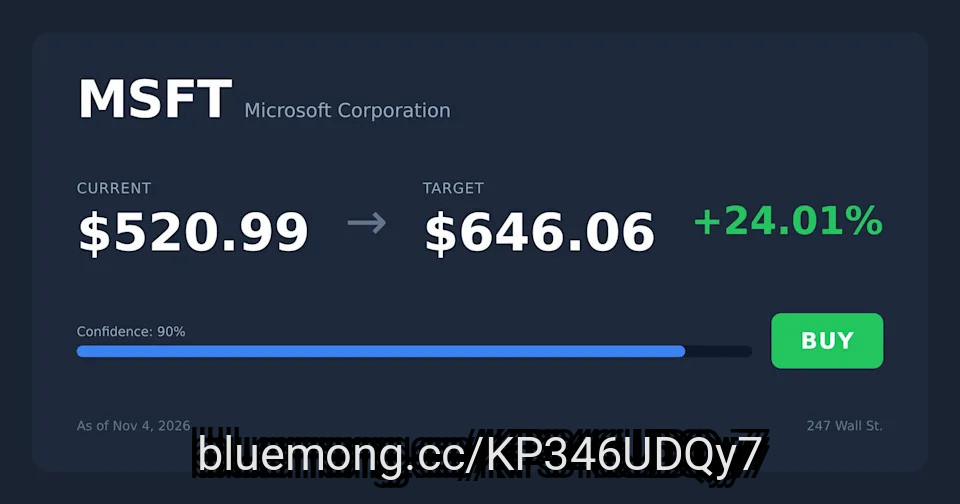
Microsoft (NASDAQ:MSFT) is one of the biggest stocks you can own to get exposure to enterprise AI, so it makes sense to ask what $1,000 put in today could grow into by 2029. Our price-prediction model uses a reference price of $525.63 per share.
#year #email #price
Azure revenue surged 48% last quarter, and CFO Amy Hood guided next-quarter growth of between 49% and 50% in constant currency.
Microsoft's contracted backlog jumped 73% to $677 billion, with Copilot daily users up over 5x year over year.
Just released. Our ***** ysts combed the entire stock market and named the ten best stocks to buy right now, and Microsoft didn't make the cut. Enter your email to see the names that beat MSFT. The report is free. Enter your email and see if any of your stocks made the cut.
Microsoft (NASDAQ:MSFT) is one of the biggest stocks you can own to get exposure to enterprise AI, so it makes sense to ask what $1,000 put in today could grow into by 2029. Our price-prediction model uses a reference price of $525.63 per share.
#year #email #price

22 days ago
England manager Sarina Wiegman has signed a two-year contract extension with the Lionesses.
The 56-year-old's previous deal was due to expire after next summer's World Cup, but her new contract will run until the end of Euro 2029.
Dutchwoman Wiegman guided England to their second straight European Championship ****** le with victory over Spain in the Euro 2025 final.
The victory meant the Lionesses became the first England team - women's or men's - to win a major trophy on foreign soil.
"I am so happy to be able to carry on with this squad and cannot think of a better job in football," said Wiegman.
#england #year
The 56-year-old's previous deal was due to expire after next summer's World Cup, but her new contract will run until the end of Euro 2029.
Dutchwoman Wiegman guided England to their second straight European Championship ****** le with victory over Spain in the Euro 2025 final.
The victory meant the Lionesses became the first England team - women's or men's - to win a major trophy on foreign soil.
"I am so happy to be able to carry on with this squad and cannot think of a better job in football," said Wiegman.
#england #year


1 month ago
Kate Middleton is reportedly advising Prince William to not react to the ongoing Prince Harry and Charles Spencer book drama. For those unversed, William was reportedly shocked by the claims and allegations his uncle Spencer, made against King Charles and the royal family in his Princess Diana memoir. It is widely speculated that Harry was already aware of the contents of the book. Now, as per new developments, the Prince of Wales is reportedly angry with his brother and his uncle.
According to Heat World, Kate Middleton is trying to pacify Prince William amid tensions involving Prince Harry and Charles Spencer. As excerpts from Spencer's memoir made headlines, Kate reportedly traveled to Scotland while supporting her husband through the controversy.
The Princess of Wales is widely speculated to be the peacemaker in the royal family who has maintained harmony in the household. According to a source, Kate is strongly advising William to remain non-reactive and not give in to the controversy, no matter what the provocation.
The source said: "Kate is begging William to follow his father's lead and keep the peace. She says they can't get caught up in this ugly mess, they need to stay focused on protecting the Crown and remaining dignified representatives." Furthermore, as per the source, the Princess of Wales has encouraged her husband to practice guided meditation, breathing exercises, and yoga to instill a sense of calmness.
Moreover, the source lavished praise on Middleton because it is an "awful lot" for her to handle as well. However, the future queen has prioritized the emotional well-being of her husband and the dignity of the crown. Middleton understands that the recent controversies have taken a toll on her husband, and there is really no end to this for now.
#middleton #harry #princess
According to Heat World, Kate Middleton is trying to pacify Prince William amid tensions involving Prince Harry and Charles Spencer. As excerpts from Spencer's memoir made headlines, Kate reportedly traveled to Scotland while supporting her husband through the controversy.
The Princess of Wales is widely speculated to be the peacemaker in the royal family who has maintained harmony in the household. According to a source, Kate is strongly advising William to remain non-reactive and not give in to the controversy, no matter what the provocation.
The source said: "Kate is begging William to follow his father's lead and keep the peace. She says they can't get caught up in this ugly mess, they need to stay focused on protecting the Crown and remaining dignified representatives." Furthermore, as per the source, the Princess of Wales has encouraged her husband to practice guided meditation, breathing exercises, and yoga to instill a sense of calmness.
Moreover, the source lavished praise on Middleton because it is an "awful lot" for her to handle as well. However, the future queen has prioritized the emotional well-being of her husband and the dignity of the crown. Middleton understands that the recent controversies have taken a toll on her husband, and there is really no end to this for now.
#middleton #harry #princess


2 months ago
On September 17, Coherent Corp. (NYSE:COHR) announced an upgraded Pluggable Optical Line System that covers the full C-band and fits in a compact QSFP module, the same slot ordinary transceivers use. That is a lot of networking gear shrunk into a plug, and it follows a quarter of 34% revenue growth. Here is what the launch means, and where the stock's story gets harder to read.
Start with what the product does. The upgraded system can pack 32 wavelengths onto a single pair of fibers, which Coherent says adds up to as much as 25.6Tbps of traffic on links running 2km to 200km. It is designed for the latest 800G coherent optics, and it configures itself, handling link setup and laser safety without a technician tuning each connection. Coherent also says the system is generally available and already shipping in high volume, in 400G and 800G versions that work with existing network setups. Madhu Krishnaswamy, who runs the company's telecom transport unit, describes the goal as easing the usual trade-off between raw performance and operational simplicity.
The launch also sits on top of a business that is already moving. On August 12, Coherent reported results for its fiscal fourth quarter, which ended June 30: revenue of $2.05 billion, up 34% from a year earlier. Non-GAAP earnings per share rose to $1.74 from $1.00, and CEO Jim Anderson noted that for the full year, that measure grew more than twice as fast as revenue. Management guided to revenue of $2.2 billion to $2.4 billion for the first quarter of fiscal 2027, and Anderson says AI data centers are increasingly moving from copper to optical links.
Now look at the two versions of profit. Coherent's non-GAAP earnings came to $1.74 per share, but under GAAP the figure was $1.19. The gap comes from items management leaves out, including stock-based pay, amortization on acquired intangibles, and restructuring and integration costs. Operating margin shows it more clearly, at 21.8% on a non-GAAP basis and 12.4% under GAAP. Some of those costs are non-cash, but they are real, and anyone anchoring on the higher figure is skipping them.
Then there is how much weight this launch can carry. The announcement puts no sales figure on the product, so its contribution to a company that booked $2.05 billion in a quarter cannot be sized from what has been published. The bullish story also rests on management's own read of where AI networks are headed, and on a capacity build-out that CFO Sherri Luther says gets priority in spending. Money spent on capacity only pays off if the demand management describes keeps arriving.
#gaap #revenue #launch #anderson
Start with what the product does. The upgraded system can pack 32 wavelengths onto a single pair of fibers, which Coherent says adds up to as much as 25.6Tbps of traffic on links running 2km to 200km. It is designed for the latest 800G coherent optics, and it configures itself, handling link setup and laser safety without a technician tuning each connection. Coherent also says the system is generally available and already shipping in high volume, in 400G and 800G versions that work with existing network setups. Madhu Krishnaswamy, who runs the company's telecom transport unit, describes the goal as easing the usual trade-off between raw performance and operational simplicity.
The launch also sits on top of a business that is already moving. On August 12, Coherent reported results for its fiscal fourth quarter, which ended June 30: revenue of $2.05 billion, up 34% from a year earlier. Non-GAAP earnings per share rose to $1.74 from $1.00, and CEO Jim Anderson noted that for the full year, that measure grew more than twice as fast as revenue. Management guided to revenue of $2.2 billion to $2.4 billion for the first quarter of fiscal 2027, and Anderson says AI data centers are increasingly moving from copper to optical links.
Now look at the two versions of profit. Coherent's non-GAAP earnings came to $1.74 per share, but under GAAP the figure was $1.19. The gap comes from items management leaves out, including stock-based pay, amortization on acquired intangibles, and restructuring and integration costs. Operating margin shows it more clearly, at 21.8% on a non-GAAP basis and 12.4% under GAAP. Some of those costs are non-cash, but they are real, and anyone anchoring on the higher figure is skipping them.
Then there is how much weight this launch can carry. The announcement puts no sales figure on the product, so its contribution to a company that booked $2.05 billion in a quarter cannot be sized from what has been published. The bullish story also rests on management's own read of where AI networks are headed, and on a capacity build-out that CFO Sherri Luther says gets priority in spending. Money spent on capacity only pays off if the demand management describes keeps arriving.
#gaap #revenue #launch #anderson


2 months ago
Microsoft's (NASDAQ:MSFT) fiscal 2026, which ended June 30, was arguably the strongest year in the software giant's history. Revenue grew 18% to $331.8 billion. Net income jumped 31% year over year, to $133.7 billion.
Micron Technology (NASDAQ:MU) is approaching that number from a different direction. The memory specialist earned $8.5 billion in its fiscal 2025.
Missed AI's "Act 1"? Act 2 Could Be 15x Bigger. Most investors think they missed the AI boat because they didn't buy Nvidia in 2005. But according to our ***** ysts, we're only at the end of "Act 1"—the R&D phase. "Act 2" is the global rollout. Continue »
But for the fiscal fourth quarter of 2026, which ended in early September, management guided to earnings of $30.73 per diluted share, plus or minus $1.00, on a generally accepted accounting principles (GAAP) basis. On about 1.15 billion diluted shares, the guidance works out to about $35 billion of profit in one quarter (about four times what the whole prior fiscal year produced).
Here's my prediction: In fiscal 2027, Micron will earn more than Microsoft. That means beating the year Microsoft is now in, not the one it just reported. It's a bold call, and it relies almost entirely on the price of memory.
#Microsoft #quarter
Micron Technology (NASDAQ:MU) is approaching that number from a different direction. The memory specialist earned $8.5 billion in its fiscal 2025.
Missed AI's "Act 1"? Act 2 Could Be 15x Bigger. Most investors think they missed the AI boat because they didn't buy Nvidia in 2005. But according to our ***** ysts, we're only at the end of "Act 1"—the R&D phase. "Act 2" is the global rollout. Continue »
But for the fiscal fourth quarter of 2026, which ended in early September, management guided to earnings of $30.73 per diluted share, plus or minus $1.00, on a generally accepted accounting principles (GAAP) basis. On about 1.15 billion diluted shares, the guidance works out to about $35 billion of profit in one quarter (about four times what the whole prior fiscal year produced).
Here's my prediction: In fiscal 2027, Micron will earn more than Microsoft. That means beating the year Microsoft is now in, not the one it just reported. It's a bold call, and it relies almost entirely on the price of memory.
#Microsoft #quarter


2 months ago
On August 20, Royal Caribbean Group (NYSE:RCL) said it had completed a sale of $1.25 billion of notes that carry a 5.55% coupon and come due on January 20, 2034. The money is earmarked first for floating-rate term loans, with anything left over used to repay or refinance other debt, and the offering rode on a shelf registration filed on February 29, 2024. That sounds like routine upkeep. But next to an earnings beat and a flat third-quarter pricing outlook, the deal gives you a handy lens on where the company stands.
Start with the debt itself. Swapping floating-rate borrowings for notes with a stated 5.550% coupon takes some interest-rate guesswork out of the picture, and the notes don't mature until January 20, 2034. That matters because $2.7 billion comes due in 2027 and $3.4 billion in 2028. Against those bills, the company held $6.9 billion of liquidity as of June 30, and it added $250 million to its revolving credit line in July.
The business generating the cash is running well. On July 28, Royal Caribbean reported second-quarter adjusted earnings of $4.21 per share, ahead of its own guidance on stronger last-minute demand, lower costs, and better results from joint ventures. Management then raised full-year adjusted EPS guidance to a range of $17.73 to $17.87, which implies 14% growth. It also kept returning cash to shareholders in the second quarter, through $404 million of dividends and $199 million of buybacks. Booking volumes are running above last year, and 2027 bookings are tracking ahead of past years, even on routes that geopolitical events hit in 2026.
Beat or not, that $4.21 is still below the $4.38 from the same quarter in 2025. Costs excluding fuel per passenger cruise day rose 4.4%, and the cost beat came largely from the timing of expenses. Then there is pricing, where the story gets less rosy. Third-quarter net yields are guided to roughly flat against 2025 while capacity grows 8.5%, so the expected 8% revenue growth comes from more capacity, not from better yields. Management also says prolonged geopolitical activity has dented bookings on select itineraries. It calls the hit modest, but it is now built into guidance.
The refinancing also doesn't shrink the debt pile. New notes pay off old borrowings, so the total owed stays roughly where it was, and the company still expects net interest of $980 million to $990 million this year. Add roughly $4.7 billion of capital spending in 2026, mostly for new ships and destination projects, and it is clear this business needs a steady supply of capital. The April ship orders, Icon VI and Icon VII, extend that appetite, though their financing is already committed.
#billion #quarter #company #year
Start with the debt itself. Swapping floating-rate borrowings for notes with a stated 5.550% coupon takes some interest-rate guesswork out of the picture, and the notes don't mature until January 20, 2034. That matters because $2.7 billion comes due in 2027 and $3.4 billion in 2028. Against those bills, the company held $6.9 billion of liquidity as of June 30, and it added $250 million to its revolving credit line in July.
The business generating the cash is running well. On July 28, Royal Caribbean reported second-quarter adjusted earnings of $4.21 per share, ahead of its own guidance on stronger last-minute demand, lower costs, and better results from joint ventures. Management then raised full-year adjusted EPS guidance to a range of $17.73 to $17.87, which implies 14% growth. It also kept returning cash to shareholders in the second quarter, through $404 million of dividends and $199 million of buybacks. Booking volumes are running above last year, and 2027 bookings are tracking ahead of past years, even on routes that geopolitical events hit in 2026.
Beat or not, that $4.21 is still below the $4.38 from the same quarter in 2025. Costs excluding fuel per passenger cruise day rose 4.4%, and the cost beat came largely from the timing of expenses. Then there is pricing, where the story gets less rosy. Third-quarter net yields are guided to roughly flat against 2025 while capacity grows 8.5%, so the expected 8% revenue growth comes from more capacity, not from better yields. Management also says prolonged geopolitical activity has dented bookings on select itineraries. It calls the hit modest, but it is now built into guidance.
The refinancing also doesn't shrink the debt pile. New notes pay off old borrowings, so the total owed stays roughly where it was, and the company still expects net interest of $980 million to $990 million this year. Add roughly $4.7 billion of capital spending in 2026, mostly for new ships and destination projects, and it is clear this business needs a steady supply of capital. The April ship orders, Icon VI and Icon VII, extend that appetite, though their financing is already committed.
#billion #quarter #company #year

2 months ago
Cybersecurity provider CrowdStrike Holdings, Inc. (NASDAQ:CRWD)'s shares are up by more than 100% year to date. With AI continuing to dominate the market narrative, the firm has found itself at the center of the industry's concerns about cybersecurity. While some, such as Anthropic's Dario Amodei, have claimed that their AI software is sufficient for cybersecurity purposes, others have argued that firms such as CrowdStrike Holdings, Inc. (NASDAQ:CRWD) will play a key role in the industry. Cramer is in the latter camp, and in his morning appearance on September 15th, the CNBC TV host discussed the recent discussions about AI being a threat:
"I had George Kurtz last night, who has partnered both with OpenAI and Anthropic. And he encouraged me to say look, they are doing a lot of things about safeguards. I think he was so much surprised, that there was so much doomsaying, of course, doomsaying being heavily refuted. Now there's a stock, remember that stock was up the most of any stock in the S&P."
While Cramer believes CrowdStrike Holdings, Inc. (NASDAQ:CRWD) will play an important role in cybersecurity in the AI era, the broader debate about the firm is about its AI-driven cybersecurity initiatives and whether they are sufficient to stay competitive and justify the eye-watering share price performance. On this front, the firm's annual recurring revenue (ARR) grew by 25% and net new ARR grew by 55% in its fiscal second quarter. Additionally, CrowdStrike Holdings, Inc. (NASDAQ:CRWD)'s net new ARR set a new record of $333 million. Cramer's bullishness on the firm is also matched by others, such as ******* ysts from Argus. Argus has set a $425 share price target for CrowdStrike Holdings, Inc. (NASDAQ:CRWD) and argued that growth in agentic AI use presents a major tailwind for the firm.
Yet, in a classic case of the bigger you are, the harder you fall, CrowdStrike Holdings, Inc. (NASDAQ:CRWD)'s massive growth creates risk. For its fiscal second quarter, the firm has guided net new ARR to range between $343 million and $347 million to imply growth ranging between 29% to 31%. Considering that the metric grew by 55% in Q1, the new figures do indicate a slowdown. As for catalysts from agentic AI, CrowdStrike Holdings, Inc. (NASDAQ:CRWD)'s next-gen SIEM (Security Information and Event Management) ending ARR grew by 60% to $695 million in the second quarter.
Hedge fund interest in CrowdStrike Holdings, Inc. (NASDAQ:CRWD) grew in Q2. According to Insider Monkey's data, 89 out of 1,006 funds had held a stake in the firm during the period. This marked a jump over the 89 out of the 1,022 funds in Q1. As for valuation, CrowdStrike Holdings, Inc. (NASDAQ:CRWD)'s forward P/E ratio of 188 is significantly higher than peer firm Palo Alto's 89 which should increase the pressure to maintain growth. Short interest as a percentage of float is 2.41% for CrowdStrike Holdings, Inc. (NASDAQ:CRWD) compared to 2.65% for Palo Alto.
#NASDAQ #firm #grew
"I had George Kurtz last night, who has partnered both with OpenAI and Anthropic. And he encouraged me to say look, they are doing a lot of things about safeguards. I think he was so much surprised, that there was so much doomsaying, of course, doomsaying being heavily refuted. Now there's a stock, remember that stock was up the most of any stock in the S&P."
While Cramer believes CrowdStrike Holdings, Inc. (NASDAQ:CRWD) will play an important role in cybersecurity in the AI era, the broader debate about the firm is about its AI-driven cybersecurity initiatives and whether they are sufficient to stay competitive and justify the eye-watering share price performance. On this front, the firm's annual recurring revenue (ARR) grew by 25% and net new ARR grew by 55% in its fiscal second quarter. Additionally, CrowdStrike Holdings, Inc. (NASDAQ:CRWD)'s net new ARR set a new record of $333 million. Cramer's bullishness on the firm is also matched by others, such as ******* ysts from Argus. Argus has set a $425 share price target for CrowdStrike Holdings, Inc. (NASDAQ:CRWD) and argued that growth in agentic AI use presents a major tailwind for the firm.
Yet, in a classic case of the bigger you are, the harder you fall, CrowdStrike Holdings, Inc. (NASDAQ:CRWD)'s massive growth creates risk. For its fiscal second quarter, the firm has guided net new ARR to range between $343 million and $347 million to imply growth ranging between 29% to 31%. Considering that the metric grew by 55% in Q1, the new figures do indicate a slowdown. As for catalysts from agentic AI, CrowdStrike Holdings, Inc. (NASDAQ:CRWD)'s next-gen SIEM (Security Information and Event Management) ending ARR grew by 60% to $695 million in the second quarter.
Hedge fund interest in CrowdStrike Holdings, Inc. (NASDAQ:CRWD) grew in Q2. According to Insider Monkey's data, 89 out of 1,006 funds had held a stake in the firm during the period. This marked a jump over the 89 out of the 1,022 funds in Q1. As for valuation, CrowdStrike Holdings, Inc. (NASDAQ:CRWD)'s forward P/E ratio of 188 is significantly higher than peer firm Palo Alto's 89 which should increase the pressure to maintain growth. Short interest as a percentage of float is 2.41% for CrowdStrike Holdings, Inc. (NASDAQ:CRWD) compared to 2.65% for Palo Alto.
#NASDAQ #firm #grew


2 months ago
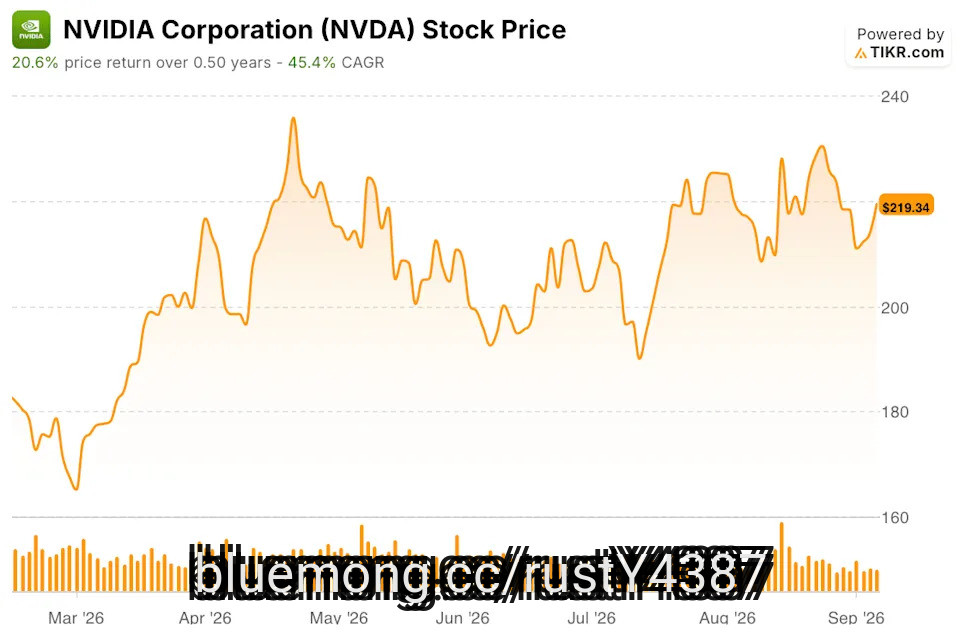
Six-Month Run: NVDA stock has climbed 20.6% since mid-March, a 45.4% annualized pace, even as the S&P 500 wobbled under the Fed's rate hike and a 10-year Treasury yield near 5%.
Model Verdict: TIKR's model puts fair value at $643, implying 193% total return by early 2031.
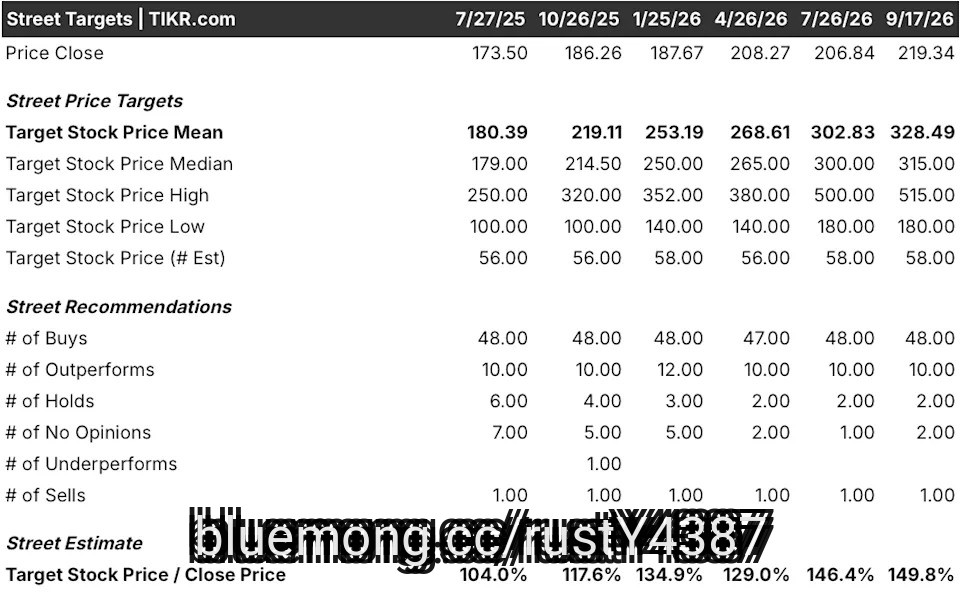
Coverage Split: Nvidia stock carries 48 buy ratings, 10 outperforms, 2 holds, 2 no opinions and 1 sell, with a mean target of $328, 50% above the current price.
Supply Squeeze: Nvidia guided to roughly 70% revenue growth for fiscal 2028 on demand it calls supply-constrained, with cloud industry backlog above $2 trillion.
Nvidia (NVDA) stock has climbed 20.6% since mid-March, a 45.4% annualized pace, while the Federal Reserve's first rate hike in more than three years pushed the 10-year Treasury yield toward 5% and dragged the S&P 500 into back-to-back weekly declines. Most of the market treated the hike as a reason to sell. Nvidia stock kept climbing anyway.
#march #model #supply #since
Model Verdict: TIKR's model puts fair value at $643, implying 193% total return by early 2031.
Coverage Split: Nvidia stock carries 48 buy ratings, 10 outperforms, 2 holds, 2 no opinions and 1 sell, with a mean target of $328, 50% above the current price.
Supply Squeeze: Nvidia guided to roughly 70% revenue growth for fiscal 2028 on demand it calls supply-constrained, with cloud industry backlog above $2 trillion.
Nvidia (NVDA) stock has climbed 20.6% since mid-March, a 45.4% annualized pace, while the Federal Reserve's first rate hike in more than three years pushed the 10-year Treasury yield toward 5% and dragged the S&P 500 into back-to-back weekly declines. Most of the market treated the hike as a reason to sell. Nvidia stock kept climbing anyway.
#march #model #supply #since

2 months ago
An old Wall Street adage just got a fresh test.
"Don't fight the Fed" has guided generations of investors through rate cycles both gentle and brutal. This time, it came roaring back into the conversation after the central bank made its first major policy shift in more than three years.
Jim Cramer wasted no time translating what happened into plain language for viewers watching at home. His verdict landed within hours of the decision, and it was blunt enough to make anyone holding stocks in their portfolio pay very close attention.
Cramer delivered his warning on Sept. 16 on "Mad Money," just hours after the Federal Reserve raised its benchmark federal funds rate by a quarter percentage point to a range of 3.75% to 4%.
"If you buy stocks here, you're now officially fighting the Federal Reserve," Cramer said, invoking the old adage that ignoring it tends to hurt returns.
#wall
"Don't fight the Fed" has guided generations of investors through rate cycles both gentle and brutal. This time, it came roaring back into the conversation after the central bank made its first major policy shift in more than three years.
Jim Cramer wasted no time translating what happened into plain language for viewers watching at home. His verdict landed within hours of the decision, and it was blunt enough to make anyone holding stocks in their portfolio pay very close attention.
Cramer delivered his warning on Sept. 16 on "Mad Money," just hours after the Federal Reserve raised its benchmark federal funds rate by a quarter percentage point to a range of 3.75% to 4%.
"If you buy stocks here, you're now officially fighting the Federal Reserve," Cramer said, invoking the old adage that ignoring it tends to hurt returns.
#wall


2 months ago
On September 17, Coherent Corp. (NYSE:COHR) announced an upgraded Pluggable Optical Line System that covers the full C-band and fits in a compact QSFP module, the same slot ordinary transceivers use. That is a lot of networking gear shrunk into a plug, and it follows a quarter of 34% revenue growth. Here is what the launch means, and where the stock's story gets harder to read.
Start with what the product does. The upgraded system can pack 32 wavelengths onto a single pair of fibers, which Coherent says adds up to as much as 25.6Tbps of traffic on links running 2km to 200km. It is designed for the latest 800G coherent optics, and it configures itself, handling link setup and laser safety without a technician tuning each connection. Coherent also says the system is generally available and already shipping in high volume, in 400G and 800G versions that work with existing network setups. Madhu Krishnaswamy, who runs the company's telecom transport unit, describes the goal as easing the usual trade-off between raw performance and operational simplicity.
The launch also sits on top of a business that is already moving. On August 12, Coherent reported results for its fiscal fourth quarter, which ended June 30: revenue of $2.05 billion, up 34% from a year earlier. Non-GAAP earnings per share rose to $1.74 from $1.00, and CEO Jim Anderson noted that for the full year, that measure grew more than twice as fast as revenue. Management guided to revenue of $2.2 billion to $2.4 billion for the first quarter of fiscal 2027, and Anderson says AI data centers are increasingly moving from copper to optical links.
Now look at the two versions of profit. Coherent's non-GAAP earnings came to $1.74 per share, but under GAAP the figure was $1.19. The gap comes from items management leaves out, including stock-based pay, amortization on acquired intangibles, and restructuring and integration costs. Operating margin shows it more clearly, at 21.8% on a non-GAAP basis and 12.4% under GAAP. Some of those costs are non-cash, but they are real, and anyone anchoring on the higher figure is skipping them.
Then there is how much weight this launch can carry. The announcement puts no sales figure on the product, so its contribution to a company that booked $2.05 billion in a quarter cannot be sized from what has been published. The bullish story also rests on management's own read of where AI networks are headed, and on a capacity build-out that CFO Sherri Luther says gets priority in spending. Money spent on capacity only pays off if the demand management describes keeps arriving.
#quarter #launch #anderson
Start with what the product does. The upgraded system can pack 32 wavelengths onto a single pair of fibers, which Coherent says adds up to as much as 25.6Tbps of traffic on links running 2km to 200km. It is designed for the latest 800G coherent optics, and it configures itself, handling link setup and laser safety without a technician tuning each connection. Coherent also says the system is generally available and already shipping in high volume, in 400G and 800G versions that work with existing network setups. Madhu Krishnaswamy, who runs the company's telecom transport unit, describes the goal as easing the usual trade-off between raw performance and operational simplicity.
The launch also sits on top of a business that is already moving. On August 12, Coherent reported results for its fiscal fourth quarter, which ended June 30: revenue of $2.05 billion, up 34% from a year earlier. Non-GAAP earnings per share rose to $1.74 from $1.00, and CEO Jim Anderson noted that for the full year, that measure grew more than twice as fast as revenue. Management guided to revenue of $2.2 billion to $2.4 billion for the first quarter of fiscal 2027, and Anderson says AI data centers are increasingly moving from copper to optical links.
Now look at the two versions of profit. Coherent's non-GAAP earnings came to $1.74 per share, but under GAAP the figure was $1.19. The gap comes from items management leaves out, including stock-based pay, amortization on acquired intangibles, and restructuring and integration costs. Operating margin shows it more clearly, at 21.8% on a non-GAAP basis and 12.4% under GAAP. Some of those costs are non-cash, but they are real, and anyone anchoring on the higher figure is skipping them.
Then there is how much weight this launch can carry. The announcement puts no sales figure on the product, so its contribution to a company that booked $2.05 billion in a quarter cannot be sized from what has been published. The bullish story also rests on management's own read of where AI networks are headed, and on a capacity build-out that CFO Sherri Luther says gets priority in spending. Money spent on capacity only pays off if the demand management describes keeps arriving.
#quarter #launch #anderson


2 months ago
On August 6, James Hardie Industries (NYSE:JHX) reported results for the quarter ended June 30 and beat its own numbers by enough to raise guidance just three months into the fiscal year. Net sales jumped 64% year over year to $1.475 billion, adjusted EBITDA climbed 79% to $422.1 million, and both figures came in ahead of what management had originally guided investors to expect. For a company that closed a transformative acquisition less than a year earlier, that kind of overshoot forces a reassessment of the growth story ahead.
The headline growth number is inflated by the AZEK Exteriors deal folded into the base, so the more telling figure is the 12% pro forma net sales growth, which also beat original guidance. Siding & Trim, the core fiber cement business, posted organic net sales growth of 20% as North American fiber cement volumes returned to growth for the first time in several quarters. CEO Aaron Erter tied that to share gains against vinyl and other competing materials, along with programs like ColorPlus and Expanded Statement drawing more of the higher-end repair and remodel market. Adjusted EBITDA margin in that segment expanded 140 basis points to 33.5%, powered by favorable pricing, cheaper raw materials, and continued savings from the company's Hardie Manufacturing Operating System even as freight costs rose.
Management also said cost synergies from the AZEK integration are running ahead of schedule and revenue synergies are on track, evidenced by newly expanded nationwide distribution partnerships with Boise Cascade and other regional distributors. In Deck, Rail & Accessories, sell-through accelerated every month of the quarter and outpaced shipments, pulling channel inventory back to normal levels and setting up a cleaner back half of the year. Free cash flow more than doubled to $254.2 million, and the company used the cash to pay down $400 million of senior unsecured notes.
Erter was careful to frame the beat as execution rather than a healthier market, telling investors the company is "not ***** uming a housing market improvement" for the rest of fiscal 2027. Part of the quarter's strength came from an easy comparison, since channel inventory was deliberately reduced a year earlier, and management said that benefit is expected to moderate as the year goes on. Deck, Rail & Accessories net sales actually fell 5% on a pro forma basis because the company intentionally cut production to work down channel inventory, leaving the segment with an operating loss of $3.3 million for the quarter.
#Growth #sales #management
The headline growth number is inflated by the AZEK Exteriors deal folded into the base, so the more telling figure is the 12% pro forma net sales growth, which also beat original guidance. Siding & Trim, the core fiber cement business, posted organic net sales growth of 20% as North American fiber cement volumes returned to growth for the first time in several quarters. CEO Aaron Erter tied that to share gains against vinyl and other competing materials, along with programs like ColorPlus and Expanded Statement drawing more of the higher-end repair and remodel market. Adjusted EBITDA margin in that segment expanded 140 basis points to 33.5%, powered by favorable pricing, cheaper raw materials, and continued savings from the company's Hardie Manufacturing Operating System even as freight costs rose.
Management also said cost synergies from the AZEK integration are running ahead of schedule and revenue synergies are on track, evidenced by newly expanded nationwide distribution partnerships with Boise Cascade and other regional distributors. In Deck, Rail & Accessories, sell-through accelerated every month of the quarter and outpaced shipments, pulling channel inventory back to normal levels and setting up a cleaner back half of the year. Free cash flow more than doubled to $254.2 million, and the company used the cash to pay down $400 million of senior unsecured notes.
Erter was careful to frame the beat as execution rather than a healthier market, telling investors the company is "not ***** uming a housing market improvement" for the rest of fiscal 2027. Part of the quarter's strength came from an easy comparison, since channel inventory was deliberately reduced a year earlier, and management said that benefit is expected to moderate as the year goes on. Deck, Rail & Accessories net sales actually fell 5% on a pro forma basis because the company intentionally cut production to work down channel inventory, leaving the segment with an operating loss of $3.3 million for the quarter.
#Growth #sales #management


2 months ago
On August 18, Amer Sports (NYSE:AS) reported second-quarter results that beat its own guidance and then raised the bar for the rest of the year. Revenue climbed 32% to $1.63 billion, adjusted operating profit nearly tripled, and every region and segment posted double-digit growth. Diluted earnings per share reached $0.18, up from a much smaller figure a year earlier. What stands out about August 18 is not just the size of the beat but how broad it was.
Technical Apparel grew 32% to $674 million, led by Arc'teryx and backed by a 17% omni-comp gain across owned stores and e-commerce. Outdoor Performance grew even faster, up 37% to $569 million, driven by Salomon Softgoods. Ball & Racquet Sports rose 24% to $390 million on the strength of Wilson Tennis 360. CEO James Zheng pointed to strong double-digit growth across every segment, geography, and channel as the reason for confidence in the outlook.
That confidence showed up in the numbers: Amer Sports raised full-year 2026 guidance to roughly 24% reported revenue growth, a gross margin of 60.5% to 61.0%, an operating margin of 14.2% to 14.5%, and diluted EPS of $1.27 to $1.30. The balance sheet backs up the reinvestment CFO Andrew Page described, with $573 million in net cash and $720 million in cash and equivalents at quarter-end.
Some of the second quarter's biggest numbers lean on a one-time tailwind. Gross margin expanded 710 basis points to 65.6%, but 390 of those points came from net tariff refunds. Operating margin's 820 basis point jump included the same 390-point benefit. The effect is largest in Ball & Racquet Sports, where adjusted segment operating margin rose 1,300 basis points to 17.2%, yet 970 of those points came from tariff refunds alone. Selling, general and administrative expenses rose 30% to $909 million, and on an adjusted basis SG&A grew 33%, faster than revenue itself.
Inventories climbed 19% year over year to $1,897 million. The guidance for the next quarter also points to a slower pace: third quarter revenue growth is guided at 18% to 20%, well below the 32% just reported, with gross margin guided down to about 59.0% and net finance cost alone guided to $15 million to $20 million, against roughly $85 million for the entire year.
#revenue #basis
Technical Apparel grew 32% to $674 million, led by Arc'teryx and backed by a 17% omni-comp gain across owned stores and e-commerce. Outdoor Performance grew even faster, up 37% to $569 million, driven by Salomon Softgoods. Ball & Racquet Sports rose 24% to $390 million on the strength of Wilson Tennis 360. CEO James Zheng pointed to strong double-digit growth across every segment, geography, and channel as the reason for confidence in the outlook.
That confidence showed up in the numbers: Amer Sports raised full-year 2026 guidance to roughly 24% reported revenue growth, a gross margin of 60.5% to 61.0%, an operating margin of 14.2% to 14.5%, and diluted EPS of $1.27 to $1.30. The balance sheet backs up the reinvestment CFO Andrew Page described, with $573 million in net cash and $720 million in cash and equivalents at quarter-end.
Some of the second quarter's biggest numbers lean on a one-time tailwind. Gross margin expanded 710 basis points to 65.6%, but 390 of those points came from net tariff refunds. Operating margin's 820 basis point jump included the same 390-point benefit. The effect is largest in Ball & Racquet Sports, where adjusted segment operating margin rose 1,300 basis points to 17.2%, yet 970 of those points came from tariff refunds alone. Selling, general and administrative expenses rose 30% to $909 million, and on an adjusted basis SG&A grew 33%, faster than revenue itself.
Inventories climbed 19% year over year to $1,897 million. The guidance for the next quarter also points to a slower pace: third quarter revenue growth is guided at 18% to 20%, well below the 32% just reported, with gross margin guided down to about 59.0% and net finance cost alone guided to $15 million to $20 million, against roughly $85 million for the entire year.
#revenue #basis

2 months ago
On September 8, 2026, the Wall Street Journal reported United Natural Foods, Inc. (NYSE:UNFI)'s fiscal fourth-quarter results, in which adjusted earnings per share of $0.69 beat ***** yst expectations even as revenue of $7.64 billion came in below consensus.
The grocery wholesaler guided for fiscal 2027 net sales of $31.2 billion to $31.8 billion, a return to growth after full-year fiscal 2026 sales declined 2% to $31.2 billion. The business said full-year adjusted EBITDA rose 27% to $701 million and free cash flow hit a record $323 million as it continued executing what CEO Sandy Douglas called its second year of a value-creation strategy.
United Natural Foods, Inc. (NYSE:UNFI)'s turnaround is improving the financial metrics that matter most for a food distributor. Full-year adjusted EBITDA increased 27%. Net debt fell by $295 million and net leverage improved to 2.2 times. The stronger balance sheet gives UNFI more financial flexibility as it works to return to sales growth.
UNFI's natural-products business is providing an important growth engine. Fourth-quarter natural-products sales increased 6.6%, even as conventional-products sales declined 8.6%. The stronger performance in natural products backs up UNFI's strategy of expanding business with customers that can drive growth as the business restructures its operations.
Management also expects fiscal 2027 sales to reach $31.2 billion to $31.8 billion, up from $31.15 billion in fiscal 2026. Adjusted EPS should reach $3.00 to $3.50 versus $2.65 previously. Management anticipates about 10 basis points of margin expansion at the midpoint, which could help UNFI reach its fiscal 2028 margin target a year earlier than planned.
#billion
The grocery wholesaler guided for fiscal 2027 net sales of $31.2 billion to $31.8 billion, a return to growth after full-year fiscal 2026 sales declined 2% to $31.2 billion. The business said full-year adjusted EBITDA rose 27% to $701 million and free cash flow hit a record $323 million as it continued executing what CEO Sandy Douglas called its second year of a value-creation strategy.
United Natural Foods, Inc. (NYSE:UNFI)'s turnaround is improving the financial metrics that matter most for a food distributor. Full-year adjusted EBITDA increased 27%. Net debt fell by $295 million and net leverage improved to 2.2 times. The stronger balance sheet gives UNFI more financial flexibility as it works to return to sales growth.
UNFI's natural-products business is providing an important growth engine. Fourth-quarter natural-products sales increased 6.6%, even as conventional-products sales declined 8.6%. The stronger performance in natural products backs up UNFI's strategy of expanding business with customers that can drive growth as the business restructures its operations.
Management also expects fiscal 2027 sales to reach $31.2 billion to $31.8 billion, up from $31.15 billion in fiscal 2026. Adjusted EPS should reach $3.00 to $3.50 versus $2.65 previously. Management anticipates about 10 basis points of margin expansion at the midpoint, which could help UNFI reach its fiscal 2028 margin target a year earlier than planned.
#billion


2 months ago
On September 14, L3Harris Technologies, Inc. (NYSE:LHX) said it had secured a $60 million contract from the U.S. Air Force to continue producing sensors that let aircrews choose the precise detonation altitude.
SpaceKris/Shutterstock.com
The DSU-43/B ******* pit Selectable Height of Burst Sensors (C-HOBS) allow crews to adjust the munition's effect to different targets and mission environments. The system will provide enhanced radar-guided performance, advanced sensing features, and manual and ******* pit-selectable burst heights, the company said in a press release.
The production will take place at L3Harris' Cincinnati facility. The order comes at a time when the defense contractor is expanding the output capacity of proximity fuzes and sensors for the U.S. military to support a wartime footing.
Investors should view the C-HOBS contract as evidence of the company's recurring business with the Air Force on precision-guidance electronics. Despite being small in magnitude, such low-risk and steady order flow underpins the bull thesis for the stock.
#cockpit
SpaceKris/Shutterstock.com
The DSU-43/B ******* pit Selectable Height of Burst Sensors (C-HOBS) allow crews to adjust the munition's effect to different targets and mission environments. The system will provide enhanced radar-guided performance, advanced sensing features, and manual and ******* pit-selectable burst heights, the company said in a press release.
The production will take place at L3Harris' Cincinnati facility. The order comes at a time when the defense contractor is expanding the output capacity of proximity fuzes and sensors for the U.S. military to support a wartime footing.
Investors should view the C-HOBS contract as evidence of the company's recurring business with the Air Force on precision-guidance electronics. Despite being small in magnitude, such low-risk and steady order flow underpins the bull thesis for the stock.
#cockpit


2 months ago
Starting the lightning round on September 14, when a caller inquired about SentinelOne, Inc. (NYSE:S), Mad Money host Jim Cramer remarked:
No, look, I think you don't need, look, my Charitable Trust owns both Palo Alto and CrowdStrike. It's already too many. I think either one of those two is superior to letter S.
The latest results show a large difference in scale. SentinelOne's fiscal second-quarter 2027 revenue rose 21% year over year to $292 million, while annualized recurring revenue increased 22% to $1.218 billion. Palo Alto Networks, Inc.'s (NASDAQ:PANW) fiscal fourth-quarter 2026 revenue rose 34% to $3.41 billion, while Next-Generation Security ARR increased 63% to $9.10 billion. Additionally, we have discussed CRWD in our recent article, "Jim Cramer Highlights CrowdStrike (CRWD) as AI Security Concerns Lift Cybersecurity Stocks."
SentinelOne, Inc. (NYSE:S) non-GAAP operating margin reached 10% in fiscal Q2 2027, up from 2% a year earlier, while its GAAP operating margin improved to negative 31% from negative 33%. The company guided for fiscal third-quarter revenue of $309 million to $311 million and full-year revenue of $1.202 billion to $1.207 billion.
Palo Alto Networks, Inc. (NASDAQ:PANW) reported approximately $1 billion of non-GAAP operating income in its fiscal fourth quarter of 2026, compared with $768 million a year earlier. Adjusted free cash flow reached approximately $1.3 billion, while GAAP operating income was $172 million versus $497 million a year earlier. Palo Alto CEO Nikesh Arora said in the September 1 earnings release that the latest advances in AI are "elevating cybersecurity to the top of the CIO priority list."
#billion #year #gaap #operating
No, look, I think you don't need, look, my Charitable Trust owns both Palo Alto and CrowdStrike. It's already too many. I think either one of those two is superior to letter S.
The latest results show a large difference in scale. SentinelOne's fiscal second-quarter 2027 revenue rose 21% year over year to $292 million, while annualized recurring revenue increased 22% to $1.218 billion. Palo Alto Networks, Inc.'s (NASDAQ:PANW) fiscal fourth-quarter 2026 revenue rose 34% to $3.41 billion, while Next-Generation Security ARR increased 63% to $9.10 billion. Additionally, we have discussed CRWD in our recent article, "Jim Cramer Highlights CrowdStrike (CRWD) as AI Security Concerns Lift Cybersecurity Stocks."
SentinelOne, Inc. (NYSE:S) non-GAAP operating margin reached 10% in fiscal Q2 2027, up from 2% a year earlier, while its GAAP operating margin improved to negative 31% from negative 33%. The company guided for fiscal third-quarter revenue of $309 million to $311 million and full-year revenue of $1.202 billion to $1.207 billion.
Palo Alto Networks, Inc. (NASDAQ:PANW) reported approximately $1 billion of non-GAAP operating income in its fiscal fourth quarter of 2026, compared with $768 million a year earlier. Adjusted free cash flow reached approximately $1.3 billion, while GAAP operating income was $172 million versus $497 million a year earlier. Palo Alto CEO Nikesh Arora said in the September 1 earnings release that the latest advances in AI are "elevating cybersecurity to the top of the CIO priority list."
#billion #year #gaap #operating

2 months ago
Netflix (NFLX) has fallen about 35% over the past year, while the S&P 500 returned about 17%. The complaint is simple. Sales growth is slowing, and management will not show the quality metrics it leans on. That case misses the engine under per-share earnings, a wider margin, and a shrinking share count.
Why Are ***** ysts Pressing Netflix On Its Slowing Top Line?
Management guided revenue growth of 11% excluding currency for the third quarter of 2026, below the second quarter's 12% on the same basis. The CFO put part of that step down to a back-half-weighted year-ago comparison. ***** ysts have also pressed on viewing hours per member, which they say has softened.
The shares trade near $78, about 63% of their 52-week high. At that price the market appears to be paying for a mature business. The buy case has to rest on something other than the top line.
How Do Netflix's Earnings Grow Faster Than Its Sales?
#sales
Why Are ***** ysts Pressing Netflix On Its Slowing Top Line?
Management guided revenue growth of 11% excluding currency for the third quarter of 2026, below the second quarter's 12% on the same basis. The CFO put part of that step down to a back-half-weighted year-ago comparison. ***** ysts have also pressed on viewing hours per member, which they say has softened.
The shares trade near $78, about 63% of their 52-week high. At that price the market appears to be paying for a mature business. The buy case has to rest on something other than the top line.
How Do Netflix's Earnings Grow Faster Than Its Sales?
#sales

2 months ago
On September 11, Elastic (NYSE:ESTC) rolled out Elasticsearch Vector Database, a new serverless offering the company says lets developers ship large-scale vector search and AI applications without stitching together the usual pile of infrastructure themselves. The launch landed less than three weeks after Elastic posted first-quarter fiscal 2027 results on August 27, for the period ended July 31, giving investors a fresh product story to weigh against a quarter that already showed accelerating growth.
The new database automates what used to require manual **** embly: chunking documents, hosting embedding and reranking models, configuring indexes, and wiring query-time retrieval. Elastic built in expert-tuned defaults, a single field type that handles indexing, embeddings, and chunking together, and hybrid search that combines full-text and vector retrieval in one query. The system scales to hundreds of billions of vectors using Elastic's Better Binary Quantization, which the company says shrinks vector memory by up to 32 times while keeping recall high, and pricing is based on data and search capacity rather than the opaque compute units the company says define most pure-play vector database pricing.
That product push follows a quarter that was already running hot. Total revenue reached $478 million in the first quarter of fiscal 2027, up 15% year over year, while current remaining performance obligations grew 21% and remaining performance obligations grew 27%. Sales-led subscription revenue, which strips out Monthly Elastic Cloud, grew 18% year over year to $399 million, outpacing the company's overall subscription growth.
Elastic added more customers with annual contract value above $100,000 than in any prior quarter, pushing that cohort past 1,800 from over 1,720 in the fourth quarter of fiscal 2026 and over 1,550 a year earlier. Net expansion rate held around 111%, and the company generated $143 million in adjusted free cash flow during the quarter. Guidance for the second quarter of fiscal 2027, ending October 31, calls for revenue of $486 million to $487 million and a swing to positive GAAP operating margin, with full fiscal 2027 non-GAAP operating margin guided to roughly 19.4%, up from 16.2% in the quarter just reported.
Growth came with a reminder that Elastic has not fully crossed into GAAP profitability. The company posted a GAAP operating loss of $24 million in the first quarter of fiscal 2027, a -5% operating margin, and a GAAP net loss per share of $0.16. Non-GAAP figures told a healthier story, with $77 million in non-GAAP operating income and $0.70 in non-GAAP diluted earnings per share, but the gap between the two measures shows how much of Elastic's reported profitability still depends on excluding real costs like stock-based compensation.
#elastic #vector #company
The new database automates what used to require manual **** embly: chunking documents, hosting embedding and reranking models, configuring indexes, and wiring query-time retrieval. Elastic built in expert-tuned defaults, a single field type that handles indexing, embeddings, and chunking together, and hybrid search that combines full-text and vector retrieval in one query. The system scales to hundreds of billions of vectors using Elastic's Better Binary Quantization, which the company says shrinks vector memory by up to 32 times while keeping recall high, and pricing is based on data and search capacity rather than the opaque compute units the company says define most pure-play vector database pricing.
That product push follows a quarter that was already running hot. Total revenue reached $478 million in the first quarter of fiscal 2027, up 15% year over year, while current remaining performance obligations grew 21% and remaining performance obligations grew 27%. Sales-led subscription revenue, which strips out Monthly Elastic Cloud, grew 18% year over year to $399 million, outpacing the company's overall subscription growth.
Elastic added more customers with annual contract value above $100,000 than in any prior quarter, pushing that cohort past 1,800 from over 1,720 in the fourth quarter of fiscal 2026 and over 1,550 a year earlier. Net expansion rate held around 111%, and the company generated $143 million in adjusted free cash flow during the quarter. Guidance for the second quarter of fiscal 2027, ending October 31, calls for revenue of $486 million to $487 million and a swing to positive GAAP operating margin, with full fiscal 2027 non-GAAP operating margin guided to roughly 19.4%, up from 16.2% in the quarter just reported.
Growth came with a reminder that Elastic has not fully crossed into GAAP profitability. The company posted a GAAP operating loss of $24 million in the first quarter of fiscal 2027, a -5% operating margin, and a GAAP net loss per share of $0.16. Non-GAAP figures told a healthier story, with $77 million in non-GAAP operating income and $0.70 in non-GAAP diluted earnings per share, but the gap between the two measures shows how much of Elastic's reported profitability still depends on excluding real costs like stock-based compensation.
#elastic #vector #company


2 months ago
Ciena stock rebounds 4% as investors reprice CEO Gary Smith's projection of a $10B backlog by fiscal year-end, despite a 19% monthly slide.
Arista rises just 2% and Cisco barely moves at 0.4%, confirming today's surge is Ciena's own order book story, not a broad networking rally.
CFO Marc Graff guided for at least 30% revenue growth next fiscal year, backed by backlog that extends beyond that period.
Read More: Learn 7 secret wealth tips high net worth investors use that most investors miss (sponsor)
Ciena (NYSE:CIEN) stock is climbing early Wednesday, up 4% to $347.60. The advance is a rebound rather than a breakout, since Ciena stock is down 19% over the past month. No fresh company news landed this morning, and the market is re-pricing disclosures Ciena made at the start of September, when the company reported record quarterly results with revenue at the top end of guidance.
#backlog
Arista rises just 2% and Cisco barely moves at 0.4%, confirming today's surge is Ciena's own order book story, not a broad networking rally.
CFO Marc Graff guided for at least 30% revenue growth next fiscal year, backed by backlog that extends beyond that period.
Read More: Learn 7 secret wealth tips high net worth investors use that most investors miss (sponsor)
Ciena (NYSE:CIEN) stock is climbing early Wednesday, up 4% to $347.60. The advance is a rebound rather than a breakout, since Ciena stock is down 19% over the past month. No fresh company news landed this morning, and the market is re-pricing disclosures Ciena made at the start of September, when the company reported record quarterly results with revenue at the top end of guidance.
#backlog


2 months ago
Adobe (ADBE) reported a record fiscal Q3 2026 and raised its fiscal 2026 revenue and earnings targets. Revenue rose 13% as reported to $6.76 billion, above the $6.70 billion the company had guided. But the key figure that did not move is the one to hold the quarter against: the fiscal 2026 target for growth in ending annualized recurring revenue, or ARR, still 10.2%.
The fiscal 2026 revenue target moved to $26.576 billion to $26.626 billion from $26.55 billion. The interim CFO sized that at around $50 million at the midpoint, a little less than the $60 million revenue beat in fiscal Q3. The gap is a slight currency headwind in fiscal Q4, and the interim CFO said nothing in the business changed. Non-GAAP earnings per share of $6.13 cleared the $6.08 guide, and the fiscal 2026 non-GAAP EPS target moved to $24.45 to $24.50.
Total ending ARR was $27.5 billion, up 11.2% year over year at the end of fiscal Q3, and the fiscal 2026 year-end growth target for it stayed at 10.2%. Remaining performance obligations, or RPO, grew 8% year over year. One ***** yst called that the first single-digit reading since early fiscal 2023, and down from the prior quarter. The interim CFO tied the RPO figure to the push to acquire new users through the freemium model, and said RPO typically steps up in fiscal Q4 and then stays roughly flat for three quarters.
Another ***** yst put net new ARR down 36% to 37% year over year. Management's answer: Adobe has sent a portion of its traffic into the freemium path to acquire users, and will calibrate when to convert them into paying ARR. The CEO said the company was happy to skip pricing actions that might have brought short-term relief but matter less than new user adoption. Creative freemium monthly active users, which include Firefly, Express and the web and mobile versions of Photoshop, crossed 100 million, growing more than 70% year over year.
So far the paying signal is small against the book. AI-first ending ARR passed $650 million, growing more than 150% year over year, which is about 2.4% of the $27.5 billion total. Management says credit consumption is accelerating quarter on quarter across Creative Cloud and the Firefly app, and Acrobat AI ***** istant monthly active users doubled from the prior quarter. Management gave no date for resuming the pricing actions it deferred in Creative Cloud, and said it is constantly calibrating the best conversion point.
#year #revenue #target #creative
The fiscal 2026 revenue target moved to $26.576 billion to $26.626 billion from $26.55 billion. The interim CFO sized that at around $50 million at the midpoint, a little less than the $60 million revenue beat in fiscal Q3. The gap is a slight currency headwind in fiscal Q4, and the interim CFO said nothing in the business changed. Non-GAAP earnings per share of $6.13 cleared the $6.08 guide, and the fiscal 2026 non-GAAP EPS target moved to $24.45 to $24.50.
Total ending ARR was $27.5 billion, up 11.2% year over year at the end of fiscal Q3, and the fiscal 2026 year-end growth target for it stayed at 10.2%. Remaining performance obligations, or RPO, grew 8% year over year. One ***** yst called that the first single-digit reading since early fiscal 2023, and down from the prior quarter. The interim CFO tied the RPO figure to the push to acquire new users through the freemium model, and said RPO typically steps up in fiscal Q4 and then stays roughly flat for three quarters.
Another ***** yst put net new ARR down 36% to 37% year over year. Management's answer: Adobe has sent a portion of its traffic into the freemium path to acquire users, and will calibrate when to convert them into paying ARR. The CEO said the company was happy to skip pricing actions that might have brought short-term relief but matter less than new user adoption. Creative freemium monthly active users, which include Firefly, Express and the web and mobile versions of Photoshop, crossed 100 million, growing more than 70% year over year.
So far the paying signal is small against the book. AI-first ending ARR passed $650 million, growing more than 150% year over year, which is about 2.4% of the $27.5 billion total. Management says credit consumption is accelerating quarter on quarter across Creative Cloud and the Firefly app, and Acrobat AI ***** istant monthly active users doubled from the prior quarter. Management gave no date for resuming the pricing actions it deferred in Creative Cloud, and said it is constantly calibrating the best conversion point.
#year #revenue #target #creative


2 months ago
NVDA's $5 trillion market cap matches every Forbes 400 billionaire combined but equals just one-tenth of private business owners' $50 trillion collective wealth.
Jensen Huang guided Q3 revenue to $108 billion and projects 70% fiscal 2028 growth, calling the outlook supply-constrained against a $2 trillion cloud backlog.
Economist Owen Zidar estimates 3 million private business owners hold $50 trillion, a figure that dwarfs the $15 trillion held by all 3,795 global billionaires combined.
Read More: Avoid these 13 retirement mistakes before they derail your future (sponsor)
On Marketplace Morning Report, economist Owen Zidar delivered a number that reframes how investors should think about American wealth. Asked how much the country's hidden business-owner class actually holds, he answered: "We estimate that there are around 3 million everywhere millionaires who are business owners outside of tech and finance who have at least $5 million" and "Collectively it's around $50 trillion, which is enormous. The Forbes 400 only has about a tenth of that."
#forbes #zidar
Jensen Huang guided Q3 revenue to $108 billion and projects 70% fiscal 2028 growth, calling the outlook supply-constrained against a $2 trillion cloud backlog.
Economist Owen Zidar estimates 3 million private business owners hold $50 trillion, a figure that dwarfs the $15 trillion held by all 3,795 global billionaires combined.
Read More: Avoid these 13 retirement mistakes before they derail your future (sponsor)
On Marketplace Morning Report, economist Owen Zidar delivered a number that reframes how investors should think about American wealth. Asked how much the country's hidden business-owner class actually holds, he answered: "We estimate that there are around 3 million everywhere millionaires who are business owners outside of tech and finance who have at least $5 million" and "Collectively it's around $50 trillion, which is enormous. The Forbes 400 only has about a tenth of that."
#forbes #zidar

2 months ago
NVDA's $5 trillion market cap matches every Forbes 400 billionaire combined but equals just one-tenth of private business owners' $50 trillion collective wealth.
Jensen Huang guided Q3 revenue to $108 billion and projects 70% fiscal 2028 growth, calling the outlook supply-constrained against a $2 trillion cloud backlog.
Economist Owen Zidar estimates 3 million private business owners hold $50 trillion, a figure that dwarfs the $15 trillion held by all 3,795 global billionaires combined.
Read More: Avoid these 13 retirement mistakes before they derail your future (sponsor)
On Marketplace Morning Report, economist Owen Zidar delivered a number that reframes how investors should think about American wealth. Asked how much the country's hidden business-owner class actually holds, he answered: "We estimate that there are around 3 million everywhere millionaires who are business owners outside of tech and finance who have at least $5 million" and "Collectively it's around $50 trillion, which is enormous. The Forbes 400 only has about a tenth of that."
#trillion #business #million #combined
Jensen Huang guided Q3 revenue to $108 billion and projects 70% fiscal 2028 growth, calling the outlook supply-constrained against a $2 trillion cloud backlog.
Economist Owen Zidar estimates 3 million private business owners hold $50 trillion, a figure that dwarfs the $15 trillion held by all 3,795 global billionaires combined.
Read More: Avoid these 13 retirement mistakes before they derail your future (sponsor)
On Marketplace Morning Report, economist Owen Zidar delivered a number that reframes how investors should think about American wealth. Asked how much the country's hidden business-owner class actually holds, he answered: "We estimate that there are around 3 million everywhere millionaires who are business owners outside of tech and finance who have at least $5 million" and "Collectively it's around $50 trillion, which is enormous. The Forbes 400 only has about a tenth of that."
#trillion #business #million #combined




2 months ago
On September 11, Elastic (NYSE:ESTC) rolled out Elasticsearch Vector Database, a new serverless offering the company says lets developers ship large-scale vector search and AI applications without stitching together the usual pile of infrastructure themselves. The launch landed less than three weeks after Elastic posted first-quarter fiscal 2027 results on August 27, for the period ended July 31, giving investors a fresh product story to weigh against a quarter that already showed accelerating growth.
The new database automates what used to require manual ***** embly: chunking documents, hosting embedding and reranking models, configuring indexes, and wiring query-time retrieval. Elastic built in expert-tuned defaults, a single field type that handles indexing, embeddings, and chunking together, and hybrid search that combines full-text and vector retrieval in one query. The system scales to hundreds of billions of vectors using Elastic's Better Binary Quantization, which the company says shrinks vector memory by up to 32 times while keeping recall high, and pricing is based on data and search capacity rather than the opaque compute units the company says define most pure-play vector database pricing.
That product push follows a quarter that was already running hot. Total revenue reached $478 million in the first quarter of fiscal 2027, up 15% year over year, while current remaining performance obligations grew 21% and remaining performance obligations grew 27%. Sales-led subscription revenue, which strips out Monthly Elastic Cloud, grew 18% year over year to $399 million, outpacing the company's overall subscription growth.
Elastic added more customers with annual contract value above $100,000 than in any prior quarter, pushing that cohort past 1,800 from over 1,720 in the fourth quarter of fiscal 2026 and over 1,550 a year earlier. Net expansion rate held around 111%, and the company generated $143 million in adjusted free cash flow during the quarter. Guidance for the second quarter of fiscal 2027, ending October 31, calls for revenue of $486 million to $487 million and a swing to positive GAAP operating margin, with full fiscal 2027 non-GAAP operating margin guided to roughly 19.4%, up from 16.2% in the quarter just reported.
Growth came with a reminder that Elastic has not fully crossed into GAAP profitability. The company posted a GAAP operating loss of $24 million in the first quarter of fiscal 2027, a -5% operating margin, and a GAAP net loss per share of $0.16. Non-GAAP figures told a healthier story, with $77 million in non-GAAP operating income and $0.70 in non-GAAP diluted earnings per share, but the gap between the two measures shows how much of Elastic's reported profitability still depends on excluding real costs like stock-based compensation.
#quarter #fiscal #year #operating
The new database automates what used to require manual ***** embly: chunking documents, hosting embedding and reranking models, configuring indexes, and wiring query-time retrieval. Elastic built in expert-tuned defaults, a single field type that handles indexing, embeddings, and chunking together, and hybrid search that combines full-text and vector retrieval in one query. The system scales to hundreds of billions of vectors using Elastic's Better Binary Quantization, which the company says shrinks vector memory by up to 32 times while keeping recall high, and pricing is based on data and search capacity rather than the opaque compute units the company says define most pure-play vector database pricing.
That product push follows a quarter that was already running hot. Total revenue reached $478 million in the first quarter of fiscal 2027, up 15% year over year, while current remaining performance obligations grew 21% and remaining performance obligations grew 27%. Sales-led subscription revenue, which strips out Monthly Elastic Cloud, grew 18% year over year to $399 million, outpacing the company's overall subscription growth.
Elastic added more customers with annual contract value above $100,000 than in any prior quarter, pushing that cohort past 1,800 from over 1,720 in the fourth quarter of fiscal 2026 and over 1,550 a year earlier. Net expansion rate held around 111%, and the company generated $143 million in adjusted free cash flow during the quarter. Guidance for the second quarter of fiscal 2027, ending October 31, calls for revenue of $486 million to $487 million and a swing to positive GAAP operating margin, with full fiscal 2027 non-GAAP operating margin guided to roughly 19.4%, up from 16.2% in the quarter just reported.
Growth came with a reminder that Elastic has not fully crossed into GAAP profitability. The company posted a GAAP operating loss of $24 million in the first quarter of fiscal 2027, a -5% operating margin, and a GAAP net loss per share of $0.16. Non-GAAP figures told a healthier story, with $77 million in non-GAAP operating income and $0.70 in non-GAAP diluted earnings per share, but the gap between the two measures shows how much of Elastic's reported profitability still depends on excluding real costs like stock-based compensation.
#quarter #fiscal #year #operating

2 months ago
One of the longest-tenured members of the Houston Astros leadership will be taking his talents to the East Coast to try out a new professional sport.
On Monday afternoon, the NHL's Pittsburgh Penguins announced the appointment of Marcel Braithwaite as the team's new President of Business Operations.
Braithwaite has been promoted to the new role after 14 years with the Houston Astros. He notably served as the Senior Vice President of Business Operations and was one of the initial hires under the Jim Crane-led baseball organization.
"It's an honor to join the Penguins at such an exciting time under new ownership," said Braithwaite. "I am grateful to the Astros and look forward to serving the employees, fans and city of Pittsburgh by bringing a winning culture to this franchise alongside Geoff, Kyle and the rest of this talented Front Office."
As a member of the Astros' Executive leadership team, Braithwaite guided the franchise through several ballpark renovations, security upgrades and naming rights negotiations, ensuring the business maximized revenue opportunities while providing a best-in-class fan experience.
#astros #braithwaite #houston
On Monday afternoon, the NHL's Pittsburgh Penguins announced the appointment of Marcel Braithwaite as the team's new President of Business Operations.
Braithwaite has been promoted to the new role after 14 years with the Houston Astros. He notably served as the Senior Vice President of Business Operations and was one of the initial hires under the Jim Crane-led baseball organization.
"It's an honor to join the Penguins at such an exciting time under new ownership," said Braithwaite. "I am grateful to the Astros and look forward to serving the employees, fans and city of Pittsburgh by bringing a winning culture to this franchise alongside Geoff, Kyle and the rest of this talented Front Office."
As a member of the Astros' Executive leadership team, Braithwaite guided the franchise through several ballpark renovations, security upgrades and naming rights negotiations, ensuring the business maximized revenue opportunities while providing a best-in-class fan experience.
#astros #braithwaite #houston

2 months ago
Glentoran manager Declan Devine is set to leave the club amid the east Belfast outfit's poor start to the Irish Premiership season.
An agreement over his departure was reached on Monday with the Glens winless in their past three league games and sat eighth in the table with seven points from their opening six fixtures.
Devine's last game in charge was a frustrating 1-1 draw with Bangor at the Oval on Saturday and the full-time whistle was met by a chorus of boos from the home faithful.
Former Glens goalkeeper Devine took over at the 23-time league champions initially as interim boss in March 2024 after Warren Feeney was sacked.
He was given the role as permanent boss the following month and guided Glentoran to the County Antrim Shield in the 2024-25 season, their first trophy in five years.
#glentoran #declan
An agreement over his departure was reached on Monday with the Glens winless in their past three league games and sat eighth in the table with seven points from their opening six fixtures.
Devine's last game in charge was a frustrating 1-1 draw with Bangor at the Oval on Saturday and the full-time whistle was met by a chorus of boos from the home faithful.
Former Glens goalkeeper Devine took over at the 23-time league champions initially as interim boss in March 2024 after Warren Feeney was sacked.
He was given the role as permanent boss the following month and guided Glentoran to the County Antrim Shield in the 2024-25 season, their first trophy in five years.
#glentoran #declan


2 months ago
Broadcom's AI revenue surged 221% year over year with a forward P/E of 19, making it cheaper than Nvidia despite a similar growth trajectory.
TSMC revenue rose 53% year over year at a forward P/E of 20, and Dell booked a record $61B in AI orders last quarter.
Just released. Our ******* ysts combed the entire stock market and named the ten best stocks to buy right now, and NVIDIA didn't make the cut. Enter your email to see the names that beat NVDA. The report is free. Enter your email and see if any of your stocks made the cut.
On a recent Earn Your Leisure episode, hosts Troy Millings and Rashaad Bilal split openly on where the next dollar of AI value accrues. Millings argued for names outside the Magnificent 7 and made Broadcom's custom accelerator business the centerpiece of the case. Bilal countered that "you have to go with the people who are on the leaderboard," naming Taiwan Semiconductor (NYSE:TSM), Nvidia (NASDAQ:NVDA), Micron (NASDAQ:MU), Apple (NASDAQ:AAPL), Alphabet (NASDAQ:GOOG, NASDAQ:GOOGL), Microsoft (NASDAQ:MSFT), and the Nasdaq 100.
I find Millings the more persuasive of the two. Broadcom (NASDAQ:AVGO) posted AI semiconductor revenue of $16.7 billion in the third quarter of fiscal 2026, up 221% year over year, and guided the fourth quarter to $21.7 billion, up 236%. On the earnings call, Hock Tan sketched a trajectory to roughly $115 billion in fiscal 2027 and $230 billion in fiscal 2028.
#NVIDIA #billion #enter
TSMC revenue rose 53% year over year at a forward P/E of 20, and Dell booked a record $61B in AI orders last quarter.
Just released. Our ******* ysts combed the entire stock market and named the ten best stocks to buy right now, and NVIDIA didn't make the cut. Enter your email to see the names that beat NVDA. The report is free. Enter your email and see if any of your stocks made the cut.
On a recent Earn Your Leisure episode, hosts Troy Millings and Rashaad Bilal split openly on where the next dollar of AI value accrues. Millings argued for names outside the Magnificent 7 and made Broadcom's custom accelerator business the centerpiece of the case. Bilal countered that "you have to go with the people who are on the leaderboard," naming Taiwan Semiconductor (NYSE:TSM), Nvidia (NASDAQ:NVDA), Micron (NASDAQ:MU), Apple (NASDAQ:AAPL), Alphabet (NASDAQ:GOOG, NASDAQ:GOOGL), Microsoft (NASDAQ:MSFT), and the Nasdaq 100.
I find Millings the more persuasive of the two. Broadcom (NASDAQ:AVGO) posted AI semiconductor revenue of $16.7 billion in the third quarter of fiscal 2026, up 221% year over year, and guided the fourth quarter to $21.7 billion, up 236%. On the earnings call, Hock Tan sketched a trajectory to roughly $115 billion in fiscal 2027 and $230 billion in fiscal 2028.
#NVIDIA #billion #enter



2 months ago
Marie Osmond's youngest son, Matthew, married his wife, Kaitlynn, on Sept. 8 in Lindon, Utah
Osmond shared wedding details — including her joy in finding childhood photos and managing family logistics for the celebration — on Instagram and in her Sunday Message blog
She introduced Kaitlynn to her followers in August, calling her "adorable" and praising the couple's love story as divinely guided
Marie Osmond's youngest son is married.
The former Donny & Marie host, 66, announced her son Matthew's marriage to his wife, Kaitlynn, on Instagram on Sunday, Sept. 13. The couple said "I do" on Tuesday, Sept. 8, in Lindon, Utah, per their wedding registry.
#kaitlynn #Instagram #wife
Osmond shared wedding details — including her joy in finding childhood photos and managing family logistics for the celebration — on Instagram and in her Sunday Message blog
She introduced Kaitlynn to her followers in August, calling her "adorable" and praising the couple's love story as divinely guided
Marie Osmond's youngest son is married.
The former Donny & Marie host, 66, announced her son Matthew's marriage to his wife, Kaitlynn, on Instagram on Sunday, Sept. 13. The couple said "I do" on Tuesday, Sept. 8, in Lindon, Utah, per their wedding registry.
#kaitlynn #Instagram #wife




2 months ago
No. 14 Tennessee (2-0) will return to Neyland Stadium in Week 3. The Vols will host Kennesaw State (1-1) on Saturday.
Kickoff between the Vols and Owls is slated for 7:45 p.m. EDT. SEC Network will televise the nonconference matchup with Dave Neal (play-by-play), Cole Cubelic (analyst) and Ashley Stroehlein (sideline reporter) on the call.
Saturday will mark the first meeting all time between Tennessee and Kennesaw State.
Jerry Mack is in his second season as Kennesaw State's head coach. He guided the Owls to a 10-4 (7-1 CUSA) record and won the 2025 Conference USA championship.
Mack served as Tennessee's running backs coach from 2021-23. He left the Vols for the NFL after the 2023 season, serving as Jacksonville's running backs coach in 2024.
#vols #state #mack #play
Kickoff between the Vols and Owls is slated for 7:45 p.m. EDT. SEC Network will televise the nonconference matchup with Dave Neal (play-by-play), Cole Cubelic (analyst) and Ashley Stroehlein (sideline reporter) on the call.
Saturday will mark the first meeting all time between Tennessee and Kennesaw State.
Jerry Mack is in his second season as Kennesaw State's head coach. He guided the Owls to a 10-4 (7-1 CUSA) record and won the 2025 Conference USA championship.
Mack served as Tennessee's running backs coach from 2021-23. He left the Vols for the NFL after the 2023 season, serving as Jacksonville's running backs coach in 2024.
#vols #state #mack #play





2 months ago
Salesforce (CRM) trades at 20.6 times earnings, below the S&P 500 median of 22.6, after losing 2.8% over the past twelve months while the index gained 17.9%. A profitable software company priced under the market is the setup value buyers wait for. The question is whether that is a good business on sale or a fair price for a legacy platform facing disintermediation from next-generation AI architectures.
Salesforce sells the customer relationship software that companies run their sales and service teams on, and it owns Slack. Deutsche Telekom and FIFA both expanded their AI spending with Salesforce in fiscal Q2 2027. Revenue over the trailing twelve months was $43.94 billion, up 11.2%. The three-year average revenue growth rate is 9.9% a year—ahead of the S&P 500 median of 8.3%—making the last twelve months the faster of the two.
Free cash flow over the same window was $15.15 billion, a 7.6% yield on the market value. Operating margin over those twelve months is 21.5% against an S&P 500 median of 18.6%, and the margin did not thin against the year before.
Free cash flow in fiscal Q2 2027 was $1.1 billion, up 81% from a year earlier. That is one quarter. For the whole of fiscal 2027 management guides free cash flow growth of 4% to 5%, against revenue guided up 11% to 12%, so cash is set to grow at less than half the pace of the top line.
License revenue is a headwind and integration and ******* ytics revenue is volatile, management says, though both only partially offset growth in the newer lines. Near $243, the stock is just 8% off its 52-week high, though it remains about 33% below its two-year peak of $363.22: while the recent rally closed the immediate valuation gap, the longer-term discount reflects that structural hesitation hasn't fully cleared.
#cash #billion
Salesforce sells the customer relationship software that companies run their sales and service teams on, and it owns Slack. Deutsche Telekom and FIFA both expanded their AI spending with Salesforce in fiscal Q2 2027. Revenue over the trailing twelve months was $43.94 billion, up 11.2%. The three-year average revenue growth rate is 9.9% a year—ahead of the S&P 500 median of 8.3%—making the last twelve months the faster of the two.
Free cash flow over the same window was $15.15 billion, a 7.6% yield on the market value. Operating margin over those twelve months is 21.5% against an S&P 500 median of 18.6%, and the margin did not thin against the year before.
Free cash flow in fiscal Q2 2027 was $1.1 billion, up 81% from a year earlier. That is one quarter. For the whole of fiscal 2027 management guides free cash flow growth of 4% to 5%, against revenue guided up 11% to 12%, so cash is set to grow at less than half the pace of the top line.
License revenue is a headwind and integration and ******* ytics revenue is volatile, management says, though both only partially offset growth in the newer lines. Near $243, the stock is just 8% off its 52-week high, though it remains about 33% below its two-year peak of $363.22: while the recent rally closed the immediate valuation gap, the longer-term discount reflects that structural hesitation hasn't fully cleared.
#cash #billion

2 months ago
Apple (AAPL) is selling iPhones and Macs faster than it can build them, but the number a holder should fear most is the gross margin underneath those sales. Leaving out tariff refunds, that margin fell in the June quarter and is guided lower again for the September quarter. Management puts both steps down to rising memory prices, while the stock's price-to-earnings multiple sits near the top of its 10-year range.
Excluding Tariff Refunds, Apple's Margin Slips As iPhone And Mac Set June-Quarter Records
Demand is not the worry. iPhone revenue rose 22% from a year earlier in the June quarter and Mac revenue rose 29%, both June-quarter records. Management says the brake on sales is supply of the advanced nodes its chips are made on.
Reported gross margin was 50.1% in the June quarter, but tariff refunds supplied about two points of it. Without them, the margin fell 120 basis points from 49.3% in the March quarter, and the September-quarter guide takes off another 160 basis points at its midpoint. On $466.8 billion of revenue over the past year, each point of gross margin is worth about $4.7 billion of gross profit.
And Management Says Memory Prices Explain All Of That Slide
#gross #tariff #year
Excluding Tariff Refunds, Apple's Margin Slips As iPhone And Mac Set June-Quarter Records
Demand is not the worry. iPhone revenue rose 22% from a year earlier in the June quarter and Mac revenue rose 29%, both June-quarter records. Management says the brake on sales is supply of the advanced nodes its chips are made on.
Reported gross margin was 50.1% in the June quarter, but tariff refunds supplied about two points of it. Without them, the margin fell 120 basis points from 49.3% in the March quarter, and the September-quarter guide takes off another 160 basis points at its midpoint. On $466.8 billion of revenue over the past year, each point of gross margin is worth about $4.7 billion of gross profit.
And Management Says Memory Prices Explain All Of That Slide
#gross #tariff #year


2 months ago
As continuous inflation squeezes household budgets, the discount retail sector should potentially benefit across the board, with middle- and lower-income consumers looking for value driving foot traffic into value chains. That's roughly what happened in the second-quarter reports from Dollar General Corporation (NYSE:DG) and Dollar Tree, Inc. (NASDAQ:DLTR), both of which were released in late August. Both retailers outperformed expectations, though only one company's stock was rewarded for this.
Dollar General Corporation (NYSE:DG) reported second-quarter results on August 27 that exceeded expectations, and shares rose more than 6.5% in premarket trading. Net sales increased 5.2% to $11.29 billion, surpassing the $11.2 billion market forecast, while diluted EPS came in at $2.48, up 33.3% year-over-year and well above the $2.01 ******* ysts projected. Same-store sales increased 3.5%, driven by a 2.0% increase in customer traffic and a 1.5% increase in average transaction amount, marking the fifth consecutive quarter of traffic growth and the sixth consecutive quarter of positive comps across all four merchandise categories.
Management improved their full-year estimate across the board: same-store sales growth is now expected to be 2.5% to 2.9%, up from 2.2% to 2.7% before, while full-year EPS guidance increased to $7.80-$8.00 from $7.20-$7.45. Tariff refunds, a lower LIFO provision, and improved shrink and damages helped increase the gross margin by 127 basis points to 32.6%. CEO Todd Vasos also pointed to continued market share gains from higher-income households switching away from traditional grocers, a trend the company has cited for several quarters, with management announcing plans to resume up to $700 million in share buybacks in the latter half of the year, backed by remodels under its Project Renovate and Project Elevate initiatives.
Dollar Tree's results, released on August 27, indicate a more complicated situation. Diluted EPS came in at $2.70, including a $1.31-per-share net benefit related to tariff refunds, while revenue increased 7% year-over-year to $4.89 billion. Comparable store sales up 3.7%, driven by a 3.3% gain in average ticket and a 0.4% increase in traffic, a return to positive traffic that occurred a full quarter ahead of management's internal plan.
However, the headline figure includes an important caveat: $1.31 of the $2.70 in EPS came from the net impact of $383 million in IEEPA tariff refunds after related reinvestment spending, duties, and taxes. Strip that out, and underlying EPS was $1.39, above the $1.00-$1.15 range management had guided to in May and about 23% above the $1.13 consensus estimate.
#TRAFFIC
Dollar General Corporation (NYSE:DG) reported second-quarter results on August 27 that exceeded expectations, and shares rose more than 6.5% in premarket trading. Net sales increased 5.2% to $11.29 billion, surpassing the $11.2 billion market forecast, while diluted EPS came in at $2.48, up 33.3% year-over-year and well above the $2.01 ******* ysts projected. Same-store sales increased 3.5%, driven by a 2.0% increase in customer traffic and a 1.5% increase in average transaction amount, marking the fifth consecutive quarter of traffic growth and the sixth consecutive quarter of positive comps across all four merchandise categories.
Management improved their full-year estimate across the board: same-store sales growth is now expected to be 2.5% to 2.9%, up from 2.2% to 2.7% before, while full-year EPS guidance increased to $7.80-$8.00 from $7.20-$7.45. Tariff refunds, a lower LIFO provision, and improved shrink and damages helped increase the gross margin by 127 basis points to 32.6%. CEO Todd Vasos also pointed to continued market share gains from higher-income households switching away from traditional grocers, a trend the company has cited for several quarters, with management announcing plans to resume up to $700 million in share buybacks in the latter half of the year, backed by remodels under its Project Renovate and Project Elevate initiatives.
Dollar Tree's results, released on August 27, indicate a more complicated situation. Diluted EPS came in at $2.70, including a $1.31-per-share net benefit related to tariff refunds, while revenue increased 7% year-over-year to $4.89 billion. Comparable store sales up 3.7%, driven by a 3.3% gain in average ticket and a 0.4% increase in traffic, a return to positive traffic that occurred a full quarter ahead of management's internal plan.
However, the headline figure includes an important caveat: $1.31 of the $2.70 in EPS came from the net impact of $383 million in IEEPA tariff refunds after related reinvestment spending, duties, and taxes. Strip that out, and underlying EPS was $1.39, above the $1.00-$1.15 range management had guided to in May and about 23% above the $1.13 consensus estimate.
#TRAFFIC