

3 days ago
JOINT BASE ANDREWS, Md. — Vice President JD Vance acknowledged Thursday that Republicans face an “uphill climb” in next month’s midterm elections — and that the results may be a data point he reviews as he decides whether to run for president in 2028.
“Historically there’s always a bit of an uphill climb, and I think you definitely sense that,” Vance said in an interview with NBC News. “I also think you can sense a sense of cautious optimism, in the sense that, you know, people feel like the numbers are sort of moving, maybe in our direction.”
He added: “Politically, there’s just a recognition that it’s always going to be hard to win a midterm when you have the White House, the Senate and the House.”
Vance spoke aboard Air Force Two shortly after it landed on a return trip from Lakeland, Florida, where he campaigned for Sen. Ashley Moody and Rep. Byron Donalds, the Republican nominee for governor. It was his latest headlining gig at a rally meant to boost support for the party’s candidates in what is expected to be a challenging year for the GOP.
Aside from the historical trends Vance mentioned, polls have shown President Donald Trump and the war in Iran highly unpopular among voters. A related rise in gas prices has added to a cascade of affordability concerns. And Americans are growing more skeptical of artificial intelligence and the large, power-hungry data centers being built to accommodate the technology. All of those issues could factor into voters’ choices in this fall’s key races for the House, the Senate and governor.
#vance #House #president
“Historically there’s always a bit of an uphill climb, and I think you definitely sense that,” Vance said in an interview with NBC News. “I also think you can sense a sense of cautious optimism, in the sense that, you know, people feel like the numbers are sort of moving, maybe in our direction.”
He added: “Politically, there’s just a recognition that it’s always going to be hard to win a midterm when you have the White House, the Senate and the House.”
Vance spoke aboard Air Force Two shortly after it landed on a return trip from Lakeland, Florida, where he campaigned for Sen. Ashley Moody and Rep. Byron Donalds, the Republican nominee for governor. It was his latest headlining gig at a rally meant to boost support for the party’s candidates in what is expected to be a challenging year for the GOP.
Aside from the historical trends Vance mentioned, polls have shown President Donald Trump and the war in Iran highly unpopular among voters. A related rise in gas prices has added to a cascade of affordability concerns. And Americans are growing more skeptical of artificial intelligence and the large, power-hungry data centers being built to accommodate the technology. All of those issues could factor into voters’ choices in this fall’s key races for the House, the Senate and governor.
#vance #House #president



15 days ago
Huntington Bancshares Incorporated (NASDAQ:HBAN) dropped 5.55% to $15.82 on September 16, 2026, close to its 52-week low. The price movement was triggered by a profit warning at a Barclays conference. Huntington brought down its 2027 EPS guidance from above $1.90 to the range of $1.75-$1.83, and its 2026 net interest income growth from 39%-43% to roughly 35%. What matters more than these numbers is the reason behind them. Deposit costs are rising, and loan pricing is tightening, and it landed on the day the Fed delivered its first interest rate hike since 2023. The drop therefore raises the question: is this an oversold bank or the opening crack in regional-bank margins?
A well-run bank has just lowered its guidance, citing intense competition for deposits and loans. If Huntington feels the margin pressure, then it is likely that its peers feel the same. This explains why Fifth Third shares slid 4.1% on the same afternoon alongside the whole financials group. The Fed's new hike makes the environment more unfavorable for the group in the near term. While rate increases eventually lift ***** et yields, banks must immediately offer higher deposit yields to retain balances, squeezing net interest margins in the near term. Furthermore, accelerated commercial real estate loan payoffs reduced total earning ***** ets, though these early payoffs lower credit risk on the loan book.
The selloff leans too much into the reset. A move to $1.75-$1.83 from above $1.90 is a modest single-digit trim. Huntington sustains its profit as well as its operational performance. Loans reached $189 billion from $50 billion in 2015. Deposits touched $222 billion. And one of the company's biggest growth engines, value-added fee income, compounded at a 14% annual rate since mid-2024, with year-to-date growth near 32%. The income helps offset a notable portion of the spread pressure and offers a competitive edge against pure spread lenders.
A higher-for-longer rate environment carries trade-offs for commercial banks. It drives up deposit expenses, reflecting the margin pressure Huntington reported. It also expands loan yields as credit ***** ets reprice. Deposit beta determines the net effect by measuring how much of each benchmark rate increase the bank transfers to depositors. After the rate hikes, deposit costs typically rise further, so betting on a near-term peak takes some faith. A lower beta allows fee revenue to support earnings, whereas a higher beta keeps the squeeze sustained over multiple quarters.
#bank #interest #Growth
A well-run bank has just lowered its guidance, citing intense competition for deposits and loans. If Huntington feels the margin pressure, then it is likely that its peers feel the same. This explains why Fifth Third shares slid 4.1% on the same afternoon alongside the whole financials group. The Fed's new hike makes the environment more unfavorable for the group in the near term. While rate increases eventually lift ***** et yields, banks must immediately offer higher deposit yields to retain balances, squeezing net interest margins in the near term. Furthermore, accelerated commercial real estate loan payoffs reduced total earning ***** ets, though these early payoffs lower credit risk on the loan book.
The selloff leans too much into the reset. A move to $1.75-$1.83 from above $1.90 is a modest single-digit trim. Huntington sustains its profit as well as its operational performance. Loans reached $189 billion from $50 billion in 2015. Deposits touched $222 billion. And one of the company's biggest growth engines, value-added fee income, compounded at a 14% annual rate since mid-2024, with year-to-date growth near 32%. The income helps offset a notable portion of the spread pressure and offers a competitive edge against pure spread lenders.
A higher-for-longer rate environment carries trade-offs for commercial banks. It drives up deposit expenses, reflecting the margin pressure Huntington reported. It also expands loan yields as credit ***** ets reprice. Deposit beta determines the net effect by measuring how much of each benchmark rate increase the bank transfers to depositors. After the rate hikes, deposit costs typically rise further, so betting on a near-term peak takes some faith. A lower beta allows fee revenue to support earnings, whereas a higher beta keeps the squeeze sustained over multiple quarters.
#bank #interest #Growth


16 days ago
An old Wall Street adage just got a fresh test.
"Don't fight the Fed" has guided generations of investors through rate cycles both gentle and brutal. This time, it came roaring back into the conversation after the central bank made its first major policy shift in more than three years.
Jim Cramer wasted no time translating what happened into plain language for viewers watching at home. His verdict landed within hours of the decision, and it was blunt enough to make anyone holding stocks in their portfolio pay very close attention.
Cramer delivered his warning on Sept. 16 on "Mad Money," just hours after the Federal Reserve raised its benchmark federal funds rate by a quarter percentage point to a range of 3.75% to 4%.
"If you buy stocks here, you're now officially fighting the Federal Reserve," Cramer said, invoking the old adage that ignoring it tends to hurt returns.
#wall
"Don't fight the Fed" has guided generations of investors through rate cycles both gentle and brutal. This time, it came roaring back into the conversation after the central bank made its first major policy shift in more than three years.
Jim Cramer wasted no time translating what happened into plain language for viewers watching at home. His verdict landed within hours of the decision, and it was blunt enough to make anyone holding stocks in their portfolio pay very close attention.
Cramer delivered his warning on Sept. 16 on "Mad Money," just hours after the Federal Reserve raised its benchmark federal funds rate by a quarter percentage point to a range of 3.75% to 4%.
"If you buy stocks here, you're now officially fighting the Federal Reserve," Cramer said, invoking the old adage that ignoring it tends to hurt returns.
#wall


17 days ago
On September 2, 2026, Snowflake Inc. (NYSE:SNOW) reported second-quarter fiscal 2027 results for the period ended July 31, 2026. Revenue rose 35% to $1.55 billion against a $1.48 billion consensus, product revenue grew 37% to $1.49 billion, and adjusted earnings came in at $0.62 per share versus the $0.45 ******* ysts expected. Management raised full-year product revenue guidance to $6.07 billion from $5.84 billion. Shares surged more than 20% in extended trading, and within 48 hours eight firms had rewritten their models.
The size of the target revisions tells the story.
Argus ******* yst Joseph Bonner moved to $450 from $300, keeping a Buy rating and arguing that new AI products are driving sales, customer conversion, and retention while Snowflake Inc. (NYSE:SNOW) grows well above management's 30% north star target with expanding margins.
Goldman Sachs also went to $436 from $300, noting product revenue landed 5% above the Street and EBIT margins 270 basis points ahead, and said the stock reaction reflects a setup where estimates keep moving higher over the next 18 months.
JPMorgan lifted its target to $426 from $285 on a third straight quarter of product revenue acceleration, while Raymond James ******* yst Adam Tindle went to $425 from $275, framing Snowflake Inc. (NYSE:SNOW) as an AI-native control plane for enterprise workflows beyond ******* ytics.
#target
The size of the target revisions tells the story.
Argus ******* yst Joseph Bonner moved to $450 from $300, keeping a Buy rating and arguing that new AI products are driving sales, customer conversion, and retention while Snowflake Inc. (NYSE:SNOW) grows well above management's 30% north star target with expanding margins.
Goldman Sachs also went to $436 from $300, noting product revenue landed 5% above the Street and EBIT margins 270 basis points ahead, and said the stock reaction reflects a setup where estimates keep moving higher over the next 18 months.
JPMorgan lifted its target to $426 from $285 on a third straight quarter of product revenue acceleration, while Raymond James ******* yst Adam Tindle went to $425 from $275, framing Snowflake Inc. (NYSE:SNOW) as an AI-native control plane for enterprise workflows beyond ******* ytics.
#target


18 days ago
On September 11, Elastic (NYSE:ESTC) rolled out Elasticsearch Vector Database, a new serverless offering the company says lets developers ship large-scale vector search and AI applications without stitching together the usual pile of infrastructure themselves. The launch landed less than three weeks after Elastic posted first-quarter fiscal 2027 results on August 27, for the period ended July 31, giving investors a fresh product story to weigh against a quarter that already showed accelerating growth.
The new database automates what used to require manual **** embly: chunking documents, hosting embedding and reranking models, configuring indexes, and wiring query-time retrieval. Elastic built in expert-tuned defaults, a single field type that handles indexing, embeddings, and chunking together, and hybrid search that combines full-text and vector retrieval in one query. The system scales to hundreds of billions of vectors using Elastic's Better Binary Quantization, which the company says shrinks vector memory by up to 32 times while keeping recall high, and pricing is based on data and search capacity rather than the opaque compute units the company says define most pure-play vector database pricing.
That product push follows a quarter that was already running hot. Total revenue reached $478 million in the first quarter of fiscal 2027, up 15% year over year, while current remaining performance obligations grew 21% and remaining performance obligations grew 27%. Sales-led subscription revenue, which strips out Monthly Elastic Cloud, grew 18% year over year to $399 million, outpacing the company's overall subscription growth.
Elastic added more customers with annual contract value above $100,000 than in any prior quarter, pushing that cohort past 1,800 from over 1,720 in the fourth quarter of fiscal 2026 and over 1,550 a year earlier. Net expansion rate held around 111%, and the company generated $143 million in adjusted free cash flow during the quarter. Guidance for the second quarter of fiscal 2027, ending October 31, calls for revenue of $486 million to $487 million and a swing to positive GAAP operating margin, with full fiscal 2027 non-GAAP operating margin guided to roughly 19.4%, up from 16.2% in the quarter just reported.
Growth came with a reminder that Elastic has not fully crossed into GAAP profitability. The company posted a GAAP operating loss of $24 million in the first quarter of fiscal 2027, a -5% operating margin, and a GAAP net loss per share of $0.16. Non-GAAP figures told a healthier story, with $77 million in non-GAAP operating income and $0.70 in non-GAAP diluted earnings per share, but the gap between the two measures shows how much of Elastic's reported profitability still depends on excluding real costs like stock-based compensation.
#elastic #vector #company
The new database automates what used to require manual **** embly: chunking documents, hosting embedding and reranking models, configuring indexes, and wiring query-time retrieval. Elastic built in expert-tuned defaults, a single field type that handles indexing, embeddings, and chunking together, and hybrid search that combines full-text and vector retrieval in one query. The system scales to hundreds of billions of vectors using Elastic's Better Binary Quantization, which the company says shrinks vector memory by up to 32 times while keeping recall high, and pricing is based on data and search capacity rather than the opaque compute units the company says define most pure-play vector database pricing.
That product push follows a quarter that was already running hot. Total revenue reached $478 million in the first quarter of fiscal 2027, up 15% year over year, while current remaining performance obligations grew 21% and remaining performance obligations grew 27%. Sales-led subscription revenue, which strips out Monthly Elastic Cloud, grew 18% year over year to $399 million, outpacing the company's overall subscription growth.
Elastic added more customers with annual contract value above $100,000 than in any prior quarter, pushing that cohort past 1,800 from over 1,720 in the fourth quarter of fiscal 2026 and over 1,550 a year earlier. Net expansion rate held around 111%, and the company generated $143 million in adjusted free cash flow during the quarter. Guidance for the second quarter of fiscal 2027, ending October 31, calls for revenue of $486 million to $487 million and a swing to positive GAAP operating margin, with full fiscal 2027 non-GAAP operating margin guided to roughly 19.4%, up from 16.2% in the quarter just reported.
Growth came with a reminder that Elastic has not fully crossed into GAAP profitability. The company posted a GAAP operating loss of $24 million in the first quarter of fiscal 2027, a -5% operating margin, and a GAAP net loss per share of $0.16. Non-GAAP figures told a healthier story, with $77 million in non-GAAP operating income and $0.70 in non-GAAP diluted earnings per share, but the gap between the two measures shows how much of Elastic's reported profitability still depends on excluding real costs like stock-based compensation.
#elastic #vector #company


18 days ago
On August 4, Westlake Corporation (NYSE:WLK) reported second-quarter results that erased two consecutive quarterly losses in a single swing. Net income landed at $260 million, or $2.01 per share, compared with a $169 million loss just three months earlier and a $142 million loss a year ago. EBITDA nearly tripled from the second quarter of 2025. The numbers mark a sharp reversal for a company whose chemicals business had been bleeding red ink.
The turnaround centers on Performance and Essential Materials, the segment that makes chlorovinyls and other basic chemicals. PEM swung from a $318 million operating loss in the second quarter of 2025 to $185 million in income this quarter, while EBITDA excluding identified items jumped from a 3% margin to 21%. The driver was pricing: average sales prices across PEM rose 14% year over year, more than offsetting a 3% price decline in the Housing and Infrastructure Products segment. Combined with a 7% increase in companywide sales volume, excluding the effects of plant shutdowns and an acquisition, the pricing recovery pushed companywide EBITDA to $679 million from $210 million a year earlier.
Westlake is also working the balance sheet alongside the market recovery. The company reduced debt by $500 million during the quarter and returned $99 million to shareholders through dividends and share repurchases. Management says its three-pillar profitability improvement plan remains on track to deliver a $600 million operating income benefit, a target that, if it holds, would layer structural cost savings on top of whatever the market gives back in pricing.
Not every part of the story improved together. Housing and Infrastructure Products, the segment tied to home construction and building products, saw its EBITDA margin slip to 22% from 24% a year earlier, even as volume rose 6% excluding the ACI acquisition. Average sales prices in that segment fell 3% year over year, a sign that pricing power in housing products has softened even as the company sells more of it.
The improvement in the core chemicals business also leans heavily on price rather than volume. PEM's turnaround came from a 14% jump in average sales price, a figure that can move in either direction with commodity cycles. The first quarter of 2026 was a reminder of how quickly conditions shift: Westlake posted a $169 million net loss just three months before this result, weighed down by $85 million in identified items, including a $67 million charge to settle litigation over PVC pipe and fittings and $18 million tied to facility shutdowns. A year earlier, in the second quarter of 2025, the company absorbed another $130 million in shutdown-related charges. Restructuring and legal charges showed up in two of the last three reported quarters.
#million #year #quarter #loss
The turnaround centers on Performance and Essential Materials, the segment that makes chlorovinyls and other basic chemicals. PEM swung from a $318 million operating loss in the second quarter of 2025 to $185 million in income this quarter, while EBITDA excluding identified items jumped from a 3% margin to 21%. The driver was pricing: average sales prices across PEM rose 14% year over year, more than offsetting a 3% price decline in the Housing and Infrastructure Products segment. Combined with a 7% increase in companywide sales volume, excluding the effects of plant shutdowns and an acquisition, the pricing recovery pushed companywide EBITDA to $679 million from $210 million a year earlier.
Westlake is also working the balance sheet alongside the market recovery. The company reduced debt by $500 million during the quarter and returned $99 million to shareholders through dividends and share repurchases. Management says its three-pillar profitability improvement plan remains on track to deliver a $600 million operating income benefit, a target that, if it holds, would layer structural cost savings on top of whatever the market gives back in pricing.
Not every part of the story improved together. Housing and Infrastructure Products, the segment tied to home construction and building products, saw its EBITDA margin slip to 22% from 24% a year earlier, even as volume rose 6% excluding the ACI acquisition. Average sales prices in that segment fell 3% year over year, a sign that pricing power in housing products has softened even as the company sells more of it.
The improvement in the core chemicals business also leans heavily on price rather than volume. PEM's turnaround came from a 14% jump in average sales price, a figure that can move in either direction with commodity cycles. The first quarter of 2026 was a reminder of how quickly conditions shift: Westlake posted a $169 million net loss just three months before this result, weighed down by $85 million in identified items, including a $67 million charge to settle litigation over PVC pipe and fittings and $18 million tied to facility shutdowns. A year earlier, in the second quarter of 2025, the company absorbed another $130 million in shutdown-related charges. Restructuring and legal charges showed up in two of the last three reported quarters.
#million #year #quarter #loss


18 days ago
On September 14, Radiant Logistics (NYSEAMERICAN:RLGT) held its fourth fiscal quarter earnings call, and the headline numbers landed harder than a typical logistics update. Net income jumped 53.1% to $7.5 million for the quarter ended June 30, while revenue climbed 18.5% to $261.4 million. Look past that one quarter, though, and the picture gets more complicated, because full-year adjusted profitability actually fell. That gap between a blowout quarter and a softer year is what makes this name worth a closer look.
The fourth fiscal quarter was strong from top to bottom. Adjusted EBITDA rose 31.6% to $10.4 million, margin expanded 240 basis points to 15.5%, and adjusted net income climbed 34.5% to $7.4 million, all against organic revenue growth of 8%. Management credited the acceleration to US forwarding operations and international airfreight, including work supporting disaster relief after typhoon activity hit the Western Pacific earlier this year, plus airfreight demand tied to capital flows into global data center buildouts.
The balance sheet backs up the story. Radiant enters fiscal 2027 with zero net debt, $25.6 million in cash as of June 30, and a $200 million senior credit facility that was extended and restated in August, pushing maturity out to August 7, 2031, while its acquisition-focused accordion grew to $100 million from $75 million. On the domestic side, capacity has been exiting the truckload and intermodal markets, and spot rates and tender rejections moved higher late in the quarter. Radiant also launched a new independent agent program at Radiant Road & Rail during the quarter, extending its freight forwarding agent network into truck brokerage and intermodal, while Navegate is gaining traction, with one enterprise customer now managing more than 1,400 vendors on the platform.
The full-year numbers tell a different story than the quarter does. Revenue rose just 3.5% to $934.4 million from $902.7 million, a fraction of the fourth quarter's 18.5% pace, and full-year net income grew a modest 8.7% to $18.8 million. Full-year adjusted EBITDA actually fell 5.4% to $36.7 million from $38.8 million, and that figure included a $1.3 million First Brands adjustment. Strip that out and normalized adjusted EBITDA comes in at $35.4 million, an even steeper decline than the headline number suggests.
The operating backdrop stays complicated too. Ocean shipping routes remain disrupted by the closure of the Strait of Hormuz and continued Houthi activity affecting Suez Canal transits, keeping capacity tight on key trade lanes. US tariff policy is generating elevated IEEPA-related filing activity, and Canada put new retaliatory tariff measures into effect in early September, adding fresh complexity for shippers moving goods across that border. Management itself acknowledged that the domestic truck brokerage improvement seen late in the fourth quarter is not yet fully reflected in the reported results.
#quarter #revenue
The fourth fiscal quarter was strong from top to bottom. Adjusted EBITDA rose 31.6% to $10.4 million, margin expanded 240 basis points to 15.5%, and adjusted net income climbed 34.5% to $7.4 million, all against organic revenue growth of 8%. Management credited the acceleration to US forwarding operations and international airfreight, including work supporting disaster relief after typhoon activity hit the Western Pacific earlier this year, plus airfreight demand tied to capital flows into global data center buildouts.
The balance sheet backs up the story. Radiant enters fiscal 2027 with zero net debt, $25.6 million in cash as of June 30, and a $200 million senior credit facility that was extended and restated in August, pushing maturity out to August 7, 2031, while its acquisition-focused accordion grew to $100 million from $75 million. On the domestic side, capacity has been exiting the truckload and intermodal markets, and spot rates and tender rejections moved higher late in the quarter. Radiant also launched a new independent agent program at Radiant Road & Rail during the quarter, extending its freight forwarding agent network into truck brokerage and intermodal, while Navegate is gaining traction, with one enterprise customer now managing more than 1,400 vendors on the platform.
The full-year numbers tell a different story than the quarter does. Revenue rose just 3.5% to $934.4 million from $902.7 million, a fraction of the fourth quarter's 18.5% pace, and full-year net income grew a modest 8.7% to $18.8 million. Full-year adjusted EBITDA actually fell 5.4% to $36.7 million from $38.8 million, and that figure included a $1.3 million First Brands adjustment. Strip that out and normalized adjusted EBITDA comes in at $35.4 million, an even steeper decline than the headline number suggests.
The operating backdrop stays complicated too. Ocean shipping routes remain disrupted by the closure of the Strait of Hormuz and continued Houthi activity affecting Suez Canal transits, keeping capacity tight on key trade lanes. US tariff policy is generating elevated IEEPA-related filing activity, and Canada put new retaliatory tariff measures into effect in early September, adding fresh complexity for shippers moving goods across that border. Management itself acknowledged that the domestic truck brokerage improvement seen late in the fourth quarter is not yet fully reflected in the reported results.
#quarter #revenue


18 days ago
Ciena stock rebounds 4% as investors reprice CEO Gary Smith's projection of a $10B backlog by fiscal year-end, despite a 19% monthly slide.
Arista rises just 2% and Cisco barely moves at 0.4%, confirming today's surge is Ciena's own order book story, not a broad networking rally.
CFO Marc Graff guided for at least 30% revenue growth next fiscal year, backed by backlog that extends beyond that period.
Read More: Learn 7 secret wealth tips high net worth investors use that most investors miss (sponsor)
Ciena (NYSE:CIEN) stock is climbing early Wednesday, up 4% to $347.60. The advance is a rebound rather than a breakout, since Ciena stock is down 19% over the past month. No fresh company news landed this morning, and the market is re-pricing disclosures Ciena made at the start of September, when the company reported record quarterly results with revenue at the top end of guidance.
#backlog
Arista rises just 2% and Cisco barely moves at 0.4%, confirming today's surge is Ciena's own order book story, not a broad networking rally.
CFO Marc Graff guided for at least 30% revenue growth next fiscal year, backed by backlog that extends beyond that period.
Read More: Learn 7 secret wealth tips high net worth investors use that most investors miss (sponsor)
Ciena (NYSE:CIEN) stock is climbing early Wednesday, up 4% to $347.60. The advance is a rebound rather than a breakout, since Ciena stock is down 19% over the past month. No fresh company news landed this morning, and the market is re-pricing disclosures Ciena made at the start of September, when the company reported record quarterly results with revenue at the top end of guidance.
#backlog



18 days ago
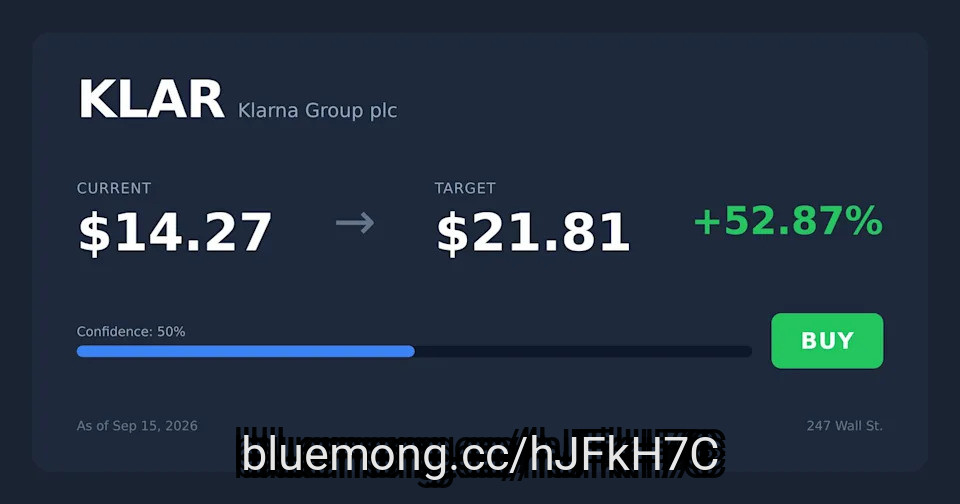
Klarna stock has cratered 51% year to date and 32% in just the past month, trading near its 52-week low of $12.
While KLAR collapsed, Sezzle surged 87% and Affirm slipped just 3%, signaling Klarna's pain is company-specific, not a BNPL sector rout.
Klarna's Q2 showed transaction margin up 42% and a swing to $9M net profit, but a guidance cut and accounting changes cloud the Q3 outlook.
Just released. Our ****** ysts combed the entire stock market and named the ten best stocks to buy right now, and Klarna Group plc didn't make the cut. Enter your email to see the names that beat KLAR. The report is free. Enter your email and see if any of your stocks made the cut.
Shares of Klarna (NYSE:KLAR) are trading at $14.23 on Tuesday afternoon, leaving the buy now, pay later (BNPL) lender down 51% year to date. Klarna stock is also down 32% over the past month, meaning much of the damage has landed recently rather than fading out.
#klar #year #month
While KLAR collapsed, Sezzle surged 87% and Affirm slipped just 3%, signaling Klarna's pain is company-specific, not a BNPL sector rout.
Klarna's Q2 showed transaction margin up 42% and a swing to $9M net profit, but a guidance cut and accounting changes cloud the Q3 outlook.
Just released. Our ****** ysts combed the entire stock market and named the ten best stocks to buy right now, and Klarna Group plc didn't make the cut. Enter your email to see the names that beat KLAR. The report is free. Enter your email and see if any of your stocks made the cut.
Shares of Klarna (NYSE:KLAR) are trading at $14.23 on Tuesday afternoon, leaving the buy now, pay later (BNPL) lender down 51% year to date. Klarna stock is also down 32% over the past month, meaning much of the damage has landed recently rather than fading out.
#klar #year #month



18 days ago
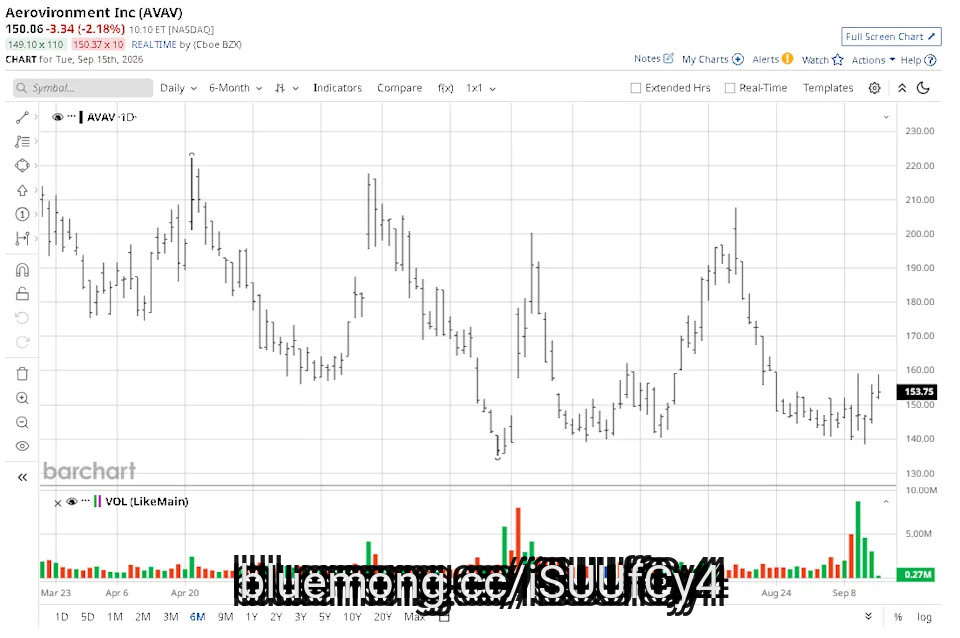
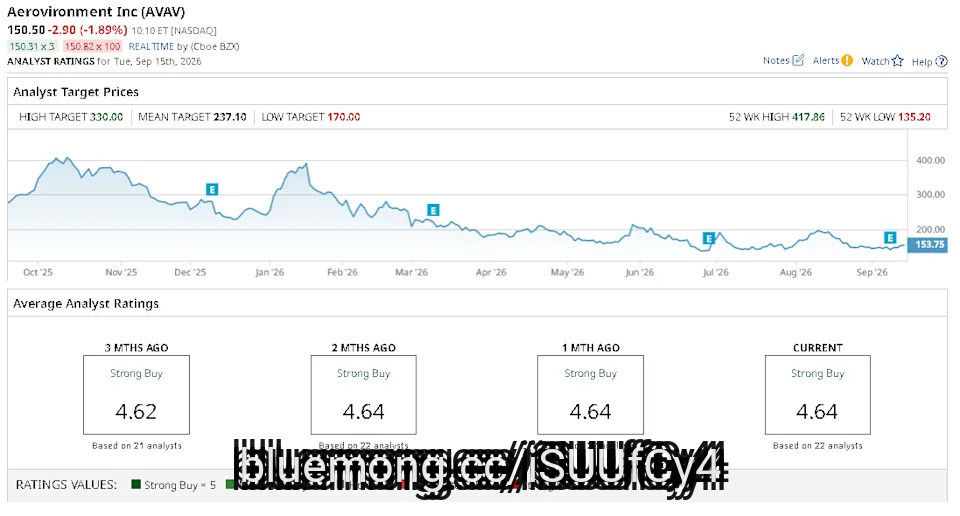
AeroVironment (AVAV) stock extended gains on Sept. 15 after the company's BlueHalo unit landed a landmark defense contract potentially worth up to $99.8 million. In its press release, AVAV said this new U.S. Air Force award — designed to advance military ******* e systems under the Leveraged Orbital Battlespace Optimization program — runs through August 2031.
The announcement arrives as AeroVironment shares are struggling to regain investor interest, currently down more than 60% versus their year-to-date high.
Goldman Sachs Expects Fed Chair Kevin Warsh to Raise Rates This Week — But Not Because of Oil Prices.
Billionaire Charlie Munger, Who Died at 99, Skipped Insurance on His Mansion Since He Could Just Write a Check to Rebuild — 'All Intelligent People Do It My Way'
The EV Bubble Has Burst. How to Play Rivian Stock Now.
#sept
The announcement arrives as AeroVironment shares are struggling to regain investor interest, currently down more than 60% versus their year-to-date high.
Goldman Sachs Expects Fed Chair Kevin Warsh to Raise Rates This Week — But Not Because of Oil Prices.
Billionaire Charlie Munger, Who Died at 99, Skipped Insurance on His Mansion Since He Could Just Write a Check to Rebuild — 'All Intelligent People Do It My Way'
The EV Bubble Has Burst. How to Play Rivian Stock Now.
#sept


19 days ago
The artificial intelligence (AI) boom is entering a new phase, and this time, the battle is moving deeper into the data center. It is no longer simply about who can build the fastest AI accelerator. Hyperscalers are scrambling for more compute, faster connectivity, and better power efficiency as AI workloads continue to grow at a breakneck pace. That is opening the door for chipmakers that can deliver customized, energy-efficient solutions at scale.
Qualcomm (QCOM) wants a seat at that table. The company just landed a major multi-generational collaboration with Amazon (AMZN) to supply customized silicon, systems, and related technology for large-scale AI data centers, with a focus on inference. The partnership also extends into high-speed optical connectivity, an increasingly critical piece of the AI infrastructure puzzle.
Goldman Sachs Expects Fed Chair Kevin Warsh to Raise Rates This Week — But Not Because of Oil Prices.
Morgan Stanley Doubles Down on Apple Stock as New Offerings Become 'More Exciting'
The EV Bubble Has Burst. How to Play Rivian Stock Now.
#customized #hyperscalers #amzn
Qualcomm (QCOM) wants a seat at that table. The company just landed a major multi-generational collaboration with Amazon (AMZN) to supply customized silicon, systems, and related technology for large-scale AI data centers, with a focus on inference. The partnership also extends into high-speed optical connectivity, an increasingly critical piece of the AI infrastructure puzzle.
Goldman Sachs Expects Fed Chair Kevin Warsh to Raise Rates This Week — But Not Because of Oil Prices.
Morgan Stanley Doubles Down on Apple Stock as New Offerings Become 'More Exciting'
The EV Bubble Has Burst. How to Play Rivian Stock Now.
#customized #hyperscalers #amzn



19 days ago
The artificial intelligence (AI) boom is entering a new phase, and this time, the battle is moving deeper into the data center. It is no longer simply about who can build the fastest AI accelerator. Hyperscalers are scrambling for more compute, faster connectivity, and better power efficiency as AI workloads continue to grow at a breakneck pace. That is opening the door for chipmakers that can deliver customized, energy-efficient solutions at scale.
Qualcomm (QCOM) wants a seat at that table. The company just landed a major multi-generational collaboration with Amazon (AMZN) to supply customized silicon, systems, and related technology for large-scale AI data centers, with a focus on inference. The partnership also extends into high-speed optical connectivity, an increasingly critical piece of the AI infrastructure puzzle.
Goldman Sachs Expects Fed Chair Kevin Warsh to Raise Rates This Week — But Not Because of Oil Prices.
Morgan Stanley Doubles Down on Apple Stock as New Offerings Become 'More Exciting'
The EV Bubble Has Burst. How to Play Rivian Stock Now.
#customized #amzn
Qualcomm (QCOM) wants a seat at that table. The company just landed a major multi-generational collaboration with Amazon (AMZN) to supply customized silicon, systems, and related technology for large-scale AI data centers, with a focus on inference. The partnership also extends into high-speed optical connectivity, an increasingly critical piece of the AI infrastructure puzzle.
Goldman Sachs Expects Fed Chair Kevin Warsh to Raise Rates This Week — But Not Because of Oil Prices.
Morgan Stanley Doubles Down on Apple Stock as New Offerings Become 'More Exciting'
The EV Bubble Has Burst. How to Play Rivian Stock Now.
#customized #amzn


19 days ago
On August 4, Westlake Corporation (NYSE:WLK) reported second-quarter results that erased two consecutive quarterly losses in a single swing. Net income landed at $260 million, or $2.01 per share, compared with a $169 million loss just three months earlier and a $142 million loss a year ago. EBITDA nearly tripled from the second quarter of 2025. The numbers mark a sharp reversal for a company whose chemicals business had been bleeding red ink.
The turnaround centers on Performance and Essential Materials, the segment that makes chlorovinyls and other basic chemicals. PEM swung from a $318 million operating loss in the second quarter of 2025 to $185 million in income this quarter, while EBITDA excluding identified items jumped from a 3% margin to 21%. The driver was pricing: average sales prices across PEM rose 14% year over year, more than offsetting a 3% price decline in the Housing and Infrastructure Products segment. Combined with a 7% increase in companywide sales volume, excluding the effects of plant shutdowns and an acquisition, the pricing recovery pushed companywide EBITDA to $679 million from $210 million a year earlier.
Westlake is also working the balance sheet alongside the market recovery. The company reduced debt by $500 million during the quarter and returned $99 million to shareholders through dividends and share repurchases. Management says its three-pillar profitability improvement plan remains on track to deliver a $600 million operating income benefit, a target that, if it holds, would layer structural cost savings on top of whatever the market gives back in pricing.
Not every part of the story improved together. Housing and Infrastructure Products, the segment tied to home construction and building products, saw its EBITDA margin slip to 22% from 24% a year earlier, even as volume rose 6% excluding the ACI acquisition. Average sales prices in that segment fell 3% year over year, a sign that pricing power in housing products has softened even as the company sells more of it.
The improvement in the core chemicals business also leans heavily on price rather than volume. PEM's turnaround came from a 14% jump in average sales price, a figure that can move in either direction with commodity cycles. The first quarter of 2026 was a reminder of how quickly conditions shift: Westlake posted a $169 million net loss just three months before this result, weighed down by $85 million in identified items, including a $67 million charge to settle litigation over PVC pipe and fittings and $18 million tied to facility shutdowns. A year earlier, in the second quarter of 2025, the company absorbed another $130 million in shutdown-related charges. Restructuring and legal charges showed up in two of the last three reported quarters.
#million #quarter #westlake #earlier
The turnaround centers on Performance and Essential Materials, the segment that makes chlorovinyls and other basic chemicals. PEM swung from a $318 million operating loss in the second quarter of 2025 to $185 million in income this quarter, while EBITDA excluding identified items jumped from a 3% margin to 21%. The driver was pricing: average sales prices across PEM rose 14% year over year, more than offsetting a 3% price decline in the Housing and Infrastructure Products segment. Combined with a 7% increase in companywide sales volume, excluding the effects of plant shutdowns and an acquisition, the pricing recovery pushed companywide EBITDA to $679 million from $210 million a year earlier.
Westlake is also working the balance sheet alongside the market recovery. The company reduced debt by $500 million during the quarter and returned $99 million to shareholders through dividends and share repurchases. Management says its three-pillar profitability improvement plan remains on track to deliver a $600 million operating income benefit, a target that, if it holds, would layer structural cost savings on top of whatever the market gives back in pricing.
Not every part of the story improved together. Housing and Infrastructure Products, the segment tied to home construction and building products, saw its EBITDA margin slip to 22% from 24% a year earlier, even as volume rose 6% excluding the ACI acquisition. Average sales prices in that segment fell 3% year over year, a sign that pricing power in housing products has softened even as the company sells more of it.
The improvement in the core chemicals business also leans heavily on price rather than volume. PEM's turnaround came from a 14% jump in average sales price, a figure that can move in either direction with commodity cycles. The first quarter of 2026 was a reminder of how quickly conditions shift: Westlake posted a $169 million net loss just three months before this result, weighed down by $85 million in identified items, including a $67 million charge to settle litigation over PVC pipe and fittings and $18 million tied to facility shutdowns. A year earlier, in the second quarter of 2025, the company absorbed another $130 million in shutdown-related charges. Restructuring and legal charges showed up in two of the last three reported quarters.
#million #quarter #westlake #earlier


19 days ago
On September 11, Elastic (NYSE:ESTC) rolled out Elasticsearch Vector Database, a new serverless offering the company says lets developers ship large-scale vector search and AI applications without stitching together the usual pile of infrastructure themselves. The launch landed less than three weeks after Elastic posted first-quarter fiscal 2027 results on August 27, for the period ended July 31, giving investors a fresh product story to weigh against a quarter that already showed accelerating growth.
The new database automates what used to require manual ***** embly: chunking documents, hosting embedding and reranking models, configuring indexes, and wiring query-time retrieval. Elastic built in expert-tuned defaults, a single field type that handles indexing, embeddings, and chunking together, and hybrid search that combines full-text and vector retrieval in one query. The system scales to hundreds of billions of vectors using Elastic's Better Binary Quantization, which the company says shrinks vector memory by up to 32 times while keeping recall high, and pricing is based on data and search capacity rather than the opaque compute units the company says define most pure-play vector database pricing.
That product push follows a quarter that was already running hot. Total revenue reached $478 million in the first quarter of fiscal 2027, up 15% year over year, while current remaining performance obligations grew 21% and remaining performance obligations grew 27%. Sales-led subscription revenue, which strips out Monthly Elastic Cloud, grew 18% year over year to $399 million, outpacing the company's overall subscription growth.
Elastic added more customers with annual contract value above $100,000 than in any prior quarter, pushing that cohort past 1,800 from over 1,720 in the fourth quarter of fiscal 2026 and over 1,550 a year earlier. Net expansion rate held around 111%, and the company generated $143 million in adjusted free cash flow during the quarter. Guidance for the second quarter of fiscal 2027, ending October 31, calls for revenue of $486 million to $487 million and a swing to positive GAAP operating margin, with full fiscal 2027 non-GAAP operating margin guided to roughly 19.4%, up from 16.2% in the quarter just reported.
Growth came with a reminder that Elastic has not fully crossed into GAAP profitability. The company posted a GAAP operating loss of $24 million in the first quarter of fiscal 2027, a -5% operating margin, and a GAAP net loss per share of $0.16. Non-GAAP figures told a healthier story, with $77 million in non-GAAP operating income and $0.70 in non-GAAP diluted earnings per share, but the gap between the two measures shows how much of Elastic's reported profitability still depends on excluding real costs like stock-based compensation.
#quarter #fiscal #year #operating
The new database automates what used to require manual ***** embly: chunking documents, hosting embedding and reranking models, configuring indexes, and wiring query-time retrieval. Elastic built in expert-tuned defaults, a single field type that handles indexing, embeddings, and chunking together, and hybrid search that combines full-text and vector retrieval in one query. The system scales to hundreds of billions of vectors using Elastic's Better Binary Quantization, which the company says shrinks vector memory by up to 32 times while keeping recall high, and pricing is based on data and search capacity rather than the opaque compute units the company says define most pure-play vector database pricing.
That product push follows a quarter that was already running hot. Total revenue reached $478 million in the first quarter of fiscal 2027, up 15% year over year, while current remaining performance obligations grew 21% and remaining performance obligations grew 27%. Sales-led subscription revenue, which strips out Monthly Elastic Cloud, grew 18% year over year to $399 million, outpacing the company's overall subscription growth.
Elastic added more customers with annual contract value above $100,000 than in any prior quarter, pushing that cohort past 1,800 from over 1,720 in the fourth quarter of fiscal 2026 and over 1,550 a year earlier. Net expansion rate held around 111%, and the company generated $143 million in adjusted free cash flow during the quarter. Guidance for the second quarter of fiscal 2027, ending October 31, calls for revenue of $486 million to $487 million and a swing to positive GAAP operating margin, with full fiscal 2027 non-GAAP operating margin guided to roughly 19.4%, up from 16.2% in the quarter just reported.
Growth came with a reminder that Elastic has not fully crossed into GAAP profitability. The company posted a GAAP operating loss of $24 million in the first quarter of fiscal 2027, a -5% operating margin, and a GAAP net loss per share of $0.16. Non-GAAP figures told a healthier story, with $77 million in non-GAAP operating income and $0.70 in non-GAAP diluted earnings per share, but the gap between the two measures shows how much of Elastic's reported profitability still depends on excluding real costs like stock-based compensation.
#quarter #fiscal #year #operating

19 days ago
On September 14, Radiant Logistics (NYSEAMERICAN:RLGT) held its fourth fiscal quarter earnings call, and the headline numbers landed harder than a typical logistics update. Net income jumped 53.1% to $7.5 million for the quarter ended June 30, while revenue climbed 18.5% to $261.4 million. Look past that one quarter, though, and the picture gets more complicated, because full-year adjusted profitability actually fell. That gap between a blowout quarter and a softer year is what makes this name worth a closer look.
The fourth fiscal quarter was strong from top to bottom. Adjusted EBITDA rose 31.6% to $10.4 million, margin expanded 240 basis points to 15.5%, and adjusted net income climbed 34.5% to $7.4 million, all against organic revenue growth of 8%. Management credited the acceleration to US forwarding operations and international airfreight, including work supporting disaster relief after typhoon activity hit the Western Pacific earlier this year, plus airfreight demand tied to capital flows into global data center buildouts.
The balance sheet backs up the story. Radiant enters fiscal 2027 with zero net debt, $25.6 million in cash as of June 30, and a $200 million senior credit facility that was extended and restated in August, pushing maturity out to August 7, 2031, while its acquisition-focused accordion grew to $100 million from $75 million. On the domestic side, capacity has been exiting the truckload and intermodal markets, and spot rates and tender rejections moved higher late in the quarter. Radiant also launched a new independent agent program at Radiant Road & Rail during the quarter, extending its freight forwarding agent network into truck brokerage and intermodal, while Navegate is gaining traction, with one enterprise customer now managing more than 1,400 vendors on the platform.
The full-year numbers tell a different story than the quarter does. Revenue rose just 3.5% to $934.4 million from $902.7 million, a fraction of the fourth quarter's 18.5% pace, and full-year net income grew a modest 8.7% to $18.8 million. Full-year adjusted EBITDA actually fell 5.4% to $36.7 million from $38.8 million, and that figure included a $1.3 million First Brands adjustment. Strip that out and normalized adjusted EBITDA comes in at $35.4 million, an even steeper decline than the headline number suggests.
The operating backdrop stays complicated too. Ocean shipping routes remain disrupted by the closure of the Strait of Hormuz and continued Houthi activity affecting Suez Canal transits, keeping capacity tight on key trade lanes. US tariff policy is generating elevated IEEPA-related filing activity, and Canada put new retaliatory tariff measures into effect in early September, adding fresh complexity for shippers moving goods across that border. Management itself acknowledged that the domestic truck brokerage improvement seen late in the fourth quarter is not yet fully reflected in the reported results.
#million #quarter #revenue #fiscal
The fourth fiscal quarter was strong from top to bottom. Adjusted EBITDA rose 31.6% to $10.4 million, margin expanded 240 basis points to 15.5%, and adjusted net income climbed 34.5% to $7.4 million, all against organic revenue growth of 8%. Management credited the acceleration to US forwarding operations and international airfreight, including work supporting disaster relief after typhoon activity hit the Western Pacific earlier this year, plus airfreight demand tied to capital flows into global data center buildouts.
The balance sheet backs up the story. Radiant enters fiscal 2027 with zero net debt, $25.6 million in cash as of June 30, and a $200 million senior credit facility that was extended and restated in August, pushing maturity out to August 7, 2031, while its acquisition-focused accordion grew to $100 million from $75 million. On the domestic side, capacity has been exiting the truckload and intermodal markets, and spot rates and tender rejections moved higher late in the quarter. Radiant also launched a new independent agent program at Radiant Road & Rail during the quarter, extending its freight forwarding agent network into truck brokerage and intermodal, while Navegate is gaining traction, with one enterprise customer now managing more than 1,400 vendors on the platform.
The full-year numbers tell a different story than the quarter does. Revenue rose just 3.5% to $934.4 million from $902.7 million, a fraction of the fourth quarter's 18.5% pace, and full-year net income grew a modest 8.7% to $18.8 million. Full-year adjusted EBITDA actually fell 5.4% to $36.7 million from $38.8 million, and that figure included a $1.3 million First Brands adjustment. Strip that out and normalized adjusted EBITDA comes in at $35.4 million, an even steeper decline than the headline number suggests.
The operating backdrop stays complicated too. Ocean shipping routes remain disrupted by the closure of the Strait of Hormuz and continued Houthi activity affecting Suez Canal transits, keeping capacity tight on key trade lanes. US tariff policy is generating elevated IEEPA-related filing activity, and Canada put new retaliatory tariff measures into effect in early September, adding fresh complexity for shippers moving goods across that border. Management itself acknowledged that the domestic truck brokerage improvement seen late in the fourth quarter is not yet fully reflected in the reported results.
#million #quarter #revenue #fiscal


21 days ago
With the news that Philadelphia Eagles offensive lineman Landon ******* erson was being placed on IR with a knee injury, ******* erson himself seemed fine with the development — especially since, in the guard's view, he had no business being on the field in Week 1.
In an interview on Philadelphia's 94 WIP radio, which took place very shortly after the IR news landed, ******* erson offered a blunt ******* sment of his play in the Eagles' narrow 24-22 win over the Washington Commanders on Sunday.
"Honestly, (to) address the elephant in the room, I played like sh** yesterday," ******* erson said. "I was a complete liability yesterday and, again, that was my fault … I shouldn't be out there until I feel healthy."
Dickerson said that he got "rolled up on" in practice last month during training camp, but continued to push through the injury. Imaging on Monday confirmed that he had a bone bruise in his right knee.
Dickerson found out that he was being placed on IR while live on air: After being read a report from the Philadelphia Inquirer's Jeff McClane, who was the first to report the news, the Eagles' starting left guard admitted to WIP that he hadn't been officially told, but that he knew it "was kind of the plan."
#Eagles #yesterday
In an interview on Philadelphia's 94 WIP radio, which took place very shortly after the IR news landed, ******* erson offered a blunt ******* sment of his play in the Eagles' narrow 24-22 win over the Washington Commanders on Sunday.
"Honestly, (to) address the elephant in the room, I played like sh** yesterday," ******* erson said. "I was a complete liability yesterday and, again, that was my fault … I shouldn't be out there until I feel healthy."
Dickerson said that he got "rolled up on" in practice last month during training camp, but continued to push through the injury. Imaging on Monday confirmed that he had a bone bruise in his right knee.
Dickerson found out that he was being placed on IR while live on air: After being read a report from the Philadelphia Inquirer's Jeff McClane, who was the first to report the news, the Eagles' starting left guard admitted to WIP that he hadn't been officially told, but that he knew it "was kind of the plan."
#Eagles #yesterday





21 days ago
Oklahoma State QB Drew Mestemaker sets school record in upset over Oregon originally appeared on The Sporting News. Add The Sporting News as a Preferred Source by clicking here.
On his very first play in front of the home fans at Boone Pickens Stadium, Oklahoma State quarterback Drew Mestemaker did something never before seen at the school.
Mestemaker faked a handoff, then took off for a 75-yard run on the Cowboys' first play from scrimmage in a 39-31 upset win over Oregon last Saturday. Oklahoma State sports information confirmed Monday that it was the longest run by a quarterback in school history.
Mestemaker setting the record is a bit of a shock at a school that has boasted prolific runners such as Zac Robinson, Spencer Sanders and J.W. Walsh. It's also surprising because Mestemaker is not known as a runner. In the entire previous season at North Texas, he ran for 89 yards on 57 carries.
That wasn't even his most exciting run of the day. He later scored on a 10-yard touchdown run in which he took off from the 3-yard line, hurdled a defender and was flipped upside down by another before he landed hard on his back in the end zone.
#mestemaker #yard #oregon #upset
On his very first play in front of the home fans at Boone Pickens Stadium, Oklahoma State quarterback Drew Mestemaker did something never before seen at the school.
Mestemaker faked a handoff, then took off for a 75-yard run on the Cowboys' first play from scrimmage in a 39-31 upset win over Oregon last Saturday. Oklahoma State sports information confirmed Monday that it was the longest run by a quarterback in school history.
Mestemaker setting the record is a bit of a shock at a school that has boasted prolific runners such as Zac Robinson, Spencer Sanders and J.W. Walsh. It's also surprising because Mestemaker is not known as a runner. In the entire previous season at North Texas, he ran for 89 yards on 57 carries.
That wasn't even his most exciting run of the day. He later scored on a 10-yard touchdown run in which he took off from the 3-yard line, hurdled a defender and was flipped upside down by another before he landed hard on his back in the end zone.
#mestemaker #yard #oregon #upset



21 days ago
NFL rumors: Cowboys named Joey Porter Jr. trade fit, and it makes sense appeared first on ClutchPoints. Add ClutchPoints as a Preferred Source by clicking here.
It was a tough Week 1 for the Dallas Cowboys. The same can be said for Steelers CB Joey Porter Jr. The Cowboys have been named a trade fit for Porter, and it makes even more sense after the disaster against the Giants.
The Cowboys landed at the top of Fowler's list of potential partners, according to ESPN.
"Dallas has been looking for cornerback help, though more so in the bargain bin to this point," Jeremy Fowler wrote. "The franchise has trade-market rapport with Pittsburgh GM Omar Khan. The sides have reached deals in back-to-back offseasons, as Dallas traded for wide receiver George Pickens in May 2025 and offensive tackle Broderick Jones on Aug. 29.
Watch sports LIVE with fuboTV (free trial)
#trade
It was a tough Week 1 for the Dallas Cowboys. The same can be said for Steelers CB Joey Porter Jr. The Cowboys have been named a trade fit for Porter, and it makes even more sense after the disaster against the Giants.
The Cowboys landed at the top of Fowler's list of potential partners, according to ESPN.
"Dallas has been looking for cornerback help, though more so in the bargain bin to this point," Jeremy Fowler wrote. "The franchise has trade-market rapport with Pittsburgh GM Omar Khan. The sides have reached deals in back-to-back offseasons, as Dallas traded for wide receiver George Pickens in May 2025 and offensive tackle Broderick Jones on Aug. 29.
Watch sports LIVE with fuboTV (free trial)
#trade


21 days ago
The San Francisco Giants have endured the bad, the worse and the ugly throughout a 2026 campaign that started with high hopes and landed with bleak realities.
The Giants have been among the most disappointing teams in Major League Baseball this season. There was optimism in San Francisco when the team brought in first-year manager Tony Vitello from the college ranks with no previous MLB experience. Many experts predicted that the Giants would win 82 games and maybe even sneak into a wild-card berth. It would have been the most success the team has seen in nearly a half decade.
Then the season began and things shifted immediately. San Francisco isn't anywhere near discussions of making a postseason appearance. Instead, the Giants have the second-worst record in the National League (only the division-rival Colorado Rockies have a worse record).
The Giants haven't had the play they were expecting on the diamond. The Giants lacked depth in the bullpen, dealt with a series of injuries which contorted lineups, and key players just looked like a shell of themselves through large parts of the season. Vitello has been ejected from multiple games this season. Frustration has settled in San Francisco like fog covering the Golden Gate Bridge.
It's since seemed like a salvageable season after seeing younger prospects such as Bryce Eldridge see the field more. After a sluggish start, Rafael Devers found his bat as of late and is nearing a 40-homer season. There are few positive takeaways from the Giants this year, which leaves a little excitement for the next season.
#team
The Giants have been among the most disappointing teams in Major League Baseball this season. There was optimism in San Francisco when the team brought in first-year manager Tony Vitello from the college ranks with no previous MLB experience. Many experts predicted that the Giants would win 82 games and maybe even sneak into a wild-card berth. It would have been the most success the team has seen in nearly a half decade.
Then the season began and things shifted immediately. San Francisco isn't anywhere near discussions of making a postseason appearance. Instead, the Giants have the second-worst record in the National League (only the division-rival Colorado Rockies have a worse record).
The Giants haven't had the play they were expecting on the diamond. The Giants lacked depth in the bullpen, dealt with a series of injuries which contorted lineups, and key players just looked like a shell of themselves through large parts of the season. Vitello has been ejected from multiple games this season. Frustration has settled in San Francisco like fog covering the Golden Gate Bridge.
It's since seemed like a salvageable season after seeing younger prospects such as Bryce Eldridge see the field more. After a sluggish start, Rafael Devers found his bat as of late and is nearing a 40-homer season. There are few positive takeaways from the Giants this year, which leaves a little excitement for the next season.
#team


21 days ago
On August 10, Red Violet Inc. (NASDAQ:RDVT) reported second-quarter 2026 results for the period ended June 30 that showed the company converting growth into profit at an accelerating clip. Revenue rose 23% to $26.7 million, and net income nearly doubled to $5 million. For a company built on selling identity intelligence to businesses, watching net margin move from 12% to 19% says that growth is not costing more to produce.
Gross profit climbed 29% to $20.2 million, pushing gross margin to 76% from 72%, while adjusted EBITDA jumped 48% to $11.2 million as its margin widened to 42% from 35%. Adjusted net income rose 58% to $7.2 million. Cash generation told the same story: operating cash flow increased 42% to a record $10.6 million for the quarter. None of that came from adding customers who barely move the needle. Red Violet signed on 447 new IDI customers in the quarter, a company record, ending with 10,869 customers on the platform.
FOREWARN, its product built for real estate agents, picked up 25,493 new users to reach 443,173, and 660 REALTOR ****** ociations across the country are now under contract to use it. The company also closed an underwritten public offering in August that sold 1,916,667 shares, including 250,000 shares from the underwriters' full exercise of their option, generating net proceeds of about $109.0 million. Between the funds already on hand and this new raise, Red Violet says it holds over $160 million in cash and carries no debt, money earmarked for working capital and possible acquisitions.
CEO Derek Dubner called it what he described as "the strongest pipeline of strategic initiatives" in the company's history. The company also repurchased 74,500 shares by June 30, paying $41.87 per share on average, and had $15.5 million left on its buyback authorization.
The August offering that padded Red Violet's cash balance also added 1,916,667 new shares to the count, arriving in the same year that per-share profit is climbing fastest. Diluted earnings came in a penny below basic at $0.34, and adjusted diluted earnings landed at $0.50 versus $0.51 on a basic basis, a gap new shares will only widen going forward. There is also a timing tension worth sitting with: Red Violet spent part of the quarter buying back its own stock at an average of $41.87 a share, then turned around weeks later and sold new shares to the public.
#million
Gross profit climbed 29% to $20.2 million, pushing gross margin to 76% from 72%, while adjusted EBITDA jumped 48% to $11.2 million as its margin widened to 42% from 35%. Adjusted net income rose 58% to $7.2 million. Cash generation told the same story: operating cash flow increased 42% to a record $10.6 million for the quarter. None of that came from adding customers who barely move the needle. Red Violet signed on 447 new IDI customers in the quarter, a company record, ending with 10,869 customers on the platform.
FOREWARN, its product built for real estate agents, picked up 25,493 new users to reach 443,173, and 660 REALTOR ****** ociations across the country are now under contract to use it. The company also closed an underwritten public offering in August that sold 1,916,667 shares, including 250,000 shares from the underwriters' full exercise of their option, generating net proceeds of about $109.0 million. Between the funds already on hand and this new raise, Red Violet says it holds over $160 million in cash and carries no debt, money earmarked for working capital and possible acquisitions.
CEO Derek Dubner called it what he described as "the strongest pipeline of strategic initiatives" in the company's history. The company also repurchased 74,500 shares by June 30, paying $41.87 per share on average, and had $15.5 million left on its buyback authorization.
The August offering that padded Red Violet's cash balance also added 1,916,667 new shares to the count, arriving in the same year that per-share profit is climbing fastest. Diluted earnings came in a penny below basic at $0.34, and adjusted diluted earnings landed at $0.50 versus $0.51 on a basic basis, a gap new shares will only widen going forward. There is also a timing tension worth sitting with: Red Violet spent part of the quarter buying back its own stock at an average of $41.87 a share, then turned around weeks later and sold new shares to the public.
#million


21 days ago
On September 10, Copart (NASDAQ:CPRT) held its fourth-quarter earnings call and used it to unveil a deal that could reshape its business: an all-cash agreement to acquire ACV, a digital auto marketplace that moved roughly $10 billion of vehicles last year without owning a single lot. The announcement landed alongside a quarter that captured the company's central tension. Revenue rose, but net income fell, and management is now betting that pairing its junkyards with someone else's software can fix that.
The ACV deal is the headline, and for good reason. ACV brings more than 22,000 active buyers and inspection and valuation technology, while Copart contributes over 275 locations, roughly 4 million vehicles sold annually, and about 1 million members across more than 185 countries. Management structured it as an all-cash tender offer funded from cash on hand, with a close targeted by the end of the calendar year and earnings accretion expected in fiscal 2028. Executives framed the fit as physical scale meeting digital liquidity, giving dealers, banks, and fleet sellers a single partner for disposing of vehicles.
That diversification push is already showing up in the numbers. International revenue grew 11.7% to $222.1 million on 15% service revenue growth, and international buyers accounted for 45.7% of total US sales dollars despite making up only 38.2% of units, a sign they are chasing pricier vehicles. Domestically, non-insurance units returned to growth of 0.2% in the quarter after a full-year decline, dealer units rose 5.8%, and BluCar, which serves banks and fleets, expanded nearly 20%. Global average selling prices climbed 3.5%, evidence that Copart's auctions still command pricing power even as volumes soften.
The quarter's numbers show where the strain is. Consolidated revenue grew 2.4% to $1.2 billion, yet net income dropped 17.4% to $327.4 million and diluted earnings per share fell 14.6% to $0.35. Operating expense per car jumped 12.7% year over year as the company poured money into long-haul delivery, **** leExpress, and dedicated wholesale facilities, and US facility costs alone rose 7.7% in the quarter. Lower interest income, a byproduct of the $1.63 billion spent on buybacks earlier in the fiscal year, added to the squeeze.
The core insurance business is also cooling. Global insurance units fell 4.2%, with domestic insurance **** ignments down 7.5%, though management noted that figure would have been up 2.3% excluding the loss of a single customer. Collision claim frequency declined 3.4% even as total loss frequency hit a record 23.3% for a second quarter and severity topped $6,300 per claim, up 8.8%. And the ACV deal itself carries integration risk, since management expects only breakeven results before accretion arrives in fiscal 2028.
#quarter #vehicles #insurance
The ACV deal is the headline, and for good reason. ACV brings more than 22,000 active buyers and inspection and valuation technology, while Copart contributes over 275 locations, roughly 4 million vehicles sold annually, and about 1 million members across more than 185 countries. Management structured it as an all-cash tender offer funded from cash on hand, with a close targeted by the end of the calendar year and earnings accretion expected in fiscal 2028. Executives framed the fit as physical scale meeting digital liquidity, giving dealers, banks, and fleet sellers a single partner for disposing of vehicles.
That diversification push is already showing up in the numbers. International revenue grew 11.7% to $222.1 million on 15% service revenue growth, and international buyers accounted for 45.7% of total US sales dollars despite making up only 38.2% of units, a sign they are chasing pricier vehicles. Domestically, non-insurance units returned to growth of 0.2% in the quarter after a full-year decline, dealer units rose 5.8%, and BluCar, which serves banks and fleets, expanded nearly 20%. Global average selling prices climbed 3.5%, evidence that Copart's auctions still command pricing power even as volumes soften.
The quarter's numbers show where the strain is. Consolidated revenue grew 2.4% to $1.2 billion, yet net income dropped 17.4% to $327.4 million and diluted earnings per share fell 14.6% to $0.35. Operating expense per car jumped 12.7% year over year as the company poured money into long-haul delivery, **** leExpress, and dedicated wholesale facilities, and US facility costs alone rose 7.7% in the quarter. Lower interest income, a byproduct of the $1.63 billion spent on buybacks earlier in the fiscal year, added to the squeeze.
The core insurance business is also cooling. Global insurance units fell 4.2%, with domestic insurance **** ignments down 7.5%, though management noted that figure would have been up 2.3% excluding the loss of a single customer. Collision claim frequency declined 3.4% even as total loss frequency hit a record 23.3% for a second quarter and severity topped $6,300 per claim, up 8.8%. And the ACV deal itself carries integration risk, since management expects only breakeven results before accretion arrives in fiscal 2028.
#quarter #vehicles #insurance


21 days ago
Coming off the Indianapolis Colts' Week 1 matchup with the Baltimore Ravens, head coach Shane Steichen said that wide receiver Alec Pierce's left hand/wrist is fine, according to Mike Chappell of FOX59.
Following Sunday's game, Chappell wrote that Pierce briefly exited the game and was taken to the locker room after his left wrist hit the helmet of Ravens' linebacker Roquan Smith at some point in the first half.
Chappell added that Pierce's X-rays came back negative. He then spoke to the Colts' wideout about the injury after the game.
"It's good,'' Pierce told Chappell. "I just bruised up my hand. No worries.''
Pierce underwent offseason ankle surgery that landed him on the PUP list for much of training camp. He has spent the past few weeks ramping up, which included taking on a smaller role in Sunday's game.
#chappell #pierce
Following Sunday's game, Chappell wrote that Pierce briefly exited the game and was taken to the locker room after his left wrist hit the helmet of Ravens' linebacker Roquan Smith at some point in the first half.
Chappell added that Pierce's X-rays came back negative. He then spoke to the Colts' wideout about the injury after the game.
"It's good,'' Pierce told Chappell. "I just bruised up my hand. No worries.''
Pierce underwent offseason ankle surgery that landed him on the PUP list for much of training camp. He has spent the past few weeks ramping up, which included taking on a smaller role in Sunday's game.
#chappell #pierce



21 days ago
Meghan Markle, Prince Harry and their children returned to the U.K. last month
Over the weekend, Meghan made her first Instagram post of her kids back in Britain
The clip showed Prince Archie and Princess Lilibet running through the woods, fishing in a pond and splashing in puddles wearing a British staple
Prince Archie and Princess Lilibet are embracing the early English fall following their move back to the U.K.
Meghan Markle, Prince Harry and their children arrived back in England on Aug. 26. PEOPLE confirmed that the family landed in Birmingham just one week after announcing the news that they were relocating to the U.K. for an extended period after spending six years living in California.
#archie
Over the weekend, Meghan made her first Instagram post of her kids back in Britain
The clip showed Prince Archie and Princess Lilibet running through the woods, fishing in a pond and splashing in puddles wearing a British staple
Prince Archie and Princess Lilibet are embracing the early English fall following their move back to the U.K.
Meghan Markle, Prince Harry and their children arrived back in England on Aug. 26. PEOPLE confirmed that the family landed in Birmingham just one week after announcing the news that they were relocating to the U.K. for an extended period after spending six years living in California.
#archie



21 days ago
Sydney Sweeney's latest ad campaign has landed very differently with some of the women who have spent their lives competing in sports.
Four-time Olympic gold medalist Ariarne ***** mus is among a growing group of athletes criticizing Sweeney's new "Just Sports" campaign for Novig, a sports prediction market. The campaign shows Sweeney nude or minimally dressed while footballs, basketballs, hockey equipment and other sports gear strategically cover her body.
Athletes including former UCLA gymnast Gracie Kramer, Olympic swimmer Lani Pallister, British sprinter Amy Hunt and water polo Olympian Tilly Kearns have responded by putting competition, training and athletic achievement back at the center of their own posts.
Sweeney is more closely tied to the campaign than a typical celebrity spokesperson. Novig announced that she joined the company as a strategic partner and equity holder, while Sweeney said she had participated in the creative process from the beginning.
The four-time Olympic champion, who retired from competitive swimming in 2025, wrote on Instagram that she had believed this kind of marketing belonged in the past.
#four
Four-time Olympic gold medalist Ariarne ***** mus is among a growing group of athletes criticizing Sweeney's new "Just Sports" campaign for Novig, a sports prediction market. The campaign shows Sweeney nude or minimally dressed while footballs, basketballs, hockey equipment and other sports gear strategically cover her body.
Athletes including former UCLA gymnast Gracie Kramer, Olympic swimmer Lani Pallister, British sprinter Amy Hunt and water polo Olympian Tilly Kearns have responded by putting competition, training and athletic achievement back at the center of their own posts.
Sweeney is more closely tied to the campaign than a typical celebrity spokesperson. Novig announced that she joined the company as a strategic partner and equity holder, while Sweeney said she had participated in the creative process from the beginning.
The four-time Olympic champion, who retired from competitive swimming in 2025, wrote on Instagram that she had believed this kind of marketing belonged in the past.
#four

23 days ago
The moment Vernell Brown III reached the end zone; a bolt of energy returned to Ben Hill Griffin Stadium.
It was energy that sat dormant for four years during Billy Napier's four years as Florida football coach. Jon Sumrall relit the flame with 66 points last week vs. Florida Atlantic, but that fire fizzled out in a sluggish first quarter vs. FCS foe Campbell.
Until Brown III caught a punt early in the second quarter.
64 yards later, he landed in the end zone. Three minutes later, Brown III once again reigned in a punt and scored another touchdown.
The two scores entered Brown into an elusive category, joining Jacquez Green as the only two Gators to return two punts for TDs in a single game.
#brown #zone #punt
It was energy that sat dormant for four years during Billy Napier's four years as Florida football coach. Jon Sumrall relit the flame with 66 points last week vs. Florida Atlantic, but that fire fizzled out in a sluggish first quarter vs. FCS foe Campbell.
Until Brown III caught a punt early in the second quarter.
64 yards later, he landed in the end zone. Three minutes later, Brown III once again reigned in a punt and scored another touchdown.
The two scores entered Brown into an elusive category, joining Jacquez Green as the only two Gators to return two punts for TDs in a single game.
#brown #zone #punt




23 days ago
Fundstrat's Tom Lee took the Future Proof Citywide stage earlier this year with CNBC's Scott Wapner for a session that landed in the middle of a jittery tape that included geopolitical conflict, oil spiking, private credit cracking, and fresh doubts about AI spending. Not too far off where we find ourselves currently, but with an awful lot of volatility and shifting, uncertain outlooks between these six months. While their conversation was a snapshot in time, you can expect more of this kind of sharp, thoughtful ****** ysis next week.
The contrarian take of the session was oil. High crude, Lee argued, is actually constructive for U.S. equities. With the U.S. as a net exporter, our economic competitors are importers, and stalled global growth pushes investors toward growth stocks, which is about 80% of the U.S. market. On AI CapEx, he pushed back on the sticker shock, claiming roughly $700 billion a year is a fraction of the $60 trillion global labor market and small change against daily moves in gold.
Lee also made the case that software had bottomed at the time, that enterprises building their own tools inherit the maintenance burden software companies exist to carry, and that private credit is genuinely bad but not a GFC repeat, with the real fix being taking private companies public rather than pushing private product into retail portfolios. On crypto, his argument shifted from a perspective of digital gold to one of plumbing whereby Wall Street tokenizes ****** ets, and AI agents needing a settlement rail that handles fractions of a penny.
His parting advice was the oldest one in the book, dressed in new clothes: miss the 10 best days of each year and a 16% average return goes to roughly nothing. Danger and opportunity show up together. Staying invested is the perpetual drumbeat of advisors to their clients, but one that needs banging louder when markets feel much less certain.
Future Proof Festival is September 14–17 in Huntington Beach and includes four days on the boardwalk with advisors, ****** et managers, and fintechs building the modern wealth management industry. Find us at the ETF Oasis and don't miss the stellar agenda we've got lined up.
#find #session #credit #time
The contrarian take of the session was oil. High crude, Lee argued, is actually constructive for U.S. equities. With the U.S. as a net exporter, our economic competitors are importers, and stalled global growth pushes investors toward growth stocks, which is about 80% of the U.S. market. On AI CapEx, he pushed back on the sticker shock, claiming roughly $700 billion a year is a fraction of the $60 trillion global labor market and small change against daily moves in gold.
Lee also made the case that software had bottomed at the time, that enterprises building their own tools inherit the maintenance burden software companies exist to carry, and that private credit is genuinely bad but not a GFC repeat, with the real fix being taking private companies public rather than pushing private product into retail portfolios. On crypto, his argument shifted from a perspective of digital gold to one of plumbing whereby Wall Street tokenizes ****** ets, and AI agents needing a settlement rail that handles fractions of a penny.
His parting advice was the oldest one in the book, dressed in new clothes: miss the 10 best days of each year and a 16% average return goes to roughly nothing. Danger and opportunity show up together. Staying invested is the perpetual drumbeat of advisors to their clients, but one that needs banging louder when markets feel much less certain.
Future Proof Festival is September 14–17 in Huntington Beach and includes four days on the boardwalk with advisors, ****** et managers, and fintechs building the modern wealth management industry. Find us at the ETF Oasis and don't miss the stellar agenda we've got lined up.
#find #session #credit #time

23 days ago
ETH is enjoying another stretch of relative strength, trading up as much as 7% this morning above $2,600, and still running around +4% on the day at the time of writing.
In this span, ETH outperformed a flat BTC (+0.33%) and warmer majors like SOL, HYPE, and ZEC (which are all roughly +2% over the past 24 hours).
The backdrop: Friday's CPI landed mixed, i.e. a hotter headline number softened by a cooler core reading. Markets seem to have shrugged this result off as already priced in, flipping the mood from Thursday's PPI-driven jitters back toward risk-on.
Secondary driver: This vibe shift led to buy pressure, the buy pressure led to a bounce, and the bounce led to a squeeze. As ETH shorts had become a crowded trade once more, that bounce forced hundreds of millions in liquidations, with one outsized position wipeout on Hyperliquid doing a lot of that damage alone.
What to watch: Traders are now betting the Fed will raise rates at next week's FOMC meeting. Odds jumped to the mid-to-high 80% range after Friday's data, up from around 70% the day before. If that rate hike happens and the Fed signals more are coming, ETH's rallying could stall. Yet if Fed Chair Warsh sounds less aggressive when he speaks afterward, ETH's strength could just as easily keep going.
#pressure #markets #hyperliquid
In this span, ETH outperformed a flat BTC (+0.33%) and warmer majors like SOL, HYPE, and ZEC (which are all roughly +2% over the past 24 hours).
The backdrop: Friday's CPI landed mixed, i.e. a hotter headline number softened by a cooler core reading. Markets seem to have shrugged this result off as already priced in, flipping the mood from Thursday's PPI-driven jitters back toward risk-on.
Secondary driver: This vibe shift led to buy pressure, the buy pressure led to a bounce, and the bounce led to a squeeze. As ETH shorts had become a crowded trade once more, that bounce forced hundreds of millions in liquidations, with one outsized position wipeout on Hyperliquid doing a lot of that damage alone.
What to watch: Traders are now betting the Fed will raise rates at next week's FOMC meeting. Odds jumped to the mid-to-high 80% range after Friday's data, up from around 70% the day before. If that rate hike happens and the Fed signals more are coming, ETH's rallying could stall. Yet if Fed Chair Warsh sounds less aggressive when he speaks afterward, ETH's strength could just as easily keep going.
#pressure #markets #hyperliquid

23 days ago
The UConn Huskies (1-1) struggled to stay above water in their 38-14 loss to the Maryland Terrapins (2-0).
Paving the way for Connecticut, quarterback Kalieb Osborne completed 10 of 21 (41.7%) passes for 156 yards and two touchdowns. Osborne also led with 62 rushing yards, while running back Kenji Christian posted 21 yards. In the air, Shamar Porter paved the way with 62 receiving yards and an end zone appearance. JD Willoughby followed with 36 yards and a touchdown. Defensively, cornerback Zion Paret racked up 12 tackles (six solo) and K'Von Sherman tallied nine (four solo).
As for Maryland, Malik Washington landed 34 of 41 (82.9%) throws for 347 yards and two touchdowns. In the backfield, running backs Iverson Howard and Harry Dalton III rushed for 57 yards and crossed the goal line three times. At wide receiver, Na'eem Abdul-Rahim Gladding led with 130 yards and a touchdown. Behind him, Chris Durr Jr. registered 103 yards and a touchdown. Defensively, linebackers Sidney Stewart and Carlton Smith recorded six tackles and Stewart earning a sack.
"There weren't any adverse moments in our first football game. This is a whole different animal," Head Coach Jason Candle said. "They were going to try and lean on us and run the ball down your throat; play up in the face of your receiver. They're going to play pressure-style defense and we're going to figure out how we're going to respond."
To kick off the game, UConn and Maryland traded end zone appearances. With just under five minutes remaining in the opening quarter, Connecticut struck first. After forcing a quick three-and-out, the Terrapins punted from their 14-yard line. Wide receiver Julian Allen's 18-yard return spotted the ball at Maryland's 32-yard line, but a 15-yard unsportsmanlike conduct penalty backed it up to the 47-yard line.
#going #touchdown #receiver #connecticut
Paving the way for Connecticut, quarterback Kalieb Osborne completed 10 of 21 (41.7%) passes for 156 yards and two touchdowns. Osborne also led with 62 rushing yards, while running back Kenji Christian posted 21 yards. In the air, Shamar Porter paved the way with 62 receiving yards and an end zone appearance. JD Willoughby followed with 36 yards and a touchdown. Defensively, cornerback Zion Paret racked up 12 tackles (six solo) and K'Von Sherman tallied nine (four solo).
As for Maryland, Malik Washington landed 34 of 41 (82.9%) throws for 347 yards and two touchdowns. In the backfield, running backs Iverson Howard and Harry Dalton III rushed for 57 yards and crossed the goal line three times. At wide receiver, Na'eem Abdul-Rahim Gladding led with 130 yards and a touchdown. Behind him, Chris Durr Jr. registered 103 yards and a touchdown. Defensively, linebackers Sidney Stewart and Carlton Smith recorded six tackles and Stewart earning a sack.
"There weren't any adverse moments in our first football game. This is a whole different animal," Head Coach Jason Candle said. "They were going to try and lean on us and run the ball down your throat; play up in the face of your receiver. They're going to play pressure-style defense and we're going to figure out how we're going to respond."
To kick off the game, UConn and Maryland traded end zone appearances. With just under five minutes remaining in the opening quarter, Connecticut struck first. After forcing a quick three-and-out, the Terrapins punted from their 14-yard line. Wide receiver Julian Allen's 18-yard return spotted the ball at Maryland's 32-yard line, but a 15-yard unsportsmanlike conduct penalty backed it up to the 47-yard line.
#going #touchdown #receiver #connecticut


23 days ago
Tommy McMillen and Marwan Rahiki turned in one of the best featherweight fights ever earlier today (Sat., Sept. 12, 2026) at Noche UFC 4 LIVE on Paramount+ from inside Desert Diamond Arena in Glendale, Arizona, as the two prospects stood toe-to-toe and unleashed everything they had.
Both fighters came into this fight with something to prove. For McMillen, it was his chance to prove he's the real deal at 145 pounds and not just an exciting fighter from the Contender Series. For Rahiki, he was out to showcase his own potential in the UFC's talent-rich featherweight division and that he should get a bigger push from matchmakers instead of McMillen. It was a recipe for unfiltered chaos and that's exactly what fight fans witnessed.
The first round was a back-and-forth affair full of combinations and exchanges in close. McMillen showcased some of his wrestling along the way, but Rahiki did well to get back to his feet. The second round was even crazier as Rahiki landed a massive uppercut that sent McMillen crashing to the canvas. Rahiki chased McMillen all over the cage in search of a finish, but "Gun" somehow survived. It was a true testament to McMillen's heart, toughness, and elite cardio.
McMillen returned the favor in the third round when he regained momentum with a huge knockdown in the center of the Octagon. From there, McMillen was on cruise control. He attacked with chokes, combinations in the clinch, knees inside, and all-out pressure. Rahiki was fading for sure, but he somehow hung in long enough to hear the final buzzer sound. It was one of the wildest three-round fights you'll ever see and another reason why McMillen is one of the quickest rising stars in the sport.
In the end, McMillen walked away with the unanimous decision win. Check out the video highlights below and let us know if McMillen can maintain this pace as he further climbs the 145-pound ladder.
#mcmillen #round
Both fighters came into this fight with something to prove. For McMillen, it was his chance to prove he's the real deal at 145 pounds and not just an exciting fighter from the Contender Series. For Rahiki, he was out to showcase his own potential in the UFC's talent-rich featherweight division and that he should get a bigger push from matchmakers instead of McMillen. It was a recipe for unfiltered chaos and that's exactly what fight fans witnessed.
The first round was a back-and-forth affair full of combinations and exchanges in close. McMillen showcased some of his wrestling along the way, but Rahiki did well to get back to his feet. The second round was even crazier as Rahiki landed a massive uppercut that sent McMillen crashing to the canvas. Rahiki chased McMillen all over the cage in search of a finish, but "Gun" somehow survived. It was a true testament to McMillen's heart, toughness, and elite cardio.
McMillen returned the favor in the third round when he regained momentum with a huge knockdown in the center of the Octagon. From there, McMillen was on cruise control. He attacked with chokes, combinations in the clinch, knees inside, and all-out pressure. Rahiki was fading for sure, but he somehow hung in long enough to hear the final buzzer sound. It was one of the wildest three-round fights you'll ever see and another reason why McMillen is one of the quickest rising stars in the sport.
In the end, McMillen walked away with the unanimous decision win. Check out the video highlights below and let us know if McMillen can maintain this pace as he further climbs the 145-pound ladder.
#mcmillen #round

23 days ago
Tommy McMillen vs. Marwan Rahiki squared off in a Featherweight bout earlier this morning (Sat., Sept. 12, 2026) inside Desert Diamond Arena in Glendale, Arizona for Noche UFC 4. After a wild and ****** fight, McMillen was named the victor.
McMillen opened the fight with an overhand right and a surprising takedown. He tried to threaten an arm triangle, but Rahiki quickly escaped to his feet. Back in the standup, the two wasted little time in throwing powerful punches. The range widened, and the two young Featherweights traded kicks. Rahiki got on the front foot and put his opponent on the defensive. His chin was really high though …
Rahiki hit the body and timed a gorgeous right hand. McMillen tied together his kicks and punches, opening a small cut by Rahiki's eye. Two hard right hands connected for McMillen, but "Freaky" fired right back. At the close of the competitive opening round, the two mouthed off at one another as the referee kept them apart.
McMillen was active to start round two, throwing a lot of volume and landing a particularly stiff jab. McMillen threatened a guillotine choke to gain top position but couldn't hold down Rahiki. Rahiki kicked the calf and then started ripping the body to great effect. McMillen's nose was bleeding, but he scored a heavy left hand that wobbled his opponent briefly.
Out of nowhere, a Rahiki counter uppercut floored McMillen! Rahiki turned up the offense and landed a bunch of cracking shots. Somehow, McMillen was able to survive and even land a big right hand of his own a minute later. McMillen started to build some offense on his fatigued opponent, including a late takedown that saw him finish the round with some submission attempts.
#round
McMillen opened the fight with an overhand right and a surprising takedown. He tried to threaten an arm triangle, but Rahiki quickly escaped to his feet. Back in the standup, the two wasted little time in throwing powerful punches. The range widened, and the two young Featherweights traded kicks. Rahiki got on the front foot and put his opponent on the defensive. His chin was really high though …
Rahiki hit the body and timed a gorgeous right hand. McMillen tied together his kicks and punches, opening a small cut by Rahiki's eye. Two hard right hands connected for McMillen, but "Freaky" fired right back. At the close of the competitive opening round, the two mouthed off at one another as the referee kept them apart.
McMillen was active to start round two, throwing a lot of volume and landing a particularly stiff jab. McMillen threatened a guillotine choke to gain top position but couldn't hold down Rahiki. Rahiki kicked the calf and then started ripping the body to great effect. McMillen's nose was bleeding, but he scored a heavy left hand that wobbled his opponent briefly.
Out of nowhere, a Rahiki counter uppercut floored McMillen! Rahiki turned up the offense and landed a bunch of cracking shots. Somehow, McMillen was able to survive and even land a big right hand of his own a minute later. McMillen started to build some offense on his fatigued opponent, including a late takedown that saw him finish the round with some submission attempts.
#round