
26 days ago
On September 17, Coherent Corp. (NYSE:COHR) announced an upgraded Pluggable Optical Line System that covers the full C-band and fits in a compact QSFP module, the same slot ordinary transceivers use. That is a lot of networking gear shrunk into a plug, and it follows a quarter of 34% revenue growth. Here is what the launch means, and where the stock's story gets harder to read.
Start with what the product does. The upgraded system can pack 32 wavelengths onto a single pair of fibers, which Coherent says adds up to as much as 25.6Tbps of traffic on links running 2km to 200km. It is designed for the latest 800G coherent optics, and it configures itself, handling link setup and laser safety without a technician tuning each connection. Coherent also says the system is generally available and already shipping in high volume, in 400G and 800G versions that work with existing network setups. Madhu Krishnaswamy, who runs the company's telecom transport unit, describes the goal as easing the usual trade-off between raw performance and operational simplicity.
The launch also sits on top of a business that is already moving. On August 12, Coherent reported results for its fiscal fourth quarter, which ended June 30: revenue of $2.05 billion, up 34% from a year earlier. Non-GAAP earnings per share rose to $1.74 from $1.00, and CEO Jim Anderson noted that for the full year, that measure grew more than twice as fast as revenue. Management guided to revenue of $2.2 billion to $2.4 billion for the first quarter of fiscal 2027, and Anderson says AI data centers are increasingly moving from copper to optical links.
Now look at the two versions of profit. Coherent's non-GAAP earnings came to $1.74 per share, but under GAAP the figure was $1.19. The gap comes from items management leaves out, including stock-based pay, amortization on acquired intangibles, and restructuring and integration costs. Operating margin shows it more clearly, at 21.8% on a non-GAAP basis and 12.4% under GAAP. Some of those costs are non-cash, but they are real, and anyone anchoring on the higher figure is skipping them.
Then there is how much weight this launch can carry. The announcement puts no sales figure on the product, so its contribution to a company that booked $2.05 billion in a quarter cannot be sized from what has been published. The bullish story also rests on management's own read of where AI networks are headed, and on a capacity build-out that CFO Sherri Luther says gets priority in spending. Money spent on capacity only pays off if the demand management describes keeps arriving.
#gaap #revenue #launch #anderson
Start with what the product does. The upgraded system can pack 32 wavelengths onto a single pair of fibers, which Coherent says adds up to as much as 25.6Tbps of traffic on links running 2km to 200km. It is designed for the latest 800G coherent optics, and it configures itself, handling link setup and laser safety without a technician tuning each connection. Coherent also says the system is generally available and already shipping in high volume, in 400G and 800G versions that work with existing network setups. Madhu Krishnaswamy, who runs the company's telecom transport unit, describes the goal as easing the usual trade-off between raw performance and operational simplicity.
The launch also sits on top of a business that is already moving. On August 12, Coherent reported results for its fiscal fourth quarter, which ended June 30: revenue of $2.05 billion, up 34% from a year earlier. Non-GAAP earnings per share rose to $1.74 from $1.00, and CEO Jim Anderson noted that for the full year, that measure grew more than twice as fast as revenue. Management guided to revenue of $2.2 billion to $2.4 billion for the first quarter of fiscal 2027, and Anderson says AI data centers are increasingly moving from copper to optical links.
Now look at the two versions of profit. Coherent's non-GAAP earnings came to $1.74 per share, but under GAAP the figure was $1.19. The gap comes from items management leaves out, including stock-based pay, amortization on acquired intangibles, and restructuring and integration costs. Operating margin shows it more clearly, at 21.8% on a non-GAAP basis and 12.4% under GAAP. Some of those costs are non-cash, but they are real, and anyone anchoring on the higher figure is skipping them.
Then there is how much weight this launch can carry. The announcement puts no sales figure on the product, so its contribution to a company that booked $2.05 billion in a quarter cannot be sized from what has been published. The bullish story also rests on management's own read of where AI networks are headed, and on a capacity build-out that CFO Sherri Luther says gets priority in spending. Money spent on capacity only pays off if the demand management describes keeps arriving.
#gaap #revenue #launch #anderson


27 days ago
The shipping industry group continues to show why it's one of the best in the current stock market, with boatloads of stocks making new highs. Among them, Scorpio Tankers (STNG) and Matson (MATX) remain in buy zones.
Shares of Monaco-based Scorpio climbed above the 87.39 buy point from an 18-week pattern. The buy zone goes to 91.76. It had already climbed above resistance around 81, a level that could have been treated as an early entry.
After slumping for much of 2024 and 2025, earnings growth surged 157%, 193% and 232% the past three quarters. Sales growth accelerated 26%, 48% and 76%. Scorpio, Tuesday's IBD Stock of the Day, has a 98 IBD Composite Rating.
Matson made new highs the past week but has settled back near its 230.74 buy point from a seven-week base. The buy range goes to 242.28. The company, which mainly serves the Hawaiian islands, has a 98 Composite Rating.
Genco Shipping & Trading (GNK) is at the top of a buy range in choppy trading following a breakout past a 26.80 handle buy point. Genco is the largest U.S.-based shipper of dry-bulk commodities. Iron ore is one of its principal shipments. It made a 52-week high Thursday.
#scorpio #genco
Shares of Monaco-based Scorpio climbed above the 87.39 buy point from an 18-week pattern. The buy zone goes to 91.76. It had already climbed above resistance around 81, a level that could have been treated as an early entry.
After slumping for much of 2024 and 2025, earnings growth surged 157%, 193% and 232% the past three quarters. Sales growth accelerated 26%, 48% and 76%. Scorpio, Tuesday's IBD Stock of the Day, has a 98 IBD Composite Rating.
Matson made new highs the past week but has settled back near its 230.74 buy point from a seven-week base. The buy range goes to 242.28. The company, which mainly serves the Hawaiian islands, has a 98 Composite Rating.
Genco Shipping & Trading (GNK) is at the top of a buy range in choppy trading following a breakout past a 26.80 handle buy point. Genco is the largest U.S.-based shipper of dry-bulk commodities. Iron ore is one of its principal shipments. It made a 52-week high Thursday.
#scorpio #genco


27 days ago
It's no secret that Arm Holdings (NASDAQ: ARM) is a crucial piece of the artificial intelligence (AI) puzzle. But how often do you think of Arm as a top-shelf AI investment? It's easy to forget this impressive compounder amid the glitzy hypergrowth of Nvidia's and AMD's expensive AI accelerators.
Arm doesn't build the chips that train large language models. The company doesn't actually build chips at all. Instead, Arm designs fundamental instruction sets and CPU cores. It licenses those designs to anyone with a fab contract and an ambition and collects a royalty on every unit shipped. It's basically a toll booth on a road that keeps getting wider.
Missed Nvidia in 2009? This Rare Signal Is Flashing Again. In 2009, a "Double Down" signal flashed for a little-known chipmaker called Nvidia. For the first time in years, that same "Total Conviction" signal is flashing for a company 1/100th the size of Nvidia. Continue »
Arm's toll road used to run almost entirely through smartphones. Now it runs through the data center too. Nvidia's Vera CPU pairs Arm cores with its accelerators. Amazon's Graviton, Microsoft's Cobalt, and Alphabet's Google Axion are all Arm-based, built in-house by companies that spend like nation-states on server capacity.
Every AI cluster on the planet needs general-purpose compute to feed the high-speed AI accelerators, handle networking, and run the orchestration layer. A growing share of that work sits on Arm designs.
#signal #flashing #build #chips
Arm doesn't build the chips that train large language models. The company doesn't actually build chips at all. Instead, Arm designs fundamental instruction sets and CPU cores. It licenses those designs to anyone with a fab contract and an ambition and collects a royalty on every unit shipped. It's basically a toll booth on a road that keeps getting wider.
Missed Nvidia in 2009? This Rare Signal Is Flashing Again. In 2009, a "Double Down" signal flashed for a little-known chipmaker called Nvidia. For the first time in years, that same "Total Conviction" signal is flashing for a company 1/100th the size of Nvidia. Continue »
Arm's toll road used to run almost entirely through smartphones. Now it runs through the data center too. Nvidia's Vera CPU pairs Arm cores with its accelerators. Amazon's Graviton, Microsoft's Cobalt, and Alphabet's Google Axion are all Arm-based, built in-house by companies that spend like nation-states on server capacity.
Every AI cluster on the planet needs general-purpose compute to feed the high-speed AI accelerators, handle networking, and run the orchestration layer. A growing share of that work sits on Arm designs.
#signal #flashing #build #chips


27 days ago
On September 17, Coherent Corp. (NYSE:COHR) announced an upgraded Pluggable Optical Line System that covers the full C-band and fits in a compact QSFP module, the same slot ordinary transceivers use. That is a lot of networking gear shrunk into a plug, and it follows a quarter of 34% revenue growth. Here is what the launch means, and where the stock's story gets harder to read.
Start with what the product does. The upgraded system can pack 32 wavelengths onto a single pair of fibers, which Coherent says adds up to as much as 25.6Tbps of traffic on links running 2km to 200km. It is designed for the latest 800G coherent optics, and it configures itself, handling link setup and laser safety without a technician tuning each connection. Coherent also says the system is generally available and already shipping in high volume, in 400G and 800G versions that work with existing network setups. Madhu Krishnaswamy, who runs the company's telecom transport unit, describes the goal as easing the usual trade-off between raw performance and operational simplicity.
The launch also sits on top of a business that is already moving. On August 12, Coherent reported results for its fiscal fourth quarter, which ended June 30: revenue of $2.05 billion, up 34% from a year earlier. Non-GAAP earnings per share rose to $1.74 from $1.00, and CEO Jim Anderson noted that for the full year, that measure grew more than twice as fast as revenue. Management guided to revenue of $2.2 billion to $2.4 billion for the first quarter of fiscal 2027, and Anderson says AI data centers are increasingly moving from copper to optical links.
Now look at the two versions of profit. Coherent's non-GAAP earnings came to $1.74 per share, but under GAAP the figure was $1.19. The gap comes from items management leaves out, including stock-based pay, amortization on acquired intangibles, and restructuring and integration costs. Operating margin shows it more clearly, at 21.8% on a non-GAAP basis and 12.4% under GAAP. Some of those costs are non-cash, but they are real, and anyone anchoring on the higher figure is skipping them.
Then there is how much weight this launch can carry. The announcement puts no sales figure on the product, so its contribution to a company that booked $2.05 billion in a quarter cannot be sized from what has been published. The bullish story also rests on management's own read of where AI networks are headed, and on a capacity build-out that CFO Sherri Luther says gets priority in spending. Money spent on capacity only pays off if the demand management describes keeps arriving.
#quarter #launch #anderson
Start with what the product does. The upgraded system can pack 32 wavelengths onto a single pair of fibers, which Coherent says adds up to as much as 25.6Tbps of traffic on links running 2km to 200km. It is designed for the latest 800G coherent optics, and it configures itself, handling link setup and laser safety without a technician tuning each connection. Coherent also says the system is generally available and already shipping in high volume, in 400G and 800G versions that work with existing network setups. Madhu Krishnaswamy, who runs the company's telecom transport unit, describes the goal as easing the usual trade-off between raw performance and operational simplicity.
The launch also sits on top of a business that is already moving. On August 12, Coherent reported results for its fiscal fourth quarter, which ended June 30: revenue of $2.05 billion, up 34% from a year earlier. Non-GAAP earnings per share rose to $1.74 from $1.00, and CEO Jim Anderson noted that for the full year, that measure grew more than twice as fast as revenue. Management guided to revenue of $2.2 billion to $2.4 billion for the first quarter of fiscal 2027, and Anderson says AI data centers are increasingly moving from copper to optical links.
Now look at the two versions of profit. Coherent's non-GAAP earnings came to $1.74 per share, but under GAAP the figure was $1.19. The gap comes from items management leaves out, including stock-based pay, amortization on acquired intangibles, and restructuring and integration costs. Operating margin shows it more clearly, at 21.8% on a non-GAAP basis and 12.4% under GAAP. Some of those costs are non-cash, but they are real, and anyone anchoring on the higher figure is skipping them.
Then there is how much weight this launch can carry. The announcement puts no sales figure on the product, so its contribution to a company that booked $2.05 billion in a quarter cannot be sized from what has been published. The bullish story also rests on management's own read of where AI networks are headed, and on a capacity build-out that CFO Sherri Luther says gets priority in spending. Money spent on capacity only pays off if the demand management describes keeps arriving.
#quarter #launch #anderson


27 days ago
This story was originally published on Supply Chain Dive. To receive daily news and insights, subscribe to our free daily Supply Chain Dive newsletter.
TJX Companies is confident in navigating weather-related events such as El Niño due to its warehouse distribution model, CEO Ernie Herrman said in a Q2 earnings call on Aug. 19.
Herrman said since the company keeps its liquidity and shipping out of its warehouses, it has better control than traditional retailers. Inventory doesn't need to go straight to the stores if the off-price retailer thinks there's going to be an unusual weather pattern in a certain region, he added.
"[T]his is a benefit of our model where we stage goods in our warehouses versus goods at most brick-and-mortar retailers come into the warehouse and have to go out," Herrman told **** ysts. He added that the company's "planning organization is really good at reacting to any wild swings in weather or natural disasters or any of those red flags."
Off-price retailers and classic retailers tend to have different supply chain models when it comes to how they manage their inventory, but it's not one-size fits all, Dheera Anand, a partner at Bain and Co., told Supply Chain Dive in an interview. The supply chain strategy Hermann described in TJX's earnings call is known as the hold and flow, or staged, model, Anand said.
#supply
TJX Companies is confident in navigating weather-related events such as El Niño due to its warehouse distribution model, CEO Ernie Herrman said in a Q2 earnings call on Aug. 19.
Herrman said since the company keeps its liquidity and shipping out of its warehouses, it has better control than traditional retailers. Inventory doesn't need to go straight to the stores if the off-price retailer thinks there's going to be an unusual weather pattern in a certain region, he added.
"[T]his is a benefit of our model where we stage goods in our warehouses versus goods at most brick-and-mortar retailers come into the warehouse and have to go out," Herrman told **** ysts. He added that the company's "planning organization is really good at reacting to any wild swings in weather or natural disasters or any of those red flags."
Off-price retailers and classic retailers tend to have different supply chain models when it comes to how they manage their inventory, but it's not one-size fits all, Dheera Anand, a partner at Bain and Co., told Supply Chain Dive in an interview. The supply chain strategy Hermann described in TJX's earnings call is known as the hold and flow, or staged, model, Anand said.
#supply


28 days ago
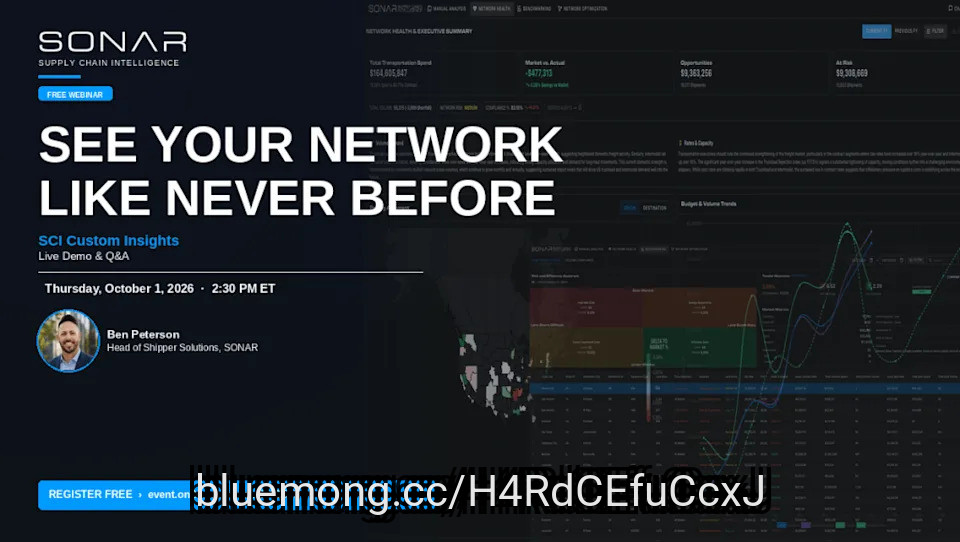
See how leading shippers are using their own freight data to find where they're overpaying, where service risk is building, and where they can save — live and in real time.
Shippers have spent years being told to let the data drive decisions. The harder problem has always been getting the right data, in the right context, fast enough to actually act on it.
SONAR's new SCI: Custom Insights is designed to close that gap — and on Thursday, October 1st at 2:30 PM ET, SONAR is hosting a free live demo so shippers can see exactly how it works.
Register free here.
What SCI: Custom Insights Does
#data #live
Shippers have spent years being told to let the data drive decisions. The harder problem has always been getting the right data, in the right context, fast enough to actually act on it.
SONAR's new SCI: Custom Insights is designed to close that gap — and on Thursday, October 1st at 2:30 PM ET, SONAR is hosting a free live demo so shippers can see exactly how it works.
Register free here.
What SCI: Custom Insights Does
#data #live



28 days ago
The biggest return in the U.S. market this year came from the cost of moving oil across the ocean.
The Breakwave Tanker Shipping ETF (BWET) has climbed about 3,600% since the start of the year. That makes it the top-performing non-leveraged fund in the country, ahead of every AI and energy trade that grabbed headlines.
BWET now trades near $726 a share, up from under $20 in January. The huge increase traces back to one event that reshaped global shipping, and it carries a warning for anyone tempted to buy in now.
BWET tracks the price of moving oil by sea. It does that by holding short-dated freight futures, which are contracts that lock in the future cost of renting an oil tanker.
About 90% of the fund follows shipping agreements with the biggest tankers on the route from the Middle East to China. Those agreements lift BWET whenever hiring rates increase.
#cost #agreements
The Breakwave Tanker Shipping ETF (BWET) has climbed about 3,600% since the start of the year. That makes it the top-performing non-leveraged fund in the country, ahead of every AI and energy trade that grabbed headlines.
BWET now trades near $726 a share, up from under $20 in January. The huge increase traces back to one event that reshaped global shipping, and it carries a warning for anyone tempted to buy in now.
BWET tracks the price of moving oil by sea. It does that by holding short-dated freight futures, which are contracts that lock in the future cost of renting an oil tanker.
About 90% of the fund follows shipping agreements with the biggest tankers on the route from the Middle East to China. Those agreements lift BWET whenever hiring rates increase.
#cost #agreements


29 days ago
Amazon Business is now a $60B operation serving 11 million customers worldwide. In this FreightWaves Today interview, Amazon Business exec Daniel Silverfield breaks down what that scale means for procurement, supplier consolidation, same-day grocery delivery and AI-driven savings.The big takeaway: business buyers want fewer suppliers, better visibility and less waste in purchasing. Silverfield explains how Amazon Business is pitching exactly that to everyone from small companies to Fortune 100s.
Amazon Business has hit $60 billion in annualized gross sales and now serves 11 million customers worldwide, with 1.8 million organizations added this year alone — a growth rate that puts it on par with a Fortune 100 company if it were standalone. The platform, which launched roughly a decade ago after Amazon noticed businesses already shopping on amazon.com, is increasingly central to how companies across sectors manage procurement, from office supplies to same-day groceries.
The scale matters to shippers, carriers, and brokers because Amazon Business is driving a fundamental shift in B2B purchasing behavior — consolidating supplier pools, centralizing data, and moving procurement from quarterly reporting cycles to an always-on, AI-powered model. Every order that migrates to the platform is one fewer touchpoint for traditional distributors and one more shipment flowing through Amazon's own logistics network.
Daniel Silverfield, head of value and selection for Amazon Business, said the platform saved customers $880 million on Prime free shipping last year and $1 billion through business-specific discounts. The company added 30% new items year over year and recently launched same-day grocery delivery across 2,300 U.S. cities in the first half of this year, a capability customers had been requesting for some time.
"The big shift that we're seeing is that people are moving to a continuous, always-on, conversational-powered procurement journey where agents may be looking for the best price while they're asleep, maybe negotiating on their behalf while they're asleep, and then surfacing to them the best product to buy," said Silverfield.
#customers
Amazon Business has hit $60 billion in annualized gross sales and now serves 11 million customers worldwide, with 1.8 million organizations added this year alone — a growth rate that puts it on par with a Fortune 100 company if it were standalone. The platform, which launched roughly a decade ago after Amazon noticed businesses already shopping on amazon.com, is increasingly central to how companies across sectors manage procurement, from office supplies to same-day groceries.
The scale matters to shippers, carriers, and brokers because Amazon Business is driving a fundamental shift in B2B purchasing behavior — consolidating supplier pools, centralizing data, and moving procurement from quarterly reporting cycles to an always-on, AI-powered model. Every order that migrates to the platform is one fewer touchpoint for traditional distributors and one more shipment flowing through Amazon's own logistics network.
Daniel Silverfield, head of value and selection for Amazon Business, said the platform saved customers $880 million on Prime free shipping last year and $1 billion through business-specific discounts. The company added 30% new items year over year and recently launched same-day grocery delivery across 2,300 U.S. cities in the first half of this year, a capability customers had been requesting for some time.
"The big shift that we're seeing is that people are moving to a continuous, always-on, conversational-powered procurement journey where agents may be looking for the best price while they're asleep, maybe negotiating on their behalf while they're asleep, and then surfacing to them the best product to buy," said Silverfield.
#customers


29 days ago
Freight fraud risks and carrier vetting are the focus as Highway Chief Commercial Officer Michael Caney joins FreightWaves Today. He breaks down what brokers, carriers and shippers need to watch right now when onboarding and monitoring capacity.If you work fraud prevention, carrier compliance or network procurement, this conversation gets straight to the operational takeaway without the fluff.#FreightFraud #CarrierVetting #SupplyChain
Carrier-vetting platform Highway is putting its balance sheet behind its fraud-detection product: if a broker moves freight using Highway's guarantee standard and loses a load, Highway writes a check for $100,000. The company's chief commercial officer said the program covers the vast majority of carrier capacity in North America — and has paid out only once across roughly one million loads.
Of the approximately 175,000 carriers that move freight for freight brokers, Highway says more than 82% qualify for the guarantee tier. "What I would tell you is the industry keeps trying to solve for the bottom 18% of the market," the CCO said. "And what we're saying is if you will just move your freight to this cohort of carriers, which is the majority of capacity in North America, not only will you be fine, but Highway will stand behind it with a performance guarantee."
"The average cargo theft is not the $100,000, it's $250,000. This idea that a motor carrier can just show up and say, hey man, I'm gonna need this cargo, it's $250 grand, I'm good for it, is bananas."
The single payout to date stemmed from an identity-design flaw tied to California's non-domiciled limited-term licensing rules. A fraudulent carrier obtained a new license through California's process, resubmitted in Highway's system, and the alert dropped off before the bug was caught and fixed — costing Highway $100,000. The CCO described theft events as a "Swiss cheese" of compounding decisions rather than a single failure point, and said Highway continuously monitors for ownership changes, inbox compromises, and cyber anomalies within the guarantee framework.
#carriers #capacity #America
Carrier-vetting platform Highway is putting its balance sheet behind its fraud-detection product: if a broker moves freight using Highway's guarantee standard and loses a load, Highway writes a check for $100,000. The company's chief commercial officer said the program covers the vast majority of carrier capacity in North America — and has paid out only once across roughly one million loads.
Of the approximately 175,000 carriers that move freight for freight brokers, Highway says more than 82% qualify for the guarantee tier. "What I would tell you is the industry keeps trying to solve for the bottom 18% of the market," the CCO said. "And what we're saying is if you will just move your freight to this cohort of carriers, which is the majority of capacity in North America, not only will you be fine, but Highway will stand behind it with a performance guarantee."
"The average cargo theft is not the $100,000, it's $250,000. This idea that a motor carrier can just show up and say, hey man, I'm gonna need this cargo, it's $250 grand, I'm good for it, is bananas."
The single payout to date stemmed from an identity-design flaw tied to California's non-domiciled limited-term licensing rules. A fraudulent carrier obtained a new license through California's process, resubmitted in Highway's system, and the alert dropped off before the bug was caught and fixed — costing Highway $100,000. The CCO described theft events as a "Swiss cheese" of compounding decisions rather than a single failure point, and said Highway continuously monitors for ownership changes, inbox compromises, and cyber anomalies within the guarantee framework.
#carriers #capacity #America


29 days ago
Saudi Arabia's oil supply crisis is rapidly becoming Europe's problem.
The September 10 attacks on Saudi Arabia's East-West Pipeline struck the system at multiple locations and damaged at least one pumping station, forcing Riyadh to shut down the Kingdom's critical alternative to the Strait of Hormuz.
The 1,200-kilometer Petroline can carry around 7 million barrels per day from Saudi Arabia's eastern producing regions to Yanbu on the Red Sea. Since the war effectively closed Hormuz, it has become one of the most important pieces of energy infrastructure in the world.
Kpler estimates the pipeline had been moving roughly 4 million bpd around Hormuz before the attack. A prolonged outage could ultimately threaten 3.5–4 million bpd of Saudi crude exports. The figure is below Petroline's nameplate capacity because Saudi Arabia can still export some crude from eastern terminals such as Ras Tanura, despite the severe constraints on Gulf shipping.
The immediate problem is storage.
#hormuz #crude
The September 10 attacks on Saudi Arabia's East-West Pipeline struck the system at multiple locations and damaged at least one pumping station, forcing Riyadh to shut down the Kingdom's critical alternative to the Strait of Hormuz.
The 1,200-kilometer Petroline can carry around 7 million barrels per day from Saudi Arabia's eastern producing regions to Yanbu on the Red Sea. Since the war effectively closed Hormuz, it has become one of the most important pieces of energy infrastructure in the world.
Kpler estimates the pipeline had been moving roughly 4 million bpd around Hormuz before the attack. A prolonged outage could ultimately threaten 3.5–4 million bpd of Saudi crude exports. The figure is below Petroline's nameplate capacity because Saudi Arabia can still export some crude from eastern terminals such as Ras Tanura, despite the severe constraints on Gulf shipping.
The immediate problem is storage.
#hormuz #crude

29 days ago
On September 14, Radiant Logistics (NYSEAMERICAN:RLGT) held its fourth fiscal quarter earnings call, and the headline numbers landed harder than a typical logistics update. Net income jumped 53.1% to $7.5 million for the quarter ended June 30, while revenue climbed 18.5% to $261.4 million. Look past that one quarter, though, and the picture gets more complicated, because full-year adjusted profitability actually fell. That gap between a blowout quarter and a softer year is what makes this name worth a closer look.
The fourth fiscal quarter was strong from top to bottom. Adjusted EBITDA rose 31.6% to $10.4 million, margin expanded 240 basis points to 15.5%, and adjusted net income climbed 34.5% to $7.4 million, all against organic revenue growth of 8%. Management credited the acceleration to US forwarding operations and international airfreight, including work supporting disaster relief after typhoon activity hit the Western Pacific earlier this year, plus airfreight demand tied to capital flows into global data center buildouts.
The balance sheet backs up the story. Radiant enters fiscal 2027 with zero net debt, $25.6 million in cash as of June 30, and a $200 million senior credit facility that was extended and restated in August, pushing maturity out to August 7, 2031, while its acquisition-focused accordion grew to $100 million from $75 million. On the domestic side, capacity has been exiting the truckload and intermodal markets, and spot rates and tender rejections moved higher late in the quarter. Radiant also launched a new independent agent program at Radiant Road & Rail during the quarter, extending its freight forwarding agent network into truck brokerage and intermodal, while Navegate is gaining traction, with one enterprise customer now managing more than 1,400 vendors on the platform.
The full-year numbers tell a different story than the quarter does. Revenue rose just 3.5% to $934.4 million from $902.7 million, a fraction of the fourth quarter's 18.5% pace, and full-year net income grew a modest 8.7% to $18.8 million. Full-year adjusted EBITDA actually fell 5.4% to $36.7 million from $38.8 million, and that figure included a $1.3 million First Brands adjustment. Strip that out and normalized adjusted EBITDA comes in at $35.4 million, an even steeper decline than the headline number suggests.
The operating backdrop stays complicated too. Ocean shipping routes remain disrupted by the closure of the Strait of Hormuz and continued Houthi activity affecting Suez Canal transits, keeping capacity tight on key trade lanes. US tariff policy is generating elevated IEEPA-related filing activity, and Canada put new retaliatory tariff measures into effect in early September, adding fresh complexity for shippers moving goods across that border. Management itself acknowledged that the domestic truck brokerage improvement seen late in the fourth quarter is not yet fully reflected in the reported results.
#quarter #revenue
The fourth fiscal quarter was strong from top to bottom. Adjusted EBITDA rose 31.6% to $10.4 million, margin expanded 240 basis points to 15.5%, and adjusted net income climbed 34.5% to $7.4 million, all against organic revenue growth of 8%. Management credited the acceleration to US forwarding operations and international airfreight, including work supporting disaster relief after typhoon activity hit the Western Pacific earlier this year, plus airfreight demand tied to capital flows into global data center buildouts.
The balance sheet backs up the story. Radiant enters fiscal 2027 with zero net debt, $25.6 million in cash as of June 30, and a $200 million senior credit facility that was extended and restated in August, pushing maturity out to August 7, 2031, while its acquisition-focused accordion grew to $100 million from $75 million. On the domestic side, capacity has been exiting the truckload and intermodal markets, and spot rates and tender rejections moved higher late in the quarter. Radiant also launched a new independent agent program at Radiant Road & Rail during the quarter, extending its freight forwarding agent network into truck brokerage and intermodal, while Navegate is gaining traction, with one enterprise customer now managing more than 1,400 vendors on the platform.
The full-year numbers tell a different story than the quarter does. Revenue rose just 3.5% to $934.4 million from $902.7 million, a fraction of the fourth quarter's 18.5% pace, and full-year net income grew a modest 8.7% to $18.8 million. Full-year adjusted EBITDA actually fell 5.4% to $36.7 million from $38.8 million, and that figure included a $1.3 million First Brands adjustment. Strip that out and normalized adjusted EBITDA comes in at $35.4 million, an even steeper decline than the headline number suggests.
The operating backdrop stays complicated too. Ocean shipping routes remain disrupted by the closure of the Strait of Hormuz and continued Houthi activity affecting Suez Canal transits, keeping capacity tight on key trade lanes. US tariff policy is generating elevated IEEPA-related filing activity, and Canada put new retaliatory tariff measures into effect in early September, adding fresh complexity for shippers moving goods across that border. Management itself acknowledged that the domestic truck brokerage improvement seen late in the fourth quarter is not yet fully reflected in the reported results.
#quarter #revenue


29 days ago
An **** ysis of recent filings from American politicians shows that Accenture (NYSE: ACN) and Boston Scientific (NYSE: BSX) saw an uptick in purchases from notable politicians. Rep. Gilbert Ray Cisneros, Jr. (D-CA) bought Boston Scientific shares, according to a filing earlier this month. The trade was made on August 18, 2026. Rep. Ro Khanna (D-CA) also bought the stock twice, on August 3 and August 10, 2026, according to a filing filed on September 4, 2026. Neither politician sold Boston Scientific shares in the same period. Cisneros and Khanna were also the two buyers of Accenture shares in July and August.
This is based on data from Quiver Quantitative, a platform that tracks congressional stock trades from politicians.
Let's focus on BSX in this article.
BSX is down about 50% so far this year amid a cyberattack that disrupted manufacturing, order processing and shipments, forcing the company to withdraw its previous third-quarter and full-year outlook. Bulls say the market has priced in too severe an outcome. By Sept. 8, the company said its major distribution centers were shipping at or above normal levels, sterilization facilities were operating, and manufacturing had restarted at most plants. Bulls believe much of the disrupted revenue could be delayed rather than permanently lost as hospitals wait for products, reschedule procedures and the company works through its backlog.
Bulls also point to a business that was still growing. Second-quarter revenue rose 7.5% year over year and organic growth was 7%. Several core franchises delivered double-digit organic growth, including Interventional Cardiology and Vascular Therapies, Interventional Oncology and Embolization, and Neuromodulation.
#august #NYSE
This is based on data from Quiver Quantitative, a platform that tracks congressional stock trades from politicians.
Let's focus on BSX in this article.
BSX is down about 50% so far this year amid a cyberattack that disrupted manufacturing, order processing and shipments, forcing the company to withdraw its previous third-quarter and full-year outlook. Bulls say the market has priced in too severe an outcome. By Sept. 8, the company said its major distribution centers were shipping at or above normal levels, sterilization facilities were operating, and manufacturing had restarted at most plants. Bulls believe much of the disrupted revenue could be delayed rather than permanently lost as hospitals wait for products, reschedule procedures and the company works through its backlog.
Bulls also point to a business that was still growing. Second-quarter revenue rose 7.5% year over year and organic growth was 7%. Several core franchises delivered double-digit organic growth, including Interventional Cardiology and Vascular Therapies, Interventional Oncology and Embolization, and Neuromodulation.
#august #NYSE


29 days ago
Some refiners in ******* an this week rushed to buy Oman's crude for earlier loadings after Saudi Arabia shut down its key pipeline bypassing the Strait of Hormuz, traders with knowledge of the purchases told Bloomberg on Wednesday.
Late last week, Saudi Arabia was forced to temporarily shut down the East-West oil pipeline following drone attacks launched from the territory of Iraq close to the Iranian border on Thursday. The shutdown of the pipeline is a precautionary measure, after the attacks resulted in a number of injuries, the world's top crude oil exporter said.
The 750-mile-long East-West pipeline became Saudi Arabia's vital oil route to bypass the Strait of Hormuz after the Middle East conflict started and Hormuz was closed to shipping traffic. Thanks to the East-West pipeline, the Kingdom has managed to re-route most of its crude loadings from the western ports in the Persian Gulf to the Red Sea port of Yanbu.
Apart from announcing the shutdown of the pipeline and condemning the attacks, Saudi Arabia has not officially updated the market either on the extent of the damage or the timelines for repairs.
The repairs could take three to five weeks, two regional officials briefed on the matter told The ******* ociated Press.
#hormuz #strait
Late last week, Saudi Arabia was forced to temporarily shut down the East-West oil pipeline following drone attacks launched from the territory of Iraq close to the Iranian border on Thursday. The shutdown of the pipeline is a precautionary measure, after the attacks resulted in a number of injuries, the world's top crude oil exporter said.
The 750-mile-long East-West pipeline became Saudi Arabia's vital oil route to bypass the Strait of Hormuz after the Middle East conflict started and Hormuz was closed to shipping traffic. Thanks to the East-West pipeline, the Kingdom has managed to re-route most of its crude loadings from the western ports in the Persian Gulf to the Red Sea port of Yanbu.
Apart from announcing the shutdown of the pipeline and condemning the attacks, Saudi Arabia has not officially updated the market either on the extent of the damage or the timelines for repairs.
The repairs could take three to five weeks, two regional officials briefed on the matter told The ******* ociated Press.
#hormuz #strait

29 days ago
NBC4's helicopter was one of several news aircraft flying over the scene of a deadly bus crash in Chatsworth Tuesday evening at sunset.
It's common for multiple news choppers to arrive at the scene of breaking news, beaming live images for newscasts and streaming.
But around 7 p.m., something went horribly wrong and in a matter of seconds the NBC4 chopper dropped out of the sky, crashing into shipping containers and vehicles outside a warehouse a few blocks away, bursting into flames. Two station journalists, reporter Eliana Moreno and pilot George Marciniw, were killed along with a bystander on the ground.
Federal investigators are now trying to figure out what went wrong. The Times interviewed several experts, who reviewed recordings of the chopper's final moments. They offered insights into the helicopter itself, its movements that afternoon and what is known about how its mechanics work.
Here's what they had to say:
#went #wrong #tuesday #nbc4
It's common for multiple news choppers to arrive at the scene of breaking news, beaming live images for newscasts and streaming.
But around 7 p.m., something went horribly wrong and in a matter of seconds the NBC4 chopper dropped out of the sky, crashing into shipping containers and vehicles outside a warehouse a few blocks away, bursting into flames. Two station journalists, reporter Eliana Moreno and pilot George Marciniw, were killed along with a bystander on the ground.
Federal investigators are now trying to figure out what went wrong. The Times interviewed several experts, who reviewed recordings of the chopper's final moments. They offered insights into the helicopter itself, its movements that afternoon and what is known about how its mechanics work.
Here's what they had to say:
#went #wrong #tuesday #nbc4


30 days ago
By Siddharth Cavale
NEW YORK, Sept 15 (Reuters) - Oil prices settled $3 higher on Tuesday after shipping industry sources said crude loadings at Saudi Arabia's Red Sea export hub of Yanbu had been suspended and Riyadh had canceled some cargo deliveries to European customers, deepening concerns that disruptions to a critical oil-export route could persist for weeks.
Gains in U.S. West Texas Intermediate crude futures outpaced Brent on Tuesday, as fears that Saudi Arabia's supply troubles were widening sent investors rushing into U.S. crude as an alternative.
Brent finished up $3.07, or 2.9%, at $108.75 a barrel, while WTI closed up $4.44, or 4.38%, at $105.83 a barrel. Both contracts closed at their highest since May 19.
The port of Yanbu has taken on outsized importance for global supply since the U.S.-Israeli war on Iran caused the closure of the Strait of Hormuz, a critical waterway that was the conduit for one-fifth of the world's oil and liquefied natural gas supplies.
#brent
NEW YORK, Sept 15 (Reuters) - Oil prices settled $3 higher on Tuesday after shipping industry sources said crude loadings at Saudi Arabia's Red Sea export hub of Yanbu had been suspended and Riyadh had canceled some cargo deliveries to European customers, deepening concerns that disruptions to a critical oil-export route could persist for weeks.
Gains in U.S. West Texas Intermediate crude futures outpaced Brent on Tuesday, as fears that Saudi Arabia's supply troubles were widening sent investors rushing into U.S. crude as an alternative.
Brent finished up $3.07, or 2.9%, at $108.75 a barrel, while WTI closed up $4.44, or 4.38%, at $105.83 a barrel. Both contracts closed at their highest since May 19.
The port of Yanbu has taken on outsized importance for global supply since the U.S.-Israeli war on Iran caused the closure of the Strait of Hormuz, a critical waterway that was the conduit for one-fifth of the world's oil and liquefied natural gas supplies.
#brent


30 days ago
Brent crude climbed above $108 a barrel on Tuesday as traders grew increasingly uncertain about when Saudi Arabia's East-West Pipeline would reopen, with fresh Houthi attacks on the kingdom and suspended oil loadings at its Red Sea export terminal adding to supply fears.
By 1:00 p.m. ET, Brent futures had climbed 3% to $108.88 per barrel, with U.S. West Texas Intermediate up 4.7% at $106.12. A close at those levels would mark the highest settlement for either contract in close to four months, according to Reuters. Prices have risen around 20% this month as fighting in the Persian Gulf has escalated.
According to shipping industry sources who spoke with Reuters, crude loadings at the Yanbu terminal on Saudi Arabia's Red Sea coast had been halted as of Tuesday. Separately, sources told Reuters that Saudi officials had notified European buyers that certain crude shipments scheduled for late September would not proceed.
Saudi Arabia shut down the East-West Pipeline after drone attacks originating from Iraq struck it last week, forcing the kingdom to halt the export route it had been using to bypass the Strait of Hormuz during the U.S.-Iran war. The pipeline can move up to 7 million barrels per day. Saudi officials have described the closure as a precautionary measure but have not provided a damage ******* sment or a timeline for resuming operations. U.K. authorities fear the pipeline may remain mostly shut for six weeks, according to Bloomberg.
Iran-backed Houthi militants in Yemen carried out additional strikes on Saudi Arabia on Monday. According to a spokesperson for the Saudi-led military coalition in Yemen, the group fired drones and ballistic missiles targeting the cities of Khamis Mushait, Abha, and Taif. According to Reuters, the Houthis claimed to have struck a military air base in Khamis Mushait, with their stated targets including hangars, radar installations, runway infrastructure, and stores of ammunition.
#west #east
By 1:00 p.m. ET, Brent futures had climbed 3% to $108.88 per barrel, with U.S. West Texas Intermediate up 4.7% at $106.12. A close at those levels would mark the highest settlement for either contract in close to four months, according to Reuters. Prices have risen around 20% this month as fighting in the Persian Gulf has escalated.
According to shipping industry sources who spoke with Reuters, crude loadings at the Yanbu terminal on Saudi Arabia's Red Sea coast had been halted as of Tuesday. Separately, sources told Reuters that Saudi officials had notified European buyers that certain crude shipments scheduled for late September would not proceed.
Saudi Arabia shut down the East-West Pipeline after drone attacks originating from Iraq struck it last week, forcing the kingdom to halt the export route it had been using to bypass the Strait of Hormuz during the U.S.-Iran war. The pipeline can move up to 7 million barrels per day. Saudi officials have described the closure as a precautionary measure but have not provided a damage ******* sment or a timeline for resuming operations. U.K. authorities fear the pipeline may remain mostly shut for six weeks, according to Bloomberg.
Iran-backed Houthi militants in Yemen carried out additional strikes on Saudi Arabia on Monday. According to a spokesperson for the Saudi-led military coalition in Yemen, the group fired drones and ballistic missiles targeting the cities of Khamis Mushait, Abha, and Taif. According to Reuters, the Houthis claimed to have struck a military air base in Khamis Mushait, with their stated targets including hangars, radar installations, runway infrastructure, and stores of ammunition.
#west #east


30 days ago
Investors choosing between Carnival (NYSE:CCL) and Uber Technologies (NYSE:UBER) must decide between a capital-intensive cruise leader and a high-growth technology platform. Both companies have shown resilience, but their financial structures offer very different risks.
Carnival operates as a global giant in the travel industry, managing a diverse fleet of ships that cater to millions of vacationers. Uber dominates the gig economy by connecting riders, diners, and shippers with service providers through its proprietary mobile applications and digital infrastructure.
As a major player among consumer discretionary stocks, Carnival operates a massive fleet of over 90 ships across eight distinct brands. In its latest annual report, the company highlighted a workforce of over 160,000 team members who served approximately 13.5 million guests throughout 2025. This scale allows the company to source passengers from major global markets, and notably, no single travel agency group accounted for more than 10% of total revenue during the year.
In FY 2025, revenue reached nearly $26.6 billion, representing a growth rate of roughly 6.4% compared to the prior year. This top-line expansion helped the company generate a net income of approximately $2.8 billion, a significant improvement over the $1.9 billion recorded in 2024. The net margin improved to 10.4%, indicating that the company is successfully converting a larger portion of its sales into actual profit.
Based on its November 2025 balance sheet, Carnival carries a debt-to-equity ratio of 2.3x, which is the total debt divided by shareholder equity. Its current ratio, a measure of current **** ets relative to current liabilities, is nearly 0.3x, suggesting tight short-term liquidity. However, the company generated close to $2.6 billion in free cash flow, which is cash from operations minus capital expenditures, providing capital for debt reduction and fleet maintenance.
#carnival #fleet #current
Carnival operates as a global giant in the travel industry, managing a diverse fleet of ships that cater to millions of vacationers. Uber dominates the gig economy by connecting riders, diners, and shippers with service providers through its proprietary mobile applications and digital infrastructure.
As a major player among consumer discretionary stocks, Carnival operates a massive fleet of over 90 ships across eight distinct brands. In its latest annual report, the company highlighted a workforce of over 160,000 team members who served approximately 13.5 million guests throughout 2025. This scale allows the company to source passengers from major global markets, and notably, no single travel agency group accounted for more than 10% of total revenue during the year.
In FY 2025, revenue reached nearly $26.6 billion, representing a growth rate of roughly 6.4% compared to the prior year. This top-line expansion helped the company generate a net income of approximately $2.8 billion, a significant improvement over the $1.9 billion recorded in 2024. The net margin improved to 10.4%, indicating that the company is successfully converting a larger portion of its sales into actual profit.
Based on its November 2025 balance sheet, Carnival carries a debt-to-equity ratio of 2.3x, which is the total debt divided by shareholder equity. Its current ratio, a measure of current **** ets relative to current liabilities, is nearly 0.3x, suggesting tight short-term liquidity. However, the company generated close to $2.6 billion in free cash flow, which is cash from operations minus capital expenditures, providing capital for debt reduction and fleet maintenance.
#carnival #fleet #current


1 month ago
On September 14, Radiant Logistics (NYSEAMERICAN:RLGT) held its fourth fiscal quarter earnings call, and the headline numbers landed harder than a typical logistics update. Net income jumped 53.1% to $7.5 million for the quarter ended June 30, while revenue climbed 18.5% to $261.4 million. Look past that one quarter, though, and the picture gets more complicated, because full-year adjusted profitability actually fell. That gap between a blowout quarter and a softer year is what makes this name worth a closer look.
The fourth fiscal quarter was strong from top to bottom. Adjusted EBITDA rose 31.6% to $10.4 million, margin expanded 240 basis points to 15.5%, and adjusted net income climbed 34.5% to $7.4 million, all against organic revenue growth of 8%. Management credited the acceleration to US forwarding operations and international airfreight, including work supporting disaster relief after typhoon activity hit the Western Pacific earlier this year, plus airfreight demand tied to capital flows into global data center buildouts.
The balance sheet backs up the story. Radiant enters fiscal 2027 with zero net debt, $25.6 million in cash as of June 30, and a $200 million senior credit facility that was extended and restated in August, pushing maturity out to August 7, 2031, while its acquisition-focused accordion grew to $100 million from $75 million. On the domestic side, capacity has been exiting the truckload and intermodal markets, and spot rates and tender rejections moved higher late in the quarter. Radiant also launched a new independent agent program at Radiant Road & Rail during the quarter, extending its freight forwarding agent network into truck brokerage and intermodal, while Navegate is gaining traction, with one enterprise customer now managing more than 1,400 vendors on the platform.
The full-year numbers tell a different story than the quarter does. Revenue rose just 3.5% to $934.4 million from $902.7 million, a fraction of the fourth quarter's 18.5% pace, and full-year net income grew a modest 8.7% to $18.8 million. Full-year adjusted EBITDA actually fell 5.4% to $36.7 million from $38.8 million, and that figure included a $1.3 million First Brands adjustment. Strip that out and normalized adjusted EBITDA comes in at $35.4 million, an even steeper decline than the headline number suggests.
The operating backdrop stays complicated too. Ocean shipping routes remain disrupted by the closure of the Strait of Hormuz and continued Houthi activity affecting Suez Canal transits, keeping capacity tight on key trade lanes. US tariff policy is generating elevated IEEPA-related filing activity, and Canada put new retaliatory tariff measures into effect in early September, adding fresh complexity for shippers moving goods across that border. Management itself acknowledged that the domestic truck brokerage improvement seen late in the fourth quarter is not yet fully reflected in the reported results.
#million #quarter #revenue #fiscal
The fourth fiscal quarter was strong from top to bottom. Adjusted EBITDA rose 31.6% to $10.4 million, margin expanded 240 basis points to 15.5%, and adjusted net income climbed 34.5% to $7.4 million, all against organic revenue growth of 8%. Management credited the acceleration to US forwarding operations and international airfreight, including work supporting disaster relief after typhoon activity hit the Western Pacific earlier this year, plus airfreight demand tied to capital flows into global data center buildouts.
The balance sheet backs up the story. Radiant enters fiscal 2027 with zero net debt, $25.6 million in cash as of June 30, and a $200 million senior credit facility that was extended and restated in August, pushing maturity out to August 7, 2031, while its acquisition-focused accordion grew to $100 million from $75 million. On the domestic side, capacity has been exiting the truckload and intermodal markets, and spot rates and tender rejections moved higher late in the quarter. Radiant also launched a new independent agent program at Radiant Road & Rail during the quarter, extending its freight forwarding agent network into truck brokerage and intermodal, while Navegate is gaining traction, with one enterprise customer now managing more than 1,400 vendors on the platform.
The full-year numbers tell a different story than the quarter does. Revenue rose just 3.5% to $934.4 million from $902.7 million, a fraction of the fourth quarter's 18.5% pace, and full-year net income grew a modest 8.7% to $18.8 million. Full-year adjusted EBITDA actually fell 5.4% to $36.7 million from $38.8 million, and that figure included a $1.3 million First Brands adjustment. Strip that out and normalized adjusted EBITDA comes in at $35.4 million, an even steeper decline than the headline number suggests.
The operating backdrop stays complicated too. Ocean shipping routes remain disrupted by the closure of the Strait of Hormuz and continued Houthi activity affecting Suez Canal transits, keeping capacity tight on key trade lanes. US tariff policy is generating elevated IEEPA-related filing activity, and Canada put new retaliatory tariff measures into effect in early September, adding fresh complexity for shippers moving goods across that border. Management itself acknowledged that the domestic truck brokerage improvement seen late in the fourth quarter is not yet fully reflected in the reported results.
#million #quarter #revenue #fiscal

1 month ago
An ******* ysis of recent filings from American politicians shows that Accenture (NYSE: ACN) and Boston Scientific (NYSE: BSX) saw an uptick in purchases from notable politicians. Rep. Gilbert Ray Cisneros, Jr. (D-CA) bought Boston Scientific shares, according to a filing earlier this month. The trade was made on August 18, 2026. Rep. Ro Khanna (D-CA) also bought the stock twice, on August 3 and August 10, 2026, according to a filing filed on September 4, 2026. Neither politician sold Boston Scientific shares in the same period. Cisneros and Khanna were also the two buyers of Accenture shares in July and August.
This is based on data from Quiver Quantitative, a platform that tracks congressional stock trades from politicians.
Let's focus on BSX in this article.
BSX is down about 50% so far this year amid a cyberattack that disrupted manufacturing, order processing and shipments, forcing the company to withdraw its previous third-quarter and full-year outlook. Bulls say the market has priced in too severe an outcome. By Sept. 8, the company said its major distribution centers were shipping at or above normal levels, sterilization facilities were operating, and manufacturing had restarted at most plants. Bulls believe much of the disrupted revenue could be delayed rather than permanently lost as hospitals wait for products, reschedule procedures and the company works through its backlog.
Bulls also point to a business that was still growing. Second-quarter revenue rose 7.5% year over year and organic growth was 7%. Several core franchises delivered double-digit organic growth, including Interventional Cardiology and Vascular Therapies, Interventional Oncology and Embolization, and Neuromodulation.
#accenture
This is based on data from Quiver Quantitative, a platform that tracks congressional stock trades from politicians.
Let's focus on BSX in this article.
BSX is down about 50% so far this year amid a cyberattack that disrupted manufacturing, order processing and shipments, forcing the company to withdraw its previous third-quarter and full-year outlook. Bulls say the market has priced in too severe an outcome. By Sept. 8, the company said its major distribution centers were shipping at or above normal levels, sterilization facilities were operating, and manufacturing had restarted at most plants. Bulls believe much of the disrupted revenue could be delayed rather than permanently lost as hospitals wait for products, reschedule procedures and the company works through its backlog.
Bulls also point to a business that was still growing. Second-quarter revenue rose 7.5% year over year and organic growth was 7%. Several core franchises delivered double-digit organic growth, including Interventional Cardiology and Vascular Therapies, Interventional Oncology and Embolization, and Neuromodulation.
#accenture


1 month ago
CAIRO (AP) — Saudi Arabia accused Yemen's Iran-backed Houthi rebels overnight of trying to attack Islam's holiest city, prompting condemnation from countries in the region but no sign of military support. The kingdom, a key U.S. ally, declared Mecca a "red line" as it slid deeper into the new front of the Iran war.
With the world's biggest oil exporter under fire from the rebels backed by the Saudis' regional adversary, Tehran, the kingdom needs a safe outlet for its crude as well as military ******* istance. A path to either one remains unclear.
A crucial Saudi pipeline has reportedly been shut down for weeks after an attack by Iranian-backed militias in Iraq. The Yemen-based Houthis have been targeting infrastructure in the kingdom as well as its shipping on the Red Sea, where they have seized several islands on the Bab el-Mandeb Strait. And Iran is still targeting ships in the Strait of Hormuz. Oil prices remain above $100 a barrel.
The Houthis denied firing drones toward Mecca, about 1,100 kilometers (680 miles) from Yemen's border. The Saudis said they intercepted and destroyed the drone before it entered the airspace over the birthplace of the Prophet Muhammad.
The attacks are the first test of a new defense pact among Saudi Arabia, NATO member Turkey and nuclear power Pakistan. But officials from Turkey and Pakistan told The ******* ociated Press they have not received a Saudi request for support in response to the Houthis' escalation.
#arabia #saudis #turkey
With the world's biggest oil exporter under fire from the rebels backed by the Saudis' regional adversary, Tehran, the kingdom needs a safe outlet for its crude as well as military ******* istance. A path to either one remains unclear.
A crucial Saudi pipeline has reportedly been shut down for weeks after an attack by Iranian-backed militias in Iraq. The Yemen-based Houthis have been targeting infrastructure in the kingdom as well as its shipping on the Red Sea, where they have seized several islands on the Bab el-Mandeb Strait. And Iran is still targeting ships in the Strait of Hormuz. Oil prices remain above $100 a barrel.
The Houthis denied firing drones toward Mecca, about 1,100 kilometers (680 miles) from Yemen's border. The Saudis said they intercepted and destroyed the drone before it entered the airspace over the birthplace of the Prophet Muhammad.
The attacks are the first test of a new defense pact among Saudi Arabia, NATO member Turkey and nuclear power Pakistan. But officials from Turkey and Pakistan told The ******* ociated Press they have not received a Saudi request for support in response to the Houthis' escalation.
#arabia #saudis #turkey




1 month ago
AMD and Intel compete for processor customers, but they have a common interest in making developers comfortable staying with x86. A September 2 GCC commit added initial support for their AI Compute Extensions, or ACE, bringing that shared strategy into a widely used compiler's development code.
For Advanced Micro Devices, Inc. (NASDAQ:AMD) and Intel Corporation (NASDAQ:INTC), the potential payoff is broader software adoption. The immediate event is much narrower: compiler infrastructure, followed by instruction-support commits. It is not evidence that compatible processors have shipped or that GCC 17 is a finished release.
The x86 Ecosystem Advisory Group's April whitepaper describes a common matrix-acceleration architecture shaped by both companies. Matrix multiplication is central to many AI workloads. A shared instruction interface could reduce the effort needed to target those operations across future processors.
That matters commercially because buyers consider the software work required to use hardware, alongside its price and performance. If developers can support both suppliers more easily, a processor purchase may depend more on execution and less on maintaining separate software paths.
For Advanced Micro Devices, Inc. (NASDAQ:AMD), the bull case is an easier route for compatible future CPUs into AI-related workloads. The risk is that a shared standard also improves the rival's appeal. Compiler support alone cannot demonstrate AMD's eventual performance advantage, customer adoption or incremental profit.
#Intel
For Advanced Micro Devices, Inc. (NASDAQ:AMD) and Intel Corporation (NASDAQ:INTC), the potential payoff is broader software adoption. The immediate event is much narrower: compiler infrastructure, followed by instruction-support commits. It is not evidence that compatible processors have shipped or that GCC 17 is a finished release.
The x86 Ecosystem Advisory Group's April whitepaper describes a common matrix-acceleration architecture shaped by both companies. Matrix multiplication is central to many AI workloads. A shared instruction interface could reduce the effort needed to target those operations across future processors.
That matters commercially because buyers consider the software work required to use hardware, alongside its price and performance. If developers can support both suppliers more easily, a processor purchase may depend more on execution and less on maintaining separate software paths.
For Advanced Micro Devices, Inc. (NASDAQ:AMD), the bull case is an easier route for compatible future CPUs into AI-related workloads. The risk is that a shared standard also improves the rival's appeal. Compiler support alone cannot demonstrate AMD's eventual performance advantage, customer adoption or incremental profit.
#Intel





1 month ago
The Iran-backed Houthi rebels in Yemen have taken control of a strategic Red Sea coastline, further complicating shipping routes in the region. At the same time, strikes inside Saudi Arabia forced the shutdown of a critical oil pipeline, the country's energy ministry confirmed.
#Iran #houthi #arabia #taken
#Iran #houthi #arabia #taken



1 month ago
BAGHDAD (AP) — Iraq's government raced Saturday to contain the fallout after local Iran-backed militias were accused of attacking and shuttering a key Saudi pipeline.
Though an umbrella group of Iran-backed militias in Iraq denied their involvement, Iraq's government confirmed the attacks had originated from its territory. The government pledged to investigate and dismissed two senior officials.
The country is under mounting pressure to prevent local militias from aiding other Iran proxy groups across the region. The Iraqi government has set a Sept. 30 deadline for nonstate groups to disarm, but several of the most powerful militias have said they will not comply.
Pressure to disarm the militias is especially acute as the Iran-backed Houthi rebels make an advance across Yemen's west coast in a major setback to the Saudi-backed coalition that risks escalating the war in the region. The Houthis on Friday seized an island in the Bab el-Mandeb Strait, a key shipping lane through which around 12% of global trade passes.
Their virtual control of the strait could send global oil prices — already inflated by the six-month Iran-U.S. war — spiraling. The strait has become a vital commercial lane for Saudi oil ever since the Iran war disrupted shipping in the Strait of Hormuz.
#saudi #across
Though an umbrella group of Iran-backed militias in Iraq denied their involvement, Iraq's government confirmed the attacks had originated from its territory. The government pledged to investigate and dismissed two senior officials.
The country is under mounting pressure to prevent local militias from aiding other Iran proxy groups across the region. The Iraqi government has set a Sept. 30 deadline for nonstate groups to disarm, but several of the most powerful militias have said they will not comply.
Pressure to disarm the militias is especially acute as the Iran-backed Houthi rebels make an advance across Yemen's west coast in a major setback to the Saudi-backed coalition that risks escalating the war in the region. The Houthis on Friday seized an island in the Bab el-Mandeb Strait, a key shipping lane through which around 12% of global trade passes.
Their virtual control of the strait could send global oil prices — already inflated by the six-month Iran-U.S. war — spiraling. The strait has become a vital commercial lane for Saudi oil ever since the Iran war disrupted shipping in the Strait of Hormuz.
#saudi #across



1 month ago
The desperate pleas for air cover from Yemeni generals started coming mid-morning on Thursday. An advance by the Iran-backed Houthis toward Yemen's strategic port city of Mocha was in full swing, and backup support from chief ally Saudi Arabia was nowhere in sight.
"The Houthis committed everything they had – waves upon waves of fighters … along with their available ballistic missiles and weapons," a senior Yemeni source attached to their military forces told CNN. The source said he contacted the United States Central Command (CENTCOM) and was ******* ured the US was "watching the situation closely and that Saudi air support was coming."
"But the air support never came," the source said. "And Mocha has now fallen."
Hours later, on Friday, the Houthis captured another key coastal ******* et, Perim Island, at the mouth of the Red Sea. The island splits the Bab al-Mandeb Strait in two, giving Tehran de facto control over another key shipping route.
The Houthis' rapid advance amounts to an extraordinary 36 hours in a conflict that had been largely on ice for years. But the kindling for renewed fighting had been laid for months amid the conflict between the United States and Iran, as Tehran seeks to use oil prices – and their impact on the global economy – as leverage.
#saudi
"The Houthis committed everything they had – waves upon waves of fighters … along with their available ballistic missiles and weapons," a senior Yemeni source attached to their military forces told CNN. The source said he contacted the United States Central Command (CENTCOM) and was ******* ured the US was "watching the situation closely and that Saudi air support was coming."
"But the air support never came," the source said. "And Mocha has now fallen."
Hours later, on Friday, the Houthis captured another key coastal ******* et, Perim Island, at the mouth of the Red Sea. The island splits the Bab al-Mandeb Strait in two, giving Tehran de facto control over another key shipping route.
The Houthis' rapid advance amounts to an extraordinary 36 hours in a conflict that had been largely on ice for years. But the kindling for renewed fighting had been laid for months amid the conflict between the United States and Iran, as Tehran seeks to use oil prices – and their impact on the global economy – as leverage.
#saudi



1 month ago
By Mike Dolan
Sept 10 (Reuters) - Energy and bond markets are on edge once again after U.S. President Donald Trump said the Iran war would not end until after November's midterm elections. That came amid the most intense attacks on Gulf shipping in the conflict so far.
Meanwhile, markets await a likely European Central Bank interest rate rise and the first of the week's U.S. inflation updates on Thursday, as Treasury Secretary Scott Bessent's bond buyback salvo appeared to flop after details of the operation disappointed.
Crude oil closed at its highest level since late May above $100 per barrel on Wednesday, and 10-year Treasury yields hit their highest in three years, fast homing in on the 5% milestone.
That came after a wave of ***** -for-tat attacks on oil tankers in the Gulf, the biggest since the Iran war started six months ago. Meantime, a planned $6 billion buyback of longer-dated bonds on Thursday disappointed some investors who had wanted more.
#thursday #attacks #buyback
Sept 10 (Reuters) - Energy and bond markets are on edge once again after U.S. President Donald Trump said the Iran war would not end until after November's midterm elections. That came amid the most intense attacks on Gulf shipping in the conflict so far.
Meanwhile, markets await a likely European Central Bank interest rate rise and the first of the week's U.S. inflation updates on Thursday, as Treasury Secretary Scott Bessent's bond buyback salvo appeared to flop after details of the operation disappointed.
Crude oil closed at its highest level since late May above $100 per barrel on Wednesday, and 10-year Treasury yields hit their highest in three years, fast homing in on the 5% milestone.
That came after a wave of ***** -for-tat attacks on oil tankers in the Gulf, the biggest since the Iran war started six months ago. Meantime, a planned $6 billion buyback of longer-dated bonds on Thursday disappointed some investors who had wanted more.
#thursday #attacks #buyback

1 month ago
September S&P 500 E-Mini futures (ESU26) are down -0.15%, and September Nasdaq 100 E-Mini futures (NQU26) are down -0.66% this morning as rising oil prices and bond yields weigh on investor sentiment ahead of crucial U.S. producer inflation data and earnings from debt-loaded AI hyperscaler Oracle.
Oil prices extended their advance on Thursday as escalating attacks between the U.S. and Iran risked prolonging disruptions to energy flows in the Middle East. Brent crude rose above $103 a barrel, while WTI crude climbed above $99 a barrel. A senior Iranian official said on Wednesday that Tehran has no plans to back down in the face of an American naval blockade and will intensify its strikes if the U.S. continues attacking its territory. Also, Iran's Islamic Revolutionary Guard warned on Wednesday of additional restrictions on shipping around the Strait of Hormuz. Meanwhile, U.S. President Donald Trump said the war with Iran would not end until after the November midterm elections.
'Not Tens Of Billions, But Tens Of Trillions': Nvidia CEO Jensen Huang Says AI Is Like the New Electricity and the Scale Is Unlike Any Tech in History
What It Means for MSFT Stock Investors as Microsoft Switches to 2 Business Segments
RKLB Stock Jumps as Rocket Lab Debuts New Solar Cell for ****** e
#Iran
Oil prices extended their advance on Thursday as escalating attacks between the U.S. and Iran risked prolonging disruptions to energy flows in the Middle East. Brent crude rose above $103 a barrel, while WTI crude climbed above $99 a barrel. A senior Iranian official said on Wednesday that Tehran has no plans to back down in the face of an American naval blockade and will intensify its strikes if the U.S. continues attacking its territory. Also, Iran's Islamic Revolutionary Guard warned on Wednesday of additional restrictions on shipping around the Strait of Hormuz. Meanwhile, U.S. President Donald Trump said the war with Iran would not end until after the November midterm elections.
'Not Tens Of Billions, But Tens Of Trillions': Nvidia CEO Jensen Huang Says AI Is Like the New Electricity and the Scale Is Unlike Any Tech in History
What It Means for MSFT Stock Investors as Microsoft Switches to 2 Business Segments
RKLB Stock Jumps as Rocket Lab Debuts New Solar Cell for ****** e
#Iran

1 month ago
Major indexes climbed Friday afternoon, holding to early momentum as investors took in stride inflation data showing consumers continued to pay higher prices for goods and services in August. Among movers rounding off the holiday-shortened week, shipping and logistics provider Matson (MATX) broke out.
The Dow Jones Industrial Average rose 1.1%, or about 590 points, as the S&P 500 moved up 1.1%. Ten of the index's 11 sectors moved higher. The tech-heavy Nasdaq composite tacked on 1.2%, and the Russell 2000 small-cap index picked up 0.7%.
Stocks found some relief from a nearly 3% slide in West Texas Intermediate crude futures to just below $100 a barrel. The 10-year Treasury yield was steady at a 52-week high of 4.95%. Bitcoin rose to roughly $77,700.
Matson (MATX) broke out of a consolidation at a 230.74 pivot. The Hawaii-based company's fleet of vessels includes containerships and barges. Matson is on the IBD Ready List – a list of stocks that are or may become actionable soon.
Meanwhile, Best Buy (BBY) neared a buy point of 91.27 in a consolidation base. The stock was the biggest gainer on the list on Friday.
#matx #higher
The Dow Jones Industrial Average rose 1.1%, or about 590 points, as the S&P 500 moved up 1.1%. Ten of the index's 11 sectors moved higher. The tech-heavy Nasdaq composite tacked on 1.2%, and the Russell 2000 small-cap index picked up 0.7%.
Stocks found some relief from a nearly 3% slide in West Texas Intermediate crude futures to just below $100 a barrel. The 10-year Treasury yield was steady at a 52-week high of 4.95%. Bitcoin rose to roughly $77,700.
Matson (MATX) broke out of a consolidation at a 230.74 pivot. The Hawaii-based company's fleet of vessels includes containerships and barges. Matson is on the IBD Ready List – a list of stocks that are or may become actionable soon.
Meanwhile, Best Buy (BBY) neared a buy point of 91.27 in a consolidation base. The stock was the biggest gainer on the list on Friday.
#matx #higher

1 month ago
It started with yelling about toilets. Steve Ballmer was so serious about turning the Los Angeles Clippers into a serious franchise for the first time in their existence that he wanted to make sure no fan ever waited in a long line to use the bathroom when the team opened its new arena. Ballmer's drive to win eventually led the Clippers to courting Kawhi Leonard in free agency, fresh off leading the Toronto Raptors to a 2019 NBA championship. Leonard wanted to live in Los Angeles, yes, but he also wanted Paul George as his running mate, so the Clippers shipped out a boatload of draft picks and future two-time MVP Shai Gilgeous-Alexander to get him.
Leonard's people also made it known that their client wanted the type of big endorsement deals his off-putting, robotic personality couldn't land legitimately. Leonard's now infamous Uncle Dennis Robertson never tried to be subtle about his desire to secure similar off-court bags to the ones Kawhi's contemporaries like LeBron James, Steph Curry, and Kevin Durant were landing on their own accord, and leaks of his demands circulated as soon as Leonard hit free agency.
The Clippers became so entangled in pleasing Leonard that it led to blatant salary cap circumvention, first reported by investigative journalist Pablo Torre. The NBA found enough evidence supporting Torre's claims that it hammered the Clippers with the most severe penalty in league history, stripping five future first-round draft picks, suspending executives including Ballmer, and more. That figured to be the end of the story, with the Clippers spending the next decade trying to climb out of the abyss. Torre continued to hint that there was another shoe to drop, and now that it's here, the Clippers might be in much bigger trouble than anyone first believed.
The Department of Justice has opened a criminal investigation into the Clippers, according to the New York Times, and it's already issued one subpoena. While the scope of the investigation is unclear for now, the fact that the feds are watching the Clippers for under-the-table dealings potentially makes this a much bigger deal than simply breaking NBA rules.
How does breaking NBA rules amount to a federal crime by the Clippers? While there's a lot left to come out, the main idea is that the Clippers committed some level of fraud. Daktronics was a publicly traded company, the only one of the four tied up in the Leonard scandal to fit that description, while Aspiration, Lockton Insurance, and Boingo Wireless were not. Publicly traded companies have a fiduciary duty to their shareholders to disclose big investments, and it sure feels like that never happened when dealing with Leonard.
#ballmer
Leonard's people also made it known that their client wanted the type of big endorsement deals his off-putting, robotic personality couldn't land legitimately. Leonard's now infamous Uncle Dennis Robertson never tried to be subtle about his desire to secure similar off-court bags to the ones Kawhi's contemporaries like LeBron James, Steph Curry, and Kevin Durant were landing on their own accord, and leaks of his demands circulated as soon as Leonard hit free agency.
The Clippers became so entangled in pleasing Leonard that it led to blatant salary cap circumvention, first reported by investigative journalist Pablo Torre. The NBA found enough evidence supporting Torre's claims that it hammered the Clippers with the most severe penalty in league history, stripping five future first-round draft picks, suspending executives including Ballmer, and more. That figured to be the end of the story, with the Clippers spending the next decade trying to climb out of the abyss. Torre continued to hint that there was another shoe to drop, and now that it's here, the Clippers might be in much bigger trouble than anyone first believed.
The Department of Justice has opened a criminal investigation into the Clippers, according to the New York Times, and it's already issued one subpoena. While the scope of the investigation is unclear for now, the fact that the feds are watching the Clippers for under-the-table dealings potentially makes this a much bigger deal than simply breaking NBA rules.
How does breaking NBA rules amount to a federal crime by the Clippers? While there's a lot left to come out, the main idea is that the Clippers committed some level of fraud. Daktronics was a publicly traded company, the only one of the four tied up in the Leonard scandal to fit that description, while Aspiration, Lockton Insurance, and Boingo Wireless were not. Publicly traded companies have a fiduciary duty to their shareholders to disclose big investments, and it sure feels like that never happened when dealing with Leonard.
#ballmer

1 month ago
Our ***** ysts just identified a stock with the potential to be the next Nvidia. Tell us how you invest and we'll show you why it's our #1 pick. Tap here.
Management attributes the sequential improvement in comparable sales to enhanced digital conversion and the successful scaling of private brand franchises like THERMACHILL.
The company is navigating a structural shift in customer behavior driven by GLP-1 medication adoption, which has led to temporary pauses in apparel purchasing during weight loss journeys.
Performance was significantly bolstered by a $4.6 million IEEPA tariff refund, which masked a 70 basis point decline in underlying merchandise margins caused by higher markdowns and shipping surcharges.
Strategic focus has shifted toward 'Fit Authority' through the FITMAP initiative, which has scanned 150,000 customers and resulted in higher average order values and lower return rates.
#performance
Management attributes the sequential improvement in comparable sales to enhanced digital conversion and the successful scaling of private brand franchises like THERMACHILL.
The company is navigating a structural shift in customer behavior driven by GLP-1 medication adoption, which has led to temporary pauses in apparel purchasing during weight loss journeys.
Performance was significantly bolstered by a $4.6 million IEEPA tariff refund, which masked a 70 basis point decline in underlying merchandise margins caused by higher markdowns and shipping surcharges.
Strategic focus has shifted toward 'Fit Authority' through the FITMAP initiative, which has scanned 150,000 customers and resulted in higher average order values and lower return rates.
#performance