
35 mins. ago
On September 10, a caller outlined a detailed financial thesis showing Micron Technology, Inc. (NASDAQ:MU) reaching $1,400 and asked whether the **** ysis held water. In response, Mad Money host Jim Cramer said:
I mean, that's a remarkable **** ysis. It's spot on in every single number. Every single thing you said is true, which is why my Charitable Trust owns it, and why we are buying it aggressively. And by the way, can I just say if you listen to what… [the caller] said, he put some money away. He was fortunate enough to have money, which I know not everybody can have, but he had money. He put it in an individual stock. Now, if he put it in an index fund, he'd make some money, but he got really rich. And part of my job is not just to get you rich, but to hopefully get you really rich.
Micron Technology, Inc. (NASDAQ:MU) stands as one of three primary global manufacturers of dynamic random-access memory (DRAM) and NAND flash memory, positioning it at the center of the ongoing expansion in artificial intelligence infrastructure. Because advanced AI workloads require significantly higher memory bandwidth, demand has surged for Micron's High-Bandwidth Memory (HBM3E) architecture, which is integrated directly into top-tier AI graphics processors and data center accelerators. With memory production capacity for advanced AI chips remaining constrained industry-wide, Micron has secured long-term purchase agreements that cover its HBM output through 2026 and into 2027, providing visibility into top-line revenue growth.
Driven by accelerated AI server adoption and broader pricing recovery across traditional DRAM and NAND markets, it reported extraordinary growth in fiscal Q3. Revenue surged to $41.46 billion, more than quadrupling the $9.30 billion generated in the same period last year and stepping up sharply from $23.86 billion in the prior quarter. The company demonstrated exceptional operating leverage during the period, posting GAAP net income of $28.24 billion ($24.67 per diluted share) and non-GAAP net income of $28.86 billion ($25.11 per diluted share). Operating cash flow also scaled quickly, reaching $25.39 billion compared to $11.90 billion in the prior quarter and $4.61 billion in the prior-year period.
Despite its strong position in the AI supply chain, Micron Technology, Inc. (NASDAQ:MU) operates in a historically cyclical memory industry with some operational and market risks. Memory chip pricing remains sensitive to industry-wide supply-and-demand imbalances, where oversupply can rapidly compress profit margins during broader downturns in consumer electronics demand or corporate IT spending.
#billion #memory #NASDAQ #industry
I mean, that's a remarkable **** ysis. It's spot on in every single number. Every single thing you said is true, which is why my Charitable Trust owns it, and why we are buying it aggressively. And by the way, can I just say if you listen to what… [the caller] said, he put some money away. He was fortunate enough to have money, which I know not everybody can have, but he had money. He put it in an individual stock. Now, if he put it in an index fund, he'd make some money, but he got really rich. And part of my job is not just to get you rich, but to hopefully get you really rich.
Micron Technology, Inc. (NASDAQ:MU) stands as one of three primary global manufacturers of dynamic random-access memory (DRAM) and NAND flash memory, positioning it at the center of the ongoing expansion in artificial intelligence infrastructure. Because advanced AI workloads require significantly higher memory bandwidth, demand has surged for Micron's High-Bandwidth Memory (HBM3E) architecture, which is integrated directly into top-tier AI graphics processors and data center accelerators. With memory production capacity for advanced AI chips remaining constrained industry-wide, Micron has secured long-term purchase agreements that cover its HBM output through 2026 and into 2027, providing visibility into top-line revenue growth.
Driven by accelerated AI server adoption and broader pricing recovery across traditional DRAM and NAND markets, it reported extraordinary growth in fiscal Q3. Revenue surged to $41.46 billion, more than quadrupling the $9.30 billion generated in the same period last year and stepping up sharply from $23.86 billion in the prior quarter. The company demonstrated exceptional operating leverage during the period, posting GAAP net income of $28.24 billion ($24.67 per diluted share) and non-GAAP net income of $28.86 billion ($25.11 per diluted share). Operating cash flow also scaled quickly, reaching $25.39 billion compared to $11.90 billion in the prior quarter and $4.61 billion in the prior-year period.
Despite its strong position in the AI supply chain, Micron Technology, Inc. (NASDAQ:MU) operates in a historically cyclical memory industry with some operational and market risks. Memory chip pricing remains sensitive to industry-wide supply-and-demand imbalances, where oversupply can rapidly compress profit margins during broader downturns in consumer electronics demand or corporate IT spending.
#billion #memory #NASDAQ #industry


4 hours ago
On September 13, Reuters reported that Anthropic is in talks to bring NVIDIA Corporation (NASDAQ:NVDA) in as an anchor investor in what could become one of the largest IPOs in history, potentially raising as much as $100 billion at a valuation of around $2 trillion. Nvidia is reportedly considering an investment of up to $10 billion. Anthropic's annualized revenue run rate has reportedly increased from about $9 billion in 2025 to more than $65 billion by mid-2026, with the company targeting as much as $200 billion of revenue by 2028.
The strategic significance for Nvidia is greater than the potential financial return from the investment: Anthropic is a major buyer and user of AI computing infrastructure, and Reuters reported that it has committed $30 billion to Microsoft Azure infrastructure powered by Nvidia chips. Anthropic is also pursuing major capacity agreements with other providers and developing custom chips, making its future hardware choices strategically important to Nvidia.
The move would also deepen an already established relationship. NVIDIA Corporation (NASDAQ:NVDA) has previously disclosed an investment and technology partnership with Anthropic, while its fiscal 2026 filing said it had entered into an agreement to invest up to $10 billion in Anthropic. Nvidia generated $215.9 billion of fiscal 2026 revenue, up 65%, with Data Center revenue up 68%, demonstrating the enormous economic leverage of continued AI infrastructure spending.
The strongest bullish argument is that an equity investment could help NVIDIA Corporation (NASDAQ:NVDA) protect and expand one of the fastest-growing sources of demand for its GPUs. Anthropic's reported annualized revenue growth from $9 billion to more than $65 billion in roughly 18 months implies a rapidly expanding need for training and inference capacity. Its reported $30 billion commitment to Microsoft Azure powered by Nvidia systems provides a particularly direct link between Anthropic's growth and Nvidia's infrastructure demand. Anthropic is also reportedly committing $45 billion to rent AI computing capacity from Nscale, with that infrastructure expected to use Nvidia's Vera Rubin chips, indicating that the relationship can translate into future-generation hardware demand rather than being limited to Nvidia's existing products.
The investment could also strengthen Nvidia's position as AI workloads shift from model training toward large-scale inference and agentic AI. Nvidia recently said Anthropic is evaluating its Vera CPU for CPU-intensive agentic workloads, while Nvidia has positioned Blackwell Ultra and the Vera Rubin platform around the rapidly expanding inference market. Nvidia has disclosed visibility into more than $1 trillion of ***** ulative Blackwell and Rubin revenue from the beginning of 2025 through 2027, with Anthropic among the model developers contributing to that ecosystem. A successful Anthropic IPO would therefore potentially create a well-capitalized AI customer capable o
The strategic significance for Nvidia is greater than the potential financial return from the investment: Anthropic is a major buyer and user of AI computing infrastructure, and Reuters reported that it has committed $30 billion to Microsoft Azure infrastructure powered by Nvidia chips. Anthropic is also pursuing major capacity agreements with other providers and developing custom chips, making its future hardware choices strategically important to Nvidia.
The move would also deepen an already established relationship. NVIDIA Corporation (NASDAQ:NVDA) has previously disclosed an investment and technology partnership with Anthropic, while its fiscal 2026 filing said it had entered into an agreement to invest up to $10 billion in Anthropic. Nvidia generated $215.9 billion of fiscal 2026 revenue, up 65%, with Data Center revenue up 68%, demonstrating the enormous economic leverage of continued AI infrastructure spending.
The strongest bullish argument is that an equity investment could help NVIDIA Corporation (NASDAQ:NVDA) protect and expand one of the fastest-growing sources of demand for its GPUs. Anthropic's reported annualized revenue growth from $9 billion to more than $65 billion in roughly 18 months implies a rapidly expanding need for training and inference capacity. Its reported $30 billion commitment to Microsoft Azure powered by Nvidia systems provides a particularly direct link between Anthropic's growth and Nvidia's infrastructure demand. Anthropic is also reportedly committing $45 billion to rent AI computing capacity from Nscale, with that infrastructure expected to use Nvidia's Vera Rubin chips, indicating that the relationship can translate into future-generation hardware demand rather than being limited to Nvidia's existing products.
The investment could also strengthen Nvidia's position as AI workloads shift from model training toward large-scale inference and agentic AI. Nvidia recently said Anthropic is evaluating its Vera CPU for CPU-intensive agentic workloads, while Nvidia has positioned Blackwell Ultra and the Vera Rubin platform around the rapidly expanding inference market. Nvidia has disclosed visibility into more than $1 trillion of ***** ulative Blackwell and Rubin revenue from the beginning of 2025 through 2027, with Anthropic among the model developers contributing to that ecosystem. A successful Anthropic IPO would therefore potentially create a well-capitalized AI customer capable o


4 hours ago
The artificial intelligence (AI) boom is entering a new phase, and this time, the battle is moving deeper into the data center. It is no longer simply about who can build the fastest AI accelerator. Hyperscalers are scrambling for more compute, faster connectivity, and better power efficiency as AI workloads continue to grow at a breakneck pace. That is opening the door for chipmakers that can deliver customized, energy-efficient solutions at scale.
Qualcomm (QCOM) wants a seat at that table. The company just landed a major multi-generational collaboration with Amazon (AMZN) to supply customized silicon, systems, and related technology for large-scale AI data centers, with a focus on inference. The partnership also extends into high-speed optical connectivity, an increasingly critical piece of the AI infrastructure puzzle.
Goldman Sachs Expects Fed Chair Kevin Warsh to Raise Rates This Week — But Not Because of Oil Prices.
Morgan Stanley Doubles Down on Apple Stock as New Offerings Become 'More Exciting'
The EV Bubble Has Burst. How to Play Rivian Stock Now.
#customized #hyperscalers #amzn
Qualcomm (QCOM) wants a seat at that table. The company just landed a major multi-generational collaboration with Amazon (AMZN) to supply customized silicon, systems, and related technology for large-scale AI data centers, with a focus on inference. The partnership also extends into high-speed optical connectivity, an increasingly critical piece of the AI infrastructure puzzle.
Goldman Sachs Expects Fed Chair Kevin Warsh to Raise Rates This Week — But Not Because of Oil Prices.
Morgan Stanley Doubles Down on Apple Stock as New Offerings Become 'More Exciting'
The EV Bubble Has Burst. How to Play Rivian Stock Now.
#customized #hyperscalers #amzn



5 hours ago
With Agentic AI accelerating CPU server chip demand, Wall Street believes Advanced Micro Devices, Inc. (NASDAQ:AMD) is one of the primary beneficiaries taking share. On September 9, Piper Sandler ******* yst David O'Connor initiated coverage on AMD (NASDAQ: AMD) with an Overweight rating and a $600 price target.
Analyst O'Connor estimates revenue for FY26-30 to grow at a 50% CAGR, while earnings per share compound at 65%.
The server-CPU share gain story for AMD is simple, Agentic AI is expected to increase demand for server CPUs. This is because the workloads require continuous control-plane activity, API calls, database queries and tool execution. AMD will benefit from this use based on its high-frequency and general-purpose processors with its Venice portfolio.
Even AMD executives have highlighted that AMD is now transitioning from merely a semiconductor supplier to a provider of rack-scale systems and software. It is also positioning its server CPU portfolio for increased demand from agentic AI workloads.
The company reported second-quarter revenue of $11.5 billion, beating ******* yst estimates. This includes $6.7 billion from data centers, up 107% year-over-year. The segment performance was attributed to EPYC processors and Instinct GPUs.
#workloads
Analyst O'Connor estimates revenue for FY26-30 to grow at a 50% CAGR, while earnings per share compound at 65%.
The server-CPU share gain story for AMD is simple, Agentic AI is expected to increase demand for server CPUs. This is because the workloads require continuous control-plane activity, API calls, database queries and tool execution. AMD will benefit from this use based on its high-frequency and general-purpose processors with its Venice portfolio.
Even AMD executives have highlighted that AMD is now transitioning from merely a semiconductor supplier to a provider of rack-scale systems and software. It is also positioning its server CPU portfolio for increased demand from agentic AI workloads.
The company reported second-quarter revenue of $11.5 billion, beating ******* yst estimates. This includes $6.7 billion from data centers, up 107% year-over-year. The segment performance was attributed to EPYC processors and Instinct GPUs.
#workloads

5 hours ago
New York-based Datadog, Inc. (DDOG) is a cloud-based observability and security company that helps businesses monitor, troubleshoot, and secure their entire technology stack in real time. Its platform brings together infrastructure monitoring, application performance monitoring (APM), log management, user experience monitoring, cloud security, and AI observability in a single platform.
With a market cap of $82.6 billion, Datadog has firmly established itself as a large-cap technology player. But its size isn't the only thing turning heads. The company's real competitive edge is its all-in-one, cloud-native platform, which gives businesses a single window into their infrastructure, applications, logs, security, and increasingly complex AI workloads.
Goldman Sachs Expects Fed Chair Kevin Warsh to Raise Rates This Week — But Not Because of Oil Prices.
Morgan Stanley Doubles Down on Apple Stock as New Offerings Become 'More Exciting'
The EV Bubble Has Burst. How to Play Rivian Stock Now.
#cloud #security #monitoring
With a market cap of $82.6 billion, Datadog has firmly established itself as a large-cap technology player. But its size isn't the only thing turning heads. The company's real competitive edge is its all-in-one, cloud-native platform, which gives businesses a single window into their infrastructure, applications, logs, security, and increasingly complex AI workloads.
Goldman Sachs Expects Fed Chair Kevin Warsh to Raise Rates This Week — But Not Because of Oil Prices.
Morgan Stanley Doubles Down on Apple Stock as New Offerings Become 'More Exciting'
The EV Bubble Has Burst. How to Play Rivian Stock Now.
#cloud #security #monitoring



7 hours ago
On September 13, Reuters reported that Anthropic is in talks to bring NVIDIA Corporation (NASDAQ:NVDA) in as an anchor investor in what could become one of the largest IPOs in history, potentially raising as much as $100 billion at a valuation of around $2 trillion. Nvidia is reportedly considering an investment of up to $10 billion. Anthropic's annualized revenue run rate has reportedly increased from about $9 billion in 2025 to more than $65 billion by mid-2026, with the company targeting as much as $200 billion of revenue by 2028.
The strategic significance for Nvidia is greater than the potential financial return from the investment: Anthropic is a major buyer and user of AI computing infrastructure, and Reuters reported that it has committed $30 billion to Microsoft Azure infrastructure powered by Nvidia chips. Anthropic is also pursuing major capacity agreements with other providers and developing custom chips, making its future hardware choices strategically important to Nvidia.
The move would also deepen an already established relationship. NVIDIA Corporation (NASDAQ:NVDA) has previously disclosed an investment and technology partnership with Anthropic, while its fiscal 2026 filing said it had entered into an agreement to invest up to $10 billion in Anthropic. Nvidia generated $215.9 billion of fiscal 2026 revenue, up 65%, with Data Center revenue up 68%, demonstrating the enormous economic leverage of continued AI infrastructure spending.
The strongest bullish argument is that an equity investment could help NVIDIA Corporation (NASDAQ:NVDA) protect and expand one of the fastest-growing sources of demand for its GPUs. Anthropic's reported annualized revenue growth from $9 billion to more than $65 billion in roughly 18 months implies a rapidly expanding need for training and inference capacity. Its reported $30 billion commitment to Microsoft Azure powered by Nvidia systems provides a particularly direct link between Anthropic's growth and Nvidia's infrastructure demand. Anthropic is also reportedly committing $45 billion to rent AI computing capacity from Nscale, with that infrastructure expected to use Nvidia's Vera Rubin chips, indicating that the relationship can translate into future-generation hardware demand rather than being limited to Nvidia's existing products.
The investment could also strengthen Nvidia's position as AI workloads shift from model training toward large-scale inference and agentic AI. Nvidia recently said Anthropic is evaluating its Vera CPU for CPU-intensive agentic workloads, while Nvidia has positioned Blackwell Ultra and the Vera Rubin platform around the rapidly expanding inference market. Nvidia has disclosed visibility into more than $1 trillion of **** ulative Blackwell and Rubin revenue from the beginning of 2025 through 2027, with Anthropic among the model developers contributing to that ecosystem. A successful Anthropic IPO would therefore potentially create a well-capitalized AI customer capable of
The strategic significance for Nvidia is greater than the potential financial return from the investment: Anthropic is a major buyer and user of AI computing infrastructure, and Reuters reported that it has committed $30 billion to Microsoft Azure infrastructure powered by Nvidia chips. Anthropic is also pursuing major capacity agreements with other providers and developing custom chips, making its future hardware choices strategically important to Nvidia.
The move would also deepen an already established relationship. NVIDIA Corporation (NASDAQ:NVDA) has previously disclosed an investment and technology partnership with Anthropic, while its fiscal 2026 filing said it had entered into an agreement to invest up to $10 billion in Anthropic. Nvidia generated $215.9 billion of fiscal 2026 revenue, up 65%, with Data Center revenue up 68%, demonstrating the enormous economic leverage of continued AI infrastructure spending.
The strongest bullish argument is that an equity investment could help NVIDIA Corporation (NASDAQ:NVDA) protect and expand one of the fastest-growing sources of demand for its GPUs. Anthropic's reported annualized revenue growth from $9 billion to more than $65 billion in roughly 18 months implies a rapidly expanding need for training and inference capacity. Its reported $30 billion commitment to Microsoft Azure powered by Nvidia systems provides a particularly direct link between Anthropic's growth and Nvidia's infrastructure demand. Anthropic is also reportedly committing $45 billion to rent AI computing capacity from Nscale, with that infrastructure expected to use Nvidia's Vera Rubin chips, indicating that the relationship can translate into future-generation hardware demand rather than being limited to Nvidia's existing products.
The investment could also strengthen Nvidia's position as AI workloads shift from model training toward large-scale inference and agentic AI. Nvidia recently said Anthropic is evaluating its Vera CPU for CPU-intensive agentic workloads, while Nvidia has positioned Blackwell Ultra and the Vera Rubin platform around the rapidly expanding inference market. Nvidia has disclosed visibility into more than $1 trillion of **** ulative Blackwell and Rubin revenue from the beginning of 2025 through 2027, with Anthropic among the model developers contributing to that ecosystem. A successful Anthropic IPO would therefore potentially create a well-capitalized AI customer capable of

8 hours ago
The artificial intelligence (AI) boom is entering a new phase, and this time, the battle is moving deeper into the data center. It is no longer simply about who can build the fastest AI accelerator. Hyperscalers are scrambling for more compute, faster connectivity, and better power efficiency as AI workloads continue to grow at a breakneck pace. That is opening the door for chipmakers that can deliver customized, energy-efficient solutions at scale.
Qualcomm (QCOM) wants a seat at that table. The company just landed a major multi-generational collaboration with Amazon (AMZN) to supply customized silicon, systems, and related technology for large-scale AI data centers, with a focus on inference. The partnership also extends into high-speed optical connectivity, an increasingly critical piece of the AI infrastructure puzzle.
Goldman Sachs Expects Fed Chair Kevin Warsh to Raise Rates This Week — But Not Because of Oil Prices.
Morgan Stanley Doubles Down on Apple Stock as New Offerings Become 'More Exciting'
The EV Bubble Has Burst. How to Play Rivian Stock Now.
#customized #amzn
Qualcomm (QCOM) wants a seat at that table. The company just landed a major multi-generational collaboration with Amazon (AMZN) to supply customized silicon, systems, and related technology for large-scale AI data centers, with a focus on inference. The partnership also extends into high-speed optical connectivity, an increasingly critical piece of the AI infrastructure puzzle.
Goldman Sachs Expects Fed Chair Kevin Warsh to Raise Rates This Week — But Not Because of Oil Prices.
Morgan Stanley Doubles Down on Apple Stock as New Offerings Become 'More Exciting'
The EV Bubble Has Burst. How to Play Rivian Stock Now.
#customized #amzn


15 hours ago
Parnassus Investments, an investment management company, released the "Parnassus Growth Equity Fund" second-quarter 2026 investor letter. The letter can be downloaded here. During the quarter, the Fund (Investor Shares) returned 17.49% (net of fees), outperforming the Russell 1000 Growth Index's 16.74%. Holdings in Information Technology and Consumer Discretionary sectors boosted relative returns, while Communication Services and Financials holdings detracted. For the year-to-date period, the Fund returned 6.17% (net of fees), outperforming the Russell 1000 Growth's 5.33%. The firm remains constructively bullish on U.S. equities and continues to be selective, valuation-sensitive, and focused on disruptive growth opportunities through active stock selection. Growth stocks advanced during the second quarter, as the Russell 1000 Growth Index generated strong double-digit returns driven by increased confidence in the durability of the ongoing artificial intelligence (AI) infrastructure build-out. Additionally, reviewing the Fund's top five holdings could help identify its best picks for 2026.
In its second-quarter 2026 investor letter, Parnassus Growth Equity Fund highlighted Sandisk Corporation (NASDAQ:SNDK) as a newly added position. Sandisk Corporation (NASDAQ:SNDK) develops, manufactures, and sells data storage devices and solutions using NAND flash technology in the United States and internationally. On September 15, 2026, Sandisk Corporation (NASDAQ:SNDK) closed at $1,530.90 per share. Over the past month, Sandisk Corporation (NASDAQ:SNDK) declined 2.32%, but its shares are up 1,530.74% over the past year. Sandisk Corporation (NASDAQ:SNDK) has a market capitalization of $224.15 billion, and its stock has traded within a 52-week range of $90.22 to $2,354.39.
Parnassus Growth Equity Fund stated the following regarding Sandisk Corporation (NASDAQ:SNDK) in its Q2 2026 investor letter:
"Other positions added during the quarter included Sandisk Corporation (NASDAQ:SNDK), a leader in flash memory solutions; Comfort Systems, a mechanical, electrical and plumbing contractor. Sandisk makes NAND flash memory, which is seeing a surge in demand from data centers and AI workloads. While NAND remains cyclical, we believe the combination of accelerating AI-driven storage demand and constrained supply provides an attractive opportunity to participate in the current upcycle."
Sandisk Corporation (NASDAQ:SNDK) is on our list of the 40 Most Popular Stocks Among Hedge Funds. As per our database, 128 hedge fund portfolios held Sandisk Corporation (NASDAQ:SNDK) at the end of the second quarter which was 114 in the previous quarter. While we acknowledge the potential of Sandisk Corporation (NASDAQ:SNDK) as an investment, we believe certain AI stocks offer greater upside potential and carry less downside risk. If you're looking for an extremely undervalued AI stock that also stands to benefit significantly from Trump-era tariffs and the onshoring trend, see our fre
In its second-quarter 2026 investor letter, Parnassus Growth Equity Fund highlighted Sandisk Corporation (NASDAQ:SNDK) as a newly added position. Sandisk Corporation (NASDAQ:SNDK) develops, manufactures, and sells data storage devices and solutions using NAND flash technology in the United States and internationally. On September 15, 2026, Sandisk Corporation (NASDAQ:SNDK) closed at $1,530.90 per share. Over the past month, Sandisk Corporation (NASDAQ:SNDK) declined 2.32%, but its shares are up 1,530.74% over the past year. Sandisk Corporation (NASDAQ:SNDK) has a market capitalization of $224.15 billion, and its stock has traded within a 52-week range of $90.22 to $2,354.39.
Parnassus Growth Equity Fund stated the following regarding Sandisk Corporation (NASDAQ:SNDK) in its Q2 2026 investor letter:
"Other positions added during the quarter included Sandisk Corporation (NASDAQ:SNDK), a leader in flash memory solutions; Comfort Systems, a mechanical, electrical and plumbing contractor. Sandisk makes NAND flash memory, which is seeing a surge in demand from data centers and AI workloads. While NAND remains cyclical, we believe the combination of accelerating AI-driven storage demand and constrained supply provides an attractive opportunity to participate in the current upcycle."
Sandisk Corporation (NASDAQ:SNDK) is on our list of the 40 Most Popular Stocks Among Hedge Funds. As per our database, 128 hedge fund portfolios held Sandisk Corporation (NASDAQ:SNDK) at the end of the second quarter which was 114 in the previous quarter. While we acknowledge the potential of Sandisk Corporation (NASDAQ:SNDK) as an investment, we believe certain AI stocks offer greater upside potential and carry less downside risk. If you're looking for an extremely undervalued AI stock that also stands to benefit significantly from Trump-era tariffs and the onshoring trend, see our fre


16 hours ago
Broadcom (NASDAQ: AVGO) has been one of the quieter top-performing investments throughout the AI arms race. If you invested $5,000 at the start of the AI arms race in 2023, that sum is now worth more than $32,000. However, investors must look forward, not backward. Luckily, Broadcom's future is brighter than ever, and I think a $5,000 investment now could lead to a much larger sum later.
While it won't be able to repeat the incredible performance it gave investors over the past three and a half years, I think it's still worth buying now.
Missed Nvidia in 2009? This Rare Signal Is Flashing Again. In 2009, a "Double Down" signal flashed for a little-known chipmaker called Nvidia. For the first time in years, that same "Total Conviction" signal is flashing for a company 1/100th the size of Nvidia. Continue »
Broadcom does a lot of different things as a company, ranging from software to virtual desktops to networking hardware. However, the most exciting product development over the past few years has been its custom AI chips. Instead of going head-to-head with companies in the GPU ***** e, which excel at all types of workloads, Broadcom is partnering directly with AI hyperscalers to develop chips purpose-built for their workloads. These units can provide better performance at a lower price tag than their GPU counterparts, but only when the workloads are properly configured.
Broadcom has several big-name clients, including Alphabet (NASDAQ: GOOG) (NASDAQ: GOOGL), Meta Platforms (NASDAQ: META), OpenAI, and Anthropic, to name a few. These companies have all chosen to partner with Broadcom over some other competitors in this ***** e, and the results have been simply incredible.
#NVIDIA #meta
While it won't be able to repeat the incredible performance it gave investors over the past three and a half years, I think it's still worth buying now.
Missed Nvidia in 2009? This Rare Signal Is Flashing Again. In 2009, a "Double Down" signal flashed for a little-known chipmaker called Nvidia. For the first time in years, that same "Total Conviction" signal is flashing for a company 1/100th the size of Nvidia. Continue »
Broadcom does a lot of different things as a company, ranging from software to virtual desktops to networking hardware. However, the most exciting product development over the past few years has been its custom AI chips. Instead of going head-to-head with companies in the GPU ***** e, which excel at all types of workloads, Broadcom is partnering directly with AI hyperscalers to develop chips purpose-built for their workloads. These units can provide better performance at a lower price tag than their GPU counterparts, but only when the workloads are properly configured.
Broadcom has several big-name clients, including Alphabet (NASDAQ: GOOG) (NASDAQ: GOOGL), Meta Platforms (NASDAQ: META), OpenAI, and Anthropic, to name a few. These companies have all chosen to partner with Broadcom over some other competitors in this ***** e, and the results have been simply incredible.
#NVIDIA #meta



2 days ago
AMD and Intel compete for processor customers, but they have a common interest in making developers comfortable staying with x86. A September 2 GCC commit added initial support for their AI Compute Extensions, or ACE, bringing that shared strategy into a widely used compiler's development code.
For Advanced Micro Devices, Inc. (NASDAQ:AMD) and Intel Corporation (NASDAQ:INTC), the potential payoff is broader software adoption. The immediate event is much narrower: compiler infrastructure, followed by instruction-support commits. It is not evidence that compatible processors have shipped or that GCC 17 is a finished release.
The x86 Ecosystem Advisory Group's April whitepaper describes a common matrix-acceleration architecture shaped by both companies. Matrix multiplication is central to many AI workloads. A shared instruction interface could reduce the effort needed to target those operations across future processors.
That matters commercially because buyers consider the software work required to use hardware, alongside its price and performance. If developers can support both suppliers more easily, a processor purchase may depend more on execution and less on maintaining separate software paths.
For Advanced Micro Devices, Inc. (NASDAQ:AMD), the bull case is an easier route for compatible future CPUs into AI-related workloads. The risk is that a shared standard also improves the rival's appeal. Compiler support alone cannot demonstrate AMD's eventual performance advantage, customer adoption or incremental profit.
#Intel
For Advanced Micro Devices, Inc. (NASDAQ:AMD) and Intel Corporation (NASDAQ:INTC), the potential payoff is broader software adoption. The immediate event is much narrower: compiler infrastructure, followed by instruction-support commits. It is not evidence that compatible processors have shipped or that GCC 17 is a finished release.
The x86 Ecosystem Advisory Group's April whitepaper describes a common matrix-acceleration architecture shaped by both companies. Matrix multiplication is central to many AI workloads. A shared instruction interface could reduce the effort needed to target those operations across future processors.
That matters commercially because buyers consider the software work required to use hardware, alongside its price and performance. If developers can support both suppliers more easily, a processor purchase may depend more on execution and less on maintaining separate software paths.
For Advanced Micro Devices, Inc. (NASDAQ:AMD), the bull case is an easier route for compatible future CPUs into AI-related workloads. The risk is that a shared standard also improves the rival's appeal. Compiler support alone cannot demonstrate AMD's eventual performance advantage, customer adoption or incremental profit.
#Intel

2 days ago
NVIDIA Corporation (NASDAQ:NVDA) has an argument against rapid hardware obsolescence: older accelerators still command rental prices. For CoreWeave, Inc. (NASDAQ:CRWV), which sells access to computing infrastructure, the harder question is how much of that rent becomes a return.
The September 7 settlement of a transaction-based GPU rental benchmark put NVIDIA's H100 SXM at $3.17 per GPU-hour and its older A100 SXM4 at $1.05. Those are market benchmarks, not CoreWeave's realized prices or the economics of its entire fleet.
The distinction matters because a chip can remain useful without every owner earning an attractive return on the equipment purchased around it.
NVIDIA benefits when buyers believe its systems can serve workloads across multiple product generations. A longer revenue-producing life can make the initial purchase easier to justify and reinforce confidence in its computing ecosystem.
That does not guarantee faster replacement demand. Customers able to run suitable tasks on older equipment may defer some upgrades. NVIDIA still needs new systems to offer advantages worth paying for, especially when power and facility capacity constrain deployment.
#NASDAQ #rental #computing #return
The September 7 settlement of a transaction-based GPU rental benchmark put NVIDIA's H100 SXM at $3.17 per GPU-hour and its older A100 SXM4 at $1.05. Those are market benchmarks, not CoreWeave's realized prices or the economics of its entire fleet.
The distinction matters because a chip can remain useful without every owner earning an attractive return on the equipment purchased around it.
NVIDIA benefits when buyers believe its systems can serve workloads across multiple product generations. A longer revenue-producing life can make the initial purchase easier to justify and reinforce confidence in its computing ecosystem.
That does not guarantee faster replacement demand. Customers able to run suitable tasks on older equipment may defer some upgrades. NVIDIA still needs new systems to offer advantages worth paying for, especially when power and facility capacity constrain deployment.
#NASDAQ #rental #computing #return

2 days ago
Chinese financial services firm GF Securities has cautioned that NAND prices will stabilize by the end of the year. For NAND king SanDisk (SNDK), this is particularly relevant as ******* yst Jeff Pu said, "We maintain our high‑teen QoQ NAND price expectation for 3Q26 but expect softening in 4Q26 to low single‑digit QoQ, pressured by weaker mobile demand and elevated mobile/PC inventories. Hyperscaler NAND inventory remains healthy at ~14 weeks (vs. ~15‑week normal), but the softer pricing outlook could slow pull‑ins."
This follows almost one-and-a-half years of strong NAND price growth, as AI drove a significant rise in enterprise SSD demand for training datasets, inference workloads, and model updates, among other use cases.
Dear ******* eX Stock Fans, Mark Your Calendars for September 21
How to Play IBM Stock as It Teams Up with NASA to Launch a New Open-Source Model
Nvidia's Jensen Huang Just Delivered a Huge Vote of Confidence to CoreWeave and Nebius
#nand
This follows almost one-and-a-half years of strong NAND price growth, as AI drove a significant rise in enterprise SSD demand for training datasets, inference workloads, and model updates, among other use cases.
Dear ******* eX Stock Fans, Mark Your Calendars for September 21
How to Play IBM Stock as It Teams Up with NASA to Launch a New Open-Source Model
Nvidia's Jensen Huang Just Delivered a Huge Vote of Confidence to CoreWeave and Nebius
#nand



4 days ago
During the September 3 episode of Mad Money, Jim Cramer mentioned Microsoft Corporation (NASDAQ:MSFT) for its unconventional approach to powering hyperscale data centers in partnership with Chevron Corporation (NYSE:CVX). He said:
How about Microsoft? Look, Mr. Softee is getting religion. They've realized that by giving us more disclosure on Azure, their cloud infrastructure business, we'll find more things to like. They're right. In the end, I come to praise Microsoft CFO Amy Hood, not bury her. They've been very clever getting power for the data centers, pumping it right out of the Permian. They got this deal with Chevron as a partner… 2.67 gigawatts. No one's talking about it. It's the cleanest behind the meter plan for power I have seen yet. People even, and this is not a stretch, I'm not kidding, people even like Copilot.
CFO Amy Hood provided Wall Street with a much clearer look at actual cloud demand by breaking down detailed Azure growth metrics and data center capacity constraints. At the same time, enterprise adoption of Microsoft 365 Copilot is moving past initial trials, with major corporations deploying the AI ***** istant across workforce segments.
A major highlight of the company's infrastructure strategy is a twenty-year agreement with Chevron Corporation (NYSE:CVX) for a proposed 2.67-gigawatt natural gas power plant in West Texas. Designed to supply dedicated off-grid electricity directly to a hyperscale data center in the Permian Basin, the project bypasses regional grid transmission queues to secure reliable power for continuous AI workloads. Microsoft Corporation's (NASDAQ:MSFT) president of Cloud Operations + Innovation, Noelle Walsh, commented:
Our agreement with Chevron helps ensure we'll have dedicated, large-scale power to support the evolution and reliability of advanced compute. Through this partnership, we're delighted to grow with and become a deeper part of the West Texas community.
#chevron #power #they 've
How about Microsoft? Look, Mr. Softee is getting religion. They've realized that by giving us more disclosure on Azure, their cloud infrastructure business, we'll find more things to like. They're right. In the end, I come to praise Microsoft CFO Amy Hood, not bury her. They've been very clever getting power for the data centers, pumping it right out of the Permian. They got this deal with Chevron as a partner… 2.67 gigawatts. No one's talking about it. It's the cleanest behind the meter plan for power I have seen yet. People even, and this is not a stretch, I'm not kidding, people even like Copilot.
CFO Amy Hood provided Wall Street with a much clearer look at actual cloud demand by breaking down detailed Azure growth metrics and data center capacity constraints. At the same time, enterprise adoption of Microsoft 365 Copilot is moving past initial trials, with major corporations deploying the AI ***** istant across workforce segments.
A major highlight of the company's infrastructure strategy is a twenty-year agreement with Chevron Corporation (NYSE:CVX) for a proposed 2.67-gigawatt natural gas power plant in West Texas. Designed to supply dedicated off-grid electricity directly to a hyperscale data center in the Permian Basin, the project bypasses regional grid transmission queues to secure reliable power for continuous AI workloads. Microsoft Corporation's (NASDAQ:MSFT) president of Cloud Operations + Innovation, Noelle Walsh, commented:
Our agreement with Chevron helps ensure we'll have dedicated, large-scale power to support the evolution and reliability of advanced compute. Through this partnership, we're delighted to grow with and become a deeper part of the West Texas community.
#chevron #power #they 've


4 days ago
High-performance computing is currently undergoing a massive generational shift. Deciding between Astera Labs Inc (NASDAQ:ALAB) and Applied Materials Inc (NASDAQ:AMAT) means choosing between a fast-growing connectivity specialist and an established ******* an of manufacturing equipment.
Astera Labs focuses on the internal plumbing of data centers, providing chips that move data between processors. Applied Materials builds the actual machines that make those chips possible. While both benefit from artificial intelligence, they occupy very different rungs on the technology ladder.
Astera Labs sells high-speed connectivity hardware and software designed for AI-heavy data centers. Its primary products include PCIe and Ethernet solutions that help hyperscale cloud providers manage massive data workloads. In its latest annual report, filed for the period ending December 31, 2025, the company noted that one end customer represented more than 70% of its revenue. Customer concentration like this adds a layer of risk to the business.
In FY 2025, revenue reached nearly $853 million, which is an increase of approximately 115% over the prior year. This growth resulted in a net income of roughly $219 million, compared to a net loss in the previous fiscal year. The company recorded a net margin of close to 26% during this period. Such expansion is notable among semiconductor stocks catering to the cloud market.
The company carries no debt, resulting in a debt-to-equity ratio of 0.0x. This metric compares total debt to shareholder equity to show how a firm finances its ******* ets. As of its December 2025 balance sheet, the so-called current ratio was nearly 10.2x, indicating a strong ability to cover short-term debts. Free cash flow was roughly $282 million. Note that stock-based compensation represented just about 50% of operating cash flow, which inflates reported cash generation since SBC is a non-cash expense added back in the cash flow statement.
#million #flow #NASDAQ
Astera Labs focuses on the internal plumbing of data centers, providing chips that move data between processors. Applied Materials builds the actual machines that make those chips possible. While both benefit from artificial intelligence, they occupy very different rungs on the technology ladder.
Astera Labs sells high-speed connectivity hardware and software designed for AI-heavy data centers. Its primary products include PCIe and Ethernet solutions that help hyperscale cloud providers manage massive data workloads. In its latest annual report, filed for the period ending December 31, 2025, the company noted that one end customer represented more than 70% of its revenue. Customer concentration like this adds a layer of risk to the business.
In FY 2025, revenue reached nearly $853 million, which is an increase of approximately 115% over the prior year. This growth resulted in a net income of roughly $219 million, compared to a net loss in the previous fiscal year. The company recorded a net margin of close to 26% during this period. Such expansion is notable among semiconductor stocks catering to the cloud market.
The company carries no debt, resulting in a debt-to-equity ratio of 0.0x. This metric compares total debt to shareholder equity to show how a firm finances its ******* ets. As of its December 2025 balance sheet, the so-called current ratio was nearly 10.2x, indicating a strong ability to cover short-term debts. Free cash flow was roughly $282 million. Note that stock-based compensation represented just about 50% of operating cash flow, which inflates reported cash generation since SBC is a non-cash expense added back in the cash flow statement.
#million #flow #NASDAQ

4 days ago
NVIDIA Corporation (NASDAQ:NVDA) is expanding its global AI infrastructure ambitions, with Australia emerging as an important new market for its growing portfolio of GPUs, CPUs, networking products, and AI software.
On September 9, it announced strategic partnerships with Australian NVIDIA Cloud Partners (NCPs) and AI infrastructure providers as it works with local partners toward an AI infrastructure buildout of up to 2 gigawatts by 2027.
The initiative will expand the availability of land, power, and data center shell capacity designed to host multiple generations of Nvidia's DSX AI factory infrastructure. While the buildout is designed to meet Australia's growing demand for AI computing, it could also create a significant new source of demand for Nvidia's hardware and software ecosystem.
The Australian buildout could benefit NVIDIA Corporation (NASDAQ:NVDA) beyond the initial sale of GPUs. Nvidia will provide its DSX platform, accelerated computing, networking, software, and ecosystem support to the emerging network of AI factories. DSX is also compatible with Nvidia's CUDA ecosystem.
As enterprises, universities, government agencies, and startups increasingly build AI workloads around Nvidia's architecture, the company could strengthen CUDA's position as the underlying software platform for AI development and deployment.
#NASDAQ #australian
On September 9, it announced strategic partnerships with Australian NVIDIA Cloud Partners (NCPs) and AI infrastructure providers as it works with local partners toward an AI infrastructure buildout of up to 2 gigawatts by 2027.
The initiative will expand the availability of land, power, and data center shell capacity designed to host multiple generations of Nvidia's DSX AI factory infrastructure. While the buildout is designed to meet Australia's growing demand for AI computing, it could also create a significant new source of demand for Nvidia's hardware and software ecosystem.
The Australian buildout could benefit NVIDIA Corporation (NASDAQ:NVDA) beyond the initial sale of GPUs. Nvidia will provide its DSX platform, accelerated computing, networking, software, and ecosystem support to the emerging network of AI factories. DSX is also compatible with Nvidia's CUDA ecosystem.
As enterprises, universities, government agencies, and startups increasingly build AI workloads around Nvidia's architecture, the company could strengthen CUDA's position as the underlying software platform for AI development and deployment.
#NASDAQ #australian


6 days ago
Demand for artificial intelligence (AI) is growing and creating massive opportunities for companies with the compute capacity to run training and inference workloads.
Iren (NASDAQ: IREN) has traditionally used its compute capacity to mine Bitcoin, but the company has pivoted from cryptocurrency mining to providing cloud services to help technology companies manage workloads.
Missed Nvidia in 2009? This Rare Signal Is Flashing Again. In 2009, a "Double Down" signal flashed for a little-known chipmaker called Nvidia. For the first time in years, that same "Total Conviction" signal is flashing for a company 1/100th the size of Nvidia. Continue »
Iren is winding down its Bitcoin operations by the end of this year and leaning fully into managing AI workloads. With the stock trading down about 37% from its 52-week high, is now a good time to buy? Let's dive into the business and opportunity ahead to find out.
For years, Iren focused on mining Bitcoin using ASIC (custom integrated circuit chips built for a specific task rather than general computing) hardware. However, the company is undergoing a massive strategic shift, redirecting its computing infrastructure toward AI cloud services.
#iren #NVIDIA #company #flashing
Iren (NASDAQ: IREN) has traditionally used its compute capacity to mine Bitcoin, but the company has pivoted from cryptocurrency mining to providing cloud services to help technology companies manage workloads.
Missed Nvidia in 2009? This Rare Signal Is Flashing Again. In 2009, a "Double Down" signal flashed for a little-known chipmaker called Nvidia. For the first time in years, that same "Total Conviction" signal is flashing for a company 1/100th the size of Nvidia. Continue »
Iren is winding down its Bitcoin operations by the end of this year and leaning fully into managing AI workloads. With the stock trading down about 37% from its 52-week high, is now a good time to buy? Let's dive into the business and opportunity ahead to find out.
For years, Iren focused on mining Bitcoin using ASIC (custom integrated circuit chips built for a specific task rather than general computing) hardware. However, the company is undergoing a massive strategic shift, redirecting its computing infrastructure toward AI cloud services.
#iren #NVIDIA #company #flashing


6 days ago
During a segment on the September 3 episode, Mad Money host Jim Cramer shared a detailed bullish thesis on Amazon.com, Inc. (NASDAQ:AMZN). He stated:
Let's start with Amazon. Ever since we went out to see Amazon earlier this year, I've been stuck on something that CEO Andy Jassy told me. He said they're going to make an immense amount of money in artificial intelligence. They were going to profit from their gigantic commitment to data centers and next year will be huge for the compute sales. Well, I think it's being pulled forward. I think it may already be huge right now. I also remember Andy talking about the $50 billion semiconductor business that's buried in the company. I like the healthcare initiatives... Amazon Web Services is doing incredibly well. Their grocery delivery business, wow...
Alright, what can I say? All this for a stock that's up just 12% for the year; that's wrong. Amazon's balance sheet isn't as good as it was a year ago; enough already. What if Amazon Web Services is able to make four times what it just paid for 2 million GPUs from NVIDIA? That ratio, by the way, is what NVIDIA CEO Jensen Huang told me companies can expect to get when they buy NVIDIA chips. That makes me think that Amazon is cheap. We've all kind of forgotten that there's a reason why a smart executive like Andy Jassy is willing to wreck Amazon's balance sheet like the old days. It's because they're going to make fortunes with the money they spend. And we are getting closer and closer to seeing huge profits for investments that the Street has hated. You can't wait until next year to buy the stock of Amazon. And that's why it is a screaming buy with the stock trading at about 20 times this year's earnings. That's wrong.
Amazon Web Services remains the primary profit engine for the company. In the second quarter, AWS revenue surged 37% year over year to reach $42.2 billion, putting its annual run rate at roughly $169 billion. Operating income for the cloud unit jumped to $16.6 billion. Companies shifting their operations to handle AI and heavy workloads are turning those massive data center investments into high-margin profits. Aside from basic cloud hosting, Amazon.com, Inc. (NASDAQ:AMZN) is leaning into its own custom chips, like Trainium and Graviton, and growing adoption of the Bedrock platform to keep its revenue streams strong and diversified.
Not everyone on Wall Street shares Cramer's enthusiasm, as it could be pointed out that Amazon.com, Inc.'s (NASDAQ:AMZN) balance sheet is noticeably weaker than it was a year ago as its long-term debt increased from nearly $66 billion at the end of 2025 to nearly $129 billion by mid-2026. Heavy capital commitments and soaring data center expenses, with full-year capital expenditure guidance climbing around $220 billion, have strained cash flow flexibility. Investors could be worried that the company is spending too aggressively. If enterprise demand for artificial intelligence tools slows down or if the massi
Let's start with Amazon. Ever since we went out to see Amazon earlier this year, I've been stuck on something that CEO Andy Jassy told me. He said they're going to make an immense amount of money in artificial intelligence. They were going to profit from their gigantic commitment to data centers and next year will be huge for the compute sales. Well, I think it's being pulled forward. I think it may already be huge right now. I also remember Andy talking about the $50 billion semiconductor business that's buried in the company. I like the healthcare initiatives... Amazon Web Services is doing incredibly well. Their grocery delivery business, wow...
Alright, what can I say? All this for a stock that's up just 12% for the year; that's wrong. Amazon's balance sheet isn't as good as it was a year ago; enough already. What if Amazon Web Services is able to make four times what it just paid for 2 million GPUs from NVIDIA? That ratio, by the way, is what NVIDIA CEO Jensen Huang told me companies can expect to get when they buy NVIDIA chips. That makes me think that Amazon is cheap. We've all kind of forgotten that there's a reason why a smart executive like Andy Jassy is willing to wreck Amazon's balance sheet like the old days. It's because they're going to make fortunes with the money they spend. And we are getting closer and closer to seeing huge profits for investments that the Street has hated. You can't wait until next year to buy the stock of Amazon. And that's why it is a screaming buy with the stock trading at about 20 times this year's earnings. That's wrong.
Amazon Web Services remains the primary profit engine for the company. In the second quarter, AWS revenue surged 37% year over year to reach $42.2 billion, putting its annual run rate at roughly $169 billion. Operating income for the cloud unit jumped to $16.6 billion. Companies shifting their operations to handle AI and heavy workloads are turning those massive data center investments into high-margin profits. Aside from basic cloud hosting, Amazon.com, Inc. (NASDAQ:AMZN) is leaning into its own custom chips, like Trainium and Graviton, and growing adoption of the Bedrock platform to keep its revenue streams strong and diversified.
Not everyone on Wall Street shares Cramer's enthusiasm, as it could be pointed out that Amazon.com, Inc.'s (NASDAQ:AMZN) balance sheet is noticeably weaker than it was a year ago as its long-term debt increased from nearly $66 billion at the end of 2025 to nearly $129 billion by mid-2026. Heavy capital commitments and soaring data center expenses, with full-year capital expenditure guidance climbing around $220 billion, have strained cash flow flexibility. Investors could be worried that the company is spending too aggressively. If enterprise demand for artificial intelligence tools slows down or if the massi


6 days ago
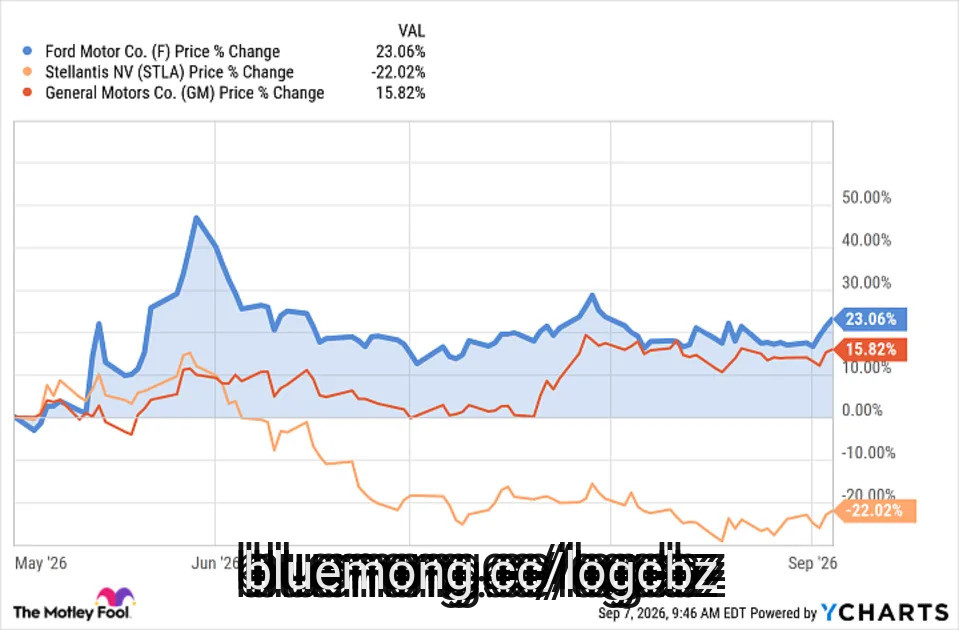
Ford Motor Company (NYSE: F) stock soared nearly 50% in May, as Wall Street began seeing the legacy automotive company as a hidden-gem infrastructure play as the demand for artificial intelligence (AI) and data center energy explodes. The stock has since given back about half of its May surge, and that gives investors who see long-term growth an opportunity to jump back in at a better price.
Here's why investors should be intrigued.
Missed Nvidia in 2009? This Rare Signal Is Flashing Again. In 2009, a "Double Down" signal flashed for a little-known chipmaker called Nvidia. For the first time in years, that same "Total Conviction" signal is flashing for a company 1/100th the size of Nvidia. Continue »
In May, the Detroit automaker announced its wholly owned subsidiary, called Ford Energy, which will develop and offer a battery energy storage system (BESS) for utility customers, AI data centers, and other large industrial and commercial customers. Savvy investors may have seen this coming, but for the most part, Ford built the new business behind the scenes, securing supply chains and preparing manufacturing. Ford Energy will manufacture battery cells, **** emble modules and containers, and offer sales and service support, which could be the lucrative part. That's because the automaker's Ford Energy DC block was designed to have a stable and predictable lifetime performance for about two decades.
To help connect the dots for investors wondering, AI data centers run intense workloads that put immense strain on the electrical grid. Ford's BESS give AI data centers security in the event of electrical grid fluctuations or blackouts, as the centers need an uninterrupted power supply. The systems will also provide power during AI workload spikes, charge when electricity is cheap, and discharge when prices peak, ultimately lowering costs and providing downtime protection.
#bess
Here's why investors should be intrigued.
Missed Nvidia in 2009? This Rare Signal Is Flashing Again. In 2009, a "Double Down" signal flashed for a little-known chipmaker called Nvidia. For the first time in years, that same "Total Conviction" signal is flashing for a company 1/100th the size of Nvidia. Continue »
In May, the Detroit automaker announced its wholly owned subsidiary, called Ford Energy, which will develop and offer a battery energy storage system (BESS) for utility customers, AI data centers, and other large industrial and commercial customers. Savvy investors may have seen this coming, but for the most part, Ford built the new business behind the scenes, securing supply chains and preparing manufacturing. Ford Energy will manufacture battery cells, **** emble modules and containers, and offer sales and service support, which could be the lucrative part. That's because the automaker's Ford Energy DC block was designed to have a stable and predictable lifetime performance for about two decades.
To help connect the dots for investors wondering, AI data centers run intense workloads that put immense strain on the electrical grid. Ford's BESS give AI data centers security in the event of electrical grid fluctuations or blackouts, as the centers need an uninterrupted power supply. The systems will also provide power during AI workload spikes, charge when electricity is cheap, and discharge when prices peak, ultimately lowering costs and providing downtime protection.
#bess

0.00$ raised of 0.00$ goal
0 donations
0.00$
to go
6 days ago
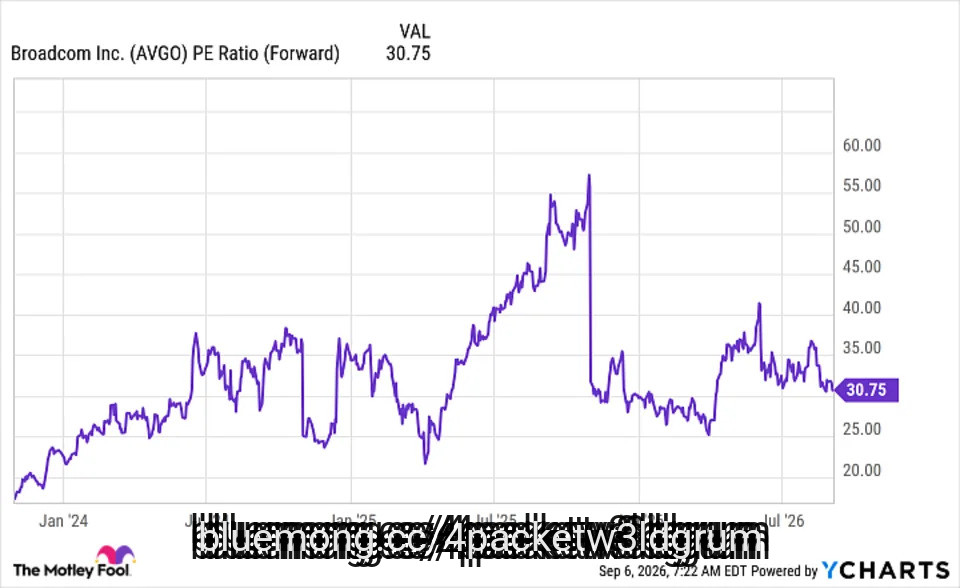
Broadcom (NASDAQ: AVGO) just posted one of the best quarters you'll ever see from a company involved in the AI computing equipment ******* e. It grew its AI semiconductor revenue at a 221% pace during the third quarter of FY 2027 (ended Aug. 2). That's better performance than nearly any of its competitors have ever put up, but that's just the beginning.
Broadcom announced major news about future demand, and there's really only one conclusion after learning about their projections: Buy the stock hand over fist.
Missed Nvidia in 2009? This Rare Signal Is Flashing Again. In 2009, a "Double Down" signal flashed for a little-known chipmaker called Nvidia. For the first time in years, that same "Total Conviction" signal is flashing for a company 1/100th the size of Nvidia. Continue »
Broadcom's exposure to AI computing units comes from its custom AI chips. The company partners with AI hyperscalers to design and build chips specifically tailored to their workloads. If done properly, this can provide a computing unit that delivers better performance at a lower cost.
However, the workload must stay consistent. This means that broad-purpose GPUs won't ever be fully replaced, but the market share of custom AI chips could increase.
#signal #broadcom
Broadcom announced major news about future demand, and there's really only one conclusion after learning about their projections: Buy the stock hand over fist.
Missed Nvidia in 2009? This Rare Signal Is Flashing Again. In 2009, a "Double Down" signal flashed for a little-known chipmaker called Nvidia. For the first time in years, that same "Total Conviction" signal is flashing for a company 1/100th the size of Nvidia. Continue »
Broadcom's exposure to AI computing units comes from its custom AI chips. The company partners with AI hyperscalers to design and build chips specifically tailored to their workloads. If done properly, this can provide a computing unit that delivers better performance at a lower cost.
However, the workload must stay consistent. This means that broad-purpose GPUs won't ever be fully replaced, but the market share of custom AI chips could increase.
#signal #broadcom


0.00$ raised of 0.00$ goal
0 donations
0.00$
to go
9 days ago
Applied Digital (NASDAQ:APLD) primarily generates its revenue by operating centralized digital infrastructure campuses and providing dedicated computing services designed for high-performance workloads across the North American region.
It recently signed an additional facility lease for a new campus and secured supplemental credit financing for ongoing construction, while reporting an operating margin of -45% for the quarter ended May 31, 2026.
IREN (NASDAQ:IREN) earns the majority of its ongoing revenue by managing vertically integrated data center facilities and actively mining digital **** ets across its international infrastructure footprint.
While integrating a newly acquired European data center developer and closing the purchase of cloud software provider Mirantis, it recorded an operating margin of -452% for the quarter ended June 30, 2026.
Revenue serves as a primary starting point for investors to evaluate a corporation's ability to attract paying clients and generate gross business volume before standard operational expenses, local taxes, or daily administrative costs are finally subtracted. For neocloud operations such as Applied Digital and IREN, revenue growth is essential to understanding if their costly artificial intelligence infrastructure buildouts are paying off.
#applied #across
It recently signed an additional facility lease for a new campus and secured supplemental credit financing for ongoing construction, while reporting an operating margin of -45% for the quarter ended May 31, 2026.
IREN (NASDAQ:IREN) earns the majority of its ongoing revenue by managing vertically integrated data center facilities and actively mining digital **** ets across its international infrastructure footprint.
While integrating a newly acquired European data center developer and closing the purchase of cloud software provider Mirantis, it recorded an operating margin of -452% for the quarter ended June 30, 2026.
Revenue serves as a primary starting point for investors to evaluate a corporation's ability to attract paying clients and generate gross business volume before standard operational expenses, local taxes, or daily administrative costs are finally subtracted. For neocloud operations such as Applied Digital and IREN, revenue growth is essential to understanding if their costly artificial intelligence infrastructure buildouts are paying off.
#applied #across


9 days ago
CNBC reported that Apple Inc. (NASDAQ:AAPL) announced new Mac Mini and Mac Studio models with updated chips built for AI workloads.
The Mac Mini now offers Apple's new M6 chip, its first built on a 2-nanometer process, or an M5 Pro, and starts at $899, up from $799 for the prior model. Apple says the M6 delivers 4 times faster AI performance and 2 times faster graphics than the M4 model it replaces, while the M5 Pro can process large language model prompts up to 8.5 times faster than the M2 Pro version. The Mac Studio now starts at $2,499 with the M5 Max chip or $5,499 with the new M5 Ultra, up from $5,299 for the prior Ultra model, and multiple M5 Ultra units can be linked together to pool memory for running large AI models. "With these frameworks and new chips, developers can run and fine-tune large AI models locally on their Mac," Apple said. Preorders opened Tuesday, with units shipping September 22.
The performance gains here are substantial, not incremental. The M6 chip delivers 4 times faster AI performance and is Apple Inc. (NASDAQ:AAPL)'s first chip built on a 2-nanometer process. The M5 Pro configuration processes large language model prompts 8.5 times faster than the model it replaces, Apple's own specifications show, giving Apple genuine technical claims to back its AI-focused marketing.
Apple is showing pricing power even as component costs rise industry-wide. Despite memory and silicon shortages pushing costs higher across the industry, Apple raised prices on both product lines rather than absorbing the cost pressure itself. It is a sign the company believes demand can bear higher price points.
These desktops are becoming more strategically important to Apple than their revenue alone suggests. It shows how Mac desktops have become a foothold in the AI development world for Apple. It is a showcase for its custom silicon that can influence which platform developers build AI tools on and an ecosystem benefit that extends beyond the sale of any individual machine.
#faster #chip #ultra
The Mac Mini now offers Apple's new M6 chip, its first built on a 2-nanometer process, or an M5 Pro, and starts at $899, up from $799 for the prior model. Apple says the M6 delivers 4 times faster AI performance and 2 times faster graphics than the M4 model it replaces, while the M5 Pro can process large language model prompts up to 8.5 times faster than the M2 Pro version. The Mac Studio now starts at $2,499 with the M5 Max chip or $5,499 with the new M5 Ultra, up from $5,299 for the prior Ultra model, and multiple M5 Ultra units can be linked together to pool memory for running large AI models. "With these frameworks and new chips, developers can run and fine-tune large AI models locally on their Mac," Apple said. Preorders opened Tuesday, with units shipping September 22.
The performance gains here are substantial, not incremental. The M6 chip delivers 4 times faster AI performance and is Apple Inc. (NASDAQ:AAPL)'s first chip built on a 2-nanometer process. The M5 Pro configuration processes large language model prompts 8.5 times faster than the model it replaces, Apple's own specifications show, giving Apple genuine technical claims to back its AI-focused marketing.
Apple is showing pricing power even as component costs rise industry-wide. Despite memory and silicon shortages pushing costs higher across the industry, Apple raised prices on both product lines rather than absorbing the cost pressure itself. It is a sign the company believes demand can bear higher price points.
These desktops are becoming more strategically important to Apple than their revenue alone suggests. It shows how Mac desktops have become a foothold in the AI development world for Apple. It is a showcase for its custom silicon that can influence which platform developers build AI tools on and an ecosystem benefit that extends beyond the sale of any individual machine.
#faster #chip #ultra


9 days ago
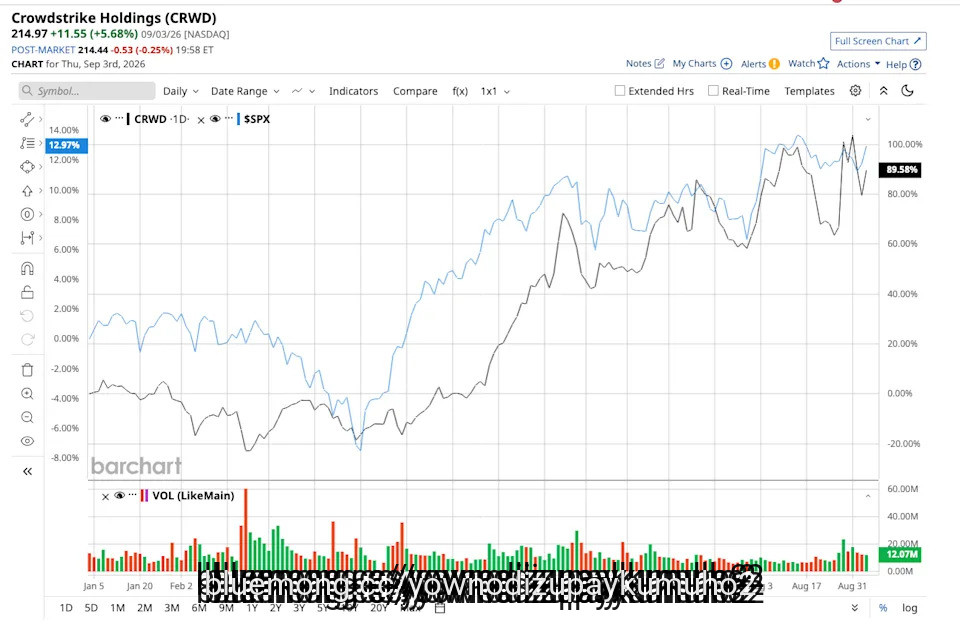
CrowdStrike (CRWD) looks like one of the strongest growth stories in cybersecurity right now. It had a lot to prove in the fiscal second-quarter earnings. The company delivered on all three numbers that I flagged ahead of the Q2 print, and in some cases it did much better than expected. And the stock's massive 90% gains so far this year reflect that outstanding performance.
With a market cap of $220 billion, CrowdStrike is a cloud-based cybersecurity company best known for its Falcon platform. The company helps businesses protect endpoints, cloud workloads, identities, and other parts of their technology infrastructure from cyber threats.
How to Play SNPS Stock as Layoffs Hit Synopsys
Micron Stock More Than Tripled in 2026. Now Taiwan Strike Threat Could Shake the AI Boom.
Dear Adobe Stock Fans, Mark Your Calendars for September 10
#Stock #company #Cybersecurity
With a market cap of $220 billion, CrowdStrike is a cloud-based cybersecurity company best known for its Falcon platform. The company helps businesses protect endpoints, cloud workloads, identities, and other parts of their technology infrastructure from cyber threats.
How to Play SNPS Stock as Layoffs Hit Synopsys
Micron Stock More Than Tripled in 2026. Now Taiwan Strike Threat Could Shake the AI Boom.
Dear Adobe Stock Fans, Mark Your Calendars for September 10
#Stock #company #Cybersecurity
11 days ago
Shares of Intel (NASDAQ: INTC) rose over 7% this past week after an ******* yst report highlighted the chipmaker's enormous artificial intelligence (AI)-driven growth potential.
Missed Nvidia in 2009? This Rare Signal Is Flashing Again. In 2009, a "Double Down" signal flashed for a little-known chipmaker called Nvidia. For the first time in years, that same "Total Conviction" signal is flashing for a company 1/100th the size of Nvidia. Continue »
The AI boom is creating a massive need for the semiconductor chips that power high-performance computing infrastructure. Many investors are aware of this trend. But they may be overlooking the shift toward central processor units (CPUs), as compute needs transition from graphics processing unit (GPU)-based model training to agentic AI workloads.
Global Equities Research ******* yst Trip Chowdhry believes this shift will help Intel's annual earnings per share grow more than tenfold to $20 by 2031. For context, Wall Street's consensus estimates call for Intel's EPS to increase to $1.51 in 2026 and $2.04 in 2027, as per Yahoo! Finance.
In turn, Chowdhry sees Intel's stock price more than doubling to $200 per share.
#NVIDIA #Intel
Missed Nvidia in 2009? This Rare Signal Is Flashing Again. In 2009, a "Double Down" signal flashed for a little-known chipmaker called Nvidia. For the first time in years, that same "Total Conviction" signal is flashing for a company 1/100th the size of Nvidia. Continue »
The AI boom is creating a massive need for the semiconductor chips that power high-performance computing infrastructure. Many investors are aware of this trend. But they may be overlooking the shift toward central processor units (CPUs), as compute needs transition from graphics processing unit (GPU)-based model training to agentic AI workloads.
Global Equities Research ******* yst Trip Chowdhry believes this shift will help Intel's annual earnings per share grow more than tenfold to $20 by 2031. For context, Wall Street's consensus estimates call for Intel's EPS to increase to $1.51 in 2026 and $2.04 in 2027, as per Yahoo! Finance.
In turn, Chowdhry sees Intel's stock price more than doubling to $200 per share.
#NVIDIA #Intel


12 days ago
Our ******* ysts just identified a stock with the potential to be the next Nvidia. Tell us how you invest and we'll show you why it's our #1 pick. Tap here.
Achieved record Q3 revenue of $1.7 billion and 22.5% operating margin, driven by an accelerating industry demand environment for data center infrastructure.
Management attributes the performance to Ciena's role in re-architecting networks for AI, which requires high-speed, low-latency optical connectivity for both training and inferencing workloads.
The company is seeing a fundamental shift where optics have become the 'indispensable element' for next-generation AI architectures across traditional WAN, AI-specific WAN, and intra-data center fabrics.
Market share gains are being driven by the WaveLogic 6 Extreme platform, which remains the only 1.6 terabit high-performance modem available after 18 months on the market.
#market #next
Achieved record Q3 revenue of $1.7 billion and 22.5% operating margin, driven by an accelerating industry demand environment for data center infrastructure.
Management attributes the performance to Ciena's role in re-architecting networks for AI, which requires high-speed, low-latency optical connectivity for both training and inferencing workloads.
The company is seeing a fundamental shift where optics have become the 'indispensable element' for next-generation AI architectures across traditional WAN, AI-specific WAN, and intra-data center fabrics.
Market share gains are being driven by the WaveLogic 6 Extreme platform, which remains the only 1.6 terabit high-performance modem available after 18 months on the market.
#market #next
12 days ago
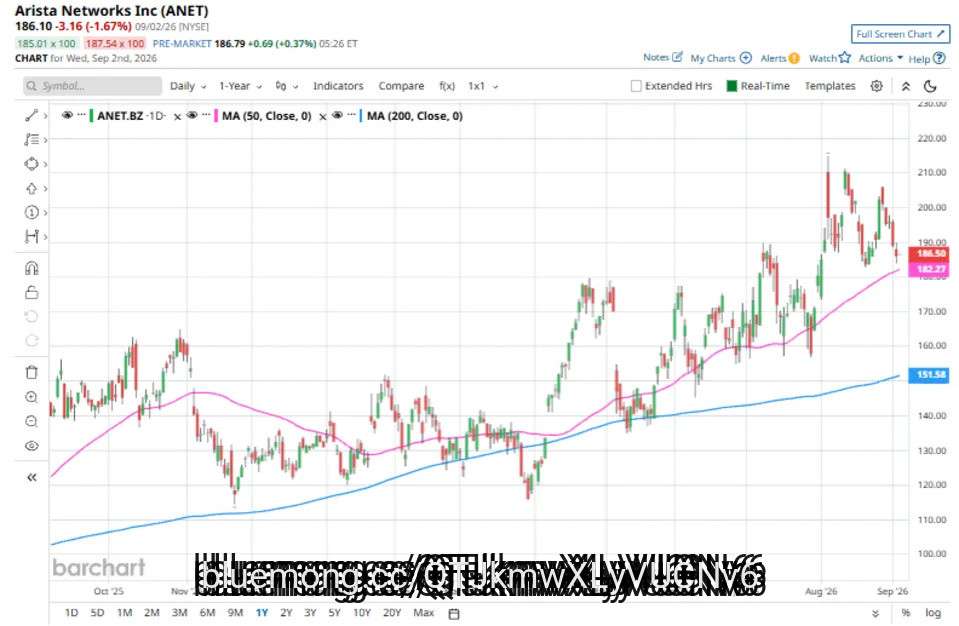
With a market cap of $238.7 billion, California-based Arista Networks Inc (ANET) is a leading cloud and AI networking company that provides high-performance Ethernet switching, routing, and software solutions for large data centers, AI infrastructure, cloud providers, and enterprise networks. Its flagship Extensible Operating System (EOS) gives customers a highly programmable, automated, and scalable platform for managing complex networks.
Companies valued over $200 billion are generally described as "mega-cap" stocks, and Arista Networks fits right into that category. The company has become an important player in the AI infrastructure buildout, with its high-speed networking platforms designed to connect massive AI and cloud workloads. Arista is also expanding beyond its core data-center business into campus, routing, security, and WAN networking, broadening its addressable market.
Nvidia CEO Jensen Huang Says His $3.5 Billion MediaTek Deal Is 'Not Circular' Because 'They Do Their Own Business'
Strategy's Strategy Appears to Have Failed, and the Outlook of MSTR Stock Is Unfavorable
A Potential ****** eX Deal Could Meaningfully Accelerate Growth for Technip Stock
#deal #business
Companies valued over $200 billion are generally described as "mega-cap" stocks, and Arista Networks fits right into that category. The company has become an important player in the AI infrastructure buildout, with its high-speed networking platforms designed to connect massive AI and cloud workloads. Arista is also expanding beyond its core data-center business into campus, routing, security, and WAN networking, broadening its addressable market.
Nvidia CEO Jensen Huang Says His $3.5 Billion MediaTek Deal Is 'Not Circular' Because 'They Do Their Own Business'
Strategy's Strategy Appears to Have Failed, and the Outlook of MSTR Stock Is Unfavorable
A Potential ****** eX Deal Could Meaningfully Accelerate Growth for Technip Stock
#deal #business

13 days ago
Nvidia's less famous telecom investment had more than doubled on paper by midyear. In October 2025, NVIDIA Corporation (NASDAQ:NVDA) agreed to invest $1 billion in Nokia at $6.01 per share. Nvidia's Q2 13F valued the stake at about $2.2 billion as of June 30. The marked gain is impressive, but the strategic prize is larger: Nokia Corporation (NYSE:NOK) and Nvidia are developing AI-RAN technology intended to carry artificial intelligence from data centers into mobile networks and eventually 6G.
NVIDIA Corporation (NASDAQ:NVDA) wants the network itself to become accelerated computing infrastructure. If radio access networks adopt software-defined, AI-enabled architectures, Nvidia can sell computing, networking, and software into a market beyond hyperscale data centers. The bull case is that inference moves closer to users and telecom operators use spare network capacity for AI workloads. The bear case is timing. Standards, carrier budgets, and commercial rollouts move slowly, making near-term revenue difficult to separate from long-term vision.
Nokia Corporation (NYSE:NOK) gains a strategic partner, capital, and access to an AI platform that can make its radio portfolio more competitive. A successful AI-RAN transition could improve product differentiation and create recurring software opportunities. Yet Nokia must balance that promise with operator spending cycles, intense competition, and the risk that open architectures reduce hardware pricing power. A valuable Nvidia stake does not by itself repair telecom margins.
The partnership is therefore an option on convergence. Nvidia supplies the compute ecosystem; Nokia supplies carrier relationships and radio expertise. Each fills a gap the other cannot quickly build. However, investors should not treat the June valuation as a realized return or ***** ume 6G revenue is imminent. The commercial value emerges only when operators deploy systems at scale and disclose credible returns with attractive economics across multiple markets.
Hedge-fund participation increased in both names. Nvidia ownership rose to 285 funds in the second quarter from 275, while Nokia ownership increased to 81 funds from 66. Fisher ***** et Management raised its Nvidia stake 3% to 90.9 million shares, and Marshall Wace increased its Nokia position 232% to 33 million shares. As of August 14, 43.2 million Nokia shares were sold short, only 0.75% of the float and 0.6 days of average trading volume. The low reported short-interest percentage shows limited reported short positioning, but it does not identify the holders or tell us why those positions exist. Nvidia's paper gain rewards the entry price; the real upside depends on AI-RAN becoming a commercial bridge to 6G.
#nokia #stake
NVIDIA Corporation (NASDAQ:NVDA) wants the network itself to become accelerated computing infrastructure. If radio access networks adopt software-defined, AI-enabled architectures, Nvidia can sell computing, networking, and software into a market beyond hyperscale data centers. The bull case is that inference moves closer to users and telecom operators use spare network capacity for AI workloads. The bear case is timing. Standards, carrier budgets, and commercial rollouts move slowly, making near-term revenue difficult to separate from long-term vision.
Nokia Corporation (NYSE:NOK) gains a strategic partner, capital, and access to an AI platform that can make its radio portfolio more competitive. A successful AI-RAN transition could improve product differentiation and create recurring software opportunities. Yet Nokia must balance that promise with operator spending cycles, intense competition, and the risk that open architectures reduce hardware pricing power. A valuable Nvidia stake does not by itself repair telecom margins.
The partnership is therefore an option on convergence. Nvidia supplies the compute ecosystem; Nokia supplies carrier relationships and radio expertise. Each fills a gap the other cannot quickly build. However, investors should not treat the June valuation as a realized return or ***** ume 6G revenue is imminent. The commercial value emerges only when operators deploy systems at scale and disclose credible returns with attractive economics across multiple markets.
Hedge-fund participation increased in both names. Nvidia ownership rose to 285 funds in the second quarter from 275, while Nokia ownership increased to 81 funds from 66. Fisher ***** et Management raised its Nvidia stake 3% to 90.9 million shares, and Marshall Wace increased its Nokia position 232% to 33 million shares. As of August 14, 43.2 million Nokia shares were sold short, only 0.75% of the float and 0.6 days of average trading volume. The low reported short-interest percentage shows limited reported short positioning, but it does not identify the holders or tell us why those positions exist. Nvidia's paper gain rewards the entry price; the real upside depends on AI-RAN becoming a commercial bridge to 6G.
#nokia #stake

13 days ago
Wall Street experts believe that AI adoption continues to create a cybersecurity spending cycle, with companies increasingly needing to secure AI agents, applications, and cloud workloads. CrowdStrike Holdings, Inc. (NASDAQ:CRWD) is benefiting from this trend, posting record net new ARR of $333 million in Q2 2027, up 51% year-over-year, and upgrading FY27 net new ARR growth guidance by 630 bps to 34%. Revenue also rose 26% to $1.47 billion, driven by elevated demand.
Scotiabank lifted its price objective on CrowdStrike Holdings, Inc. (NASDAQ:CRWD)'s stock to $250 from $227 on August 27, while maintaining a "Sector Outperform" rating. The firm sees broad-based enterprise demand and increased spending on AI security for CRWD. The firm also tagged the company as a medium-term compounder even though it commands a premium valuation.
Wall Street ***** ysts believe that the upside case for CRWD revolves around platform expansion and AI security. Falcon Flex ARR crossed $2.29 billion, implying a rise of 101% YoY. Notably, 51% of subscription customers are now using six or more modules. Moving forward, growth is expected to be backed by cross-selling, AI security adoption, and record FCF.
However, bears highlight valuation as the biggest risk. Since expectations for high growth remain elevated, this leaves room for multiple compression if ARR growth slows, module adoption disappoints, or competition intensifies. CrowdStrike Holdings, Inc. (NASDAQ:CRWD) trades at a forward P/E of ~172.4x, significantly higher than that of competitor Palo Alto Networks, Inc. (NASDAQ:PANW)'s forward P/E of ~87.7x.
CrowdStrike's strong ARR growth and expanding Falcon platform provide the company with a strong growth profile. On the other hand, Palo Alto Networks, Inc. (NASDAQ:PANW) is benefiting from broader network-security exposure. Overall, CrowdStrike's strong presence across endpoint, cloud, identity, SIEM, and AI security cements its position as the consolidated cybersecurity platform.
#adoption
Scotiabank lifted its price objective on CrowdStrike Holdings, Inc. (NASDAQ:CRWD)'s stock to $250 from $227 on August 27, while maintaining a "Sector Outperform" rating. The firm sees broad-based enterprise demand and increased spending on AI security for CRWD. The firm also tagged the company as a medium-term compounder even though it commands a premium valuation.
Wall Street ***** ysts believe that the upside case for CRWD revolves around platform expansion and AI security. Falcon Flex ARR crossed $2.29 billion, implying a rise of 101% YoY. Notably, 51% of subscription customers are now using six or more modules. Moving forward, growth is expected to be backed by cross-selling, AI security adoption, and record FCF.
However, bears highlight valuation as the biggest risk. Since expectations for high growth remain elevated, this leaves room for multiple compression if ARR growth slows, module adoption disappoints, or competition intensifies. CrowdStrike Holdings, Inc. (NASDAQ:CRWD) trades at a forward P/E of ~172.4x, significantly higher than that of competitor Palo Alto Networks, Inc. (NASDAQ:PANW)'s forward P/E of ~87.7x.
CrowdStrike's strong ARR growth and expanding Falcon platform provide the company with a strong growth profile. On the other hand, Palo Alto Networks, Inc. (NASDAQ:PANW) is benefiting from broader network-security exposure. Overall, CrowdStrike's strong presence across endpoint, cloud, identity, SIEM, and AI security cements its position as the consolidated cybersecurity platform.
#adoption

13 days ago
Equinix (NASDAQ:EQIX) shares rose 2% on Wednesday after the company announced Equinix Inference Exchange, a distributed artificial intelligence inference program developed in collaboration with Nvidia and Together AI.
The program brings together Nvidia Enterprise Reference Architectures, Together AI's inference platform and Equinix's global infrastructure for enterprises deploying AI workloads.
According to Equinix, the combination is designed to support deployment speed, flexibility and cost management. These benefits represent the company's stated objectives for the program rather than independently established performance outcomes.
Equinix said Inference Exchange will provide enterprises with connectivity to data, users and other parts of their technology ecosystems through Equinix Fabric.
The program integrates Nvidia's validated Enterprise Reference Architectures with Together AI's inference platform, which supports more than 200 open-source models, according to the company.
#equinix #exchange #NVIDIA #enterprise
The program brings together Nvidia Enterprise Reference Architectures, Together AI's inference platform and Equinix's global infrastructure for enterprises deploying AI workloads.
According to Equinix, the combination is designed to support deployment speed, flexibility and cost management. These benefits represent the company's stated objectives for the program rather than independently established performance outcomes.
Equinix said Inference Exchange will provide enterprises with connectivity to data, users and other parts of their technology ecosystems through Equinix Fabric.
The program integrates Nvidia's validated Enterprise Reference Architectures with Together AI's inference platform, which supports more than 200 open-source models, according to the company.
#equinix #exchange #NVIDIA #enterprise


13 days ago
Our ****** ysts just identified a stock with the potential to be the next Nvidia. Tell us how you invest and we'll show you why it's our #1 pick. Tap here.
Record revenue and EPS were driven by the compounding benefits of a modernized operating model, enabling earnings to grow faster than revenue through significant operating leverage.
Management attributes the 122% growth in traditional servers to a structural shift where customers view IT as a value driver rather than a cost center, accelerating the refresh of an aged installed base.
AI server momentum is broadening across Neoclouds, sovereigns, and enterprise customers, with the customer count surpassing 6,500 as organizations move from design to production.
Storage returned to growth and share gains, fueled by strong demand for Dell IP products and early tailwinds from AI workloads requiring massive data movement and protection.
#Growth #management #storage
Record revenue and EPS were driven by the compounding benefits of a modernized operating model, enabling earnings to grow faster than revenue through significant operating leverage.
Management attributes the 122% growth in traditional servers to a structural shift where customers view IT as a value driver rather than a cost center, accelerating the refresh of an aged installed base.
AI server momentum is broadening across Neoclouds, sovereigns, and enterprise customers, with the customer count surpassing 6,500 as organizations move from design to production.
Storage returned to growth and share gains, fueled by strong demand for Dell IP products and early tailwinds from AI workloads requiring massive data movement and protection.
#Growth #management #storage

14 days ago
On August 10, Chemours (NYSE:CC) launched two new refrigerants, Opteon ZE and Opteon 515B, built specifically for stationary chillers that cool data centers, commercial buildings, and other facilities that cannot afford downtime. The announcement lands as data center operators everywhere are scrambling to keep pace with the heat that AI workloads generate, and Chemours is betting its chemistry can be part of the answer.
Chemours designed these products around a specific problem: AI infrastructure is pushing heat loads and uptime requirements past what older cooling systems were built for. Joseph Martinko, President of Thermal & Specialized Solutions at Chemours, said the company is expanding the choices available to chiller manufacturers and operators as they build and maintain the systems powering data centers and other mission-critical environments. That framing matters because it puts Chemours squarely inside the AI infrastructure buildout rather than on its periphery, and the company describes this as part of a broader push into higher-value, high-growth cooling applications.
The two products are designed to work together rather than compete for the same customer. Opteon ZE, the R-1234ze(E) formulation, is an HFO-based refrigerant with a GWP of approximately 1 and zero ozone depletion potential, aimed at air- and water-cooled chillers, commercial air conditioning, heat pumps, and data center cooling specifically. It also offers high energy efficiency and works with commonly used POE lubricants, which matters for equipment makers who do not want to redesign their systems from scratch.
Opteon 515B is a blend of roughly 91.1% R-1234ze(E) and 8.9% R-227ea, with a GWP near 293, pitched at operators running conventional chillers who want an easier path away from higher-GWP refrigerants without a full system overhaul. Having both a near-zero-GWP option and a lower-friction transitional option lets Chemours sell into new builds and legacy fleets at the same time.
The launch is not without caveats. Opteon ZE carries an ASHRAE A2L classification, meaning it is mildly flammable, while Opteon 515B carries the non-flammable A1 rating. That difference alone could steer certain customers toward one product over the other depending on local codes and installation requirements.
#heat #cooling
Chemours designed these products around a specific problem: AI infrastructure is pushing heat loads and uptime requirements past what older cooling systems were built for. Joseph Martinko, President of Thermal & Specialized Solutions at Chemours, said the company is expanding the choices available to chiller manufacturers and operators as they build and maintain the systems powering data centers and other mission-critical environments. That framing matters because it puts Chemours squarely inside the AI infrastructure buildout rather than on its periphery, and the company describes this as part of a broader push into higher-value, high-growth cooling applications.
The two products are designed to work together rather than compete for the same customer. Opteon ZE, the R-1234ze(E) formulation, is an HFO-based refrigerant with a GWP of approximately 1 and zero ozone depletion potential, aimed at air- and water-cooled chillers, commercial air conditioning, heat pumps, and data center cooling specifically. It also offers high energy efficiency and works with commonly used POE lubricants, which matters for equipment makers who do not want to redesign their systems from scratch.
Opteon 515B is a blend of roughly 91.1% R-1234ze(E) and 8.9% R-227ea, with a GWP near 293, pitched at operators running conventional chillers who want an easier path away from higher-GWP refrigerants without a full system overhaul. Having both a near-zero-GWP option and a lower-friction transitional option lets Chemours sell into new builds and legacy fleets at the same time.
The launch is not without caveats. Opteon ZE carries an ASHRAE A2L classification, meaning it is mildly flammable, while Opteon 515B carries the non-flammable A1 rating. That difference alone could steer certain customers toward one product over the other depending on local codes and installation requirements.
#heat #cooling