
1 hr. ago
The stock market gapped lower to start the week, pressured by the latest rise in long-term bond rates and the Wall Street Journal's reporting that artificial intelligence (AI) hyperscalers are on the hook for another $3 trillion in debt and purchase obligations over the next few years.
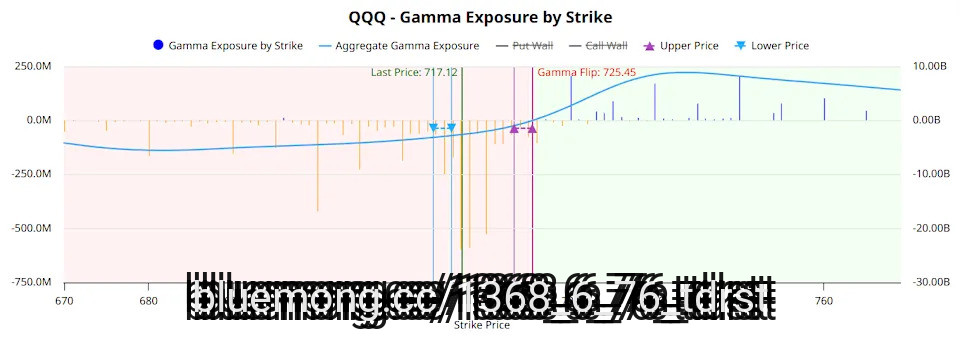
The Invesco QQQ Trust (QQQ), which tracks the Nasdaq-100 Index ($IUXX), "gamma flipped" at 725, forcing market makers to follow the market. In other words, they're forced to sell as prices fall in order to hedge their open positions (e.g., puts they have sold).
Huge Unusual Long-Dated Call Options in Oracle Corp - A Covered Call ORCL Play?
Why There Might Be a Case for Taiwan Semiconductor Stock at $450 in September
Alphabet Stock Has Attractive Short-Put Yields As GOOGL Stock Treads Water
#market #call #wall #invesco
The Invesco QQQ Trust (QQQ), which tracks the Nasdaq-100 Index ($IUXX), "gamma flipped" at 725, forcing market makers to follow the market. In other words, they're forced to sell as prices fall in order to hedge their open positions (e.g., puts they have sold).
Huge Unusual Long-Dated Call Options in Oracle Corp - A Covered Call ORCL Play?
Why There Might Be a Case for Taiwan Semiconductor Stock at $450 in September
Alphabet Stock Has Attractive Short-Put Yields As GOOGL Stock Treads Water
#market #call #wall #invesco


2 days ago
VOO and SCHD pair a 0.03% expense ratio with reinvested dividends, creating two separate compounding streams from a single $500 monthly deposit.
QQQM's Nasdaq-100 concentration delivered 104% over five years, making it the growth accelerator best suited for investors with longer time horizons.
It sounds nuts, but SoFi1 is giving new Active Invest users up to $3,000 in stock for a limited time, and all it takes is a $50 deposit to get started.2 See for yourself (Sponsor)
A $500 monthly contribution sounds modest until it collides with three or four decades of compounding. That is the mechanism behind every millionaire retirement story built on index funds, and it is why the three-ETF combination of Vanguard S&P 500 ETF (NYSEARCA:VOO), Schwab U.S. Dividend Equity ETF (NYSEARCA:SCHD), and Invesco NASDAQ 100 ETF (NASDAQ:QQQM) shows up so often in long-horizon portfolios.
Each fund plays a different role. VOO supplies broad U.S. large-cap exposure at rock-bottom cost. SCHD adds a quality-dividend sleeve that produces reinvestable cash every quarter. QQQM tilts the portfolio toward the mega-cap growth names that have historically produced the highest realized returns among diversified equity baskets. Combining them lets a monthly investor hold a diversified core, an income compounder, and a growth accelerator without stacking overlapping bets.
#schd #NASDAQ #Growth #deposit
QQQM's Nasdaq-100 concentration delivered 104% over five years, making it the growth accelerator best suited for investors with longer time horizons.
It sounds nuts, but SoFi1 is giving new Active Invest users up to $3,000 in stock for a limited time, and all it takes is a $50 deposit to get started.2 See for yourself (Sponsor)
A $500 monthly contribution sounds modest until it collides with three or four decades of compounding. That is the mechanism behind every millionaire retirement story built on index funds, and it is why the three-ETF combination of Vanguard S&P 500 ETF (NYSEARCA:VOO), Schwab U.S. Dividend Equity ETF (NYSEARCA:SCHD), and Invesco NASDAQ 100 ETF (NASDAQ:QQQM) shows up so often in long-horizon portfolios.
Each fund plays a different role. VOO supplies broad U.S. large-cap exposure at rock-bottom cost. SCHD adds a quality-dividend sleeve that produces reinvestable cash every quarter. QQQM tilts the portfolio toward the mega-cap growth names that have historically produced the highest realized returns among diversified equity baskets. Combining them lets a monthly investor hold a diversified core, an income compounder, and a growth accelerator without stacking overlapping bets.
#schd #NASDAQ #Growth #deposit


2 days ago
The iShares Top 20 U.S. Stocks ETF (TOPT) is designed to capture market performance by isolating the largest enterprise leaders in the U.S. market. That covers nearly half the S&P 500 Index's ($SPX) total market capitalization. But chances are you probably haven't heard of this ETF.
Despite being part of the huge iShares lineup, TOPT, which debuted less than two years ago, is puny in size compared to the more established SPDR S&P 500 Trust ETF (SPY) and the Invesco QQQ ETF (QQQ). And while it has underperformed that pair over the past 12 months, TOPT is perhaps the best way an investor could bet on mega-cap stocks. Instead of spreading capital across hundreds of companies, TOPT strips out the mid-caps and smaller S&P 500 constituents to build a highly concentrated portfolio.
A $210 Billion Reason to Buy AMD Stock Here
CoreWeave vs Nebius: Both Companies Reported Strong Earnings, But Here's the Stock You Should Buy
As Oracle Deepens Its Partnership with AWS, Here's How You Should Play ORCL Stock
#topt #despite
Despite being part of the huge iShares lineup, TOPT, which debuted less than two years ago, is puny in size compared to the more established SPDR S&P 500 Trust ETF (SPY) and the Invesco QQQ ETF (QQQ). And while it has underperformed that pair over the past 12 months, TOPT is perhaps the best way an investor could bet on mega-cap stocks. Instead of spreading capital across hundreds of companies, TOPT strips out the mid-caps and smaller S&P 500 constituents to build a highly concentrated portfolio.
A $210 Billion Reason to Buy AMD Stock Here
CoreWeave vs Nebius: Both Companies Reported Strong Earnings, But Here's the Stock You Should Buy
As Oracle Deepens Its Partnership with AWS, Here's How You Should Play ORCL Stock
#topt #despite



5 days ago
The iShares Russell 2000 Growth ETF (NYSEMKT:IWO) provides broad, low-cost exposure to small-cap growth stocks, while the Invesco S&P SmallCap 600 Revenue ETF (NYSEMKT:RZG) uses a concentrated, revenue-weighted methodology.
Investors seeking the high-growth potential of smaller companies often compare these two funds. While both target the small-cap segment, their differing index strategies and portfolio densities create unique risk-reward profiles. This ******* ysis examines how their costs, historical performance, and underlying holdings differ as of Aug. 10, 2026.
Metric
RZG
IWO
#revenue #investors #metric #ishares
Investors seeking the high-growth potential of smaller companies often compare these two funds. While both target the small-cap segment, their differing index strategies and portfolio densities create unique risk-reward profiles. This ******* ysis examines how their costs, historical performance, and underlying holdings differ as of Aug. 10, 2026.
Metric
RZG
IWO
#revenue #investors #metric #ishares

11 days ago
Trading in ETFs has exploded over the past few years, as a new generation of investors has come to the market and the number of funds has multiplied, offering exposure to just about every strategy imaginable.
What's interesting, though, is that the most actively traded ETFs aren't necessarily the biggest. Case in point is the Vanguard S&P 500 ETF (VOO). It's the only fund to cross $1 trillion in ******* ets, yet it barely makes the top 10 in terms of daily dollar volume.
The fund that dominates trading is the SPDR S&P 500 ETF Trust (SPY), which tracks the same index and was the largest ETF in the world for decades until VOO overtook it in 2025. It remains the runaway leader in activity, with almost $30 billion of the fund changing hands on Thursday.
The Invesco QQQ Trust (QQQ), which follows the tech-heavy Nasdaq-100, is a juggernaut in its own right, with nearly $24 billion in dollar volume.
After QQQ there is a steep drop off, though tech remains popular. The Direxion Daily Semiconductor Bull 3X Shares (SOXL) was the third most actively traded fund, with $7.6 billion changing hands.
That is an enormous figure for a fund with only $22.5 billion in ******* ets, a sign that SOXL is a trading vehicle above all else. The same is true of the ProShares UltraPro QQQ (TQQQ), which traded $4.4 billion.
SOXL and TQQQ are leveraged instruments that traders use to get amplified exposure to tech, and to the AI trade in particular. But plenty of activity went into unleveraged semiconductor funds as well.
The iShares Semiconductor ETF (SOXX) and the VanEck Semiconductor ETF (SMH) each traded roughly $4 billion. The two funds track the chip stocks that have benefited most from the AI boom.
The bearish versions drew heavy volume too, with the Direxion Daily Semiconductor Bear 3X Shares (SOXS) and the ProShares UltraPro Short QQQ (SQQQ) both landing in the top 20.
The chip theme extended overseas. The iShares MSCI South Korea ETF (EWY) traded $2.9 billion, and the Roundhill Memory ETF (DRAM), which is heavily weighted toward Korean names, traded $2.8 billion. Both cracked the top 15, a reflection of how central Korean memory makers have become to the AI story.
Outside of tech, the iShares Russell 2000 ETF (IWM) stood out with $4.9 billion, far and away the most actively traded small-cap fund. Small caps have had a strong year, rising 23% against 14% for large caps.
On the fixed income side, the iShares iBoxx $ Investment Grade Corporate Bond ETF (LQD), at $3.4 billion, and the iShares 20+ Year Treasury Bond ETF (TLT), at $2.3 billion, drew the most activity. Bonds have performed poorly this year amid expectations that the Federal Reserve could raise rates to fight resurgent inflation.
Gold remained a draw as well. The SPDR Gold Shares (GLD), with $4.3 billion, and the VanEck Gold Miners ETF (GDX), with $2.1 billion, both made the list, even though the metal has had a fairly tepid year.
A more surprising entrant in the top 20
What's interesting, though, is that the most actively traded ETFs aren't necessarily the biggest. Case in point is the Vanguard S&P 500 ETF (VOO). It's the only fund to cross $1 trillion in ******* ets, yet it barely makes the top 10 in terms of daily dollar volume.
The fund that dominates trading is the SPDR S&P 500 ETF Trust (SPY), which tracks the same index and was the largest ETF in the world for decades until VOO overtook it in 2025. It remains the runaway leader in activity, with almost $30 billion of the fund changing hands on Thursday.
The Invesco QQQ Trust (QQQ), which follows the tech-heavy Nasdaq-100, is a juggernaut in its own right, with nearly $24 billion in dollar volume.
After QQQ there is a steep drop off, though tech remains popular. The Direxion Daily Semiconductor Bull 3X Shares (SOXL) was the third most actively traded fund, with $7.6 billion changing hands.
That is an enormous figure for a fund with only $22.5 billion in ******* ets, a sign that SOXL is a trading vehicle above all else. The same is true of the ProShares UltraPro QQQ (TQQQ), which traded $4.4 billion.
SOXL and TQQQ are leveraged instruments that traders use to get amplified exposure to tech, and to the AI trade in particular. But plenty of activity went into unleveraged semiconductor funds as well.
The iShares Semiconductor ETF (SOXX) and the VanEck Semiconductor ETF (SMH) each traded roughly $4 billion. The two funds track the chip stocks that have benefited most from the AI boom.
The bearish versions drew heavy volume too, with the Direxion Daily Semiconductor Bear 3X Shares (SOXS) and the ProShares UltraPro Short QQQ (SQQQ) both landing in the top 20.
The chip theme extended overseas. The iShares MSCI South Korea ETF (EWY) traded $2.9 billion, and the Roundhill Memory ETF (DRAM), which is heavily weighted toward Korean names, traded $2.8 billion. Both cracked the top 15, a reflection of how central Korean memory makers have become to the AI story.
Outside of tech, the iShares Russell 2000 ETF (IWM) stood out with $4.9 billion, far and away the most actively traded small-cap fund. Small caps have had a strong year, rising 23% against 14% for large caps.
On the fixed income side, the iShares iBoxx $ Investment Grade Corporate Bond ETF (LQD), at $3.4 billion, and the iShares 20+ Year Treasury Bond ETF (TLT), at $2.3 billion, drew the most activity. Bonds have performed poorly this year amid expectations that the Federal Reserve could raise rates to fight resurgent inflation.
Gold remained a draw as well. The SPDR Gold Shares (GLD), with $4.3 billion, and the VanEck Gold Miners ETF (GDX), with $2.1 billion, both made the list, even though the metal has had a fairly tepid year.
A more surprising entrant in the top 20


14 days ago
Growth ETFs are a great way to get exposure to the high return potential of growth stocks while minimizing some of the risks and volatility that tend to come with them. The key, though, is to ensure your growth ETF is set up for sustained success and not riding a temporary wave.
Two growth ETFs you can comfortably hold through thick and thin are the Invesco Nasdaq 100 ETF (NASDAQ: QQQM) and Vanguard Growth ETF (NYSEMKT: VUG). They have both stood the test of time and are positioned to continue doing so.
Missed Nvidia in 2009? This Rare Signal Is Flashing Again. In 2009, a "Double Down" signal flashed for a little-known chipmaker called Nvidia. For the first time in years, that same "Total Conviction" signal is flashing for a company 1/100th the size of Nvidia. Continue »
QQQM mirrors the Nasdaq-100 index, which tracks the 100 largest non-financial companies trading on the Nasdaq stock exchange. It only began trading in October 2020, but we can look at the Nasdaq-100's performance to get an idea of how resilient (and lucrative) it has been.
Since the beginning of 1995, the Nasdaq-100 has averaged 14.4% annual returns, outpacing the S&P 500's 9.2% average in that time. Arguably more impressive is that it has done so despite going through three recessions (those resulting from the dot-com bubble, financial crisis, and COVID-19).
#signal
Two growth ETFs you can comfortably hold through thick and thin are the Invesco Nasdaq 100 ETF (NASDAQ: QQQM) and Vanguard Growth ETF (NYSEMKT: VUG). They have both stood the test of time and are positioned to continue doing so.
Missed Nvidia in 2009? This Rare Signal Is Flashing Again. In 2009, a "Double Down" signal flashed for a little-known chipmaker called Nvidia. For the first time in years, that same "Total Conviction" signal is flashing for a company 1/100th the size of Nvidia. Continue »
QQQM mirrors the Nasdaq-100 index, which tracks the 100 largest non-financial companies trading on the Nasdaq stock exchange. It only began trading in October 2020, but we can look at the Nasdaq-100's performance to get an idea of how resilient (and lucrative) it has been.
Since the beginning of 1995, the Nasdaq-100 has averaged 14.4% annual returns, outpacing the S&P 500's 9.2% average in that time. Arguably more impressive is that it has done so despite going through three recessions (those resulting from the dot-com bubble, financial crisis, and COVID-19).
#signal



17 days ago
GPIQ dropped 6% in July while Apple surged 15%, as the covered-call overlay handed the rally directly to option buyers instead of shareholders.
QQQ's 89% price-only return since GPIQ's inception already outpaces GPIQ's 89% total return with all distributions reinvested, before counting QQQ's own dividends.
Are you ahead, or behind on retirement? SmartAsset's free tool can match you with a financial advisor in minutes to help you answer that today. Each advisor has been carefully vetted, and must act in your best interests. Don't waste another minute; learn more here.
If you bought Goldman Sachs Nasdaq-100 Core Premium Income ETF (NYSEARCA:GPIQ) at launch expecting to capture the Nasdaq-100's upside while collecting high monthly income, you may have been disappointed in July. Apple (NASDAQ:AAPL), the fund's largest single exposure, ripped 15.23% higher in the month on a blockbuster earnings beat. GPIQ fell 6.1% during the same period. That performance gap reflects the fund's strategy working exactly as designed.
GPIQ has an expense ratio of 0.29% a year, or roughly $29 annually per $10,000 invested. Set against Invesco QQQ Trust (NASDAQ:QQQ), the mainstream Nasdaq-100 mirror commonly quoted around 0.20% ($20 per $10,000), the fee gap looks trivial. Over 20 years, that spread compounds to just a few hundred dollars.
#advisor #sachs
QQQ's 89% price-only return since GPIQ's inception already outpaces GPIQ's 89% total return with all distributions reinvested, before counting QQQ's own dividends.
Are you ahead, or behind on retirement? SmartAsset's free tool can match you with a financial advisor in minutes to help you answer that today. Each advisor has been carefully vetted, and must act in your best interests. Don't waste another minute; learn more here.
If you bought Goldman Sachs Nasdaq-100 Core Premium Income ETF (NYSEARCA:GPIQ) at launch expecting to capture the Nasdaq-100's upside while collecting high monthly income, you may have been disappointed in July. Apple (NASDAQ:AAPL), the fund's largest single exposure, ripped 15.23% higher in the month on a blockbuster earnings beat. GPIQ fell 6.1% during the same period. That performance gap reflects the fund's strategy working exactly as designed.
GPIQ has an expense ratio of 0.29% a year, or roughly $29 annually per $10,000 invested. Set against Invesco QQQ Trust (NASDAQ:QQQ), the mainstream Nasdaq-100 mirror commonly quoted around 0.20% ($20 per $10,000), the fee gap looks trivial. Over 20 years, that spread compounds to just a few hundred dollars.
#advisor #sachs


18 days ago
The State Street Health Care Select Sector SPDR ETF (NYSEMKT:XLV) offers broad exposure to the S&P 500 healthcare sector at a low cost, whereas the Invesco Biotechnology & Genome ETF (NYSEMKT:PBE) targets a concentrated niche of biotechnology companies.
Choosing between these two ETFs involves balancing broad sector stability against the high-growth potential of a specific industry. While XLV offers diversified exposure to the largest healthcare names in the S&P 500, PBE utilizes a quantitative approach to target 30 U.S. firms leading the way in genomic engineering and biotechnology research. This comparison highlights the trade-offs between a low-cost, established fund and a more specialized, higher-fee industry play.
Metric
PBE
XLV
#nysemkt #broad
Choosing between these two ETFs involves balancing broad sector stability against the high-growth potential of a specific industry. While XLV offers diversified exposure to the largest healthcare names in the S&P 500, PBE utilizes a quantitative approach to target 30 U.S. firms leading the way in genomic engineering and biotechnology research. This comparison highlights the trade-offs between a low-cost, established fund and a more specialized, higher-fee industry play.
Metric
PBE
XLV
#nysemkt #broad


30 days ago
XLU trades at 23x earnings, which is above its 17x historical norm, as Constellation and Vistra add direct AI data center power pricing exposure.
VPU delivers similar returns to XLU with broader diversification, while RSPU prevents any one stock from dominating the way NextEra does at 14%.
Don't wait: the ****** yst who called NVIDIA in 2010 just revealed his top 10 AI stocks. See the full list FREE now.
Utility stocks returned to focus in 2026 as artificial intelligence data center demand strained the power grid. That backdrop has pushed investors back into sector funds like the Utilities Select Sector SPDR Fund (NYSEARCA:XLU), the Vanguard Utilities ETF (NYSEARCA:VPU), the Invesco S&P 500 Equal Weight Utilities ETF (NYSEARCA:RSPU), and the actively managed Virtus Reaves Utilities ETF (NYSEARCA:UTES).
XLU sits at the center of the conversation. The fund carries a 0.08% net expense ratio, has climbed roughly 8% year to date, and pays a 2.6% dividend yield. The question for investors is whether that combination still offers the stability the sector is known for after a re-rating driven more by AI narratives than by regulated returns.
VPU delivers similar returns to XLU with broader diversification, while RSPU prevents any one stock from dominating the way NextEra does at 14%.
Don't wait: the ****** yst who called NVIDIA in 2010 just revealed his top 10 AI stocks. See the full list FREE now.
Utility stocks returned to focus in 2026 as artificial intelligence data center demand strained the power grid. That backdrop has pushed investors back into sector funds like the Utilities Select Sector SPDR Fund (NYSEARCA:XLU), the Vanguard Utilities ETF (NYSEARCA:VPU), the Invesco S&P 500 Equal Weight Utilities ETF (NYSEARCA:RSPU), and the actively managed Virtus Reaves Utilities ETF (NYSEARCA:UTES).
XLU sits at the center of the conversation. The fund carries a 0.08% net expense ratio, has climbed roughly 8% year to date, and pays a 2.6% dividend yield. The question for investors is whether that combination still offers the stability the sector is known for after a re-rating driven more by AI narratives than by regulated returns.


1 month ago
XLU trades at 23x earnings, which is above its 17x historical norm, as Constellation and Vistra add direct AI data center power pricing exposure.
VPU delivers similar returns to XLU with broader diversification, while RSPU prevents any one stock from dominating the way NextEra does at 14%.
Don't wait: the **** yst who called NVIDIA in 2010 just revealed his top 10 AI stocks. See the full list FREE now.
Utility stocks returned to focus in 2026 as artificial intelligence data center demand strained the power grid. That backdrop has pushed investors back into sector funds like the Utilities Select Sector SPDR Fund (NYSEARCA:XLU), the Vanguard Utilities ETF (NYSEARCA:VPU), the Invesco S&P 500 Equal Weight Utilities ETF (NYSEARCA:RSPU), and the actively managed Virtus Reaves Utilities ETF (NYSEARCA:UTES).
XLU sits at the center of the conversation. The fund carries a 0.08% net expense ratio, has climbed roughly 8% year to date, and pays a 2.6% dividend yield. The question for investors is whether that combination still offers the stability the sector is known for after a re-rating driven more by AI narratives than by regulated returns.
VPU delivers similar returns to XLU with broader diversification, while RSPU prevents any one stock from dominating the way NextEra does at 14%.
Don't wait: the **** yst who called NVIDIA in 2010 just revealed his top 10 AI stocks. See the full list FREE now.
Utility stocks returned to focus in 2026 as artificial intelligence data center demand strained the power grid. That backdrop has pushed investors back into sector funds like the Utilities Select Sector SPDR Fund (NYSEARCA:XLU), the Vanguard Utilities ETF (NYSEARCA:VPU), the Invesco S&P 500 Equal Weight Utilities ETF (NYSEARCA:RSPU), and the actively managed Virtus Reaves Utilities ETF (NYSEARCA:UTES).
XLU sits at the center of the conversation. The fund carries a 0.08% net expense ratio, has climbed roughly 8% year to date, and pays a 2.6% dividend yield. The question for investors is whether that combination still offers the stability the sector is known for after a re-rating driven more by AI narratives than by regulated returns.


1 month ago
The iShares Global Healthcare ETF (NYSEMKT:IXJ) provides broad, established exposure to global healthcare giants, while the Invesco Nasdaq Biotechnology ETF (NASDAQ:IBBQ) offers a lower-cost concentrated bet on biotechnology.
Both funds give investors exposure to the healthcare sector. But while IXJ tracks a global index of healthcare stocks spanning multiple sub-industries, IBBQ zeroes in on biotech and pharma names listed on the Nasdaq.
Metric
IBBQ
IXJ
Both funds give investors exposure to the healthcare sector. But while IXJ tracks a global index of healthcare stocks spanning multiple sub-industries, IBBQ zeroes in on biotech and pharma names listed on the Nasdaq.
Metric
IBBQ
IXJ


1 month ago
QQQ trades near $720, up 17% YTD, but NVIDIA's $5.1 trillion weighting means a handful of mega-caps effectively control the fund's direction.
Nvidia guided Q2 revenue to $91 billion while Meta raised its 2026 capex guide to $145 billion, validating AI infrastructure spending for now.
The 10-year Treasury at 4.62% sits near 12-month highs, and a sustained break above 4.75% would compress QQQ's long-duration growth-stock multiples fastest.
Are you ahead, or behind on retirement? SmartAsset's free tool can match you with a financial advisor in minutes to help you answer that today. Each advisor has been carefully vetted, and must act in your best interests. Don't waste another minute; learn more here.
The Invesco QQQ Trust (NASDAQ:QQQ) trades near $720, up roughly 17% year to date and about 29% over the past year. Memory names like Micron Technology (NASDAQ:MU) are up roughly 245% YTD while Microsoft has fallen about 20% in the same window. For anyone holding QQQ into the second half of 2026, two factors matter more than the fund's 100-stock label suggests.
Nvidia guided Q2 revenue to $91 billion while Meta raised its 2026 capex guide to $145 billion, validating AI infrastructure spending for now.
The 10-year Treasury at 4.62% sits near 12-month highs, and a sustained break above 4.75% would compress QQQ's long-duration growth-stock multiples fastest.
Are you ahead, or behind on retirement? SmartAsset's free tool can match you with a financial advisor in minutes to help you answer that today. Each advisor has been carefully vetted, and must act in your best interests. Don't waste another minute; learn more here.
The Invesco QQQ Trust (NASDAQ:QQQ) trades near $720, up roughly 17% year to date and about 29% over the past year. Memory names like Micron Technology (NASDAQ:MU) are up roughly 245% YTD while Microsoft has fallen about 20% in the same window. For anyone holding QQQ into the second half of 2026, two factors matter more than the fund's 100-stock label suggests.


1 month ago
As Warren Buffett once said, "There seems to be some perverse human characteristic that likes to make easy things difficult."
And for current and future retirees, this raises a question: Can you build a retirement portfolio using only simple exchange-traded funds, or ETFs, like the SPDR S&P 500 ETF Trust (NYSEMKT: SPY), the Vanguard S&P 500 ETF (NYSEMKT: VOO), or even the tech-heavy Invesco QQQ Trust (NASDAQ: QQQ)?
Missed Nvidia in 2009? This Rare Signal Is Flashing Again. In 2009, a "Double Down" signal flashed for a little-known chipmaker called Nvidia. For the first time in years, that same "Total Conviction" signal is flashing for a company 1/100th the size of Nvidia. Continue »
Or more specifically, should you? Owning individual stocks certainly feels like it offers more potential upside, after all. Here's a reality check.
The question isn't one of logistics; any retirement account that can hold an individual stock can certainly hold an ETF, which trades just like any other exchange-traded ticker. The question is one of performance: Can ETFs compete with stock-picking?
And for current and future retirees, this raises a question: Can you build a retirement portfolio using only simple exchange-traded funds, or ETFs, like the SPDR S&P 500 ETF Trust (NYSEMKT: SPY), the Vanguard S&P 500 ETF (NYSEMKT: VOO), or even the tech-heavy Invesco QQQ Trust (NASDAQ: QQQ)?
Missed Nvidia in 2009? This Rare Signal Is Flashing Again. In 2009, a "Double Down" signal flashed for a little-known chipmaker called Nvidia. For the first time in years, that same "Total Conviction" signal is flashing for a company 1/100th the size of Nvidia. Continue »
Or more specifically, should you? Owning individual stocks certainly feels like it offers more potential upside, after all. Here's a reality check.
The question isn't one of logistics; any retirement account that can hold an individual stock can certainly hold an ETF, which trades just like any other exchange-traded ticker. The question is one of performance: Can ETFs compete with stock-picking?


1 month ago
Semiconductor stocks have dominated every performance leaderboard in 2026, with memory and equipment makers delivering triple-digit gains that dwarf the broader market.
Yet the fund capturing most of that upside is not the industry's largest, and it manages a fraction of the ****** ets held by the sector's biggest ETF.
The Invesco Semiconductors ETF (PSI) has returned about 103.6% year to date through early July, Benzinga reported on July 6.
That figure towers over the roughly 66.2% gain posted by the much larger VanEck Semiconductor ETF (SMH) during the same period.
The roughly 37-point gap between two funds fishing from the same pool of chip stocks traces to a single overlooked variable: how the underlying index weights its holdings.
Yet the fund capturing most of that upside is not the industry's largest, and it manages a fraction of the ****** ets held by the sector's biggest ETF.
The Invesco Semiconductors ETF (PSI) has returned about 103.6% year to date through early July, Benzinga reported on July 6.
That figure towers over the roughly 66.2% gain posted by the much larger VanEck Semiconductor ETF (SMH) during the same period.
The roughly 37-point gap between two funds fishing from the same pool of chip stocks traces to a single overlooked variable: how the underlying index weights its holdings.


1 month ago
Underperformance across most of the Magnificent Seven is giving ETFs built around smaller stocks a rare chance to beat the S&P 500 this year.
Five of the seven megacaps are trailing the index in 2026. The S&P 500 is up 10.9% year to date through July 9. Apple, with a 16.5% gain, and Alphabet, up 14.8%, are ahead of it, but Nvidia, Microsoft, Amazon, Meta Platforms, and Tesla are all behind, and three of them are in the red for the year.
For most of the past few years, these stocks powered the bulk of the S&P 500's returns. They finished 2025 at roughly 35% of the S&P 500, and they sit at about a third of it today.
Their dominance is why plain exposure to the S&P 500, or to a broader fund like the Vanguard Total Stock Market ETF (VTI), has been such a reliable bet. It also punished anyone who strayed from that setup, whether by layering on a mid- or small-cap fund like the iShares Core S&P Mid-Cap ETF (IJH) or the iShares Core S&P Small-Cap ETF (IJR), or by trimming the largest names with something like the Invesco S&P 500 Equal Weight ETF (RSP).
But this year, with the megacaps stalling, those same funds have found an opening. IJH is up 15.3% so far in 2026 and IJR is up 21.6%, both comfortably ahead of the index. RSP has outperformed too, though by a slimmer margin at 12.4%.
Taken together, the data shows smaller companies outrunning their larger counterparts as a group. That may come as a surprise given the magnitude of the AI boom—a boom the Magnificent Seven are spending heavily on and benefiting from.
The boom is real, but so are the questions around it. What kind of returns will the massive spending on AI generate? And how will AI reshape the long-term business models and competitive moats for the Mag-7?
The bigger winners at the stock level have been the semiconductors. There is a chip name inside the Magnificent Seven in Nvidia, but it has sharply lagged the rest of the industry this year. Broadcom, which entered 2026 in the top 10, has also trailed its semiconductor peers.
Micron Technology is the one that broke through, muscling into the top 10 on the back of a massive run tied to memory demand. Names like Intel, AMD, and Applied Materials have also soared.
But because these semis were a relatively small percentage of the S&P 500 entering the year, their surge has not lifted the index the way the Magnificent Seven's gains did in prior years.
Of course, none of this takes much away from the index itself. A double-digit first half is a strong showing in its own right, and it would take far more small-cap outperformance to undo years of large-cap dominance.
Whether that continues will likely come down to the same thing that opened the door in the first place, which is whether the Magnificent Seven keep lagging.
Permalink | © Copyright 2026 etf.com. All rights reserved
Five of the seven megacaps are trailing the index in 2026. The S&P 500 is up 10.9% year to date through July 9. Apple, with a 16.5% gain, and Alphabet, up 14.8%, are ahead of it, but Nvidia, Microsoft, Amazon, Meta Platforms, and Tesla are all behind, and three of them are in the red for the year.
For most of the past few years, these stocks powered the bulk of the S&P 500's returns. They finished 2025 at roughly 35% of the S&P 500, and they sit at about a third of it today.
Their dominance is why plain exposure to the S&P 500, or to a broader fund like the Vanguard Total Stock Market ETF (VTI), has been such a reliable bet. It also punished anyone who strayed from that setup, whether by layering on a mid- or small-cap fund like the iShares Core S&P Mid-Cap ETF (IJH) or the iShares Core S&P Small-Cap ETF (IJR), or by trimming the largest names with something like the Invesco S&P 500 Equal Weight ETF (RSP).
But this year, with the megacaps stalling, those same funds have found an opening. IJH is up 15.3% so far in 2026 and IJR is up 21.6%, both comfortably ahead of the index. RSP has outperformed too, though by a slimmer margin at 12.4%.
Taken together, the data shows smaller companies outrunning their larger counterparts as a group. That may come as a surprise given the magnitude of the AI boom—a boom the Magnificent Seven are spending heavily on and benefiting from.
The boom is real, but so are the questions around it. What kind of returns will the massive spending on AI generate? And how will AI reshape the long-term business models and competitive moats for the Mag-7?
The bigger winners at the stock level have been the semiconductors. There is a chip name inside the Magnificent Seven in Nvidia, but it has sharply lagged the rest of the industry this year. Broadcom, which entered 2026 in the top 10, has also trailed its semiconductor peers.
Micron Technology is the one that broke through, muscling into the top 10 on the back of a massive run tied to memory demand. Names like Intel, AMD, and Applied Materials have also soared.
But because these semis were a relatively small percentage of the S&P 500 entering the year, their surge has not lifted the index the way the Magnificent Seven's gains did in prior years.
Of course, none of this takes much away from the index itself. A double-digit first half is a strong showing in its own right, and it would take far more small-cap outperformance to undo years of large-cap dominance.
Whether that continues will likely come down to the same thing that opened the door in the first place, which is whether the Magnificent Seven keep lagging.
Permalink | © Copyright 2026 etf.com. All rights reserved


1 month ago
Invesco Pharmaceuticals ETF (NYSEMKT:PJP) offers a less volatile, concentrated pharmaceutical focus with higher yield, whereas State Street SPDR S&P Biotech ETF (NYSEMKT:XBI) provides high-growth, equal-weighted biotechnology exposure at a lower cost.
Investors seeking healthcare exposure often choose between the higher volatility of biotechnology and the established stability of major pharmaceuticals. This comparison explores how XBI and PJP balance risk, total return, and diversification within the medical and life sciences sectors.
Metric
XBI
PJP
Investors seeking healthcare exposure often choose between the higher volatility of biotechnology and the established stability of major pharmaceuticals. This comparison explores how XBI and PJP balance risk, total return, and diversification within the medical and life sciences sectors.
Metric
XBI
PJP


1 month ago
Concerned about an AI bubble? Sign up for The Daily Upside for smart and actionable market news, built for investors.
Ever hear of too much of a good thing?
Years of strong stock market returns have created an unexpected challenge for advisors using separately managed accounts. It has become harder for direct-indexing strategies to generate the tax losses that underpin much of their appeal, said Eddie Bernhardt, head of SMAs at Invesco. But an innovative strategy is gaining popularity. Maintaining both long and short positions on stocks, opening up additional opportunities to realize tax losses in different market environments.
Here's how it works: In a rising market, short positions can generate tax-loss harvesting opportunities when those stocks move higher. Conversely, long positions can generate harvestable losses as stock prices decline. "You're generating realized loss potential in various markets, and you're extending the life of loss generation in a portfolio," Bernhardt said. While ***** et managers say the approach can help wealthy clients offset gains from concentrated stock positions, advisors caution such strategies add complexity and aren't a substitute for comprehensive tax planning.
Sign up for The Daily Upside at no cost for premium ***** ysis on all your favorite stocks.
Ever hear of too much of a good thing?
Years of strong stock market returns have created an unexpected challenge for advisors using separately managed accounts. It has become harder for direct-indexing strategies to generate the tax losses that underpin much of their appeal, said Eddie Bernhardt, head of SMAs at Invesco. But an innovative strategy is gaining popularity. Maintaining both long and short positions on stocks, opening up additional opportunities to realize tax losses in different market environments.
Here's how it works: In a rising market, short positions can generate tax-loss harvesting opportunities when those stocks move higher. Conversely, long positions can generate harvestable losses as stock prices decline. "You're generating realized loss potential in various markets, and you're extending the life of loss generation in a portfolio," Bernhardt said. While ***** et managers say the approach can help wealthy clients offset gains from concentrated stock positions, advisors caution such strategies add complexity and aren't a substitute for comprehensive tax planning.
Sign up for The Daily Upside at no cost for premium ***** ysis on all your favorite stocks.


1 month ago
Space Exploration Technologies (NASDAQ:SPCX) has already set several records in just a few weeks as a publicly traded company.
It was the largest IPO ever, raising roughly $75 billion in its offering, and it was also the most valuable listing ever, valued at $1.75 trillion based on the listing price. It opened at more than $1.9 trillion before soaring to nearly $3 trillion briefly two sessions later.
Missed Nvidia in 2009? This Rare Signal Is Flashing Again. In 2009, a "Double Down" signal flashed for a little-known chipmaker called Nvidia. For the first time in years, that same "Total Conviction" signal is flashing for a company 1/100th the size of Nvidia. Continue »
Now, ******* eX is setting another first. It will be the fastest company ever to join the Nasdaq-100, which modified its rules to allow Elon Musk's ******* e company to join the vaunted index, accepting ******* eX today, less than a month after it went public.
The Invesco QQQ Trust (NASDAQ:QQQ), which tracks the Nasdaq-100, is one of the largest ETFs in the world with net ******* ets of $490.1 billion. Like the index, the ETF tracks the top 100 non-financial Nasdaq stocks, and that now includes ******* eX.
It was the largest IPO ever, raising roughly $75 billion in its offering, and it was also the most valuable listing ever, valued at $1.75 trillion based on the listing price. It opened at more than $1.9 trillion before soaring to nearly $3 trillion briefly two sessions later.
Missed Nvidia in 2009? This Rare Signal Is Flashing Again. In 2009, a "Double Down" signal flashed for a little-known chipmaker called Nvidia. For the first time in years, that same "Total Conviction" signal is flashing for a company 1/100th the size of Nvidia. Continue »
Now, ******* eX is setting another first. It will be the fastest company ever to join the Nasdaq-100, which modified its rules to allow Elon Musk's ******* e company to join the vaunted index, accepting ******* eX today, less than a month after it went public.
The Invesco QQQ Trust (NASDAQ:QQQ), which tracks the Nasdaq-100, is one of the largest ETFs in the world with net ******* ets of $490.1 billion. Like the index, the ETF tracks the top 100 non-financial Nasdaq stocks, and that now includes ******* eX.


1 month ago
SpaceX joined the Nasdaq-100 Index on Tuesday, automatically exposing millions of investors to the rocket and satellite company through the mutual funds and ETFs that track the benchmark.
The Nasdaq-100 underpins a universe of more than 200 investment products collectively holding around $800 billion, all of which are obligated to hold ******* eX now that it is a benchmark constituent. JPMorgan estimated the inclusion could generate $4.3 billion in passive inflows, according to Reuters. The Invesco QQQ ETF, among the largest funds tracking the index, is one of the products now required to hold ******* eX.
Despite ******* eX's market capitalization exceeding $2 trillion, its initial weight in the index will be well below what that valuation might suggest. Because only a thin slice of ******* eX's total share count was released in the offering, the publicly tradeable pool is a small fraction of the company's overall equity, and Nasdaq anchors index weights to that freely circulating supply. To prevent a distorted impact from the limited float, Nasdaq is scaling ******* eX's effective market capitalization to three times its float-adjusted figure, a calculation that lands the company closer to $300 billion in index terms rather than its headline valuation of more than $2 trillion, according to The Wall Street Journal. JPMorgan put the resulting index weight at roughly 1.3%.
Investors holding Nasdaq-100 products who want to avoid ******* eX have limited options. The S&P 500 remains out of reach for now: Unlike Nasdaq, S&P Dow Jones Indices chose not to revise its entry criteria, and ******* eX cannot yet satisfy the index's requirement of four consecutive profitable quarters and a minimum one-year listing history, according to CNN.
Nasdaq revised its eligibility rules earlier this year, shrinking the seasoning window that once kept newly listed stocks out of the Nasdaq-100 for a minimum of three months down to just 15 trading days for large qualifying offerings, clearing the path for ******* eX's rapid inclusion. ******* eX began trading on June 12 under the ticker SPCX and entered the Nasdaq-100 just 15 days later. The company priced its IPO at $135 per share and carries a dual-class share structure that gives CEO Elon Musk approximately 82.4% of voting power. ******* eX reported a net loss of $4.94 billion in 2025 alongside revenue of $18.67 billion.
The Nasdaq-100 underpins a universe of more than 200 investment products collectively holding around $800 billion, all of which are obligated to hold ******* eX now that it is a benchmark constituent. JPMorgan estimated the inclusion could generate $4.3 billion in passive inflows, according to Reuters. The Invesco QQQ ETF, among the largest funds tracking the index, is one of the products now required to hold ******* eX.
Despite ******* eX's market capitalization exceeding $2 trillion, its initial weight in the index will be well below what that valuation might suggest. Because only a thin slice of ******* eX's total share count was released in the offering, the publicly tradeable pool is a small fraction of the company's overall equity, and Nasdaq anchors index weights to that freely circulating supply. To prevent a distorted impact from the limited float, Nasdaq is scaling ******* eX's effective market capitalization to three times its float-adjusted figure, a calculation that lands the company closer to $300 billion in index terms rather than its headline valuation of more than $2 trillion, according to The Wall Street Journal. JPMorgan put the resulting index weight at roughly 1.3%.
Investors holding Nasdaq-100 products who want to avoid ******* eX have limited options. The S&P 500 remains out of reach for now: Unlike Nasdaq, S&P Dow Jones Indices chose not to revise its entry criteria, and ******* eX cannot yet satisfy the index's requirement of four consecutive profitable quarters and a minimum one-year listing history, according to CNN.
Nasdaq revised its eligibility rules earlier this year, shrinking the seasoning window that once kept newly listed stocks out of the Nasdaq-100 for a minimum of three months down to just 15 trading days for large qualifying offerings, clearing the path for ******* eX's rapid inclusion. ******* eX began trading on June 12 under the ticker SPCX and entered the Nasdaq-100 just 15 days later. The company priced its IPO at $135 per share and carries a dual-class share structure that gives CEO Elon Musk approximately 82.4% of voting power. ******* eX reported a net loss of $4.94 billion in 2025 alongside revenue of $18.67 billion.

1 month ago
This article was originally published on ETFTrends.com.
Through the first half of 2026, artificial intelligence (AI) and technology continued dominating the U.S. equity landscape, prompting some investors to gloss over the long-term value of dividend growth investing. With the second half upon us, market participants might want to reconsider that perspective.
That could prove to be sound advice at a time when many market observers remain bullish on equities while citing a long awaited widening of market breadth. Said another way, there's evidence that non-growth sectors, such as financial services and healthcare, are contributing to broader market upside. Investors that want to get in on that act while generating dependable equity income may want to evaluate ETFs such as the Invesco High Yield Equity Dividend Achievers™ ETF (PEY).
In quiet fashion, the $1.1 billion PEY is up nearly 16% year-to-date, soundly outpacing the 8.9% returned by S&P 500-tracking ETFs. Under any circumstances, that's an impressive feat. It's even more noteworthy considering that PEY, turning 22 years old in December, devotes just 2.66% of its weight to tech stocks.
As the ETF's name implies, it is a high-dividend strategy, highlighted by a 30-day SEC yield of 4.56%. However, the fund isn't just a high-yield affair. It tracks the NASDAQ US Dividend Achievers™ 50 Index, which includes stocks based on both yield and dividend growth consistency. The latter point is important because it can set up patient investors for long-term success.
Through the first half of 2026, artificial intelligence (AI) and technology continued dominating the U.S. equity landscape, prompting some investors to gloss over the long-term value of dividend growth investing. With the second half upon us, market participants might want to reconsider that perspective.
That could prove to be sound advice at a time when many market observers remain bullish on equities while citing a long awaited widening of market breadth. Said another way, there's evidence that non-growth sectors, such as financial services and healthcare, are contributing to broader market upside. Investors that want to get in on that act while generating dependable equity income may want to evaluate ETFs such as the Invesco High Yield Equity Dividend Achievers™ ETF (PEY).
In quiet fashion, the $1.1 billion PEY is up nearly 16% year-to-date, soundly outpacing the 8.9% returned by S&P 500-tracking ETFs. Under any circumstances, that's an impressive feat. It's even more noteworthy considering that PEY, turning 22 years old in December, devotes just 2.66% of its weight to tech stocks.
As the ETF's name implies, it is a high-dividend strategy, highlighted by a 30-day SEC yield of 4.56%. However, the fund isn't just a high-yield affair. It tracks the NASDAQ US Dividend Achievers™ 50 Index, which includes stocks based on both yield and dividend growth consistency. The latter point is important because it can set up patient investors for long-term success.


1 month ago
The Vanguard S&P 500 ETF (NYSEMKT:VOO) provides broad market exposure at a minimal cost, while the Invesco QQQ Trust (NASDAQ:QQQ) offers significantly higher technology exposure that comes with greater historical volatility.
Choosing between these two heavyweights means comparing the aggressive, high-growth trajectory of the tech-heavy Nasdaq-100 to the diversified stability of the S&P 500. While both funds are cornerstones of modern equity portfolios, they differ significantly in sector concentration, fees, and historical volatility. This ******* ysis looks at how these two funds stack up for long-term investors seeking the right balance of risk and reward.
Metric
QQQ
VOO
Choosing between these two heavyweights means comparing the aggressive, high-growth trajectory of the tech-heavy Nasdaq-100 to the diversified stability of the S&P 500. While both funds are cornerstones of modern equity portfolios, they differ significantly in sector concentration, fees, and historical volatility. This ******* ysis looks at how these two funds stack up for long-term investors seeking the right balance of risk and reward.
Metric
QQQ
VOO

1 month ago
On July 7, ******* e Exploration Technologies (NASDAQ: SPCX) joined the Nasdaq-100 -- which is the 100 largest non-financial companies by market cap listed on the Nasdaq stock exchange. It also received a $300 price target from Morgan Stanley, one of the Wall Street banks that underwrote ******* eX's initial public offering (IPO).
Being a part of a major index is more than just name recognition. Exchange-traded funds (ETFs) benchmarked to the Nasdaq-100, such as the Invesco QQQ Trust (NASDAQ: QQQ), will begin buying shares of ******* eX. The more indexes a company can be a part of, the more demand is unlocked from ETF inflows -- the crown jewel being the S&P 500 (SNPINDEX: ^GSPC), because the largest ETFs in the world are linked to it.
Missed Nvidia in 2009? This Rare Signal Is Flashing Again. In 2009, a "Double Down" signal flashed for a little-known chipmaker called Nvidia. For the first time in years, that same "Total Conviction" signal is flashing for a company 1/100th the size of Nvidia. Continue »
Here's why ******* eX was added to the Nasdaq-100 so quickly, and why the growth stock is falling anyway.
The Nasdaq's new fast-track rules are meant to expedite the inclusion of megacap companies that recently had IPOs. If a company is at least as valuable as the 40th-largest Nasdaq listing, which is a market cap of around $121 billion, it can now be added to the Nasdaq-100 after its 15th trading day. ******* eX has a market cap of around $2 trillion and is the world's seventh-most valuable company -- so it clears the size hurdle with ease.
Being a part of a major index is more than just name recognition. Exchange-traded funds (ETFs) benchmarked to the Nasdaq-100, such as the Invesco QQQ Trust (NASDAQ: QQQ), will begin buying shares of ******* eX. The more indexes a company can be a part of, the more demand is unlocked from ETF inflows -- the crown jewel being the S&P 500 (SNPINDEX: ^GSPC), because the largest ETFs in the world are linked to it.
Missed Nvidia in 2009? This Rare Signal Is Flashing Again. In 2009, a "Double Down" signal flashed for a little-known chipmaker called Nvidia. For the first time in years, that same "Total Conviction" signal is flashing for a company 1/100th the size of Nvidia. Continue »
Here's why ******* eX was added to the Nasdaq-100 so quickly, and why the growth stock is falling anyway.
The Nasdaq's new fast-track rules are meant to expedite the inclusion of megacap companies that recently had IPOs. If a company is at least as valuable as the 40th-largest Nasdaq listing, which is a market cap of around $121 billion, it can now be added to the Nasdaq-100 after its 15th trading day. ******* eX has a market cap of around $2 trillion and is the world's seventh-most valuable company -- so it clears the size hurdle with ease.


2 months ago
TQQQ's daily reset mechanic delivered just 178% over five years when a true 3x of QQQ's 107% gain should have produced 323%.
QQQ and QQQM offer identical Nasdaq-100 exposure without volatility decay, at expense ratios of 0.20% and 0.15% versus TQQQ's 0.82%.
Don't wait: the ***** yst who called NVIDIA in 2010 just revealed his top 10 AI stocks. See the full list FREE now.
If you bought ProShares UltraPro QQQ (NASDAQ:TQQQ) expecting a clean 3x version of the Nasdaq-100, look at the last five years. The index proxy Invesco QQQ Trust (NASDAQ:QQQ) returned 107.69%. Triple that is 323%. TQQQ actually returned 177.7%. That gap, roughly 145 percentage points of missing upside on a rising index, is the hidden cost the fact sheet won't frame for you.
Start with the sticker. TQQQ's expense ratio is 0.82%, both gross and net, as of the March 6, 2026 prospectus. On a $10,000 position, that is $82 a year quietly skimmed off the top. QQQ carries a stated 0.20% expense ratio and QQQM runs at 0.15%. On the same $10,000, that is $20 or $15 a year. Compounded over 20 years, the fee difference alone (before returns) is more than $1,200 per $10,000 versus QQQM, without any leverage math attached.
QQQ and QQQM offer identical Nasdaq-100 exposure without volatility decay, at expense ratios of 0.20% and 0.15% versus TQQQ's 0.82%.
Don't wait: the ***** yst who called NVIDIA in 2010 just revealed his top 10 AI stocks. See the full list FREE now.
If you bought ProShares UltraPro QQQ (NASDAQ:TQQQ) expecting a clean 3x version of the Nasdaq-100, look at the last five years. The index proxy Invesco QQQ Trust (NASDAQ:QQQ) returned 107.69%. Triple that is 323%. TQQQ actually returned 177.7%. That gap, roughly 145 percentage points of missing upside on a rising index, is the hidden cost the fact sheet won't frame for you.
Start with the sticker. TQQQ's expense ratio is 0.82%, both gross and net, as of the March 6, 2026 prospectus. On a $10,000 position, that is $82 a year quietly skimmed off the top. QQQ carries a stated 0.20% expense ratio and QQQM runs at 0.15%. On the same $10,000, that is $20 or $15 a year. Compounded over 20 years, the fee difference alone (before returns) is more than $1,200 per $10,000 versus QQQM, without any leverage math attached.

2 months ago
The iShares U.S. Pharmaceuticals ETF (NYSEMKT:IHE) offers lower fees and a higher dividend yield, while the Invesco Pharmaceuticals ETF (NYSEMKT:PJP) spreads its holdings more evenly across the sector's biggest players.
Investors seeking pharmaceutical exposure in an ETF often have to choose between broad industry coverage and a more concentrated strategy. This comparison examines how IHE and PJP navigate the regulatory and research-heavy world of American drugmakers -- weighing fees, portfolio concentration, and long-term performance in a sector that can swing hard on a single clinical trial or FDA decision.
Metric
PJP
IHE
Investors seeking pharmaceutical exposure in an ETF often have to choose between broad industry coverage and a more concentrated strategy. This comparison examines how IHE and PJP navigate the regulatory and research-heavy world of American drugmakers -- weighing fees, portfolio concentration, and long-term performance in a sector that can swing hard on a single clinical trial or FDA decision.
Metric
PJP
IHE


2 months ago
Investors choosing between Invesco S&P SmallCap 600 Revenue ETF (NYSEMKT:RZG) and Vanguard S&P 500 Growth ETF (NYSEMKT:VOOG) must weigh the higher historical returns of large-cap growth against the recent momentum of small-cap revenue-weighted stocks.
Both funds target growth, but they look for it in very different corners of the market. While RZG uses a revenue-weighted strategy to filter the small-cap universe, VOOG tracks the growth-oriented subset of the S&P 500, offering a traditional large-cap growth profile.
Metric
RZG
VOOG
Both funds target growth, but they look for it in very different corners of the market. While RZG uses a revenue-weighted strategy to filter the small-cap universe, VOOG tracks the growth-oriented subset of the S&P 500, offering a traditional large-cap growth profile.
Metric
RZG
VOOG

2 months ago
Barron’s Advisor Staff
July 03, 2026, 5:22 pm EDT
Investors eager to own and trade the tech-heavy Nasdaq 100 stock index are getting a larger and
potentially cheaper lineup of exchange-traded funds
to choose from. On Wednesday, the State Street SPDR Portfolio Nasdaq 100 ETF
QNDX
-1.75%
launched. Until now, Invesco QQQ Trust Series I
QQQ
-1.73%
ETF has been the go-to option for many Nasdaq 100 investors. BlackRock is also poised to join the fray.
QNDX
-1.75%
July 03, 2026, 5:22 pm EDT
Investors eager to own and trade the tech-heavy Nasdaq 100 stock index are getting a larger and
potentially cheaper lineup of exchange-traded funds
to choose from. On Wednesday, the State Street SPDR Portfolio Nasdaq 100 ETF
QNDX
-1.75%
launched. Until now, Invesco QQQ Trust Series I
QQQ
-1.73%
ETF has been the go-to option for many Nasdaq 100 investors. BlackRock is also poised to join the fray.
QNDX
-1.75%
2 months ago
The once high-flying "Magnificent Seven" are looking more like the Dreadful Seven.
Quick insight: Longtime Magnificent Seven fans are being reminded of a golden rule when it comes to investing: No stock is indestructible.
Since peaking in mid-May, Magnificent Seven stocks are down more than 13%, 22V Research strategist Jeff Jacobson pointed out. Both the Invesco QQQ Trust (QQQ) and the S&P 500 (^GSPC) are down only about 2% over that time.
The performance is even worse when looking at the Magnificent Seven names versus their 52-week highs:
Amazon (AMZN): -11%
Quick insight: Longtime Magnificent Seven fans are being reminded of a golden rule when it comes to investing: No stock is indestructible.
Since peaking in mid-May, Magnificent Seven stocks are down more than 13%, 22V Research strategist Jeff Jacobson pointed out. Both the Invesco QQQ Trust (QQQ) and the S&P 500 (^GSPC) are down only about 2% over that time.
The performance is even worse when looking at the Magnificent Seven names versus their 52-week highs:
Amazon (AMZN): -11%


2 months ago
Futures for the Dow Jones Industrial Average and other major stock indexes traded sharply lower Tuesday amid a global sell-off in memory-chip related stocks. Micron Technology (MU), Nvidia (NVDA) and Sandisk (SNDK) were big losers on the stock market today
Ahead of Tuesday's opening bell, Dow futures declined 0.5% as S&P 500 futures dropped 1.5%. Nasdaq-100 futures sold off 3% in premarket trading. South Korea's Kospi index plunged nearly 10%, with artificial intelligence chip leader SK Hynix plummeting more than 12%.
West Texas intermediate crude oil futures dipped to around $73.50 per barrel. The 10-year Treasury yield edged lower to around 4.49%. Bitcoin slipped to around $62,200.
Among exchange-traded funds, the Invesco QQQ Trust (QQQ) moved down nearly 3% as the SPDR S&P 500 ETF Trust (SPY) lost 1.4% ahead of Tuesday's market open.
Inside the Dow industrials, IBM (IBM) rallied more than 4% in early morning action. Also up was Salesforce (CRM), which climbed 1.5%.
Ahead of Tuesday's opening bell, Dow futures declined 0.5% as S&P 500 futures dropped 1.5%. Nasdaq-100 futures sold off 3% in premarket trading. South Korea's Kospi index plunged nearly 10%, with artificial intelligence chip leader SK Hynix plummeting more than 12%.
West Texas intermediate crude oil futures dipped to around $73.50 per barrel. The 10-year Treasury yield edged lower to around 4.49%. Bitcoin slipped to around $62,200.
Among exchange-traded funds, the Invesco QQQ Trust (QQQ) moved down nearly 3% as the SPDR S&P 500 ETF Trust (SPY) lost 1.4% ahead of Tuesday's market open.
Inside the Dow industrials, IBM (IBM) rallied more than 4% in early morning action. Also up was Salesforce (CRM), which climbed 1.5%.


2 months ago
Wall Street couldn't agree on a direction on Tuesday. The Dow went for a run while the Nasdaq sulked in a corner.
The Dow Jones Industrial Average (DJINDICES: ^DJI) rose 0.8% by noon ET, building on Monday's record-setting session. The S&P 500 (SNPINDEX: ^GSPC) slipped 0.2%, while the Nasdaq Composite (NASDAQINDEX: ^IXIC) fell 0.4%. The Invesco QQQ Trust (NASDAQ: QQQ), which tracks the Nasdaq-100 index, dropped 1.2%. One stock's absence from the stricter Nasdaq-100 list made a big difference.
Missed Nvidia in 2009? This Rare Signal Is Flashing Again. In 2009, a "Double Down" signal flashed for a little-known chipmaker called Nvidia. For the first time in years, that same "Total Conviction" signal is flashing for a company 1/100th the size of Nvidia. Continue »
^DJI data by YCharts
As usual, the Dow's winners on Tuesday made up an old-school portfolio. Banks and bulldozers led the way. JPMorgan Chase (NYSE: JPM) jumped 3.2%, contributing 64 points to the index. Goldman Sachs (NYSE: GS) added 1.6% for another 104 points. When oil falls and geopolitical risk fades, banks tend to smile.
The Dow Jones Industrial Average (DJINDICES: ^DJI) rose 0.8% by noon ET, building on Monday's record-setting session. The S&P 500 (SNPINDEX: ^GSPC) slipped 0.2%, while the Nasdaq Composite (NASDAQINDEX: ^IXIC) fell 0.4%. The Invesco QQQ Trust (NASDAQ: QQQ), which tracks the Nasdaq-100 index, dropped 1.2%. One stock's absence from the stricter Nasdaq-100 list made a big difference.
Missed Nvidia in 2009? This Rare Signal Is Flashing Again. In 2009, a "Double Down" signal flashed for a little-known chipmaker called Nvidia. For the first time in years, that same "Total Conviction" signal is flashing for a company 1/100th the size of Nvidia. Continue »
^DJI data by YCharts
As usual, the Dow's winners on Tuesday made up an old-school portfolio. Banks and bulldozers led the way. JPMorgan Chase (NYSE: JPM) jumped 3.2%, contributing 64 points to the index. Goldman Sachs (NYSE: GS) added 1.6% for another 104 points. When oil falls and geopolitical risk fades, banks tend to smile.


2 months ago
Futures for the Dow Jones Industrial Average and other major stock indexes traded mixed amid disappointing housing data Tuesday as Wall Street awaited the start of the Federal Reserve's two-day policy meeting. Meanwhile, ******* e Exploration Technologies (SPCX) — known as ******* eX — was a big winner yet again on the stock market today
Ahead of Tuesday's opening bell, the Dow futures gained 0.3%, as S&P 500 futures edged lower. Nasdaq-100 futures dipped 0.1% in premarket trading.
West Texas intermediate crude oil futures sold off more than 4% to around $77.25 per barrel. The 10-year Treasury yield fell to 4.44%. Bitcoin eased to around $66,400.
Among exchange-traded funds, the Invesco QQQ Trust (QQQ) descended 0.2% as the SPDR S&P 500 ETF Trust (SPY) inched lower ahead of Tuesday's market open.
Inside the Dow industrials, financial giants Goldman Sachs (GS) and JPMorgan Chase (JPM) traded up nearly 1% each ahead of the market open.
Ahead of Tuesday's opening bell, the Dow futures gained 0.3%, as S&P 500 futures edged lower. Nasdaq-100 futures dipped 0.1% in premarket trading.
West Texas intermediate crude oil futures sold off more than 4% to around $77.25 per barrel. The 10-year Treasury yield fell to 4.44%. Bitcoin eased to around $66,400.
Among exchange-traded funds, the Invesco QQQ Trust (QQQ) descended 0.2% as the SPDR S&P 500 ETF Trust (SPY) inched lower ahead of Tuesday's market open.
Inside the Dow industrials, financial giants Goldman Sachs (GS) and JPMorgan Chase (JPM) traded up nearly 1% each ahead of the market open.