

23 hours ago
A $300,000 investment in SCHD grew to $468,150 over five years versus $573,900 in VOO, leaving a $105,750 gap driven by missing big tech.
SCHD's dividend quality screen kept out the tech giants that led the market, yet that same tilt powered its 23.86% one-year return.
SCHD suits retirees drawing income today, but younger investors should know the yield cost a $300,000 account over $100,000 in five years.
Building a portfolio and living off one are two completely different skills, and almost ****** ody teaches the second. This problem is what The Definitive Guide to Retirement Income helps, and it is free today. Read more here. (Sponsor)
Putting $300,000 into the Schwab U.S. Dividend Equity ETF (NYSEARCA:SCHD) on October 1, 2021 left a holder with $468,150 by October 5, 2026. The same money in the Vanguard S&P 500 ETF (NYSEARCA:VOO) grew to $573,900. That leaves a shortfall of $105,750.
#nysearca #Dividend #income #same
SCHD's dividend quality screen kept out the tech giants that led the market, yet that same tilt powered its 23.86% one-year return.
SCHD suits retirees drawing income today, but younger investors should know the yield cost a $300,000 account over $100,000 in five years.
Building a portfolio and living off one are two completely different skills, and almost ****** ody teaches the second. This problem is what The Definitive Guide to Retirement Income helps, and it is free today. Read more here. (Sponsor)
Putting $300,000 into the Schwab U.S. Dividend Equity ETF (NYSEARCA:SCHD) on October 1, 2021 left a holder with $468,150 by October 5, 2026. The same money in the Vanguard S&P 500 ETF (NYSEARCA:VOO) grew to $573,900. That leaves a shortfall of $105,750.
#nysearca #Dividend #income #same

18 days ago
SCHD delivers nearly double VIG's forward yield at roughly 3% compared to 1.7%, making it the stronger cash anchor for retirees funding withdrawals today.
Despite radically different portfolios, both funds produced nearly identical 10-year returns: VIG at 243% versus SCHD's 237%.
With the 10-year Treasury at 5%, rising rates are punishing VIG's growth tilt, and SCHD leads year-to-date by a wide margin of 25% to 8%.
Two retirees, same $1 million, same 4% rule, buy one finished with $1.4 million, the other hit $0 in 12 years. Our free reader guide explains the flaw that separated them, and the income-first method built to avoid it.
Retirees weighing a dividend anchor keep landing on the same two funds: Schwab U.S. Dividend Equity ETF (NYSEARCA:SCHD) and Vanguard Dividend Appreciation ETF (NYSEARCA:VIG). They look like siblings but diverge sharply under the hood. SCHD screens hard for cash-flow quality and pays a meaningfully higher current yield. VIG buys only companies with 10-plus consecutive years of dividend increases and explicitly kicks out the highest-yielding quartile. That single rule sends the two funds toward very different portfolios, and it is showing up in the returns.
#Dividend #same #nearly #cash
Despite radically different portfolios, both funds produced nearly identical 10-year returns: VIG at 243% versus SCHD's 237%.
With the 10-year Treasury at 5%, rising rates are punishing VIG's growth tilt, and SCHD leads year-to-date by a wide margin of 25% to 8%.
Two retirees, same $1 million, same 4% rule, buy one finished with $1.4 million, the other hit $0 in 12 years. Our free reader guide explains the flaw that separated them, and the income-first method built to avoid it.
Retirees weighing a dividend anchor keep landing on the same two funds: Schwab U.S. Dividend Equity ETF (NYSEARCA:SCHD) and Vanguard Dividend Appreciation ETF (NYSEARCA:VIG). They look like siblings but diverge sharply under the hood. SCHD screens hard for cash-flow quality and pays a meaningfully higher current yield. VIG buys only companies with 10-plus consecutive years of dividend increases and explicitly kicks out the highest-yielding quartile. That single rule sends the two funds toward very different portfolios, and it is showing up in the returns.
#Dividend #same #nearly #cash


19 days ago
VYMI outran SCHY 29% to 23% over the past year while charging a lower 0.07% fee and covering both developed and emerging markets.
IDV delivers the highest yield at 5%, but its 0.50% expense ratio is seven times VYMI's fee, eroding long-term accumulation returns.
SCHY holders switching to VYMI in taxable accounts should check cost basis first, since many carry embedded gains after 2026's international rally.
Read More: Learn 7 ways to generate income with a $1,000,000+ portfolio (sponsor)
SCHD holders reaching for international diversification usually land on one name first: Schwab International Dividend Equity ETF (NYSEARCA:SCHY), built on the same Dow Jones dividend-quality methodology that made the Schwab U.S. Dividend Equity ETF (NYSEARCA:SCHD) a portfolio staple. SCHY looks like SCHD's international twin because Schwab designed it that way. However, three deep-pocketed rivals from Vanguard, Fidelity, and BlackRock now compete for the same wallet share, and one has quietly outrun SCHY on nearly every metric that matters to a SCHD-style investor.
#international #schwab
IDV delivers the highest yield at 5%, but its 0.50% expense ratio is seven times VYMI's fee, eroding long-term accumulation returns.
SCHY holders switching to VYMI in taxable accounts should check cost basis first, since many carry embedded gains after 2026's international rally.
Read More: Learn 7 ways to generate income with a $1,000,000+ portfolio (sponsor)
SCHD holders reaching for international diversification usually land on one name first: Schwab International Dividend Equity ETF (NYSEARCA:SCHY), built on the same Dow Jones dividend-quality methodology that made the Schwab U.S. Dividend Equity ETF (NYSEARCA:SCHD) a portfolio staple. SCHY looks like SCHD's international twin because Schwab designed it that way. However, three deep-pocketed rivals from Vanguard, Fidelity, and BlackRock now compete for the same wallet share, and one has quietly outrun SCHY on nearly every metric that matters to a SCHD-style investor.
#international #schwab


20 days ago
Generating $2,200 monthly in dividends requires between $264,000 at a 10% yield and $754,000 at a 3.5% yield, with higher yields carrying greater principal erosion risk.
A blended portfolio of SCHD (35%), DGRO (25%), VYM (20%), and JEPI (20%) hits a 3.9% weighted yield requiring about $670,000 to reach the $2,200 target.
A 3.5% yield growing 8% annually doubles income in roughly nine years, while a flat 10% yield stays stagnant or declines if distributions are cut.
Read More: Learn 7 secret wealth tips high net worth investors use that most investors miss (sponsor)
Turning zero into $2,200 a month in dividend income requires only two things: a target yield and the capital to support it. The annualized goal is $26,400, which lands somewhere between covering a mortgage payment and replacing a part-time salary. The capital needed depends entirely on the yield you choose, and the yield you choose determines how durable that income actually is.
#yield #choose #dgro
A blended portfolio of SCHD (35%), DGRO (25%), VYM (20%), and JEPI (20%) hits a 3.9% weighted yield requiring about $670,000 to reach the $2,200 target.
A 3.5% yield growing 8% annually doubles income in roughly nine years, while a flat 10% yield stays stagnant or declines if distributions are cut.
Read More: Learn 7 secret wealth tips high net worth investors use that most investors miss (sponsor)
Turning zero into $2,200 a month in dividend income requires only two things: a target yield and the capital to support it. The annualized goal is $26,400, which lands somewhere between covering a mortgage payment and replacing a part-time salary. The capital needed depends entirely on the yield you choose, and the yield you choose determines how durable that income actually is.
#yield #choose #dgro


25 days ago
A ~$1.7M portfolio split evenly between SCHD and JEPI targets $7,700/month using each fund's forward payout rate.
JEPI's monthly distributions have dropped sharply since 2022 as volatility fell, and recent payouts still vary from $0.34 to $0.45 per share.
Hold JEPI in an IRA and SCHD in a taxable account to maximize after-tax income from this two-fund strategy.
Read More: Learn 7 ways to generate income with a $1,000,000+ portfolio (sponsor)
A portfolio of roughly $1.7 million, split evenly between SCHD and JEPI, targets $7,700 a month in distributions using each fund's current forward payout rate. Two tickers, one brokerage screen, nothing to rebalance beyond keeping the halves even. For a reader who finds a seven-holding portfolio intimidating, that simplicity is genuinely appealing, and it deserves to be said before the caveats begin.
#targets
JEPI's monthly distributions have dropped sharply since 2022 as volatility fell, and recent payouts still vary from $0.34 to $0.45 per share.
Hold JEPI in an IRA and SCHD in a taxable account to maximize after-tax income from this two-fund strategy.
Read More: Learn 7 ways to generate income with a $1,000,000+ portfolio (sponsor)
A portfolio of roughly $1.7 million, split evenly between SCHD and JEPI, targets $7,700 a month in distributions using each fund's current forward payout rate. Two tickers, one brokerage screen, nothing to rebalance beyond keeping the halves even. For a reader who finds a seven-holding portfolio intimidating, that simplicity is genuinely appealing, and it deserves to be said before the caveats begin.
#targets

25 days ago
SCHD returned 28.99% through Sept. 1 versus 12.31% for SPY, despite owning none of the Magnificent Seven stocks that dominated market performance in previous years.
SCHD's dividend methodology doubles as a quality and value screen, ranking companies using free cash flow relative to debt, return on equity, dividend yield, and five-year dividend growth.
With only 8% overlap by weight with SPY, a 0.06% expense ratio, and a 3.15% 30-day SEC yield, SCHD provides a relatively inexpensive way to diversify away from the S&P 500's growth and technology concentration.
Just released. Our ***** ysts combed the entire stock market and named the ten best stocks to buy right now. The report is free. Enter your email and see if any of your stocks made the cut.
Investors have spent much of 2026 talking about a potential style rotation. Large-cap growth stocks are still positive year to date, but their leadership has weakened as small-cap and, increasingly, value stocks have taken over more of the market's momentum.
#Dividend #market
SCHD's dividend methodology doubles as a quality and value screen, ranking companies using free cash flow relative to debt, return on equity, dividend yield, and five-year dividend growth.
With only 8% overlap by weight with SPY, a 0.06% expense ratio, and a 3.15% 30-day SEC yield, SCHD provides a relatively inexpensive way to diversify away from the S&P 500's growth and technology concentration.
Just released. Our ***** ysts combed the entire stock market and named the ten best stocks to buy right now. The report is free. Enter your email and see if any of your stocks made the cut.
Investors have spent much of 2026 talking about a potential style rotation. Large-cap growth stocks are still positive year to date, but their leadership has weakened as small-cap and, increasingly, value stocks have taken over more of the market's momentum.
#Dividend #market


25 days ago
SCHD (Schwab U.S. Dividend Equity ETF) is a low-cost index fund that owns about 100 high-quality, dividend-growing companies that are built for rising income and long-term total return. JEPI (JPMorgan Equity Premium Income ETF) is an actively managed fund that owns low-volatility stocks and sells call options to generate a high monthly payout, meaning it's built for maximum current income at the cost of upside. In short: SCHD is for growing your income over time; JEPI is for maximizing your income right now.
Feature
JEPI
SCHD
Strategy
#fund #high
Feature
JEPI
SCHD
Strategy
#fund #high


1 month ago
With a total return of 57% over the last three years, the Schwab U.S. Dividend Equity ETF (NYSEMKT: SCHD) has been a boon for income-focused investors who value stability and diversification. Those who already own the fund should probably hold on to it for those two reasons.
That said, no investment exists in a vacuum. And potential new investors have a lot of other options to choose from. Let's dig deeper into the pros and cons of SCHD to decide what the next five years might have in store.
Missed Nvidia in 2009? This Rare Signal Is Flashing Again. In 2009, a "Double Down" signal flashed for a little-known chipmaker called Nvidia. For the first time in years, that same "Total Conviction" signal is flashing for a company 1/100th the size of Nvidia. Continue »
According to research from S&P Global, dividends accounted for a whopping 31% of the S&P 500's total return since 1926, making them a vital part of any long-term investment strategy. This might sound surprising considering blue chip stock yields tend to be relatively small. But these payouts benefit from compounding as they are reinvested into more shares that continue growing and paying more dividends.
And while returning cash directly to investors creates more tax exposure than other strategies like stock buybacks, investors can mitigate the impact by using a tax-advantaged account (such as a Roth IRA). Furthermore, the new cash can be invested in different ****** ets to boost portfolio diversification.
#signal
That said, no investment exists in a vacuum. And potential new investors have a lot of other options to choose from. Let's dig deeper into the pros and cons of SCHD to decide what the next five years might have in store.
Missed Nvidia in 2009? This Rare Signal Is Flashing Again. In 2009, a "Double Down" signal flashed for a little-known chipmaker called Nvidia. For the first time in years, that same "Total Conviction" signal is flashing for a company 1/100th the size of Nvidia. Continue »
According to research from S&P Global, dividends accounted for a whopping 31% of the S&P 500's total return since 1926, making them a vital part of any long-term investment strategy. This might sound surprising considering blue chip stock yields tend to be relatively small. But these payouts benefit from compounding as they are reinvested into more shares that continue growing and paying more dividends.
And while returning cash directly to investors creates more tax exposure than other strategies like stock buybacks, investors can mitigate the impact by using a tax-advantaged account (such as a Roth IRA). Furthermore, the new cash can be invested in different ****** ets to boost portfolio diversification.
#signal


1 month ago
DHS pays monthly at a 3.3% yield and owns high-dividend stocks SCHD's strict 10-year consecutive payment requirement screens out.
SCHD charges just 0.06% versus DHS's 0.38%, costing investors an extra $320 annually per $100,000. This expense gap is reflected in its $111 billion size advantage.
Don't wait: the ******* yst who called NVIDIA in 2010 just revealed his top 10 AI stocks. See the full list FREE now.
The Schwab U.S. Dividend Equity ETF (NYSEARCA:SCHD) has become the default answer for dividend investors. More than $110 billion now sits in the fund, and the combination of dividend growth, quality screens, and 0.06% expense ratio makes its popularity easy to understand. But SCHD is not the only way to build a portfolio around American dividend stocks.
The WisdomTree U.S. High Dividend Fund (NYSEARCA:DHS) takes a noticeably different approach, pays its distributions every month, and owns several high-yielding stocks that SCHD's methodology can leave behind. The surprising part is how little money has noticed. DHS holds only about $1.6 billion in ******* ets despite launching all the way back in 2006.
#Dividend #billion #pays #screens
SCHD charges just 0.06% versus DHS's 0.38%, costing investors an extra $320 annually per $100,000. This expense gap is reflected in its $111 billion size advantage.
Don't wait: the ******* yst who called NVIDIA in 2010 just revealed his top 10 AI stocks. See the full list FREE now.
The Schwab U.S. Dividend Equity ETF (NYSEARCA:SCHD) has become the default answer for dividend investors. More than $110 billion now sits in the fund, and the combination of dividend growth, quality screens, and 0.06% expense ratio makes its popularity easy to understand. But SCHD is not the only way to build a portfolio around American dividend stocks.
The WisdomTree U.S. High Dividend Fund (NYSEARCA:DHS) takes a noticeably different approach, pays its distributions every month, and owns several high-yielding stocks that SCHD's methodology can leave behind. The surprising part is how little money has noticed. DHS holds only about $1.6 billion in ******* ets despite launching all the way back in 2006.
#Dividend #billion #pays #screens
1 month ago
The Schwab U.S. Dividend Equity ETF (NYSEMKT: SCHD) has delivered a 13.4% annualized total return since its inception in 2011, while growing its payout at an 11.2% compound annual rate since 2017. If the dividend ETF maintains its current pace, the share price would grow from $35 to around $90 by the end of 2035, while the yield on cost would rise from 3.1% to over 8% by then.
Here's a look at what drives that view.
Missed Nvidia in 2009? This Rare Signal Is Flashing Again. In 2009, a "Double Down" signal flashed for a little-known chipmaker called Nvidia. For the first time in years, that same "Total Conviction" signal is flashing for a company 1/100th the size of Nvidia. Continue »
The Schwab U.S. Dividend Equity ETF has been a compounding machine. The share price has risen at an average annual rate of around 10% since inception. Add in the high-yielding dividend (SCHD currently yields 3.1%), and the annualized total return is 13.4%. That's a fantastic return for a lower-risk, dividend-focused investment. A big driver of those returns is the rapidly rising dividend.
If the ETF's price continues to grow by more than 10% annually, it would approach $90 a share by the end of 2035. That's a more than 150% increase. Meanwhile, if the dividend continues to grow at its recent historical pace of more than 11%, it would rise from the current annualized rate of $1.05 per share to over $2.90 per share by the end of 2035. That's more than an 8% yield at the current cost.
#Dividend
Here's a look at what drives that view.
Missed Nvidia in 2009? This Rare Signal Is Flashing Again. In 2009, a "Double Down" signal flashed for a little-known chipmaker called Nvidia. For the first time in years, that same "Total Conviction" signal is flashing for a company 1/100th the size of Nvidia. Continue »
The Schwab U.S. Dividend Equity ETF has been a compounding machine. The share price has risen at an average annual rate of around 10% since inception. Add in the high-yielding dividend (SCHD currently yields 3.1%), and the annualized total return is 13.4%. That's a fantastic return for a lower-risk, dividend-focused investment. A big driver of those returns is the rapidly rising dividend.
If the ETF's price continues to grow by more than 10% annually, it would approach $90 a share by the end of 2035. That's a more than 150% increase. Meanwhile, if the dividend continues to grow at its recent historical pace of more than 11%, it would rise from the current annualized rate of $1.05 per share to over $2.90 per share by the end of 2035. That's more than an 8% yield at the current cost.
#Dividend


1 month ago
When it comes to investing in an exchange-traded fund (ETF), there's no fixed rule regarding how much money you need to get started. However, if you have $10,000 and are looking for a dividend-paying investment that can provide a steady income stream with potential growth, these three ETFs are worth a closer look.
Missed Nvidia in 2009? This Rare Signal Is Flashing Again. In 2009, a "Double Down" signal flashed for a little-known chipmaker called Nvidia. For the first time in years, that same "Total Conviction" signal is flashing for a company 1/100th the size of Nvidia. Continue »
If you're seeking an index fund that homes in on companies with excellent records of paying and growing dividends, SCHD may be precisely what you're looking for. The ETF is a low-cost, passive fund that tracks the Dow Jones U.S. Dividend 100 index, providing exposure to roughly 100 high-quality U.S. dividend-paying stocks.
SCHD screens companies for at least 10 consecutive years of dividends, while also looking for strong fundamentals. With a 0.06% expense ratio and a recent 30-day dividend yield of 3.20%, SCHD is one of the most popular dividend ETFs available.
Another low-cost, passively managed ETF is VYM. VYM seeks to track the FTSE High Dividend Yield index, which consists of U.S. companies with above-average dividend yields. The ETF uses the full replication approach, holding nearly all stocks in its benchmark.
#fund #looking #etfs
Missed Nvidia in 2009? This Rare Signal Is Flashing Again. In 2009, a "Double Down" signal flashed for a little-known chipmaker called Nvidia. For the first time in years, that same "Total Conviction" signal is flashing for a company 1/100th the size of Nvidia. Continue »
If you're seeking an index fund that homes in on companies with excellent records of paying and growing dividends, SCHD may be precisely what you're looking for. The ETF is a low-cost, passive fund that tracks the Dow Jones U.S. Dividend 100 index, providing exposure to roughly 100 high-quality U.S. dividend-paying stocks.
SCHD screens companies for at least 10 consecutive years of dividends, while also looking for strong fundamentals. With a 0.06% expense ratio and a recent 30-day dividend yield of 3.20%, SCHD is one of the most popular dividend ETFs available.
Another low-cost, passively managed ETF is VYM. VYM seeks to track the FTSE High Dividend Yield index, which consists of U.S. companies with above-average dividend yields. The ETF uses the full replication approach, holding nearly all stocks in its benchmark.
#fund #looking #etfs

2 months ago
When it comes to investing in an exchange-traded fund (ETF), there's no fixed rule regarding how much money you need to get started. However, if you have $10,000 and are looking for a dividend-paying investment that can provide a steady income stream with potential growth, these three ETFs are worth a closer look.
Missed Nvidia in 2009? This Rare Signal Is Flashing Again. In 2009, a "Double Down" signal flashed for a little-known chipmaker called Nvidia. For the first time in years, that same "Total Conviction" signal is flashing for a company 1/100th the size of Nvidia. Continue »
If you're seeking an index fund that homes in on companies with excellent records of paying and growing dividends, SCHD may be precisely what you're looking for. The ETF is a low-cost, passive fund that tracks the Dow Jones U.S. Dividend 100 index, providing exposure to roughly 100 high-quality U.S. dividend-paying stocks.
SCHD screens companies for at least 10 consecutive years of dividends, while also looking for strong fundamentals. With a 0.06% expense ratio and a recent 30-day dividend yield of 3.20%, SCHD is one of the most popular dividend ETFs available.
Another low-cost, passively managed ETF is VYM. VYM seeks to track the FTSE High Dividend Yield index, which consists of U.S. companies with above-average dividend yields. The ETF uses the full replication approach, holding nearly all stocks in its benchmark.
#schd #looking
Missed Nvidia in 2009? This Rare Signal Is Flashing Again. In 2009, a "Double Down" signal flashed for a little-known chipmaker called Nvidia. For the first time in years, that same "Total Conviction" signal is flashing for a company 1/100th the size of Nvidia. Continue »
If you're seeking an index fund that homes in on companies with excellent records of paying and growing dividends, SCHD may be precisely what you're looking for. The ETF is a low-cost, passive fund that tracks the Dow Jones U.S. Dividend 100 index, providing exposure to roughly 100 high-quality U.S. dividend-paying stocks.
SCHD screens companies for at least 10 consecutive years of dividends, while also looking for strong fundamentals. With a 0.06% expense ratio and a recent 30-day dividend yield of 3.20%, SCHD is one of the most popular dividend ETFs available.
Another low-cost, passively managed ETF is VYM. VYM seeks to track the FTSE High Dividend Yield index, which consists of U.S. companies with above-average dividend yields. The ETF uses the full replication approach, holding nearly all stocks in its benchmark.
#schd #looking

2 months ago
VOO and SCHD pair a 0.03% expense ratio with reinvested dividends, creating two separate compounding streams from a single $500 monthly deposit.
QQQM's Nasdaq-100 concentration delivered 104% over five years, making it the growth accelerator best suited for investors with longer time horizons.
It sounds nuts, but SoFi1 is giving new Active Invest users up to $3,000 in stock for a limited time, and all it takes is a $50 deposit to get started.2 See for yourself (Sponsor)
A $500 monthly contribution sounds modest until it collides with three or four decades of compounding. That is the mechanism behind every millionaire retirement story built on index funds, and it is why the three-ETF combination of Vanguard S&P 500 ETF (NYSEARCA:VOO), Schwab U.S. Dividend Equity ETF (NYSEARCA:SCHD), and Invesco NASDAQ 100 ETF (NASDAQ:QQQM) shows up so often in long-horizon portfolios.
Each fund plays a different role. VOO supplies broad U.S. large-cap exposure at rock-bottom cost. SCHD adds a quality-dividend sleeve that produces reinvestable cash every quarter. QQQM tilts the portfolio toward the mega-cap growth names that have historically produced the highest realized returns among diversified equity baskets. Combining them lets a monthly investor hold a diversified core, an income compounder, and a growth accelerator without stacking overlapping bets.
#schd #NASDAQ #Growth #deposit
QQQM's Nasdaq-100 concentration delivered 104% over five years, making it the growth accelerator best suited for investors with longer time horizons.
It sounds nuts, but SoFi1 is giving new Active Invest users up to $3,000 in stock for a limited time, and all it takes is a $50 deposit to get started.2 See for yourself (Sponsor)
A $500 monthly contribution sounds modest until it collides with three or four decades of compounding. That is the mechanism behind every millionaire retirement story built on index funds, and it is why the three-ETF combination of Vanguard S&P 500 ETF (NYSEARCA:VOO), Schwab U.S. Dividend Equity ETF (NYSEARCA:SCHD), and Invesco NASDAQ 100 ETF (NASDAQ:QQQM) shows up so often in long-horizon portfolios.
Each fund plays a different role. VOO supplies broad U.S. large-cap exposure at rock-bottom cost. SCHD adds a quality-dividend sleeve that produces reinvestable cash every quarter. QQQM tilts the portfolio toward the mega-cap growth names that have historically produced the highest realized returns among diversified equity baskets. Combining them lets a monthly investor hold a diversified core, an income compounder, and a growth accelerator without stacking overlapping bets.
#schd #NASDAQ #Growth #deposit


2 months ago
To generate $7,200 a month in dividends, investors need roughly $2.16M at a 4% yield or as little as $864,000 at 10%, though higher yields risk principal erosion.
A 3.5% yield growing 8% annually doubles income in nine years, outperforming static high yields that steadily lose real purchasing power to inflation.
Blending SCHD and AMGN for growth with O for monthly cash flow targets a ~4% blended yield while preserving inflation-fighting compounding.
Many financial professionals are salespeople paid on what they push, not whether you end up wealthier. A fiduciary is the opposite. The SEC legally requires them to put your interests first. Advisor.com's free matching tool pairs you with vetted fiduciaries from major national firms, all in under three minutes. See who you match with today.
$7,200 a month in distributions works out to $86,400 a year. That is roughly what a comfortable retirement costs in most of the country once a paid-off house and Medicare are in the picture. The real question is how much capital you need to park, and what you have to accept in exchange, to produce it without ever selling a share.
#roughly #real #paid #blending
A 3.5% yield growing 8% annually doubles income in nine years, outperforming static high yields that steadily lose real purchasing power to inflation.
Blending SCHD and AMGN for growth with O for monthly cash flow targets a ~4% blended yield while preserving inflation-fighting compounding.
Many financial professionals are salespeople paid on what they push, not whether you end up wealthier. A fiduciary is the opposite. The SEC legally requires them to put your interests first. Advisor.com's free matching tool pairs you with vetted fiduciaries from major national firms, all in under three minutes. See who you match with today.
$7,200 a month in distributions works out to $86,400 a year. That is roughly what a comfortable retirement costs in most of the country once a paid-off house and Medicare are in the picture. The real question is how much capital you need to park, and what you have to accept in exchange, to produce it without ever selling a share.
#roughly #real #paid #blending

2 months ago
Markets now price 53% odds of a September rate hike, punishing SCHD's bond-proxy tilt while FDRR screens dividend payers for positive yield correlation.
FDRR's top three holdings are NVIDIA, Apple, and Alphabet, which together exceed 22% of the portfolio, fueling an 86% five-year return but adding significant growth-stock concentration risk.
Directing new contributions to FDRR while leaving existing SCHD lots intact captures the rate hedge without crystallizing embedded capital gains in taxable accounts.
Don't wait: the ***** yst who called NVIDIA in 2010 just revealed his top 10 AI stocks. See the full list FREE now.
The Schwab US Dividend Equity ETF (NYSEARCA:SCHD) is the default income holding for millions of investors. SCHD screens for cash-rich payers, delivers a yield above the S&P 500, and costs almost nothing to hold. Yet the fund was built for a world of falling or stable long rates, and that world is under pressure.
#screens #yield
FDRR's top three holdings are NVIDIA, Apple, and Alphabet, which together exceed 22% of the portfolio, fueling an 86% five-year return but adding significant growth-stock concentration risk.
Directing new contributions to FDRR while leaving existing SCHD lots intact captures the rate hedge without crystallizing embedded capital gains in taxable accounts.
Don't wait: the ***** yst who called NVIDIA in 2010 just revealed his top 10 AI stocks. See the full list FREE now.
The Schwab US Dividend Equity ETF (NYSEARCA:SCHD) is the default income holding for millions of investors. SCHD screens for cash-rich payers, delivers a yield above the S&P 500, and costs almost nothing to hold. Yet the fund was built for a world of falling or stable long rates, and that world is under pressure.
#screens #yield

2 months ago
A 50/50 blend of SCHD and JEPQ produces a ~5.7% blended yield, requiring roughly $737,000 to generate $42,000 annually.
JEPQ's 8.5% yield ties to volatile Nasdaq option premiums, not growing earnings, making it a poor sole holding over a 25-year retirement.
Hold JEPQ inside an IRA or Roth since its distributions are taxed as ordinary income, while SCHD's qualified dividends face lower rates.
Are you ahead, or behind on retirement? SmartAsset's free tool can match you with a financial advisor in minutes to help you answer that today. Each advisor has been carefully vetted, and must act in your best interests. Don't waste another minute; learn more here.
A 61-year-old aiming to replace roughly $3,500 a month in take-home income is targeting $42,000 a year from a portfolio. That is the classic pre-Social-Security bridge number: enough to cover housing, healthcare premiums, and basic living costs for a household that has already paid down the mortgage. Two ETFs get most of the attention for this job, and the reason is simple: one prioritizes dividend growth, the other prioritizes cash yield today.
#Retirement #advisor #prioritizes
JEPQ's 8.5% yield ties to volatile Nasdaq option premiums, not growing earnings, making it a poor sole holding over a 25-year retirement.
Hold JEPQ inside an IRA or Roth since its distributions are taxed as ordinary income, while SCHD's qualified dividends face lower rates.
Are you ahead, or behind on retirement? SmartAsset's free tool can match you with a financial advisor in minutes to help you answer that today. Each advisor has been carefully vetted, and must act in your best interests. Don't waste another minute; learn more here.
A 61-year-old aiming to replace roughly $3,500 a month in take-home income is targeting $42,000 a year from a portfolio. That is the classic pre-Social-Security bridge number: enough to cover housing, healthcare premiums, and basic living costs for a household that has already paid down the mortgage. Two ETFs get most of the attention for this job, and the reason is simple: one prioritizes dividend growth, the other prioritizes cash yield today.
#Retirement #advisor #prioritizes


2 months ago
The popular dividend fund is more expensive than its own recent past, but the earnings inside haven't kept pace.
After a +30% run over the past twelve months, the Schwab US Dividend Equity ETF (SCHD) asks a sharp question of new money. With a 10-year US Treasury yielding a safe 4.8%, is what you get inside this fund worth the price you now have to pay? The answer lies in comparing the cost of the fund to what its collection of companies actually earns.
Paying a Premium to Your Past Self
First, let's look at the price tag versus the fund's own history. SCHD currently trades at a trailing price-to-earnings (P/E) ratio of 20.1. For context, over the last five years, that same ratio has averaged 18.4. Today's price is about 9% above that recent average. You are, quite simply, paying more for the same basket of stocks than investors have on average over the past five years. The question is whether you are getting more for your money.
When the Engine Sputters But the Price Stays High
#price #earnings
After a +30% run over the past twelve months, the Schwab US Dividend Equity ETF (SCHD) asks a sharp question of new money. With a 10-year US Treasury yielding a safe 4.8%, is what you get inside this fund worth the price you now have to pay? The answer lies in comparing the cost of the fund to what its collection of companies actually earns.
Paying a Premium to Your Past Self
First, let's look at the price tag versus the fund's own history. SCHD currently trades at a trailing price-to-earnings (P/E) ratio of 20.1. For context, over the last five years, that same ratio has averaged 18.4. Today's price is about 9% above that recent average. You are, quite simply, paying more for the same basket of stocks than investors have on average over the past five years. The question is whether you are getting more for your money.
When the Engine Sputters But the Price Stays High
#price #earnings


2 months ago
A single exchange-traded fund that pays you $1,000 a month in dividends sounds almost too clean, and one fund keeps landing at the center of that conversation.
The Schwab U.S. Dividend Equity ETF (SCHD) holds more than $102 billion in total net ******* ets as of July 2026, according to Schwab ******* et Management's fund page. A 3.3% trailing yield, a 0.06% expense ratio, and 14 straight years of dividend growth explain why it draws so much attention.
But run the numbers on what it actually takes to pull $1,000 a month from that yield, and the reality hits differently.
Generating $1,000 a month means earning $12,000 a year from one investment. Dividing that annual target by SCHD's current 3.3% distribution yield produces a required investment of roughly $364,000, the fund's yield data confirmed.
At a share price near $33.29 as of late July 2026, that's approximately 10,900 shares, a portfolio concentration that few individual investors would find comfortable or feasible.
#july #schd #asset
The Schwab U.S. Dividend Equity ETF (SCHD) holds more than $102 billion in total net ******* ets as of July 2026, according to Schwab ******* et Management's fund page. A 3.3% trailing yield, a 0.06% expense ratio, and 14 straight years of dividend growth explain why it draws so much attention.
But run the numbers on what it actually takes to pull $1,000 a month from that yield, and the reality hits differently.
Generating $1,000 a month means earning $12,000 a year from one investment. Dividing that annual target by SCHD's current 3.3% distribution yield produces a required investment of roughly $364,000, the fund's yield data confirmed.
At a share price near $33.29 as of late July 2026, that's approximately 10,900 shares, a portfolio concentration that few individual investors would find comfortable or feasible.
#july #schd #asset


2 months ago
A single exchange-traded fund that pays you $1,000 a month in dividends sounds almost too clean, and one fund keeps landing at the center of that conversation.
The Schwab U.S. Dividend Equity ETF (SCHD) holds more than $102 billion in total net ****** ets as of July 2026, according to Schwab ****** et Management's fund page. A 3.3% trailing yield, a 0.06% expense ratio, and 14 straight years of dividend growth explain why it draws so much attention.
But run the numbers on what it actually takes to pull $1,000 a month from that yield, and the reality hits differently.
Generating $1,000 a month means earning $12,000 a year from one investment. Dividing that annual target by SCHD's current 3.3% distribution yield produces a required investment of roughly $364,000, the fund's yield data confirmed.
At a share price near $33.29 as of late July 2026, that's approximately 10,900 shares, a portfolio concentration that few individual investors would find comfortable or feasible.
#july
The Schwab U.S. Dividend Equity ETF (SCHD) holds more than $102 billion in total net ****** ets as of July 2026, according to Schwab ****** et Management's fund page. A 3.3% trailing yield, a 0.06% expense ratio, and 14 straight years of dividend growth explain why it draws so much attention.
But run the numbers on what it actually takes to pull $1,000 a month from that yield, and the reality hits differently.
Generating $1,000 a month means earning $12,000 a year from one investment. Dividing that annual target by SCHD's current 3.3% distribution yield produces a required investment of roughly $364,000, the fund's yield data confirmed.
At a share price near $33.29 as of late July 2026, that's approximately 10,900 shares, a portfolio concentration that few individual investors would find comfortable or feasible.
#july


2 months ago
MCD and PG fit Cramer's AHY template today, with both showing price weakness without fundamental deterioration. MCD is down 10% YTD despite beating earnings.
SCHD is up 24% YTD, closing its AHY window and making it better suited as a core dividend holding than a crash-opportunity buy.
Act now: the ***** yst who called NVIDIA in 2010 just named his top 10 AI stocks — and P&G didn't make the cut. Grab the names FREE today.
Jim Cramer laid out a dividend strategy that filters income investing: buy quality names when a market-wide decline has doubled their normal yield. He calls them Accidental High Yielders, or AHYs.
The setup came from a caller who identified himself as Stackwell, worried about chasing yield into dividend cuts. "You want good bread, you might as well go to a qualified baker," Stackwell said. Cramer's answer was direct: "I don't want dividends that are so high yielding that something's fishy. What I want are very solid companies with good balance sheets to pay dividends that we reinvest constantly. That is nirvana for me."
#stackwell #dividends #schd
SCHD is up 24% YTD, closing its AHY window and making it better suited as a core dividend holding than a crash-opportunity buy.
Act now: the ***** yst who called NVIDIA in 2010 just named his top 10 AI stocks — and P&G didn't make the cut. Grab the names FREE today.
Jim Cramer laid out a dividend strategy that filters income investing: buy quality names when a market-wide decline has doubled their normal yield. He calls them Accidental High Yielders, or AHYs.
The setup came from a caller who identified himself as Stackwell, worried about chasing yield into dividend cuts. "You want good bread, you might as well go to a qualified baker," Stackwell said. Cramer's answer was direct: "I don't want dividends that are so high yielding that something's fishy. What I want are very solid companies with good balance sheets to pay dividends that we reinvest constantly. That is nirvana for me."
#stackwell #dividends #schd


3 months ago
You probably own a lot more of this one high-flying health insurer than you realize, tucked away inside your favorite funds.
Even if you feel diversified, a single stock can quietly become a concentrated position inside the funds you own. UnitedHealth (UNH), a health insurance and services giant, now trades about 25% above its 200-day moving average, a sign of a powerful run-up that has likely pulled your portfolio along with it, whether you chose to buy the stock or not.
A stock running far ahead of its own long-term trend is worth a closer look. Over the past year, the stock has returned +50%, with much of that coming in the last three months, which saw a +31% gain. Investors are paying for that performance. The stock trades at about 22 times its expected earnings for the year ahead, pricing in expectations that profits will continue to grow. The question for a fund investor is how much of this single company's story you now own indirectly.
UnitedHealth is a popular holding, found across 52 of the equity funds in our universe. But the concentration varies widely. The iShares U.S. Healthcare Providers ETF (IHF) holds UNH at about 22% of the fund. That heavy weight helped power its +31% return over the past year. The exposure is common even in broader funds. The State Street Health Care Select Sector SPDR ETF (XLV) holds it at about 6.6% of the fund, and the Vanguard Health Care ETF (VHT) holds it at about 5.6%. Even dividend-focused funds like the Schwab U.S. Dividend Equity ETF (SCHD) have a meaningful position, holding UNH at about 4.4% of the fund.
This concentration cuts both ways. Let's run a simple scenario, not a forecast: if UNH simply reverted to its 200-day average, it would drop about 20% from here. For the heavily concentrated iShares U.S. Healthcare Providers ETF (IHF), that one stock's move would erase about 4.3% from the entire fund's value. For the State Street Health Care Select Sector SPDR ETF (XLV), the drag would be about 1.3%. For the Vanguard Health Care ETF (VHT), it would be about 1.1%.
#year
Even if you feel diversified, a single stock can quietly become a concentrated position inside the funds you own. UnitedHealth (UNH), a health insurance and services giant, now trades about 25% above its 200-day moving average, a sign of a powerful run-up that has likely pulled your portfolio along with it, whether you chose to buy the stock or not.
A stock running far ahead of its own long-term trend is worth a closer look. Over the past year, the stock has returned +50%, with much of that coming in the last three months, which saw a +31% gain. Investors are paying for that performance. The stock trades at about 22 times its expected earnings for the year ahead, pricing in expectations that profits will continue to grow. The question for a fund investor is how much of this single company's story you now own indirectly.
UnitedHealth is a popular holding, found across 52 of the equity funds in our universe. But the concentration varies widely. The iShares U.S. Healthcare Providers ETF (IHF) holds UNH at about 22% of the fund. That heavy weight helped power its +31% return over the past year. The exposure is common even in broader funds. The State Street Health Care Select Sector SPDR ETF (XLV) holds it at about 6.6% of the fund, and the Vanguard Health Care ETF (VHT) holds it at about 5.6%. Even dividend-focused funds like the Schwab U.S. Dividend Equity ETF (SCHD) have a meaningful position, holding UNH at about 4.4% of the fund.
This concentration cuts both ways. Let's run a simple scenario, not a forecast: if UNH simply reverted to its 200-day average, it would drop about 20% from here. For the heavily concentrated iShares U.S. Healthcare Providers ETF (IHF), that one stock's move would erase about 4.3% from the entire fund's value. For the State Street Health Care Select Sector SPDR ETF (XLV), the drag would be about 1.3%. For the Vanguard Health Care ETF (VHT), it would be about 1.1%.
#year


3 months ago
SCHD's 0.06% fee is trivial, but its top 10 holdings eat 40% of ******* ets, doubling exposure you likely already own elsewhere.
DGRW beat SCHD by 38% over the last decade, roughly $3,800 more per $10,000 invested, despite charging higher fees.
SCHD's annual March reconstitution cut Q2 2026 dividends to $0.25 from $0.82 the prior year, proving stable income is a myth.
Don't wait: the ******* yst who called NVIDIA in 2010 just revealed his top 10 AI stocks. See the full list FREE now.
You bought Schwab U.S. Dividend Equity ETF (NYSEARCA:SCHD) because the sticker price looked unbeatable: 6 basis points, a rounding error. But the fee is the cheapest part of this ETF. The expensive part is what you never see on the factsheet: the returns you left on the table, the ten stocks you accidentally over-own, and the tax bill triggered every March.
DGRW beat SCHD by 38% over the last decade, roughly $3,800 more per $10,000 invested, despite charging higher fees.
SCHD's annual March reconstitution cut Q2 2026 dividends to $0.25 from $0.82 the prior year, proving stable income is a myth.
Don't wait: the ******* yst who called NVIDIA in 2010 just revealed his top 10 AI stocks. See the full list FREE now.
You bought Schwab U.S. Dividend Equity ETF (NYSEARCA:SCHD) because the sticker price looked unbeatable: 6 basis points, a rounding error. But the fee is the cheapest part of this ETF. The expensive part is what you never see on the factsheet: the returns you left on the table, the ten stocks you accidentally over-own, and the tax bill triggered every March.

3 months ago
According to a July 2, 2026, SEC filing, Burkett Financial Services, LLC added 346,467 shares of J.P. Morgan Exchange-Traded Fund Trust - JPMorgan ActiveBuilders Emerging Markets Equity ETF (NASDAQ:JEMA). The estimated value of the purchase was $20.83 million, calculated using the average closing price over the quarter. The quarter-end position was valued at $22.19 million, reflecting both the share increase and price movement during the period.
Burkett Financial increased its stake in J.P. Morgan Exchange-Traded Fund Trust - JPMorgan ActiveBuilders Emerging Markets Equity ETF, which now represents 6.94% of 13F reportable ******* ets under management.
Top five holdings after the filing:
NYSEMKT: SCHG: $54.65 million (17.1% of AUM)
NYSEMKT: SCHD: $54.18 million (17.0% of AUM)
Burkett Financial increased its stake in J.P. Morgan Exchange-Traded Fund Trust - JPMorgan ActiveBuilders Emerging Markets Equity ETF, which now represents 6.94% of 13F reportable ******* ets under management.
Top five holdings after the filing:
NYSEMKT: SCHG: $54.65 million (17.1% of AUM)
NYSEMKT: SCHD: $54.18 million (17.0% of AUM)


3 months ago
When markets are volatile, many investors turn to safer, yet still good, investments. That generally means dividend stocks and exchange-traded funds (ETFs). But there are alternatives. While dividend ETFs are my preferred investment for portfolio diversification and balance, others favor bond ETFs as diversifiers.
When it comes to dividend ETFs versus bond ETFs, which are better investments? Let's take a look.
Missed Nvidia in 2009? This Rare Signal Is Flashing Again. In 2009, a "Double Down" signal flashed for a little-known chipmaker called Nvidia. For the first time in years, that same "Total Conviction" signal is flashing for a company 1/100th the size of Nvidia. Continue »
Dividend ETFs invest in stocks that pay dividends, but not all dividend ETFs are the same. Some are made up of stocks with high dividend yields, like the Schwab U.S. Dividend Equity ETF (NYSEMKT: SCHD). This ETF tracks an index of stocks with above-average dividends.
Some dividend ETFs focus more on stability and the consistent payment of dividends, like the Vanguard Dividend Appreciation ETF (NYSEMKT: VIG). This ETF tracks an index made of stocks that consistently grow their dividends, regardless of their yields.
When it comes to dividend ETFs versus bond ETFs, which are better investments? Let's take a look.
Missed Nvidia in 2009? This Rare Signal Is Flashing Again. In 2009, a "Double Down" signal flashed for a little-known chipmaker called Nvidia. For the first time in years, that same "Total Conviction" signal is flashing for a company 1/100th the size of Nvidia. Continue »
Dividend ETFs invest in stocks that pay dividends, but not all dividend ETFs are the same. Some are made up of stocks with high dividend yields, like the Schwab U.S. Dividend Equity ETF (NYSEMKT: SCHD). This ETF tracks an index of stocks with above-average dividends.
Some dividend ETFs focus more on stability and the consistent payment of dividends, like the Vanguard Dividend Appreciation ETF (NYSEMKT: VIG). This ETF tracks an index made of stocks that consistently grow their dividends, regardless of their yields.

3 months ago
SCHD and JEPI anchor a four-ETF stack targeting $4,000 a month, combining dividend growth with covered-call income from mega-cap blue chips.
Social Security's 2.8% COLA barely keeps pace with inflation, and projected reserve depletion by 2033 makes outside income non-negotiable for retirees.
It sounds nuts, but SoFi is giving new active invest users up to $1,000 in stock for a limited time, and all it takes is a $50 deposit to get started. See for yourself (Sponsor)
The 2026 Social Security cost-of-living adjustment came in at 2.8%, which barely keeps pace with what you actually spend at the grocery store. If you are counting on that check alone to fund the next 20 or 30 years of your life, you are gambling with the rent. The fix is simpler than it sounds: build a four-ETF income stack that does the heavy lifting your benefits cannot. The funds in question are Schwab U.S. Dividend Equity ETF (NYSEARCA:SCHD), JPMorgan Equity Premium Income ETF (NYSEARCA:JEPI), JPMorgan Nasdaq Equity Premium Income ETF (NASDAQ:JEPQ), and Vanguard High Dividend Yield ETF (NYSEARCA:VYM). Used together, they can realistically generate $4,000 a month for a well-sized portfolio, and each one plays a distinct role.
Stanford economists note that Social Security's reserves are on track to run short, with projections showing the surplus gone by 2033 unless something changes. Even if you delay claiming to age 70 for the roughly 8% annual ******* p, you still need outside income. A $4,000-a-month target equals $48,000 a year in cash distributions on top of whatever Social Security delivers. That is the gap these four ETFs are built to close, with different yields, different risk profiles, and enough overlap to smooth out bad quarters.
Social Security's 2.8% COLA barely keeps pace with inflation, and projected reserve depletion by 2033 makes outside income non-negotiable for retirees.
It sounds nuts, but SoFi is giving new active invest users up to $1,000 in stock for a limited time, and all it takes is a $50 deposit to get started. See for yourself (Sponsor)
The 2026 Social Security cost-of-living adjustment came in at 2.8%, which barely keeps pace with what you actually spend at the grocery store. If you are counting on that check alone to fund the next 20 or 30 years of your life, you are gambling with the rent. The fix is simpler than it sounds: build a four-ETF income stack that does the heavy lifting your benefits cannot. The funds in question are Schwab U.S. Dividend Equity ETF (NYSEARCA:SCHD), JPMorgan Equity Premium Income ETF (NYSEARCA:JEPI), JPMorgan Nasdaq Equity Premium Income ETF (NASDAQ:JEPQ), and Vanguard High Dividend Yield ETF (NYSEARCA:VYM). Used together, they can realistically generate $4,000 a month for a well-sized portfolio, and each one plays a distinct role.
Stanford economists note that Social Security's reserves are on track to run short, with projections showing the surplus gone by 2033 unless something changes. Even if you delay claiming to age 70 for the roughly 8% annual ******* p, you still need outside income. A $4,000-a-month target equals $48,000 a year in cash distributions on top of whatever Social Security delivers. That is the gap these four ETFs are built to close, with different yields, different risk profiles, and enough overlap to smooth out bad quarters.


3 months ago
I primarily invest in individual stocks. However, I have a small and growing portion of my portfolio in exchange-traded funds (ETFs). I find them to be very complementary to my investment strategy, which is to generate growing streams of passive income. My goal is to eventually generate enough passive income to cover my basic living expenses and become financially independent.
While Vanguard offers several income-focused funds, my favorite ETF is from another fund sponsor. Here's why I prefer the Schwab U.S. Dividend Equity ETF (NYSEMKT: SCHD) to Vanguard's dividend ETFs.
Missed Nvidia in 2009? This Rare Signal Is Flashing Again. In 2009, a "Double Down" signal flashed for a little-known chipmaker called Nvidia. For the first time in years, that same "Total Conviction" signal is flashing for a company 1/100th the size of Nvidia. Continue »
The Schwab U.S. Dividend Equity ETF has a straightforward investment strategy. It aims to track the Dow Jones U.S. Dividend 100 Index, which measures the performance of high-yielding U.S. dividend stocks with a consistent dividend record. It screens companies based on several dividend quality characteristics, including current yield, five-year dividend growth rate, and financial strength.
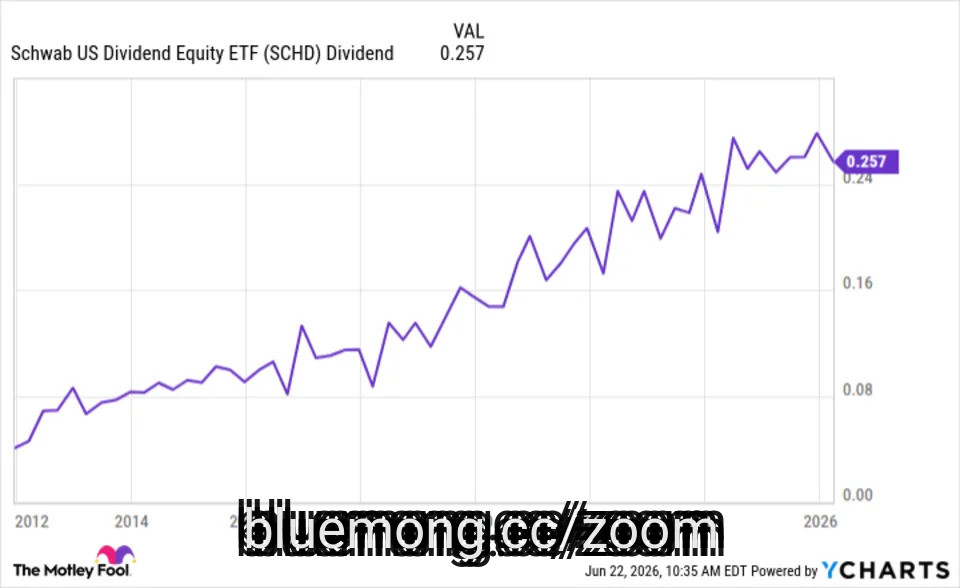
The fund holds about 100 high-quality, high-yielding dividend stocks. It has a roughly 3.3% current yield based on its dividend distributions over the last 12 months, which is about three times the S&P 500's yield. SCHD's holdings have increased their dividend by more than 9% annualized over the last five years. That dividend growth provides investors with a steadily rising income stream:
While Vanguard offers several income-focused funds, my favorite ETF is from another fund sponsor. Here's why I prefer the Schwab U.S. Dividend Equity ETF (NYSEMKT: SCHD) to Vanguard's dividend ETFs.
Missed Nvidia in 2009? This Rare Signal Is Flashing Again. In 2009, a "Double Down" signal flashed for a little-known chipmaker called Nvidia. For the first time in years, that same "Total Conviction" signal is flashing for a company 1/100th the size of Nvidia. Continue »
The Schwab U.S. Dividend Equity ETF has a straightforward investment strategy. It aims to track the Dow Jones U.S. Dividend 100 Index, which measures the performance of high-yielding U.S. dividend stocks with a consistent dividend record. It screens companies based on several dividend quality characteristics, including current yield, five-year dividend growth rate, and financial strength.
The fund holds about 100 high-quality, high-yielding dividend stocks. It has a roughly 3.3% current yield based on its dividend distributions over the last 12 months, which is about three times the S&P 500's yield. SCHD's holdings have increased their dividend by more than 9% annualized over the last five years. That dividend growth provides investors with a steadily rising income stream:

4 months ago
The Schwab U.S. Dividend Equity ETF (NYSEMKT: SCHD) has raised its annual dividend every year since its 2011 inception. That's 14 consecutive years of dividend growth, a feat that few dividend ETFs can match.
The other stats behind that streak are equally impressive:
Missed Nvidia in 2009? This Rare Signal Is Flashing Again. In 2009, a "Double Down" signal flashed for a little-known chipmaker called Nvidia. For the first time in years, that same "Total Conviction" signal is flashing for a company 1/100th the size of Nvidia. Continue »
10.4% annual dividend growth rate over the past decade
3.3% dividend yield
The other stats behind that streak are equally impressive:
Missed Nvidia in 2009? This Rare Signal Is Flashing Again. In 2009, a "Double Down" signal flashed for a little-known chipmaker called Nvidia. For the first time in years, that same "Total Conviction" signal is flashing for a company 1/100th the size of Nvidia. Continue »
10.4% annual dividend growth rate over the past decade
3.3% dividend yield
4 months ago
Holding $850,000 entirely in cash and CDs costs roughly $34,000 annually in forgone growth compared to a balanced 60/40 portfolio.
At 3% inflation, an all-cash portfolio loses half its purchasing power over 25 years, making conservative investing the real retirement risk.
Shifting 5% per quarter into dividend stocks like SCHD or a single 60/40 index fund builds equity exposure without triggering market-timing regret.
Are you ahead, or behind on retirement? SmartAsset's free tool can match you with a financial advisor in minutes to help you answer that today. Each advisor has been carefully vetted, and must act in your best interests. Don't waste another minute; learn more here.
The scenario looks like this: a 63-year-old has built up $850,000 over a working lifetime, watched 2022 and a few scary headlines since, and parked almost all of it in CDs, money market funds, and short Treasuries paying roughly 4%. That throws off about $34,000 a year in interest. It feels prudent. It is also quietly expensive.
At 3% inflation, an all-cash portfolio loses half its purchasing power over 25 years, making conservative investing the real retirement risk.
Shifting 5% per quarter into dividend stocks like SCHD or a single 60/40 index fund builds equity exposure without triggering market-timing regret.
Are you ahead, or behind on retirement? SmartAsset's free tool can match you with a financial advisor in minutes to help you answer that today. Each advisor has been carefully vetted, and must act in your best interests. Don't waste another minute; learn more here.
The scenario looks like this: a 63-year-old has built up $850,000 over a working lifetime, watched 2022 and a few scary headlines since, and parked almost all of it in CDs, money market funds, and short Treasuries paying roughly 4%. That throws off about $34,000 a year in interest. It feels prudent. It is also quietly expensive.


4 months ago
OMAH combines $805 million in Berkshire-style blue chips with covered calls to deliver a 15% annualized monthly distribution to income-focused retirees.
OMAH's 5% YTD gain beat Berkshire's 5% slide but trailed SCHD by 15 points, as covered calls capped upside in the blue-chip rally.
Act now: the ******* yst who called NVIDIA in 2010 just named his top 10 AI stocks — and OMAH didn't make the cut. Grab the names FREE today.
VistaShares Target 15 Berkshire Select Income ETF (NASDAQ:OMAH) targets a specific investor: the retiree who wants Warren Buffett's playbook without Berkshire's $300 billion-plus cash drag and needs monthly income. OMAH holds Berkshire-style blue chips (insurance, regulated utilities, consumer staples, financial franchises) and writes covered calls to aim at a 15.3% trailing distribution yield. With shares around $19 and ******* ets at roughly $805 million, OMAH has captured attention precisely because Berkshire (NYSE:BRK-B) has gone the other direction this year.
OMAH owns a concentrated basket of durable franchise equities that Buffett has historically favored, then sells call options against those holdings to harvest premium income, which is distributed monthly alongside underlying dividends. The fund's name ("Target 15") signals the goal: an annualized 15% distribution rate, paid monthly. A $250,000 stake at that target throws off roughly $37,500 a year in cash, though investors should pull the latest Form 19-A-1 notice to see how much is realized income versus a return of capital.
OMAH's 5% YTD gain beat Berkshire's 5% slide but trailed SCHD by 15 points, as covered calls capped upside in the blue-chip rally.
Act now: the ******* yst who called NVIDIA in 2010 just named his top 10 AI stocks — and OMAH didn't make the cut. Grab the names FREE today.
VistaShares Target 15 Berkshire Select Income ETF (NASDAQ:OMAH) targets a specific investor: the retiree who wants Warren Buffett's playbook without Berkshire's $300 billion-plus cash drag and needs monthly income. OMAH holds Berkshire-style blue chips (insurance, regulated utilities, consumer staples, financial franchises) and writes covered calls to aim at a 15.3% trailing distribution yield. With shares around $19 and ******* ets at roughly $805 million, OMAH has captured attention precisely because Berkshire (NYSE:BRK-B) has gone the other direction this year.
OMAH owns a concentrated basket of durable franchise equities that Buffett has historically favored, then sells call options against those holdings to harvest premium income, which is distributed monthly alongside underlying dividends. The fund's name ("Target 15") signals the goal: an annualized 15% distribution rate, paid monthly. A $250,000 stake at that target throws off roughly $37,500 a year in cash, though investors should pull the latest Form 19-A-1 notice to see how much is realized income versus a return of capital.
