
2 days ago
A pastor kicked off a recent campaign stop for Michael Whatley, the Republican nominee for Senate, with a prayer that asked God to bestow "integrity and honesty" upon the event and to right wrongs "hammered down on the conservative movement."
The prayer was hardly unusual by North Carolina political standards. What was surprising was the man who delivered it. Pastor Daimon L. King is a registered ***** offender, twice sentenced to prison for convictions involving children, according to state and court records.
The episode occurred with two months to go in a marquee Senate race that could help decide which party controls the chamber after the November elections. It risks undermining one of Whatley's central campaign arguments — that his Democratic opponent, former Gov. Roy Cooper, is soft on crime. And it could feed into an advertising blitz by Democrats that has targeted the Republican candidate's ***** ociation with another convicted ***** offender, a former GOP official.
King did not respond to messages seeking comment.
Whatley's campaign declined to make him available for an interview. In a statement, campaign spokesman DJ Griffin said Whatley did not know King and the event "was NOT planned nor organized by the Whatley campaign nor did the campaign invite any of the guests."
#king #prayer #Event
The prayer was hardly unusual by North Carolina political standards. What was surprising was the man who delivered it. Pastor Daimon L. King is a registered ***** offender, twice sentenced to prison for convictions involving children, according to state and court records.
The episode occurred with two months to go in a marquee Senate race that could help decide which party controls the chamber after the November elections. It risks undermining one of Whatley's central campaign arguments — that his Democratic opponent, former Gov. Roy Cooper, is soft on crime. And it could feed into an advertising blitz by Democrats that has targeted the Republican candidate's ***** ociation with another convicted ***** offender, a former GOP official.
King did not respond to messages seeking comment.
Whatley's campaign declined to make him available for an interview. In a statement, campaign spokesman DJ Griffin said Whatley did not know King and the event "was NOT planned nor organized by the Whatley campaign nor did the campaign invite any of the guests."
#king #prayer #Event



2 days ago
Prosper Stars & Stripes, a long/short equity fund, recently released its second-quarter 2026 investor letter. The letter can be downloaded here. In Q2 2026, the portfolio delivered a strong net return of +30.1% compared to the Russell 2000 Index's +21.5% return and the HFRX Equity Hedge Index's +10.3% return. The long book drove performance, generating a 43.2% gross contribution, while average net exposure remained relatively modest at 47%. U.S. economic growth remained resilient despite inflation concerns, elevated energy prices, and geopolitical uncertainty. Markets rallied sharply after easing U.S.-Iran tensions pushed oil prices lower, supporting renewed risk appetite. Small-cap equities benefited significantly, with Information Technology, Industrials, and Health Care leading gains, while Energy declined as crude prices fell. Year to date, the Composite returned +23.7%, slightly ahead of the Russell 2000's +22.6% and well above the HFRI Equity Hedge Index's +9.7%. Additionally, you can review the Portfolio's top 5 holdings to see its best picks for 2026.
In its second-quarter 2026 investor letter, Prosper Stars & Stripes highlighted TechTarget, Inc. (NASDAQ:TTGT) as the largest contributor to the portfolio's short book. TechTarget, Inc. (NASDAQ:TTGT) provides sales and support of purchase intent-driven advertising campaigns. On September 9, 2026, TechTarget, Inc. (NASDAQ:TTGT) closed at $3.89 per share. Over the past month, TechTarget, Inc. (NASDAQ:TTGT) returned 1.57% and its shares lost 35.17% over the past 52 weeks. TechTarget, Inc. (NASDAQ:TTGT) has a market capitalization of $281.37 million, and its stock has traded within a 52-week range of $3.37 to $7.15.
Prosper Stars & Stripes stated the following regarding TechTarget, Inc. (NASDAQ:TTGT) in its Q2 2026 investor letter:
"TechTarget, Inc. (NASDAQ:TTGT) was the largest contributor to our short book during the quarter. The company monetizes the purchase research behavior of enterprise IT buyers by operating a network of websites where buyers register to consume technical content, then selling those intent signals as leads to IT vendors. We first shorted the company after it completed a value-destroying acquisition in December 2024 that led to significant impairment charges in Q1 2025 and again in Q1 2026. We believe AI is likely to dismantle search-based discovery and commoditize content, the two pillars of TechTarget's value propositions. Results have validated our concerns, with management describing its market as mature, with 2% to 3% top-line growth, and EBITDA margins that peaked in 2022 falling to 7% in Q1 2026. Notably, revenue growth began deteriorating before ChatGPT launched in November 2022, suggesting that problems run deeper than AI alone. We continue to believe generative AI will weigh on TechTarget's prospects and remain short the company."
#techtarget #NASDAQ
In its second-quarter 2026 investor letter, Prosper Stars & Stripes highlighted TechTarget, Inc. (NASDAQ:TTGT) as the largest contributor to the portfolio's short book. TechTarget, Inc. (NASDAQ:TTGT) provides sales and support of purchase intent-driven advertising campaigns. On September 9, 2026, TechTarget, Inc. (NASDAQ:TTGT) closed at $3.89 per share. Over the past month, TechTarget, Inc. (NASDAQ:TTGT) returned 1.57% and its shares lost 35.17% over the past 52 weeks. TechTarget, Inc. (NASDAQ:TTGT) has a market capitalization of $281.37 million, and its stock has traded within a 52-week range of $3.37 to $7.15.
Prosper Stars & Stripes stated the following regarding TechTarget, Inc. (NASDAQ:TTGT) in its Q2 2026 investor letter:
"TechTarget, Inc. (NASDAQ:TTGT) was the largest contributor to our short book during the quarter. The company monetizes the purchase research behavior of enterprise IT buyers by operating a network of websites where buyers register to consume technical content, then selling those intent signals as leads to IT vendors. We first shorted the company after it completed a value-destroying acquisition in December 2024 that led to significant impairment charges in Q1 2025 and again in Q1 2026. We believe AI is likely to dismantle search-based discovery and commoditize content, the two pillars of TechTarget's value propositions. Results have validated our concerns, with management describing its market as mature, with 2% to 3% top-line growth, and EBITDA margins that peaked in 2022 falling to 7% in Q1 2026. Notably, revenue growth began deteriorating before ChatGPT launched in November 2022, suggesting that problems run deeper than AI alone. We continue to believe generative AI will weigh on TechTarget's prospects and remain short the company."
#techtarget #NASDAQ


3 days ago
Pinterest's CFO resignation and slowing Q3 guidance are repricing its 54x P/E multiple, sending PINS down 21% this month while RDDT falls just 2%.
SOCL and SPY are off just 1% and 0.4%, confirming Pinterest's selloff is company-specific rather than a broad social-advertising sector rotation.
Just released. Our ***** ysts combed the entire stock market and named the ten best stocks to buy right now, and Pinterest didn't make the cut. Enter your email to see the names that beat PINS. The report is free. Enter your email and see if any of your stocks made the cut.
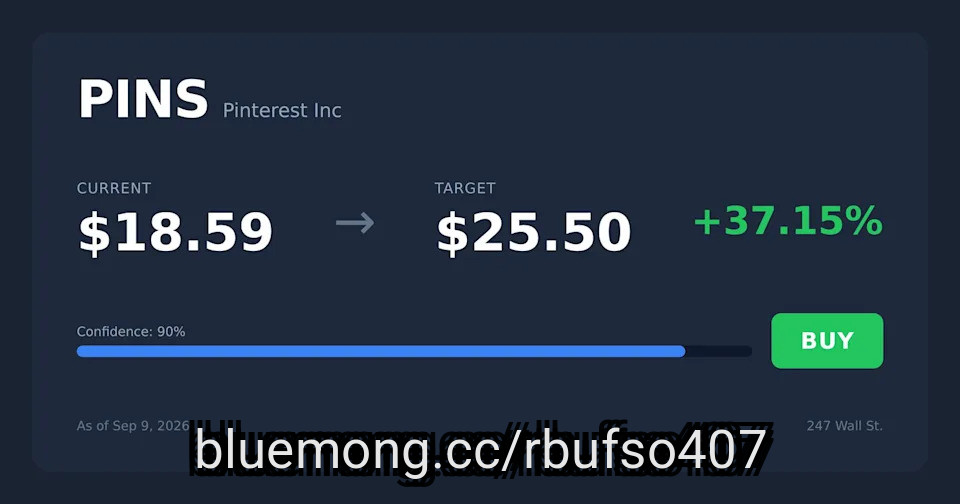
Pinterest (NYSE:PINS) stock is sliding again Wednesday afternoon, and the frustrating part for holders is that there's no fresh company headline attached to the move. Pinterest shares are down 8% to $18.59, extending a punishing stretch that has taken the stock down 21% over the past month and pushing it back near the average price where management ran its recent buyback program.
The social peers are softer but nowhere near as weak. Reddit (NYSE:RDDT) stock is down 2% to $147.04, and Snap (NYSE:SNAP) stock is off 1% to $5.36. Both names posted clean Q2 2026 beats earlier this summer, so today's fade for the peer group reflects a sentiment reset across advertising-driven names more than a fundamentals reaction.
#pinterest
SOCL and SPY are off just 1% and 0.4%, confirming Pinterest's selloff is company-specific rather than a broad social-advertising sector rotation.
Just released. Our ***** ysts combed the entire stock market and named the ten best stocks to buy right now, and Pinterest didn't make the cut. Enter your email to see the names that beat PINS. The report is free. Enter your email and see if any of your stocks made the cut.
Pinterest (NYSE:PINS) stock is sliding again Wednesday afternoon, and the frustrating part for holders is that there's no fresh company headline attached to the move. Pinterest shares are down 8% to $18.59, extending a punishing stretch that has taken the stock down 21% over the past month and pushing it back near the average price where management ran its recent buyback program.
The social peers are softer but nowhere near as weak. Reddit (NYSE:RDDT) stock is down 2% to $147.04, and Snap (NYSE:SNAP) stock is off 1% to $5.36. Both names posted clean Q2 2026 beats earlier this summer, so today's fade for the peer group reflects a sentiment reset across advertising-driven names more than a fundamentals reaction.


3 days ago
Crypto advocates and community bankers are taking their fight over the Clarity Act to senators' home states ahead of a key vote next week.
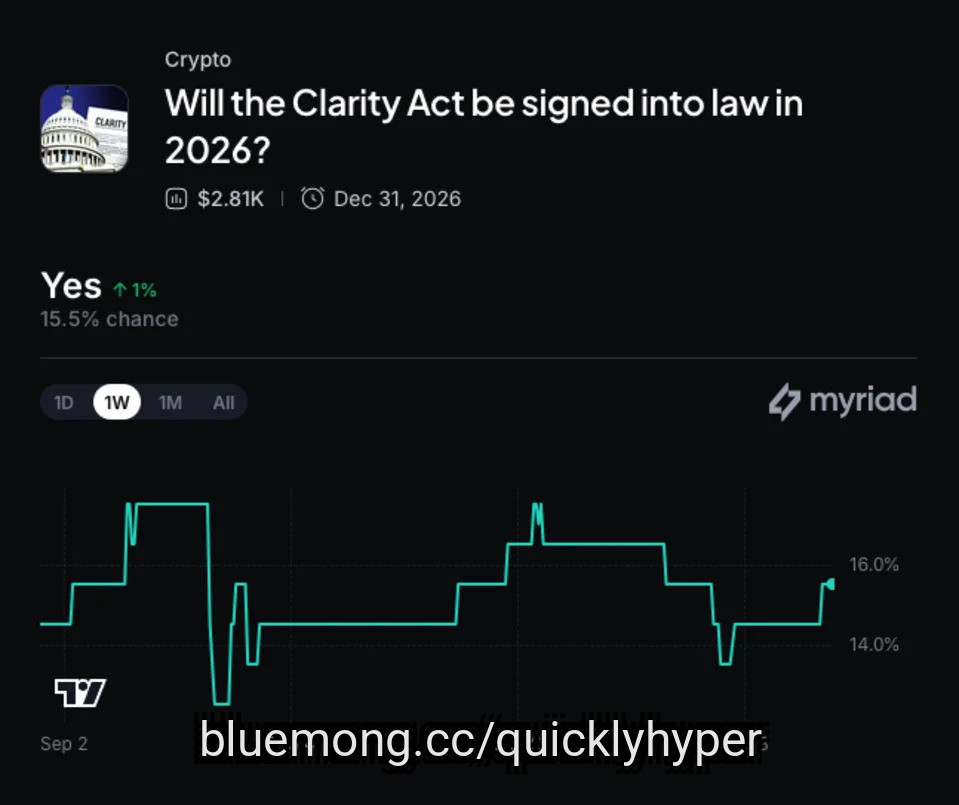
The Senate is scheduled to hold a procedural vote on the Clarity Act on September 15. The legislation would establish federal rules for digital ******* ets and divide oversight between the Securities and Exchange Commission and the Commodity Futures Trading Commission.
According to a report by Reuters, during the August recess, both sides targeted senators with meetings, local events, op-eds, calls, emails, and advertising.
Stand With Crypto, a Coinbase-backed advocacy group that says it has 3 million supporters, said members called or emailed Congress nearly 50,000 times in August while organizing events and placing pro-Clarity Act op-eds in local newspapers. In Georgia, chapter president Tia Williams met with staff for Democratic Senator Raphael Warnock, who voted against advancing the bill out of the Senate Banking Committee.
Crypto groups have already spent at least $190 million ahead of the November midterm elections.
#Crypto #august #ahead #vote
The Senate is scheduled to hold a procedural vote on the Clarity Act on September 15. The legislation would establish federal rules for digital ******* ets and divide oversight between the Securities and Exchange Commission and the Commodity Futures Trading Commission.
According to a report by Reuters, during the August recess, both sides targeted senators with meetings, local events, op-eds, calls, emails, and advertising.
Stand With Crypto, a Coinbase-backed advocacy group that says it has 3 million supporters, said members called or emailed Congress nearly 50,000 times in August while organizing events and placing pro-Clarity Act op-eds in local newspapers. In Georgia, chapter president Tia Williams met with staff for Democratic Senator Raphael Warnock, who voted against advancing the bill out of the Senate Banking Committee.
Crypto groups have already spent at least $190 million ahead of the November midterm elections.
#Crypto #august #ahead #vote

3 days ago
Our ****** ysts just identified a stock with the potential to be the next Nvidia. Tell us how you invest and we'll show you why it's our #1 pick. Tap here.
Management attributes the 25% revenue decline primarily to a technical 'algorithm dislocation' with its largest advertising partner, causing an audience drift that sharply increased customer acquisition costs (CPA) for IL MAKIAGE.
The company is prioritizing technical remediation over immediate growth for IL MAKIAGE, shifting resources toward intensive testing to retrain the ad algorithm rather than executing its planned product pipeline.
SpoiledChild is demonstrating operational resilience, on track for $350 million in 2026 revenue by maintaining strong unit economics and 12-month net revenue repeat rates exceeding 100% despite broader platform headwinds.
The launch of METHODIQ signals a strategic pivot toward the 'beauty and medicine' convergence, leveraging computer vision and ODDITY Labs' patented molecules to capture higher-intent medical-grade customers.
#tell #management
Management attributes the 25% revenue decline primarily to a technical 'algorithm dislocation' with its largest advertising partner, causing an audience drift that sharply increased customer acquisition costs (CPA) for IL MAKIAGE.
The company is prioritizing technical remediation over immediate growth for IL MAKIAGE, shifting resources toward intensive testing to retrain the ad algorithm rather than executing its planned product pipeline.
SpoiledChild is demonstrating operational resilience, on track for $350 million in 2026 revenue by maintaining strong unit economics and 12-month net revenue repeat rates exceeding 100% despite broader platform headwinds.
The launch of METHODIQ signals a strategic pivot toward the 'beauty and medicine' convergence, leveraging computer vision and ODDITY Labs' patented molecules to capture higher-intent medical-grade customers.
#tell #management

3 days ago
I have spent much of this week watching Australian coverage of the NFL and scrolling through social media posts as the 49ers and Rams prepare to play the first regular-season game in Australia. The coverage has been entertaining, enthusiastic and occasionally educational. There have been explanations of the rules, breakdowns of the equipment and attempts to introduce American football to a country that already has a sport called football.
The Aussies are excited. Nearly 100,000 people are expected to fill the Melbourne Cricket Ground. Moreover, the NFL has taken over the city. The Jonas Brothers will perform at halftime, and Tourism Australia has built an advertising campaign around the game featuring wildlife conservationist and television personality Robert Irwin. He's the son of the late "Crocodile Hunter" Steve Irwin. In addition, Netflix will distribute the game globally.
It should be a spectacular event. I'm just not convinced it proves football has become a global sport.
This season, the NFL is staging nine regular-season games in seven countries outside the United States. That represents an extraordinary expansion from the occasional London game of the past. The league is no longer simply testing international markets. Moreover, overseas games have become an important part of its schedule, television strategy and marketing machine.
However, more games in more countries don't automatically mean football has developed deep roots in those places.
#sport
The Aussies are excited. Nearly 100,000 people are expected to fill the Melbourne Cricket Ground. Moreover, the NFL has taken over the city. The Jonas Brothers will perform at halftime, and Tourism Australia has built an advertising campaign around the game featuring wildlife conservationist and television personality Robert Irwin. He's the son of the late "Crocodile Hunter" Steve Irwin. In addition, Netflix will distribute the game globally.
It should be a spectacular event. I'm just not convinced it proves football has become a global sport.
This season, the NFL is staging nine regular-season games in seven countries outside the United States. That represents an extraordinary expansion from the occasional London game of the past. The league is no longer simply testing international markets. Moreover, overseas games have become an important part of its schedule, television strategy and marketing machine.
However, more games in more countries don't automatically mean football has developed deep roots in those places.
#sport


5 days ago
Baidu announced on September 4 that its Hong Kong Class A shares are now included in both the Shanghai-Hong Kong and Shenzhen-Hong Kong Stock Connect programs, effective September 7.. The change gives eligible mainland investors direct access to the Hong Kong listing, potentially widening liquidity and the shareholder base. It does not alter the operating competition between Baidu, Inc. (NASDAQ:BIDU) and Alibaba Group Holding Limited (NYSE:BABA), which are pursuing AI through different mixes of models, cloud infrastructure, chips, and consumer distribution.
Baidu's bull case combines search traffic, its Ernie ecosystem, cloud services, and Kunlunxin chips. Stock Connect can make that story easier for mainland investors to own, while its dual-primary Hong Kong listing broadens access. The bear case is that improved trading access does not repair weak advertising, guarantee cloud share, or remove geopolitical and regulatory risk. The catalyst affects liquidity more directly than earnings.
Insider Monkey counted 49 hedge funds holding Baidu, Inc. (NASDAQ:BIDU) at June 30, down from 50 at March 31. David Tepper's Appaloosa Management disclosed 1,295,000 shares, 87% more than in Q1. That increase shows one manager's conviction, not a broad rise in fund participation.
Alibaba's June-quarter AI Cloud and Compute Services revenue reached $7.1 billion, up 45% year over year, while segment adjusted EBITA rose 133% to $830 million. Its bull case is a full stack spanning Qwen models, cloud, proprietary chips, and commerce distribution. The bear case is capital intensity, fierce domestic competition, exposure to consumer spending, and the possibility that fast AI growth remains too small to transform the larger group's valuation.
Ninety-seven hedge funds held Alibaba Group Holding Limited (NYSE:BABA) in Q2, down from 102 in Q1. Ken Fisher's Fisher **** et Management disclosed 5,096,418 shares after trimming the position by 0.5%.
#kong #holding
Baidu's bull case combines search traffic, its Ernie ecosystem, cloud services, and Kunlunxin chips. Stock Connect can make that story easier for mainland investors to own, while its dual-primary Hong Kong listing broadens access. The bear case is that improved trading access does not repair weak advertising, guarantee cloud share, or remove geopolitical and regulatory risk. The catalyst affects liquidity more directly than earnings.
Insider Monkey counted 49 hedge funds holding Baidu, Inc. (NASDAQ:BIDU) at June 30, down from 50 at March 31. David Tepper's Appaloosa Management disclosed 1,295,000 shares, 87% more than in Q1. That increase shows one manager's conviction, not a broad rise in fund participation.
Alibaba's June-quarter AI Cloud and Compute Services revenue reached $7.1 billion, up 45% year over year, while segment adjusted EBITA rose 133% to $830 million. Its bull case is a full stack spanning Qwen models, cloud, proprietary chips, and commerce distribution. The bear case is capital intensity, fierce domestic competition, exposure to consumer spending, and the possibility that fast AI growth remains too small to transform the larger group's valuation.
Ninety-seven hedge funds held Alibaba Group Holding Limited (NYSE:BABA) in Q2, down from 102 in Q1. Ken Fisher's Fisher **** et Management disclosed 5,096,418 shares after trimming the position by 0.5%.
#kong #holding


6 days ago
Alphabet (GOOGL) is the parent company of Google and one of the world's largest technology conglomerates. Headquartered in Mountain View, California, Alphabet operates through three primary segments: Google Services, encompassing Search, YouTube, Android, and Chrome; Google Cloud, its rapidly scaling enterprise infrastructure business; and Other Bets, which includes the Waymo autonomous vehicle unit.
Under CEO Sundar Pichai, Alphabet has aggressively expanded its artificial intelligence (AI) capabilities through Gemini models, custom Tensor Processing Units (TPUs), and AI-powered search features, positioning itself at the forefront of the generative AI race. With dominant digital advertising market share and accelerating cloud growth, the company remains a global technology bellwether.
How to Play SNPS Stock as Layoffs Hit Synopsys
Micron Stock More Than Tripled in 2026. Now Taiwan Strike Threat Could Shake the AI Boom.
Dear Adobe Stock Fans, Mark Your Calendars for September 10
#alphabet #technology #googl
Under CEO Sundar Pichai, Alphabet has aggressively expanded its artificial intelligence (AI) capabilities through Gemini models, custom Tensor Processing Units (TPUs), and AI-powered search features, positioning itself at the forefront of the generative AI race. With dominant digital advertising market share and accelerating cloud growth, the company remains a global technology bellwether.
How to Play SNPS Stock as Layoffs Hit Synopsys
Micron Stock More Than Tripled in 2026. Now Taiwan Strike Threat Could Shake the AI Boom.
Dear Adobe Stock Fans, Mark Your Calendars for September 10
#alphabet #technology #googl



7 days ago
Baidu announced on September 4 that its Hong Kong Class A shares are now included in both the Shanghai-Hong Kong and Shenzhen-Hong Kong Stock Connect programs, effective September 7.. The change gives eligible mainland investors direct access to the Hong Kong listing, potentially widening liquidity and the shareholder base. It does not alter the operating competition between Baidu, Inc. (NASDAQ:BIDU) and Alibaba Group Holding Limited (NYSE:BABA), which are pursuing AI through different mixes of models, cloud infrastructure, chips, and consumer distribution.
Baidu's bull case combines search traffic, its Ernie ecosystem, cloud services, and Kunlunxin chips. Stock Connect can make that story easier for mainland investors to own, while its dual-primary Hong Kong listing broadens access. The bear case is that improved trading access does not repair weak advertising, guarantee cloud share, or remove geopolitical and regulatory risk. The catalyst affects liquidity more directly than earnings.
Insider Monkey counted 49 hedge funds holding Baidu, Inc. (NASDAQ:BIDU) at June 30, down from 50 at March 31. David Tepper's Appaloosa Management disclosed 1,295,000 shares, 87% more than in Q1. That increase shows one manager's conviction, not a broad rise in fund participation.
Alibaba's June-quarter AI Cloud and Compute Services revenue reached $7.1 billion, up 45% year over year, while segment adjusted EBITA rose 133% to $830 million. Its bull case is a full stack spanning Qwen models, cloud, proprietary chips, and commerce distribution. The bear case is capital intensity, fierce domestic competition, exposure to consumer spending, and the possibility that fast AI growth remains too small to transform the larger group's valuation.
Ninety-seven hedge funds held Alibaba Group Holding Limited (NYSE:BABA) in Q2, down from 102 in Q1. Ken Fisher's Fisher **** et Management disclosed 5,096,418 shares after trimming the position by 0.5%.
#kong #cloud
Baidu's bull case combines search traffic, its Ernie ecosystem, cloud services, and Kunlunxin chips. Stock Connect can make that story easier for mainland investors to own, while its dual-primary Hong Kong listing broadens access. The bear case is that improved trading access does not repair weak advertising, guarantee cloud share, or remove geopolitical and regulatory risk. The catalyst affects liquidity more directly than earnings.
Insider Monkey counted 49 hedge funds holding Baidu, Inc. (NASDAQ:BIDU) at June 30, down from 50 at March 31. David Tepper's Appaloosa Management disclosed 1,295,000 shares, 87% more than in Q1. That increase shows one manager's conviction, not a broad rise in fund participation.
Alibaba's June-quarter AI Cloud and Compute Services revenue reached $7.1 billion, up 45% year over year, while segment adjusted EBITA rose 133% to $830 million. Its bull case is a full stack spanning Qwen models, cloud, proprietary chips, and commerce distribution. The bear case is capital intensity, fierce domestic competition, exposure to consumer spending, and the possibility that fast AI growth remains too small to transform the larger group's valuation.
Ninety-seven hedge funds held Alibaba Group Holding Limited (NYSE:BABA) in Q2, down from 102 in Q1. Ken Fisher's Fisher **** et Management disclosed 5,096,418 shares after trimming the position by 0.5%.
#kong #cloud

8 days ago
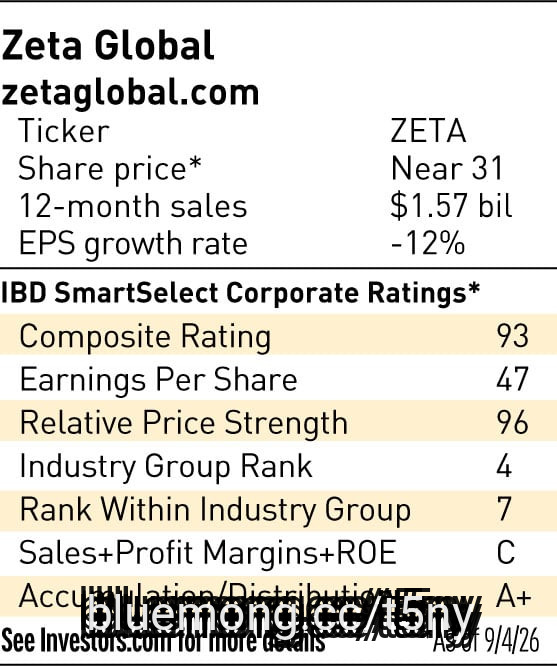
Chief Executive David Steinberg cracked some XL-sized eggs before hatching Zeta Global (ZETA) and building it up into a soaring and swooping AI marketing stock. Just this year, Zeta shares have climbed more than 50%.
His prior company, InPhonic, drew condemnation from a Better Business Bureau chief executive, prized growth over profits, faced regulatory charges and landed in bankruptcy court. After it delisted, it seems the serial founder was ***** -bent on constructing its foil.
That's Zeta. Early on, it was apparently so bottom-line focused that venture capitalists deemed it "too profitable" to invest. Steinberg and his partners initially self-funded it.
Zeta is now a rising marketing and advertising platform — with partners such as Palantir (PLTR) and OpenAI, and an AI bot named after a Greek goddess.
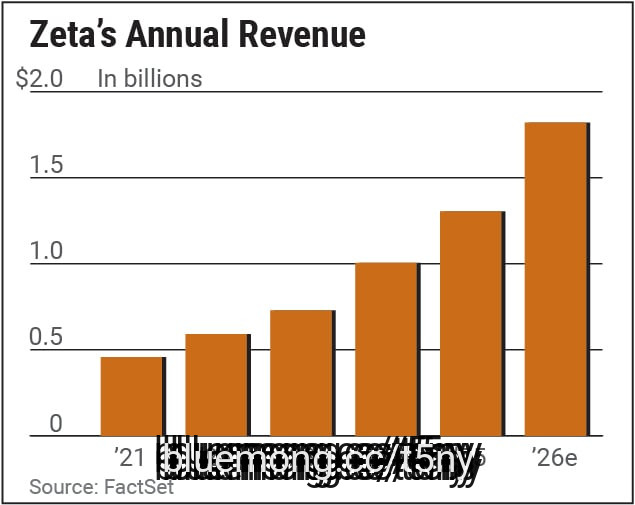
Wall Street expects Zeta's revenue growth to accelerate. After rising an average of 30.3% over the past three years, ***** ysts see 39% growth this year, to $1.82 billion, per FactSet. They also anticipate rising quarterly profits, including $12.5 million in the third quarter and $22.4 million in the fourth, with a dip attributable to seasonality the following quarter.
#partners
His prior company, InPhonic, drew condemnation from a Better Business Bureau chief executive, prized growth over profits, faced regulatory charges and landed in bankruptcy court. After it delisted, it seems the serial founder was ***** -bent on constructing its foil.
That's Zeta. Early on, it was apparently so bottom-line focused that venture capitalists deemed it "too profitable" to invest. Steinberg and his partners initially self-funded it.
Zeta is now a rising marketing and advertising platform — with partners such as Palantir (PLTR) and OpenAI, and an AI bot named after a Greek goddess.
Wall Street expects Zeta's revenue growth to accelerate. After rising an average of 30.3% over the past three years, ***** ysts see 39% growth this year, to $1.82 billion, per FactSet. They also anticipate rising quarterly profits, including $12.5 million in the third quarter and $22.4 million in the fourth, with a dip attributable to seasonality the following quarter.
#partners


8 days ago
Gabelli Investment Management Firm recently released its "Global Content & Connectivity Fund" second-quarter 2026 investor letter. A copy of the letter can be downloaded here. The Fund delivered a strong second quarter of 2026, with its Class I shares gaining 12.88%, more than double the 6.02% return of the MSCI AC World Communication Services Index, though trailing the broader MSCI AC World Index's 15.06% gain. The fund's performance reflected renewed investor interest in AI-related investments, easing tensions in the Middle East, and lower Brent crude prices, with Information Technology gaining 39.2% and Communication Services advancing 6.0% during the quarter. Over the past year, the fund gained 25.50%, compared with 13.06% for its communication-services benchmark and 24.16% for the MSCI AC World Index. Looking ahead, Gabelli remains constructive on the long-term opportunities created by AI adoption, expanding digital infrastructure, connectivity, and the continued growth of content and entertainment, while recognizing that higher interest rates, geopolitical tensions, and the sustainability of AI-related spending could create volatility. In addition, please check the Fund's top five holdings to know its best picks in 2026.
In its second-quarter 2026 investor letter, Global Content & Connectivity Fund highlighted stocks like T-Mobile US Inc. (NASDAQ:TMUS). T-Mobile US Inc. (NASDAQ:TMUS) is a major U.S. wireless operator expanding across broadband, 5G, advertising, financial services, and emerging technology markets. The one-month return of T-Mobile US Inc. (NASDAQ:TMUS) was 1.86% while its shares traded between $165.66 and $247.25 over the last 52 weeks. On September 3, 2026, T-Mobile US Inc. (NASDAQ:TMUS) stock closed at approximately $188.02 per share, with a market capitalization of about $194.71 billion.
Global Content & Connectivity Fund stated the following regarding T-Mobile US Inc. (NASDAQ:TMUS) in its Q2 2026 investor letter:
T-Mobile US Inc. (NASDAQ:TMUS) (4.5%) (TMUS – $167.73 – NASDAQ) is the second-largest wireless operator in the U.S., serving over 142 million branded customers. In February 2026, the company hosted a Capital Markets Day, where it increased its 2027 targets for service revenue, EBITDA, and free cash flow. Management expects meaningful incremental growth over the next few years, driven by (a) continued share gains across various market segments, (b) growth of the broadband business, and (c) leveraging the firm's scale and its 5G Advanced network to expand into new growth areas (including advertising, financial services, and long-term opportunities in edge and physical AI).
#NASDAQ #global
In its second-quarter 2026 investor letter, Global Content & Connectivity Fund highlighted stocks like T-Mobile US Inc. (NASDAQ:TMUS). T-Mobile US Inc. (NASDAQ:TMUS) is a major U.S. wireless operator expanding across broadband, 5G, advertising, financial services, and emerging technology markets. The one-month return of T-Mobile US Inc. (NASDAQ:TMUS) was 1.86% while its shares traded between $165.66 and $247.25 over the last 52 weeks. On September 3, 2026, T-Mobile US Inc. (NASDAQ:TMUS) stock closed at approximately $188.02 per share, with a market capitalization of about $194.71 billion.
Global Content & Connectivity Fund stated the following regarding T-Mobile US Inc. (NASDAQ:TMUS) in its Q2 2026 investor letter:
T-Mobile US Inc. (NASDAQ:TMUS) (4.5%) (TMUS – $167.73 – NASDAQ) is the second-largest wireless operator in the U.S., serving over 142 million branded customers. In February 2026, the company hosted a Capital Markets Day, where it increased its 2027 targets for service revenue, EBITDA, and free cash flow. Management expects meaningful incremental growth over the next few years, driven by (a) continued share gains across various market segments, (b) growth of the broadband business, and (c) leveraging the firm's scale and its 5G Advanced network to expand into new growth areas (including advertising, financial services, and long-term opportunities in edge and physical AI).
#NASDAQ #global

8 days ago
On August 6, Versant Media Group (NASDAQ:VSNT) reported second-quarter 2026 results that capture a company in transition. Revenue slipped 3.8% year over year to $1.64 billion, and net income attributable to Versant tumbled 30.1% to $211 million. Yet the same report included a raised full-year outlook, a third straight quarterly dividend, and a second $100 million stock buyback. For a company barely eight months removed from its separation from Comcast on January 2, the numbers tell two stories at once.
Versant's headline Adjusted EBITDA fell 8.9% to $624 million, but measured against the prior year's Standalone Adjusted EBITDA, the more relevant apples-to-apples baseline, EBITDA actually grew 3.0%. That gap matters because it shows the company trimming programming and overhead costs faster than legacy revenue is shrinking. Management leaned into that momentum by raising full-year revenue guidance to $6.2 billion to $6.45 billion and Adjusted EBITDA guidance to $1.9 billion to $2.05 billion, while holding free cash flow guidance at $1.0 billion to $1.2 billion.
The growth story lives outside the traditional cable bundle. Platforms revenue, excluding the divested SportsEngine business, climbed 9.3% on the strength of Fandango and GolfNow, and Versant used the quarter to lock in two multi-year distribution renewals with major partners in the US and Canada. Sports rights remain the anchor: PGA TOUR coverage delivered its best second quarter since 2020, USA Network's WNBA broadcasts drew three of the quarter's most watched games across cable and streaming, and a new five-year Bundesliga deal adds more than 300 live matches a year, with at least 30 landing on USA Network. MS NOW backed that up digitally, posting audience growth for a seventh straight month through June and racking up close to 3 billion YouTube and TikTok views so far this year. Layer in the Full Swing acquisition completed after quarter-end, and Versant is placing real bets beyond linear television.
The pressure driving those buybacks and that raised guidance is real. Total revenue fell 3.8% to $1.64 billion, or 2.8% excluding SportsEngine, and linear distribution revenue, still the largest piece of the business, dropped 6.3% as subscribers kept leaving traditional pay TV. Rate increases only partly offset that erosion, and advertising revenue slipped another 0.6% even with better ratings and a boost from a recent acquisition.
The bottom line felt it more than the top line. Net income attributable to Versant fell $91 million to $211 million, and the company pointed to higher costs of running as a standalone public company, new interest expense tied to debt taken on after leaving Comcast, and a bigger tax bill linked to the SportsEngine sale. Those are the direct costs of standing alone rather than sitting inside a larger conglomerate. Versant's prior year financial statements were also built from Comcast's carve out accounting rather than results as a true independent company, so s
Versant's headline Adjusted EBITDA fell 8.9% to $624 million, but measured against the prior year's Standalone Adjusted EBITDA, the more relevant apples-to-apples baseline, EBITDA actually grew 3.0%. That gap matters because it shows the company trimming programming and overhead costs faster than legacy revenue is shrinking. Management leaned into that momentum by raising full-year revenue guidance to $6.2 billion to $6.45 billion and Adjusted EBITDA guidance to $1.9 billion to $2.05 billion, while holding free cash flow guidance at $1.0 billion to $1.2 billion.
The growth story lives outside the traditional cable bundle. Platforms revenue, excluding the divested SportsEngine business, climbed 9.3% on the strength of Fandango and GolfNow, and Versant used the quarter to lock in two multi-year distribution renewals with major partners in the US and Canada. Sports rights remain the anchor: PGA TOUR coverage delivered its best second quarter since 2020, USA Network's WNBA broadcasts drew three of the quarter's most watched games across cable and streaming, and a new five-year Bundesliga deal adds more than 300 live matches a year, with at least 30 landing on USA Network. MS NOW backed that up digitally, posting audience growth for a seventh straight month through June and racking up close to 3 billion YouTube and TikTok views so far this year. Layer in the Full Swing acquisition completed after quarter-end, and Versant is placing real bets beyond linear television.
The pressure driving those buybacks and that raised guidance is real. Total revenue fell 3.8% to $1.64 billion, or 2.8% excluding SportsEngine, and linear distribution revenue, still the largest piece of the business, dropped 6.3% as subscribers kept leaving traditional pay TV. Rate increases only partly offset that erosion, and advertising revenue slipped another 0.6% even with better ratings and a boost from a recent acquisition.
The bottom line felt it more than the top line. Net income attributable to Versant fell $91 million to $211 million, and the company pointed to higher costs of running as a standalone public company, new interest expense tied to debt taken on after leaving Comcast, and a bigger tax bill linked to the SportsEngine sale. Those are the direct costs of standing alone rather than sitting inside a larger conglomerate. Versant's prior year financial statements were also built from Comcast's carve out accounting rather than results as a true independent company, so s


9 days ago
Google's Arkansas data-center buildout is providing a rare look at the price of AI electricity. Documents reported on September 1 show Alphabet Inc. (NASDAQ:GOOGL) agreeing to pay $526 million toward the Cypress Solar project and another $190 million for transmission upgrades. Those commitments benefit Entergy Corporation (NYSE:ETR), the regulated utility responsible for turning Google's computing ambitions into reliable power. The arrangements also reveal why electricity, not chips, may become the next constraint on AI growth.
Photo from Entergy website
Cypress is expected to pair 600 megawatts of solar generation with 350 megawatts of battery storage and cost about $1.6 billion. For Entergy Corporation (NYSE:ETR), a large customer helping fund generation and grid work can expand its rate base while reducing the burden on existing customers. The bull case is that data centers create years of visible load growth, supporting capital investment and earnings without forcing the utility to speculate on which AI model wins.
The bear case sits inside that same promise: huge projects can face construction delays, cost overruns, regulatory scrutiny, and uncertainty over how much demand ultimately materializes. Utilities must build for peak reliability, not optimistic averages. If Google's consumption projections prove too high or technology becomes more efficient, Entergy could be left defending expensive infrastructure. Alphabet Inc. (NASDAQ:GOOGL), meanwhile, is absorbing a major power bill before the ***** ociated AI revenue is guaranteed.
Alphabet's advantage is that it can spread infrastructure costs across search, cloud, advertising, and internal AI products. Google Cloud's rapid growth suggests demand is real, and direct participation in power projects may secure capacity rivals cannot easily obtain. Yet the commitment also makes the economics of AI more capital intensive. Every dollar devoted to generation and transmission raises the hurdle for returns, while electricity contracts can lock a hyperscaler into long-lived obligations.
#entergy #electricity #Growth #corporation
Photo from Entergy website
Cypress is expected to pair 600 megawatts of solar generation with 350 megawatts of battery storage and cost about $1.6 billion. For Entergy Corporation (NYSE:ETR), a large customer helping fund generation and grid work can expand its rate base while reducing the burden on existing customers. The bull case is that data centers create years of visible load growth, supporting capital investment and earnings without forcing the utility to speculate on which AI model wins.
The bear case sits inside that same promise: huge projects can face construction delays, cost overruns, regulatory scrutiny, and uncertainty over how much demand ultimately materializes. Utilities must build for peak reliability, not optimistic averages. If Google's consumption projections prove too high or technology becomes more efficient, Entergy could be left defending expensive infrastructure. Alphabet Inc. (NASDAQ:GOOGL), meanwhile, is absorbing a major power bill before the ***** ociated AI revenue is guaranteed.
Alphabet's advantage is that it can spread infrastructure costs across search, cloud, advertising, and internal AI products. Google Cloud's rapid growth suggests demand is real, and direct participation in power projects may secure capacity rivals cannot easily obtain. Yet the commitment also makes the economics of AI more capital intensive. Every dollar devoted to generation and transmission raises the hurdle for returns, while electricity contracts can lock a hyperscaler into long-lived obligations.
#entergy #electricity #Growth #corporation

9 days ago
AppLovin Corporation (APP) builds a software-based platform for advertisers to enhance the marketing and monetization of their content. Valued at $106.8 billion by market cap, the company provides end-to-end software and AI solutions for businesses to reach, monetize, and grow their global audiences.
Companies worth $10 billion or more are generally described as "large-cap stocks," and APP definitely fits that description, with its market cap exceeding this threshold, reflecting its substantial size, influence, and dominance in the advertising agencies industry. AppLovin's competitive advantage stems from its vertically integrated platform, combining app discovery, monetization, and ****** ytics. The company has a solid financial foundation for investments and acquisitions. Its innovation in AI-driven marketing and agile, data-driven culture enable it to stay ahead in the mobile app ecosystem. Focused on the high-growth mobile gaming market, AppLovin's strategic positioning and integrated platform drive its success.
Nvidia CEO Jensen Huang Says His $3.5 Billion MediaTek Deal Is 'Not Circular' Because 'They Do Their Own Business'
Strategy's Strategy Appears to Have Failed, and the Outlook of MSTR Stock Is Unfavorable
A Potential ****** eX Deal Could Meaningfully Accelerate Growth for Technip Stock
#billion #Stock #software #company
Companies worth $10 billion or more are generally described as "large-cap stocks," and APP definitely fits that description, with its market cap exceeding this threshold, reflecting its substantial size, influence, and dominance in the advertising agencies industry. AppLovin's competitive advantage stems from its vertically integrated platform, combining app discovery, monetization, and ****** ytics. The company has a solid financial foundation for investments and acquisitions. Its innovation in AI-driven marketing and agile, data-driven culture enable it to stay ahead in the mobile app ecosystem. Focused on the high-growth mobile gaming market, AppLovin's strategic positioning and integrated platform drive its success.
Nvidia CEO Jensen Huang Says His $3.5 Billion MediaTek Deal Is 'Not Circular' Because 'They Do Their Own Business'
Strategy's Strategy Appears to Have Failed, and the Outlook of MSTR Stock Is Unfavorable
A Potential ****** eX Deal Could Meaningfully Accelerate Growth for Technip Stock
#billion #Stock #software #company



9 days ago
Microsoft announced a new financial reporting structure on Wednesday, collapsing its three operating segments into two as artificial intelligence reshapes how the company organizes its business. The change takes effect in fiscal year 2027.
The two new segments are Agents and Infra, and Devices and Consumer. Those three categories — Productivity and Business Processes, Intelligent Cloud, and More Personal Computing — dated to 2015, according to CNBC.
Agents and Infra will include Azure cloud infrastructure, Microsoft 365, GitHub, productivity and server licensing, industry solutions, and frontier and support services. Devices and Consumer will cover search and advertising, Xbox, Windows operating system licenses, and device sales. The restructuring brings Microsoft's advertising businesses together under one segment, the company said.
"There's no question AI represents a profound shift in both technology and business," Chairman and Chief Executive Officer Satya Nadella wrote in the presentation. "It is changing what we build and how we operate, and it is blurring the boundaries between our products and reshaping our business models."
As part of the changes, Microsoft will begin reporting quarterly Azure revenue figures — a disclosure it has not previously made. Under the new, narrower definition of Azure, which excludes GitHub cloud services, developer cloud services, the Security Copilot **** istant, and healthcare and life sciences cloud products, Azure revenue grew 42% to $29.42 billion in the June quarter. That compares with 43% growth under the old Azure and other cloud services metric. Azure represented roughly 33% of Microsoft's total revenue in that period.
#Services #agents
The two new segments are Agents and Infra, and Devices and Consumer. Those three categories — Productivity and Business Processes, Intelligent Cloud, and More Personal Computing — dated to 2015, according to CNBC.
Agents and Infra will include Azure cloud infrastructure, Microsoft 365, GitHub, productivity and server licensing, industry solutions, and frontier and support services. Devices and Consumer will cover search and advertising, Xbox, Windows operating system licenses, and device sales. The restructuring brings Microsoft's advertising businesses together under one segment, the company said.
"There's no question AI represents a profound shift in both technology and business," Chairman and Chief Executive Officer Satya Nadella wrote in the presentation. "It is changing what we build and how we operate, and it is blurring the boundaries between our products and reshaping our business models."
As part of the changes, Microsoft will begin reporting quarterly Azure revenue figures — a disclosure it has not previously made. Under the new, narrower definition of Azure, which excludes GitHub cloud services, developer cloud services, the Security Copilot **** istant, and healthcare and life sciences cloud products, Azure revenue grew 42% to $29.42 billion in the June quarter. That compares with 43% growth under the old Azure and other cloud services metric. Azure represented roughly 33% of Microsoft's total revenue in that period.
#Services #agents

9 days ago
On August 5, LiveRamp (NYSE:RAMP) reported first-quarter fiscal 2027 results for the period ended June 30, and the numbers looked less like a company coasting toward a sale than one hitting its stride. Revenue rose 10% to $214 million, but the more striking move was further down the income statement, where operating income more than doubled. LiveRamp skipped its usual earnings call this quarter, a direct result of its pending acquisition by Publicis Groupe, but that silence has not slowed the underlying business.
GAAP operating income jumped to $20 million from $7 million a year earlier, pushing operating margin up six points to 9%. Non-GAAP operating income rose 41% to $50 million, with margin expanding five points to 24%, meaning more of every new revenue dollar is dropping to profit rather than being spent to chase it. Diluted earnings per share more than doubled on a GAAP basis to $0.28 from $0.12, while operating cash flow flipped from a $16 million outflow a year ago to $17 million generated this quarter.
LiveRamp is also positioning itself inside the AI advertising buildout rather than at its edges. The company launched LiveRamp Agent Builders, a program pulling outside AI agents into its network for planning and measurement work, and added integrations tied to OpenAI's advertising tools, Databricks' new Agentic Customer Data Platform, and Adobe's commerce content pipeline, alongside a measurement partnership with DoorDash. None of that shows up in a revenue line yet, but customer behavior already reflects some payoff. LiveRamp ended the quarter with 132 customers paying more than $1 million a year, up from 127, and subscription net retention held at 103%. Annualized recurring revenue grew 7% to $539 million, and Data Marketplace revenue climbed 13% to $40 million.
None of that operational improvement changes the number shareholders actually care about: $38.50 a share, the all-cash price Publicis Groupe agreed to pay when the deal was announced on May 17, 2026. However much operating income grows from here, the merger agreement fixes what LiveRamp holders collect if the transaction closes, so this quarter's beat does not translate into upside for anyone holding the stock for the buyout. LiveRamp also confirmed it will not hold a conference call or issue guidance while the deal is pending, which limits how much investors can independently verify beyond what is in this release.
The transaction still has to clear a shareholder vote scheduled for August 17, and closing remains subject to customary conditions even though management called it on track for before the end of calendar 2026. That leaves a few weeks of real, if narrow, uncertainty. The growth numbers are also decelerating slightly at the edges: total revenue grew 10% this quarter versus 11% in the prior year period, and subscription revenue growth slowed to 8% from 10%. Marketplace and Other revenue, the more variable, usage-driven part of the business, is doing more of the work
GAAP operating income jumped to $20 million from $7 million a year earlier, pushing operating margin up six points to 9%. Non-GAAP operating income rose 41% to $50 million, with margin expanding five points to 24%, meaning more of every new revenue dollar is dropping to profit rather than being spent to chase it. Diluted earnings per share more than doubled on a GAAP basis to $0.28 from $0.12, while operating cash flow flipped from a $16 million outflow a year ago to $17 million generated this quarter.
LiveRamp is also positioning itself inside the AI advertising buildout rather than at its edges. The company launched LiveRamp Agent Builders, a program pulling outside AI agents into its network for planning and measurement work, and added integrations tied to OpenAI's advertising tools, Databricks' new Agentic Customer Data Platform, and Adobe's commerce content pipeline, alongside a measurement partnership with DoorDash. None of that shows up in a revenue line yet, but customer behavior already reflects some payoff. LiveRamp ended the quarter with 132 customers paying more than $1 million a year, up from 127, and subscription net retention held at 103%. Annualized recurring revenue grew 7% to $539 million, and Data Marketplace revenue climbed 13% to $40 million.
None of that operational improvement changes the number shareholders actually care about: $38.50 a share, the all-cash price Publicis Groupe agreed to pay when the deal was announced on May 17, 2026. However much operating income grows from here, the merger agreement fixes what LiveRamp holders collect if the transaction closes, so this quarter's beat does not translate into upside for anyone holding the stock for the buyout. LiveRamp also confirmed it will not hold a conference call or issue guidance while the deal is pending, which limits how much investors can independently verify beyond what is in this release.
The transaction still has to clear a shareholder vote scheduled for August 17, and closing remains subject to customary conditions even though management called it on track for before the end of calendar 2026. That leaves a few weeks of real, if narrow, uncertainty. The growth numbers are also decelerating slightly at the edges: total revenue grew 10% this quarter versus 11% in the prior year period, and subscription revenue growth slowed to 8% from 10%. Marketplace and Other revenue, the more variable, usage-driven part of the business, is doing more of the work


10 days ago
The Justice Department has spent years attempting to break up Google's gargantuan advertising business across two separate antitrust lawsuits: one filed in 2020 focused on Google's dominance in search, and a second filed in 2023 that specifically targeted Google's ad-technology business. Both cases argued that the search giant's grip on the digital ad economy represents an illegal monopoly.
Courts have largely sided with the government in both cases. In 2024, a court determined that Google's search business, including its exceedingly lucrative search-ad operation, was an illegal monopoly, claiming that the tech giant had "exercised its monopoly power" to dominate the search industry and search ads. Last April, a second court case — this one focused specifically on Google's ad-tech business — also came to the same conclusion.
Following the 2024 ruling, Justice Department officials suggested a variety of ways Google's search business could be broken up, including divesting its Chrome browser and Android operating system. But in September 2025, the judge overseeing that case, Amit Mehta, rejected those divestiture requests, ruling that Google could keep both Chrome and Android. He did order the company to end exclusive default-placement deals and share certain search data with competitors (remedies that Google is currently appealing).
That same pattern held this week. In a ruling handed down on Wednesday, federal judge Leonie M. Brinkema of the Eastern District of Virginia, who oversaw the ad-tech case, said that Google would be able to keep its advertising business. Instead of selling it, the search giant will instead be required to adjust its business practices to favor competitors, Brinkema said. The New York Times notes that the judge's ruling "did not provide specifics" as to how Google should go about doing that.
Brinkema's full written ruling will remain under seal for 14 days to allow those involved to issue necessary redactions. Her finding that Google had acted illegally in maintaining its ad-tech business dates back to April of last year; this week's decision addressed only the remedy.
#ruling #Tech
Courts have largely sided with the government in both cases. In 2024, a court determined that Google's search business, including its exceedingly lucrative search-ad operation, was an illegal monopoly, claiming that the tech giant had "exercised its monopoly power" to dominate the search industry and search ads. Last April, a second court case — this one focused specifically on Google's ad-tech business — also came to the same conclusion.
Following the 2024 ruling, Justice Department officials suggested a variety of ways Google's search business could be broken up, including divesting its Chrome browser and Android operating system. But in September 2025, the judge overseeing that case, Amit Mehta, rejected those divestiture requests, ruling that Google could keep both Chrome and Android. He did order the company to end exclusive default-placement deals and share certain search data with competitors (remedies that Google is currently appealing).
That same pattern held this week. In a ruling handed down on Wednesday, federal judge Leonie M. Brinkema of the Eastern District of Virginia, who oversaw the ad-tech case, said that Google would be able to keep its advertising business. Instead of selling it, the search giant will instead be required to adjust its business practices to favor competitors, Brinkema said. The New York Times notes that the judge's ruling "did not provide specifics" as to how Google should go about doing that.
Brinkema's full written ruling will remain under seal for 14 days to allow those involved to issue necessary redactions. Her finding that Google had acted illegally in maintaining its ad-tech business dates back to April of last year; this week's decision addressed only the remedy.
#ruling #Tech


10 days ago
A federal judge on Wednesday ordered Google to retool the system powering its monopoly in digital advertising, sparing the company from a wrenching breakup sought by the U.S. government.
The initial two-page decision by U.S. District Judge Leonie Brinkema in Virginia marks the second time in a year that Google has received a reprieve from a Justice Department proposal to dismantle its internet empire. Meanwhile, what courts have described as the company's anti-competitive practices have enriched Google's corporate parent, Alphabet Inc., which has a market value of $4.11 trillion.
The judge's full opinion, which includes the specific remedies, will remain under seal for 14 days to allow the parties to review it and propose any necessary redactions.
"We're very pleased the Court rejected the DOJ's proposal to break apart tools that help small businesses reach new customers and grow," said Lee-Anne Mulholland, Google's vice president for regulatory affairs.
After a judge declared Google's ubiquitous search engine as an illegal monopoly in 2024, the Justice Department pushed for a penalty that would have required the company to sell its popular Chrome web browser. But it was rebuffed last September by another federal judge overseeing that case.
#district
The initial two-page decision by U.S. District Judge Leonie Brinkema in Virginia marks the second time in a year that Google has received a reprieve from a Justice Department proposal to dismantle its internet empire. Meanwhile, what courts have described as the company's anti-competitive practices have enriched Google's corporate parent, Alphabet Inc., which has a market value of $4.11 trillion.
The judge's full opinion, which includes the specific remedies, will remain under seal for 14 days to allow the parties to review it and propose any necessary redactions.
"We're very pleased the Court rejected the DOJ's proposal to break apart tools that help small businesses reach new customers and grow," said Lee-Anne Mulholland, Google's vice president for regulatory affairs.
After a judge declared Google's ubiquitous search engine as an illegal monopoly in 2024, the Justice Department pushed for a penalty that would have required the company to sell its popular Chrome web browser. But it was rebuffed last September by another federal judge overseeing that case.
#district


10 days ago
By Jody Godoy
Sept 2 (Reuters) - Alphabet's Google escaped a breakup of its advertising technology business on Wednesday, when a judge in Virginia rejected U.S. antitrust enforcers' bid to force a sale of Google's online advertising exchange.
While the ad exchange is a small part of Google's business, the ruling is the second powerful symbolic victory against the U.S. Department of Justice in its efforts to force Google to sell ******* ets to address illegal monopolies.
U.S. Judge Leonie Brinkema in Alexandria, Virginia, declined to make Google sell AdX, where publishers pay Google a 20% fee to sell ads in auctions that happen instantly when users load websites. She accepted most of the parties' proposed behavioral remedies.
The DOJ and a broad coalition of states sued Google in 2023 over its dominance in markets for advertising technology used by online publishers and websites.
#advertising #judge #technology #force
Sept 2 (Reuters) - Alphabet's Google escaped a breakup of its advertising technology business on Wednesday, when a judge in Virginia rejected U.S. antitrust enforcers' bid to force a sale of Google's online advertising exchange.
While the ad exchange is a small part of Google's business, the ruling is the second powerful symbolic victory against the U.S. Department of Justice in its efforts to force Google to sell ******* ets to address illegal monopolies.
U.S. Judge Leonie Brinkema in Alexandria, Virginia, declined to make Google sell AdX, where publishers pay Google a 20% fee to sell ads in auctions that happen instantly when users load websites. She accepted most of the parties' proposed behavioral remedies.
The DOJ and a broad coalition of states sued Google in 2023 over its dominance in markets for advertising technology used by online publishers and websites.
#advertising #judge #technology #force


10 days ago
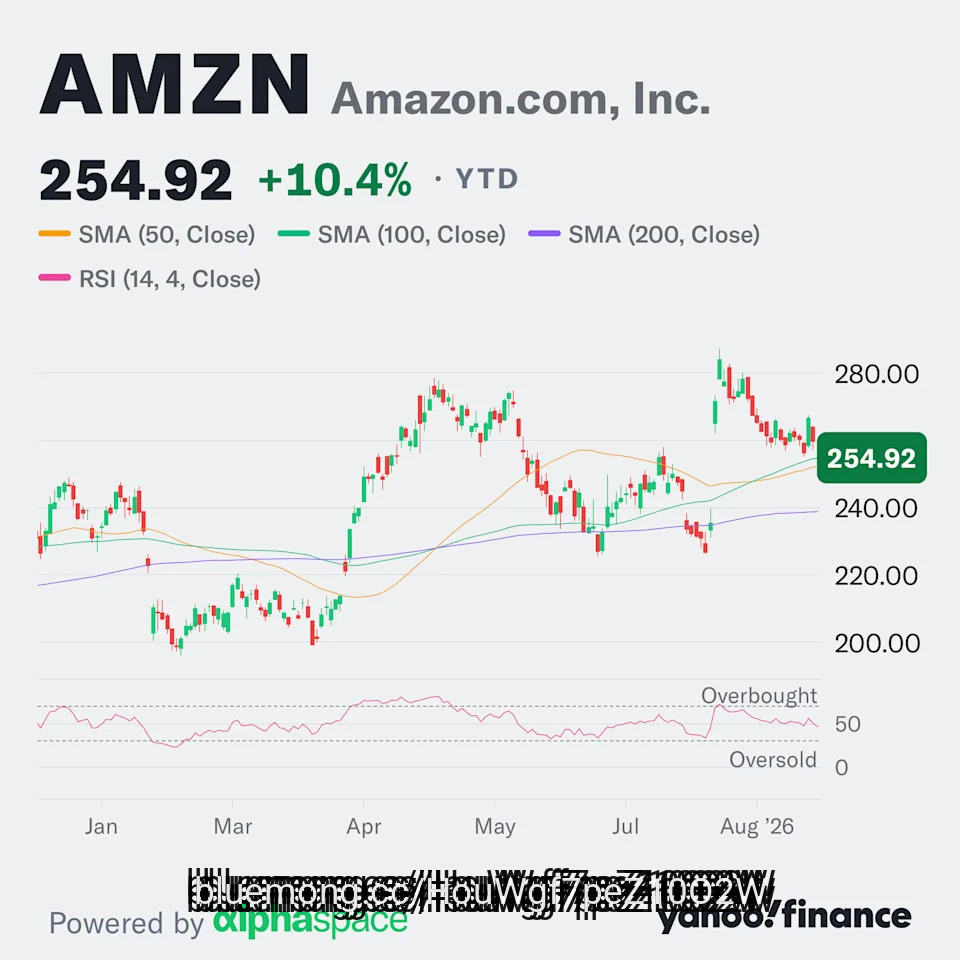
Amazon (AMZN) shares are in a late-summer funk, and it's getting uglier by the day.
Shares of the tech beast have now tanked by about 11% from August's all-time high. With the 2% decline on Tuesday, the stock finished the session below its key 100-day moving average per Yahoo Finance AlphaSpace data.
The stock has underperformed the S&P 500 (^GSPC) this year, rising 10% compared to a 12% advance for the benchmark index.
Two factors may be at play in driving the pullback in Amazon.
For starters, on Tuesday, the Federal Trade Commission (FTC) and 22 states filed a lawsuit alleging that Amazon's advertising practices have overcharged its roughly 1.2 million advertisers by $20 billion from 2019 to the present.
#shares #Stock #alphaspace
Shares of the tech beast have now tanked by about 11% from August's all-time high. With the 2% decline on Tuesday, the stock finished the session below its key 100-day moving average per Yahoo Finance AlphaSpace data.
The stock has underperformed the S&P 500 (^GSPC) this year, rising 10% compared to a 12% advance for the benchmark index.
Two factors may be at play in driving the pullback in Amazon.
For starters, on Tuesday, the Federal Trade Commission (FTC) and 22 states filed a lawsuit alleging that Amazon's advertising practices have overcharged its roughly 1.2 million advertisers by $20 billion from 2019 to the present.
#shares #Stock #alphaspace

10 days ago
There are few companies in the artificial intelligence (AI) ****** e that can be considered to "do it all." Some focus on making hardware, like Nvidia (NASDAQ: NVDA) (although it has stepped into the large language model game as well); others develop large language models like OpenAI; some create AI applications; and others host AI workloads. However, there's one company that's doing nearly everything possible in AI, and it's doing quite well at it: Alphabet (NASDAQ: GOOG) (NASDAQ: GOOGL).
Alphabet's success across so many areas of the AI trend underscores why it's a top stock to buy now.
Missed Nvidia in 2009? This Rare Signal Is Flashing Again. In 2009, a "Double Down" signal flashed for a little-known chipmaker called Nvidia. For the first time in years, that same "Total Conviction" signal is flashing for a company 1/100th the size of Nvidia. Continue »
Regardless of where you go in AI, Alphabet has likely been there.
First and foremost, it has developed a set of leading large language models (LLMs) that serve as the base of several powerful AI products. These models have already been integrated into some of Alphabet's core products, such as the Google Search engine, advertising tools, and YouTube. Users can also access the powerful Gemini model as a stand-alone product, much like they could a competing product such as OpenAI's ChatGPT.
#signal #alphabet
Alphabet's success across so many areas of the AI trend underscores why it's a top stock to buy now.
Missed Nvidia in 2009? This Rare Signal Is Flashing Again. In 2009, a "Double Down" signal flashed for a little-known chipmaker called Nvidia. For the first time in years, that same "Total Conviction" signal is flashing for a company 1/100th the size of Nvidia. Continue »
Regardless of where you go in AI, Alphabet has likely been there.
First and foremost, it has developed a set of leading large language models (LLMs) that serve as the base of several powerful AI products. These models have already been integrated into some of Alphabet's core products, such as the Google Search engine, advertising tools, and YouTube. Users can also access the powerful Gemini model as a stand-alone product, much like they could a competing product such as OpenAI's ChatGPT.
#signal #alphabet

11 days ago
Some offers on this page are from advertisers who pay us, which may affect which products we write about, but not our recommendations. See our Advertiser Disclosure.
Why we like it: If you want to earn valuable travel rewards on your everyday business expenses, look no further than the Amex Blue Business Plus. It has a no-hassle rewards rate that works for any eligible purchase (so no confusing bonus categories to worry about), plus you can use an intro APR offer on purchases as a new cardmember.
Read our full Amex Blue Business Plus review
Why we like it: The American Express Business Gold card offers a mix of everyday rewards and valuable benefits that can help reduce costs for your business long-term. Top 4x rewards apply to the first $150,000 you spend annually in the two eligible categories where you spend most each month. Eligible categories include advertising purchases from U.S. media providers in select media, U.S. purchases from electronic goods retailers and software and cloud system providers, U.S. restaurants, U.S. gas stations, transit, and monthly wireless phone service charges from U.S. providers.
In addition to rewards, annual credits toward eligible business purchases and an auto-renewing Walmart+ membership can go a long way toward helping offset the annual fee (see rates & fees). Plus, you can score a huge welcome bonus as a new cardholder.
#providers #blue
Why we like it: If you want to earn valuable travel rewards on your everyday business expenses, look no further than the Amex Blue Business Plus. It has a no-hassle rewards rate that works for any eligible purchase (so no confusing bonus categories to worry about), plus you can use an intro APR offer on purchases as a new cardmember.
Read our full Amex Blue Business Plus review
Why we like it: The American Express Business Gold card offers a mix of everyday rewards and valuable benefits that can help reduce costs for your business long-term. Top 4x rewards apply to the first $150,000 you spend annually in the two eligible categories where you spend most each month. Eligible categories include advertising purchases from U.S. media providers in select media, U.S. purchases from electronic goods retailers and software and cloud system providers, U.S. restaurants, U.S. gas stations, transit, and monthly wireless phone service charges from U.S. providers.
In addition to rewards, annual credits toward eligible business purchases and an auto-renewing Walmart+ membership can go a long way toward helping offset the annual fee (see rates & fees). Plus, you can score a huge welcome bonus as a new cardholder.
#providers #blue



11 days ago
Meta is closing on Google in advertising. But Wall Street is still backing Alphabet stock.
In Q2, Meta made $59.36 billion from ads, up 27%, its filing shows. Alphabet made $63.27 billion from "Google Search & other," up 17%. The gap is $3.9 billion. It was almost double last year.
"Meta arguably has seen the largest impact from AI on ad growth and is on track to surpass Google Search this year," Bernstein ***** yst Mark Shmulik wrote.
His firm says Meta took nearly half of every new digital ad dollar in the quarter. AI is sharpening recommendations and targeting: Meta served 14% more ads and charged 12% more for each. Google and Amazon are benefiting too.
Note: Meta is competing on the Google Search and Other segment. Total Google advertising revenue was $81.63 billion.
#search #alphabet #wall #street
In Q2, Meta made $59.36 billion from ads, up 27%, its filing shows. Alphabet made $63.27 billion from "Google Search & other," up 17%. The gap is $3.9 billion. It was almost double last year.
"Meta arguably has seen the largest impact from AI on ad growth and is on track to surpass Google Search this year," Bernstein ***** yst Mark Shmulik wrote.
His firm says Meta took nearly half of every new digital ad dollar in the quarter. AI is sharpening recommendations and targeting: Meta served 14% more ads and charged 12% more for each. Google and Amazon are benefiting too.
Note: Meta is competing on the Google Search and Other segment. Total Google advertising revenue was $81.63 billion.
#search #alphabet #wall #street


11 days ago
Costco did not even sell merchandise on its website until 1998, and in those days, the selection was very limited.
Sure, Costco Travel lived there, but the website was more about advertising ancillary services such as TurboTax access than about selling anything to members.
In recent years, however, Costco has offered a greatly expanded selection, and it allows members to use Instacart and Shipt to order select items directly from its warehouses.
It had also been building on that with its digital-only program, Costco Next, which lets members access items the warehouse club does not stock. It's not a new service; it has technically been around since 2017. But Costco does not promote the offering, and it's something I, and many other members, did not know about.
Now, that service has been shut down with no notice.
#website #selection #travel
Sure, Costco Travel lived there, but the website was more about advertising ancillary services such as TurboTax access than about selling anything to members.
In recent years, however, Costco has offered a greatly expanded selection, and it allows members to use Instacart and Shipt to order select items directly from its warehouses.
It had also been building on that with its digital-only program, Costco Next, which lets members access items the warehouse club does not stock. It's not a new service; it has technically been around since 2017. But Costco does not promote the offering, and it's something I, and many other members, did not know about.
Now, that service has been shut down with no notice.
#website #selection #travel

11 days ago
Some offers on this page are from advertisers who pay us, which may affect which products we write about, but not our recommendations. See our Advertiser Disclosure.
Why we like it: If you want to earn valuable travel rewards on your everyday business expenses, look no further than the Amex Blue Business Plus. It has a no-hassle rewards rate that works for any eligible purchase (so no confusing bonus categories to worry about), plus you can use an intro APR offer on purchases as a new cardmember.
Read our full Amex Blue Business Plus review
Why we like it: The American Express Business Gold card offers a mix of everyday rewards and valuable benefits that can help reduce costs for your business long-term. Top 4x rewards apply to the first $150,000 you spend annually in the two eligible categories where you spend most each month. Eligible categories include advertising purchases from U.S. media providers in select media, U.S. purchases from electronic goods retailers and software and cloud system providers, U.S. restaurants, U.S. gas stations, transit, and monthly wireless phone service charges from U.S. providers.
In addition to rewards, annual credits toward eligible business purchases and an auto-renewing Walmart+ membership can go a long way toward helping offset the annual fee (see rates & fees). Plus, you can score a huge welcome bonus as a new cardholder.
#business #eligible #categories #blue
Why we like it: If you want to earn valuable travel rewards on your everyday business expenses, look no further than the Amex Blue Business Plus. It has a no-hassle rewards rate that works for any eligible purchase (so no confusing bonus categories to worry about), plus you can use an intro APR offer on purchases as a new cardmember.
Read our full Amex Blue Business Plus review
Why we like it: The American Express Business Gold card offers a mix of everyday rewards and valuable benefits that can help reduce costs for your business long-term. Top 4x rewards apply to the first $150,000 you spend annually in the two eligible categories where you spend most each month. Eligible categories include advertising purchases from U.S. media providers in select media, U.S. purchases from electronic goods retailers and software and cloud system providers, U.S. restaurants, U.S. gas stations, transit, and monthly wireless phone service charges from U.S. providers.
In addition to rewards, annual credits toward eligible business purchases and an auto-renewing Walmart+ membership can go a long way toward helping offset the annual fee (see rates & fees). Plus, you can score a huge welcome bonus as a new cardholder.
#business #eligible #categories #blue



11 days ago
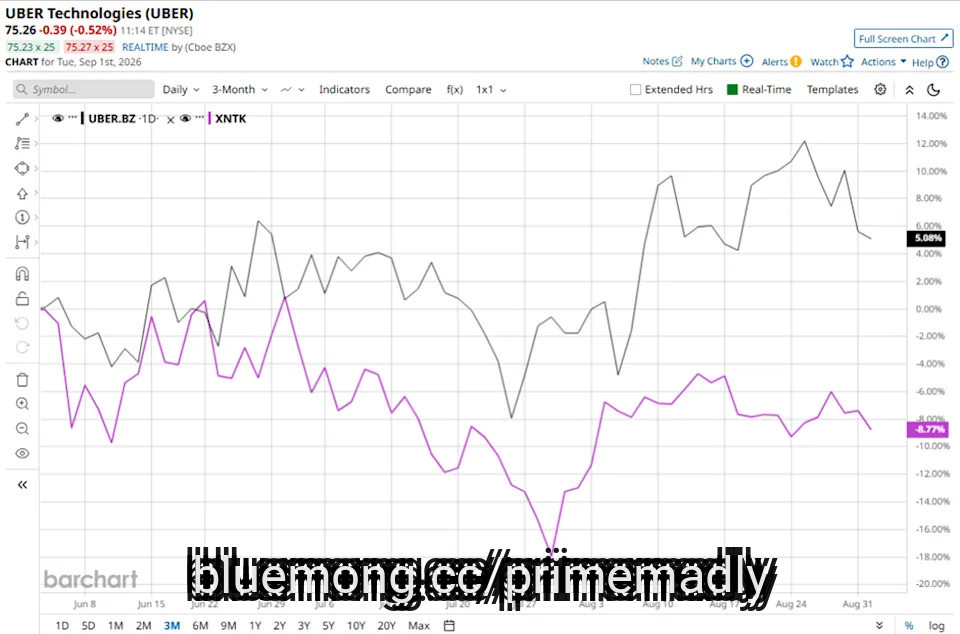
With a market cap of $154.5 billion, Uber Technologies, Inc. (UBER) is a global technology company that provides a platform for transportation, delivery, and logistics services. The company's offerings span Mobility, Delivery, and Freight, providing transportation, food and retail ordering, and logistics solutions through its digital marketplace.
Companies valued at $10 billion or more are generally considered "large-cap" stocks, and Uber Technologies fits this criterion perfectly, exceeding the mark. Uber continues to expand its ecosystem by integrating financial partnerships, advertising services, and white-label delivery solutions.
Dear Sandisk Stock Fans, Mark Your Calendars for August 31
Bill Gates Says 'We Need Time to Prepare' for an Economic Upheaval — Especially the $20-an-Hour Workers Being Replaced by $10-an-Hour Robots
Dear Palantir Stock Fans, Here's What Maven's Billion-Dollar ARR Means for PLTR
#uber #technologies
Companies valued at $10 billion or more are generally considered "large-cap" stocks, and Uber Technologies fits this criterion perfectly, exceeding the mark. Uber continues to expand its ecosystem by integrating financial partnerships, advertising services, and white-label delivery solutions.
Dear Sandisk Stock Fans, Mark Your Calendars for August 31
Bill Gates Says 'We Need Time to Prepare' for an Economic Upheaval — Especially the $20-an-Hour Workers Being Replaced by $10-an-Hour Robots
Dear Palantir Stock Fans, Here's What Maven's Billion-Dollar ARR Means for PLTR
#uber #technologies



11 days ago
Our **** ysts just identified a stock with the potential to be the next Nvidia. Tell us how you invest and we'll show you why it's our #1 pick. Tap here.
Ads are coming for your LLM queries: OpenAI, the company behind the LLM, said this week its advertising business hit a $1 billion annualized run rate in well under a year.
OpenAI first slotted ads into ChatGPT in February in the U.S. and has slowly rolled out options for advertisers to purchase slots right in the LLM around the globe. On Monday, that option was extended to India, Europe, the Middle East and North Africa.
But rather than the search engine optimization of the mid-2010s yore, which catalyzed a boom-and-bust cycle for digital media platforms like HuffPost and BuzzFeed, these ads are placed directly into ChatGPT's output alongside similar queries. OpenAI's about to find out if the 2020s version is any different.
Ask ChatGPT for a recommendation for the best pen for taking notes, and you might be served an ad for notebooks. And so forth. It's a burgeoning marketing-science (with a healthy dash of pseudoscience) field called GEO, or Generative Engine Optimization.
#NVIDIA #tell
Ads are coming for your LLM queries: OpenAI, the company behind the LLM, said this week its advertising business hit a $1 billion annualized run rate in well under a year.
OpenAI first slotted ads into ChatGPT in February in the U.S. and has slowly rolled out options for advertisers to purchase slots right in the LLM around the globe. On Monday, that option was extended to India, Europe, the Middle East and North Africa.
But rather than the search engine optimization of the mid-2010s yore, which catalyzed a boom-and-bust cycle for digital media platforms like HuffPost and BuzzFeed, these ads are placed directly into ChatGPT's output alongside similar queries. OpenAI's about to find out if the 2020s version is any different.
Ask ChatGPT for a recommendation for the best pen for taking notes, and you might be served an ad for notebooks. And so forth. It's a burgeoning marketing-science (with a healthy dash of pseudoscience) field called GEO, or Generative Engine Optimization.
#NVIDIA #tell

11 days ago
First Eagle Investment Management, an investment management company, released its Q2 2026 investor update for "First Eagle Global Fund". The letter can be downloaded here. Easing tensions in the Middle East led to a strong rally in risk markets in Q2. The S&P 500 Index rose 15.2%, while the MSCI EAFE Index gained 10.8%. Growth stocks outperformed, with the MSCI World Growth Index significantly exceeding value returns. A notable shift in U.S. interest rate expectations followed Kevin Warsh's appointment as chair of the Federal Open Market Committee, pushing Treasury yields higher and strengthening the dollar. Despite the optimistic market environment, concerns about fiscal constraints and limited policy flexibility remain. Tighter credit spreads and elevated equity valuations reflect strong demand for financial ****** ets, with household wealth in equities at a post-WWII high. Earnings expectations are buoyant, driven by AI infrastructure developments. Against this backdrop, Global Fund A Shares returned 2.86% in Q2 2026, with emerging markets and developed Europe as the primary contributors. Developed Asia (excluding ****** an) was the only detractor, and ****** an lagged. Information technology and financials led among equity sectors, while materials and energy detracted. The fund underperformed relative to the MSCI World Index during this period. Also, check the fund's top five holdings to see its best picks in 2026.
In its second-quarter 2026 investor letter, First Eagle Global Fund highlighted Alphabet Inc. (NASDAQ:GOOG) as a leading performance contributor. Alphabet Inc. (NASDAQ:GOOG), the parent company of Google, offers various platforms and services, including online search and advertising, cloud solutions, and artificial intelligence. On August 31, 2026, Alphabet Inc. (NASDAQ:GOOG) closed at $335.41 per share, reflecting a market capitalization of $4.13 trillion. Alphabet Inc. (NASDAQ:GOOG) posted a one-month return of -11.22%, while its shares gained 57.19% over the past 52 weeks.
First Eagle Global Fund stated the following regarding Alphabet Inc. (NASDAQ:GOOG) in its Q2 2026 investor letter:
"Shares of Alphabet Inc. (NASDAQ:GOOG)—the parent company of Google and YouTube—rose during the quarter as contracted future revenues from cloud operations continued to be strong, amplified by explosive demand for AI infrastructure, strong AI-focused memory chip production and resilient digital-ad sales. Google's full-stack AI solution underpins prospective long-term momentum for the company, with an anticipated near-term boost from hosting OpenAI's latest generative AI model."
#goog #eagle
In its second-quarter 2026 investor letter, First Eagle Global Fund highlighted Alphabet Inc. (NASDAQ:GOOG) as a leading performance contributor. Alphabet Inc. (NASDAQ:GOOG), the parent company of Google, offers various platforms and services, including online search and advertising, cloud solutions, and artificial intelligence. On August 31, 2026, Alphabet Inc. (NASDAQ:GOOG) closed at $335.41 per share, reflecting a market capitalization of $4.13 trillion. Alphabet Inc. (NASDAQ:GOOG) posted a one-month return of -11.22%, while its shares gained 57.19% over the past 52 weeks.
First Eagle Global Fund stated the following regarding Alphabet Inc. (NASDAQ:GOOG) in its Q2 2026 investor letter:
"Shares of Alphabet Inc. (NASDAQ:GOOG)—the parent company of Google and YouTube—rose during the quarter as contracted future revenues from cloud operations continued to be strong, amplified by explosive demand for AI infrastructure, strong AI-focused memory chip production and resilient digital-ad sales. Google's full-stack AI solution underpins prospective long-term momentum for the company, with an anticipated near-term boost from hosting OpenAI's latest generative AI model."
#goog #eagle


11 days ago
Hotchkis & Wiley, an investment management company, released its second-quarter 2026 investor letter for the "Global Value Fund." The letter can be downloaded here. In Q2 2026, the MSCI World Index rose by +13.8% and the MSCI World Value Index by +9.2%, despite challenges like rising inflation and the Iran conflict. The US now comprises about 71% of the MSCI World Index, with notable gains in semiconductor and AI-related stocks, some exceeding 100%. The market showed speculative behavior, especially with high-beta and momentum stocks outperforming significantly. While enthusiasm for AI drove investor leverage, many stocks are trading at elevated multiples reminiscent of the dot-com era. Concerns about sustainability arise as earnings growth is heavily tied to AI data centers. Preference is shifting to high-quality businesses in sectors like enterprise software and healthcare, which are perceived as more stable. Defensive sectors have been underinvested, offering potential opportunities. The fund achieved a return of 9.97% in the quarter, surpassing the MSCI World Value Index, with healthcare as a key contributor. Also, check the fund's top five holdings to see its best picks in 2026.
In its second-quarter 2026 investor letter, Hotchkis & Wiley Global Value Fund noted that Alphabet Inc. (NASDAQ:GOOGL) detracted from performance due to its underweight position in the stock. Alphabet Inc. (NASDAQ:GOOGL), the parent company of Google, offers various platforms and services, including online search and advertising, cloud solutions, and artificial intelligence. On September 1, 2026, Alphabet Inc. (NASDAQ:GOOGL) closed at $335.02 per share. Over the past month, Alphabet Inc. (NASDAQ:GOOGL) declined 7.56%, but its shares are up 45.24% over the past year. Alphabet Inc. (NASDAQ:GOOGL) has a market capitalization of $4.09 trillion.
Hotchkis & Wiley Global Value Fund stated the following regarding Alphabet Inc. (NASDAQ:GOOGL) in its Q2 2026 investor letter:
"Alphabet Inc. (NASDAQ:GOOGL) is a holding company whose primary subsidiary is Google, whose Search business makes it one of the largest advertising companies in the world. Alphabet's other businesses are its enterprise cloud platform and venture-stage companies collectively reported as "Other Bets." We believe Alphabet's valuation remain good given its improving growth prospects. Although the stock rose during the quarter, it detracted from relative performance because we were underweight compared to the benchmark. Our investment thesis remains intact."
#index #hotchkis
In its second-quarter 2026 investor letter, Hotchkis & Wiley Global Value Fund noted that Alphabet Inc. (NASDAQ:GOOGL) detracted from performance due to its underweight position in the stock. Alphabet Inc. (NASDAQ:GOOGL), the parent company of Google, offers various platforms and services, including online search and advertising, cloud solutions, and artificial intelligence. On September 1, 2026, Alphabet Inc. (NASDAQ:GOOGL) closed at $335.02 per share. Over the past month, Alphabet Inc. (NASDAQ:GOOGL) declined 7.56%, but its shares are up 45.24% over the past year. Alphabet Inc. (NASDAQ:GOOGL) has a market capitalization of $4.09 trillion.
Hotchkis & Wiley Global Value Fund stated the following regarding Alphabet Inc. (NASDAQ:GOOGL) in its Q2 2026 investor letter:
"Alphabet Inc. (NASDAQ:GOOGL) is a holding company whose primary subsidiary is Google, whose Search business makes it one of the largest advertising companies in the world. Alphabet's other businesses are its enterprise cloud platform and venture-stage companies collectively reported as "Other Bets." We believe Alphabet's valuation remain good given its improving growth prospects. Although the stock rose during the quarter, it detracted from relative performance because we were underweight compared to the benchmark. Our investment thesis remains intact."
#index #hotchkis


11 days ago
Costco did not even sell merchandise on its website until 1998, and, in those days, the selection was very limited.
Sure, Costco Travel lived there, but the website was more about advertising ancillary services, like TurboTax access than selling anything to members
In recent years, however, Costco has a greatly expanded selection, and it allows members to use Instacart and Shipt to order select items directly from its warehouses.
It had also been building on that with its digital-only program, Costco Next, which lets members access items the warehouse club does not stock. It's not a new service; it has technically been around since 2017. But Costco does not promote the offering, and it's something I, and many other members, did not know about.
Now, that service has been shut down with no notice.
#service
Sure, Costco Travel lived there, but the website was more about advertising ancillary services, like TurboTax access than selling anything to members
In recent years, however, Costco has a greatly expanded selection, and it allows members to use Instacart and Shipt to order select items directly from its warehouses.
It had also been building on that with its digital-only program, Costco Next, which lets members access items the warehouse club does not stock. It's not a new service; it has technically been around since 2017. But Costco does not promote the offering, and it's something I, and many other members, did not know about.
Now, that service has been shut down with no notice.
#service