
1 month ago
Estes Express Lines is investing nearly $56 million to expand its cross-border and offshore freight network, including terminals, equipment and capacity serving Canada, Mexico, Alaska, Hawaii and Puerto Rico.
Alex Peebles, senior director of offshore and international at Estes, said the privately held, family-owned carrier is taking a longer view of the freight market rather than allowing current conditions to dictate its investment strategy.
"We're really looking at all of these investments from a long-term horizon and viewpoint perspective and one that's going to help accommodate growth and capacity into all the offshore international markets that we service," Peebles told FreightWaves.
Estes, which is celebrating its 95th anniversary this year, is North America's largest privately held less-than-truckload (LTL) freight transportation provider. The company operates a network of over 300 terminals and service centers across the U.S., Puerto Rico, Alaska, Hawaii with coverage extending to Canada, Mexico and the Caribbean
Peebles said the company's ownership structure gives it flexibility to move quickly when real estate and equipment opportunities arise.
#rico



1 month ago
Amazon Business is now a $60B operation serving 11 million customers worldwide. In this FreightWaves Today interview, Amazon Business exec Daniel Silverfield breaks down what that scale means for procurement, supplier consolidation, same-day grocery delivery and AI-driven savings.The big takeaway: business buyers want fewer suppliers, better visibility and less waste in purchasing. Silverfield explains how Amazon Business is pitching exactly that to everyone from small companies to Fortune 100s.
Amazon Business has hit $60 billion in annualized gross sales and now serves 11 million customers worldwide, with 1.8 million organizations added this year alone — a growth rate that puts it on par with a Fortune 100 company if it were standalone. The platform, which launched roughly a decade ago after Amazon noticed businesses already shopping on amazon.com, is increasingly central to how companies across sectors manage procurement, from office supplies to same-day groceries.
The scale matters to shippers, carriers, and brokers because Amazon Business is driving a fundamental shift in B2B purchasing behavior — consolidating supplier pools, centralizing data, and moving procurement from quarterly reporting cycles to an always-on, AI-powered model. Every order that migrates to the platform is one fewer touchpoint for traditional distributors and one more shipment flowing through Amazon's own logistics network.
Daniel Silverfield, head of value and selection for Amazon Business, said the platform saved customers $880 million on Prime free shipping last year and $1 billion through business-specific discounts. The company added 30% new items year over year and recently launched same-day grocery delivery across 2,300 U.S. cities in the first half of this year, a capability customers had been requesting for some time.
"The big shift that we're seeing is that people are moving to a continuous, always-on, conversational-powered procurement journey where agents may be looking for the best price while they're asleep, maybe negotiating on their behalf while they're asleep, and then surfacing to them the best product to buy," said Silverfield.
#customers


1 month ago
Freight fraud risks and carrier vetting are the focus as Highway Chief Commercial Officer Michael Caney joins FreightWaves Today. He breaks down what brokers, carriers and shippers need to watch right now when onboarding and monitoring capacity.If you work fraud prevention, carrier compliance or network procurement, this conversation gets straight to the operational takeaway without the fluff.#FreightFraud #CarrierVetting #SupplyChain
Carrier-vetting platform Highway is putting its balance sheet behind its fraud-detection product: if a broker moves freight using Highway's guarantee standard and loses a load, Highway writes a check for $100,000. The company's chief commercial officer said the program covers the vast majority of carrier capacity in North America — and has paid out only once across roughly one million loads.
Of the approximately 175,000 carriers that move freight for freight brokers, Highway says more than 82% qualify for the guarantee tier. "What I would tell you is the industry keeps trying to solve for the bottom 18% of the market," the CCO said. "And what we're saying is if you will just move your freight to this cohort of carriers, which is the majority of capacity in North America, not only will you be fine, but Highway will stand behind it with a performance guarantee."
"The average cargo theft is not the $100,000, it's $250,000. This idea that a motor carrier can just show up and say, hey man, I'm gonna need this cargo, it's $250 grand, I'm good for it, is bananas."
The single payout to date stemmed from an identity-design flaw tied to California's non-domiciled limited-term licensing rules. A fraudulent carrier obtained a new license through California's process, resubmitted in Highway's system, and the alert dropped off before the bug was caught and fixed — costing Highway $100,000. The CCO described theft events as a "Swiss cheese" of compounding decisions rather than a single failure point, and said Highway continuously monitors for ownership changes, inbox compromises, and cyber anomalies within the guarantee framework.
#carriers #capacity #America


1 month ago
Three and a half years of freight recession did two things to the truck financing market at once. It shredded the credit profiles of the carriers who most needed to borrow. It also pushed a large share of the lenders who would have lent to them out of the sector. Both are now rationing the equipment replacement cycle the industry has spent two years waiting on.
Kirk Mann stayed in. As executive vice president and general manager of the transportation vendor solutions business at Mitsubishi HC Capital America, he financed trucks through the entire downturn and watched a great many of them come back.
"There are a lot of lenders, banks that left, and so we've had the benefit of being one of the lenders actually lending money in this ****** e," Mann said in an interview with FreightWaves. What competition remains is mostly OEM captive finance arms, a couple of large independents and a few bank-led groups, he said.
The carriers that did not survive were overwhelmingly the newest. On average, 85% of motor carriers with fewer than two years of operating experience and their own operating authority failed over a three-year stretch of the downturn, Mann said.
Back in January 2023, Mann sat in Mitsubishi HC Capital's Chicago offices with Wayne Pass, the company's chief credit officer for vendor solutions, since retired. He asked what a Freightliner Cascadia 13-speed with a tall sleeper and fewer than 500,000 miles was worth. Both men wrote down $45,000. Mann then asked what the company was financing those trucks at. About $110,000.
#mitsubishi #back #financing #large


2 months ago
AI gate automation cut dwell times to under 30 seconds while EAIGLE posted 350% year-over-year growth. CEO Amir Hoss explains how the company uses existing security cameras and computer vision to automate gate, yard and dock workflows.On site at a live facility, Hoss breaks down how EAIGLE went from a customer problem to a fully automated, paperless gate and yard operation. He also explains why the next growth phase matters for carriers, shippers and warehouse operators trying to move trucks through the yard faster.#GateAutomation #YardManagement #SupplyChainAI
EAIGLE, an automation company focused on gate-to-dock logistics, has closed a growth funding round on the heels of 350% year-over-year revenue growth, CEO and founder Amir Hoss said in an interview with FreightWaves. The company's computer vision platform reduces gate dwell times that previously ranged from 7.5 to 18 minutes down to under 30 seconds — and sometimes under one minute — by tapping into camera infrastructure that facilities already own.
The technology matters to carriers, brokers, and shippers because gate congestion and yard opacity have long been among the most stubborn inefficiencies in distribution operations. EAIGLE's system automates the full check-in and check-out process, validates bills of lading, purchase orders, appointments, and USDOT numbers in real time, and feeds clean data directly into yard management, warehouse management, and transportation management systems via APIs.
At one active facility where Hoss spoke — a site processing roughly 1,100 trucks per day across two gates and four lanes — EAIGLE replaced 18 full-time staff across three shifts with a fully unmanned, paperless operation. "We didn't validate here, we just log," Hoss recalled a security guard telling him five or six years ago, a dynamic he said rendered downstream YMS data unreliable. "It becomes garbage in and garbage out," he said.
"The bar is really high because you own that responsibility of initiating the high accuracy and complete data capture and validation for the rest of the systems in the supply chain ecosystem of each one of the operational customers."
#eaigle #amir #automation


2 months ago
A former employee has filed a class action lawsuit against Ceva Logistics, alleging the freight giant failed to protect highly sensitive personal information stolen during a recent cyberattack that impacted operations in Europe.
Hackers gained access to Ceva Logistics systems and data in late July, which disrupted operations at eight warehouses that provide store replenishment and e-commerce fulfillment for retailers in the Netherlands and other European countries, as FreightWaves reported. The legal action suggests that customers were not the only ones affected by the data breach.
Why It Matters: France-based Ceva is one of the largest third-party logistics providers, with more than 1,000 warehouses worldwide. Last year the company generated $18.3 billion in revenue.
Kevin Krupa, a former employee, sued Ceva Logistics late last month in U.S. District Court for the Southern District of Texas, in Houston, where Ceva's U.S. headquarters is located.
The complaint alleges that the personal information of employees, including bank account details and social security numbers, was stolen during the cyber intrusion, which never would have happened had the company taken appropriate precautions following a similar incident a year earlier.
#ceva


2 months ago
TruckSmarter announced on Tuesday that it has been acquired and that its driver app, Dispatch, shuts down on Friday, September 4.
The scale is what makes this more than a routine startup wind-down. More than 500,000 carriers have used the TruckSmarter platform, which included a free load board alongside the paid Dispatch product. Dispatch was an AI chat interface that let a driver ask for freight in plain language and had software agents handle the bidding and booking, rather than making the driver work a traditional load board.
Automated replies from the company indicated that active Dispatch subscriptions are canceled Friday, and that invoices paid within the previous 30 days will be refunded within seven business days of cancellation. Co-founder and chief executive Dan Kao posted a message inside the app thanking users for five years of trust, and drivers and trucking groups spread screenshots of it across social media.
One thing has been ruled out. OTR Solutions, which bought TruckSmarter's factoring and banking division in November 2025, told FreightWaves it did not acquire the remaining business.
So a company that raised money twelve months ago is gone by Friday, and ****** ody will say who bought it. That combination has a name in technology, even if no one involved here has used it.
#Friday #load #board #company


2 months ago
Diesel prices are still above $5, and Aaron Decker says the real problem is refining capacity — not crude oil.In this FreightWaves Today interview, Decker breaks down crack spreads, refinery outages, low distillate inventories and how the Russia-Ukraine conflict is still hitting diesel markets. For carriers, brokers and shippers, this is the fuel outlook that matters heading into Q3 and Q4.#DieselPrices #FuelSurcharge #FreightWaves
On-road diesel prices hit the high $5.60s this week, and the culprit is not crude oil — which has been hovering in the $80s — but a refining capacity crunch that has sent crack spreads above $100 per barrel, well beyond their typical $15–$25 range, said Aaron Decker, partner and chief executive officer of Multi-Service Fuel Card.
"It's not necessarily a crude issue or a crude crisis," Decker said. "We're not in a crude crisis, we're in a refining crisis." Ultra-low distillate inventories have fallen to levels not seen since the early 2000s, and even the late 1990s, he added — a signal he called "really troubling."
Several forces are compounding the supply squeeze. Ukrainian drone strikes have taken out Russian refineries that were previously helping backfill global shortfalls. U.S. Gulf Coast diesel exports are running elevated as domestic refiners supply shortage-stricken markets overseas, which simultaneously tightens American supply and consumes domestic refining capacity. Decker said a weekly government report tracking Hormuz tanker traffic, Russian refinery runs, and U.S. distillate inventories are the three indicators he watches most closely.
"I don't anticipate this getting better in the very near future. I anticipate, and I think the EIA agrees with that, they adjusted their forecast from where they were at the beginning of the year to how things stand now. And I would imagine we're north of $5 for the foreseeable future." — Aaron Decker, CEO, Multi-Service Fuel Card
#Diesel #aaron #refining #inventories


2 months ago
Autonomous trucking is moving from pilot talk to real freight ops. Einride CEO Roozbeh Charli breaks down 27% revenue growth, a 60% jump in driverless hours, the Amazon middle-mile rollout, and the plan for 500 Tesla Semis on its platform.The conversation gets into what matters for carriers and fleet operators: where autonomous trucks actually stand today, how Einride's platform handles routing and charging, and why the company says adoption will be gradual—not overnight.#AutonomousTrucking #ElectricTrucks #FreightTech
Einride posted a 27% increase in revenue for the first half of 2025 following its June 10 IPO, and the company expects that growth rate to roughly double in the second half of the year, CEO Roozbeh Charli said in an interview with FreightWaves. The results represent early progress toward converting approximately $800 million in joint business plans with customers into recognized revenue.
Alongside the revenue gains, Einride grew its autonomous driverless operating hours by about 60% in the first half. The company currently has roughly 250 trucks deployed on its Saga AI platform across more than 30 customers in seven countries, including Amazon, Heineken, and PepsiCo.
The most significant near-term expansion is a 500-truck order for Tesla Semi vehicles, which Einride will purchase, finance through third-party partners, and deploy on its platform as the carrier of record. Charli said approximately 75 of those trucks are expected to be deployed before year-end, with the remainder targeted for deployment by the end of next year. The program is U.S.-focused.
"By accumulating this transport demand on the platform, we're well positioned to decide where and when, in which case it makes sense to deploy autonomous into the networks of our customers," Charli said.
#einride #platform #trucks


2 months ago
The freight market has seen a brutal downturn, with an astounding 85% failure rate for new carriers in the past three years. Kirk Mann, EVP & GM of Transportation and Vendor Solutions at Mitsubishi HC Capital America, dives into why this cycle was the longest, the impact of over-financed ****** ets, and what it means for the future of freight demand and equipment financing. Learn how lenders navigate this volatile landscape and what's next for carrier growth.
The average three-year failure rate for motor carriers with fewer than two years of operating experience and their own ICC authority hit 85% during the prolonged freight downturn, according to Kirk Mann, EVP & GM of Transportation and Vendor Solutions at Mitsubishi HC Capital. Mann shared the figure in a FreightWaves interview, offering one of the starkest measures yet of how the roughly three-and-a-half-year downturn devastated the smallest participants in the for-hire trucking market.
The elevated failure rate traces directly to the equipment bubble that inflated during 2021 and 2022. Mann recalled a conversation with his chief risk officer in which they discussed a four-year-old Freightliner Cascadia with fewer than 500,000 miles — an ****** et the risk officer valued at roughly $45,000 but that the company was financing at $100,000 to $110,000. FreightWaves data showed pre-COVID prices on five-year-old equipment running around $34,000, climbing to as high as $120,000 at the peak. Carriers that entered the business buying equipment at those inflated values were immediately underwater when rates collapsed.
"I remember we were way bubble. It was an ****** et bubble of enormous proportions," Mann said.
When defaults mounted, Mitsubishi HC Capital leaned on workout tools rather than immediate repossession. Mann said the company restructured approximately 75% of its loans during its 2020 customer ****** istance program launched at the onset of COVID-19, and that 95% of those borrowers resumed payments within 90 days. Even so, the lender accumulated repossessed inventory it held "for quite a long time" before conditions improved enough to move units through dealer networks, auctions, and internal sales channels.
#freight


2 months ago
Discover how intermodal freight is delivering massive savings in today's volatile market. As truckload spot and contract rates stabilize, intermodal options provide a crucial cost-saving advantage, especially on key lanes. Learn where to find the biggest savings and how shifting modes can optimize your freight spend.
Intermodal savings have surged to their highest level in several years, driven by a widening gap between rising truckload rates and relatively flat intermodal pricing, according to FreightWaves SONAR data presented by Julie Van de Kamp during a live update from the College Football Hall of Fame.
On the Harrisburg, Pennsylvania, to Atlanta lane — one of the top savings lanes in SONAR's intermodal dashboard — van spot truckload rates are up approximately 42%, van contract rates are up about 26%, and intermodal rates have risen only 16%, making a compelling case for mode conversion. East Coast corridors, particularly those out of Atlanta and Harrisburg, are leading the savings rankings, with lanes including Atlanta to Chicago, Atlanta to Joliet, Atlanta to Elizabeth, New Jersey, and Harrisburg to both Ontario, California, and Los Angeles all trending upward in the savings index over the most recent three months.
"That is such a good reason to consider mode conversion, take advantage of those savings, and understand where that helps even in a backhaul lane like what would typically be PA to Chicago at a length of haul that's not transcon," said Julie Van de Kamp.
The broader market context reinforces the intermodal value proposition. Tender rejections saw a significant drop from July 20 to August 5 but are now stabilizing, and spot rates, while down from earlier peaks year to date, are also leveling off. Meanwhile, contract truckload rates continue to rise, narrowing the gap between spot and contract. Van de Kamp noted a roughly 66-cent-per-mile spread between spot rates on the NTI and contract rates on the VCRPM1, though she cautioned that spot rates are all-in while contract rates are linehaul only — with fuel surcharges running approximately $0.70 per mile based on a Department of Energy estimate of around $45.
#spot #kamp


2 months ago
The national parcel carriers that once set retail delivery economics have spent a decade shedding their least profitable packages. What filled the gap is a deeper bench: regional carriers, 3PL cross-dock networks, gig courier platforms and private fleets. As it turns out, almost none of them talk to each other.
Burq, a last-mile delivery technology company, wagers that last-mile orchestration — the decision layer sitting above that bench — is the product enterprise retailers will actually pay for.
The shift is already underway. FreightWaves reported in July that carrier diversification is eroding the last-mile delivery duopoly: 55% of retailers now use carriers outside FedEx, UPS and the U.S. Postal Service, and more than a third are actively moving volume away from the two national giants. The payoff is measurable. In one example, home goods brand Caraway cut total parcel costs 20% after its 3PL began shopping every order across a network of regional and national carriers. Capturing that value requires knowing which provider performs in which ZIP code on which day. Most retailers do not know, because the systems that pick a carrier stop watching the moment the order leaves.
Jake Stein joined Burq four months ago to run growth for its retail sector, after four and a half years at Uber launching ship-from-store, same-day and on-demand programs on Uber Direct. The limitations of using a single network are what pushed him out.
"It still came down to that Uber couldn't be the single source for everything," Stein told FreightWaves. "Mostly gig, reasonably shorter distances, some batching but not large scale, no big and bulky. And they can't be 100% of every possible location."
#retailers

3 months ago
Fewer cargo theft reports did not mean smaller losses during the second quarter, according to Verisk CargoNet's ******* ysis. The intelligence network documented 677 incidents across the United States and Canada. That total fell 26% from Q2 2025. It also dropped 14% from the previous quarter.
Estimated cargo losses nevertheless climbed to $304.6 million during the three-month period. That figure more than doubled the $135.7 million reported during Q2 2025. The average reported commodity value reached $564,009. Several multimillion-dollar thefts involving metals and enterprise technology heavily influenced that average.
"Lower incident volume should not be mistaken for lower risk," Keith Lewis, Verisk CargoNet's vice president of operations, said. "The groups driving the largest losses are not necessarily trying to steal more freight; they are trying to identify the right shipment." Lewis pointed to metals and enterprise technology as areas attracting organized theft groups. Those shipments can offer major value and established resale opportunities.
Scott Cornell, EVP, Crime and Theft Specialist at SPG Cargo & Logistics and chair of TAPA Americas, discussed the results during a recent FreightWaves interview. He described the decrease as welcome news after years when theft activity stayed elevated. Cornell also urged the industry to avoid treating one quarter as proof of a broader shift. "It's not going to be a trend until we see it for maybe two or three quarters consecutively," Cornell said.
Cornell noted that cargo theft numbers have historically moved up and down. He said recent law-enforcement arrests could be contributing to the quarterly decrease. Those efforts included operations in New York, New Jersey, California and Canada, along with FBI and Homeland Security cases. Cornell called the results from law enforcement and private-sector cooperation encouraging.
#theft #lower


3 months ago
SummaryView Transcript
Paul Svindland, former CEO of Celadon, reveals the emotional toll of the company's bankruptcy. He recounts how FreightWaves breaking the news prematurely led to chaos, stranded drivers, and fuel cards being shut off during the harsh winter of 2019. Despite the operational health of the business, a mountain of financial and legal issues ultimately led to its demise. Svindland shares his candid thoughts on the challenges of a massive trucking turnaround and his new chapter with Mallory Alexander.
When FreightWaves published its Celadon bankruptcy scoop on a Friday night in December 2019, CEO Paul Svendlund had intended to wait until Sunday — flying into Indianapolis to brief his management team — before communicating the Chapter 11 filing to fuel-card providers and drivers the following Monday. The early publication triggered an immediate shutdown of fuel cards, stranding drivers on the road during winter holiday season and creating what Svendlund described as roughly 36 hours of chaos.
"I'm not going to lie to you. I mean, it was the first and probably only time in my professional career that I literally actually cried because I felt I let everybody down." — Paul Svendlund, former Celadon CEO
Svendlund, now CEO of Mallory Alexander and a turnaround veteran who also led Pacer and STG Logistics, told FreightWaves the filing was structured as a liquidating Chapter 11 rather than a straight Chapter 7, preserving the entity while winding it down because ******* et value exceeded outstanding loan balances. The company was burning approximately $1 million per month just to fund legal defense for former officers after exhausting its directors-and-officers insurance — a cash drain that made lenders unwilling to continue extending credit even as operations had stabilized.
#chapter #celadon

3 months ago
(The views expressed here are solely those of the author and do not necessarily represent the views of FreightWaves or its affiliates.)
A Dallas County jury last week hit freight broker C.H. Robinson with a share of a $604 million verdict in Peyton Lipe et al. v. Lupus Superior, LLC et al. The case stems from a deadly 2021 crash on Interstate 20 in Mississippi. A tractor-trailer operated by Lupus Superior and driven by Gorgonio Gonzalez plowed into stopped traffic. The wreck sparked a multi-vehicle fire that killed Jennifer Lipe, Benjamin Brewer, and Rhoderick Coleman. Two others were seriously hurt. Gonzalez also died.
The jury found the driver, the motor carrier, and C.H. Robinson all negligent. The jury ******* igned Gonzalez with 45% responsibility, Lupus Superior with 32% responsibility, and C.H. Robinson 23% responsibility. Lupus Superior, a Grand Prairie, TX based motor carrier, holds a satisfactory safety rating with the FMCSA. More importantly, the jurors decided Gonzalez was acting as a "borrowed employee" of C.H. Robinson and was carrying out a mission under the broker's control. That finding opens the door to full vicarious liability for the driver's negligence. C.H. Robinson has said it will appeal.
This verdict lands right after two major court decisions that reshape how courts treat liability in trucking and logistics. Understanding the difference between vicarious liability and negligent hiring is key to seeing what happens next.
Vicarious Liability: When One Party Answers for Another's Mistakes.
#superior

3 months ago
(The views expressed here are solely those of the author and do not necessarily represent the views of FreightWaves or its affiliates.)
The Supreme Court's Montgomery decision changed the litigation landscape for the trucking industry. Although the case addressed a negligent selection claim against a freight broker, plaintiffs will not limit their investigations to the broker's carrier qualification file. They will examine the full chain of decisions that placed a particular truck and driver on the road.
That means reviewing the shipper's conduct as well. Plaintiffs will ask who selected the broker, what the shipper required of the broker's carrier selection process, which carrier was approved, which truck arrived, what facility personnel observed, and why the freight was released.
Montgomery did not create a new cause of action against shippers. It did, however, reinforce that transportation safety decisions may be tested under state negligence law. Shippers should expect increased scrutiny when their own conduct contributed to an unsafe transportation arrangement.
The broker may select and approve the motor carrier, but the shipper controls the freight at pickup. The shipper can see the truck, verify the carrier information, confirm the driver, review the paperwork, and decide whether the goods will be released. The shipper is not expected to repeat the broker's entire carrier vetting process. Its responsibility is more focused: confirm that the carrier, driver, and equipment arriving at the facility match the transportation **** ignment.
#freight #Transportation #montgomery #plaintiffs


3 months ago
CHICAGO — FreightWaves unveiled the winners of its 2026 AI Excellence in Supply Chain Awards during a ceremony at the Old Post Office in Chicago as part of the FreightWaves Supply Chain AI Symposium on July 15, 2026. The awards recognize companies using artificial intelligence to transform supply chain, transportation and logistics operations.
The competition this year was fierce. FreightWaves received a record 60 nominations, more than double last year's total, reflecting how quickly AI has moved from pilot projects to production systems across the industry. To capture the full picture of that shift, the 2026 awards were split into two categories: AI Solution Providers, honoring the technology companies building AI tools for the industry, and Operational AI Integration, honoring the carriers, brokers, forwarders and shippers deploying AI inside their own operations.
This year's honorees in the AI Solution Providers category are Arkestro, CloneOps.ai, Intelligent Audit, Fixefy, Augment, Eranova, Gather AI, Trimble Autonomous Procurement, Fullbay AI and Samsara. The Operational AI Integration honorees are NFI, Flexport, YMX Logistics, Uber Freight and Atlas Energy Solutions.
Honoring the technology companies building AI tools for the industry
Arkestro earned recognition for its AI-enabled predictive procurement platform, which combines artificial intelligence and game theory to let procurement teams simulate sourcing events before they happen and shape outcomes before suppliers ever submit a quote. Rather than replacing human decision-making, the platform augments it, giving suppliers AI-assisted pricing guidance and real-time feedback on how their offers compare. Customers report an average 18.8% savings on spend and sourcing cycles accelerated by up to 60%. One manufacturer identified more than $55 million in savings with a two-month ROI across 40 plants and more than 400 suppliers; an LNG operator cut high-value sourcing cycles from days to minutes while achieving 29% savings; and a global medical device manufacturer compressed logistics request-for-quote timelines from four months to six weeks, saving $2.4 million.

4 months ago
CSX underscored its industry primacy in Washington with a U.S. 250th anniversary event that highlighted its claim as the sole Class I operating in the nation's capitol.
The Jacksonville, Fla.-based carrier's All Aboard for America 250 business special rolled into Washington Union Station behind engines 2026 and 250, the first public exhibition of the commemorative locomotives marking the USA 250th anniversary.
"CSX (NASDAQ: CSX) is pleased to be the only Class I freight railroad operating in Washington, D.C., and we are honored to be part of this celebration in our nation's capital," Chief Executive Steve Angel told the gathering. "We are very proud of our history here, and of the work our railroaders do every day across our national network to serve our customers, communities, and country."
With the painting of the special units completed in Waycross, Ga., the train made its inaugural run crewed by engineer J.R. Walker and conductor C.A. Bydume.
Subscribe to FreightWaves' Rail e-newsletter and get the latest insights on rail freight right in your inbox.

4 months ago
C.H. Robinson has been dismissed as a defendant in a Florida case that might have been one of the first tests of broker liability in a legal arena changed by Montgomery vs. Caribe Transport II.
A court document filed Friday afternoon in the 19th Circuit Court for St. Lucie County, in the widely-publicized case involving driver Harjinder Singh and his fatal u-turn behind the wheel, removed C.H. Robinson as a defendant in the lawsuit brought by the estate of Faniola Joseph, killed in the crash along with two others that occurred after Singh's tragic turn.
Reiterates: we weren't part of this
The document doesn't say why C.H. Robinson (NASDAQ: CHRW) was dismissed as a defendant. But in a prepared statement, the giant 3PL said the same thing Tuesday as it did when the lawsuit from Joseph's estate was first filed: it had nothing to do with any of the companies involved in the crash.
"The lawsuit in Cantelar v. White Hawk Carriers incorrectly alleged that C.H. Robinson brokered the shipment involved in the accident," the company said in a prepared statement provided to FreightWaves. "That was false, which is why C.H. Robinson has been dismissed from the case." (Yaniel Cantelar represents the Joseph estate).


4 months ago
Drayage operators are under growing pressure to do more with less. Between demand volatility, terminal congestion, driver shortages, and shrinking margins, relying on manual processes is no longer sustainable.
FreightWaves partnered with CargoWise Landside to survey drayage professionals and uncover how carriers are responding to today's operational challenges.
Insights include:
The biggest operational challenges limiting growth and profitability
Where drayage providers are investing in automation and digital transformation


4 months ago
A rollover on the interstate at 3:00 a.m. is already a bad day. But for a growing number of motor carriers, even worse financial damage comes from the tow bill that follows.
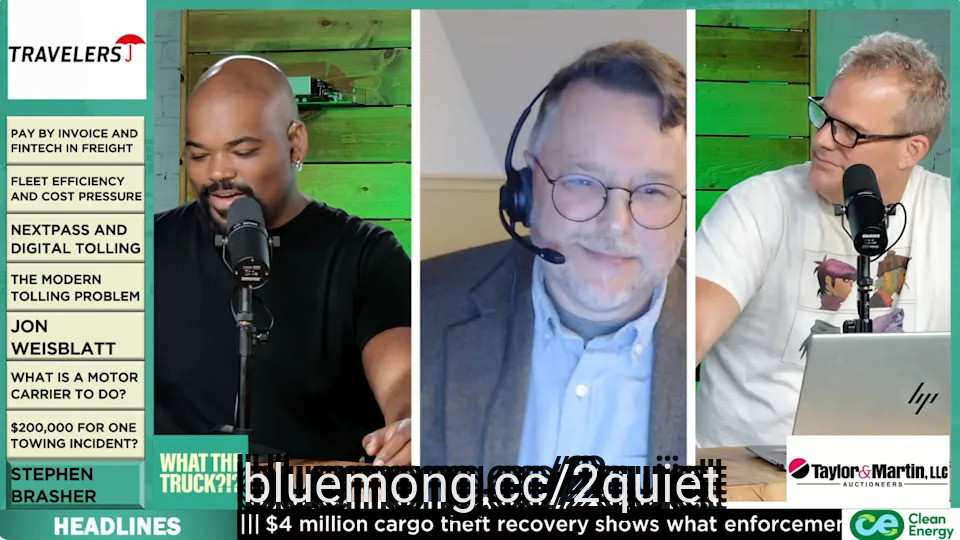
Stephen Brasher, Travelers Inland Marine Claim Unit Manager, joined FreightWaves' What the Truck?! with host Malcolm Harris to break down how predatory towing practices are draining carriers of tens (and sometimes hundreds) of thousands of dollars per incident.
Brasher says the tow operators hold nearly all the leverage, invoices are routinely inflated, and motor carriers who don't respond immediately can watch storage fees consume whatever margin they had left.
"Imagine it's 3:00 a.m. and one of your drivers is involved in a rollover accident on the interstate," Brasher said. "The truck and trailer are blocking the roadway, the trailer is breached, and cargo is strewn across the highway. When the County Sheriff shows up, his priority is to get those travel lanes cleared as fast as possible, so he dispatches a tow company."
The motor carrier has no say in which company responds, and the moment that tow operator hooks up, a billing clock starts running that can be extraordinarily difficult to stop. "Motor carriers need to understand, you do not get to choose that tow company," Brasher said.


4 months ago
.
The U.S. Department of Transportation (USDOT) has awarded a contract to FreightWaves SONAR to provide high-frequency freight market data in support of federal transportation ****** ysis and economic research, SONAR announced Wednesday.
SONAR's data will help monitor freight market health, inform regulatory enforcement, and supply timely insights to the Department's Office of the ****** istant Secretary for Research and Technology.
USDOT has made strengthening oversight of the nation's transportation and supply chain networks a top priority, with renewed focus on the safety, security, and resilience of freight movement nationwide.
Through this contract, USDOT will incorporate SONAR datasets and freight market indicators to improve visibility into freight activity, market dynamics, and supply chain conditions across the United States.


5 months ago
The freight downturn that defined 2023 and 2024 has decisively reversed, and the May data clarifies the mechanism behind it: industrial production, rather than consumer spending or inventory restocking, is now driving the cycle. FreightWaves identified the inflection months ago. The latest readings from the Institute for Supply Management and the Logistics Managers’ Index, corroborated by real-time tender data, confirm it.
The ISM Manufacturing PMI registered 54.0 in May, up 1.3 points from April and the highest reading since May 2022. The index has now held above the expansion threshold for five consecutive months, following a 10-month contraction. On ISM’s own regression, a 54.0 composite is consistent with roughly 2.2% annualized growth in real GDP.
The internals are stronger than the headline. The New Orders index rose to 56.8, comfortably above the 51.9 level ISM identifies as the breakeven for rising Census manufacturing orders in constant dollars. Production reached 54.3, above the 52.0 threshold ***** ociated with rising Federal Reserve industrial output. As a forward-looking series, new orders typically lead realized freight volumes by several weeks, which makes the current reading the more economically meaningful of the two.
Breadth reinforces the signal. All six of the largest manufacturing industries expanded in May — led by computer and electronic products, machinery, and transportation equipment — and 16 of 18 industries reported growth, with only wood products in contraction. Diffusion of this width is characteristic of a self-sustaining expansion rather than a narrow, sector-specific rebound.
The labor data points to a productivity-led expansion. The Employment index came in at 48.6 — still below the 50.3 breakeven for rising BLS manufacturing payrolls, but up 2.2 points and trending toward it. Manufacturers have expanded output for seven straight months while holding headcount roughly flat, indicating they are absorbing incremental demand through existing capacity. Payroll growth typically lags output in the early phase of an industrial recovery; the trajectory of the employment index suggests hiring is the next stage.