

1 day ago
New integration embeds SONAR rates and coverage difficulty across FleetWorks' AI phone, email, and SMS workflows to help brokers and carriers book with more confidence.
San Francisco, CA August 13, 2026 — FleetWorks, the AI marketplace that matches brokers and carriers at scale, and SONAR, the leading freight market data and supply chain intelligence tool, today announced a partnership that brings SONAR's TRAC rates and coverage scores into FleetWorks' AI agents platform-wide. The integration is live now for any carrier using the FleetWorks platform as well as brokers who are both FleetWorks and SONAR customers, giving broker teams verified market context at the moment they quote, negotiate, and cover freight.
Freight moves faster than the systems most brokerages use to book it. A carrier sales rep negotiating a load typically has the conversation in one place and the market data in another — a SONAR dashboard, a rate tool, an account manager or pricing ****** yst on Teams. By the time the context arrives, the carrier has hung up or the load has been covered by someone who answered first. The same gap exists for AI agents: automation built around a brokerage's min/max spread, without current market data, misses key insights in a dynamic market..
The partnership closes that gap. SONAR's high frequency data now feeds directly into FleetWorks' AI agents across every channel the platform supports — phone, email, and SMS. When a FleetWorks agent works a carrier or load, it references SONAR's current spot rate and live market conditions as it works toward a bookable price within the broker's guardrails. When market conditions fall outside those guardrails, the agent escalates to a person with the SONAR context attached. Brokers input rate tolerances, and approval or escalation rules; SONAR supplies the ground truth those controls act on.
Mutual broker teams can now:
#sonar #freight
San Francisco, CA August 13, 2026 — FleetWorks, the AI marketplace that matches brokers and carriers at scale, and SONAR, the leading freight market data and supply chain intelligence tool, today announced a partnership that brings SONAR's TRAC rates and coverage scores into FleetWorks' AI agents platform-wide. The integration is live now for any carrier using the FleetWorks platform as well as brokers who are both FleetWorks and SONAR customers, giving broker teams verified market context at the moment they quote, negotiate, and cover freight.
Freight moves faster than the systems most brokerages use to book it. A carrier sales rep negotiating a load typically has the conversation in one place and the market data in another — a SONAR dashboard, a rate tool, an account manager or pricing ****** yst on Teams. By the time the context arrives, the carrier has hung up or the load has been covered by someone who answered first. The same gap exists for AI agents: automation built around a brokerage's min/max spread, without current market data, misses key insights in a dynamic market..
The partnership closes that gap. SONAR's high frequency data now feeds directly into FleetWorks' AI agents across every channel the platform supports — phone, email, and SMS. When a FleetWorks agent works a carrier or load, it references SONAR's current spot rate and live market conditions as it works toward a bookable price within the broker's guardrails. When market conditions fall outside those guardrails, the agent escalates to a person with the SONAR context attached. Brokers input rate tolerances, and approval or escalation rules; SONAR supplies the ground truth those controls act on.
Mutual broker teams can now:
#sonar #freight


1 day ago
Sands Capital, an investment management company, released its "Sands Capital Technology Innovators Fund" Q2 2026 investor letter. A copy of the letter can be downloaded here. In the quarter, global equities rebounded sharply, with the MSCI ACWI posting its strongest quarterly gain since 2020, supported by broad market strength, easing geopolitical tensions, and continued enthusiasm for AI infrastructure. Information technology led the advance, with semiconductor and hardware companies accounting for most of the index's rise. The fund returned 26.9% (net) in the second quarter of 2026. The portfolio benefited from strong gains across memory, software infrastructure, cybersecurity, and other AI-related holdings, although its concentrated exposure to mega-cap chip designers and manufacturers weighed on relative performance as leadership broadened into CPUs, networking, and memory. Vertical software, internet, and financial holdings were modest detractors amid macro concerns and uncertainty over AI disruption. The fund remains focused on critical AI bottlenecks, including compute, memory, manufacturing, networking, and power, while retaining selected businesses that may use AI to strengthen their competitive positions. You can check the fund's top five holdings to learn more about its leading investment ideas for the year.
In its Q2 2026 investor letter, Sands Capital Technology Innovators Fund highlighted Arm Holdings plc (NASDAQ:ARM) as a new holding. Arm Holdings plc (NASDAQ:ARM) is a UK-based technology company that develops and licenses central processing unit designs and related technologies for semiconductor companies and original equipment manufacturers. On August 7, 2026, Arm Holdings plc (NASDAQ:ARM) closed at $282.57 per share. The one-month return of Arm Holdings plc (NASDAQ:ARM) was -10.03%, and its shares gained 90.72% over the past 52 weeks. Arm Holdings plc (NASDAQ:ARM) has a market capitalization of $301.78 billion.
Sands Capital Technology Innovators Fund stated the following regarding Arm Holdings plc (NASDAQ:ARM) in its Q2 2026 investor letter:
"Advanced Micro Devices, Arm Holdings plc (NASDAQ:ARM), and Intel increased the portfolio's exposure to rising CPU demand driven by agentic AI. While GPUs remain central to training and token generation, CPUs are increasingly important for scheduling, memory management, tool execution, and the orchestration of agentic workflows. As AI workloads evolve toward inference, agentic workflows, and more complex data center architectures, we believe the need to coordinate, feed, and manage accelerated compute could drive stronger CPU demand than investors previously expected. AMD and Arm provide exposure to supplier diversity, open standards, and more efficient compute architectures, while Intel adds exposure to server CPUs and potential foundry optionality as customers seek additional sources of advanced manufacturing supply. While execution risk remains meaningful, particularly for Intel, we b
In its Q2 2026 investor letter, Sands Capital Technology Innovators Fund highlighted Arm Holdings plc (NASDAQ:ARM) as a new holding. Arm Holdings plc (NASDAQ:ARM) is a UK-based technology company that develops and licenses central processing unit designs and related technologies for semiconductor companies and original equipment manufacturers. On August 7, 2026, Arm Holdings plc (NASDAQ:ARM) closed at $282.57 per share. The one-month return of Arm Holdings plc (NASDAQ:ARM) was -10.03%, and its shares gained 90.72% over the past 52 weeks. Arm Holdings plc (NASDAQ:ARM) has a market capitalization of $301.78 billion.
Sands Capital Technology Innovators Fund stated the following regarding Arm Holdings plc (NASDAQ:ARM) in its Q2 2026 investor letter:
"Advanced Micro Devices, Arm Holdings plc (NASDAQ:ARM), and Intel increased the portfolio's exposure to rising CPU demand driven by agentic AI. While GPUs remain central to training and token generation, CPUs are increasingly important for scheduling, memory management, tool execution, and the orchestration of agentic workflows. As AI workloads evolve toward inference, agentic workflows, and more complex data center architectures, we believe the need to coordinate, feed, and manage accelerated compute could drive stronger CPU demand than investors previously expected. AMD and Arm provide exposure to supplier diversity, open standards, and more efficient compute architectures, while Intel adds exposure to server CPUs and potential foundry optionality as customers seek additional sources of advanced manufacturing supply. While execution risk remains meaningful, particularly for Intel, we b

1 day ago
Sands Capital, an investment management company, released its "Sands Capital Technology Innovators Fund" Q2 2026 investor letter. A copy of the letter can be downloaded here. In the quarter, global equities rebounded sharply, with the MSCI ACWI posting its strongest quarterly gain since 2020, supported by broad market strength, easing geopolitical tensions, and continued enthusiasm for AI infrastructure. Information technology led the advance, with semiconductor and hardware companies accounting for most of the index's rise. The fund returned 26.9% (net) in the second quarter of 2026. The portfolio benefited from strong gains across memory, software infrastructure, cybersecurity, and other AI-related holdings, although its concentrated exposure to mega-cap chip designers and manufacturers weighed on relative performance as leadership broadened into CPUs, networking, and memory. Vertical software, internet, and financial holdings were modest detractors amid macro concerns and uncertainty over AI disruption. The fund remains focused on critical AI bottlenecks, including compute, memory, manufacturing, networking, and power, while retaining selected businesses that may use AI to strengthen their competitive positions. You can check the fund's top five holdings to learn more about its leading investment ideas for the year.
In its second-quarter 2026 investor letter, Sands Capital Technology Innovators Fund highlighted Intel Corporation (NASDAQ:INTC) as anew holding. Intel Corporation (NASDAQ:INTC) designs, develops, manufactures, markets, sells, and services computing and related end products and services. On August 7, 2026, Intel Corporation (NASDAQ:INTC) closed at $101.65 per share. One-month return of Intel Corporation (NASDAQ:INTC) was -1.43% and its shares gained 392.25% over the past 52 weeks. Intel Corporation (NASDAQ:INTC) has a market capitalization of $512.72 billion.
Sands Capital Technology Innovators Fund stated the following regarding Intel Corporation (NASDAQ:INTC) in its Q2 2026 investor letter:
"Advanced Micro Devices, Arm Holdings, and Intel Corporation (NASDAQ:INTC) increased the portfolio's exposure to rising CPU demand driven by agentic AI. While GPUs remain central to training and token generation, CPUs are increasingly important for scheduling, memory management, tool execution, and the orchestration of agentic workflows. As AI workloads evolve toward inference, agentic workflows, and more complex data center architectures, we believe the need to coordinate, feed, and manage accelerated compute could drive stronger CPU demand than investors previously expected. AMD and Arm provide exposure to supplier diversity, open standards, and more efficient compute architectures, while Intel adds exposure to server CPUs and potential foundry optionality as customers seek additional sources of advanced manufacturing supply. While execution risk remains meaningful, particularly for Intel, we believe these businesses provide differentiate
In its second-quarter 2026 investor letter, Sands Capital Technology Innovators Fund highlighted Intel Corporation (NASDAQ:INTC) as anew holding. Intel Corporation (NASDAQ:INTC) designs, develops, manufactures, markets, sells, and services computing and related end products and services. On August 7, 2026, Intel Corporation (NASDAQ:INTC) closed at $101.65 per share. One-month return of Intel Corporation (NASDAQ:INTC) was -1.43% and its shares gained 392.25% over the past 52 weeks. Intel Corporation (NASDAQ:INTC) has a market capitalization of $512.72 billion.
Sands Capital Technology Innovators Fund stated the following regarding Intel Corporation (NASDAQ:INTC) in its Q2 2026 investor letter:
"Advanced Micro Devices, Arm Holdings, and Intel Corporation (NASDAQ:INTC) increased the portfolio's exposure to rising CPU demand driven by agentic AI. While GPUs remain central to training and token generation, CPUs are increasingly important for scheduling, memory management, tool execution, and the orchestration of agentic workflows. As AI workloads evolve toward inference, agentic workflows, and more complex data center architectures, we believe the need to coordinate, feed, and manage accelerated compute could drive stronger CPU demand than investors previously expected. AMD and Arm provide exposure to supplier diversity, open standards, and more efficient compute architectures, while Intel adds exposure to server CPUs and potential foundry optionality as customers seek additional sources of advanced manufacturing supply. While execution risk remains meaningful, particularly for Intel, we believe these businesses provide differentiate


1 day ago
Synopsys (NASDAQ:SNPS) just handed AMD (NASDAQ:AMD) and Microsoft (NASDAQ:MSFT) a new way to design chips: let AI agents do more of the work. On July 27, Synopsys unveiled autonomous agentic AI workflows built with Microsoft and already being evaluated by AMD, aimed at cutting the time it takes to turn a chip specification into working silicon. The announcement lands as investors weigh whether Synopsys deserves its premium for owning so much of the AI buildout's tooling.
Synopsys introduced two autonomous workflows at the DAC Chips to Systems Conference, developed with Microsoft and available for evaluation on Microsoft Discovery. One handles debug closure, using domain-specific and task-level agents to find design failures and speed up validation, with early evaluations showing a 25% to 40% reduction in debug cycle time. The other automates implementation and closure work on Synopsys' Fusion Compiler on Azure, with early results pointing to improved quality of results. AMD is actively evaluating these workflows for its next-generation products.
That traction fits a broader pattern. Synopsys already counts Nvidia (NASDAQ:NVDA) as both a customer and an investor, after Nvidia expanded its partnership with a $2 billion investment. Synopsys' design software and intellectual property make it hard for rivals to dislodge once a chipmaker builds a project around its tools, and that stickiness showed up in the numbers: fiscal 2026 second quarter revenue grew 42% year-over-year, prompting the company to raise its full-year guidance.
Despite that growth, Synopsys shares had fallen 12% year to date as of July 16, a gap one **** ysis called jarring given the company's market share gains. Part of the explanation sits inside the Ansys deal: Synopsys paid $35 billion for it, and the resulting amortization costs have kept margins tight, with relief only expected once those costs wind down. Stock-based compensation made up roughly 58.8% of Synopsys' operating cash flow in fiscal 2025, meaning a large share of its reported free cash flow, about $1.3 billion for the year, comes from a non-cash add-back rather than actual cash generation.
There are also risks outside the balance sheet. Synopsys is managing multiple class action lawsuits alleging misstatements about its intellectual property segment, and a settlement with Elliott Investment Management could still push the company toward strategic changes.
#cash #workflows #NVIDIA
Synopsys introduced two autonomous workflows at the DAC Chips to Systems Conference, developed with Microsoft and available for evaluation on Microsoft Discovery. One handles debug closure, using domain-specific and task-level agents to find design failures and speed up validation, with early evaluations showing a 25% to 40% reduction in debug cycle time. The other automates implementation and closure work on Synopsys' Fusion Compiler on Azure, with early results pointing to improved quality of results. AMD is actively evaluating these workflows for its next-generation products.
That traction fits a broader pattern. Synopsys already counts Nvidia (NASDAQ:NVDA) as both a customer and an investor, after Nvidia expanded its partnership with a $2 billion investment. Synopsys' design software and intellectual property make it hard for rivals to dislodge once a chipmaker builds a project around its tools, and that stickiness showed up in the numbers: fiscal 2026 second quarter revenue grew 42% year-over-year, prompting the company to raise its full-year guidance.
Despite that growth, Synopsys shares had fallen 12% year to date as of July 16, a gap one **** ysis called jarring given the company's market share gains. Part of the explanation sits inside the Ansys deal: Synopsys paid $35 billion for it, and the resulting amortization costs have kept margins tight, with relief only expected once those costs wind down. Stock-based compensation made up roughly 58.8% of Synopsys' operating cash flow in fiscal 2025, meaning a large share of its reported free cash flow, about $1.3 billion for the year, comes from a non-cash add-back rather than actual cash generation.
There are also risks outside the balance sheet. Synopsys is managing multiple class action lawsuits alleging misstatements about its intellectual property segment, and a settlement with Elliott Investment Management could still push the company toward strategic changes.
#cash #workflows #NVIDIA


1 day ago
Sands Capital, an investment management company, released its "Sands Capital Technology Innovators Fund" Q2 2026 investor letter. A copy of the letter can be downloaded here. In the quarter, global equities rebounded sharply, with the MSCI ACWI posting its strongest quarterly gain since 2020, supported by broad market strength, easing geopolitical tensions, and continued enthusiasm for AI infrastructure. Information technology led the advance, with semiconductor and hardware companies accounting for most of the index's rise. The fund returned 26.9% (net) in the second quarter of 2026. The portfolio benefited from strong gains across memory, software infrastructure, cybersecurity, and other AI-related holdings, although its concentrated exposure to mega-cap chip designers and manufacturers weighed on relative performance as leadership broadened into CPUs, networking, and memory. Vertical software, internet, and financial holdings were modest detractors amid macro concerns and uncertainty over AI disruption. The fund remains focused on critical AI bottlenecks, including compute, memory, manufacturing, networking, and power, while retaining selected businesses that may use AI to strengthen their competitive positions. You can check the fund's top five holdings to learn more about its leading investment ideas for the year.
In its second-quarter 2026 investor letter, Sands Capital Technology Innovators Fund highlighted Advanced Micro Devices, Inc. (NASDAQ:AMD) as a newly added position. Advanced Micro Devices, Inc. (NASDAQ:AMD) is a leading semiconductor company that designs and manufactures AI accelerators, microprocessors, and graphics processing units, which contributed to the fund's performance in the quarter. On August 7, 2026, Advanced Micro Devices, Inc. (NASDAQ:AMD) closed at $483.36 per share. One-month return of Advanced Micro Devices, Inc. (NASDAQ:AMD) was -14.80% and its shares gained 178.94% over the past 52 weeks. Advanced Micro Devices, Inc. (NASDAQ:AMD) has a market capitalization of about $789.07 billion.
Sands Capital Technology Innovators Fund stated the following regarding Advanced Micro Devices, Inc. (NASDAQ:AMD) in its Q2 2026 investor letter:
"Advanced Micro Devices, Inc. (NASDAQ:AMD), Arm Holdings, and Intel increased the portfolio's exposure to rising CPU demand driven by agentic AI. While GPUs remain central to training and token generation, CPUs are increasingly important for scheduling, memory management, tool execution, and the orchestration of agentic workflows. As AI workloads evolve toward inference, agentic workflows, and more complex data center architectures, we believe the need to coordinate, feed, and manage accelerated compute could drive stronger CPU demand than investors previously expected. AMD and Arm provide exposure to supplier diversity, open standards, and more efficient compute architectures, while Intel adds exposure to server CPUs and potential foundry optionality as customers seek additional sources
In its second-quarter 2026 investor letter, Sands Capital Technology Innovators Fund highlighted Advanced Micro Devices, Inc. (NASDAQ:AMD) as a newly added position. Advanced Micro Devices, Inc. (NASDAQ:AMD) is a leading semiconductor company that designs and manufactures AI accelerators, microprocessors, and graphics processing units, which contributed to the fund's performance in the quarter. On August 7, 2026, Advanced Micro Devices, Inc. (NASDAQ:AMD) closed at $483.36 per share. One-month return of Advanced Micro Devices, Inc. (NASDAQ:AMD) was -14.80% and its shares gained 178.94% over the past 52 weeks. Advanced Micro Devices, Inc. (NASDAQ:AMD) has a market capitalization of about $789.07 billion.
Sands Capital Technology Innovators Fund stated the following regarding Advanced Micro Devices, Inc. (NASDAQ:AMD) in its Q2 2026 investor letter:
"Advanced Micro Devices, Inc. (NASDAQ:AMD), Arm Holdings, and Intel increased the portfolio's exposure to rising CPU demand driven by agentic AI. While GPUs remain central to training and token generation, CPUs are increasingly important for scheduling, memory management, tool execution, and the orchestration of agentic workflows. As AI workloads evolve toward inference, agentic workflows, and more complex data center architectures, we believe the need to coordinate, feed, and manage accelerated compute could drive stronger CPU demand than investors previously expected. AMD and Arm provide exposure to supplier diversity, open standards, and more efficient compute architectures, while Intel adds exposure to server CPUs and potential foundry optionality as customers seek additional sources


1 day ago
Johnson & Johnson (NYSE:JNJ) has officially entered the U.S. soft-tissue robotic surgery market after receiving FDA De Novo authorization for its OTTAVA robotic surgical system. The authorization represents an important milestone for J&J's MedTech ambitions, but the company is entering a market in which Intuitive Surgical (NASDAQ:ISRG) already has an extensive installed base, established surgeon relationships, and a rapidly expanding da Vinci 5 platform.
The question for investors is not whether OTTAVA can become a viable product, but whether Johnson & Johnson (NYSE:JNJ) can convert its differentiated design and broader surgical portfolio into meaningful market share, and even challenge Intuitive Surgical (ISRG) in the process.
OTTAVA's most compelling feature is its table-integrated architecture. Johnson & Johnson (NYSE:JNJ) stated that the robotic arms are incorporated directly into the operating table, which allows the system to occupy 30% to 50% less ****** e than traditional boom- and cart-mounted systems. The company believes this design could make robotic surgery accessible to operating rooms that previously could not accommodate a larger platform. That gives Johnson & Johnson (NYSE:JNJ) a potentially differentiated selling point among hospitals focused on operating-room capacity and workflow efficiency.
The FDA authorized OTTAVA for multiple upper-abdominal general surgery procedures, including gastric bypass, gastrectomy, cholecystectomy, gastric sleeve surgery, appendectomy, and hiatal hernia repair. Johnson & Johnson (NYSE:JNJ) will commercially launch the OTTAVA system with select customers in the United States to focus on early customer success and simultaneously advance the technology into additional regulatory jurisdictions and indications gradually. In addition, it has an ongoing U.S. clinical trial for OTTAVA in inguinal hernia procedures.
The selective launch is strategically sensible because robotic surgery systems require several factors for their smooth functioning in addition to regulatory authorization, including training for surgeons and operating-room staff, integration of the system into existing workflows, and establishing procedure volumes sufficient to justify the investment. With such a measured rollout, Johnson & Johnson (NYSE:JNJ) has time to collect real-world feedback, improve training, and refine the platform before attempting a broader commercial expansion.
#ottava #operating #market
The question for investors is not whether OTTAVA can become a viable product, but whether Johnson & Johnson (NYSE:JNJ) can convert its differentiated design and broader surgical portfolio into meaningful market share, and even challenge Intuitive Surgical (ISRG) in the process.
OTTAVA's most compelling feature is its table-integrated architecture. Johnson & Johnson (NYSE:JNJ) stated that the robotic arms are incorporated directly into the operating table, which allows the system to occupy 30% to 50% less ****** e than traditional boom- and cart-mounted systems. The company believes this design could make robotic surgery accessible to operating rooms that previously could not accommodate a larger platform. That gives Johnson & Johnson (NYSE:JNJ) a potentially differentiated selling point among hospitals focused on operating-room capacity and workflow efficiency.
The FDA authorized OTTAVA for multiple upper-abdominal general surgery procedures, including gastric bypass, gastrectomy, cholecystectomy, gastric sleeve surgery, appendectomy, and hiatal hernia repair. Johnson & Johnson (NYSE:JNJ) will commercially launch the OTTAVA system with select customers in the United States to focus on early customer success and simultaneously advance the technology into additional regulatory jurisdictions and indications gradually. In addition, it has an ongoing U.S. clinical trial for OTTAVA in inguinal hernia procedures.
The selective launch is strategically sensible because robotic surgery systems require several factors for their smooth functioning in addition to regulatory authorization, including training for surgeons and operating-room staff, integration of the system into existing workflows, and establishing procedure volumes sufficient to justify the investment. With such a measured rollout, Johnson & Johnson (NYSE:JNJ) has time to collect real-world feedback, improve training, and refine the platform before attempting a broader commercial expansion.
#ottava #operating #market


3 days ago
ServiceNow (NYSE:NOW) has quietly built one of the fastest-growing cybersecurity businesses in the industry, and on August 4, it made that ambition explicit. The company rolled out six new Autonomous Security solutions built to catch and fix threats before they turn into breaches, tied together under what it calls Shift Zero. The timing lines up with a security unit that is already outgrowing dedicated cybersecurity vendors, and the announcement explains why.
ServiceNow's security and risk franchise crossed $1 billion in annual contract value, backed by Q2 2026 subscription revenues of $3.88 billion (up 23% year-over-year in constant currency) and a remaining performance obligation base of $29 billion. CEO Bill McDermott notes it is growing faster than top standalone cybersecurity peers, aided by a 98% renewal rate. Those products were included in 16 of the company's top 20 deals, and cyber solutions appeared in 80% of its largest contracts overall. McDermott put it plainly: "we're in the party now."
The new release leans into that position. The average enterprise runs more than 70 separate security tools, and ServiceNow is trying to fold that sprawl into a single, governed system spanning exposure management, identity, cyber-physical ******* ets, incident response, and compliance. Acquired technology does the heavy lifting: Armis brings real-time visibility across billions of connected devices, and Veza's Access Graph maps permissions across human, machine, and AI identities. Where a detection-focused vendor can flag a threat, ServiceNow's configuration database can trace which system, owner, and workflow the fix actually touches.
The stock's recent bounce hides how much ground it still has to make up. Shares remained down 41% over the trailing 12 months even after jumping as much as 13.8% in the week of July 31, when ServiceNow beat guidance and raised its full-year subscription revenue outlook to $15.76 billion. That kind of gap between a strong quarter and a still-depressed share price points to a deeper worry: if AI agents can run enterprise workflows on their own, investors question how much terminal value an expensive workflow software stock deserves, no matter how good the next print looks.
The Autonomous Security rollout does not fully answer that worry yet, because it is not finished. Several of the pieces ServiceNow is counting on to make the "most complete" claim stick, including the Tier 2 SOC AI Specialist, the Vulnerability Resolution AI Specialist, continuous control monitoring, and cryptographic ******* et compliance, are not scheduled to ship until December this year. Until then, the platform's promise of governing every ******* et, identity, and agent in one motion rests partly on capabilities customers cannot yet test, leaving a gap between what ServiceNow announced and what it can currently prove in production.
#servicenow
ServiceNow's security and risk franchise crossed $1 billion in annual contract value, backed by Q2 2026 subscription revenues of $3.88 billion (up 23% year-over-year in constant currency) and a remaining performance obligation base of $29 billion. CEO Bill McDermott notes it is growing faster than top standalone cybersecurity peers, aided by a 98% renewal rate. Those products were included in 16 of the company's top 20 deals, and cyber solutions appeared in 80% of its largest contracts overall. McDermott put it plainly: "we're in the party now."
The new release leans into that position. The average enterprise runs more than 70 separate security tools, and ServiceNow is trying to fold that sprawl into a single, governed system spanning exposure management, identity, cyber-physical ******* ets, incident response, and compliance. Acquired technology does the heavy lifting: Armis brings real-time visibility across billions of connected devices, and Veza's Access Graph maps permissions across human, machine, and AI identities. Where a detection-focused vendor can flag a threat, ServiceNow's configuration database can trace which system, owner, and workflow the fix actually touches.
The stock's recent bounce hides how much ground it still has to make up. Shares remained down 41% over the trailing 12 months even after jumping as much as 13.8% in the week of July 31, when ServiceNow beat guidance and raised its full-year subscription revenue outlook to $15.76 billion. That kind of gap between a strong quarter and a still-depressed share price points to a deeper worry: if AI agents can run enterprise workflows on their own, investors question how much terminal value an expensive workflow software stock deserves, no matter how good the next print looks.
The Autonomous Security rollout does not fully answer that worry yet, because it is not finished. Several of the pieces ServiceNow is counting on to make the "most complete" claim stick, including the Tier 2 SOC AI Specialist, the Vulnerability Resolution AI Specialist, continuous control monitoring, and cryptographic ******* et compliance, are not scheduled to ship until December this year. Until then, the platform's promise of governing every ******* et, identity, and agent in one motion rests partly on capabilities customers cannot yet test, leaving a gap between what ServiceNow announced and what it can currently prove in production.
#servicenow


4 days ago
Our ****** ysts just identified a stock with the potential to be the next Nvidia. Tell us how you invest and we'll show you why it's our #1 pick. Tap here.
Achieved record consumable revenue and units, driven by a growing installed base and higher system utilization across the top 20 pharma customers.
Attributed the 15% record gross margin to successful execution of margin expansion strategies, including manufacturing efficiencies and service productivity improvements.
Observed a strategic shift in customer behavior toward integrating the Growth Direct platform into broader automation, digital, and data enablement workflows.
Reported that the MilliporeSigma partnership is expanding the commercial funnel into new geographies and adjacent markets, though it remains in the early stages.
#tell #Growth #direct
Achieved record consumable revenue and units, driven by a growing installed base and higher system utilization across the top 20 pharma customers.
Attributed the 15% record gross margin to successful execution of margin expansion strategies, including manufacturing efficiencies and service productivity improvements.
Observed a strategic shift in customer behavior toward integrating the Growth Direct platform into broader automation, digital, and data enablement workflows.
Reported that the MilliporeSigma partnership is expanding the commercial funnel into new geographies and adjacent markets, though it remains in the early stages.
#tell #Growth #direct

6 days ago
Emerald Wealth Partners, an independent ***** et and wealth management firm based in Zurich, released its Q2 2026 investor letter for the "Focused Equity Strategy." A copy of the letter can be downloaded here. The Strategy reported a 0.8% gross return for the second quarter of 2026. Equity markets rallied after the first quarter's Iran shock faded and oil prices reversed their spike, but the advance remained narrow and concentrated in cyclical semiconductor and memory stocks benefiting from supply constraints. The letter warned that investors were treating peak-cycle earnings as durable, while FOMO, IPO demand, and a US cyclically adjusted P/E ratio near 40 pointed to late-cycle market behavior. Long-term fundamentals are currently undervalued by the market, leading to underperformance in the strategy, notably due to the portfolio's avoidance of low-quality momentum-driven semiconductor stocks, which boosted the benchmark this quarter. It remains focused on enterprise infrastructure, digital platforms, custom silicon, and networking businesses that hold customer relationships, workflow data, distribution, and efficiency advantages, which could allow them to monetize AI rather than be displaced by it. Please review the Strategy's top five holdings for its key selections.
In its second-quarter 2026 investor letter, Emerald Wealth Partners Focused Equity Strategy ServiceNow, Inc. (NYSE:NOW), noting its inclusion in the portfolio this quarter. ServiceNow, Inc. (NYSE:NOW) is a cloud-based software company that provides a platform for automating and managing digital workflows. On August 04, 2026, ServiceNow, Inc. (NYSE:NOW) closed at $118.14 per share. The one-month return of ServiceNow, Inc. (NYSE:NOW) was 9.61% and its shares lost 35.25% over the past 52 weeks. ServiceNow, Inc. (NYSE:NOW) has a market capitalization of $122.16 billion with a 52-week trading range between $81.24 - $194.73.
Emerald Wealth Partners Focused Equity Strategy stated the following regarding ServiceNow, Inc. (NYSE:NOW) in its Q2 2026 investor letter:
"Finally, we added to ServiceNow, Inc. (NYSE:NOW). As we explained last quarter, investors are drawing too few distinctions in the software sell-off. We believe businesses that sit at the operating core of large enterprises are far harder to displace than the market ***** umes, because what has to be replaced is not the code but everything built around it — years of configuration, shared investment and accumulated understanding of each customer's specificities. ServiceNow is the clearest illustration we own: its Now Platform has become the system of record for how large organizations manage work across IT, HR, finance, legal and customer operations, and the proprietary workflow data it holds is precisely what allows it to deliver AI tools that are immediately relevant — and what makes it a monetization vehicle for enterprise AI adoption rather than a casualty of it."
#wealth #focused #quarter #partners
In its second-quarter 2026 investor letter, Emerald Wealth Partners Focused Equity Strategy ServiceNow, Inc. (NYSE:NOW), noting its inclusion in the portfolio this quarter. ServiceNow, Inc. (NYSE:NOW) is a cloud-based software company that provides a platform for automating and managing digital workflows. On August 04, 2026, ServiceNow, Inc. (NYSE:NOW) closed at $118.14 per share. The one-month return of ServiceNow, Inc. (NYSE:NOW) was 9.61% and its shares lost 35.25% over the past 52 weeks. ServiceNow, Inc. (NYSE:NOW) has a market capitalization of $122.16 billion with a 52-week trading range between $81.24 - $194.73.
Emerald Wealth Partners Focused Equity Strategy stated the following regarding ServiceNow, Inc. (NYSE:NOW) in its Q2 2026 investor letter:
"Finally, we added to ServiceNow, Inc. (NYSE:NOW). As we explained last quarter, investors are drawing too few distinctions in the software sell-off. We believe businesses that sit at the operating core of large enterprises are far harder to displace than the market ***** umes, because what has to be replaced is not the code but everything built around it — years of configuration, shared investment and accumulated understanding of each customer's specificities. ServiceNow is the clearest illustration we own: its Now Platform has become the system of record for how large organizations manage work across IT, HR, finance, legal and customer operations, and the proprietary workflow data it holds is precisely what allows it to deliver AI tools that are immediately relevant — and what makes it a monetization vehicle for enterprise AI adoption rather than a casualty of it."
#wealth #focused #quarter #partners

6 days ago
Our ******* ysts just identified a stock with the potential to be the next Nvidia. Tell us how you invest and we'll show you why it's our #1 pick. Tap here.
Recurring revenue growth of 12.4% in Q4 was driven by a differentiated value proposition centered on a modern, unified platform for HCM, finance, and IT.
Average revenue per client (ARPU) increased by 5% to approximately $37,200, fueled by the expansion of the product portfolio and increased adoption of high-value modules.
The launch of Paylocity Ignite AI represents a strategic shift toward embedding agentic capabilities directly into core workflows to drive measurable productivity gains for clients.
Sales execution remained strong with the benefit broker channel consistently contributing more than 25% of new business due to a non-compete strategy on insurance products.
#arpu
Recurring revenue growth of 12.4% in Q4 was driven by a differentiated value proposition centered on a modern, unified platform for HCM, finance, and IT.
Average revenue per client (ARPU) increased by 5% to approximately $37,200, fueled by the expansion of the product portfolio and increased adoption of high-value modules.
The launch of Paylocity Ignite AI represents a strategic shift toward embedding agentic capabilities directly into core workflows to drive measurable productivity gains for clients.
Sales execution remained strong with the benefit broker channel consistently contributing more than 25% of new business due to a non-compete strategy on insurance products.
#arpu


6 days ago
Diamond Hill Capital, a First Eagle Investment Management company, issued its Q2 2026 investor letter for its "Mid Cap Strategy". A copy of the Q2 2026 investor letter can be downloaded here. In the quarter, equity markets posted strong returns as resilient economic growth and robust corporate earnings supported investor sentiment, although AI-related companies continued to dominate market leadership. Technology was the strongest-performing sector, while industrials also advanced and energy lagged as oil prices declined. The Fund returned 7.92% and the Russell Midcap Index returned 13.83%. Health care holdings were the largest positive contributor, supported by strength across managed care, diagnostics, and life sciences. However, stock selection and an underweight position in information technology remained the main relative headwinds. The strategy maintained limited exposure to highly valued semiconductor and memory companies, reflecting concerns that current valuations **** ume an extended period of elevated AI spending. It also continued to **** s software and services businesses individually based on how AI may affect their long-term competitive positions. Management emphasized higher-quality companies, attractive valuations, capital preservation, and durable long-term compounding while remaining cautious about elevated valuations, concentrated leadership, and the sustainability of the current AI investment cycle. Please review the Strategy's top five holdings for its key selections.
In its second-quarter 2026 investor letter, Diamond Hill Capital Mid Cap Strategy highlighted Verisk **** ytics, Inc. (NASDAQ:VRSK) as a newly added position. Verisk **** ytics, Inc. (NASDAQ:VRSK) is a US-based technology company that offers data **** ytics and technology solutions to the insurance industry. On August 4, 2026, Verisk **** ytics, Inc. (NASDAQ:VRSK) closed at $192.80 per share. One-month return of Verisk **** ytics, Inc. (NASDAQ:VRSK) was 1.65% and its shares gained -27.24% over the past 52 weeks. Verisk **** ytics, Inc. (NASDAQ:VRSK) has a market capitalization of $25.13 billion with a 52-week trading range between $155.94 - $276.19.
Diamond Hill Capital Mid Cap Strategy stated the following regarding Verisk **** ytics, Inc. (NASDAQ:VRSK) in its Q2 2026 investor letter:
"Verisk **** ytics, Inc. (NASDAQ:VRSK), the leading provider of data and **** ytics to the insurance industry, benefits from a market position with limited competition. We initiated a position as its services represent a small portion of customers' overall costs but are deeply embedded in their workflows and critical to their operations, supporting consistent revenue growth, strong margins and sustained pricing power."
#strategy
In its second-quarter 2026 investor letter, Diamond Hill Capital Mid Cap Strategy highlighted Verisk **** ytics, Inc. (NASDAQ:VRSK) as a newly added position. Verisk **** ytics, Inc. (NASDAQ:VRSK) is a US-based technology company that offers data **** ytics and technology solutions to the insurance industry. On August 4, 2026, Verisk **** ytics, Inc. (NASDAQ:VRSK) closed at $192.80 per share. One-month return of Verisk **** ytics, Inc. (NASDAQ:VRSK) was 1.65% and its shares gained -27.24% over the past 52 weeks. Verisk **** ytics, Inc. (NASDAQ:VRSK) has a market capitalization of $25.13 billion with a 52-week trading range between $155.94 - $276.19.
Diamond Hill Capital Mid Cap Strategy stated the following regarding Verisk **** ytics, Inc. (NASDAQ:VRSK) in its Q2 2026 investor letter:
"Verisk **** ytics, Inc. (NASDAQ:VRSK), the leading provider of data and **** ytics to the insurance industry, benefits from a market position with limited competition. We initiated a position as its services represent a small portion of customers' overall costs but are deeply embedded in their workflows and critical to their operations, supporting consistent revenue growth, strong margins and sustained pricing power."
#strategy

6 days ago
Diamond Hill Capital, a First Eagle Investment Management company, issued its Q2 2026 investor letter for its "Mid Cap Strategy". A copy of the Q2 2026 investor letter can be downloaded here. In the quarter, equity markets posted strong returns as resilient economic growth and robust corporate earnings supported investor sentiment, although AI-related companies continued to dominate market leadership. Technology was the strongest-performing sector, while industrials also advanced and energy lagged as oil prices declined. The Fund returned 7.92% and the Russell Midcap Index returned 13.83%. Health care holdings were the largest positive contributor, supported by strength across managed care, diagnostics, and life sciences. However, stock selection and an underweight position in information technology remained the main relative headwinds. The strategy maintained limited exposure to highly valued semiconductor and memory companies, reflecting concerns that current valuations ******* ume an extended period of elevated AI spending. It also continued to ******* s software and services businesses individually based on how AI may affect their long-term competitive positions. Management emphasized higher-quality companies, attractive valuations, capital preservation, and durable long-term compounding while remaining cautious about elevated valuations, concentrated leadership, and the sustainability of the current AI investment cycle. Please review the Strategy's top five holdings for its key selections.
In its second-quarter 2026 investor letter, Diamond Hill Capital Mid Cap Strategy highlighted Equifax Inc. (NYSE:EFX), a company specializing in data, ******* ytics, and technology through its Workforce Solutions, U.S. Information Solutions (USIS), and International divisions. During the quarter, the strategy added Equifax Inc. (NYSE:EFX) to its portfolio. On August 04, 2026, Equifax Inc. (NYSE:EFX) closed at $177.12 per share, reflecting a market capitalization of $20.81 billion. Equifax Inc. (NYSE:EFX) posted a one-month return of 6.00%, while its shares lost 26.38% over the past 52 weeks.
Diamond Hill Capital Mid Cap Strategy stated the following regarding Equifax Inc. (NYSE:EFX) in its Q2 2026 investor letter:
"Equifax Inc. (NYSE:EFX), a provider of mortgage, employment and other data, manages proprietary datasets that are costly and difficult to replicate. Given that its data is critical to customers' workflows yet represents a small portion of their overall costs and it operates in a consolidated industry, the company has historically benefited from strong pricing power and consistent growth."
#capital #diamond #letter
In its second-quarter 2026 investor letter, Diamond Hill Capital Mid Cap Strategy highlighted Equifax Inc. (NYSE:EFX), a company specializing in data, ******* ytics, and technology through its Workforce Solutions, U.S. Information Solutions (USIS), and International divisions. During the quarter, the strategy added Equifax Inc. (NYSE:EFX) to its portfolio. On August 04, 2026, Equifax Inc. (NYSE:EFX) closed at $177.12 per share, reflecting a market capitalization of $20.81 billion. Equifax Inc. (NYSE:EFX) posted a one-month return of 6.00%, while its shares lost 26.38% over the past 52 weeks.
Diamond Hill Capital Mid Cap Strategy stated the following regarding Equifax Inc. (NYSE:EFX) in its Q2 2026 investor letter:
"Equifax Inc. (NYSE:EFX), a provider of mortgage, employment and other data, manages proprietary datasets that are costly and difficult to replicate. Given that its data is critical to customers' workflows yet represents a small portion of their overall costs and it operates in a consolidated industry, the company has historically benefited from strong pricing power and consistent growth."
#capital #diamond #letter


6 days ago
Emerald Wealth Partners, an independent ***** et and wealth management firm based in Zurich, released its Q2 2026 investor letter for the "Focused Equity Strategy." A copy of the letter can be downloaded here. The Strategy reported a 0.8% gross return for the second quarter of 2026. Equity markets rallied after the first quarter's Iran shock faded and oil prices reversed their spike, but the advance remained narrow and concentrated in cyclical semiconductor and memory stocks benefiting from supply constraints. The letter warned that investors were treating peak-cycle earnings as durable, while FOMO, IPO demand, and a US cyclically adjusted P/E ratio near 40 pointed to late-cycle market behavior. Long-term fundamentals are currently undervalued by the market, leading to underperformance in the strategy, notably due to the portfolio's avoidance of low-quality momentum-driven semiconductor stocks, which boosted the benchmark this quarter. It remains focused on enterprise infrastructure, digital platforms, custom silicon, and networking businesses that hold customer relationships, workflow data, distribution, and efficiency advantages, which could allow them to monetize AI rather than be displaced by it. Please review the Strategy's top five holdings for its key selections.
In its second-quarter 2026 investor letter, Emerald Wealth Partners Focused Equity Strategy ServiceNow, Inc. (NYSE:NOW), noting its inclusion in the portfolio this quarter. ServiceNow, Inc. (NYSE:NOW) is a cloud-based software company that provides a platform for automating and managing digital workflows. On August 04, 2026, ServiceNow, Inc. (NYSE:NOW) closed at $118.14 per share. The one-month return of ServiceNow, Inc. (NYSE:NOW) was 9.61% and its shares lost 35.25% over the past 52 weeks. ServiceNow, Inc. (NYSE:NOW) has a market capitalization of $122.16 billion with a 52-week trading range between $81.24 - $194.73.
Emerald Wealth Partners Focused Equity Strategy stated the following regarding ServiceNow, Inc. (NYSE:NOW) in its Q2 2026 investor letter:
"Finally, we added to ServiceNow, Inc. (NYSE:NOW). As we explained last quarter, investors are drawing too few distinctions in the software sell-off. We believe businesses that sit at the operating core of large enterprises are far harder to displace than the market ***** umes, because what has to be replaced is not the code but everything built around it — years of configuration, shared investment and accumulated understanding of each customer's specificities. ServiceNow is the clearest illustration we own: its Now Platform has become the system of record for how large organizations manage work across IT, HR, finance, legal and customer operations, and the proprietary workflow data it holds is precisely what allows it to deliver AI tools that are immediately relevant — and what makes it a monetization vehicle for enterprise AI adoption rather than a casualty of it."
#strategy #letter
In its second-quarter 2026 investor letter, Emerald Wealth Partners Focused Equity Strategy ServiceNow, Inc. (NYSE:NOW), noting its inclusion in the portfolio this quarter. ServiceNow, Inc. (NYSE:NOW) is a cloud-based software company that provides a platform for automating and managing digital workflows. On August 04, 2026, ServiceNow, Inc. (NYSE:NOW) closed at $118.14 per share. The one-month return of ServiceNow, Inc. (NYSE:NOW) was 9.61% and its shares lost 35.25% over the past 52 weeks. ServiceNow, Inc. (NYSE:NOW) has a market capitalization of $122.16 billion with a 52-week trading range between $81.24 - $194.73.
Emerald Wealth Partners Focused Equity Strategy stated the following regarding ServiceNow, Inc. (NYSE:NOW) in its Q2 2026 investor letter:
"Finally, we added to ServiceNow, Inc. (NYSE:NOW). As we explained last quarter, investors are drawing too few distinctions in the software sell-off. We believe businesses that sit at the operating core of large enterprises are far harder to displace than the market ***** umes, because what has to be replaced is not the code but everything built around it — years of configuration, shared investment and accumulated understanding of each customer's specificities. ServiceNow is the clearest illustration we own: its Now Platform has become the system of record for how large organizations manage work across IT, HR, finance, legal and customer operations, and the proprietary workflow data it holds is precisely what allows it to deliver AI tools that are immediately relevant — and what makes it a monetization vehicle for enterprise AI adoption rather than a casualty of it."
#strategy #letter


7 days ago
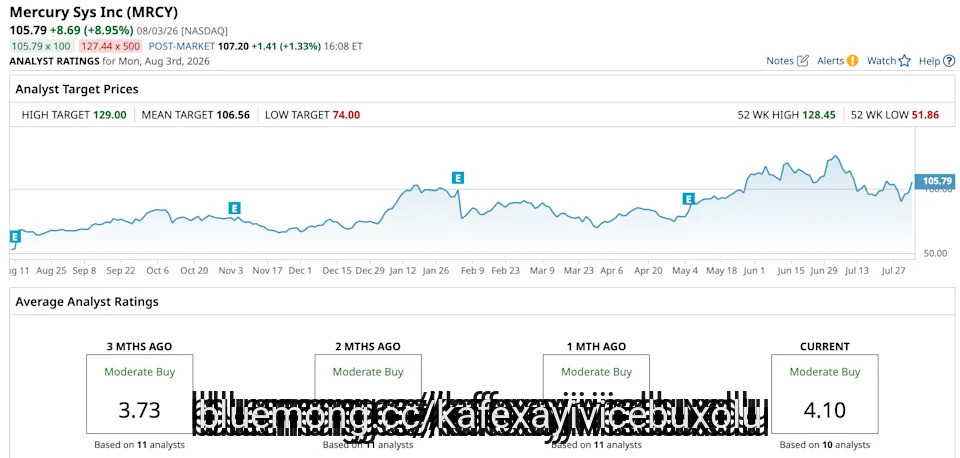
Mercury Systems (MRCY) has partnered with Palantir Technologies (PLTR) to automate factory operations and material planning, aiming to accelerate delivery of critical defense technology for U.S. military programs. The collaboration supports the Department of Defense's push to boost throughput and shorten delivery timelines for essential components across the defense industrial base.
Through two initial workflows, Mercury will streamline material planning and reduce manual workloads, strengthening its ability to scale production without extending delivery times or driving up costs. By integrating its data sources onto Palantir's Foundry platform, Mercury aims to speed up design and delivery processes to meet growing customer demand.
General Motors vs. Ford: 1 Auto Giant Is Winning the EV Race
1 **** anese Company Just Waved a Red Flag for Micron Stock. How to Play It Here.
Billionaire Ken Griffin Just Saved Situational Awareness, But Here's What a Rescue Call From Citadel Really Sounds Like — 'I… Heard the Grim Reaper's Scythe'
#mercury #defense #palantir
Through two initial workflows, Mercury will streamline material planning and reduce manual workloads, strengthening its ability to scale production without extending delivery times or driving up costs. By integrating its data sources onto Palantir's Foundry platform, Mercury aims to speed up design and delivery processes to meet growing customer demand.
General Motors vs. Ford: 1 Auto Giant Is Winning the EV Race
1 **** anese Company Just Waved a Red Flag for Micron Stock. How to Play It Here.
Billionaire Ken Griffin Just Saved Situational Awareness, But Here's What a Rescue Call From Citadel Really Sounds Like — 'I… Heard the Grim Reaper's Scythe'
#mercury #defense #palantir


10 days ago
Coinbase (NASDAQ: COIN) CEO Brian Armstrong recently claimed that the rise of artificial intelligence (AI) agents would boost cryptocurrency adoption. In a post on X, Armstrong said AI agents will need their own financial infrastructure and will eventually transact far more per day than all humans combined." Since AI agents can't open bank accounts or wait for wire transfers, Armstrong believes they will need to use cryptocurrencies as 'real-time programmable money'.
It might seem odd to think that AI agents will need their own money, but it actually makes sense if we expect those agents to work autonomously. Let's see how that could happen, and what that shift might mean for cryptocurrency investors over the long term.
Missed Nvidia in 2009? This Rare Signal Is Flashing Again. In 2009, a "Double Down" signal flashed for a little-known chipmaker called Nvidia. For the first time in years, that same "Total Conviction" signal is flashing for a company 1/100th the size of Nvidia. Continue »
Coinbase's own Base network already supports the development of AI agents. Armstrong believes those agents will eventually "need to hold funds and pay for things on their own" and "raise or borrow money for new projects they are undertaking." By doing so, they can serve as financial advisors and automate tax planning, portfolio rebalancing, and bill-paying tasks. They can also pay for other on-demand cloud and AI services to complete their own workflows.
Therefore, AI agents could operate independently and pay one another using cryptocurrencies rather than going through conventional banks. If that happens, cryptocurrencies would become a foundational layer of the agentic AI market.
#armstrong #flashing #financial
It might seem odd to think that AI agents will need their own money, but it actually makes sense if we expect those agents to work autonomously. Let's see how that could happen, and what that shift might mean for cryptocurrency investors over the long term.
Missed Nvidia in 2009? This Rare Signal Is Flashing Again. In 2009, a "Double Down" signal flashed for a little-known chipmaker called Nvidia. For the first time in years, that same "Total Conviction" signal is flashing for a company 1/100th the size of Nvidia. Continue »
Coinbase's own Base network already supports the development of AI agents. Armstrong believes those agents will eventually "need to hold funds and pay for things on their own" and "raise or borrow money for new projects they are undertaking." By doing so, they can serve as financial advisors and automate tax planning, portfolio rebalancing, and bill-paying tasks. They can also pay for other on-demand cloud and AI services to complete their own workflows.
Therefore, AI agents could operate independently and pay one another using cryptocurrencies rather than going through conventional banks. If that happens, cryptocurrencies would become a foundational layer of the agentic AI market.
#armstrong #flashing #financial

12 days ago
Investment management company Vulcan Value Partners recently released its second-quarter 2026 investor letter. A copy of the letter can be downloaded here. Vulcan Value Partners prioritizes long-term returns and lower risk over short-term performance. In the quarter, the Large Cap Composite (Net) returned 9.5%, the Small Cap Composite (Net) returned 13.3%, the Focus Composite (Net) returned 10.4%, the Focus Plus Composite (Net) returned 10.5%, and the All-Cap Composite (Net) returned 9.0%. The firm reported strong compounding across its strategies in Q2 2026. Management highlighted that their exceptional holdings remain deeply undervalued relative to "what is working" in the market, viewing this as an excellent opportunity for patient investors. In addition, please check the Firm's top five holdings to know its best picks in 2026.
Vulcan Value Partners' Q2 2026 investor letter highlighted ServiceNow, Inc. (NYSE:NOW), noting its inclusion in the firm's All-Cap strategy this quarter. ServiceNow, Inc. (NYSE:NOW) is a cloud-based software company that provides a platform for automating and managing digital workflows. On July 29, 2026, ServiceNow, Inc. (NYSE:NOW) closed at $115.76 per share, reflecting a market capitalization of $119.7 billion. ServiceNow, Inc. (NYSE:NOW) posted a one-month return of 4.56%, while its shares lost 44.33% over the past 52 weeks.
Vulcan Value Partners stated the following regarding ServiceNow, Inc. (NYSE:NOW) in its Q2 2026 investor update:
"We purchased three new positions during the quarter: Veeva Systems Inc., Equifax Inc., and ServiceNow, Inc. (NYSE:NOW). We believe that ServiceNow is also one of the best businesses in the world. ServiceNow automates workflows in large and complex enterprises. Their platform sits on top of all of an enterprise's data and systems of record. This very unique and enviable position allows ServiceNow to orchestrate and automate work across departments, enterprise wide. To use an **** ogy, if a large enterprise is an airport, and its multiple software applications are planes, ServiceNow is the control tower coordinating all of these planes/applications.
The company has grown from its roots in IT and now has very large businesses in sales and service, HR, finance, supply chain, operations, and security, as well as in industry specific verticals like Financial Services, Healthcare, and Government. ServiceNow grew revenue 21%, adjusted EBIT 28%, and free cash flow per share 33% in 2025. This growth at scale puts ServiceNow in elite company. Despite the strong performance, the stock is down approximately 40% year to date and 60% since the beginning of 2025. The company has been on our MVP list for over 5 years and has compounded its value at an incredible rate over that period. It has never been materially discounted until recently…." (Click here to read the full text)
#servicenow #composite #company #returned
Vulcan Value Partners' Q2 2026 investor letter highlighted ServiceNow, Inc. (NYSE:NOW), noting its inclusion in the firm's All-Cap strategy this quarter. ServiceNow, Inc. (NYSE:NOW) is a cloud-based software company that provides a platform for automating and managing digital workflows. On July 29, 2026, ServiceNow, Inc. (NYSE:NOW) closed at $115.76 per share, reflecting a market capitalization of $119.7 billion. ServiceNow, Inc. (NYSE:NOW) posted a one-month return of 4.56%, while its shares lost 44.33% over the past 52 weeks.
Vulcan Value Partners stated the following regarding ServiceNow, Inc. (NYSE:NOW) in its Q2 2026 investor update:
"We purchased three new positions during the quarter: Veeva Systems Inc., Equifax Inc., and ServiceNow, Inc. (NYSE:NOW). We believe that ServiceNow is also one of the best businesses in the world. ServiceNow automates workflows in large and complex enterprises. Their platform sits on top of all of an enterprise's data and systems of record. This very unique and enviable position allows ServiceNow to orchestrate and automate work across departments, enterprise wide. To use an **** ogy, if a large enterprise is an airport, and its multiple software applications are planes, ServiceNow is the control tower coordinating all of these planes/applications.
The company has grown from its roots in IT and now has very large businesses in sales and service, HR, finance, supply chain, operations, and security, as well as in industry specific verticals like Financial Services, Healthcare, and Government. ServiceNow grew revenue 21%, adjusted EBIT 28%, and free cash flow per share 33% in 2025. This growth at scale puts ServiceNow in elite company. Despite the strong performance, the stock is down approximately 40% year to date and 60% since the beginning of 2025. The company has been on our MVP list for over 5 years and has compounded its value at an incredible rate over that period. It has never been materially discounted until recently…." (Click here to read the full text)
#servicenow #composite #company #returned


13 days ago
Synopsys (SNPS) stock jumped more than 4% on Monday after the company unveiled autonomous AI workflows for chip design at the 2026 DAC Chips to Systems Conference.
The new technology, developed in collaboration with Microsoft (MSFT) and already being evaluated by AMD (AMD), marks another step toward automating complex semiconductor engineering tasks with AI agents. The announcement reinforces Synopsys' leadership in electronic design automation (EDA) software at a time when demand for AI chips continues to accelerate.
Dear Sandisk Stock Fans, Mark Your Calendars for August 5
Intel Stock Sinks 40%, But Most ****** ysts Still Aren't Bullish on INTC
Ahead of Microsoft Earnings, Here's What Barchart Data Says Comes Next for MSFT Stock
#msft #conference
The new technology, developed in collaboration with Microsoft (MSFT) and already being evaluated by AMD (AMD), marks another step toward automating complex semiconductor engineering tasks with AI agents. The announcement reinforces Synopsys' leadership in electronic design automation (EDA) software at a time when demand for AI chips continues to accelerate.
Dear Sandisk Stock Fans, Mark Your Calendars for August 5
Intel Stock Sinks 40%, But Most ****** ysts Still Aren't Bullish on INTC
Ahead of Microsoft Earnings, Here's What Barchart Data Says Comes Next for MSFT Stock
#msft #conference




14 days ago
Night View Capital, an investment management firm, released its second-quarter 2026 investor letter. The letter highlights that AI is a transformative force, comparable to electricity due to its industry-wide impact. A copy of the letter can be downloaded here. Although fears about the software sector have led to significant declines in stock prices, the letter argues that AI integration will ultimately benefit many companies. They recognize that some software firms may experience temporary slowdowns, but most will adapt and succeed by embracing AI, citing advantages like systems of record, high switching costs, entrenched distribution, and rapid AI adoption. The sharp decline in software valuations appears to be an overreaction rather than a sign of industry failure. Nightview believes the so-called "software panic of 2026" is temporary, and resilient businesses will adapt and flourish in the age of AI. In addition, please check the Strategy's top five holdings to know its best picks in 2026.
In its Q2 2026 investor letter, Night View Capital highlighted ServiceNow, Inc. (NYSE:NOW). ServiceNow, Inc. (NYSE:NOW) is a cloud-based software company that provides a platform for automating and managing digital workflows. On July 27, 2026, ServiceNow, Inc. (NYSE:NOW) closed at $107.78 per share, reflecting a market capitalization of $111.15 billion. ServiceNow, Inc. (NYSE:NOW) posted a one-month return of 4.56%, while its shares lost 44.33% over the past 52 weeks.
Night View Capital stated the following regarding ServiceNow, Inc. (NYSE:NOW) in its Q2 2026 investor update:
"ServiceNow, Inc. (NYSE:NOW) runs the digital plumbing of the enterprise: the workflows that move a request from "someone asked" to "someone did it." Automation is not a threat to that kind of business. The more work an organization wants to hand to software agents, the more it needs a trusted place to route, track, and govern what those agents do. We added here as well during the quarter."
ServiceNow, Inc. (NYSE:NOW) ranks 25 on our list of 40 Most Popular Stocks Among Hedge Funds Heading Into 2026. According to our database, 108 hedge fund portfolios held ServiceNow, Inc. (NYSE:NOW) at the end of the first quarter, compared to 118 in the previous quarter. In the first quarter of 2026, ServiceNow, Inc.'s (NYSE:NOW) subscription revenues increased 19% year-over-year (in constant currency) to $3.67 billion. While we acknowledge the risk and potential of ServiceNow, Inc. (NYSE:NOW) as an investment, our conviction lies in the belief that some AI stocks hold greater promise for delivering higher returns and doing so within a shorter time frame. If you are looking for an AI stock that is more promising than ServiceNow, Inc. (NYSE:NOW) and that has 10,000% upside potential, check out our report about this cheapest AI stock.
#servicenow #software #quarter
In its Q2 2026 investor letter, Night View Capital highlighted ServiceNow, Inc. (NYSE:NOW). ServiceNow, Inc. (NYSE:NOW) is a cloud-based software company that provides a platform for automating and managing digital workflows. On July 27, 2026, ServiceNow, Inc. (NYSE:NOW) closed at $107.78 per share, reflecting a market capitalization of $111.15 billion. ServiceNow, Inc. (NYSE:NOW) posted a one-month return of 4.56%, while its shares lost 44.33% over the past 52 weeks.
Night View Capital stated the following regarding ServiceNow, Inc. (NYSE:NOW) in its Q2 2026 investor update:
"ServiceNow, Inc. (NYSE:NOW) runs the digital plumbing of the enterprise: the workflows that move a request from "someone asked" to "someone did it." Automation is not a threat to that kind of business. The more work an organization wants to hand to software agents, the more it needs a trusted place to route, track, and govern what those agents do. We added here as well during the quarter."
ServiceNow, Inc. (NYSE:NOW) ranks 25 on our list of 40 Most Popular Stocks Among Hedge Funds Heading Into 2026. According to our database, 108 hedge fund portfolios held ServiceNow, Inc. (NYSE:NOW) at the end of the first quarter, compared to 118 in the previous quarter. In the first quarter of 2026, ServiceNow, Inc.'s (NYSE:NOW) subscription revenues increased 19% year-over-year (in constant currency) to $3.67 billion. While we acknowledge the risk and potential of ServiceNow, Inc. (NYSE:NOW) as an investment, our conviction lies in the belief that some AI stocks hold greater promise for delivering higher returns and doing so within a shorter time frame. If you are looking for an AI stock that is more promising than ServiceNow, Inc. (NYSE:NOW) and that has 10,000% upside potential, check out our report about this cheapest AI stock.
#servicenow #software #quarter


19 days ago
Ripple has launched Ripple Mint, a platform that lets institutions mint, redeem, and manage Ripple USD (RLUSD) through one console.
The company also invested in Notabene, a compliance firm, to add identity checks and transaction authorization to its stablecoin network. Standard Custody & Trust Company, a New York-chartered trust firm, issues RLUSD under state financial regulation. Jack McDonald, an executive at the company, called the Notabene deal a step toward globally compliant stablecoin transfers.
"Bringing together $RLUSD, Ripple Payments & Notabene's trusted institutional network to help scale compliant stablecoin payments," McDonald said.
Ripple Mint replaces the platform-only setup institutions previously used for RLUSD operations. Users can choose a web console for manual oversight, or new application programming interfaces (APIs) for automated workflows.
The system tracks transactions in real time and sends webhook alerts for fiat receipt, minting, and onchain settlement. Consistent reference IDs tie every stage together, which simplifies reconciliation for exchanges and market makers.
#notabene
The company also invested in Notabene, a compliance firm, to add identity checks and transaction authorization to its stablecoin network. Standard Custody & Trust Company, a New York-chartered trust firm, issues RLUSD under state financial regulation. Jack McDonald, an executive at the company, called the Notabene deal a step toward globally compliant stablecoin transfers.
"Bringing together $RLUSD, Ripple Payments & Notabene's trusted institutional network to help scale compliant stablecoin payments," McDonald said.
Ripple Mint replaces the platform-only setup institutions previously used for RLUSD operations. Users can choose a web console for manual oversight, or new application programming interfaces (APIs) for automated workflows.
The system tracks transactions in real time and sends webhook alerts for fiat receipt, minting, and onchain settlement. Consistent reference IDs tie every stage together, which simplifies reconciliation for exchanges and market makers.
#notabene


19 days ago
Ironvine Capital Partners, an investment management company, released its Q2 2026 investor letter. A copy of the letter can be downloaded here. The letter emphasizes the vital role of AI adoption in capital markets, highlighting a projected $7 trillion in new debt issuance by 2029 due to increased AI computing investments by hyperscale companies. This trend presents both risks and opportunities. The firm has shifted away from semiconductors during the quarter, as they require 2027 or 2028 spending levels for sustainable returns. The Ironvine Concentrated fund reported a year-to-date return of 11.02% (net), outperforming the S&P 500 Index's 10.21% return. In addition, please check the Strategy's top five holdings to know its best picks in 2026.
In its Q2 2026 investor letter, Ironvine Capital Partners highlighted SAP SE (NYSE:SAP). Headquartered in Walldorf, Germany, SAP SE (NYSE:SAP) is a leading enterprise application and business solutions provider. On July 22, 2026, SAP SE (NYSE:SAP) closed at $148.75 per share. One-month return of SAP SE (NYSE:SAP) was -2.51%, and its shares lost 49.41% over the past 52 weeks. SAP SE (NYSE:SAP) has a market capitalization of $175.9 billion.
Ironvine Capital Partners stated the following regarding SAP SE (NYSE:SAP) in its Q2 2026 investor update:
"Over the last five decades SAP SE (NYSE:SAP) has become the leading provider of ERP software for many of the world's largest, most supply chain-intensive companies. SAP counts 98 of the Fortune 100 as customers, with approximately 70% of revenue derived from large enterprises. Across much of this market the company operates in a duopoly with Oracle, although in certain niches it is the only practical solution. Its software integrates procurement, manufacturing, inventory, sales, human resources, and financial reporting into a single operating platform for the business.
Over time, SAP systems permeate customer operations, often with extensive customization reflecting company-specific workflows, regulatory requirements, and accumulated business knowledge. For example, Boeing relies on SAP to coordinate the ******* embly of airplanes containing tens of thousands of components, sourced from thousands of suppliers. If one part isn't where it's supposed to be, a $50 million plane doesn't move forward. Every component must be tracked, certified, and correctly installed with an auditable record. Boeing's SAP environment contains decades of custom code integrated with its supply chain to provide this digital paper trail…" (Click here to read the full text)
#NYSE #partners #letter #here
In its Q2 2026 investor letter, Ironvine Capital Partners highlighted SAP SE (NYSE:SAP). Headquartered in Walldorf, Germany, SAP SE (NYSE:SAP) is a leading enterprise application and business solutions provider. On July 22, 2026, SAP SE (NYSE:SAP) closed at $148.75 per share. One-month return of SAP SE (NYSE:SAP) was -2.51%, and its shares lost 49.41% over the past 52 weeks. SAP SE (NYSE:SAP) has a market capitalization of $175.9 billion.
Ironvine Capital Partners stated the following regarding SAP SE (NYSE:SAP) in its Q2 2026 investor update:
"Over the last five decades SAP SE (NYSE:SAP) has become the leading provider of ERP software for many of the world's largest, most supply chain-intensive companies. SAP counts 98 of the Fortune 100 as customers, with approximately 70% of revenue derived from large enterprises. Across much of this market the company operates in a duopoly with Oracle, although in certain niches it is the only practical solution. Its software integrates procurement, manufacturing, inventory, sales, human resources, and financial reporting into a single operating platform for the business.
Over time, SAP systems permeate customer operations, often with extensive customization reflecting company-specific workflows, regulatory requirements, and accumulated business knowledge. For example, Boeing relies on SAP to coordinate the ******* embly of airplanes containing tens of thousands of components, sourced from thousands of suppliers. If one part isn't where it's supposed to be, a $50 million plane doesn't move forward. Every component must be tracked, certified, and correctly installed with an auditable record. Boeing's SAP environment contains decades of custom code integrated with its supply chain to provide this digital paper trail…" (Click here to read the full text)
#NYSE #partners #letter #here


27 days ago
International Business Machines Corporation (NYSE:IBM) is one of the Best Quantum Computing Stocks to buy and Hold Forever. The company runs a growing fleet of superconducting quantum processors, offers cloud access to them through IBM Quantum, and has a public roadmap targeting fault-tolerant quantum computing by the end of the decade.
Recently, on July 9, International Business Machines Corporation (NYSE:IBM) announced major updates to Bob, which is the company's agentic software development platform. The updates add multi-agent capabilities, built-in cost ******* ytics, and pre-built workflows for modernizing enterprise systems.
Management noted that the updates are a response to shifts in software development challenges. The company's survey shows most DevSecOps professionals now see reviewing and validating AI-written code as the bigger bottleneck, rather than writing it. The platform is designed to support engineering work across the full development lifecycle, not just a single coding interface.
Management added that a new feature called Bobalytics gives organizations visibility into productivity, quality, performance, and AI spend, helping them balance cost against performance more effectively. Moreover, other new capabilities include parallel, model-native tool calling, which lets models request multiple tools in a single turn, and "subagents" that isolate context for complex tasks to control cost and improve response speed.
International Business Machines Corporation (NYSE:IBM) operates as an integrated solutions and services provider across the Asia Pacific, the Americas, the Middle East, Europe, and Africa. The company operates in the Infrastructure, Software, Financing, and Consulting segments.
Recently, on July 9, International Business Machines Corporation (NYSE:IBM) announced major updates to Bob, which is the company's agentic software development platform. The updates add multi-agent capabilities, built-in cost ******* ytics, and pre-built workflows for modernizing enterprise systems.
Management noted that the updates are a response to shifts in software development challenges. The company's survey shows most DevSecOps professionals now see reviewing and validating AI-written code as the bigger bottleneck, rather than writing it. The platform is designed to support engineering work across the full development lifecycle, not just a single coding interface.
Management added that a new feature called Bobalytics gives organizations visibility into productivity, quality, performance, and AI spend, helping them balance cost against performance more effectively. Moreover, other new capabilities include parallel, model-native tool calling, which lets models request multiple tools in a single turn, and "subagents" that isolate context for complex tasks to control cost and improve response speed.
International Business Machines Corporation (NYSE:IBM) operates as an integrated solutions and services provider across the Asia Pacific, the Americas, the Middle East, Europe, and Africa. The company operates in the Infrastructure, Software, Financing, and Consulting segments.

27 days ago
Harris Oakmark recently released its second-quarter 2026 investor letter for its "Oakmark Global Select Fund". A copy of the letter can be downloaded here. It is a non-diversified fund that focuses on long-term capital appreciation by investing in common stocks of U.S. and non-U.S. companies. In the quarter, the fund (Investor Class) delivered a return of 3.76%, lagging behind the benchmark, the MSCI World Index's 13.76 % return. Health care and consumer staples were the top performance contributors at the sector level, while consumer discretionary and information technology detracted from performance. AI remains a key market theme. The firm focuses on evaluating companies based on their competitive advantages, long-term cash flow potential, and valuation, not predictions. In addition, you can check the Fund's top five holdings to determine its best picks for 2026.
In its Q2 2026 investor letter, Oakmark Global Select Fund highlighted. SAP SE (NYSE:SAP). Headquartered in Walldorf, Germany, SAP SE (NYSE:SAP) is a leading enterprise application and business solutions provider. On July 14, 2026, SAP SE (NYSE:SAP) closed at $154.81 per share. One-month return of SAP SE (NYSE:SAP) was -2.51%, and its shares lost 49.41% over the past 52 weeks. SAP SE (NYSE:SAP) has a market capitalization of $182.51 billion.
Oakmark Global Select Fund stated the following regarding SAP SE (NYSE:SAP) in its Q2 2026 investor update:
"SAP SE (NYSE:SAP) is one of the largest enterprise software providers in the world and a global leader in enterprise resource planning. The Germany-based company provides solutions that form the backbone of its clients' technology infrastructure, leading to recurring revenue streams and very low churn rates. Recently, SAP has accelerated the rate of client migrations from on-premise to cloud systems, a trend we expect to improve growth and reduce costs. However, those benefits have not resonated in a market concerned that artificial intelligence will obscure the need for enterprise software. We believe that narrative underestimates the scale, data ownership, and definition of client workflows that make SAP an irreplaceable piece of its clients' tech ecosystems. Moreover, we have confidence that this management team—led by a tested CEO and prudent, disciplined CFO—can steer SAP through the artificial intelligence era. We have invested successfully in SAP before and were excited to buy back in at what we view as a considerable discount to our estimate of intrinsic value."
In its Q2 2026 investor letter, Oakmark Global Select Fund highlighted. SAP SE (NYSE:SAP). Headquartered in Walldorf, Germany, SAP SE (NYSE:SAP) is a leading enterprise application and business solutions provider. On July 14, 2026, SAP SE (NYSE:SAP) closed at $154.81 per share. One-month return of SAP SE (NYSE:SAP) was -2.51%, and its shares lost 49.41% over the past 52 weeks. SAP SE (NYSE:SAP) has a market capitalization of $182.51 billion.
Oakmark Global Select Fund stated the following regarding SAP SE (NYSE:SAP) in its Q2 2026 investor update:
"SAP SE (NYSE:SAP) is one of the largest enterprise software providers in the world and a global leader in enterprise resource planning. The Germany-based company provides solutions that form the backbone of its clients' technology infrastructure, leading to recurring revenue streams and very low churn rates. Recently, SAP has accelerated the rate of client migrations from on-premise to cloud systems, a trend we expect to improve growth and reduce costs. However, those benefits have not resonated in a market concerned that artificial intelligence will obscure the need for enterprise software. We believe that narrative underestimates the scale, data ownership, and definition of client workflows that make SAP an irreplaceable piece of its clients' tech ecosystems. Moreover, we have confidence that this management team—led by a tested CEO and prudent, disciplined CFO—can steer SAP through the artificial intelligence era. We have invested successfully in SAP before and were excited to buy back in at what we view as a considerable discount to our estimate of intrinsic value."


30 days ago
Halliburton has been awarded contracts to provide integrated drilling and completions services for the GranMorgu deepwater oil development located around 150km off Suriname's coast.
The deal covers a long-term programme and will see Halliburton implement a digital and automation execution model designed to connect planning, engineering and operations.
For the GranMorgu project, Halliburton plans to use integrated digital workflows, real-time data and remote operations control.
These methods aim to improve well placement accuracy and delivery ***** urance, helping to connect surface activities with subsurface objectives.
According to the company, this approach is expected to help enhance recovery and reduce overall ownership costs for TotalEnergies.
The deal covers a long-term programme and will see Halliburton implement a digital and automation execution model designed to connect planning, engineering and operations.
For the GranMorgu project, Halliburton plans to use integrated digital workflows, real-time data and remote operations control.
These methods aim to improve well placement accuracy and delivery ***** urance, helping to connect surface activities with subsurface objectives.
According to the company, this approach is expected to help enhance recovery and reduce overall ownership costs for TotalEnergies.


1 month ago
NCR Atleos Corporation (NYSE:NATL) is one of the best up and coming tech stocks to buy now. On June 23, NCR Atleos announced a new collaboration to resell Sesami's CM-Series Intelligent Teller Cash Recycler/TCR solutions to financial institutions across the US. This partnership aims to support branch modernization by providing banks and credit unions with technology that automates routine cash transactions, reduces manual processing, and enhances operational accuracy.
To ensure high performance and device availability, NCR Atleos Corporation (NYSE:NATL) will use its existing nationwide field service organization to provide hardware repair, monitoring, and issue resolution for the Sesami devices. This support structure mirrors the maintenance services currently provided for Atleos's extensive ATM fleet.
Pixabay/Public Domain
The collaboration combines Sesami's reliable, high-volume cash handling technology with Atleos's established service network and customer reach. By integrating these capabilities, the companies aim to help financial institutions streamline branch workflows, improve efficiency, and ultimately deliver a better experience for their customers.
NCR Atleos Corporation (NYSE:NATL) provides self-service banking solutions like ATMs and interactive teller machines. The company offers hardware, software, installation, and maintenance services to banks and businesses worldwide.
To ensure high performance and device availability, NCR Atleos Corporation (NYSE:NATL) will use its existing nationwide field service organization to provide hardware repair, monitoring, and issue resolution for the Sesami devices. This support structure mirrors the maintenance services currently provided for Atleos's extensive ATM fleet.
Pixabay/Public Domain
The collaboration combines Sesami's reliable, high-volume cash handling technology with Atleos's established service network and customer reach. By integrating these capabilities, the companies aim to help financial institutions streamline branch workflows, improve efficiency, and ultimately deliver a better experience for their customers.
NCR Atleos Corporation (NYSE:NATL) provides self-service banking solutions like ATMs and interactive teller machines. The company offers hardware, software, installation, and maintenance services to banks and businesses worldwide.

1 month ago
SailPoint Inc. (NASDAQ:SAIL) is one of the best up and coming tech stocks to buy now. On June 29, SailPoint announced the completion of its acquisition of Entro Security, a firm specializing in non-human identity/NHI and credential security. By integrating Entro's technology with its own platform, SailPoint aims to provide a unified control plane for managing the lifecycles and security of all identities, whether human, machine, or autonomous AI agents.
The acquisition addresses the growing challenge of managing non-human identities, which now outnumber human ones in many organizations. While SailPoint Inc.'s (NASDAQ:SAIL) existing Agentic Fabric focuses on human accountability and broad governance, Entro provides granular visibility into developer environments, automatically discovering secrets, tokens, and certificates buried within codebases, CI/CD pipelines, and container registries.
This combined solution bridges the gap between high-level governance workflows and proactive runtime defense. Security teams can now leverage Entro's NHIDR technology to monitor token behavior, detect anomalies, and intercept malicious AI activity in real time. The integration is available immediately, offering customers a comprehensive approach to mitigating risks ****** ociated with the expanding autonomous AI workforce.
SailPoint Inc. (NASDAQ:SAIL) provides an elaborate identity security platform for the enterprise, with its solutions allowing organizations to control, establish, and automate policies that allow them to attain regulatory compliance and define and maintain a robust security posture.
While we acknowledge the potential of SAIL as an investment, we believe certain AI stocks offer greater upside potential and carry less downside risk. If you're looking for an extremely undervalued AI stock that also stands to benefit significantly from Trump-era tariffs and the onshoring trend, see our free report on the best short-term AI stock.
The acquisition addresses the growing challenge of managing non-human identities, which now outnumber human ones in many organizations. While SailPoint Inc.'s (NASDAQ:SAIL) existing Agentic Fabric focuses on human accountability and broad governance, Entro provides granular visibility into developer environments, automatically discovering secrets, tokens, and certificates buried within codebases, CI/CD pipelines, and container registries.
This combined solution bridges the gap between high-level governance workflows and proactive runtime defense. Security teams can now leverage Entro's NHIDR technology to monitor token behavior, detect anomalies, and intercept malicious AI activity in real time. The integration is available immediately, offering customers a comprehensive approach to mitigating risks ****** ociated with the expanding autonomous AI workforce.
SailPoint Inc. (NASDAQ:SAIL) provides an elaborate identity security platform for the enterprise, with its solutions allowing organizations to control, establish, and automate policies that allow them to attain regulatory compliance and define and maintain a robust security posture.
While we acknowledge the potential of SAIL as an investment, we believe certain AI stocks offer greater upside potential and carry less downside risk. If you're looking for an extremely undervalued AI stock that also stands to benefit significantly from Trump-era tariffs and the onshoring trend, see our free report on the best short-term AI stock.


1 month ago
NVIDIA Corporation (NASDAQ:NVDA) is one of the best QQQ Stocks to invest in. On July 6, NVIDIA and Hugging Face announced a collaboration to integrate NVIDIA's physical AI capabilities into LeRobot, Hugging Face's open-source library for robotics. This partnership brings the NVIDIA Isaac GR00T 1.7 reasoning model and the Isaac Teleop framework directly to the LeRobot platform, providing developers with a standardized, accessible pipeline for training and deploying foundation models for humanoid robots.
The integration aims to reduce the fragmentation in robotics development by allowing users to collect human demonstration data, fine-tune models, and validate behaviors within a single ecosystem. By connecting NVIDIA Corporation's (NASDAQ:NVDA) tools (including simulation frameworks and physical AI datasets) with Hugging Face's vast community of AI builders, the initiative enables developers to standardize data collection and share performance metrics more effectively.
Looking ahead, the companies plan to incorporate NVIDIA Cosmos 3, a frontier world model, into LeRobot to further support robotics innovation where real-world data is limited. This collaboration seeks to accelerate the pace of robotics research by making advanced AI tools and workflows open and adaptable, fostering a more collaborative environment for building the next generation of physical AI.
NVIDIA Corporation (NASDAQ:NVDA) is a fabless semiconductor and AI computing company that designs GPUs, AI accelerators, APIs, and system-on-a-chip units. Through its CUDA ecosystem, the company enables industries ranging from autonomous vehicles to scientific research by advancing AI, accelerated computing, and data center infrastructure.
While we acknowledge the potential of NVDA as an investment, we believe certain AI stocks offer greater upside potential and carry less downside risk. If you're looking for an extremely undervalued AI stock that also stands to benefit significantly from Trump-era tariffs and the onshoring trend, see our free report on the best short-term AI stock.
The integration aims to reduce the fragmentation in robotics development by allowing users to collect human demonstration data, fine-tune models, and validate behaviors within a single ecosystem. By connecting NVIDIA Corporation's (NASDAQ:NVDA) tools (including simulation frameworks and physical AI datasets) with Hugging Face's vast community of AI builders, the initiative enables developers to standardize data collection and share performance metrics more effectively.
Looking ahead, the companies plan to incorporate NVIDIA Cosmos 3, a frontier world model, into LeRobot to further support robotics innovation where real-world data is limited. This collaboration seeks to accelerate the pace of robotics research by making advanced AI tools and workflows open and adaptable, fostering a more collaborative environment for building the next generation of physical AI.
NVIDIA Corporation (NASDAQ:NVDA) is a fabless semiconductor and AI computing company that designs GPUs, AI accelerators, APIs, and system-on-a-chip units. Through its CUDA ecosystem, the company enables industries ranging from autonomous vehicles to scientific research by advancing AI, accelerated computing, and data center infrastructure.
While we acknowledge the potential of NVDA as an investment, we believe certain AI stocks offer greater upside potential and carry less downside risk. If you're looking for an extremely undervalued AI stock that also stands to benefit significantly from Trump-era tariffs and the onshoring trend, see our free report on the best short-term AI stock.



1 month ago
Pegasystems Inc. (NASDAQ:PEGA) is one of the undervalued stocks to buy according to the Wall Street. On June 8, Pegasystems announced that its Pega Blueprint AI application design agent will integrate with Amazon Web Services/AWS Transform. This partnership is designed to help organizations rapidly modernize aging mainframe applications by extracting and ******* yzing legacy COBOL code to reimagine it as cloud-native, agentic applications.
The integration combines AWS Transform's ability to ******* yze and document complex COBOL code with Pega Blueprint AI's generative capabilities. By ingesting technical data and industry best practices, the platform autonomously generates future-state application designs, allowing businesses to replace outdated workflows without losing critical business logic or data structures.
This solution aims to accelerate digital transformation by reducing the manual labor and time typically required for mainframe off-ramps. By providing a seamless, iterative experience, the platform enables enterprises to build reliable and agile digital foundations that are better suited for the modern AI economy.
Pegasystems Inc. (NASDAQ:PEGA) develops, markets, licenses, and supports software that enables organizations to deploy, build, and change enterprise applications.
While we acknowledge the potential of PEGA as an investment, we believe certain AI stocks offer greater upside potential and carry less downside risk. If you're looking for an extremely undervalued AI stock that also stands to benefit significantly from Trump-era tariffs and the onshoring trend, see our free report on the best short-term AI stock.
The integration combines AWS Transform's ability to ******* yze and document complex COBOL code with Pega Blueprint AI's generative capabilities. By ingesting technical data and industry best practices, the platform autonomously generates future-state application designs, allowing businesses to replace outdated workflows without losing critical business logic or data structures.
This solution aims to accelerate digital transformation by reducing the manual labor and time typically required for mainframe off-ramps. By providing a seamless, iterative experience, the platform enables enterprises to build reliable and agile digital foundations that are better suited for the modern AI economy.
Pegasystems Inc. (NASDAQ:PEGA) develops, markets, licenses, and supports software that enables organizations to deploy, build, and change enterprise applications.
While we acknowledge the potential of PEGA as an investment, we believe certain AI stocks offer greater upside potential and carry less downside risk. If you're looking for an extremely undervalued AI stock that also stands to benefit significantly from Trump-era tariffs and the onshoring trend, see our free report on the best short-term AI stock.

1 month ago
Stepstone Group Inc. (NASDAQ:STEP) is one of the undervalued stocks to buy according to the Wall Street. On June 17, StepStone and PitchBook announced the general availability of SPI Deal Benchmarking, a solution designed to integrate institutional-grade deal-level performance and operating metrics into PitchBook's private market intelligence platform.
This partnership combines StepStone's performance data with PitchBook's research and AI-powered tools, offering users a new way to ***** yze private equity, venture capital, and infrastructure deals. The platform provides users with enhanced ***** ytics and the ability to conduct "apples-to-apples" comparisons by filtering data across industry, geography, size, and time period.
By focusing on deal-level rather than fund-level ***** ysis, the tool allows investors and fund managers to better distinguish alpha from beta and identify specific performance drivers while maintaining data confidentiality through aggregation and anonymization. This integration aims to streamline decision-making for fund managers, investors, and service providers by embedding granular benchmarks directly into existing professional workflows.
Stepstone Group Inc. (NASDAQ:STEP) is a private equity and venture capital firm specializing in primary, secondary, and co-investments. They support mature and middle-market companies across a wide range of sectors, from technology and healthcare to infrastructure and clean energy. The firm provides flexible capital solutions, including minority and majority ownership stakes.
While we acknowledge the potential of STEP as an investment, we believe certain AI stocks offer greater upside potential and carry less downside risk. If you're looking for an extremely undervalued AI stock that also stands to benefit significantly from Trump-era tariffs and the onshoring trend, see our free report on the best short-term AI stock.
This partnership combines StepStone's performance data with PitchBook's research and AI-powered tools, offering users a new way to ***** yze private equity, venture capital, and infrastructure deals. The platform provides users with enhanced ***** ytics and the ability to conduct "apples-to-apples" comparisons by filtering data across industry, geography, size, and time period.
By focusing on deal-level rather than fund-level ***** ysis, the tool allows investors and fund managers to better distinguish alpha from beta and identify specific performance drivers while maintaining data confidentiality through aggregation and anonymization. This integration aims to streamline decision-making for fund managers, investors, and service providers by embedding granular benchmarks directly into existing professional workflows.
Stepstone Group Inc. (NASDAQ:STEP) is a private equity and venture capital firm specializing in primary, secondary, and co-investments. They support mature and middle-market companies across a wide range of sectors, from technology and healthcare to infrastructure and clean energy. The firm provides flexible capital solutions, including minority and majority ownership stakes.
While we acknowledge the potential of STEP as an investment, we believe certain AI stocks offer greater upside potential and carry less downside risk. If you're looking for an extremely undervalued AI stock that also stands to benefit significantly from Trump-era tariffs and the onshoring trend, see our free report on the best short-term AI stock.

1 month ago
Microsoft Corporation (NASDAQ:MSFT) is one of the top stocks to buy according to Whale Rock Capital Management. On June 29, Haleon, a consumer health company, announced a new five-year collaboration with Microsoft Corporation (NASDAQ:MSFT) to expand the use of cloud, data, and artificial intelligence tools across Haleon's global operations.
Ken Wolter / Shutterstock.com
Haleon said the deal builds on its current use of Microsoft 365 Copilot and is designed to speed up the company's wider "Win as One" strategy. The strategy is the company's global plan for growth and digital transformation. The expanded collaboration entails Haleon continuing to use Microsoft Azure as its main cloud platform and expanding its use of Copilot. As such, Haleon will get access to broader computing power, data **** ytics, and enterprise security tools.
A major focus of the partnership is agentic AI, where Haleon plans to use this technology to help teams manage and secure digital AI agents across the business. To that end, the two companies will jointly build AI applications across several parts of Haleon's operations. This includes consumer research, product innovation, supply chain management, marketing, and commercial execution. Microsoft will also provide stronger identity management, governance, and threat protection tools, which Haleon said will let it scale AI use safely across its systems and workflows.
Haleon framed the expanded AI push as supporting two long-term business goals: reaching one billion additional consumers by 2030 and improving shareholder returns.
Ken Wolter / Shutterstock.com
Haleon said the deal builds on its current use of Microsoft 365 Copilot and is designed to speed up the company's wider "Win as One" strategy. The strategy is the company's global plan for growth and digital transformation. The expanded collaboration entails Haleon continuing to use Microsoft Azure as its main cloud platform and expanding its use of Copilot. As such, Haleon will get access to broader computing power, data **** ytics, and enterprise security tools.
A major focus of the partnership is agentic AI, where Haleon plans to use this technology to help teams manage and secure digital AI agents across the business. To that end, the two companies will jointly build AI applications across several parts of Haleon's operations. This includes consumer research, product innovation, supply chain management, marketing, and commercial execution. Microsoft will also provide stronger identity management, governance, and threat protection tools, which Haleon said will let it scale AI use safely across its systems and workflows.
Haleon framed the expanded AI push as supporting two long-term business goals: reaching one billion additional consumers by 2030 and improving shareholder returns.


1 month ago
The market has had an up-and-down year, but there are a few stocks that are taking a bigger beating than most. Microsoft (NASDAQ: MSFT) and Meta Platforms (NASDAQ: META) are two major underperformers in the tech realm, and have lost investors' money in 2026. So far, Meta is down around 12%, while Microsoft is nearly down 20%.
That's some poor performance from two stocks that have been historically great investments, and I think each could turn it around and be excellent performers before 2026 is over. Here's why.
Missed Nvidia in 2009? This Rare Signal Is Flashing Again. In 2009, a "Double Down" signal flashed for a little-known chipmaker called Nvidia. For the first time in years, that same "Total Conviction" signal is flashing for a company 1/100th the size of Nvidia. Continue »
It's hard not to appreciate Microsoft's strategy in the artificial intelligence (AI) era. It has several strategies, and all of them seem to be paying off just fine. The launch of Copilot has been incredibly successful, and this business now has $37 billion in annual revenue, growing at a 123% year-over-year pace. This allows its business productivity tools to integrate seamlessly with AI and boost productivity.
However, if clients turn sour on Copilot, it also has a thriving cloud computing division that's powering AI workflows. Azure grew at a 40% year-over-year pace in its most recent quarter, showcasing strong demand for computing infrastructure. So, even if its own internal AI tools don't pan out, it can benefit from other companies building great AI products on its platform.
That's some poor performance from two stocks that have been historically great investments, and I think each could turn it around and be excellent performers before 2026 is over. Here's why.
Missed Nvidia in 2009? This Rare Signal Is Flashing Again. In 2009, a "Double Down" signal flashed for a little-known chipmaker called Nvidia. For the first time in years, that same "Total Conviction" signal is flashing for a company 1/100th the size of Nvidia. Continue »
It's hard not to appreciate Microsoft's strategy in the artificial intelligence (AI) era. It has several strategies, and all of them seem to be paying off just fine. The launch of Copilot has been incredibly successful, and this business now has $37 billion in annual revenue, growing at a 123% year-over-year pace. This allows its business productivity tools to integrate seamlessly with AI and boost productivity.
However, if clients turn sour on Copilot, it also has a thriving cloud computing division that's powering AI workflows. Azure grew at a 40% year-over-year pace in its most recent quarter, showcasing strong demand for computing infrastructure. So, even if its own internal AI tools don't pan out, it can benefit from other companies building great AI products on its platform.