
1 month ago
Coherent jumped 6% and Lumentum climbed 5% with no catalyst, driven by short covering after both stocks fell sharply over the prior month.
SOXX gained only 2% and SPY just 0.3%, making the optics group's surge a positioning-only bounce confined to the sector, not a broad re-rating.
Just released. Our ******* ysts combed the entire stock market and named the ten best stocks to buy right now, and Coherent didn't make the cut. Enter your email to see the names that beat COHR. The report is free. Enter your email and see if any of your stocks made the cut.
Optics stocks are rebounding Wednesday morning without a fresh headline to point to, and the size of the group's move relative to the broader market is the story. The iShares Semiconductor ETF (NASDAQ:SOXX) is at $508.59, up 2%, while the SPDR S&P 500 ETF Trust (NYSEARCA:SPY) is at $759.69, up just 0.3%. The three optics names running today are outpacing both benchmarks by a wide margin.
Coherent Corp. (NYSE:COHR) stock is up 6% to $287.21 in Wednesday morning trading. The bounce arrives after a rough stretch. Coherent shares had fallen 12% over the past month heading into today's session, and that drawdown is the part of the setup that hasn't been undone.
#optics


1 month ago
Intel and SK Hynix each jumped roughly 3% after Reuters reported talks to produce memory chips at Intel's $100B Ohio campus, with plants not due until 2030.
Semiconductor ETF SOXX gained 2%, tripling QQQ's advance, while Micron risks losing its CHIPS Act home-market edge if SK Hynix secures U.S. soil production.
Just released. Our ******* ysts combed the entire stock market and named the ten best stocks to buy right now, and Intel didn't make the cut. Enter your email to see the names that beat INTC. The report is free. Enter your email and see if any of your stocks made the cut.
Shares of Intel (NASDAQ:INTC) are trading higher early Wednesday after Reuters reported the chipmaker is in talks with a Korean memory partner about producing memory chips at Intel's Ohio campus. Intel stock is up 4% to $100.55 in early Wednesday trading, extending a run that has the shares up 171% year to date. The move points to a paying tenant on the same site Intel has been funding on its own.
SK Hynix (NASDAQ:SKHY) is the reported counterparty, and its U.S.-listed shares are climbing on the same story. SK Hynix stock is up 3.3% to $180.52. The Korean memory leader is in the middle of a wider U.S. build-out that already includes a groundbreaking last month on a high-bandwidth memory (HBM) production base in Indiana.
#Intel #Stock #reuters

1 month ago
Software stocks, once left in the dust, have bounced back in recent months as high-flying chip stocks take a back seat.
"One of the things that was greatly overstated earlier this year was the death of software," Brian Mulberry, Zacks Investment Management chief market strategist, told Yahoo Finance on Tuesday.
"In order to engage with these AI tools … you need software to customize those tools for your business, " he said.
The iShares Expanded Tech-Software Sector ETF (IGV) is up 15% over the past three months and more than 40% higher from its April lows. Among individual movers, Microsoft (MSFT) and Palantir (PLTR) are both up 30%, while Salesforce (CRM) has risen more than 50% since mid-June.
In comparison, the iShares Semiconductor ETF (SOXX) is down 17% over the three-month period, according to Yahoo Finance's AlphaSpace chart.
#brian


1 month ago
KCHP launched September 15, 2026 on NYSE Arca, giving U.S. investors a single-ticker bet on South Korean semiconductor companies at a 0.65% expense ratio.
Unlike broad Korea funds EWY and FLKR or global chip ETFs SOXX and SMH, KCHP targets only Korean chipmakers but charges more than all of them.
With just one day of trading history and likely wide bid-ask spreads, KCHP carries real liquidity risk on top of concentrated memory-chip exposure.
Read More: Learn 7 ways to generate income with a $1,000,000+ portfolio (sponsor)
The specific index the fund tracks, the method used to weight the holdings (for example, by market value or a capped scheme to prevent one stock from dominating), and the exact number of positions were not spelled out in the data available for this article. Those details sit in the prospectus filed with the SEC, which investors should consult directly.
#korea
2 months ago
Intel's 7% drop and AMD's 6% slide outpace NVIDIA's 3% pullback, an order that is the reverse of AI exposure ranking, suggesting a positioning unwind rather than a demand shift.
SOXX falling 6% against QQQ's 2% drop confirms the sell-off is chip-specific, not a broad Nasdaq retreat.
Amodei explicitly ruled out halting AI training, and Anthropic itself committed to deploying AMD's MI450 GPUs in a disclosed partnership.
Just released. Our **** ysts combed the entire stock market and named the ten best stocks to buy right now, and NVIDIA made the cut. Enter your email to see the other nine names and why NVDA earned its spot. The report is free. Enter your email and see the full list.
Chip stocks are sliding in early Monday trading after an AI pacing appeal over the weekend rippled beyond memory suppliers and into logic and accelerator names. Intel (NASDAQ:INTC) stock is falling 7% to $95.96, AMD (NASDAQ:AMD) stock is down 6% to $486.80, and NVIDIA (NASDAQ:NVDA) stock is declining 3% to $212.50. Intel is falling hardest of the three, NVIDIA is falling the least, and AMD sits in the middle, an ordering that runs opposite to each name's exposure to AI accelerator demand.
#nvda


2 months ago
SWKS surged 9% and QRVO gained 6% as CEO Phil Brace confirmed China's SAMR review hit its final phase, targeting a year-end close.
SOXX dropped 2% on the same session, isolating the rally as merger-arb repricing, with AAPL the largest customer for both companies post-merger.
Just released. Our ***** ysts combed the entire stock market and named the ten best stocks to buy right now, and Skyworks Solutions didn't make the cut. Enter your email to see the names that beat SWKS. The report is free. Enter your email and see if any of your stocks made the cut.
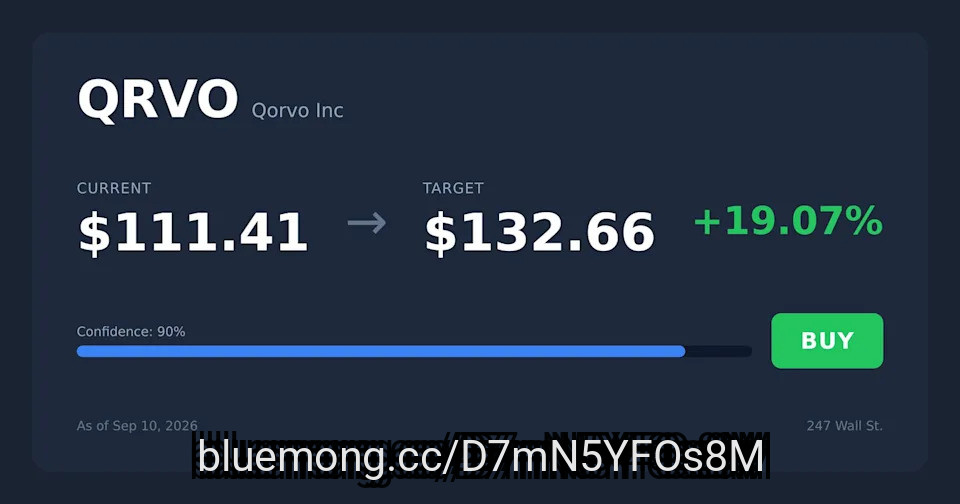
Shares of Skyworks Solutions (NASDAQ:SWKS) are up 10% to $84.24 in Thursday midday trade, while Qorvo (NASDAQ:QRVO) stock is climbing 6% to $111.49. The paired rally arrives on a session when the broader chip complex is red, which frames the move as merger-arb repricing driven by transaction odds.
The iShares Semiconductor ETF (NASDAQ:SOXX) is down 2%. Meanwhile, the Invesco QQQ Trust (NASDAQ:QQQ) is off 0.9%, so the divergence between the two RF names and the wider market isn't subtle.
#soxx #enter


0.00$ raised of 0.00$ goal
0 donations
0.00$
to go

2 months ago
It's crucial to separate two very different time frames, because they tell opposite stories. On a year-to-date basis, semiconductors still dominate: semiconductor ETFs like SOXX and SMH are up roughly 50% to 70%+, while the flagship software ETF, IGV, spent much of the year underwater, down double digits at points as investors dumped software on fears that AI would disrupt SaaS business models.
But on a month-to-date and recent-trend basis, the leadership has completely reversed. Over the past several weeks, software ETFs have sharply outperformed chip ETFs. In August alone, software crushed semiconductors in what ****** ysts called a record divergence. 58 of 61 major chip stocks fell while the software winners posted enormous monthly gains. If you're looking at the last month rather than the last year, software is winning decisively.
After a monster first half, chip stocks became expensive with some names trading at extreme forward multiples (Intel at one point traded near 79x forward earnings). Meanwhile, software had been sold off hard earlier in the year on AI-disruption fears, leaving many SaaS names historically cheap. When the growth is comparable but one side is pricey and the other is discounted, money typically rotates toward the discount.
The first phase of the AI boom was about building the infrastructure — the chips, the data centers, the memory. That phase overwhelmingly rewarded semiconductors. The market is now shifting to the next question: who actually monetizes AI? Increasingly, the answer points to the application and software layer — the companies embedding AI into enterprise products and charging for it. That thesis flows directly into software ETFs like IGV, SKYY, and WCLD.
Semiconductor indices had become historically top-heavy and crowded, with concentration metrics near record extremes. When a trade gets that crowded, it becomes vulnerable to a sharp unwind, exactly what the August sell-off in chips looked like. Investors took profits in their biggest winners and redeployed into the laggard.
#year #Semiconductors #chip #semiconductor


2 months ago
I have a chart that will knock your socks off. It's none other than the very popular iShares Semiconductor ETF (SOXX), and I've marked in purple a very important point in the long up cycle. That's a triangle, or wedge. And if SOXX breaks down through it without an instant recovery, it could open the stock market floodgates.
For now, it is simply a marker. And it won't take long to resolve, one way or the other. That's the usual nature of this type of pattern, once it hits that most narrow section at the far right of the chart.
Dear Sandisk Stock Fans, Mark Your Calendars for August 31
Bill Gates Says 'We Need Time to Prepare' for an Economic Upheaval — Especially the $20-an-Hour Workers Being Replaced by $10-an-Hour Robots
Dear Palantir Stock Fans, Here's What Maven's Billion-Dollar ARR Means for PLTR
#fans #semiconductor #i 've


2 months ago
Burry called LULU "screaming cheap," doubling his stake to 17.4% of his portfolio while shorting NVDA at a $5.2 trillion valuation.
Burry's short book extends to QQQ and SOXX, but he refuses to short AAPL, calling it "permacostly" despite its rich valuation.
With 29 of 34 ****** ysts rating LULU a Hold, Burry's contrarian bet on its forward P/E of 11 stands nearly alone on Wall Street.
Don't wait: the ****** yst who called NVIDIA in 2010 just revealed his top 10 AI stocks. See the full list FREE now.
Michael Burry is heading into the most important earnings report of the AI cycle positioned against it. NVIDIA (NASDAQ:NVDA) reports fiscal Q2 2027 results on Wednesday, Aug. 26, 2026, after the market close, and the Scion ****** et Management founder spent the weekend on his Substack, Cassandra Unchained, defending a very different kind of stock. His comments were reported by Stocktwits reporter Prabhjote Gill on Monday, Aug. 24, 2026.
#short


2 months ago
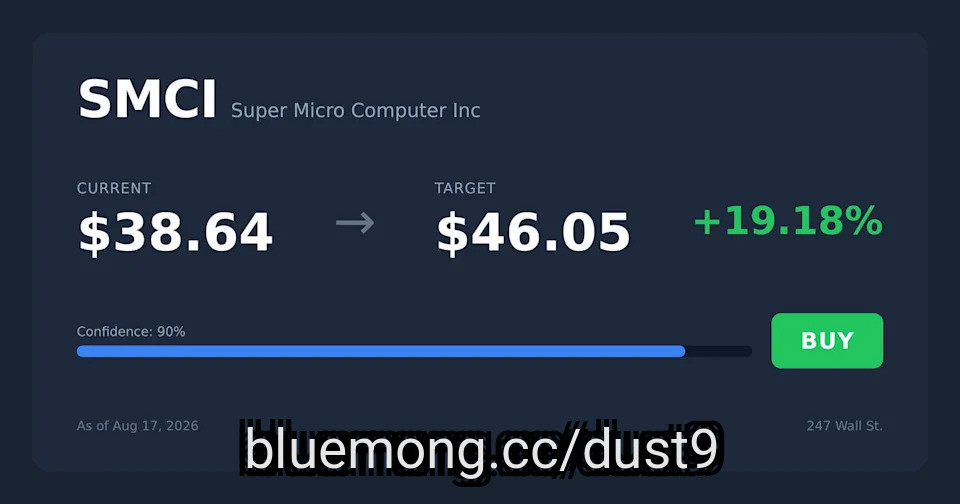
SMCI fell 4% and DELL dropped 3% after Netlist filed an ITC complaint over DDR5 patents, though SMCI remains up 28% for the week.
Micron rallied 4% despite being named in the Netlist filing, while SOXX gained 2%, both signaling sector rotation rather than fading AI demand.
Super Micro booked over $60 billion in new orders last quarter and guided fiscal 2027 revenue of $65 to $72 billion, driving last week's surge.
Act now: the ****** yst who called NVIDIA in 2010 just named his top 10 AI stocks — and Dell Technologies didn't make the cut. Grab the names FREE today.
Shares of Super Micro Computer (NASDAQ:SMCI) are down 4% to $38.4 Monday morning, giving back part of last week's rally as a fresh patent complaint over DDR5 memory modules lands on the AI server builders. The complaint names several major hardware vendors alongside memory supplier Micron Technology (NASDAQ:MU).
#last #netlist #ddr5



3 months ago
Trading in ETFs has exploded over the past few years, as a new generation of investors has come to the market and the number of funds has multiplied, offering exposure to just about every strategy imaginable.
What's interesting, though, is that the most actively traded ETFs aren't necessarily the biggest. Case in point is the Vanguard S&P 500 ETF (VOO). It's the only fund to cross $1 trillion in ******* ets, yet it barely makes the top 10 in terms of daily dollar volume.
The fund that dominates trading is the SPDR S&P 500 ETF Trust (SPY), which tracks the same index and was the largest ETF in the world for decades until VOO overtook it in 2025. It remains the runaway leader in activity, with almost $30 billion of the fund changing hands on Thursday.
The Invesco QQQ Trust (QQQ), which follows the tech-heavy Nasdaq-100, is a juggernaut in its own right, with nearly $24 billion in dollar volume.
After QQQ there is a steep drop off, though tech remains popular. The Direxion Daily Semiconductor Bull 3X Shares (SOXL) was the third most actively traded fund, with $7.6 billion changing hands.
That is an enormous figure for a fund with only $22.5 billion in ******* ets, a sign that SOXL is a trading vehicle above all else. The same is true of the ProShares UltraPro QQQ (TQQQ), which traded $4.4 billion.
SOXL and TQQQ are leveraged instruments that traders use to get amplified exposure to tech, and to the AI trade in particular. But plenty of activity went into unleveraged semiconductor funds as well.
The iShares Semiconductor ETF (SOXX) and the VanEck Semiconductor ETF (SMH) each traded roughly $4 billion. The two funds track the chip stocks that have benefited most from the AI boom.
The bearish versions drew heavy volume too, with the Direxion Daily Semiconductor Bear 3X Shares (SOXS) and the ProShares UltraPro Short QQQ (SQQQ) both landing in the top 20.
The chip theme extended overseas. The iShares MSCI South Korea ETF (EWY) traded $2.9 billion, and the Roundhill Memory ETF (DRAM), which is heavily weighted toward Korean names, traded $2.8 billion. Both cracked the top 15, a reflection of how central Korean memory makers have become to the AI story.
Outside of tech, the iShares Russell 2000 ETF (IWM) stood out with $4.9 billion, far and away the most actively traded small-cap fund. Small caps have had a strong year, rising 23% against 14% for large caps.
On the fixed income side, the iShares iBoxx $ Investment Grade Corporate Bond ETF (LQD), at $3.4 billion, and the iShares 20+ Year Treasury Bond ETF (TLT), at $2.3 billion, drew the most activity. Bonds have performed poorly this year amid expectations that the Federal Reserve could raise rates to fight resurgent inflation.
Gold remained a draw as well. The SPDR Gold Shares (GLD), with $4.3 billion, and the VanEck Gold Miners ETF (GDX), with $2.1 billion, both made the list, even though the metal has had a fairly tepid year.
A more surprising entrant in the top 20


3 months ago
Investors added $191.3 billion to US-listed ETFs in July, pushing year-to-date inflows toward $1.3 trillion.
The AI trade stayed volatile through the month, but the broader stock market held near all-time highs. Bonds went the other way, with the 30-year Treasury yield climbing to a 19-year high.
By category, US equity ETFs led the way with $75 billion of inflows. International equity ETFs followed with almost $46 billion, then US fixed income with more than $39 billion. Leveraged ETFs took in $10.5 billion, and alternatives gathered $6.3 billion.
At the individual fund level, the usual broad-market suspects sat at the top. The Vanguard S&P 500 ETF (VOO) picked up nearly $20 billion, followed by the SPDR S&P 500 ETF Trust (SPY) with $14 billion and the SPDR Portfolio S&P 500 ETF (SPYM) with more than $8 billion.
Outside of the big broad-market US funds, AI-fueled ETFs dominated. The iShares Semiconductor ETF (SOXX) picked up $6.9 billion, the Direxion Daily Semiconductor Bull 3X Shares (SOXL) added $6.9 billion, the Roundhill Memory ETF (DRAM) took in $6.2 billion, the iShares MSCI South Korea ETF (EWY) gathered $4.8 billion, and the VanEck Semiconductor ETF (SMH) brought in $4.5 billion.
#semiconductor #market #spdr #inflows


3 months ago
The semiconductor sell-off has punished investors across the board. Leverage has made the damage far harder to recover from.
The iShares Semiconductor ETF (SOXX) has fallen roughly 25% from its June 22 peak while the Direxion Daily Semiconductor Bull 3X Shares (SOXL), a leveraged ETF, has plunged nearly two-thirds over the same stretch.
The latest slide is part of a chip-stock crash that the rest of the market has largely absorbed.
The leverage unwind intensified overnight after SK Hynix (SKHY) reported earnings, sending South Korea's Kospi (^KS11) down as much as 13% before dip buyers cut the loss to 6%. Goldman Sachs traders still saw buyers stepping into memory stocks, suggesting the rout remains disorderly rather than capitulatory, even as the sell-off triggered a record wave of trading halts.
It would be easy to ******* ume that SOXL should be down three times the SOXX loss of 25%, or 75%. SOXL did not malfunction. The fund is designed to deliver three times the daily return of the NYSE Semiconductor Index.
#down



3 months ago
My article from June 28 outlining the M-A-N-I-A trade was either a warning signal to heed or a case of that broken clock being right twice a day.
In this case, MANIA refers to these uber-popular stocks, all of which are among the biggest holdings of the iShares Semiconductor ETF (SOXX), which made quite a move earlier this year:
Alibaba Stock Just Got Apple's Biggest AI Endorsement. This Could Be a Game Changer for BABA.
Elon Musk Says If ******* eX Accomplishes Its Goals, 'It Will Be Worth More Than The Rest of Earth' — Though He's Also Said 'Money Will Stop Being Relevant'
AI Bubble Fears, Earnings and Other Can't Miss Items this Week

3 months ago
The two largest semiconductor exchange-traded funds (ETFs) are the iShares Semiconductor ETF (NASDAQ: SOXX) and the VanEck Semiconductor ETF (NASDAQ: SMH). Combined, they have more than $115 billion in **** ets under management and are the two most popular ways to play the current chip rally.
At a high level, the two are pretty similar. Both have portfolios of around 25 to 30 names. They have nearly the same expense ratio. You might think the two are interchangeable.
Missed Nvidia in 2009? This Rare Signal Is Flashing Again. In 2009, a "Double Down" signal flashed for a little-known chipmaker called Nvidia. For the first time in years, that same "Total Conviction" signal is flashing for a company 1/100th the size of Nvidia. Continue »
They're not. In fact, some very simple differences in their construction strategies produce two very different portfolios. One factor in particular makes me think that the iShares Semiconductor ETF is the better choice moving forward.
These two ETFs hold mostly the same individual companies. SOXX holds a couple more, but that's only because of a slight variation in how the funds define semiconductor companies.

4 months ago
Technology remains a primary driver of market performance, but investors can choose between a broad-market approach and a specialized industry tilt.
iShares Semiconductor ETF (NASDAQ:SOXX) offers concentrated, high-volatility exposure to 30 chipmakers, while Fidelity MSCI Information Technology Index ETF (NYSEMKT:FTEC) provides a broader, lower-cost entry into the entire technology sector.
Metric
FTEC
SOXX
iShares Semiconductor ETF (NASDAQ:SOXX) offers concentrated, high-volatility exposure to 30 chipmakers, while Fidelity MSCI Information Technology Index ETF (NYSEMKT:FTEC) provides a broader, lower-cost entry into the entire technology sector.
Metric
FTEC
SOXX
4 months ago
Stock futures are sharply lower and oil prices are surging as investors react to the escalating tension between Iran and the U.S.; the two countries traded strikes overnight and President Trump said the ceasefire could be over; chip stocks are poised to extend their losses into a second session; Apple reached a deal to buy at least $30 billion worth of chips from Broadcom; and the minutes from last month's Fed meeting on interest rates are scheduled to be released this afternoon. Here's what you need to know today.
Stock futures are sinking this morning as markets react to the escalating tension between the U.S. and Iran. (more on that below) S&P 500 futures were down 0.7% recently, while futures tied to the Dow Jones Industrial Average and the tech-heavy Nasdaq dropped 1% and 1.1%, respectively. The major indexes fell yesterday as the Dow pulled back from a record high and chip stocks tumbled. WTI crude oil futures were up 5% at $74 per barrel, trading at a two-week high as investors monitored developments in the Middle East. Gold futures were down 2% at $4,075 an ounce, while bitcoin traded at $62,200, down from yesterday's high of $64,600. The yield on the 10-year Treasury note, which affects interest rates on all sorts of loans, rose to 4.57%, its highest level in more than a month.
The U.S. and Iran are again trading strikes after multiple ships were attacked in the Strait of Hormuz early yesterday. The U.S. responded by launching new strikes in Iran, and Iranian forces are retaliating by attacking other countries, including Bahrain, that host U.S. military bases. President Trump was asked about the status of the ceasefire that has kept attacks to a minimum for the last few months, and he said he thinks the agreement could be "over." Trump said U.S. officials will be allowed to continue negotiating with Iran, but said "I think they're wasting their time," per The **** ociated Press.
Chip stocks are poised to extend yesterday's losses into a second straight session. Several major hardware makers are down premarket, including Nvidia (NVDA), Intel (INTC), Marvell (MRVL), Advanced Micro Devices (AMD), Micron (MU) and Sandisk (SNDK). The AI trade stumbled yesterday after preliminary second-quarter results from South Korean tech giant Samsung beat estimates, but not by enough to wow investors, dragging the U.S. tech sector lower. Samsung shares fell by more than 6% for a second straight day in Korean Stock Exchange trading on Wednesday. Worries about an AI bubble have also been reignited for some investors recently after last month's rally that sent many AI stocks to new record highs. The iShares Semiconductor ETF (SOXX) was down 2% in recent premarket trading, while the Roundhill Memory ETF (DRAM) dropped more than 5%.

4 months ago
Samsung's record $58B quarterly profit still triggered a chip selloff, sinking Intel and Applied Materials each 10% and pushing AMD 8% lower as investors questioned stretched AI valuations.
The SOXX ETF fell 6% while the Dow hit a record Monday, confirming the selloff is chip-specific rather than a broader market breakdown.
AMD's 208x P/E and Applied Materials' 30%-plus growth guidance leave both stocks highly exposed to any earnings shortfall in coming quarters.
Act now: the ****** yst who called NVIDIA in 2010 just named his top 10 AI stocks — and AMD didn't make the cut. Grab the names FREE today.
Shares of Intel (NASDAQ:INTC) are down 10% in Tuesday morning trading to $110, while Advanced Micro Devices (NASDAQ:AMD) stock is off 8% to $508. The moves cap a sharp reversal after both names rallied Monday.


4 months ago
Investors poured $210 billion into US-listed ETFs in June, pushing year-to-date inflows past $1 trillion and putting 2026 on track for a $2 trillion haul if the current pace holds.
US equity ETFs did most of the heavy lifting for the month, taking in $103 billion. Fixed income funds followed with $46 billion, international equity ETFs added $37 billion, and leveraged products picked up $15 billion. The two categories in the red were commodities, which lost $6 billion, and currency ETFs, which shed $4.6 billion.
The backdrop was a strong one. US stocks climbed to fresh records during the second quarter after finishing near their lows for the year at the end of Q1, when the war involving Iran, Israel and the US rattled markets. The S&P 500 was up more than 10% at the midpoint of the year, and the Nasdaq-100 had gained over 20%.
International stocks also performed well, rising around 14%, while bonds managed only a fractional gain.
The flows data, which comes courtesy of FactSet, showed the iShares Core S&P 500 ETF (IVV) at the top of the June leaderboard.
Right behind it was the Roundhill Memory ETF (DRAM), the breakout hit that has become one of the fastest-growing ETFs of all time. The fund pulled in almost $10 billion during the month, lifting its ***** ets above $25 billion. Another AI winner, the iShares Semiconductor ETF (SOXX), collected $4.1 billion.
Returns for both ETFs have been remarkable. SOXX is up 113% so far this year, most of that coming in the second quarter, and DRAM has gained 166% since it launched in April.
Other standouts on the inflows side included the iShares Systematic Alternatives Active ETF (IALT), which took in $4.3 billion in what looks like a model portfolio or institutional allocation. The iShares 0-3 Month Treasury Bond ETF (SGOV) added nearly $4 billion, making it the biggest fixed income winner of June.
The outflows column was led by the iShares MSCI EAFE Value ETF (EFV), which lost $5.6 billion. The ETF gained 10% through the first half of the year, which is respectable, but trailed the broader international category.
Another value fund, the iShares MSCI USA Value Factor ETF (VLUE), gave up $5.4 billion even as it turned in one of the stronger performances of any fund this year, up 47% on the back of well-timed stakes in Micron and Cisco, two tech names that have taken off.
Rounding out the June outflows list were the iShares Bitcoin Trust (IBIT) and the SPDR Gold Shares (GLD), which shed $3.4 billion and $3.2 billion. Both bitcoin and gold have had a rough year, down 33% and 7%.
A full list of the top inflows and outflows for June and for 2026 so far appears in the tables below.


4 months ago
No pair dominated ETF.com's comparison tool in the first half of 2026 more than the VanEck Semiconductor ETF (SMH) against the iShares Semiconductor ETF (SOXX), with 6,743 views. With the AI infrastructure buildout continuing to fuel explosive demand for chips, it's little surprise investors want to know which semiconductor ETF belongs in their portfolio.
On the surface, these two funds look nearly identical — same sector, overlapping holdings, nearly identical expense ratios (SMH at 0.35%, SOXX at 0.34%). But dig into the details and meaningful differences emerge.
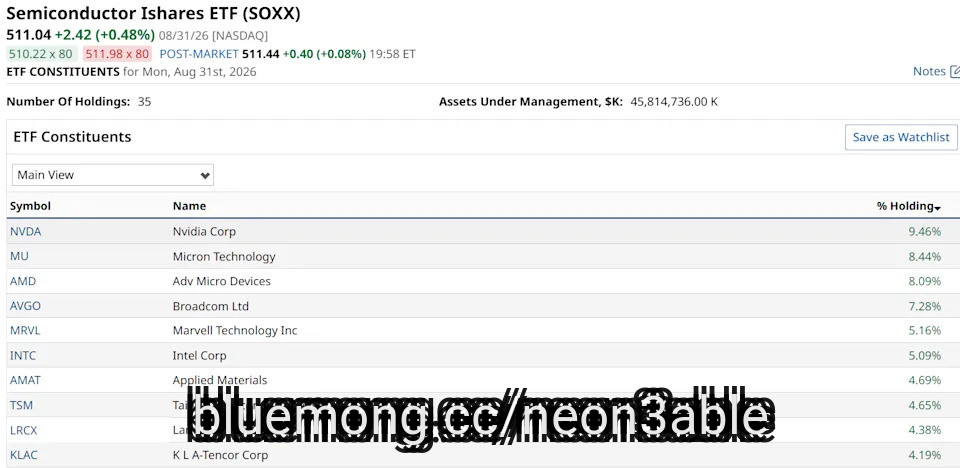
The biggest distinction is portfolio construction. SMH holds just 26 stocks, making it a highly concentrated bet on the sector's largest players. NVIDIA alone represents 17.55% of the fund. SOXX, by contrast, holds 31 names and applies a more equal-weight tilt — NVIDIA sits at just 6.81% there, while Micron Technology and AMD each carry larger weights than in SMH.
That difference in construction has translated into divergent performance. Over the trailing year through mid-2026, SOXX returned 169.68% compared to SMH's 135.91% — a stunning gap driven in part by SOXX's heavier exposure to names that outperformed. Over three years, however, SMH holds the edge, returning 63.44% against SOXX's 56.95% CAGR.
Size is also a factor: SMH is the larger fund at $74.4B in AUM versus SOXX's $45.9B, and SMH's average daily dollar volume of $6.1B gives it a slight liquidity advantage. For investors who want pure, high-octane semiconductor exposure in a liquid wrapper, this debate isn't going away anytime soon.


4 months ago
SOXX surged 96% year-to-date then shed nearly 8% in one week after Broadcom's softer AI chip forecast and SK Hynix slowed memory expansion.
Unlike SMH's NVIDIA-heavy concentration, SOXX's tilt toward Applied Materials and Micron means equipment booking cancellations hit three top weights simultaneously.
Michael Burry holds a January 2027 $330 put on SOXX, betting hyperscaler capex cuts below $1 trillion will unwind the fund's premium valuation.
Don't wait: the ****** yst who called NVIDIA in 2010 just revealed his top 10 AI stocks. See the full list FREE now.
The iShares Semiconductor ETF (NASDAQ:SOXX) has had one of the most violent round trips in its history. SOXX is up 96% year to date and 148% over the past 12 months, yet it just shed almost 8% in a single week, closing near $590. That whipsaw, triggered by Broadcom's softer AI chip sales forecast and SK Hynix slowing its AI memory expansion, is exactly why the next 12 months for SOXX will hinge on two specific signals, not a generic tech narrative.

4 months ago
Move over, Magnificent 7. It's time for the M-A-N-I-A trade, courtesy of the top holdings of the iShares Semiconductor ETF (SOXX).
The top 20 holdings in SOXX by size start with Micron (MU), Advanced Micro Devices (AMD), Intel (INTC), Broadcom (AVGO), and Nvidia (NVDA). They might as well be the new pop stars of the U.S. stock market. You can rearrange that nicely to MU-AMD-NVDA-INTC-AVGO, or "MANIA" for short.
Billionaire Mark Cuban Asks If AI 'Collapses' And Data Centers Turn Into 'Chuck E Cheeses,' Would That 'Create A Revival Of Jobs?'
As Trump Doubles Down on Quantum Computing, This Is the Top-Performing Stock to Buy YTD
Why Verizon, AT&T, and T-Mobile Should Be Terrified of Elon Musk's Next Move


4 months ago
The tech sector took a hit on June 22, 2026. The Nasdaq 100 ($IUXX) dropped 3.29%, while the iShares Semiconductor ETF (SOXX) fell 7.88%. In Asia, South Korea's Kospi slid over 10% as foreign investors pulled more than $2.5 billion from chip stocks. Sandisk (SNDK) lost 13.64%, Micron Technology (MU) lost 13.18%, while Samsung Electronics dropped more than 12%. The sell-off started in Asia and spread globally as investors began questioning whether heavy AI spending can really support current chip valuations.
But while chip stocks were falling, International Business Machines (IBM) moved the other way. The stock jumped 5.3% in midday training to lead the Dow Jones industrials after JPMorgan upgraded it to "Overweight" from "Neutral" and raised its price target to $291. The firm pointed to stronger confidence in software growth going into the second half of 2026, noting that software makes up about 45% of revenue but drives roughly two-thirds of total profit.
Palantir Stock Crashes to a 52-Week Low: Why It's Time to Buy the Dip.
Corning Stock Skyrockets on AI-Related Demand, Spurring Unusual Call Option Buying
Nasdaq Futures Gain After Brutal Tech Selloff, Micron Earnings in Focus



4 months ago
Any time an ETF can double in value in a handful of years, it's an impressive feat. Based on the Rule of 72, it would take an investment 7.2 years to double in value if it averaged 10% annual returns.
Any time an exchange-traded fund (ETF) can double in value in half a year, it's on a generational run. That's been the case so far this year with the iShares Semiconductor ETF (NASDAQ: SOXX). Through market close on June 22, SOXX is up 108%, 12 times higher than the S&P 500's returns in that time.
Missed Nvidia in 2009? This Rare Signal Is Flashing Again. In 2009, a "Double Down" signal flashed for a little-known chipmaker called Nvidia. For the first time in years, that same "Total Conviction" signal is flashing for a company 1/100th the size of Nvidia. Continue »
Considering SOXX's huge run-up this year, is it still a buy, or have investors missed the boat? Let's take a look.
Semiconductors (chips) are the invisible heroes of the tech world. You might not see them, but any time you're using an electronic device -- whether it's a smartphone, laptop, tablet, TV, or car infotainment system -- you're indirectly interacting with chips.


4 months ago
Broad U.S. stock indexes were all down on Tuesday, with tech-hardware stocks seeing especially sharp pullbacks.
The S&P 500 SPX declined 1.4%, while its information-technology sector XX:SP500.45 was down 3.7%.
Is Wendy's the next meme stock? Everyday traders are trying to 'save' the fast-food chain.
'We are habitually frugal': My wife and I have money. How do we help our children without ruining their independence?
Digging further into tech, the iShares Semiconductor ETF SOXX was down 7.9% on the day. This exchange-traded fund holds 30 stocks tracking the PHLX Semiconductor Index SOX — and all of them declined on Tuesday.