

1 hr. ago
Tesla, Inc. (NASDAQ:TSLA) spent nearly two years raising anticipation for the Cybercab. When the time arrived on September 3 in Austin, the result was a stock that popped, then rapidly returned all of its gains, and a robotaxi race that still seems to be Alphabet's to lose.
Tesla, Inc. (NASDAQ:TSLA) had its long-awaited Cybercab launch event in Austin, Texas, but it was invitation-only, not livestreamed, and CEO Elon Musk wasn't there. The company's main public update was a 51-second video released on X of the two-seat, steering-wheel-free vehicle roaming city streets and people hailing it by app. Shares rose roughly 5% throughout the session, finishing near $376. By September 4, enthusiasm had waned, with the stock plummeting as much as 6% as investors realized how little the event revealed about deployment timelines, production ramp, or regulatory clearance.
Only 45 Cybercabs were registered in Texas, and Tesla, Inc. (NASDAQ:TSLA) did not seek an NHTSA exemption before deployment, instead self-certifying the Cybercab as compliant with applicable federal safety standards. NHTSA subsequently opened an audit into that certification and has ordered Tesla to provide additional information about the basis for its compliance claims. CNBC summarized the reaction bluntly: the update "underwhelmed" Wall Street, which had been relying on Tesla, Inc. (NASDAQ:TSLA) becoming a strong rival in the robotaxi sector, which Alphabet's Waymo currently leads.
That comparison is at the heart of the story. Waymo has established the operational track record that Tesla, Inc. (NASDAQ:TSLA) is still chasing: more than 4,000 autonomous vehicles across its U.S. fleet and more than 500,000 fully autonomous rides per week.
Wall Street's take on the incident was severely divided along those lines. Despite Tesla's efforts to control the narrative, some ******* ysts, including Gary Black of Future Fund, called the Cybercab debut largely a bust. Others, such as Deepwater ******* et Management's Gene Munster, predicted that Tesla, Inc. (NASDAQ:TSLA) will add approximately 300 Cybercabs in Austin over the next month.
#tesla #NASDAQ #cybercab
Tesla, Inc. (NASDAQ:TSLA) had its long-awaited Cybercab launch event in Austin, Texas, but it was invitation-only, not livestreamed, and CEO Elon Musk wasn't there. The company's main public update was a 51-second video released on X of the two-seat, steering-wheel-free vehicle roaming city streets and people hailing it by app. Shares rose roughly 5% throughout the session, finishing near $376. By September 4, enthusiasm had waned, with the stock plummeting as much as 6% as investors realized how little the event revealed about deployment timelines, production ramp, or regulatory clearance.
Only 45 Cybercabs were registered in Texas, and Tesla, Inc. (NASDAQ:TSLA) did not seek an NHTSA exemption before deployment, instead self-certifying the Cybercab as compliant with applicable federal safety standards. NHTSA subsequently opened an audit into that certification and has ordered Tesla to provide additional information about the basis for its compliance claims. CNBC summarized the reaction bluntly: the update "underwhelmed" Wall Street, which had been relying on Tesla, Inc. (NASDAQ:TSLA) becoming a strong rival in the robotaxi sector, which Alphabet's Waymo currently leads.
That comparison is at the heart of the story. Waymo has established the operational track record that Tesla, Inc. (NASDAQ:TSLA) is still chasing: more than 4,000 autonomous vehicles across its U.S. fleet and more than 500,000 fully autonomous rides per week.
Wall Street's take on the incident was severely divided along those lines. Despite Tesla's efforts to control the narrative, some ******* ysts, including Gary Black of Future Fund, called the Cybercab debut largely a bust. Others, such as Deepwater ******* et Management's Gene Munster, predicted that Tesla, Inc. (NASDAQ:TSLA) will add approximately 300 Cybercabs in Austin over the next month.
#tesla #NASDAQ #cybercab

6 days ago
Tesla, Inc. (NASDAQ:TSLA) is moving further into the autonomous-driving market as it has started offering robotaxi rides using its Cybercab. The company hosted a Cybercab launch event in Austin on September 3.
Following the event, Goldman Sachs maintained a Neutral rating on Tesla, Inc. (NASDAQ:TSLA). The bank has a 12-month price target of $360 on the stock. The firm sees an illustrative upside scenario of about $500 and a downside scenario of roughly $150.
Goldman Sachs said the Cybercab could give the company a cost advantage in the autonomous-vehicle market. However, the firm believes the company's ability to scale its robotaxi business will depend more on software performance than on the cost of manufacturing the vehicle.
Tesla, Inc. (NASDAQ:TSLA) said it has completed 1 million miles of unsupervised robotaxi operations. The company is also looking for operators interested in owning Cybercab fleets, running hubs and related infrastructure, or hosting robotaxi events.
Goldman Sachs highlighted the company's focus on developing a low-cost autonomous vehicle. The company's unboxed manufacturing approach and camera-only sensor system could help improve the economics of its robotaxi business. According to Goldman estimates, if Tesla, Inc. (NASDAQ:TSLA) can achieve its targeted Cybercab cost of $20,000 to $30,000 at scale, it could have a potential $0.05 to $0.30 per-mile cost advantage over autonomous-vehicle competitors with upfront vehicle costs of $50,000 to $100,000.
#sachs
Following the event, Goldman Sachs maintained a Neutral rating on Tesla, Inc. (NASDAQ:TSLA). The bank has a 12-month price target of $360 on the stock. The firm sees an illustrative upside scenario of about $500 and a downside scenario of roughly $150.
Goldman Sachs said the Cybercab could give the company a cost advantage in the autonomous-vehicle market. However, the firm believes the company's ability to scale its robotaxi business will depend more on software performance than on the cost of manufacturing the vehicle.
Tesla, Inc. (NASDAQ:TSLA) said it has completed 1 million miles of unsupervised robotaxi operations. The company is also looking for operators interested in owning Cybercab fleets, running hubs and related infrastructure, or hosting robotaxi events.
Goldman Sachs highlighted the company's focus on developing a low-cost autonomous vehicle. The company's unboxed manufacturing approach and camera-only sensor system could help improve the economics of its robotaxi business. According to Goldman estimates, if Tesla, Inc. (NASDAQ:TSLA) can achieve its targeted Cybercab cost of $20,000 to $30,000 at scale, it could have a potential $0.05 to $0.30 per-mile cost advantage over autonomous-vehicle competitors with upfront vehicle costs of $50,000 to $100,000.
#sachs


7 days ago
Benzinga and Yahoo Finance LLC may earn commission or revenue on some items through the links below.
Investor Ross Gerber on Monday advised Tesla Inc. owners to refrain from participating in the EV giant's Airbnb Inc.-like Robotaxi service rollout amid the Cybercab launch.
In a series of posts on the social media platform X on Monday, the Gerber Kawasaki co-founder shared his view on CEO Elon Musk's vision about the Cybercab being a crossover between Airbnb and Uber Technologies Inc.. "So tesla sells the cybercab to other "fleet managers" and takes a cut of the revenue for managing the system plus the sale price," the investor said in his post.
Don't Miss:
A single bad hire can set a startup back years. Here are the 5 hires founders most often misjudge — and why
#gerber #finance
Investor Ross Gerber on Monday advised Tesla Inc. owners to refrain from participating in the EV giant's Airbnb Inc.-like Robotaxi service rollout amid the Cybercab launch.
In a series of posts on the social media platform X on Monday, the Gerber Kawasaki co-founder shared his view on CEO Elon Musk's vision about the Cybercab being a crossover between Airbnb and Uber Technologies Inc.. "So tesla sells the cybercab to other "fleet managers" and takes a cut of the revenue for managing the system plus the sale price," the investor said in his post.
Don't Miss:
A single bad hire can set a startup back years. Here are the 5 hires founders most often misjudge — and why
#gerber #finance

0.00$ raised of 0.00$ goal
0 donations
0.00$
to go

7 days ago
For today's Kevin O'Connor Show, KOC is joined by Raj Chipalu from Lakers Screen & Roll to continue the NBA Entertainment rankings with Luka Doncic's Lakers. Who's the fifth starter for Los Angeles? Can Luka win MVP with this roster?
Then, KOC reviews the young Spurs fresh off an NBA Finals appearance. What will they do with Dylan Harper?
Plus, EV + tech guru Sawyer Merritt joins to talk about Tesla's new Cybercab.
01:01 Entertainment Rankings No. 4 with Raj Chipalu: Los Angeles Lakers
28:26 Entertainment Rankings No. 3: San Antonio Spurs
#luka #kevin #show
Then, KOC reviews the young Spurs fresh off an NBA Finals appearance. What will they do with Dylan Harper?
Plus, EV + tech guru Sawyer Merritt joins to talk about Tesla's new Cybercab.
01:01 Entertainment Rankings No. 4 with Raj Chipalu: Los Angeles Lakers
28:26 Entertainment Rankings No. 3: San Antonio Spurs
#luka #kevin #show


0.00$ raised of 0.00$ goal
0 donations
0.00$
to go

10 days ago
In typical fashion, Tesla (NASDAQ: TSLA) has been an extremely volatile stock to own in the past five years. During this time, the share price fell at least 30% on three separate occasions.
But unlike historical trends, this electric vehicle (EV) stock has underperformed the S&P 500 index over the trailing half decade. It's up only 54% during this time (as of Sept. 4), while the benchmark has climbed 71%.
Missed Nvidia in 2009? This Rare Signal Is Flashing Again. In 2009, a "Double Down" signal flashed for a little-known chipmaker called Nvidia. For the first time in years, that same "Total Conviction" signal is flashing for a company 1/100th the size of Nvidia. Continue »
This business continues to live in the spotlight, which will certainly result in persistently heightened volatility for investors to deal with. Where will Tesla be in five years?
On Sept. 3, Tesla held an invite-only event launching its much-hyped Cybercab vehicle. The car design, which comes with no pedals and no steering wheel, was revealed nearly two years ago in October 2024. However, the company finally introduced a small number of Cybercabs to its Austin robotaxi fleet. There are 250 vehicles in the total robotaxi fleet (also including model Y's) that Tesla operates both in Texas and Florida.
#years #signal #sept #flashing
But unlike historical trends, this electric vehicle (EV) stock has underperformed the S&P 500 index over the trailing half decade. It's up only 54% during this time (as of Sept. 4), while the benchmark has climbed 71%.
Missed Nvidia in 2009? This Rare Signal Is Flashing Again. In 2009, a "Double Down" signal flashed for a little-known chipmaker called Nvidia. For the first time in years, that same "Total Conviction" signal is flashing for a company 1/100th the size of Nvidia. Continue »
This business continues to live in the spotlight, which will certainly result in persistently heightened volatility for investors to deal with. Where will Tesla be in five years?
On Sept. 3, Tesla held an invite-only event launching its much-hyped Cybercab vehicle. The car design, which comes with no pedals and no steering wheel, was revealed nearly two years ago in October 2024. However, the company finally introduced a small number of Cybercabs to its Austin robotaxi fleet. There are 250 vehicles in the total robotaxi fleet (also including model Y's) that Tesla operates both in Texas and Florida.
#years #signal #sept #flashing


14 days ago
Tesla
TSLA
+0.26%
stock started the week with a bang, rising 5.5%
on Monday
. Investors’ optimism wasn’t easy to explain. The likeliest reason, according to
Future FundExternal link
co-founder
Gary Black
, was
robo-taxis
. Investors are getting more excited about a potential introduction of Tesla’s Cybercab into its fleet of self-driving cabs. Investors, however, might be getting ahead of themselves.
TSLA
+0.26%
Copyright ©2026 Dow Jones & Company, Inc. All Rights Reserved. 87990cbe856818d5eddac44c7b1cdeb8
#tesla #Tsla #getting
TSLA
+0.26%
stock started the week with a bang, rising 5.5%
on Monday
. Investors’ optimism wasn’t easy to explain. The likeliest reason, according to
Future FundExternal link
co-founder
Gary Black
, was
robo-taxis
. Investors are getting more excited about a potential introduction of Tesla’s Cybercab into its fleet of self-driving cabs. Investors, however, might be getting ahead of themselves.
TSLA
+0.26%
Copyright ©2026 Dow Jones & Company, Inc. All Rights Reserved. 87990cbe856818d5eddac44c7b1cdeb8
#tesla #Tsla #getting

15 days ago
Tesla (NASDAQ:TSLA), the global electric vehicle (EV) and energy storage manufacturer, closed at $367.95, up 5.51%. Investors focused on the upcoming Sept. 3 Cybercab event and renewed interest in FSD and robotaxi plans.
Trading volume reached 60.9 million shares, coming in about 46% above its three-month average of 41.6 million shares. Tesla IPO'd in 2010 and has grown 23,042% since going public.
The S&P 500 (SNPINDEX:^GSPC) closed at 7,686, down 0.33%, while the Nasdaq Composite (NASDAQINDEX:^IXIC) closed at 26,371, down 0.12%. Among EV and automotive software peers, Rivian Automotive (NASDAQ:RIVN) closed at $16.06, down 0.06%, and Lucid Group (NASDAQ:LCID) closed at $4.85, down 3.19%.
Tesla CEO Elon Musk has been guiding investors to focus on his company's EV autonomy software as a main driver for Tesla's future fortunes. The next big step in that regard is coming on Thursday, and anticipation looked to be helping drive shares higher today.
The invite-only Cybercab event in Austin is being billed as offering exclusive access to the steering-wheel- and pedal-free vehicle. Investors may hear more from that gathering about Tesla's progress and plans for that brand-new product.
Tesla's full self-driving (FSD) technology gained approval for a limited robotaxi rollout in Nevada two weeks ago, helping to expand its footprint and set the stage for an eventual Cybercab fleet.
#tesla #down #Event
Trading volume reached 60.9 million shares, coming in about 46% above its three-month average of 41.6 million shares. Tesla IPO'd in 2010 and has grown 23,042% since going public.
The S&P 500 (SNPINDEX:^GSPC) closed at 7,686, down 0.33%, while the Nasdaq Composite (NASDAQINDEX:^IXIC) closed at 26,371, down 0.12%. Among EV and automotive software peers, Rivian Automotive (NASDAQ:RIVN) closed at $16.06, down 0.06%, and Lucid Group (NASDAQ:LCID) closed at $4.85, down 3.19%.
Tesla CEO Elon Musk has been guiding investors to focus on his company's EV autonomy software as a main driver for Tesla's future fortunes. The next big step in that regard is coming on Thursday, and anticipation looked to be helping drive shares higher today.
The invite-only Cybercab event in Austin is being billed as offering exclusive access to the steering-wheel- and pedal-free vehicle. Investors may hear more from that gathering about Tesla's progress and plans for that brand-new product.
Tesla's full self-driving (FSD) technology gained approval for a limited robotaxi rollout in Nevada two weeks ago, helping to expand its footprint and set the stage for an eventual Cybercab fleet.
#tesla #down #Event


15 days ago
Tesla stock shot to the top of the S&P 500 on Monday. Shares rose more than 5% over the course of the day, according to MarketSurge.
There was no immediate catalyst for the stock. However, a series of developments over the weekend may have been responsible for the rally. CEO Elon Musk made comments about future updates to Tesla's self-driving software. When an X user said they would like their "Tesla to be able to avoid potholes," Musk replied: "Coming soon."
Any remarks about upgrades to Full Self-Driving tend to catch investors' attention, given the software's importance to Tesla's future.
Musk also hinted at an imminent release of Cybercabs in Austin, Texas. The long-awaited launch of Tesla's robotaxi-specific EV model would be a notable milestone for its still nascent service. Last month, when Musk and team, told investors the robotaxi expansion would be slow, the stock tanked.
Stock Market Today: Dow Skids, Oil Stock Tests Entry
#Stock
There was no immediate catalyst for the stock. However, a series of developments over the weekend may have been responsible for the rally. CEO Elon Musk made comments about future updates to Tesla's self-driving software. When an X user said they would like their "Tesla to be able to avoid potholes," Musk replied: "Coming soon."
Any remarks about upgrades to Full Self-Driving tend to catch investors' attention, given the software's importance to Tesla's future.
Musk also hinted at an imminent release of Cybercabs in Austin, Texas. The long-awaited launch of Tesla's robotaxi-specific EV model would be a notable milestone for its still nascent service. Last month, when Musk and team, told investors the robotaxi expansion would be slow, the stock tanked.
Stock Market Today: Dow Skids, Oil Stock Tests Entry
#Stock


23 days ago
SpaceX (NASDAQ: SPCX), Tesla (NASDAQ: TSLA), and Intel (NASDAQ: INTC) recently broke ground on the Terafab, the world's largest vertically integrated chipmaking factory. The massive plant is located in Grimes County, approximately 70 miles outside of Houston.
The initial phase of the Terafab will cost $16.8 billion, while its total costs across all phases could surpass $119 billion. Upon completion, the 100-million-square-foot facility will meet ******* eX and Tesla's projected computing demand of more than 1 terawatt per year.
Missed Nvidia in 2009? This Rare Signal Is Flashing Again. In 2009, a "Double Down" signal flashed for a little-known chipmaker called Nvidia. For the first time in years, that same "Total Conviction" signal is flashing for a company 1/100th the size of Nvidia. Continue »
SpaceX and Tesla will fund the plant's construction, while Intel will support its development with its licensed chipmaking process and foundry operations. ******* eX and Tesla haven't disclosed the exact dollar-for-dollar equity split for the project, but ******* eX will absorb a larger portion of those costs because it will claim more of those chips. Approximately 75% of the Terafab's chips will be allocated to ******* eX's orbital data centers and satellite constellations, while the remaining 25% will power Tesla's Optimus robots, self-driving vehicles, and Cybercabs.
Those chips could help ******* eX achieve Elon Musk's ambitious goal of becoming the first company to generate over $1 trillion in annual revenue by 2030. To achieve that goal, ******* eX would need its Starlink, rocket launch, and AI businesses to grow exponentially.
#tesla #Intel #approximately
The initial phase of the Terafab will cost $16.8 billion, while its total costs across all phases could surpass $119 billion. Upon completion, the 100-million-square-foot facility will meet ******* eX and Tesla's projected computing demand of more than 1 terawatt per year.
Missed Nvidia in 2009? This Rare Signal Is Flashing Again. In 2009, a "Double Down" signal flashed for a little-known chipmaker called Nvidia. For the first time in years, that same "Total Conviction" signal is flashing for a company 1/100th the size of Nvidia. Continue »
SpaceX and Tesla will fund the plant's construction, while Intel will support its development with its licensed chipmaking process and foundry operations. ******* eX and Tesla haven't disclosed the exact dollar-for-dollar equity split for the project, but ******* eX will absorb a larger portion of those costs because it will claim more of those chips. Approximately 75% of the Terafab's chips will be allocated to ******* eX's orbital data centers and satellite constellations, while the remaining 25% will power Tesla's Optimus robots, self-driving vehicles, and Cybercabs.
Those chips could help ******* eX achieve Elon Musk's ambitious goal of becoming the first company to generate over $1 trillion in annual revenue by 2030. To achieve that goal, ******* eX would need its Starlink, rocket launch, and AI businesses to grow exponentially.
#tesla #Intel #approximately

24 days ago
Benzinga and Yahoo Finance LLC may earn commission or revenue on some items through the links below.
Investment bank JPMorgan Chase & Co. on Wednesday said that Tesla Inc. appears to be prioritizing the Cybercab over further scaling its Model Y robotaxi fleet.
Influencer and Tesla investor Sawyer Merritt took to the social media platform X, sharing a note released by JPMorgan following its meeting with the EV giant's management at its Fremont, California, facility. JPMorgan said that Tesla "expressed confidence in its ability to scale Cybercab in the near-term."
Don't Miss:
A single bad hire can set a startup back years. Here are the 5 hires founders most often misjudge — and why
#finance #investment #model
Investment bank JPMorgan Chase & Co. on Wednesday said that Tesla Inc. appears to be prioritizing the Cybercab over further scaling its Model Y robotaxi fleet.
Influencer and Tesla investor Sawyer Merritt took to the social media platform X, sharing a note released by JPMorgan following its meeting with the EV giant's management at its Fremont, California, facility. JPMorgan said that Tesla "expressed confidence in its ability to scale Cybercab in the near-term."
Don't Miss:
A single bad hire can set a startup back years. Here are the 5 hires founders most often misjudge — and why
#finance #investment #model

25 days ago
Tesla (NASDAQ:TSLA), the leading global electric vehicle (EV) and energy storage manufacturer closed at $362.86, up 5.14%. Investors were encouraged by Nevada's permitting of paid robotaxi service as they watched the autonomous ride-hailing rollout progress.
Trading volume reached 58.5 million shares, coming in about 39% above its three-month average of 42.1 million shares. Tesla IPO'd in 2010 and has grown 22,721% since going public.
The S&P 500 (SNPINDEX:^GSPC) closed at 7,674, up 0.43%, while the Nasdaq Composite (NASDAQINDEX:^IXIC) closed at 26,180, also up 0.43%. Among automotive and EV peers, Rivian Automotive (NASDAQ:RIVN) closed at $16.97, up 6.00%, and Ford Motor (NYSE:F) closed at $14.41, up 3.00%, with Tesla drawing extra attention thanks to robotaxi approvals.
Officials announced on Friday that the Nevada Transportation Authority has authorized three autonomous vehicle companies to offer passenger transportation using driverless cars within Clark County, which includes Las Vegas. Tesla has been permitted to operate a fleet of up to 5,000 fully autonomous vehicles in its first year, though it's unlikely the company will deploy that many.
Last week, reports said Tesla was preparing to launch its Cybercab in Austin later this month, beginning with rides for employees. Investors have been anticipating Tesla's fully autonomous ride-hailing fleet, and the stock is reacting to that progress.
In 2009, a "Double Down" signal flashed for a little-known chipmaker called Nvidia. If you'd invested $5,000 then, you'd be sitting on $2,815,676 today.*
#investors #robotaxi
Trading volume reached 58.5 million shares, coming in about 39% above its three-month average of 42.1 million shares. Tesla IPO'd in 2010 and has grown 22,721% since going public.
The S&P 500 (SNPINDEX:^GSPC) closed at 7,674, up 0.43%, while the Nasdaq Composite (NASDAQINDEX:^IXIC) closed at 26,180, also up 0.43%. Among automotive and EV peers, Rivian Automotive (NASDAQ:RIVN) closed at $16.97, up 6.00%, and Ford Motor (NYSE:F) closed at $14.41, up 3.00%, with Tesla drawing extra attention thanks to robotaxi approvals.
Officials announced on Friday that the Nevada Transportation Authority has authorized three autonomous vehicle companies to offer passenger transportation using driverless cars within Clark County, which includes Las Vegas. Tesla has been permitted to operate a fleet of up to 5,000 fully autonomous vehicles in its first year, though it's unlikely the company will deploy that many.
Last week, reports said Tesla was preparing to launch its Cybercab in Austin later this month, beginning with rides for employees. Investors have been anticipating Tesla's fully autonomous ride-hailing fleet, and the stock is reacting to that progress.
In 2009, a "Double Down" signal flashed for a little-known chipmaker called Nvidia. If you'd invested $5,000 then, you'd be sitting on $2,815,676 today.*
#investors #robotaxi


27 days ago
Tesla (TSLA) is a global leader in electric vehicles, energy storage, and artificial intelligence, headquartered in Austin, Texas. Led by CEO Elon Musk, Tesla designs and manufactures EVs, energy storage systems, and solar products while aggressively expanding into autonomous driving, robotics, and AI infrastructure through its Full Self-Driving (FSD) software, Robotaxi network, and Optimus humanoid robot program. The company operates through two primary segments: Automotive, and Energy Generation and Storage. As Tesla transitions from a pure-play automaker into a broader AI and robotics powerhouse, it continues to invest heavily in manufacturing capacity, battery technology, and next-generation autonomous systems worldwide.
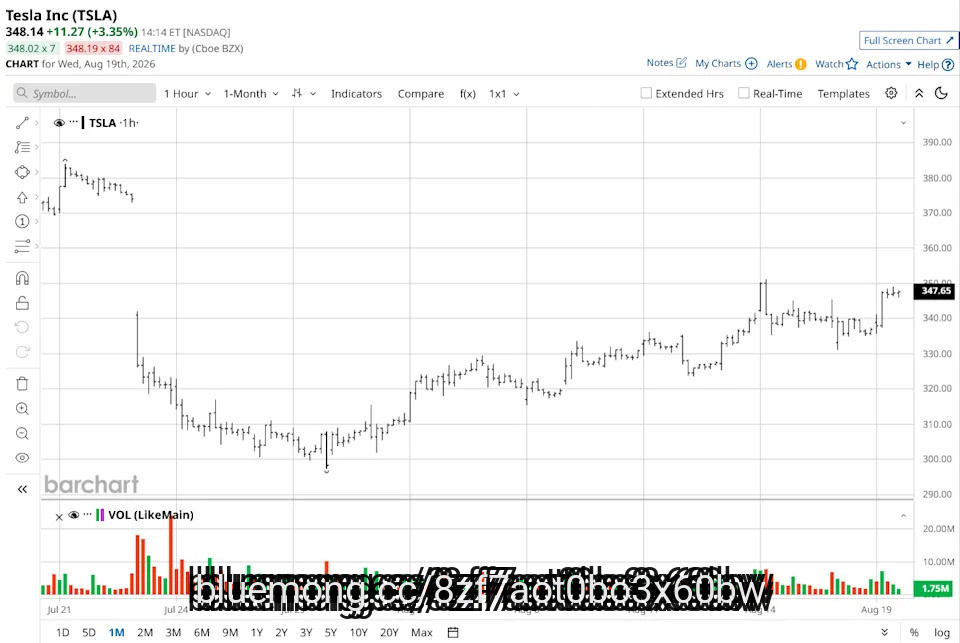
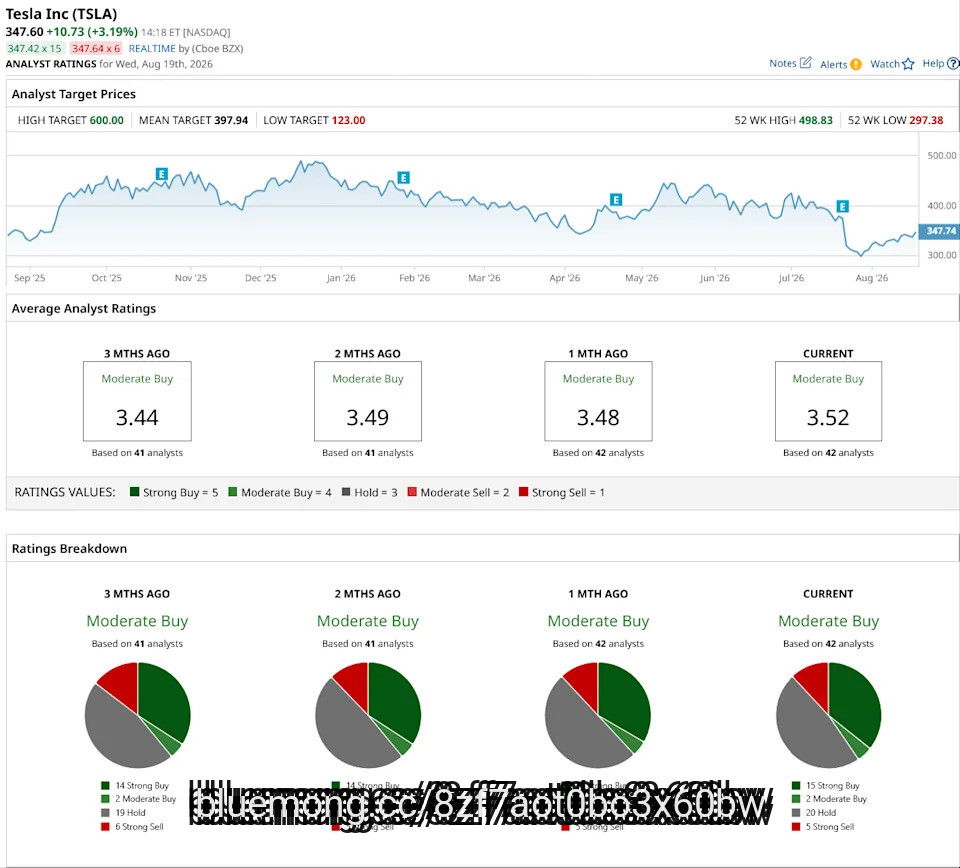
Tesla's stock has struggled in 2026, trading near the bottom of its 52-week range and below its 200-day moving average. Shares recently closed around $336.87, down sharply from a 52-week high of $498.83 set in June, though still above the 52-week low of $297.38 touched in late July. The stock has been pressured by margin compression, a negative free cash flow quarter, and investor anxiety over Tesla's massive AI and robotics capital spending, even as anticipation builds around the upcoming public Cybercab robotaxi launch in Austin and continued progress on Optimus humanoid robot production.
Barron Trump, 20, Now Worth $150 Million — More Than Mom, Melania — From Crypto And $39 Energy Drink
Billionaire Michael Saylor Warns Against Buying a House Because 'Every 36 Years You Actually Pay the Cost of the House in Tax to the Government'
QQQ Just 'Gamma Flipped' as Market Makers Were Forced to Sell. Here's What Our Top Chart Expert is Tracking Next.
#robotics #driving
Tesla's stock has struggled in 2026, trading near the bottom of its 52-week range and below its 200-day moving average. Shares recently closed around $336.87, down sharply from a 52-week high of $498.83 set in June, though still above the 52-week low of $297.38 touched in late July. The stock has been pressured by margin compression, a negative free cash flow quarter, and investor anxiety over Tesla's massive AI and robotics capital spending, even as anticipation builds around the upcoming public Cybercab robotaxi launch in Austin and continued progress on Optimus humanoid robot production.
Barron Trump, 20, Now Worth $150 Million — More Than Mom, Melania — From Crypto And $39 Energy Drink
Billionaire Michael Saylor Warns Against Buying a House Because 'Every 36 Years You Actually Pay the Cost of the House in Tax to the Government'
QQQ Just 'Gamma Flipped' as Market Makers Were Forced to Sell. Here's What Our Top Chart Expert is Tracking Next.
#robotics #driving

1 month ago
Tesla posted a picture on X showing its new Starlink integration on Monday.
It's the latest partnership between Musk's companies — and comes as merger rumors continue to swirl.
Musk previously warned of robotaxi "Bermuda Triangles."
Tesla is giving its Cybercab a little help from another Elon Musk company.
On Monday, the EV maker shared photos on X of what it called the "First Cybercab with Starlink integration." The images show a square-like cutout in the roofline, where the satellite internet equipment is built directly into the vehicle.
#Monday #musk #elon
It's the latest partnership between Musk's companies — and comes as merger rumors continue to swirl.
Musk previously warned of robotaxi "Bermuda Triangles."
Tesla is giving its Cybercab a little help from another Elon Musk company.
On Monday, the EV maker shared photos on X of what it called the "First Cybercab with Starlink integration." The images show a square-like cutout in the roofline, where the satellite internet equipment is built directly into the vehicle.
#Monday #musk #elon

2 months ago
July 22 and 23 proved to be one of the most significant 48-hour periods of 2026's artificial intelligence trade, showing a clear flaw in how public equity markets reward massive capital spending. Both Tesla, Inc. (NASDAQ:TSLA) and Alphabet published second-quarter financial results after the market closed on July 22, with both reporting negative quarterly free cash flow due to significant AI infrastructure investments. However, the market distinguished between spending connected to visible near-term margin conversion and spending ***** ociated with core margin compression and an indefinite payout period. While Alphabet had a modest reversal, Tesla, Inc. (NASDAQ:TSLA) fell as much as 15% intraday, marking one of the company's worst single-day falls in history.
On the surface, Tesla's top-line headline numbers were strong, with second-quarter revenue reaching a record $28.24 billion, a 26% year-over-year increase that comfortably exceeded Wall Street consensus projections of $25.55 billion to $25.71 billion. Vehicle deliveries set a quarterly high of 480,126 units, while automotive revenue increased 23% to $20.52 billion. Auxiliary areas grew even faster, with Energy Generation and Storage up 13% to $3.14 billion and Services up 50% to a record $4.58 billion.
However, underneath these top-line gains lies considerable margin deterioration. Non-GAAP adjusted earnings per share came in at $0.33, roughly a third lower than the consensus forecast of $0.51 to $0.53, while GAAP operating income fell 57% year-over-year to $398 million, implying an operating margin of 1.4% versus slightly over 4% posted both in last quarter and the same quarter last year.
This profitability compression was directly related to Tesla's core vehicle price strategy. Total gross margin fell to 16.8%, down from 17.2% a year ago and well below ***** ysts' expectations of 19.4%. Tesla's decision to introduce lower-cost variants of the Model 3 and Model Y while discontinuing its higher-margin Model S and Model X flagship vehicles reduced average selling prices throughout the fleet. This structural decline in average selling price, combined with a rapid contraction in high-margin regulatory credit revenue, severely harmed profitability while fixed overhead increased.
An enormous spike in spending added to the core vehicle pricing pressures. Operating expenses increased by 47% year-over-year to $4.35 billion, while capital expenditures nearly doubled to $5.80 billion, resulting in a $1.10 billion negative free cash flow balance. This substantial cash burn represents significant expenditures in AI compute infrastructure, custom semiconductor development, battery material manufacture, and production capacity for the Cybercab and Optimus humanoid robots.
#vehicle #operating
On the surface, Tesla's top-line headline numbers were strong, with second-quarter revenue reaching a record $28.24 billion, a 26% year-over-year increase that comfortably exceeded Wall Street consensus projections of $25.55 billion to $25.71 billion. Vehicle deliveries set a quarterly high of 480,126 units, while automotive revenue increased 23% to $20.52 billion. Auxiliary areas grew even faster, with Energy Generation and Storage up 13% to $3.14 billion and Services up 50% to a record $4.58 billion.
However, underneath these top-line gains lies considerable margin deterioration. Non-GAAP adjusted earnings per share came in at $0.33, roughly a third lower than the consensus forecast of $0.51 to $0.53, while GAAP operating income fell 57% year-over-year to $398 million, implying an operating margin of 1.4% versus slightly over 4% posted both in last quarter and the same quarter last year.
This profitability compression was directly related to Tesla's core vehicle price strategy. Total gross margin fell to 16.8%, down from 17.2% a year ago and well below ***** ysts' expectations of 19.4%. Tesla's decision to introduce lower-cost variants of the Model 3 and Model Y while discontinuing its higher-margin Model S and Model X flagship vehicles reduced average selling prices throughout the fleet. This structural decline in average selling price, combined with a rapid contraction in high-margin regulatory credit revenue, severely harmed profitability while fixed overhead increased.
An enormous spike in spending added to the core vehicle pricing pressures. Operating expenses increased by 47% year-over-year to $4.35 billion, while capital expenditures nearly doubled to $5.80 billion, resulting in a $1.10 billion negative free cash flow balance. This substantial cash burn represents significant expenditures in AI compute infrastructure, custom semiconductor development, battery material manufacture, and production capacity for the Cybercab and Optimus humanoid robots.
#vehicle #operating

2 months ago
Welcome back to TechCrunch Mobility, your hub for the future of transportation and now, more than ever, the role AI is playing in it. To get this in your inbox, sign up here for free — just click TechCrunch Mobility!
Tesla kicked off earnings season — at least for this sector — and the shareholder letter, along with Elon Musk's remarks during the conference call, provided some pretty incredible disclosures I imagine have some investors concerned, or at least puzzled.
Tesla has backed off previous promises to reach "volume production" of the Cybercab, Tesla Semi, and Megapack 3 in 2026. And while the company has publicly touted expansions of its Tesla Robotaxi service into new cities in Florida and Texas, the quarter-over-quarter data shows a drop in paid robotaxi miles.
Senior reporter Sean O'Kane took a closer look at a graph shared in Tesla's shareholder letter. At a passing glance, the chart appears to show steady growth in paid robotaxi rides between August 2025 and June 2026, O'Kane notes. But the numbers displayed are **** ulative, and when broken down by quarter, they show that Tesla's Robotaxi fleet of Model Y SUVs carrying paying passengers covered around 1.1 million miles in the first quarter. That fell to roughly 700,000 miles in the second quarter, a decline of about 36%.
Musk also disclosed during the call that Tesla needs to accumulate driving data specific to the Cybercab before it can put large numbers of the vehicles on the road. That isn't terribly surprising; the Cybercab is new, after all. But the reason got my attention. He explained that Tesla has to accumulate miles using Cybercabs retrofitted with steering wheels and accelerator and braking pedals so it can calibrate to the Cybercab chassis.
#robotaxi
Tesla kicked off earnings season — at least for this sector — and the shareholder letter, along with Elon Musk's remarks during the conference call, provided some pretty incredible disclosures I imagine have some investors concerned, or at least puzzled.
Tesla has backed off previous promises to reach "volume production" of the Cybercab, Tesla Semi, and Megapack 3 in 2026. And while the company has publicly touted expansions of its Tesla Robotaxi service into new cities in Florida and Texas, the quarter-over-quarter data shows a drop in paid robotaxi miles.
Senior reporter Sean O'Kane took a closer look at a graph shared in Tesla's shareholder letter. At a passing glance, the chart appears to show steady growth in paid robotaxi rides between August 2025 and June 2026, O'Kane notes. But the numbers displayed are **** ulative, and when broken down by quarter, they show that Tesla's Robotaxi fleet of Model Y SUVs carrying paying passengers covered around 1.1 million miles in the first quarter. That fell to roughly 700,000 miles in the second quarter, a decline of about 36%.
Musk also disclosed during the call that Tesla needs to accumulate driving data specific to the Cybercab before it can put large numbers of the vehicles on the road. That isn't terribly surprising; the Cybercab is new, after all. But the reason got my attention. He explained that Tesla has to accumulate miles using Cybercabs retrofitted with steering wheels and accelerator and braking pedals so it can calibrate to the Cybercab chassis.
#robotaxi



2 months ago
Three big earnings reports came out this week. Alphabet Inc. (NASDAQ:GOOGL) and Tesla, Inc. (NASDAQ:TSLA) reported Wednesday after the market closed, and International Business Machines Corporation (NYSE:IBM) shared its official results the same day. All three show the same thing: spending money on AI is starting to hurt profits. However, each company's story is different enough that treating them as one big story would miss what's actually going on. So let's dig into it:
Alphabet Inc. (NASDAQ:GOOGL) made more money than expected. Revenue came in at $119.8 billion compared to the $116.9 billion ***** ysts expected, growing 24% from last year. Its cloud business also had its best quarter ever. Cloud revenue jumped 82% to $24.77 billion, way above the $22.46 billion ***** ysts predicted, and the amount of future cloud business it has lined up hit $514 billion, up from about $460 billion. Even so, the stock fell about 4% after hours. Why? Because Alphabet said it will spend even more money in 2026 than planned, between $195 billion and $205 billion instead of the earlier $180-190 billion range and well above the roughly $186 billion Wall Street expected. The firm's leftover cash after paying for everything actually went negative, by $5.9 billion, for the first time in at least 10 years. That happened because Alphabet spent $44.9 billion in just this one quarter, double what it spent a year ago. Alphabet's finance chief, Anat Ashkenazi, told ***** ysts the tech firm still doesn't have enough computing power to meet demand. Google is even renting extra computing capacity from ***** eX to keep up while it builds more of its own.
Tesla, Inc. (NASDAQ:TSLA) had a similar problem, just in a different business. Revenue beat expectations, coming in at $28.24 billion versus $25.71 billion expected, up 26% from last year. Tesla also delivered more cars than expected. But profit missed, and adjusted earnings were 33 cents per share, well below the 51 cents ***** ysts expected. The profit margin on each car sold also shrank to about 16.3% instead of the roughly 18% expected. And Tesla's leftover cash went negative too, by $1.1 billion, for the first time in over two years. That's because Tesla spent 142% more money than usual, $5.8 billion, mostly on things like Optimus robots, its Cybercab robotaxi, and AI computing power, not on making more cars. Elon Musk called it "a massive capex year" and said he believes these investments will pay off. But right now, it's the car business paying for all of it, and the car business is making less money per vehicle than before.
#expected #alphabet #money
Alphabet Inc. (NASDAQ:GOOGL) made more money than expected. Revenue came in at $119.8 billion compared to the $116.9 billion ***** ysts expected, growing 24% from last year. Its cloud business also had its best quarter ever. Cloud revenue jumped 82% to $24.77 billion, way above the $22.46 billion ***** ysts predicted, and the amount of future cloud business it has lined up hit $514 billion, up from about $460 billion. Even so, the stock fell about 4% after hours. Why? Because Alphabet said it will spend even more money in 2026 than planned, between $195 billion and $205 billion instead of the earlier $180-190 billion range and well above the roughly $186 billion Wall Street expected. The firm's leftover cash after paying for everything actually went negative, by $5.9 billion, for the first time in at least 10 years. That happened because Alphabet spent $44.9 billion in just this one quarter, double what it spent a year ago. Alphabet's finance chief, Anat Ashkenazi, told ***** ysts the tech firm still doesn't have enough computing power to meet demand. Google is even renting extra computing capacity from ***** eX to keep up while it builds more of its own.
Tesla, Inc. (NASDAQ:TSLA) had a similar problem, just in a different business. Revenue beat expectations, coming in at $28.24 billion versus $25.71 billion expected, up 26% from last year. Tesla also delivered more cars than expected. But profit missed, and adjusted earnings were 33 cents per share, well below the 51 cents ***** ysts expected. The profit margin on each car sold also shrank to about 16.3% instead of the roughly 18% expected. And Tesla's leftover cash went negative too, by $1.1 billion, for the first time in over two years. That's because Tesla spent 142% more money than usual, $5.8 billion, mostly on things like Optimus robots, its Cybercab robotaxi, and AI computing power, not on making more cars. Elon Musk called it "a massive capex year" and said he believes these investments will pay off. But right now, it's the car business paying for all of it, and the car business is making less money per vehicle than before.
#expected #alphabet #money

2 months ago
Tesla runs its earnings Q&A through a platform called Say Technologies, where shareholders submit questions and vote them up based on how many shares they hold. The idea is that the most pressing investor concerns rise to the top, giving Musk and his team a clear read on what the market actually wants answered before he gets on the call.
For Tesla's second-quarter earnings on July 22, the top categories looked predictable: FSD, Robotaxi, Optimus, Cybercab. And then, in fifth place, ****** eX. Not Starlink. Not ****** eX's technology. Whether Tesla and ****** eX might merge. Twenty-two questions on that topic made it onto the formal shareholder agenda, and Tesla investors want a direct answer from Musk, Business Insider reported.
The persistence of the question has a lot to do with how much the two companies already overlap. Tesla holds a stake in ****** eX. Tesla sold roughly $890 million in vehicles and batteries to ****** eX and its subsidiary xAI since 2023, and ****** eX spent $131 million on Cybertrucks in 2025 alone, according to the company's IPO filing.
Earlier this year, ****** eX acquired xAI. Tesla had put $2 billion into xAI, so that investment became a small equity stake in ****** eX when the deal closed, the first time a regulatory filing had formally connected the two companies, CNBC reported.
More Teslaand ****** eX:
#musk
For Tesla's second-quarter earnings on July 22, the top categories looked predictable: FSD, Robotaxi, Optimus, Cybercab. And then, in fifth place, ****** eX. Not Starlink. Not ****** eX's technology. Whether Tesla and ****** eX might merge. Twenty-two questions on that topic made it onto the formal shareholder agenda, and Tesla investors want a direct answer from Musk, Business Insider reported.
The persistence of the question has a lot to do with how much the two companies already overlap. Tesla holds a stake in ****** eX. Tesla sold roughly $890 million in vehicles and batteries to ****** eX and its subsidiary xAI since 2023, and ****** eX spent $131 million on Cybertrucks in 2025 alone, according to the company's IPO filing.
Earlier this year, ****** eX acquired xAI. Tesla had put $2 billion into xAI, so that investment became a small equity stake in ****** eX when the deal closed, the first time a regulatory filing had formally connected the two companies, CNBC reported.
More Teslaand ****** eX:
#musk
2 months ago
Tesla (TSLA) earns a BUY rating and $428 price target, offering 16% upside on rebounding automotive margins and a Q1 EPS beat of 18%.
GM trades near 25x earnings on real cash while Rivian posts negative EBITDA, making Tesla's 167x forward P/E a pure bet on auto-plus-AI.
Prediction markets price a 78% chance Tesla beats Q2 EPS, with the bull case targeting $487 if Cybercab launches and FSD subscriptions hold above 40% growth.
Act now: the ******* yst who called NVIDIA in 2010 just named his top 10 AI stocks — and Tesla didn't make the cut. Grab the names FREE today.
Tesla (NASDAQ:TSLA) heads into its Q2 2026 earnings report tomorrow as the undisputed laggard of the Magnificent 7. Shares are down 17.82% year to date, badly trailing every other name in the cohort. Our proprietary model says the setup is more constructive than the tape suggests.
#price
GM trades near 25x earnings on real cash while Rivian posts negative EBITDA, making Tesla's 167x forward P/E a pure bet on auto-plus-AI.
Prediction markets price a 78% chance Tesla beats Q2 EPS, with the bull case targeting $487 if Cybercab launches and FSD subscriptions hold above 40% growth.
Act now: the ******* yst who called NVIDIA in 2010 just named his top 10 AI stocks — and Tesla didn't make the cut. Grab the names FREE today.
Tesla (NASDAQ:TSLA) heads into its Q2 2026 earnings report tomorrow as the undisputed laggard of the Magnificent 7. Shares are down 17.82% year to date, badly trailing every other name in the cohort. Our proprietary model says the setup is more constructive than the tape suggests.
#price