

2 months ago
On August 10, Simon Property Group (NYSE:SPG) reported results for the three months through June 30 and raised its full-year profit outlook once again. Real estate funds from operations (FFO), a cash-flow measure suited to landlords, hit $3.29 per share. Tenants are earning more from their stores, and management is confident enough to lift its guidance again. Yet the professionals who own the stock are heading the other way.
Start with the tenants, because they pay the rent. Reported retailer sales reached $838 per square foot over the year through June 30, up from $736 a year earlier, on June 30, 2025. Stronger sales tend to make higher rent easier to swallow, and base minimum rent per square foot did climb to $62.42 from $58.70.
That demand flowed through to profit. Real estate FFO rose to $3.29 per diluted share from $3.05, and net operating income at Simon's domestic properties grew 8.5%. Management responded by lifting its full-year real estate FFO range to $13.20 to $13.30 per share, moving the midpoint up by $0.08.
Shareholders get paid while they wait. The board declared a third-quarter dividend of $2.25 per share, $0.10 more than a year ago, to be paid on September 30 to anyone on the books by September 9. Simon also put $211.4 million into buying back stock at an average of $205.10 per share, and it finished June with about $9.3 billion of liquidity.
Now the less flattering side. Net income for common stockholders was $483.1 million, or $1.49 per diluted share, versus $1.70 a year earlier. The 2025 quarter included a non-cash gain of $0.21 per share from investment activity, which flatters that comparison. Still, plain FFO followed the same path, slipping to $3.12 from $3.15.
#Share #year #june #estate
Start with the tenants, because they pay the rent. Reported retailer sales reached $838 per square foot over the year through June 30, up from $736 a year earlier, on June 30, 2025. Stronger sales tend to make higher rent easier to swallow, and base minimum rent per square foot did climb to $62.42 from $58.70.
That demand flowed through to profit. Real estate FFO rose to $3.29 per diluted share from $3.05, and net operating income at Simon's domestic properties grew 8.5%. Management responded by lifting its full-year real estate FFO range to $13.20 to $13.30 per share, moving the midpoint up by $0.08.
Shareholders get paid while they wait. The board declared a third-quarter dividend of $2.25 per share, $0.10 more than a year ago, to be paid on September 30 to anyone on the books by September 9. Simon also put $211.4 million into buying back stock at an average of $205.10 per share, and it finished June with about $9.3 billion of liquidity.
Now the less flattering side. Net income for common stockholders was $483.1 million, or $1.49 per diluted share, versus $1.70 a year earlier. The 2025 quarter included a non-cash gain of $0.21 per share from investment activity, which flatters that comparison. Still, plain FFO followed the same path, slipping to $3.12 from $3.15.
#Share #year #june #estate


2 months ago
Interested in Upexi, Inc.? Here are five stocks we like better.
Upexi strengthened its balance sheet and cut costs by extinguishing about $20 million of debt, refinancing at a lower 7.5% interest rate and reducing its workforce to 10 employees from 59.
The company held approximately 2.34 million Solana tokens worth $165.3 million at June 30, with 95% staked; the treasury generated $17.4 million in digital-asset revenue but incurred $195.1 million in unrealized and $11.7 million in realized losses.
Fiscal-year net loss widened sharply to $246.1 million from $13.7 million, while stockholders' equity fell to negative $53.8 million, largely due to digital-asset losses, higher interest costs and stock-based compensation.
Upexi (NASDAQ:UPXI) said it strengthened its balance sheet, reduced operating expenses and continued to build its Solana treasury during fiscal 2026, though declines in digital-asset values drove a substantially wider full-year net loss.
#digital #Solana #strengthened #costs
Upexi strengthened its balance sheet and cut costs by extinguishing about $20 million of debt, refinancing at a lower 7.5% interest rate and reducing its workforce to 10 employees from 59.
The company held approximately 2.34 million Solana tokens worth $165.3 million at June 30, with 95% staked; the treasury generated $17.4 million in digital-asset revenue but incurred $195.1 million in unrealized and $11.7 million in realized losses.
Fiscal-year net loss widened sharply to $246.1 million from $13.7 million, while stockholders' equity fell to negative $53.8 million, largely due to digital-asset losses, higher interest costs and stock-based compensation.
Upexi (NASDAQ:UPXI) said it strengthened its balance sheet, reduced operating expenses and continued to build its Solana treasury during fiscal 2026, though declines in digital-asset values drove a substantially wider full-year net loss.
#digital #Solana #strengthened #costs


2 months ago
On August 5, Clear Channel Outdoor Holdings Inc. (NYSE:CCO) reported second-quarter results that showed the billboard and airport advertising company accelerating just as it prepares to leave the public markets. On February 9, Clear Channel agreed to be acquired by an investor consortium advised by Mubadala Capital for $2.43 per share, a deal stockholders approved on May 12, and one expected to close by the end of the third quarter of 2026. Because of the pending Merger, Clear Channel skipped its usual earnings call and offered no forward guidance.
Consolidated revenue climbed 8.7% to $438.0 million in the quarter and 10.2% to $811.9 million over the first half, with the 2026 FIFA World Cup pulling in extra advertising spend across both of Clear Channel's segments. The America division, which houses the roadside billboard and street furniture business, grew revenue 7% to $324.3 million as demand from technology advertisers in the San Francisco/Bay Area market broadened out and digital billboard revenue rose 7.2% to $122 million. Airports revenue jumped 14% to $113.6 million, helped by strong demand at San Francisco
International Airport and digital sales that climbed 15.6% to $73.4 million, with national advertisers now accounting for 57.8% of that segment's revenue. Profitability grew even faster than the top line. Adjusted EBITDA rose 11.6% to $143.4 million for the quarter and 19% to $247.3 million for the first half, while Airports Segment Adjusted EBITDA jumped 22.8% to $29.9 million. Adjusted Funds From Operations climbed 61.6% to $44.9 million in the quarter, and for the first half it went from just $5 million a year ago to $51.5 million. On August 4, Clear Channel also closed the sale of its Spain business for about $132.3 million, proceeds it plans to put toward paying down debt.
The growth did not reach the bottom line. Clear Channel posted a loss from continuing operations of $10 million in the quarter, reversing a $6.3 million profit a year earlier, and the consolidated net loss came to $5 million versus net income of $10.6 million in the same period of 2025. Over six months, the loss from continuing operations widened 21.4% to $59.4 million. Costs rose alongside revenue. Direct operating and SG&A expenses increased 5.9% for the quarter, and Airports site lease expense alone jumped 12.0% to $67.1 million on higher minimum guaranteed payments and the renewed contract with the Metropolitan Washington Airports Authority.
#channel #revenue #airports #operations
Consolidated revenue climbed 8.7% to $438.0 million in the quarter and 10.2% to $811.9 million over the first half, with the 2026 FIFA World Cup pulling in extra advertising spend across both of Clear Channel's segments. The America division, which houses the roadside billboard and street furniture business, grew revenue 7% to $324.3 million as demand from technology advertisers in the San Francisco/Bay Area market broadened out and digital billboard revenue rose 7.2% to $122 million. Airports revenue jumped 14% to $113.6 million, helped by strong demand at San Francisco
International Airport and digital sales that climbed 15.6% to $73.4 million, with national advertisers now accounting for 57.8% of that segment's revenue. Profitability grew even faster than the top line. Adjusted EBITDA rose 11.6% to $143.4 million for the quarter and 19% to $247.3 million for the first half, while Airports Segment Adjusted EBITDA jumped 22.8% to $29.9 million. Adjusted Funds From Operations climbed 61.6% to $44.9 million in the quarter, and for the first half it went from just $5 million a year ago to $51.5 million. On August 4, Clear Channel also closed the sale of its Spain business for about $132.3 million, proceeds it plans to put toward paying down debt.
The growth did not reach the bottom line. Clear Channel posted a loss from continuing operations of $10 million in the quarter, reversing a $6.3 million profit a year earlier, and the consolidated net loss came to $5 million versus net income of $10.6 million in the same period of 2025. Over six months, the loss from continuing operations widened 21.4% to $59.4 million. Costs rose alongside revenue. Direct operating and SG&A expenses increased 5.9% for the quarter, and Airports site lease expense alone jumped 12.0% to $67.1 million on higher minimum guaranteed payments and the renewed contract with the Metropolitan Washington Airports Authority.
#channel #revenue #airports #operations


2 months ago
On August 5, Primerica (NYSE:PRI) reported second-quarter results that read as two different companies bolted together. Net income climbed 13% to $202 million, and earnings per diluted share jumped 19% to $6.45, pushing return on stockholders' equity to 32.1%. Total revenue reached $865 million, up 9% from a year earlier. But those headline figures obscure a split story. The investment arm is sprinting to record highs while the life insurance sales force is quietly getting smaller. Here is what is actually moving the numbers.
Investment and savings product sales hit a record $4.4 billion in the quarter, up 23% from a year ago, while client ***** et values ended the period at an all-time high of $140 billion, up 16%. Net inflows added another $397 million. That growth translated directly into profit. ISP segment revenue rose 21% to $361 million, and pretax income jumped 31% to $104 million, meaning the segment's margin expanded even as it grew. The reason: ***** et-based commission revenue climbed 28%, outpacing the 19% rise in average client ***** ets, thanks to a shift toward higher-margin US managed accounts and Canadian mutual funds.
Primerica also returned $172 million to shareholders in the quarter through $135 million in buybacks and roughly $37 million in dividends, bringing year-to-date capital returns to $352 million. Its effective tax rate improved to 21.7% from 23.9% a year earlier, and its life insurer's statutory risk-based capital ratio stood at approximately 440%, a cushion most insurers would envy.
The company's distribution engine tells a rougher story. The life-licensed sales force fell 3% year over year to 148,612 representatives. Recruiting rose 2% to 82,346 recruits, but far fewer of them actually got licensed: new life-licensed representatives dropped 15% to 11,020. That gap between recruiting and licensing shows up directly in output. The company issued 78,904 life insurance policies, down 12%, with total face amount issued falling 8% to $27.7 billion.
Term Life revenue was roughly flat at $444 million even as adjusted direct premiums rose 3%, and segment pretax income fell 4% to $148 million. Part of that came from cost creep rather than claims: the benefits and claims ratio held steady at 57.9%, but the insurance expense ratio rose to 8.4% from 7.6% a year earlier, eating into a segment that is supposed to be Primerica's stable, predictable cash generator.
#million #year #rose #sales
Investment and savings product sales hit a record $4.4 billion in the quarter, up 23% from a year ago, while client ***** et values ended the period at an all-time high of $140 billion, up 16%. Net inflows added another $397 million. That growth translated directly into profit. ISP segment revenue rose 21% to $361 million, and pretax income jumped 31% to $104 million, meaning the segment's margin expanded even as it grew. The reason: ***** et-based commission revenue climbed 28%, outpacing the 19% rise in average client ***** ets, thanks to a shift toward higher-margin US managed accounts and Canadian mutual funds.
Primerica also returned $172 million to shareholders in the quarter through $135 million in buybacks and roughly $37 million in dividends, bringing year-to-date capital returns to $352 million. Its effective tax rate improved to 21.7% from 23.9% a year earlier, and its life insurer's statutory risk-based capital ratio stood at approximately 440%, a cushion most insurers would envy.
The company's distribution engine tells a rougher story. The life-licensed sales force fell 3% year over year to 148,612 representatives. Recruiting rose 2% to 82,346 recruits, but far fewer of them actually got licensed: new life-licensed representatives dropped 15% to 11,020. That gap between recruiting and licensing shows up directly in output. The company issued 78,904 life insurance policies, down 12%, with total face amount issued falling 8% to $27.7 billion.
Term Life revenue was roughly flat at $444 million even as adjusted direct premiums rose 3%, and segment pretax income fell 4% to $148 million. Part of that came from cost creep rather than claims: the benefits and claims ratio held steady at 57.9%, but the insurance expense ratio rose to 8.4% from 7.6% a year earlier, eating into a segment that is supposed to be Primerica's stable, predictable cash generator.
#million #year #rose #sales


2 months ago
On August 5, Primerica (NYSE:PRI) reported second-quarter results that read as two different companies bolted together. Net income climbed 13% to $202 million, and earnings per diluted share jumped 19% to $6.45, pushing return on stockholders' equity to 32.1%. Total revenue reached $865 million, up 9% from a year earlier. But those headline figures obscure a split story. The investment arm is sprinting to record highs while the life insurance sales force is quietly getting smaller. Here is what is actually moving the numbers.
Investment and savings product sales hit a record $4.4 billion in the quarter, up 23% from a year ago, while client ****** et values ended the period at an all-time high of $140 billion, up 16%. Net inflows added another $397 million. That growth translated directly into profit. ISP segment revenue rose 21% to $361 million, and pretax income jumped 31% to $104 million, meaning the segment's margin expanded even as it grew. The reason: ****** et-based commission revenue climbed 28%, outpacing the 19% rise in average client ****** ets, thanks to a shift toward higher-margin US managed accounts and Canadian mutual funds.
Primerica also returned $172 million to shareholders in the quarter through $135 million in buybacks and roughly $37 million in dividends, bringing year-to-date capital returns to $352 million. Its effective tax rate improved to 21.7% from 23.9% a year earlier, and its life insurer's statutory risk-based capital ratio stood at approximately 440%, a cushion most insurers would envy.
The company's distribution engine tells a rougher story. The life-licensed sales force fell 3% year over year to 148,612 representatives. Recruiting rose 2% to 82,346 recruits, but far fewer of them actually got licensed: new life-licensed representatives dropped 15% to 11,020. That gap between recruiting and licensing shows up directly in output. The company issued 78,904 life insurance policies, down 12%, with total face amount issued falling 8% to $27.7 billion.
Term Life revenue was roughly flat at $444 million even as adjusted direct premiums rose 3%, and segment pretax income fell 4% to $148 million. Part of that came from cost creep rather than claims: the benefits and claims ratio held steady at 57.9%, but the insurance expense ratio rose to 8.4% from 7.6% a year earlier, eating into a segment that is supposed to be Primerica's stable, predictable cash generator.
#sales
Investment and savings product sales hit a record $4.4 billion in the quarter, up 23% from a year ago, while client ****** et values ended the period at an all-time high of $140 billion, up 16%. Net inflows added another $397 million. That growth translated directly into profit. ISP segment revenue rose 21% to $361 million, and pretax income jumped 31% to $104 million, meaning the segment's margin expanded even as it grew. The reason: ****** et-based commission revenue climbed 28%, outpacing the 19% rise in average client ****** ets, thanks to a shift toward higher-margin US managed accounts and Canadian mutual funds.
Primerica also returned $172 million to shareholders in the quarter through $135 million in buybacks and roughly $37 million in dividends, bringing year-to-date capital returns to $352 million. Its effective tax rate improved to 21.7% from 23.9% a year earlier, and its life insurer's statutory risk-based capital ratio stood at approximately 440%, a cushion most insurers would envy.
The company's distribution engine tells a rougher story. The life-licensed sales force fell 3% year over year to 148,612 representatives. Recruiting rose 2% to 82,346 recruits, but far fewer of them actually got licensed: new life-licensed representatives dropped 15% to 11,020. That gap between recruiting and licensing shows up directly in output. The company issued 78,904 life insurance policies, down 12%, with total face amount issued falling 8% to $27.7 billion.
Term Life revenue was roughly flat at $444 million even as adjusted direct premiums rose 3%, and segment pretax income fell 4% to $148 million. Part of that came from cost creep rather than claims: the benefits and claims ratio held steady at 57.9%, but the insurance expense ratio rose to 8.4% from 7.6% a year earlier, eating into a segment that is supposed to be Primerica's stable, predictable cash generator.
#sales


2 months ago
On August 13, Kodiak Sciences Inc. (NASDAQ:KOD) reported second-quarter financial results for the period ended June 30, alongside an update on its three late-stage eye disease programs. The clinical-stage biotech told investors it now sits within months of three separate Phase 3 readouts, a stretch CEO Victor Perlroth called the payoff of years of disciplined execution. For a company with no approved products and a widening cash burn, those trial results are about to decide a lot.
Kodiak's near-term story rests on Zenkuda and KSI-501, both being tested in the Phase 3 DAYBREAK study for treatment-naive wet age-related macular degeneration, with one-year primary endpoint topline data due in September 2026. Zenkuda already has four completed Phase 3 studies behind it. In GLOW1 and GLOW2, every patient remained on extended six-month dosing at one year, and in BEACON, nearly half of Zenkuda patients needed no further treatment in the second six months while matching aflibercept on vision and anatomical outcomes. That durability comes from a mean ocular half-life of 20 days, roughly three times longer than approved anti-VEGF drugs.
Behind DAYBREAK sits PEAK, evaluating KSI-101 in macular edema secondary to inflammation, where Kodiak finished enrolling the first 300-patient cohort during the quarter and expects Pivotal ***** ysis 1 data in December 2026. Earlier Phase 1b data showed more than half of MESI patients gaining at least 15 letters of vision, with over 90% resolution of retinal fluid by week eight. Kodiak also began enrolling patients in the roughly 910-patient ALTO study testing KSI-501 against aflibercept in diabetic macular edema, its second registrational trial for that molecule. Zenkuda and KSI-501 together are aimed at a $15 billion anti-VEGF market.
None of that comes cheap. Kodiak's net loss widened to $65.6 million in the second quarter of 2026, or $1.05 per share, up from $54.3 million and $1.03 per share a year earlier. R&D spending jumped to $56.1 million from $42.8 million, as the company ramped up clinical activity across PEAK and PINNACLE and stepped up manufacturing for its Phase 3 programs. General and administrative costs eased slightly to $10.8 million from $12.8 million, but that was not enough to offset the R&D increase.
Kodiak ended the quarter with $125.9 million in cash and equivalents, which management says covers operations into 2027, but working capital fell from $169.3 million at the end of 2025 to $78.6 million by June 30, and stockholders' equity dropped from $157.4 million to $61.1 million over the same stretch. With three separate trials due to report between September and December, any delay or disappointing result would hit a balance sheet that already has less room to absorb it.
#data
Kodiak's near-term story rests on Zenkuda and KSI-501, both being tested in the Phase 3 DAYBREAK study for treatment-naive wet age-related macular degeneration, with one-year primary endpoint topline data due in September 2026. Zenkuda already has four completed Phase 3 studies behind it. In GLOW1 and GLOW2, every patient remained on extended six-month dosing at one year, and in BEACON, nearly half of Zenkuda patients needed no further treatment in the second six months while matching aflibercept on vision and anatomical outcomes. That durability comes from a mean ocular half-life of 20 days, roughly three times longer than approved anti-VEGF drugs.
Behind DAYBREAK sits PEAK, evaluating KSI-101 in macular edema secondary to inflammation, where Kodiak finished enrolling the first 300-patient cohort during the quarter and expects Pivotal ***** ysis 1 data in December 2026. Earlier Phase 1b data showed more than half of MESI patients gaining at least 15 letters of vision, with over 90% resolution of retinal fluid by week eight. Kodiak also began enrolling patients in the roughly 910-patient ALTO study testing KSI-501 against aflibercept in diabetic macular edema, its second registrational trial for that molecule. Zenkuda and KSI-501 together are aimed at a $15 billion anti-VEGF market.
None of that comes cheap. Kodiak's net loss widened to $65.6 million in the second quarter of 2026, or $1.05 per share, up from $54.3 million and $1.03 per share a year earlier. R&D spending jumped to $56.1 million from $42.8 million, as the company ramped up clinical activity across PEAK and PINNACLE and stepped up manufacturing for its Phase 3 programs. General and administrative costs eased slightly to $10.8 million from $12.8 million, but that was not enough to offset the R&D increase.
Kodiak ended the quarter with $125.9 million in cash and equivalents, which management says covers operations into 2027, but working capital fell from $169.3 million at the end of 2025 to $78.6 million by June 30, and stockholders' equity dropped from $157.4 million to $61.1 million over the same stretch. With three separate trials due to report between September and December, any delay or disappointing result would hit a balance sheet that already has less room to absorb it.
#data


2 months ago
On August 5, LTC Properties (NYSE:LTC) reported second-quarter results for the period ended June 30, 2026, and the numbers show a real estate investment trust leaning harder into a strategy it only started a year ago. Total revenue climbed to $98.9 million from $60.2 million a year earlier, and net income available to common stockholders nearly doubled to $29.5 million. Diluted earnings per share rose to $0.56 from $0.32. Alongside the results, the company raised its full-year 2026 investment guidance by 50% at the midpoint, putting more weight behind a business line called SHOP.
LTC increased the midpoint of its 2026 SHOP investment guidance to $900 million, calling that figure a jump of 50% from the previous midpoint. Management now expects $700 million in year-to-date SHOP acquisitions by the end of the third quarter, and projects SHOP will represent 40% of pro forma annualized net operating income by that same point, which the company says is ahead of its own estimates. LTC expects that share to approach 50% by year-end, with a stated pathway toward 75% by the end of 2028.
Since launching the platform in May 2025, LTC has built the SHOP portfolio to 39 communities across 12 operators, 10 of which are new relationships for the company, representing 37% of total gross real estate investments as of July 31, 2026. Second quarter core SHOP NOI came in at $13.3 million. The company closed $171 million in acquisitions during the quarter and expects another $529 million to close in the third quarter, with $208 million of that already done. LTC also raised its full-year diluted earnings per share guidance to $8.08 to $8.10 and expanded its credit facility to $1.1 billion, leaving $648 million in total pro forma liquidity.
Growth this fast comes with a cost that shows up once you move past revenue. Core FFO per diluted share held flat at $0.68, unchanged from a year earlier even though revenue grew 64%. Core FAD per diluted share actually slipped to $0.70 from $0.71. Part of the explanation is share count. Diluted weighted average shares outstanding rose to 52.2 million from 46.0 million, and total shares outstanding climbed to 53.9 million from 46.1 million, dilution that has kept per-share growth well behind the topline.
Expenses grew just as fast as revenue did. Total expenses nearly doubled to $75.5 million from $44.5 million, with senior housing operating expenses, the direct cost of running SHOP, jumping to $42.2 million from $9.4 million as the new segment scaled up. Interest expense rose to $9.5 million from $8.0 million, and $356 million remains drawn on the revolving credit line even after that facility's expansion. SHOP also depends on the 12 third-party operators running those communities day to day, 10 of which have never worked with LTC before, concentrating execution risk in relationships still being tested.
#million #company
LTC increased the midpoint of its 2026 SHOP investment guidance to $900 million, calling that figure a jump of 50% from the previous midpoint. Management now expects $700 million in year-to-date SHOP acquisitions by the end of the third quarter, and projects SHOP will represent 40% of pro forma annualized net operating income by that same point, which the company says is ahead of its own estimates. LTC expects that share to approach 50% by year-end, with a stated pathway toward 75% by the end of 2028.
Since launching the platform in May 2025, LTC has built the SHOP portfolio to 39 communities across 12 operators, 10 of which are new relationships for the company, representing 37% of total gross real estate investments as of July 31, 2026. Second quarter core SHOP NOI came in at $13.3 million. The company closed $171 million in acquisitions during the quarter and expects another $529 million to close in the third quarter, with $208 million of that already done. LTC also raised its full-year diluted earnings per share guidance to $8.08 to $8.10 and expanded its credit facility to $1.1 billion, leaving $648 million in total pro forma liquidity.
Growth this fast comes with a cost that shows up once you move past revenue. Core FFO per diluted share held flat at $0.68, unchanged from a year earlier even though revenue grew 64%. Core FAD per diluted share actually slipped to $0.70 from $0.71. Part of the explanation is share count. Diluted weighted average shares outstanding rose to 52.2 million from 46.0 million, and total shares outstanding climbed to 53.9 million from 46.1 million, dilution that has kept per-share growth well behind the topline.
Expenses grew just as fast as revenue did. Total expenses nearly doubled to $75.5 million from $44.5 million, with senior housing operating expenses, the direct cost of running SHOP, jumping to $42.2 million from $9.4 million as the new segment scaled up. Interest expense rose to $9.5 million from $8.0 million, and $356 million remains drawn on the revolving credit line even after that facility's expansion. SHOP also depends on the 12 third-party operators running those communities day to day, 10 of which have never worked with LTC before, concentrating execution risk in relationships still being tested.
#million #company


2 months ago
Napoli's operational reset triggered a 42% LCID stock collapse, exposing negative stockholders' equity and a $17.7 billion accumulated deficit against a $1.8 billion market cap.
RIVN and TSLA held steady while LCID collapsed, and Lucid's biggest **** yst-implied upside in the group signals a stale target, not hidden value.
Just released. Our **** ysts combed the entire stock market and named the ten best stocks to buy right now. The report is free. Enter your email and see if any of your stocks made the cut.
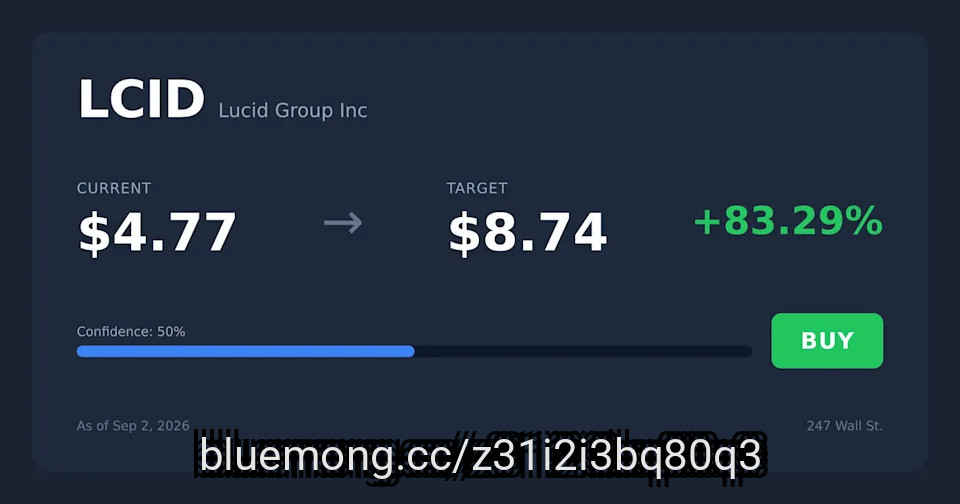
Lucid Group (NASDAQ:LCID) stock trades at $4.81 midday, while the average **** yst price target sits at $8.11. That gap implies upside of more than 70%.
Lucid designs and builds luxury electric vehicles from Newark, California. CEO Silvio Napoli filed an operational reset on August 4 promising $1.4 billion in cash flow improvements this year. Napoli took over on June 1 after previously running Schindler, and he framed the plan as one of four must-win priorities.
#Stock #reset #market
RIVN and TSLA held steady while LCID collapsed, and Lucid's biggest **** yst-implied upside in the group signals a stale target, not hidden value.
Just released. Our **** ysts combed the entire stock market and named the ten best stocks to buy right now. The report is free. Enter your email and see if any of your stocks made the cut.
Lucid Group (NASDAQ:LCID) stock trades at $4.81 midday, while the average **** yst price target sits at $8.11. That gap implies upside of more than 70%.
Lucid designs and builds luxury electric vehicles from Newark, California. CEO Silvio Napoli filed an operational reset on August 4 promising $1.4 billion in cash flow improvements this year. Napoli took over on June 1 after previously running Schindler, and he framed the plan as one of four must-win priorities.
#Stock #reset #market



2 months ago
On August 10, TPG Mortgage Investment Trust, Inc. (NYSE:MITT) and Cherry Hill Mortgage Investment Corporation (NYSE:CHMI) announced a definitive merger agreement in which MITT will acquire CHMI. Under the cash-and-stock deal, CHMI stockholders will receive 0.3063 shares of MITT common stock and $0.93 in cash per share, implying a value of $3.10 per CHMI share based on August 7 closing prices. This represents a 29% premium to CHMI's unaffected price and a 32% premium to its 30-day VWAP. Unanimously approved by both boards and slated to close in Q4 2026, the combined entity will operate as TPG Mortgage Investment Trust under CEO T.J. Durkin, expanding MITT's board to eight with two CHMI independent directors.
Following the announcement, Citizens downgraded Cherry Hill Mortgage from Outperform to Market Perform on August 11, removing its price target and noting that CHMI shares are now fairly valued around the $3.10 implied buyout price.
11 Tips to Get Approved for a Mortgage
In Q2 2026, TPG Mortgage Investment Trust, Inc. (NYSE:MITT) demonstrated stronger underlying financial execution. MITT reported GAAP net income of $0.29 per diluted share and Earnings Available for Distribution (EAD) of $0.24 per share, fully covering its $0.24 dividend. Book value rose to $10.00 per share with an economic return on equity of 2.7%. Its total investment portfolio stood at $7.7 billion with low economic leverage of 1.8x.
Cherry Hill Mortgage Investment Corporation (NYSE:CHMI), by contrast, generated GAAP net income of $0.04 per share and EAD of $0.15 per share, which fell short of covering its $0.10 quarterly dividend without factoring in preferred obligations. CHMI's GAAP book value ended at $3.16 per share, while its portfolio leverage was significantly higher at 5.02x. MITT clearly enters the deal from a position of relative operational stability, better dividend coverage, and lower balance sheet leverage.
#mortgage #mitt #Share #NYSE
Following the announcement, Citizens downgraded Cherry Hill Mortgage from Outperform to Market Perform on August 11, removing its price target and noting that CHMI shares are now fairly valued around the $3.10 implied buyout price.
11 Tips to Get Approved for a Mortgage
In Q2 2026, TPG Mortgage Investment Trust, Inc. (NYSE:MITT) demonstrated stronger underlying financial execution. MITT reported GAAP net income of $0.29 per diluted share and Earnings Available for Distribution (EAD) of $0.24 per share, fully covering its $0.24 dividend. Book value rose to $10.00 per share with an economic return on equity of 2.7%. Its total investment portfolio stood at $7.7 billion with low economic leverage of 1.8x.
Cherry Hill Mortgage Investment Corporation (NYSE:CHMI), by contrast, generated GAAP net income of $0.04 per share and EAD of $0.15 per share, which fell short of covering its $0.10 quarterly dividend without factoring in preferred obligations. CHMI's GAAP book value ended at $3.16 per share, while its portfolio leverage was significantly higher at 5.02x. MITT clearly enters the deal from a position of relative operational stability, better dividend coverage, and lower balance sheet leverage.
#mortgage #mitt #Share #NYSE


3 months ago
Venture Global, Inc. (NYSE:VG) shares are drawing heightened attention following the release of its second-quarter 2026 financial results. The company delivered substantial growth across key operational and financial metrics, prompting management to raise its full-year 2026 Consolidated Adjusted EBITDA guidance to $8.7 billion–$9.1 billion (up from $8.2 billion–$8.5 billion). Driven by accelerating production from its Plaquemines LNG facility, Venture Global exported 127 cargoes and sold 466.4 TBtu during the quarter, a 42% surge in volume year-over-year.
For Q2 2026, Venture Global, Inc. (NYSE:VG) reported total revenue of $4.6 billion, up 48% from $3.10 billion in Q2 2025. Operating income soared 111% year-over-year to $2.2 billion, while net income attributable to common stockholders surged 266% to $1.3 billion ($0.51 diluted EPS vs. $0.14 a year ago). Consolidated Adjusted EBITDA reached $2.5 billion, marking a 79% jump compared to $1.39 billion in the prior-year period. Stronger implied liquefaction fees under commissioning sales agreements and tight cost controls allowed operating margins to expand to 47.8%. Additionally, the board declared a $0.04 per share cash dividend for Q3.
On August 12, Wells Fargo raised its price target on Venture Global, Inc. (NYSE:VG) to $15 from $14 while maintaining an Equal Weight rating. The firm noted Q2 was essentially in line with expectations, highlighting the company's raised 2026 guidance above consensus on higher market spreads. Wells cited higher underlying EBITDA estimates and a significant increase in Venture Global's dividend per share as key supporting drivers.
This brings up a core question: Does the guidance hike and operational expansion signal a lasting multi-year earnings transformation, or are investors exposed to project execution and leverage risks?
Proponents point to Venture Global, Inc. (NYSE:VG)'s strong profitability, expanding scale, and long-term contracted position. Rapid volume growth, evidenced by passing its 1,000th total exported cargo, proves operational capability, while 91% contracted cargo coverage for 2026 offers high cash flow visibility. Furthermore, management's recent refinancing efforts extend maturities and lower debt-service costs, offering a stable financial foundation to fund project build-outs like CP2 and maintain shareholder returns.
#billion #global #ebitda
For Q2 2026, Venture Global, Inc. (NYSE:VG) reported total revenue of $4.6 billion, up 48% from $3.10 billion in Q2 2025. Operating income soared 111% year-over-year to $2.2 billion, while net income attributable to common stockholders surged 266% to $1.3 billion ($0.51 diluted EPS vs. $0.14 a year ago). Consolidated Adjusted EBITDA reached $2.5 billion, marking a 79% jump compared to $1.39 billion in the prior-year period. Stronger implied liquefaction fees under commissioning sales agreements and tight cost controls allowed operating margins to expand to 47.8%. Additionally, the board declared a $0.04 per share cash dividend for Q3.
On August 12, Wells Fargo raised its price target on Venture Global, Inc. (NYSE:VG) to $15 from $14 while maintaining an Equal Weight rating. The firm noted Q2 was essentially in line with expectations, highlighting the company's raised 2026 guidance above consensus on higher market spreads. Wells cited higher underlying EBITDA estimates and a significant increase in Venture Global's dividend per share as key supporting drivers.
This brings up a core question: Does the guidance hike and operational expansion signal a lasting multi-year earnings transformation, or are investors exposed to project execution and leverage risks?
Proponents point to Venture Global, Inc. (NYSE:VG)'s strong profitability, expanding scale, and long-term contracted position. Rapid volume growth, evidenced by passing its 1,000th total exported cargo, proves operational capability, while 91% contracted cargo coverage for 2026 offers high cash flow visibility. Furthermore, management's recent refinancing efforts extend maturities and lower debt-service costs, offering a stable financial foundation to fund project build-outs like CP2 and maintain shareholder returns.
#billion #global #ebitda


3 months ago
Interested in LiveRamp Holdings, Inc.? Here are five stocks we like better.
LiveRamp shareholders approved the proposed merger with MMS USA Holdings, with affirmative votes representing more than 77% of shares outstanding and entitled to vote. The preliminary results satisfy a key condition of the May 16, 2026 merger agreement.
The special meeting had strong participation, with 92.23% of outstanding shares represented. Shareholders also reelected three directors and approved an equity-plan share increase, executive compensation on a non-binding basis, and KPMG as the fiscal 2027 auditor.
A separate advisory proposal covering merger-related compensation for named executives failed, receiving affirmative support from only 14.16% of votes cast. LiveRamp expects to file certified final voting results with the SEC within four business days.
LiveRamp (NYSE:RAMP) stockholders approved the company's proposed merger with MMS USA Holdings Inc. at a virtual special meeting, clearing a key shareholder-vote requirement for the transaction outlined in a May 16, 2026 merger agreement.
#affirmative #shares
LiveRamp shareholders approved the proposed merger with MMS USA Holdings, with affirmative votes representing more than 77% of shares outstanding and entitled to vote. The preliminary results satisfy a key condition of the May 16, 2026 merger agreement.
The special meeting had strong participation, with 92.23% of outstanding shares represented. Shareholders also reelected three directors and approved an equity-plan share increase, executive compensation on a non-binding basis, and KPMG as the fiscal 2027 auditor.
A separate advisory proposal covering merger-related compensation for named executives failed, receiving affirmative support from only 14.16% of votes cast. LiveRamp expects to file certified final voting results with the SEC within four business days.
LiveRamp (NYSE:RAMP) stockholders approved the company's proposed merger with MMS USA Holdings Inc. at a virtual special meeting, clearing a key shareholder-vote requirement for the transaction outlined in a May 16, 2026 merger agreement.
#affirmative #shares


3 months ago
On August 11, Venture Global (NYSE:VG) reported its Q2 2026 earnings. While the text implies an established corporate history, Venture Global completed its IPO in January 2025, making this only its second Q2 report as a publicly traded company. The company posted its largest quarterly EBITDA ever, raised its full-year guidance for the second time this year, and lifted its dividend by triple digits. But the stock still carries one of the most lopsided sentiment profiles on the market, and that gap between the fundamentals and the trading floor is the real story here.
The headline number was $2.5 billion in consolidated adjusted EBITDA for the second quarter of 2026, a 79% jump from the $1.4 billion posted in the same quarter of 2025. Revenue followed the same trajectory, climbing 48% year over year to $4.6 billion, with $1.3 billion of that increase coming from higher sales volumes and the rest from better pricing. Venture Global shipped 466 TBtu of LNG in the quarter, up from 329 TBtu a year earlier, and net income attributable to common stockholders came in at $1.3 billion, up 266% from $368 million.
That kind of operating leverage let management raise 2026 EBITDA guidance to a range of $8.7 billion to $9.1 billion, up from the $8.2 billion to $8.5 billion range given back in May. The company also exported its 1,000th cargo, just four years after its first shipment in March 2022, while keeping 91% of its 2026 volumes contracted, up from 84% at the start of the year. On the balance sheet side, Venture Global refinanced $5.3 billion of debt and preferred equity during the quarter, part of more than $103 billion raised or refinanced since the company's founding, a move management says will cut annual interest and coupon costs by more than $100 million. The board followed that up by raising the quarterly dividend 122% to $0.04 per share.
Not everything in the release points in one direction. Management kept its EBITDA guidance range wider than usual, citing LNG price volatility tied to events in the Middle East, and said it would only narrow that range after the third quarter. The current guidance ****** umes a liquefaction fee of $12.50 to $13.50 per MMBtu for uncontracted 2026 cargoes, and every $1 swing in that fee moves EBITDA by $180 million to $210 million, a reminder of how exposed results still are to global gas prices.
Much of the company's future growth also sits years out. A final investment decision on the 10 MTPA CP2 expansion isn't expected until early 2027, with first production not until late 2028, while the Plaquemines expansion is targeting an FID in the first half of 2027 and Phase 1 output only starting in 2029. Of the roughly 85 MTPA of run-rate production expected once all three projects and their bolt-ons are online, only about 53 MTPA is currently committed under long- and medium-term contracts, leaving 32 MTPA still to be marketed. And despite the dividend increase, the payout remains modest at $0.04 per share, even as t
The headline number was $2.5 billion in consolidated adjusted EBITDA for the second quarter of 2026, a 79% jump from the $1.4 billion posted in the same quarter of 2025. Revenue followed the same trajectory, climbing 48% year over year to $4.6 billion, with $1.3 billion of that increase coming from higher sales volumes and the rest from better pricing. Venture Global shipped 466 TBtu of LNG in the quarter, up from 329 TBtu a year earlier, and net income attributable to common stockholders came in at $1.3 billion, up 266% from $368 million.
That kind of operating leverage let management raise 2026 EBITDA guidance to a range of $8.7 billion to $9.1 billion, up from the $8.2 billion to $8.5 billion range given back in May. The company also exported its 1,000th cargo, just four years after its first shipment in March 2022, while keeping 91% of its 2026 volumes contracted, up from 84% at the start of the year. On the balance sheet side, Venture Global refinanced $5.3 billion of debt and preferred equity during the quarter, part of more than $103 billion raised or refinanced since the company's founding, a move management says will cut annual interest and coupon costs by more than $100 million. The board followed that up by raising the quarterly dividend 122% to $0.04 per share.
Not everything in the release points in one direction. Management kept its EBITDA guidance range wider than usual, citing LNG price volatility tied to events in the Middle East, and said it would only narrow that range after the third quarter. The current guidance ****** umes a liquefaction fee of $12.50 to $13.50 per MMBtu for uncontracted 2026 cargoes, and every $1 swing in that fee moves EBITDA by $180 million to $210 million, a reminder of how exposed results still are to global gas prices.
Much of the company's future growth also sits years out. A final investment decision on the 10 MTPA CP2 expansion isn't expected until early 2027, with first production not until late 2028, while the Plaquemines expansion is targeting an FID in the first half of 2027 and Phase 1 output only starting in 2029. Of the roughly 85 MTPA of run-rate production expected once all three projects and their bolt-ons are online, only about 53 MTPA is currently committed under long- and medium-term contracts, leaving 32 MTPA still to be marketed. And despite the dividend increase, the payout remains modest at $0.04 per share, even as t


3 months ago
Generation Income Properties (NASDAQ:GIPR) narrowed its second-quarter 2026 net loss attributable to common shareholders by 76% year over year and regained compliance with Nasdaq's stockholders' equity requirement as ******* et sales, capital raising and preferred equity restructuring strengthened its balance sheet.
The Q2 results show measurable progress in GIPR's deleveraging strategy, but near-term risks remain, including a $7.96 million preferred equity redemption obligation, debt maturities, a going-concern disclosure and an unresolved Nasdaq minimum bid-price and market-value issue.
Generation Income Properties (NASDAQ:GIPR) reduced its Q2 net loss attributable to common shareholders to $1.08 million from $4.42 million a year earlier.
Nasdaq confirmed that GIPR regained compliance with its stockholders' equity requirement effective August 10, although compliance will be monitored for one year.
The Loci preferred equity redemption obligation has fallen from a peak of approximately $20 million to $7.96 million as of August 1.
#NASDAQ #compliance #generation
The Q2 results show measurable progress in GIPR's deleveraging strategy, but near-term risks remain, including a $7.96 million preferred equity redemption obligation, debt maturities, a going-concern disclosure and an unresolved Nasdaq minimum bid-price and market-value issue.
Generation Income Properties (NASDAQ:GIPR) reduced its Q2 net loss attributable to common shareholders to $1.08 million from $4.42 million a year earlier.
Nasdaq confirmed that GIPR regained compliance with its stockholders' equity requirement effective August 10, although compliance will be monitored for one year.
The Loci preferred equity redemption obligation has fallen from a peak of approximately $20 million to $7.96 million as of August 1.
#NASDAQ #compliance #generation


3 months ago
Glucotrack (NASDAQ:GCTK) has regained compliance with Nasdaq's stockholders' equity requirement, with the Nasdaq Hearings Panel granting the company's request for continued listing subject to certain conditions.
The Nasdaq compliance milestone removes one specific listing issue for Glucotrack as management continues its strategic transformation, although the company said it is still working toward full compliance with all applicable Nasdaq standards.
Glucotrack (NASDAQ:GCTK) has regained compliance with Nasdaq's stockholders' equity requirement.
The Nasdaq Hearings Panel granted continued listing subject to certain conditions, meaning compliance remains an area for investors to monitor.
Management views the decision as part of efforts to strengthen Glucotrack's financial foundation and reposition the business for longer-term growth.
#gctk #management #stockholders
The Nasdaq compliance milestone removes one specific listing issue for Glucotrack as management continues its strategic transformation, although the company said it is still working toward full compliance with all applicable Nasdaq standards.
Glucotrack (NASDAQ:GCTK) has regained compliance with Nasdaq's stockholders' equity requirement.
The Nasdaq Hearings Panel granted continued listing subject to certain conditions, meaning compliance remains an area for investors to monitor.
Management views the decision as part of efforts to strengthen Glucotrack's financial foundation and reposition the business for longer-term growth.
#gctk #management #stockholders


3 months ago
Hyperscale Data has sold most of its Bitcoin holdings to help finance the expansion of its Michigan data center.
In an announcement on Friday, the Las Vegas-based company, which trades on the NYSE American under the ticker GPUS, said it sold approximately 685 Bitcoin for about $43 million.
Hyperscale said it plans to use the proceeds primarily to continue developing and expanding the Michigan facility. The sale also gives the company more flexibility to manage its debt, equity, and broader capital structure. According to the company, it has reduced its debt by approximately $30 million.
According to Hyperscale, the sale "is about capital allocation."
"We have built a substantial Bitcoin position, and today we have the ability to convert a portion of that highly liquid **** et into capital that can accelerate the development of one of the most important **** ets in our portfolio," Executive Chairman Milton Ault said in a statement. "We believe that is the appropriate decision for Hyperscale Data and its stockholders at this point in the Company's evolution."
#Bitcoin
In an announcement on Friday, the Las Vegas-based company, which trades on the NYSE American under the ticker GPUS, said it sold approximately 685 Bitcoin for about $43 million.
Hyperscale said it plans to use the proceeds primarily to continue developing and expanding the Michigan facility. The sale also gives the company more flexibility to manage its debt, equity, and broader capital structure. According to the company, it has reduced its debt by approximately $30 million.
According to Hyperscale, the sale "is about capital allocation."
"We have built a substantial Bitcoin position, and today we have the ability to convert a portion of that highly liquid **** et into capital that can accelerate the development of one of the most important **** ets in our portfolio," Executive Chairman Milton Ault said in a statement. "We believe that is the appropriate decision for Hyperscale Data and its stockholders at this point in the Company's evolution."
#Bitcoin


3 months ago
Airbnb (ABNB) has spent years telling investors artificial intelligence could transform travel.
Now it has a number to back up that claim.
Airbnb shares surged about 14% on Aug. 7 to their highest level in four years after the company raised its annual revenue-growth outlook and reported better-than-expected second-quarter results, Reuters reported.
Revenue increased 17% to $3.61 billion, while the company now expects full-year revenue growth in the mid-teens rather than its previous low-to-mid-teens forecast.
But one figure buried in those data may matter more to stockholders. Airbnb claimed its AI customer-support ****** istant upgrades helped reduce support costs per booking by 16% compared to a year ago, according to Reuters.
#Growth
Now it has a number to back up that claim.
Airbnb shares surged about 14% on Aug. 7 to their highest level in four years after the company raised its annual revenue-growth outlook and reported better-than-expected second-quarter results, Reuters reported.
Revenue increased 17% to $3.61 billion, while the company now expects full-year revenue growth in the mid-teens rather than its previous low-to-mid-teens forecast.
But one figure buried in those data may matter more to stockholders. Airbnb claimed its AI customer-support ****** istant upgrades helped reduce support costs per booking by 16% compared to a year ago, according to Reuters.
#Growth

3 months ago
Electronic Arts announced the completion of its acquisition by a consortium comprising Saudi Arabia's Public Investment Fund, private equity firm Silver Lake, and Affinity Partners, the investment firm led by Jared Kushner. The deal, valued at $55 billion, closed on Tuesday, according to CNBC.
EA shareholders received $210 in cash per share. The company's stock has ceased trading and has been delisted from Nasdaq, EA said.
The consortium's agreement to acquire the Redwood City, California-based video game maker was first announced on September 29, 2025, and EA stockholders approved the deal at a special meeting on December 22, 2025.
Andrew Wilson, chairman and CEO of Electronic Arts, said in a statement that the company would "invest boldly, accelerate innovation, and build the next generation of games and experiences" with its new partners.
Turqi Alnowaiser, deputy governor and head of international investments at PIF, noted that the fund had been a minority investor in EA for more than five years. "Entertainment and sports are key areas of strategic focus for PIF, and are among the fastest growing and evolving sectors around the world," he said in a statement.
#electronic #arts #announced #deal
EA shareholders received $210 in cash per share. The company's stock has ceased trading and has been delisted from Nasdaq, EA said.
The consortium's agreement to acquire the Redwood City, California-based video game maker was first announced on September 29, 2025, and EA stockholders approved the deal at a special meeting on December 22, 2025.
Andrew Wilson, chairman and CEO of Electronic Arts, said in a statement that the company would "invest boldly, accelerate innovation, and build the next generation of games and experiences" with its new partners.
Turqi Alnowaiser, deputy governor and head of international investments at PIF, noted that the fund had been a minority investor in EA for more than five years. "Entertainment and sports are key areas of strategic focus for PIF, and are among the fastest growing and evolving sectors around the world," he said in a statement.
#electronic #arts #announced #deal


3 months ago
Valued at a market cap of $923.7 billion, JPMorgan Chase & Co. (JPM) is one of the world's leading financial services firms, with a strong global presence across investment banking, consumer and commercial banking, financial transaction processing, and ******* et management. As of June 30, 2026, the company reported $5.0 trillion in ******* ets and $375 billion in stockholders' equity, serving millions of customers and many of the world's leading corporate, institutional, and government clients under the J.P. Morgan and Chase brands.
Shares of the New York-based company have outpaced the broader market over the past 52 weeks. JPM stock has increased 15.7% over this time frame, while the broader S&P 500 Index ($SPX) has returned 14.8%. Moreover, shares of the company are up 7.5% on a YTD basis, compared to SPX's 6.9% gain.
Dear Sandisk Stock Fans, Mark Your Calendars for August 5
Intel Stock Sinks 40%, But Most ******* ysts Still Aren't Bullish on INTC
Nebius Stock Gets Another Wall Street Upgrade. Here's Why Investors Are Paying Attention.
#chase #market #billion
Shares of the New York-based company have outpaced the broader market over the past 52 weeks. JPM stock has increased 15.7% over this time frame, while the broader S&P 500 Index ($SPX) has returned 14.8%. Moreover, shares of the company are up 7.5% on a YTD basis, compared to SPX's 6.9% gain.
Dear Sandisk Stock Fans, Mark Your Calendars for August 5
Intel Stock Sinks 40%, But Most ******* ysts Still Aren't Bullish on INTC
Nebius Stock Gets Another Wall Street Upgrade. Here's Why Investors Are Paying Attention.
#chase #market #billion



4 months ago
Tesla stock has spent nearly a year going sideways. Wednesday's earnings could finally break the stalemate.
Stockholders can buy protection against a drop — though the cost of that insurance may be nearly as important as the protection itself.
That protection can come from a put option. A put gives its owner the right, but not the obligation, to sell a stock at a fixed price before a set date.
One way to build that protection is to buy one July 24 put with a $375 strike price against 100 Tesla shares already owned. The strike is the price at which the shares can be sold, while July 24 is the expiration date — the final day that right exists.
One standard stock-option contract generally covers 100 shares.
#nearly #option
Stockholders can buy protection against a drop — though the cost of that insurance may be nearly as important as the protection itself.
That protection can come from a put option. A put gives its owner the right, but not the obligation, to sell a stock at a fixed price before a set date.
One way to build that protection is to buy one July 24 put with a $375 strike price against 100 Tesla shares already owned. The strike is the price at which the shares can be sold, while July 24 is the expiration date — the final day that right exists.
One standard stock-option contract generally covers 100 shares.
#nearly #option


4 months ago
Blackstone Mortgage Trust, Inc. (NYSE:BXMT) is one of the top beaten-down REITs ready for a rotation rally. On June 15, Blackstone Mortgage Trust, Inc. (NYSE:BXMT) declared a dividend of $0.47 per share of Class A common stock for the second quarter of 2026. The funds will be paid on July 15 to stockholders of record as of June 30.
The company has left this rate unchanged since the third quarter of 2024 when it cut it from $0.62. Management chose to go ahead with the $0.47 per share rate even though the distributable earnings in Q1 FY2026 came in at $0.21 per share.
However, management's preferred coverage metric, which is distributable earnings prior to realized gains and losses, came in at $0.49 per share. This exceeds the $0.47 dividend and marks the third consecutive quarter that this adjusted measure has covered the payout, according to CEO Tim Johnson on the Q1 FY2026 earnings call.
CFO Marcin Urbaszek explained that the gap between the two earnings figures stemmed from $46 million in realized losses tied to resolving an impaired San Francisco hotel loan. The company foreclosed on the hotel and now holds as owned real estate at a 70% discount to the prior owner's cost basis, a one-time charge that Urbaszek said masked otherwise stable underlying earnings power.
Blackstone Mortgage Trust, Inc. (NYSE:BXMT) is a real estate finance company structured as a REIT. It originates senior loans collateralized by commercial properties in North America, Europe, and Australia. The company participates in the real estate sector through its REIT structure and its relationship with Blackstone, which provides access to deal flow and investment opportunities across global commercial real estate markets.
The company has left this rate unchanged since the third quarter of 2024 when it cut it from $0.62. Management chose to go ahead with the $0.47 per share rate even though the distributable earnings in Q1 FY2026 came in at $0.21 per share.
However, management's preferred coverage metric, which is distributable earnings prior to realized gains and losses, came in at $0.49 per share. This exceeds the $0.47 dividend and marks the third consecutive quarter that this adjusted measure has covered the payout, according to CEO Tim Johnson on the Q1 FY2026 earnings call.
CFO Marcin Urbaszek explained that the gap between the two earnings figures stemmed from $46 million in realized losses tied to resolving an impaired San Francisco hotel loan. The company foreclosed on the hotel and now holds as owned real estate at a 70% discount to the prior owner's cost basis, a one-time charge that Urbaszek said masked otherwise stable underlying earnings power.
Blackstone Mortgage Trust, Inc. (NYSE:BXMT) is a real estate finance company structured as a REIT. It originates senior loans collateralized by commercial properties in North America, Europe, and Australia. The company participates in the real estate sector through its REIT structure and its relationship with Blackstone, which provides access to deal flow and investment opportunities across global commercial real estate markets.


4 months ago
Ladder Capital Corp (NYSE:LADR) is one of the top beaten-down REITs ready for a rotation rally. On June 15, Ladder Capital Corp.'s (NYSE:LADR) board of directors declared a second-quarter 2026 dividend of $0.23 per share of Class A common stock. The company will distribute the payout on July 15 to stockholders of record as of June 30. This payout translates to a yield of about 9.1%.
This dividend decision builds on the company's Q1 FY2026 earnings, reported on April 23. Ladder posted distributable earnings of $28 million, or $0.22 per share, which was just one cent short of the $0.23 dividend it had already paid out for that quarter on April 15. On the earnings call, CFO Paul Miceli confirmed the $0.23 dividend had been paid and explained that as the loan portfolio continues to scale and interest income grows, the company expects dividend coverage to expand. This scenario would position the company for potential future dividend growth once fully deployed, said Miceli.
When ***** yst Jade Rahmani of KBW asked management about when distributable earnings would exceed the dividend, CEO Brian Harris said next quarter, meaning the second quarter of 2026. This is the very period covered by the newly declared $0.23 dividend.
Pamela McCormack, President of the company, said on the earnings call that that expected improvement is tied to loan portfolio growth of nearly 60% since March 31, 2025. Balance sheet loans now make up 46% of total ***** ets and leverage rose modestly back toward 3 times, as the company continues rotating capital out of lower-yielding securities and into higher-yielding loans. She added that each dollar redeployed from the $2.1 billion securities portfolio into loans generates meaningful incremental yield, and projected that yields could climb from the current 5.3% average toward nearly 7% as the shift completes. This, McCormack noted, directly supports future dividend coverage.
Ladder Capital Corp (NYSE:LADR) is a real estate investment trust. It operates through Loans, Securities, and Real Estate segments. The company originates conduit first mortgage loans; invests in commercial mortgage-backed securities, US treasury and agency securities, corporate bonds, and equity securities; and owns and leases commercial properties.
This dividend decision builds on the company's Q1 FY2026 earnings, reported on April 23. Ladder posted distributable earnings of $28 million, or $0.22 per share, which was just one cent short of the $0.23 dividend it had already paid out for that quarter on April 15. On the earnings call, CFO Paul Miceli confirmed the $0.23 dividend had been paid and explained that as the loan portfolio continues to scale and interest income grows, the company expects dividend coverage to expand. This scenario would position the company for potential future dividend growth once fully deployed, said Miceli.
When ***** yst Jade Rahmani of KBW asked management about when distributable earnings would exceed the dividend, CEO Brian Harris said next quarter, meaning the second quarter of 2026. This is the very period covered by the newly declared $0.23 dividend.
Pamela McCormack, President of the company, said on the earnings call that that expected improvement is tied to loan portfolio growth of nearly 60% since March 31, 2025. Balance sheet loans now make up 46% of total ***** ets and leverage rose modestly back toward 3 times, as the company continues rotating capital out of lower-yielding securities and into higher-yielding loans. She added that each dollar redeployed from the $2.1 billion securities portfolio into loans generates meaningful incremental yield, and projected that yields could climb from the current 5.3% average toward nearly 7% as the shift completes. This, McCormack noted, directly supports future dividend coverage.
Ladder Capital Corp (NYSE:LADR) is a real estate investment trust. It operates through Loans, Securities, and Real Estate segments. The company originates conduit first mortgage loans; invests in commercial mortgage-backed securities, US treasury and agency securities, corporate bonds, and equity securities; and owns and leases commercial properties.

4 months ago
Interested in Catalyst Pharmaceuticals, Inc.? Here are five stocks we like better.
Catalyst Pharmaceuticals stockholders approved the company's merger with Angelini Pharma at a special meeting held on July 8. Under the deal, Angelini Cello Inc. will merge into Catalyst, and Catalyst will become a wholly owned subsidiary of Angelini Pharma.
The merger proposal passed with the required vote of a majority of Catalyst's outstanding shares entitled to vote. Company officials said the final voting results will be announced publicly after certification.
A separate non-binding compensation advisory proposal did not receive stockholder approval, but it was not a condition for completing the merger. Because the merger proposal passed, no adjournment vote was needed and the meeting was concluded.
2 Biotechs Making Waves With A Single Product in their Pipeline
Catalyst Pharmaceuticals stockholders approved the company's merger with Angelini Pharma at a special meeting held on July 8. Under the deal, Angelini Cello Inc. will merge into Catalyst, and Catalyst will become a wholly owned subsidiary of Angelini Pharma.
The merger proposal passed with the required vote of a majority of Catalyst's outstanding shares entitled to vote. Company officials said the final voting results will be announced publicly after certification.
A separate non-binding compensation advisory proposal did not receive stockholder approval, but it was not a condition for completing the merger. Because the merger proposal passed, no adjournment vote was needed and the meeting was concluded.
2 Biotechs Making Waves With A Single Product in their Pipeline

4 months ago
Gold Resource Corporation (NYSEAMERICAN:GORO) is one of the 7 Best Silver Mining Penny Stocks to Buy.
On July 2, 2026, Gold Resource Corporation (NYSEAMERICAN:GORO) announced that shareholders approved the previously announced Arrangement and Plan of Merger at the company's Special Meeting of Shareholders. The agreement, dated January 25, 2026, and amended on May 15, 2026, is among Gold Resource Corporation, Goldgroup Mining Inc., and Goldgroup Merger Sub Inc. Under the agreement, Goldgroup Merger Sub will merge with and into Gold Resource Corporation, with Gold Resource Corporation surviving as a wholly owned subsidiary of Goldgroup. Subject to required approvals and closing conditions, the merger is expected to close on or about July 17, 2026, following completion of a share consolidation by Goldgroup.
Last month, Gold Resource Corporation announced updates ahead of the July 2, 2026, Special Meeting of Shareholders. The company said the definitive proxy statement had been filed with the Securities and Exchange Commission, and mailing had been completed to shareholders of record as of May 26. Under the terms of the amended Arrangement Agreement and Plan of Merger, Gold Resource Corporation will combine with Goldgroup Mining (GGAZF) through a reverse triangular merger with Goldgroup Merger Sub. Management said the proposed merger represents a net benefit for shareholders. GRC stockholders will receive 1.4476 common shares of Goldgroup for each share of GRC common stock they own. The company said the proposed merger would create a consolidated precious metals company with stronger ****** et utilization, expanded exploration potential, and a unified platform, while allowing shareholders to retain ongoing equity ownership in the combined enterprise.
zoff/Shutterstock.com
Gold Resource Corporation (NYSEAMERICAN:GORO) engages in the exploration, development, and production of gold and silver projects in the United States.
On July 2, 2026, Gold Resource Corporation (NYSEAMERICAN:GORO) announced that shareholders approved the previously announced Arrangement and Plan of Merger at the company's Special Meeting of Shareholders. The agreement, dated January 25, 2026, and amended on May 15, 2026, is among Gold Resource Corporation, Goldgroup Mining Inc., and Goldgroup Merger Sub Inc. Under the agreement, Goldgroup Merger Sub will merge with and into Gold Resource Corporation, with Gold Resource Corporation surviving as a wholly owned subsidiary of Goldgroup. Subject to required approvals and closing conditions, the merger is expected to close on or about July 17, 2026, following completion of a share consolidation by Goldgroup.
Last month, Gold Resource Corporation announced updates ahead of the July 2, 2026, Special Meeting of Shareholders. The company said the definitive proxy statement had been filed with the Securities and Exchange Commission, and mailing had been completed to shareholders of record as of May 26. Under the terms of the amended Arrangement Agreement and Plan of Merger, Gold Resource Corporation will combine with Goldgroup Mining (GGAZF) through a reverse triangular merger with Goldgroup Merger Sub. Management said the proposed merger represents a net benefit for shareholders. GRC stockholders will receive 1.4476 common shares of Goldgroup for each share of GRC common stock they own. The company said the proposed merger would create a consolidated precious metals company with stronger ****** et utilization, expanded exploration potential, and a unified platform, while allowing shareholders to retain ongoing equity ownership in the combined enterprise.
zoff/Shutterstock.com
Gold Resource Corporation (NYSEAMERICAN:GORO) engages in the exploration, development, and production of gold and silver projects in the United States.


4 months ago
Repay Holdings Corporation (NASDAQ:RPAY) is one of the best value penny stocks to buy according to hedge funds. On June 29, Repay Holdings confirmed that it had received a revised, non-binding proposal from Forager Capital Management, LLC to acquire all outstanding shares of the company for $5.25 per share in cash. This unsolicited offer is currently under review by Repay's Board of Directors, which is consulting with its legal and financial advisors to ensure the proposal is evaluated in accordance with its fiduciary duties.
The company has explicitly stated that its stockholders do not need to take any action regarding this proposal at this time. As the process moves forward, Repay Holdings Corporation (NASDAQ:RPAY) is being advised by JPMorgan Securities LLC on the financial front, with legal counsel provided by Troutman Pepper Locke LLP and Sullivan & Cromwell LLP.
Forager Capital Management is an existing stockholder of the payment processing firm. The board's review process will determine the next steps for the company in response to this offer, maintaining a focus on corporate strategy and shareholder interests throughout the evaluation.
Repay Holdings Corporation (NASDAQ:RPAY) is a payment technology company offering integrated solutions that enable businesses to accept and send electronic payments, serving sectors such as personal loans, auto finance, and B2B through its Consumer and Business Payments segments.
While we acknowledge the potential of RPAY as an investment, we believe certain AI stocks offer greater upside potential and carry less downside risk. If you're looking for an extremely undervalued AI stock that also stands to benefit significantly from Trump-era tariffs and the onshoring trend, see our free report on the best short-term AI stock.
The company has explicitly stated that its stockholders do not need to take any action regarding this proposal at this time. As the process moves forward, Repay Holdings Corporation (NASDAQ:RPAY) is being advised by JPMorgan Securities LLC on the financial front, with legal counsel provided by Troutman Pepper Locke LLP and Sullivan & Cromwell LLP.
Forager Capital Management is an existing stockholder of the payment processing firm. The board's review process will determine the next steps for the company in response to this offer, maintaining a focus on corporate strategy and shareholder interests throughout the evaluation.
Repay Holdings Corporation (NASDAQ:RPAY) is a payment technology company offering integrated solutions that enable businesses to accept and send electronic payments, serving sectors such as personal loans, auto finance, and B2B through its Consumer and Business Payments segments.
While we acknowledge the potential of RPAY as an investment, we believe certain AI stocks offer greater upside potential and carry less downside risk. If you're looking for an extremely undervalued AI stock that also stands to benefit significantly from Trump-era tariffs and the onshoring trend, see our free report on the best short-term AI stock.


5 months ago
T-Mobile US, Inc. (NASDAQ:TMUS) is one of the best falling stocks to invest in, according to **** ysts. On June 16, T-Mobile US, Inc. (NASDAQ:TMUS) reaffirmed its commitment to shareholder value, with the board approving a quarterly dividend of $1.02 per share.
The dividend offering translates to an annualized dividend of $4.08 and a dividend yield of 2.2%. The $1.02 a share quarterly dividend is to be paid on September 10, 2026, to stockholders of record as of August 28, 2026.
Meanwhile, the Wall Street Journal reports that Deutsche Telekom CEO Tim Hottges is pushing for a merger with T-Mobile. Deutsche Telekom is the majority shareholder in T-Mobile, a company that accounts for a significant share of its earnings and contributes about two-thirds of revenue.
For a merger to proceed, Deutsche Telekom will have to win over the T-Mobile minority shareholders, who are believed to be skeptical of the transaction. A bone of contention is the fact that Deutsche Telekom is exposed to lower-margin international operations.
T-Mobile US, Inc. (NASDAQ:TMUS) is a wireless communications company that operates 4G and 5G networks. They primarily offer mobile phone plans, 5G home and fiber internet, and connected devices such as smartwatches and tablets. Beyond basic connectivity, they offer satellite phone services, cloud-integrated business solutions, and various digital member perks.
The dividend offering translates to an annualized dividend of $4.08 and a dividend yield of 2.2%. The $1.02 a share quarterly dividend is to be paid on September 10, 2026, to stockholders of record as of August 28, 2026.
Meanwhile, the Wall Street Journal reports that Deutsche Telekom CEO Tim Hottges is pushing for a merger with T-Mobile. Deutsche Telekom is the majority shareholder in T-Mobile, a company that accounts for a significant share of its earnings and contributes about two-thirds of revenue.
For a merger to proceed, Deutsche Telekom will have to win over the T-Mobile minority shareholders, who are believed to be skeptical of the transaction. A bone of contention is the fact that Deutsche Telekom is exposed to lower-margin international operations.
T-Mobile US, Inc. (NASDAQ:TMUS) is a wireless communications company that operates 4G and 5G networks. They primarily offer mobile phone plans, 5G home and fiber internet, and connected devices such as smartwatches and tablets. Beyond basic connectivity, they offer satellite phone services, cloud-integrated business solutions, and various digital member perks.


5 months ago
Karman Holdings Inc. (NYSE:KRMN) is one of the best up and coming stocks to buy for the next 3 years. On May 28, Karman ***** e & Defense priced an upsized secondary offering of 14,000,000 shares of its common stock at $61.00 per share, totaling approximately $854 million in gross proceeds for the selling stockholders.
The offering size was increased from the originally proposed 13,500,000 shares, and underwriters have been granted a 30-day option to purchase an additional 2,100,000 shares. Karman Holdings Inc. (NYSE:KRMN) is not selling any shares in this offering and will not receive any proceeds from the transaction. The sale is managed by Citigroup and Evercore ISI.
rommma/Shutterstock.com
The shares are being sold through an effective automatic shelf registration statement filed with the SEC. Investors are advised to review the preliminary prospectus supplement and related base prospectus available on the SEC's EDGAR website for complete details regarding the offering.
Karman Holdings Inc. (NYSE:KRMN) is an aerospace & defense company that deals in mission-critical systems in the US. The company supplies products for hypersonic systems, strategic missile defense, tactical & integrated defense, and ***** e & launch markets.
The offering size was increased from the originally proposed 13,500,000 shares, and underwriters have been granted a 30-day option to purchase an additional 2,100,000 shares. Karman Holdings Inc. (NYSE:KRMN) is not selling any shares in this offering and will not receive any proceeds from the transaction. The sale is managed by Citigroup and Evercore ISI.
rommma/Shutterstock.com
The shares are being sold through an effective automatic shelf registration statement filed with the SEC. Investors are advised to review the preliminary prospectus supplement and related base prospectus available on the SEC's EDGAR website for complete details regarding the offering.
Karman Holdings Inc. (NYSE:KRMN) is an aerospace & defense company that deals in mission-critical systems in the US. The company supplies products for hypersonic systems, strategic missile defense, tactical & integrated defense, and ***** e & launch markets.

5 months ago
SOLV Energy (NASDAQ:MWH) is one of the best up and coming stocks to buy for the next 3 years. On May 28, SOLV Energy priced an upsized public offering of 15,000,000 shares of its Class A common stock at $36.00 per share. The offering includes 7,301,590 shares sold by the company and 7,698,410 shares sold by affiliates of American Securities LLC. Additionally, underwriters have been granted a 30-day option to purchase up to 2,250,000 supplementary shares.
The company plans to use the net proceeds from its portion of the sale to purchase limited liability company interests in SOLV Energy Holdings LLC from existing holders, including certain directors and executives. SOLV Energy (NASDAQ:MWH) will not receive any proceeds from the shares sold by the selling stockholders.
The offering is managed by a group of financial institutions led by Jefferies and J.P. Morgan. The securities are being offered via a prospectus filed with the SEC, and further information is available through the commission's EDGAR database or the managing underwriters.
eliza-diamond-Iw2oRD2NP2w-unsplash
SOLV Energy (NASDAQ:MWH) provides power infrastructure services, offering engineering, procurement, construction, operations, maintenance, repowering, and grid-related solutions for utility-scale energy projects.
The company plans to use the net proceeds from its portion of the sale to purchase limited liability company interests in SOLV Energy Holdings LLC from existing holders, including certain directors and executives. SOLV Energy (NASDAQ:MWH) will not receive any proceeds from the shares sold by the selling stockholders.
The offering is managed by a group of financial institutions led by Jefferies and J.P. Morgan. The securities are being offered via a prospectus filed with the SEC, and further information is available through the commission's EDGAR database or the managing underwriters.
eliza-diamond-Iw2oRD2NP2w-unsplash
SOLV Energy (NASDAQ:MWH) provides power infrastructure services, offering engineering, procurement, construction, operations, maintenance, repowering, and grid-related solutions for utility-scale energy projects.

5 months ago
Karman Holdings Inc. (NYSE:KRMN) is one of the 10 best mid-cap stocks that could double your money.
On May 29, Karman Holdings Inc. (NYSE:KRMN) announced the initiation of an underwritten public offering consisting of 13.5 million shares of its common stock, which is being facilitated by specific selling stockholders.
Phovoir/Shutterstock.com
This offering's execution is still contingent upon current market and customary conditions. Additionally, it has been made clear that Karman is not selling any shares in this deal and will not receive any money from the sale. Rather, the selling stockholders will receive full net proceeds.
Additionally, Citigroup and Evercore ISI have been appointed to serve as the joint book-running managers for the offering.
On May 29, Karman Holdings Inc. (NYSE:KRMN) announced the initiation of an underwritten public offering consisting of 13.5 million shares of its common stock, which is being facilitated by specific selling stockholders.
Phovoir/Shutterstock.com
This offering's execution is still contingent upon current market and customary conditions. Additionally, it has been made clear that Karman is not selling any shares in this deal and will not receive any money from the sale. Rather, the selling stockholders will receive full net proceeds.
Additionally, Citigroup and Evercore ISI have been appointed to serve as the joint book-running managers for the offering.

1 yr. ago
Rosen Law Firm Urges Rocket Pharmaceuticals, Inc. (NASDAQ: RCKT) Stockholders with Losses in Excess of $100K to Contact the Firm for Information About Their Rights http://dlvr.it/TLKK8R
http://dlvr.it/TLKK8R
http://dlvr.it/TLKK8R