
2 hours ago
PepsiCo (PEP) and Johnson & Johnson (JNJ) anchor the conservative tier, with 54 and 64 consecutive dividend raises and a combined yield near 3.5%.
Dividend-growth compounding turns $465,000 into roughly $1 million in a decade, unlocking $3,350 monthly without the principal erosion of high-yield alternatives.
Are you ahead, or behind on retirement? SmartAsset's free tool can match you with a financial advisor in minutes to help you answer that today. Each advisor has been carefully vetted, and must act in your best interests. Don't waste another minute; learn more here.
At age 53, with $465,000 tucked away, the goal is to build a portfolio that can start cutting monthly checks a decade from now. The math is unforgiving, but that 10‑year runway to age 63 changes which levers actually move the needle. Starting yield is one piece of the equation. Dividend growth is the other, and over a full decade, growth tends to win out.
This piece walks through what $465,000 produces today at three different yield levels, then shows why a lower-yield, faster-growing portfolio can out-earn a higher static payout by age 63. All three names in the framing, PepsiCo (NASDAQ:PEP), Johnson & Johnson (NYSE:JNJ), and Exxon Mobil (NYSE:XOM), sit inside the conservative tier for a reason.
#Growth #pepsico
Dividend-growth compounding turns $465,000 into roughly $1 million in a decade, unlocking $3,350 monthly without the principal erosion of high-yield alternatives.
Are you ahead, or behind on retirement? SmartAsset's free tool can match you with a financial advisor in minutes to help you answer that today. Each advisor has been carefully vetted, and must act in your best interests. Don't waste another minute; learn more here.
At age 53, with $465,000 tucked away, the goal is to build a portfolio that can start cutting monthly checks a decade from now. The math is unforgiving, but that 10‑year runway to age 63 changes which levers actually move the needle. Starting yield is one piece of the equation. Dividend growth is the other, and over a full decade, growth tends to win out.
This piece walks through what $465,000 produces today at three different yield levels, then shows why a lower-yield, faster-growing portfolio can out-earn a higher static payout by age 63. All three names in the framing, PepsiCo (NASDAQ:PEP), Johnson & Johnson (NYSE:JNJ), and Exxon Mobil (NYSE:XOM), sit inside the conservative tier for a reason.
#Growth #pepsico


2 days ago
Listen and subscribe to Power Players with Brian Sozzi on Apple Podcasts, Amazon Music, Spotify, YouTube, or wherever you find your favorite podcasts.
Mastercard (MA) CEO Michael Miebach vividly recalls working on long-term strategy as the new CEO of an iconic company smack in the middle of the COVID-19 pandemic in early 2020.
His office was inside an empty, sprawling headquarters a few miles from PepsiCo (PEP) in Purchase, N.Y., and next to a furry friend.
"It was a big learning. One of the things that I picked up was it's good to be in the office," Miebach said on the Power Players with Brian Sozzi podcast (see video above; listen below) inside that same sprawling headquarters. "So every day, I drove to the office, including my predecessor, who was our executive chair for a period of time. … One gentleman from our canteen company was brave enough to come in this office. It was five of us and a security person. One of my colleagues brought his dog because his dog sitter wasn't around any longer. And this was the think tank."
What a way to start a CEO tenure!
#office #brian
Mastercard (MA) CEO Michael Miebach vividly recalls working on long-term strategy as the new CEO of an iconic company smack in the middle of the COVID-19 pandemic in early 2020.
His office was inside an empty, sprawling headquarters a few miles from PepsiCo (PEP) in Purchase, N.Y., and next to a furry friend.
"It was a big learning. One of the things that I picked up was it's good to be in the office," Miebach said on the Power Players with Brian Sozzi podcast (see video above; listen below) inside that same sprawling headquarters. "So every day, I drove to the office, including my predecessor, who was our executive chair for a period of time. … One gentleman from our canteen company was brave enough to come in this office. It was five of us and a security person. One of my colleagues brought his dog because his dog sitter wasn't around any longer. And this was the think tank."
What a way to start a CEO tenure!
#office #brian


4 days ago
On August 6, Nature's Sunshine Products (NASDAQ:NATR) held its second-quarter earnings call, and the numbers told two very different stories at once. Net sales hit $117 million, the strongest second quarter in the company's history. Gross margin climbed to 73.7%, the highest level in over four years. Yet management also cut its full-year sales and profit guidance, pointing to currency swings and a sudden reversal in China. The tension between a record quarter and a lowered forecast defines where this stock stands today.
North America digital sales grew 26% year-over-year in the quarter, and new customers acquired through the digital channel rose by the same amount. Autoship subscriptions made up 36% of website orders, while the newer social commerce channel jumped 177%, with autoship accounting for 60% of that revenue. Management noted that subscription customers carry a lifetime value more than three times higher than other buyers. The digital business overall is on pace to reach $50 million in sales by the end of 2026, just five years after it launched.
Growth outside China held up too. ****** an sales jumped 50%, and the company's Synergy Eagle system, which operates in ****** an, Taiwan and Korea, grew sales 11% with China excluded from the Asia Pacific total. Europe sales rose 4% to $26.7 million. The company also strengthened its leadership bench, naming Ruth Perkins, a finance veteran of Ford, Estee Lauder and PepsiCo, as CFO effective September 1, and Janine Weber, who helped build Rodan + Fields into a $1 billion skin care brand, as President of North America effective August 10.
China sales fell 20% in the quarter, a sharp reversal from growth that had exceeded 30% over the prior year, which management attributed to unspecified operational issues. That slowdown, combined with currency headwinds, pushed the company to lower its full-year net sales guidance to a range of $490 million to $500 million, down from $500 million to $515 million, and to cut its EBITDA guidance to $48 million to $52 million from $50 million to $54 million. SG&A expenses rose to $44.9 million from $43.7 million a year earlier, and management expects that figure to run between $45 million and $47 million for the rest of the year as growth investments ramp up. Volume incentives climbed to 30.6% of net sales from 29.9%.
The company also spent part of the quarter without a permanent CFO after Shane Jones departed in June, and executives acknowledged that the North American direct selling business has been under pressure for some time, with a planned overhaul not arriving until early 2027.
#sales #digital
North America digital sales grew 26% year-over-year in the quarter, and new customers acquired through the digital channel rose by the same amount. Autoship subscriptions made up 36% of website orders, while the newer social commerce channel jumped 177%, with autoship accounting for 60% of that revenue. Management noted that subscription customers carry a lifetime value more than three times higher than other buyers. The digital business overall is on pace to reach $50 million in sales by the end of 2026, just five years after it launched.
Growth outside China held up too. ****** an sales jumped 50%, and the company's Synergy Eagle system, which operates in ****** an, Taiwan and Korea, grew sales 11% with China excluded from the Asia Pacific total. Europe sales rose 4% to $26.7 million. The company also strengthened its leadership bench, naming Ruth Perkins, a finance veteran of Ford, Estee Lauder and PepsiCo, as CFO effective September 1, and Janine Weber, who helped build Rodan + Fields into a $1 billion skin care brand, as President of North America effective August 10.
China sales fell 20% in the quarter, a sharp reversal from growth that had exceeded 30% over the prior year, which management attributed to unspecified operational issues. That slowdown, combined with currency headwinds, pushed the company to lower its full-year net sales guidance to a range of $490 million to $500 million, down from $500 million to $515 million, and to cut its EBITDA guidance to $48 million to $52 million from $50 million to $54 million. SG&A expenses rose to $44.9 million from $43.7 million a year earlier, and management expects that figure to run between $45 million and $47 million for the rest of the year as growth investments ramp up. Volume incentives climbed to 30.6% of net sales from 29.9%.
The company also spent part of the quarter without a permanent CFO after Shane Jones departed in June, and executives acknowledged that the North American direct selling business has been under pressure for some time, with a planned overhaul not arriving until early 2027.
#sales #digital


13 days ago
PepsiCo (NASDAQ: PEP) is known for its reliability, having increased its dividend payout for 54 consecutive years.
But in addition to earning the **** le of Dividend King by increasing that payout for 50 or more consecutive years, that dividend payout also comes with a generous yield: 4.2% as of this writing.
Missed Nvidia in 2009? This Rare Signal Is Flashing Again. In 2009, a "Double Down" signal flashed for a little-known chipmaker called Nvidia. For the first time in years, that same "Total Conviction" signal is flashing for a company 1/100th the size of Nvidia. Continue »
To turn Pepsi into an income generator for retirement or just to have some extra money coming in, this is the number of shares needed to generate $20,000 a year in PepsiCo dividends.
Pepsi pays a quarterly dividend of $1.48 per share, so you would need roughly 3,378 shares to generate $20,000 in yearly dividends. Based on the Aug. 6 closing price of $138.44, those shares would cost $467,650.
#pepsi #known
But in addition to earning the **** le of Dividend King by increasing that payout for 50 or more consecutive years, that dividend payout also comes with a generous yield: 4.2% as of this writing.
Missed Nvidia in 2009? This Rare Signal Is Flashing Again. In 2009, a "Double Down" signal flashed for a little-known chipmaker called Nvidia. For the first time in years, that same "Total Conviction" signal is flashing for a company 1/100th the size of Nvidia. Continue »
To turn Pepsi into an income generator for retirement or just to have some extra money coming in, this is the number of shares needed to generate $20,000 a year in PepsiCo dividends.
Pepsi pays a quarterly dividend of $1.48 per share, so you would need roughly 3,378 shares to generate $20,000 in yearly dividends. Based on the Aug. 6 closing price of $138.44, those shares would cost $467,650.
#pepsi #known


16 days ago
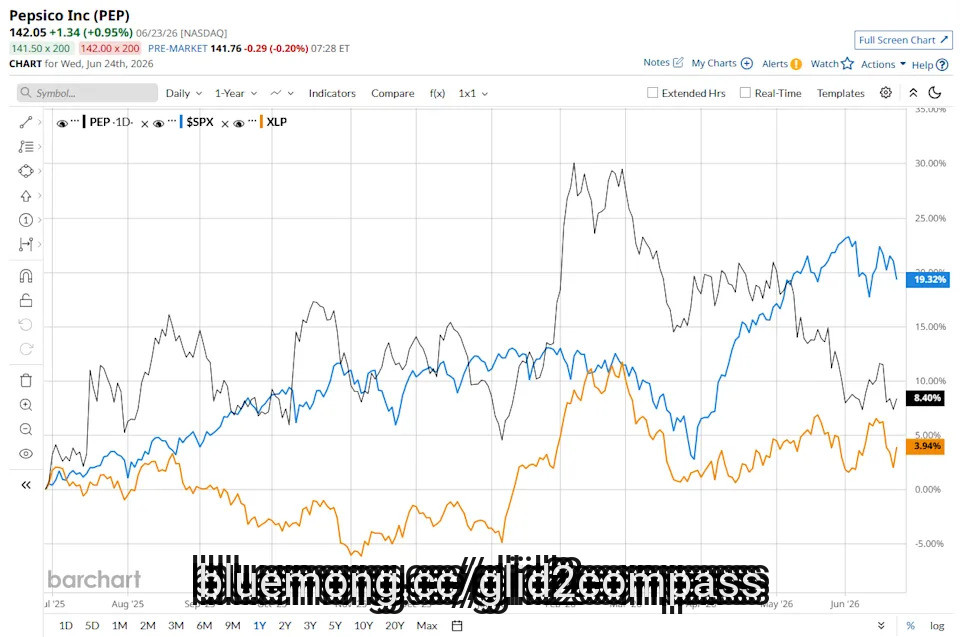
PepsiCo (NASDAQ:PEP) has spent close to a year going nowhere while the broader market climbed steadily, and shares recently traded near a 52-week low even after the company posted higher revenue and earnings. That gap between decent headline numbers and a beaten-down stock price is the whole story right now. Investors are trying to figure out whether a business that looks strong overseas and stuck at home is worth paying up for, all while collecting one of the most dependable dividends around.
ja-san-miguel-xYSp0kkIUio-unsplash
Outside the United States, PepsiCo's business is humming. International beverage volume climbed 5% last quarter and revenue jumped 11%, or 9% once currency swings are stripped out, and none of that came from acquisitions since those deals were concentrated on U.S. brands. Snacks told a similar story abroad, with Asia Pacific revenue up 15% and Latin America up 12%. That geographic spread matters because it's cushioning a domestic business that isn't pulling its weight. On top of that, volume is finally moving in the right direction everywhere: PepsiCo posted its fastest volume sales growth since 2022, and global organic sales volume through the first half of fiscal 2026 was the highest in four years, a sign that recent price cuts aimed at cost-conscious shoppers are working rather than just squeezing margins.
The stock's price tag adds to the case. Shares trade around 16 times forward earnings, a discount to its five-year median near 22. Layer on a dividend that's been raised for 54 straight years, with the payout still covered by adjusted earnings. Management is "restaging" four core brands, Lay's, Tostitos, Gatorade, and Quaker, with new packaging, marketing, and ingredients, while rolling out products like protein chips and probiotic drinks. Activist investor Elliott Investment Management has also been in the mix, pushing the company to move faster on growth and cost cuts.
The trouble is that PepsiCo's biggest market is still shrinking in the ways that matter. North American food sales fell 2% last quarter, and beverage volume in that region dropped 4% even as reported beverage revenue ticked up. Management pointed to higher gas prices as one culprit, arguing that pricier fill-ups are cutting into convenience store traffic, a channel where impulse buys of chips and soda matter a lot. Strip out acquisitions, and organic growth in North American beverages was just 1%.
#beverage #Growth
ja-san-miguel-xYSp0kkIUio-unsplash
Outside the United States, PepsiCo's business is humming. International beverage volume climbed 5% last quarter and revenue jumped 11%, or 9% once currency swings are stripped out, and none of that came from acquisitions since those deals were concentrated on U.S. brands. Snacks told a similar story abroad, with Asia Pacific revenue up 15% and Latin America up 12%. That geographic spread matters because it's cushioning a domestic business that isn't pulling its weight. On top of that, volume is finally moving in the right direction everywhere: PepsiCo posted its fastest volume sales growth since 2022, and global organic sales volume through the first half of fiscal 2026 was the highest in four years, a sign that recent price cuts aimed at cost-conscious shoppers are working rather than just squeezing margins.
The stock's price tag adds to the case. Shares trade around 16 times forward earnings, a discount to its five-year median near 22. Layer on a dividend that's been raised for 54 straight years, with the payout still covered by adjusted earnings. Management is "restaging" four core brands, Lay's, Tostitos, Gatorade, and Quaker, with new packaging, marketing, and ingredients, while rolling out products like protein chips and probiotic drinks. Activist investor Elliott Investment Management has also been in the mix, pushing the company to move faster on growth and cost cuts.
The trouble is that PepsiCo's biggest market is still shrinking in the ways that matter. North American food sales fell 2% last quarter, and beverage volume in that region dropped 4% even as reported beverage revenue ticked up. Management pointed to higher gas prices as one culprit, arguing that pricier fill-ups are cutting into convenience store traffic, a channel where impulse buys of chips and soda matter a lot. Strip out acquisitions, and organic growth in North American beverages was just 1%.
#beverage #Growth


23 days ago
KO surged 28% YTD while PEP gained just 1%, as Coca-Cola Zero Sugar's 16% volume growth and margin expansion separated the two businesses.
Pepsi's Frito-Lay North America unit slipped 2% in Q2, and recovering those volumes is the single catalyst that unlocks the $155 ***** yst target.
Pepsi's 3.91% yield and 16x forward P/E offer more room to surprise than ***** e's stretched 26x valuation after a one-year run.
Act now: the ***** yst who called NVIDIA in 2010 just named his top 10 AI stocks — and Coca-Cola didn't make the cut. Grab the names FREE today.
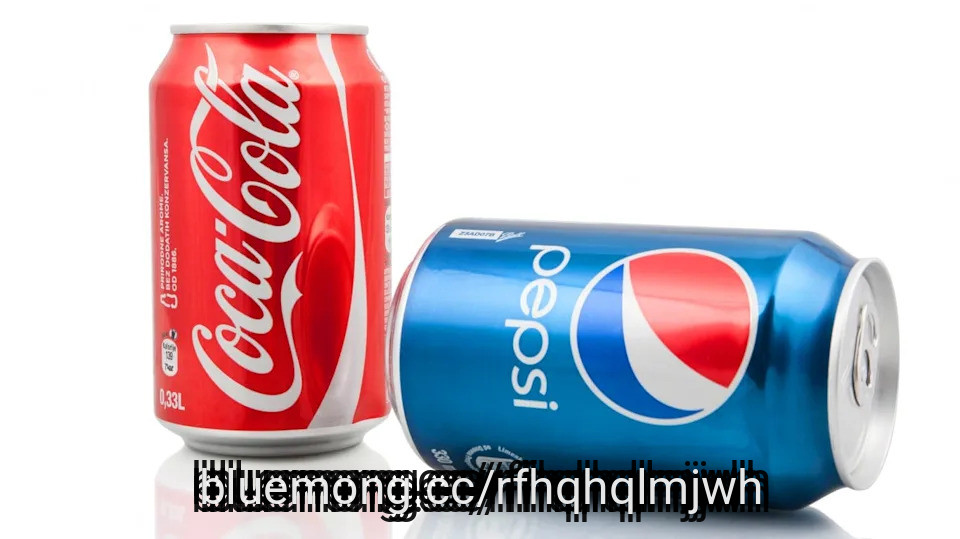
Coca-Cola (NYSE: KO) and PepsiCo (NASDAQ: PEP) both closed the books on Q2 2026 with beats, yet the businesses look further apart than ever.
#coca #cola #zero #grab
Pepsi's Frito-Lay North America unit slipped 2% in Q2, and recovering those volumes is the single catalyst that unlocks the $155 ***** yst target.
Pepsi's 3.91% yield and 16x forward P/E offer more room to surprise than ***** e's stretched 26x valuation after a one-year run.
Act now: the ***** yst who called NVIDIA in 2010 just named his top 10 AI stocks — and Coca-Cola didn't make the cut. Grab the names FREE today.
Coca-Cola (NYSE: KO) and PepsiCo (NASDAQ: PEP) both closed the books on Q2 2026 with beats, yet the businesses look further apart than ever.
#coca #cola #zero #grab


1 month ago
A warehouse shift in Tulsa will result in 184 job cuts, even as production lines beside it continue to operate.
TheStreet recently reported that Coca-Cola is closing a Massachusetts bottling plant, while Mars-owned Nature's Bakery is transferring production from a Missouri facility to other locations.
The circumstances differ, but both showed how companies are redrawing their manufacturing and distribution networks while their products remain widely available to shoppers.
Now a similar shift is affecting PepsiCo workers in Tulsa, Oklahoma.
PepsiCo Beverages will discontinue warehouse operations at its facility at 510 W. Skelly Drive, Tulsa, on Nov. 15, according to a Worker Adjustment and Retraining Notification (WARN) notice reviewed by TheStreet.
TheStreet recently reported that Coca-Cola is closing a Massachusetts bottling plant, while Mars-owned Nature's Bakery is transferring production from a Missouri facility to other locations.
The circumstances differ, but both showed how companies are redrawing their manufacturing and distribution networks while their products remain widely available to shoppers.
Now a similar shift is affecting PepsiCo workers in Tulsa, Oklahoma.
PepsiCo Beverages will discontinue warehouse operations at its facility at 510 W. Skelly Drive, Tulsa, on Nov. 15, according to a Worker Adjustment and Retraining Notification (WARN) notice reviewed by TheStreet.


1 month ago
A warehouse shift in Tulsa will result in 184 job cuts, even as production lines beside it continue to operate.
TheStreet recently reported that Coca-Cola is closing a Massachusetts bottling plant, while Mars-owned Nature's Bakery is transferring production from a Missouri facility to other locations.
The circumstances differ, but both showed how companies are redrawing their manufacturing and distribution networks while their products remain widely available to shoppers.
Now a similar shift is affecting PepsiCo workers in Tulsa, Oklahoma.
PepsiCo Beverages will discontinue warehouse operations at its facility at 510 W. Skelly Drive, Tulsa, on Nov. 15, according to a Worker Adjustment and Retraining Notification (WARN) notice reviewed by TheStreet.
TheStreet recently reported that Coca-Cola is closing a Massachusetts bottling plant, while Mars-owned Nature's Bakery is transferring production from a Missouri facility to other locations.
The circumstances differ, but both showed how companies are redrawing their manufacturing and distribution networks while their products remain widely available to shoppers.
Now a similar shift is affecting PepsiCo workers in Tulsa, Oklahoma.
PepsiCo Beverages will discontinue warehouse operations at its facility at 510 W. Skelly Drive, Tulsa, on Nov. 15, according to a Worker Adjustment and Retraining Notification (WARN) notice reviewed by TheStreet.

1 month ago
American companies are finally getting relief from tariff refunds—only it's just in time for a new wave of inflationary economic factors.
The U.S. Customs and Border Protection issued $49.2 billion in refunds in June, according to the U.S. Treasury's monthly statement, bringing total tariff refunds to about $71 billion, or more than 60% of the $166 billion available following the Supreme Court striking down tariffs under the International Emergency Economic Powers Act (IEEPA) in February.
But as companies recoup costs ******* ociated with the import taxes they were forced to pay last year, they're finding that, in many cases, those funds are being eaten up thanks to the impact of other economic pressures.
"We do expect some more pressure on the business from a commodity standpoint," PepsiCo Chief Financial Officer Steve Schmitt said in the company's earnings call last week. "We will be using the tariff, essentially the refunds, to help offset some commodity inflation that we're seeing and allow us to continue to play offense in the business."
The company's CEO Ramon Laguarta said the Iran war and its impact on gas prices in particular have impacted consumer behavior, reducing discretionary spending and trips to convenience stores, which is correlated with purchases.
The U.S. Customs and Border Protection issued $49.2 billion in refunds in June, according to the U.S. Treasury's monthly statement, bringing total tariff refunds to about $71 billion, or more than 60% of the $166 billion available following the Supreme Court striking down tariffs under the International Emergency Economic Powers Act (IEEPA) in February.
But as companies recoup costs ******* ociated with the import taxes they were forced to pay last year, they're finding that, in many cases, those funds are being eaten up thanks to the impact of other economic pressures.
"We do expect some more pressure on the business from a commodity standpoint," PepsiCo Chief Financial Officer Steve Schmitt said in the company's earnings call last week. "We will be using the tariff, essentially the refunds, to help offset some commodity inflation that we're seeing and allow us to continue to play offense in the business."
The company's CEO Ramon Laguarta said the Iran war and its impact on gas prices in particular have impacted consumer behavior, reducing discretionary spending and trips to convenience stores, which is correlated with purchases.


1 month ago
PepsiCo, Inc. (NASDAQ:PEP) was among Jim Cramer's stock calls on Mad Money, as he advised investors to stick with the largest tech companies in the market. Cramer commented on the company's earnings and management commentary, as he said:
This morning, PepsiCo reported a quarter that looked fine on the surface, but failed to wow when you got to the fine print. Meanwhile, the stock, once a market darling, has turned into an ugly duckling. On the conference call, management admitted that inflation and the price of gasoline caused domestic snack sales to fall. That led to a collapse in the stock… This quarter, I think some of the largest distributors had enough and demanded price rollbacks… It wouldn't shock me if Walmart forced PepsiCo's hand and demanded rollbacks…
I think it was the rollbacks in the traditional grocers plus the sticker shock of the convenience stores that made it so no matter what Pepsi did, it couldn't grow the business. Now, they've tried things to forestall this moment. I know they want to stick by their innovation playbook. I respect that. They're tremendous cost cutters too, but maybe they just have to take the darn hit and cut the price of their products big time, take a ton of market share, and then three quarters from now, they can have a much better return. I fear, as others do, that this is the beginning of a slow rollback in pricing. I say rip the band-aid off. Go back to prices from 10 years ago before the endless increases and get realistic.
You raise prices too much, too often for a country that's now weight-obsessed, health-obsessed, and GLP-1 obsessed, and you're just not going to make as much money for a bag as you'd like to. Now, PepsiCo gets about half of its sales from overseas, and that business is terrific. They need to make international much bigger to lessen the impact of Frito-Lay's domestic pain. Here's the bottom line: I fear now that only drastic pricing can reverse a domestic dive, something, by the way, the CEO Ramon Laguarta disagreed with when we interviewed him on Squawk on the Street. In truth, I thought Ramon wasn't really disagreeing with me. I think he was subtly disagreeing with the action in the stock, and that's actually not that great an idea when you're running a publicly traded company.
ja-san-miguel-xYSp0kkIUio-unsplash
This morning, PepsiCo reported a quarter that looked fine on the surface, but failed to wow when you got to the fine print. Meanwhile, the stock, once a market darling, has turned into an ugly duckling. On the conference call, management admitted that inflation and the price of gasoline caused domestic snack sales to fall. That led to a collapse in the stock… This quarter, I think some of the largest distributors had enough and demanded price rollbacks… It wouldn't shock me if Walmart forced PepsiCo's hand and demanded rollbacks…
I think it was the rollbacks in the traditional grocers plus the sticker shock of the convenience stores that made it so no matter what Pepsi did, it couldn't grow the business. Now, they've tried things to forestall this moment. I know they want to stick by their innovation playbook. I respect that. They're tremendous cost cutters too, but maybe they just have to take the darn hit and cut the price of their products big time, take a ton of market share, and then three quarters from now, they can have a much better return. I fear, as others do, that this is the beginning of a slow rollback in pricing. I say rip the band-aid off. Go back to prices from 10 years ago before the endless increases and get realistic.
You raise prices too much, too often for a country that's now weight-obsessed, health-obsessed, and GLP-1 obsessed, and you're just not going to make as much money for a bag as you'd like to. Now, PepsiCo gets about half of its sales from overseas, and that business is terrific. They need to make international much bigger to lessen the impact of Frito-Lay's domestic pain. Here's the bottom line: I fear now that only drastic pricing can reverse a domestic dive, something, by the way, the CEO Ramon Laguarta disagreed with when we interviewed him on Squawk on the Street. In truth, I thought Ramon wasn't really disagreeing with me. I think he was subtly disagreeing with the action in the stock, and that's actually not that great an idea when you're running a publicly traded company.
ja-san-miguel-xYSp0kkIUio-unsplash
1 month ago
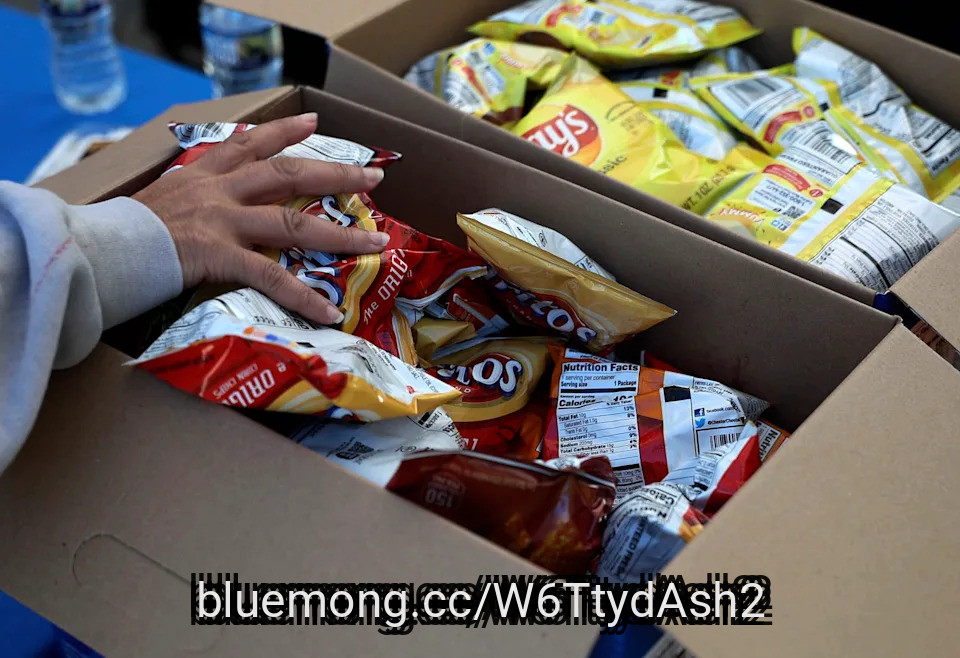
PepsiCo (PEP) quarterly results showed that North American consumers remain under pressure as they focus on essentials and budget for higher gas prices.
The soda and snack giant beat Wall Street's expectations on both the top and bottom lines, but its North American results weighed on the quarter. Additionally, Americans didn't stock up on snacks following price cuts of roughly 15% in February on Lay's, Doritos, Cheetos, and Tostitos.
"Results were tempered in the quarter as U.S. food and beverage category performance moderated with consumer budgets tightening due to rising inflationary pressures," chair and CEO Ramon Laguarta said in prepared remarks.
PepsiCo's stock fell 3% on Thursday.
Adjusted earnings per share came in at $2.20 in the fiscal second quarter, more than the $2.19 Wall Street **** ysts expected. Pepsi also posted a revenue beat, driven by international results, with sales of $24.2 billion above the $23.9 billion expected.
The soda and snack giant beat Wall Street's expectations on both the top and bottom lines, but its North American results weighed on the quarter. Additionally, Americans didn't stock up on snacks following price cuts of roughly 15% in February on Lay's, Doritos, Cheetos, and Tostitos.
"Results were tempered in the quarter as U.S. food and beverage category performance moderated with consumer budgets tightening due to rising inflationary pressures," chair and CEO Ramon Laguarta said in prepared remarks.
PepsiCo's stock fell 3% on Thursday.
Adjusted earnings per share came in at $2.20 in the fiscal second quarter, more than the $2.19 Wall Street **** ysts expected. Pepsi also posted a revenue beat, driven by international results, with sales of $24.2 billion above the $23.9 billion expected.

1 month ago
As of roughly noon E.T., the S&P 500 (SNPINDEX:^GSPC) rose 0.56% to 7,524.39, the Nasdaq Composite (NASDAQINDEX:^IXIC) climbed 0.78% to 26,073.17, and the Dow Jones Industrial Average (DJINDICES:^DJI) added 0.24% to 52,473.28 as AI chip strength helped markets stabilize after war‑driven volatility.
Chip and optical‑communication names, including Marvell Technology (NASDAQ:MRVL), Corning (NYSE:GLW), Coherent (NYSE:COHR), and Lumentum (NASDAQ:LITE), were among the day's notable gainers amid sector‑wide demand for communications chips. However, high-valuation AI behemoth Palantir (NASDAQ:PLTR) extended its 29% decline year-to-date, dropping about 4% so far today.
Despite the U.S.-Iran ceasefire being paused for now, and the market facing a growing drumbeat of **** ysts saying we might be in "bubbly" territory, stocks surged higher today, buoyed by the strength of AI and semiconductor stocks. In addition to a handful of **** yst upgrades of semiconductor stocks, SK Hynix's upcoming U.S. ADR offering is estimated to be more than seven times oversubscribed, indicating that immense investor appetite remains in the **** e.
Elsewhere, PepsiCo (NASDAQ:PEP) unofficially kicked off earnings season this morning, delivering mixed earnings that prompted shares to dip roughly 3%. The beverages and snacks giant grew sales by 6% in the second quarter, but said it saw weaker consumer spending in the U.S. due to higher gas prices and broader macroeconomic volatility.
Whether or not the AI and technology industries are indeed in "bubbly territory" as many **** ysts suggest, there are a surprising number of S&P 500 stocks near their 52-week lows, so plenty of opportunities remain despite the indexes trading at or near all-time highs.
Chip and optical‑communication names, including Marvell Technology (NASDAQ:MRVL), Corning (NYSE:GLW), Coherent (NYSE:COHR), and Lumentum (NASDAQ:LITE), were among the day's notable gainers amid sector‑wide demand for communications chips. However, high-valuation AI behemoth Palantir (NASDAQ:PLTR) extended its 29% decline year-to-date, dropping about 4% so far today.
Despite the U.S.-Iran ceasefire being paused for now, and the market facing a growing drumbeat of **** ysts saying we might be in "bubbly" territory, stocks surged higher today, buoyed by the strength of AI and semiconductor stocks. In addition to a handful of **** yst upgrades of semiconductor stocks, SK Hynix's upcoming U.S. ADR offering is estimated to be more than seven times oversubscribed, indicating that immense investor appetite remains in the **** e.
Elsewhere, PepsiCo (NASDAQ:PEP) unofficially kicked off earnings season this morning, delivering mixed earnings that prompted shares to dip roughly 3%. The beverages and snacks giant grew sales by 6% in the second quarter, but said it saw weaker consumer spending in the U.S. due to higher gas prices and broader macroeconomic volatility.
Whether or not the AI and technology industries are indeed in "bubbly territory" as many **** ysts suggest, there are a surprising number of S&P 500 stocks near their 52-week lows, so plenty of opportunities remain despite the indexes trading at or near all-time highs.


1 month ago
Palm Valley Capital Management, an investment management firm, has issued the second-quarter 2026 investor letter for the "Palm Valley Capital Fund." A copy of the letter can be downloaded here. In the second quarter, the fund's investor class gained 1.80%, while the S&P SmallCap 600 rose 19.7% and the Morningstar Small Cap Total Return Index returned 14.0%. The Strategy primarily focused on small-cap categories, allocating 75% to cash equivalents. This led to underperformance relative to benchmarks. The Fund is currently seeking more small-cap opportunities that meet its return criteria and will act swiftly if market conditions improve. The Index benefited from strong contributions from data center construction and biotech sectors, while the energy industry lagged. Additionally, reviewing the fund's top five holdings can reveal its best investments in 2026.
In its second-quarter 2026 investor letter, Palm Valley Capital Management highlighted Heartland Express, Inc. (NASDAQ:HTLD). Heartland Express, Inc. (NASDAQ:HTLD) is a trucking company that provides short-to-medium and long-haul truckload carrier and transportation services. On July 7, 2026, Heartland Express, Inc. (NASDAQ:HTLD) closed at $14.89 per share, reflecting a market capitalization of $1.15 billion. Heartland Express, Inc. (NASDAQ:HTLD) posted a one-month return of -5.64%, while its shares gained 59.42% over the past 52 weeks.
Palm Valley Capital Management stated the following regarding Heartland Express, Inc. (NASDAQ:HTLD) in its Q2 2026 investor letter:
"We sold our position in Heartland Express, Inc. (NASDAQ:HTLD) during the quarter. The stock rallied to our valuation in anticipation of a trucking industry recovery. The freight cycle has experienced a prolonged bottoming, yet Heartland's shares have priced in significantly improved fundamentals already. We sold Heartland in April but observed with interest a June Wall Street Journal article discussing PepsiCo's use of driverless box trucks in Arizona to transport Frito-Lay and Doritos relatively short distances from distribution centers to retail stores like Walmart. Trucking is another sector where investors are **** sing how quickly automation will impact incumbents, and their judgments and misjudgments could create future opportunities."
Heartland Express, Inc. (NASDAQ:HTLD) is not on our list of 40 Most Popular Stocks Among Hedge Funds Heading Into 2026. According to our database, 14 hedge fund portfolios held Heartland Express, Inc. (NASDAQ:HTLD) at the end of the first quarter, up from 12 in the previous quarter. While we acknowledge the potential of Heartland Express, Inc. (NASDAQ:HTLD) as an investment, we believe certain AI stocks offer greater upside potential and carry less downside risk. If you're looking for an extremely undervalued AI stock that also stands to benefit significantly from Trump-era tariffs and the onshoring trend, see our free report on the best short-term AI stock.
In its second-quarter 2026 investor letter, Palm Valley Capital Management highlighted Heartland Express, Inc. (NASDAQ:HTLD). Heartland Express, Inc. (NASDAQ:HTLD) is a trucking company that provides short-to-medium and long-haul truckload carrier and transportation services. On July 7, 2026, Heartland Express, Inc. (NASDAQ:HTLD) closed at $14.89 per share, reflecting a market capitalization of $1.15 billion. Heartland Express, Inc. (NASDAQ:HTLD) posted a one-month return of -5.64%, while its shares gained 59.42% over the past 52 weeks.
Palm Valley Capital Management stated the following regarding Heartland Express, Inc. (NASDAQ:HTLD) in its Q2 2026 investor letter:
"We sold our position in Heartland Express, Inc. (NASDAQ:HTLD) during the quarter. The stock rallied to our valuation in anticipation of a trucking industry recovery. The freight cycle has experienced a prolonged bottoming, yet Heartland's shares have priced in significantly improved fundamentals already. We sold Heartland in April but observed with interest a June Wall Street Journal article discussing PepsiCo's use of driverless box trucks in Arizona to transport Frito-Lay and Doritos relatively short distances from distribution centers to retail stores like Walmart. Trucking is another sector where investors are **** sing how quickly automation will impact incumbents, and their judgments and misjudgments could create future opportunities."
Heartland Express, Inc. (NASDAQ:HTLD) is not on our list of 40 Most Popular Stocks Among Hedge Funds Heading Into 2026. According to our database, 14 hedge fund portfolios held Heartland Express, Inc. (NASDAQ:HTLD) at the end of the first quarter, up from 12 in the previous quarter. While we acknowledge the potential of Heartland Express, Inc. (NASDAQ:HTLD) as an investment, we believe certain AI stocks offer greater upside potential and carry less downside risk. If you're looking for an extremely undervalued AI stock that also stands to benefit significantly from Trump-era tariffs and the onshoring trend, see our free report on the best short-term AI stock.


1 month ago
PepsiCo (PEP) quarterly results showed that North American consumers remain under pressure as they focus on essentials and budget for higher gas prices.
The soda and snack giant beat Wall Street's expectations on both the top and bottom lines, but its North American results weighed on the quarter. Additionally, Americans didn't stock up on snacks following price cuts of roughly 15% in February on Lay's, Doritos, Cheetos, and Tostitos.
"Results were tempered in the quarter as U.S. food and beverage category performance moderated with consumer budgets tightening due to rising inflationary pressures," Chairman and CEO Ramon Laguarta said in prepared remarks.
PepsiCo's stock fell over 1% in premarket trading.
Adjusted earnings per share came in at $2.20 in the fiscal second quarter, more than the $2.19 Wall Street **** ysts expected. Pepsi also posted a revenue beat, driven by international results, with sales of $24.2 billion above the $23.9 billion expected.
The soda and snack giant beat Wall Street's expectations on both the top and bottom lines, but its North American results weighed on the quarter. Additionally, Americans didn't stock up on snacks following price cuts of roughly 15% in February on Lay's, Doritos, Cheetos, and Tostitos.
"Results were tempered in the quarter as U.S. food and beverage category performance moderated with consumer budgets tightening due to rising inflationary pressures," Chairman and CEO Ramon Laguarta said in prepared remarks.
PepsiCo's stock fell over 1% in premarket trading.
Adjusted earnings per share came in at $2.20 in the fiscal second quarter, more than the $2.19 Wall Street **** ysts expected. Pepsi also posted a revenue beat, driven by international results, with sales of $24.2 billion above the $23.9 billion expected.


1 month ago
PepsiCo's next earnings report is set to be released Thursday morning following a recent pullback in the soda and snack maker's stock.
Sales and profits are expected to have grown year-over-year, but ******* ysts have said sales in some of Pepsi's segments look to have weakened recently.
PepsiCo is scheduled to post its latest quarterly results ahead of the opening bell Thursday. The food and beverage giant's stock could undergo a sizable swing to finish the week.
Based on current options pricing, PepsiCo (PEP) shares are seen moving as much as 4% in either direction by the end of the week. A move of that size from Monday's close of $143.29 could see shares rise to nearly $149, their highest point in over a month, or fall to below $138, near their lowest point of the year. Pepsi shares fell slightly Monday on a solid day for stocks broadly, with the Dow closing at a new record high.
PepsiCo and fellow household names like Delta Air Lines and Levi Strauss are each set to report earnings this week, kicking off the second-quarter earnings season and providing fresh insights on how American consumers fared in the second quarter.
Sales and profits are expected to have grown year-over-year, but ******* ysts have said sales in some of Pepsi's segments look to have weakened recently.
PepsiCo is scheduled to post its latest quarterly results ahead of the opening bell Thursday. The food and beverage giant's stock could undergo a sizable swing to finish the week.
Based on current options pricing, PepsiCo (PEP) shares are seen moving as much as 4% in either direction by the end of the week. A move of that size from Monday's close of $143.29 could see shares rise to nearly $149, their highest point in over a month, or fall to below $138, near their lowest point of the year. Pepsi shares fell slightly Monday on a solid day for stocks broadly, with the Dow closing at a new record high.
PepsiCo and fellow household names like Delta Air Lines and Levi Strauss are each set to report earnings this week, kicking off the second-quarter earnings season and providing fresh insights on how American consumers fared in the second quarter.

2 months ago
When former PepsiCo CEO Indra Nooyi arrived in the U.S. in the late 1970s to study graduate-level management at Yale University, she was a self-described "misfit" from India. Instead of adjusting to the rhythms of college nightlife, Nooyi was working the midnight-to-5 a.m. shift as a dormitory receptionist before heading to class each morning to pay for her degree.
"We worked our tail off because to us, we didn't come there for the social life—we came there to study and to work hard and to move ahead," Nooyi recalled in a recent interview with former U.S. Secretary of State Condoleezza Rice, recalling the experiences of her and her fellow classmates from developing countries. "So the goal we had was very, very clear: study, work hard, get great grades, and somehow land a job. That's all the objective was at that time."
Paying for an Ivy League degree wasn't easy, either. At the time, annual tuition was equivalent to about $20,000 in today's dollars (a far cry from the six-figure tuition costs of today), and her parents told her they couldn't help her out financially. But eventually, that relentless work ethic inside and outside of the classroom paid off.
"When we got consulting jobs or investment banking jobs, people looked at us and said, 'Hey, these are brainiacs,'" Nooyi said. "Respect just went up—purely because of the hard work and all the efforts we put in…People realized that this was a grueling experience for us, and they respected us for that."
Looking back, the overnight shifts and long hours were part of a larger belief as an immigrant: success wasn't guaranteed in America, but opportunity was.
"We worked our tail off because to us, we didn't come there for the social life—we came there to study and to work hard and to move ahead," Nooyi recalled in a recent interview with former U.S. Secretary of State Condoleezza Rice, recalling the experiences of her and her fellow classmates from developing countries. "So the goal we had was very, very clear: study, work hard, get great grades, and somehow land a job. That's all the objective was at that time."
Paying for an Ivy League degree wasn't easy, either. At the time, annual tuition was equivalent to about $20,000 in today's dollars (a far cry from the six-figure tuition costs of today), and her parents told her they couldn't help her out financially. But eventually, that relentless work ethic inside and outside of the classroom paid off.
"When we got consulting jobs or investment banking jobs, people looked at us and said, 'Hey, these are brainiacs,'" Nooyi said. "Respect just went up—purely because of the hard work and all the efforts we put in…People realized that this was a grueling experience for us, and they respected us for that."
Looking back, the overnight shifts and long hours were part of a larger belief as an immigrant: success wasn't guaranteed in America, but opportunity was.

2 months ago
Coming off a holiday-shortened week filled with tons of labor market data and a surprising jobs report, investors are greeted with a relatively quiet stretch in the week ahead.
Markets will pick things up after a mixed Thursday that saw an unsure market with the S&P 500 (^GSPC) closing flat, the Nasdaq (^IXIC) falling 0.8%, and the Dow (^DJI) gaining 1.1%.
Monday is likely to be the biggest day to watch on the economic calendar, with a host of index readings from S&P Global and the Institute of Supply Management set to give investors a read on the state of the US service economy.
That data comes after the monthly private payrolls release from data provider ADP showed that the services side of the economy added the dominant count of jobs in June.
In the corporate world, reports from PepsiCo (PEP) on Thursday and Delta Air Lines (DAL) on Friday should highlight the week. PepsiCo's results should give investors some insight into the state of the American consumer, while Delta is set to provide one more read on the lasting effects of the war in Iran and the energy crisis it kicked off.
Markets will pick things up after a mixed Thursday that saw an unsure market with the S&P 500 (^GSPC) closing flat, the Nasdaq (^IXIC) falling 0.8%, and the Dow (^DJI) gaining 1.1%.
Monday is likely to be the biggest day to watch on the economic calendar, with a host of index readings from S&P Global and the Institute of Supply Management set to give investors a read on the state of the US service economy.
That data comes after the monthly private payrolls release from data provider ADP showed that the services side of the economy added the dominant count of jobs in June.
In the corporate world, reports from PepsiCo (PEP) on Thursday and Delta Air Lines (DAL) on Friday should highlight the week. PepsiCo's results should give investors some insight into the state of the American consumer, while Delta is set to provide one more read on the lasting effects of the war in Iran and the energy crisis it kicked off.



2 months ago
Coca-Cola's **** et-light tollbooth model delivered 10% organic revenue growth and free cash flow surging 132% to $1.8 billion in Q1 FY26.
PepsiCo's operating cash flow collapsed 98% to $41 million in Q1 as a $2 billion Rockstar write-down gutted full-year 2025 income.
Act now: the **** yst who called NVIDIA in 2010 just named his top 10 AI stocks — and Coca-Cola didn't make the cut. Grab the names FREE today.
PepsiCo (NASDAQ:PEP) just hiked its dividend for the 54th straight year and beat Q1 estimates, putting it squarely back in dividend-investor chatter as consumer staples wobble through another bout of volatility.
PepsiCo's Q1 FY26 headline beat masks a business that posted organic revenue growth of just 2.6%, with operating cash flow that collapsed 97.92% to $41 million. The full-year 2025 picture is worse: operating income fell 19.57% and net income fell 13.97% on the back of a $1.993 billion Rockstar impairment plus an additional Be & Cheery write-down.
PepsiCo's operating cash flow collapsed 98% to $41 million in Q1 as a $2 billion Rockstar write-down gutted full-year 2025 income.
Act now: the **** yst who called NVIDIA in 2010 just named his top 10 AI stocks — and Coca-Cola didn't make the cut. Grab the names FREE today.
PepsiCo (NASDAQ:PEP) just hiked its dividend for the 54th straight year and beat Q1 estimates, putting it squarely back in dividend-investor chatter as consumer staples wobble through another bout of volatility.
PepsiCo's Q1 FY26 headline beat masks a business that posted organic revenue growth of just 2.6%, with operating cash flow that collapsed 97.92% to $41 million. The full-year 2025 picture is worse: operating income fell 19.57% and net income fell 13.97% on the back of a $1.993 billion Rockstar impairment plus an additional Be & Cheery write-down.


2 months ago
PepsiCo Beverages US CMO Mark Kirkham credits a focus on organic social media with helping drive the brand's engagement to a 20-year high. Working with VaynerMedia, the company has increased its content output fivefold. Kirkham says the approach requires trusting internal teams and allowing social media algorithms to determine what resonates.


2 months ago
Dirty sodas have moved from novelty to the mainstream. What was once a social media trend now gets sold at McDonald's and Target, and even PepsiCo has embraced the idea with its own ready-to-drink (RTD) dirty sodas.
Retailers and restaurants have embraced the trend, with 2.7% of U.S. eateries offering a carbonated soft drink that includes cream or milk, up from 1.5% a decade ago, according to CNBC, citing Datassential.
Target has jumped on the dirty soda bandwagon as well, offering up a "secret" menu of dirty sodas that can be made with one of its own beverage lines, and selling an exclusive RTD drink line from Slice.
While dirty soda has become a growing trend, it's important to understand the background and where the idea came from — Mormons in Utah who don't drink alcohol.
Utah-based drink chain Swig created "dirty soda" back in 2010.
Retailers and restaurants have embraced the trend, with 2.7% of U.S. eateries offering a carbonated soft drink that includes cream or milk, up from 1.5% a decade ago, according to CNBC, citing Datassential.
Target has jumped on the dirty soda bandwagon as well, offering up a "secret" menu of dirty sodas that can be made with one of its own beverage lines, and selling an exclusive RTD drink line from Slice.
While dirty soda has become a growing trend, it's important to understand the background and where the idea came from — Mormons in Utah who don't drink alcohol.
Utah-based drink chain Swig created "dirty soda" back in 2010.

2 months ago
PepsiCo Inc (NASDAQ:PEP, XETRA:PEP) earnings outlook was trimmed by Bank of America ****** ysts ahead of the company's second quarter results, with softer-than-expected performance in its North American snacks business offsetting steadier international trends.
The ****** ysts lowered their fiscal 2026 earnings per share (EPS) estimate to $8.61 from $8.65 and slightly reduced their second quarter forecast to $2.18 from $2.19. The revision reflects weaker performance at PepsiCo Foods North America (PFNA) and expectations that its recovery will take longer to materialize in the second half of the year.
For the quarter, Bank of America now expects consolidated organic sales growth of 2.9%, down from a prior estimate of 3.1%. The full-year organic sales growth outlook was also cut to 3.0% from 3.4%.
Despite the downward revisions, the ****** ysts noted continued strength in international markets, which are now expected to deliver 5.4% organic sales growth in the second quarter, up from a prior forecast of 4.9%. They suggested PepsiCo could still reiterate its full-year guidance when it reports results on July 9, though the underlying mix of performance may be less favorable.
The primary pressure point remains PFNA, where scanner data indicated a sequential deterioration in trends during the quarter. NielsenIQ data showed retail sales growth slowing to a 1.0% decline in the second quarter from 0.6% growth in the first. Bank of America attributed the weakness to macroeconomic pressures, inflation, and unfavorable weather conditions around Memorial Day.
The ****** ysts lowered their fiscal 2026 earnings per share (EPS) estimate to $8.61 from $8.65 and slightly reduced their second quarter forecast to $2.18 from $2.19. The revision reflects weaker performance at PepsiCo Foods North America (PFNA) and expectations that its recovery will take longer to materialize in the second half of the year.
For the quarter, Bank of America now expects consolidated organic sales growth of 2.9%, down from a prior estimate of 3.1%. The full-year organic sales growth outlook was also cut to 3.0% from 3.4%.
Despite the downward revisions, the ****** ysts noted continued strength in international markets, which are now expected to deliver 5.4% organic sales growth in the second quarter, up from a prior forecast of 4.9%. They suggested PepsiCo could still reiterate its full-year guidance when it reports results on July 9, though the underlying mix of performance may be less favorable.
The primary pressure point remains PFNA, where scanner data indicated a sequential deterioration in trends during the quarter. NielsenIQ data showed retail sales growth slowing to a 1.0% decline in the second quarter from 0.6% growth in the first. Bank of America attributed the weakness to macroeconomic pressures, inflation, and unfavorable weather conditions around Memorial Day.

2 months ago
Purchase, New York-based PepsiCo, Inc. (PEP) engages in the manufacture, marketing, distribution, and sale of various beverages and convenient foods worldwide. The company has a market capitalization of $194.1 billion and operates through PepsiCo Foods North America, PepsiCo Beverages North America, International Beverages Franchise, Europe, the Middle East and Africa, Latin America Foods, and Asia Pacific Foods segments.
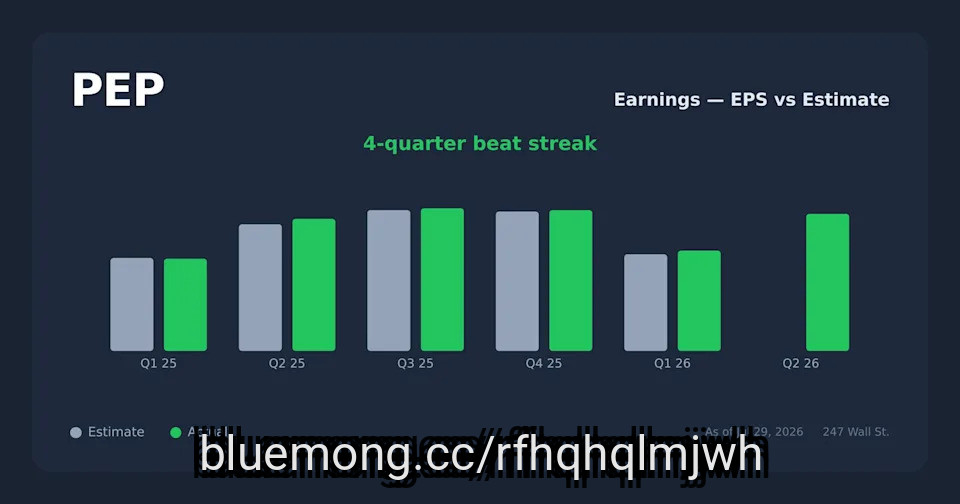
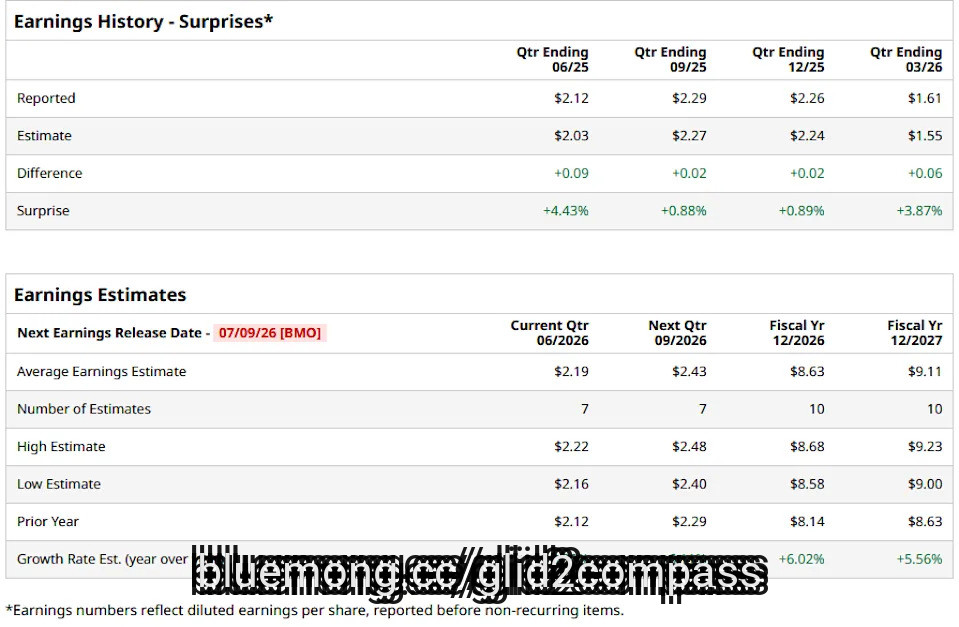
PEP is expected to release its Q2 2026 earnings on July 9, before the market opens. Ahead of the event, ******* ysts expect the company's EPS to be $2.19 on a diluted basis, up 3.3% from $2.12 in the year-ago quarter. The company has exceeded Wall Street's EPS estimates in each of its last four quarters.
Ahead of Micron Earnings, Here's What Barchart Data Says Comes Next for MU Stock
Huge, Unusual In-the-Money Call Option Volume in Intel Stock Today Shows Investors Bullish
Stock Index Futures Plunge as Tech Selloff Rages On, U.S. PMI Data in Focus
PEP is expected to release its Q2 2026 earnings on July 9, before the market opens. Ahead of the event, ******* ysts expect the company's EPS to be $2.19 on a diluted basis, up 3.3% from $2.12 in the year-ago quarter. The company has exceeded Wall Street's EPS estimates in each of its last four quarters.
Ahead of Micron Earnings, Here's What Barchart Data Says Comes Next for MU Stock
Huge, Unusual In-the-Money Call Option Volume in Intel Stock Today Shows Investors Bullish
Stock Index Futures Plunge as Tech Selloff Rages On, U.S. PMI Data in Focus
2 months ago
Hershey is bringing in PepsiCo executive Heather Hoytink to lead the confectionery and salty snack group's US division.
Hoytink will take up her role as president of the Reese's chocolate and SkinnyPop popcorn maker's US business on 8 July. She was most recently senior vice president and chief commercial officer for PepsiCo's US business in out-of-home beverages.
Andrew Archambault previously occupied the role but left in May to join US drinks firm Nutrabolt as president and COO.
Another former PepsiCo executive, Kirk Tanner, helms Hershey as its president and CEO. He joined the business in August last year from the fast-food chain Wendy's having spent more than 30 years at PepsiCo.
Tanner said in a statement that Hoytink has "operating discipline to execute at scale and a track record of growth that will accelerate our US business".
Hoytink will take up her role as president of the Reese's chocolate and SkinnyPop popcorn maker's US business on 8 July. She was most recently senior vice president and chief commercial officer for PepsiCo's US business in out-of-home beverages.
Andrew Archambault previously occupied the role but left in May to join US drinks firm Nutrabolt as president and COO.
Another former PepsiCo executive, Kirk Tanner, helms Hershey as its president and CEO. He joined the business in August last year from the fast-food chain Wendy's having spent more than 30 years at PepsiCo.
Tanner said in a statement that Hoytink has "operating discipline to execute at scale and a track record of growth that will accelerate our US business".

3 months ago
Interested in Celsius Holdings Inc.? Here are five stocks we like better.
Celsius is reshaping into a multi-brand energy platform as it integrates Alani and Rockstar, with CEO John Fieldly saying the company now reaches about one in five energy drink sales. Celsius is positioning each brand for a different consumer: Celsius for fitness/health, Alani for health-and-beauty, and Rockstar for traditional energy users.
The core Celsius brand is being reset for a return to growth after SKU rationalization and PepsiCo distribution changes. Management expects most retail resets to finish by June or July, with stability over the next few months and a move back toward growth by year-end.
Management sees margin recovery and international expansion as key longer-term drivers, with more than $50 million in synergy savings already secured from Alani integration. Celsius also highlighted early international momentum in markets like France and the U.K., while planning a cautious rollout for Alani overseas in 2027.
MarketBeat Week in Review – 10/06 - 10/10
Celsius is reshaping into a multi-brand energy platform as it integrates Alani and Rockstar, with CEO John Fieldly saying the company now reaches about one in five energy drink sales. Celsius is positioning each brand for a different consumer: Celsius for fitness/health, Alani for health-and-beauty, and Rockstar for traditional energy users.
The core Celsius brand is being reset for a return to growth after SKU rationalization and PepsiCo distribution changes. Management expects most retail resets to finish by June or July, with stability over the next few months and a move back toward growth by year-end.
Management sees margin recovery and international expansion as key longer-term drivers, with more than $50 million in synergy savings already secured from Alani integration. Celsius also highlighted early international momentum in markets like France and the U.K., while planning a cautious rollout for Alani overseas in 2027.
MarketBeat Week in Review – 10/06 - 10/10