

2 months ago
Saia, Inc. (NASDAQ:SAIA) reported that August less-than-truckload shipments per workday increased 1.1% year over year, while tonnage per workday rose 8.7% and weight per shipment increased 7.5%. For July and August combined, shipments per workday increased 1.0%, tonnage per workday rose 8.3%, and weight per shipment grew 7.2%.
The data show higher freight intensity, but most of the tonnage growth came from heavier shipments rather than strong shipment-count growth. The investment question is whether that mix can improve trailer utilization and spread terminal, driver, and line-haul costs across more freight without weakening yield or service.
Heavier shipments can support operating leverage when added weight fills available trailer capacity and moves through the network efficiently. The 218-terminal network of Saia, Inc. (NASDAQ:SAIA) may provide room to absorb incremental tonnage, although Saia, Inc. (NASDAQ:SAIA) did not disclose network utilization.
Second-quarter results offer evidence that higher volume can translate into improved economics. Saia, Inc. (NASDAQ:SAIA) increased tonnage per workday 8.4%, grew revenue 17.1%, and increased operating income 26%. The operating ratio improved to 86.9% from 87.8%, meaning operating expenses consumed a smaller share of revenue.
Pricing and shipment economics were mixed but constructive. Second-quarter revenue per shipment, excluding fuel surcharge revenue, increased 1.5%. If heavier freight continues to raise revenue per shipment while fixed network costs grow more slowly, Saia, Inc. (NASDAQ:SAIA) could produce additional operating leverage.
#operating #revenue #shipments
The data show higher freight intensity, but most of the tonnage growth came from heavier shipments rather than strong shipment-count growth. The investment question is whether that mix can improve trailer utilization and spread terminal, driver, and line-haul costs across more freight without weakening yield or service.
Heavier shipments can support operating leverage when added weight fills available trailer capacity and moves through the network efficiently. The 218-terminal network of Saia, Inc. (NASDAQ:SAIA) may provide room to absorb incremental tonnage, although Saia, Inc. (NASDAQ:SAIA) did not disclose network utilization.
Second-quarter results offer evidence that higher volume can translate into improved economics. Saia, Inc. (NASDAQ:SAIA) increased tonnage per workday 8.4%, grew revenue 17.1%, and increased operating income 26%. The operating ratio improved to 86.9% from 87.8%, meaning operating expenses consumed a smaller share of revenue.
Pricing and shipment economics were mixed but constructive. Second-quarter revenue per shipment, excluding fuel surcharge revenue, increased 1.5%. If heavier freight continues to raise revenue per shipment while fixed network costs grow more slowly, Saia, Inc. (NASDAQ:SAIA) could produce additional operating leverage.
#operating #revenue #shipments


2 months ago
XPO, Inc. (NYSE:XPO) reported that preliminary August 2026 North American less-than-truckload, or LTL, tonnage per day increased 3.7% from a year earlier. Shipments per day rose 5.7%, while average weight per shipment declined 1.8%. Final July figures showed tonnage per day increasing 5.8%, shipments per day rising 5.9%, and weight per shipment slipping 0.2%.
The two months indicate stronger shipment activity, but August's wider gap between shipment and tonnage growth points to lighter freight. The investment question is whether XPO, Inc. (NYSE:XPO) can convert additional shipments into better network density and fixed-cost absorption without allowing extra handling costs to dilute margins.
Higher shipment counts can improve the utilization of routes, service centers, dock doors, and equipment. XPO, Inc. (NYSE:XPO) operates an ****** et-based North American LTL network that moves approximately 16 billion pounds of freight annually. More shipments moving through that infrastructure can spread terminal, technology, and equipment costs across a larger revenue base.
The second quarter provides evidence that XPO, Inc. (NYSE:XPO) has recently translated volume and pricing growth into stronger economics. North American LTL revenue increased 15.2% to $1.43 billion. Fuel-surcharge revenue accounted for part of that increase, rising to $314 million from $183 million. Separately, yield excluding fuel increased 4.4%, shipments per day rose 2.8%, and tonnage per day increased 1.0%.
XPO, Inc. (NYSE:XPO) reported a company-defined non-GAAP adjusted operating ratio of 79.9%, an improvement of 300 basis points. XPO, Inc. (NYSE:XPO) calculates adjusted operating ratio as one minus adjusted operating income divided by segment revenue, using unrounded amounts. Adjusted operating income removes amortization and restructuring costs and adjusts for gains on real estate transactions. XPO, Inc. (NYSE:XPO) also reported a damage claims ratio below 0.2%.
#adjusted #north #operating
The two months indicate stronger shipment activity, but August's wider gap between shipment and tonnage growth points to lighter freight. The investment question is whether XPO, Inc. (NYSE:XPO) can convert additional shipments into better network density and fixed-cost absorption without allowing extra handling costs to dilute margins.
Higher shipment counts can improve the utilization of routes, service centers, dock doors, and equipment. XPO, Inc. (NYSE:XPO) operates an ****** et-based North American LTL network that moves approximately 16 billion pounds of freight annually. More shipments moving through that infrastructure can spread terminal, technology, and equipment costs across a larger revenue base.
The second quarter provides evidence that XPO, Inc. (NYSE:XPO) has recently translated volume and pricing growth into stronger economics. North American LTL revenue increased 15.2% to $1.43 billion. Fuel-surcharge revenue accounted for part of that increase, rising to $314 million from $183 million. Separately, yield excluding fuel increased 4.4%, shipments per day rose 2.8%, and tonnage per day increased 1.0%.
XPO, Inc. (NYSE:XPO) reported a company-defined non-GAAP adjusted operating ratio of 79.9%, an improvement of 300 basis points. XPO, Inc. (NYSE:XPO) calculates adjusted operating ratio as one minus adjusted operating income divided by segment revenue, using unrounded amounts. Adjusted operating income removes amortization and restructuring costs and adjusts for gains on real estate transactions. XPO, Inc. (NYSE:XPO) also reported a damage claims ratio below 0.2%.
#adjusted #north #operating



2 months ago
Less-than-truckload carrier Saia saw tonnage growth accelerate on a year-over-year comparison in August, but it faced an easier prior-year comp during the month than it did in July.
Johns Creek, Georgia-based Saia (NASDAQ: SAIA) reported Thursday an 8.7% y/y tonnage increase in August as daily shipments stepped 1.1% higher and weight per shipment jumped 7.5%. The metrics improved slightly from July's y/y growth rates due to easier prior-year comps.
On a two-year-stacked comparison, Saia's tonnage increases slowed for a second straight month (+6.5% in August and +8.7% in July). That said, the carrier implemented a 7.1% general rate increase on July 6, which it noted can create some near-term volatility. Further, the carrier faces easier prior-year comps (excluding November) the rest of the year.
Saia does not provide revenue-based metrics in its intraquarter updates.
However, the company previously noted that revenue per shipment increased 4% from the beginning to the end of the second quarter. The recent GRI was 120 basis points higher and three months earlier than last year's rate ***** p—another positive sign. And, contractual rate renewals averaged 10.7% in the second quarter (+15.8% on a two-year-stacked comp).
#carrier #tonnage
Johns Creek, Georgia-based Saia (NASDAQ: SAIA) reported Thursday an 8.7% y/y tonnage increase in August as daily shipments stepped 1.1% higher and weight per shipment jumped 7.5%. The metrics improved slightly from July's y/y growth rates due to easier prior-year comps.
On a two-year-stacked comparison, Saia's tonnage increases slowed for a second straight month (+6.5% in August and +8.7% in July). That said, the carrier implemented a 7.1% general rate increase on July 6, which it noted can create some near-term volatility. Further, the carrier faces easier prior-year comps (excluding November) the rest of the year.
Saia does not provide revenue-based metrics in its intraquarter updates.
However, the company previously noted that revenue per shipment increased 4% from the beginning to the end of the second quarter. The recent GRI was 120 basis points higher and three months earlier than last year's rate ***** p—another positive sign. And, contractual rate renewals averaged 10.7% in the second quarter (+15.8% on a two-year-stacked comp).
#carrier #tonnage



2 months ago
Less-than-truckload carrier Old Dominion Freight Line saw yield growth accelerate in August, but tonnage remained slightly negative, according to a Thursday update.
The Thomasville, North Carolina-based company's daily revenue increased 12.4% year over year in August, an improvement from the 8.2% y/y growth rate logged in July. However, diesel fuel prices increased 46% y/y in August compared with a 31% y/y increase in July. (Fuel was up 10% sequentially in August.)
Less-than-truckload fuel surcharge programs include a step function as diesel prices rise, typically resulting in better margins.
Old Dominion's (NASDAQ: ODFL) yield growth accelerated from July, both with and without fuel surcharges. August revenue per hundredweight (yield) was likely 13% higher y/y with fuel surcharges, and roughly 5.5% higher excluding fuel. The July growth rates were 9.3% and 4.2%, respectively. (Growth rates for the two months combined were 11.3% and 4.8%, respectively.) Higher shipment weights were a modest drag on the yield metrics in both months.
"Old Dominion produced solid revenue growth for July and August, with underlying demand trends remaining relatively consistent as the quarter has progressed," said Marty Freeman, president and CEO, in a news release. "In addition, the strength and consistency of our industry-leading service continue to support the ongoing improvement in our LTL revenue per hundredweight."
#revenue #higher
The Thomasville, North Carolina-based company's daily revenue increased 12.4% year over year in August, an improvement from the 8.2% y/y growth rate logged in July. However, diesel fuel prices increased 46% y/y in August compared with a 31% y/y increase in July. (Fuel was up 10% sequentially in August.)
Less-than-truckload fuel surcharge programs include a step function as diesel prices rise, typically resulting in better margins.
Old Dominion's (NASDAQ: ODFL) yield growth accelerated from July, both with and without fuel surcharges. August revenue per hundredweight (yield) was likely 13% higher y/y with fuel surcharges, and roughly 5.5% higher excluding fuel. The July growth rates were 9.3% and 4.2%, respectively. (Growth rates for the two months combined were 11.3% and 4.8%, respectively.) Higher shipment weights were a modest drag on the yield metrics in both months.
"Old Dominion produced solid revenue growth for July and August, with underlying demand trends remaining relatively consistent as the quarter has progressed," said Marty Freeman, president and CEO, in a news release. "In addition, the strength and consistency of our industry-leading service continue to support the ongoing improvement in our LTL revenue per hundredweight."
#revenue #higher



2 months ago
On August 21, Insteel Industries Inc. (NYSE:IIIN) announced plans to close its Upper Sandusky, Ohio, welded wire reinforcement facility. Operations are expected to cease by the end of October 2026, with production requirements transferred to the company's remaining plants. Management says those facilities have "ample open capacity" and does not expect the consolidation to affect revenue.
The closure is expected to eliminate up to 65 positions and generate approximately $4.6 million of restructuring charges. That includes $2.5 million for equipment relocation, $400,000 for employee separation, $1.0 million for ***** et impairment and $700,000 of other closure costs. All but the impairment are expected to be cash expenditures beginning in the first quarter of fiscal 2027 and continuing through the year.
For Insteel Industries Inc. (NYSE:IIIN), the announcement confirms meaningful excess welded-wire capacity, but it does not quantify it. The company provided no production tonnage, utilization percentage, or annual savings estimate. The clearest evidence is operational: management believes the remaining plants can absorb all Upper Sandusky requirements without losing revenue.
Insteel Industries Inc. (NYSE:IIIN) currently operates 11 U.S. manufacturing facilities. Earlier company materials identified eight as welded-wire plants and three as prestressed-concrete-strand plants, implying that the closure would leave seven welded-wire facilities, ***** uming no other footprint changes.
Consolidation could improve margins at Insteel Industries Inc. (NYSE:IIIN) by spreading production across fewer sites, raising utilization and eliminating duplicated labor and fixed costs. The $2.5 million equipment-relocation charge indicates that useful machinery will be transferred rather than abandoned.
#production
The closure is expected to eliminate up to 65 positions and generate approximately $4.6 million of restructuring charges. That includes $2.5 million for equipment relocation, $400,000 for employee separation, $1.0 million for ***** et impairment and $700,000 of other closure costs. All but the impairment are expected to be cash expenditures beginning in the first quarter of fiscal 2027 and continuing through the year.
For Insteel Industries Inc. (NYSE:IIIN), the announcement confirms meaningful excess welded-wire capacity, but it does not quantify it. The company provided no production tonnage, utilization percentage, or annual savings estimate. The clearest evidence is operational: management believes the remaining plants can absorb all Upper Sandusky requirements without losing revenue.
Insteel Industries Inc. (NYSE:IIIN) currently operates 11 U.S. manufacturing facilities. Earlier company materials identified eight as welded-wire plants and three as prestressed-concrete-strand plants, implying that the closure would leave seven welded-wire facilities, ***** uming no other footprint changes.
Consolidation could improve margins at Insteel Industries Inc. (NYSE:IIIN) by spreading production across fewer sites, raising utilization and eliminating duplicated labor and fixed costs. The $2.5 million equipment-relocation charge indicates that useful machinery will be transferred rather than abandoned.
#production


2 months ago
Royal De Vries Cardboard Printing has ended production at its folding-carton factory in Sneek, the Netherlands, after 152 years, after efforts to sell the entire business failed, according to a press release posted on WhatTheyThink.
The decision has resulted in all 98 employees losing their jobs.
All ****** ets have been taken over by German industrial remarketing company Allaoui and are being put up for sale.
The machinery on offer includes a KBA offset press, along with Bobst and MK Masterwork converting lines.
Royal De Vries, formally Koninklijke Drukkerij De Vries Vouwkartonnage, was founded in 1874 as a printer in the north of the Netherlands.
#netherlands #german
The decision has resulted in all 98 employees losing their jobs.
All ****** ets have been taken over by German industrial remarketing company Allaoui and are being put up for sale.
The machinery on offer includes a KBA offset press, along with Bobst and MK Masterwork converting lines.
Royal De Vries, formally Koninklijke Drukkerij De Vries Vouwkartonnage, was founded in 1874 as a printer in the north of the Netherlands.
#netherlands #german


3 months ago
Lake Victoria Gold Ltd. (TSXV:LVG) (OTCQB:LVGLF) (FSE:E1K) has released the maiden National Instrument 43-101 (NI 43-101) Mineral Resource Estimate for its wholly owned Tembo Gold Project in northwestern Tanzania, outlining an initial resource of nearly 580,000 ounces of gold across three deposits.Lake Victoria Gold Ltd. has outlined its first NI 43-101 compliant mineral resource at the Tembo Gold Project in Tanzania, establishing nearly 580,000 ounces of contained gold and giving the company a second defined development **** et alongside its fully permitted Imwelo project.The resource is centered on the Ngula 1, Nyakagwe Village, and Nyakagwe East deposits, all located on four granted mining licences covering approximately 34 square kilometers within the Lake Victoria Goldfield. The project borders Barrick Gold's Bulyanhulu Mine, one of Tanzania's largest underground gold operations, although mineralization on adjacent properties is not necessarily indicative of mineralization at Tembo.
Gold bars. Photo by Zlaťáky.cz on PexelsAmong the three deposits, Ngula 1 represents the most advanced target, accounting for approximately 331,000 ounces, or roughly 57% of the project's total resource and nearly two-thirds of the Indicated ounces. According to the company, the deposit extends for approximately 600 metres along strike, remains open at depth and along strike, and will serve as the focus of a planned 5,000-metre infill drilling program designed to improve geological confidence and support future mine planning.Beyond the headline resource estimate, the company highlighted the presence of a higher-grade component within the deposit. Using progressively higher cut-off grades, the resource estimate outlines 400,400 ounces grading 2.13 grams per tonne at a 1.0 g/t cut-off and 280,500 ounces grading 3.08 g/t at a 1.5 g/t cut-off. These figures are reported as grade-tonnage sensitivities within the same conceptual open-pit shells as the mineral resource estimate and do not represent separate mineral resources or mineral reserves.Lake Victoria Gold said much of the current resource remains classified as Inferred because of drill **** ing, particularly at the Nyakagwe Village and Nyakagwe East deposits. Planned infill drilling is intended to improve confidence in the geological model and support future resource conversion, although there is no **** urance that additional drilling will upgrade existing resources.The company also continues to advance a previously announced toll-milling initiative with Nyati Resources (T) Limited involving a proposed 500-tonne-per-day processing plant located on a Tembo mining licence. The proposed arrangement is intended to provide a processing option for potential near-surface material from Ngula 1, subject to additional drilling, permitting, financing, and the negotiation and execution of definitive agreements.Tembo represents Lake Victoria Gold's second principal development **** et alongside its fully permitted Imwelo G
Gold bars. Photo by Zlaťáky.cz on PexelsAmong the three deposits, Ngula 1 represents the most advanced target, accounting for approximately 331,000 ounces, or roughly 57% of the project's total resource and nearly two-thirds of the Indicated ounces. According to the company, the deposit extends for approximately 600 metres along strike, remains open at depth and along strike, and will serve as the focus of a planned 5,000-metre infill drilling program designed to improve geological confidence and support future mine planning.Beyond the headline resource estimate, the company highlighted the presence of a higher-grade component within the deposit. Using progressively higher cut-off grades, the resource estimate outlines 400,400 ounces grading 2.13 grams per tonne at a 1.0 g/t cut-off and 280,500 ounces grading 3.08 g/t at a 1.5 g/t cut-off. These figures are reported as grade-tonnage sensitivities within the same conceptual open-pit shells as the mineral resource estimate and do not represent separate mineral resources or mineral reserves.Lake Victoria Gold said much of the current resource remains classified as Inferred because of drill **** ing, particularly at the Nyakagwe Village and Nyakagwe East deposits. Planned infill drilling is intended to improve confidence in the geological model and support future resource conversion, although there is no **** urance that additional drilling will upgrade existing resources.The company also continues to advance a previously announced toll-milling initiative with Nyati Resources (T) Limited involving a proposed 500-tonne-per-day processing plant located on a Tembo mining licence. The proposed arrangement is intended to provide a processing option for potential near-surface material from Ngula 1, subject to additional drilling, permitting, financing, and the negotiation and execution of definitive agreements.Tembo represents Lake Victoria Gold's second principal development **** et alongside its fully permitted Imwelo G

3 months ago
Less-than-truckload carrier Saia's shares were off 12% in midday trading on Thursday following a better-than-expected second-quarter report that was muted by management's softer third-quarter margin outlook. The company has made real estate investments totaling over $1 billion in recent years, and its new locations are still working to close the profitability gap to the rest of the network.
Saia (NASDAQ: SAIA) reeled in its full-year margin outlook on a Thursday call with ***** ysts. It now expects to hit the lower end of a guidance range calling for 100 to 200 basis points of year-over-year improvement.
"Our strong second quarter results highlight the continued enhancement of our expanded service offering, disciplined execution and the commitment of our team members," said Saia CEO Fritz Holzgrefe. "We achieved record revenue and tonnage, along with a second-quarter record in shipments, reflecting solid growth across our network."
The Johns Creek, Georgia-based company reported second-quarter earnings per share of $3.51 on Thursday before the market opened. The result was 84 cents higher y/y and 12 cents better than the consensus estimate. A lower tax rate compared to the prior-year quarter was a 2-cent tailwind. A $3 million decline in net interest expense was an 8-cent tailwind.
Revenue was 17% higher y/y at 957 million, largely in line with consensus. Both tonnage and yield increased by 8% y/y. (Yield was down 2% excluding fuel surcharges.)
#quarter #saia #better
Saia (NASDAQ: SAIA) reeled in its full-year margin outlook on a Thursday call with ***** ysts. It now expects to hit the lower end of a guidance range calling for 100 to 200 basis points of year-over-year improvement.
"Our strong second quarter results highlight the continued enhancement of our expanded service offering, disciplined execution and the commitment of our team members," said Saia CEO Fritz Holzgrefe. "We achieved record revenue and tonnage, along with a second-quarter record in shipments, reflecting solid growth across our network."
The Johns Creek, Georgia-based company reported second-quarter earnings per share of $3.51 on Thursday before the market opened. The result was 84 cents higher y/y and 12 cents better than the consensus estimate. A lower tax rate compared to the prior-year quarter was a 2-cent tailwind. A $3 million decline in net interest expense was an 8-cent tailwind.
Revenue was 17% higher y/y at 957 million, largely in line with consensus. Both tonnage and yield increased by 8% y/y. (Yield was down 2% excluding fuel surcharges.)
#quarter #saia #better



3 months ago
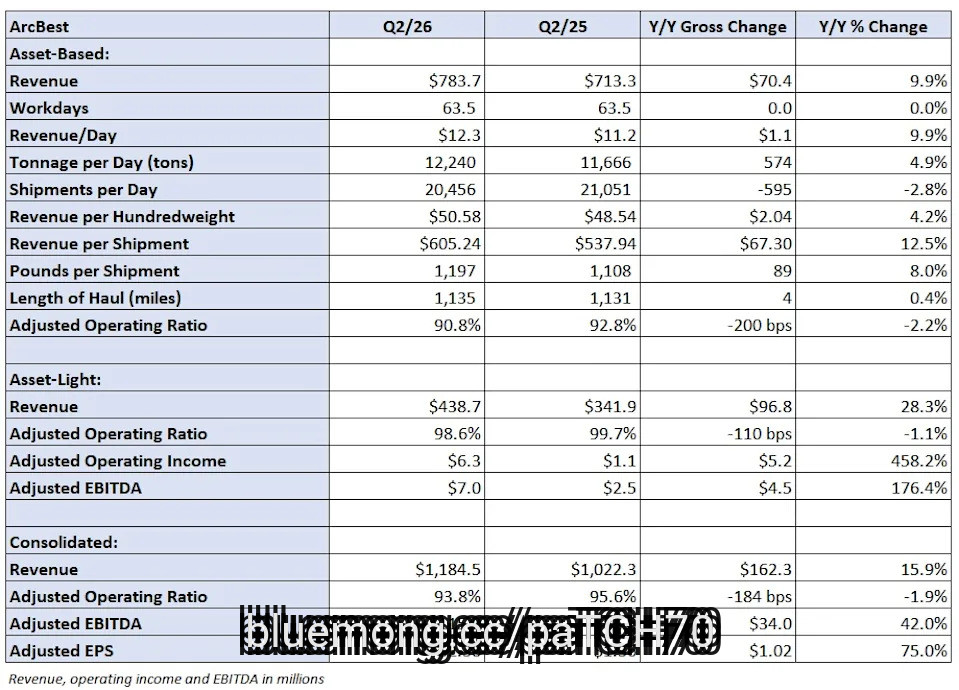
ArcBest's second-quarter results showed operational improvements in both of its business segments. It is benefitting from heavier shipment weights on the ***** et-based side of the house while cost initiatives have pushed its logistics offering back into profitability.
ArcBest's (NASDAQ: ARCB) ***** et-based unit, which includes less-than-truckload subsidiary ABF Freight, reported a 10% y/y increase in revenue to $784 million. Tonnage per day was 5% higher as a 3% decline in shipments was more than offset by an 8% increase in weight per shipment.
Tonnage growth on a y/y comparison was fairly steady throughout the quarter—up 6.1% in April, up 4.6% in May and up 4.1% in June. The two-year-stacked comps were up 10%, 11% and 7%, respectively.
Tonnage growth accelerated in July, up 8% y/y (plus-9.3% on a two-year-stacked comp). Management said on a Wednesday call with ***** ysts that tonnage normally declines 4.6% from June to July but is only down 1% this year.
Some freight lost to a depressed truckload market has returned as TL spot rates have climbed. This is driving average shipment weights higher. ArcBest is capturing low-double-digit rate increases on TL shipments.
#tonnage #freight #quarter #based
ArcBest's (NASDAQ: ARCB) ***** et-based unit, which includes less-than-truckload subsidiary ABF Freight, reported a 10% y/y increase in revenue to $784 million. Tonnage per day was 5% higher as a 3% decline in shipments was more than offset by an 8% increase in weight per shipment.
Tonnage growth on a y/y comparison was fairly steady throughout the quarter—up 6.1% in April, up 4.6% in May and up 4.1% in June. The two-year-stacked comps were up 10%, 11% and 7%, respectively.
Tonnage growth accelerated in July, up 8% y/y (plus-9.3% on a two-year-stacked comp). Management said on a Wednesday call with ***** ysts that tonnage normally declines 4.6% from June to July but is only down 1% this year.
Some freight lost to a depressed truckload market has returned as TL spot rates have climbed. This is driving average shipment weights higher. ArcBest is capturing low-double-digit rate increases on TL shipments.
#tonnage #freight #quarter #based


4 months ago
Canadian Pacific Kansas City Limited (NYSE:CP) is one of the Best Railroad Stocks to Invest In According to Billionaires. As of Q1 2026, 12 billionaires held the stock.
On July 7, CPKC said it set new June monthly grain records in both Canada and the United States. The company moved 2.8 million metric tonnes of Canadian grain and grain products in June, beating the previous June record from 2020, and said the second quarter also set records for Canadian grain tonnage and carloads. In the United States, CPKC moved 2.5 million metric tonnes of grain in June and 7.5 million metric tonnes in the second quarter, both records for those periods. This is a directly relevant rail operating story because grain is a core bulk commodity for the network. It also shows the value of CPKC's cross-border rail footprint when agricultural volumes are strong, especially since the company's system links Canada, the United States, and Mexico under a single operator.
Canadian Pacific Kansas City Limited (NYSE:CP) operates a single-line transnational freight railway linking Canada, the United States, and Mexico, with access to major ports and key North American markets.
While we acknowledge the potential of CP as an investment, we believe certain AI stocks offer greater upside potential and carry less downside risk. If you're looking for an extremely undervalued AI stock that also stands to benefit significantly from Trump-era tariffs and the onshoring trend, see our free report on the best short-term AI stock.
READ NEXT: 33 Stocks That Should Double in 3 Years and Cathie Wood 2026 Portfolio: 10 Best Stocks to Buy.
On July 7, CPKC said it set new June monthly grain records in both Canada and the United States. The company moved 2.8 million metric tonnes of Canadian grain and grain products in June, beating the previous June record from 2020, and said the second quarter also set records for Canadian grain tonnage and carloads. In the United States, CPKC moved 2.5 million metric tonnes of grain in June and 7.5 million metric tonnes in the second quarter, both records for those periods. This is a directly relevant rail operating story because grain is a core bulk commodity for the network. It also shows the value of CPKC's cross-border rail footprint when agricultural volumes are strong, especially since the company's system links Canada, the United States, and Mexico under a single operator.
Canadian Pacific Kansas City Limited (NYSE:CP) operates a single-line transnational freight railway linking Canada, the United States, and Mexico, with access to major ports and key North American markets.
While we acknowledge the potential of CP as an investment, we believe certain AI stocks offer greater upside potential and carry less downside risk. If you're looking for an extremely undervalued AI stock that also stands to benefit significantly from Trump-era tariffs and the onshoring trend, see our free report on the best short-term AI stock.
READ NEXT: 33 Stocks That Should Double in 3 Years and Cathie Wood 2026 Portfolio: 10 Best Stocks to Buy.


5 months ago
Saia reported a pickup in year-over-year tonnage growth in its May update issued Tuesday, though the improvement was measured against a softer prior-year result.
The Johns Creek, Georgia-based less-than-truckload carrier reported May tonnage growth of 8.4% y/y as shipments grew 3.7% and weight per shipment increased 4.5%. That compared to final results for April, showing a 6.9% tonnage increase as shipments and weight per shipment were up 5.6% and 1.3%, respectively. (April was up against a prior-year comp that was 480 basis points higher than May’s.)
Two-year-stacked comps show Saia’s (NASDAQ: SAIA) tonnage growth has slowed from a recent high of 15% in March to 8% in May. However, Saia’s prior-year comps range from mostly negative to slightly positive for the rest of the year.
Higher shipment weights are a sign of an improving LTL market, typically driving revenue per shipment and margins higher. Saia’s weight per shipment averaged 8% on a two-year-stacked comp in both April and May.
Manufacturing data released Monday showed industrial activity was positive for a fifth consecutive month in May. The Purchasing Managers’ Index registered a 54 reading for the month, which was 130 bps higher than April. (A reading above 50 signals expansion while one below 50 indicates contraction.) The May reading was the highest for the dataset in four years.
The Johns Creek, Georgia-based less-than-truckload carrier reported May tonnage growth of 8.4% y/y as shipments grew 3.7% and weight per shipment increased 4.5%. That compared to final results for April, showing a 6.9% tonnage increase as shipments and weight per shipment were up 5.6% and 1.3%, respectively. (April was up against a prior-year comp that was 480 basis points higher than May’s.)
Two-year-stacked comps show Saia’s (NASDAQ: SAIA) tonnage growth has slowed from a recent high of 15% in March to 8% in May. However, Saia’s prior-year comps range from mostly negative to slightly positive for the rest of the year.
Higher shipment weights are a sign of an improving LTL market, typically driving revenue per shipment and margins higher. Saia’s weight per shipment averaged 8% on a two-year-stacked comp in both April and May.
Manufacturing data released Monday showed industrial activity was positive for a fifth consecutive month in May. The Purchasing Managers’ Index registered a 54 reading for the month, which was 130 bps higher than April. (A reading above 50 signals expansion while one below 50 indicates contraction.) The May reading was the highest for the dataset in four years.






