
2 months ago
By Aditya Kalra
NEW DELHI, Sept 9 (Reuters) - India's Serious Fraud Office has recommended Xiaomi be investigated for alleged irregularities in its business model and compliance with foreign investment law, potentially intensifying scrutiny of the smartphone maker, a government document shows.
China's Xiaomi was once India's top-selling smartphone brand but has seen its market share dwindle amid intense competition from Apple and Samsung. It is also battling several tax demands and royalty payment disputes.
The recommendation from India's Serious Fraud Investigation Office (SFIO) said the investigation should examine movement of funds and whether Xiaomi sought mandatory investment approvals as required after India tightened scrutiny of Chinese investments following deadly border clashes between the two nations in 2020.
A person familiar with the matter said the government is examining the memorandum, which was drafted in May and reviewed by Reuters.
#serious #fraud #investigation #investment
NEW DELHI, Sept 9 (Reuters) - India's Serious Fraud Office has recommended Xiaomi be investigated for alleged irregularities in its business model and compliance with foreign investment law, potentially intensifying scrutiny of the smartphone maker, a government document shows.
China's Xiaomi was once India's top-selling smartphone brand but has seen its market share dwindle amid intense competition from Apple and Samsung. It is also battling several tax demands and royalty payment disputes.
The recommendation from India's Serious Fraud Investigation Office (SFIO) said the investigation should examine movement of funds and whether Xiaomi sought mandatory investment approvals as required after India tightened scrutiny of Chinese investments following deadly border clashes between the two nations in 2020.
A person familiar with the matter said the government is examining the memorandum, which was drafted in May and reviewed by Reuters.
#serious #fraud #investigation #investment


2 months ago
Apple's (AAPL) rivals in China are not waiting for it to make the first move. Just days before Apple's anticipated debut of its first foldable iPhone at its Sept. 9 event, Huawei and Xiaomi (XIACF) rolled out premium foldable devices of their own.
The timing gives both companies a chance to grab attention before Apple's launch. Huawei is launching the Mate XT 2, a trifold device that packs a phone and a tablet-sized screen into one body, while Xiaomi is close behind with the Xiaomi 18 Fold, a passport-style handset that looks a lot like what Apple is expected to show. So, both companies are trying to enter the high-end foldable market before Apple arrives.
Dear Nvidia Stock Fans, Mark Your Calendars for September 10
Rocket Lab Keeps Landing Defense Deals. Here's Why ******* ysts Aren't Getting More Bullish.
Why Stifel Just Revamped Its Price Target for Microsoft Stock
#xiaomi #huawei #aapl
The timing gives both companies a chance to grab attention before Apple's launch. Huawei is launching the Mate XT 2, a trifold device that packs a phone and a tablet-sized screen into one body, while Xiaomi is close behind with the Xiaomi 18 Fold, a passport-style handset that looks a lot like what Apple is expected to show. So, both companies are trying to enter the high-end foldable market before Apple arrives.
Dear Nvidia Stock Fans, Mark Your Calendars for September 10
Rocket Lab Keeps Landing Defense Deals. Here's Why ******* ysts Aren't Getting More Bullish.
Why Stifel Just Revamped Its Price Target for Microsoft Stock
#xiaomi #huawei #aapl


2 months ago
DeepSeek has engaged CITIC Securities to prepare for an initial public offering on Shanghai's STAR Market, according to Reuters, citing two people with knowledge of the matter who spoke on condition of anonymity.
The Hangzhou-based AI startup aims to begin the IPO process this year, according to Reuters. The timing of a potential offering, the amount DeepSeek could seek to raise, and its target valuation have not been determined. DeepSeek and CITIC did not respond to requests for comment.
In China, firms pursuing a mainland listing are generally required to retain a securities company for pre-IPO tutoring before they can file an application, Reuters notes. The previously undisclosed arrangement with CITIC suggests DeepSeek is making concrete progress toward a public offering.
The IPO push comes as DeepSeek seeks capital to fund computing infrastructure, model development, and talent retention amid competition from rival Chinese and U.S. AI firms. A person familiar with the matter told Reuters that Liang Wenfeng sees the IPO as a way to build a compensation structure capable of holding onto the startup's most important engineers and researchers. The company has lost talent to rivals including ByteDance and Xiaomi.
According to Reuters, DeepSeek is currently raising a new funding round at a valuation of 500 billion yuan ($75 billion). In June, the startup closed a round of roughly $7.4 billion at a post-money valuation exceeding $50 billion, with Liang Wenfeng personally contributing 20 billion yuan. Tencent Holdings and battery company CATL contributed 10 billion yuan and 5 billion yuan, respectively, becoming the largest external shareholders, according to Reuters.
#deepseek #according #company
The Hangzhou-based AI startup aims to begin the IPO process this year, according to Reuters. The timing of a potential offering, the amount DeepSeek could seek to raise, and its target valuation have not been determined. DeepSeek and CITIC did not respond to requests for comment.
In China, firms pursuing a mainland listing are generally required to retain a securities company for pre-IPO tutoring before they can file an application, Reuters notes. The previously undisclosed arrangement with CITIC suggests DeepSeek is making concrete progress toward a public offering.
The IPO push comes as DeepSeek seeks capital to fund computing infrastructure, model development, and talent retention amid competition from rival Chinese and U.S. AI firms. A person familiar with the matter told Reuters that Liang Wenfeng sees the IPO as a way to build a compensation structure capable of holding onto the startup's most important engineers and researchers. The company has lost talent to rivals including ByteDance and Xiaomi.
According to Reuters, DeepSeek is currently raising a new funding round at a valuation of 500 billion yuan ($75 billion). In June, the startup closed a round of roughly $7.4 billion at a post-money valuation exceeding $50 billion, with Liang Wenfeng personally contributing 20 billion yuan. Tencent Holdings and battery company CATL contributed 10 billion yuan and 5 billion yuan, respectively, becoming the largest external shareholders, according to Reuters.
#deepseek #according #company

0.00$ raised of 0.00$ goal
0 donations
0.00$
to go

2 months ago
Xiaomi Corporation (OTC:XIACF) is no longer content to compete through hardware design and pricing alone. The Chinese smartphone maker has unveiled the Xring O3, which is the second generation of its proprietary handset processor, as it seeks greater control over the technology powering its devices.
The strategy could improve product differentiation and bolster Xiaomi's negotiating position with outside chip suppliers, all the while supporting its expansion into premium smartphones. However, the investment comes as rising component costs and weakening global handset demand are already pressuring the company's core business. Let's dive deeper into it.
Developing processors internally could give Xiaomi greater control over several features that influence the smartphone experience. A system-on-chip integrates computing, graphics, artificial intelligence processing, and imaging functions, allowing the company to optimize important capabilities around its own hardware and software. Xiaomi launched its first proprietary smartphone processor, the Xring O1, in 2025. During its latest earnings call, the company said ******* ulative shipments of O1-powered smartphones, tablets, and watches had surpassed one million units. Although Reuters' sources estimated that only approximately 150,000 of those shipments were smartphones, the broader total shows Xiaomi has already deployed the technology across multiple product categories.
The O3 could also support Xiaomi's push into more expensive devices. According to two people familiar with the plans, TSMC will manufacture the processor using its 3-nanometre technology. One source said the chip is expected to power Xiaomi's next flagship foldable phone, with shipments targeted at between 200,000 and 300,000 units. Foldables offer Xiaomi an opportunity to compete more directly in a premium category currently dominated in China by Huawei. Huawei shipped 1.6 million foldable smartphones in China during the second quarter, accounting for 68% of the market, according to data cited by Reuters.
The company's ambitions also extend beyond smartphones. Reuters reported that Xiaomi contracted TSMC to produce the Xring O100, a 6-nanometre neural-processing chip designed to support its MiMo artificial-intelligence model on consumer devices, and the Xring D100, a 3-nanometre autonomous-driving processor. Xiaomi said both chips have completed development and are scheduled for deployment next year. Together, these projects show that Xiaomi is extending its chip-development strategy beyond smartphones into AI-enabled consumer devices and autonomous driving.
#shipments
The strategy could improve product differentiation and bolster Xiaomi's negotiating position with outside chip suppliers, all the while supporting its expansion into premium smartphones. However, the investment comes as rising component costs and weakening global handset demand are already pressuring the company's core business. Let's dive deeper into it.
Developing processors internally could give Xiaomi greater control over several features that influence the smartphone experience. A system-on-chip integrates computing, graphics, artificial intelligence processing, and imaging functions, allowing the company to optimize important capabilities around its own hardware and software. Xiaomi launched its first proprietary smartphone processor, the Xring O1, in 2025. During its latest earnings call, the company said ******* ulative shipments of O1-powered smartphones, tablets, and watches had surpassed one million units. Although Reuters' sources estimated that only approximately 150,000 of those shipments were smartphones, the broader total shows Xiaomi has already deployed the technology across multiple product categories.
The O3 could also support Xiaomi's push into more expensive devices. According to two people familiar with the plans, TSMC will manufacture the processor using its 3-nanometre technology. One source said the chip is expected to power Xiaomi's next flagship foldable phone, with shipments targeted at between 200,000 and 300,000 units. Foldables offer Xiaomi an opportunity to compete more directly in a premium category currently dominated in China by Huawei. Huawei shipped 1.6 million foldable smartphones in China during the second quarter, accounting for 68% of the market, according to data cited by Reuters.
The company's ambitions also extend beyond smartphones. Reuters reported that Xiaomi contracted TSMC to produce the Xring O100, a 6-nanometre neural-processing chip designed to support its MiMo artificial-intelligence model on consumer devices, and the Xring D100, a 3-nanometre autonomous-driving processor. Xiaomi said both chips have completed development and are scheduled for deployment next year. Together, these projects show that Xiaomi is extending its chip-development strategy beyond smartphones into AI-enabled consumer devices and autonomous driving.
#shipments


2 months ago
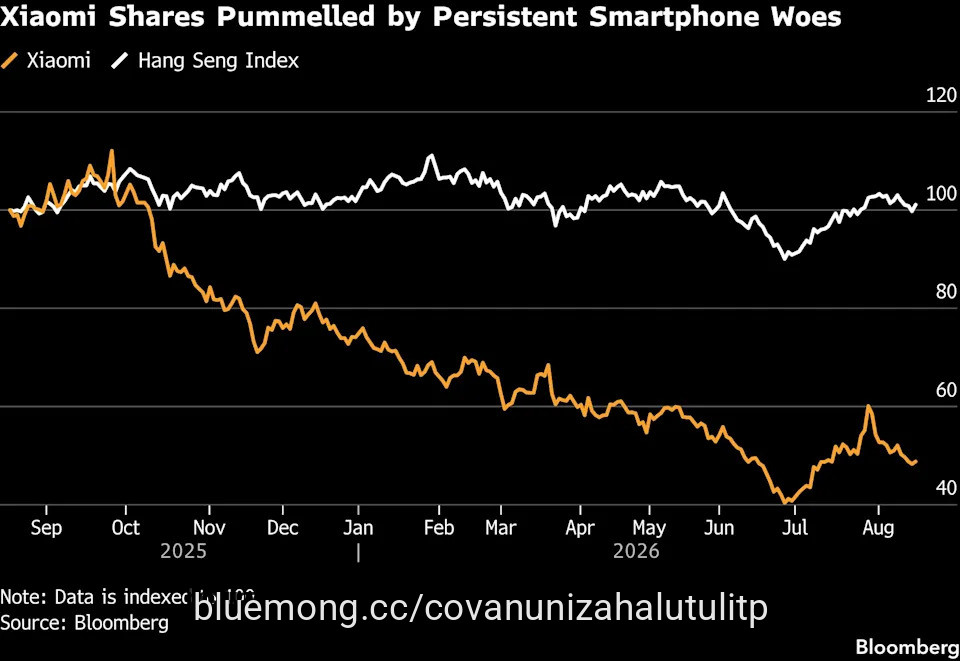
(Bloomberg) -- Xiaomi Corp. posted its third consecutive profit decline, underscoring the heavy toll a persistent global memory shortage has taken on one of the world's top smartphone makers.
Most Read from Bloomberg
US Bond Selloff Drives 30-Year Yields to Highest Since 2007
US-Iran Peace Prospects Dim as Trump Rejects Truce Extension
Anthropic's Annualized Revenue Tops $65 Billion Before IPO
#selloff #year #yields #since
Most Read from Bloomberg
US Bond Selloff Drives 30-Year Yields to Highest Since 2007
US-Iran Peace Prospects Dim as Trump Rejects Truce Extension
Anthropic's Annualized Revenue Tops $65 Billion Before IPO
#selloff #year #yields #since

2 months ago
BEIJING, Aug 18 (Reuters) - China's Xiaomi Corp posted a fall of 42.6% in second-quarter net profit on Tuesday, missing ****** ysts' estimates, as higher costs of memory and other components squeezed margins for the maker of smartphones and electric vehicles.
Adjusted net profit of 6.2 billion yuan ($919.50 million)for the period from April to June, fell short of an average ****** yst estimate of 6.6 billion yuan, according to LSEG data.
"Significant increases in key component costs, including memory, along with intensified industry competition, continued to create headwinds for our business," Xiaomi said in its earnings statement.
Second-quarter revenue came in at 108.9 billion yuan, it added, missing the average estimate of 112.2 billion.
Xiaomi's smartphone revenue fell 7.5% year-on-year to 42.1 billion yuan, while its smartphone gross margin declined to 8.5% from 11.5% a year earlier, clipped by higher prices for key components.
#costs
Adjusted net profit of 6.2 billion yuan ($919.50 million)for the period from April to June, fell short of an average ****** yst estimate of 6.6 billion yuan, according to LSEG data.
"Significant increases in key component costs, including memory, along with intensified industry competition, continued to create headwinds for our business," Xiaomi said in its earnings statement.
Second-quarter revenue came in at 108.9 billion yuan, it added, missing the average estimate of 112.2 billion.
Xiaomi's smartphone revenue fell 7.5% year-on-year to 42.1 billion yuan, while its smartphone gross margin declined to 8.5% from 11.5% a year earlier, clipped by higher prices for key components.
#costs

3 months ago
Tesla rival BYD (BYDDF), the world's largest electric vehicle maker, reported July sales rose 21.8% vs. a year earlier, gaining momentum thanks to strong overseas demand and improved production of its flash charging Blade 2.0 batteries.
Other China EV makers reported July deliveries as well, including Nio (NIO), XPeng (XPEV), Li Auto (LI), Xiaomi (XIACY) and Leapmotor.
Tesla (TSLA) does not release monthly China sales but industry data will provide those figures in the coming days. That comes after a report the Tesla is mulling selling its China unit to pave the way for a ******* eX merger. Elon Musk denied that as "fake news."
BYD (BYDDF) sold 419,211 electric vehicles, up 21.8% vs. a year earlier. It was the third straight month of year-on-year-growth, picking up from June's 5.5%. July sales rose 3.9% vs. June and were the highest since last December.
The automaker sells fully battery electric vehicles (BEVs) and plug-in hybrids (PHEVs). It's regained the BEV crown from Tesla in Q2
#july #reported #earlier
Other China EV makers reported July deliveries as well, including Nio (NIO), XPeng (XPEV), Li Auto (LI), Xiaomi (XIACY) and Leapmotor.
Tesla (TSLA) does not release monthly China sales but industry data will provide those figures in the coming days. That comes after a report the Tesla is mulling selling its China unit to pave the way for a ******* eX merger. Elon Musk denied that as "fake news."
BYD (BYDDF) sold 419,211 electric vehicles, up 21.8% vs. a year earlier. It was the third straight month of year-on-year-growth, picking up from June's 5.5%. July sales rose 3.9% vs. June and were the highest since last December.
The automaker sells fully battery electric vehicles (BEVs) and plug-in hybrids (PHEVs). It's regained the BEV crown from Tesla in Q2
#july #reported #earlier


4 months ago
BEIJING, July 9 (Reuters) - China's Xiaomi on Thursday unveiled an SUV series named Sky Nomad, accelerating the technology company's push into automobiles as growth slows in its mainstay smartphone market.
The extended-range electric vehicle (EREV) series, branded Xiaomi Pengcheng in Chinese, will comprise "smart, versatile, ****** ious" SUVs, CEO Lei Jun said on his Weibo micro-blog account along with a teaser poster of one of the vehicles.
EREVs are a type of plug-in hybrid that sit between conventional petrol-electric hybrids and battery-only vehicles, using a combustion engine as a generator to extend battery driving range.
Xiaomi's announcement represents expansion beyond battery-powered sedans and crossovers into a category popularised by models from automakers such as Li Auto.
With its SU7 sedan and YU7 crossover, Xiaomi's EV business has become a revenue pillar over the past two years.
The extended-range electric vehicle (EREV) series, branded Xiaomi Pengcheng in Chinese, will comprise "smart, versatile, ****** ious" SUVs, CEO Lei Jun said on his Weibo micro-blog account along with a teaser poster of one of the vehicles.
EREVs are a type of plug-in hybrid that sit between conventional petrol-electric hybrids and battery-only vehicles, using a combustion engine as a generator to extend battery driving range.
Xiaomi's announcement represents expansion beyond battery-powered sedans and crossovers into a category popularised by models from automakers such as Li Auto.
With its SU7 sedan and YU7 crossover, Xiaomi's EV business has become a revenue pillar over the past two years.
4 months ago
BEIJING, July 9 (Reuters) - China's Xiaomi on Thursday unveiled an SUV series named Sky Nomad, accelerating the technology company's push into automobiles as growth slows in its mainstay smartphone market.
The extended-range electric vehicle (EREV) series, branded Xiaomi Pengcheng in Chinese, will comprise "smart, versatile, ***** ious" SUVs, CEO Lei Jun said on his Weibo micro-blog account along with a teaser poster of one of the vehicles.
EREVs are a type of plug-in hybrid that sit between conventional petrol-electric hybrids and battery-only vehicles, using a combustion engine as a generator to extend battery driving range.
Xiaomi's announcement represents expansion beyond battery-powered sedans and crossovers into a category popularised by models from automakers such as Li Auto.
With its SU7 sedan and YU7 crossover, Xiaomi's EV business has become a revenue pillar over the past two years.
The extended-range electric vehicle (EREV) series, branded Xiaomi Pengcheng in Chinese, will comprise "smart, versatile, ***** ious" SUVs, CEO Lei Jun said on his Weibo micro-blog account along with a teaser poster of one of the vehicles.
EREVs are a type of plug-in hybrid that sit between conventional petrol-electric hybrids and battery-only vehicles, using a combustion engine as a generator to extend battery driving range.
Xiaomi's announcement represents expansion beyond battery-powered sedans and crossovers into a category popularised by models from automakers such as Li Auto.
With its SU7 sedan and YU7 crossover, Xiaomi's EV business has become a revenue pillar over the past two years.