

2 months ago
Elon Musk is getting serious about putting artificial intelligence (AI) into orbit. The ***** eX (SPCX) CEO is reportedly confident the company can launch Nvidia (NVDA) powered AI systems into ***** e in 2027. ***** eX and Nvidia are working on a ***** e-optimized version of Nvidia's Vera Rubin NVL72 platform, and Musk says the system should be lighter, denser, and cheaper than a traditional data-center rack. That matters because ***** eX is trying to turn orbital computing into a major business, while Nvidia could gain another market for its AI hardware.
The opportunity is much bigger than a headline. ***** eX could eventually sell computing capacity from satellites just as it sells broadband through Starlink. Meanwhile, Nvidia could supply the chips behind that infrastructure. Investors should still remember that this is an emerging business, and commercial scale is not expected immediately. Still, the plan gives both companies another way to capitalize on the AI spending boom.
Why It's Time to Load Up on Nvidia Stock
Mark Cuban Says He Was Dizzy for Months, So He Built a VR Fix That Does at Home 'Much Of What A 180k Machine' Does
Bank of America Just Declared a 'Generational Entry Point' in U.S. Bonds. Why Investors Should Be Backing Up the Truck on Treasuries Here.
#NVIDIA #SpaceX #much #still
The opportunity is much bigger than a headline. ***** eX could eventually sell computing capacity from satellites just as it sells broadband through Starlink. Meanwhile, Nvidia could supply the chips behind that infrastructure. Investors should still remember that this is an emerging business, and commercial scale is not expected immediately. Still, the plan gives both companies another way to capitalize on the AI spending boom.
Why It's Time to Load Up on Nvidia Stock
Mark Cuban Says He Was Dizzy for Months, So He Built a VR Fix That Does at Home 'Much Of What A 180k Machine' Does
Bank of America Just Declared a 'Generational Entry Point' in U.S. Bonds. Why Investors Should Be Backing Up the Truck on Treasuries Here.
#NVIDIA #SpaceX #much #still


2 months ago
Weitz Investment Management, an investment management firm, released its second-quarter Q2 2026 investor letter for the "Multi Cap Equity Fund". The letter can be downloaded here. The Multi Cap Equity Fund's Institutional Class returned 7.90% in Q2, underperforming the Bloomberg U.S. 3000 Index's 15.71% gain. Markets rose in the quarter on hopes of de-escalating Middle East tensions and easing oil flow. Investor focus shifted back to artificial intelligence, despite component shortages like processing chips affecting profits and valuations. Valuation-sensitive investors are selective within the AI sector, in contrast to valuation-agnostic indexes that adopt a more relaxed strategy. Additionally, reviewing the Fund's top five holdings could help identify its best picks for 2026.
In its second-quarter 2026 investor letter, Weitz Multi Cap Equity Fund highlighted Charter Communications, Inc. (NASDAQ:CHTR). Charter Communications, Inc. (NASDAQ:CHTR) is a US-based broadband connectivity company. On September 15, 2026, Charter Communications, Inc. closed at $141.20 per share. Over the past month, Charter Communications, Inc. declined 7.39% and its shares lost 47.32% over the past 52 weeks. Charter Communications, Inc. has a market capitalization of $24.73 billion and its stock has traded within a 52-week range of $111.55 and $285.82.
Weitz Multi Cap Equity Fund stated the following regarding Charter Communications, Inc. (NASDAQ:CHTR) in its Q2 2026 investor letter:
"Charter Communications, Inc. (NASDAQ:CHTR) (the principal **** et of portfolio holding Liberty Broadband) shares were weak as investors remain laser-focused on the impact of competition in Charter's core broadband market. Although the stock price has not yet improved, we remain constructive and believe Charter's growing wireless business, forecasted reduction in investment spending and impending combination with **** provide reasons for optimism."
Charter Communications, Inc. (NASDAQ:CHTR) is not on our list of the 40 Most Popular Stocks Among Hedge Funds. As per our database, 63 hedge fund portfolios held Charter Communications, Inc. (NASDAQ:CHTR) at the end of the second quarter which was 48 in the previous quarter. While we acknowledge the potential of Charter Communications, Inc. (NASDAQ:CHTR) as an investment, we believe certain AI stocks offer greater upside potential and carry less downside risk. If you're looking for an extremely undervalued AI stock that also stands to benefit significantly from Trump-era tariffs and the onshoring trend, see our free report on the best short-term AI stock.
#communications #quarter #investor
In its second-quarter 2026 investor letter, Weitz Multi Cap Equity Fund highlighted Charter Communications, Inc. (NASDAQ:CHTR). Charter Communications, Inc. (NASDAQ:CHTR) is a US-based broadband connectivity company. On September 15, 2026, Charter Communications, Inc. closed at $141.20 per share. Over the past month, Charter Communications, Inc. declined 7.39% and its shares lost 47.32% over the past 52 weeks. Charter Communications, Inc. has a market capitalization of $24.73 billion and its stock has traded within a 52-week range of $111.55 and $285.82.
Weitz Multi Cap Equity Fund stated the following regarding Charter Communications, Inc. (NASDAQ:CHTR) in its Q2 2026 investor letter:
"Charter Communications, Inc. (NASDAQ:CHTR) (the principal **** et of portfolio holding Liberty Broadband) shares were weak as investors remain laser-focused on the impact of competition in Charter's core broadband market. Although the stock price has not yet improved, we remain constructive and believe Charter's growing wireless business, forecasted reduction in investment spending and impending combination with **** provide reasons for optimism."
Charter Communications, Inc. (NASDAQ:CHTR) is not on our list of the 40 Most Popular Stocks Among Hedge Funds. As per our database, 63 hedge fund portfolios held Charter Communications, Inc. (NASDAQ:CHTR) at the end of the second quarter which was 48 in the previous quarter. While we acknowledge the potential of Charter Communications, Inc. (NASDAQ:CHTR) as an investment, we believe certain AI stocks offer greater upside potential and carry less downside risk. If you're looking for an extremely undervalued AI stock that also stands to benefit significantly from Trump-era tariffs and the onshoring trend, see our free report on the best short-term AI stock.
#communications #quarter #investor


2 months ago
Alluvium **** et Management, an **** et management company, released its "Conventum – Alluvium Global Fund" second-quarter 2026 investor letter. The letter can be downloaded here. The second quarter reflected a sharp shift from geopolitical uncertainty and oil market volatility to a powerful equity rally led by semiconductor companies. Despite the broader market strength, the Fund declined 1.4% in EUR terms, 2.2% in USD terms, and 3.9% in AUD terms. Portfolio results were mixed, with Alphabet benefiting from strong Cloud growth, while Robert Half, H&R Block and other holdings posted solid gains. However, cable businesses and several healthcare and consumer holdings weighed on performance. Also, check the fund's top five holdings to see its best picks in 2026.
In its second-quarter 2026 investor letter, Conventum – Alluvium Global Fund highlighted Liberty Capital Corporation (NASDAQ:GLIBK). Liberty Capital Corporation (NASDAQ:GLIBK) is a communication services company that provides a range of data, wireless, video, voice, and managed services. GCI Liberty, Inc. rebranded to Liberty Capital Corporation (NASDAQ:GLIBK) in May 2026. On September 15, 2026, Liberty Capital Corporation (NASDAQ:GLIBK) closed at $25.55 per share. Over the past month, Liberty Capital Corporation (NASDAQ:GLIBK) declined 1.50% and its shares lost 27.02% over the past 52 weeks. Liberty Capital Corporation (NASDAQ:GLIBK) has a market capitalization of $1.02 billion, and its stock trades within a 52-week range of $19.30 and $41.18.
Conventum – Alluvium Global Fund stated the following regarding Liberty Capital Corporation (NASDAQ:GLIBK) in its Q2 2026 investor letter:
"GCI Liberty, the Alaskan cable business that was spun out of Liberty Broadband, has been renamed Liberty Capital Corporation (NASDAQ:GLIBK) (to reflect a future which is expected to include a broader array of businesses, and with its legacy GCI Alaska cable business being the solid "cash cow"). It fell 40.6%. There was plenty of news. Most notable was its USD 360m acquisition of Quintillion, which owns around 3,000 kilometres of fibre cable and plans to expand it by a further 2,500 kilometres or so. This perfectly aligns with Liberty's GCI operations. We understand Quintillion generates around USD 55-60m in revenue and USD 30m in free cash. We would expect significant synergies (reportedly around USD 20m) so we have little doubt that the deal adds value. And in fact, when we incorporate it into our model, the valuation uplift is around 35%. Management also decided to retreat from the competitive and low margin video business. And finally, Liberty Capital had intended to acquire an interest in Liberty Latin America by striking a deal for an initial 6% stake and building on that by buying John Malone's interest. For some reason this did not proceed which perhaps spooked the market. With the share price falling (to levels approximating half our valuation), and encouraged by its CEO buying shares, we increased our
In its second-quarter 2026 investor letter, Conventum – Alluvium Global Fund highlighted Liberty Capital Corporation (NASDAQ:GLIBK). Liberty Capital Corporation (NASDAQ:GLIBK) is a communication services company that provides a range of data, wireless, video, voice, and managed services. GCI Liberty, Inc. rebranded to Liberty Capital Corporation (NASDAQ:GLIBK) in May 2026. On September 15, 2026, Liberty Capital Corporation (NASDAQ:GLIBK) closed at $25.55 per share. Over the past month, Liberty Capital Corporation (NASDAQ:GLIBK) declined 1.50% and its shares lost 27.02% over the past 52 weeks. Liberty Capital Corporation (NASDAQ:GLIBK) has a market capitalization of $1.02 billion, and its stock trades within a 52-week range of $19.30 and $41.18.
Conventum – Alluvium Global Fund stated the following regarding Liberty Capital Corporation (NASDAQ:GLIBK) in its Q2 2026 investor letter:
"GCI Liberty, the Alaskan cable business that was spun out of Liberty Broadband, has been renamed Liberty Capital Corporation (NASDAQ:GLIBK) (to reflect a future which is expected to include a broader array of businesses, and with its legacy GCI Alaska cable business being the solid "cash cow"). It fell 40.6%. There was plenty of news. Most notable was its USD 360m acquisition of Quintillion, which owns around 3,000 kilometres of fibre cable and plans to expand it by a further 2,500 kilometres or so. This perfectly aligns with Liberty's GCI operations. We understand Quintillion generates around USD 55-60m in revenue and USD 30m in free cash. We would expect significant synergies (reportedly around USD 20m) so we have little doubt that the deal adds value. And in fact, when we incorporate it into our model, the valuation uplift is around 35%. Management also decided to retreat from the competitive and low margin video business. And finally, Liberty Capital had intended to acquire an interest in Liberty Latin America by striking a deal for an initial 6% stake and building on that by buying John Malone's interest. For some reason this did not proceed which perhaps spooked the market. With the share price falling (to levels approximating half our valuation), and encouraged by its CEO buying shares, we increased our

2 months ago
Alluvium ****** et Management, an ****** et management company, released its "Conventum – Alluvium Global Fund" second-quarter 2026 investor letter. The letter can be downloaded here. The second quarter reflected a sharp shift from geopolitical uncertainty and oil market volatility to a powerful equity rally led by semiconductor companies. Despite the broader market strength, the Fund declined 1.4% in EUR terms, 2.2% in USD terms, and 3.9% in AUD terms. Portfolio results were mixed, with Alphabet benefiting from strong Cloud growth, while Robert Half, H&R Block and other holdings posted solid gains. However, cable businesses and several healthcare and consumer holdings weighed on performance. Also, check the fund's top five holdings to see its best picks in 2026.
In its second-quarter 2026 investor letter, Conventum – Alluvium Global Fund highlighted Charter Communications, Inc. (NASDAQ:CHTR). Charter Communications, Inc. (NASDAQ:CHTR) is a US-based broadband connectivity company. On September 15, 2026, Charter Communications, Inc. (NASDAQ:CHTR) closed at $141.20 per share. Over the past month, Charter Communications, Inc. (NASDAQ:CHTR) declined 7.39% and its shares lost 47.32% over the past 52 weeks. Charter Communications, Inc. (NASDAQ:CHTR) has a market capitalization of $24.73 billion and its stock has traded within a 52-week range of $111.55 and $285.82.
Conventum – Alluvium Global Fund stated the following regarding Charter Communications, Inc. (NASDAQ:CHTR) in its Q2 2026 investor letter:
"Charter Communications, Inc. (NASDAQ:CHTR) and its tracking stock Liberty Broadband fell 34.1% and 33.7% following the release of Charter's results in April. It seems the market is understandably concerned with the average revenue per user (ARPU) being flat, and the continual loss of internet customers. Competition is intense from both fixed wireless providers and low earth orbit satellite (Starlink). Compared to Charter's cables, these are higher cost and more capacity constrained. Charter's flat ARPU is the result of its decision to provide a demonstrably better offering at a low price - so why is it losing so many internet customers? We do not know the answer. We do know though that it is growing its mobile subscribers at a much faster rate than it is losing its internet customers, and more than half of its residential customers subscribe to more than one product. We also see positives stemming from the pending ****** acquisition, and indeed management increased expected synergies by 60%. It seems to us that the broader market has extrapolated current conditions to perpetuity..." (Click here to read the full text)
#fund
In its second-quarter 2026 investor letter, Conventum – Alluvium Global Fund highlighted Charter Communications, Inc. (NASDAQ:CHTR). Charter Communications, Inc. (NASDAQ:CHTR) is a US-based broadband connectivity company. On September 15, 2026, Charter Communications, Inc. (NASDAQ:CHTR) closed at $141.20 per share. Over the past month, Charter Communications, Inc. (NASDAQ:CHTR) declined 7.39% and its shares lost 47.32% over the past 52 weeks. Charter Communications, Inc. (NASDAQ:CHTR) has a market capitalization of $24.73 billion and its stock has traded within a 52-week range of $111.55 and $285.82.
Conventum – Alluvium Global Fund stated the following regarding Charter Communications, Inc. (NASDAQ:CHTR) in its Q2 2026 investor letter:
"Charter Communications, Inc. (NASDAQ:CHTR) and its tracking stock Liberty Broadband fell 34.1% and 33.7% following the release of Charter's results in April. It seems the market is understandably concerned with the average revenue per user (ARPU) being flat, and the continual loss of internet customers. Competition is intense from both fixed wireless providers and low earth orbit satellite (Starlink). Compared to Charter's cables, these are higher cost and more capacity constrained. Charter's flat ARPU is the result of its decision to provide a demonstrably better offering at a low price - so why is it losing so many internet customers? We do not know the answer. We do know though that it is growing its mobile subscribers at a much faster rate than it is losing its internet customers, and more than half of its residential customers subscribe to more than one product. We also see positives stemming from the pending ****** acquisition, and indeed management increased expected synergies by 60%. It seems to us that the broader market has extrapolated current conditions to perpetuity..." (Click here to read the full text)
#fund


2 months ago
Weitz Investment Management, an investment management firm, released its second-quarter Q2 2026 investor letter for the "Multi Cap Equity Fund". The letter can be downloaded here. The Multi Cap Equity Fund's Institutional Class returned 7.90% in Q2, underperforming the Bloomberg U.S. 3000 Index's 15.71% gain. Markets rose in the quarter on hopes of de-escalating Middle East tensions and easing oil flow. Investor focus shifted back to artificial intelligence, despite component shortages like processing chips affecting profits and valuations. Valuation-sensitive investors are selective within the AI sector, in contrast to valuation-agnostic indexes that adopt a more relaxed strategy. Additionally, reviewing the Fund's top five holdings could help identify its best picks for 2026.
In its second-quarter 2026 investor letter, Weitz Multi Cap Equity Fund highlighted Charter Communications, Inc. (NASDAQ:CHTR). Charter Communications, Inc. (NASDAQ:CHTR) is a US-based broadband connectivity company. On September 15, 2026, Charter Communications, Inc. closed at $141.20 per share. Over the past month, Charter Communications, Inc. declined 7.39% and its shares lost 47.32% over the past 52 weeks. Charter Communications, Inc. has a market capitalization of $24.73 billion and its stock has traded within a 52-week range of $111.55 and $285.82.
Weitz Multi Cap Equity Fund stated the following regarding Charter Communications, Inc. (NASDAQ:CHTR) in its Q2 2026 investor letter:
"Charter Communications, Inc. (NASDAQ:CHTR) (the principal **** et of portfolio holding Liberty Broadband) shares were weak as investors remain laser-focused on the impact of competition in Charter's core broadband market. Although the stock price has not yet improved, we remain constructive and believe Charter's growing wireless business, forecasted reduction in investment spending and impending combination with **** provide reasons for optimism."
Charter Communications, Inc. (NASDAQ:CHTR) is not on our list of the 40 Most Popular Stocks Among Hedge Funds. As per our database, 63 hedge fund portfolios held Charter Communications, Inc. (NASDAQ:CHTR) at the end of the second quarter which was 48 in the previous quarter. While we acknowledge the potential of Charter Communications, Inc. (NASDAQ:CHTR) as an investment, we believe certain AI stocks offer greater upside potential and carry less downside risk. If you're looking for an extremely undervalued AI stock that also stands to benefit significantly from Trump-era tariffs and the onshoring trend, see our free report on the best short-term AI stock.
#charter #multi #investor
In its second-quarter 2026 investor letter, Weitz Multi Cap Equity Fund highlighted Charter Communications, Inc. (NASDAQ:CHTR). Charter Communications, Inc. (NASDAQ:CHTR) is a US-based broadband connectivity company. On September 15, 2026, Charter Communications, Inc. closed at $141.20 per share. Over the past month, Charter Communications, Inc. declined 7.39% and its shares lost 47.32% over the past 52 weeks. Charter Communications, Inc. has a market capitalization of $24.73 billion and its stock has traded within a 52-week range of $111.55 and $285.82.
Weitz Multi Cap Equity Fund stated the following regarding Charter Communications, Inc. (NASDAQ:CHTR) in its Q2 2026 investor letter:
"Charter Communications, Inc. (NASDAQ:CHTR) (the principal **** et of portfolio holding Liberty Broadband) shares were weak as investors remain laser-focused on the impact of competition in Charter's core broadband market. Although the stock price has not yet improved, we remain constructive and believe Charter's growing wireless business, forecasted reduction in investment spending and impending combination with **** provide reasons for optimism."
Charter Communications, Inc. (NASDAQ:CHTR) is not on our list of the 40 Most Popular Stocks Among Hedge Funds. As per our database, 63 hedge fund portfolios held Charter Communications, Inc. (NASDAQ:CHTR) at the end of the second quarter which was 48 in the previous quarter. While we acknowledge the potential of Charter Communications, Inc. (NASDAQ:CHTR) as an investment, we believe certain AI stocks offer greater upside potential and carry less downside risk. If you're looking for an extremely undervalued AI stock that also stands to benefit significantly from Trump-era tariffs and the onshoring trend, see our free report on the best short-term AI stock.
#charter #multi #investor


2 months ago
Alluvium **** et Management, an **** et management company, released its "Conventum – Alluvium Global Fund" second-quarter 2026 investor letter. The letter can be downloaded here. The second quarter reflected a sharp shift from geopolitical uncertainty and oil market volatility to a powerful equity rally led by semiconductor companies. Despite the broader market strength, the Fund declined 1.4% in EUR terms, 2.2% in USD terms, and 3.9% in AUD terms. Portfolio results were mixed, with Alphabet benefiting from strong Cloud growth, while Robert Half, H&R Block and other holdings posted solid gains. However, cable businesses and several healthcare and consumer holdings weighed on performance. Also, check the fund's top five holdings to see its best picks in 2026.
In its second-quarter 2026 investor letter, Conventum – Alluvium Global Fund highlighted Liberty Capital Corporation (NASDAQ:GLIBK). Liberty Capital Corporation (NASDAQ:GLIBK) is a communication services company that provides a range of data, wireless, video, voice, and managed services. GCI Liberty, Inc. rebranded to Liberty Capital Corporation (NASDAQ:GLIBK) in May 2026. On September 15, 2026, Liberty Capital Corporation (NASDAQ:GLIBK) closed at $25.55 per share. Over the past month, Liberty Capital Corporation (NASDAQ:GLIBK) declined 1.50% and its shares lost 27.02% over the past 52 weeks. Liberty Capital Corporation (NASDAQ:GLIBK) has a market capitalization of $1.02 billion, and its stock trades within a 52-week range of $19.30 and $41.18.
Conventum – Alluvium Global Fund stated the following regarding Liberty Capital Corporation (NASDAQ:GLIBK) in its Q2 2026 investor letter:
"GCI Liberty, the Alaskan cable business that was spun out of Liberty Broadband, has been renamed Liberty Capital Corporation (NASDAQ:GLIBK) (to reflect a future which is expected to include a broader array of businesses, and with its legacy GCI Alaska cable business being the solid "cash cow"). It fell 40.6%. There was plenty of news. Most notable was its USD 360m acquisition of Quintillion, which owns around 3,000 kilometres of fibre cable and plans to expand it by a further 2,500 kilometres or so. This perfectly aligns with Liberty's GCI operations. We understand Quintillion generates around USD 55-60m in revenue and USD 30m in free cash. We would expect significant synergies (reportedly around USD 20m) so we have little doubt that the deal adds value. And in fact, when we incorporate it into our model, the valuation uplift is around 35%. Management also decided to retreat from the competitive and low margin video business. And finally, Liberty Capital had intended to acquire an interest in Liberty Latin America by striking a deal for an initial 6% stake and building on that by buying John Malone's interest. For some reason this did not proceed which perhaps spooked the market. With the share price falling (to levels approximating half our valuation), and encouraged by its CEO buying shares, we increased our
In its second-quarter 2026 investor letter, Conventum – Alluvium Global Fund highlighted Liberty Capital Corporation (NASDAQ:GLIBK). Liberty Capital Corporation (NASDAQ:GLIBK) is a communication services company that provides a range of data, wireless, video, voice, and managed services. GCI Liberty, Inc. rebranded to Liberty Capital Corporation (NASDAQ:GLIBK) in May 2026. On September 15, 2026, Liberty Capital Corporation (NASDAQ:GLIBK) closed at $25.55 per share. Over the past month, Liberty Capital Corporation (NASDAQ:GLIBK) declined 1.50% and its shares lost 27.02% over the past 52 weeks. Liberty Capital Corporation (NASDAQ:GLIBK) has a market capitalization of $1.02 billion, and its stock trades within a 52-week range of $19.30 and $41.18.
Conventum – Alluvium Global Fund stated the following regarding Liberty Capital Corporation (NASDAQ:GLIBK) in its Q2 2026 investor letter:
"GCI Liberty, the Alaskan cable business that was spun out of Liberty Broadband, has been renamed Liberty Capital Corporation (NASDAQ:GLIBK) (to reflect a future which is expected to include a broader array of businesses, and with its legacy GCI Alaska cable business being the solid "cash cow"). It fell 40.6%. There was plenty of news. Most notable was its USD 360m acquisition of Quintillion, which owns around 3,000 kilometres of fibre cable and plans to expand it by a further 2,500 kilometres or so. This perfectly aligns with Liberty's GCI operations. We understand Quintillion generates around USD 55-60m in revenue and USD 30m in free cash. We would expect significant synergies (reportedly around USD 20m) so we have little doubt that the deal adds value. And in fact, when we incorporate it into our model, the valuation uplift is around 35%. Management also decided to retreat from the competitive and low margin video business. And finally, Liberty Capital had intended to acquire an interest in Liberty Latin America by striking a deal for an initial 6% stake and building on that by buying John Malone's interest. For some reason this did not proceed which perhaps spooked the market. With the share price falling (to levels approximating half our valuation), and encouraged by its CEO buying shares, we increased our


2 months ago
Alluvium **** et Management, an **** et management company, released its "Conventum – Alluvium Global Fund" second-quarter 2026 investor letter. The letter can be downloaded here. The second quarter reflected a sharp shift from geopolitical uncertainty and oil market volatility to a powerful equity rally led by semiconductor companies. Despite the broader market strength, the Fund declined 1.4% in EUR terms, 2.2% in USD terms, and 3.9% in AUD terms. Portfolio results were mixed, with Alphabet benefiting from strong Cloud growth, while Robert Half, H&R Block and other holdings posted solid gains. However, cable businesses and several healthcare and consumer holdings weighed on performance. Also, check the fund's top five holdings to see its best picks in 2026.
In its second-quarter 2026 investor letter, Conventum – Alluvium Global Fund highlighted Charter Communications, Inc. (NASDAQ:CHTR). Charter Communications, Inc. (NASDAQ:CHTR) is a US-based broadband connectivity company. On September 15, 2026, Charter Communications, Inc. (NASDAQ:CHTR) closed at $141.20 per share. Over the past month, Charter Communications, Inc. (NASDAQ:CHTR) declined 7.39% and its shares lost 47.32% over the past 52 weeks. Charter Communications, Inc. (NASDAQ:CHTR) has a market capitalization of $24.73 billion and its stock has traded within a 52-week range of $111.55 and $285.82.
Conventum – Alluvium Global Fund stated the following regarding Charter Communications, Inc. (NASDAQ:CHTR) in its Q2 2026 investor letter:
"Charter Communications, Inc. (NASDAQ:CHTR) and its tracking stock Liberty Broadband fell 34.1% and 33.7% following the release of Charter's results in April. It seems the market is understandably concerned with the average revenue per user (ARPU) being flat, and the continual loss of internet customers. Competition is intense from both fixed wireless providers and low earth orbit satellite (Starlink). Compared to Charter's cables, these are higher cost and more capacity constrained. Charter's flat ARPU is the result of its decision to provide a demonstrably better offering at a low price - so why is it losing so many internet customers? We do not know the answer. We do know though that it is growing its mobile subscribers at a much faster rate than it is losing its internet customers, and more than half of its residential customers subscribe to more than one product. We also see positives stemming from the pending **** acquisition, and indeed management increased expected synergies by 60%. It seems to us that the broader market has extrapolated current conditions to perpetuity..." (Click here to read the full text)
#fund
In its second-quarter 2026 investor letter, Conventum – Alluvium Global Fund highlighted Charter Communications, Inc. (NASDAQ:CHTR). Charter Communications, Inc. (NASDAQ:CHTR) is a US-based broadband connectivity company. On September 15, 2026, Charter Communications, Inc. (NASDAQ:CHTR) closed at $141.20 per share. Over the past month, Charter Communications, Inc. (NASDAQ:CHTR) declined 7.39% and its shares lost 47.32% over the past 52 weeks. Charter Communications, Inc. (NASDAQ:CHTR) has a market capitalization of $24.73 billion and its stock has traded within a 52-week range of $111.55 and $285.82.
Conventum – Alluvium Global Fund stated the following regarding Charter Communications, Inc. (NASDAQ:CHTR) in its Q2 2026 investor letter:
"Charter Communications, Inc. (NASDAQ:CHTR) and its tracking stock Liberty Broadband fell 34.1% and 33.7% following the release of Charter's results in April. It seems the market is understandably concerned with the average revenue per user (ARPU) being flat, and the continual loss of internet customers. Competition is intense from both fixed wireless providers and low earth orbit satellite (Starlink). Compared to Charter's cables, these are higher cost and more capacity constrained. Charter's flat ARPU is the result of its decision to provide a demonstrably better offering at a low price - so why is it losing so many internet customers? We do not know the answer. We do know though that it is growing its mobile subscribers at a much faster rate than it is losing its internet customers, and more than half of its residential customers subscribe to more than one product. We also see positives stemming from the pending **** acquisition, and indeed management increased expected synergies by 60%. It seems to us that the broader market has extrapolated current conditions to perpetuity..." (Click here to read the full text)
#fund


2 months ago
Prosper Stars & Stripes, a long/short equity fund, recently released its second-quarter 2026 investor letter. The letter can be downloaded here. In Q2 2026, the portfolio delivered a strong net return of +30.1% compared to the Russell 2000 Index's +21.5% return and the HFRX Equity Hedge Index's +10.3% return. The long book drove performance, generating a 43.2% gross contribution, while average net exposure remained relatively modest at 47%. U.S. economic growth remained resilient despite inflation concerns, elevated energy prices, and geopolitical uncertainty. Markets rallied sharply after easing U.S.-Iran tensions pushed oil prices lower, supporting renewed risk appetite. Small-cap equities benefited significantly, with Information Technology, Industrials, and Health Care leading gains, while Energy declined as crude prices fell. Year to date, the Composite returned +23.7%, slightly ahead of the Russell 2000's +22.6% and well above the HFRI Equity Hedge Index's +9.7%. Additionally, you can review the Portfolio's top 5 holdings to see its best picks for 2026.
In its second-quarter 2026 investor letter, Prosper Stars & Stripes highlighted Cable One, Inc. (NYSE:CABO). Cable One, Inc. (NYSE:CABO) is a US-based data, video, and voice services provider. On September 8, 2026, Cable One, Inc. (NYSE:CABO) closed at $23.03 per share. Over the past month, Cable One, Inc. (NYSE:CABO) declined 31.48%, and its shares lost 85.49% over the past 52 weeks. Cable One, Inc. (NYSE:CABO) has a market capitalization of $144.51 million, and its stock has traded within a 52-week range of $21.98 and $180.74.
Prosper Stars & Stripes stated the following regarding Cable One, Inc. (NYSE:CABO) in its Q2 2026 investor letter:
"Cable One, Inc. (NYSE:CABO) was the second largest contributor to our short book during the quarter. Cable One provides cable broadband in rural markets, where it once enjoyed pricing power and high barriers to entry. But industries are dynamic and new competition has changed the company's position. Our process kept Cable One on our focus list through that transformation and allowed us to revisit it repeatedly; we have shorted the stock five times over the last four years. Increasing competition is an excellent short driver, and Cable One faced pressure from multiple directions at once, including fiber overbuilders, fixed wireless, and satellite internet. Broadband is a commodity, so when lower-priced alternatives entered its markets, Cable One had no meaningful way to differentiate and began losing share. In Q1 2026, the company reported a 7% revenue decline and an earnings decline of approximately 33%. Management compounded the damage by recognizing the shift late and allocating capital to **** et purchases at peak multiples. The combination of leverage, subscriber losses, and falling prices have pressured margins and now threatens the company's terminal value. We covered our position during the quarter."
#stripes #quarter #letter
In its second-quarter 2026 investor letter, Prosper Stars & Stripes highlighted Cable One, Inc. (NYSE:CABO). Cable One, Inc. (NYSE:CABO) is a US-based data, video, and voice services provider. On September 8, 2026, Cable One, Inc. (NYSE:CABO) closed at $23.03 per share. Over the past month, Cable One, Inc. (NYSE:CABO) declined 31.48%, and its shares lost 85.49% over the past 52 weeks. Cable One, Inc. (NYSE:CABO) has a market capitalization of $144.51 million, and its stock has traded within a 52-week range of $21.98 and $180.74.
Prosper Stars & Stripes stated the following regarding Cable One, Inc. (NYSE:CABO) in its Q2 2026 investor letter:
"Cable One, Inc. (NYSE:CABO) was the second largest contributor to our short book during the quarter. Cable One provides cable broadband in rural markets, where it once enjoyed pricing power and high barriers to entry. But industries are dynamic and new competition has changed the company's position. Our process kept Cable One on our focus list through that transformation and allowed us to revisit it repeatedly; we have shorted the stock five times over the last four years. Increasing competition is an excellent short driver, and Cable One faced pressure from multiple directions at once, including fiber overbuilders, fixed wireless, and satellite internet. Broadband is a commodity, so when lower-priced alternatives entered its markets, Cable One had no meaningful way to differentiate and began losing share. In Q1 2026, the company reported a 7% revenue decline and an earnings decline of approximately 33%. Management compounded the damage by recognizing the shift late and allocating capital to **** et purchases at peak multiples. The combination of leverage, subscriber losses, and falling prices have pressured margins and now threatens the company's terminal value. We covered our position during the quarter."
#stripes #quarter #letter


2 months ago
Corning (GLW) stock rose Tuesday after the provider of optical communications gear for telecom networks and artificial intelligence data centers announced a multibillion-dollar agreement with longtime customer Verizon Communications (VZ). Corning stock has advanced 70% in 2026, but shares have retreated from a 52-week high set on June 30.
Under the deal, Verizon will buy optical fiber and connectivity products from 2027 to 2032 for its landline broadband network. Verizon also is building a new long-distance backbone network for cloud computing companies.
On the stock market today, Corning stock rose more than 7% to 165.70 in morning trading. Corning stock hit a high of 271.78 on June 30. Meanwhile, Verizon stock climbed nearly 1% to 50.51.
Corning was long known for its flat-panel display business and Gorilla Glass used in smartphones. But the company has pivoted to become a provider of fiber, cables, connectors and networking components needed to link AI computer servers inside and between AI data centers.
Nvidia (NVDA) recently agreed to invest up to $3.2 billion in Corning under a warrant deal. Corning plans to expand production capacity for AI data centers.
#Stock #centers
Under the deal, Verizon will buy optical fiber and connectivity products from 2027 to 2032 for its landline broadband network. Verizon also is building a new long-distance backbone network for cloud computing companies.
On the stock market today, Corning stock rose more than 7% to 165.70 in morning trading. Corning stock hit a high of 271.78 on June 30. Meanwhile, Verizon stock climbed nearly 1% to 50.51.
Corning was long known for its flat-panel display business and Gorilla Glass used in smartphones. But the company has pivoted to become a provider of fiber, cables, connectors and networking components needed to link AI computer servers inside and between AI data centers.
Nvidia (NVDA) recently agreed to invest up to $3.2 billion in Corning under a warrant deal. Corning plans to expand production capacity for AI data centers.
#Stock #centers


2 months ago
Gabelli Investment Management Firm recently released its "Global Content & Connectivity Fund" second-quarter 2026 investor letter. A copy of the letter can be downloaded here. The Fund delivered a strong second quarter of 2026, with its Class I shares gaining 12.88%, more than double the 6.02% return of the MSCI AC World Communication Services Index, though trailing the broader MSCI AC World Index's 15.06% gain. The fund's performance reflected renewed investor interest in AI-related investments, easing tensions in the Middle East, and lower Brent crude prices, with Information Technology gaining 39.2% and Communication Services advancing 6.0% during the quarter. Over the past year, the fund gained 25.50%, compared with 13.06% for its communication-services benchmark and 24.16% for the MSCI AC World Index. Looking ahead, Gabelli remains constructive on the long-term opportunities created by AI adoption, expanding digital infrastructure, connectivity, and the continued growth of content and entertainment, while recognizing that higher interest rates, geopolitical tensions, and the sustainability of AI-related spending could create volatility. In addition, please check the Fund's top five holdings to know its best picks in 2026.
In its second-quarter 2026 investor letter, Global Content & Connectivity Fund highlighted stocks like Anterix Inc. (NASDAQ:ATEX). Anterix Inc. (NASDAQ:ATEX) is a wireless communications company focused on private broadband spectrum and utility communications applications. The one-month return of Anterix Inc. (NASDAQ:ATEX) was -7.03% while its shares traded between $17.58 and $113.00 over the last 52 weeks. On September 3, 2026, Anterix Inc. (NASDAQ:ATEX) stock closed at approximately $87.10 per share, with a market capitalization of about $1.69 billion.
Global Content & Connectivity Fund stated the following regarding Anterix Inc. (NASDAQ:ATEX) in its Q2 2026 investor letter:
Leading the list of positive contributors to Fund performance in the second quarter was Anterix Inc. (NASDAQ:ATEX) (8.8% of net ******* ets as of June 30, 2026; +169.6%) as it continued rallying following the Federal Communications Commission (FCC) approval of expanding broadband allocation in the 900 MHz band to 10 MHz (from 6 MHz) in February, allowing the firm to offer enhanced capacity and, possibly, address additional use cases. In addition, in May, the FCC approved an experimental license to explore the use of Lynk Global's satellite direct-to-device communications network in Anterix's licensed 900 MHz broadband spectrum.
#content #connectivity #global
In its second-quarter 2026 investor letter, Global Content & Connectivity Fund highlighted stocks like Anterix Inc. (NASDAQ:ATEX). Anterix Inc. (NASDAQ:ATEX) is a wireless communications company focused on private broadband spectrum and utility communications applications. The one-month return of Anterix Inc. (NASDAQ:ATEX) was -7.03% while its shares traded between $17.58 and $113.00 over the last 52 weeks. On September 3, 2026, Anterix Inc. (NASDAQ:ATEX) stock closed at approximately $87.10 per share, with a market capitalization of about $1.69 billion.
Global Content & Connectivity Fund stated the following regarding Anterix Inc. (NASDAQ:ATEX) in its Q2 2026 investor letter:
Leading the list of positive contributors to Fund performance in the second quarter was Anterix Inc. (NASDAQ:ATEX) (8.8% of net ******* ets as of June 30, 2026; +169.6%) as it continued rallying following the Federal Communications Commission (FCC) approval of expanding broadband allocation in the 900 MHz band to 10 MHz (from 6 MHz) in February, allowing the firm to offer enhanced capacity and, possibly, address additional use cases. In addition, in May, the FCC approved an experimental license to explore the use of Lynk Global's satellite direct-to-device communications network in Anterix's licensed 900 MHz broadband spectrum.
#content #connectivity #global


2 months ago
Gabelli Investment Management Firm recently released its "Global Content & Connectivity Fund" second-quarter 2026 investor letter. A copy of the letter can be downloaded here. The Fund delivered a strong second quarter of 2026, with its Class I shares gaining 12.88%, more than double the 6.02% return of the MSCI AC World Communication Services Index, though trailing the broader MSCI AC World Index's 15.06% gain. The fund's performance reflected renewed investor interest in AI-related investments, easing tensions in the Middle East, and lower Brent crude prices, with Information Technology gaining 39.2% and Communication Services advancing 6.0% during the quarter. Over the past year, the fund gained 25.50%, compared with 13.06% for its communication-services benchmark and 24.16% for the MSCI AC World Index. Looking ahead, Gabelli remains constructive on the long-term opportunities created by AI adoption, expanding digital infrastructure, connectivity, and the continued growth of content and entertainment, while recognizing that higher interest rates, geopolitical tensions, and the sustainability of AI-related spending could create volatility. In addition, please check the Fund's top five holdings to know its best picks in 2026.
In its second-quarter 2026 investor letter, Global Content & Connectivity Fund highlighted stocks like T-Mobile US Inc. (NASDAQ:TMUS). T-Mobile US Inc. (NASDAQ:TMUS) is a major U.S. wireless operator expanding across broadband, 5G, advertising, financial services, and emerging technology markets. The one-month return of T-Mobile US Inc. (NASDAQ:TMUS) was 1.86% while its shares traded between $165.66 and $247.25 over the last 52 weeks. On September 3, 2026, T-Mobile US Inc. (NASDAQ:TMUS) stock closed at approximately $188.02 per share, with a market capitalization of about $194.71 billion.
Global Content & Connectivity Fund stated the following regarding T-Mobile US Inc. (NASDAQ:TMUS) in its Q2 2026 investor letter:
T-Mobile US Inc. (NASDAQ:TMUS) (4.5%) (TMUS – $167.73 – NASDAQ) is the second-largest wireless operator in the U.S., serving over 142 million branded customers. In February 2026, the company hosted a Capital Markets Day, where it increased its 2027 targets for service revenue, EBITDA, and free cash flow. Management expects meaningful incremental growth over the next few years, driven by (a) continued share gains across various market segments, (b) growth of the broadband business, and (c) leveraging the firm's scale and its 5G Advanced network to expand into new growth areas (including advertising, financial services, and long-term opportunities in edge and physical AI).
#NASDAQ #global
In its second-quarter 2026 investor letter, Global Content & Connectivity Fund highlighted stocks like T-Mobile US Inc. (NASDAQ:TMUS). T-Mobile US Inc. (NASDAQ:TMUS) is a major U.S. wireless operator expanding across broadband, 5G, advertising, financial services, and emerging technology markets. The one-month return of T-Mobile US Inc. (NASDAQ:TMUS) was 1.86% while its shares traded between $165.66 and $247.25 over the last 52 weeks. On September 3, 2026, T-Mobile US Inc. (NASDAQ:TMUS) stock closed at approximately $188.02 per share, with a market capitalization of about $194.71 billion.
Global Content & Connectivity Fund stated the following regarding T-Mobile US Inc. (NASDAQ:TMUS) in its Q2 2026 investor letter:
T-Mobile US Inc. (NASDAQ:TMUS) (4.5%) (TMUS – $167.73 – NASDAQ) is the second-largest wireless operator in the U.S., serving over 142 million branded customers. In February 2026, the company hosted a Capital Markets Day, where it increased its 2027 targets for service revenue, EBITDA, and free cash flow. Management expects meaningful incremental growth over the next few years, driven by (a) continued share gains across various market segments, (b) growth of the broadband business, and (c) leveraging the firm's scale and its 5G Advanced network to expand into new growth areas (including advertising, financial services, and long-term opportunities in edge and physical AI).
#NASDAQ #global

2 months ago
Gabelli Investment Management Firm recently released its "Global Content & Connectivity Fund" second-quarter 2026 investor letter. A copy of the letter can be downloaded here. The Fund delivered a strong second quarter of 2026, with its Class I shares gaining 12.88%, more than double the 6.02% return of the MSCI AC World Communication Services Index, though trailing the broader MSCI AC World Index's 15.06% gain. The fund's performance reflected renewed investor interest in AI-related investments, easing tensions in the Middle East, and lower Brent crude prices, with Information Technology gaining 39.2% and Communication Services advancing 6.0% during the quarter. Over the past year, the fund gained 25.50%, compared with 13.06% for its communication-services benchmark and 24.16% for the MSCI AC World Index. Looking ahead, Gabelli remains constructive on the long-term opportunities created by AI adoption, expanding digital infrastructure, connectivity, and the continued growth of content and entertainment, while recognizing that higher interest rates, geopolitical tensions, and the sustainability of AI-related spending could create volatility. In addition, please check the Fund's top five holdings to know its best picks in 2026.
In its second-quarter 2026 investor letter, Global Content & Connectivity Fund highlighted stocks like Anterix Inc. (NASDAQ:ATEX). Anterix Inc. (NASDAQ:ATEX) is a wireless communications company focused on private broadband spectrum and utility communications applications. The one-month return of Anterix Inc. (NASDAQ:ATEX) was -7.03% while its shares traded between $17.58 and $113.00 over the last 52 weeks. On September 3, 2026, Anterix Inc. (NASDAQ:ATEX) stock closed at approximately $87.10 per share, with a market capitalization of about $1.69 billion.
Global Content & Connectivity Fund stated the following regarding Anterix Inc. (NASDAQ:ATEX) in its Q2 2026 investor letter:
Leading the list of positive contributors to Fund performance in the second quarter was Anterix Inc. (NASDAQ:ATEX) (8.8% of net ****** ets as of June 30, 2026; +169.6%) as it continued rallying following the Federal Communications Commission (FCC) approval of expanding broadband allocation in the 900 MHz band to 10 MHz (from 6 MHz) in February, allowing the firm to offer enhanced capacity and, possibly, address additional use cases. In addition, in May, the FCC approved an experimental license to explore the use of Lynk Global's satellite direct-to-device communications network in Anterix's licensed 900 MHz broadband spectrum.
#anterix #atex #communications
In its second-quarter 2026 investor letter, Global Content & Connectivity Fund highlighted stocks like Anterix Inc. (NASDAQ:ATEX). Anterix Inc. (NASDAQ:ATEX) is a wireless communications company focused on private broadband spectrum and utility communications applications. The one-month return of Anterix Inc. (NASDAQ:ATEX) was -7.03% while its shares traded between $17.58 and $113.00 over the last 52 weeks. On September 3, 2026, Anterix Inc. (NASDAQ:ATEX) stock closed at approximately $87.10 per share, with a market capitalization of about $1.69 billion.
Global Content & Connectivity Fund stated the following regarding Anterix Inc. (NASDAQ:ATEX) in its Q2 2026 investor letter:
Leading the list of positive contributors to Fund performance in the second quarter was Anterix Inc. (NASDAQ:ATEX) (8.8% of net ****** ets as of June 30, 2026; +169.6%) as it continued rallying following the Federal Communications Commission (FCC) approval of expanding broadband allocation in the 900 MHz band to 10 MHz (from 6 MHz) in February, allowing the firm to offer enhanced capacity and, possibly, address additional use cases. In addition, in May, the FCC approved an experimental license to explore the use of Lynk Global's satellite direct-to-device communications network in Anterix's licensed 900 MHz broadband spectrum.
#anterix #atex #communications


2 months ago
In its S-1 filing for its IPO, Elon Musk's ******* eX (SPCX) had earmarked a market opportunity of $28 trillion. Out of this, the company, most popularly known for its rockets and Starlink broadband services, attributed more than 90% of this opportunity to AI. Some skeptics raised concerns; however, there was no stopping Musk as the company's data center buildout continues in full swing, and compute deals with the likes of Alphabet's (GOOGL) (GOOG) Google and Anthropic give ******* eX the much-needed AI street cred.
Yet, when Musk is involved, nothing is as smooth as it seems.
Nvidia CEO Jensen Huang Says His $3.5 Billion MediaTek Deal Is 'Not Circular' Because 'They Do Their Own Business'
Strategy's Strategy Appears to Have Failed, and the Outlook of MSTR Stock Is Unfavorable
A Potential ******* eX Deal Could Meaningfully Accelerate Growth for Technip Stock
#deal #Stock #goog
Yet, when Musk is involved, nothing is as smooth as it seems.
Nvidia CEO Jensen Huang Says His $3.5 Billion MediaTek Deal Is 'Not Circular' Because 'They Do Their Own Business'
Strategy's Strategy Appears to Have Failed, and the Outlook of MSTR Stock Is Unfavorable
A Potential ******* eX Deal Could Meaningfully Accelerate Growth for Technip Stock
#deal #Stock #goog


2 months ago
First Eagle Investment Management, an investment management company, released its Q2 2026 investor update for "First Eagle Global Fund". The letter can be downloaded here. Easing tensions in the Middle East led to a strong rally in risk markets in Q2. The S&P 500 Index rose 15.2%, while the MSCI EAFE Index gained 10.8%. Growth stocks outperformed, with the MSCI World Growth Index significantly exceeding value returns. A notable shift in U.S. interest rate expectations followed Kevin Warsh's appointment as chair of the Federal Open Market Committee, pushing Treasury yields higher and strengthening the dollar. Despite the optimistic market environment, concerns about fiscal constraints and limited policy flexibility remain. Tighter credit spreads and elevated equity valuations reflect strong demand for financial ****** ets, with household wealth in equities at a post-WWII high. Earnings expectations are buoyant, driven by AI infrastructure developments. Against this backdrop, Global Fund A Shares returned 2.86% in Q2 2026, with emerging markets and developed Europe as the primary contributors. Developed Asia (excluding ****** an) was the only detractor, and ****** an lagged. Information technology and financials led among equity sectors, while materials and energy detracted. The fund underperformed relative to the MSCI World Index during this period. Also, check the fund's top five holdings to see its best picks in 2026.
In its second-quarter 2026 investor letter, First Eagle Global Fund highlighted Charter Communications, Inc. (NASDAQ:CHTR). Charter Communications, Inc. (NASDAQ:CHTR) is a US-based broadband connectivity company. On August 31, 2026, Charter Communications, Inc. (NASDAQ:CHTR) closed at $152.44 per share. The one-month return of Charter Communications, Inc. (NASDAQ:CHTR) was -4.10%, and its shares lost -44.49% over the past 52 weeks. Charter Communications, Inc. (NASDAQ:CHTR) has a market capitalization of $26.69 billion.
First Eagle Global Fund stated the following regarding Charter Communications, Inc. (NASDAQ:CHTR) in its Q2 2026 investor letter:
"The leading detractors in the quarter were gold bullion, Charter Communications, Inc. (NASDAQ:CHTR), HCA Healthcare Inc., Exxon Mobil Corporation and Salesforce.com, Inc. Charter Communications is the second-largest broadband commu nications service company in the US, providing cable broadcasting, internet, voice and mass-media services. Cable providers in general remain under competitive pressure from mobile operators, which are scaling up entry-level fixed wireless service. We continue to view Charter as a high-quality business with difficult-to-replicate ****** ets that generate steady cash flows and returns cash to shareholders."
#charter #global #msci
In its second-quarter 2026 investor letter, First Eagle Global Fund highlighted Charter Communications, Inc. (NASDAQ:CHTR). Charter Communications, Inc. (NASDAQ:CHTR) is a US-based broadband connectivity company. On August 31, 2026, Charter Communications, Inc. (NASDAQ:CHTR) closed at $152.44 per share. The one-month return of Charter Communications, Inc. (NASDAQ:CHTR) was -4.10%, and its shares lost -44.49% over the past 52 weeks. Charter Communications, Inc. (NASDAQ:CHTR) has a market capitalization of $26.69 billion.
First Eagle Global Fund stated the following regarding Charter Communications, Inc. (NASDAQ:CHTR) in its Q2 2026 investor letter:
"The leading detractors in the quarter were gold bullion, Charter Communications, Inc. (NASDAQ:CHTR), HCA Healthcare Inc., Exxon Mobil Corporation and Salesforce.com, Inc. Charter Communications is the second-largest broadband commu nications service company in the US, providing cable broadcasting, internet, voice and mass-media services. Cable providers in general remain under competitive pressure from mobile operators, which are scaling up entry-level fixed wireless service. We continue to view Charter as a high-quality business with difficult-to-replicate ****** ets that generate steady cash flows and returns cash to shareholders."
#charter #global #msci


2 months ago
Brennan ******* et Management recently released its Q2 2026 investor letter. The letter can be downloaded here. Investors were optimistic about a potential truce with Iran, highlighted by a mid-June memorandum for negotiations on regional security and sanctions, causing oil prices to drop and the market to rally. Despite geopolitical uncertainties, investors remain focused on a surge in AI infrastructure spending, which is expected to heavily influence the global economy, although questions about the returns from this investment loom. Overall, the S&P 500 remains at high valuations, seemingly unfazed by these challenges, while there are few pockets of value left, mostly outside the U.S. market. Also, check the fund's top five holdings to see its best picks in 2026.
In its second-quarter 2026 investor letter, Brennan ******* et Management highlighted Charter Communications, Inc. (NASDAQ:CHTR). Charter Communications, Inc. (NASDAQ:CHTR) is a US-based broadband connectivity company. On August 28, 2026, Charter Communications, Inc. (NASDAQ:CHTR) closed at $153.62 per share. The one-month return of Charter Communications, Inc. (NASDAQ:CHTR) was 5.25%, and its shares lost -42.89% over the past 52 weeks. Charter Communications, Inc. (NASDAQ:CHTR) has a market capitalization of $26.9 billion.
Brennan ******* et Management stated the following regarding Charter Communications, Inc. (NASDAQ:CHTR) in its Q2 2026 investor letter:
"Charter Communications, Inc. (NASDAQ:CHTR): Universally Hated, We've Been Very Wrong But…~50% Forward Free Cash Flow Yield Incongruous with 2030 Bonds Near Par
As noted earlier, it is incredibly difficult to hold onto winners over time, especially when one has an experience like CHTR. As we have discussed in prior letters, CHTR was once a fantastic winner for us -- really. We sold roughly half and, with the benefit of hindsight, life would be easier if we had sold the rest. What makes it hard is less arithmetic than psychology. A winner that visibly surrenders its gains inflicts far more mental anguish than the same dollar gain ever delivers in pleasure. That asymmetry – the very loss aversion we described with TIGO and GTX – is exactly what tempts investors to sell the sort of hated, mispriced name they should be holding.
#charter #NASDAQ #investors #investor
In its second-quarter 2026 investor letter, Brennan ******* et Management highlighted Charter Communications, Inc. (NASDAQ:CHTR). Charter Communications, Inc. (NASDAQ:CHTR) is a US-based broadband connectivity company. On August 28, 2026, Charter Communications, Inc. (NASDAQ:CHTR) closed at $153.62 per share. The one-month return of Charter Communications, Inc. (NASDAQ:CHTR) was 5.25%, and its shares lost -42.89% over the past 52 weeks. Charter Communications, Inc. (NASDAQ:CHTR) has a market capitalization of $26.9 billion.
Brennan ******* et Management stated the following regarding Charter Communications, Inc. (NASDAQ:CHTR) in its Q2 2026 investor letter:
"Charter Communications, Inc. (NASDAQ:CHTR): Universally Hated, We've Been Very Wrong But…~50% Forward Free Cash Flow Yield Incongruous with 2030 Bonds Near Par
As noted earlier, it is incredibly difficult to hold onto winners over time, especially when one has an experience like CHTR. As we have discussed in prior letters, CHTR was once a fantastic winner for us -- really. We sold roughly half and, with the benefit of hindsight, life would be easier if we had sold the rest. What makes it hard is less arithmetic than psychology. A winner that visibly surrenders its gains inflicts far more mental anguish than the same dollar gain ever delivers in pleasure. That asymmetry – the very loss aversion we described with TIGO and GTX – is exactly what tempts investors to sell the sort of hated, mispriced name they should be holding.
#charter #NASDAQ #investors #investor


2 months ago
Brennan **** et Management recently released its Q2 2026 investor letter. The letter can be downloaded here. Investors were optimistic about a potential truce with Iran, highlighted by a mid-June memorandum for negotiations on regional security and sanctions, causing oil prices to drop and the market to rally. Despite geopolitical uncertainties, investors remain focused on a surge in AI infrastructure spending, which is expected to heavily influence the global economy, although questions about the returns from this investment loom. Overall, the S&P 500 remains at high valuations, seemingly unfazed by these challenges, while there are few pockets of value left, mostly outside the U.S. market. Also, check the fund's top five holdings to see its best picks in 2026.
In its second-quarter 2026 investor letter, Brennan **** et Management highlighted Millicom International Cellular S.A. (NASDAQ:TIGO) as a notable contributor. Millicom International Cellular S.A. (NASDAQ:TIGO) is a telecommunications and media company that provides cable and mobile services in Latin America. On August 28, 2026, Millicom International Cellular S.A. (NASDAQ:TIGO) stock closed at $93.38 per share. The one-month return of Millicom International Cellular S.A. (NASDAQ:TIGO) was -1.10%, and its shares gained 93.04% over the past 52 weeks. Millicom International Cellular S.A. (NASDAQ:TIGO) has a market capitalization of $15.64 billion.
Brennan **** et Management stated the following regarding Millicom International Cellular S.A. (NASDAQ:TIGO) in its Q2 2026 investor letter:
"Millicom International Cellular S.A. (NASDAQ:TIGO) and GTX operate in vastly different businesses, but our investment journey with each shares some similarities. We believe that both are good businesses. TIGO is an oligopoly of an essential service (broadband and cell phone). Meanwhile, GTX is an oligopoly provider of turbochargers to the automotive industry with a potentially valuable new product portfolio focused on industrial and electric vehicle (EV) markets. At the time of purchase, both stocks were hated and exceptionally cheap. TIGO operated in riskier Central and South American markets and had a mixed operating history (to be kind). The prior management team executed a fantastic acquisition (buyout of minority partner in Guatemala) but funded it via a rights offering at stock prices ~60% below where the deal was announced. GTX was a post bankruptcy special situation name, and we initially bought preferred shares that ultimately were forcefully converted to common stock. As EV sales expanded across the world, there was understandable concern that GTX's core turbocharger business was at risk and huge uncertainty arose about whether the company could ever crack the EV market. At the time of purchase TIGO traded for ~17% forward free cash flow yield (post rights offering) while GTX sported valuations only slightly higher…." (Click here to read the full text)
#tigo #asset #letter #market
In its second-quarter 2026 investor letter, Brennan **** et Management highlighted Millicom International Cellular S.A. (NASDAQ:TIGO) as a notable contributor. Millicom International Cellular S.A. (NASDAQ:TIGO) is a telecommunications and media company that provides cable and mobile services in Latin America. On August 28, 2026, Millicom International Cellular S.A. (NASDAQ:TIGO) stock closed at $93.38 per share. The one-month return of Millicom International Cellular S.A. (NASDAQ:TIGO) was -1.10%, and its shares gained 93.04% over the past 52 weeks. Millicom International Cellular S.A. (NASDAQ:TIGO) has a market capitalization of $15.64 billion.
Brennan **** et Management stated the following regarding Millicom International Cellular S.A. (NASDAQ:TIGO) in its Q2 2026 investor letter:
"Millicom International Cellular S.A. (NASDAQ:TIGO) and GTX operate in vastly different businesses, but our investment journey with each shares some similarities. We believe that both are good businesses. TIGO is an oligopoly of an essential service (broadband and cell phone). Meanwhile, GTX is an oligopoly provider of turbochargers to the automotive industry with a potentially valuable new product portfolio focused on industrial and electric vehicle (EV) markets. At the time of purchase, both stocks were hated and exceptionally cheap. TIGO operated in riskier Central and South American markets and had a mixed operating history (to be kind). The prior management team executed a fantastic acquisition (buyout of minority partner in Guatemala) but funded it via a rights offering at stock prices ~60% below where the deal was announced. GTX was a post bankruptcy special situation name, and we initially bought preferred shares that ultimately were forcefully converted to common stock. As EV sales expanded across the world, there was understandable concern that GTX's core turbocharger business was at risk and huge uncertainty arose about whether the company could ever crack the EV market. At the time of purchase TIGO traded for ~17% forward free cash flow yield (post rights offering) while GTX sported valuations only slightly higher…." (Click here to read the full text)
#tigo #asset #letter #market


2 months ago
Brennan ***** et Management recently released its Q2 2026 investor letter. The letter can be downloaded here. Investors were optimistic about a potential truce with Iran, highlighted by a mid-June memorandum for negotiations on regional security and sanctions, causing oil prices to drop and the market to rally. Despite geopolitical uncertainties, investors remain focused on a surge in AI infrastructure spending, which is expected to heavily influence the global economy, although questions about the returns from this investment loom. Overall, the S&P 500 remains at high valuations, seemingly unfazed by these challenges, while there are few pockets of value left, mostly outside the U.S. market. Also, check the fund's top five holdings to see its best picks in 2026.
In its second-quarter 2026 investor letter, Brennan ***** et Management highlighted Garrett Motion Inc. (NASDAQ:GTX). Garrett Motion Inc. (NASDAQ:GTX) designs and manufactures engineered turbocharging and high-speed electric motor technologies for OEMs, distributors, and industrial fields. On August 28, 2026, Garrett Motion Inc. (NASDAQ:GTX) stock closed at $26.66 per share. The one-month return of Garrett Motion Inc. (NASDAQ:GTX) was -12.70%, and its shares gained 105.66% over the past 52 weeks. Garrett Motion Inc. (NASDAQ:GTX) has a market capitalization of $4.97 billion.
Brennan ***** et Management stated the following regarding Garrett Motion Inc. (NASDAQ:GTX) in its Q2 2026 investor letter:
"TIGO and Garrett Motion Inc. (NASDAQ:GTX) operate in vastly different businesses, but our investment journey with each shares some similarities. We believe that both are good businesses. TIGO is an oligopoly of an essential service (broadband and cell phone). Meanwhile, GTX is an oligopoly provider of turbochargers to the automotive industry with a potentially valuable new product portfolio focused on industrial and electric vehicle (EV) markets. At the time of purchase, both stocks were hated and exceptionally cheap. GTX was a post bankruptcy special situation name, and we initially bought preferred shares that ultimately were forcefully converted to common stock. As EV sales expanded across the world, there was understandable concern that GTX's core turbocharger business was at risk and huge uncertainty arose about whether the company could ever crack the EV market. At the time of purchase TIGO traded for ~17% forward free cash flow yield (post rights offering) while GTX sported valuations only slightly higher…." (Click here to read the full text)
#asset
In its second-quarter 2026 investor letter, Brennan ***** et Management highlighted Garrett Motion Inc. (NASDAQ:GTX). Garrett Motion Inc. (NASDAQ:GTX) designs and manufactures engineered turbocharging and high-speed electric motor technologies for OEMs, distributors, and industrial fields. On August 28, 2026, Garrett Motion Inc. (NASDAQ:GTX) stock closed at $26.66 per share. The one-month return of Garrett Motion Inc. (NASDAQ:GTX) was -12.70%, and its shares gained 105.66% over the past 52 weeks. Garrett Motion Inc. (NASDAQ:GTX) has a market capitalization of $4.97 billion.
Brennan ***** et Management stated the following regarding Garrett Motion Inc. (NASDAQ:GTX) in its Q2 2026 investor letter:
"TIGO and Garrett Motion Inc. (NASDAQ:GTX) operate in vastly different businesses, but our investment journey with each shares some similarities. We believe that both are good businesses. TIGO is an oligopoly of an essential service (broadband and cell phone). Meanwhile, GTX is an oligopoly provider of turbochargers to the automotive industry with a potentially valuable new product portfolio focused on industrial and electric vehicle (EV) markets. At the time of purchase, both stocks were hated and exceptionally cheap. GTX was a post bankruptcy special situation name, and we initially bought preferred shares that ultimately were forcefully converted to common stock. As EV sales expanded across the world, there was understandable concern that GTX's core turbocharger business was at risk and huge uncertainty arose about whether the company could ever crack the EV market. At the time of purchase TIGO traded for ~17% forward free cash flow yield (post rights offering) while GTX sported valuations only slightly higher…." (Click here to read the full text)
#asset


2 months ago
First Eagle Investment Management, an investment management company, released its Q2 2026 investor update for "First Eagle Global Fund". The letter can be downloaded here. Easing tensions in the Middle East led to a strong rally in risk markets in Q2. The S&P 500 Index rose 15.2%, while the MSCI EAFE Index gained 10.8%. Growth stocks outperformed, with the MSCI World Growth Index significantly exceeding value returns. A notable shift in U.S. interest rate expectations followed Kevin Warsh's appointment as chair of the Federal Open Market Committee, pushing Treasury yields higher and strengthening the dollar. Despite the optimistic market environment, concerns about fiscal constraints and limited policy flexibility remain. Tighter credit spreads and elevated equity valuations reflect strong demand for financial ******* ets, with household wealth in equities at a post-WWII high. Earnings expectations are buoyant, driven by AI infrastructure developments. Against this backdrop, Global Fund A Shares returned 2.86% in Q2 2026, with emerging markets and developed Europe as the primary contributors. Developed Asia (excluding ******* an) was the only detractor, and ******* an lagged. Information technology and financials led among equity sectors, while materials and energy detracted. The fund underperformed relative to the MSCI World Index during this period. Also, check the fund's top five holdings to see its best picks in 2026.
In its second-quarter 2026 investor letter, First Eagle Global Fund highlighted Charter Communications, Inc. (NASDAQ:CHTR). Charter Communications, Inc. (NASDAQ:CHTR) is a US-based broadband connectivity company. On August 31, 2026, Charter Communications, Inc. (NASDAQ:CHTR) closed at $152.44 per share. The one-month return of Charter Communications, Inc. (NASDAQ:CHTR) was -4.10%, and its shares lost -44.49% over the past 52 weeks. Charter Communications, Inc. (NASDAQ:CHTR) has a market capitalization of $26.69 billion.
First Eagle Global Fund stated the following regarding Charter Communications, Inc. (NASDAQ:CHTR) in its Q2 2026 investor letter:
"The leading detractors in the quarter were gold bullion, Charter Communications, Inc. (NASDAQ:CHTR), HCA Healthcare Inc., Exxon Mobil Corporation and Salesforce.com, Inc. Charter Communications is the second-largest broadband commu nications service company in the US, providing cable broadcasting, internet, voice and mass-media services. Cable providers in general remain under competitive pressure from mobile operators, which are scaling up entry-level fixed wireless service. We continue to view Charter as a high-quality business with difficult-to-replicate ******* ets that generate steady cash flows and returns cash to shareholders."
#NASDAQ #global #index #msci
In its second-quarter 2026 investor letter, First Eagle Global Fund highlighted Charter Communications, Inc. (NASDAQ:CHTR). Charter Communications, Inc. (NASDAQ:CHTR) is a US-based broadband connectivity company. On August 31, 2026, Charter Communications, Inc. (NASDAQ:CHTR) closed at $152.44 per share. The one-month return of Charter Communications, Inc. (NASDAQ:CHTR) was -4.10%, and its shares lost -44.49% over the past 52 weeks. Charter Communications, Inc. (NASDAQ:CHTR) has a market capitalization of $26.69 billion.
First Eagle Global Fund stated the following regarding Charter Communications, Inc. (NASDAQ:CHTR) in its Q2 2026 investor letter:
"The leading detractors in the quarter were gold bullion, Charter Communications, Inc. (NASDAQ:CHTR), HCA Healthcare Inc., Exxon Mobil Corporation and Salesforce.com, Inc. Charter Communications is the second-largest broadband commu nications service company in the US, providing cable broadcasting, internet, voice and mass-media services. Cable providers in general remain under competitive pressure from mobile operators, which are scaling up entry-level fixed wireless service. We continue to view Charter as a high-quality business with difficult-to-replicate ******* ets that generate steady cash flows and returns cash to shareholders."
#NASDAQ #global #index #msci


3 months ago
On August 20, Charter Communications, Inc. (NASDAQ:CHTR) and Liberty Broadband Corporation (NASDAQ:LBRDK) made major waves after announcing a multi-party transaction alongside **** Communications. Charter acquired Liberty Broadband while issuing ~46 million shares to **** , absorbing $12 billion of **** debt, and retiring 38.6 million Charter shares previously held by Liberty. The combined entity will eventually rebrand its parent name to **** Communications while operating as Spectrum. However, looking past the complex corporate restructuring, a comparison of their Q2 2026 financials reveals distinct operational realities for both companies.
Charter Communications, Inc. (NASDAQ:CHTR) generated Q2 2026 revenue of $13.5 billion, down 1.7% year-over-year, primarily dragged down by a 9.7% drop in residential video revenue. Net income totaled $1.3 billion, while Adjusted EBITDA declined 4.3% to $5.4 billion. Charter's underlying business faced notable headwinds: broadband net additions turned negative with a loss of 172,000 Internet customers, bringing total Internet subscribers to 29.4 million. The bright spot remained Spectrum Mobile, which added 406,000 mobile lines in Q2 to reach 12.5 million lines, driving mobile revenue up 18.9% to $1.095 billion.
Liberty Broadband Corporation (NASDAQ:LBRDK) historically operated primarily as a holding vehicle for its stake in Charter alongside ownership of GCI (Alaska's dominant telecom provider). For Q2 2026, Liberty Broadband's standalone performance reflected GCI's steady operational baseline, generating steady regional revenue and positive free cash flow. However, because over 80% of Liberty Broadband's net **** et value was tied directly to its Charter common stock ownership, Liberty's financial health was effectively a leveraged reflection of Charter's core performance.
In terms of financial strength, CHTR is performing better execution-wise as an operating entity. While facing cable broadband saturation, Charter generates massive operational scale with $3.9 billion in quarterly operating cash flow and $969 million in free cash flow. LBRDK, while maintaining a cleaner balance sheet, lacked independent organic growth drivers to outpace Charter's operating cash generation.
Charter Communications' bull case is supported by the transaction's potential to simplify its ownership structure by eliminating the Liberty holding company discount while integrating **** 's **** ets, creating a combined company with approximately 31.5 million customer relationships. Wireless convergence also continues to gain traction, with Spectrum Mobile lines increasing 15.5% year over year and providing a potential long-term growth engine to offset losses in the core cable business. Meanwhile, subsidized rural expansion, including 127,000 additional passings in Q2, creates opportunities to capture untapped regional market share.
#lbrdk
Charter Communications, Inc. (NASDAQ:CHTR) generated Q2 2026 revenue of $13.5 billion, down 1.7% year-over-year, primarily dragged down by a 9.7% drop in residential video revenue. Net income totaled $1.3 billion, while Adjusted EBITDA declined 4.3% to $5.4 billion. Charter's underlying business faced notable headwinds: broadband net additions turned negative with a loss of 172,000 Internet customers, bringing total Internet subscribers to 29.4 million. The bright spot remained Spectrum Mobile, which added 406,000 mobile lines in Q2 to reach 12.5 million lines, driving mobile revenue up 18.9% to $1.095 billion.
Liberty Broadband Corporation (NASDAQ:LBRDK) historically operated primarily as a holding vehicle for its stake in Charter alongside ownership of GCI (Alaska's dominant telecom provider). For Q2 2026, Liberty Broadband's standalone performance reflected GCI's steady operational baseline, generating steady regional revenue and positive free cash flow. However, because over 80% of Liberty Broadband's net **** et value was tied directly to its Charter common stock ownership, Liberty's financial health was effectively a leveraged reflection of Charter's core performance.
In terms of financial strength, CHTR is performing better execution-wise as an operating entity. While facing cable broadband saturation, Charter generates massive operational scale with $3.9 billion in quarterly operating cash flow and $969 million in free cash flow. LBRDK, while maintaining a cleaner balance sheet, lacked independent organic growth drivers to outpace Charter's operating cash generation.
Charter Communications' bull case is supported by the transaction's potential to simplify its ownership structure by eliminating the Liberty holding company discount while integrating **** 's **** ets, creating a combined company with approximately 31.5 million customer relationships. Wireless convergence also continues to gain traction, with Spectrum Mobile lines increasing 15.5% year over year and providing a potential long-term growth engine to offset losses in the core cable business. Meanwhile, subsidized rural expansion, including 127,000 additional passings in Q2, creates opportunities to capture untapped regional market share.
#lbrdk

3 months ago
Broadcom (AVGO) is a premier global technology leader specializing in semiconductors and infrastructure software solutions that power mission-critical systems worldwide. Founded in 1961 and headquartered in Palo Alto, California, Broadcom designs advanced chips for networking connectivity, wireless devices, servers, storage, broadband, and industrial applications, alongside robust software for private cloud, mainframe, cybersecurity, and enterprise needs via VMware.
With more than 33,000 employees, thousands of patents, and more than $11 billion invested in research and development in fiscal 2025 alone, the company enables hyperscale data centers, artificial intelligence (AI) acceleration, and secure enterprise infrastructure.
Walmart Stock Is More Expensive Than Nvidia Amid Earnings Miss
SpaceX Stock Just Crashed Below Its IPO Price: Here's the Bull Case ****** ody Can Ignore
A Major Bitcoin Short Squeeze Is Taking MicroStrategy Stock Higher. What Comes Next.
#enterprise #avgo
With more than 33,000 employees, thousands of patents, and more than $11 billion invested in research and development in fiscal 2025 alone, the company enables hyperscale data centers, artificial intelligence (AI) acceleration, and secure enterprise infrastructure.
Walmart Stock Is More Expensive Than Nvidia Amid Earnings Miss
SpaceX Stock Just Crashed Below Its IPO Price: Here's the Bull Case ****** ody Can Ignore
A Major Bitcoin Short Squeeze Is Taking MicroStrategy Stock Higher. What Comes Next.
#enterprise #avgo
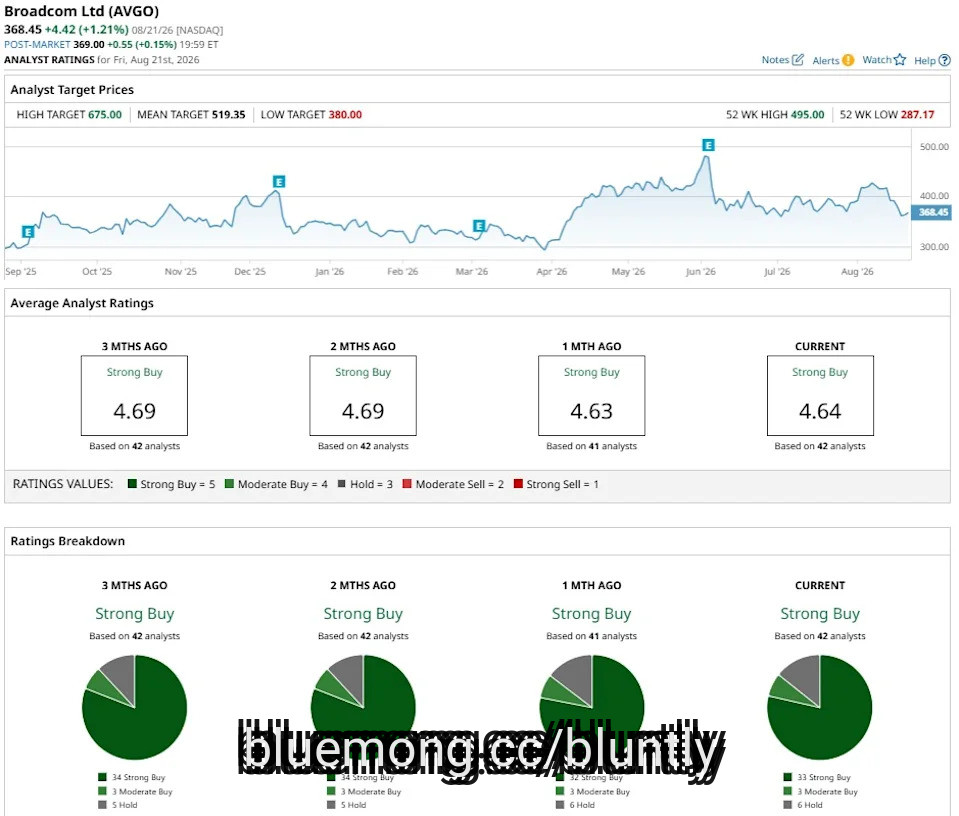

3 months ago
Greenlight Capital is an investment management firm specializing in value-oriented strategies. The letter can be downloaded here. Greenlight Capital released its second-quarter 2026 investor letter, reporting a 4.3% decline for the Partnerships and a 1.9% year-to-date gain, net of fees and expenses, compared with gains of 15.2% and 10.2% for the S&P 500 Index. The funds entered the quarter conservatively, but costly trading decisions and macro positions, particularly in gold and U.S. interest rates, weighed on results. Long positions contributed roughly 9%, offset by similar losses from shorts. The letter also highlighted concerns over speculative market conditions, using ****** eX's $1.75 trillion IPO valuation and investment-grade rating as examples of excess. Looking ahead, Greenlight is more constructive on Fed Chairman Kevin Warsh's inflation stance and expects positions to recover if inflation moderates and rates remain unchanged. Additionally, reviewing the Strategy's top holdings could help identify its best ideas for 2026.
In its second-quarter 2026 investor letter, Greenlight Capital highlighted Comcast Corporation (NASDAQ:CMCSA). Comcast Corporation (NASDAQ:CMCSA) is a leading media and technology company. On August 26, 2026, Comcast Corporation (NASDAQ:CMCSA) closed at $27.20 per share. Over the past month, Comcast Corporation (NASDAQ:CMCSA) returned 12.76%, while its shares have declined 15.13% in the last 52 weeks. Comcast Corporation (NASDAQ:CMCSA) has a market capitalization of $3.51 billion, and its stock has traded within a 52-week range of $21.28 to $32.86.
Greenlight Capital stated the following regarding Comcast Corporation (NASDAQ:CMCSA) in its Q2 2026 investor letter:
"Comcast Corporation (NASDAQ:CMCSA) is a diversified media and technology company with broadband, video and wireless businesses, alongside media, studios and theme parks. The stock declined about 60% over the past five years as structural and competitive pressures have weighed on its legacy broadband and video businesses. At our entry price of $23.91 per share, CMCSA traded at only 5x EBITDA, which we believe significantly undervalues its free cash flow generation and the collective value of its businesses. At the end of the quarter, CMCSA announced the spin-off of NBCUniversal, an important step that we believe should help highlight the value embedded within the company. CMCSA shares ended the quarter at $24.55."
Comcast Corporation (NASDAQ:CMCSA) is not on our list of the 40 Most Popular Stocks Among Hedge Funds. As per our database, 82 hedge fund portfolios held Comcast Corporation (NASDAQ:CMCSA) at the end of the second quarter which was 78 in the previous quarter. While we acknowledge the potential of Comcast Corporation (NASDAQ:CMCSA) as an investment, we believe certain AI stocks offer greater upside potential and carry less downside risk. If you're looking for an extremely undervalued AI stock that also stands to benefit significantly from Trump-er
In its second-quarter 2026 investor letter, Greenlight Capital highlighted Comcast Corporation (NASDAQ:CMCSA). Comcast Corporation (NASDAQ:CMCSA) is a leading media and technology company. On August 26, 2026, Comcast Corporation (NASDAQ:CMCSA) closed at $27.20 per share. Over the past month, Comcast Corporation (NASDAQ:CMCSA) returned 12.76%, while its shares have declined 15.13% in the last 52 weeks. Comcast Corporation (NASDAQ:CMCSA) has a market capitalization of $3.51 billion, and its stock has traded within a 52-week range of $21.28 to $32.86.
Greenlight Capital stated the following regarding Comcast Corporation (NASDAQ:CMCSA) in its Q2 2026 investor letter:
"Comcast Corporation (NASDAQ:CMCSA) is a diversified media and technology company with broadband, video and wireless businesses, alongside media, studios and theme parks. The stock declined about 60% over the past five years as structural and competitive pressures have weighed on its legacy broadband and video businesses. At our entry price of $23.91 per share, CMCSA traded at only 5x EBITDA, which we believe significantly undervalues its free cash flow generation and the collective value of its businesses. At the end of the quarter, CMCSA announced the spin-off of NBCUniversal, an important step that we believe should help highlight the value embedded within the company. CMCSA shares ended the quarter at $24.55."
Comcast Corporation (NASDAQ:CMCSA) is not on our list of the 40 Most Popular Stocks Among Hedge Funds. As per our database, 82 hedge fund portfolios held Comcast Corporation (NASDAQ:CMCSA) at the end of the second quarter which was 78 in the previous quarter. While we acknowledge the potential of Comcast Corporation (NASDAQ:CMCSA) as an investment, we believe certain AI stocks offer greater upside potential and carry less downside risk. If you're looking for an extremely undervalued AI stock that also stands to benefit significantly from Trump-er

3 months ago
Charter Communications, Inc. (CHTR) operates as a broadband connectivity and cable operator company serving residential and commercial customers. Valued at $17.9 billion by market cap, the company offers cable broadcasting, internet, voice, and mass media services.
Shares of this broadband giant have considerably underperformed the broader market over the past year. CHTR has declined 44% over this time frame, while the broader S&P 500 Index ($SPX) has rallied nearly 20.5%. In 2026, CHTR's stock fell 28.1%, compared to the SPX's 12.1% rise on a YTD basis.
Soros Fund Management Opened a New Position in Nebius During Q2. What This Means for NBIS Stock.
Nvidia Earnings, Jackson Hole and Other Key Things to Watch this Week
Ahead of Nvidia Earnings, Here's What Barchart Data Says Comes Next for NVDA Stock
#NVIDIA #earnings #broadband #charter
Shares of this broadband giant have considerably underperformed the broader market over the past year. CHTR has declined 44% over this time frame, while the broader S&P 500 Index ($SPX) has rallied nearly 20.5%. In 2026, CHTR's stock fell 28.1%, compared to the SPX's 12.1% rise on a YTD basis.
Soros Fund Management Opened a New Position in Nebius During Q2. What This Means for NBIS Stock.
Nvidia Earnings, Jackson Hole and Other Key Things to Watch this Week
Ahead of Nvidia Earnings, Here's What Barchart Data Says Comes Next for NVDA Stock
#NVIDIA #earnings #broadband #charter


3 months ago
Broadcom (AVGO) is a global technology leader headquartered in Palo Alto, California, that designs, develops, and supplies a broad portfolio of semiconductor and infrastructure software solutions. The company has emerged as a critical enabler of the AI computing boom through its custom AI accelerators (XPUs), high-speed networking chips, and broadband and enterprise semiconductor products, with hyperscale customers including Google (GOOG) (GOOGL), OpenAI, and Anthropic. Beyond semiconductors, Broadcom's infrastructure software segment, anchored by VMware Cloud Foundation, has become a major growth driver following its 2023 acquisition of VMware.
Broadcom's stock has delivered a strong 2026, climbing roughly 26% over the past year and recently trading around $380, though well off its 52-week high of $495 set earlier this year. Shares have pulled back nearly 12% in recent sessions as investors booked profits and repositioned ahead of Broadcom's fiscal third-quarter earnings report on Sept. 2, even as the stock remains far above its 52-week low of $281.87. Institutional buying remains robust, with major funds adding to positions amid continued optimism around Broadcom's expanding AI semiconductor backlog and custom accelerator roadmap.
Nvidia Q2 Preview: Strong Earnings and Low Valuation Set the Stage for Upside
A $28.7 Billion Reason to Buy SK hynix Stock Now
Powerful Growth, Multiple Endorsements Bode Well for Oracle Stock
#vmware #Growth #software #custom
Broadcom's stock has delivered a strong 2026, climbing roughly 26% over the past year and recently trading around $380, though well off its 52-week high of $495 set earlier this year. Shares have pulled back nearly 12% in recent sessions as investors booked profits and repositioned ahead of Broadcom's fiscal third-quarter earnings report on Sept. 2, even as the stock remains far above its 52-week low of $281.87. Institutional buying remains robust, with major funds adding to positions amid continued optimism around Broadcom's expanding AI semiconductor backlog and custom accelerator roadmap.
Nvidia Q2 Preview: Strong Earnings and Low Valuation Set the Stage for Upside
A $28.7 Billion Reason to Buy SK hynix Stock Now
Powerful Growth, Multiple Endorsements Bode Well for Oracle Stock
#vmware #Growth #software #custom

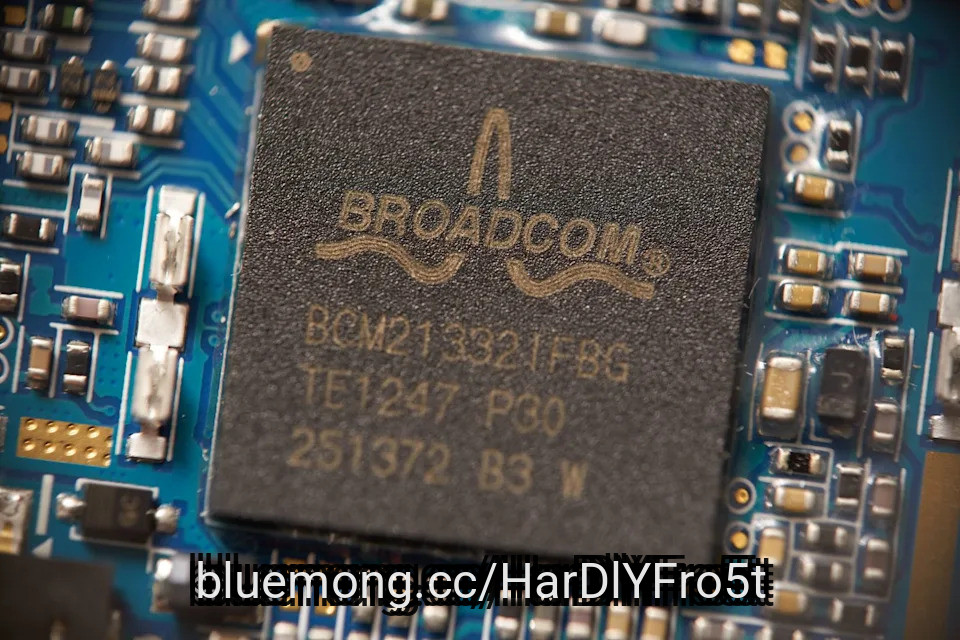
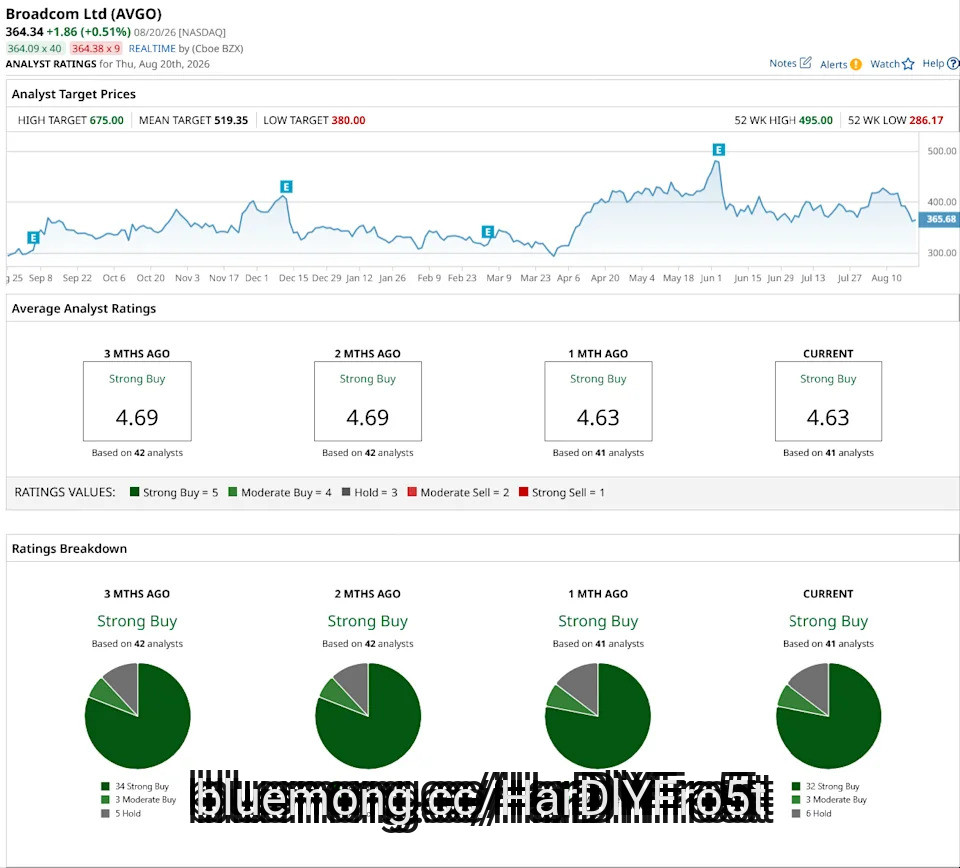

3 months ago
As we look toward 2027, the contrast between a high-flying satellite newcomer and a legacy aerospace giant creates a unique dilemma for investors. You must choose between AST ***** eMobile Inc (NASDAQ:ASTS) and Boeing Co (NYSE:BA).
AST ***** eMobile is pioneering a ***** e-based cellular network, while Boeing continues to be a ***** an in commercial aviation and defense. This comparison pits a speculative, rapid-growth technology story against a massive industrial turnaround effort. Deciding which to buy requires balancing the potential for massive disruption against the stability of established manufacturing.
AST ***** eMobile is building the first ***** e-based cellular broadband network designed to connect directly to standard smartphones for commercial and government use. Its strategy, detailed in its latest annual report, relies on partnering with mobile network operators like AT&T Inc (NYSE:T) and Verizon Communications (NYSE:VZ) to fill coverage gaps for nearly 3 billion subscribers. With definitive agreements with these major carriers and various U.S. government agencies, customer concentration like this adds a layer of risk to the business. That said, it also counts Vodafone Group (NASDAQ:VOD) and Saudi Telecom Co as strategic international partners who help it navigate local regulatory markets.
In FY 2025, revenue reached approximately $70.9 million, a substantial jump from the $4.4 million reported in the prior fiscal year. The company reported a net loss of nearly $342 million for the period. While revenue growth is accelerating as the company begins its commercial rollout, profitability remains a distant goal during this build-out phase.
The current debt-to-equity ratio is roughly 1.2x, showing the company relies more on debt than equity to fund its operations. Free cash flow, which is cash flow from operations minus capital expenditures, was more than negative $1.1 billion for FY 2025, as the firm invested heavily in its proprietary manufacturing and launch capabilities.
#boeing
AST ***** eMobile is pioneering a ***** e-based cellular network, while Boeing continues to be a ***** an in commercial aviation and defense. This comparison pits a speculative, rapid-growth technology story against a massive industrial turnaround effort. Deciding which to buy requires balancing the potential for massive disruption against the stability of established manufacturing.
AST ***** eMobile is building the first ***** e-based cellular broadband network designed to connect directly to standard smartphones for commercial and government use. Its strategy, detailed in its latest annual report, relies on partnering with mobile network operators like AT&T Inc (NYSE:T) and Verizon Communications (NYSE:VZ) to fill coverage gaps for nearly 3 billion subscribers. With definitive agreements with these major carriers and various U.S. government agencies, customer concentration like this adds a layer of risk to the business. That said, it also counts Vodafone Group (NASDAQ:VOD) and Saudi Telecom Co as strategic international partners who help it navigate local regulatory markets.
In FY 2025, revenue reached approximately $70.9 million, a substantial jump from the $4.4 million reported in the prior fiscal year. The company reported a net loss of nearly $342 million for the period. While revenue growth is accelerating as the company begins its commercial rollout, profitability remains a distant goal during this build-out phase.
The current debt-to-equity ratio is roughly 1.2x, showing the company relies more on debt than equity to fund its operations. Free cash flow, which is cash flow from operations minus capital expenditures, was more than negative $1.1 billion for FY 2025, as the firm invested heavily in its proprietary manufacturing and launch capabilities.
#boeing


3 months ago
Comcast has attached a new service to its Xfinity internet plans as it faces mounting customer losses.
The company revealed in its most recent earnings report that it lost 167,000 U.S. broadband customers in the second quarter of this year. Also, its revenue in this segment dropped by 5.5% year over year.
The exodus of customers follows last year's Xfinity price increases. It also comes as Comcast faces heightened broadband competition from T-Mobile, AT&T and Verizon, which have been attracting customers through fiber and fixed wireless internet services. ******* eX's Starlink satellite internet service is also becoming a threat, with over 9 million customers.
"Fiber continues to expand, fixed wireless remains aggressive, satellite is emerging as another alternative and convergence-based promotional activity remains elevated across the industry," said Comcast Chief Financial Officer Jason Armstrong on an earnings call in July. "We are operating under the ******* umption that the market will remain intensely competitive."
To help attract and retain internet customers, Comcast has launched its new Xfinity Shield platform, which offers two new tiers of advanced cybersecurity and home self-monitoring protection that can be added to internet plans, according to a recent press release.
#recent
The company revealed in its most recent earnings report that it lost 167,000 U.S. broadband customers in the second quarter of this year. Also, its revenue in this segment dropped by 5.5% year over year.
The exodus of customers follows last year's Xfinity price increases. It also comes as Comcast faces heightened broadband competition from T-Mobile, AT&T and Verizon, which have been attracting customers through fiber and fixed wireless internet services. ******* eX's Starlink satellite internet service is also becoming a threat, with over 9 million customers.
"Fiber continues to expand, fixed wireless remains aggressive, satellite is emerging as another alternative and convergence-based promotional activity remains elevated across the industry," said Comcast Chief Financial Officer Jason Armstrong on an earnings call in July. "We are operating under the ******* umption that the market will remain intensely competitive."
To help attract and retain internet customers, Comcast has launched its new Xfinity Shield platform, which offers two new tiers of advanced cybersecurity and home self-monitoring protection that can be added to internet plans, according to a recent press release.
#recent

3 months ago
On August 18, Comcast Corp. (NASDAQ:CMCSA) announced Xfinity Shield, a new home security platform meant to make its broadband service harder to leave. The rollout matters because Comcast has spent much of 2026 managing broadband subscriber losses, and a bundled security product gives the company something fiber and wireless rivals cannot easily replicate. Xfinity Shield combines Wi-Fi-based protection, cybersecurity, and family controls inside the existing Xfinity app, folding a new revenue lever onto a business that badly needs one.
Xfinity Shield ships free to every Xfinity Internet customer, with a $15-a-month tier adding an indoor camera, door and window sensors, cloud video storage, and 24/7 urgent response. Comcast product chief Fraser Stirling described the strategy plainly, saying the company is "lowering the barrier of entry to the idea of a total security product under Xfinity Shield." The timing lines up with how connected the average home has become. Comcast says the typical Xfinity customer now runs 36 devices on their home Wi-Fi, and its network filters an average of 30 million threats every day, numbers that make a bundled security layer feel less like an add-on and more like a necessity.
That stickiness push sits on top of a business that already throws off serious cash. Comcast generated nearly $21.9 billion in free cash flow in FY 2025 and turned $123.7 billion in revenue into roughly $20.0 billion of net income, a 16.2% margin. Execution has held up too. Peacock turned profitable for the first time, wireless lines crossed a major milestone, and Comcast beat earnings estimates in its most recent quarter, evidence that the company can still deliver even while restructuring around it.
None of that changes the core problem Xfinity Shield is designed to fix: broadband subscribers are still leaving. Comcast faces intensifying competition from fiber providers and 5G fixed wireless rivals, a fight that keeps chipping away at what was once a near-monopoly business. The balance sheet reflects a company carrying real leverage, with a debt-to-equity ratio of 1.1x and a current ratio of 0.9x, meaning short-term liabilities outweigh short-term ***** ets as of the December 2025 balance sheet.
Comcast also paused its share buyback program ahead of a planned NBCUniversal spinoff, a separation that adds years of complexity for investors trying to value the pieces separately. The company took an $8.6 billion noncash impairment tied to Sky, and rising costs for sports broadcasting rights, including the NFL and NBA, continue to pressure the media segment. There is also an uncomfortable irony in Comcast selling a cybersecurity product months after agreeing to a $117.5 million settlement over a prior Xfinity data breach, a reminder that the company's own network security has already been tested and found wanting once.
#home #broadband
Xfinity Shield ships free to every Xfinity Internet customer, with a $15-a-month tier adding an indoor camera, door and window sensors, cloud video storage, and 24/7 urgent response. Comcast product chief Fraser Stirling described the strategy plainly, saying the company is "lowering the barrier of entry to the idea of a total security product under Xfinity Shield." The timing lines up with how connected the average home has become. Comcast says the typical Xfinity customer now runs 36 devices on their home Wi-Fi, and its network filters an average of 30 million threats every day, numbers that make a bundled security layer feel less like an add-on and more like a necessity.
That stickiness push sits on top of a business that already throws off serious cash. Comcast generated nearly $21.9 billion in free cash flow in FY 2025 and turned $123.7 billion in revenue into roughly $20.0 billion of net income, a 16.2% margin. Execution has held up too. Peacock turned profitable for the first time, wireless lines crossed a major milestone, and Comcast beat earnings estimates in its most recent quarter, evidence that the company can still deliver even while restructuring around it.
None of that changes the core problem Xfinity Shield is designed to fix: broadband subscribers are still leaving. Comcast faces intensifying competition from fiber providers and 5G fixed wireless rivals, a fight that keeps chipping away at what was once a near-monopoly business. The balance sheet reflects a company carrying real leverage, with a debt-to-equity ratio of 1.1x and a current ratio of 0.9x, meaning short-term liabilities outweigh short-term ***** ets as of the December 2025 balance sheet.
Comcast also paused its share buyback program ahead of a planned NBCUniversal spinoff, a separation that adds years of complexity for investors trying to value the pieces separately. The company took an $8.6 billion noncash impairment tied to Sky, and rising costs for sports broadcasting rights, including the NFL and NBA, continue to pressure the media segment. There is also an uncomfortable irony in Comcast selling a cybersecurity product months after agreeing to a $117.5 million settlement over a prior Xfinity data breach, a reminder that the company's own network security has already been tested and found wanting once.
#home #broadband

3 months ago
On August 18, Comcast Corp. (NASDAQ:CMCSA) announced Xfinity Shield, a new home security platform meant to make its broadband service harder to leave. The rollout matters because Comcast has spent much of 2026 managing broadband subscriber losses, and a bundled security product gives the company something fiber and wireless rivals cannot easily replicate. Xfinity Shield combines Wi-Fi-based protection, cybersecurity, and family controls inside the existing Xfinity app, folding a new revenue lever onto a business that badly needs one.
Xfinity Shield ships free to every Xfinity Internet customer, with a $15-a-month tier adding an indoor camera, door and window sensors, cloud video storage, and 24/7 urgent response. Comcast product chief Fraser Stirling described the strategy plainly, saying the company is "lowering the barrier of entry to the idea of a total security product under Xfinity Shield." The timing lines up with how connected the average home has become. Comcast says the typical Xfinity customer now runs 36 devices on their home Wi-Fi, and its network filters an average of 30 million threats every day, numbers that make a bundled security layer feel less like an add-on and more like a necessity.
That stickiness push sits on top of a business that already throws off serious cash. Comcast generated nearly $21.9 billion in free cash flow in FY 2025 and turned $123.7 billion in revenue into roughly $20.0 billion of net income, a 16.2% margin. Execution has held up too. Peacock turned profitable for the first time, wireless lines crossed a major milestone, and Comcast beat earnings estimates in its most recent quarter, evidence that the company can still deliver even while restructuring around it.
None of that changes the core problem Xfinity Shield is designed to fix: broadband subscribers are still leaving. Comcast faces intensifying competition from fiber providers and 5G fixed wireless rivals, a fight that keeps chipping away at what was once a near-monopoly business. The balance sheet reflects a company carrying real leverage, with a debt-to-equity ratio of 1.1x and a current ratio of 0.9x, meaning short-term liabilities outweigh short-term ****** ets as of the December 2025 balance sheet.
Comcast also paused its share buyback program ahead of a planned NBCUniversal spinoff, a separation that adds years of complexity for investors trying to value the pieces separately. The company took an $8.6 billion noncash impairment tied to Sky, and rising costs for sports broadcasting rights, including the NFL and NBA, continue to pressure the media segment. There is also an uncomfortable irony in Comcast selling a cybersecurity product months after agreeing to a $117.5 million settlement over a prior Xfinity data breach, a reminder that the company's own network security has already been tested and found wanting once.
#company
Xfinity Shield ships free to every Xfinity Internet customer, with a $15-a-month tier adding an indoor camera, door and window sensors, cloud video storage, and 24/7 urgent response. Comcast product chief Fraser Stirling described the strategy plainly, saying the company is "lowering the barrier of entry to the idea of a total security product under Xfinity Shield." The timing lines up with how connected the average home has become. Comcast says the typical Xfinity customer now runs 36 devices on their home Wi-Fi, and its network filters an average of 30 million threats every day, numbers that make a bundled security layer feel less like an add-on and more like a necessity.
That stickiness push sits on top of a business that already throws off serious cash. Comcast generated nearly $21.9 billion in free cash flow in FY 2025 and turned $123.7 billion in revenue into roughly $20.0 billion of net income, a 16.2% margin. Execution has held up too. Peacock turned profitable for the first time, wireless lines crossed a major milestone, and Comcast beat earnings estimates in its most recent quarter, evidence that the company can still deliver even while restructuring around it.
None of that changes the core problem Xfinity Shield is designed to fix: broadband subscribers are still leaving. Comcast faces intensifying competition from fiber providers and 5G fixed wireless rivals, a fight that keeps chipping away at what was once a near-monopoly business. The balance sheet reflects a company carrying real leverage, with a debt-to-equity ratio of 1.1x and a current ratio of 0.9x, meaning short-term liabilities outweigh short-term ****** ets as of the December 2025 balance sheet.
Comcast also paused its share buyback program ahead of a planned NBCUniversal spinoff, a separation that adds years of complexity for investors trying to value the pieces separately. The company took an $8.6 billion noncash impairment tied to Sky, and rising costs for sports broadcasting rights, including the NFL and NBA, continue to pressure the media segment. There is also an uncomfortable irony in Comcast selling a cybersecurity product months after agreeing to a $117.5 million settlement over a prior Xfinity data breach, a reminder that the company's own network security has already been tested and found wanting once.
#company


3 months ago
Crossroads Capital LLC, an investment management firm, published its second-quarter 2026 investor letter. A copy of the letter can be downloaded here. The Fund increased by 11.5% net of fees and expenses during the quarter. Since its founding, the fund has compounded at a net rate of 17.9%. By the end of June 2026, the fund's overall non-delta-adjusted gross and net exposures were 115.0% and 86.9%, respectively. In Q2, the S&P 500 rebounded 14.9%, its best since 2020, as market uncertainty eased. The oil market showed a transition, with Brent crude prices fluctuating. AI and semiconductors thrived, with 25% earnings growth. The quarter underscored a key principle: risk is priced continuously but resolved discontinuously. Small-cap benchmarks hit new highs, though the Magnificent 7 saw modest gains. In Q2, market activity focused on adjustments rather than facts, capitalizing on high option premiums. In addition, please check the Fund's top five holdings to know its best picks in 2026.
In its Q2 2026 investor letter, Crossroads Capital highlighted AST ***** eMobile, Inc. (NASDAQ:ASTS). AST ***** eMobile, Inc. (NASDAQ:ASTS) is a US-based satellite communication company developing a ***** e-based cellular broadband network designed to connect directly to smartphones through its BlueBird satellites. On August 19, 2026, AST ***** eMobile, Inc. (NASDAQ:ASTS) closed at $66.43 per share, reflecting a market capitalization of $25.85 billion. AST ***** eMobile, Inc. (NASDAQ:ASTS) posted a one‑month return of 12.25%, while its shares gained 47.69% over the past 52 weeks.
Crossroads Capital stated the following regarding AST ***** eMobile, Inc. (NASDAQ:ASTS) in its Q2 2026 investor letter:
"AST ***** eMobile, Inc. (NASDAQ:ASTS): Q2 picked up exactly where Q1 left off. As we've stated before, the transition we laid out last quarter—from R&D stage startup to operational scaleup—went from "underway" to "unmistakable" over the last three months. It charged us a toll along the way, however: The BB7 satellite launched on April 19 but was then lost when Blue Origin's New Glenn rocket failed during deployment. The failure was cleanly attributable to Blue Origin, not to AST; it amounted to a ~$125 million write-off (partially covered by launch insurance, and claims have been filed). AST's response on the May call was the right one, citing its 33 satellites (now 42, as of this writing) in advanced stages of production. So, yes, BB7 was a loss, but it's moving on to the next launch.
First-quarter results in May landed with modest revenue from gateways and government milestones, guidance reaffirmed, and. roughly $3.5B of cash. More important, the FCC granted commercial authorization for ***** eMobile service in the United States, covering a network of up to 248 satellites. So the regulatory question for the home market is now answered. Block 1 satellites also set a 98.9 Mbps peak-speed record to unmodified smartphones, with Block 2 expected to nearly double it..."
In its Q2 2026 investor letter, Crossroads Capital highlighted AST ***** eMobile, Inc. (NASDAQ:ASTS). AST ***** eMobile, Inc. (NASDAQ:ASTS) is a US-based satellite communication company developing a ***** e-based cellular broadband network designed to connect directly to smartphones through its BlueBird satellites. On August 19, 2026, AST ***** eMobile, Inc. (NASDAQ:ASTS) closed at $66.43 per share, reflecting a market capitalization of $25.85 billion. AST ***** eMobile, Inc. (NASDAQ:ASTS) posted a one‑month return of 12.25%, while its shares gained 47.69% over the past 52 weeks.
Crossroads Capital stated the following regarding AST ***** eMobile, Inc. (NASDAQ:ASTS) in its Q2 2026 investor letter:
"AST ***** eMobile, Inc. (NASDAQ:ASTS): Q2 picked up exactly where Q1 left off. As we've stated before, the transition we laid out last quarter—from R&D stage startup to operational scaleup—went from "underway" to "unmistakable" over the last three months. It charged us a toll along the way, however: The BB7 satellite launched on April 19 but was then lost when Blue Origin's New Glenn rocket failed during deployment. The failure was cleanly attributable to Blue Origin, not to AST; it amounted to a ~$125 million write-off (partially covered by launch insurance, and claims have been filed). AST's response on the May call was the right one, citing its 33 satellites (now 42, as of this writing) in advanced stages of production. So, yes, BB7 was a loss, but it's moving on to the next launch.
First-quarter results in May landed with modest revenue from gateways and government milestones, guidance reaffirmed, and. roughly $3.5B of cash. More important, the FCC granted commercial authorization for ***** eMobile service in the United States, covering a network of up to 248 satellites. So the regulatory question for the home market is now answered. Block 1 satellites also set a 98.9 Mbps peak-speed record to unmodified smartphones, with Block 2 expected to nearly double it..."

3 months ago
Eagle Capital Management, an investment management company, released its second quarter 2026 investor letter. A copy of the letter can be downloaded here. In the quarter, Eagle Capital Management discussed how enthusiasm around AI capital spending has driven strong S&P 500 earnings growth while also increasing risks from elevated valuations, concentrated demand, and aggressive investment **** umptions. Eagle remains a strong believer in AI but prefers constructing a portfolio that can perform across multiple outcomes rather than relying on one forecast. The firm believes current earnings can overstate underlying economics because semiconductor equipment is depreciated over several years, while free cash flow growth remains much weaker. It also expects competition and additional capacity across AI labs, hyperscalers, and semiconductors to eventually create winners and losers. These dynamics are encouraging Eagle to recycle capital toward attractive opportunities outside the most crowded AI trades while maintaining selective exposure to high quality beneficiaries. The portfolio trades at a 20% market discount with faster expected EPS growth. Please review the Strategy's top five holdings for key selections.
In its second-quarter 2026 investor letter, Eagle Capital Management highlighted Charter Communications, Inc. (NASDAQ:CHTR). Charter Communications, Inc. (NASDAQ:CHTR) operates as a broadband connectivity company in the United States. On August 19 2026, Charter Communications, Inc. (NASDAQ:CHTR) closed at $152.47 per share. One-month return of Charter Communications, Inc. (NASDAQ:CHTR) was 20.53% and its shares lost -43.10% over the past 52 weeks. Charter Communications, Inc. (NASDAQ:CHTR) has a market capitalization of $19.85 billion with a 52-week trading range between $111.55 - $285.82.
Eagle Capital Management stated the following regarding Charter Communications, Inc. (NASDAQ:CHTR) in its Q2 2026 investor letter:
"Charter Communications will become the largest cable operator in the U.S. when its acquisition of **** closes. Cable has been a disappointing area, with heavy competitive pressure and minimal growth. We see Charter equity as a cheaply priced option. 80% of the capital structure is low-cost long-term debt. With a free cash flow yield that will exceed 30% in a couple of years, the company is enormously liquid and can both de-lever and return cash to shareholders. In time, we expect the company to be consolidated by Comcast, a telco, or even a non-traditional buyer. The equity could be up by a multiple in certain scenarios. We expect EPS growth of approximately 20% for this group of companies over the coming years."
#charter
In its second-quarter 2026 investor letter, Eagle Capital Management highlighted Charter Communications, Inc. (NASDAQ:CHTR). Charter Communications, Inc. (NASDAQ:CHTR) operates as a broadband connectivity company in the United States. On August 19 2026, Charter Communications, Inc. (NASDAQ:CHTR) closed at $152.47 per share. One-month return of Charter Communications, Inc. (NASDAQ:CHTR) was 20.53% and its shares lost -43.10% over the past 52 weeks. Charter Communications, Inc. (NASDAQ:CHTR) has a market capitalization of $19.85 billion with a 52-week trading range between $111.55 - $285.82.
Eagle Capital Management stated the following regarding Charter Communications, Inc. (NASDAQ:CHTR) in its Q2 2026 investor letter:
"Charter Communications will become the largest cable operator in the U.S. when its acquisition of **** closes. Cable has been a disappointing area, with heavy competitive pressure and minimal growth. We see Charter equity as a cheaply priced option. 80% of the capital structure is low-cost long-term debt. With a free cash flow yield that will exceed 30% in a couple of years, the company is enormously liquid and can both de-lever and return cash to shareholders. In time, we expect the company to be consolidated by Comcast, a telco, or even a non-traditional buyer. The equity could be up by a multiple in certain scenarios. We expect EPS growth of approximately 20% for this group of companies over the coming years."
#charter


3 months ago
On August 6, Cable One (NYSE:CABO) walked investors through a quarter that reads like two different companies. Residential broadband customers kept leaving, yet management pointed to improving connect trends, rising average revenue per user, and an aggressive debt paydown as signs the business is stabilizing underneath the subscriber losses. The result is a report that gives both the bulls and the bears real ammunition.
Cable One's acquisition numbers moved in the right direction in the second quarter. Connect activity improved sequentially from the first quarter and grew in each month of Q2, and door-to-door sales have more than doubled as a share of quarterly connects over the past year. Residential broadband ARPU also rose sequentially, lifted by promotional roll-offs, changes to the AutoPay Plus program, and customers adding higher-value products. Essentially all of Cable One's network can already deliver gigabit speeds, and the company expects most customers on multi-gig infrastructure by year-end, upgrades it credits to disciplined investment rather than new capital spending.
Business services found firmer ground too, with enterprise, wholesale, and carrier offerings benefiting from long-term contracts and recurring revenue, and Cable One rounded out that lineup with a new unified communications product called UCaaS. Underneath all of it, the company cut its debt balances by $63 million in the quarter, close to $60 million of that through voluntary repurchases at a discount, pushing year-to-date debt reduction to nearly $130 million with $700 million still undrawn on its revolver.
The subscriber numbers remain the core problem. Cable One lost 17,000 residential broadband customers in the second quarter as elevated churn persisted, and residential data revenue fell 7.3% year-over-year on a 6.6% drop in subscribers even as ARPU held roughly flat. Total revenue slid to $348.9 million from $381.1 million a year earlier, and the SMB broadband business stayed under pressure while business data revenue fell 6.6% year over year, partly reflecting tower ****** ets the company sold earlier in the year.
Profitability moved the wrong way as well. Adjusted EBITDA fell to $173.5 million, or 49.7% of revenue, down from 53.3% of revenue a year earlier, while capital expenditures climbed to $74 million, up $5.6 million year-over-year. That combination pushed adjusted EBITDA less capex down to $99.5 million from $134.8 million a year ago. Cable One also booked non-cash impairment charges tied to its franchise agreements, goodwill, and its MBI investment, and net leverage stood at 4.2 times against a gross debt load of $3.06 billion, as management flagged continued competitive intensity in fiber overbuild markets.
#million
Cable One's acquisition numbers moved in the right direction in the second quarter. Connect activity improved sequentially from the first quarter and grew in each month of Q2, and door-to-door sales have more than doubled as a share of quarterly connects over the past year. Residential broadband ARPU also rose sequentially, lifted by promotional roll-offs, changes to the AutoPay Plus program, and customers adding higher-value products. Essentially all of Cable One's network can already deliver gigabit speeds, and the company expects most customers on multi-gig infrastructure by year-end, upgrades it credits to disciplined investment rather than new capital spending.
Business services found firmer ground too, with enterprise, wholesale, and carrier offerings benefiting from long-term contracts and recurring revenue, and Cable One rounded out that lineup with a new unified communications product called UCaaS. Underneath all of it, the company cut its debt balances by $63 million in the quarter, close to $60 million of that through voluntary repurchases at a discount, pushing year-to-date debt reduction to nearly $130 million with $700 million still undrawn on its revolver.
The subscriber numbers remain the core problem. Cable One lost 17,000 residential broadband customers in the second quarter as elevated churn persisted, and residential data revenue fell 7.3% year-over-year on a 6.6% drop in subscribers even as ARPU held roughly flat. Total revenue slid to $348.9 million from $381.1 million a year earlier, and the SMB broadband business stayed under pressure while business data revenue fell 6.6% year over year, partly reflecting tower ****** ets the company sold earlier in the year.
Profitability moved the wrong way as well. Adjusted EBITDA fell to $173.5 million, or 49.7% of revenue, down from 53.3% of revenue a year earlier, while capital expenditures climbed to $74 million, up $5.6 million year-over-year. That combination pushed adjusted EBITDA less capex down to $99.5 million from $134.8 million a year ago. Cable One also booked non-cash impairment charges tied to its franchise agreements, goodwill, and its MBI investment, and net leverage stood at 4.2 times against a gross debt load of $3.06 billion, as management flagged continued competitive intensity in fiber overbuild markets.
#million