
2 months ago
On September 15, Jazz Pharmaceuticals plc (NASDAQ:JAZZ) completed its acquisition of privately held Actio Biosciences for $820 million upfront, adding a clinical-stage epilepsy drug called ABS-1230 to its rare disease pipeline. The deal lands weeks after Jazz posted its highest quarterly revenue ever on August 3, and raised its full-year guidance, so a fresh acquisition now sits on top of a business that was already accelerating. The question for investors is whether that combination adds up to durable growth or just a bigger bill.
ABS-1230 targets KCNT1-related epilepsy, a rare and hard-to-treat form of the disease. In an early clinical proof-of-concept trial, children who received the drug experienced meaningful seizure reductions, and preclinical testing showed it inhibited KCNT1 across every pathogenic mutation researchers evaluated, hinting it could work across the whole patient population rather than a narrow subset. The FDA has already granted ABS-1230 Orphan Drug, Rare Pediatric Disease and Fast Track designations, and accepted it into the agency's Rare Disease Evidence Principles process, a set of regulatory advantages that can speed a drug toward approval.
The acquisition also arrives while Jazz's existing business is firing on multiple cylinders. Second-quarter revenue climbed 16% year over year to $1.2 billion, the company's highest quarterly total on record, and management raised full-year 2026 revenue guidance to a range of $4.6 billion to $4.75 billion. Growth was not confined to one product. Xywav sales rose 13% to $471 million on 525 net new patients, Epidiolex grew 16% to $292 million, and Zepzelca jumped 42% to $106 million. Zanidatamab, sold as Ziihera in biliary tract cancer, also received Breakthrough Therapy designation from the FDA for a form of colorectal cancer, adding another avenue for the oncology franchise Jazz has been building beyond its epilepsy and sleep businesses.
None of that came free. The $820 million upfront payment for Actio lands on top of $4.4 billion in long-term debt that Jazz already carried as of June 30, even after the company used part of its cash to repay $1.0 billion of exchangeable notes that matured this year. Cash, equivalents and investments stood at $2.2 billion at that point, meaning the Actio payment alone accounts for a meaningful share of the company's liquid resources.
Jazz's recent history also shows how acquisitions can distort the bottom line before they pay off. A $905.4 million in-process research and development charge tied to the 2025 Chimerix acquisition pushed second-quarter 2025 GAAP earnings to a loss of $11.74 per share, and a smaller $77 million IPR&D charge from the AbCellera and Werewolf deals still dented second-quarter 2026 results. ABS-1230 itself remains early, with only proof-of-concept data in hand and no late-stage trial results yet. The portfolio is not without setbacks, either. Jazz is moving to voluntarily drop the second-line indication for Zepzelca in meta
ABS-1230 targets KCNT1-related epilepsy, a rare and hard-to-treat form of the disease. In an early clinical proof-of-concept trial, children who received the drug experienced meaningful seizure reductions, and preclinical testing showed it inhibited KCNT1 across every pathogenic mutation researchers evaluated, hinting it could work across the whole patient population rather than a narrow subset. The FDA has already granted ABS-1230 Orphan Drug, Rare Pediatric Disease and Fast Track designations, and accepted it into the agency's Rare Disease Evidence Principles process, a set of regulatory advantages that can speed a drug toward approval.
The acquisition also arrives while Jazz's existing business is firing on multiple cylinders. Second-quarter revenue climbed 16% year over year to $1.2 billion, the company's highest quarterly total on record, and management raised full-year 2026 revenue guidance to a range of $4.6 billion to $4.75 billion. Growth was not confined to one product. Xywav sales rose 13% to $471 million on 525 net new patients, Epidiolex grew 16% to $292 million, and Zepzelca jumped 42% to $106 million. Zanidatamab, sold as Ziihera in biliary tract cancer, also received Breakthrough Therapy designation from the FDA for a form of colorectal cancer, adding another avenue for the oncology franchise Jazz has been building beyond its epilepsy and sleep businesses.
None of that came free. The $820 million upfront payment for Actio lands on top of $4.4 billion in long-term debt that Jazz already carried as of June 30, even after the company used part of its cash to repay $1.0 billion of exchangeable notes that matured this year. Cash, equivalents and investments stood at $2.2 billion at that point, meaning the Actio payment alone accounts for a meaningful share of the company's liquid resources.
Jazz's recent history also shows how acquisitions can distort the bottom line before they pay off. A $905.4 million in-process research and development charge tied to the 2025 Chimerix acquisition pushed second-quarter 2025 GAAP earnings to a loss of $11.74 per share, and a smaller $77 million IPR&D charge from the AbCellera and Werewolf deals still dented second-quarter 2026 results. ABS-1230 itself remains early, with only proof-of-concept data in hand and no late-stage trial results yet. The portfolio is not without setbacks, either. Jazz is moving to voluntarily drop the second-line indication for Zepzelca in meta


2 months ago
On August 5, Cytek Biosciences (NASDAQ:CTKB) reported financial results for the second quarter ended June 30, and the report reads like two different companies at once. Revenue climbed, margins widened, and the installed base of instruments kept expanding. At the same time, the net loss more than doubled from a year earlier and adjusted EBITDA swung negative. For a company selling hardware into cell ***** ysis labs, that split between growing revenue and growing losses is the story investors need to untangle.
Total revenue reached $48.1 million in the second quarter of 2026, up 6% from the second quarter of 2025, and the growth came from more than one source. Cytek expanded its installed base to 3,933 instruments as of June 30, 2026, adding 142 units in the quarter, and each new machine tends to pull in service and reagent sales over time. That dynamic already shows up in the numbers: recurring revenue from service and reagents hit $18.5 million in the quarter, and on a trailing 12-month basis it now makes up 35% of total revenue, up from 32% a year earlier.
Gross profit told a similar story, climbing 19% to $28.3 million, with GAAP gross margin rising to 59% from 52% and adjusted gross margin reaching 61% from 56%. Some of that lift came from a one-time tariff refund, but even stripped of it, adjusted gross margin still improved to 56%. Cytek also launched the Borealis, a 7-laser flow cytometer built for 60-color panels, and rolled out more automated configurations of its Aurora Evo line, giving the sales team new hardware to sell into the rest of 2026. Full-year revenue guidance moved up to a range of $207 million to $212 million, raising the midpoint by $1 million.
The same quarter that grew revenue also widened the losses. Operating expenses rose 15% year over year to $39.7 million, with general and administrative costs jumping 24% to $16.8 million because of litigation-related expenses, severance, and other personnel costs. R&D spending grew 10% to $9.7 million, and sales and marketing rose 9% to $13.2 million, so the increase was not confined to one line item. The loss from operations widened to $11.4 million from $10.6 million a year earlier, and net loss more than doubled to $12.2 million from $5.6 million.
Adjusted EBITDA, which strips out stock-based compensation and currency swings, swung to a $1.5 million loss from a positive $1.3 million a year earlier, after also adjusting for a write-off tied to an early-stage technology investment. The tariff refund that boosted this quarter's headline gross margin also means the underlying figures, 53% GAAP and 56% adjusted, are the more honest baseline going forward. Cash and marketable securities held roughly flat at $262.0 million as of June 30, 2026, down only slightly from $262.2 million three months earlier, so the balance sheet has not yet felt the strain.
#quarter #adjusted
Total revenue reached $48.1 million in the second quarter of 2026, up 6% from the second quarter of 2025, and the growth came from more than one source. Cytek expanded its installed base to 3,933 instruments as of June 30, 2026, adding 142 units in the quarter, and each new machine tends to pull in service and reagent sales over time. That dynamic already shows up in the numbers: recurring revenue from service and reagents hit $18.5 million in the quarter, and on a trailing 12-month basis it now makes up 35% of total revenue, up from 32% a year earlier.
Gross profit told a similar story, climbing 19% to $28.3 million, with GAAP gross margin rising to 59% from 52% and adjusted gross margin reaching 61% from 56%. Some of that lift came from a one-time tariff refund, but even stripped of it, adjusted gross margin still improved to 56%. Cytek also launched the Borealis, a 7-laser flow cytometer built for 60-color panels, and rolled out more automated configurations of its Aurora Evo line, giving the sales team new hardware to sell into the rest of 2026. Full-year revenue guidance moved up to a range of $207 million to $212 million, raising the midpoint by $1 million.
The same quarter that grew revenue also widened the losses. Operating expenses rose 15% year over year to $39.7 million, with general and administrative costs jumping 24% to $16.8 million because of litigation-related expenses, severance, and other personnel costs. R&D spending grew 10% to $9.7 million, and sales and marketing rose 9% to $13.2 million, so the increase was not confined to one line item. The loss from operations widened to $11.4 million from $10.6 million a year earlier, and net loss more than doubled to $12.2 million from $5.6 million.
Adjusted EBITDA, which strips out stock-based compensation and currency swings, swung to a $1.5 million loss from a positive $1.3 million a year earlier, after also adjusting for a write-off tied to an early-stage technology investment. The tariff refund that boosted this quarter's headline gross margin also means the underlying figures, 53% GAAP and 56% adjusted, are the more honest baseline going forward. Cash and marketable securities held roughly flat at $262.0 million as of June 30, 2026, down only slightly from $262.2 million three months earlier, so the balance sheet has not yet felt the strain.
#quarter #adjusted

0.00$ raised of 0.00$ goal
0 donations
0.00$
to go

2 months ago
On August 26, Biohaven (NYSE:BHVN) and SK Biopharmaceuticals announced a global licensing agreement covering opakalim, Biohaven's lead epilepsy candidate, in a deal worth up to $795 million plus royalties. SK Biopharmaceuticals picks up exclusive worldwide rights to Biohaven's Kv7 ion channel platform, while Biohaven walks away with $400 million in near-term cash. The timing lines up with an August 10, 2026 earnings report that showed Biohaven still losing well over $100 million a quarter, and the gap between those two dates explains a lot about why this deal happened now.
SK Biopharmaceuticals will pay up to $795 million in upfront and milestone payments connected to the Kv7 platform, on top of tiered royalties on US net sales of opakalim that range from the mid-teens to low twenties. Biohaven collects $350 million at closing and another $50 million in 2027, with as much as $150 million more available through development and regulatory milestones plus royalties on global sales. SK Biopharmaceuticals is also taking over Kv7 program costs going forward, including certain Knopp Biosciences obligations. CEO Vlad Coric described the structure as proof Biohaven can monetize its pipeline through partnerships rather than leaning on public markets for cash.
The deal only makes sense because opakalim looks like it works. In a proof-of-concept study in idiopathic generalized epilepsy, the median time to a second generalized tonic-clonic seizure stretched to 141 days on opakalim versus 47 days on placebo, and a third of patients made it through the full 24 weeks without a second seizure. In focal epilepsy, 54% of patients in an open-label extension study saw at least a 50% drop in seizure frequency over any six months, in a group of more than 100 patients.
Opakalim is also designed as a once-daily pill with no ******* ration required, a real edge over older antiseizure drugs. Pairing that data with SK Biopharmaceuticals, the company behind XCOPRI and the only firm to bring a new focal-seizure drug to the US market since 2016, gives Opakalim a commercial path Biohaven would have struggled to build alone. The cash also buys runway for the rest of the pipeline, including protein degraders BHV-1300 and BHV-1400, which have shown rapid, selective reductions in disease-driving antibodies in Graves' disease and IgA nephropathy with clean safety data across nearly 200 patients dosed.
Biohaven is giving up full ownership of an ******* et it now believes could be a major seller. Royalties in the mid-teens to low twenties are real money, but they are a fraction of what outright ownership of an approved epilepsy drug would be worth, and $50 million of the $400 million upfront does not arrive until 2027. The Knopp Biosciences obligations SK Biopharmaceuticals is absorbing, worth up to $245 million plus mid-single-digit royalties, are a reminder that other parties already have claims on opakalim's future revenue before Biohaven sees a dollar of profit from it.
#ro
SK Biopharmaceuticals will pay up to $795 million in upfront and milestone payments connected to the Kv7 platform, on top of tiered royalties on US net sales of opakalim that range from the mid-teens to low twenties. Biohaven collects $350 million at closing and another $50 million in 2027, with as much as $150 million more available through development and regulatory milestones plus royalties on global sales. SK Biopharmaceuticals is also taking over Kv7 program costs going forward, including certain Knopp Biosciences obligations. CEO Vlad Coric described the structure as proof Biohaven can monetize its pipeline through partnerships rather than leaning on public markets for cash.
The deal only makes sense because opakalim looks like it works. In a proof-of-concept study in idiopathic generalized epilepsy, the median time to a second generalized tonic-clonic seizure stretched to 141 days on opakalim versus 47 days on placebo, and a third of patients made it through the full 24 weeks without a second seizure. In focal epilepsy, 54% of patients in an open-label extension study saw at least a 50% drop in seizure frequency over any six months, in a group of more than 100 patients.
Opakalim is also designed as a once-daily pill with no ******* ration required, a real edge over older antiseizure drugs. Pairing that data with SK Biopharmaceuticals, the company behind XCOPRI and the only firm to bring a new focal-seizure drug to the US market since 2016, gives Opakalim a commercial path Biohaven would have struggled to build alone. The cash also buys runway for the rest of the pipeline, including protein degraders BHV-1300 and BHV-1400, which have shown rapid, selective reductions in disease-driving antibodies in Graves' disease and IgA nephropathy with clean safety data across nearly 200 patients dosed.
Biohaven is giving up full ownership of an ******* et it now believes could be a major seller. Royalties in the mid-teens to low twenties are real money, but they are a fraction of what outright ownership of an approved epilepsy drug would be worth, and $50 million of the $400 million upfront does not arrive until 2027. The Knopp Biosciences obligations SK Biopharmaceuticals is absorbing, worth up to $245 million plus mid-single-digit royalties, are a reminder that other parties already have claims on opakalim's future revenue before Biohaven sees a dollar of profit from it.
#ro


2 months ago
Eli Lilly and Company (NYSE:LLY) has agreed to acquire privately held Merida Biosciences for up to $2.875 billion in cash, including an upfront payment and milestone-based payments. The deal is expected to close in the fourth quarter of 2026.
The acquisition expands Lilly's immunology pipeline and gives it access to Merida's antibody-engineering platform, which is designed to selectively eliminate disease-causing autoantibodies while preserving normal immune function. Merida's lead candidate, MER511, is in Phase 1 development for Graves' disease and thyroid eye disease (TED). Early data showed substantial reductions in disease-related antibodies along with a favorable initial safety profile.
The deal also fits Eli Lilly and Company (NYSE:LLY)'s broader strategy of using the cash generated by its obesity and diabetes franchises to diversify into additional therapeutic areas. Lilly has been active in acquisitions throughout 2026, making Merida the latest addition to its expanding pipeline.
The biggest benefit for Eli Lilly and Company (NYSE:LLY) is pipeline diversification. The company has generated significant growth from Mounjaro and Zepbound, but that success also increases its reliance on the obesity and diabetes markets. Adding Merida gives Lilly another potential growth platform in immunology.
Merida's technology could be particularly valuable if it works beyond its lead program. Rather than broadly suppressing the immune system, its approach is designed to target the antibodies responsible for specific autoimmune and allergic diseases. This could potentially offer a more targeted treatment strategy and create opportunities across several conditions.
#lilly #NYSE #immunology
The acquisition expands Lilly's immunology pipeline and gives it access to Merida's antibody-engineering platform, which is designed to selectively eliminate disease-causing autoantibodies while preserving normal immune function. Merida's lead candidate, MER511, is in Phase 1 development for Graves' disease and thyroid eye disease (TED). Early data showed substantial reductions in disease-related antibodies along with a favorable initial safety profile.
The deal also fits Eli Lilly and Company (NYSE:LLY)'s broader strategy of using the cash generated by its obesity and diabetes franchises to diversify into additional therapeutic areas. Lilly has been active in acquisitions throughout 2026, making Merida the latest addition to its expanding pipeline.
The biggest benefit for Eli Lilly and Company (NYSE:LLY) is pipeline diversification. The company has generated significant growth from Mounjaro and Zepbound, but that success also increases its reliance on the obesity and diabetes markets. Adding Merida gives Lilly another potential growth platform in immunology.
Merida's technology could be particularly valuable if it works beyond its lead program. Rather than broadly suppressing the immune system, its approach is designed to target the antibodies responsible for specific autoimmune and allergic diseases. This could potentially offer a more targeted treatment strategy and create opportunities across several conditions.
#lilly #NYSE #immunology


3 months ago
On August 6, Jim Cramer highlighted Becton, **** inson and Company (NYSE:BDX) on CNBC's Mad Money following its third-quarter fiscal 2026 financial report and said:
This morning, we got a very strong quarter from BD. That's the big medical technology and supply play... That was formerly known as Becton, **** son. This was the first full quarter after they split off their biosciences and diagnostics business, something we loved. They posted a 9-cent earnings beat off a $3.14 basis, higher-than-expected revenue, up 5.4% year-over-year.
They also said their full-year revenue growth would be toward the high end of their previously issued guidance, raised the low end of the earnings per share outlook, and that's why the stock jumped almost 4%. Even after this move, though, BD still trades at roughly 14 times forward earnings estimates, which is pretty darn cheap… This is one that is going to bring out a lot of value. I love this part of tech and… you don't have to worry about memory and memory shortage.
The fiscal third-quarter results represented the initial full operational cycle following the February spin-off of the biosciences and diagnostic solutions business. Top-line revenue reached $4.98 billion, which shows a 4.4% expansion on a constant-currency basis. Adjusted diluted EPS reached $3.23. It is worth noting that decoupling the diagnostics unit allowed management to streamline capital allocation toward high-margin medical devices and automated dispensing systems.
Broad-based demand across all four operating divisions proved to be a catalyst in the quarter, led by Medical Essentials at $1.68 billion and Connected Care at $1.22 billion, which grew 4.4% on a constant-currency basis behind double-digit dispensing gains. BioPharma Systems generated $670 million, which was powered by double-digit biologics volume in GLP-1 auto-injector programs. Furthermore, year-to-date free cash flow surged 44.6% to $1.7 billion, which provided balance sheet strength to absorb approximately 110 basis points of international tariff headwinds.
#quarter #full #earnings
This morning, we got a very strong quarter from BD. That's the big medical technology and supply play... That was formerly known as Becton, **** son. This was the first full quarter after they split off their biosciences and diagnostics business, something we loved. They posted a 9-cent earnings beat off a $3.14 basis, higher-than-expected revenue, up 5.4% year-over-year.
They also said their full-year revenue growth would be toward the high end of their previously issued guidance, raised the low end of the earnings per share outlook, and that's why the stock jumped almost 4%. Even after this move, though, BD still trades at roughly 14 times forward earnings estimates, which is pretty darn cheap… This is one that is going to bring out a lot of value. I love this part of tech and… you don't have to worry about memory and memory shortage.
The fiscal third-quarter results represented the initial full operational cycle following the February spin-off of the biosciences and diagnostic solutions business. Top-line revenue reached $4.98 billion, which shows a 4.4% expansion on a constant-currency basis. Adjusted diluted EPS reached $3.23. It is worth noting that decoupling the diagnostics unit allowed management to streamline capital allocation toward high-margin medical devices and automated dispensing systems.
Broad-based demand across all four operating divisions proved to be a catalyst in the quarter, led by Medical Essentials at $1.68 billion and Connected Care at $1.22 billion, which grew 4.4% on a constant-currency basis behind double-digit dispensing gains. BioPharma Systems generated $670 million, which was powered by double-digit biologics volume in GLP-1 auto-injector programs. Furthermore, year-to-date free cash flow surged 44.6% to $1.7 billion, which provided balance sheet strength to absorb approximately 110 basis points of international tariff headwinds.
#quarter #full #earnings


3 months ago
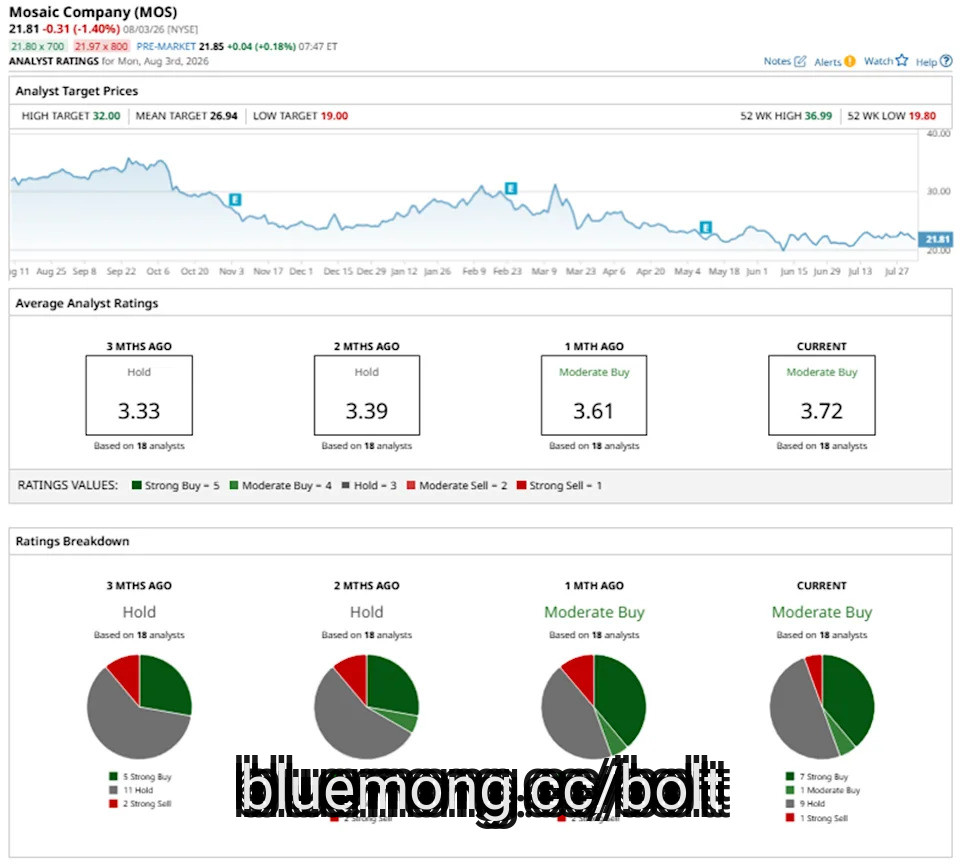
With a market cap of $6.9 billion, The Mosaic Company (MOS) is a leading global producer and marketer of potash and phosphate fertilizers, which are essential inputs for agriculture. With 13,000 employees serving customers in more than 40 countries, Mosaic is also advancing biological solutions through Mosaic Biosciences to improve nutrient efficiency, crop performance, and sustainable food production.
Shares of the Tampa, Florida-based company have underperformed the broader market over the past 52 weeks. MOS stock has decreased 38.3% over this time frame, while the broader S&P 500 Index ($SPX) has gained 21.8%. Moreover, shares of the company have declined 9.5% on a YTD basis, compared to SPX's 11% return.
General Motors vs. Ford: 1 Auto Giant Is Winning the EV Race
1 ****** anese Company Just Waved a Red Flag for Micron Stock. How to Play It Here.
Billionaire Ken Griffin Just Saved Situational Awareness, But Here's What a Rescue Call From Citadel Really Sounds Like — 'I… Heard the Grim Reaper's Scythe'
#Florida
Shares of the Tampa, Florida-based company have underperformed the broader market over the past 52 weeks. MOS stock has decreased 38.3% over this time frame, while the broader S&P 500 Index ($SPX) has gained 21.8%. Moreover, shares of the company have declined 9.5% on a YTD basis, compared to SPX's 11% return.
General Motors vs. Ford: 1 Auto Giant Is Winning the EV Race
1 ****** anese Company Just Waved a Red Flag for Micron Stock. How to Play It Here.
Billionaire Ken Griffin Just Saved Situational Awareness, But Here's What a Rescue Call From Citadel Really Sounds Like — 'I… Heard the Grim Reaper's Scythe'
#Florida



3 months ago
Interested in Castle Biosciences, Inc.? Here are five stocks we like better.
Castle Biosciences reported strong Q2 growth, with revenue rising 20% year over year to $103.5 million. The company raised its 2026 revenue outlook to $365 million–$375 million, up from $345 million–$355 million previously.
TissueCypher was the primary growth driver, generating 14,988 reports, up 63% year over year. Castle now expects TissueCypher report volume to increase approximately 50%–52% in 2026, while AdvanceAD-Tx exceeded 1,000 orders in the quarter.
Despite higher revenue, gross margins declined and Castle posted a $2.1 million net loss, although adjusted EBITDA rose to $12.4 million. Management expects positive adjusted EBITDA in Q3, Q4 and for full-year 2026, supported by $266.8 million in cash and investments at quarter-end.
Castle Biosciences (NASDAQ:CSTL) reported second-quarter 2026 revenue of $103.5 million, up 20% from the prior-year period, as growth in its TissueCypher test and other core offerings supported results. The company raised its full-year revenue outlook to $365 million to $375 million, from a previous range of $345 million to $355 million.
#year #quarter
Castle Biosciences reported strong Q2 growth, with revenue rising 20% year over year to $103.5 million. The company raised its 2026 revenue outlook to $365 million–$375 million, up from $345 million–$355 million previously.
TissueCypher was the primary growth driver, generating 14,988 reports, up 63% year over year. Castle now expects TissueCypher report volume to increase approximately 50%–52% in 2026, while AdvanceAD-Tx exceeded 1,000 orders in the quarter.
Despite higher revenue, gross margins declined and Castle posted a $2.1 million net loss, although adjusted EBITDA rose to $12.4 million. Management expects positive adjusted EBITDA in Q3, Q4 and for full-year 2026, supported by $266.8 million in cash and investments at quarter-end.
Castle Biosciences (NASDAQ:CSTL) reported second-quarter 2026 revenue of $103.5 million, up 20% from the prior-year period, as growth in its TissueCypher test and other core offerings supported results. The company raised its full-year revenue outlook to $365 million to $375 million, from a previous range of $345 million to $355 million.
#year #quarter


3 months ago
Argenx (ARGX) announced the acquisition of Forte Biosciences (FBRX) at $77 per share on July 27.
FBRX saw significant price movement beginning June 29, weeks before the public announcement.
Both FBRX and ARGX exhibited notable trading activity ahead of the deal, suggesting possible insider knowledge influencing price action.
This case exemplifies how pre-announcement trading patterns can signal forthcoming M&A activity, offering educational insight into market behavior.
Author's Note: Today's Chart of the Day is for educational purposes only. I want to illustrate that before any M&A is announced to the public, you will sometimes see an individual who has insider information acting on it.
#fbrx #price
FBRX saw significant price movement beginning June 29, weeks before the public announcement.
Both FBRX and ARGX exhibited notable trading activity ahead of the deal, suggesting possible insider knowledge influencing price action.
This case exemplifies how pre-announcement trading patterns can signal forthcoming M&A activity, offering educational insight into market behavior.
Author's Note: Today's Chart of the Day is for educational purposes only. I want to illustrate that before any M&A is announced to the public, you will sometimes see an individual who has insider information acting on it.
#fbrx #price



3 months ago
The biopharma sector is in the middle of a transformation in which macroeconomic pressures and policy developments actively dictate corporate dealmaking. As leading pharmaceutical companies prepare for a $300 billion patent cliff in the second half of the decade, capital allocation has switched sharply toward restocking commercial pipelines with low-risk, high-conviction clinical ******* ets. At the same time, implementation of the Inflation Reduction Act has changed the relative attractiveness of drug options. Since small-molecule drugs are subject to government price negotiations earlier in their lifecycle compared to large-molecule biologics, commercial buyers are shifting premium valuations to large-molecule immunology platforms.
Against this macro context, argenx SE (NASDAQ:ARGX) entered a definitive all-cash agreement on July 27 to acquire clinical-stage biotech Forte Biosciences, Inc. (NASDAQ:FBRX) for $77 per share, valuing the company at over $2.2 billion. At first glance, the $77 offer represents a 40% premium to Forte's closing price prior to the announcement. However, the underlying deal economics demonstrate argenx's readiness to pay a premium for clinical validation: when compared to Forte's volume-weighted average pricing following its successful Phase 1b vitiligo readout on July 9, the purchase price represents an 86% premium.
The target ******* et, Forte's FB102, is a first-in-class anti-CD122 antibody that has shown clinical efficacy in vitiligo and celiac disease. In a 24-week experiment, FB102 showed a significant 29.6% mean improvement on the Facial Vitiligo Area Scoring Index, separating from placebo by day 64.
Argenx's ability to carry out a $2.2 billion cash deal stems from its strong financial condition. The company's Q1 2026 financial report showed global product net sales of $1.3 billion, a 63% increase year-over-year, as well as a quarterly net profit of $366 million and a strong balance sheet with $4.9 billion in cash and financial ******* ets. This commercial momentum is almost exclusively driven by Vyvgart, the company's blockbuster FcRn-blocking medication, which is now seeing its 17th straight quarter of growth.
That said, the explosive top-line trajectory poses a major concentration risk. According to CEO Karen Massey's "Vision 2030" framework, which targets 50,000 patients and ten designated indications worldwide, argenx SE (NASDAQ:ARGX) needs a supplementary second leg in immunology. FB102 offers that diversification by delivering a unique CD122 mechanism into unserved autoimmune indications without jeopardizing its core FcRn business.
#premium #price
Against this macro context, argenx SE (NASDAQ:ARGX) entered a definitive all-cash agreement on July 27 to acquire clinical-stage biotech Forte Biosciences, Inc. (NASDAQ:FBRX) for $77 per share, valuing the company at over $2.2 billion. At first glance, the $77 offer represents a 40% premium to Forte's closing price prior to the announcement. However, the underlying deal economics demonstrate argenx's readiness to pay a premium for clinical validation: when compared to Forte's volume-weighted average pricing following its successful Phase 1b vitiligo readout on July 9, the purchase price represents an 86% premium.
The target ******* et, Forte's FB102, is a first-in-class anti-CD122 antibody that has shown clinical efficacy in vitiligo and celiac disease. In a 24-week experiment, FB102 showed a significant 29.6% mean improvement on the Facial Vitiligo Area Scoring Index, separating from placebo by day 64.
Argenx's ability to carry out a $2.2 billion cash deal stems from its strong financial condition. The company's Q1 2026 financial report showed global product net sales of $1.3 billion, a 63% increase year-over-year, as well as a quarterly net profit of $366 million and a strong balance sheet with $4.9 billion in cash and financial ******* ets. This commercial momentum is almost exclusively driven by Vyvgart, the company's blockbuster FcRn-blocking medication, which is now seeing its 17th straight quarter of growth.
That said, the explosive top-line trajectory poses a major concentration risk. According to CEO Karen Massey's "Vision 2030" framework, which targets 50,000 patients and ten designated indications worldwide, argenx SE (NASDAQ:ARGX) needs a supplementary second leg in immunology. FB102 offers that diversification by delivering a unique CD122 mechanism into unserved autoimmune indications without jeopardizing its core FcRn business.
#premium #price


3 months ago
argenx has entered a definitive agreement to acquire Forte Biosciences for approximately $2.2bn in total equity value.
Approved by both companies' boards of directors, the transaction is expected to close in the third quarter of 2026, contingent upon standard closing conditions.
The main ***** et involved is FB102, Forte Biosciences' first-in-class anti-CD122 antibody, which will be added to argenx's immunology portfolio. FB102 was evaluated in Phase Ib studies for vitiligo and celiac disease.
These studies were a key factor in deciding to proceed from a strategic investment to acquisition by argenx.
Forte Biosciences expects to release Phase II data for FB102 in the second half of this year.
#forte #biosciences
Approved by both companies' boards of directors, the transaction is expected to close in the third quarter of 2026, contingent upon standard closing conditions.
The main ***** et involved is FB102, Forte Biosciences' first-in-class anti-CD122 antibody, which will be added to argenx's immunology portfolio. FB102 was evaluated in Phase Ib studies for vitiligo and celiac disease.
These studies were a key factor in deciding to proceed from a strategic investment to acquisition by argenx.
Forte Biosciences expects to release Phase II data for FB102 in the second half of this year.
#forte #biosciences


4 months ago
Fred Alger Management, an investment management company, released its "Alger Small Cap Focus Fund" second-quarter 2026 investor letter. A copy of the letter can be downloaded here. U.S. equities experienced a strong recovery in Q2 2026, with the S&P 500 Index gaining 15.2%, marking its best quarter since 2020. A ceasefire between the United States and Iran and accelerated investment in artificial intelligence (AI) fueled market optimism in the quarter, driving the Information Technology and Industrials sectors forward while Energy and Utilities lagged due to falling oil and gas prices. In June, the Federal Reserve maintained steady interest rates, but the meeting had a hawkish tone. As AI transitions into its agentic phase, opportunities are identified within sectors adopting the technology. The Alger Small Cap Focus Fund's Class A shares outperformed the Russell 2000 Growth Index in the quarter, driven by strong performances in the Industrials and Health Care sectors, while Financials and Consumer Discretionary detracted from the performance. In addition, please check the Fund's top five holdings to know its best picks in 2026.
In its Q2 2026 investor letter, Alger Small Cap Focus Fund highlighted Forte Biosciences, Inc. (NASDAQ:FBRX). Forte Biosciences, Inc. (NASDAQ:FBRX), a US-based clinical-stage biopharmaceutical company, detracted from the Fund's performance during the quarter. On July 20, 2026, Forte Biosciences, Inc. (NASDAQ:FBRX) closed at $47.49 per share, reflecting a market capitalization of $972.54 million. Forte Biosciences, Inc. (NASDAQ:FBRX) posted a one-month return of 161.65%, while its shares gained 355.32% over the past 52 weeks.
Alger Small Cap Focus Fund stated the following regarding Forte Biosciences, Inc. (NASDAQ:FBRX) in its Q2 2026 investor update:
"Forte Biosciences, Inc. (NASDAQ:FBRX) is a clinical-stage biopharmaceutical company developing FB102, an anti-CD122 monoclonal antibody with potential application across a range of autoimmune conditions, including celiac disease, vitiligo, and alopecia areata. We view Forte favorably given the differentiated mechanism underlying FB102 and its potential applicability across multiple sizeable indications, supported by encouraging early celiac data and a series of meaningful clinical readouts anticipated through the balance of the year. Shares detracted from performance during the quarter, pressured by an equity raise whose limited initial disclosure was poorly received, as well as by growing investor impatience as anticipated vitiligo data extended beyond the previously communicated timeline. Despite a challenging quarter, we remain constructive ahead of the celiac readout expected later this year and cautiously optimistic on the forthcoming vitiligo results. We believe FB102 retains meaningful strategic value as its clinical profile comes into clearer focus."
#forte #biosciences #small #investor
In its Q2 2026 investor letter, Alger Small Cap Focus Fund highlighted Forte Biosciences, Inc. (NASDAQ:FBRX). Forte Biosciences, Inc. (NASDAQ:FBRX), a US-based clinical-stage biopharmaceutical company, detracted from the Fund's performance during the quarter. On July 20, 2026, Forte Biosciences, Inc. (NASDAQ:FBRX) closed at $47.49 per share, reflecting a market capitalization of $972.54 million. Forte Biosciences, Inc. (NASDAQ:FBRX) posted a one-month return of 161.65%, while its shares gained 355.32% over the past 52 weeks.
Alger Small Cap Focus Fund stated the following regarding Forte Biosciences, Inc. (NASDAQ:FBRX) in its Q2 2026 investor update:
"Forte Biosciences, Inc. (NASDAQ:FBRX) is a clinical-stage biopharmaceutical company developing FB102, an anti-CD122 monoclonal antibody with potential application across a range of autoimmune conditions, including celiac disease, vitiligo, and alopecia areata. We view Forte favorably given the differentiated mechanism underlying FB102 and its potential applicability across multiple sizeable indications, supported by encouraging early celiac data and a series of meaningful clinical readouts anticipated through the balance of the year. Shares detracted from performance during the quarter, pressured by an equity raise whose limited initial disclosure was poorly received, as well as by growing investor impatience as anticipated vitiligo data extended beyond the previously communicated timeline. Despite a challenging quarter, we remain constructive ahead of the celiac readout expected later this year and cautiously optimistic on the forthcoming vitiligo results. We believe FB102 retains meaningful strategic value as its clinical profile comes into clearer focus."
#forte #biosciences #small #investor


4 months ago
Sagimet Biosciences Inc. (NASDAQ:SGMT) is one of the 10 best stocks under $10 that could triple.
On June 29, Sagimet Biosciences Inc. (NASDAQ:SGMT) announced that it had been included in the broader Russell 3000 Index and the small-cap focused Russell 2000 Index, as part of the Russell Indexes reconstitution for 2026. The June index reconstitution incorporates about 4,000 of the largest U.S. companies, based on their market capitalization as of the April 30 close.
M. A. Arkhipov/Shutterstock.com
Inclusion in the Russell 3000 Index results in automatic addition to either the Russell 1000 Index or the Russell 2000 Index. It also leads to inclusions across indexes that cover value or growth tilts.
CEO David Happel said this development speaks volumes about what Sagimet has achieved over the years, with people now expecting the company to start its Phase 3 clinical study on denifanstat. He further stated:
On June 29, Sagimet Biosciences Inc. (NASDAQ:SGMT) announced that it had been included in the broader Russell 3000 Index and the small-cap focused Russell 2000 Index, as part of the Russell Indexes reconstitution for 2026. The June index reconstitution incorporates about 4,000 of the largest U.S. companies, based on their market capitalization as of the April 30 close.
M. A. Arkhipov/Shutterstock.com
Inclusion in the Russell 3000 Index results in automatic addition to either the Russell 1000 Index or the Russell 2000 Index. It also leads to inclusions across indexes that cover value or growth tilts.
CEO David Happel said this development speaks volumes about what Sagimet has achieved over the years, with people now expecting the company to start its Phase 3 clinical study on denifanstat. He further stated:


4 months ago
Heartland Advisors, an investment management company, released its second-quarter 2026 investor letter for "Heartland Mid Cap Value Fund". A copy can be downloaded here. Mid-cap stocks sharply rose in the second quarter, driven by perceived AI beneficiaries, particularly in Technology. The Fund returned 9.90% in the quarter, compared to the Russell Midcap® Value Index's 13.40% return. The underperformance was driven by negative stock selection despite Tech being one of the top absolute return contributors. In the challenging environment, the Fund remains focused on its disciplined approach to security selection. In addition, you can check the Fund's top 5 holdings to determine its best picks for 2026.
In its Q2 2026 investor letter, Heartland Mid Cap Value Fund highlighted International Flavors & Fragrances Inc. (NYSE:IFF). International Flavors & Fragrances Inc. (NYSE:IFF) is a specialty chemical company that manufactures products across food, beverage, health and biosciences, scent, pharma solutions, and complementary adjacent products. On July 14, 2026, International Flavors & Fragrances Inc. (NYSE:IFF) closed at $74.67 per share, reflecting a market capitalization of $19.06 billion. International Flavors & Fragrances Inc. (NYSE:IFF) posted a one-month return of -1.81%, while its shares gained 0.61% over the past 52 weeks.
Heartland Mid Cap Value Fund stated the following regarding International Flavors & Fragrances Inc. (NYSE:IFF) in its Q2 2026 investor update:
"Materials. A new deep-value holding is International Flavors & Fragrances Inc. (NYSE:IFF), a specialty ingredient producer that sells flavors, fragrances, and enzymes to food, beverage, personal care, household products, and human health product manufacturers. This is an example of identifying a self-help opportunity through bottom-up research.
For more than two years, management has worked on streamlining IFF's portfolio and operations to focus on higher-margin businesses where it enjoys leading market share, better pricing power, attractive growth, and significantly enhanced capital allocation flexibility. This strategy follows years of wayward capital allocation executed by prior management. Today, IFF's revenue is evenly split across three segments. Taste accounts for 30% of profits, Health & Biosciences generates 37%, and Scent contributes 32%. In the Scent segment, IFF's pioneering of encapsulated fragrance technology secured its leadership in fabric care, a position now expanding into scent boosters, shampoos, and body washes.
In its Q2 2026 investor letter, Heartland Mid Cap Value Fund highlighted International Flavors & Fragrances Inc. (NYSE:IFF). International Flavors & Fragrances Inc. (NYSE:IFF) is a specialty chemical company that manufactures products across food, beverage, health and biosciences, scent, pharma solutions, and complementary adjacent products. On July 14, 2026, International Flavors & Fragrances Inc. (NYSE:IFF) closed at $74.67 per share, reflecting a market capitalization of $19.06 billion. International Flavors & Fragrances Inc. (NYSE:IFF) posted a one-month return of -1.81%, while its shares gained 0.61% over the past 52 weeks.
Heartland Mid Cap Value Fund stated the following regarding International Flavors & Fragrances Inc. (NYSE:IFF) in its Q2 2026 investor update:
"Materials. A new deep-value holding is International Flavors & Fragrances Inc. (NYSE:IFF), a specialty ingredient producer that sells flavors, fragrances, and enzymes to food, beverage, personal care, household products, and human health product manufacturers. This is an example of identifying a self-help opportunity through bottom-up research.
For more than two years, management has worked on streamlining IFF's portfolio and operations to focus on higher-margin businesses where it enjoys leading market share, better pricing power, attractive growth, and significantly enhanced capital allocation flexibility. This strategy follows years of wayward capital allocation executed by prior management. Today, IFF's revenue is evenly split across three segments. Taste accounts for 30% of profits, Health & Biosciences generates 37%, and Scent contributes 32%. In the Scent segment, IFF's pioneering of encapsulated fragrance technology secured its leadership in fabric care, a position now expanding into scent boosters, shampoos, and body washes.


5 months ago
Cathie Wood has been taking it slow with her shopping sprees lately. The co-founder, CEO, and chief investment officer at Ark Invest has been doing more selling than buying across her firm's aggressive growth exchange-traded funds (ETFs).
Wood kicked off the new trading week by buying shares in ******* e Exploration (NASDAQ: SPCX), Roblox (NYSE: RBLX), and Alamar Biosciences (NASDAQ: ALMR). They were the only three stocks she purchased on Monday. Let's take a closer look at these fresh purchases.
Missed Nvidia in 2009? This Rare Signal Is Flashing Again. In 2009, a "Double Down" signal flashed for a little-known chipmaker called Nvidia. For the first time in years, that same "Total Conviction" signal is flashing for a company 1/100th the size of Nvidia. Continue »
It's been a wild first six days of trading for ******* eX stock. Following the record-shattering IPO, shares rose sharply in their first three days on the market, only to give most of those gains away in the past three trading sessions.
Just 3% above its first-day trade of $150, the stock has shed nearly a third of its value since peaking a week ago. But despite the swift pullback, ******* eX remains one of just seven U.S. exchange-listed stocks with market caps north of $2 trillion.
Wood kicked off the new trading week by buying shares in ******* e Exploration (NASDAQ: SPCX), Roblox (NYSE: RBLX), and Alamar Biosciences (NASDAQ: ALMR). They were the only three stocks she purchased on Monday. Let's take a closer look at these fresh purchases.
Missed Nvidia in 2009? This Rare Signal Is Flashing Again. In 2009, a "Double Down" signal flashed for a little-known chipmaker called Nvidia. For the first time in years, that same "Total Conviction" signal is flashing for a company 1/100th the size of Nvidia. Continue »
It's been a wild first six days of trading for ******* eX stock. Following the record-shattering IPO, shares rose sharply in their first three days on the market, only to give most of those gains away in the past three trading sessions.
Just 3% above its first-day trade of $150, the stock has shed nearly a third of its value since peaking a week ago. But despite the swift pullback, ******* eX remains one of just seven U.S. exchange-listed stocks with market caps north of $2 trillion.


5 months ago
Pacific Biosciences of California, Inc. (NASDAQ:PACB) is one of the 8 Best Genomics Stocks to Buy According to **** ysts.
On May 26, Pacific Biosciences of California, Inc. (NASDAQ:PACB) began global shipments of its SPRQ-Nx sequencing chemistry and new multi-use SMRT Cells for the Revio platform. The firm lowered the per-genome list price to $345 and authorized sub-$300 sequencing at scale. The company said the new chemistry cuts costs by about 30%. It also improved accuracy and yield through updates to its artificial intelligence-powered DeepConsensus algorithm developed with Google.
The company said beta testing across more than 1,400 runs showed higher yield and lower failure rates. **** ociate Professor and Senior Bioinformatician at Uppsala University, Adam Ameur, stated the system delivered "consistently strong run performance" with lower pricing and simplified workflows. CEO Christian Henry said AI advances, "improving data quality, speed, and usability," are expanding what researchers can extract from each run.
Product Lead for Genomics at Google Research, Andrew Carroll, added that DeepConsensus upgrades introduce more data quality, while PacBio said expanded methylation detection and reusable consumables increase output and reduce costs.
15 States with the Best Healthcare in the US
On May 26, Pacific Biosciences of California, Inc. (NASDAQ:PACB) began global shipments of its SPRQ-Nx sequencing chemistry and new multi-use SMRT Cells for the Revio platform. The firm lowered the per-genome list price to $345 and authorized sub-$300 sequencing at scale. The company said the new chemistry cuts costs by about 30%. It also improved accuracy and yield through updates to its artificial intelligence-powered DeepConsensus algorithm developed with Google.
The company said beta testing across more than 1,400 runs showed higher yield and lower failure rates. **** ociate Professor and Senior Bioinformatician at Uppsala University, Adam Ameur, stated the system delivered "consistently strong run performance" with lower pricing and simplified workflows. CEO Christian Henry said AI advances, "improving data quality, speed, and usability," are expanding what researchers can extract from each run.
Product Lead for Genomics at Google Research, Andrew Carroll, added that DeepConsensus upgrades introduce more data quality, while PacBio said expanded methylation detection and reusable consumables increase output and reduce costs.
15 States with the Best Healthcare in the US


5 months ago
Is COGT a good stock to buy? We came across a bullish thesis on Cogent Biosciences, Inc. on X.com by seedy19tron. In this article, we will summarize the bulls’ thesis on COGT. Cogent Biosciences, Inc.'s share was trading at $34.81 as of June 1st.
Likoper/Shutterstock.com
Cogent Biosciences (COGT) is a clinical-stage oncology company focused on KIT mutation-driven diseases, primarily systemic mastocytosis (SM) and gastrointestinal stromal tumors (GIST). Its lead ****** et bezuclastinib is a highly selective type I KIT inhibitor targeting KIT D816V, positioning it as a differentiated therapy in mast-cell driven oncology. Beyond its lead program, the company is advancing a broader pipeline including a pan-KRAS(ON) inhibitor CGT1815, a JAK2 inhibitor CGT1145, and FGFR2/3 ****** ets, expanding its optionality across solid tumors and hematologic malignancies.
Read More: 15 AI Stocks That Are Quietly Making Investors Rich
Read More: Undervalued AI Stock Poised For Massive Gains: 10000% Upside Potential
Likoper/Shutterstock.com
Cogent Biosciences (COGT) is a clinical-stage oncology company focused on KIT mutation-driven diseases, primarily systemic mastocytosis (SM) and gastrointestinal stromal tumors (GIST). Its lead ****** et bezuclastinib is a highly selective type I KIT inhibitor targeting KIT D816V, positioning it as a differentiated therapy in mast-cell driven oncology. Beyond its lead program, the company is advancing a broader pipeline including a pan-KRAS(ON) inhibitor CGT1815, a JAK2 inhibitor CGT1145, and FGFR2/3 ****** ets, expanding its optionality across solid tumors and hematologic malignancies.
Read More: 15 AI Stocks That Are Quietly Making Investors Rich
Read More: Undervalued AI Stock Poised For Massive Gains: 10000% Upside Potential


12 months ago
In the fast-moving world of biotech innovation, few figures have commanded attention in 2025 the way Ben Lamm has.
As founder and CEO of Colossal Biosciences, he has transformed what sounded like science fiction into a high-stakes, headline-dominating movement.
His company’s mission, once dismissed as sensational, now sits at the center of global discussions about climate solutions, genetics, and the future of life itself.
Ben Lamm’s rise began with a concept that seemed almost too audacious to be real: bringing extinct species back into the modern world.
Colossal Biosciences quickly earne
As founder and CEO of Colossal Biosciences, he has transformed what sounded like science fiction into a high-stakes, headline-dominating movement.
His company’s mission, once dismissed as sensational, now sits at the center of global discussions about climate solutions, genetics, and the future of life itself.
Ben Lamm’s rise began with a concept that seemed almost too audacious to be real: bringing extinct species back into the modern world.
Colossal Biosciences quickly earne