
8 days ago
Brace for minor market tremors now that the Fed has hiked interest rates by 0.25%.
Although if history holds up, any losses could prove short-lived.
The S&P 500 (^GSPC) has declined by an average of 4.0% over the six weeks following the first Fed rate hike of a cycle across seven such episodes since 1988, per new ****** ysis from strategists at The Kobeissi Letter.
Stocks recovered all of those losses over the next five to six weeks on average.
In the six months following the first interest rate hike, the S&P 500 returned 4% on average. After 12 months, the S&P 500's average gain tallied 9%. Positive returns have occurred in every episode except 2022 over the 12 months.
"Fed rate hikes have historically been great buying opportunities," the strategists added.
Read more: Follow live coverage of the Fed meeting
The decision by the Fed to lift rates comes as sticky inflation readings — from the CPI to PPI — and rising energy costs force central bankers back into tightening mode. The rate hike marks the central bank's first interest rate increase since July 2023.
Investors are also focused on the updated economic projections and the Fed's "dot plot" to gauge future moves on rates — said dot plot didn't rule out one more hike this year. A hawkish dot plot as was received and follow up commentary from Fed Chairman Kevin Warsh could further elevate borrowing costs and pressure stocks initially around the world.
#rate #hike #first #plot
Although if history holds up, any losses could prove short-lived.
The S&P 500 (^GSPC) has declined by an average of 4.0% over the six weeks following the first Fed rate hike of a cycle across seven such episodes since 1988, per new ****** ysis from strategists at The Kobeissi Letter.
Stocks recovered all of those losses over the next five to six weeks on average.
In the six months following the first interest rate hike, the S&P 500 returned 4% on average. After 12 months, the S&P 500's average gain tallied 9%. Positive returns have occurred in every episode except 2022 over the 12 months.
"Fed rate hikes have historically been great buying opportunities," the strategists added.
Read more: Follow live coverage of the Fed meeting
The decision by the Fed to lift rates comes as sticky inflation readings — from the CPI to PPI — and rising energy costs force central bankers back into tightening mode. The rate hike marks the central bank's first interest rate increase since July 2023.
Investors are also focused on the updated economic projections and the Fed's "dot plot" to gauge future moves on rates — said dot plot didn't rule out one more hike this year. A hawkish dot plot as was received and follow up commentary from Fed Chairman Kevin Warsh could further elevate borrowing costs and pressure stocks initially around the world.
#rate #hike #first #plot



19 days ago
The federal interest burden has reached a new height, exceeding even the 1991 record, but **** ysts warn the risks **** ociated with servicing the ever-growing national debt today are much higher than they were 35 years ago, **** ysts warn.
A recent **** ysis from investment management firm Doubleline noted that in 2025, the federal net interest payment on the U.S.'s now-$40 trillion national debt reached 18.5% of revenue, surpassing 1991's record 18.4%. That means the U.S. is collecting nearly 19% of all taxes and revenue just to pay off interest on its ballooning debt, equivalent to $1.25 trillion—more than the entire 2026 defense budget.
Growing interest payments create a cycle: the government must borrow more just to cover the interest, leaving it less flexible to spend on infrastructure, education, and other investments that drive growth.
The amount of money needed just to pay the interest on America's debt has swelled over the last decade as interest rates have grown, with interest expense as a percentage of revenue tripling since 2015, according to global market commentator the Kobeissi Letter, citing the Congressional Budget Office, which predicts interest expense levels to climb to 25% by 2036.
"The US debt crisis is in uncharted territory," the Kobeissi Letter wrote on a social media post. "These projections **** ume no major slowdown, recession, or significant rise in Treasury yields over this period."
#interest #kobeissi #letter #record
A recent **** ysis from investment management firm Doubleline noted that in 2025, the federal net interest payment on the U.S.'s now-$40 trillion national debt reached 18.5% of revenue, surpassing 1991's record 18.4%. That means the U.S. is collecting nearly 19% of all taxes and revenue just to pay off interest on its ballooning debt, equivalent to $1.25 trillion—more than the entire 2026 defense budget.
Growing interest payments create a cycle: the government must borrow more just to cover the interest, leaving it less flexible to spend on infrastructure, education, and other investments that drive growth.
The amount of money needed just to pay the interest on America's debt has swelled over the last decade as interest rates have grown, with interest expense as a percentage of revenue tripling since 2015, according to global market commentator the Kobeissi Letter, citing the Congressional Budget Office, which predicts interest expense levels to climb to 25% by 2036.
"The US debt crisis is in uncharted territory," the Kobeissi Letter wrote on a social media post. "These projections **** ume no major slowdown, recession, or significant rise in Treasury yields over this period."
#interest #kobeissi #letter #record


21 days ago
The numbers don't lie: Nvidia (NVDA) has never had more influence on the broader stock market than right now.
Nvidia now accounts for about 8% of the S&P 500's (^GSPC) market cap, near its highest proportion on record per data from Augur Infinity (chart below). At a market cap of $5.4 trillion (and climbing), Nvidia's value is now bigger than that of five of the S&P 500's 11 sectors.
The AI chip darling's market cap also exceeds the combined value of the energy, utilities, real estate, and materials sectors in the S&P 500.
"Nvidia is making history," strategists at The Kobeissi Letter said.
The history is not coming without a host of very good reasons.
Nvidia said after reporting its fiscal second quarter earnings that it sees 70% revenue growth for fiscal year 2028. This was above **** yst forecasts for 45% growth. The sales gain would be larger — think in excess of 100% — if not for memory chip shortages, said Nvidia CEO Jensen Huang.
The company saw adjusted earnings per share of $2.22 on revenue of $96.2 billion in its just-reported quarter. These were better than the $2.09 per share the Street had expected and revenue of $92.3 billion.
#market #history #quarter #earnings
Nvidia now accounts for about 8% of the S&P 500's (^GSPC) market cap, near its highest proportion on record per data from Augur Infinity (chart below). At a market cap of $5.4 trillion (and climbing), Nvidia's value is now bigger than that of five of the S&P 500's 11 sectors.
The AI chip darling's market cap also exceeds the combined value of the energy, utilities, real estate, and materials sectors in the S&P 500.
"Nvidia is making history," strategists at The Kobeissi Letter said.
The history is not coming without a host of very good reasons.
Nvidia said after reporting its fiscal second quarter earnings that it sees 70% revenue growth for fiscal year 2028. This was above **** yst forecasts for 45% growth. The sales gain would be larger — think in excess of 100% — if not for memory chip shortages, said Nvidia CEO Jensen Huang.
The company saw adjusted earnings per share of $2.22 on revenue of $96.2 billion in its just-reported quarter. These were better than the $2.09 per share the Street had expected and revenue of $92.3 billion.
#market #history #quarter #earnings


24 days ago
The ugly US debt picture seems to get uglier by the day.
Case in point: rising interest payments on some $40 trillion in debt, in part powered by a recent climb in Treasury yields.
US annual interest expense is up to a record 18.5% of federal government revenue, according to fresh ****** ysis from bond investment firm Doubleline (see chart below). This is now officially above the previous record of 18.4% set in 1991.
"The US debt crisis is in uncharted territory," strategists at the Kobeissi Letter wrote in a note.
Consider this: The aforementioned percentage has more than quadrupled over the past four years. The US annual interest expense now stands at a record $1.25 trillion, more than four times the level seen in 1991.
#debt
Case in point: rising interest payments on some $40 trillion in debt, in part powered by a recent climb in Treasury yields.
US annual interest expense is up to a record 18.5% of federal government revenue, according to fresh ****** ysis from bond investment firm Doubleline (see chart below). This is now officially above the previous record of 18.4% set in 1991.
"The US debt crisis is in uncharted territory," strategists at the Kobeissi Letter wrote in a note.
Consider this: The aforementioned percentage has more than quadrupled over the past four years. The US annual interest expense now stands at a record $1.25 trillion, more than four times the level seen in 1991.
#debt


1 month ago
Benzinga and Yahoo Finance LLC may earn commission or revenue on some items through the links below.
Market commentator The Kobeissi Letter said U.S. homebuyers are pulling back as seller surplus over buyers widened in July.
In a post on X on Sunday, The Kobeissi Letter said sellers outnumbered buyers by an estimated 51.3% in July, the second-highest gap on record. Active homebuyers fell 2.5% month over month to 966,752, the lowest level on record, while sellers declined 0.3% to about 1.46 million. It said about 80% of major U.S. metros are now buyer's markets and warned of further downward pressure on home prices.
US homebuyers are quitting.
There were an estimated +51.3% more home sellers than buyers in July, the 2nd highest level on record.
This percentage has doubled over the last 2 years.
By comparison, an all-time high of +51.8% was recorded in December 2025.
This comes as the… pic.twitter.com/x0sZ51NXPx
— The Kobeissi Letter (KobeissiLetter) August 23, 2026
#letter #month
Market commentator The Kobeissi Letter said U.S. homebuyers are pulling back as seller surplus over buyers widened in July.
In a post on X on Sunday, The Kobeissi Letter said sellers outnumbered buyers by an estimated 51.3% in July, the second-highest gap on record. Active homebuyers fell 2.5% month over month to 966,752, the lowest level on record, while sellers declined 0.3% to about 1.46 million. It said about 80% of major U.S. metros are now buyer's markets and warned of further downward pressure on home prices.
US homebuyers are quitting.
There were an estimated +51.3% more home sellers than buyers in July, the 2nd highest level on record.
This percentage has doubled over the last 2 years.
By comparison, an all-time high of +51.8% was recorded in December 2025.
This comes as the… pic.twitter.com/x0sZ51NXPx
— The Kobeissi Letter (KobeissiLetter) August 23, 2026
#letter #month


1 month ago
Crypto card spending hit a monthly record, with stablecoin-funded purchases climbing to $1.03 billion, or $1.04 billion in supplementary reporting based on PaymentsScan data. PaymentsScan, an on-chain ******* ytics platform that tracks card activity across dozens of issuers, reported that the figure was up 16% from June and nearly 200% from a year earlier.
More than 10 million individual purchases were logged in July alone, according to PaymentsScan data cited on X by The Kobeissi Letter. Just three years ago, PaymentsScan's tracked monthly volume was roughly $1 million. The climb from $382 million in August 2025 to more than $1 billion in July 2026 marks sustained growth in the platform's tracked data.
PaymentsScan tracks card issuers across Ethereum, Solana, Base, Tron and Polygon, spanning providers including RedotPay, KAST, Gnosis Pay, Wirex and Rain-issued cards.
A supplementary report from Bitcoin World, put July spending at $1.04 billion. The report said USDT and USDC were the dominant stablecoins used for such payments, while noting that an exact breakdown by network was not disclosed. The figures point to digital dollars as a major funding source for crypto-card purchases.
Stablecoin cards can offer near-instant settlement and access for users without a local bank account. As more regional issuers launch and stablecoins continue settling faster than multi-day card networks, PaymentsScan's tracked monthly volume has continued to rise.
#billion #july #data
More than 10 million individual purchases were logged in July alone, according to PaymentsScan data cited on X by The Kobeissi Letter. Just three years ago, PaymentsScan's tracked monthly volume was roughly $1 million. The climb from $382 million in August 2025 to more than $1 billion in July 2026 marks sustained growth in the platform's tracked data.
PaymentsScan tracks card issuers across Ethereum, Solana, Base, Tron and Polygon, spanning providers including RedotPay, KAST, Gnosis Pay, Wirex and Rain-issued cards.
A supplementary report from Bitcoin World, put July spending at $1.04 billion. The report said USDT and USDC were the dominant stablecoins used for such payments, while noting that an exact breakdown by network was not disclosed. The figures point to digital dollars as a major funding source for crypto-card purchases.
Stablecoin cards can offer near-instant settlement and access for users without a local bank account. As more regional issuers launch and stablecoins continue settling faster than multi-day card networks, PaymentsScan's tracked monthly volume has continued to rise.
#billion #july #data


2 months ago
Moneywise and Yahoo Finance LLC may earn commission or revenue through links in the content below.
American workers are getting a smaller slice of the economic pie — and some people blame it on a decision made more than 50 years ago.
A Kobeissi Letter chart (1) based on Federal Reserve Bank (FRED) data (2) has been making the rounds online (3). It shows wages and salaries at roughly 43% of U.S. gross domestic income in the first quarter of 2026. Taken from a government data series going back to 1929, that share is nearly the lowest since the Great Depression began.
Jeff Bezos backs a platform that lets anyone invest in rental homes for as little as $100 — 6 ways to build wealth like a landlord without actually being one
JPMorgan still sees gold hitting $5,000/oz by Q4 — and savvy investors are protecting their wealth with a tax-advantaged Gold IRA. Learn more with a free guide from Priority Gold
#wealth #moneywise #finance #kobeissi
American workers are getting a smaller slice of the economic pie — and some people blame it on a decision made more than 50 years ago.
A Kobeissi Letter chart (1) based on Federal Reserve Bank (FRED) data (2) has been making the rounds online (3). It shows wages and salaries at roughly 43% of U.S. gross domestic income in the first quarter of 2026. Taken from a government data series going back to 1929, that share is nearly the lowest since the Great Depression began.
Jeff Bezos backs a platform that lets anyone invest in rental homes for as little as $100 — 6 ways to build wealth like a landlord without actually being one
JPMorgan still sees gold hitting $5,000/oz by Q4 — and savvy investors are protecting their wealth with a tax-advantaged Gold IRA. Learn more with a free guide from Priority Gold
#wealth #moneywise #finance #kobeissi

2 months ago
The reaction to SK Hynix's (SKHY) capex guidance on Wednesday only highlights the stunning summer rout in semiconductor stocks.
Shares of the South Korean chip play tanked as the company said it expects its capital expenditures to surge 50% this year to at least $31 billion. The company is attempting to meet the strong demand for its memory chips, which are playing a key role in the AI boom.
Quick insight: The SK Hynix rout will unlikely do anything to reawaken animal spirits in the chips ***** e. All the stocks of the closely watched Philadelphia Semiconductor Index (^SOX) are now trading below their 50-day moving averages, the first such occurrence since April 2025, according to FactSet data.
The SOX has declined 18.9% so far in July, and is on track for its largest monthly loss since 2008.
"Chip stocks are becoming oversold," strategists at The Kobeissi Letter wrote in a note.
#wednesday
Shares of the South Korean chip play tanked as the company said it expects its capital expenditures to surge 50% this year to at least $31 billion. The company is attempting to meet the strong demand for its memory chips, which are playing a key role in the AI boom.
Quick insight: The SK Hynix rout will unlikely do anything to reawaken animal spirits in the chips ***** e. All the stocks of the closely watched Philadelphia Semiconductor Index (^SOX) are now trading below their 50-day moving averages, the first such occurrence since April 2025, according to FactSet data.
The SOX has declined 18.9% so far in July, and is on track for its largest monthly loss since 2008.
"Chip stocks are becoming oversold," strategists at The Kobeissi Letter wrote in a note.
#wednesday

3 months ago
Benzinga and Yahoo Finance LLC may earn commission or revenue on some items through the links below.
Central banks are increasingly turning to gold as protection against financial crises, inflation and geopolitical risks, according to a World Gold Council survey highlighted Tuesday by market commentator, The Kobeissi Letter.
According to the survey of 69 central banks, 90% of respondents cited gold's performance during periods of crisis as a primary reason for holding on to the precious metal.
Don't Miss:
A single bad hire can set a startup back years. Here are the 5 hires founders most often misjudge — and why
Central banks are increasingly turning to gold as protection against financial crises, inflation and geopolitical risks, according to a World Gold Council survey highlighted Tuesday by market commentator, The Kobeissi Letter.
According to the survey of 69 central banks, 90% of respondents cited gold's performance during periods of crisis as a primary reason for holding on to the precious metal.
Don't Miss:
A single bad hire can set a startup back years. Here are the 5 hires founders most often misjudge — and why

3 months ago
The valuations on the world's largest companies — mostly tech names — look goofy if you zoom out and compare them to other ****** ets.
That's exactly what the team at the Kobeissi Letter did, offering up these stunning notes:
The top 10 US stocks now have a combined market cap of $25.3 trillion.
If the top 10 US stocks were a stock market, they would be the second-largest in the world, even exceeding China.
The top 10 US stocks' market value is also larger than China's GDP of $19.4 trillion, the world's second biggest economy.
That's exactly what the team at the Kobeissi Letter did, offering up these stunning notes:
The top 10 US stocks now have a combined market cap of $25.3 trillion.
If the top 10 US stocks were a stock market, they would be the second-largest in the world, even exceeding China.
The top 10 US stocks' market value is also larger than China's GDP of $19.4 trillion, the world's second biggest economy.


4 months ago
Big Tech is becoming hooked on debt to fuel its grandiose visions of AI dominance, a slight shift from years past, when aggressive investments were largely driven by internally generated cash.
The news: AI-related companies have issued about $140 billion in investment-grade bonds year to date, accounting for 49% of the total investment-grade issuance, according to new ***** ysis from the Kobeissi Letter.
In high-yield corporate bonds, AI-related companies have accounted for 38% of total issuance, or roughly $21 billion year to date.
The most headline-making debt raise of the year has been out of Alphabet (GOOG, GOOGL).
Alphabet became the first tech company in decades to issue a 100-year bond. In total, Alphabet raised $31.51 billion in February across its global bond offering, tapping sterling and Swiss franc markets alongside US dollar issuance.
The news: AI-related companies have issued about $140 billion in investment-grade bonds year to date, accounting for 49% of the total investment-grade issuance, according to new ***** ysis from the Kobeissi Letter.
In high-yield corporate bonds, AI-related companies have accounted for 38% of total issuance, or roughly $21 billion year to date.
The most headline-making debt raise of the year has been out of Alphabet (GOOG, GOOGL).
Alphabet became the first tech company in decades to issue a 100-year bond. In total, Alphabet raised $31.51 billion in February across its global bond offering, tapping sterling and Swiss franc markets alongside US dollar issuance.



10 months ago
[LIVE] Bitcoin Price Watch: September PCE Inflation Hits 2.8% as Expected—Will F...
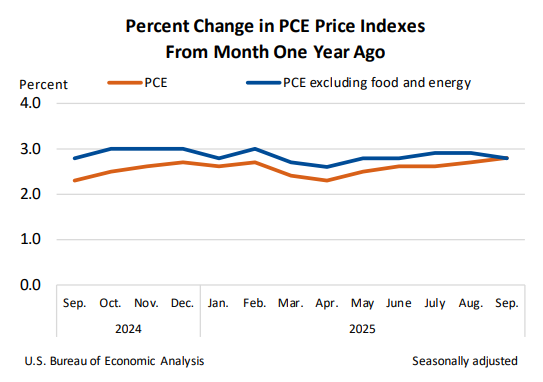
According to The Kobeissi Letter, the S&P 500 surges +0.5% as Core PCE inflation unexpectedly falls to 2.8%, now just 30 points away from a new record high.
The Letter noted: "The S&P 500 has now added +$3.3 TRILLION since the November 21st low. Those who ignored the noise are winning. **** et owners are winning."
Core PCE came in at 2.8% versus 2.9% expected, with the softer-than-expected reading fueling risk **** et gains as December Fed rate cut odds hold at 88.8%.
https://cryptonews.com/new...
According to The Kobeissi Letter, the S&P 500 surges +0.5% as Core PCE inflation unexpectedly falls to 2.8%, now just 30 points away from a new record high.
The Letter noted: "The S&P 500 has now added +$3.3 TRILLION since the November 21st low. Those who ignored the noise are winning. **** et owners are winning."
Core PCE came in at 2.8% versus 2.9% expected, with the softer-than-expected reading fueling risk **** et gains as December Fed rate cut odds hold at 88.8%.
https://cryptonews.com/new...
10 months ago
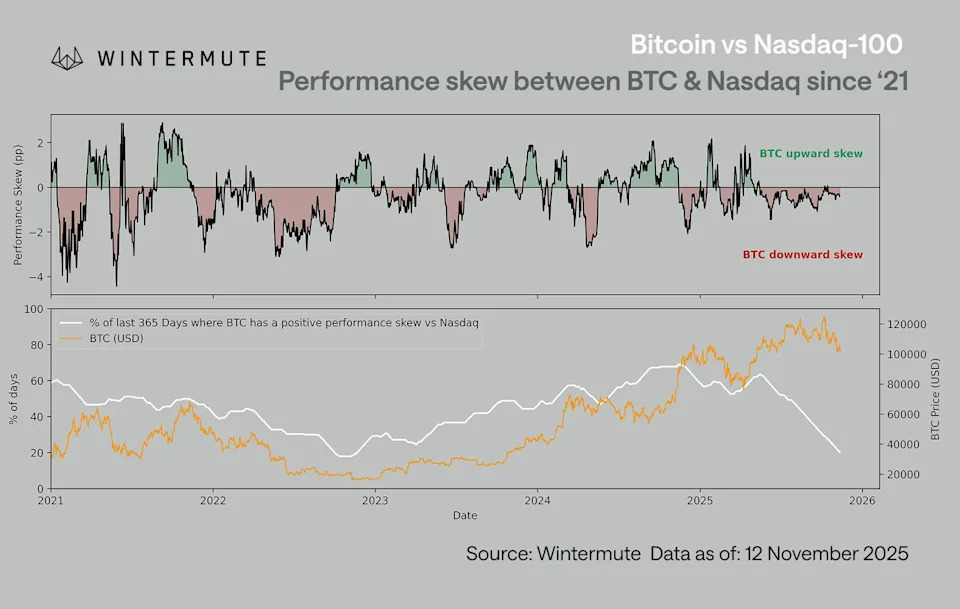
Bitcoin's 30-day correlation with the Nasdaq 100 Index has surged to its highest level in 3 years. Meanwhile, its link to traditional safe-haven **** ets, such as gold, has dropped to nearly zero.
This significant shift raises questions about Bitcoin's digital gold narrative as it now acts more like a high-beta technology **** et than a stable store of value.
In a recent post on X (formerly Twitter), The Kobeissi Letter highlighted that the cryptocurrency’s 30-day correlation with the Nasdaq 100 Index has reached roughly 0.80. This was the highest reading since 2022 and the second-strongest
This significant shift raises questions about Bitcoin's digital gold narrative as it now acts more like a high-beta technology **** et than a stable store of value.
In a recent post on X (formerly Twitter), The Kobeissi Letter highlighted that the cryptocurrency’s 30-day correlation with the Nasdaq 100 Index has reached roughly 0.80. This was the highest reading since 2022 and the second-strongest