
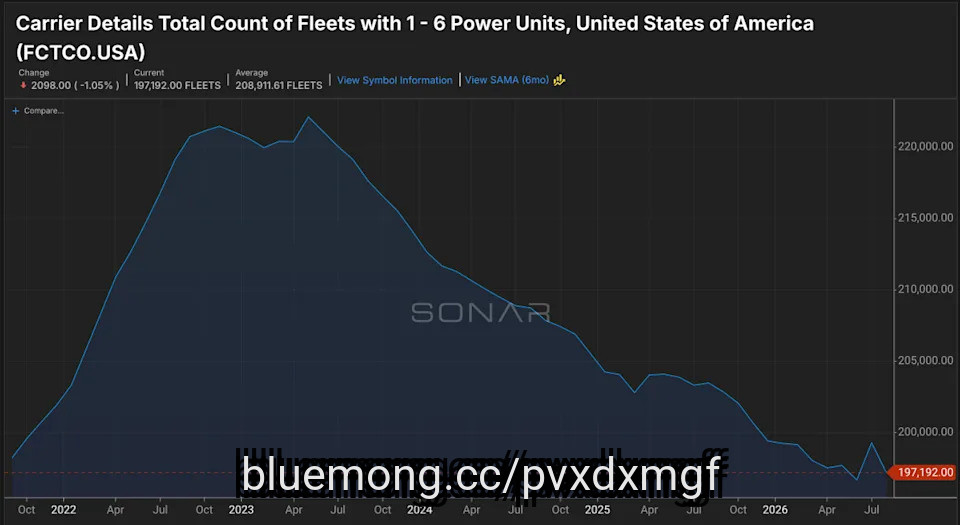
There is a question hanging over the small carrier world right now, and two of the most knowledgeable transportation attorneys in the country did not flinch from it when they sat down separately on The Long Haul. The question is whether the small carrier, the one-truck owner-operator and the five-truck fleet, still has a viable future as an independent business, or whether the forces set in motion by the Supreme Court's Montgomery decision are quietly pushing that operator toward extinction as an independent and into the arms of a larger carrier.
Neither attorney sugarcoated it. Brian Nelson, a partner at Taylor Nelson Slattery Bernard in St. Petersburg, Florida, who spent years as general counsel inside a broker, a motor carrier, and a 3PL under one roof, walked through the legal machinery now bearing down on carriers. Greg Feary, president and managing partner of Scopelitis, the firm the biggest fleets in the country call when things go wrong, went further and named the outcome he is already seeing. Together, their two conversations form the clearest picture available of where the small carrier stands, and it is a picture every independent operator needs to see.
Start with the ruling itself, because everything else flows from it. In Montgomery v. Caribe Transport, decided this May by a unanimous 9-0 Supreme Court, the justices answered a single question: do brokers have a duty to select carriers that operate safely over the roadways? The Court said yes. As Nelson explained, that put brokers back into what he called the firing squad, meaning they can no longer get a negligent selection lawsuit dismissed early on the grounds that federal law preempts it.
Before May 14, in most of the country, a broker sued after a crash could file a motion to dismiss and often walk out of the litigation quickly on preemption grounds. Nelson described the old routine: file the answer, file the motion to dismiss, argue there is no valid claim, and get out. That door is now closed. As Nelson put it, brokers can no longer rely on that early exit, which means they now have to go through discovery and potentially all the way to summary judgment. That longer, more expensive path is why insurance companies are raising rates, because they know they will have to pay defense costs deeper into every case.
Nelson was careful to note that causation still matters. A plaintiff still has to prove that the specific thing the broker was negligent about, say, selecting a carrier with poor vehicle maintenance, actually caused the crash. But he explained how plaintiffs get around that requirement using what is called the reptile theory. The argument runs that if a carrier is bad at one thing, hours of service, for instance, a jury will believe they must be bad at everything, including whatever actually caused the wreck. The practical consequence, Nelson said, is that a carrier can no longer afford to be excellent at four things and poor at one. In his words, you have to take a hol
Neither attorney sugarcoated it. Brian Nelson, a partner at Taylor Nelson Slattery Bernard in St. Petersburg, Florida, who spent years as general counsel inside a broker, a motor carrier, and a 3PL under one roof, walked through the legal machinery now bearing down on carriers. Greg Feary, president and managing partner of Scopelitis, the firm the biggest fleets in the country call when things go wrong, went further and named the outcome he is already seeing. Together, their two conversations form the clearest picture available of where the small carrier stands, and it is a picture every independent operator needs to see.
Start with the ruling itself, because everything else flows from it. In Montgomery v. Caribe Transport, decided this May by a unanimous 9-0 Supreme Court, the justices answered a single question: do brokers have a duty to select carriers that operate safely over the roadways? The Court said yes. As Nelson explained, that put brokers back into what he called the firing squad, meaning they can no longer get a negligent selection lawsuit dismissed early on the grounds that federal law preempts it.
Before May 14, in most of the country, a broker sued after a crash could file a motion to dismiss and often walk out of the litigation quickly on preemption grounds. Nelson described the old routine: file the answer, file the motion to dismiss, argue there is no valid claim, and get out. That door is now closed. As Nelson put it, brokers can no longer rely on that early exit, which means they now have to go through discovery and potentially all the way to summary judgment. That longer, more expensive path is why insurance companies are raising rates, because they know they will have to pay defense costs deeper into every case.
Nelson was careful to note that causation still matters. A plaintiff still has to prove that the specific thing the broker was negligent about, say, selecting a carrier with poor vehicle maintenance, actually caused the crash. But he explained how plaintiffs get around that requirement using what is called the reptile theory. The argument runs that if a carrier is bad at one thing, hours of service, for instance, a jury will believe they must be bad at everything, including whatever actually caused the wreck. The practical consequence, Nelson said, is that a carrier can no longer afford to be excellent at four things and poor at one. In his words, you have to take a hol

2 months ago