
Distressed investors are, by their nature, optimists. They must be, since they see bargains and opportunities where other investors fear to tread. True to form, recent conversations with a number of distressed players reveal a significant distressed opportunity set in the back half of 2026 in the face of a roaring US equity bull market and a vibrant US economy.
Beginning on a positive note, "the US economy is doing well and isn't likely to turn south in the next six to 12 months," says Jeremy Burton, managing director and portfolio manager at PineBridge Investments. Even the rise of oil prices isn't of great concern for Burton, as he believes that the hit to consumers from rising oil prices in one region of the country will be offset by a healthy oil-and-gas-based economy in another region. As a result, the opportunities are more sector-specific, he believes.
Concurring with Burton's relatively sunny view are Morgan Stanley strategists Vishwas Patka and Joyce Jiang, who, in a recent piece covering their mid-year outlook, said "capex growth and a resilient consumer support a stable macro environment with strong earnings, while attractive yields anchor robust [debt] demand." This bodes well for business growth and equity generally, the pair said.
That health is reflected in the numbers. PitchBook LCD reported on July 1 that the trailing 12-month default rate for the Morningstar LSTA US Leveraged Loan index was only 0.97% by dollar amount and 1.34% by issuer count. The default rate by count, including Liability Management Exercises (LMEs), was 2.77%.
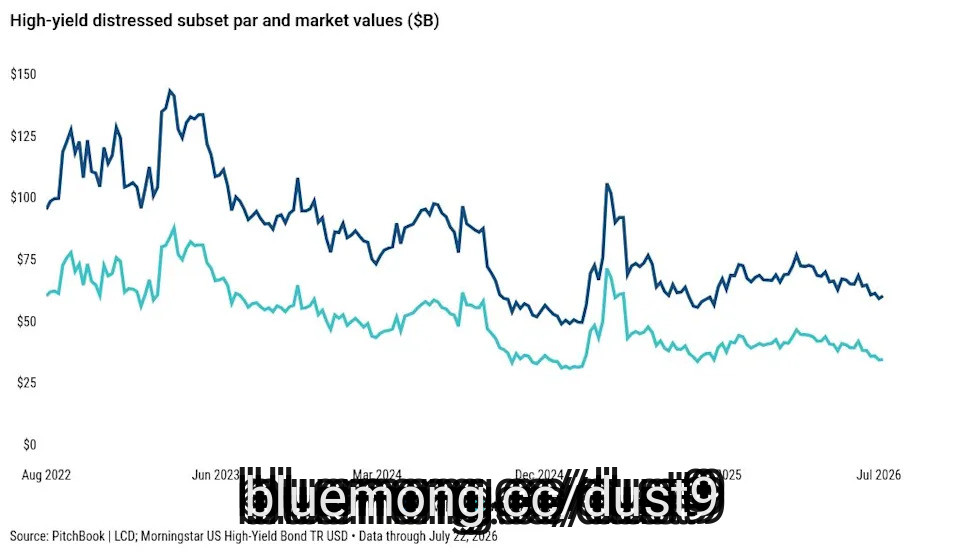
But danger in the leveraged loan index lurks. The index's distress ratio by amount (defined as the share of loans trading below 80 cents on the dollar) rose 34 bps in June, to 6.87%. In fact, the distress ratio has trended higher over the past nine months after plumbing a near-term low of 2.59% in September 2025. The peak for 2026 is 7.23% in March, which was the result of six consecutive monthly increases and marked the highest level since the distress ratio hit 7.36% in December 2022, in the midst of a series of US fed funds rate hikes by the FOMC. Roughly 45% of the debt trading under 80 is in software-related sectors.
#distressed #ratio #leveraged
Beginning on a positive note, "the US economy is doing well and isn't likely to turn south in the next six to 12 months," says Jeremy Burton, managing director and portfolio manager at PineBridge Investments. Even the rise of oil prices isn't of great concern for Burton, as he believes that the hit to consumers from rising oil prices in one region of the country will be offset by a healthy oil-and-gas-based economy in another region. As a result, the opportunities are more sector-specific, he believes.
Concurring with Burton's relatively sunny view are Morgan Stanley strategists Vishwas Patka and Joyce Jiang, who, in a recent piece covering their mid-year outlook, said "capex growth and a resilient consumer support a stable macro environment with strong earnings, while attractive yields anchor robust [debt] demand." This bodes well for business growth and equity generally, the pair said.
That health is reflected in the numbers. PitchBook LCD reported on July 1 that the trailing 12-month default rate for the Morningstar LSTA US Leveraged Loan index was only 0.97% by dollar amount and 1.34% by issuer count. The default rate by count, including Liability Management Exercises (LMEs), was 2.77%.
But danger in the leveraged loan index lurks. The index's distress ratio by amount (defined as the share of loans trading below 80 cents on the dollar) rose 34 bps in June, to 6.87%. In fact, the distress ratio has trended higher over the past nine months after plumbing a near-term low of 2.59% in September 2025. The peak for 2026 is 7.23% in March, which was the result of six consecutive monthly increases and marked the highest level since the distress ratio hit 7.36% in December 2022, in the midst of a series of US fed funds rate hikes by the FOMC. Roughly 45% of the debt trading under 80 is in software-related sectors.
#distressed #ratio #leveraged


2 months ago