
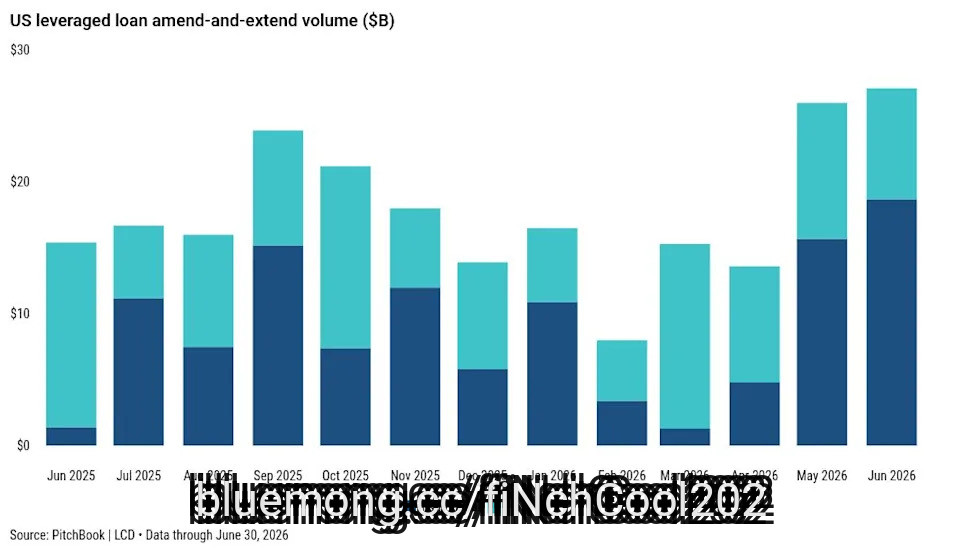
Amend-and-extend volume totaled $27 billion in June, up from $26 billion in May, according to LCD. June's amend-and-extend activity came courtesy of 24 transactions, up from 21 in May. The $106 billion of A&E volume this year is running well ahead of last year's pace (roughly $84 billion over the first half of 2025). Last year was the second busiest year for such activity on record, behind only 2024.
Part of what continues to make amend-and-extend transactions attractive to issuers is the cost calculus versus a full refinancing. The average yield to maturity for refinancing institutional term loans via syndication is 6.7% in 2026, down from 7.4% in 2025 and 8.6% in 2024, but still higher than all the years spanning 2011-2022. With refinancing costs sitting above pre-2023 norms, extending an existing credit remains the cheaper path for many borrowers than marking the entire loan to market at today's spreads.
"Borrowers are also trying to be proactive and bring their deals to market before a new event that triggers risk-off sentiment, such as the AI-related selloff from a few months ago," said a market participant.
The distribution between institutional and pro rata A&E volume has been fairly balanced this year, with pro rata at $52 billion and institutional activity at $54 billion. June featured $18 billion of institutional volume and $8 billion of pro rata volume. Institutional volume in Q2 was $39 billion, the strongest quarterly showing in the recent series.
Note that pro rata debt typically entails amortizing TLAs and/or revolving credit facilities and is traditionally syndicated to finance companies and banks. Institutional debt consists of term loans structured specifically for institutional investors, including CLOs.
Part of what continues to make amend-and-extend transactions attractive to issuers is the cost calculus versus a full refinancing. The average yield to maturity for refinancing institutional term loans via syndication is 6.7% in 2026, down from 7.4% in 2025 and 8.6% in 2024, but still higher than all the years spanning 2011-2022. With refinancing costs sitting above pre-2023 norms, extending an existing credit remains the cheaper path for many borrowers than marking the entire loan to market at today's spreads.
"Borrowers are also trying to be proactive and bring their deals to market before a new event that triggers risk-off sentiment, such as the AI-related selloff from a few months ago," said a market participant.
The distribution between institutional and pro rata A&E volume has been fairly balanced this year, with pro rata at $52 billion and institutional activity at $54 billion. June featured $18 billion of institutional volume and $8 billion of pro rata volume. Institutional volume in Q2 was $39 billion, the strongest quarterly showing in the recent series.
Note that pro rata debt typically entails amortizing TLAs and/or revolving credit facilities and is traditionally syndicated to finance companies and banks. Institutional debt consists of term loans structured specifically for institutional investors, including CLOs.


14 days ago