

2 months ago
WASHINGTON, Sept 3 (Reuters) - U.S. Commerce Secretary Howard Lutnick apologized on Thursday for stating that no Americans had died in the Iran war, acknowledging that 18 service members have been killed and he was thinking about Venezuela when he made the mistaken statement.
"I misspoke. Eighteen members of our military have died, and to those families my heart breaks and I am so very sorry for their loss. I was thinking about the Venezuelan military operation where no service members died," Lutnick said in a post on X.
Lutnick made the comments during an interview with CNBC on Wednesday in which Venezuela did not come up.
"I think the way the president is playing Iran... There haven't been American deaths. It's really just an economic choke-out, which the administration is now executing more broadly, and I think it'll be very effective," Lutnick told CNBC.
Moments before Lutnick's apology, Trump defended the commerce secretary on Truth Social.
#lutnick #venezuela

2 months ago
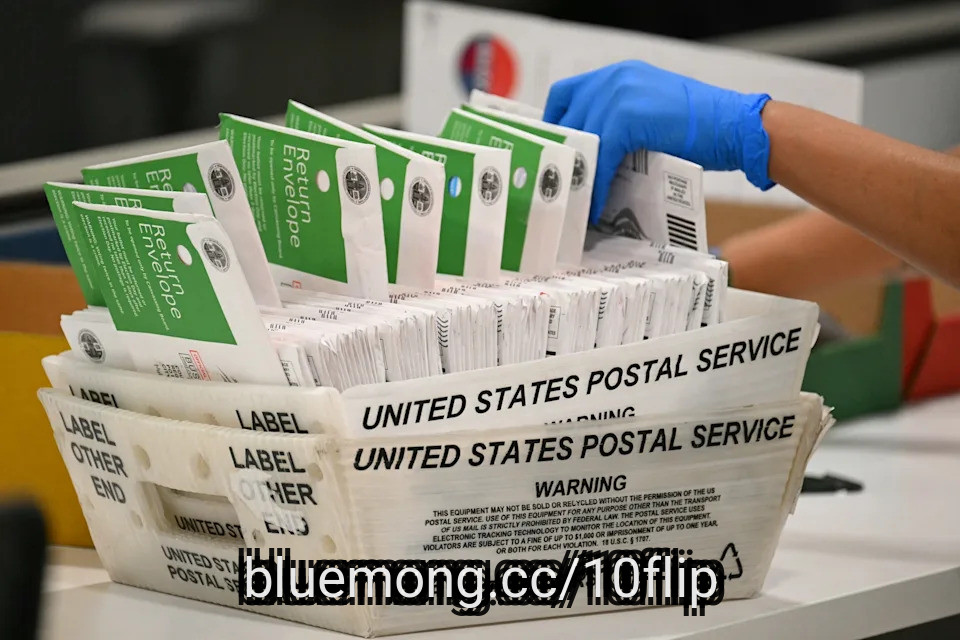
A federal judge who blocked the most controversial aspect of President Donald Trump's executive order aimed at restricting mail-in ballots -- namely, employing the Postal Service as the primary enforcer of mail-voter eligibility -- has now lifted that decision following the Supreme Court's ruling Monday that legal challenges are premature.
The move means there are no longer legal holds on any aspect of Trump's March 2026 mail-in ballot executive order and that the administration is free to move forward, for now, with its implementation without caveats.
Trump's executive order directs the Department of Homeland Security to build a federal citizenship list and give it to the states; the Department of Justice to target state officials who give ballots to noncitizens; and the USPS to direct states to abide by certain mail-ballot design and tracking requirements.
Patrick T. Fallon/AFP via Getty Images, FILE - PHOTO: An election worker processes mail-in ballots at the Los Angeles County Ballot Processing Center during California's state primary election in the City of Industry, Calif., on June 2, 2026.
Most critically, the order would require states to provide a list of registered eligible voters to USPS for verification and mandate that postal workers only deliver ballots to persons on the list.
#mail #ballot #department
3 months ago
DAKAR, Aug 14 (Reuters) - The Ebola outbreak in Democratic Republic of Congo has spread to a sixth province, Bas-Uele, located in the northeast of the country, the communications ministry said on Friday, officially confirming a case discovered earlier.
Health authorities have identified a person who has died from Ebola in the provincial capital Buta, an official from the National Institute for Biomedical Research told Reuters on Thursday.
Bas-Uele wasn't previously affected by the virus. The new case raised fears that people who have been in contact with the patient may have also been infected.
Delayed detection, conflict and strained health services have helped the virus spread more rapidly than in previous outbreaks.
The latest report, published on the ministry's X account, said that the number of confirmed Ebola cases in Congo has increased to 4,665, including 2,184 deaths.
#case


4 months ago
By Joe Brock
FARNBOROUGH, England, July 20 (Reuters) - Lockheed Martin announced a lower-cost Patriot interceptor on Monday as militaries seek cheaper ways to counter drones and missiles, while defense contractors face competition from startups making low-cost weapons that can be produced at scale.
Lockheed said its new PAC-3 Adapted Capability Effector, or ACE, missile would cost less than half as much as its PAC-3 MSE interceptors, which cost roughly $4 million per missile, according to U.S. Army budget documents.
Initial production could start within 36 months, the company said, adding that it plans to develop and manufacture the weapon with U.S. and European industry partners.
"American and allied warfighters need a solution that is battle-tested and budget-smart," Tim Cahill, president of Lockheed Martin Missiles and Fire Control, said in a statement at Britain's Farnborough Airshow.

4 months ago
Two weeks ago, the Supreme Court ruled that "an agreement not to appeal a sentence is unenforceable when it would result in a miscarriage of justice." This week, the Court held that a government-ordered **** ysis of cellphone location data qualifies as a "search" under the Fourth Amendment.
In both cases, Justice Neil Gorsuch agreed with the result but wrote separately to highlight deeper issues that the majority did not address: the Supreme Court's endorsement of coercive plea bargaining and its embrace of two dubious Fourth Amendment doctrines. Gorsuch's opinions, which criticize precedents that have undermined civil liberties, illustrate his talent for identifying wrong turns that his colleagues are not yet ready to acknowledge.
The first case involved Munson P. Hunter III, who was sentenced to four years in federal prison after pleading guilty to one count of aiding and abetting wire fraud. His sentence also included a requirement that he undergo psychiatric treatment after his release and "take all mental health medications" prescribed for him.
Hunter objected to the latter condition, saying it violated his "constitutionally protected liberty interest in avoiding the unwanted administration of antipsychotic drugs." But the U.S. Court of Appeals for the 5th Circuit said he was not allowed to raise that issue because he had given up his right to contest any aspect of his sentence, as federal defendants usually do when they plead guilty.
The Supreme Court disagreed, saying Hunter should be allowed to argue that forced medication qualifies as a "miscarriage of justice" because it is unconstitutional. Gorsuch concurred, noting that an appeal waiver can hardly be considered "knowing and voluntary" when the defendant does not yet know the details of his sentence.