

Since Toni Kroos's retirement, Real Madrid's attack seems largely like an orchestra without a conductor, unable to find someone to cohesively pull the strings on a pitch filled with talented footballers with distinct skillsets. The de facto leader of Madrid on the pitch in the later years of his career, Kroos attempted over 100 passes per 90 minutes in La Liga in his final season at Madrid, completing nearly 95% of his passes, and 82 pass attempts per 90 in the Champions League. By comparison, Madrid's leading passer from midfield last season was Aurélien Tchouaméni with only 65.5 pass attempts per 90 in La Liga and 55.7 per 90 in Champions. In fact, with Luka Modric's subsequent departure, it was two centre-backs (Antonio Rüdiger in La Liga and Dean Huijsen in the Champions League) that led Madrid in pass attempts per 90 for the first time in nearly a decade.
Two of the criticisms of Madrid post-Kroos/Modric is that the deeper players like Rüdiger and Fede Valverde don't: i) circulate the ball quickly enough or ii) provide sufficient incisive passes to the forward line. We ****** yzed both points to see the validity of these concerns as it relates to Madrid's midfield.
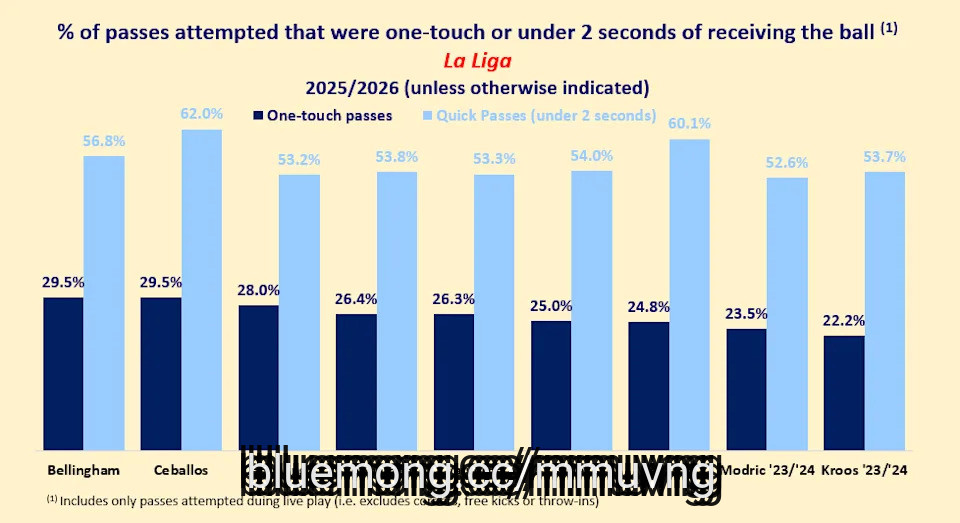
Let's first tackle quick ball circulation. Kroos's final season at Madrid saw him attempt 22.2% of his passes one-touch (fourth percentile amongst midfielders in the top five leagues) and 53.7% within two seconds of receiving the ball (eighth percentile amongst midfielders in the top five leagues) in league play while Modric that same season saw 23.5% of his passes come via first touch (10th percentile) and 52.6% under two seconds (seventh percentile). By comparison, Aurelien Tchouaméni and Valverde last season distributed 26.4% and 26.3% of their passes, respectively in La Liga one-time (higher percentages than Kroos and Modric in 2023/2024) with nearly the identical percentage of quick passes (passes within two seconds of receiving the ball) as the German legend and Croatian maestro had in 2023/2024 (Tchouaméni: 53.8%; Kroos: 53.7%; Valverde: 53.3%; Modric: 52.6%).
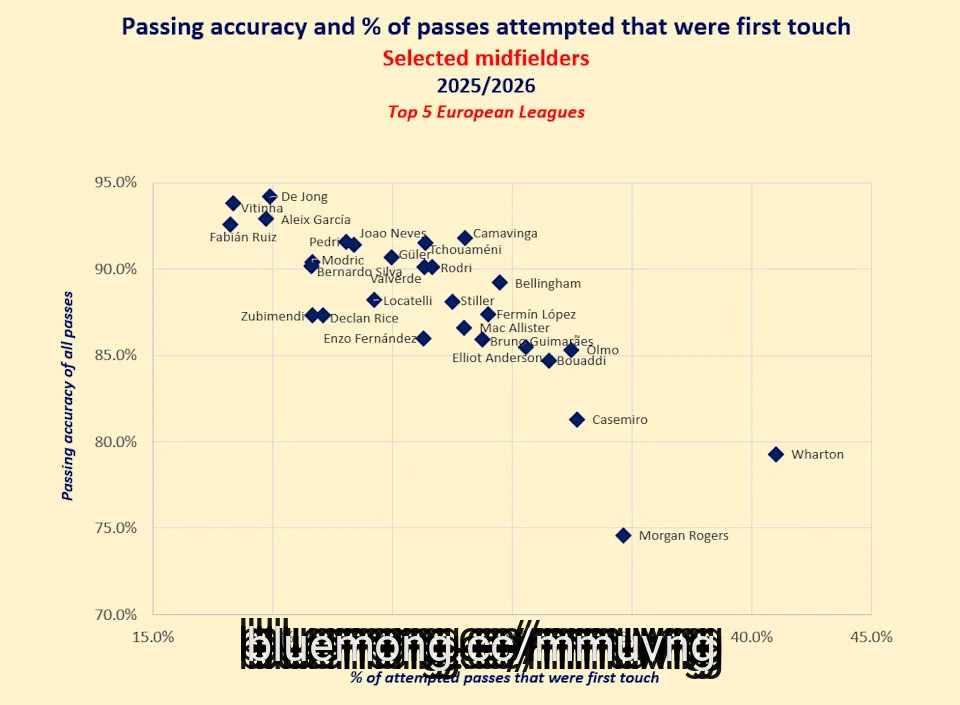
It is a popular misconception that being a tempo controller often requires playing the ball quickly and having a significant percentage of one-two touch passes. Kroos was not a great tempo controller because he often passed the ball first touch. As the chart above demonstrates, Kroos actually circulated the ball slower his final season than many of Madrid's midfielders last season. The best tempo controllers know when to play first-time, when to hold on to the ball for several seconds, when to progress the ball and when to value retaining possession, understanding that the scoreline, moment in the match, and positioning of players on the pitch dictate when to move the ball quickly and when to slow the play down. Vitinha, considered by many to be the best deep-lying playmaker in the game today, distributed less than our out of every five attempted passes (18.3%) during live play last season in Ligue 1 from a first
Two of the criticisms of Madrid post-Kroos/Modric is that the deeper players like Rüdiger and Fede Valverde don't: i) circulate the ball quickly enough or ii) provide sufficient incisive passes to the forward line. We ****** yzed both points to see the validity of these concerns as it relates to Madrid's midfield.
Let's first tackle quick ball circulation. Kroos's final season at Madrid saw him attempt 22.2% of his passes one-touch (fourth percentile amongst midfielders in the top five leagues) and 53.7% within two seconds of receiving the ball (eighth percentile amongst midfielders in the top five leagues) in league play while Modric that same season saw 23.5% of his passes come via first touch (10th percentile) and 52.6% under two seconds (seventh percentile). By comparison, Aurelien Tchouaméni and Valverde last season distributed 26.4% and 26.3% of their passes, respectively in La Liga one-time (higher percentages than Kroos and Modric in 2023/2024) with nearly the identical percentage of quick passes (passes within two seconds of receiving the ball) as the German legend and Croatian maestro had in 2023/2024 (Tchouaméni: 53.8%; Kroos: 53.7%; Valverde: 53.3%; Modric: 52.6%).
It is a popular misconception that being a tempo controller often requires playing the ball quickly and having a significant percentage of one-two touch passes. Kroos was not a great tempo controller because he often passed the ball first touch. As the chart above demonstrates, Kroos actually circulated the ball slower his final season than many of Madrid's midfielders last season. The best tempo controllers know when to play first-time, when to hold on to the ball for several seconds, when to progress the ball and when to value retaining possession, understanding that the scoreline, moment in the match, and positioning of players on the pitch dictate when to move the ball quickly and when to slow the play down. Vitinha, considered by many to be the best deep-lying playmaker in the game today, distributed less than our out of every five attempted passes (18.3%) during live play last season in Ligue 1 from a first

2 months ago



