

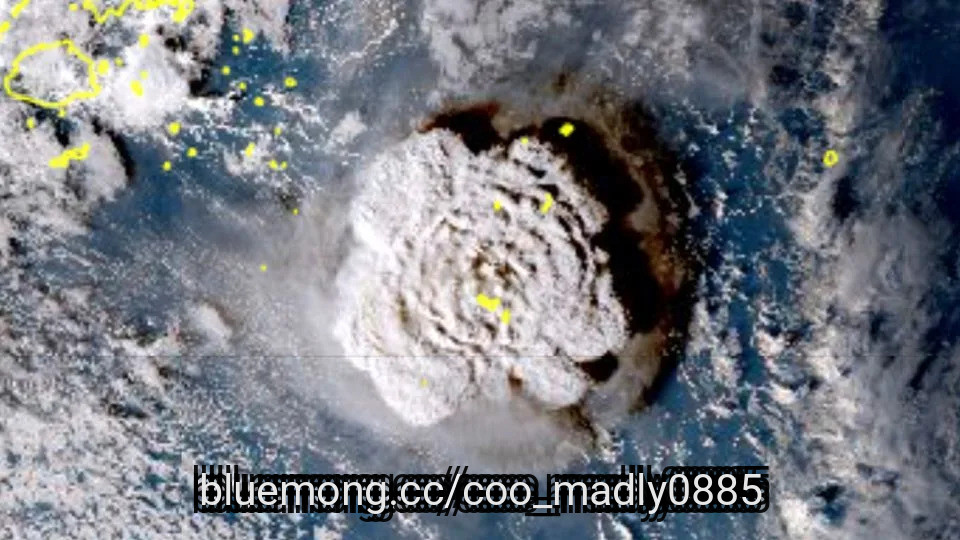
When an underwater volcano erupted in the South Pacific in January 2022, it sent a plume of ash, steam and gas nearly 40 miles above the Earth’s surface. It was one of the most violent volcanic eruptions of modern times. It may also have also revealed a new weapon in the fight against a potent planet-heating gas, according to new research.
The Hunga Tonga-Hunga Ha’apai volcano erupted with a power hundreds of times stronger than the Hiroshima nuclear explosion, setting off a tsunami and a sonic boom that went around the planet twice. It then did something “unexpected,” according to the authors of the new study published Thursday in the journal Nature Communications. It started cleaning up some of its own pollution.
The scientists’ discovery came from looking at advanced satellite data of the eruption. “We found a huge cloud of formaldehyde that should normally not be there,” said Maarten van Herpen, a study author, and a physicist and executive director at Acacia Impact Innovation, a Dutch consultancy. Formaldehyde often forms when methane, a potent planet-heating gas, is destroyed in the atmosphere.
The researchers believed they were observing a chemical process that had previously been identified over the Atlantic Ocean.
Scientists had found that when Saharan dust is blown over the Atlantic, it mixes with salt spray and forms small iron-based particles. As the sunlight hits them, it produces chlorine atoms, which react with methane in the atmosphere and help break it down.
The Hunga Tonga-Hunga Ha’apai volcano erupted with a power hundreds of times stronger than the Hiroshima nuclear explosion, setting off a tsunami and a sonic boom that went around the planet twice. It then did something “unexpected,” according to the authors of the new study published Thursday in the journal Nature Communications. It started cleaning up some of its own pollution.
The scientists’ discovery came from looking at advanced satellite data of the eruption. “We found a huge cloud of formaldehyde that should normally not be there,” said Maarten van Herpen, a study author, and a physicist and executive director at Acacia Impact Innovation, a Dutch consultancy. Formaldehyde often forms when methane, a potent planet-heating gas, is destroyed in the atmosphere.
The researchers believed they were observing a chemical process that had previously been identified over the Atlantic Ocean.
Scientists had found that when Saharan dust is blown over the Atlantic, it mixes with salt spray and forms small iron-based particles. As the sunlight hits them, it produces chlorine atoms, which react with methane in the atmosphere and help break it down.
5 months ago